

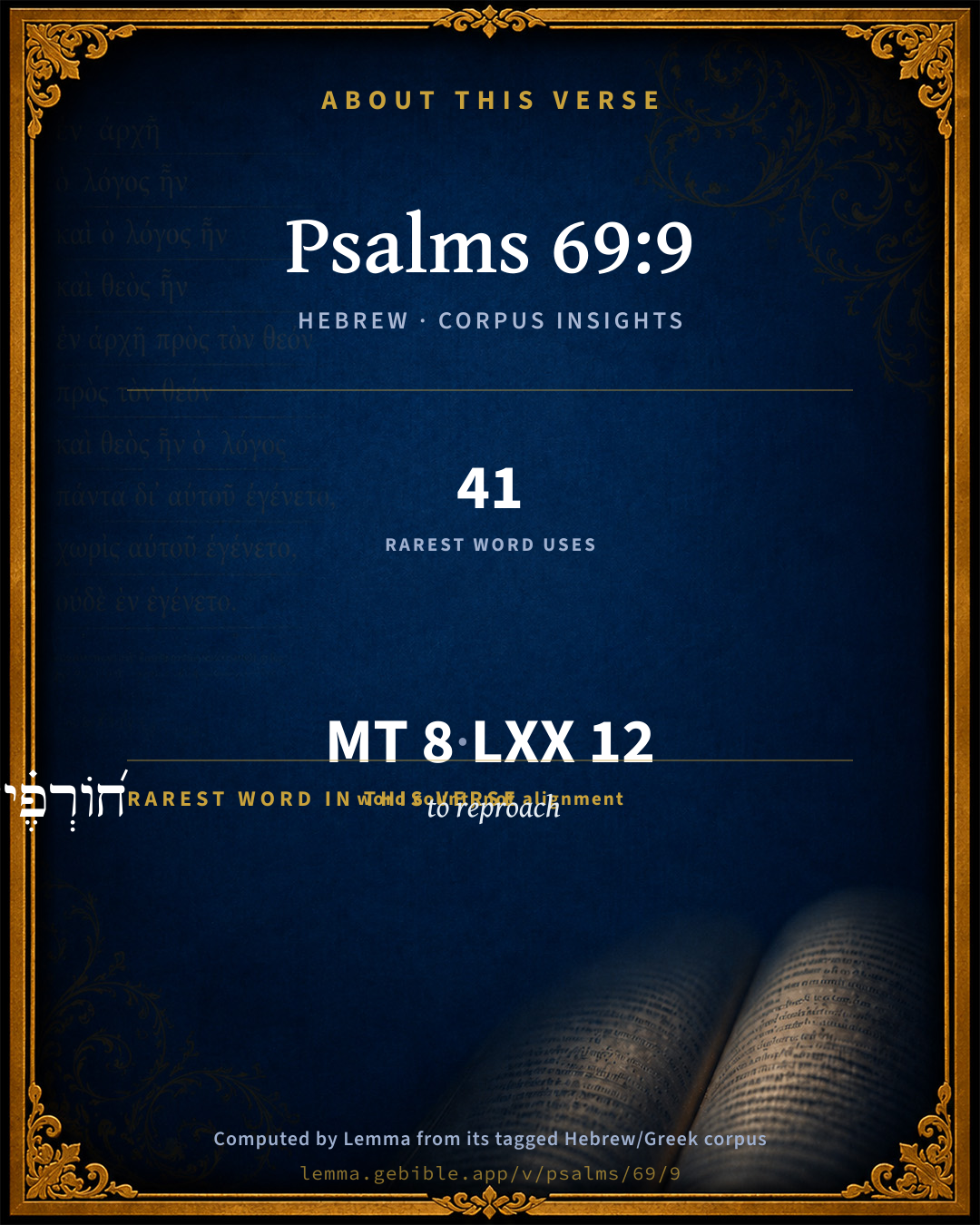
Psalms 69:9

Hebrew (Westminster Leningrad Codex) Psalms 69:9 appears in the Hebrew Old Testament. The text above is from the Westminster Leningrad Codex. Each word links to its Strong’s number, a concise gloss, and parsing drawn from the Open Scriptures Hebrew Bible morphology. Click any word for its full Brown-Driver-Briggs (BDB) entry.
Download image
Cite this verse

Psalms 69:9 (World English Bible). Public Domain. Lemma interlinear Bible study tool, https://lemma.gebible.app/v/psalms/69/9.

Show BibTeX & RIS
BibTeX
RIS
English Translation
For the zeal of your house consumes me. The reproaches of those who reproach you have fallen on me.
World English Bible · Public Domain
Download a study sheet

One document with this verse’s original text, its word-by-word gloss line, the meaning frame, cross-references with their text, attributed commentary, and full source and license credits — printable, and it pastes into notes with its structure intact.

This verse Autodidact and up

Study sheet (.html) Plain text (.txt)

A passage Seminary Student

Up to 50 verses in one chapter. A passage sheet keeps up to 6 commentary sources and 12 cross-references per verse, in the order this page ranks them, and says so on the sheet whenever that leaves anything out. Ask for a single verse and you get the Autodidact verse sheet above.

Everything on this page stays free to read, with no account — the sheet is a download of what is already on screen, not access to it.

Want to remove ads? Support Godless Engineer
Compare translations 3

The same verse in 3 English versions, stacked beneath the original-language interlinear above. Click any original word for its lexicon entry.

Each is an independent rendering of the whole verse — the interlinear is not word-aligned to these translations.

Highlighted words mark where these versions differ — a whole-verse word diff, not a word-by-word alignment.

  • World English Bible Public Domain
    For the zeal of your house consumes me. The reproaches of those who reproach you have fallen on me.
  • King James Version Public Domain
    For the zeal of thine house hath eaten me up; and the reproaches of them that reproached thee are fallen upon me.
  • unfoldingWord Literal Text CC BY-SA 4.0
    For zeal for your house has consumed me, and the reproaches of the ones reproaching you have fallen on me.

unfoldingWord Literal Text — © unfoldingWord, licensed CC BY-SA 4.0. Word-aligned USFM3 via Door43 (git.door43.org/unfoldingWord/en_ult).

Versions to compare (up to 4)

3 of 4 selected

Show all 18 translations

Every available English version of this verse, each an independent rendering of the whole verse.

  • World English Bible Public Domain
    For the zeal of your house consumes me. The reproaches of those who reproach you have fallen on me.
  • Berean Standard Bible Public Domain
    because zeal for Your house has consumed me, and the insults of those who insult You have fallen on me.
  • Majority Standard Bible Public Domain
    because zeal for Your house has consumed me, and the insults of those who insult You have fallen on me.
  • King James Version Public Domain
    For the zeal of thine house hath eaten me up; and the reproaches of them that reproached thee are fallen upon me.
  • American Standard Version (1901) Public Domain
    For the zeal of thy house hath eaten me up; And the reproaches of them that reproach thee are fallen upon me.
  • Revised Version (1885) Public Domain
    For the zeal of thine house hath eaten me up; and the reproaches of them that reproach thee are fallen upon me.
  • Geneva Bible (1599) Public Domain
    For the zeale of thine house hath eaten mee, and the rebukes of them that rebuked thee, are fallen vpon me.
  • Douay-Rheims (1899) Public Domain
    I am become a stranger to my brethren, and an alien to the sons of my mother.
  • Young's Literal Translation Public Domain
    For zeal for Thy house hath consumed me, And the reproaches of Thy reproachers Have fallen upon me.
  • Literal Standard Version CC BY-SA 4.0
    For [my] zeal for Your house has consumed me, || And the reproaches of Your reproachers || Have fallen on me.
  • Unlocked Literal Bible CC BY-SA 4.0
    For the zeal of your house has eaten me up, and the rebukes of those who rebuke you have fallen on me.
  • unfoldingWord Literal Text CC BY-SA 4.0
    For zeal for your house has consumed me, and the reproaches of the ones reproaching you have fallen on me.
  • Darby Bible Public Domain
    For the zeal of thy house hath devoured me, and the reproaches of them that reproach thee have fallen upon me.
  • World Messianic Bible Public Domain
    For the zeal of your house consumes me. The reproaches of those who reproach you have fallen on me.
  • Webster's Bible Public Domain
    \\69:8\\I am become a stranger to my brethren, and an alien to my mother's children.
  • Free Bible Version CC BY-SA 4.0
    My devotion for your house is burning me up inside; the insults of those who insulted you have fallen on me.
  • Bible in Basic English Public Domain
    I am on fire with passion for your house; and the hard things which are said about you have come on me.
  • JPS Tanakh (1917) Public Domain
    (69-10) Because zeal for Thy house hath eaten me up, and the reproaches of them that reproach Thee are fallen upon me.

Literal Standard Version (2020), Covenant Press — licensed CC BY-SA 4.0. Text via the HelloAO Bible API (eBible.org). Unlocked Literal Bible (unfoldingWord) — licensed CC BY-SA 4.0. Text via the HelloAO Bible API (eBible.org). unfoldingWord Literal Text — © unfoldingWord, licensed CC BY-SA 4.0. Word-aligned USFM3 via Door43 (git.door43.org/unfoldingWord/en_ult). Free Bible Version, Dr. Jonathan Gallagher — licensed CC BY-SA 4.0. Text via the HelloAO Bible API (eBible.org).

Word by word

More ways to search: Search by grammar → Find every occurrence → Compare this word →

Practice this passage: Drill this verse → Learn its vocabulary →

ח֝וֹרְפֶ֗יךָ
châraph
H2778
“reproaching · you”
Verb, Qal, Participle Active, Masculine, Plural, Construct + Suffix, Personal, 2nd Person, Masculine, Singular
Part of Speech
Verb
Stem
Qal
Form
Participle Active
Gender
Masculine
Number
Plural
State
Construct
Full BDB Definition

Origin: a primitive root

TWOT: 749 , 750 , 751

to reproach, taunt, blaspheme, defy, jeopardise, rail, upbraid - (Qal) to reproach - (Piel) to reproach, defy, taunt - (Qal) to winter, spend harvest time, remain in harvest time - (Niphal) to acquire, be betrothed
  1. כִּֽי kîy H3588 “that” Conjunction
  2. קִנְאַ֣ת qinʼâh H7068 “jealousy of” Noun, Common, Feminine, Singular, Construct
  3. בֵּיתְךָ֣ bayith H1004 “house · your” Noun, Common, Masculine, Singular, Construct + Suffix, Personal, 2nd Person, Masculine, Singular
  4. אֲכָלָ֑תְנִי ʼâkal H398 “to eat · me” Verb, Qal, Perfect, 3rd Person, Feminine, Singular + Suffix, Personal, 1st Person, Common, Singular
  5. וְחֶרְפּ֥וֹת cherpâh H2781 “and · reproaches of” Conjunction + Noun, Common, Feminine, Plural, Construct
  6. נָפְל֥וּ nâphal H5307 “to fall” Verb, Qal, Perfect, 3rd Person, Common, Plural
  7. עָלָֽי ʻal H5921 “upon · me” Preposition + Suffix, Personal, 1st Person, Common, Singular

About this verse

These counts appear in no published source. They are computed here, from the morphology-tagged text and Lemma’s own curated glosses. What Lemma adds →

8
words
8
distinct lemmas
Wisdom
section

Shared distinctive vocabulary

ח֝וֹרְפֶ֗יךָ to reproach H2778 occurs in 40 verses of the Hebrew Bible. Also found in:

Grammatical profile

  • 3 verbs
  • 3 nouns
  • 1 preposition
  • 1 conjunction

Verb forms

  • אֲכָלָ֑תְנִי Qal · Perfect
  • ח֝וֹרְפֶ֗יךָ Qal · Participle Active
  • נָפְל֥וּ Qal · Perfect

Hebrew & Septuagint length

In English translation the verse runs 19 words from the Hebrew and 22 from the Septuagint (LXX English) — closely comparable.

A rough comparison of the two English renderings, which tokenize alike — not a word-level alignment.

Word counts can differ between the Hebrew and the Greek without any difference in meaning — e.g. the Hebrew direct-object marker אֵת has no separate Greek word, and Greek often adds the article ὁ.

In the original languages it is 8 Hebrew tokens and 12 Greek tokens — but the two are counted differently (Hebrew bundles its prefixes and suffixes into one token; the Greek is in lemma form), so that isn’t a like-for-like length.

Cross-references

9

Topical passages linked to Psalms 69:9 in the Treasury of Scripture Knowledge — connected by theme and wording, ordered by reader-vote popularity; previews shown in the World English Bible.

  • Romans 15:3 For even Christ didn't please himself. But, as it is written, "The reproaches of those who reproached you fell on me."
  • John 2:14–17 He found in the temple those who sold oxen, sheep, and doves, and the changers of money sitting.
  • Psalms 119:139 My zeal wears me out, Because my enemies ignore your words.
  • Mark 11:15–17 They came to Jerusalem, and Jesus entered into the temple, and began to throw out those who sold and those who bought in the temple, and overthrew the tables of the money-changers, and the seats of those who sold the doves.
  • 1 Kings 19:10 He said, I have been very jealous for Yahweh, the God of hosts; for the children of Israel have forsaken your covenant, thrown down your altars, and slain your prophets with the sword: and I, even I only, am left; and they seek my life, to take it away.
  • Psalms 89:41 All who pass by the way rob him. He has become a reproach to his neighbors.
  • Psalms 89:50–51 Remember, Lord, the reproach of your servants, How I bear in my heart the taunts of all the mighty peoples,
  • 1 Chronicles 29:3 In addition, because I have set my affection on the house of my God, seeing that I have a treasure of my own of gold and silver, I give it to the house of my God, over and above all that I have prepared for the holy house,
  • 1 Chronicles 15:27–29 David was clothed with a robe of fine linen, and all the Levites who bore the ark, and the singers, and Chenaniah the master of the song [with] the singers: and David had on him an ephod of linen.

Cross-references courtesy of OpenBible.info (CC BY 4.0).

Hebrew and Greek witnesses Masoretic Hebrew ↔ Greek Septuagint

The same verse in the two great witnesses to the Old Testament, shown verse-for-verse.

You’re reading Greek Psalm 68 (Hebrew Psalm 69). The Septuagint counts the superscription, so verse numbers can differ from the Hebrew — chapter-level alignment, not verse-by-verse. Numbering follows Rahlfs.

These are two independent witnesses, not word-aligned to each other, and the Septuagint is shown in lemma (dictionary) form.

Hebrew Psalms 69:9 Masoretic · Westminster Leningrad Codex

כִּֽי קִנְאַ֣ת בֵּיתְךָ֣ אֲכָלָ֑תְנִי וְחֶרְפּ֥וֹת ח֝וֹרְפֶ֗יךָ נָפְל֥וּ עָלָֽי

For the zeal of your house consumes me. The reproaches of those who reproach you have fallen on me.

World English Bible · Public Domain

Greek LXX Greek Psalm 68:9 Septuagint · lemma form

ἀποἀλλοτριόω γίγνομαι ὁ ἀδελφός ἐγώ καί ξένος ὁ υἱός ὁ μήτηρ ἐγώ

For the zeal of your house has eaten me up; and the reproaches of them that reproached you are fallen upon me.

LXX2012 (modern English Septuagint) · Public Domain

On this verse, The Cambridge Bible for Schools and Colleges discusses the Septuagint’s reading. Read the note in Commentary ↓

Hebrew: Westminster Leningrad Codex (CC BY 4.0). Greek: Septuagint (public domain); English from LXX2012 (modern English Septuagint) (Public Domain). How the Septuagint differs from the Hebrew →

Commentary

Notes on Psalms 69:9 from classic Christian and Jewish commentators (each source and its license shown beneath its notes). The classic Christian expositions comment on the surrounding passage and are grouped to its opening verse, so a note may address several verses; the Jewish commentaries on the Tanakh (Rashi and others) are per-verse, so they appear only where the commentator wrote on this verse.

Lemma curates 59 commentaries, every one of them public domain or Creative Commons licensed, each selected and text-cleaned for this edition rather than reprinted as found. About our sources →

Trapp's Complete Commentary

John Trapp

Psa 69:9 For the zeal of thine house hath eaten me up; and the reproaches of them that reproached thee are fallen upon me.

Ver. 9. For the zeal of thine house hath eaten me up] Non amat qui non zelat. David’s love to God (much less the Lord Christ’s) would not suffer him to bear with God’s dishonour and the contempt of his ordinances. And this was it that procured him so much ill-will, and such a general alienation from nearest friends and allies.

And the reproaches of them that reproached thee] Wicked men soon set their mouths against heaven, and fall foul upon God himself. This David (and the Son of David) could not endure, nec aliter amare didicit, as Basil once answered those that blamed him for appearing so far for his friend, to his own great danger (Chrysost. lib. 2, de Sacerdot.).

John Trapp, A Commentary or Exposition upon All the Books of the Old and New Testament (1647–1656) — public domain. Text from a community e-Sword module.

The Biblical Illustrator

Joseph S. Exell

Psa_69:9

For the zeal of Thine house hath eaten me up, and the reproaches of them that reproached Thee are fallen upon me.

A suffering Saviour

Nearly all the prophecies of Scripture admit of and require a threefold interpretation.

1. They tell of some event or experience in the life Of the writer.

2. Then of like experience in the people of God.

3. And chiefly of what in yet higher degree our Lord Himself should suffer or accomplish. And these remarks apply to this prophecy. Twice in the New Testament it is applied to our Lord, and we may take the words as those of the Lord Himself. Now, it is good for us oftentimes to stand by our Saviours cross and to contemplate His sufferings. And this is what the text leads us to do. For it shows us--

I. The motive by which He was sustained. The zeal of Thine house, etc. We must not limit these words to His expulsion of the traders from the temple at Jerusalem, but they tell of the spirit which ever animated Him. And Gods house does not mean merely a building such as the temple, but the world at large, the race of mankind whom Christ came to save. His zeal, therefore, means that consuming desire to preserve and save them. For this He became incarnate, and lived, suffered and died. His zeal devoured Him, wore away His vigour so that His visage was marred more, etc. Hence, also, He became a stranger to His brethren and an alien, etc.

II. The sufferings themselves. The reproaches of them that, etc. We must not limit our idea of these sufferings to that which was outward, such as is represented in the well-known picture, Ecce Homo. But it was the soul of our Lord that suffered, Could not but suffer. For He was that holy one, and to such the ever present sight of sin, the infinite dishonour done to God, and the ruin wrought upon men, could not but have been far more terrible than any outward pain. Hence He was consumed with desire to vindicate the honour of God and to save men. (H. Melvill, B. D.)

Service here and hereafter

(with Rev_7:15):--These passages of Gods Word, significant in the several truths they contain when standing apart, but still more significant in their contrast when placed side by side, express and interpret the two most prominent phases of the highest form of Christian life and activity. It is not every servant of God who could use them with propriety, but only that man who has not only lived but died for the Master, whose spirits have been burdened, and whose life has been cut off prematurely by unwonted zeal and unvarying labours for the Saviour. The service which has been in the midst of much imperfection and weariness, death may and must end; but the service which shall be without imperfection and without change, it may not and cannot touch. The words, used in such a light, are eloquent with the simplicity of truth, and full of the hope of immortality.

I. First, look at the deep underlying agreement amid the differences these words suggest. Both speak of service, yes, and of zealous service, and both speak of service for God.

1. There is a consecration unto God amid the sin and the impurity of earth, even as there is a consecration amid the holiness and beatific blessedness of heaven. It may seem to the angels of God, looking down in wonder, a toil amid darkness, as in some murky mine, in which men grope while there is daylight above; none the less does it yield precious jewels and gold and silver to the crown of the Messiah and to the kingdom of God. And He, the Lord of all, counts it as His work. He has put especial honour upon it. He has taken upon Himself this service of toil, when He became a Man of Sorrows, knowing what weariness was in the midst of labour. And it was when the disciples saw His zeal for God, they remembered it was written, The zeal of Thine house hath eaten me up.

2. But again, our text carries us on to glance at the occupation of heaven. That also is a service, and a ceaseless service. Not rest, as some would interpret that word, but work--the work which is rest, the balanced activity which brings its own enjoyment and blessedness. To live, more life and fuller, that is what we want. Heaven would be no heaven unless it gave room to develop, to expand like flowers in the sunshine, in one word, to live. We have had enough of lethargy, enough of sloth, of unused powers in this world; we long to do something in the next. And that conception of heaven is highest which sees it a sphere of loyal service unto God, a realm of ceaseless activities, where they labour amid their rest, and rest in their labours, and find His presence to be, in all, an infinite and everlasting joy.

II. Consider the contrast suggested in the text. The second phrase found here is taken from that gathering around the throne of the Lamb which included the sealed of the twelve tribes of Israel, and a great multitude out of every nation and kindred, and peoples, and tongues. Davids tribe was there, for twelve thousand were sealed of the tribe of Judah, and doubtless David was there. The man who had said, The zeal of Thine house hath eaten me up, who had borne reproach for God until it had eaten, like a canker, into his very soul, stands with that multitude before the throne, serving day and night. Wondrous change! It is the same service, yet how different in all its results. The idea is that it is not merely the persecutions and dangers of Christian life which tire out these faithful ones; the very enthusiasm and zeal for Christs service may do this. We have the treasure, says Paul, in earthen vessels, and the heavenly often wears out the earthly. There are not only martyrs for Christ, whose bones bleach upon a foreign shore, unsuccessful and unknown, but yonder in the great city you may find those whose ministry, it may be, has been crowned abundantly, and yet who can say with equal truthfulness, The zeal of Thine house hath eaten me up. But to all these comes the same consolation of the future. Heaven stands out to give meaning to earth. The Christian who has realized this twofold aspect of Christian service has climbed to some Pisgah height from which he can see both past and future. It is said that when Cortez led his sailors across the vast continent of South America, after months of toil and sickness, they climbed one of the peaks of the Andes, and saw out there in the distance, far away, the glimmering of the sea. And the men wept for joy at the sight. It was their own native element, the love of their life, their home. Toil there was a pleasure in comparison with this journeying through endless forests and wildernesses, and they wept for joy. So it is with Gods children when they catch sight of that sea of glass mingled with fire, which is before the throne. There is the desire of their hearts, the hope of their life, their treasure and their home. There is the shout of triumph and the song of victory, the rest that shall never end and the service which cannot weary. But, again, we have a further contrast here. In the former text you have the idea of conflict, the evidence of that struggle which is ever going on in the heart of man; the spirit against the flesh, the flesh against the spirit, the soul cramped and hindered in its progress, as in some prison-house struggling to be free, the body worn out and enfeebled by the restless energy of that which is within. It is a state of intense unrest in which that which is best in the man, his zeal for God, is the disturbing element. And against this, in strong contrast, the text places the calm and composure, the serenity of heaven and heavenly service. On the one hand, it is a sea torn and tossed by every wind and wave, boiling and seething as from some internal convulsion; on the other, it is an ocean quiet and peaceful, in whose every movement there is majesty and grandeur. Or, to change the imagery, here it is a morbid spasmodic activity, a life producing death by its very violence, like some untimely plant which springs up too soon and fast, and is withered ere strength and beauty can be developed; yonder it is a maturity which knows neither change nor decay, but is ever green and fair as the seasons roll round, return, and come again. Here the day of labour needs the night of rest, and even then there is left perchance a weariness which slumber may not remove. In heaven they serve Him day and night in His temple without rest. Lastly, I but emphasize one thought, and that by way of making a practical use of all this. It is the important thought which stands connected with the continuity of the Divine life. For the service here, we must never forget, is the beginning of the service which is yonder. They are essentially one and indivisible, and this is necessary to that. Life is the apprenticeship, the school for heaven, necessary not so much, indeed, in this aspect for the work which is done, and the service which is rendered, as that we may learn how to work and how to serve. (W. Baxendale.)

Unquenchable zeal for Christian work

When Stanley found Livingstone in the heart of Africa, he begged the old hero to go home. There seemed to be every reason why he should go back to England. His wife was dead, his children lived in England, the weight of years was pressing upon him, the shortest march wearied him, he was often compelled to halt many days to recover strength after his frequent attacks of prostrating illness. Moreover, he was destitute of men and means to enable him to make practical progress. But, like Paul, none of these things moved him; nor counted he his life dear to himself. No, no, he said to Stanley; to be knighted, as you say, by the Queen, welcomed by thousands of admirers, yes--but impossible. It must not, cannot, will not be. I must finish my task.

The Biblical Illustrator, edited by Joseph S. Exell (c. 1880s–1900s) — public domain. Text from a community e-Sword module.

Tyndale Open Study Notes

Tyndale Open Resources

69:9 Though the psalmist concerns himself with God and all that is holy, insults have been his earthly reward. This verse was later applied to Jesus’ anger at the Temple’s money changers (John 2:17) and to his undeserved suffering (Rom 15:3).

Tyndale Open Study Notes — © Tyndale Open Resources, licensed CC BY-SA 4.0. Text via the HelloAO Bible API.

Geneva Bible (1599)

Geneva Bible translators

When I saw thine enemies pretend thy Name only in mouth, and in their life deny the same, thine holy Spirit, thrust me forward, to reprove them and defend thy glory.

Geneva Bible (1599) marginal notes — public domain. Text via Bolls.life.

Adam Clarke's Commentary

Verse 9. The zeal of thine house hath eaten me up] The strong desire to promote thy glory has absorbed all others. All the desires of my body and soul are wrapped up in this. This verse is very properly applied to our Lord, Joh 2:17, who went about doing good; and gave up his life, not only for the redemption of man, but to "magnify the law, and make it honourable."

Adam Clarke's Commentary on the Bible (1810–1826) — public domain. Text from a community e-Sword/MySword module.

John Calvin's Commentaries

9 For the zeal of thy house hath eaten me up David’s enemies, no doubt, professed that nothing was farther from their mind than to touch the sacred name of God; but he reproves their hypocritical pretences, and affirms that he is fighting in God’s quarrel. The manner in which he did this, he shows, was by the zeal for the Church of God with which his soul was inflamed. He not only assigns the cause of the evil treatment which he received — his zeal for the house of God — but also declares that whatever evil treatment he was undeservedly made the object of, yet, as it were, forgetting himself, he burned with a holy zeal to maintain the Church, and at the same time the glory of God, with which it is inseparably connected. To make this the more obvious, let it be observed, that although all boast in words of allowing to God the glory which belongs to him; yet when the law, the rule of virtuous and holy living, presents its claims to them, men only mock him, and not only so, but they furiously rush against him by the opposition which they make to his Word. They do this as if he willed to be honored and served merely with the breath of the lip, and had not rather erected a throne among men, from which to govern them by laws. David, therefore, here places the Church in the room of God; not that it was his intention to transfer to the Church what is proper to God, but to show the vanity of the pretensions which men make of being the people of God, when they shake themselves loose from the control of God’s holy law, of which the Church is the faithful guardian. Besides, David had to deal with a class of men who, although a hypocritical and bastard race, professed to be the people of God; for all who adhered to Saul boasted of having a place in the Church, and stigmatised David as an apostate or a rotten member. With this unworthy treatment David was so far from being discouraged, that he willingly sustained all assaults for the defense of the true Church. He declares that he is unmoved by all the wrongs and revilings which he personally suffered at the hands of his enemies. Laying aside all concern about himself, he is disquieted and distressed only for the oppressed condition of the Church, or rather burns with anguish, and is consumed with the vehemence of his grief.

The second clause of the verse is to the same effect, denoting that he has nothing separate from God. Some explain it in a different sense, understanding it to mean that the wicked and proud, with the view of making an assault upon David, directed their fury and violence against God himself, and in this way indirectly pierced the heart of this holy man with their blasphemies, knowing as they did that nothing would be more grievous to him to bear than this. But this interpretation is too forced. Equally forced is that of those who consider David as intimating that he did not less prostrate himself in humble supplication at the mercy-seat whenever he heard the name of God torn by reproaches and blasphemy, than if he himself had been guilty of treason against the Divine Majesty. I therefore adhere to the opinion which I have already expressed, That David forgot what concerned himself, and that all the grief which he felt proceeded from the holy zeal with which he burned when he saw the sacred name of God insulted and outraged with horrible blasphemies. By this example we are taught, that whereas we are naturally so tender and delicate as to be unable to bear ignominy and reproach, we must endeavor to get quit of this unhappy state of mind, and ought rather to be grieved and agonised with the reproaches which are poured forth against God. On account of these, it becomes us to feel deep indignation, and even to give expression to this in strong language; but we ought to bear the wrongs and reproaches which we personally suffer without complaining. Until we have learned to set very little value upon our own reputation, we will never be inflamed with true zeal in contending for the preservation and advancement of the interests of the Divine glory. Besides, as David speaks in the name of the whole Church, whatever he says concerning himself behoved to be fulfilled in the supreme Head. It is, therefore, not surprising to find the Evangelists applying this passage to Christ, (John 2:17.) In like manner, Paul, in Romans 15:3, 5, 6, exhorting the faithful to imitate Christ, applies the second member to them all, and there also teaches us that the doctrine contained in it is very comprehensive, requiring them to devote themselves wholly to the advancement of the Divine glory, to endeavor in all their words and actions to preserve it unimpaired, and to be carefully on their guard that it may not be obscured by any fault of theirs. Since Christ, in whom there shines forth all the majesty of Deity, did not hesitate to expose himself to every species of reproach for the maintenance of his Father’s glory, how base and shameful will it be for us to shrink from a similar lot.

John Calvin's Commentaries (1540-1563) — public domain. Text from the Calvin Translation Society English edition (1840s-50s) via the Christian Classics Ethereal Library (ccel.org). Calvin's coverage is partial (roughly two-thirds of the Bible); uncommented books and verses are honest gaps, never fabricated. The 19th-century editor's footnotes and remarks are omitted so the notes are faithfully Calvin's own voice.

Ellicott's Commentary for English Readers

(9) Of thine house—i.e., for thine house. Hos_8:1, shows that house might stand for congregation, but very probably we are to understand zeal for the restoration or repair of the Temple, or more likely regard for its purity and honour. So at least one applied the words long after, Joh_2:17 (where see Note in New Testament Commentary).

And the reproaches.—See St. Paul’s application of these words Rom_15:3. If the author had been thinking chiefly of his sin as the cause of the reproach of God, surely he would have said “the reproaches of these that reproach me are fallen upon Thee.” The intention seems to be that though in his own eyes a very insignificant and unworthy member of the community, yet being one who burnt with zeal for it, he felt as personally directed against himself all the taunts aimed at Jehovah and His religion.

A Bible Commentary for English Readers, edited by Charles John Ellicott (1878–1897) — public domain. Text from a community e-Sword module.

The Cambridge Bible for Schools and Colleges

gen. ed. J. J. S. Perowne

9. His jealousy for the honour of God’s house was like a consuming fire within him. Cp. Psa_119:139; Psa_39:3; Jer_20:9. It is difficult to determine whether ‘thine house’ means the Temple only, or as in Num_12:7, Hos_8:1, bears the wider meaning of the land or the people of Israel. (1) In the former case the reference may be to the burning indignation which was stirred by the sight of abominations such as those which Ezekiel describes as polluting the Temple (ch. 8); and it is noteworthy that he particularly mentions “the image of jealousy which provoketh to jealousy,” i.e. some image or symbol which was a direct challenge of the “jealous God” who could brook no rival, and which must have stirred the grief and indignation of His faithful servants. (2) In the latter case it is the general condition of the nation, the contrast between its calling to be a holy nation and the universal corruption prevalent, which stirs his deepest emotion. This alternative gains some support from Jeremiah’s usage (Jer_11:15; Jer_12:7; Jer_23:11).

The zeal of Christ for His Father’s desecrated house recalled these words to the minds of His disciples (Joh_2:17 : the reading of the true text follows the LXX (B), shall eat me up).

the reproaches &c.] Better as R.V., the reproaches of them that reproach thee are fallen upon me. On the one hand their blasphemies against God wound and crush the spirit of His servant; and on the other hand they shew their contempt for God by their mockery of His servant. Such was Jeremiah’s experience: his contemporaries mocked God’s message, and mocked him for delivering it (ch. Psa_6:10; Psa_20:8): such too was the experience of Christ Himself, to whom St Paul applies these words in Rom_15:3.

The Cambridge Bible for Schools and Colleges (gen. ed. J. J. S. Perowne; Cambridge University Press, 1878–1918) — public domain. Text from a community e-Sword module.

John Gill's Exposition

For the zeal of thine house hath eaten me up,.... Of the house of the sanctuary, as the Targum; that is, the temple, which was Christ's Father's house, where he was worshipped and dwelt; and zeal for his Father, and his glory in it, and indignation against those that made it an house of merchandise, inflamed him; put him upon driving out the buyers and sellers in it, whereby this passage had its accomplishment, Joh 2:14; and this may be applied to the church of God which is the house of God, of his building, and where he dwells; and zeal may design the fervent affection of Christ for it, for the doctrine, discipline, and salvation of it. His zeal for the Gospel appeared in his warm and lively preaching it, in his assiduity and constancy in it; in the wearisome journeys he took to spread it, in the risks he run, and dangers he exposed himself to, for the sake of it; in the miracles he wrought to confirm it, and in the care he took to free it from calumny and reproach: his zeal for the worship and discipline of God's house was shown by his asserting the purity of worship in spirit and truth; by his severe inveighing against the traditions, superstition, and will worship of men, and against the vices and corruptions of professors of religion, the Scribes and Pharisees: his zeal for the salvation of his people is easily seen in his suretyship engagements for them; in coming into this world to do the will of him that sent him; in his early regards unto it, and vehement desire, even of suffering death, in order to accomplish it, and in his voluntary and cheerful submission and obedience, even to the death of the cross: this zeal of his was according to knowledge, and was cordial, hearty, and unfeigned; and this "eat him up": inflamed like fire his spirit and affections; consumed his time and strength, and even life itself;

and the reproaches of them that reproached thee are fallen upon me: the same persons that reproached the one reproached the other; and the reproaches of his divine Father were as cutting to him as if cast on himself; it went to his heart that his Father's house should be made an house of merchandise; that his doctrine should be despised, his worship neglected, and his glory lessened; to have the name of God, his ways and truth, evil spoken of, were not pleasing to him; he took all reproach of this kind to himself, and bore it becomingly; and yet showed zeal for his Father's glory, and indignation against those that reproached him; see Rom 15:1.

John Gill's Exposition of the Whole Bible (1746–1763) — public domain (CC PDM 1.0). Text via the HelloAO Bible API.

Albert Barnes' Notes on the Bible

For the zeal of thine house hath eaten me up - My zeal - my ardor - in the cause of religion (that is, of thy pure worship) has been so great as to consume me. It has been like a devouring fire within me. Zeal is represented under the idea of heat - as it is in the Greek language; and the characteristics of heat or fire are here applied to it. This passage is quoted in Joh 2:17, and applied to the Saviour, not as having had originally a reference to him, but as language which would accurately describe his character. See the notes at that passage.

And the reproaches of them that reproached thee are fallen upon me - This, too, is applied, in the same way, to the Saviour, by the Apostle Paul, in Rom 15:3. See the notes at that passage.

Albert Barnes' Notes on the Bible (1834–1885) — public domain. Text from a community e-Sword/MySword module.

Matthew Poole's English Annotations

For: this is the reason of that alienation of my brethren and others from me, because there is a vast difference and contrariety in our tempers. They mind not the concerns of God and of religion, but are wholly intent upon wealth, and honour, and worldly greatness.

The zeal of thine house; that fervent passion which I have for thy house, and service, and glory, and people.

Eaten me up; exhausted and wasted my natural moisture and vital spirits, which is oft effected by grief and anger, and fervent love and desire; of which passions zeal is composed.

That reproached thee: that speak contemptuously or wickedly of thy name, or providence, or truth, or worship and service. Fallen upon me; either,

1. By imputation. They reflect upon me, because I am engaged in the defence of thy cause and glory, which wicked men oppose and despise, and therefore must needs suffer in it, and with it. Or,

2. By choice and affection. I have been as deeply affected with thy reproaches as with mine own. This whole verse, though truly belonging to David, yet was also directed by him, at least by the Spirit of God in him, to a higher use, to represent the disposition and condition of Christ, in whom this was more truly and fully accomplished than in David; to whom therefore it is applied in the New Testament, the first part of it, Joh 2:17, and the latter, Rom 15:3.

Matthew Poole's English Annotations on the Holy Bible (1683–1685) — public domain. Text from a community e-Sword/MySword module.

The Treasury of David

Charles H. Spurgeon

Ver. 9. For the zeal of thine house hath eaten me up. His burning ardour, like the flame of a candle, fed on his strength and consumed it. His heart, like a sharp sword, cut through the scabbard. Some men are eaten up with lechery, others with covetousness, and a third class with pride, but the master passion with our great leader was the glory of God, jealousy for his name, and love to the divine family. Zeal for God is so little understood by men of the world, that it always draws down opposition upon those who are inspired with it; they are sure to be accused of sinister motives, or of hypocrisy, or of being out of their senses. When zeal eats us up, ungodly men seek to eat us up too, and this was preeminently the case with our Lord, because his holy jealousy was preeminent. With more than a seraph's fire he glowed, and consumed himself with his fervour.

And the reproaches of them that reproached thee have fallen upon me. Those who habitually blaspheme God now curse me instead. I have become the butt for arrows intended for the Lord himself. Thus the Great Mediator was, in this respect, a substitute for God as well as for man, he bore the reproaches aimed at the one, as well as the sins committed by the other.

Ver. 9. For the zeal of thine house hath eaten me up. He who recollects that the Scriptures speak of a "peace which passeth understanding, "and a "joy unspeakable and full of glory, "will be more disposed to lament the low state of his own feeling, than to suspect the propriety of sentiments the most rational and scriptural, merely because they rise to a pitch that he has never reached. The Sacred Oracles afford no countenance to the supposition that devotional feelings are to the condemned as visionary and enthusiastic merely on account of their intenseness and elevation; provided they be of the right kind, and spring from legitimate sources, they never teach us to suspect they can be carried too far. David danced before the Lord with all his might, and when he was reproached for degrading himself in the eyes of his people by indulging in such transports, he replied, "If this be vile, I will yet make myself more vile." That the objects which interest the heart in religion are infinitely more durable and important than all others will not be disputed; and why should it be deemed irrational to be affected by them in a degree somewhat suitable to their value? Robert Hall. 1764-1831.

Ver. 9. The zeal of thine house hath eaten me up. Consider the examples of the saints of old, who have taken heaven by force. David broke his sleep for meditation. Ps 119:148. His violence for heaven was boiled up to zeal, Ps 119:139: "My zeal hath consumed me." And Paul did "reach forth (epekteinomenoz) unto those things which were before." The Greek word signifies to stretch out the neck, a metaphor taken from racers that strain every limb, and reach forward to lay hold upon the prize. We read of Anna, a prophetess (Lu 2:37); "she departed not from the temple, but served God with fastings and prayers night and day." How industrious was Calvin in the Lord's vineyard. When his friends persuaded him for his health's sake to remit a little of his labour, saith he, "Would you have the Lord find me idle when he comes?" Luther spent three hours a day in prayer. It is said of holy Bradford, preaching, reading, and prayer, was his whole life. I rejoice, said bishop Jewel, that my body is exhausted in the labours of my holy calling. How violent were the blessed martyrs! They wore their fetters as ornaments, they snatched up torments as crowns, and embraced the flames as cheerfully as Elijah did the fiery chariot that came to fetch him to heaven. Let racks, fires, pullies, and all manner of torments come, so I may win Christ, said Ignatius. These pious souls "resisted unto blood." How should this provoke our zeal! Write after these fair copies. Thomas Watson.

Ver. 9. The zeal of thine house hath eaten me up. Zeal in and for true religion is a praise worthy thing. Was David zealous? it may then become a royal spirit. Was Christ our Saviour zealous? it may become an heroical spirit. Albeit, zeal is out of grace with most men who sit still, and love to be at quiet rest; yet it is no disgrace to any generous spirit that is regenerate, to have the zeal of God's house to eat him up. It is a slander to call it folly. Was not zealous David wiser than his teachers, than his enemies, than the aged? Lukewarm men call it fury; God's Spirit names it a "live coal, " that hath a most vehement flame. Why bears zeal the imputation of indiscretion, rashness, puritanism, or headiness? Was it David's rashness? It was fervency in religion. Was Christ indiscreet? The wisdom of his Father. Festus called Paul mad, with a loud voice (Ac 26:24), when he spake but words of truth and soberness (Ac 26:25). Christ's kinsmen thought that he was beside himself. Mr 3:21. Was the judgment of such stolid men any disparagement to our Saviour's zeal? Nay, it is a commendation. To root out evil from, and to establish good in, the house of God is a good thing. Ga 4:18. Thomas Wilson, in "A Sermon preached before sundry of the Honourable House of Commons, "entitled, "David's Zeal for Zion." 1641.

Ver. 9. Zeal, reproaches. Grace never rises to so great a height as it does in times of persecution. Suffering times are a Christian's harvest times. Let me instance in that grace of zeal: I remember Moulin speaking of the French Protestants, saith, "When Papists hurt us for reading the Scriptures, we burn with zeal to be reading of them; but now persecution is over, our Bibles are like old almanacs, " etc. All the reproaches, frowns, threatenings, oppositions, and persecutions that a Christian meets with in a way of holiness, do but raise his zeal and courage to a greater height. Michal's scoffing at David did but inflame and raise his zeal: "If this be to be vile, I will be more vile, "2Sa 6:20-22. Look, as fire in the winter burns the hotter, by an antiperistasiv because of the coldness of the air; so in the winter of affliction and persecution, that divine fire, the zeal of a Christian, burns so much the hotter, and flames forth so much the more vehemently and strongly. In times of greatest affliction and persecution for holiness' sake, a Christian hath, first, a good captain to lead and encourage him; secondly, a righteous cause to prompt and embolden him; thirdly, a gracious God to relieve and succour him; fourthly, a glorious heaven to receive and reward him; and, certainly, these things cannot but mightily raise him and inflame him under the greatest opposition and persecution. These things will keep him from fearing, fawning, fainting, sinking, or flying in a stormy day; yea, these things will make his face like the face of an adamant, as God's promised to make Ezekiel's. Eze 3:7-9, and Job 41:24. Now an adamant is the hardest of stones, it is harder than a flint, yea, it is harder than the nether millstone. The naturalists (Pliny) observe, that the hardness of this stone is unspeakable: the fire cannot burn it, nor so much as heat it through, nor the hammer cannot break it, nor the water cannot dissolve it, and, therefore, the Greeks call it an adamant from its untameableness; and in all storms the adamant shrinks not, it shrinks not, it fears not, it changeth not its hue; let the times be what they will, the adamant is still the same. In times of persecution, a good cause, a good God, and a good conscience will make a Christian like an adamant, it will make him invincible and unchangeable. When one desired to know what kind of man Basil was, there was presented to him in a dream, saith the history, a pillar of fire with this motto, Talis est Basilius, Basil is such a one, he is all on a light fire for God. Persecutions will but set a Christian all on a light fire for God. Thomas Brooks.

Ver. 9. Eaten me up. The verb means, not only "to eat up, to devour, "but "to corrode, or consume, "by separating the parts from each another, as fire. And the radical import of the Hebrew word for zeal seems to be "to eat into, corrode, as fire." The word, says Parkhurst, is in the Hebrew Bible generally applied to the fervent or ardent affections of the human frame; the effects of which are well known to be ever like those of fire, corroding and consuming. And, accordingly, the poets, both ancient and modern, abound with descriptions of these ardent and consuming affections, taken from fire and its effects. Richard Mant.

Ver. 9. Eaten me up. He who is zealous in his religion, or ardent in his attachments, is said to be eaten up. "Old Muttoo has determined to leave his home for ever; he is to walk barefoot to the Ganges for the salvation of his soul: his zeal has eaten him up." J. Roberts' Oriental Illustrations.

Ver. 9. The reproaches of them that reproached thee are fallen upon me. We should, if it were possible, labour to wipe off all the reproach of Christ, and take it upon ourselves that we might rather be spit upon and contemned than Christ. It was a brave speech of Ambrose, "he wished it would please God to turn all the adversaries from the church upon himself, and let them satisfy their thirst with his blood:" this is a true Christian heart. And, therefore, if it be for our sakes, and we have anything in the business by which Christ is reproached, we should be willing rather to sacrifice ourselves, than that Christ should be reproached; and as Jonah, when he knew that the tempest rose for his sake, says he, "Cast me into the sea; "and so Nazianzen, when contention rose about him, says he, "Cast me into the sea, let me lose my place, rather than the name of Christ should suffer for me." Jeremiah Burroughs.

Ver. 9.

I. The object of zeal: thy house; thy Zion; thy

Church.

II. The degree of zeal: hath eaten me up. Our Lord was

consumed by his own zeal. So Paul: And I if I be

offered up, etc.

III. The manifestation of zeal: The reproaches, etc.; of

thy justice; of thy law; of thy moral government; of

thy lovingkindness. "Who himself bare our sins, "

etc. G. R.

Psalms 69:10*

Charles H. Spurgeon's The Treasury of David (1869–1885) — public domain. Psalms only. Text from a community e-Sword/MySword module.

Whedon's Commentary on the Bible

Daniel D. Whedon

9. The zeal of thine house hath eaten me up—Hath consumed or devoured me; absorbed my faculties and my being. This is directly applied to Christ, Joh_2:17. It may be supposed improbable that David, the king, so popular at home and so renowned abroad, should suffer persecution for his religious zeal; but all history declares that the restraints of pure religion provoke enmity, and have been the chief source of persecution of the Church in all ages, not less in kingly courts than among the baser sort, nor less from one’s own family and kin than from strangers. See Mat_10:21; Mat_10:36; Joh_7:5. David’s family (Psa_69:8) looked for selfish aggrandizement, he for the glory of God. Joab and Abishai, his nephews, and in power next to himself, had no sympathy with his piety.

The Hebrew particle for, should here take its causal signification, “Because the zeal,” etc. “The house of God must be understood of his worship,” (Hupfeld,) which was chiefly at the tent on Mount Zion, or the tabernacle at Gibeon.

Daniel D. Whedon (gen. ed.), Commentary on the Old and New Testaments (1874–1909) — public domain. Text from a community e-Sword module.

The Pulpit Commentary

For the zeal of thine house hath eaten me up. David"s "zeal for God"s house" was shown, first, in his establishment of the tabernacle on Mount Zion; (2Sa_6:12-19) next, in his earnest desire to build a permanent and magnificent dwelling for the ark of the covenant; (2Sa_7:2 Psa_132:2-5) then, in his careful collection of materials for the building which he was forbidden to erect himself; (1Ch_28:11-18 1Ch_29:2-5) and finally, in the directions that he left to Solomon with respect to it. (1Ch_28:9, 1Ch_28:10, 1Ch_28:20) It was also shown, if we take "house" in a wider sense, by his careful government of the land and people, the kingdom and household of God, for forty years. And the reproaches of them that reproached thee are fallen upon me. David may either mean that every reproach uttered against God was as keenly felt by him as if it had been directed against himself, or that, when men reproached him, they really meant to reproach God (i.e. religion) in him.

The Pulpit Commentary (1880–1919), ed. H.D.M. Spence-Jones & Joseph S. Exell — public domain. Text from a community e-Sword module.

John Wesley's Explanatory Notes

Zeal - That fervent love which I have for thy house and service, and glory, and people. Eaten - Exhausted my spirits. Upon me - I have been as deeply affected with thy reproaches, as with mine own. This tho' truly belonging to David, yet was also directed by the spirit of God in him, to represent the disposition and condition of Christ, in whom it was more fully accomplished, to whom therefore it is applied in the New Testament, the first part of it, John ii, 17, and the latter, Rom. xv, 3.

John Wesley, Explanatory Notes Upon the Whole Bible (1754–1765) — public domain. Text via the GEBible commentary corpus.

Rashi

Rabbi Shlomo Yitzchaki (Rashi)

to my brothers To Esau.

Rashi on the Tanakh — English translations: “The Judaica Press complete Tanach with Rashi, translated by A. J. Rosenberg” (CC BY 4.0); “Pentateuch with Rashi's commentary by M. Rosenbaum and A.M. Silbermann, 1929-1934” (public domain); “The Metsudah Tanach series, Lakewood, N.J” (CC BY 4.0); and “The Book of Joshua, Metsudah Publications, 1997” (CC BY 4.0). Text via Sefaria.

Lesson kit

Teaching starters — assembled from the data on this page, not authored interpretation. Every prompt links to the verse data it draws on. Edit before teaching.

Psalms, in the Wisdom, opens this verse with 8 words (8 distinct Hebrew lemmas). Its most distinctive word is châraph (“to reproach”). A historical commentator’s framing appears above. Read the whole chapter for the surrounding context.

Discussion questions

  1. The word châraph carries the sense “to reproach.” How does it shape the verse?
  2. Leviticus 19:20 shares the word «to reproach» with this verse. How do the two illuminate each other?
  3. These translations render this verse differently; the difference is in the English rendering, not the original. What questions does that raise?
  4. The verb «אֲכָלָ֑תְנִי» is Qal Perfect. How does its form color the action?
  5. Reading how Trapp's Complete Commentary and The Biblical Illustrator read this verse, where do the two commentators agree and where do they part?

Things to notice

Reading settings

Reading text

Shown beneath each verse's original-language words.

Old Testament
Old Testament edition

Read the OT as the Masoretic Hebrew (MT) or the Greek Septuagint (LXX).

English shown for the Greek Septuagint (in the Hebrew ↔ Greek comparison).

Comparing translations? Open the Compare panel on any verse page to stack up to four side by side.