
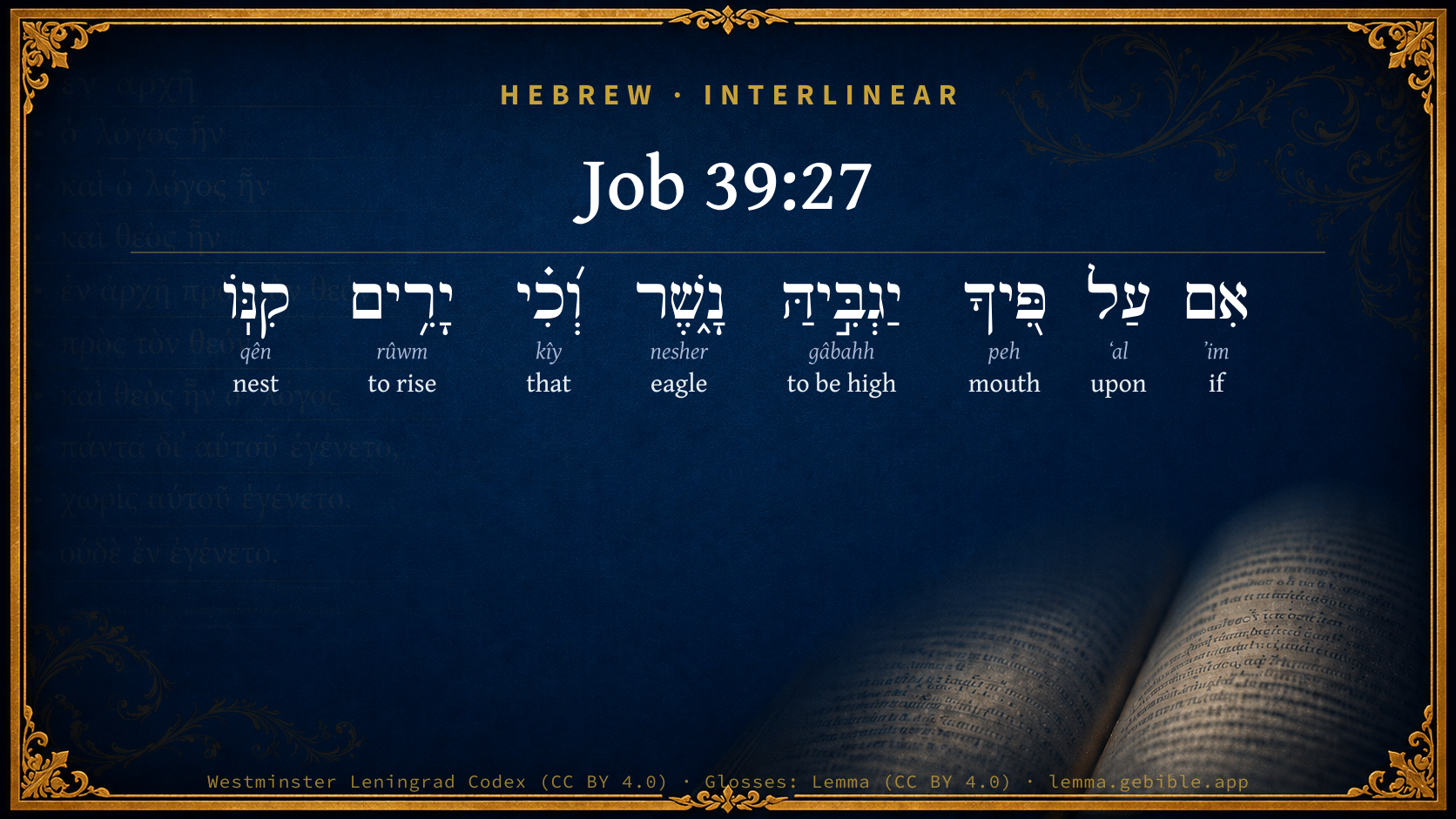
Job 39:27

Hebrew (Westminster Leningrad Codex) Job 39:27 appears in the Hebrew Old Testament. The text above is from the Westminster Leningrad Codex. Each word links to its Strong’s number, a concise gloss, and parsing drawn from the Open Scriptures Hebrew Bible morphology. Click any word for its full Brown-Driver-Briggs (BDB) entry.
Download image
Cite this verse

Job 39:27 (World English Bible). Public Domain. Lemma interlinear Bible study tool, https://lemma.gebible.app/v/job/39/27.

Show BibTeX & RIS
BibTeX
RIS
English Translation
Is it at your command that the eagle mounts up, And makes his nest on high?
World English Bible · Public Domain
Download a study sheet

One document with this verse’s original text, its word-by-word gloss line, the meaning frame, cross-references with their text, attributed commentary, and full source and license credits — printable, and it pastes into notes with its structure intact.

This verse Autodidact and up

Study sheet (.html) Plain text (.txt)

A passage Seminary Student

Up to 50 verses in one chapter. A passage sheet keeps up to 6 commentary sources and 12 cross-references per verse, in the order this page ranks them, and says so on the sheet whenever that leaves anything out. Ask for a single verse and you get the Autodidact verse sheet above.

Everything on this page stays free to read, with no account — the sheet is a download of what is already on screen, not access to it.

Want to remove ads? Support Godless Engineer
Compare translations 3

The same verse in 3 English versions, stacked beneath the original-language interlinear above. Click any original word for its lexicon entry.

Each is an independent rendering of the whole verse — the interlinear is not word-aligned to these translations.

Highlighted words mark where these versions differ — a whole-verse word diff, not a word-by-word alignment.

  • World English Bible Public Domain
    Is it at your command that the eagle mounts up, And makes his nest on high?
  • King James Version Public Domain
    Doth the eagle mount up at thy command, and make her nest on high?
  • unfoldingWord Literal Text CC BY-SA 4.0
    If at your mouth the eagle mounts up and that its nest is high?

unfoldingWord Literal Text — © unfoldingWord, licensed CC BY-SA 4.0. Word-aligned USFM3 via Door43 (git.door43.org/unfoldingWord/en_ult).

Versions to compare (up to 4)

3 of 4 selected

Show all 18 translations

Every available English version of this verse, each an independent rendering of the whole verse.

  • World English Bible Public Domain
    Is it at your command that the eagle mounts up, And makes his nest on high?
  • Berean Standard Bible Public Domain
    Does the eagle soar at your command and make his nest on high?
  • Majority Standard Bible Public Domain
    Does the eagle soar at your command and make his nest on high?
  • King James Version Public Domain
    Doth the eagle mount up at thy command, and make her nest on high?
  • American Standard Version (1901) Public Domain
    Is it at thy command that the eagle mounteth up, And maketh her nest on high?
  • Revised Version (1885) Public Domain
    Doth the eagle mount up at thy command, and make her nest on high?
  • Geneva Bible (1599) Public Domain
    He swalloweth the ground for fearcenes and rage, and he beleeueth not that it is the noise of the trumpet.
  • Douay-Rheims (1899) Public Domain
    Will the eagle mount up at thy command, and make her nest in high places?
  • Young's Literal Translation Public Domain
    At thy command goeth an eagle up high? Or lifteth he up his nest?
  • Literal Standard Version CC BY-SA 4.0
    At your command does an eagle go up high? Or lift up his nest?
  • Unlocked Literal Bible CC BY-SA 4.0
    Is it at your orders that the eagle mounts up and makes his nest in high places?
  • unfoldingWord Literal Text CC BY-SA 4.0
    If at your mouth the eagle mounts up and that its nest is high?
  • Darby Bible Public Domain
    Doth the eagle mount up at thy command, and make his nest on high?
  • World Messianic Bible Public Domain
    Is it at your command that the eagle mounts up, and makes his nest on high?
  • Webster's Bible Public Domain
    \\39:24\\He swalloweth the ground with fierceness and rage: neither believeth he that it is the sound of the trumpet.
  • Free Bible Version CC BY-SA 4.0
    Do you command the eagle to fly high and make its nest in the summits of the mountains?
  • Bible in Basic English Public Domain
    Shaking with passion, he is biting the earth; he is not able to keep quiet at the sound of the horn;
  • JPS Tanakh (1917) Public Domain
    Doth the vulture mount up at thy command, and make her nest on high?

Literal Standard Version (2020), Covenant Press — licensed CC BY-SA 4.0. Text via the HelloAO Bible API (eBible.org). Unlocked Literal Bible (unfoldingWord) — licensed CC BY-SA 4.0. Text via the HelloAO Bible API (eBible.org). unfoldingWord Literal Text — © unfoldingWord, licensed CC BY-SA 4.0. Word-aligned USFM3 via Door43 (git.door43.org/unfoldingWord/en_ult). Free Bible Version, Dr. Jonathan Gallagher — licensed CC BY-SA 4.0. Text via the HelloAO Bible API (eBible.org).

Word by word

More ways to search: Search by grammar → Find every occurrence → Compare this word →

Practice this passage: Drill this verse → Learn its vocabulary →

About this verse

These counts appear in no published source. They are computed here, from the morphology-tagged text and Lemma’s own curated glosses. What Lemma adds →

8
words
8
distinct lemmas
Wisdom
section

Notable vocabulary

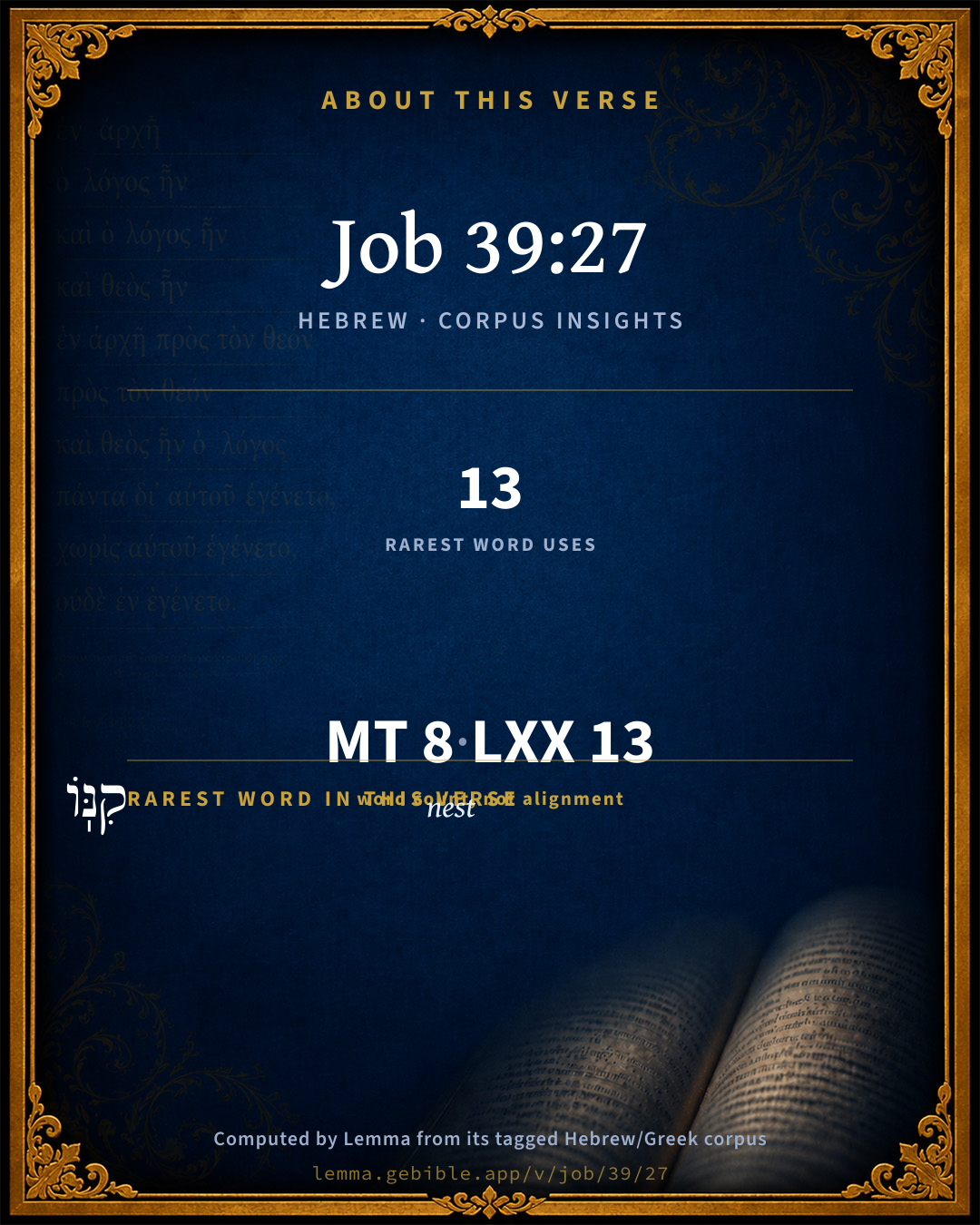
The rarest word here is קִנּֽוֹ nest H7064 — appearing just 13 times in the whole Hebrew Bible.

Shared distinctive vocabulary

קִנּֽוֹ nest H7064 occurs in 13 verses of the Hebrew Bible. Also found in:

Grammatical profile

  • 2 verbs
  • 3 nouns
  • 1 preposition
  • 2 conjunctions

Verb forms

  • יַגְבִּ֣יהַּ Hiphil · Imperfect
  • יָרִ֥ים Hiphil · Imperfect

Hebrew & Septuagint length

In English translation the verse runs 16 words from the Hebrew and 16 from the Septuagint (LXX English) — the same length.

A rough comparison of the two English renderings, which tokenize alike — not a word-level alignment.

Word counts can differ between the Hebrew and the Greek without any difference in meaning — e.g. the Hebrew direct-object marker אֵת has no separate Greek word, and Greek often adds the article ὁ.

In the original languages it is 8 Hebrew tokens and 13 Greek tokens — but the two are counted differently (Hebrew bundles its prefixes and suffixes into one token; the Greek is in lemma form), so that isn’t a like-for-like length.

Cross-references

8

Topical passages linked to Job 39:27 in the Treasury of Scripture Knowledge — connected by theme and wording, ordered by reader-vote popularity; previews shown in the World English Bible.

  • Jeremiah 49:16 As for your terror, the pride of your heart has deceived you, O you who dwell in the clefts of the rock, who hold the height of the hill: though you should make your nest as high as the eagle, I will bring you down from there, says Yahweh.
  • Obadiah 1:4 Though you mount on high as the eagle, and though your nest is set among the stars, I will bring you down from there, says Yahweh.
  • Exodus 19:4 'You have seen what I did to the Egyptians, and how I bore you on eagles' wings, and brought you to myself.
  • Leviticus 11:13 "'These you shall detest among the birds; they shall not be eaten, they are an abomination: the eagle, and the vulture, and the black vulture,
  • Psalms 103:5 Who satisfies your desire with good things, So that your youth is renewed like the eagle's.
  • Proverbs 23:5 Why do you set your eyes on that which is not? For it certainly sprouts wings like an eagle and flies in the sky.
  • Isaiah 40:31 but those who wait for Yahweh shall renew their strength; they shall mount up with wings as eagles; they shall run, and not be weary; they shall walk, and not faint.
  • Hosea 8:1 "Put the trumpet to your lips! Something like an eagle is over Yahweh's house, Because they have broken my covenant, And rebelled against my law.

Cross-references courtesy of OpenBible.info (CC BY 4.0).

Hebrew and Greek witnesses Masoretic Hebrew ↔ Greek Septuagint

The same verse in the two great witnesses to the Old Testament, shown verse-for-verse.

These are two independent witnesses, not word-aligned to each other, and the Septuagint is shown in lemma (dictionary) form.

Hebrew Job 39:27 Masoretic · Westminster Leningrad Codex

אִם עַל פִּ֭יךָ יַגְבִּ֣יהַּ נָ֑שֶׁר וְ֝כִ֗י יָרִ֥ים קִנּֽוֹ

Is it at your command that the eagle mounts up, And makes his nest on high?

World English Bible · Public Domain

Greek LXX Job 39:27 Septuagint · lemma form

ἐπί δέ σός πρόσταγμα ὑψόω ἀετός γύψ δέ ἐπί νοσσιά αὐτός καταἕζομαι αὐλίζω

And does the eagle rise at your command, and the vulture remain sitting over his nest,

LXX2012 (modern English Septuagint) · Public Domain

Hebrew: Westminster Leningrad Codex (CC BY 4.0). Greek: Septuagint (public domain); English from LXX2012 (modern English Septuagint) (Public Domain). How the Septuagint differs from the Hebrew →

Commentary

Notes on Job 39:27 from classic Christian and Jewish commentators (each source and its license shown beneath its notes). The classic Christian expositions comment on the surrounding passage and are grouped to its opening verse, so a note may address several verses; the Jewish commentaries on the Tanakh (Rashi and others) are per-verse, so they appear only where the commentator wrote on this verse.

Lemma curates 59 commentaries, every one of them public domain or Creative Commons licensed, each selected and text-cleaned for this edition rather than reprinted as found. About our sources →

Trapp's Complete Commentary

John Trapp

Job 39:27 Doth the eagle mount up at thy command, and make her nest on high?

Ver. 27. Doth the eagle mount up at thy command?] Mount plumb up (which no bird else can do) to an infinite height, even out of sight; not without an eye still on her prey, which by this means she spies sooner, and seizeth upon better, Mat 24:28. A fit emblem of a hypocrite, who seems to soar aloft, but it is for some self and sinister respect: he seeketh not the Lord Jesus Christ (as the sincere hearted do), but his own belly, Rom 16:18.

And make her nest on high] Not in plains, but on lofty tops and inaccessible rocks, for the safety of her young ones. Of the nature of eagles, read Aristotle, De Nat. Animal. lib. 9, cap. 32, and Pliny, lib. 3, cap. 10. They tell us, that there is an enmity between the eagle and the serpent; and because the serpent seeketh to destroy the young eagles, she setteth her nest on high, to safeguard them. And if any man seek to rob her nest, she doubteth not to assault him with her wings and talons. Formidable she is to all birds save only the hawk, who is able to deal with her if he can but avoid the first shock.

John Trapp, A Commentary or Exposition upon All the Books of the Old and New Testament (1647–1656) — public domain. Text from a community e-Sword module.

The Biblical Illustrator

Joseph S. Exell

Job_39:27

Doth the eagle mount up at thy command?

The captive set free

Many years had a noble eagle been confined in such a manner that no one had seen it even attempt to raise a wing. It had been cherished and fed that it might be exhibited to visitors and friends. Perfectly subdued, unconscious now of its native power, it remained inactive, and apparently contented, oblivious of the heights it once could soar. But its owner was about to leave for a far country, never to return. He could not take the eagle with him. I will do, said he, one act of kindness before I go, which shall be remembered long after me. He unloosed the chain from the captive. His neighbours and children looked on with regret that they should see the eagle no more. A moment, and it would be gone forever! But no. The bird walked the usual round, which had been the length of his chain, looked tamely about, unconscious that he was free, and at length perched himself at his usual height. The gazers looked on in wonder and in pity. Brief, however, was their pity. The slow rustling of a wing was heard. It was projected from the body, then folded. Anon it moved again. At last, stretched to its full expansion, it quivered a moment in the air, then folded softly against its resting place. Now slowly and cautiously the eagle expanded the other, and stood at last upon his perch with both wings spread, looking earnestly in the blue sky above. One effort to mount, then another. The wings have found their lost skill and strength. Upward, slowly, still upward--higher and speedier he mounts his way. The eye follows him in vain. Lost to sight, far above tide mountain top he is bathing his cramped wings in misty clouds, and revels in his liberty. Hast thou, O child of God, been pinioned long to the cares and toils of earth, so that thy wings of faith and love have lost all power to rise? Long bound to earth, its hopes and visions, thou canst not shake thy wings at once. The heart tries to mount in prayer, but it tries in vain. Scenes of earth are floating still before the vision, and sounds of earth ring in the ears. But cease not thy efforts. Expand thy soul once more, if only for a little. Raise the wing of thought first--still more, raise it higher yet. (Preachers Lantern.)

The eagle

The eagle is built for a solitary life. There is no bird so alone; other birds go in flocks--the eagle never, two at most together, and they are mates. Its majesty consists partly in its solitariness. It lives apart because other birds cannot live where and as it lives, and follow where it leads. The true child of God must consent to a lonely life apart with God, and often the condition of holiness is separation. (A. T. Pierson.)

.

The Biblical Illustrator, edited by Joseph S. Exell (c. 1880s–1900s) — public domain. Text from a community e-Sword module.

Joseph Benson's Commentary

Job 39:27-28. Doth the eagle mount up at thy command? — Fly directly upward till she be out of thy sight, which no other bird can do; and make her nest on high — In the highest and inaccessible rocks: compare Jer 49:16; Oba 1:4. She dwelleth upon the crag of the rock — Which she doth partly for the security of herself and her young; and partly that she may thence have the better prospect to discern her prey, as it follows.

Joseph Benson's Commentary on the Old and New Testaments (1811–1818) — public domain. Text from a community e-Sword module.

Geneva Bible (1599)

Geneva Bible translators

He so rideth the ground that it seemeth nothing under him.

Geneva Bible (1599) marginal notes — public domain. Text via Bolls.life.

Jamieson, Fausset & Brown

Robert Jamieson, A. R. Fausset & David Brown

eagle--It flies highest of all birds: thence called "the bird of heaven."

Jamieson, Fausset & Brown — Commentary Critical and Explanatory on the Whole Bible (1871) — public domain (CC PDM 1.0). Text via the HelloAO Bible API.

Adam Clarke's Commentary

Verse 27. Doth the eagle mount up] The eagle is said to be of so acute a sight, that when she is so high in the air that men cannot see her, she can discern a small fish in the water! See on Job 39:29.

Adam Clarke's Commentary on the Bible (1810–1826) — public domain. Text from a community e-Sword/MySword module.

The Cambridge Bible for Schools and Colleges

gen. ed. J. J. S. Perowne

27–30. The eagle.

Is it at Job’s command that the eagle fixes her habitation fearlessly on the dizzy crag? Did he bestow on her her penetrating vision, which scans the wide expanse of country and pierces into the deep ravine? or did he endow her with her terrible instincts, that shew themselves at once in her young, which “suck up blood”?

The Cambridge Bible for Schools and Colleges (gen. ed. J. J. S. Perowne; Cambridge University Press, 1878–1918) — public domain. Text from a community e-Sword module.

John Gill's Exposition

Doth the eagle mount up at thy command,.... No; but by an instinct which God has placed in it, and a capacity he has given it above all other birds. They take a circuit in their flight, and bend about before they soar aloft: but the eagle steers its course directly upwards towards heaven, till out of sight; and, as Apuleius says (p), up to the clouds, where it rains and snows, and beyond which there is no place for thunder and lightning;

and make her nest on high? so the philosopher says (q); eagles make their nests not in plains, but in high places, especially in cragged rocks, as in Job 39:28.

(p) Florida 1. (q) Aristot. Hist. Animal. l. 9. c. 32.

John Gill's Exposition of the Whole Bible (1746–1763) — public domain (CC PDM 1.0). Text via the HelloAO Bible API.

Albert Barnes' Notes on the Bible

Doth the eagle mount up at thy command? - Margin, as in Hebrew, “by thy mouth.” The meaning is, that Job had not power to direct or order the eagle in his lofty flight. The eagle has always been celebrated for the height to which it ascends. When Ramond had reached the summit of Mount Perdu, the highest of the Pyrenees, he perceived no living creature but an eagle which passed above him, flying with inconceivable rapidity in direct opposition to a furious wind. “Edin. Ency.” “Of all animals, the eagle flies highest; and from thence the ancients have given him the epithet of “the bird of heaven.” “Goldsmith.” What is particularly worth remarking here is, the accuracy with which the descriptions in Job are made. If these are any indications of the progress of the knowledge of Natural History, that science could not have been then in its infancy. Just the things are adverted to here which all the investigations of subsequent ages have shown to characterize the classes of the feathered creation referred to.

And make her nest on high - “The nest of the eagle is usually built in the most inaccessible cliff of the rock, and often shielded from the weather by some jutting crag that hangs over it.” “Goldsmith.” “It is usually placed horizontally, in the hollow or fissure, of some high and abrupt rock, and is constructed of sticks of five or six feet in length, interlaced with pliant twigs, and covered with layers of rushes, heath, or moss. Unless destroyed by some accident, it is supposed to suffice, with occasional repairs, for the same couple during their lives.” “Edin. Ency.”

Albert Barnes' Notes on the Bible (1834–1885) — public domain. Text from a community e-Sword/MySword module.

Matthew Poole's English Annotations

Mount up; fly directly upward, till she be out of thy sight; which no other bird can do.

On high; in the highest and inaccessible rocks. Compare Jer 49:16; Oba 1:4.

Matthew Poole's English Annotations on the Holy Bible (1683–1685) — public domain. Text from a community e-Sword/MySword module.

Whedon's Commentary on the Bible

Daniel D. Whedon

27. The eagle — Comp. Oba_1:4. The climax is reached in the eagle, king of birds, (compare the lion, king of beasts, with which the description commences, Job_38:39,) which, notwithstanding its home “is in the teeth of the rock,” delights in blood. Another marvellous feature of instinct is thus presented, that he who flies so high should stoop so low, so that “wheresoever the carcass is, there will the eagles be gathered together.”

Mat_24:28. Tristram observes that eagles will not kill their prey, if they can find it ready slain to their hand.

Her nest — his nest. The gender is the same throughout the description.

Daniel D. Whedon (gen. ed.), Commentary on the Old and New Testaments (1874–1909) — public domain. Text from a community e-Sword module.

The Pulpit Commentary

Doth the eagle mount up at thy command? The enumeration of natural marvels ends with the eagle, the monarch of birds, as it began with the lion, the king of beasts. (Job_38:39) The power of the eagle to "mount up," notwithstanding its great size and weight, is very surprising. The species intended in this place is probably the golden eagle (Aquila chrysaetos) or else the imperial eagle (Aquila heliaca)" which arc both of them common in Syria and Mesopotamia. And make her nest on high? The nests of eagles are almost always built on lofty, generally on inaccessible, rocks. Aristotle says, Poiountai deauta (sc, taav ), ouk en pedinoiv topoiv all en uqhkoiv malista me en petraiv apokrhmnoiv . (comp. Jer_49:16)

The Pulpit Commentary (1880–1919), ed. H.D.M. Spence-Jones & Joseph S. Exell — public domain. Text from a community e-Sword module.

John Wesley's Explanatory Notes

Mount - Flies directly upward 'till she be out of thy sight; which no other bird can do.

John Wesley, Explanatory Notes Upon the Whole Bible (1754–1765) — public domain. Text via the GEBible commentary corpus.

unfoldingWord translationNotes

Door43 World Missions Community

Connecting Statement:

Yahweh continues to challenge Job.

Is it at your orders ... nest in high places?

Yahweh uses this question to prove that Job is not powerful enough to command the eagles. The implicit answer to this question is "no." AT: "You are not able to command the eagle to mount up and build his nest in high places." (See: Rhetorical Question)

at your orders

The abstract noun "orders" can be stated as a verb. AT: "because you tell it to do so" (See: Abstract Nouns)

mounts up

This means he flies upward. AT: "flies up into the sky" (See: Idiom)

a stronghold

The high cliffs are strongholds for eagles because the animals that would want to eat them cannot reach them.

translationWords

eagle

life

stronghold

unfoldingWord translationNotes — © Distant Shores Media and the Door43 World Missions Community, licensed CC BY-SA 4.0. Source: git.door43.org/Door43/en_tn.

Rashi

Rabbi Shlomo Yitzchaki (Rashi)

Or is it by your order that the eagle flies high [This refers to] the Shechinah, as it is said (Deut. 32:11): “As an eagle first stirs up its nest.” He would remove His court so that they should not injure Aaron when he entered the sanctuary on Yom Kippur.

Rashi on the Tanakh — English translations: “The Judaica Press complete Tanach with Rashi, translated by A. J. Rosenberg” (CC BY 4.0); “Pentateuch with Rashi's commentary by M. Rosenbaum and A.M. Silbermann, 1929-1934” (public domain); “The Metsudah Tanach series, Lakewood, N.J” (CC BY 4.0); and “The Book of Joshua, Metsudah Publications, 1997” (CC BY 4.0). Text via Sefaria.

Lesson kit

Teaching starters — assembled from the data on this page, not authored interpretation. Every prompt links to the verse data it draws on. Edit before teaching.

Job, in the Wisdom, opens this verse with 8 words (8 distinct Hebrew lemmas). Its most distinctive word is qên (“nest”). A historical commentator’s framing appears above. Read the whole chapter for the surrounding context.

Discussion questions

  1. How does “nest” (qên) shape what this verse is saying?
  2. Genesis 6:14 shares the word «nest» with this verse. How do the two illuminate each other?
  3. The translations on this page render this verse differently — a whole-verse word diff, not a word-by-word alignment. What might account for the different wordings?
  4. The verb «יַגְבִּ֣יהַּ» is Hiphil Imperfect. How does its form color the action?
  5. Reading how Trapp's Complete Commentary and The Biblical Illustrator read this verse, where do the two commentators agree and where do they part?

Things to notice

Reading settings

Reading text

Shown beneath each verse's original-language words.

Old Testament
Old Testament edition

Read the OT as the Masoretic Hebrew (MT) or the Greek Septuagint (LXX).

English shown for the Greek Septuagint (in the Hebrew ↔ Greek comparison).

Comparing translations? Open the Compare panel on any verse page to stack up to four side by side.