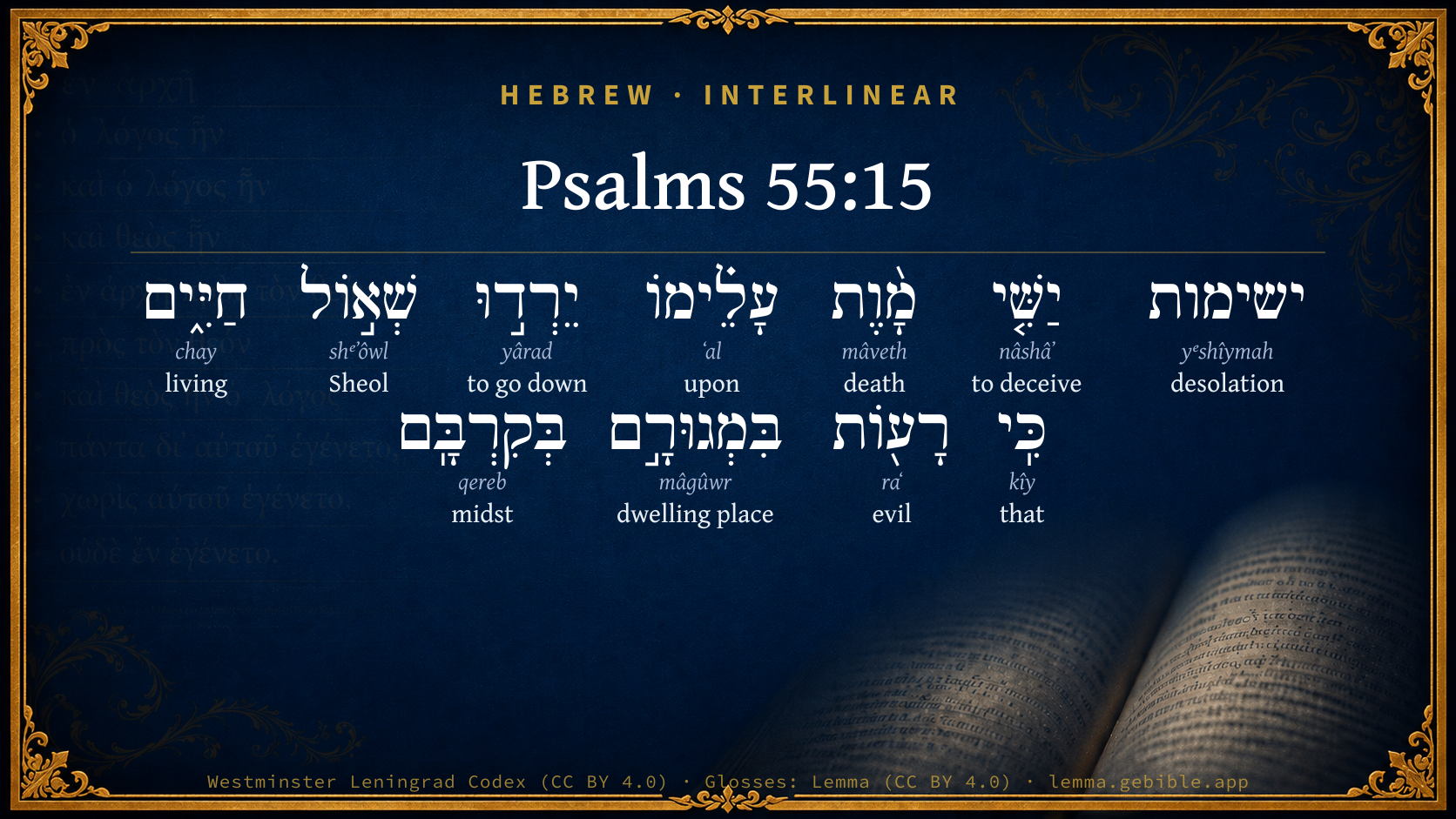
Psalms 55:15

Hebrew (Westminster Leningrad Codex) Psalms 55:15 appears in the Hebrew Old Testament. The text above is from the Westminster Leningrad Codex. Each word links to its Strong’s number, a concise gloss, and parsing drawn from the Open Scriptures Hebrew Bible morphology. Click any word for its full Brown-Driver-Briggs (BDB) entry.
Download image
Cite this verse

Psalms 55:15 (World English Bible). Public Domain. Lemma interlinear Bible study tool, https://lemma.gebible.app/v/psalms/55/15.

Show BibTeX & RIS
BibTeX
RIS
English Translation
Let death come suddenly on them. Let them go down alive into Sheol. For wickedness is in their dwelling, in the midst of them.
World English Bible · Public Domain
Highlights
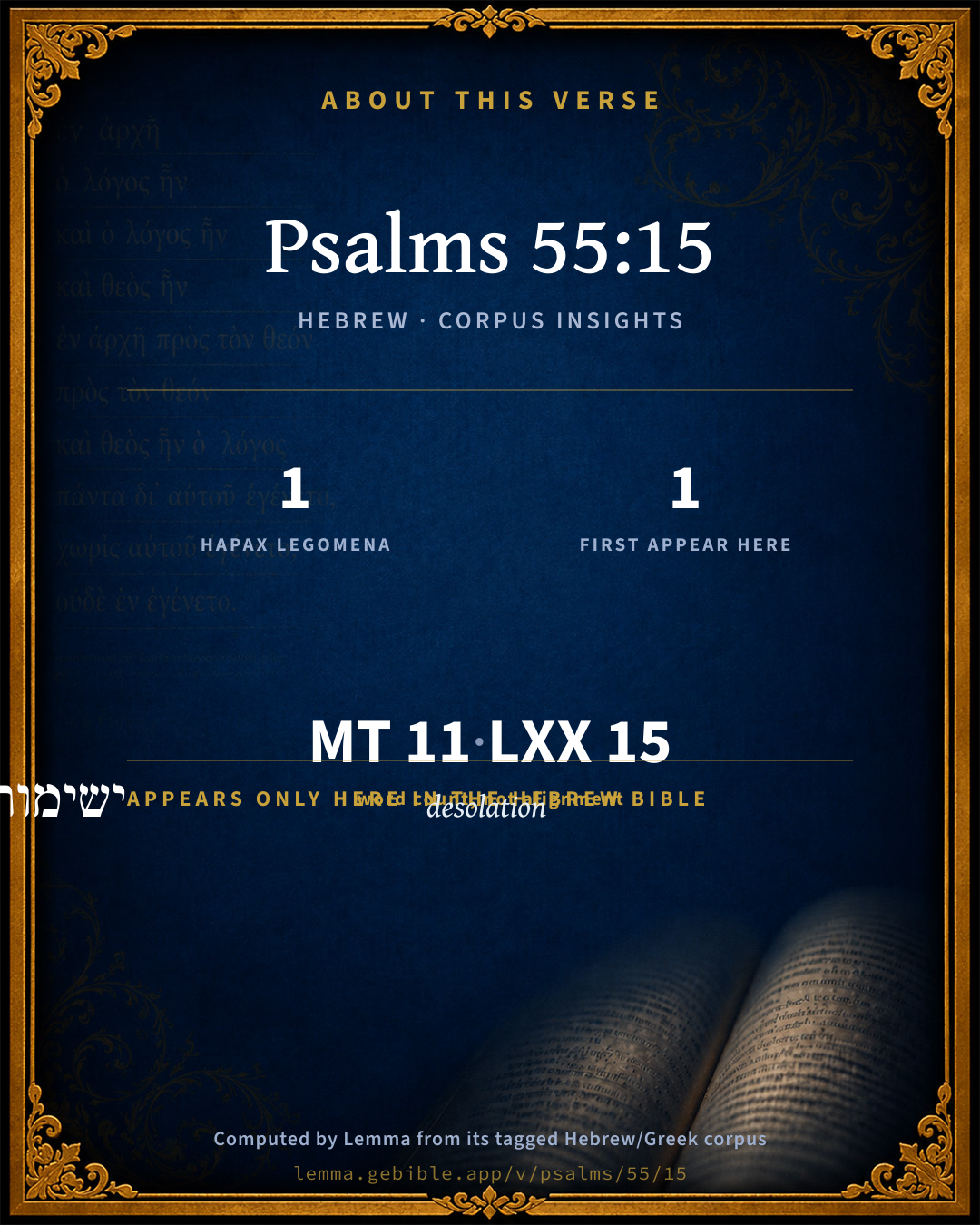
  • 1 hapax legomenon — only here in the Hebrew Bible
  • 1 first appearance in the Hebrew Bible
Full analysis ↓
Download a study sheet

One document with this verse’s original text, its word-by-word gloss line, the meaning frame, cross-references with their text, attributed commentary, and full source and license credits — printable, and it pastes into notes with its structure intact.

This verse Autodidact and up

Study sheet (.html) Plain text (.txt)

A passage Seminary Student

Up to 50 verses in one chapter. A passage sheet keeps up to 6 commentary sources and 12 cross-references per verse, in the order this page ranks them, and says so on the sheet whenever that leaves anything out. Ask for a single verse and you get the Autodidact verse sheet above.

Everything on this page stays free to read, with no account — the sheet is a download of what is already on screen, not access to it.

Want to remove ads? Support Godless Engineer
Compare translations 3

The same verse in 3 English versions, stacked beneath the original-language interlinear above. Click any original word for its lexicon entry.

Each is an independent rendering of the whole verse — the interlinear is not word-aligned to these translations.

Highlighted words mark where these versions differ — a whole-verse word diff, not a word-by-word alignment.

  • World English Bible Public Domain
    Let death come suddenly on them. Let them go down alive into Sheol. For wickedness is in their dwelling, in the midst of them.
  • King James Version Public Domain
    Let death seize upon them, and let them go down quick into hell: for wickedness is in their dwellings, and among them.
  • unfoldingWord Literal Text CC BY-SA 4.0
    desolations upon them; may they go down Sheol alive, for evils in their dwelling, in the midst of them.

unfoldingWord Literal Text — © unfoldingWord, licensed CC BY-SA 4.0. Word-aligned USFM3 via Door43 (git.door43.org/unfoldingWord/en_ult).

Versions to compare (up to 4)

3 of 4 selected

Show all 18 translations

Every available English version of this verse, each an independent rendering of the whole verse.

  • World English Bible Public Domain
    Let death come suddenly on them. Let them go down alive into Sheol. For wickedness is in their dwelling, in the midst of them.
  • Berean Standard Bible Public Domain
    Let death seize them by surprise; let them go down to Sheol alive, for evil is with them in their homes.
  • Majority Standard Bible Public Domain
    Let death seize them by surprise; let them go down to Sheol alive, for evil is with them in their homes.
  • King James Version Public Domain
    Let death seize upon them, and let them go down quick into hell: for wickedness is in their dwellings, and among them.
  • American Standard Version (1901) Public Domain
    Let death come suddenly upon them, Let them go down alive into Sheol; For wickedness is in their dwelling, in the midst of them.
  • Revised Version (1885) Public Domain
    Let death come suddenly upon them, let them go down alive into the pit: for wickedness is in their dwelling, in the midst of them.
  • Geneva Bible (1599) Public Domain
    Let death sense vpon them: let them goe downe quicke into the graue: for wickednes is in their dwellings, euen in the middes of them.
  • Douay-Rheims (1899) Public Domain
    For if my enemy had reviled me, I would verily have borne with it. And if he that hated me had spoken great things against me, I would perhaps have hidden myself from him.
  • Young's Literal Translation Public Domain
    Desolations `are' upon them, They go down `to' Sheol -- alive, For wickedness `is' in their dwelling, in their midst.
  • Literal Standard Version CC BY-SA 4.0
    Desolations [are] on them, || They go down [to] Sheol—alive, || For wickedness [is] in their dwelling, in their midst.
  • Unlocked Literal Bible CC BY-SA 4.0
    Let death come suddenly on them; let them go down alive to Sheol, for wickedness is where they live, right among them.
  • unfoldingWord Literal Text CC BY-SA 4.0
    desolations upon them; may they go down Sheol alive, for evils in their dwelling, in the midst of them.
  • Darby Bible Public Domain
    Let death seize upon them, let them go down alive into Sheol. For wickedness is in their dwellings, in their midst.
  • World Messianic Bible Public Domain
    Let death come suddenly on them. Let them go down alive into Sheol. For wickedness is among them, in their dwelling.
  • Webster's Bible Public Domain
    \\55:14\\We took sweet counsel together, and walked to the house of God in company.
  • Free Bible Version CC BY-SA 4.0
    May death come quickly to them; may they go down into the grave alive, because evil finds its home in them.
  • Bible in Basic English Public Domain
    Let the hand of death come on them suddenly, and let them go down living into the underworld; because evil is in their houses and in their hearts.
  • JPS Tanakh (1917) Public Domain
    (55-16) May He incite death against them, let them go down alive into the nether-world; for evil is in their dwelling, and within them.

Literal Standard Version (2020), Covenant Press — licensed CC BY-SA 4.0. Text via the HelloAO Bible API (eBible.org). Unlocked Literal Bible (unfoldingWord) — licensed CC BY-SA 4.0. Text via the HelloAO Bible API (eBible.org). unfoldingWord Literal Text — © unfoldingWord, licensed CC BY-SA 4.0. Word-aligned USFM3 via Door43 (git.door43.org/unfoldingWord/en_ult). Free Bible Version, Dr. Jonathan Gallagher — licensed CC BY-SA 4.0. Text via the HelloAO Bible API (eBible.org).

Word by word

More ways to search: Search by grammar → Find every occurrence → Compare this word →

Practice this passage: Drill this verse → Learn its vocabulary →

ישימות
yᵉshîymah
H3451
“desolations”
Noun, Common, Feminine, Plural, Absolute
Part of Speech
Noun
Type
Common
Gender
Feminine
Number
Plural
State
Absolute
Full BDB Definition

Origin: from H3456

TWOT: 927a

desolation
  1. יַשִּׁ֤י nâshâʼ H5377 “to deceive” Verb, Hiphil, Jussive, 3rd Person, Masculine, Singular
  2. מָ֨וֶת mâveth H4194 “death” Noun, Common, Masculine, Singular, Absolute
  3. עָלֵ֗ימוֹ ʻal H5921 “upon · them” Preposition + Suffix, Personal, 3rd Person, Masculine, Plural
  4. יֵרְד֣וּ yârad H3381 “to go down” Verb, Qal, Imperfect, 3rd Person, Masculine, Plural
  5. שְׁא֣וֹל shᵉʼôwl H7585 “Sheol” Noun, Proper
  6. חַיִּ֑ים chay H2416 “living” Adjective, Adjective, Masculine, Plural, Absolute
  7. כִּֽי kîy H3588 “that” Conjunction
  8. רָע֖וֹת raʻ H7451 “evils” Noun, Common, Feminine, Plural, Absolute
  9. בִּמְגוּרָ֣ם mâgûwr H4033 “in/at · dwelling place · their” Preposition + Noun, Common, Masculine, Singular, Construct + Suffix, Personal, 3rd Person, Masculine, Plural
  10. בְּקִרְבָּֽם qereb H7130 “in/at · midst · their” Preposition + Noun, Common, Masculine, Singular, Construct + Suffix, Personal, 3rd Person, Masculine, Plural

About this verse

These counts appear in no published source. They are computed here, from the morphology-tagged text and Lemma’s own curated glosses. What Lemma adds →

11
words
11
distinct lemmas
Wisdom
section

Notable vocabulary

1 hapax legomenon — a word that appears only here in the entire Hebrew Bible:

  • ישימות desolation H3451

First appearance in Scripture

This word makes its first canonical appearance in the Hebrew Bible here:

  • ישימות desolation H3451

Shared distinctive vocabulary

בִּמְגוּרָ֣ם dwelling place H4033 occurs in 10 verses of the Hebrew Bible. Also found in:

Grammatical profile

  • 2 verbs
  • 6 nouns
  • 1 adjective
  • 1 preposition
  • 1 conjunction

Verb forms

  • יַשִּׁ֤י Hiphil · Jussive
  • יֵרְד֣וּ Qal · Imperfect

Hebrew & Septuagint length

In English translation the verse runs 24 words from the Hebrew and 24 from the Septuagint (LXX English) — the same length.

A rough comparison of the two English renderings, which tokenize alike — not a word-level alignment.

Word counts can differ between the Hebrew and the Greek without any difference in meaning — e.g. the Hebrew direct-object marker אֵת has no separate Greek word, and Greek often adds the article ὁ.

In the original languages it is 11 Hebrew tokens and 15 Greek tokens — but the two are counted differently (Hebrew bundles its prefixes and suffixes into one token; the Greek is in lemma form), so that isn’t a like-for-like length.

Cross-references

13

Topical passages linked to Psalms 55:15 in the Treasury of Scripture Knowledge — connected by theme and wording, ordered by reader-vote popularity; previews shown in the World English Bible.

  • Psalms 59:13 Consume them in wrath. Consume them, and they will be no more. Let them know that God rules in Jacob, To the ends of the earth. Selah.
  • Psalms 9:17 The wicked shall be turned back to Sheol, Even all the nations that forget God.
  • Psalms 64:7 But God will shoot at them. They will be suddenly struck down with an arrow.
  • Psalms 109:6–20 Set a wicked man over him. Let an adversary stand at his right hand.
  • Acts 1:18–20 Now this man obtained a field with the reward for his wickedness, and falling headlong, his body burst open, and all his intestines gushed out.
  • Numbers 16:30–34 But if Yahweh make a new thing, and the ground open its mouth, and swallow them up, with all that appertain to them, and they go down alive into Sheol; then you shall understand that these men have despised Yahweh.
  • 2 Samuel 18:14 Then said Joab, I may not wait thus with you. He took three darts in his hand, and thrust them through the heart of Absalom, while he was yet alive in the midst of the oak.
  • Matthew 26:24 The Son of Man goes, even as it is written of him, but woe to that man through whom the Son of Man is betrayed! It would be better for that man if he had not been born."
  • Matthew 27:5 He threw down the pieces of silver in the sanctuary, and departed. He went away and hanged himself.
  • Acts 1:25 to take part in this ministry and apostleship from which Judas fell away, that he might go to his own place."
  • 2 Samuel 18:9 Absalom happened to meet the servants of David. Absalom was riding on his mule, and the mule went under the thick boughs of a great oak, and his head caught hold of the oak, and he was taken up between the sky and earth; and the mule that was under him went on.
  • Psalms 69:22–28 Let their table before them become a snare. May it become a retribution and a trap.
  • 2 Samuel 17:23 When Ahithophel saw that his counsel was not followed, he saddled his donkey, and arose, and got him home, to his city, and set his house in order, and hanged himself; and he died, and was buried in the tomb of his father.

Cross-references courtesy of OpenBible.info (CC BY 4.0).

Hebrew and Greek witnesses Masoretic Hebrew ↔ Greek Septuagint

The same verse in the two great witnesses to the Old Testament, shown verse-for-verse.

You’re reading Greek Psalm 54 (Hebrew Psalm 55). The Septuagint counts the superscription, so verse numbers can differ from the Hebrew — chapter-level alignment, not verse-by-verse. Numbering follows Rahlfs.

These are two independent witnesses, not word-aligned to each other, and the Septuagint is shown in lemma (dictionary) form.

Hebrew Psalms 55:15 Masoretic · Westminster Leningrad Codex

ישימות יַשִּׁ֤י מָ֨וֶת עָלֵ֗ימוֹ יֵרְד֣וּ שְׁא֣וֹל חַיִּ֑ים כִּֽי רָע֖וֹת בִּמְגוּרָ֣ם בְּקִרְבָּֽם

Let death come suddenly on them. Let them go down alive into Sheol. For wickedness is in their dwelling, in the midst of them.

World English Bible · Public Domain

Greek LXX Greek Psalm 54:15 Septuagint · lemma form

ὅς ἐπί ὁ αὐτός ἐγώ γλυκαίνω ἔδεσμα ἐν ὁ οἶκος ὁ θεός πορεύομαι ἐν ὁμόνοια

Let death come upon them, and let them go down alive into Hades, for iniquity is in their dwellings, in the midst of them.

LXX2012 (modern English Septuagint) · Public Domain

On this verse, The Cambridge Bible for Schools and Colleges discusses the Septuagint’s reading. Read the note in Commentary ↓

Hebrew: Westminster Leningrad Codex (CC BY 4.0). Greek: Septuagint (public domain); English from LXX2012 (modern English Septuagint) (Public Domain). How the Septuagint differs from the Hebrew →

Commentary

Notes on Psalms 55:15 from classic Christian and Jewish commentators (each source and its license shown beneath its notes). The classic Christian expositions comment on the surrounding passage and are grouped to its opening verse, so a note may address several verses; the Jewish commentaries on the Tanakh (Rashi and others) are per-verse, so they appear only where the commentator wrote on this verse.

Lemma curates 59 commentaries, every one of them public domain or Creative Commons licensed, each selected and text-cleaned for this edition rather than reprinted as found. About our sources →

Trapp's Complete Commentary

John Trapp

Psa 55:15 Let death seize upon them, [and] let them go down quick into hell: for wickedness [is] in their dwellings, [and] among them.

Ver. 15. Let death seize upon them] Irruat super illos mors, as a merciless landlord, as a cruel creditor, or as he in the Gospel, who took his fellow by the throat, and said, Pay that thou owest me. A sad time it must needs be with the wicked when death shall come upon them with a writ of Habeas corpus, and the devil with another of Habeas animam. Capiat illos mors, Thou shalt have the spirit. Let death seize them, so Aben Ezra rendereth it; Exigat mors in cos, so Kimchi, a נושׁח Psa 89:22. Here it is written, saith he, without an Aleph, {Hebrew Text Note} as it were, with a swift hand; and as if death and seize were all one word; to note the sudden stroke of death, and that it will soon despatch them. To which sense also some render it, Decipiat eos mors, Let death deceive them, be too nimble for them.

And let them go down quick into hell] As did Dathan and his complices, Num 16:31-33 {See Trapp on "Psa 55:9"} According to this imprecation Ahithophel and Judas, hanging themselves, went to hell alive, that is, hale and well; not enfeebled by sickness first. Augustine saith that heretics do the like, falling with open eyes, and self-condemned.

For wickedness is in their dwellings, and among them] Heb. in their sojourning place (for here we are but guests and sojourners), and in the middle of them, that is, in their hearts and houses both, undique circumfluunt malitia et maleficiis, they are as naught as need to be.

John Trapp, A Commentary or Exposition upon All the Books of the Old and New Testament (1647–1656) — public domain. Text from a community e-Sword module.

Joseph Benson's Commentary

Psa 55:15. Let death seize upon them — Hebrew, ישׁי מות עלימו, jashi maveth gnaleemo, which Cocceius renders, death will exact the debt with usury, a version which, as Dr. Chandler well remarks, preserves the propriety of the original verb, and greatly adds to the force of the expression. The verb is in the future tense, and therefore should not be rendered as an execration; for it only points out what would be the punishment of such perfidy and wickedness. And let them go down, &c. — Hebrew, ירדו שׁאול חיים, jeeredu sheol chiim, they shall descend alive into hades, or into the grave, for the word, as has been observed before, may mean either. Thou wilt cut off, by a sudden and violent death, him, and all such false-hearted and hypocritical wretches, that pretend to religion with a wicked design, and now have manifestly apostatized both from the profession and practice of it. This was awfully verified by the event, as Ahithophel hanged himself, and went down, as it were, alive into hades. Wickedness is in their dwelling — במגורם, bimguram, in the place where they sojourn. They carry their wickedness along with them from place to place, and leave the impressions and effects of it wheresoever they come. And among them — Hebrew, בקרבם, bekirbam, in their inwards. Wickedness is deeply rooted in their hearts, and it breaks forth in all their houses and actions.

Joseph Benson's Commentary on the Old and New Testaments (1811–1818) — public domain. Text from a community e-Sword module.

J. A. Alexander on Psalms

Joseph Addison Alexander

16. (Psa 55:15) Desolations (are) upon them! They shall go down to Sheol alive! For evils are in their dwellings, in their heart. The optative form given to his sentence in most versions is entirely gratuitous. All that the Hebrew words express is a confident anticipation. The common version of the first words (let death seize upon them) is founded on the masoretic reading; but the best critics now prefer the older reading in the text, which, instead of a verb and a singular noun, exhibits one noun in the plural number, meaning desolations, and agreeing with the substantive verb understood. Upon them, hovering or impending over them. Sheol, the grave, the state of the dead, the wide old English sense of hell. See above, on Psa 6:6 (5). There is an obvious allusion to another great historical type of God's retributory judgments, the destruction of Korah and his company, who went down alive into the pit, Num 16:33. The word quick, in the common English version of this sentence, is an adjective synonymous with living or alive, and not an adverb meaning soon or swiftly. Evils, i.e. evil deeds and evil thoughts. In their heart, or inside, inner part, as in Psa 5:10 (9), Psa 49:12 (11): This is a much better sense than in the midst of them, among them.

Joseph Addison Alexander, The Psalms Translated and Explained (1850) — public domain. Text from a community e-Sword module.

Geneva Bible (1599)

Geneva Bible translators

As Korah, Dathan and Abiram.

Geneva Bible (1599) marginal notes — public domain. Text via Bolls.life.

Jamieson, Fausset & Brown

Robert Jamieson, A. R. Fausset & David Brown

Let death, &c.--or, "Desolations are on them."

let them go--literally, "they will go."

quick--or, living in the midst of life, death will come (compare Num 16:33).

among them--or, "within them," in their hearts (Psa 5:9; Psa 49:11).

Jamieson, Fausset & Brown — Commentary Critical and Explanatory on the Whole Bible (1871) — public domain (CC PDM 1.0). Text via the HelloAO Bible API.

Adam Clarke's Commentary

Verse 15. Let death seize upon them] This is a prediction of the sudden destruction which should fall on the ringleaders in this rebellion. And it was so. Ahithophel, seeing his counsel rejected, hanged himself. Absalom was defeated; and, fleeing away, he was suspended by the hair in a tree, under which his mule had passed; and being found thus by Joab, he was despatched with three darts; and the people who espoused his interests were almost all cut off. They fell by the sword, or perished in the woods. See 2Sa 18:8.

Let then go down quick into hell] Let them go down alive into the pit. Let the earth swallow them up! And something of this kind actually took place. Absalom and his army were defeated; twenty thousand of the rebels were slain on the field; and the wood devoured more people that day than the sword devoured, 2Sa 18:7-8. The words might be rendered, "Death shall exact upon them; they shall descend alive into sheol." And death did exact his debt upon them, as we have seen above.

Adam Clarke's Commentary on the Bible (1810–1826) — public domain. Text from a community e-Sword/MySword module.

John Calvin's Commentaries

15 Let death seize upon them. He now denounces the whole faction, not the nation generally, but those who had taken a prominent part in the persecution of him. In imprecating this curse he was not influenced by any bad feeling towards them, and must be understood as speaking not in his own cause but in that of God, and under the immediate guidance of his Spirit. This was no wish uttered in a moment of resentment or of reckless and ill-considered zeal, and which would justify us in launching maledictions against our enemies upon every trivial provocation. The spirit of revenge differs widely from the holy and regulated fervor with which David prays for the judgment of God against wicked men, who had already been doomed to everlasting destruction. The translation, Let death condemn them, is forced, and so also is another which has been suggested, Let him appoint death a creditor over them. That which we have given is the most obvious and simple. In praying that his enemies may descend alive into the grave, it has been well observed, that he seems to allude to the punishment of Korah, Dathan, and Abiram; though I conceive that in imprecating sudden and unexpected ruin upon them, he adverts to the proud persuasion which they cherished in their prosperity, that they would escape the stroke of death. “Lord,” as if he had said, “in the infatuation of their pride they consider themselves to be exempted from the ordinary lot of mortality, but let the earth swallow them up alive — let nothing prevent their being dragged down with all their pomp to the destruction which they deserve.” The cause which he assigns for his prayer in the latter part of the verse, is another proof that he was not influenced by any personal resentment against his enemies, but simply denounced the just judgments of God upon such as persecuted the Church. Wickedness, he adds, is in their dwelling By this he meant that it could not but dwell where they dwelt and this he expresses still more fully when he adds, in the midst of them; intimating, that they inwardly cherished their wickedness, so that it was their inseparable companion, and dwelt with them under the same roof.

John Calvin's Commentaries (1540-1563) — public domain. Text from the Calvin Translation Society English edition (1840s-50s) via the Christian Classics Ethereal Library (ccel.org). Calvin's coverage is partial (roughly two-thirds of the Bible); uncommented books and verses are honest gaps, never fabricated. The 19th-century editor's footnotes and remarks are omitted so the notes are faithfully Calvin's own voice.

Ellicott's Commentary for English Readers

(15) Let death.—According to the written text we should render desolations upon them. Here we have another sudden outburst of overmastering feeling.

Quick—i.e., alive, perhaps with reminiscence of the fate of Korah. (Comp. Pro_1:12.)

Hell.—Sheôl. (See Note Psa_6:5.)

And among them.—The conjunction is unnecessary. Render, in their dwellings, in their very midst.

A Bible Commentary for English Readers, edited by Charles John Ellicott (1878–1897) — public domain. Text from a community e-Sword module.

The Cambridge Bible for Schools and Colleges

gen. ed. J. J. S. Perowne

15. The mournful recollections of past friendships so cruelly outraged give way to a fierce invocation of vengeance, and the individual disappears behind the whole body of the Psalmist’s enemies. It will be noted that he avoids any personal execration of his old friend.

Let death &c.] The consonants of the written text must be rendered, Desolations be upon them! but the word for desolations is one which only occurs in the name of a place (Beth-jeshimoth) and is not a natural word to apply to persons; and the marginal reading, with which all the Ancient Versions agree, should certainly be followed in its division of the consonants into two words. Render, Let death come upon them unawares. In this and in the next line, Let them go down alive into Sheol, there may be an allusion to the fate of Korah and his company of rebels (Num_16:30; Num_16:33). Let them be overtaken in the midst of their villany by a sudden and premature death, which will be a visible judgement on their crimes. Cp. Psa_35:8; and Psa_124:3; Pro_1:12. Quick in A.V. regularly retains its old meaning alive. Sheol (A.V. hell) is not the place of torment, but the abode of the departed, the O.T. equivalent of Hades, by which it is rendered in the LXX. See note on Psa_6:5.

for wickedness &c.] For wickedness (lit. evils) is in their dwelling, in the midst of them (lit. in their inward part). Evil of every kind finds a home, not only in their dwellings, but in their hearts.

The Cambridge Bible for Schools and Colleges (gen. ed. J. J. S. Perowne; Cambridge University Press, 1878–1918) — public domain. Text from a community e-Sword module.

John Gill's Exposition

As for me, I will call upon God,.... Not upon a creature, on idols and images, on angels or saints departed; but upon God, in his time of trouble, for salvation and deliverance from enemies; who is able to save. This is to be understood of calling upon God in prayer; as Psa 55:17 explains it, and the Targum here renders it; though sometimes invocation of the name of God takes in the whole of divine worship;

and the Lord shall save me; which confidence was founded partly upon his promise to deliver such that call upon him in the day of trouble, Psa 50:15; and partly upon his power, whose hand is not shortened that it cannot save. The Targum is,

"the Word of the Lord shall redeem me.''

John Gill's Exposition of the Whole Bible (1746–1763) — public domain (CC PDM 1.0). Text via the HelloAO Bible API.

Albert Barnes' Notes on the Bible

Let death seize upon them - This would be more correctly rendered, “Desolations (are) upon them!” That is, Desolation, or destruction will certainly come upon them. There is in the original no necessary expression of a wish or prayer that this might be, but it is rather the language of certain assurance - the expression of a fact - that such base conduct - such wickedness - would make their destruction certain; that as God is just, they must be overwhelmed with ruin. Injury is sometimes done in the translation of the Scriptures by the insertion of a wish or prayer, where all that is necessarily implied in the original is the statement of a fact. This has been caused here by the somewhat uncertain meaning of the word which is used in the original. That phrase is ישׁימות yaśimâveth. It occurs nowhere else. Our translators understood it (as the Septuagint, the Vulgate, and Luther do) as made up of two words. More correctly, however, it is to be regarded as one word, meaning “desolations,” or “destructions.” So Gesenius (Lexicon), Rosenmuller, and Prof. Alexander understand it.

And let them go down quick into hell - “Alive,” or “living,” for that is the meaning of the word “quick” here - חיים chayiym - as it commonly is in the Scriptures. Compare Lev 13:10; Num 16:30; Act 10:42; 2Ti 4:1; Heb 4:12; 1Pe 4:5. The word “hell” is rendered in the margin “the grave.” The original word is “sheol,” and means here either the grave, or the abode of departed spirits. See the notes at Isa 14:9; notes at Job 10:21-22. There is a harshness in the translation of the term here which is unnecessary, as the word “hell” with us now uniformly refers to the place of punishment for the wicked beyond death. The meaning here, however, is not that they would be consigned to wrath, but that they would be cut off from the land of the living. The idea is that their destruction might be as sudden as if the earth were to open, and they were to descend alive into the chasm. Probably there is an implied allusion here to the manner in which the company of Korah, Dathan, and Abiram was destroyed, Num 16:31-33. Compare Psa 106:17.

For wickedness is in their dwellings, and among them - Wickedness abounds in all their transactions. It is in their houses, and in their hearts. This is mentioned as a reason why they should be cut off and consigned to the grave. It is the reason why people are cut down at all; it is often a fact that wicked people are most manifestly cut down for their sins. And because it will be better for the community that the wicked should be punished than that they should escape, so there is no evidence that David cherished malice or ill-will in his heart. See General Introduction, Section 6 (5).

Albert Barnes' Notes on the Bible (1834–1885) — public domain. Text from a community e-Sword/MySword module.

Matthew Poole's English Annotations

Them, i.e. him and all such false-hearted wretches, that pretended religion with wicked design, and now have manifestly apostatized, both from the profession and practice of it, and fallen into all manner of wickedness; for such are the vilest of men, and most obnoxious to the curse of God.

Into hell; or, into the grave; cut them off by a sudden and violent death, as thou didst those Num 16:32. But these imprecations used by inspired persons in extraordinary cases is no precedent for our imitation.

Their dwellings; or, where they sojourn. They carry their wickedness along with them from place to place, and leave the impressions and effects of it wheresoever they come.

Among them, Heb. in their inwards. Wickedness is deeply rooted in their hearts, and it breaks forth in all their houses and actions.

Matthew Poole's English Annotations on the Holy Bible (1683–1685) — public domain. Text from a community e-Sword/MySword module.

The Treasury of David

Charles H. Spurgeon

Ver. 15. Not thus would Jesus pray, but the rough soldier David so poured out the anguish of his spirit, under treachery and malice seldom equalled and altogether unprovoked. The soldier, as such, desires the overthrow of his foes, for this very end he fights; and viewed as a matter of law and justice, David was right in his wish; he was waging a just, defensive war against men utterly regardless of truth and justice. Read the words as a warrior's imprecation.

Let death seize upon them. Traitors such as these deserve to die, there is no living with them, earth is polluted by their tread; if spies are shot, much more these sneaking villains.

Let them go down quick into hell. While in the vigour of life into sheol let them sink, let them suddenly exchange the enjoyment of the quick or living for the sepulchre of the dead. There is, however, no need to read this verse as an imprecation, it is rather a confident expectation or prophecy: God would, he was sure, desolate them, and cast them out of the land of the living into the regions of the dead.

For wickedness is in their dwellings, and among them. They are too bad to be spared, for their houses are dens of infamy, and their hearts fountains of mischief. They are a pest to the commonwealth, a moral plague, a spiritual pestilence, to be stamped out by the laws of men and the providence of God. Both Ahithophel and Judas soon ended their own lives; Absalom was hanged in the oak, and the rebels perished in the wood in great numbers. There is justice in the universe, love itself demands it; pity to rebels against God, as such, is no virtue--we pray for them as creatures, we abhor them as enemies of God. We need in these days far more to guard against the disguised iniquity which sympathises with evil, and counts punishment to be cruelty, than against the harshness of a former age. We have steered so far from Scylla that Charybdis is absorbing us.

Ver. 15. Let death seize upon them, and let them go down quick into hell. The last part and end of sinners' lives is worst with them. They have in their lives been busily trading in the world, buying and selling, and getting gain and ruffling it in the world, but meanwhile by their sins they run deep in debt with God, and for want of interest in Christ to be their surety at death (it may be on the sudden) it comes to that of the psalmist, Let death seize upon them, and let them go down quick into hell. Death seizes on them unawares, as a sergeant or pursevant, casts them into prison, which is expressed by their going down quick into hell (as it is said Nu 16:32-33), that Korah and his company did. Anthony Tuckney, 1599-1670.

Ver. 15. Let death seize upon them by divine warrant, and let them go quick into hell; let them be dead and buried, and damned in a moment; for wickedness is wherever they are, it is in the midst of them. The souls of impenitent sinners go down quick, or alive, into hell; for they have a perfect sense of their miseries, and shall therefore live still, that they may be still miserable. This prayer is a prophecy of the utter, the final, the everlasting ruin of all those who, whether secretly or openly, oppose and rebel against the Lord's Messiah. Matthew Henry.

Ver. 15. Quick, that is alive, like Korah, Dathan and Abiram. From "The Psalms chronologically arranged, By Four Friends, " 1867.

Ver. 15. Throughout this series of Psalms, there appears to be a peculiar penalty attached to each class of transgressions, or, each variety of opposition against God meets a suitable end. The ungodly, that is, the irreligious and indifferent, lay up for themselves an evil recompense when the wrath of God shall be revealed (Ps 54:5): but an instant punishment falls upon false and treacherous professors; as Paul denounced "anathema" against any who perverted the gospel of Christ in the churches of Galatia; so in this Psalm, Let death seize upon them, and let them go down quick into hell, announces the awful judgment of Jehovah, as once it was shown upon Dathan and Abiram; a punishment that will by its suddenness and notoriety at the same time expose the guilt, and make manifest the displeasure of the Almighty against it. R. H. Ryland, in "The Psalms restored to Messiah, "1853.

None.

Psalms 55:16*

Charles H. Spurgeon's The Treasury of David (1869–1885) — public domain. Psalms only. Text from a community e-Sword/MySword module.

Whedon's Commentary on the Bible

Daniel D. Whedon

15. Again the subdued and tender strain of the muse is suddenly broken by one of the harshest imprecations in the Book of Psalms. The style is exceedingly impassioned.

Let death seize upon them—The word “death” is needlessly harsh. The Hebrew is simply, Destructions upon them! The idea is, desolation, not death; and it may be understood of his public fame and his plans.

Let them go downs quick into hell—Literally, they shall descend alive into the grave, or region of the dead. Pro_1:12. Sheol is not to be understood here of the place of future punishment, but of the grave, underworld, region of the dead. The Saxon hell is modernly restricted to signify the place of future punishment, and is not now, as formerly, an adequate translation of sheol. The description is based on Num_16:30, where sheol is rendered pit, “and they go down quick into the pit.” David’s conspirators had all forfeited their lives for the highest crime against the State, and the judgment is only suited to their desert, and to the exigency of the kingdom. But see on Psalms 109

Daniel D. Whedon (gen. ed.), Commentary on the Old and New Testaments (1874–1909) — public domain. Text from a community e-Sword module.

The Pulpit Commentary

Let death seize upon them. As this strophe begins (ver. 9), so it ends, with an imprecation. The psalmist calls on God to bring destruction upon the whole mass of his enemies. Of the two readings in the original, the one adopted by our translators seems the best, "Let death come suddenly upon them." Let them go down quick (i.e. alive) into hell. There is an allusion to the fate of Korah and his company, (Num_16:30-33) who "went down quick into the pit;" but probably the psalmist neither expected nor desired a literal fulfilment of his imprecation. The deaths of Ahithophel (2Sa_17:23) and Absalom, (2Sa_18:14, 2Sa_18:15) and of so many of Absalom"s followers, (2Sa_18:7, 2Sa_18:8) were quite a sufficient fulfilment. For wickedness is in their dwellings, and among them. (comp. vers. 3, 9-11).

The Pulpit Commentary (1880–1919), ed. H.D.M. Spence-Jones & Joseph S. Exell — public domain. Text from a community e-Sword module.

John Wesley's Explanatory Notes

Them - All such as pretend to religion, and have manifestly apostatized both from the profession and practice of it. The grave - Cut off by a sudden and violent death. Among them - Hebrew. in their inwards. Wickedness is deeply rooted in their hearts.

John Wesley, Explanatory Notes Upon the Whole Bible (1754–1765) — public domain. Text via the GEBible commentary corpus.

Scofield Reference Notes

C. I. Scofield

hell

Or, the grave.

The Scofield Reference Bible (1917 edition), notes by C. I. Scofield — public domain. Text from a community e-Sword module.

unfoldingWord translationNotes

Door43 World Missions Community

Let death come suddenly on them

Death is spoken of as if it were a person that could attack people. AT: "Let my enemies die suddenly" (See: Personification)

let them go down alive to Sheol

Dying suddenly is spoken of as if people were to go to Sheol so fast that they do not even die first. AT: "let them suddenly go to Sheol" (See: Metaphor)

wickedness is where they live

Wickedness is spoken of as if it were a thing that could be in a certain place. The habitual wickedness of his enemies is spoken of as if wickedness were with them or near them. AT: "they always do wicked things where they live" (See: Metaphor)

right among them

This phrase intensifies the idea of wickedness being very near them. Here wickedness is spoken of as being not only in their homes, but right where they are. AT: "They always do wicked things wherever they are" or "wherever they are" (See: Metaphor)

translationWords

die

life

Hades

evil

unfoldingWord translationNotes — © Distant Shores Media and the Door43 World Missions Community, licensed CC BY-SA 4.0. Source: git.door43.org/Door43/en_tn.

Rashi

Rabbi Shlomo Yitzchaki (Rashi)

That together we used to devise counsel in the Torah and in the house of God we would walk בְרָגֶשּׁ, with a multitude.

in the house of God In the study-halls.

Rashi on the Tanakh — English translations: “The Judaica Press complete Tanach with Rashi, translated by A. J. Rosenberg” (CC BY 4.0); “Pentateuch with Rashi's commentary by M. Rosenbaum and A.M. Silbermann, 1929-1934” (public domain); “The Metsudah Tanach series, Lakewood, N.J” (CC BY 4.0); and “The Book of Joshua, Metsudah Publications, 1997” (CC BY 4.0). Text via Sefaria.

Lesson kit

Teaching starters — assembled from the data on this page, not authored interpretation. Every prompt links to the verse data it draws on. Edit before teaching.

Psalms, in the Wisdom, opens this verse with 11 words (11 distinct Hebrew lemmas). Its most distinctive word is yᵉshîymah (“desolation”). A historical commentator’s framing appears above. Read the whole chapter for the surrounding context.

Discussion questions

  1. How does “desolation” (yᵉshîymah) shape what this verse is saying?
  2. This verse holds 1 word here found nowhere else in the Hebrew Bible. What might the rare word draw attention to?
  3. The word “desolation” first appears here in Scripture. What is being introduced at this debut?
  4. Genesis 17:8 shares the word «dwelling place» with this verse. How do the two illuminate each other?
  5. These translations render this verse differently. What is at stake in choosing one wording over another?
  6. The verb «יַשִּׁ֤י» is Hiphil Jussive. How does its form color the action?
  7. Reading how Trapp's Complete Commentary and Joseph Benson's Commentary read this verse, where do the two commentators agree and where do they part?

Things to notice

Reading settings

Reading text

Shown beneath each verse's original-language words.

Old Testament
Old Testament edition

Read the OT as the Masoretic Hebrew (MT) or the Greek Septuagint (LXX).

English shown for the Greek Septuagint (in the Hebrew ↔ Greek comparison).

Comparing translations? Open the Compare panel on any verse page to stack up to four side by side.