
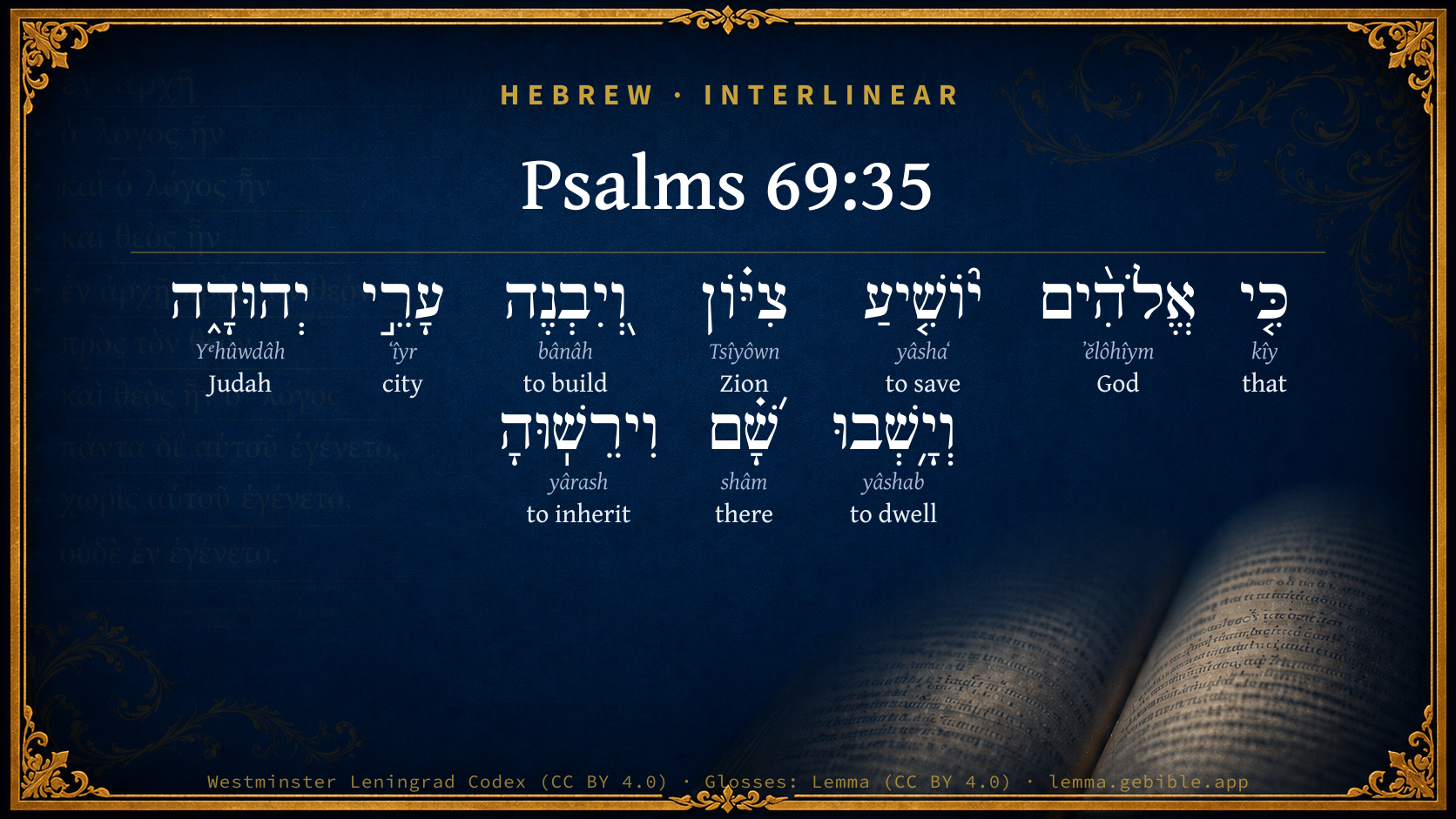
Psalms 69:35

Hebrew (Westminster Leningrad Codex) Psalms 69:35 appears in the Hebrew Old Testament. The text above is from the Westminster Leningrad Codex. Each word links to its Strong’s number, a concise gloss, and parsing drawn from the Open Scriptures Hebrew Bible morphology. Click any word for its full Brown-Driver-Briggs (BDB) entry.
Download image
Cite this verse

Psalms 69:35 (World English Bible). Public Domain. Lemma interlinear Bible study tool, https://lemma.gebible.app/v/psalms/69/35.

Show BibTeX & RIS
BibTeX
RIS
English Translation
For God will save Zion, and build the cities of Judah. They shall settle there, and own it.
World English Bible · Public Domain
Download a study sheet

One document with this verse’s original text, its word-by-word gloss line, the meaning frame, cross-references with their text, attributed commentary, and full source and license credits — printable, and it pastes into notes with its structure intact.

This verse Autodidact and up

Study sheet (.html) Plain text (.txt)

A passage Seminary Student

Up to 50 verses in one chapter. A passage sheet keeps up to 6 commentary sources and 12 cross-references per verse, in the order this page ranks them, and says so on the sheet whenever that leaves anything out. Ask for a single verse and you get the Autodidact verse sheet above.

Everything on this page stays free to read, with no account — the sheet is a download of what is already on screen, not access to it.

Want to remove ads? Support Godless Engineer
Compare translations 3

The same verse in 3 English versions, stacked beneath the original-language interlinear above. Click any original word for its lexicon entry.

Each is an independent rendering of the whole verse — the interlinear is not word-aligned to these translations.

Highlighted words mark where these versions differ — a whole-verse word diff, not a word-by-word alignment.

  • World English Bible Public Domain
    For God will save Zion, and build the cities of Judah. They shall settle there, and own it.
  • King James Version Public Domain
    For God will save Zion, and will build the cities of Judah: that they may dwell there, and have it in possession.
  • unfoldingWord Literal Text CC BY-SA 4.0
    For God will save Zion, and he will build the cities of Judah, that they may dwell there and possess it.

unfoldingWord Literal Text — © unfoldingWord, licensed CC BY-SA 4.0. Word-aligned USFM3 via Door43 (git.door43.org/unfoldingWord/en_ult).

Versions to compare (up to 4)

3 of 4 selected

Show all 18 translations

Every available English version of this verse, each an independent rendering of the whole verse.

  • World English Bible Public Domain
    For God will save Zion, and build the cities of Judah. They shall settle there, and own it.
  • Berean Standard Bible Public Domain
    For God will save Zion and rebuild the cities of Judah, that they may dwell there and possess it.
  • Majority Standard Bible Public Domain
    For God will save Zion and rebuild the cities of Judah, that they may dwell there and possess it.
  • King James Version Public Domain
    For God will save Zion, and will build the cities of Judah: that they may dwell there, and have it in possession.
  • American Standard Version (1901) Public Domain
    For God will save Zion, and build the cities of Judah; And they shall abide there, and have it in possession.
  • Revised Version (1885) Public Domain
    For God will save Zion, and build the cities of Judah; and they shall abide there, and have it in possession.
  • Geneva Bible (1599) Public Domain
    For God will saue Zion, and builde the cities of Iudah, that men may dwell there and haue it in possession.
  • Douay-Rheims (1899) Public Domain
    Let the heavens and the earth praise him; the sea, and every thing that creepeth therein.
  • Young's Literal Translation Public Domain
    For God doth save Zion, And doth build the cities of Judah, And they have dwelt there, and possess it.
  • Literal Standard Version CC BY-SA 4.0
    For God saves Zion, || And builds the cities of Judah, || And they have dwelt there, and possess it.
  • Unlocked Literal Bible CC BY-SA 4.0
    For God will save Zion and will rebuild the cities of Judah; the people will live there and have it as a possession.
  • unfoldingWord Literal Text CC BY-SA 4.0
    For God will save Zion, and he will build the cities of Judah, that they may dwell there and possess it.
  • Darby Bible Public Domain
    For God will save Zion, and will build the cities of Judah; and they shall dwell there, and possess it:
  • World Messianic Bible Public Domain
    For God will save Zion, and build the cities of Judah. They shall settle there, and own it.
  • Webster's Bible Public Domain
    \\69:34\\Let the heaven and earth praise him, the seas, and every thing that moveth therein.
  • Free Bible Version CC BY-SA 4.0
    For God will save Zion, and rebuild the cities of Judah. They will live there and own the land.
  • Bible in Basic English Public Domain
    For God will be the saviour of Zion, and the builder of the towns of Judah; so that it may be their resting-place and heritage.
  • JPS Tanakh (1917) Public Domain
    (69-36) For God will save Zion, and build the cities of Judah; and they shall abide there, and have it in possession.

Literal Standard Version (2020), Covenant Press — licensed CC BY-SA 4.0. Text via the HelloAO Bible API (eBible.org). Unlocked Literal Bible (unfoldingWord) — licensed CC BY-SA 4.0. Text via the HelloAO Bible API (eBible.org). unfoldingWord Literal Text — © unfoldingWord, licensed CC BY-SA 4.0. Word-aligned USFM3 via Door43 (git.door43.org/unfoldingWord/en_ult). Free Bible Version, Dr. Jonathan Gallagher — licensed CC BY-SA 4.0. Text via the HelloAO Bible API (eBible.org).

Word by word

More ways to search: Search by grammar → Find every occurrence → Compare this word →

Practice this passage: Drill this verse → Learn its vocabulary →

About this verse

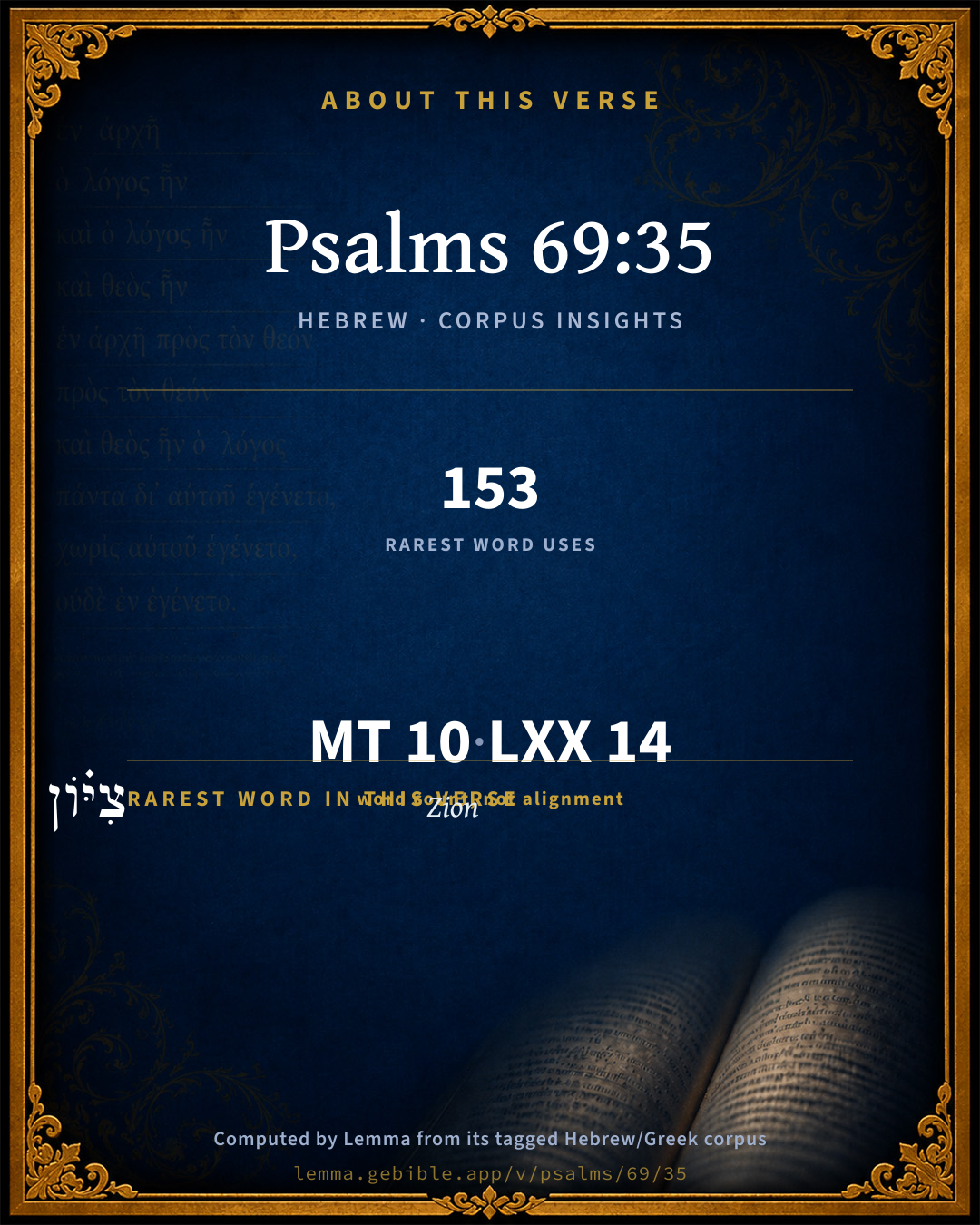
These counts appear in no published source. They are computed here, from the morphology-tagged text and Lemma’s own curated glosses. What Lemma adds →

10
words
10
distinct lemmas
Wisdom
section

Grammatical profile

  • 4 verbs
  • 4 nouns
  • 1 conjunction
  • 1 adverb

Verb forms

  • י֘וֹשִׁ֤יעַ Hiphil · Imperfect
  • וְ֭יִבְנֶה Qal · Imperfect
  • וְיָ֥שְׁבוּ Qal · Sequential Perfect
  • וִירֵשֽׁוּהָ Qal · Sequential Perfect

Hebrew & Septuagint length

In English translation the verse runs 18 words from the Hebrew and 21 from the Septuagint (LXX English) — closely comparable.

A rough comparison of the two English renderings, which tokenize alike — not a word-level alignment.

Word counts can differ between the Hebrew and the Greek without any difference in meaning — e.g. the Hebrew direct-object marker אֵת has no separate Greek word, and Greek often adds the article ὁ.

In the original languages it is 10 Hebrew tokens and 14 Greek tokens — but the two are counted differently (Hebrew bundles its prefixes and suffixes into one token; the Greek is in lemma form), so that isn’t a like-for-like length.

Cross-references

12

Topical passages linked to Psalms 69:35 in the Treasury of Scripture Knowledge — connected by theme and wording, ordered by reader-vote popularity; previews shown in the World English Bible.

  • Isaiah 44:26 who confirms the word of his servant, and performs the counsel of his messengers; who says of Jerusalem, She shall be inhabited; and of the cities of Judah, They shall be built, and I will raise up the waste places of it;
  • Psalms 51:18 Do well in your good pleasure to Zion. Build the walls of Jerusalem.
  • Isaiah 46:13 I bring near my righteousness, it shall not be far off, and my salvation shall not wait; and I will place salvation in Zion for Israel my glory.
  • Psalms 48:11–13 Let Mount Zion be glad! Let the daughters of Judah rejoice, Because of your judgments.
  • Psalms 102:16 For Yahweh has built up Zion. He has appeared in his glory.
  • Obadiah 1:17 But in Mount Zion, there will be those who escape, and it will be holy. The house of Jacob will possess their possessions.
  • Ezekiel 36:35–36 They shall say, This land that was desolate is become like the garden of Eden; and the waste and desolate and ruined cities are fortified and inhabited.
  • Revelation 14:1 I saw, and behold, the Lamb standing on Mount Zion, and with him a number, one hundred forty-four thousand, having his name, and the name of his Father, written on their foreheads.
  • Psalms 102:13 You will arise and have mercy on Zion; For it is time to have pity on her. Yes, the set time has come.
  • Psalms 147:12–13 Praise Yahweh, Jerusalem! Praise your God, Zion!
  • Isaiah 14:32 What then shall one answer the messengers of the nation? That Yahweh has founded Zion, and in her shall the afflicted of his people take refuge.
  • Jeremiah 33:10–11 Thus says Yahweh: Yet again there shall be heard in this place, about which you say, It is waste, without man and without animal, even in the cities of Judah, and in the streets of Jerusalem, that are desolate, without man and without inhabitant and without animal,

Cross-references courtesy of OpenBible.info (CC BY 4.0).

Hebrew and Greek witnesses Masoretic Hebrew ↔ Greek Septuagint

The same verse in the two great witnesses to the Old Testament, shown verse-for-verse.

You’re reading Greek Psalm 68 (Hebrew Psalm 69). The Septuagint counts the superscription, so verse numbers can differ from the Hebrew — chapter-level alignment, not verse-by-verse. Numbering follows Rahlfs.

These are two independent witnesses, not word-aligned to each other, and the Septuagint is shown in lemma (dictionary) form.

Hebrew Psalms 69:35 Masoretic · Westminster Leningrad Codex

כִּ֤י אֱלֹהִ֨ים י֘וֹשִׁ֤יעַ צִיּ֗וֹן וְ֭יִבְנֶה עָרֵ֣י יְהוּדָ֑ה וְיָ֥שְׁבוּ שָׁ֝֗ם וִירֵשֽׁוּהָ

For God will save Zion, and build the cities of Judah. They shall settle there, and own it.

World English Bible · Public Domain

Greek LXX Greek Psalm 68:35 Septuagint · lemma form

αἰνέω αὐτός ὁ οὐρανός καί ὁ γῆ θάλασσα καί πᾶς ὁ ἕρπω ἐν αὐτός

For God will save Sion, and the cities of Judea shall be built; and men shall dwell there, and inherit it.

LXX2012 (modern English Septuagint) · Public Domain

Hebrew: Westminster Leningrad Codex (CC BY 4.0). Greek: Septuagint (public domain); English from LXX2012 (modern English Septuagint) (Public Domain). How the Septuagint differs from the Hebrew →

Commentary

Notes on Psalms 69:35 from classic Christian and Jewish commentators (each source and its license shown beneath its notes). The classic Christian expositions comment on the surrounding passage and are grouped to its opening verse, so a note may address several verses; the Jewish commentaries on the Tanakh (Rashi and others) are per-verse, so they appear only where the commentator wrote on this verse.

Lemma curates 59 commentaries, every one of them public domain or Creative Commons licensed, each selected and text-cleaned for this edition rather than reprinted as found. About our sources →

Adam Clarke's Commentary

Verse 35. God will save Zion] This fixes the Psalm to the time of the captivity. There was no Zion belonging to the Jews in the time of Saul, when those suppose the Psalm to be written who make David the author; for David after he came to the throne, won the stronghold of Zion from the Jebusites. 2Sa 5:7; 1Ch 11:5.

Will build the cities of Judah] This refers to the return from the captivity, when all the destroyed cities should be rebuilt, and the Jews repossess their forfeited heritages. Some apply this to the redemption of the human race; and suppose that Zion is the type of the Christian Church into which the Gentiles were to be called. What evangelists and apostles apply to our Lord, we safely may. What others see so clearly in this Psalm relative to Gospel matters, I cannot discern.

ANALYSIS OF THE SIXTY-NINTH PSALM

There are three parts in this Psalm: -

I. The psalmist's prayer, and the reasons for it, Ps 69:1-21.

II. Declaration of God's judgments against his enemies, Ps 69:22-28.

III. His profession of thanks, Ps 69:29-36.

I. His prayer: "Save me, O God!" And then his reasons.

1. His present condition: "The waters are come in unto my soul."

2. "I sink in deep mire."

3. "I am come into deep waters."

4. "I am weary of my crying."

5. "My throat is dried" with calling on thee.

6. "Mine eyes fail while I wait for my God."

When he considered his enemies, he found reason to cry. They were,

1. Malicious: "They hate me without a cause."

2. Numerous: "More than the hairs of my head."

3. Powerful: "My enemies are mighty," Ps 69:1-4.

1. He declares his innocence with respect to their accusations, and the oppression he suffered: "I restored that which I took not away."

2. Begs to be heard, lest he should be confounded before his enemies.

3. Shows that he suffers for God's cause.

4. He was zealous for the Divine worship.

5. He was a deep penitent.

On which account he was a subject of reproach: -

1. To the high - those who sat in the gate.

2. To the low and base: "I was the song of the drunkards."

He renews his petition, and presses on God to hear him: -

1. Because of his being ready to sink. Ps 69:13-15.

2. Because of God's goodness, mercy, and truth: "In the multitude of thy mercies," c.

3. Because he was God's servant, and would not desert his Master.

4. Because of his enemies, who would have a sinful triumph if he was not delivered.

And he pleads their ill usage as a reason why God should help him.

1. They were scorners, and God knew it: "They are all before thee," Ps 69:19.

2. Reproach had almost broken his heart.

3. His friends had abandoned him, Ps 69:20.

4. His enemies were inhuman: "They gave me gall," &c., Ps 69:22.

II. Prophetic declaration of God's judgments against them: -

1. Their "table should be a snare to them," Ps 69:22.

2. They should be given up to judicial blindness, Ps 69:23.

3. They should be enfeebled in their bodies: "Make their loins shake," Ps 69:23.

4. God's "wrath should be poured out upon them," Ps 69:24.

5. Their country should be wasted, Ps 69:25.

6. They should have the punishment due to their iniquity, Ps 69:27.

7. They should come to an untimely death: "Let them be blotted out," Ps 69:28.

III. His profession of thanks. Having spoken of his own condition, that he was poor and sorrowful, he now breaks out into praise: -

1. "I will praise the name of God," Ps 69:30.

2. This will be the most acceptable sacrifice, Ps 69:31.

The effect of his deliverance would be double: -

1. It would "gladden the poor," Ps 69:32 Ps 69:33.

2. All "creatures would take an interest in it," Ps 69:34. All shall praise God.

And for this he gives the following reasons: -

1. God's goodness to his Church: "He will save Zion."

2. He will confirm his kingdom among them: "He will build," &c.

3. They shall have peace and security: "That they may dwell there, and have it in possession," Ps 69:35.

4. All that love his name should have it perpetually, Ps 69:36.

The cruel, the oppressor, the scorner, the irreligious, the hypocrite, shall have nothing of God's approbation here, and shall be excluded from his heavenly kingdom for ever.

Adam Clarke's Commentary on the Bible (1810–1826) — public domain. Text from a community e-Sword/MySword module.

Trapp's Complete Commentary

John Trapp

Psa 69:35 For God will save Zion, and will build the cities of Judah: that they may dwell there, and have it in possession.

Ver. 35. For God will save Zion] i.e. The Church universal.

And will build the cities] The particular Churches.

That they may dwell there] viz. The seed of his servants, Psa 69:36.

John Trapp, A Commentary or Exposition upon All the Books of the Old and New Testament (1647–1656) — public domain. Text from a community e-Sword module.

J. A. Alexander on Psalms

Joseph Addison Alexander

36. (Psa 69:35). For God will save Zion, and will build the cities of Judah, and they shall dwell in them and possess them. He who is thus faithful to the the individual believer must be faithful to the whole church. It is characteristic of the ancient saints to regard every personal mercy as a pledge of greater favours to the body of God's people. This is peculiarly appropriate in such a case as this, where the words are those of an ideal person representing a whole class, and that a class including, as its most conspicuous member, the Messiah himself. There is no need of supposing an allusion, either prophetical or historical, to the restoration of the Jews from Babylon, the rather as the temple is referred to in Psa 69:9, as still standing. They in the last clause are the poor of Psa 69:33, i.e. the righteous or God's people.

Joseph Addison Alexander, The Psalms Translated and Explained (1850) — public domain. Text from a community e-Sword module.

The Cambridge Bible for Schools and Colleges

gen. ed. J. J. S. Perowne

35. So Jeremiah couples ‘Jerusalem and the cities of Judah,’ Psa_33:10 ff., Psa_34:7 : and the prediction of restoration corresponds to the prophecies collected in his ‘Book of Consolation,’ chaps, 30–33. The language does not presume that Jerusalem was already in ruins, any more than do those prophecies.

that they may dwell there] Better, and men shall abide there.

The Cambridge Bible for Schools and Colleges (gen. ed. J. J. S. Perowne; Cambridge University Press, 1878–1918) — public domain. Text from a community e-Sword module.

John Gill's Exposition

For God will save Zion,.... The church of Christ, as it is often called; See Gill on Psa 2:6; this is to be understood not so much of the salvation of the people of God, by Christ, from sin and Satan, and the world, law, hell, and death, as of the preservation and continuance of the Gospel church state, notwithstanding all the opposition and persecution of the Jews and Gentiles; and especially of the deliverance of the Lord's people, in the latter day, from the cruelty, captivity, and bondage of antichrist, by the destruction of him; which will occasion joy and praise, Rev 18:4;

and will build the cities of Judah: erect Gospel churches in the Roman empire, and in the several parts of the world; as were in the first times of the Gospel, and will be in the latter day, when the cities of God shall be yet spread abroad through prosperity, Zac 1:17; of which the saints are citizens, and enjoy in them many privileges and immunities: these may be said to be "built", when they are built upon Christ, and on their most holy faith; when the members of them are edified and multiplied; when purity of faith, discipline, and worship, prevails among them; and though this is usually by the ministers of the Gospel, as instruments, yet the Lord is the chief builder; for, unless he builds, in vain do the builders build, Psa 127:1;

that they may dwell there, and have it in possession; the men of Judah, such as confess the name of Christ, as the word "Judah" signifies; who profess to believe in him with their hearts; these have a name and a place, and an inheritance in the churches, and an abiding one; they shall never go out, but dwell in the house of God for ever; Gospel churches being erected and built up for their sakes, and for such ends and purposes.

John Gill's Exposition of the Whole Bible (1746–1763) — public domain (CC PDM 1.0). Text via the HelloAO Bible API.

Albert Barnes' Notes on the Bible

For God will save Zion - See the notes at Psa 51:18. That is, he will save his people; he will protect and defend them. This expresses the confident assurance of the psalmist that, whatever might be the existing troubles, God would not forsake his people, but would interpose in their behalf.

And will build the cities of Judah - Though they may now lie waste, or be desolate. See the notes at Psa 51:18. The general idea here is, that God would be favorable to his land; that he would give success and prosperity to his people; that he would manifest his mercy to them. There is no necessity from the language used here to suppose, as DeWette and Rosenmuller do, that there is an allusion to the time of the exile, and to the restoration of the Jews from Babylon, and that consequently either the whole psalm must have been composed at that time - or (as Rosenmuller supposes) that the last verses of the psalm were added by a later hand, and that thus the whole psalm was adapted to the time of the exile. From Psa 69:9 it would seem that, when the psalm was composed, the place of public worship was still standing, and the language here, as in Psa 51:18, is so general that it might have been employed at any time.

That they may dwell there ... - That his people may dwell there according to the ancient promise. The idea is, that he would be the protector of his people, and that all his promises to them would be fulfilled.

Albert Barnes' Notes on the Bible (1834–1885) — public domain. Text from a community e-Sword/MySword module.

Matthew Poole's English Annotations

Zion; the city of Zion or Jerusalem; and his church and people, which are frequently expressed under that title.

They; the humble and poor, Psa 69:32,33, or his servants, as is explained in the following verse.

Dwell there; in the literal Canaan for a long time, and in the heavenly Canaan for ever.

Matthew Poole's English Annotations on the Holy Bible (1683–1685) — public domain. Text from a community e-Sword/MySword module.

The Treasury of David

Charles H. Spurgeon

Ver. 35. For God will save Zion, and will build the cities of Judah. Poor, fallen Israel shall have a portion in the mercy of the Lord; but, above all, the church, so dear to the heart of her glorious bridegroom, shall be revived and strengthened. Ancient saints so dearly loved Zion, that even in their distresses they did not forget her; with the first gleam of light which visited them, they fell to pleading for the faithful: see notable instances of this which have passed under our eye already. Ps 5:11 14:7 22:23 51:18. To us, in these modern times, it is the subject of cheering hope that better days are coming for the chosen people of God, and for this we would ever pray. O Zion, whatever other memories fade away, we cannot forget thee.

That they may dwell there, and have it in possession. Whatever captivities may occur, or desolations be caused, the land of Canaan belongs to Israel by a covenant of salt, and they will surely repossess it; and this shall be a sign unto us, that through the atonement of the Christ of God, all the poor in spirit shall enjoy the mercies promised in the covenant of grace. The sure mercies of David shall be the heritage of all the seed.

None.

Ver. 35. Salvation, edification, preservation, peace, full assurance.

Ver. 35-36. Observe the sequence: --"Save, ""build, ""dwell and have, ""inherit, ""love and dwell."

Psalms 69:36*

Ver. 35-36. Observe the sequence: --"Save, ""build, ""dwell and have, ""inherit, ""love and dwell."

Charles H. Spurgeon's The Treasury of David (1869–1885) — public domain. Psalms only. Text from a community e-Sword/MySword module.

Whedon's Commentary on the Bible

Daniel D. Whedon

35. God will save Zion—Despite the roaring, threatening tumult of rebellion. This verse of itself suits well enough the perilous times of Jeremiah, and not less the time of David, who uses the same language at a time when his capital and chief cities stood in their strength, as in Psa_51:18. It cannot, therefore, be urged, as some do, against the Davidic origin of the psalm.

Daniel D. Whedon (gen. ed.), Commentary on the Old and New Testaments (1874–1909) — public domain. Text from a community e-Sword module.

The Pulpit Commentary

For God will save Zion. It is not necessary to suppose that Jerusalem was in any immediate danger. The psalmist merely means that the same God from whom he now confidently expects deliverance will always watch over his city, over his people, over his inheritance, and whenever danger threatens, will exert his protecting power and save. Prophecies of this kind are always conditional, and thus Zion, when she rejected God for idols, (2Ch_36:14) and again when she rejected him for Barabbas, (Mat_27:21) forfeited the promised blessing of continuance, and brought about her own destruction. And will build the cities of Judah; i.e. maintain them, keep them from decay and ruin. That they may dwell there; i.e. continue to inhabit the cities. And have it (i.e. Zion, or Jerusalem) in possession.

The Pulpit Commentary (1880–1919), ed. H.D.M. Spence-Jones & Joseph S. Exell — public domain. Text from a community e-Sword module.

John Wesley's Explanatory Notes

Sion - His church and people. They - His servants, as is explained in the following verse. There - In the literal Canaan for a long time, in the heavenly Canaan forever.

John Wesley, Explanatory Notes Upon the Whole Bible (1754–1765) — public domain. Text via the GEBible commentary corpus.

Lesson kit

Teaching starters — assembled from the data on this page, not authored interpretation. Every prompt links to the verse data it draws on. Edit before teaching.

Psalms, in the Wisdom, opens this verse with 10 words (10 distinct Hebrew lemmas). Its most distinctive word is Tsîyôwn (“Zion”). A historical commentator’s framing appears above. Read the whole chapter for the surrounding context.

Discussion questions

  1. What does “Zion” (Tsîyôwn) contribute to the verse as a whole?
  2. How does Isaiah 44:26, which shares this passage’s theme, read alongside this verse?
  3. These translations render this verse differently; the difference is in the English rendering, not the original. What questions does that raise?
  4. «י֘וֹשִׁ֤יעַ» is a Hiphil Imperfect verb. How does that grammatical form shape the action described?
  5. Compare how Adam Clarke's Commentary and Trapp's Complete Commentary read this verse. Where do they agree or differ?

Things to notice

Reading settings

Reading text

Shown beneath each verse's original-language words.

Old Testament
Old Testament edition

Read the OT as the Masoretic Hebrew (MT) or the Greek Septuagint (LXX).

English shown for the Greek Septuagint (in the Hebrew ↔ Greek comparison).

Comparing translations? Open the Compare panel on any verse page to stack up to four side by side.