Psalms 37:28

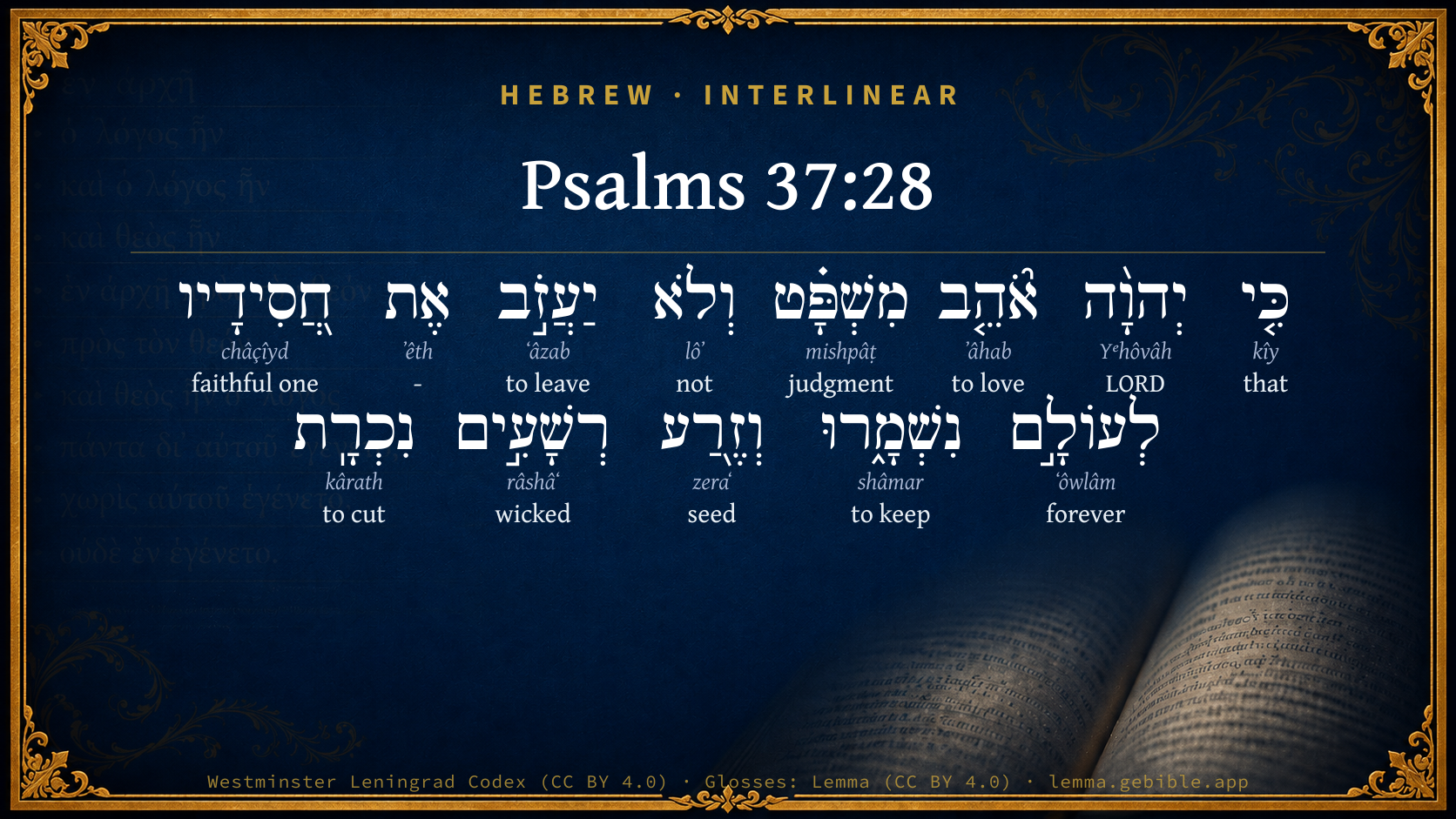
Hebrew (Westminster Leningrad Codex) Psalms 37:28 appears in the Hebrew Old Testament. The text above is from the Westminster Leningrad Codex. Each word links to its Strong’s number, a concise gloss, and parsing drawn from the Open Scriptures Hebrew Bible morphology. Click any word for its full Brown-Driver-Briggs (BDB) entry.
Download image
Cite this verse

Psalms 37:28 (World English Bible). Public Domain. Lemma interlinear Bible study tool, https://lemma.gebible.app/v/psalms/37/28.

Show BibTeX & RIS
BibTeX
RIS
English Translation
For Yahweh loves justice, And doesn't forsake his saints. They are preserved forever, But the children of the wicked shall be cut off.
World English Bible · Public Domain
Download a study sheet

One document with this verse’s original text, its word-by-word gloss line, the meaning frame, cross-references with their text, attributed commentary, and full source and license credits — printable, and it pastes into notes with its structure intact.

This verse Autodidact and up

Study sheet (.html) Plain text (.txt)

A passage Seminary Student

Up to 50 verses in one chapter. A passage sheet keeps up to 6 commentary sources and 12 cross-references per verse, in the order this page ranks them, and says so on the sheet whenever that leaves anything out. Ask for a single verse and you get the Autodidact verse sheet above.

Everything on this page stays free to read, with no account — the sheet is a download of what is already on screen, not access to it.

Want to remove ads? Support Godless Engineer
Compare translations 3

The same verse in 3 English versions, stacked beneath the original-language interlinear above. Click any original word for its lexicon entry.

Each is an independent rendering of the whole verse — the interlinear is not word-aligned to these translations.

Highlighted words mark where these versions differ — a whole-verse word diff, not a word-by-word alignment.

  • World English Bible Public Domain
    For Yahweh loves justice, And doesn't forsake his saints. They are preserved forever, But the children of the wicked shall be cut off.
  • King James Version Public Domain
    For the LORD loveth judgment, and forsaketh not his saints; they are preserved for ever: but the seed of the wicked shall be cut off.
  • unfoldingWord Literal Text CC BY-SA 4.0
    For Yahweh is loving justice, and he will not abandon his faithful. Forever they are preserved, but the offspring of the wicked will be cut off.

unfoldingWord Literal Text — © unfoldingWord, licensed CC BY-SA 4.0. Word-aligned USFM3 via Door43 (git.door43.org/unfoldingWord/en_ult).

Versions to compare (up to 4)

3 of 4 selected

Show all 18 translations

Every available English version of this verse, each an independent rendering of the whole verse.

  • World English Bible Public Domain
    For Yahweh loves justice, And doesn't forsake his saints. They are preserved forever, But the children of the wicked shall be cut off.
  • Berean Standard Bible Public Domain
    For the LORD loves justice and will not forsake His saints. They are preserved forever, but the offspring of the wicked will be cut off.
  • Majority Standard Bible Public Domain
    For the LORD loves justice and will not forsake His saints. They are preserved forever, but the offspring of the wicked will be cut off.
  • King James Version Public Domain
    For the LORD loveth judgment, and forsaketh not his saints; they are preserved for ever: but the seed of the wicked shall be cut off.
  • American Standard Version (1901) Public Domain
    For Jehovah loveth justice, And forsaketh not his saints; They are preserved for ever: But the seed of the wicked shall be cut off.
  • Revised Version (1885) Public Domain
    For the LORD loveth judgment, and forsaketh not his saints; they are preserved for ever: but the seed of the wicked shall be cut off.
  • Geneva Bible (1599) Public Domain
    For the Lord loueth iudgement, and forsaketh not his Saintes: they shall be preserued for euermore: but the seede of the wicked shall be cut off.
  • Douay-Rheims (1899) Public Domain
    For the Lord loveth judgment, and will not forsake his saints: they shall be preserved for ever. The unjust shall be punished, and the seed of the wicked shall perish.
  • Young's Literal Translation Public Domain
    For Jehovah is loving judgment, And He doth not forsake His saintly ones, To the age they have been kept, And the seed of the wicked is cut off.
  • Literal Standard Version CC BY-SA 4.0
    For YHWH is loving judgment, || And He does not forsake His saintly ones, || They have been kept for all time, || And the seed of the wicked is cut off.
  • Unlocked Literal Bible CC BY-SA 4.0
    For Yahweh loves justice and does not abandon his faithful followers. They are preserved forever, but the descendants of the wicked will be cut off.
  • unfoldingWord Literal Text CC BY-SA 4.0
    For Yahweh is loving justice, and he will not abandon his faithful. Forever they are preserved, but the offspring of the wicked will be cut off.
  • Darby Bible Public Domain
    for Jehovah loveth judgment, and will not forsake his saints: They are preserved for ever; but the seed of the wicked shall be cut off.
  • World Messianic Bible Public Domain
    For the LORD loves justice, and doesn’t forsake his holy ones. They are preserved forever, but the children of the wicked shall be cut off.
  • Webster's Bible Public Domain
    For the LORD loveth judgment, and forsaketh not his saints; they are preserved for ever: but the seed of the wicked shall be cut off.
  • Free Bible Version CC BY-SA 4.0
    For the Lord loves fairness and he will never abandon those who are trustworthy. He will protect them forever. But the children of the wicked will die.
  • Bible in Basic English Public Domain
    For the Lord is a lover of righteousness, and takes care of his saints; they will be kept safe for ever; but the seed of the evil-doers will be cut off.
  • JPS Tanakh (1917) Public Domain
    For the LORD loveth justice, and forsaketh not His saints; they are preserved for ever; but the seed of the wicked shall be cut off.

Literal Standard Version (2020), Covenant Press — licensed CC BY-SA 4.0. Text via the HelloAO Bible API (eBible.org). Unlocked Literal Bible (unfoldingWord) — licensed CC BY-SA 4.0. Text via the HelloAO Bible API (eBible.org). unfoldingWord Literal Text — © unfoldingWord, licensed CC BY-SA 4.0. Word-aligned USFM3 via Door43 (git.door43.org/unfoldingWord/en_ult). Free Bible Version, Dr. Jonathan Gallagher — licensed CC BY-SA 4.0. Text via the HelloAO Bible API (eBible.org).

Word by word

More ways to search: Search by grammar → Find every occurrence → Compare this word →

Practice this passage: Drill this verse → Learn its vocabulary →

חֲ֭סִידָיו
châçîyd
H2623
“faithful one · his”
Adjective, Adjective, Masculine, Plural, Construct + Suffix, Personal, 3rd Person, Masculine, Singular
Part of Speech
Adjective
Type
Adjective
Gender
Masculine
Number
Plural
State
Construct
Full BDB Definition

Origin: from H2616

TWOT: 698b

faithful, kind, godly, holy one, saint, pious - kind - pious, godly - faithful ones (substantive)
  1. כִּ֤י kîy H3588 “that” Conjunction
  2. יְהוָ֨ה Yᵉhôvâh H3068 “LORD” Noun, Proper
  3. אֹ֘הֵ֤ב ʼâhab H157 “loving” Verb, Qal, Participle Active, Masculine, Singular, Absolute
  4. מִשְׁפָּ֗ט mishpâṭ H4941 “judgment” Noun, Common, Masculine, Singular, Absolute
  5. וְלֹא lôʼ H3808 “and · not” Conjunction + Particle, Negative
  6. יַעֲזֹ֣ב ʻâzab H5800 “to leave” Verb, Qal, Imperfect, 3rd Person, Masculine, Singular
  7. אֶת ʼêth H853 “-” Particle, Direct Object
  8. לְעוֹלָ֣ם ʻôwlâm H5769 “to/for · forever” Preposition + Noun, Common, Masculine, Singular, Absolute
  9. נִשְׁמָ֑רוּ shâmar H8104 “to keep” Verb, Niphal, Perfect, 3rd Person, Common, Plural
  10. וְזֶ֖רַע zeraʻ H2233 “and · seed of” Conjunction + Noun, Common, Masculine, Singular, Construct
  11. רְשָׁעִ֣ים râshâʻ H7563 “wicked” Adjective, Adjective, Masculine, Plural, Absolute
  12. נִכְרָֽת kârath H3772 “to cut” Verb, Niphal, Perfect, 3rd Person, Masculine, Singular

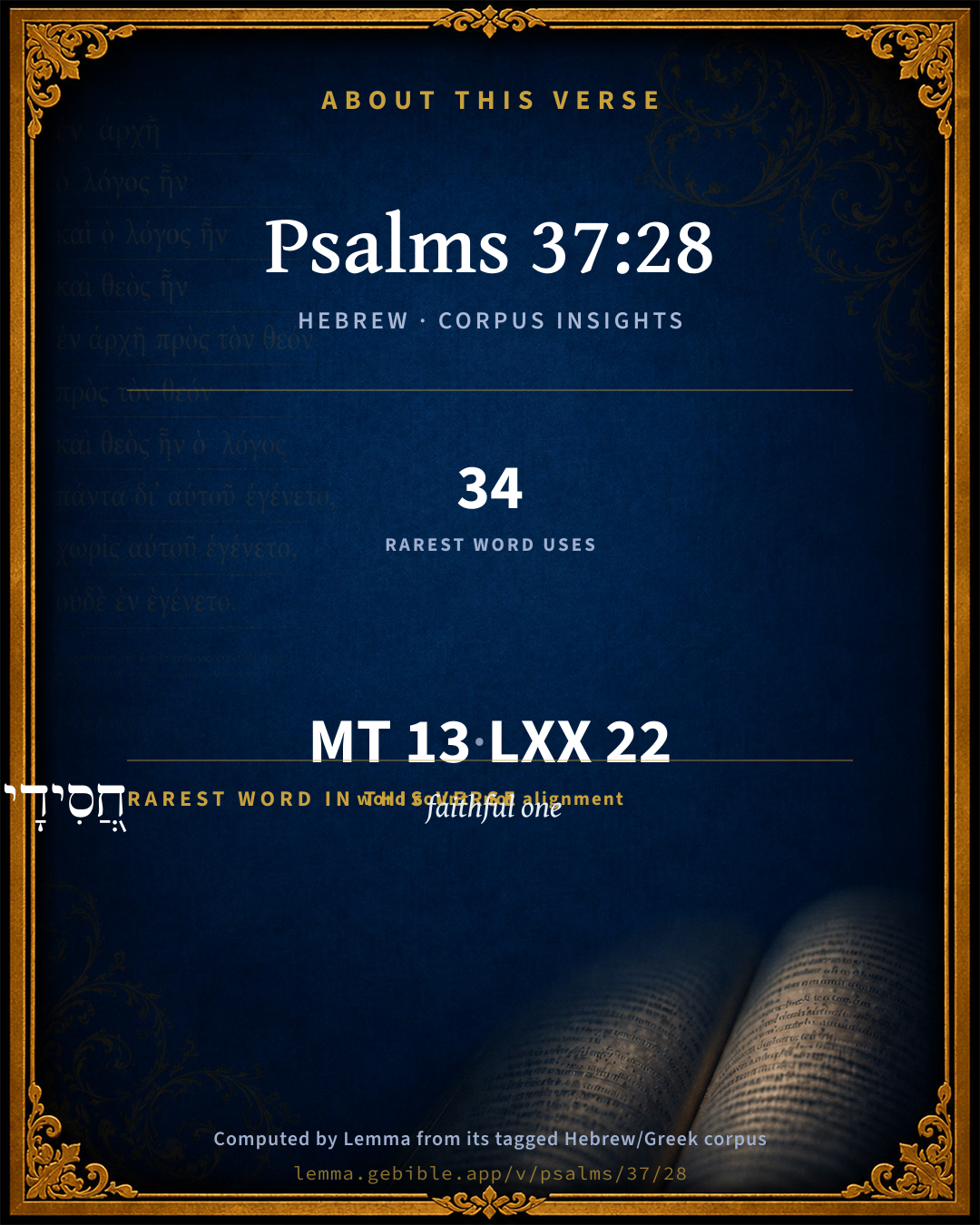
About this verse

These counts appear in no published source. They are computed here, from the morphology-tagged text and Lemma’s own curated glosses. What Lemma adds →

13
words
13
distinct lemmas
Wisdom
section

Shared distinctive vocabulary

חֲ֭סִידָיו faithful one H2623 occurs in 32 verses of the Hebrew Bible. Also found in:

Grammatical profile

  • 4 verbs
  • 4 nouns
  • 2 adjectives
  • 1 conjunction
  • 2 particles

Verb forms

  • אֹ֘הֵ֤ב Qal · Participle Active
  • יַעֲזֹ֣ב Qal · Imperfect
  • נִשְׁמָ֑רוּ Niphal · Perfect
  • נִכְרָֽת Niphal · Perfect

Hebrew & Septuagint length

In English translation the verse runs 23 words from the Hebrew and 32 from the Septuagint (LXX English) — closely comparable.

A rough comparison of the two English renderings, which tokenize alike — not a word-level alignment.

Word counts can differ between the Hebrew and the Greek without any difference in meaning — e.g. the Hebrew direct-object marker אֵת has no separate Greek word, and Greek often adds the article ὁ.

In the original languages it is 13 Hebrew tokens and 22 Greek tokens — but the two are counted differently (Hebrew bundles its prefixes and suffixes into one token; the Greek is in lemma form), so that isn’t a like-for-like length.

Cross-references

24

Topical passages linked to Psalms 37:28 in the Treasury of Scripture Knowledge — connected by theme and wording, ordered by reader-vote popularity; previews shown in the World English Bible.

  • Proverbs 2:22 But the wicked will be cut off from the land. The treacherous will be rooted out of it.
  • Psalms 11:7 For Yahweh is righteous. He loves righteousness. The upright shall see his face.
  • Psalms 21:10 You will destroy their descendants from the earth, Their posterity from among the children of men.
  • Isaiah 59:21 As for me, this is my covenant with them, says Yahweh: my Spirit who is on you, and my words which I have put in your mouth, shall not depart out of your mouth, nor out of the mouth of your seed, nor out of the mouth of your seed's seed, says Yahweh, from henceforth and forever.
  • Job 27:14 If his children are multiplied, it is for the sword. His offspring shall not be satisfied with bread.
  • Isaiah 14:20–21 You shall not be joined with them in burial, because you have destroyed your land, you have killed your people; the seed of evil-doers shall not be named forever.
  • Isaiah 61:8 For I, Yahweh, love justice, I hate robbery with iniquity; and I will give them their recompense in truth, and I will make an everlasting covenant with them.
  • 1 Peter 1:5 who by the power of God are guarded through faith for a salvation ready to be revealed in the last time.
  • Jude 1:1 Jude, a servant of Jesus Christ, and brother of James, to those who are called, sanctified by God the Father, and kept for Jesus Christ:
  • Psalms 37:40 Yahweh helps them, and rescues them. He rescues them from the wicked, and saves them, Because they have taken refuge in him.
  • Psalms 45:6–7 Your throne, God, is forever and ever. A scepter of equity is the scepter of your kingdom.
  • John 5:24 "Most assuredly I tell you, he who hears my word, and believes him who sent me, has eternal life, and doesn't come into judgment, but has passed out of death into life.
  • John 15:9 Even as the Father has loved me, I also have loved you. Remain in my love.
  • 1 John 2:19 They went out from us, but they didn't belong to us; for if they had belonged to us, they would have continued with us. But they left, that they might be revealed that none of them belong to us.
  • Jeremiah 9:24 but let him who glories glory in this, that he has understanding, and knows me, that I am Yahweh who exercises loving kindness, justice, and righteousness, in the earth: for in these things I delight, says Yahweh.
  • John 6:39–40 This is the will of my Father who sent me, that of all he has given to me I should lose nothing, but should raise him up at the last day.
  • Exodus 20:5 you shall not bow yourself down to them, nor serve them, for I, Yahweh your God, am a jealous God, visiting the iniquity of the fathers on the children, on the third and on the fourth generation of those who hate me,
  • Job 18:19 He shall have neither son nor grandson among his people, Nor any remaining where he sojourned.
  • Psalms 37:25 I have been young, and now am old, Yet I have not seen the righteous forsaken, Nor his children begging for bread.
  • Psalms 92:13–15 They are planted in Yahweh's house. They will flourish in our God's courts.
  • Psalms 99:4 The King's strength also loves justice. You do establish equity. You execute justice and righteousness in Jacob.
  • Isaiah 30:18 Therefore will Yahweh wait, that he may be gracious to you; and therefore will he be exalted, that he may have mercy on you: for Yahweh is a God of justice; blessed are all those who wait for him.
  • Jeremiah 32:40–41 and I will make an everlasting covenant with them, that I will not turn away from following them, to do them good; and I will put my fear in their hearts, that they may not depart from me.
  • John 10:28–30 I give eternal life to them. They will never perish, and no one will snatch them out of my hand.

Cross-references courtesy of OpenBible.info (CC BY 4.0).

Hebrew and Greek witnesses Masoretic Hebrew ↔ Greek Septuagint

The same verse in the two great witnesses to the Old Testament, shown verse-for-verse.

You’re reading Greek Psalm 36 (Hebrew Psalm 37). The Septuagint counts the superscription, so verse numbers can differ from the Hebrew — chapter-level alignment, not verse-by-verse. Numbering follows Rahlfs.

These are two independent witnesses, not word-aligned to each other, and the Septuagint is shown in lemma (dictionary) form.

Hebrew Psalms 37:28 Masoretic · Westminster Leningrad Codex

כִּ֤י יְהוָ֨ה אֹ֘הֵ֤ב מִשְׁפָּ֗ט וְלֹא יַעֲזֹ֣ב אֶת חֲ֭סִידָיו לְעוֹלָ֣ם נִשְׁמָ֑רוּ וְזֶ֖רַע רְשָׁעִ֣ים נִכְרָֽת

For Yahweh loves justice, And doesn't forsake his saints. They are preserved forever, But the children of the wicked shall be cut off.

World English Bible · Public Domain

Greek LXX Greek Psalm 36:28 Septuagint · lemma form

ὅτι κύριος ἀγαπάω κρίσις καί οὐ ἐν καταλείπω ὁ ὅσιος αὐτός εἰς ὁ αἰών φυλάσσω ἄνομος δέ ἐκδιώκω καί σπέρμα ἀσεβής ἐκὀλεθρεύω

For the Lord loves judgment, and will not forsake his saints; they shall be preserved for ever: the blameless shall be avenged, but the seed of the ungodly shall be utterly destroyed.

LXX2012 (modern English Septuagint) · Public Domain

On this verse, Ellicott's Commentary for English Readers discusses the Septuagint’s reading. Read the note in Commentary ↓

Hebrew: Westminster Leningrad Codex (CC BY 4.0). Greek: Septuagint (public domain); English from LXX2012 (modern English Septuagint) (Public Domain). How the Septuagint differs from the Hebrew →

Commentary

Notes on Psalms 37:28 from classic Christian and Jewish commentators (each source and its license shown beneath its notes). The classic Christian expositions comment on the surrounding passage and are grouped to its opening verse, so a note may address several verses; the Jewish commentaries on the Tanakh (Rashi and others) are per-verse, so they appear only where the commentator wrote on this verse.

Lemma curates 59 commentaries, every one of them public domain or Creative Commons licensed, each selected and text-cleaned for this edition rather than reprinted as found. About our sources →

Trapp's Complete Commentary

John Trapp

Psa 37:28 For the LORD loveth judgment, and forsaketh not his saints; they are preserved for ever: but the seed of the wicked shall be cut off.

Ver. 28. For the Lord loveth judgment] See Psa 11:7.

But the seed of the wicked shall be cut off] See Job 18:19, {See Trapp on "Job 18:19"}

John Trapp, A Commentary or Exposition upon All the Books of the Old and New Testament (1647–1656) — public domain. Text from a community e-Sword module.

The Biblical Illustrator

Joseph S. Exell

Psa_37:28

The Lord forsaketh not His saints: they are preserved for ever.

Secure property

A religion of contingencies and uncertainties deserve not the name of Christianity, and it is perfectly a misnomer to call it Christianity.

I. The property of jehovah is his saints. Not the angels, the heavens, or the earth, but His saints. I mean real, not hypocritical saints. Let me describe them a little.

1. They were once vile and full of sin: but they are transformed and they know it. They are created anew in Christ.

2. Moreover, they are consecrated, or they could not be saints, and God claims such as His own.

3. They have been eternally set apart as such: and for God Himself, as His sons, His servants, and His especial treasure. You must be a son before you can be a servant of God.

4. And they are manifestly Gods saints both in creed and in conduct.

II. The Lords unchanging love for them. He forsaketh not His saints.

III. The triumphs of his grace in them. They are preserved for ever. (Joseph Irons.)

The Biblical Illustrator, edited by Joseph S. Exell (c. 1880s–1900s) — public domain. Text from a community e-Sword module.

J. A. Alexander on Psalms

Joseph Addison Alexander

28. (Psa 37:28) For Jehovah (is) loving, he habitually loves, judgment, i.e. justice actually exercised, he doing of justice. The for assigns a reason for the strong assurance a the close of the preceding verse. No one need fear to lay hold of the promise in its widest sense; for it is not an arbitrary one, but a spontaneous expression of Goa's natural essential love of moral rectitude. And, as a necessary consequence of this, he will not forsake his gracious ones, the objects of his grace or favour. For the true sense of the Hebrew word, see above, on Psa 4:4 (3), Psa 12:2 (1), Psa 18:26 (25), Psa 30:5 (4), Psa 31:24 (23.) Those whom he once favours he will not forsake. For ever, to eternity, they are kept, kept safe, preserved. The past tense of the verb is peculiarly appropriate to describe their preservation as already secured. So certain is it, that he seems to look back upon the future as already past, and says, they have been kept for ever. Here again, although a Jewish reader might have been inclined to put a lower sense upon for ever, as denoting nothing more than permanency in contrast with the fluctuations of secular prosperity, it is neither right nor possible for us to give it any but its strongest and its most extensive application. (See above, on Psa 37:18, and compare 1Pe 1:5.—Equally certain is the fate of the ungodly: And the seed of wicked men (is) cut off, has already been cut off, in the divine prescience and purpose, from all participation in the blessings of the righteous. See above, on Psa 37:22.

Joseph Addison Alexander, The Psalms Translated and Explained (1850) — public domain. Text from a community e-Sword module.

Adam Clarke's Commentary

Verse 28. Forsaketh not his saints] את חטידיו eth chasidaiv, his merciful or compassionate ones; those who, through love to him and all mankind, are ever ready to give of their substance to the poor.

But the seed of the wicked shall be cut off.] The children who follow the wicked steps of wicked parents shall, like their parents, be cut off. God's judgments descend to posterity, as well as his mercies.

Adam Clarke's Commentary on the Bible (1810–1826) — public domain. Text from a community e-Sword/MySword module.

John Calvin's Commentaries

28 For Jehovah loveth judgement. This, it ought to be observed, is a confirmation of the doctrine contained in the preceding sentence; and it is here made to rest upon a higher principle, namely, that God takes pleasure in righteousness and truth. The argument indeed appears to be incomplete; but as David takes for granted — what ought to be deeply fixed in the hearts of all the faithful — that the world is directed by the providence of God, his conclusion is admirable. In the first place, then, it must be admitted that the condition of the human race is not under the direction of chance, but of the providence of God, and that the world is conducted and governed by his counsel: so that he regulates according to his pleasure the issue of all things, and controls them by his power; and, secondly, to this it must be added what David here states, that righteousness and truth are pleasing to God. Hence it follows, that all who lead an upright and blameless life among men shall be happy, because, enjoying the favor of God, every thing at length must in regard to them have a happy and successful result. But let us bear in mind, that the promise which is spoken of in this verse is to be understood in this sense, that while God has undertaken the preservation of the godly, it is not to cherish them continually in retirement and ease, but after he has for a time exercised them under the cross, at length to come to their help: for the language here employed, Jehovah forsaketh not his meek ones, is tacitly very emphatic. Those, therefore, who separate the exercise of patience from the favor which God bestows upon the godly in this life, misinterpret this psalm. On the contrary, lest any one should hastily and rashly pronounce judgment, the prophet entreats the faithful to suspend their judgment, until God manifest his displeasure after the death of the wicked, in inflicting punishment upon their posterity: The seed of the wicked shall be cut off This is of the same import as if he had again asserted, that although the judgements of God are not immediately executed upon the wicked and ungodly, yet they are not on that account anything the better of it, since the punishment justly due to them will extend to their children. If then the curse of God is not forthwith inflicted upon them, it need not surprise us if he delay for a time to manifest the favor which he bears towards the faithful.

John Calvin's Commentaries (1540-1563) — public domain. Text from the Calvin Translation Society English edition (1840s-50s) via the Christian Classics Ethereal Library (ccel.org). Calvin's coverage is partial (roughly two-thirds of the Bible); uncommented books and verses are honest gaps, never fabricated. The 19th-century editor's footnotes and remarks are omitted so the notes are faithfully Calvin's own voice.

Ellicott's Commentary for English Readers

(28) For the Lord.—In the Hebrew the stanza that should begin with the letter ayin is wanting, but may be restored by a very slight change, to agree with the Codex Alex., of the LXX., the Vulg. and Symmachus. “The unjust shall be punished.”

Probably the transcriber was misled by the tsaddê of the next verse, since that letter and ayin were often interchanged. (See Note, Psa_34:14.)

A Bible Commentary for English Readers, edited by Charles John Ellicott (1878–1897) — public domain. Text from a community e-Sword module.

John Gill's Exposition

The righteous shall inherit the land,.... See Gill on Psa 37:9 and See Gill on Psa 37:11;

and dwell therein for ever; See Gill on Psa 37:27.

John Gill's Exposition of the Whole Bible (1746–1763) — public domain (CC PDM 1.0). Text via the HelloAO Bible API.

Albert Barnes' Notes on the Bible

For the Lord loveth judgment - That is, God loves that which is right; he loves to do right. The idea is, that such a recompense as is here adverted to - that on the one hand, in rewarding with prosperity a pure and upright life - and that, on the other, in cutting off the wicked - is right and proper in itself; and that as God loves to do right, these consequences respectively may be expected to follow in regard to the righteous and the wicked. Compare Psa 11:7.

And forsaketh not his saints - He manifests his sense of that which is right, by not forsaking His saints.

They are preserved forever - They are ever under his paternal eye, and he will keep them. It will be literally true that they will be preserved “forever,” that they will never be suffered to perish.

But the seed of the wicked shall be cut off - See the notes at Psa 21:10. Compare Psa 37:22.

Albert Barnes' Notes on the Bible (1834–1885) — public domain. Text from a community e-Sword/MySword module.

Matthew Poole's English Annotations

Judgment, i.e. just judgment, or righteousness, as that word is oft taken, as hath been showed again and again; either,

1. In himself, i.e. he loveth to execute judgment upon the wicked, and for the righteous; which he doth in the manner expressed in this Psalm. Or,

2. In the righteous themselves, whose justice, and piety, and charity he sees and loves, and will reward it.

His saints; or, his favourites; or, they to whom he hath a good will; or, his bountiful ones, who exercise benignity and charity to others.

Matthew Poole's English Annotations on the Holy Bible (1683–1685) — public domain. Text from a community e-Sword/MySword module.

The Treasury of David

Charles H. Spurgeon

Ver. 28. For the Lord loveth judgment. The awarding of honour to whom honour is due is God's delight, especially when the upright man has been traduced by his fellow men. It must be a divine pleasure to right wrongs, and to defeat the machinations of the unjust. The great Arbiter of human destinies is sure to deal out righteous measure both to rich and poor, to good and evil, for such judgment is his delight. And forsaketh not his saints. This would not be right, and, therefore, shall never be done. God is as faithful to the objects of his love as he is just towards all mankind. They are preserved for ever. By covenant engagements their security is fixed, and by suretyship fulfilments that safety is accomplished; come what may, the saints are preserved in Christ Jesus, and because he lives, they shall live also. A king will not lose his jewels, nor will Jehovah lose his people. As the manna in the golden pot, which else had melted, was preserved in the ark of the covenant beneath the mercyseat, so shall the faithful be preserved in the covenant by the power of Jesus their propitiation. But the seed of the wicked shall be cut off. Like the house of Jeroboam and Ahab, of which not a dog was left. Honour and wealth ill gotten seldom reach the third generation; the curse grows ripe before many years have passed, and falls upon the evil house. Among the legacies of wicked men the surest entail is a judgment on their family.

Ver. 28. For the Lord...forsaketh not his saints; they are preserved for ever. How? since they die as others do. Mark the antithesis, and that will explain it. They are preserved for ever: but the seed of the wicked shall be cut off. They are preserved in their posterity: children are but the parents multiplied, and the parents continued; it is nodosa aeternitas; when the father's life is run out to the last, there is a knot tied, and the line is still continued by the child. I confess temporal blessings, such as long life, and the promise of an happy posterity, are more visible in the eye of that dispensation of the covenant; but yet God still taketh care for the children of his people, and many promises run that way that belong to the gospel administration, and still God's service is the surest way to establish a family, as sin is the ready way to root it out. And if it doth not always fall out accordingly, yet for the most part it doth; and we are no competent judges of God's dispensations in this kind, because we see providence by pieces, and have not the skill to set them together; but at the day of judgment, when the whole contexture of God's dealings is laid before us, we shall clearly understand how the children of his servants continue, and their seed is established. Ps 102:28. Thomas Manton.

Ver. 28.

1. The Lord's love of right.

2. His faithfulness to the righteous.

3. Their sure preservation thus doubly guaranteed.

4. The doom of the wicked thus certified.

Psalms 37:29*

Charles H. Spurgeon's The Treasury of David (1869–1885) — public domain. Psalms only. Text from a community e-Sword/MySword module.

The Pulpit Commentary

For the Lord loveth judgment. (comp. Psa_11:7) "Judgment fpvm is here "justice," "righteousness;" as in Psa_33:5 Psa_99:4 Psa_103:6, etc. And forsaketh not his saints. (see ver. 25; and comp. Isa_41:17 Isa_42:16, etc.) They are preserved for ever. Something has probably fallen out at the commencement of this line, which ought to begin with the letter ain. But the seed of the wicked shall be out off. The wicked shall perish, not only in their own persons, but in their posterity, who shall be "cut off from the land of the living", (Isa_53:8) and have "their name blotted out". (Psa_109:13)

The Pulpit Commentary (1880–1919), ed. H.D.M. Spence-Jones & Joseph S. Exell — public domain. Text from a community e-Sword module.

unfoldingWord translationNotes

Door43 World Missions Community

They are preserved forever

This can be stated in active form. AT: "Yahweh will protect them forever" (See: Active or Passive)

will be cut off

The destruction of the wicked is spoken of as if they were a branch of plant that was cut off and thrown away. See how you translated this in Psalms 37:9. (See: Metaphor)

the righteous

This refers to the people who are righteous. AT: "the righteous people" (See: Nominal Adjectives)

will inherit the land

The possession of the land is spoken of as if it had been received as an inheritance. See how you translated this in Psalms 37:9. AT: "will receive the land as their own possession" or "will be allowed to live safely in the land" (See: Metaphor)

The mouth of the righteous person

Here "mouth" represents the whole person who speaks. AT: "The righteous person" (See: Synecdoche)

speaks wisdom

The abstract noun "wisdom" can be stated as "wise." AT: "gives wise advice to others" (See: Abstract Nouns)

increases justice

The abstract noun "justice" can be stated as an action. AT: "encourages other people to live rightly" (See: Abstract Nouns)

translationWords

love

just

faithful

eternity

descend

cut off

righteous

life

wise

unfoldingWord translationNotes — © Distant Shores Media and the Door43 World Missions Community, licensed CC BY-SA 4.0. Source: git.door43.org/Door43/en_tn.

Lesson kit

Teaching starters — assembled from the data on this page, not authored interpretation. Every prompt links to the verse data it draws on. Edit before teaching.

Psalms, in the Wisdom, opens this verse with 13 words (13 distinct Hebrew lemmas). Its most distinctive word is châçîyd (“faithful one”). A historical commentator’s framing appears above. Read the whole chapter for the surrounding context.

Discussion questions

  1. How does “faithful one” (châçîyd) shape what this verse is saying?
  2. Deuteronomy 33:8 shares the word «faithful one» with this verse. How do the two illuminate each other?
  3. The translations on this page render this verse differently — a whole-verse word diff, not a word-by-word alignment. What might account for the different wordings?
  4. The verb «אֹ֘הֵ֤ב» is Qal Participle Active. How does its form color the action?
  5. Reading how Trapp's Complete Commentary and The Biblical Illustrator read this verse, where do the two commentators agree and where do they part?

Things to notice

Reading settings

Reading text

Shown beneath each verse's original-language words.

Old Testament
Old Testament edition

Read the OT as the Masoretic Hebrew (MT) or the Greek Septuagint (LXX).

English shown for the Greek Septuagint (in the Hebrew ↔ Greek comparison).

Comparing translations? Open the Compare panel on any verse page to stack up to four side by side.