
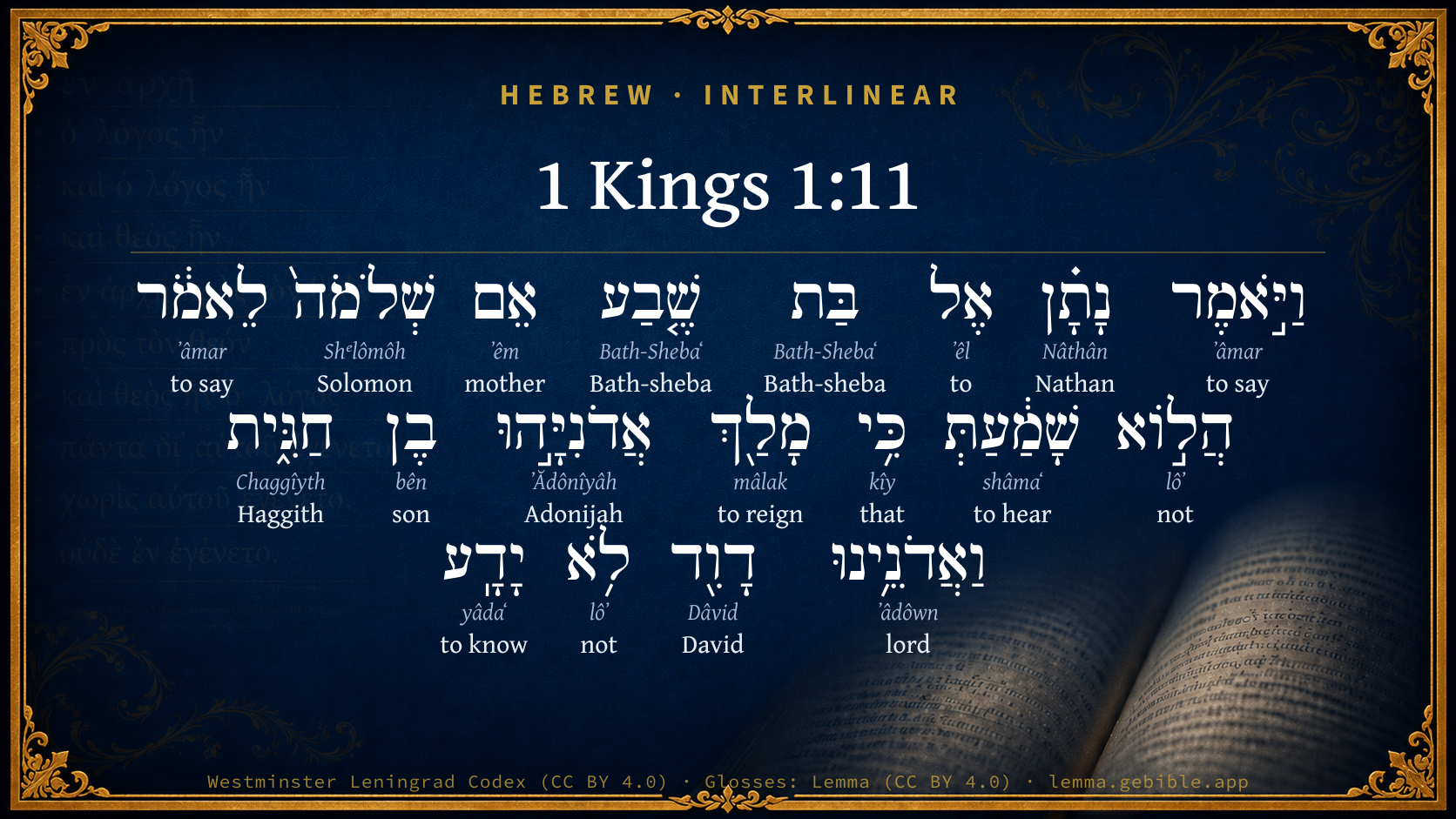
1 Kings 1:11

Hebrew (Westminster Leningrad Codex) 1 Kings 1:11 appears in the Hebrew Old Testament. The text above is from the Westminster Leningrad Codex. Each word links to its Strong’s number, a concise gloss, and parsing drawn from the Open Scriptures Hebrew Bible morphology. Click any word for its full Brown-Driver-Briggs (BDB) entry.
Download image
Cite this verse

1 Kings 1:11 (World English Bible). Public Domain. Lemma interlinear Bible study tool, https://lemma.gebible.app/v/1-kings/1/11.

Show BibTeX & RIS
BibTeX
RIS
English Translation
Then Nathan spoke to Bathsheba the mother of Solomon, saying, Haven't you heard that Adonijah the son of Haggith reigns, and David our lord doesn't know it?
World English Bible · Public Domain
Download a study sheet

One document with this verse’s original text, its word-by-word gloss line, the meaning frame, cross-references with their text, attributed commentary, and full source and license credits — printable, and it pastes into notes with its structure intact.

This verse Autodidact and up

Study sheet (.html) Plain text (.txt)

A passage Seminary Student

Up to 50 verses in one chapter. A passage sheet keeps up to 6 commentary sources and 12 cross-references per verse, in the order this page ranks them, and says so on the sheet whenever that leaves anything out. Ask for a single verse and you get the Autodidact verse sheet above.

Everything on this page stays free to read, with no account — the sheet is a download of what is already on screen, not access to it.

Want to remove ads? Support Godless Engineer
Compare translations 3

The same verse in 3 English versions, stacked beneath the original-language interlinear above. Click any original word for its lexicon entry.

Each is an independent rendering of the whole verse — the interlinear is not word-aligned to these translations.

Highlighted words mark where these versions differ — a whole-verse word diff, not a word-by-word alignment.

  • World English Bible Public Domain
    Then Nathan spoke to Bathsheba the mother of Solomon, saying, Haven't you heard that Adonijah the son of Haggith reigns, and David our lord doesn't know it?
  • King James Version Public Domain
    Wherefore Nathan spake unto Bathsheba the mother of Solomon, saying, Hast thou not heard that Adonijah the son of Haggith doth reign, and David our lord knoweth it not?
  • unfoldingWord Literal Text CC BY-SA 4.0
    And Nathan spoke to Bathsheba, the mother of Solomon, saying, “Have you not heard that Adonijah, the son of Haggith, reigns, and our master David does not know?

unfoldingWord Literal Text — © unfoldingWord, licensed CC BY-SA 4.0. Word-aligned USFM3 via Door43 (git.door43.org/unfoldingWord/en_ult).

Versions to compare (up to 4)

3 of 4 selected

Show all 18 translations

Every available English version of this verse, each an independent rendering of the whole verse.

  • World English Bible Public Domain
    Then Nathan spoke to Bathsheba the mother of Solomon, saying, Haven't you heard that Adonijah the son of Haggith reigns, and David our lord doesn't know it?
  • Berean Standard Bible Public Domain
    Then Nathan said to Bathsheba the mother of Solomon, “Have you not heard that Adonijah son of Haggith has become king, and our lord David does not know it?
  • Majority Standard Bible Public Domain
    Then Nathan said to Bathsheba the mother of Solomon, “Have you not heard that Adonijah son of Haggith has become king, and our lord David does not know it?
  • King James Version Public Domain
    Wherefore Nathan spake unto Bathsheba the mother of Solomon, saying, Hast thou not heard that Adonijah the son of Haggith doth reign, and David our lord knoweth it not?
  • American Standard Version (1901) Public Domain
    Then Nathan spake unto Bath-sheba the mother of Solomon, saying, Hast thou not heard that Adonijah the son of Haggith doth reign, and David our lord knoweth it not?
  • Revised Version (1885) Public Domain
    Then Nathan spake unto Bath-sheba the mother of Solomon, saying, Hast thou not heard that Adonijah the son of Haggith doth reign, and David our lord knoweth it not?
  • Geneva Bible (1599) Public Domain
    Wherefore Nathan spake vnto Bath-sheba the mother of Salomon, saying, Hast thou not heard, that Adoniiah ye sonne of Haggith doeth reigne, and Dauid our lord knoweth it not?
  • Douay-Rheims (1899) Public Domain
    And Nathan said to Bethsabee the mother of Solomon: Hast thou not heard that Adonias the son of Haggith reigneth, and our lord David knoweth it not?
  • Young's Literal Translation Public Domain
    And Nathan speaketh unto Bath-Sheba, mother of Solomon, saying, `Hast thou not heard that Adonijah son of Haggith hath reigned, and our lord David hath not known?
  • Literal Standard Version CC BY-SA 4.0
    And Nathan speaks to Bathsheba, mother of Solomon, saying, “Have you not heard that Adonijah son of Haggith has reigned, and our lord David has not known?
  • Unlocked Literal Bible CC BY-SA 4.0
    Then Nathan spoke to Bathsheba the mother of Solomon, saying, “Have you not heard that Adonijah son of Haggith has become king, and David our master does not know it?
  • unfoldingWord Literal Text CC BY-SA 4.0
    And Nathan spoke to Bathsheba, the mother of Solomon, saying, “Have you not heard that Adonijah, the son of Haggith, reigns, and our master David does not know?
  • Darby Bible Public Domain
    And Nathan spoke to Bathsheba the mother of Solomon, saying, Hast thou not heard that Adonijah the son of Haggith is king, and David our lord does not know [it]?
  • World Messianic Bible Public Domain
    Then Nathan spoke to Bathsheba the mother of Solomon, saying, “Haven’t you heard that Adonijah the son of Haggith reigns, and David our lord doesn’t know it?
  • Webster's Bible Public Domain
    Wherefore Nathan spoke to Bath-sheba the mother of Solomon, saying, Hast thou not heard that Adonijah the son of Haggith doth reign, and David our lord knoweth it not?
  • Free Bible Version CC BY-SA 4.0
    Nathan went to Bathsheba, Solomon's mother, and asked her, “Haven't you heard that Adonijah, son of Haggith, has become king, and His Majesty King David doesn't even know?
  • Bible in Basic English Public Domain
    Then Nathan said to Bath-sheba, the mother of Solomon, Has it not come to your ears that Adonijah, the son of Haggith, has made himself king without the knowledge of David our lord?
  • JPS Tanakh (1917) Public Domain
    Then Nathan spoke unto Bath-sheba the mother of Solomon, saying: 'Hast thou not heard that Adonijah the son of Haggith doth reign, and David our lord knoweth it not?

Literal Standard Version (2020), Covenant Press — licensed CC BY-SA 4.0. Text via the HelloAO Bible API (eBible.org). Unlocked Literal Bible (unfoldingWord) — licensed CC BY-SA 4.0. Text via the HelloAO Bible API (eBible.org). unfoldingWord Literal Text — © unfoldingWord, licensed CC BY-SA 4.0. Word-aligned USFM3 via Door43 (git.door43.org/unfoldingWord/en_ult). Free Bible Version, Dr. Jonathan Gallagher — licensed CC BY-SA 4.0. Text via the HelloAO Bible API (eBible.org).

Word by word

More ways to search: Search by grammar → Find every occurrence → Compare this word →

Practice this passage: Drill this verse → Learn its vocabulary →

חַגִּ֑ית
Chaggîyth
H2294
“Haggith”
Noun, Proper
Part of Speech
Noun
Type
Proper
Full BDB Definition

Origin: from H2291

TWOT: None

Haggith = "festive" - a wife of David and mother of Adonijah
  1. וַיֹּ֣אמֶר ʼâmar H559 “and · to say” Conjunction + Verb, Qal, Sequential Imperfect, 3rd Person, Masculine, Singular
  2. נָתָ֗ן Nâthân H5416 “Nathan” Noun, Proper
  3. אֶל ʼêl H413 “to” Preposition
  4. בַּת Bath-Shebaʻ H1339 “Bath-sheba” Noun, Proper
  5. שֶׁ֤בַע Bath-Shebaʻ H1339 “Bath-sheba” Adjective, Cardinal number, Feminine, Singular, Absolute
  6. אֵם ʼêm H517 “mother of” Noun, Common, Feminine, Singular, Construct
  7. שְׁלֹמֹה֙ Shᵉlômôh H8010 “Solomon” Noun, Proper
  8. לֵאמֹ֔ר ʼâmar H559 “to say” Preposition + Verb, Qal, Infinitive Construct
  9. הֲל֣וֹא lôʼ H3808 “not” Particle, Interrogative + Particle, Negative
  10. שָׁמַ֔עַתְּ shâmaʻ H8085 “to hear” Verb, Qal, Perfect, 2nd Person, Feminine, Singular
  11. כִּ֥י kîy H3588 “that” Conjunction
  12. מָלַ֖ךְ mâlak H4427 “to reign” Verb, Qal, Perfect, 3rd Person, Masculine, Singular
  13. אֲדֹנִיָּ֣הוּ ʼĂdônîyâh H138 “Adonijah” Noun, Proper
  14. בֶן bên H1121 “son of” Noun, Common, Masculine, Singular, Construct
  15. וַאֲדֹנֵ֥ינוּ ʼâdôwn H113 “and · lords · our” Conjunction + Noun, Common, Masculine, Plural, Construct + Suffix, Personal, 1st Person, Common, Plural
  16. דָוִ֖ד Dâvid H1732 “David” Noun, Proper
  17. לֹ֥א lôʼ H3808 “not” Particle, Negative
  18. יָדָֽע yâdaʻ H3045 “to know” Verb, Qal, Perfect, 3rd Person, Masculine, Singular

About this verse

These counts appear in no published source. They are computed here, from the morphology-tagged text and Lemma’s own curated glosses. What Lemma adds →

19
words
16
distinct lemmas
Historical
section

Notable vocabulary

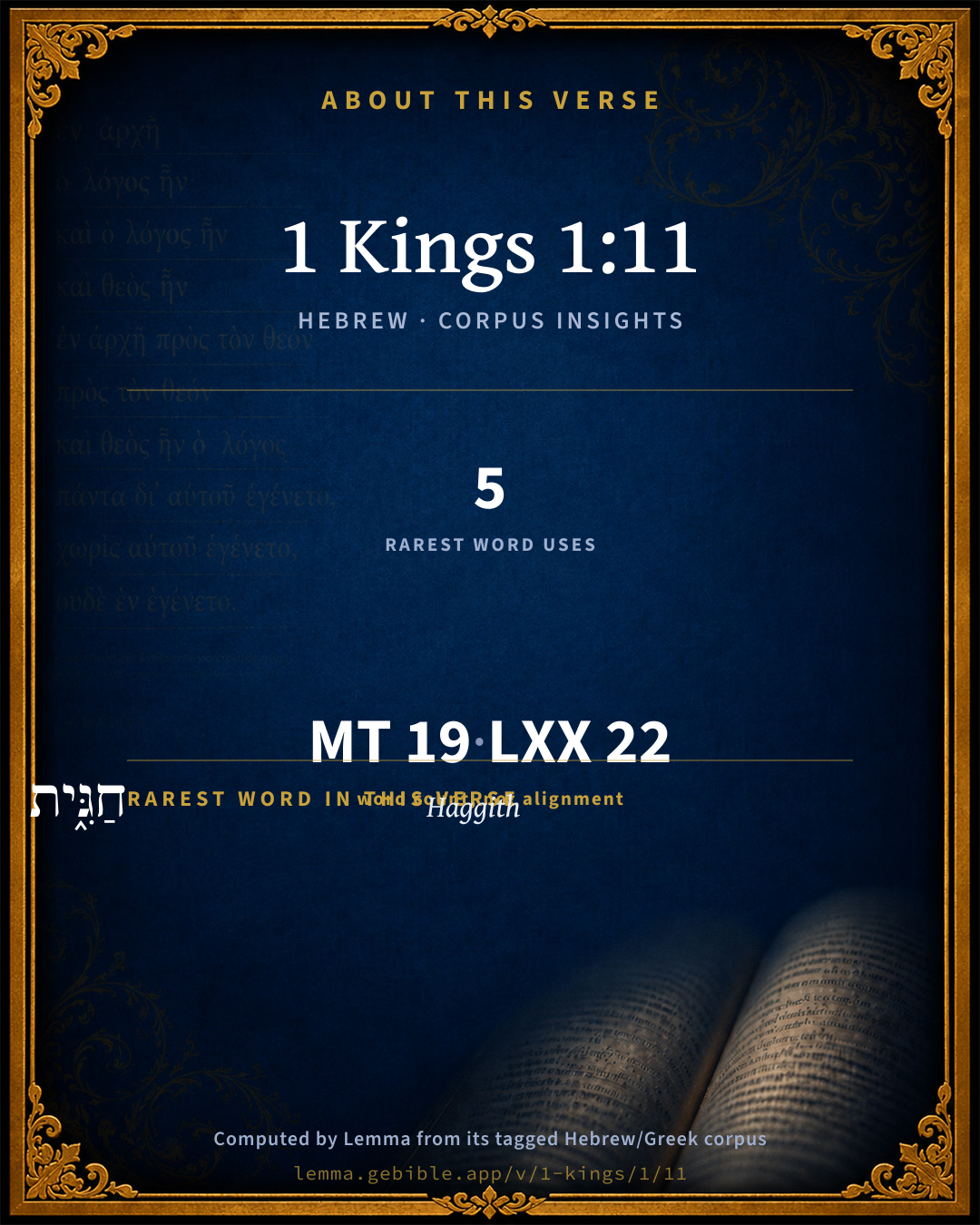
The rarest word here is חַגִּ֑ית Haggith H2294 — appearing just 5 times in the whole Hebrew Bible.

Shared distinctive vocabulary

חַגִּ֑ית Haggith H2294 occurs in 5 verses of the Hebrew Bible. Also found in:

Grammatical profile

  • 5 verbs
  • 9 nouns
  • 1 adjective
  • 1 preposition
  • 1 conjunction
  • 2 particles

Verb forms

  • וַיֹּ֣אמֶר Qal · Sequential Imperfect
  • לֵאמֹ֔ר Qal · Infinitive Construct
  • שָׁמַ֔עַתְּ Qal · Perfect
  • מָלַ֖ךְ Qal · Perfect
  • יָדָֽע Qal · Perfect

Repetition

Words recur within this verse — often emphatic in Hebrew:

  • וַיֹּ֣אמֶר to say H559 ×2
  • בַּת Bath-sheba H1339 ×2
  • הֲל֣וֹא not H3808 ×2

Hebrew & Septuagint length

In English translation the verse runs 27 words from the Hebrew and 28 from the Septuagint (LXX English) — closely comparable.

A rough comparison of the two English renderings, which tokenize alike — not a word-level alignment.

Word counts can differ between the Hebrew and the Greek without any difference in meaning — e.g. the Hebrew direct-object marker אֵת has no separate Greek word, and Greek often adds the article ὁ.

In the original languages it is 19 Hebrew tokens and 22 Greek tokens — but the two are counted differently (Hebrew bundles its prefixes and suffixes into one token; the Greek is in lemma form), so that isn’t a like-for-like length.

Cross-references

6

Topical passages linked to 1 Kings 1:11 in the Treasury of Scripture Knowledge — connected by theme and wording, ordered by reader-vote popularity; previews shown in the World English Bible.

  • 2 Samuel 3:4 and the fourth, Adonijah the son of Haggith; and the fifth, Shephatiah the son of Abital;
  • 2 Samuel 7:12–17 When your days are fulfilled, and you shall sleep with your fathers, I will set up your seed after you, who shall proceed out of your bowels, and I will establish his kingdom.
  • 2 Samuel 12:24–25 David comforted Bathsheba his wife, and went in to her, and lay with her: and she bore a son, and he called his name Solomon. Yahweh loved him;
  • 1 Chronicles 22:9–10 Behold, a son shall be born to you, who shall be a man of rest; and I will give him rest from all his enemies round about; for his name shall be Solomon, and I will give peace and quietness to Israel in his days:
  • 1 Chronicles 28:4–5 However Yahweh, the God of Israel, chose me out of all the house of my father to be king over Israel forever: for he has chosen Judah to be prince; and in the house of Judah, the house of my father; and among the sons of my father he took pleasure in me to make me king over all Israel;
  • 1 Chronicles 29:1 David the king said to all the assembly, Solomon my son, whom alone God has chosen, is yet young and tender, and the work is great; for the palace is not for man, but for Yahweh God.

Cross-references courtesy of OpenBible.info (CC BY 4.0).

Hebrew and Greek witnesses Masoretic Hebrew ↔ Greek Septuagint

The same verse in the two great witnesses to the Old Testament, shown verse-for-verse.

These are two independent witnesses, not word-aligned to each other, and the Septuagint is shown in lemma (dictionary) form.

Hebrew 1 Kings 1:11 Masoretic · Westminster Leningrad Codex

וַיֹּ֣אמֶר נָתָ֗ן אֶל בַּת שֶׁ֤בַע אֵם שְׁלֹמֹה֙ לֵאמֹ֔ר הֲל֣וֹא שָׁמַ֔עַתְּ כִּ֥י מָלַ֖ךְ אֲדֹנִיָּ֣הוּ בֶן חַגִּ֑ית וַאֲדֹנֵ֥ינוּ דָוִ֖ד לֹ֥א יָדָֽע

Then Nathan spoke to Bathsheba the mother of Solomon, saying, Haven't you heard that Adonijah the son of Haggith reigns, and David our lord doesn't know it?

World English Bible · Public Domain

Greek LXX 1 Kings 1:11 Septuagint · lemma form

καί εἶπον ναθαν πρός βηρσαβεε μήτηρ σαλωμών λέγω οὐ ἀκούω ὅτι βασιλεύω αδωνίας υἱός αγγιθ καί ὁ κύριος ἐγώ δαυίδ οὐ γιγνώσκω

And Nathan spoke to Bersabee the mother of Solomon, saying, Have you not heard that Adonias the son of Aggith reigns, and our lord David knows it not?

LXX2012 (modern English Septuagint) · Public Domain

On this verse, The Pulpit Commentary discusses the Septuagint’s reading. Read the note in Commentary ↓

Hebrew: Westminster Leningrad Codex (CC BY 4.0). Greek: Septuagint (public domain); English from LXX2012 (modern English Septuagint) (Public Domain). How the Septuagint differs from the Hebrew →

Targum (Aramaic paraphrase)

1

The Targum is the ancient Jewish Aramaic paraphrase of the Hebrew Scriptures — an interpretive translation, not the Hebrew text itself. Onkelos (literal) and Pseudo-Jonathan (expansive) render the Torah, and Jonathan the Prophets. Coverage is partial: where no permissively-licensed English translation exists for a verse, only the Aramaic is shown. This is verse-level text, not a word-by-word alignment to the Hebrew.

  1. Targum Jonathan Prophets (Joshua–Malachi)
    וַאֲמַר נָתָן לְבַת שֶׁבַע אִמֵיהּ דִשְׁלֹמֹה לְמֵימַר הֲלָא שְׁמַעְתְּ אֲרֵי מְלַךְ אֲדוֹנִיָהוּ בַר חַגִית וְרִבּוֹנָנָא דָוִד לָא יְדָע:

    (no public-domain English translation for this verse)

    Targum Jonathan — Aramaic: “Mikraot Gedolot” (public domain). English: “Sefaria Community Translation” (CC0 1.0 (public-domain dedication)); “London "Chaldee Paraphrase," 1871” (public domain). Text via Sefaria.

Commentary

Notes on 1 Kings 1:11 from classic Christian and Jewish commentators (each source and its license shown beneath its notes). The classic Christian expositions comment on the surrounding passage and are grouped to its opening verse, so a note may address several verses; the Jewish commentaries on the Tanakh (Rashi and others) are per-verse, so they appear only where the commentator wrote on this verse.

Lemma curates 59 commentaries, every one of them public domain or Creative Commons licensed, each selected and text-cleaned for this edition rather than reprinted as found. About our sources →

Matthew Henry's Commentary

We have here the effectual endeavours that were used by Nathan and Bathsheba to obtain from David a ratification of Solomon's succession, for the crushing of Adonijah's usurpation. 1. David himself knew not what was doing. Disobedient children think that they are well enough off if they can but keep their good old parents ignorant of their bad courses; but a bird of the air will carry the voice. 2. Bathsheba lived retired, and knew nothing of it either, till Nathan informed her. Many get very comfortably through this world that know little how the world goes. 3. Solomon, it is likely, knew of it, but was as a deaf man that heard not. Though he had years, and wisdom above his years, yet we do not find that he stirred to oppose Adonijah, but quietly composed himself and left it to God and his friends to order the matter. Hence David, in his Psalm for Solomon, observes that while men, in pursuit of the world, in vain rise early and sit up late, God giveth his beloved (his Jedidiahs) sleep, in giving them to be easy, and to gain their point without agitation, Psa 127:1, Psa 127:2. How then is the design brought about?

I. Nathan the prophet alarms Bathsheba by acquainting her with the case, and puts her in a way to get an order from the king for the confirming of Solomon's title. He was concerned, because he knew God's mind, and David's and Israel's interest; it was by him that God had named Solomon Jedidiah (Sa2 12:25), and therefore he could not sit still and see the throne usurped, which he knew was Solomon's right by the will of him from whom promotion cometh. When crowns were disposed of by immediate direction from heaven, no marvel that prophets were so much interested and employed in that matter; but now that common providence rules the affairs of the kingdom of men (Dan 4:32) the subordinate agency must be left to common persons, and let not prophets intermeddle in them, but keep to the affairs of the kingdom of God among men. Nathan applied to Bathsheba, as one that had the greatest concern for Solomon, and could have the freest access to David. He informed her of Adonijah's attempt (Kg1 1:11), and that it was not with David's consent or knowledge. He suggested to her that not only Solomon was in danger of losing the crown, but that he and she too were in danger of losing their lives if Adonijah prevailed. A humble spirit may be indifferent to a crown, and may be content, notwithstanding the prospect of it, to sit down short of the possession of it. But the law of self-preservation, and the sixth commandment, obliges us to use all possible endeavours to secure our own life and the life of others. Now, says Nathan, let me give thee counsel how to save thy own life and the life of thy son, Kg1 1:12. Such as this is the counsel that Christ's ministers give us in his name, to give all diligence, not only that no man take our crown (Rev 3:11), but that we save our lives, even the lives of our souls. He directs her (Kg1 1:13) to go to the king, to remind him of his word and oath, that Solomon should be his successor; and to ask him in the most humble manner, Why doth Adonijah reign? He thought David was not so cold but this would warm him. Conscience, as well as a sense of honour, would put life into him upon such an occasion as this; and he promised (Kg1 1:24) that, while she was reasoning with the king in this matter, he would come in and second her, as if he came accidentally, which perhaps the king might look upon as a special providence (and he was one that took notice of such evidences, Sa1 25:32, Sa1 25:33), or, at least, it would help to awaken him so much the more.

II. Bathsheba, according to Nathan's advice and direction, loses no time, but immediately makes her application to the king, on the same errand on which Esther came to king Ahasuerus, to intercede for her life. She needed not wait for a call as Esther did, she knew she should be welcome at any time; but it is remarked that when she visited the king Abishag was ministering to him (Kg1 1:15), and Bathsheba took no displeasure either at him or her for it, also that she bowed and did obeisance to the king (Kg1 1:16), in token of her respect to him both as her prince and as her husband; such a genuine daughter was she of Sarah, who obeyed Abraham, calling him lord. Those that would find favour with superiors mush show them reverence, and be dutiful to those whom they expect to be kind to them. Her address to the king, on this occasion, is very discreet. 1. She reminded him of his promise made to her and confirmed with a solemn oath, that Solomon should succeed him, Kg1 1:17. She knew how fast this would hold such a conscientious man as David was. 2. She informed him of Adonijah's attempt, which he was ignorant of (Kg1 1:18): "Adonijah reigns, in competition with thee for the present and in contradiction to thy promise for the future. The fault is not thine, for thou knewest it not; but now that thou knowest it thou wilt, in pursuance of thy promise, take care to suppress this usurpation." She told him who were Adonijah's guests, and who were in his interest, and added, but "Solomon thy servant has he not called, which plainly shows he looks upon him as his rival, and aims to undermine him, Kg1 1:19. It is not an oversight, but a contempt of the act of settlement, that Solomon is neglected." 3. She pleads that it is very much in his power to obviate this mischief (Kg1 1:20): The eyes of all Israel are upon thee, not only as a king, for we cannot suppose it the prerogative of any prince to bequeath his subjects by will (as if they were his goods and chattels) to whom he pleases, but as a prophet. All Israel knew that David was not only himself the anointed of the God of Jacob, but that the Spirit of the Lord spoke by him (Sa2 23:1, Sa2 23:2), and therefore waiting for and depending upon a divine designation, in a matter of such importance, David's word would be an oracle and a law to them; this therefore (says Bathsheba) they expect, and it will end the controversy and effectually quash all Adonijah's pretensions. A divine sentence is in the lips of the king. Note, Whatever power, interest or influence, men have, they ought to improve it to the utmost for the preserving and advancing of the kingdom of the Messiah, of which Solomon's kingdom was a type. 4. She suggested the imminent peril which she and her son would be in if this matter was not settled in David's life-time, Kg1 1:21. "If Adonijah prevail, as he is likely to do (having Joab the general and Abiathar the priest on his side) unless speedily suppressed, Solomon and all his friends will be looked upon as traitors and dealt with accordingly." Usurpers are most cruel. If Adonijah had got into the throne, he would not have dealt so fairly with Solomon as Solomon did with him. Those hazard everything who stand in the way of such as against right force their entrance.

III. Nathan the prophet, according to his promise, seasonably stepped in, and seconded her, while she was speaking, before the king had given his answer, lest. if he had heard Bathsheba's representation only, his answer should be dilatory and only that he would consider of it: but out of the mouth of two witnesses, two such witnesses, the word would be established, and he would immediately give positive orders. The king is told that Nathan the prophet has come, and he is sure to be always welcome to the king, especially when either he is not well or has any great affair upon his thoughts; for, in either case, a prophet will be, in a particular manner, serviceable to him. Nathan knows he must render honour to whom honour is due, and therefore pays the king the same respect now that he finds him sick in bed as he would have done if he had found him in his throne: He bowed himself with his face to the ground, Kg1 1:23. He deals a little more plainly with the king than Bathsheba had done. In this his character would support him, and the present languor of the king's spirits made it necessary that they should be roused. 1. He makes the same representation of Adonijah's attempt as Bathsheba had made (Kg1 1:25, Kg1 1:26), adding that his party had already got to such a height of assurance as to shout, God save king Adonijah, as if king David were already dead, taking notice also that they had not invited him to their feast (Me thy servant has he not called), thereby intimating that they resolved not to consult either God or David in the matter, for Nathan was secretioribus consiliis - intimately acquainted with the mind of both. 2. He makes David sensible how much he was concerned to clear himself from having a hand in it: Hast thou said, Adonijah shall reign after me? (Kg1 1:24), and again (Kg1 1:27), "Is this thing done by my lord the king? If it be, he is not so faithful either to God's word or to his own as we all took him to be; if it be not, it is high time that we witness against the usurpation, and declare Solomon his successor. If it be, why is not Nathan made acquainted with it, who is not only in general, the king's confidant, but is particularly concerned in this matter, having been employed to notify to David the mind of God concerning the succession; but, if my lord the king knows nothing of the matter (as certainly he does not), what daring insolence are Adonijah and his party guilty of!" Thus he endeavoured to incense David against them, that he might act the more vigorously for the support of Solomon's interest. Note, Good men would do their duty if they were reminded of it, and put upon it, and told what occasion there is for them to appear; and those who thus are their remembrancers do them a real kindness, as Nathan here did to David.

IV. David, hereupon, made a solemn declaration of his firm adherence to his former resolution, that Solomon should be his successor. Bathsheba is called in (Kg1 1:28), and to her, as acting for and on behalf of her son, the king gives these fresh assurances. 1. He repeats his former promise and oath, owns that he had sworn unto her by the Lord God of Israel that Solomon would reign after him, Kg1 1:30. Though he is old, and his memory begins to fail him, yet he remembers this. Note, An oath is so sacred a thing that the obligations of it cannot be broken, and so solemn a thing that the impressions of it, one would think, cannot be forgotten. 2. He ratifies it with another, because the occasion called for it: As the Lord liveth, that hath redeemed my soul out of all distress, even so will I certainly do this day, without dispute, without delay. His form of swearing seems to be what he commonly used on solemn occasions, for we find it, Sa2 4:9. And it carries in it a grateful acknowledgment of the goodness of God to him, in bringing him safely through the many difficulties and hardships which had lain in his way, and which he now makes mention of to the glory of God (as Jacob, when he lay a dying, Gen 48:16), thus setting to his seal, from his own experience, that that was true which the Spirit of the Lord spoke by him. Psa 34:22, The Lord redeemeth the soul of his servants. Dying saints ought to be witnesses for God, and speak of him as they have found. Perhaps he speaks thus, on this occasion, for the encouragement of his son and successor to trust in God in the distresses he also might meet with.

V. Bathsheba receives these assurances (Kg1 1:31), 1. With great complaisance to the king's person; she did reverence to him; while Adonijah and his party affronted him. 2. With hearty good wishes for the king's health; Let him live. So far was she from thinking that he lived too long that she prayed he might live for ever, if it were possible, to adorn the crown he wore and to be a blessing to his people. We should earnestly desire the prolonging of useful lives, however it may be the postponing of any advantages of our own.

Matthew Henry's Commentary on the Whole Bible (1708–1710) — public domain (CC PDM 1.0). Text via the HelloAO Bible API.

Trapp's Complete Commentary

John Trapp

1Ki 1:11 Wherefore Nathan spake unto Bathsheba the mother of Solomon, saying, Hast thou not heard that Adonijah the son of Haggith doth reign, and David our lord knoweth [it] not?

Ver. 11. Wherefore Nathan spake unto Bathsheba.] See here, saith P. Martyr, how God by weak means confoundeth the mighty, and worketh for the accomplishment of his own will.

And David our lord knoweth it not.] Either Adonijah’s partisans and parasites kept it from David, or else through age and weakness he took no notice of it.

John Trapp, A Commentary or Exposition upon All the Books of the Old and New Testament (1647–1656) — public domain. Text from a community e-Sword module.

Joseph Benson's Commentary

1Ki 1:11. Nathan spake unto Bath-sheba — Who, being private and retired in her apartment, was ignorant of what was done abroad; and who was likely to be most zealous in the cause, and most prevalent with David. To her Nathan was induced to speak, both by his piety, that he might fulfil the will of God declared to him concerning Solomon’s succession, 2Sa 7:13; and by his prudence, knowing that Adonijah hated him for being the principal instrument of Solomon’s advancement. That Adonijah doth reign — It seems they were so bold as to proclaim him king.

Joseph Benson's Commentary on the Old and New Testaments (1811–1818) — public domain. Text from a community e-Sword module.

Whedon's Commentary on the Bible

Daniel D. Whedon

SOLOMON MADE KING, 1Ki_1:11-40.

11. Nathan spake unto Bathsheba — That devout prophet had his eye upon the movements of Adonijah, and be took timely measures to frustrate his seditious projects. He was thoroughly acquainted with the private history of David’s relation and pledges to Bathsheba, and was well aware that no one could have such power over the king as she whom he loved above all women.

Daniel D. Whedon (gen. ed.), Commentary on the Old and New Testaments (1874–1909) — public domain. Text from a community e-Sword module.

The Preacher's Complete Homiletical Commentary

Joseph S. Exell (gen. ed.)

CRITICAL AND EXPLANATORY NOTES.—

1Ki_1:12. Save thine own life, &c.; for had the scheme of Adonijah succeeded, all rivals to the throne would have been slain.

1Ki_1:13. Assuredly Solomon, &c.—The particle כִּי scarcely allows of so forcible a rendering; saying, That Solomon shall reign.

1Ki_1:14. Confirm thy words: דּנָרָוִךְ מִלֵּאתִי אֶת—I will make full thy words—a phrase used for the fulfilment of divine utterances (chapters 1Ki_2:27, 1Ki_8:15; 1Ki_8:24).

HOMILETICS OF 1Ki_1:11-14

THE COUNSEL OF THE WISE AND GOOD

I. Is prompted by an unselfish concern to carry out the Divine will.

1. The Divine will is the first and highest consideration with a true prophet. Nathan well knew it was the Divine purpose that Solomon should reign. Doubtless it was he who revealed to David the promise of Jehovah to this effect (1Ch_22:8-9). Without blindly and inactively resting on the issue of the Divine decree, he saw the wisdom and importance of using all lawful means to disconcert the wicked attempt to frustrate it. He was not influenced by a priestly officiousness and love of political intrigue, but by the supreme and jealous anxiety to fulfil the will of God. “When crowns were disposed of by immediate direction from Heaven, no marvel that prophets were so much interested and employed in that matter; but now that common Providence rules the affairs of the kingdom of men (Dan_4:32) the subordinate agency must be left to common persons. Let not prophets intermeddle in them, but keep to the affairs of the kingdom of God among men.” Nathan was indifferent to the personal risk he run had his counsel been rejected and Adonijah allowed to become king. In all things, spiritual and temporal, the will of God is the highest reason. It is the safest motive to action.

2. The conduct of Nathan was in harmony with a genuine friendship. The faithfulness of the prophet in reproving David’s sin not only produced repentance, but established a bond of friendship which lasted for the remainder of the monarch’s life. The training of Solomon was entrusted to Nathan, and the amiable qualities and superior abilities of the youthful prince won the prophet’s love. The services of a true friend may be more freely and cheerfully rendered when they accord with the Divine intentions. It is no act of friendliness to tender advice which involves in its observance the displeasure of God. Advice should be given with gentleness and wisdom: it should fall as the dew, not overwhelm as the torrent.

II. Highly valuable in great emergencies. A grave crisis had come in the history of the kingdom. It needed the utmost caution and promptitude in dealing with it. Important interests were threatened.

1. A crown was at stake (1Ki_1:11). Adonijah had usurped the position to which his brother was formally designated. There was danger the sceptre should not pass into the hands of Solomon. The crown of life, more lustrous far than the costliest earthly diadem, is reserved for the faithful. That no man take our crown, we must give heed to Divine counsel.

2. Life was at stake (1Ki_1:12). It was the sanguinary custom among the ancient monarchies of the East, in the event of a forcible seizure of the throne, to murder the dethroned ruler, or the opposing pretenders to the crown, and all their nearest relatives (Jdg_9:5; 1Ki_15:29; 2Ki_10:6; 2Ki_10:13; ib. 1Ki_11:1). If Adonijah succeeded, Bathsheba, Solomon, and, probably, Nathan, must perish. We are in danger of eternal death. It is the privileged function of God’s messengers, while warning against threatened death, to offer life. Happy are they who are wise to receive instruction! To keep sound wisdom and discretion is life to the soul and grace to the neck (Pro_3:21-22).

3. The wish of the dying king was disregarded. That Adonijah knew the intention of David was evident by his refusing to summon Solomon, and by conducting the conspiracy so secretly that the aged king was ignorant of it. Filial duty dictates a reverential regard to the last wishes of a dying parent. Rebellion outrages all family relationships, and ignores the dearest parental wishes.

4. The future prestige of the empire was imperilled. Adonijah was unfit to govern. Had he reached the throne, his career must have been one of disaster. There would have been no Solomon-era; and the peace, the commercial affluence, the luxurious display, the intellectual glory, and theocratic splendour that characterised the brilliant reign of the wise and gifted king, would have been, if not unknown, indefinitely postponed. A prophet and a woman—both contemptuously overlooked by the proud conspirators—were the instruments of defeating an ill-starred enterprise. The timely and vigorous action of a single mind has often decided the destiny of a nation.

III. Suggests the most forcible reasons for right action (1Ki_1:13).

1. The king is informed that his own arrangement concerning the regal succession is violently disturbed. “Why, then, doth Adonijah reign?” It was a terrible blow to David to be told that his son—a son so fondly loved and excessively indulged—was engaged in a rebellious attempt to defeat his father’s declared intention. It would affect David the more that his informant was Bathsheba, a woman he tenderly loved, and mother of the son who would be most injured if the usurper triumphed. Nothing will sooner rouse a man into action than the forcible and wilful interference with his own long-cherished and thoughtfully formed plans.

2. The king is reminded of his oath. “Didst not thou swear?” It is not known when David made the promise on oath to Bathsheba that her son should be king. It was evidently after the revelation made to him by Jehovah, recorded in 2 Samuel 7. The reference to his oath, uttered with the utmost solemnity and awe, would he irresistible. The God-fearing king would be incited to adopt prompt and active measures for ensuring the accomplishment of his purpose. The man who fears God must ever be most solicitous to fulfil the promise made by his solemn invocation of the Divine Name.

IV. Is supplemented and confirmed by active, personal endeavours (1Ki_1:14). Many are ready to tender advice when it does not involve personal effort and inconvenience. Advice thus cheaply given is generally estimated at the same value. The true friend, not content with simply giving the wisest counsel, is prepared to substantiate his words with earnest, diligent, and self-sacrificing personal endeavours. The advice of such a friend is beyond all price. It should be gratefully obeyed.

LESSONS:—

1. The minister of God should be able to give sound counsel.

2. The best counsel is that which is most in harmony with the will of God.

3. The counsel of the wise and good should be carefully pondered.

4. Good counsel, when promptly acted upon, is followed with beneficial results.

GERM NOTES ON THE VERSES

1Ki_1:11. The watchfulness of the faithful minister—

1. Enables him to discern the dangers which threaten the interests of God’s kingdom.

2. To discover the secret plots of evil workers.

3. To afford seasonable and important counsel in grave emergencies.

4. To lend all the force of his personal efforts in defeating the designs of the wicked.

5. To brave all the perils of fidelity.

Nathan, the type of a true prophet. Seen—

1. In his watchfulness and fidelity (Eze_33:7). He is not silent when it was his duty to open his mouth (Isa_56:10).

2. In his wisdom and gentleness (Mat_10:16).

3. In his earnestness and courage (Mat_10:28). How grand is this Nathan! How reproving to all who sleep when they should be wakeful, who are dumb when they should counsel, who flatter when they should warn! It is a solemn duty not to conceal what can prove an injury and evil to an individual or to a community, but to expose it at the right time and in the right place, so that the injury may be averted.—Lange.

1Ki_1:12. The great burden of the Gospel message. The mission of the Gospel is—

1. To counsel the ignorant.

2. To warn the indifferent.

3. To offer life to the spiritually dead.

4. To reveal the endless duration and consummate felicity of the life enjoyed by the believer.

5. To set forth the character and redeeming work of the great Life-Giver.

—What Nathan here says to Bathsheba, Christ and His Apostles, in an infinitely higher sense, say to us all, especially every father and every mother. How many take kindly the good advice of a wise man, for themselves and for their children, in their earthly and outward affairs, but who wish to hear nothing of the best advice which shall bring blessedness to their souls!

1Ki_1:14. The purity of the counsel is confirmed by the accompanying result. There are some seeming contradictions in Scripture; and though they seem to be as the accusers of Christ, never a one speaking like the other, yet, if we understand, we shall find them speaking like Nathan and Bathsheba, both speaking the same things.—Trapp.

The Preacher's Complete Homiletical Commentary (gen. ed. Joseph S. Exell; Funk & Wagnalls, c. 1892) — public domain (pre-1929). A full-Bible homiletical/sermon-outline anthology covering 65 of 66 books (2 John is absent from the source module). Text from a community e-Sword module.

Keil & Delitzsch

C. F. Keil & F. Delitzsch

Adonijah's attempt was frustrated by the vigilance of the prophet Nathan.

Kg1 1:11-13

Nathan informed Solomon's mother, Bathsheba (see at Sa2 11:3), that Adonijah was making himself king (מלך כּי, that he had become as good as king: Thenius), and advised her, in order to save her life and that of her son Solomon (וּמלטי, and save = so that thou mayest save; cf. Ewald, 347, a.), to go to the king and remind him of his promise on oath, that her son Solomon should be king after him, and to inquire why Adonijah had become king. If Adonijah had really got possession of the throne, he would probably have put Solomon and his mother out of the way, according to the barbarous custom of the East, as his political opponents.

Kg1 1:14

While she was still talking to the king, he (Nathan) would come in after her and confirm her words. דּבר מלּא, to make a word full, i.e., not to supply what is wanting, but to make full, like πληροῦν, either to fill by accomplishing, or (as in this case) to confirm it by similar assertion.

Kg1 1:15-21

Bathsheba followed this advice, and went to the king into the inner chamber (החדרה), since the very aged king, who was waited upon by Abishag, could not leave his room (משׁרת for משׁרתת; cf. Ewald, 188, b., p. 490), and, bowing low before him, communicated to him what Adonijah had taken in hand in opposition to his will and without his knowledge. The second ועתּה is not to be altered into ואתּה, inasmuch as it is supported by the oldest codices and the Masora,

(Note: Kimchi says: "Plures scribae errant in hoc verbo, scribentes ואתה cum Aleph, quia sensui hoc conformius est; sed constat nobis ex correctis MSS et masora, scribendum esse ועתה cum Ain." Hence both Norzi and Bruns have taken ועתה under their protection.Compare de Rossi, variae lectt. ad h. l.)

although about two hundred codd. contain the latter reading. The repetition of ועתּה ("And now, behold, Adonijah has become king; and now, my lord king, thou knowest it not") may be explained from the energy with which Bathsheba speaks. "And Solomon thy servant he hath not invited" (Kg1 1:19). Bathsheba added this, not because she felt herself injured, but as a sign of Adonijah's feelings towards Solomon, which showed that he had reason to fear the worst if Adonijah should succeed in his usurpation of the throne. In Kg1 1:20, again, many codd. have ועתּה in the place of ואתּה; and Thenius, after his usual fashion, pronounces the former the "only correct" reading, because it is apparently a better one. But here also the appearance is deceptive. The antithesis to what Adonijah has already done is brought out quite suitably by ואתּה: Adonijah has made himself king, etc.; but thou my lord king must decide in the matter. "The eyes of all Israel are turned towards thee, to tell them who (whether Adonijah or Solomon) is to sit upon the throne after thee." "The decision of this question is in thy hand, for the people have not yet attached themselves to Adonijah, but are looking to thee, to see what thou wilt do; and they will follow thy judgment, if thou only hastenest to make Solomon king." - Seb. Schmidt. To secure this decision, Bathsheba refers again, in Kg1 1:21, to the fate which would await both herself and her son Solomon after the death of the king. They would be הטּאים, i.e., guilty of a capital crime. "We should be punished as though guilty of high treason" (Clericus).

Kg1 1:22-27

While Bathsheba was still speaking, Nathan came. When he was announced to the king, Bathsheba retired, just as afterwards Nathan went away when the king had Bathsheba called in again (cf. Kg1 1:28 with Kg1 1:32). This was done, not to avoid the appearance of a mutual arrangement (Cler., Then., etc.), but for reasons of propriety, inasmuch as, in audiences granted by the king to his wife or one of his counsellors, no third person ought to be present unless the king required his attendance. Nathan confirmed Bathsheba's statement, commencing thus: "My lord king, thou hast really said, Adonijah shall be king after me...? for he has gone down to-day, and has prepared a feast, ... and they are eating and drinking before him, and saying, Long live king Adonijah!" And he then closed by asking, "Has this taken place on the part of my lord the king, and thou hast not shown thy servants (Nathan, Zadok, Benaiah, and Solomon) who is to sit upon the throne of my lord the king after him?" The indirect question introduced with אם is not merely an expression of modesty, but also of doubt, whether what had occurred had emanated from the king and he had not shown it to his servants.

Kg1 1:28-30

The king then sent for Bathsheba again, and gave her this promise on oath: "As truly as Jehovah liveth, who hath redeemed my soul out of all distress (as in Sa2 4:9), yea, as I swore to thee by Jehovah, the God of Israel, saying, Solomon thy son shall be king after me, ... yea, so shall I do this day." The first and third כּי serve to give emphasis to the assertion, like imo, yea (cf. Ewald, 330, b.). The second merely serves as an introduction to the words.

Kg1 1:31

Bathsheba then left the king with the deepest prostration and the utterance of a blessing, as an expression of her inmost gratitude. The benedictory formula, "May the king live for ever," was only used by the Israelites on occasions of special importance; whereas the Babylonians and ancient Persians constantly addressed their kings in this way (cf. Dan 2:4; Dan 3:9; Dan 5:10; Dan 6:22; Neh 2:3. Aeliani var. hist. i. 32, and Curtius de gestis Alex. vi. 5).

Kg1 1:32-40

David then sent for Zadok, Nathan, and Benaiah, and directed them to fetch the servants of their lord (אדניכם, a pluralis majestatis, referring to David alone), and to conduct Solomon to Gihon riding upon the royal mule, and there to anoint him and solemnly proclaim him king. The servants of your lord (אדניכם עבדי) are the Crethi and Plethi, and not the Gibborim also (Thenius), as Kg1 1:38 clearly shows, where we find that these alone went down with him to Gihon as the royal body-guard. לי אשׁר על־הפּרדּה, upon the mule which belongs to me, i.e., upon my (the king's) mule. When the king let any one ride upon the animal on which he generally rode himself, this was a sign that he was his successor upon the throne. Among the ancient Persians riding upon the king's horse was a public honour, which the king conferred upon persons of great merit in the eyes of all the people (cf. Est 6:8-9). פּרדּה, the female mule, which in Kahira is still preferred to the male for riding (see Rosenmller, bibl. Althk. iv. 2, p. 56). Gihon (גּחון) was the name given, according to Ch2 32:30 and Ch2 33:14, to a spring on the western side of Zion, which supplied two basins or pools, viz., the upper watercourse of Gihon (Ch2 32:30) or upper pool (Kg2 18:17; Isa 7:3; Isa 36:2), and the lower pool (Isa 22:9). The upper Gihon still exists as a large reservoir built up with hewn stones, though somewhat fallen to decay, which is called by the monks Gihon, by the natives Birket el Mamilla, about 700 yards W.N.W. from the Joppa gate, in the basin which opens into the valley of Hinnom. The lower pool is probably the present Birket es Sultan, on the south-western side of Zion (see Robinson, Palestine, i. p. 485ff., 512ff., and Biblical Researches, p. 142ff.). The valley between the two was certainly the place where Solomon was anointed, as it is not stated that this took place at the fountain of Gihon. And even the expression גּחון על אתו הורדתּם (take him down to Gihon) agrees with this. For is you go from Zion to Gihon towards the west, you first of all have to descend a slope, and then ascend by a gradual rise; and this slope was probably a more considerable one in ancient times (Rob. Pal. i. p. 514, note).

(Note: The conjecture of Thenius, that גּחון should be altered into גּבעון, is hardly worth mentioning; for, apart from the fact that all the ancient versions confirm the correctness of גּחון, the objections which Thenius brings against it amount to mere conjectures or groundless assumptions, such as that Zadok took the oil-horn out of the tabernacle at Gibeon, which is not stated in v. 39. Moreover, Gibeon was a three hours' journey from Jerusalem, so that it would have been absolutely impossible for the anointing, which was not commanded by David till after Adonijah's feast had commenced, to be finished so quickly that the procession could return to Jerusalem before it was ended, as is distinctly recorded in v. 41.)

Keil & Delitzsch — Biblical Commentary on the Old Testament (1861–1891) — public domain (CC PDM 1.0). Text via the HelloAO Bible API. (Old Testament only.)

Tyndale Open Study Notes

Tyndale Open Resources

1:11-14 Bathsheba was Solomon’s mother and David’s favored wife. Their affair led to the death of Bathsheba’s husband, Uriah the Hittite (see 2 Sam 11:1-27). • Nathan, the prophet who revealed God’s covenant with David (2 Sam 7:1-17) and announced God’s love for Solomon at his birth (2 Sam 12:24-25), confirmed God’s selection of Solomon to succeed David as king (see 1 Chr 28:4-7). Although Nathan had sharply rebuked David for his affair with Bathsheba and his murder of Uriah (2 Sam 12:1-15), the king respected the prophet. • Adonijah certainly observed Nathan’s close association with Bathsheba and Solomon. All three could expect to be killed if Adonijah’s plot to seize the throne succeeded (see 1 Kgs 15:29; 16:11).

Tyndale Open Study Notes — © Tyndale Open Resources, licensed CC BY-SA 4.0. Text via the HelloAO Bible API.

Jamieson, Fausset & Brown

Robert Jamieson, A. R. Fausset & David Brown

Nathan spake unto Bath-sheba . . . let me . . . give thee counsel, &c.--The revolt was defeated by this prophet, who, knowing the Lord's will (Sa2 7:12; Ch1 22:9), felt himself bound, in accordance with his character and office, to take the lead in seeing it executed. Hitherto the succession of the Hebrew monarchy had not been settled. The Lord had reserved to Himself the right of nomination (Deu 17:15), which was acted upon in the appointments both of Saul and David; and in the case of the latter the rule was so far modified that his posterity were guaranteed the perpetual possession of the sovereignty (Sa2 7:12). This divine purpose was known throughout the kingdom; but no intimation had been made as to whether the right of inheritance was to belong to the oldest son. Adonijah, in common with the people generally, expected that this natural arrangement should be followed in the Hebrew kingdom as in all others. Nathan, who was aware of the old king's solemn promise to Solomon, and, moreover, that this promise was sanctioned by the divine will, saw that no time was to be lost. Fearing the effects of too sudden excitement in the king's feeble state, he arranged that Bath-sheba should go first to inform him of what was being transacted without the walls, and that he himself should follow to confirm her statement. The narrative here not only exhibits the vivid picture of a scene within the interior of a palace, but gives the impression that a great deal of Oriental state ceremonial had been established in the Hebrew court.

Jamieson, Fausset & Brown — Commentary Critical and Explanatory on the Whole Bible (1871) — public domain (CC PDM 1.0). Text via the HelloAO Bible API.

Adam Clarke's Commentary

Verse 11. Hast thou not heard that Adonijah the son of Haggith doth reign] He was now considered as being legally appointed to the regal office, and no doubt was about to begin to perform its functions.

Adam Clarke's Commentary on the Bible (1810–1826) — public domain. Text from a community e-Sword/MySword module.

Ellicott's Commentary for English Readers

(11) Wherefore Nathan.—The initiative taken by Nathan is especially natural, since he had been the medium both of the prophecy to David of the son who should build the Lord’s house (2Sa_7:12-15), and also of the blessing on Solomon, embodied in the name Jedidiah (“beloved of Jehovah,” 2Sa_12:25). Perhaps for this very reason the conspirators had altogether held aloof from him.

A Bible Commentary for English Readers, edited by Charles John Ellicott (1878–1897) — public domain. Text from a community e-Sword module.

The Cambridge Bible for Schools and Colleges

gen. ed. J. J. S. Perowne

11–14. Nathan’s counsel to Bath-sheba (Not in Chronicles)

11. Bath-sheba] She who had before been the wife of Uriah the Hittite. Nathan’s zeal for Solomon’s cause may be well understood, because it was by his message (2Sa_12:25) that Solomon was specially called the ‘beloved of the Lord.’

doth reign] As though the work were already completed and Adonijah already assured of the throne.

The Cambridge Bible for Schools and Colleges (gen. ed. J. J. S. Perowne; Cambridge University Press, 1878–1918) — public domain. Text from a community e-Sword module.

Albert Barnes' Notes on the Bible

The son of Haggith - Compare the margin reference. This expression was well chosen to touch the pride of Bath-sheba. “Adonijah; not thy son, but the son of thy rival, Haggith.”

Albert Barnes' Notes on the Bible (1834–1885) — public domain. Text from a community e-Sword/MySword module.

Haydock's Catholic Bible Commentary

It not. So that we may safely endeavour to overturn his plane. (Menochius)

George Leo Haydock (1774–1849), Haydock's Catholic Family Bible and Commentary, 1859 edition — public domain. Excludes Psalms (Douay-Rheims chapter numbering differs from Protestant) and Deuterocanonical books (Catholic canon only).

Matthew Poole's English Annotations

Nathan was prompted to this both by his piety in fulfilling the will of God declared to him, and by him to David, concerning Solomon’s succession, 2Sa 7:13; 1Ch 22:8,9; and by his prudence, as knowing that Adonijah hated him for being the principal instrument of Solomon’s advancement. Bath-sheba being retired and private in her apartment, was yet ignorant of what was done abroad; and she was likely to be most zealous in the cause, and most prevalent with David.

David our lord knoweth it not; so far is he from consenting to it, as thou mayest fear or others think, that they have not yet acquainted him with it.

Matthew Poole's English Annotations on the Holy Bible (1683–1685) — public domain. Text from a community e-Sword/MySword module.

The Pulpit Commentary

Wherefore Nathan spake unto Bathsheba the mother of Solomon the person after Solomon most directly concerned and also best fitted to approach the king saying, Hast thou not heard that Adonijah tile son of Haggith possibly there is a touch of worldly wisdom here, as Rawlinson suggests, "Haggith, thy rival." We may be sure David"s harem was not without its fierce jealousies. But (see ver. 5, and 1Ki_2:13) the patronymic is so common in Hebrews that we cannot safely found an argument upon it. See on chap. 2:5 doth reign Hebrews did reign. LXX ejbasileusaen, aor. =" succeeded." "Schon so gut wie Konig geworden ist." Bahr and Keil and David our Lord knoweth it not.

Ver. 11 sqq.

The Jewish prophet: an example to the Christian pastor.

The dealings of Nathan with David may suggest some thoughts as to

(1) the office, and

(2) the duties of the Christian minister. For observe

THE CHRISTIAN MINISTER OCCUPIES IN THE NEW DISPENSATION A POSITION SOME, WHAT ANALOGOUS TO THAT OF THE PROPHET IN THE OLD. Prophecy, that is to say, is one of his functions. For prophecy does not, strictly and properly, mean prediction (or foretelling), but preaching (or forthtelling). The prophetes was the spokesman or interpreter of God. (See Introduction, note.) The "prophesyings" of the New Testament (1Co_11:14) were preachings or expositions; and in this sense the word is used by Lord Bacon, and others. So the prophet was, and the preacher is, an ambassador for God, an expounder of his laws, a herald of his kingdom. The former, therefore, may well serve as a pattern to the latter. Now the dealings of the prophet Nathan with King David were of two kinds:

1. He admonished him in health;

2. He counselled him in sickness.

Hence let us learn that we owe doctrine, reproof, correction, instruction in righteousness; in other words, "both public and private monitions and exhortations, as well to the sick as to the whole within our cures." (See "The Ordering of Priests," Book of Common Prayer.) The latter are liable to be overlooked. But the prophet further suggests to us

(1) what are the ministrations or admonitions the pastor owes to his flock, and

(2) what is the spirit in which he should offer them. He teaches the former by his dealings with David in health, and the latter by his dealings with David in sickness.

I Under the first head, observe that,

1. He boldly denounced Davids sin (2Sa_12:7) at the risk, perhaps, of his life, and fearlessly threatened him with shame (ver. 11) and sword (ver. 10).

2. He proclaimed forgiveness on Davids repentance (ver. 13).

3. He ministered comfort in Davids sorrow (ver. 25).

4. He encouraged and advised David in his undertakings. (2Sa_7:3-17) Behold here, the principal duties of the pastoral office to rebuke sin, to pronounce absolution, to comfort the sorrowing, to guide the conscience. And note: in all these functions, Nathan merely echoed the word the Lord had given him. We must take care not to "go beyond the word of the Lord, to do more or less.

II Under the second category, we find that,

1. He was faithful to his God. He had been employed by God to declare Solomon the heir to the throne. He would have been unfaithful had he permitted another to usurp the crown.

2. He was faithful and deferential to his king. As keeper of the king"s conscience, as trusted adviser and counsellor, he owed it to the king to apprize him of Adonijah"s plot. It is a sacred duty to speak, and he speaks speaks with the profound reverence which even the Lord"s prophetowes to the Lord"s anointed (ver. 23). (A great churchman confessed that he had not served his God as faithfully as he had served his king. Nathan was true to both.)

1. He was disinterested. He asks no favours for himself. It is for the Hebrew commonwealth, for the Jewish Church, that he acts and speaks. He does not abuse his position to extort gifts from a dying man. (Compare Savonarola dictating the terms of absolution to Lorenzo de" Medici.)

2. He was discreet. "Wise as serpent, but harmless as dove." He approaches Bathsheba (ver. 11), excites her alarm (ver. 12), uses her as the most likely agent to prevail with the king, instructs her (ver. 13), follows her (ver. 22). "The policy of Nathan was of use as well as his prophecy" (Bp. Hall) Thus the prophet teaches the pastor to use all fidelity, to show true loyalty and courtesy, to act purely and unselfishly, to use the means God has put within his reach with consideration and discretion.

The Benedictus of the Old Testament, and the Benedictus of the New (Ver. Luk_1:68)

On two memorable occasions this doxology has been found on the lips of the saints. No doubt the formula, "Blessed be the Lord God of Israel," was a favourite one with the people of Israel; no doubt the words were often used (cf. Psa_41:13 Psa_72:18) But there are two occasions of preeminent interest and importance when this thanksgiving broke from joyful lips. Let us consider them.

1. It was used (as we see) by the aged King David on the day that he sawhis son Solomon (Peace) a forerunner of the Messiah, seated on the throne of Israel.

2. It was used by the aged priest Zacharias on the day that he saw his son John (Grace), the forerunner of Messiah, brought into the commonwealth of Israel. It is just possible, but hardly probable, that the words, as used by the latter, (under the guidance of the Holy Ghost (Luk_1:67) had a reference to their use by the former. But it may be instructive, nevertheless, to compare these two ascriptions of praise, for they are more or less characteristic, the one of the old dispensation, the other of the new. Let us observe,

I THEIR POINTS OF CONTACT,

II THEIR POINTS OF CONTRAST.

I They are alike in three particulars.

1. Each Benedictus was in some sort the Nunc Dimittis" of an aged saint. Each proceeded from a man "old and stricken in years" (1Ki_1:1, 1Ki_1:2; Luk_1:7) each from a man of fervent piety (1Ki_11:4; Luk_1:6) each was suggested by the speaker"s son rising up to take his place, and to carry on his and God"s work.

2. Each Benedictus was connected with a son of David. The first was a grateful acknowledgment of the anointing of a Son of David to be King; the second was in thankful anticipation of the coming of the Son of David to be Prophet, Priest, and King. Note: all the praises of Scripture connect themselves directly or indirectly with Christ.

3. Each Benedictus was elicited by Gods gracious fulfilment of His promise. The first commemorated the realization of the promise of a successor made through the prophet Nathan; (2Sa_7:12) the second, the (proximate) fulfilment of the promises of a Saviour, made by "all the holy prophets since the world began", (Luk_1:70) and of which the promise of 2Sa 7., was a foretaste and pledge. Note: in all ages the faithfulness of God has elicited the thankfulness of his people.

II But let us now consider their points of contrast. These are four in number, and show how the thanksgiving of David was for temporal, and that of Zacharias for spiritual benefits.

1. The Benedictus of David celebrated the ascent of the throne of Israel by his Son; that of Zacharias, the leaving of the throne of Heaven by the Son of God. Solomon was beginning his glory: Jesus had laid His aside. Solomon was going to be ministered unto: Jesus to minister to others.

2. The Benedictus of David commemorated the gift of a son to rule His people: that of Zacharias, the gift of a Saviour to redeem the world (vers. 68, 77, 79).

3, The Benedictus of David proclaimed that the succession to the throne was preserved in his house: that of Zacharias, that through the "house of David" a "horn of salvation" was raised up for men. The aged king, doubtless, thought that in Solomon God had "made the horn of David to; (Psa_132:17) but Zacharias celebrated the true fulfilment of that promise its blossoming into salvation.

4. The Benedictus of David celebrated the reign of a son who should be a man of peace: (1Ch_22:9) that of Zacharias, the coming of one who should guide men"s "feet into the way of peace" (ver. 79). We said each Benedictus was a sort of Nunc Dimittis. That last sentence of David"s eyes also seeing it carry our thoughts to another of theEvangelical Hymns, the Nunc Dimittis of Simeon eyes have seen Thy salvation." Zacharias was not a greater poet than David. And David, as well as he, spake by the Holy Ghost. (2Sa_23:2) Yet how much grander, and every way nobler, is the Benedictus of the latter than that of the former; of the New Testament than the Old. It is because the theme is so much higher, and the benefits are so much greater, because "a greater than Solomon is here.

The two triumphal entries. Twice in the history of Jerusalem has a Son of David ridden through her streets, sitting on ass or mule, amid the shouts and praises of the people. Let us compare the two occasions. They will furnish a further proof and illustration of the typical character of Solomon; a further proof that a "greater than Solomon is here." Observe

I THE TRIUMPHAL RIDE THROUGH THE CITY WAS IN EACH CASE AFTER AN ANOINTING. Solomon had been anointed by prophet and priest: Jesus, the Divine Solomon, by God himself. Solomon"s anointing was with holy oil out of the tabernacle (ver. 39); that of Jesus with the Holy Ghost (Luk_4:18; Act_4:27 Act_10:38) Solomon was anointed to be king: Jesus to be King, and Priest, and Prophet.

II EACH RODE THROUGH THE CITY AS KING (vers. 34, 35). save King Solomon," cried the populace. "Blessed is the king that cometh in the name of the Lord". (Luk_19:38) In each case the words were true, "Behold thy King cometh" (Mat_21:5; Joh_12:15)

III EACH RODE AS THE SON OF DAVID (1Ki_1:43; Mat_21:9) Did the populace remember the triumphal progress of Solomon, one thousand years before, through those same streets, as they cried, "Hosanna to the Son of David". (Mat_21:9-15)

IV EACH RODE AMID THE ACCLAMATIONS OF THE PEOPLE. Each, that is to say, was acknowledged as king by popular acclaim. Ineach case, a curious Oriental hyperbole expresses the enthusiastic rejoicing and the deafening cries of the throng. "The earth rent". (1Ki_1:40) "The stones would immediately cry out" (Luk_19:40; cf. Mat_21:10) But here the resemblance ends.

Henceforward how great and striking is the contrast.

I ALL THE GREAT PEOPLE SURROUNDED SOLOMON OUR LORD WAS PRECEDED AND FOLLOWED BY THE POOR. The dignitaries of the realm, both in church and state, prophet and priest, soldier and civilian, all assembled to do Solomon honour. But our Lord had none of these to do Him reverence. "Master, rebuke Thy disciples". (Luk_19:8-9) The pomp and grandeur were all on the side of Solomon.

II SOLOMON WENT TO SIT ON HIS THRONE JESUS TO SUFFER AND REIGN ON THE CROSS. The former rode to ease and glory and pomp and unparalleled magnificence; the latter to shame and spitting, to denial and death. But, crux scala caeli.

III SOLOMON RODE TO GLORY: JESUS TO BRING OTHERS TO GLORY. The triumphal entry of Solomon was an ordinary thing. Such royal progresses have often been before and since. But never has the world seen such an entry as that of our Redeemer. He might have reigned as a king, but He chose to suffer as a felon: He might have lived for self, He chose to die for others. Shall we deny Him our hosannas? Shall not earth and heaven ring with His praises? And God said unto him. Because thou hast asked this thing and hast not asked for thyself long life Heb. many days; neither hast asked riches for thyself, nor hast asked the life i.e., destruction in battle of thine enemies not so much personal enemies, like Hadad and Rezon, (Rawlinson) as military foes. The meaning is explained by the corresponding word, "honour" (dwObK; glory) in ver. 13; but hast asked The word is repeated, according to Hebrew usage, now for the sixth time for thyself understanding to discern Heb. hear; see on ver. 9 Judgment.

The Pulpit Commentary (1880–1919), ed. H.D.M. Spence-Jones & Joseph S. Exell — public domain. Text from a community e-Sword module.

John Wesley's Explanatory Notes

Nathan spake - Being prompted to it both by his piety in fulfilling the will of God declared to him, concerning Solomon's succession, 2 Sam. vii, 13, and by his prudence, knowing that Adonijah hated him for being the principal instrument of Solomon's advancement. Bathsheba - Who being retired and private in her apartment, was ignorant of what was done abroad: and, who was likely to be most zealous in the cause, and most prevalent with David.

John Wesley, Explanatory Notes Upon the Whole Bible (1754–1765) — public domain. Text via the GEBible commentary corpus.

unfoldingWord translationNotes

Door43 World Missions Community

Have you not heard ... it?

The purpose of this question is to introduce the information that Nathan wants to tell Bathsheba. AT: "You do not seem to have heard ... it." or "Have you heard ... it?" (See: Rhetorical Question)

that Adonijah son of Haggith has become king

"that Haggith's son Adonijah is trying to become king"

Haggith

Adonijah's mother and a wife of David. (See: How to Translate Names)

translationWords

Bathsheba

David

lord

advice

save

life

unfoldingWord translationNotes — © Distant Shores Media and the Door43 World Missions Community, licensed CC BY-SA 4.0. Source: git.door43.org/Door43/en_tn.

Lesson kit

Teaching starters — assembled from the data on this page, not authored interpretation. Every prompt links to the verse data it draws on. Edit before teaching.

1 Kings, in the Historical, opens this verse with 19 words (16 distinct Hebrew lemmas). Its most distinctive word is Chaggîyth (“Haggith”). A historical commentator’s framing appears above. Read the whole chapter for the surrounding context.

Discussion questions

  1. What does “Haggith” (Chaggîyth) contribute to the verse as a whole?
  2. 2 Samuel 3:4 shares the word «Haggith» with this verse. How do the two illuminate each other?
  3. “to say” occurs 2× in this one verse. What is the effect of the repetition?
  4. These translations render this verse differently; the difference is in the English rendering, not the original. What questions does that raise?
  5. The verb «וַיֹּ֣אמֶר» is Qal Sequential Imperfect. How does its form color the action?
  6. Reading how Matthew Henry's Commentary and Trapp's Complete Commentary read this verse, where do the two commentators agree and where do they part?

Things to notice

Reading settings

Reading text

Shown beneath each verse's original-language words.

Old Testament
Old Testament edition

Read the OT as the Masoretic Hebrew (MT) or the Greek Septuagint (LXX).

English shown for the Greek Septuagint (in the Hebrew ↔ Greek comparison).

Comparing translations? Open the Compare panel on any verse page to stack up to four side by side.