

Psalms 22:8

Hebrew (Westminster Leningrad Codex) Psalms 22:8 appears in the Hebrew Old Testament. The text above is from the Westminster Leningrad Codex. Each word links to its Strong’s number, a concise gloss, and parsing drawn from the Open Scriptures Hebrew Bible morphology. Click any word for its full Brown-Driver-Briggs (BDB) entry.
Download image
Cite this verse

Psalms 22:8 (World English Bible). Public Domain. Lemma interlinear Bible study tool, https://lemma.gebible.app/v/psalms/22/8.

Show BibTeX & RIS
BibTeX
RIS
English Translation
"He trusts in Yahweh; Let him deliver him; Let him rescue him, since he delights in him."
World English Bible · Public Domain
Download a study sheet

One document with this verse’s original text, its word-by-word gloss line, the meaning frame, cross-references with their text, attributed commentary, and full source and license credits — printable, and it pastes into notes with its structure intact.

This verse Autodidact and up

Study sheet (.html) Plain text (.txt)

A passage Seminary Student

Up to 50 verses in one chapter. A passage sheet keeps up to 6 commentary sources and 12 cross-references per verse, in the order this page ranks them, and says so on the sheet whenever that leaves anything out. Ask for a single verse and you get the Autodidact verse sheet above.

Everything on this page stays free to read, with no account — the sheet is a download of what is already on screen, not access to it.

Want to remove ads? Support Godless Engineer
Compare translations 3

The same verse in 3 English versions, stacked beneath the original-language interlinear above. Click any original word for its lexicon entry.

Each is an independent rendering of the whole verse — the interlinear is not word-aligned to these translations.

Highlighted words mark where these versions differ — a whole-verse word diff, not a word-by-word alignment.

  • World English Bible Public Domain
    "He trusts in Yahweh; Let him deliver him; Let him rescue him, since he delights in him."
  • King James Version Public Domain
    He trusted on the LORD that he would deliver him: let him deliver him, seeing he delighted in him.
  • unfoldingWord Literal Text CC BY-SA 4.0
    “Roll to Yahweh; let him deliver him. Let him rescue him, since he delights in him.”

unfoldingWord Literal Text — © unfoldingWord, licensed CC BY-SA 4.0. Word-aligned USFM3 via Door43 (git.door43.org/unfoldingWord/en_ult).

Versions to compare (up to 4)

3 of 4 selected

Show all 18 translations

Every available English version of this verse, each an independent rendering of the whole verse.

  • World English Bible Public Domain
    "He trusts in Yahweh; Let him deliver him; Let him rescue him, since he delights in him."
  • Berean Standard Bible Public Domain
    “He trusts in the LORD, let the LORD deliver him; let the LORD rescue him, since He delights in him.”
  • Majority Standard Bible Public Domain
    “He trusts in the LORD, let the LORD deliver him; let the LORD rescue him, since He delights in him.”
  • King James Version Public Domain
    He trusted on the LORD that he would deliver him: let him deliver him, seeing he delighted in him.
  • American Standard Version (1901) Public Domain
    Commit `thyself' unto Jehovah; Let him deliver him: Let him rescue him, seeing he delighteth in him.
  • Revised Version (1885) Public Domain
    Commit thyself unto the LORD; let him deliver him: let him deliver him, seeing he delighteth in him.
  • Geneva Bible (1599) Public Domain
    He trusted in the Lord, let him deliuer him: let him saue him, seeing he loueth him.
  • Douay-Rheims (1899) Public Domain
    All they that saw me have laughed me to scorn: they have spoken with the lips, and wagged the head.
  • Young's Literal Translation Public Domain
    `Roll unto Jehovah, He doth deliver him, He doth deliver him, for he delighted in him.'
  • Literal Standard Version CC BY-SA 4.0
    “Roll to YHWH, He delivers Him, || He delivers Him, for He delighted in Him.”
  • Unlocked Literal Bible CC BY-SA 4.0
    They say, “He trusts in Yahweh; let Yahweh rescue him. Let him rescue him, for he delights in him.”
  • unfoldingWord Literal Text CC BY-SA 4.0
    “Roll to Yahweh; let him deliver him. Let him rescue him, since he delights in him.”
  • Darby Bible Public Domain
    Commit it to Jehovah -- let him rescue him; let him deliver him, because he delighteth in him!
  • World Messianic Bible Public Domain
    “He trusts in the LORD. Let him deliver him. Let him rescue him, since he delights in him.”
  • Webster's Bible Public Domain
    \\22:7\\All they that see me deride me: they shoot out the lip, they shake the head, saying,
  • Free Bible Version CC BY-SA 4.0
    “He trusts in the Lord—well then, let the Lord save him! If the Lord is such a friend, then let the Lord rescue him!”
  • Bible in Basic English Public Domain
    He put his faith in the Lord; let the Lord be his saviour now: let the Lord be his saviour, because he had delight in him.
  • JPS Tanakh (1917) Public Domain
    (22-9) 'Let him commit himself unto the LORD! let Him rescue him; let Him deliver him, seeing He delighteth in him.'

Literal Standard Version (2020), Covenant Press — licensed CC BY-SA 4.0. Text via the HelloAO Bible API (eBible.org). Unlocked Literal Bible (unfoldingWord) — licensed CC BY-SA 4.0. Text via the HelloAO Bible API (eBible.org). unfoldingWord Literal Text — © unfoldingWord, licensed CC BY-SA 4.0. Word-aligned USFM3 via Door43 (git.door43.org/unfoldingWord/en_ult). Free Bible Version, Dr. Jonathan Gallagher — licensed CC BY-SA 4.0. Text via the HelloAO Bible API (eBible.org).

Word by word

More ways to search: Search by grammar → Find every occurrence → Compare this word →

Practice this passage: Drill this verse → Learn its vocabulary →

About this verse

These counts appear in no published source. They are computed here, from the morphology-tagged text and Lemma’s own curated glosses. What Lemma adds →

8
words
7
distinct lemmas
Wisdom
section

Notable vocabulary

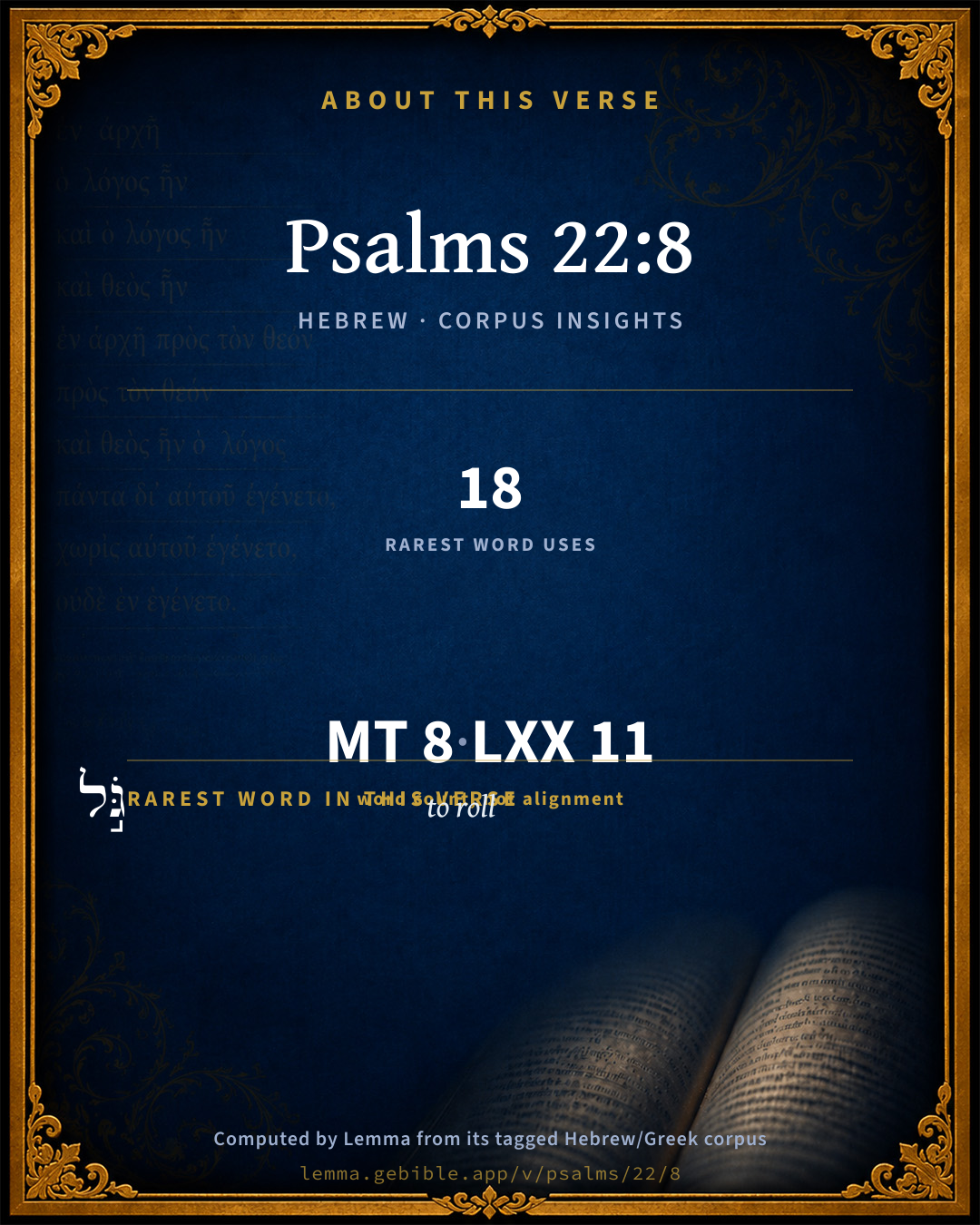
The rarest word here is גֹּ֣ל to roll H1556 — appearing just 18 times in the whole Hebrew Bible.

Shared distinctive vocabulary

גֹּ֣ל to roll H1556 occurs in 18 verses of the Hebrew Bible. Also found in:

Grammatical profile

  • 4 verbs
  • 1 noun
  • 2 prepositions
  • 1 conjunction

Verb forms

  • גֹּ֣ל Qal · Imperative
  • יְפַלְּטֵ֑הוּ Piel · Imperfect
  • יַ֝צִּילֵ֗הוּ Hiphil · Imperfect
  • חָ֥פֵֽץ Qal · Perfect

Hebrew & Septuagint length

In English translation the verse runs 17 words from the Hebrew and 19 from the Septuagint (LXX English) — closely comparable.

A rough comparison of the two English renderings, which tokenize alike — not a word-level alignment.

Word counts can differ between the Hebrew and the Greek without any difference in meaning — e.g. the Hebrew direct-object marker אֵת has no separate Greek word, and Greek often adds the article ὁ.

In the original languages it is 8 Hebrew tokens and 11 Greek tokens — but the two are counted differently (Hebrew bundles its prefixes and suffixes into one token; the Greek is in lemma form), so that isn’t a like-for-like length.

Cross-references

15

Topical passages linked to Psalms 22:8 in the Treasury of Scripture Knowledge — connected by theme and wording, ordered by reader-vote popularity; previews shown in the World English Bible.

  • Matthew 27:42–43 "He saved others, but he can't save himself. If he is the King of Israel, let him come down from the cross now, and we will believe in him.
  • Mark 15:30–32 save yourself, and come down from the cross!"
  • Psalms 91:14 "Because he has set his love on me, therefore I will deliver him. I will set him on high, because he has known my name.
  • Psalms 18:19 He brought me forth also into a large place. He delivered me, because he delighted in me.
  • Psalms 37:5 Commit your way to Yahweh. Trust also in him, and he will do this:
  • Psalms 55:22 Cast your burden on Yahweh, and he will sustain you. He will never allow the righteous to be moved.
  • Psalms 71:11 Saying, "God has forsaken him. Pursue and take him, for no one will rescue him."
  • Proverbs 16:3 Commit your deeds to Yahweh, And your plans shall succeed.
  • Isaiah 42:1 Behold, my servant, whom I uphold; my chosen, in whom my soul delights: I have put my Spirit on him; he will bring forth justice to the Gentiles.
  • Matthew 3:17 Behold, a voice out of the heavens said, "This is my beloved Son, with whom I am well pleased."
  • Matthew 17:5 While he was still speaking, behold, a bright cloud overshadowed them. Behold, a voice came out of the cloud, saying, "This is my beloved Son, in whom I am well pleased. Listen to him."
  • Matthew 12:18 "Behold, my servant whom I have chosen; My beloved in whom my soul is well pleased: I will put my Spirit on him. He will proclaim justice to the Gentiles.
  • Luke 23:35 The people stood watching. The rulers with them also scoffed at him, saying, "He saved others. Let him save himself, if this is the Christ of God, his chosen one!"
  • Psalms 42:10 As with a sword in my bones, my adversaries reproach me, While they continually ask me, "Where is your God?"
  • Psalms 3:1–2 Yahweh, how my adversaries have increased! Many are those who rise up against me.

Cross-references courtesy of OpenBible.info (CC BY 4.0).

Hebrew and Greek witnesses Masoretic Hebrew ↔ Greek Septuagint

The same verse in the two great witnesses to the Old Testament, shown verse-for-verse.

You’re reading Greek Psalm 21 (Hebrew Psalm 22). The Septuagint counts the superscription, so verse numbers can differ from the Hebrew — chapter-level alignment, not verse-by-verse. Numbering follows Rahlfs.

These are two independent witnesses, not word-aligned to each other, and the Septuagint is shown in lemma (dictionary) form.

Hebrew Psalms 22:8 Masoretic · Westminster Leningrad Codex

גֹּ֣ל אֶל יְהוָ֣ה יְפַלְּטֵ֑הוּ יַ֝צִּילֵ֗הוּ כִּ֘י חָ֥פֵֽץ בּֽוֹ

"He trusts in Yahweh; Let him deliver him; Let him rescue him, since he delights in him."

World English Bible · Public Domain

Greek LXX Greek Psalm 21:8 Septuagint · lemma form

πᾶς ὁ θεωρέω ἐγώ ἐκμυκτηρίζω ἐγώ λαλέω ἐν χεῖλος κινέω κεφαλή

He hoped in the Lord: let him deliver him, let him save him, because he takes pleasure in him.

LXX2012 (modern English Septuagint) · Public Domain

On this verse, J. A. Alexander on Psalms discusses the Septuagint’s reading. Read the note in Commentary ↓

Hebrew: Westminster Leningrad Codex (CC BY 4.0). Greek: Septuagint (public domain); English from LXX2012 (modern English Septuagint) (Public Domain). How the Septuagint differs from the Hebrew →

Commentary

Notes on Psalms 22:8 from classic Christian and Jewish commentators (each source and its license shown beneath its notes). The classic Christian expositions comment on the surrounding passage and are grouped to its opening verse, so a note may address several verses; the Jewish commentaries on the Tanakh (Rashi and others) are per-verse, so they appear only where the commentator wrote on this verse.

Lemma curates 59 commentaries, every one of them public domain or Creative Commons licensed, each selected and text-cleaned for this edition rather than reprinted as found. About our sources →

Trapp's Complete Commentary

John Trapp

Psa 22:8 He trusted on the LORD [that] he would deliver him: let him deliver him, seeing he delighted in him.

Ver. 8. He trusted on the Lord that he would deliver him] Is this a prophecy of our Saviour’s sufferings, or a history rather? See Mat 27:43, {See Trapp on "Mat 27:43"}

Seeing he delighted in him] A most virulent irony, whereby they sought to cajole him of his confidence, and so to drive him into utter desperation and destruction.

John Trapp, A Commentary or Exposition upon All the Books of the Old and New Testament (1647–1656) — public domain. Text from a community e-Sword module.

The Biblical Illustrator

Joseph S. Exell

Psa_22:8

He trusted on the Lord that He would deliver him.

Faith among mockers

David experienced cruel mockings. The flesh may not be cut, but the heart may be torn. But text tells of the Lord Jesus. David knew reproach but in small measure compared with Him. It is the common heritage of the godly. But--

I. Their trust in God is known. Hence we learn--

1. Our trust in God should be apparent, manifest, public. That in Christ which revealed it was His wonderful calmness. We ought distinctly to avow our trust, life man has a right to be a secret believer.

2. Our general conduct should reveal our faith. If I trust the Lord about my soul I must trust Him about my body, wife, children, and all my affairs.

3. This trust should come out most distinctly in times of trouble. For then it is our adversaries are most likely to notice it. In bereavements, business troubles. Let the possession of godliness tell its own tale, the spikenard its own fragrance.

II. The world does not understand this trust. Our Lords enemies restricted His trust to the point of His being delivered. But--

1. Our faith is not confined to merely receiving from God. We must not live and wait upon God merely with a cupboard love.

2. Nor to what men call deliverance. Our Lord trusted still, though the cup did not pass from Him. The blind world cannot understand this. They say, like their father, Doth Job serve God for nought? And--

3. Our faith is not tied to time. Christs enemies thought that if the Lord did not deliver Him then, His trust would be proved a folly. But it is not so. We may not be delivered from our distresses tonight, nor tomorrow, nor next month; it may be for years. We do not tie God down to conditions, but we trust Him all the same.

4. Nor will it judge at all by present circumstances. How wrongly the world judged of Christ when it judged of Him by His sorrows.

III. This true faith will, in all probability, be mocked at some time or other.

1. Some men scoff at faith itself. It is an honour to have ones name written up on such an Arch of Triumph as that of Heb_11:1-40. But many think it no honour at all. They hold faith to be a folly of weak minds.

2. Others, at the very idea of Divine interposition. Look, they say, he fancies that God will deliver him; as if the Creator had not something else to do besides looking after him, poor miserable that he is! They believe in laws, they say, irreversible, immutable laws, that grind in like the great cogs of a machine which, when once they are set in motion, tear everything to pieces that comes in their way.

3. And some mock at all kinds of faith in the Divine love. How the world rages against electing love! The heathen could not make out a certain brave saint because he called himself Theophorus, or God bearer; but he stuck to it that he was so, though they hated him all the more.

4. Some find amusement in the trials involved in the life of faith. Their cry, Let Him deliver him, implies that their victim was in serious difficulty, but that was only sport to them. Such mocking is a part of the covenanted heritage.

IV. The time shall come when our trust shall be abundantly justified.

1. It is no small thing to have the ungodly bearing witness. He trusted in God. It helps one to believe that he is really Gods child.

2. Another justification will come when God shall deliver His people. That day will come. Dives sees Lazarus in Abrahams bosom: what a sight for him. At the last great day ungodly men will witness for the saints. They will have to own, They did trust, for we mocked them for it. But whether men mock or praise, we trust in God. (C. H. Spurgeon.)

The Biblical Illustrator, edited by Joseph S. Exell (c. 1880s–1900s) — public domain. Text from a community e-Sword module.

J. A. Alexander on Psalms

Joseph Addison Alexander

9. (Psa 22:8). Trust in Jehovah! He will deliver him, he will save him, for he delights in him. The literal meaning of the first clause is, roll to (or on) Jehovah, which would be unintelligible but for the parallel expressions in Psa 37:5, roll thy way upon Jehovah, and in Pro 16:3, roll thy work upon Jehovah, where the idea is evidently that of a burden cast upon another by one who is unable to sustain it himself. This burden, in the first case, is his way, i.e. his course of life, his fortune, his destiny, and in the other case, his work, i.e. his business, his affairs, his interest. In evident allusion to these places, the apostle Peter says, casting all your care upon him, for he careth for you (1Pe 5:7). By these three parallels light is thrown on the elliptical expression now before us, roll, i.e. thy burden or thy care upon Jehovah.—A further difficulty is occasioned by the form of the original, which, according to usage, must be either the infinitive construct or the second person of the imperative. But as these seem out of place in such a context, some arbitrarily explain it as an absolute infinitive, or a third person imperative, or change the form to that of a preterite. This last is the construction in the Septuagint version retained in the New Testament (Mat 27:43), and really included in the Hebrew, but by no means an exact representation of its form. Perhaps the best solution of the syntax is to make this clause a quotation, or derisive repetition of the sufferer's own words, as if they had said, "This is he who was so fond of repeating the precept, Trust in Jehovah! Let him now try its virtue in his own case. He in whom he has trusted, and exhorted others to trust also, will no doubt deliver him." The next two verbs are ironical futures, not imperatives, and should be so translated.—The last words of the verse are always applied elsewhere to God's complacency in man, and not to man's reciprocal delight in God. The Septuagint version, retained in the New Testament, if he will (have) him, or if he will (deliver) him, although not incorrect, is much inferior in strength to the original.—By appropriating these words, the spectators of our Lord's sufferings identified themselves with the wicked persecutors, by whom they are here supposed to be originally uttered.

Joseph Addison Alexander, The Psalms Translated and Explained (1850) — public domain. Text from a community e-Sword module.

Geneva Bible (1599)

Geneva Bible translators

Hebrew, rolled upon God.

Geneva Bible (1599) marginal notes — public domain. Text via Bolls.life.

Jamieson, Fausset & Brown

Robert Jamieson, A. R. Fausset & David Brown

trusted on the Lord--literally, "rolled"--that is, his burden (Psa 37:5; Pro 16:3) on the Lord. This is the language of enemies sporting with his faith in the hour of his desertion.

Jamieson, Fausset & Brown — Commentary Critical and Explanatory on the Whole Bible (1871) — public domain (CC PDM 1.0). Text via the HelloAO Bible API.

John Calvin's Commentaries

How severe a temptation this must have been to David every man may judge from his own experience. But by the remedy he used he afforded a proof of the sincerity of his confidence: for unless he had had God as the undoubted witness and approver of the sincerity of his heart, he would never have dared to come before him with this complaint. Whenever, therefore, men charge us with hypocrisy, let it be our endeavor that the inward sincerity of our hearts may answer for us before God. And whenever Satan attempts to dislodge faith from our minds, by biting detraction and cruel derision, let this be our sacred anchors — to call upon God to witness it, and that, beholding it, he may be pleased to show his righteousness in maintaining our right, since his holy name cannot be branded with viler blasphemy than to say that those who put their trust in him are puffed up with vain confidence, and that those who persuade themselves that God loves them deceive themselves with a groundless fancy. As the Son of God was assailed with the same weapon, it is certain that Satan will not be more sparing of true believers who are his members than of him. They ought, therefore, to defend themselves from this consideration - that although men may regard them as in a desperate condition, yet, if they commit to God both themselves and all their affairs, their prayers will not be in vain. By the verb, גל, gol, which is rendered to commit, the nature and efficacy of faith are very well expressed, which, reposing itself upon the providence of God, relieves our minds from the burdens of the cares and troubles with which they are agitated.

John Calvin's Commentaries (1540-1563) — public domain. Text from the Calvin Translation Society English edition (1840s-50s) via the Christian Classics Ethereal Library (ccel.org). Calvin's coverage is partial (roughly two-thirds of the Bible); uncommented books and verses are honest gaps, never fabricated. The 19th-century editor's footnotes and remarks are omitted so the notes are faithfully Calvin's own voice.

Ellicott's Commentary for English Readers

(8) He trusted.—So the LXX. (Comp. Mat_27:43.) So, too, Ewald among moderns. But generally the form gol (short for gôl) is taken as an imperative. Literally, roll thyself on God. (Comp. Psa_37:5; Pro_16:3, margin.)

A Bible Commentary for English Readers, edited by Charles John Ellicott (1878–1897) — public domain. Text from a community e-Sword module.

The Cambridge Bible for Schools and Colleges

gen. ed. J. J. S. Perowne

8. ‘Roll it upon Jehovah! let him deliver him:

Let him rescue him, for he delighteth in him.’

Ironically they bid the sufferer ‘roll’ i.e. commit his cause to Jehovah. The verb is certainly imperative, as in Psa_37:5; Pro_16:3; though the Versions all give the perfect tense, and the words are quoted in that form in Mat_27:43. Usage makes it certain that the subject in the last clause is Jehovah, as in Psa_18:19.

There is a remarkable parallel to this passage in Wis_2:16 ff. The ungodly say of the righteous man: “He maketh his boast that God is his Father. Let us see if his words be true, and let us prove what shall happen in the end of him. For if the just man be the son of God, he will help him, and deliver him from the hand of his enemies.” The whole passage is worth comparing.

The Cambridge Bible for Schools and Colleges (gen. ed. J. J. S. Perowne; Cambridge University Press, 1878–1918) — public domain. Text from a community e-Sword module.

John Gill's Exposition

He trusted on the Lord, that he would deliver him,.... Not that they spoke in a deriding way of the object of his trust, for, as impious as they were, this they did not do; but of his trust in the Lord, which they looked upon to be a false one, as would appear by his not being delivered, as he trusted; but his confidence was a well grounded one, though jeered at by these men, and he was delivered in the Lord's own time and way from all his enemies, and out of all his troubles;

let him deliver him, seeing he delighted in him; this is another ironical sarcastic flout, not at God, but at Christ, and at his profession of trust in God, his claim of interest in his favour, and of relation to him as being the Son of his love, in whom he was well pleased; he always was the delight of his Father; he expressed his well pleasedness in him at his baptism, and transfiguration on the mount; he took pleasure in him while he was suffering and dying in the room and stead of his people; and he delivered him, raised him from the dead, and brought him into a large place, because he delighted in him, Psa 18:19; These very words were said by the Jews concerning Christ, as he hung upon the cross, Mat 27:43.

John Gill's Exposition of the Whole Bible (1746–1763) — public domain (CC PDM 1.0). Text via the HelloAO Bible API.

Albert Barnes' Notes on the Bible

He trusted on the Lord that he would deliver him - Margin, “He rolled himself on the Lord.” The margin expresses the true sense of the Hebrew word. The idea is that of being under the pressure of a heavy burden, and of rolling it off, or casting it on another. Hence, the word is often used in the sense of committing to another; entrusting anything to another; confiding in another. Psa 37:5, “commit thy way unto the Lord;” Margin, as in Hebrew: “Roll thy way upon the Lord.” Pro 16:3, “commit thy works unto the Lord,” Margin, as in Hebrew: “Roll.” The language here is the taunting language of his enemies, and the meaning is that he had professed to commit himself to the Lord as if he were his friend; he had expressed confidence in God, and he believed that his cause was sate in His hand. This, too, was actually fulfilled in the ease of the Saviour. Mat 27:43, “he trusted in God; let him deliver him now, if he will have him.” It is one of the most remarkable instances of blindness and infatuation that has ever occurred in the world, that the Jews should have used this language in taunting the dying Redeemer, without even suspecting that they were fulfilling the prophecies, and demonstrating at the very time when they were reviling him that he was the true Messiah.

Let him deliver him - Let him come and save him. Since he professes to belong to God; since he claims that God loves him and regards him as his friend, let him come now and rescue one so dear to him. He is hopelessly abandoned by men. If God chooses to have one so abject, so despised, so forsaken, so helpless, let him come now and take him as his own. We will not rescue him; we will do nothing to save him, for we do not need him. If God wants him, let him come and save him. What blasphemy! What an exhibition of the dreadful depravity of the human heart was manifested in the crucifixion of the Redeemer!

Seeing he delighted in him - Margin, “if he delight in him.” The correct rendering is,” for he delighted in him.” That is, it was claimed by the sufferer that God delighted in him. If this is so, say they, let him come and rescue one so dear to himself. Let him show his friendship for this vagrant, this impostor, this despised and worthless man

Albert Barnes' Notes on the Bible (1834–1885) — public domain. Text from a community e-Sword/MySword module.

Matthew Poole's English Annotations

He trusted on the Lord; he rolled himself

upon the Lord; where they seem to scoff not only at the thing, but at the expression. Their sense is, He pretended that he did wholly lean, and rest himself, and cast his cares upon God, and quietly and confidently commit all his affairs to his providence, assuring himself of a happy issue from him.

That he would deliver him; or, without any supplement, let him deliver him, as it follows, though the Hebrew words be differing. And so the same thing is twice repeated, to show both the vehemency of their hatred, and their confidence of success against him. They thought his case desperate, and past all hope and remedy.

Seeing he delighted in him, as he useth to allege and boast, but how vainly the event now showeth.

Matthew Poole's English Annotations on the Holy Bible (1683–1685) — public domain. Text from a community e-Sword/MySword module.

The Treasury of David

Charles H. Spurgeon

Ver. 8. Saying, He trusted on the Lord that he would deliver him: let him deliver him, seeing he delighted in him. Here the taunt is cruelly aimed at the sufferer's faith in God, which is the most tender point in a good man's soul, the very apple of his eye. They must have learned the diabolical art from Satan himself, for they made rare proficiency in it. According to Mt 27:39-44, there were five forms of taunt hurled at the Lord Jesus; this special piece of mockery is probably mentioned in this psalm because it is the most bitter of the whole; it has a biting, sarcastic irony in it, which gives it a peculiar venom; it must have stung the Man of Sorrows to the quick. When we are tormented in the same manner, let us remember him who endured such contradiction of sinners against himself, and we shall be comforted. On reading these verses one is ready, with Trapp, to ask, Is this a prophecy or a history? for the description is so accurate. We must not lose sight of the truth which was unwittingly uttered by the Jewish scoffers. They themselves are witnesses that Jesus of Nazareth trusted in God: why then was he permitted to perish? Jehovah had aforetime delivered those who rolled their burdens upon him: why was this man deserted? Oh that they had understood the answer! Note further, that their ironical jest,

seeing he delighted in him, was true. The Lord did delight in his dear Son, and when he was found in fashion as a man, and became obedient unto death, he still was well pleased with him. Strange mixture! Jehovah delights in him, and yet bruises him; is well pleased, and yet slays him.

Ver. 8. Here are recorded some of those very words, by which the persecutors of our Lord expressed their mockery and scorn. How remarkable to find them in a Psalm written so many hundred years before! John Stevenson.

Charles H. Spurgeon's The Treasury of David (1869–1885) — public domain. Psalms only. Text from a community e-Sword/MySword module.

Whedon's Commentary on the Bible

Daniel D. Whedon

8. He trusted on the Lord… let him deliver him—Rather, He rolled himself upon Jehovah. This passage was derisively applied to Christ while on the cross, as a test of his divine Sonship. Mat_27:43. The whole verse is, in the Hebrew, intensely and cruelly sarcastic, and the refinement of blasphemy: “He rolled himself upon Jehovah; he will cause him to escape; he will rescue him, for he took pleasure in him!” Matthew follows almost verbatim the Septuagint.

Daniel D. Whedon (gen. ed.), Commentary on the Old and New Testaments (1874–1909) — public domain. Text from a community e-Sword module.

The Pulpit Commentary

He trusted on the Lord that he would deliver him. This is a translation of the Septuagint Version rather than of the Hebrew text, which runs, Trust in the Lord (literally, Roll thy care upon the Lord): let him deliver him. Let him deliver him, seeing he delighted in him. St. Matthew has put it on record that this text was actually cited by the scribes and elders who witnessed the Crucifixion, and applied to our Lord in scorn. (Mat_27:43) They quoted apparently from the Septuagint, but with an inaccuracy common at the time, when books were scarce, and persons had to depend on their memory of what they had occasionally heard read.

The Pulpit Commentary (1880–1919), ed. H.D.M. Spence-Jones & Joseph S. Exell — public domain. Text from a community e-Sword module.

Rashi

Rabbi Shlomo Yitzchaki (Rashi)

they will open Heb. יפטירו, they open, as (in Exod. 13:12, 13): “all that open (פטר) the womb,...and firstling (ופטר) of a donkey.” [Also] (in Prov. 17: 14): “like letting out (פוטר) water.”

Rashi on the Tanakh — English translations: “The Judaica Press complete Tanach with Rashi, translated by A. J. Rosenberg” (CC BY 4.0); “Pentateuch with Rashi's commentary by M. Rosenbaum and A.M. Silbermann, 1929-1934” (public domain); “The Metsudah Tanach series, Lakewood, N.J” (CC BY 4.0); and “The Book of Joshua, Metsudah Publications, 1997” (CC BY 4.0). Text via Sefaria.

Radak

Rabbi David Kimhi (Radak)

All that see me laugh me to scorn: – This is true of Israel, for all who see them laugh them to scorn;

They shoot out with the lip: – and shoot out upon them with the lip words of mockery and insult;

They shake the head: – and they shake the head at them. They shoot out (יפטירי): i-e. they send out words with the lip. (This meaning may be illustrated) from “the shooting out (פוטר) of water” (Prov. 17:14). “Sending out” applies also to water, as “He sendeth forth springs” (Ps. 104:10); and it applies also to words, as “Thou sendest out thy mouth to evil” (ibid. 1. 19). cf. also the Targum of שלחו והאנשׁים (and the men were sent away) (Gen. 44:3), which is אתפטרו וגובריא.

Radak on the Tanakh — English translations: “Sefaria Community Translation” (CC0 1.0 (public-domain dedication)); “Eliyahu Munk, HaChut Hameshulash” (CC BY 4.0); “Rabbi Mike Feuer, Jerusalem Anthology” (CC BY 4.0); and “R. David Kimhi on the first book of Psalms, Translated by R.G. Finch, London, 1919” (public domain). Text via Sefaria.

Lesson kit

Teaching starters — assembled from the data on this page, not authored interpretation. Every prompt links to the verse data it draws on. Edit before teaching.

Psalms, in the Wisdom, opens this verse with 8 words (7 distinct Hebrew lemmas). Its most distinctive word is gâlal (“to roll”). A historical commentator’s framing appears above. Read the whole chapter for the surrounding context.

Discussion questions

  1. How does “to roll” (gâlal) shape what this verse is saying?
  2. Genesis 29:3 shares the word «to roll» with this verse. How do the two illuminate each other?
  3. The translations on this page render this verse differently — a whole-verse word diff, not a word-by-word alignment. What might account for the different wordings?
  4. The verb «גֹּ֣ל» is Qal Imperative. How does its form color the action?
  5. Reading how Trapp's Complete Commentary and The Biblical Illustrator read this verse, where do the two commentators agree and where do they part?

Things to notice

Reading settings

Reading text

Shown beneath each verse's original-language words.

Old Testament
Old Testament edition

Read the OT as the Masoretic Hebrew (MT) or the Greek Septuagint (LXX).

English shown for the Greek Septuagint (in the Hebrew ↔ Greek comparison).

Comparing translations? Open the Compare panel on any verse page to stack up to four side by side.