
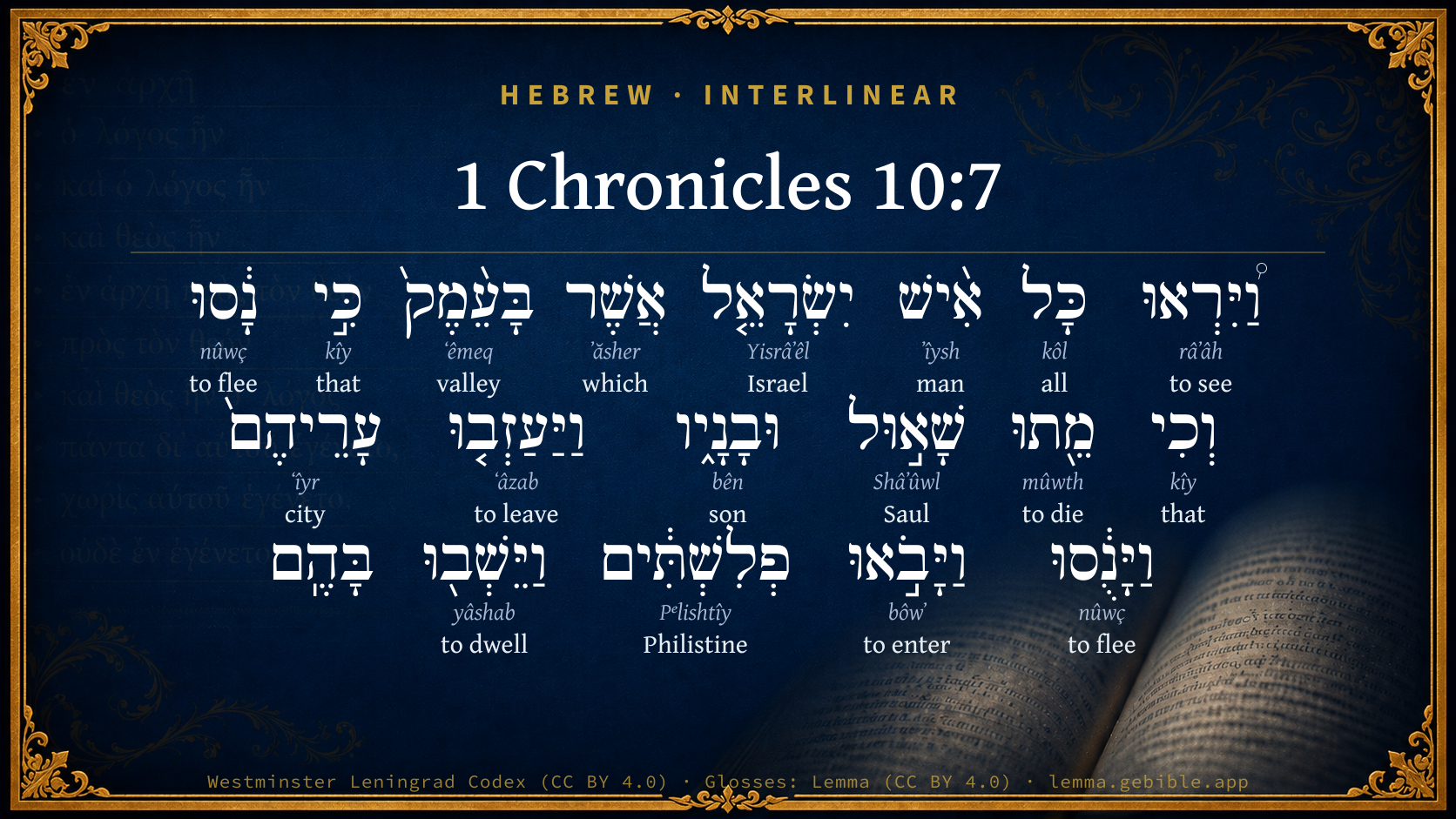
1 Chronicles 10:7

Hebrew (Westminster Leningrad Codex) 1 Chronicles 10:7 appears in the Hebrew Old Testament. The text above is from the Westminster Leningrad Codex. Each word links to its Strong’s number, a concise gloss, and parsing drawn from the Open Scriptures Hebrew Bible morphology. Click any word for its full Brown-Driver-Briggs (BDB) entry.
Download image
Cite this verse

1 Chronicles 10:7 (World English Bible). Public Domain. Lemma interlinear Bible study tool, https://lemma.gebible.app/v/1-chronicles/10/7.

Show BibTeX & RIS
BibTeX
RIS
English Translation
When all the men of Israel who were in the valley saw that they fled, and that Saul and his sons were dead, they forsook their cities, and fled; and the Philistines came and lived in them.
World English Bible · Public Domain
Download a study sheet

One document with this verse’s original text, its word-by-word gloss line, the meaning frame, cross-references with their text, attributed commentary, and full source and license credits — printable, and it pastes into notes with its structure intact.

This verse Autodidact and up

Study sheet (.html) Plain text (.txt)

A passage Seminary Student

Up to 50 verses in one chapter. A passage sheet keeps up to 6 commentary sources and 12 cross-references per verse, in the order this page ranks them, and says so on the sheet whenever that leaves anything out. Ask for a single verse and you get the Autodidact verse sheet above.

Everything on this page stays free to read, with no account — the sheet is a download of what is already on screen, not access to it.

Want to remove ads? Support Godless Engineer
Compare translations 3

The same verse in 3 English versions, stacked beneath the original-language interlinear above. Click any original word for its lexicon entry.

Each is an independent rendering of the whole verse — the interlinear is not word-aligned to these translations.

Highlighted words mark where these versions differ — a whole-verse word diff, not a word-by-word alignment.

  • World English Bible Public Domain
    When all the men of Israel who were in the valley saw that they fled, and that Saul and his sons were dead, they forsook their cities, and fled; and the Philistines came and lived in them.
  • King James Version Public Domain
    And when all the men of Israel that were in the valley saw that they fled, and that Saul and his sons were dead, then they forsook their cities, and fled: and the Philistines came and dwelt in them.
  • unfoldingWord Literal Text CC BY-SA 4.0
    And all of the men of Israel who in the valley saw that they had fled and that Saul and his sons had died. And they abandoned their cities and fled. And the Philistines came and dwelled in them.

unfoldingWord Literal Text — © unfoldingWord, licensed CC BY-SA 4.0. Word-aligned USFM3 via Door43 (git.door43.org/unfoldingWord/en_ult).

Versions to compare (up to 4)

3 of 4 selected

Show all 18 translations

Every available English version of this verse, each an independent rendering of the whole verse.

  • World English Bible Public Domain
    When all the men of Israel who were in the valley saw that they fled, and that Saul and his sons were dead, they forsook their cities, and fled; and the Philistines came and lived in them.
  • Berean Standard Bible Public Domain
    When all the Israelites in the valley saw that the army had fled and that Saul and his sons had died, they abandoned their cities and ran away. So the Philistines came and occupied their cities.
  • Majority Standard Bible Public Domain
    When all the Israelites in the valley saw that the army had fled and that Saul and his sons had died, they abandoned their cities and ran away. So the Philistines came and occupied their cities.
  • King James Version Public Domain
    And when all the men of Israel that were in the valley saw that they fled, and that Saul and his sons were dead, then they forsook their cities, and fled: and the Philistines came and dwelt in them.
  • American Standard Version (1901) Public Domain
    And when all the men of Israel that were in the valley saw that they fled, and that Saul and his sons were dead, they forsook their cities, and fled; and the Philistines came and dwelt in them.
  • Revised Version (1885) Public Domain
    And when all the men of Israel that were in the valley saw that they fled, and that Saul and his sons were dead, they forsook their cities, and fled; and the Philistines came and dwelt in them.
  • Geneva Bible (1599) Public Domain
    And when all the men of Israel that were in the valley, sawe how they fledde, and that Saul and his sonnes were dead, they forsooke their cities, and fled away, and the Philistims came, and dwelt in them.
  • Douay-Rheims (1899) Public Domain
    And when the men of Israel, that dwelt in the plains, saw this, they fled: and Saul and his sons being dead, they forsook their cities, and were scattered up and down: and the Philistines came, and dwelt in them.
  • Young's Literal Translation Public Domain
    And all the men of Israel who `are' in the valley see that they have fled, and that Saul and his sons have died, and they forsake their cities and flee, and the Philistines come and dwell in them.
  • Literal Standard Version CC BY-SA 4.0
    And all the men of Israel who [are] in the valley see that they have fled and that Saul and his sons have died, and they forsake their cities and flee, and the Philistines come and dwell in them.
  • Unlocked Literal Bible CC BY-SA 4.0
    When every man of Israel in the valley saw that they had fled, and that Saul and his sons were dead, they abandoned their cities and fled. Then the Philistines came and lived in them.
  • unfoldingWord Literal Text CC BY-SA 4.0
    And all of the men of Israel who in the valley saw that they had fled and that Saul and his sons had died. And they abandoned their cities and fled. And the Philistines came and dwelled in them.
  • Darby Bible Public Domain
    And when all the men of Israel that were in the valley saw that they fled, and that Saul and his sons were dead, they forsook their cities and fled; and the Philistines came and dwelt in them.
  • World Messianic Bible Public Domain
    When all the men of Israel who were in the valley saw that they fled, and that Saul and his sons were dead, they abandoned their cities, and fled; and the Philistines came and lived in them.
  • Webster's Bible Public Domain
    And when all the men of Israel that were in the valley saw that they fled, and that Saul and his sons were dead, then they forsook their cities, and fled: and the Philistines came and dwelt in them.
  • Free Bible Version CC BY-SA 4.0
    When all the Israelites in the valley saw that their army had run away, and that Saul and his sons were dead, they abandoned their towns and they also ran away. The Philistines came and occupied them.
  • Bible in Basic English Public Domain
    And when all the men of Israel who were in the valley saw that the men of Israel had gone in flight and that Saul and his sons were dead, they went in flight away from their towns; and the Philistines came and took them for themselves.
  • JPS Tanakh (1917) Public Domain
    And when all the men of Israel that were in the valley saw that Israel fled, and that Saul and his sons were dead, they forsook their cities, and fled; and the Philistines came and dwelt in them.

Literal Standard Version (2020), Covenant Press — licensed CC BY-SA 4.0. Text via the HelloAO Bible API (eBible.org). Unlocked Literal Bible (unfoldingWord) — licensed CC BY-SA 4.0. Text via the HelloAO Bible API (eBible.org). unfoldingWord Literal Text — © unfoldingWord, licensed CC BY-SA 4.0. Word-aligned USFM3 via Door43 (git.door43.org/unfoldingWord/en_ult). Free Bible Version, Dr. Jonathan Gallagher — licensed CC BY-SA 4.0. Text via the HelloAO Bible API (eBible.org).

Word by word

More ways to search: Search by grammar → Find every occurrence → Compare this word →

Practice this passage: Drill this verse → Learn its vocabulary →

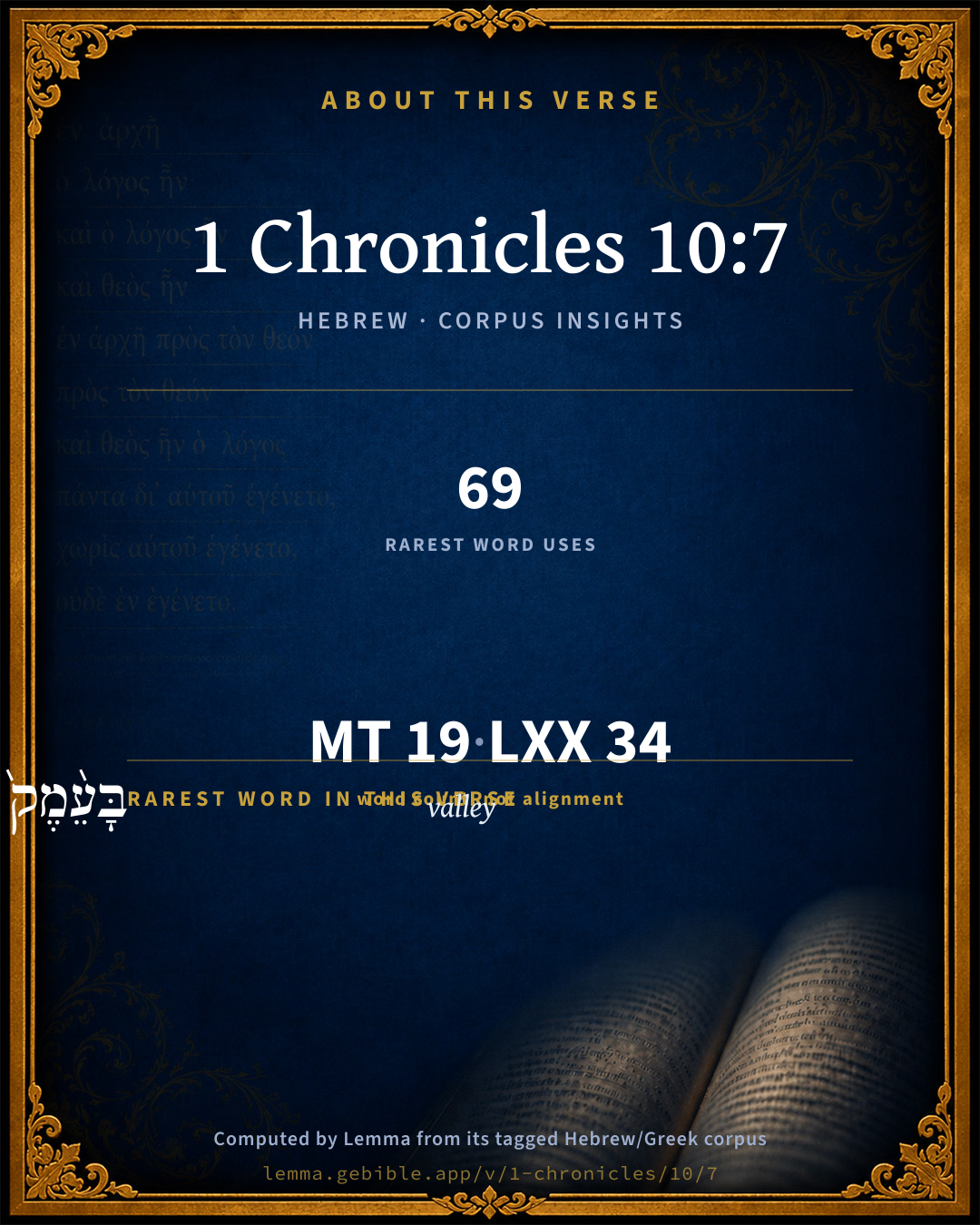
בָּעֵ֨מֶק֙
ʻêmeq
H6010
“in/at the · valley”
Preposition, Determined + Noun, Common, Masculine, Singular, Absolute
Part of Speech
Preposition + Noun
Type
Common
Gender
Masculine
Number
Singular
State
Absolute
Full BDB Definition

Origin: from H6009

TWOT: 1644a

valley, vale, lowland, open country
  1. וַ֠יִּרְאוּ râʼâh H7200 “and · to see” Conjunction + Verb, Qal, Sequential Imperfect, 3rd Person, Masculine, Plural
  2. כָּל kôl H3605 “all of” Noun, Common, Masculine, Singular, Construct
  3. אִ֨ישׁ ʼîysh H376 “man of” Noun, Common, Masculine, Singular, Construct
  4. יִשְׂרָאֵ֤ל Yisrâʼêl H3478 “Israel” Noun, Proper
  5. אֲשֶׁר ʼăsher H834 “which” Particle, Relative
  6. כִּ֣י kîy H3588 “that” Conjunction
  7. נָ֔סוּ nûwç H5127 “to flee” Verb, Qal, Perfect, 3rd Person, Common, Plural
  8. וְכִי kîy H3588 “and · that” Conjunction + Conjunction
  9. מֵ֖תוּ mûwth H4191 “to die” Verb, Qal, Perfect, 3rd Person, Common, Plural
  10. שָׁא֣וּל Shâʼûwl H7586 “Saul” Noun, Proper
  11. וּבָנָ֑יו bên H1121 “and · sons · his” Conjunction + Noun, Common, Masculine, Plural, Construct + Suffix, Personal, 3rd Person, Masculine, Singular
  12. וַיַּעַזְב֤וּ ʻâzab H5800 “and · to leave” Conjunction + Verb, Qal, Sequential Imperfect, 3rd Person, Masculine, Plural
  13. עָרֵיהֶם֙ ʻîyr H5892 “cities · their” Noun, Common, Feminine, Plural, Construct + Suffix, Personal, 3rd Person, Masculine, Plural
  14. וַיָּנֻ֔סוּ nûwç H5127 “and · to flee” Conjunction + Verb, Qal, Sequential Imperfect, 3rd Person, Masculine, Plural
  15. וַיָּבֹ֣אוּ bôwʼ H935 “and · to enter” Conjunction + Verb, Qal, Sequential Imperfect, 3rd Person, Masculine, Plural
  16. פְלִשְׁתִּ֔ים Pᵉlishtîy H6430 “Philistines” Noun, Gentilic, Masculine, Plural, Absolute
  17. וַיֵּשְׁב֖וּ yâshab H3427 “and · to dwell” Conjunction + Verb, Qal, Sequential Imperfect, 3rd Person, Masculine, Plural

About this verse

These counts appear in no published source. They are computed here, from the morphology-tagged text and Lemma’s own curated glosses. What Lemma adds →

19
words
16
distinct lemmas
Historical
section

Grammatical profile

  • 7 verbs
  • 8 nouns
  • 1 preposition
  • 2 conjunctions
  • 1 particle

Verb forms

  • וַ֠יִּרְאוּ Qal · Sequential Imperfect
  • נָ֔סוּ Qal · Perfect
  • מֵ֖תוּ Qal · Perfect
  • וַיַּעַזְב֤וּ Qal · Sequential Imperfect
  • וַיָּנֻ֔סוּ Qal · Sequential Imperfect
  • וַיָּבֹ֣אוּ Qal · Sequential Imperfect
  • וַיֵּשְׁב֖וּ Qal · Sequential Imperfect

Repetition

Words recur within this verse — often emphatic in Hebrew:

  • נָ֔סוּ to flee H5127 ×2
  • כִּ֣י that H3588 ×2

Hebrew & Septuagint length

In English translation the verse runs 37 words from the Hebrew and 38 from the Septuagint (LXX English) — closely comparable.

A rough comparison of the two English renderings, which tokenize alike — not a word-level alignment.

Word counts can differ between the Hebrew and the Greek without any difference in meaning — e.g. the Hebrew direct-object marker אֵת has no separate Greek word, and Greek often adds the article ὁ.

In the original languages it is 19 Hebrew tokens and 34 Greek tokens — but the two are counted differently (Hebrew bundles its prefixes and suffixes into one token; the Greek is in lemma form), so that isn’t a like-for-like length.

Cross-references

7

Topical passages linked to 1 Chronicles 10:7 in the Treasury of Scripture Knowledge — connected by theme and wording, ordered by reader-vote popularity; previews shown in the World English Bible.

  • 1 Samuel 13:6 When the men of Israel saw that they were in a strait (for the people were distressed), then the people did hide themselves in caves, and in thickets, and in rocks, and in coverts, and in pits.
  • 1 Samuel 31:7 When the men of Israel who were on the other side of the valley, and those who were beyond the Jordan, saw that the men of Israel fled, and that Saul and his sons were dead, they forsook the cities, and fled; and the Philistines came and lived in them.
  • Leviticus 26:31 I will lay your cities waste, and will bring your sanctuaries to desolation, and I will not take delight in the sweet fragrence of your offerings.
  • Leviticus 26:36 "'As for those of you who are left, I will send a faintness into their hearts in the lands of their enemies: and the sound of a driven leaf will put them to flight; and they shall flee, as one flees from the sword; and they will fall when no one pursues.
  • Deuteronomy 28:33 The fruit of your ground, and all your labors, shall a nation which you don't know eat up; and you shall be only oppressed and crushed always;
  • Deuteronomy 28:43 The foreigner who is in the midst of you shall mount up above you higher and higher; and you shall come down lower and lower.
  • Judges 6:2 The hand of Midian prevailed against Israel; and because of Midian the children of Israel made them the dens which are in the mountains, and the caves, and the strongholds.

Cross-references courtesy of OpenBible.info (CC BY 4.0).

Hebrew and Greek witnesses Masoretic Hebrew ↔ Greek Septuagint

The same verse in the two great witnesses to the Old Testament, shown verse-for-verse.

These are two independent witnesses, not word-aligned to each other, and the Septuagint is shown in lemma (dictionary) form.

Hebrew 1 Chronicles 10:7 Masoretic · Westminster Leningrad Codex

וַ֠יִּרְאוּ כָּל אִ֨ישׁ יִשְׂרָאֵ֤ל אֲשֶׁר בָּעֵ֨מֶק֙ כִּ֣י נָ֔סוּ וְכִי מֵ֖תוּ שָׁא֣וּל וּבָנָ֑יו וַיַּעַזְב֤וּ עָרֵיהֶם֙ וַיָּנֻ֔סוּ וַיָּבֹ֣אוּ פְלִשְׁתִּ֔ים וַיֵּשְׁב֖וּ בָּהֶֽם

When all the men of Israel who were in the valley saw that they fled, and that Saul and his sons were dead, they forsook their cities, and fled; and the Philistines came and lived in them.

World English Bible · Public Domain

Greek LXX 1 Chronicles 10:7 Septuagint · lemma form

καί ὁράω πᾶς ἀνήρ ἰσραήλ ὁ ἐν ὁ αὐλών ὅτι φεύγω ἰσραήλ καί ὅτι ἀποθνήσκω σαούλ καί ὁ υἱός αὐτός καί καταλείπω ὁ πόλις αὐτός καί φεύγω καί ἔρχομαι ἀλλόφυλος καί καταοἰκέω ἐν αὐτός

And all the men of Israel that were in the valley saw that Israel fled, and that Saul and his sons were dead, and they left their cities, and fled: and the Philistines came and lived in them.

LXX2012 (modern English Septuagint) · Public Domain

Hebrew: Westminster Leningrad Codex (CC BY 4.0). Greek: Septuagint (public domain); English from LXX2012 (modern English Septuagint) (Public Domain). How the Septuagint differs from the Hebrew →

Commentary

Notes on 1 Chronicles 10:7 from classic Christian and Jewish commentators (each source and its license shown beneath its notes). The classic Christian expositions comment on the surrounding passage and are grouped to its opening verse, so a note may address several verses; the Jewish commentaries on the Tanakh (Rashi and others) are per-verse, so they appear only where the commentator wrote on this verse.

Lemma curates 59 commentaries, every one of them public domain or Creative Commons licensed, each selected and text-cleaned for this edition rather than reprinted as found. About our sources →

Trapp's Complete Commentary

John Trapp

1Ch 10:7 And when all the men of Israel that [were] in the valley saw that they fled, and that Saul and his sons were dead, then they forsook their cities, and fled: and the Philistines came and dwelt in them.

Ver. 7. And the Philistines came and dwelt in them.] But before they were well warm in these their new nests, David unroosted and dislodged them "The triumphing of the wicked is but short." {Job 20:5}

John Trapp, A Commentary or Exposition upon All the Books of the Old and New Testament (1647–1656) — public domain. Text from a community e-Sword module.

Ellicott's Commentary for English Readers

(7) That were in the valley.—Rather, the plain, in which the main battle was fought—that of Jezreel. Samuel has “that were on the other side of the plain, and on the other side of the Jordan.” The curt phrase “who (dwelt) in the plain,” may be compared with 1Ch_9:2. The people of the surrounding districts are meant; who, when they “saw that they” (viz., Saul’s army, “the men of Israel,” Samuel) “fled,” or had been routed, deserted “their (Samuel, ‘the,’ perhaps a transposition of letters) cities” which were then occupied by the Philistines.

Dwelt in them.—The pronoun here is masculine, in Samuel, feminine, which is correct.

A Bible Commentary for English Readers, edited by Charles John Ellicott (1878–1897) — public domain. Text from a community e-Sword module.

The Cambridge Bible for Schools and Colleges

gen. ed. J. J. S. Perowne

7. that were in the valley] The “valley of Jezreel” (Hos_1:5), called in later times the “plain of Esdrelon” (Esdraelon) is meant. Even those who lived east of Jordan took to flight; 1Sa_31:7.

forsook their cities] Among these was no doubt Beth-shan (Beisan) “the key of Western Palestine” (see G. A. Smith, Hist. Geog. p. 358 f.), where Saul’s body was exposed (1Sa_31:12).

and dwelt in them] Only perhaps until Abner reconquered this district for Ish-bosheth the son of Saul; cp. 2Sa_2:9, “[Abner] made him (Ish-bosheth) king over … Jezreel.”

The Cambridge Bible for Schools and Colleges (gen. ed. J. J. S. Perowne; Cambridge University Press, 1878–1918) — public domain. Text from a community e-Sword module.

Matthew Poole's English Annotations

In the valley; which was beneath Mount Gilboa, where the fight was, 1Ch 10:1.

Matthew Poole's English Annotations on the Holy Bible (1683–1685) — public domain. Text from a community e-Sword/MySword module.

The Pulpit Commentary

In the valley. In place of these words, the parallel (1Sa_31:7) has, "On the other side of the valley, and.., on the other side Jordan." We have here a clear instance of the desire of the compiler of Chronicles to compress his narrative, while the fidelity of the parallel narrative is testi-fled in the naturalness of its statements, amounting to this, that, quick as the intelligence or report could reach all those Israelites who were at all within the range of the victorious Philistines, they hastened to vacate their abodes.

The Pulpit Commentary (1880–1919), ed. H.D.M. Spence-Jones & Joseph S. Exell — public domain. Text from a community e-Sword module.

unfoldingWord translationNotes

Door43 World Missions Community

When every man of Israel

This is probably a generalization. AT: "When the men of Israel" (See: Hyperbole and Generalization)

they had fled

"the Israelite soldiers had fled"

the Philistines came and lived in them

"the Philistines came and lived in the cities from which the Israelites had fled." This probably happened after the events in verses 8-12.

It came about

This phrase is used here to mark an important event in the story. If your language has a way for doing this, you could consider using it here.

to strip the dead

"to take everything of value off of the dead bodies"

Saul and his sons fallen

Here "fallen" is a polite way to refer to someone who died in battle. AT: "Saul and his sons dead" (See: Euphemism)

translationWords

life

unfoldingWord translationNotes — © Distant Shores Media and the Door43 World Missions Community, licensed CC BY-SA 4.0. Source: git.door43.org/Door43/en_tn.

Lesson kit

Teaching starters — assembled from the data on this page, not authored interpretation. Every prompt links to the verse data it draws on. Edit before teaching.

1 Chronicles, in the Historical, opens this verse with 19 words (16 distinct Hebrew lemmas). Its most distinctive word is ʻêmeq (“valley”). A historical commentator’s framing appears above. Read the whole chapter for the surrounding context.

Discussion questions

  1. The word ʻêmeq carries the sense “valley.” How does it shape the verse?
  2. How does 1 Samuel 13:6, which shares this passage’s theme, read alongside this verse?
  3. What does the repetition of “to flee” (2× in this one verse) do in this verse?
  4. The translations on this page render this verse differently — a whole-verse word diff, not a word-by-word alignment. What might account for the different wordings?
  5. «וַ֠יִּרְאוּ» is a Qal Sequential Imperfect verb. How does that grammatical form shape the action described?
  6. Compare how Trapp's Complete Commentary and Ellicott's Commentary for English Readers read this verse. Where do they agree or differ?

Things to notice

Reading settings

Reading text

Shown beneath each verse's original-language words.

Old Testament
Old Testament edition

Read the OT as the Masoretic Hebrew (MT) or the Greek Septuagint (LXX).

English shown for the Greek Septuagint (in the Hebrew ↔ Greek comparison).

Comparing translations? Open the Compare panel on any verse page to stack up to four side by side.