
Psalms 38:2

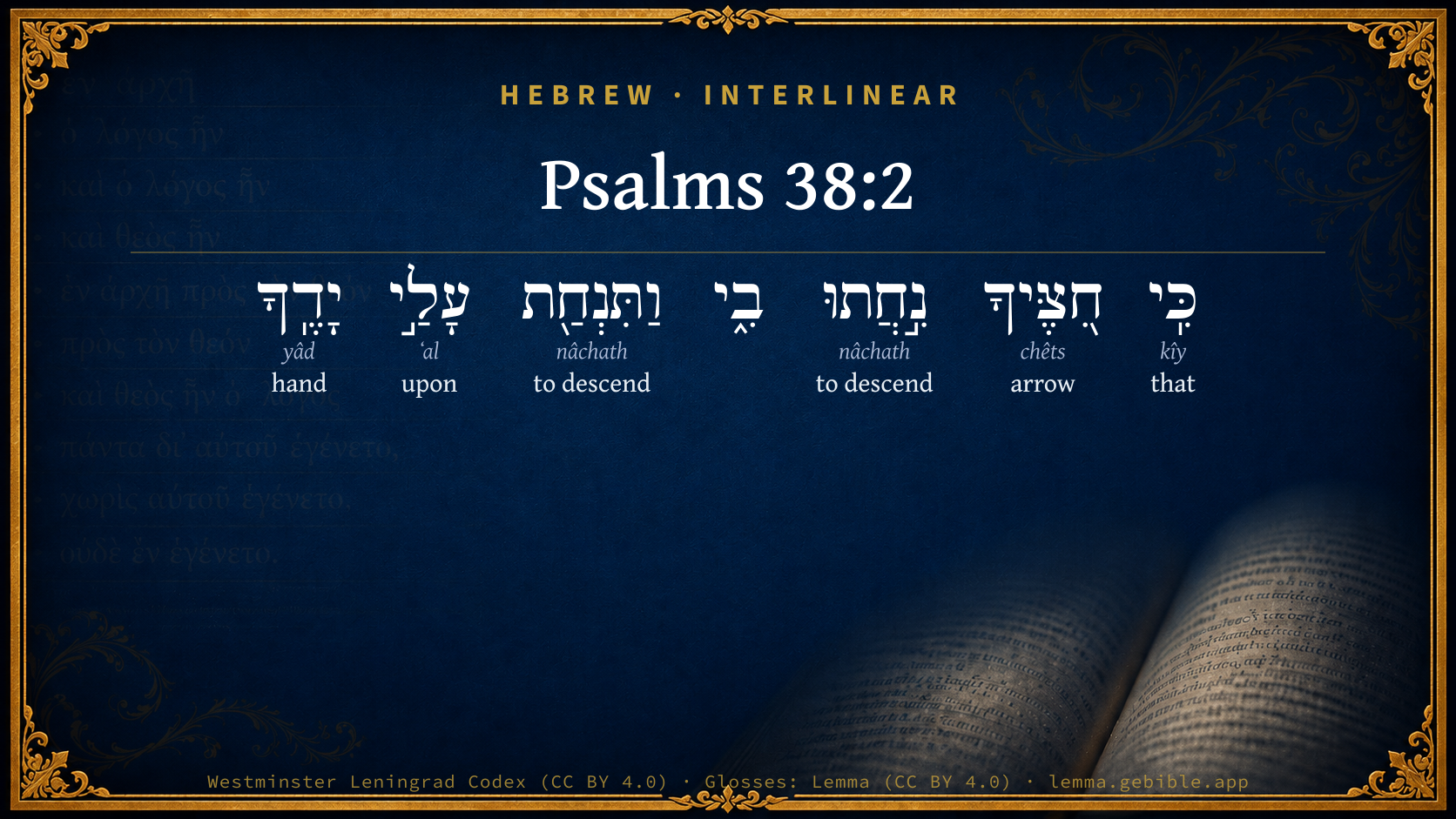
Hebrew (Westminster Leningrad Codex) Psalms 38:2 appears in the Hebrew Old Testament. The text above is from the Westminster Leningrad Codex. Each word links to its Strong’s number, a concise gloss, and parsing drawn from the Open Scriptures Hebrew Bible morphology. Click any word for its full Brown-Driver-Briggs (BDB) entry.
Download image
Cite this verse

Psalms 38:2 (World English Bible). Public Domain. Lemma interlinear Bible study tool, https://lemma.gebible.app/v/psalms/38/2.

Show BibTeX & RIS
BibTeX
RIS
English Translation
For your arrows have pierced me, Your hand presses hard on me.
World English Bible · Public Domain
Download a study sheet

One document with this verse’s original text, its word-by-word gloss line, the meaning frame, cross-references with their text, attributed commentary, and full source and license credits — printable, and it pastes into notes with its structure intact.

This verse Autodidact and up

Study sheet (.html) Plain text (.txt)

A passage Seminary Student

Up to 50 verses in one chapter. A passage sheet keeps up to 6 commentary sources and 12 cross-references per verse, in the order this page ranks them, and says so on the sheet whenever that leaves anything out. Ask for a single verse and you get the Autodidact verse sheet above.

Everything on this page stays free to read, with no account — the sheet is a download of what is already on screen, not access to it.

Want to remove ads? Support Godless Engineer
Compare translations 3

The same verse in 3 English versions, stacked beneath the original-language interlinear above. Click any original word for its lexicon entry.

Each is an independent rendering of the whole verse — the interlinear is not word-aligned to these translations.

Highlighted words mark where these versions differ — a whole-verse word diff, not a word-by-word alignment.

  • World English Bible Public Domain
    For your arrows have pierced me, Your hand presses hard on me.
  • King James Version Public Domain
    For thine arrows stick fast in me, and thy hand presseth me sore.
  • unfoldingWord Literal Text CC BY-SA 4.0
    For your arrows have sunk into me, and your hand has come down on me.

unfoldingWord Literal Text — © unfoldingWord, licensed CC BY-SA 4.0. Word-aligned USFM3 via Door43 (git.door43.org/unfoldingWord/en_ult).

Versions to compare (up to 4)

3 of 4 selected

Show all 18 translations

Every available English version of this verse, each an independent rendering of the whole verse.

  • World English Bible Public Domain
    For your arrows have pierced me, Your hand presses hard on me.
  • Berean Standard Bible Public Domain
    For Your arrows have pierced me deeply, and Your hand has pressed down on me.
  • Majority Standard Bible Public Domain
    For Your arrows have pierced me deeply, and Your hand has pressed down on me.
  • King James Version Public Domain
    For thine arrows stick fast in me, and thy hand presseth me sore.
  • American Standard Version (1901) Public Domain
    For thine arrows stick fast in me, And thy hand presseth me sore.
  • Revised Version (1885) Public Domain
    For thine arrows stick fast in me, and thy hand presseth me sore.
  • Geneva Bible (1599) Public Domain
    For thine arrowes haue light vpon me, and thine hand lyeth vpon me.
  • Douay-Rheims (1899) Public Domain
    Rebuke me not, O Lord, in thy indignation; nor chastise me in thy wrath.
  • Young's Literal Translation Public Domain
    For Thine arrows have come down on me, And Thou lettest down upon me Thy hand.
  • Literal Standard Version CC BY-SA 4.0
    For Your arrows have come down on me, || And You let down Your hand on me.
  • Unlocked Literal Bible CC BY-SA 4.0
    For your arrows pierce me, and your hand presses me down.
  • unfoldingWord Literal Text CC BY-SA 4.0
    For your arrows have sunk into me, and your hand has come down on me.
  • Darby Bible Public Domain
    For thine arrows stick fast in me, and thy hand cometh down upon me.
  • World Messianic Bible Public Domain
    For your arrows have pierced me, your hand presses hard on me.
  • Webster's Bible Public Domain
    \\38:1\\A Psalm of David, to bring to remembrance. O LORD, rebuke me not in thy wrath: neither chasten me in thy hot displeasure.
  • Free Bible Version CC BY-SA 4.0
    Your arrows have pierced me deeply, your hand has come down hard on me.
  • Bible in Basic English Public Domain
    For your arrows have gone into my flesh, and I am crushed under the weight of your hand.
  • JPS Tanakh (1917) Public Domain
    (38-3) For Thine arrows are gone deep into me, and Thy hand is come down upon me.

Literal Standard Version (2020), Covenant Press — licensed CC BY-SA 4.0. Text via the HelloAO Bible API (eBible.org). Unlocked Literal Bible (unfoldingWord) — licensed CC BY-SA 4.0. Text via the HelloAO Bible API (eBible.org). unfoldingWord Literal Text — © unfoldingWord, licensed CC BY-SA 4.0. Word-aligned USFM3 via Door43 (git.door43.org/unfoldingWord/en_ult). Free Bible Version, Dr. Jonathan Gallagher — licensed CC BY-SA 4.0. Text via the HelloAO Bible API (eBible.org).

Word by word

More ways to search: Search by grammar → Find every occurrence → Compare this word →

Practice this passage: Drill this verse → Learn its vocabulary →

About this verse

These counts appear in no published source. They are computed here, from the morphology-tagged text and Lemma’s own curated glosses. What Lemma adds →

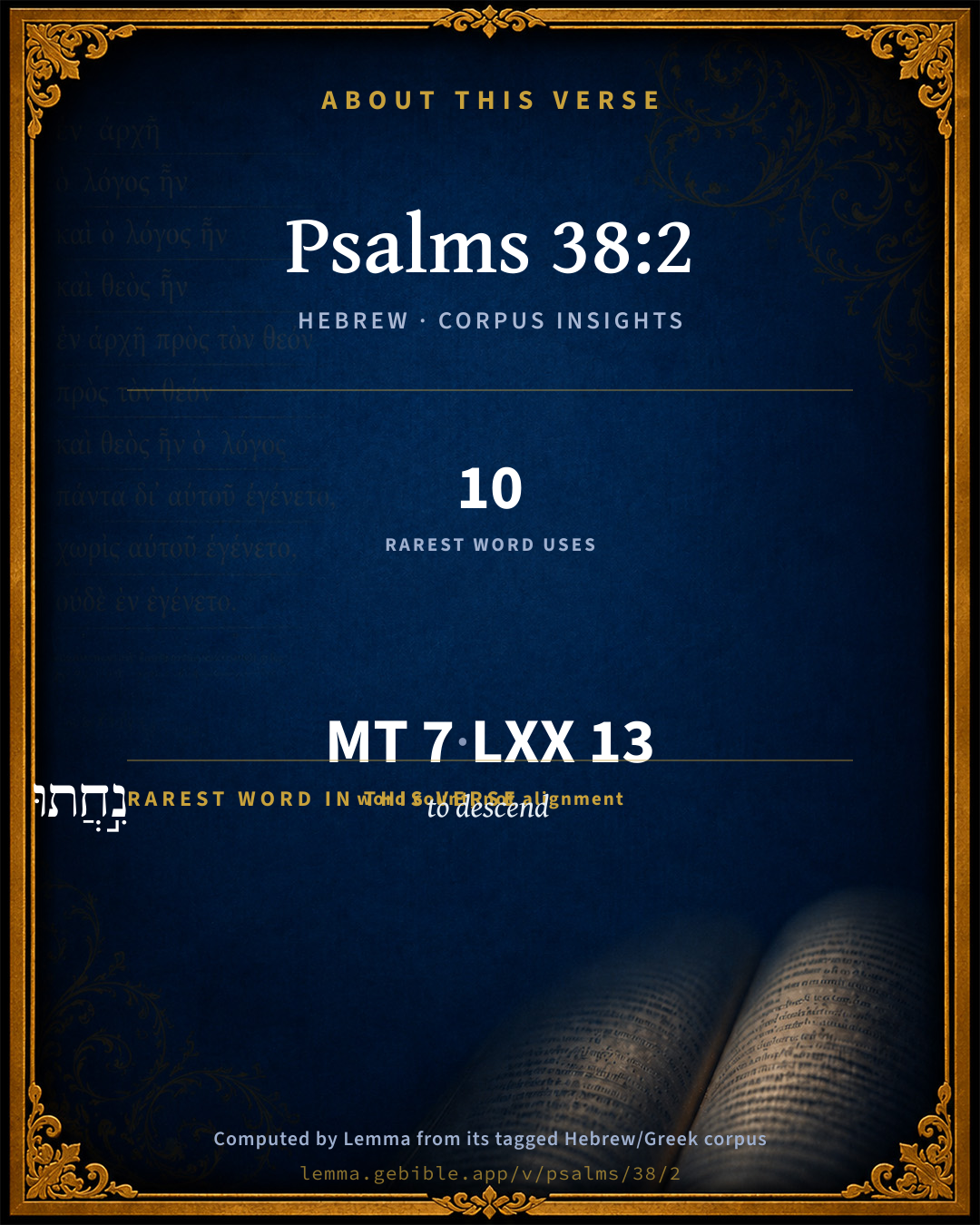
7
words
5
distinct lemmas
Wisdom
section

Notable vocabulary

The rarest word here is נִ֣חֲתוּ to descend H5181 — appearing just 10 times in the whole Hebrew Bible.

Shared distinctive vocabulary

נִ֣חֲתוּ to descend H5181 occurs in 9 verses of the Hebrew Bible. Also found in:

Grammatical profile

  • 2 verbs
  • 2 nouns
  • 2 prepositions
  • 1 conjunction

Verb forms

  • נִ֣חֲתוּ Niphal · Perfect
  • וַתִּנְחַ֖ת Qal · Sequential Imperfect

Repetition

A word recurs within this verse — often emphatic in Hebrew:

  • נִ֣חֲתוּ to descend H5181 ×2

Hebrew & Septuagint length

In English translation the verse runs 12 words from the Hebrew and 16 from the Septuagint (LXX English) — closely comparable.

A rough comparison of the two English renderings, which tokenize alike — not a word-level alignment.

Word counts can differ between the Hebrew and the Greek without any difference in meaning — e.g. the Hebrew direct-object marker אֵת has no separate Greek word, and Greek often adds the article ὁ.

In the original languages it is 7 Hebrew tokens and 13 Greek tokens — but the two are counted differently (Hebrew bundles its prefixes and suffixes into one token; the Greek is in lemma form), so that isn’t a like-for-like length.

Cross-references

11

Topical passages linked to Psalms 38:2 in the Treasury of Scripture Knowledge — connected by theme and wording, ordered by reader-vote popularity; previews shown in the World English Bible.

  • Job 6:4 For the arrows of the Almighty are within me, My spirit drinks up their poison. The terrors of God set themselves in array against me.
  • Psalms 32:4 For day and night your hand was heavy on me. My strength was sapped in the heat of summer. Selah.
  • Deuteronomy 2:15 Moreover the hand of Yahweh was against them, to destroy them from the midst of the camp, until they were consumed.
  • 1 Samuel 5:6 But the hand of Yahweh was heavy on them of Ashdod, and he destroyed them, and struck them with tumors, even Ashdod and the borders of it.
  • Lamentations 3:12 He has bent his bow, and set me as a mark for the arrow.
  • Ruth 1:13 would you therefore wait until they were grown? would you therefore stay from having husbands? nay, my daughters, for it grieves me much for your sakes, for the hand of Yahweh is gone forth against me.
  • 1 Samuel 5:11 They sent therefore and gathered together all the lords of the Philistines, and they said, Send away the ark of the God of Israel, and let it go again to its own place, that it not kill us and our people. For there was a deadly confusion throughout all the city; the hand of God was very heavy there.
  • 1 Samuel 6:9 Behold; if it goes up by the way of its own border to Beth-shemesh, then he has done us this great evil: but if not, then we shall know that it is not his hand that struck us; it was a chance that happened to us."
  • Psalms 21:12 For you will make them turn their back, When you aim drawn bows at their face.
  • Psalms 39:10–11 Remove your scourge away from me. I am overcome by the blow of your hand.
  • Psalms 64:7 But God will shoot at them. They will be suddenly struck down with an arrow.

Cross-references courtesy of OpenBible.info (CC BY 4.0).

Hebrew and Greek witnesses Masoretic Hebrew ↔ Greek Septuagint

The same verse in the two great witnesses to the Old Testament, shown verse-for-verse.

You’re reading Greek Psalm 37 (Hebrew Psalm 38). The Septuagint counts the superscription, so verse numbers can differ from the Hebrew — chapter-level alignment, not verse-by-verse. Numbering follows Rahlfs.

These are two independent witnesses, not word-aligned to each other, and the Septuagint is shown in lemma (dictionary) form.

Hebrew Psalms 38:2 Masoretic · Westminster Leningrad Codex

כִּֽי חִ֭צֶּיךָ נִ֣חֲתוּ בִ֑י וַתִּנְחַ֖ת עָלַ֣י יָדֶֽךָ

For your arrows have pierced me, Your hand presses hard on me.

World English Bible · Public Domain

Greek LXX Greek Psalm 37:2 Septuagint · lemma form

κύριος μή ὁ θυμός σύ ἐλέγχω ἐγώ μηδέ ὁ ὀργή σύ παιδεύω ἐγώ

For your weapons are fixed in me, and you have pressed your hand heavily upon me.

LXX2012 (modern English Septuagint) · Public Domain

Hebrew: Westminster Leningrad Codex (CC BY 4.0). Greek: Septuagint (public domain); English from LXX2012 (modern English Septuagint) (Public Domain). How the Septuagint differs from the Hebrew →

Commentary

Notes on Psalms 38:2 from classic Christian and Jewish commentators (each source and its license shown beneath its notes). The classic Christian expositions comment on the surrounding passage and are grouped to its opening verse, so a note may address several verses; the Jewish commentaries on the Tanakh (Rashi and others) are per-verse, so they appear only where the commentator wrote on this verse.

Lemma curates 59 commentaries, every one of them public domain or Creative Commons licensed, each selected and text-cleaned for this edition rather than reprinted as found. About our sources →

Trapp's Complete Commentary

John Trapp

Psa 38:2 For thine arrows stick fast in me, and thy hand presseth me sore.

Ver. 2. For thine arrows stick fast in me] i.e. Sicknesses of body and troubles of mind, Job 6:4 Psa 18:14. The Jewish doctors say, that he had a leprosy for six months; and that the Divine presence was taken away from him; so that he complained not without uause (R. Obadiah). But these were sagittae salutis, saith Chrysostom; arrows of salvation, love tokens from the Lord, Dens amat quos sagittat (Aug.), not unlike Jonathan’s arrows, 1Sa 20:36, and he had been forewarned of them by Nathan the prophet, 2Sa 12:9-12, and so bore them the better. Praevisa iacula minus feriunt, Darts foreseen are in a manner dintless.

And thy hand presseth me sore] Heb. Thou lettest down thy hand upon me. Now, God’s hand is a mighty hand, 1Pe 5:6, and the weight of it is importable, but that una eademque manus, &c.

John Trapp, A Commentary or Exposition upon All the Books of the Old and New Testament (1647–1656) — public domain. Text from a community e-Sword module.

The Biblical Illustrator

Joseph S. Exell

Psa_38:2

For Thine arrows stick fast in me, and Thy hand presseth me sore.

Gods arrows

Those arrows commonly are either wicked men or devils, whom God sendeth forth to afflict His own children, sharp as arrows, light and swift as arrows, and ready to do harm to Gods saints; or else sickness, poverty, infamy, and such other afflictions, whereby our most gracious Father thinketh most fit to subdue our vile corruption: all which, albeit in their own nature they are evil, yet God can convert and turn them to the utility and profit of His own children. As a physician can use the most poisionable and venomous herbs to cure the most desperate diseases; yea, the flesh of the dead serpent, to cure the wound gotten by the living serpent: so God can convert and turn the mischievous machinations of our enemies to our salvation. (A. Symson.)

The Biblical Illustrator, edited by Joseph S. Exell (c. 1880s–1900s) — public domain. Text from a community e-Sword module.

J. A. Alexander on Psalms

Joseph Addison Alexander

3. (Psa 38:2). For thine arrows are sunk into me, and thy hand has sunk upon me. This verse assigns the reason of the prayer in that before it. Arrows, sharp inflictions, as in Deu 32:23, Job 6:4. The verbs of the two clauses are active and passive forms from the same root. Sunk into, penetrated, and by implication, stuck fast, although this specific idea is not expressed. Sunk upon, heavily descended, or, as the English version has it, presseth me sore. Compare Psa 32:4; Psa 39:11 (10).

Joseph Addison Alexander, The Psalms Translated and Explained (1850) — public domain. Text from a community e-Sword module.

Geneva Bible (1599)

Geneva Bible translators

Thy sickness, wherewith thou hast visited me.

Geneva Bible (1599) marginal notes — public domain. Text via Bolls.life.

Jamieson, Fausset & Brown

Robert Jamieson, A. R. Fausset & David Brown

arrows . . . and thy hand--the sharp and heavy afflictions he suffered (Deu 32:23).

Jamieson, Fausset & Brown — Commentary Critical and Explanatory on the Whole Bible (1871) — public domain (CC PDM 1.0). Text via the HelloAO Bible API.

Adam Clarke's Commentary

Verse 2. Thine arrows stick fast in me] This no doubt, refers to the acute pains which he endured; each appearing to his feeling as if an arrow were shot into his body.

Adam Clarke's Commentary on the Bible (1810–1826) — public domain. Text from a community e-Sword/MySword module.

John Calvin's Commentaries

2. For thy arrows go down in me. He shows that he was constrained by dire necessity to ask an alleviation of his misery; for he was crushed under the weight of the burden which he sustained. This rule is always to be observed in our prayers — to keep God’s promises present to our view. But God has promised that he will chastise his servants, not according to their deserts, but as they are able to bear. This is the reason why the saints so often speak of their own weakness, when they are severely oppressed with affliction. David very properly describes the malady under which he labored, by the terms, the arrows and the hand, or the chastisement of God. Had he not been persuaded that it was God who thus afflicted him, he could never have been brought to seek from him deliverance from his affliction. We know that the great majority of men are blinded under the judgments of God, and imagine that they are entirely the events of chance; and scarcely one in a hundred discerns in them the hand of God. But, in his sickness, as in all his other adversities, David views the hand of God lifted up to punish him for his sins. And certainly, the man who estimates his affliction only by the feeling of pain which it produces, and views it in no other light, differs nothing from the beasts of the field. As every chastisement of God should remind us of his judgment, the true wisdom of the saints, as the prophet declares,

“to look to the hand of him who smiteth.”— (Isaiah 9:13)

The pronoun thy is therefore emphatic. David’s words are, as if he had said, I have not to do with a mortal man, who can shoot his arrows with a force only in proportion to his own strength, but I have to do with God, who can discharge the arrows that come from his hand with a force altogether overwhelming.

John Calvin's Commentaries (1540-1563) — public domain. Text from the Calvin Translation Society English edition (1840s-50s) via the Christian Classics Ethereal Library (ccel.org). Calvin's coverage is partial (roughly two-thirds of the Bible); uncommented books and verses are honest gaps, never fabricated. The 19th-century editor's footnotes and remarks are omitted so the notes are faithfully Calvin's own voice.

Ellicott's Commentary for English Readers

(2) For thine arrows . . .—The same figure is used of the disease from which Job suffered (elephantiasis? Job_6:4); of famine (Eze_5:16); and generally of divine judgments (Deu_32:23). By itself it therefore decides nothing as to the particular cause of the Psalmist’s grief.

Stick fast.—Better, have sunk into, from a root meaning to descend. Presseth, in the next clause, is from the same verb. Translate, therefore,

For thine arrows have fallen deep into me,

And fallen upon me has thine hand.

A Bible Commentary for English Readers, edited by Charles John Ellicott (1878–1897) — public domain. Text from a community e-Sword module.

The Cambridge Bible for Schools and Colleges

gen. ed. J. J. S. Perowne

2. God’s ‘arrows’ are His judgements in general (Psa_7:12 : Deu_32:23); here in particular pain and sickness (Job_6:4; Job_16:12-13; Lam_3:12-13). Blow after blow from God’s ‘hand’ (Psa_32:4; Psa_39:10) has lighted upon him. Stick fast and presseth sore are renderings of different voices of the same verb, meaning literally to come down, to light upon.

The Cambridge Bible for Schools and Colleges (gen. ed. J. J. S. Perowne; Cambridge University Press, 1878–1918) — public domain. Text from a community e-Sword module.

John Gill's Exposition

There is no soundness in my flesh, because of thine anger,.... Such was the nature of the affliction the psalmist laboured under, and which he took to be an effect of the anger of God towards him, that the whole frame of nature was affected with it, and from the crown of the head to, the soles of the feet there was no health or soundness, as in Isa 1:6; where the same word is used as here; some think the word (g) here used has the signification of man; and that the sense is, that through, the violence of the distemper he had not so much, as the form of a man, as his antitype in Isa 52:14; and as this led him to a view of his sins, as the cause of his affliction, he was so far from thinking himself sound and whole, or perfect in a spiritual sense, that he saw he was all over diseased with sin, and that in his flesh dwelt no good thing;

neither is there any rest in my bones, because of my sin; or "peace" (h) there; sin breaks the believer's rest, and disturbs his peace; nor can he, in a view of it, find any rest in himself, nor in any creature, nor in any service or duty, only in Jesus Christ, his blood, righteousness, and sacrifice.

(g) "non superest amplius ulla forma seu figura hominis", Amama; so Joseph Kimchi. (h) "non (est) pax", Pagninus, Montanus, Vatablus, Tigurine version, Junius & Tremellius, Piscator, Musculus, Cocceius, Gejerus, Michaelis; so Ainsworth.

John Gill's Exposition of the Whole Bible (1746–1763) — public domain (CC PDM 1.0). Text via the HelloAO Bible API.

Albert Barnes' Notes on the Bible

For thine arrows stick fast in me - See the notes at Job 6:4. The word rendered “stick fast” - נחת nâchath - means properly to go or come down; to descend; and the literal idea here would be, “thine arrows come down upon me.” It is not so much the idea of their “sticking fast” when in the wound or flesh; it is that they come down upon one, and pierce him. The meaning is, that he was afflicted “as if” God had wounded him with arrows - arrows which pierced deep in his flesh. Compare the notes at Psa 45:5. The allusion is to the disease with which he was afflicted.

And thy hand presseth me sore - The same word is used here which in the former part of the verse is rendered “stick fast.” The idea is, that the hand of God had “descended” or “come down” upon him, prostrating his strength, and laying him on a bed of pain.

Albert Barnes' Notes on the Bible (1834–1885) — public domain. Text from a community e-Sword/MySword module.

Matthew Poole's English Annotations

Thine arrows, i.e. thy judgments inflicted upon my outward and inward man, oft compared to arrows, as Deu 32:23; Psa 7:13; 45:5; 91:5.

Presseth me sore; or, comes down upon me; as when a strong man lifts up his hand and weapon, that it may fall down with greater violence, and make the deeper wound.

Matthew Poole's English Annotations on the Holy Bible (1683–1685) — public domain. Text from a community e-Sword/MySword module.

The Treasury of David

Charles H. Spurgeon

Ver. 2. For thine arrows stick fast in me. By this he means both bodily and spiritual griefs, but we may suppose, especially the latter, for these are most piercing and stick the fastest. God's law applied by the Spirit to the conviction of the soul of sin, wounds deeply and rankles long; it is an arrow not lightly to be brushed out by careless mirthfulness, or to be extracted by the flattering hand of self righteousness. The Lord knows how to shoot so that his bolts not only strike but stick. He can make convictions sink into the innermost spirit like arrows driven in up to the head. It seems strange that the Lord should shoot at his own beloved ones, but in truth he shoots at their sins rather than them, and those who feel his sin killing shafts in this life, shall not be slain with his hot thunderbolts in the next world. And thy hand presseth me sore. The Lord had come to close dealings with him, and pressed him down with the weight of his hand, so that he had no rest or strength left. By these two expressions we are taught that conviction of sin is a piercing and a pressing thing, sharp and sore, smarting and crushing. Those who know by experience "the terrors of the Lord, "will be best able to vouch for the accuracy of such descriptions; they are true to the life.

Ver. 2. For thine arrows stick fast in me. First, we shall see in what respect he calls them arrows: and therein, first, that they are alienae, they are shot from others, they are not in his own power; a man shoots not an arrow at himself; and then that they are veloces, swift in coming, he cannot give them their time; and again, they are vix visibiles, though they be not altogether invisible in their cunning, yet there is required a quick eye, and an express diligence and watchfulness to avoid them; so they are arrows in the hand of another, not his own; and swift as they come, and invisible before they come. And secondly, they are many arrows, the victory lies not in escaping one or two. And thirdly, they stick in him: they find not David so good proof as to rebound back again, and imprint no sense: and they stick Fast: though the blow be felt and the wound discerned, yet there is not a present cure, he cannot shake them off; infixae sunt, and then, with all this, they stick fast in him; that is, in all him; in his body and soul; in him, in his thoughts and actions; in him, in his sins and in his good works too; infixae mihi, there is no part of him, no faculty in him, in which they stick not; for (which may well be another consideration), that hand, which shot them, presses him: follows the blow, and presses him sore, that is, vehemently. But yet (which will be our conclusion), sagittae tuae, thy arrows, and manus tua, thy hand, these arrows that are shot, and this hand that presses him so sore, are the arrows, and the hand of God; and therefore, first, they must have their effect, they cannot be disappointed; but yet they bring their comfort with them, because they are his, because no arrows from him, no pressing with his hand, comes without that balsamum of mercy to heal as fast as he wounds. John Donne.

Ver. 2. Thine arrows stick fast. Though importunity be to God most pleasing always, yet to us it is then most necessary when the cheerful face of God is turned into frowns, and when there is a justly conceived fear of the continuance of his anger: and have I not just cause to fear it, having the arrows of his anger sticking so fast in me? If he had meant to make me but a butt, at which to shoot his arrows, he would quickly, I suppose, have taken them up again; but now that he leaves them sticking in me, what can I think, but that he means to make me his quiver; and then I may look long enough before he come to pluck them out. They are arrows, indeed, that are feathered with swiftness, and headed with sharpness; and to give them a force in flying, they are shot, I may say, out of his crossbow, I am sure his bow of crosses; for no arrows can fly so fast, none pierce so deep, as the crosses and afflictions with which he hath surprised me: I may truly say surprised me, seeing when I thought myself most safe, and said, "I shall never be moved, "even then, these arrows of his anger lighted upon me, and stick so fast in my flesh, that no arm but his that shot them, is ever able to draw them forth. Oh, then, as thou hast stretched forth thine arm of anger, O God, to shoot these arrows at me, so stretch forth thine arm of mercy to draw them forth, that I may rather sing hymns than dirges unto thee; and that thou mayest show thy power, as well in pardoning as thou hast done in condemning. Sir Richard Baker.

Ver. 2. Thine arrows. Arrows are (1) swift, (2) secret, (3) sharp (4) killing instruments. They are instruments drawing blood and drinking blood, even unto drunkenness De 32:42; afflictions are like arrows in all these properties. 1. Afflictions often come very speedily, with a glance as an arrow, quick as a thought. 2. Afflictions come suddenly, unexpectedly; an arrow is upon a man afore he is aware, so are afflictions. Though Job saith, the thing he feared came upon him, he looked for this arrow before it came; yet usually afflictions are unlooked for guests, they thrust in upon us when we dream not of them. 3. They come with little noise; an arrow is felt before, or, as soon as it is heard; an arrow flies silently and secretly, stealing upon and wounding a man, unobserved and unseen. Lastly, all afflictions are sharp, and in their own nature killing and deadly. That any have good from them, is from the grace of God, not from their nature. Joseph Caryl.

Ver. 2. Let no one think these expressions of penitence Ps 38:1-4 overstrained or excessive. They are the words of the Holy Spirit of God, speaking by the mouth of the man after God's own heart. If we were as repentant as David, we should bring home to ourselves his language; as it is, our affections are chilled, and therefore we do not enter into his words...And let us observe how all the miseries are referred to their proper end. The sin is not bewailed merely on account of its ill effect on the guilty one, but on account of the despite done to God. The psalmist's first thought is the "anger" of the Lord, and his hot displeasure. It is not the "arrows" that afflict him so much as that they are God's. "Thine arrows stick fast in me, and thy hand presseth me." The reason why there is no health in his flesh is because of God's displeasure. Such is true contrition, "not the sorrow of the world which worketh death, but the sorrow that worketh repentance not to be repented of." A Commentary on the Seven Penitential Psalms. Chiefly from Ancient Sources, (by A.P.F.) 1847.

Ver. 2. Thy hand presseth me sore. Not the hand of Egypt or Ashur; then it were hand for hand, a duel of some equality: hand to hand; here forces and stratagems might achieve a victory: but Thy hand. The weight of a man's blow is but weak, according to the force and pulse of his arm; as the princes of Midian answered Gideon, when he bade his son try the dint of his sword upon them; "Rise thou, and fall upon us: for as the man is, so is his strength." Jud 8:21. But "it is a fearful thing to fall into the hands of the living God." Heb 10:31. As Homer called the hands of Jupiter ceirez aeptoi, hands whose praise could not be sufficiently spoken; which some read ceires aaptoii, hands inaccessible, irresistible for strength: all the gods in heaven could not ward a blow of Jupiter's hand. This hand never strikes but for sin; and where sin is mighty his blow is heavy. Thomas Adams.

Ver. 2. God sharply chasteneth many of his children, and yet for all that he loves them never a whit the less, nor withholdeth in good time his mercy from them. Thomas Wilcocks.

Psalms 38:3*

Charles H. Spurgeon's The Treasury of David (1869–1885) — public domain. Psalms only. Text from a community e-Sword/MySword module.

Whedon's Commentary on the Bible

Daniel D. Whedon

2. Arrows—See Job_6:4. The arrows sticking fast, are a proof that they had entered deep into the flesh.

Daniel D. Whedon (gen. ed.), Commentary on the Old and New Testaments (1874–1909) — public domain. Text from a community e-Sword module.

The Pulpit Commentary

For thine arrows stick fast in me. (On the "arrows" of the Almighty, see above, Psa_7:13; and comp. Job_6:4 Psa_18:14 Psa_45:5 Psa_64:7 Psa_77:17, etc.) It has been maintained that by "God"s arrows" only sickness is meant (Hitzig); but the contrary appears from Deu_32:23-25. Hengstenberg is right, "The arrows of the Almighty denote all the chastisements of sin depending on God." And thy hand presseth me sore. The verb used is the same in both clauses; but it is difficult to express both ideas by one term in English. Dr. Kay makes the attempt by translating, "For thine arrows have sunk deep in me; yea, thine hand sank heavily on me."

The Pulpit Commentary (1880–1919), ed. H.D.M. Spence-Jones & Joseph S. Exell — public domain. Text from a community e-Sword module.

John Wesley's Explanatory Notes

Arrows - Thy judgments outward and inward.

John Wesley, Explanatory Notes Upon the Whole Bible (1754–1765) — public domain. Text via the GEBible commentary corpus.

Lesson kit

Teaching starters — assembled from the data on this page, not authored interpretation. Every prompt links to the verse data it draws on. Edit before teaching.

Psalms, in the Wisdom, opens this verse with 7 words (5 distinct Hebrew lemmas). Its most distinctive word is nâchath (“to descend”). A historical commentator’s framing appears above. Read the whole chapter for the surrounding context.

Discussion questions

  1. What does “to descend” (nâchath) contribute to the verse as a whole?
  2. How does 1 Samuel 2:10, which shares the word «to descend», read alongside this verse?
  3. What does the repetition of “to descend” (2× in this one verse) do in this verse?
  4. The translations on this page render this verse differently — a whole-verse word diff, not a word-by-word alignment. What might account for the different wordings?
  5. «נִ֣חֲתוּ» is a Niphal Perfect verb. How does that grammatical form shape the action described?
  6. Compare how Trapp's Complete Commentary and The Biblical Illustrator read this verse. Where do they agree or differ?

Things to notice

Reading settings

Reading text

Shown beneath each verse's original-language words.

Old Testament
Old Testament edition

Read the OT as the Masoretic Hebrew (MT) or the Greek Septuagint (LXX).

English shown for the Greek Septuagint (in the Hebrew ↔ Greek comparison).

Comparing translations? Open the Compare panel on any verse page to stack up to four side by side.