Psalms 31:17

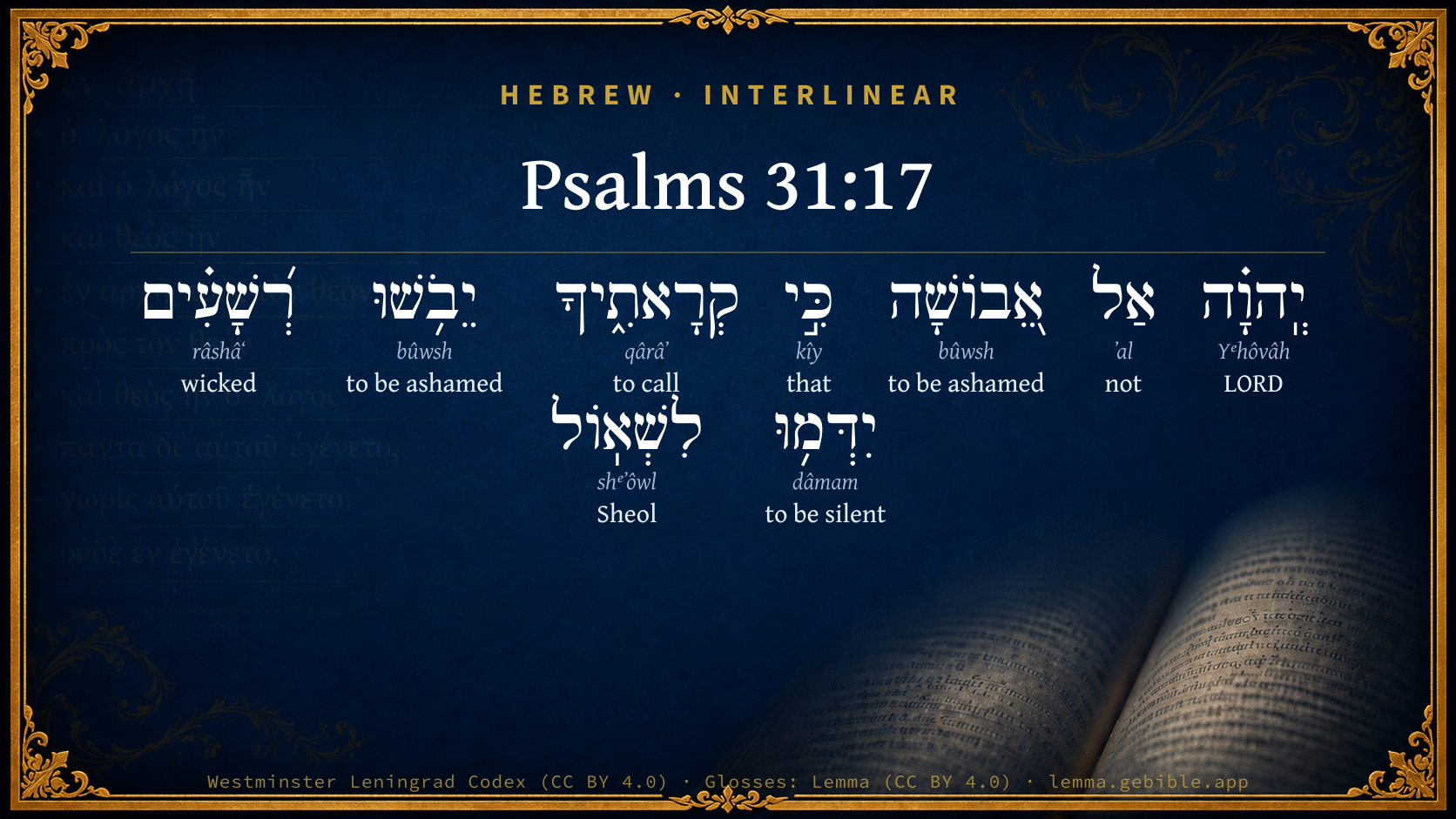
Hebrew (Westminster Leningrad Codex) Psalms 31:17 appears in the Hebrew Old Testament. The text above is from the Westminster Leningrad Codex. Each word links to its Strong’s number, a concise gloss, and parsing drawn from the Open Scriptures Hebrew Bible morphology. Click any word for its full Brown-Driver-Briggs (BDB) entry.
Download image
Cite this verse

Psalms 31:17 (World English Bible). Public Domain. Lemma interlinear Bible study tool, https://lemma.gebible.app/v/psalms/31/17.

Show BibTeX & RIS
BibTeX
RIS
English Translation
Let me not be disappointed, Yahweh, for I have called on you. Let the wicked be disappointed. Let them be silent in Sheol.
World English Bible · Public Domain
Download a study sheet

One document with this verse’s original text, its word-by-word gloss line, the meaning frame, cross-references with their text, attributed commentary, and full source and license credits — printable, and it pastes into notes with its structure intact.

This verse Autodidact and up

Study sheet (.html) Plain text (.txt)

A passage Seminary Student

Up to 50 verses in one chapter. A passage sheet keeps up to 6 commentary sources and 12 cross-references per verse, in the order this page ranks them, and says so on the sheet whenever that leaves anything out. Ask for a single verse and you get the Autodidact verse sheet above.

Everything on this page stays free to read, with no account — the sheet is a download of what is already on screen, not access to it.

Want to remove ads? Support Godless Engineer
Compare translations 3

The same verse in 3 English versions, stacked beneath the original-language interlinear above. Click any original word for its lexicon entry.

Each is an independent rendering of the whole verse — the interlinear is not word-aligned to these translations.

Highlighted words mark where these versions differ — a whole-verse word diff, not a word-by-word alignment.

  • World English Bible Public Domain
    Let me not be disappointed, Yahweh, for I have called on you. Let the wicked be disappointed. Let them be silent in Sheol.
  • King James Version Public Domain
    Let me not be ashamed, O LORD; for I have called upon thee: let the wicked be ashamed, and let them be silent in the grave.
  • unfoldingWord Literal Text CC BY-SA 4.0
    Yahweh, do not let me have shame, for I have called upon you; let the wicked have shame; let them be silent in Sheol.

unfoldingWord Literal Text — © unfoldingWord, licensed CC BY-SA 4.0. Word-aligned USFM3 via Door43 (git.door43.org/unfoldingWord/en_ult).

Versions to compare (up to 4)

3 of 4 selected

Show all 18 translations

Every available English version of this verse, each an independent rendering of the whole verse.

  • World English Bible Public Domain
    Let me not be disappointed, Yahweh, for I have called on you. Let the wicked be disappointed. Let them be silent in Sheol.
  • Berean Standard Bible Public Domain
    O LORD, let me not be ashamed, for I have called on You. Let the wicked be put to shame; let them lie silent in Sheol.
  • Majority Standard Bible Public Domain
    O LORD, let me not be ashamed, for I have called on You. Let the wicked be put to shame; let them lie silent in Sheol.
  • King James Version Public Domain
    Let me not be ashamed, O LORD; for I have called upon thee: let the wicked be ashamed, and let them be silent in the grave.
  • American Standard Version (1901) Public Domain
    Let me not be put to shame, O Jehovah; for I have called upon thee: Let the wicked be put to shame, let them be silent in Sheol.
  • Revised Version (1885) Public Domain
    Let me not he ashamed, O LORD; for I have called upon thee: let the wicked be ashamed, let them be silent in Sheol.
  • Geneva Bible (1599) Public Domain
    Let me not be confounded, O Lord: for I haue called vpon thee: let the wicked bee put to confusion, and to silence in the graue.
  • Douay-Rheims (1899) Public Domain
    Make thy face to shine upon thy servant; save me in thy mercy.
  • Young's Literal Translation Public Domain
    O Jehovah, let me not be ashamed, For I have called Thee, let the wicked be ashamed, Let them become silent to Sheol.
  • Literal Standard Version CC BY-SA 4.0
    O YHWH, do not let me be ashamed, || For I have called You, let the wicked be ashamed, || Let them become silent to Sheol.
  • Unlocked Literal Bible CC BY-SA 4.0
    Do not let me be humiliated, Yahweh; for I call out to you! May the wicked be humiliated! May they be silent in Sheol.
  • unfoldingWord Literal Text CC BY-SA 4.0
    Yahweh, do not let me have shame, for I have called upon you; let the wicked have shame; let them be silent in Sheol.
  • Darby Bible Public Domain
    Jehovah, let me not be ashamed; for I have called upon thee: let the wicked be ashamed, let them be silent in Sheol.
  • World Messianic Bible Public Domain
    Let me not be disappointed, LORD, for I have called on you. Let the wicked be disappointed. Let them be silent in Sheol.
  • Webster's Bible Public Domain
    \\31:16\\Make thy face to shine upon thy servant: save me for thy mercies' sake.
  • Free Bible Version CC BY-SA 4.0
    Lord, don't let me be disgraced, for I'm calling out to you. Instead let the wicked be disgraced, let them be silent in the grave.
  • Bible in Basic English Public Domain
    Let me not be shamed, O Lord, for I have made my prayer to you; let the sinners be shamed, and let their mouths be shut in the underworld.
  • JPS Tanakh (1917) Public Domain
    (31-18) O LORD, let me not be ashamed, for I have called upon Thee; let the wicked be ashamed, let them be put to silence in the nether-world.

Literal Standard Version (2020), Covenant Press — licensed CC BY-SA 4.0. Text via the HelloAO Bible API (eBible.org). Unlocked Literal Bible (unfoldingWord) — licensed CC BY-SA 4.0. Text via the HelloAO Bible API (eBible.org). unfoldingWord Literal Text — © unfoldingWord, licensed CC BY-SA 4.0. Word-aligned USFM3 via Door43 (git.door43.org/unfoldingWord/en_ult). Free Bible Version, Dr. Jonathan Gallagher — licensed CC BY-SA 4.0. Text via the HelloAO Bible API (eBible.org).

Word by word

More ways to search: Search by grammar → Find every occurrence → Compare this word →

Practice this passage: Drill this verse → Learn its vocabulary →

יִדְּמ֥וּ
dâmam
H1826
“to be silent”
Verb, Qal, Imperfect, 3rd Person, Masculine, Plural
Part of Speech
Verb
Stem
Qal
Form
Imperfect
Person
3rd Person
Gender
Masculine
Number
Plural
Full BDB Definition

Origin: a prim root [compare H1724 , H1820 ]

TWOT: 439

to be silent, be still, wait, be dumb, grow dumb - (Qal) - to be silent - to be still, die - to be struck dumb - (Niphal) to be silenced, be made silent, destroyed - (Poal) to make quiet - (Hiphil) to make silent (cause to die)
  1. יְֽהוָ֗ה Yᵉhôvâh H3068 “LORD” Noun, Proper
  2. אַל ʼal H408 “not” Particle, Negative
  3. אֵ֭בוֹשָׁה bûwsh H954 “to be ashamed” Verb, Qal, Cohortative, 1st Person, Common, Singular
  4. כִּ֣י kîy H3588 “that” Conjunction
  5. קְרָאתִ֑יךָ qârâʼ H7121 “to call · you” Verb, Qal, Perfect, 1st Person, Common, Singular + Suffix, Personal, 2nd Person, Masculine, Singular
  6. יֵבֹ֥שׁוּ bûwsh H954 “to be ashamed” Verb, Qal, Imperfect, 3rd Person, Masculine, Plural
  7. רְ֝שָׁעִ֗ים râshâʻ H7563 “wicked” Adjective, Adjective, Masculine, Plural, Absolute
  8. לִשְׁאֽוֹל shᵉʼôwl H7585 “to/for · Sheol” Preposition + Noun, Proper

About this verse

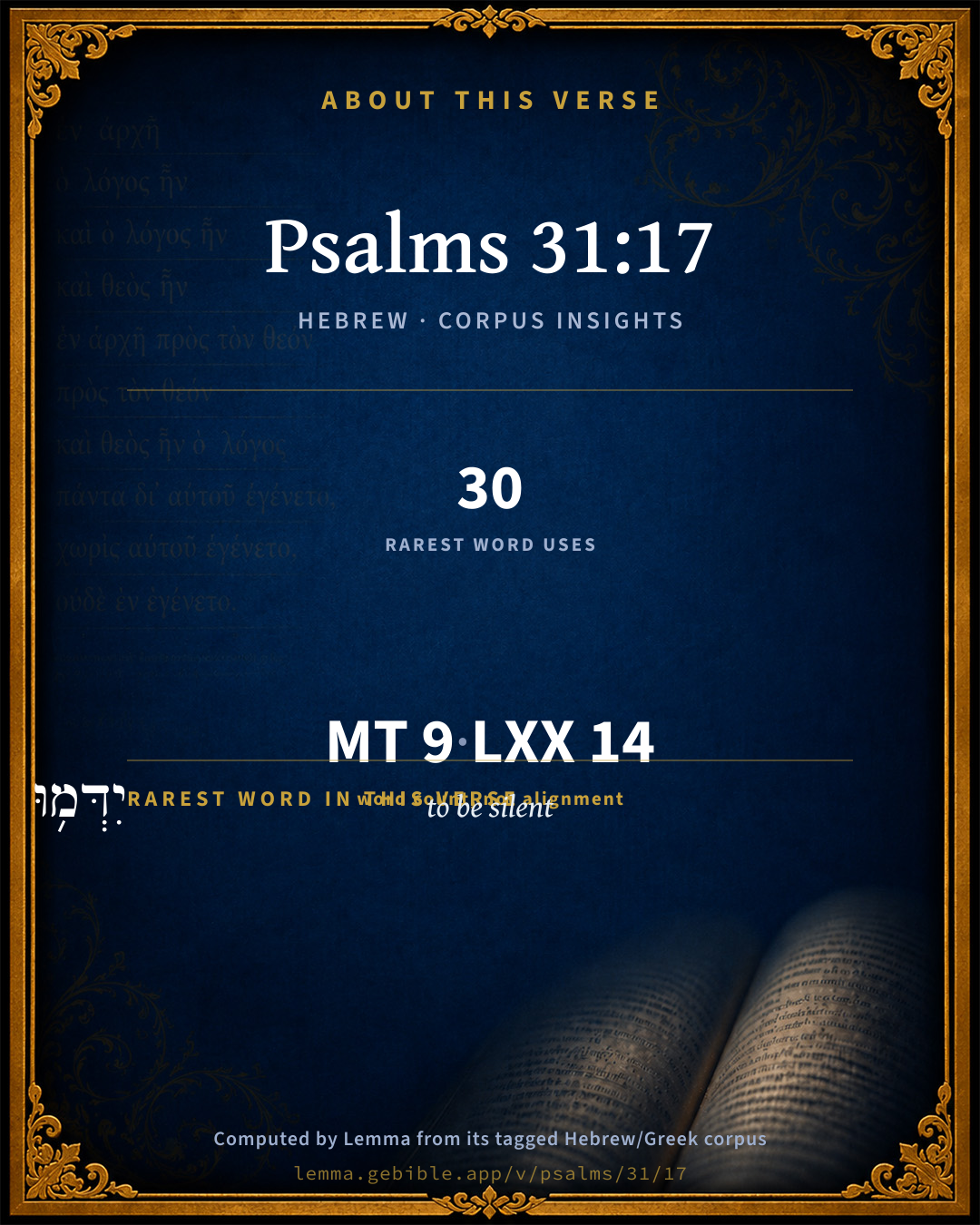
These counts appear in no published source. They are computed here, from the morphology-tagged text and Lemma’s own curated glosses. What Lemma adds →

9
words
8
distinct lemmas
Wisdom
section

Shared distinctive vocabulary

יִדְּמ֥וּ to be silent H1826 occurs in 29 verses of the Hebrew Bible. Also found in:

Grammatical profile

  • 4 verbs
  • 2 nouns
  • 1 adjective
  • 1 conjunction
  • 1 particle

Verb forms

  • אֵ֭בוֹשָׁה Qal · Cohortative
  • קְרָאתִ֑יךָ Qal · Perfect
  • יֵבֹ֥שׁוּ Qal · Imperfect
  • יִדְּמ֥וּ Qal · Imperfect

Repetition

A word recurs within this verse — often emphatic in Hebrew:

  • אֵ֭בוֹשָׁה to be ashamed H954 ×2

Hebrew & Septuagint length

In English translation the verse runs 23 words from the Hebrew and 23 from the Septuagint (LXX English) — the same length.

A rough comparison of the two English renderings, which tokenize alike — not a word-level alignment.

Word counts can differ between the Hebrew and the Greek without any difference in meaning — e.g. the Hebrew direct-object marker אֵת has no separate Greek word, and Greek often adds the article ὁ.

In the original languages it is 9 Hebrew tokens and 14 Greek tokens — but the two are counted differently (Hebrew bundles its prefixes and suffixes into one token; the Greek is in lemma form), so that isn’t a like-for-like length.

Cross-references

22

Topical passages linked to Psalms 31:17 in the Treasury of Scripture Knowledge — connected by theme and wording, ordered by reader-vote popularity; previews shown in the World English Bible.

  • Psalms 25:2–3 My God, I have trusted in you, Don't let me be shamed. Don't let my enemies triumph over me.
  • Jeremiah 20:11 But Yahweh is with me as an awesome mighty one: therefore my persecutors shall stumble, and they shall not prevail; they shall be utterly disappointed, because they have not dealt wisely, even with an everlasting dishonor which shall never be forgotten.
  • Psalms 34:5 They looked to him, and were radiant. Their faces shall never be covered with shame.
  • Psalms 35:26 Let them be disappointed and confounded together who rejoice at my calamity. Let them be clothed with shame and dishonor who magnify themselves against me.
  • Psalms 115:17 The dead don't praise Yah, Neither any who go down into silence;
  • Isaiah 41:11–12 Behold, all those who are incensed against you shall be disappointed and confounded: those who strive with you shall be as nothing, and shall perish.
  • 1 Samuel 2:9 He will keep the feet of his holy ones; But the wicked shall be put to silence in darkness; For by strength shall no man prevail.
  • Psalms 35:4 Let those who seek after my soul be disappointed and brought to dishonor. Let those who plot my ruin be turned back and confounded.
  • Psalms 40:14–15 Let them be disappointed and confounded together who seek after my soul to destroy it. Let them be turned backward and brought to dishonor who delight in my hurt.
  • Psalms 69:6–7 Don't let those who wait for you be shamed through me, Lord Yahweh of Hosts. Don't let those who seek you be brought to dishonor through me, God of Israel.
  • Psalms 70:2–3 Let them be disappointed and confounded who seek my soul. Let those who desire my ruin be turned back in disgrace.
  • Psalms 71:24 My tongue will also talk about your righteousness all day long, For they are disappointed, and they are confounded, who want to harm me.
  • Psalms 94:17 Unless Yahweh had been my help, My soul would have soon lived in silence.
  • Isaiah 45:16–17 They shall be disappointed, yes, confounded, all of them; they shall go into confusion together who are makers of idols.
  • Daniel 12:2 Many of those who sleep in the dust of the earth shall awake, some to everlasting life, and some to shame and everlasting contempt.
  • Psalms 6:10 May all my enemies be ashamed and dismayed. They shall turn back, they shall be disgraced suddenly.
  • Psalms 31:1 In you, Yahweh, I take refuge. Let me never be disappointed: Deliver me in your righteousness.
  • Psalms 83:16–17 Fill their faces with confusion, That they may seek your name, Yahweh.
  • Isaiah 50:6–7 I gave my back to the strikers, and my cheeks to those who plucked off the hair; I didn't hide my face from shame and spitting.
  • Isaiah 65:13–14 Therefore thus says the Lord Yahweh, Behold, my servants shall eat, but you shall be hungry; behold, my servants shall drink, but you shall be thirsty; behold, my servants shall rejoice, but you shall be disappointed;
  • Joel 2:26–27 You will have plenty to eat, and be satisfied, And will praise the name of Yahweh, your God, Who has dealt wondrously with you; And my people will never again be disappointed.
  • Matthew 22:12–13 and he said to him, 'Friend, how did you come in here not wearing wedding clothing?' He was speechless.

Cross-references courtesy of OpenBible.info (CC BY 4.0).

Hebrew and Greek witnesses Masoretic Hebrew ↔ Greek Septuagint

The same verse in the two great witnesses to the Old Testament, shown verse-for-verse.

You’re reading Greek Psalm 30 (Hebrew Psalm 31). The Septuagint counts the superscription, so verse numbers can differ from the Hebrew — chapter-level alignment, not verse-by-verse. Numbering follows Rahlfs.

These are two independent witnesses, not word-aligned to each other, and the Septuagint is shown in lemma (dictionary) form.

Hebrew Psalms 31:17 Masoretic · Westminster Leningrad Codex

יְֽהוָ֗ה אַל אֵ֭בוֹשָׁה כִּ֣י קְרָאתִ֑יךָ יֵבֹ֥שׁוּ רְ֝שָׁעִ֗ים יִדְּמ֥וּ לִשְׁאֽוֹל

Let me not be disappointed, Yahweh, for I have called on you. Let the wicked be disappointed. Let them be silent in Sheol.

World English Bible · Public Domain

Greek LXX Greek Psalm 30:17 Septuagint · lemma form

ἐπιφαίνω ὁ πρόσωπον σύ ἐπί ὁ δοῦλος σύ σώζω ἐγώ ἐν ὁ ἔλεος σύ

O Lord, let me not be ashamed, for I have called upon you: let the ungodly be ashamed, and brought down to Hades.

LXX2012 (modern English Septuagint) · Public Domain

Hebrew: Westminster Leningrad Codex (CC BY 4.0). Greek: Septuagint (public domain); English from LXX2012 (modern English Septuagint) (Public Domain). How the Septuagint differs from the Hebrew →

Commentary

Notes on Psalms 31:17 from classic Christian and Jewish commentators (each source and its license shown beneath its notes). The classic Christian expositions comment on the surrounding passage and are grouped to its opening verse, so a note may address several verses; the Jewish commentaries on the Tanakh (Rashi and others) are per-verse, so they appear only where the commentator wrote on this verse.

Lemma curates 59 commentaries, every one of them public domain or Creative Commons licensed, each selected and text-cleaned for this edition rather than reprinted as found. About our sources →

Trapp's Complete Commentary

John Trapp

Psa 31:17 Let me not be ashamed, O LORD; for I have called upon thee: let the wicked be ashamed, [and] let them be silent in the grave.

Ver. 17. Let me not be ashamed] i.e. Disappointed of my hopes.

Let the wicked be ashamed] For they call not upon God, but shame those that do, Psa 14:4; Psa 14:6.

Let them be silent in the grave] Let their large spoken mouths be stopped with a spadeful of mould.

John Trapp, A Commentary or Exposition upon All the Books of the Old and New Testament (1647–1656) — public domain. Text from a community e-Sword module.

J. A. Alexander on Psalms

Joseph Addison Alexander

18. (Psa 31:17). Jehovah, let me not be shamed, for I have called (upon thee). Let the wicked be shamed, be silenced, in hell. He distinguishes himself, as one who calls upon God, from the wicked who do not, and appeals to the righteousness of God as requiring that defeat, and disappointment, and frustration of the hopes, should fall, not upon the class to which he belongs and of which he is the representative, but upon that represented by his enemies, of whom it has been well said, that they are not reckoned sinners because they are his enemies, but enemies because they are sinners, or in other words, enemies to him because they are the enemies of God.— Silenced in reference to their present loud and angry contests with the righteous.—In hell, or in the grave, i.e. in death.

Joseph Addison Alexander, The Psalms Translated and Explained (1850) — public domain. Text from a community e-Sword module.

Tyndale Open Study Notes

Tyndale Open Resources

31:17 The psalmist, who did not deserve to be disgraced, invokes the principle of retribution (see study note on 1:6; see also “Prayers for Vengeance” Theme Note).

Tyndale Open Study Notes — © Tyndale Open Resources, licensed CC BY-SA 4.0. Text via the HelloAO Bible API.

Geneva Bible (1599)

Geneva Bible translators

Let death destroy them to the intent that they may hurt no more.

Geneva Bible (1599) marginal notes — public domain. Text via Bolls.life.

Adam Clarke's Commentary

Verse 17. Let the wicked be ashamed] Those who traduce my character and lay snares for my life; let them be confounded.

Adam Clarke's Commentary on the Bible (1810–1826) — public domain. Text from a community e-Sword/MySword module.

John Calvin's Commentaries

17. O Jehovah! let me not be ashamed. In these words, the Psalmist continues his prayer, and to strengthen his hopes, he contrasts himself with his enemies; for it would have been more than absurd to permit those who by their wickedness so openly provoked the wrath of God to escape with impunity, and that one who was innocent and relied upon God should be disappointed and made a laughing-stock. Here, accordingly, we perceive what the Psalmist’s comparison implies. Moreover, instead of speaking of his hope or trust, he now speaks of his calling upon God, saying, I have called on thee; and he does this with good reason, for he who relies on the providence of God must flee to him with prayers and strong cries. To be silent in the grave, implies that death, when it befalls the ungodly, restrains and prevents them from doing farther injury. This silence is opposed both to their deceitful and treacherous devices, and to their outrageous insolence. In the very next verse, therefore, he adds, Let lying lips be put to silence, which, in my opinion, includes both their craftiness, and the false pretences and calumnies by which they endeavor to accomplish their designs, and also the vain boasting in which they indulge themselves. For he tells us that they speak with harshness and severity against the righteous, in pride and scorn; because it was their froward conceit, which almost always begets contempt, that made David’s enemies so bold in lying. Whoever proudly arrogates to himself more than is his due, will almost necessarily treat others with contempt.

John Calvin's Commentaries (1540-1563) — public domain. Text from the Calvin Translation Society English edition (1840s-50s) via the Christian Classics Ethereal Library (ccel.org). Calvin's coverage is partial (roughly two-thirds of the Bible); uncommented books and verses are honest gaps, never fabricated. The 19th-century editor's footnotes and remarks are omitted so the notes are faithfully Calvin's own voice.

The Cambridge Bible for Schools and Colleges

gen. ed. J. J. S. Perowne

17. The prayer of Psa_31:1 is repeated. While my prayers are answered, let my enemies be silenced and consigned to Sheol. A similar prayer in Psa_25:2-3; Jer_17:18.

The Cambridge Bible for Schools and Colleges (gen. ed. J. J. S. Perowne; Cambridge University Press, 1878–1918) — public domain. Text from a community e-Sword module.

John Gill's Exposition

Let me not be ashamed, O Lord,.... The same petition as in Psa 31:1;

for I have called upon thee; who is nigh unto all that call upon him in truth, and is rich unto them, and has promised to help and save them; which should he not do, not only he would be made ashamed, but the promise of God would seem to fail: for the psalmist does not plead any duty of his, nor make a merit of his prayers; but has respect to the promise and faithfulness of God;

let the wicked be ashamed; as they will be, sooner or later, of their wickedness, and of their false trust and confidence; of their being incensed against Christ, and their rage against his people, and persecution of them;

and let them be silent in the grave; as all are that are there; and the sense is, let them be brought to the grave, where they will be silent, or cease (f); that is, from their evil words and works, and particularly from troubling the saints, Job 3:17.

(f) "Verbum est" "quod significat cessare ab aliquo opere, vel sermone", Psal. iv. 5. Gejerus.

John Gill's Exposition of the Whole Bible (1746–1763) — public domain (CC PDM 1.0). Text via the HelloAO Bible API.

Albert Barnes' Notes on the Bible

Let me not be ashamed, O Lord, for I have called upon thee - That is, I have reposed entire confidence in thee, and in thy promises, in the time of trial; let now the result be such as to show that I had reason thus to trust in thee; that thy character is such that the persecuted and the afflicted may always find thee to be a safe and secure refuge. In other words, Let me not be disappointed, and thus be made “ashamed” before men, as if I had put my trust where no relief was to be found, or where there was nothing to authorize an act of unreserved confidence. See the notes at Psa 25:2-3.

Let the wicked be ashamed - Let them be disappointed in that on which they had put their trust; let it be seen that they, in their wicked plans, had no safe ground of confidence. They rely on their strength; their skill; their courage; their resources; and not on God. Let it now be seen that these things constitute no safe ground of trust, and let not others be encouraged to follow their example by any success that shall attend them in their designs.

And let them be silent in the grave - Margin, “let them be cut off for the grave.” Hebrew: “for Sheol.” The more correct translation is that which is in the text, “Let them be silent.” That is, let them go down to the grave - to “Sheol” - to the “underworld” - to the “land of silence.” On the meaning of the word used here - “Sheol,” the grave - see the notes at Isa 14:9; compare the notes at Job 10:21-22; and the notes at Psa 16:10. This is represented as a land of “silence.” This idea is derived from “the grave,” where the dead repose in silence; and the meaning here is, let them be cut off and consigned to that land of silence. It is a prayer that the wicked may not triumph.

Albert Barnes' Notes on the Bible (1834–1885) — public domain. Text from a community e-Sword/MySword module.

Matthew Poole's English Annotations

I have called upon thee; and therefore thy honour will be eclipsed in my disappointment, as if thou didst not hear prayers, nor keep promise, nor make any difference between good and bad men.

Let the wicked be ashamed; frustrated in their wicked designs and carnal confidences. Seeing they are implacable in their malice and rage against innocent and good men, do thou cut them off by thy just judgment; and since either the righteous or the wicked must be cut off, let destruction fall upon them, who most deserve it.

Matthew Poole's English Annotations on the Holy Bible (1683–1685) — public domain. Text from a community e-Sword/MySword module.

The Treasury of David

Charles H. Spurgeon

Ver. 17. Let me not be ashamed, O Lord; for I have called upon thee. Put not my prayers to the blush! Do not fill profane mouths with jeers at my confidence in my God. Let the wicked be ashamed, and let them be silent in the grave. Cause them to their amazement to see my wrongs righted and their own pride horribly confounded. A milder spirit rules our prayers under the gentle reign of the Prince of Peace, and, therefore, we can only use such words as these in their prophetic sense, knowing as we do full well, that shame and the silence of death are the best portion that ungodly sinners can expect. That which they desired for despised believers shall come upon themselves by a decree of retributive justice, at which they cannot cavil"As he loved mischief, so let it come upon him."

Ver. 17. None.

Ver. 17. The shame and silence of the wicked in eternity.

The silence of the grave, its grave eloquence.

Psalms 31:18*

Charles H. Spurgeon's The Treasury of David (1869–1885) — public domain. Psalms only. Text from a community e-Sword/MySword module.

Whedon's Commentary on the Bible

Daniel D. Whedon

17. Ashamed—This marks the different results of a wicked and a holy life. The verb, in either case, is simply declarative. Shame is often, as here, used to represent the punishment of the wicked, in the recoil of their evil designs upon themselves.

Silent in the grave—Hebrew, silent to sheol. Either silent in sheol, or silent as sheol. On sheol, see notes on Psa_6:5; Psa_9:17; Psa_16:10

Daniel D. Whedon (gen. ed.), Commentary on the Old and New Testaments (1874–1909) — public domain. Text from a community e-Sword module.

The Pulpit Commentary

Let me not be ashamed, O Lord (see the comment on ver. l). For I have called upon thee. "I have," i.e. , "been ever thy true worshipper." Even when I have sinned (ver. 10), my sins have not been "sins of unfaithfulness," but lapses, sins of infirmity, unpremeditated yieldings to temptation. Let the wicked be ashamed. Bring shame, i.e. , upon those who are at once my enemies and thine the wicked and impenitent generally and, among them on my present adversaries, those who are collected together to carry on war against me. And let them be silent in the grave; or, in Sheol. Let a stop be put to their slanders (ver. 13) and lying speeches (ver. 18); let them he silenced by removal from this world to the land of the departed.

The Pulpit Commentary (1880–1919), ed. H.D.M. Spence-Jones & Joseph S. Exell — public domain. Text from a community e-Sword module.

Scofield Reference Notes

C. I. Scofield

grave

Heb. "Sheol," (See Scofield "Hab 2:5")

The Scofield Reference Bible (1917 edition), notes by C. I. Scofield — public domain. Text from a community e-Sword module.

unfoldingWord translationNotes

Door43 World Missions Community

Do not let me be humiliated

This can be stated in active form. AT: "Do not let others make me feel ashamed" (See: Active or Passive)

May the wicked be humiliated!

"I wish that God would disgrace wicked people!"

the wicked

This refers to "wicked people. (See: Nominal Adjectives)

May they be silent in Sheol. May lying lips be silenced

This idea is repeated to emphasize the writer's desire that the voices of the wicked are not heard. (See: Parallelism)

May they be silent in Sheol

Here "in Sheol" represents death. AT: "Let them die so they cannot speak" (See: Metonymy)

lying lips

These represent lying people. AT: "people who lie" (See: Metonymy)

that speak against the righteous defiantly

Here "the righteous" refers to people who are righteous. AT: "that say terrible things about righteous people" (See: Nominal Adjectives)

with arrogance and contempt

These terms have similar meanings. AT: "with a complete lack of respect"

translationWords

call

evil

Hades

righteous

arrogant

contempt

unfoldingWord translationNotes — © Distant Shores Media and the Door43 World Missions Community, licensed CC BY-SA 4.0. Source: git.door43.org/Door43/en_tn.

Lesson kit

Teaching starters — assembled from the data on this page, not authored interpretation. Every prompt links to the verse data it draws on. Edit before teaching.

Psalms, in the Wisdom, opens this verse with 9 words (8 distinct Hebrew lemmas). Its most distinctive word is dâmam (“to be silent”). A historical commentator’s framing appears above. Read the whole chapter for the surrounding context.

Discussion questions

  1. What does “to be silent” (dâmam) contribute to the verse as a whole?
  2. Exodus 15:16 shares the word «to be silent» with this verse. How do the two illuminate each other?
  3. “to be ashamed” occurs 2× in this one verse. What is the effect of the repetition?
  4. These translations render this verse differently; the difference is in the English rendering, not the original. What questions does that raise?
  5. The verb «אֵ֭בוֹשָׁה» is Qal Cohortative. How does its form color the action?
  6. Reading how Trapp's Complete Commentary and J. A. Alexander on Psalms read this verse, where do the two commentators agree and where do they part?

Things to notice

Reading settings

Reading text

Shown beneath each verse's original-language words.

Old Testament
Old Testament edition

Read the OT as the Masoretic Hebrew (MT) or the Greek Septuagint (LXX).

English shown for the Greek Septuagint (in the Hebrew ↔ Greek comparison).

Comparing translations? Open the Compare panel on any verse page to stack up to four side by side.