
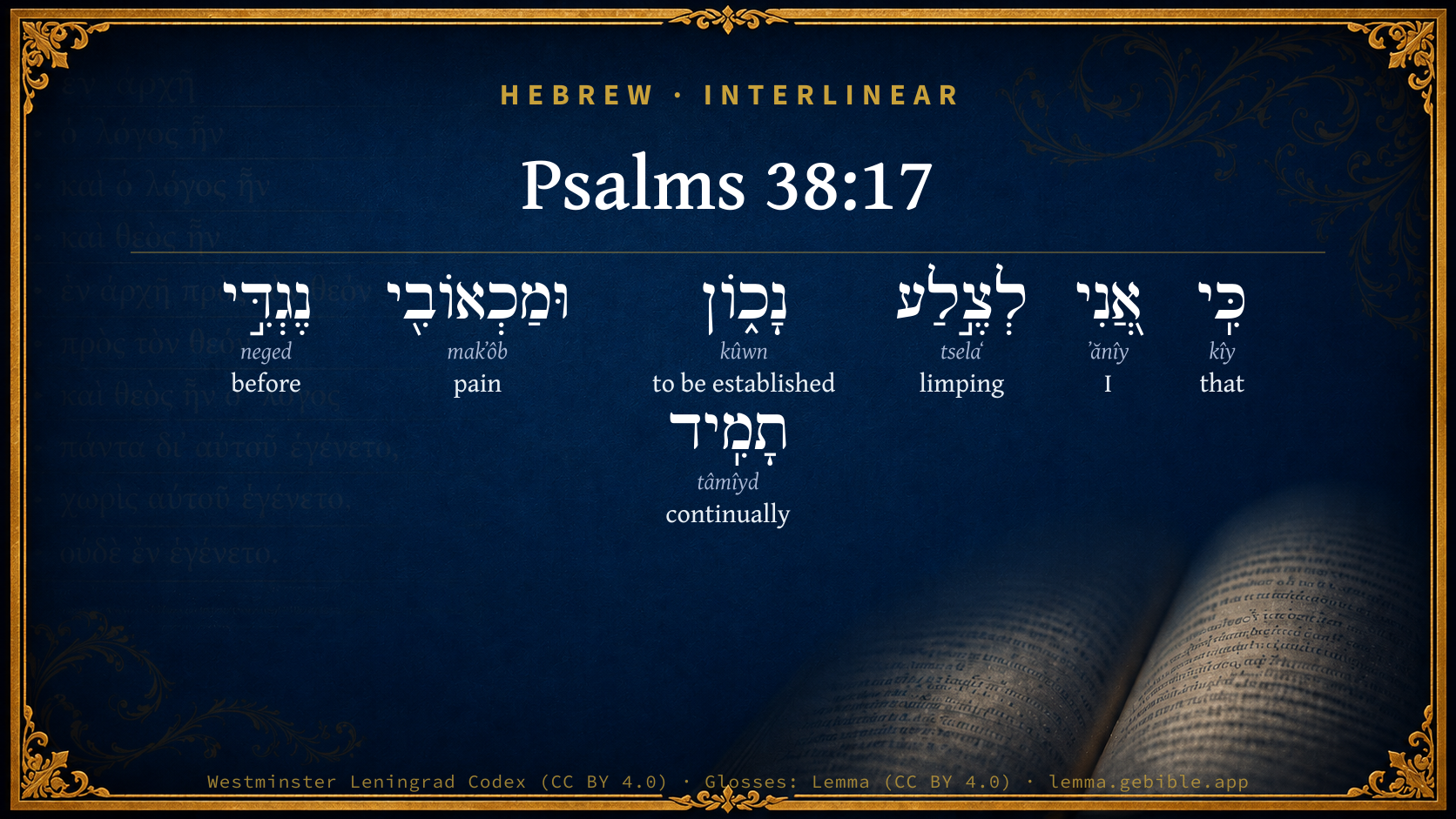
Psalms 38:17

Hebrew (Westminster Leningrad Codex) Psalms 38:17 appears in the Hebrew Old Testament. The text above is from the Westminster Leningrad Codex. Each word links to its Strong’s number, a concise gloss, and parsing drawn from the Open Scriptures Hebrew Bible morphology. Click any word for its full Brown-Driver-Briggs (BDB) entry.
Download image
Cite this verse

Psalms 38:17 (World English Bible). Public Domain. Lemma interlinear Bible study tool, https://lemma.gebible.app/v/psalms/38/17.

Show BibTeX & RIS
BibTeX
RIS
English Translation
For I am ready to fall. My pain is continually before me.
World English Bible · Public Domain
Download a study sheet

One document with this verse’s original text, its word-by-word gloss line, the meaning frame, cross-references with their text, attributed commentary, and full source and license credits — printable, and it pastes into notes with its structure intact.

This verse Autodidact and up

Study sheet (.html) Plain text (.txt)

A passage Seminary Student

Up to 50 verses in one chapter. A passage sheet keeps up to 6 commentary sources and 12 cross-references per verse, in the order this page ranks them, and says so on the sheet whenever that leaves anything out. Ask for a single verse and you get the Autodidact verse sheet above.

Everything on this page stays free to read, with no account — the sheet is a download of what is already on screen, not access to it.

Want to remove ads? Support Godless Engineer
Compare translations 3

The same verse in 3 English versions, stacked beneath the original-language interlinear above. Click any original word for its lexicon entry.

Each is an independent rendering of the whole verse — the interlinear is not word-aligned to these translations.

Highlighted words mark where these versions differ — a whole-verse word diff, not a word-by-word alignment.

  • World English Bible Public Domain
    For I am ready to fall. My pain is continually before me.
  • King James Version Public Domain
    For I am ready to halt, and my sorrow is continually before me.
  • unfoldingWord Literal Text CC BY-SA 4.0
    For I am set up for a stumbling, and my pain before me continually.

unfoldingWord Literal Text — © unfoldingWord, licensed CC BY-SA 4.0. Word-aligned USFM3 via Door43 (git.door43.org/unfoldingWord/en_ult).

Versions to compare (up to 4)

3 of 4 selected

Show all 18 translations

Every available English version of this verse, each an independent rendering of the whole verse.

  • World English Bible Public Domain
    For I am ready to fall. My pain is continually before me.
  • Berean Standard Bible Public Domain
    For I am ready to fall, and my pain is ever with me.
  • Majority Standard Bible Public Domain
    For I am ready to fall, and my pain is ever with me.
  • King James Version Public Domain
    For I am ready to halt, and my sorrow is continually before me.
  • American Standard Version (1901) Public Domain
    For I am ready to fall, And my sorrow is continually before me.
  • Revised Version (1885) Public Domain
    For I am ready to halt, and my sorrow is continually before me.
  • Geneva Bible (1599) Public Domain
    Surely I am ready to halte, and my sorow is euer before me.
  • Douay-Rheims (1899) Public Domain
    For I said: Lest at any time my enemies rejoice over me: and whilst my feet are moved, they speak great things against me.
  • Young's Literal Translation Public Domain
    For I am ready to halt, And my pain `is' before me continually.
  • Literal Standard Version CC BY-SA 4.0
    For I am ready to halt, || And my pain [is] continually before me.
  • Unlocked Literal Bible CC BY-SA 4.0
    For I am about to stumble, and I am in constant pain.
  • unfoldingWord Literal Text CC BY-SA 4.0
    For I am set up for a stumbling, and my pain before me continually.
  • Darby Bible Public Domain
    For I am ready to halt, and my pain is continually before me.
  • World Messianic Bible Public Domain
    For I am ready to fall. My pain is continually before me.
  • Webster's Bible Public Domain
    \\38:16\\For I said, Hear me, lest otherwise they should rejoice over me: when my foot slippeth, they magnify themselves against me.
  • Free Bible Version CC BY-SA 4.0
    For I'm about ready to collapse—the pain never stops.
  • Bible in Basic English Public Domain
    My feet are near to falling, and my sorrow is ever before me.
  • JPS Tanakh (1917) Public Domain
    (38-18) For I am ready to halt, and my pain is continually before me.

Literal Standard Version (2020), Covenant Press — licensed CC BY-SA 4.0. Text via the HelloAO Bible API (eBible.org). Unlocked Literal Bible (unfoldingWord) — licensed CC BY-SA 4.0. Text via the HelloAO Bible API (eBible.org). unfoldingWord Literal Text — © unfoldingWord, licensed CC BY-SA 4.0. Word-aligned USFM3 via Door43 (git.door43.org/unfoldingWord/en_ult). Free Bible Version, Dr. Jonathan Gallagher — licensed CC BY-SA 4.0. Text via the HelloAO Bible API (eBible.org).

Word by word

More ways to search: Search by grammar → Find every occurrence → Compare this word →

Practice this passage: Drill this verse → Learn its vocabulary →

About this verse

These counts appear in no published source. They are computed here, from the morphology-tagged text and Lemma’s own curated glosses. What Lemma adds →

7
words
7
distinct lemmas
Wisdom
section

Notable vocabulary

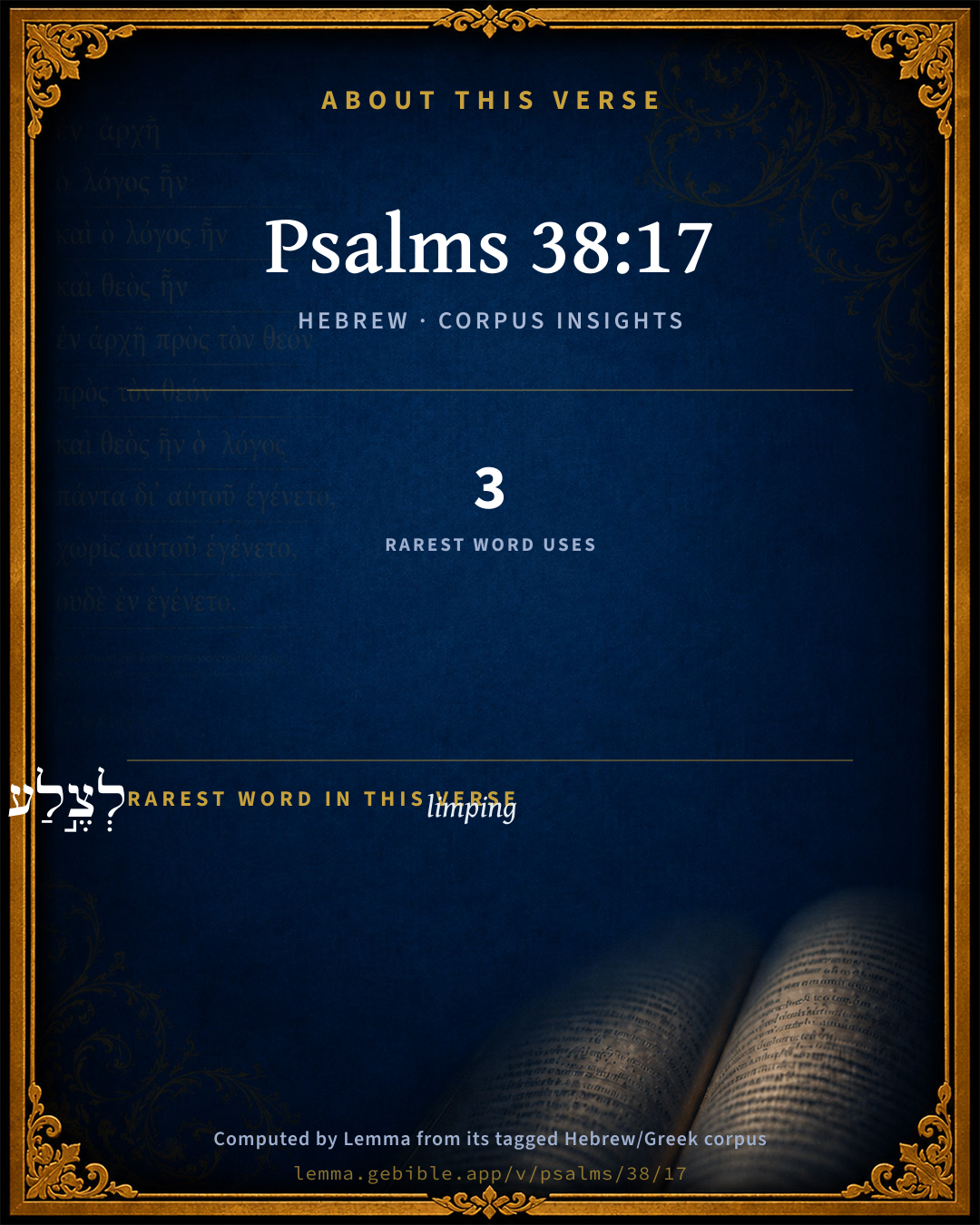
The rarest word here is לְצֶ֣לַע limping H6761 — appearing just 3 times in the whole Hebrew Bible.

Shared distinctive vocabulary

לְצֶ֣לַע limping H6761 occurs in 3 verses of the Hebrew Bible. Also found in:

Grammatical profile

  • 1 verb
  • 3 nouns
  • 1 pronoun
  • 1 preposition
  • 1 conjunction

Verb forms

  • נָכ֑וֹן Niphal · Participle Active

Hebrew & Septuagint length

In English translation the verse runs 12 words from the Hebrew and 13 from the Septuagint (LXX English) — closely comparable.

A rough comparison of the two English renderings, which tokenize alike — not a word-level alignment.

Word counts can differ between the Hebrew and the Greek without any difference in meaning — e.g. the Hebrew direct-object marker אֵת has no separate Greek word, and Greek often adds the article ὁ.

Cross-references

6

Topical passages linked to Psalms 38:17 in the Treasury of Scripture Knowledge — connected by theme and wording, ordered by reader-vote popularity; previews shown in the World English Bible.

  • Psalms 6:6 I am weary with my groaning; Every night I flood my bed; I drench my couch with my tears.
  • Psalms 35:15 But in my adversity, they rejoiced, and gathered themselves together. The attackers gathered themselves together against me, and I didn't know it. They tore at me, and didn't cease.
  • Psalms 38:6 I am pained and bowed down greatly. I go mourning all day long.
  • Psalms 77:2–3 In the day of my trouble I sought the Lord. My hand was stretched out in the night, and didn't get tired. My soul refused to be comforted.
  • Isaiah 53:3–5 He was despised, and rejected by men; a man of suffering, and acquainted with disease: and as one from whom men hide their face he was despised; and we didn't respect him.
  • Micah 4:6–7 "In that day," says Yahweh, "I will assemble that which is lame, And I will gather that which is driven away, And that which I have afflicted;

Cross-references courtesy of OpenBible.info (CC BY 4.0).

Hebrew and Greek witnesses Masoretic Hebrew ↔ Greek Septuagint

The same verse in the two great witnesses to the Old Testament, shown verse-for-verse.

You’re reading Greek Psalm 37 (Hebrew Psalm 38). The Septuagint counts the superscription, so verse numbers can differ from the Hebrew — chapter-level alignment, not verse-by-verse. Numbering follows Rahlfs.

These are two independent witnesses, not word-aligned to each other, and the Septuagint is shown in lemma (dictionary) form.

Hebrew Psalms 38:17 Masoretic · Westminster Leningrad Codex

כִּֽי אֲ֭נִי לְצֶ֣לַע נָכ֑וֹן וּמַכְאוֹבִ֖י נֶגְדִּ֣י תָמִֽיד

For I am ready to fall. My pain is continually before me.

World English Bible · Public Domain

Greek LXX Greek Psalm 37:17 Septuagint · lemma form

ὅτι εἶπον μήποτε ἐπιχαίρω ἐγώ ὁ ἐχθρός ἐγώ καί ἐν ὁ σαλεύω πούς ἐγώ ἐπί ἐγώ μεγαλορρημονέω

For I am ready for plagues, and my grief is continually before me.

LXX2012 (modern English Septuagint) · Public Domain

Hebrew: Westminster Leningrad Codex (CC BY 4.0). Greek: Septuagint (public domain); English from LXX2012 (modern English Septuagint) (Public Domain). How the Septuagint differs from the Hebrew →

Commentary

Notes on Psalms 38:17 from classic Christian and Jewish commentators (each source and its license shown beneath its notes). The classic Christian expositions comment on the surrounding passage and are grouped to its opening verse, so a note may address several verses; the Jewish commentaries on the Tanakh (Rashi and others) are per-verse, so they appear only where the commentator wrote on this verse.

Lemma curates 59 commentaries, every one of them public domain or Creative Commons licensed, each selected and text-cleaned for this edition rather than reprinted as found. About our sources →

Trapp's Complete Commentary

John Trapp

Psa 38:17 For I [am] ready to halt, and my sorrow [is] continually before me.

Ver. 17. For I am ready to halt] i.e. To misbehave mysetf and so to mar a good cause by ill-managing it, and then what will become of thy great name? This is a very forcible motive to prevail with a jealous and just God.

And my sorrow is continually before me] That is, my sin, as Ecc 11:10 : or, my sorrow, but much more my sin the cause of it.

John Trapp, A Commentary or Exposition upon All the Books of the Old and New Testament (1647–1656) — public domain. Text from a community e-Sword module.

The Biblical Illustrator

Joseph S. Exell

Psa_38:17

For I am ready to halt.

Resolution almost exhausted

We reach the I will by I must and I ought. Now, this struggle with self-will is like a man with narrow chest and feeble lungs walking in the teeth of a biting north-east wind; it is like a bare-footed girl treading a road made with rough stones and sharp flints; it is like a feeble man climbing a mountain by a rocky path beneath a noon-day sun; and under the exhaustion of resolution and courage and patience there be many that say, I am ready to halt. (Samuel Martin.)

The Biblical Illustrator, edited by Joseph S. Exell (c. 1880s–1900s) — public domain. Text from a community e-Sword module.

Joseph Benson's Commentary

Psa 38:17-18. For I am ready to halt — To fall into destruction, Jer 20:10. And, therefore, if thou dost not help me speedily it will be too late. My sorrow is continually before me — I am deeply and constantly sensible of thy justice in my chastisement, and I shall be overwhelmed with sorrow if thou dost not prevent it. For I will declare mine iniquity — I will confess it to thee as the cause of my sufferings. I will be sorry for my sin — Hebrew, אדאג, edag, I will be, or am solicitous, or anxious; full of grief for what is past, and of cares and fears for the future; therefore pity, pardon, and save me.

Joseph Benson's Commentary on the Old and New Testaments (1811–1818) — public domain. Text from a community e-Sword module.

J. A. Alexander on Psalms

Joseph Addison Alexander

18. (Psa 38:17). Because I for limping (am) ready (to halt), and my grief (sorrow) is before me always (or continually before me). This verse assigns a reason for the triumph of his enemies, to wit, that he was really in danger. Ready to halt or limp, i.e. constantly liable to some interruption of his even prosperous course. See above, on Psa 35:15. The form of expression does not exclude the idea of his actually halting, but rather suggests it. As if he had said, "The slightest occasion makes me halt or limp." Grief or sorrow seems to be put here for that which causes it. I am always in full view of my worst distress.

Joseph Addison Alexander, The Psalms Translated and Explained (1850) — public domain. Text from a community e-Sword module.

Tyndale Open Study Notes

Tyndale Open Resources

38:17-20 No longer able to endure his suffering and teetering on the verge of collapse (cp. 15:5), the psalmist confesses his sin (see 32:5).

Tyndale Open Study Notes — © Tyndale Open Resources, licensed CC BY-SA 4.0. Text via the HelloAO Bible API.

Geneva Bible (1599)

Geneva Bible translators

I am without hope to recover my strength.

Geneva Bible (1599) marginal notes — public domain. Text via Bolls.life.

Adam Clarke's Commentary

Verse 17. For I am ready to halt] Literally, I am prepared to halt. So completely infirm is my soul, that it is impossible for me to take one right step in the way of righteousness, unless strengthened by thee.

Adam Clarke's Commentary on the Bible (1810–1826) — public domain. Text from a community e-Sword/MySword module.

John Calvin's Commentaries

17 Surely I am ready to halt This verse has led expositors to suppose that David was afflicted with some sore, from which he was afraid of having brought upon him the infirmity of halting all his days; but I have already shown, in Psalm 35:15, that this supposition is very improbable. We have certainly no greater reason for supposing that David was lame than that Jeremiah was so, when he said,

“All my familiars watched for my halting.” — (Jeremiah 20:10,)

I therefore think that David here employs a metaphorical mode of expression, and that his meaning is, that if God did not soon come to his aid, there was no hope of his ever being restored to his former condition; and that he was so greatly afflicted, that he would walk as if he had been maimed or lame all the days of his life. It next follows by way of exposition, that his sorrow was continually before him. The sense is, that he was so grievously afflicted, that he could not forget it for a single moment, so as to obtain some relaxation. In both the clauses of the verse, David confesses that his disease is incurable, unless he obtain some remedy from God, and that he cannot endure it, unless he be raised up and sustained by the hand of God himself. This is the reason why he directs all his thoughts and his requests to God alone; for as soon as he shall turn aside from him, he sees nothing but immediate ruin.

John Calvin's Commentaries (1540-1563) — public domain. Text from the Calvin Translation Society English edition (1840s-50s) via the Christian Classics Ethereal Library (ccel.org). Calvin's coverage is partial (roughly two-thirds of the Bible); uncommented books and verses are honest gaps, never fabricated. The 19th-century editor's footnotes and remarks are omitted so the notes are faithfully Calvin's own voice.

The Cambridge Bible for Schools and Colleges

gen. ed. J. J. S. Perowne

17. For &c.] A further argument for a speedy hearing. For the metaphor cp. Psa_35:15.

my sorrow &c.] I.e. my suffering is unceasingly present with me. Cp. Psa_51:3.

The Cambridge Bible for Schools and Colleges (gen. ed. J. J. S. Perowne; Cambridge University Press, 1878–1918) — public domain. Text from a community e-Sword module.

John Gill's Exposition

For I will declare mine iniquity,.... Either to men, to ease his mind, justify God in his proceedings with him, and for their caution and admonition: or rather to God, against whom he had sinned, and who only could pardon him; with a view to which he was determined to make a free and open confession of it before him:

I will be sorry for my sin, or "careful" (p) about it; that is, how he committed it for the future: true repentance for sin produces a carefulness to abstain from all appearance of it; see Co2 7:10.

(p) "solicitus ero", Montanus; so Junius & Tremellius, Piscator, Gejerus, Michaelis, Ainsworth.

John Gill's Exposition of the Whole Bible (1746–1763) — public domain (CC PDM 1.0). Text via the HelloAO Bible API.

Albert Barnes' Notes on the Bible

For I am ready to halt - Margin, as in Hebrew, “for halting.” The word from which the word used here is derived means properly to lean on one side, and then to halt or limp. The meaning here is, that he was like one who was limping along, and who was ready to fall; that is, in the case here referred to, he felt that his strength was almost gone, and that he was in continual danger of falling into sin, or sinking under his accumulated burdens, and of thus giving occasion for all that his enemies said of him, or occasion for their triumphing over him. Men often have this feeling - that their sorrows are so great that they cannot hope to hold out much longer, and that if God does not interpose they must fall.

And my sorrow is continually before me - That is, my grief or suffering is unintermitted. Probably the reference here is particularly to that which “caused” his grief, or which was the source of his trouble - his sin. The fact that he was a sinner was never absent from his mind; that was the source of all his trouble; that was what so pressed upon him that it was likely to crush him to the dust.

Albert Barnes' Notes on the Bible (1834–1885) — public domain. Text from a community e-Sword/MySword module.

Matthew Poole's English Annotations

Ready to halt; just falling into utter destruction; see Jer 20:10; and therefore if thou dost not help me speedily, it will be too late.

My sorrow is continually before me; I am deeply and constantly sensible of thy just hand, and of my sins, the cause of it; wherewith I shall be overwhelmed, if thou dost not prevent it.

Matthew Poole's English Annotations on the Holy Bible (1683–1685) — public domain. Text from a community e-Sword/MySword module.

The Treasury of David

Charles H. Spurgeon

Ver. 17. For I am ready to halt. Like one who limps, or a person with tottering footsteps, in danger of falling. How well this befits us all. "Let him that thinketh he standeth, take heed lest he fall." How small a thing will lame a Christian, how insignificant a stumbling block may cause him to fall! This passage refers to a weakness caused by pain and sorrow; the sufferer was ready to give up in despair; he was so depressed in spirit that he stumbled at a straw. Some of us painfully know what it is to be like dry tinder for the sparks of sorrow; ready to halt, ready to mourn, and sigh and cry upon any occasion, and for any cause. And my sorrow is continually before me. He did not need to look out of window to find sorrow, he felt it within, and groaned under a body of sin which was an increasing plague to him. Deep conviction continues to irritate the conscience; it will not endure a patched up peace; but cries war to the knife till the enmity is slain. Until the Holy Ghost applies the precious blood of Jesus, a truly awakened sinner is covered with raw wounds which cannot be healed nor bound up, nor mollified with ointment.

Ver. 17. For I am ready to halt: to show my infirmity in my trials and afflictions; as Jacob halted after his wrestling with God. Ge 32:31. In the Greek, I am ready for scourges, that is, to suffer correction and punishment for my sins: so the Chaldee saith, for calamity. Henry Ainsworth.

Ver. 17. Mr. Ready to halt. His pedigree, and infirmity; his crutches, and his cure; his history, and safe departure.

Psalms 38:18*

Charles H. Spurgeon's The Treasury of David (1869–1885) — public domain. Psalms only. Text from a community e-Sword/MySword module.

Whedon's Commentary on the Bible

Daniel D. Whedon

17. I am ready to halt—The idea is, literally, My fall is certain; that is, humanly speaking, nothing is left for me but inevitable ruin, or help from God.

Daniel D. Whedon (gen. ed.), Commentary on the Old and New Testaments (1874–1909) — public domain. Text from a community e-Sword module.

The Pulpit Commentary

For I am ready to halt. I am weak and helpless, liable at any moment to stumble and fall. And my sorrow is continually before me; i.e. my sin, which I sorrow over, which lies at the root of all my distress. (comp. Psa_51:3)

The Pulpit Commentary (1880–1919), ed. H.D.M. Spence-Jones & Joseph S. Exell — public domain. Text from a community e-Sword module.

John Wesley's Explanatory Notes

To halt - just falling into destruction. Before me - I am constantly sensible of thy just hand, and of my sins the cause of it.

John Wesley, Explanatory Notes Upon the Whole Bible (1754–1765) — public domain. Text via the GEBible commentary corpus.

unfoldingWord translationNotes

Door43 World Missions Community

I am about to stumble

Possible meanings for this metaphor are 1) "I am so sick that I am about to die" or 2) "I will soon be ruined." It may be best not to interpret the metaphor in the text. (See: Metaphor)

I am in constant pain

"I am always in pain"

translationWords

stumble

confess

guilt

unfoldingWord translationNotes — © Distant Shores Media and the Door43 World Missions Community, licensed CC BY-SA 4.0. Source: git.door43.org/Door43/en_tn.

Rashi

Rabbi Shlomo Yitzchaki (Rashi)

For I said, “Lest they rejoice over me” For this reason we remain silent, because we say to ourselves, “If we answer them brazenly, they may witness our downfall and rejoice over us when our feet falter, and they will magnify themselves over us saying, ‘Weren’t you boasting of your salvation?’”

Rashi on the Tanakh — English translations: “The Judaica Press complete Tanach with Rashi, translated by A. J. Rosenberg” (CC BY 4.0); “Pentateuch with Rashi's commentary by M. Rosenbaum and A.M. Silbermann, 1929-1934” (public domain); “The Metsudah Tanach series, Lakewood, N.J” (CC BY 4.0); and “The Book of Joshua, Metsudah Publications, 1997” (CC BY 4.0). Text via Sefaria.

Lesson kit

Teaching starters — assembled from the data on this page, not authored interpretation. Every prompt links to the verse data it draws on. Edit before teaching.

Psalms, in the Wisdom, opens this verse with 7 words (7 distinct Hebrew lemmas). Its most distinctive word is tselaʻ (“limping”). A historical commentator’s framing appears above. Read the whole chapter for the surrounding context.

Discussion questions

  1. How does “limping” (tselaʻ) shape what this verse is saying?
  2. How does Psalms 35:15, which shares the word «limping», read alongside this verse?
  3. These translations render this verse differently. What is at stake in choosing one wording over another?
  4. «נָכ֑וֹן» is a Niphal Participle Active verb. How does that grammatical form shape the action described?
  5. Compare how Trapp's Complete Commentary and The Biblical Illustrator read this verse. Where do they agree or differ?

Things to notice

Reading settings

Reading text

Shown beneath each verse's original-language words.

Old Testament
Old Testament edition

Read the OT as the Masoretic Hebrew (MT) or the Greek Septuagint (LXX).

English shown for the Greek Septuagint (in the Hebrew ↔ Greek comparison).

Comparing translations? Open the Compare panel on any verse page to stack up to four side by side.