
Psalms 56:9

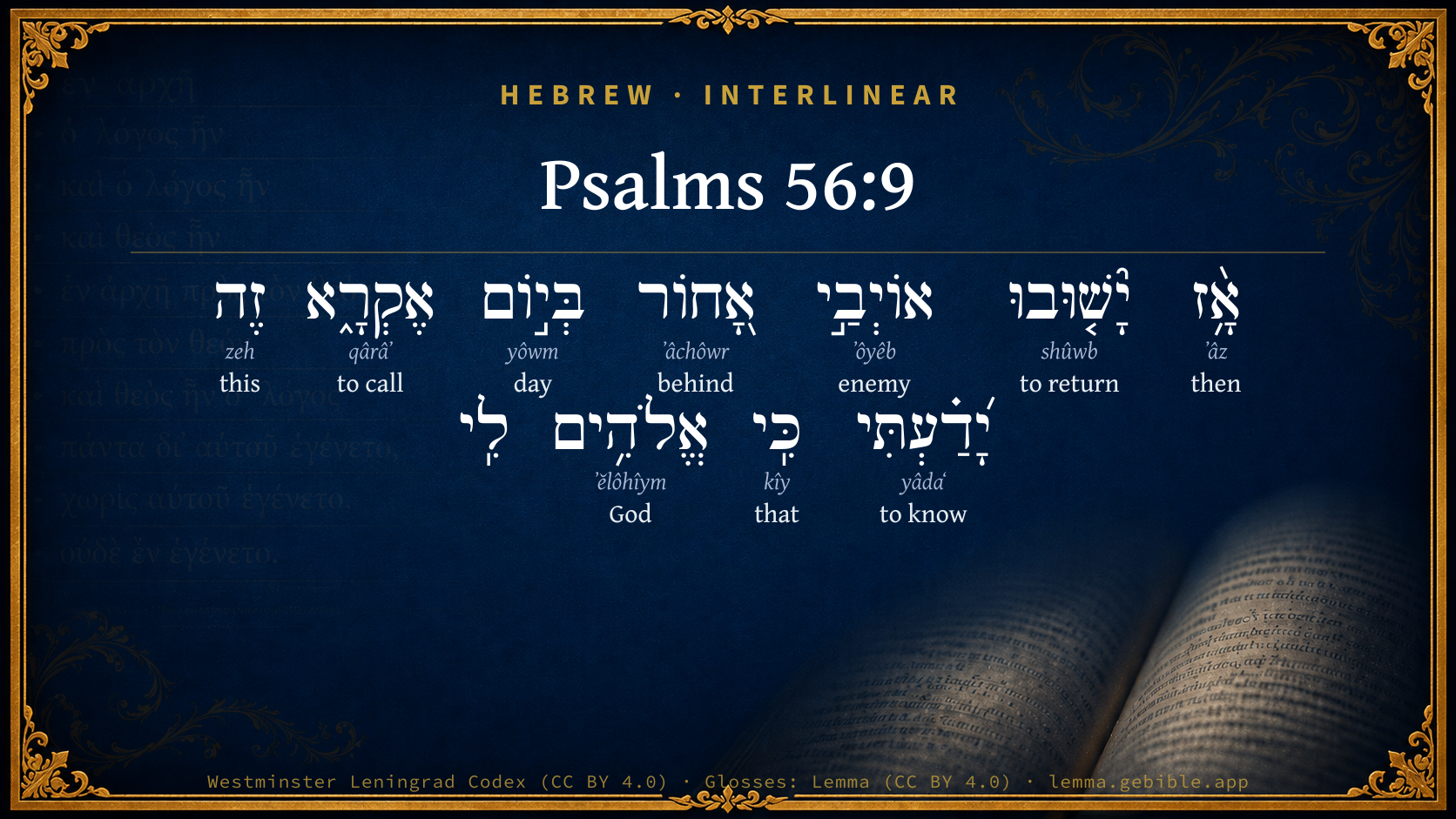
Hebrew (Westminster Leningrad Codex) Psalms 56:9 appears in the Hebrew Old Testament. The text above is from the Westminster Leningrad Codex. Each word links to its Strong’s number, a concise gloss, and parsing drawn from the Open Scriptures Hebrew Bible morphology. Click any word for its full Brown-Driver-Briggs (BDB) entry.
Download image
Cite this verse

Psalms 56:9 (World English Bible). Public Domain. Lemma interlinear Bible study tool, https://lemma.gebible.app/v/psalms/56/9.

Show BibTeX & RIS
BibTeX
RIS
English Translation
Then my enemies shall turn back in the day that I call. I know this, that God is for me.
World English Bible · Public Domain
Download a study sheet

One document with this verse’s original text, its word-by-word gloss line, the meaning frame, cross-references with their text, attributed commentary, and full source and license credits — printable, and it pastes into notes with its structure intact.

This verse Autodidact and up

Study sheet (.html) Plain text (.txt)

A passage Seminary Student

Up to 50 verses in one chapter. A passage sheet keeps up to 6 commentary sources and 12 cross-references per verse, in the order this page ranks them, and says so on the sheet whenever that leaves anything out. Ask for a single verse and you get the Autodidact verse sheet above.

Everything on this page stays free to read, with no account — the sheet is a download of what is already on screen, not access to it.

Want to remove ads? Support Godless Engineer
Compare translations 3

The same verse in 3 English versions, stacked beneath the original-language interlinear above. Click any original word for its lexicon entry.

Each is an independent rendering of the whole verse — the interlinear is not word-aligned to these translations.

Highlighted words mark where these versions differ — a whole-verse word diff, not a word-by-word alignment.

  • World English Bible Public Domain
    Then my enemies shall turn back in the day that I call. I know this, that God is for me.
  • King James Version Public Domain
    When I cry unto thee, then shall mine enemies turn back: this I know; for God is for me.
  • unfoldingWord Literal Text CC BY-SA 4.0
    Then my enemies will turn back on the day I call. This I know, for God for me.

unfoldingWord Literal Text — © unfoldingWord, licensed CC BY-SA 4.0. Word-aligned USFM3 via Door43 (git.door43.org/unfoldingWord/en_ult).

Versions to compare (up to 4)

3 of 4 selected

Show all 18 translations

Every available English version of this verse, each an independent rendering of the whole verse.

  • World English Bible Public Domain
    Then my enemies shall turn back in the day that I call. I know this, that God is for me.
  • Berean Standard Bible Public Domain
    Then my enemies will retreat on the day I cry for help. By this I will know that God is on my side.
  • Majority Standard Bible Public Domain
    Then my enemies will retreat on the day I cry for help. By this I will know that God is on my side.
  • King James Version Public Domain
    When I cry unto thee, then shall mine enemies turn back: this I know; for God is for me.
  • American Standard Version (1901) Public Domain
    Then shall mine enemies turn back in the day that I call: This I know, that God is for me.
  • Revised Version (1885) Public Domain
    Then shall mine enemies turn back in the day that I call: this I know, that God is for me.
  • Geneva Bible (1599) Public Domain
    When I cry, then mine enemies shall turne backe: this I know, for God is with me.
  • Douay-Rheims (1899) Public Domain
    I have declared to thee my life: thou hast set my tears in thy sight, As also in thy promise.
  • Young's Literal Translation Public Domain
    Then turn back do mine enemies in the day I call. This I have known, that God `is' for me.
  • Literal Standard Version CC BY-SA 4.0
    Then turn back my enemies in the day I call. This I have known, that God [is] for me.
  • Unlocked Literal Bible CC BY-SA 4.0
    Then my enemies will turn back on the day that I call to you; this I know, that God is for me.
  • unfoldingWord Literal Text CC BY-SA 4.0
    Then my enemies will turn back on the day I call. This I know, for God for me.
  • Darby Bible Public Domain
    Then shall mine enemies return backward in the day when I call: this I know, for God is for me.
  • World Messianic Bible Public Domain
    Then my enemies shall turn back in the day that I call. I know this: that God is for me.
  • Webster's Bible Public Domain
    \\56:8\\Thou numberest my wanderings: put thou my tears into thy bottle: are they not in thy book?
  • Free Bible Version CC BY-SA 4.0
    Then those who hate me will run away when I call for your help. For I know this: God is for me!
  • Bible in Basic English Public Domain
    When I send up my cry to you, my haters will be turned back; I am certain of this, for God is with me.
  • JPS Tanakh (1917) Public Domain
    (56-10) Then shall mine enemies turn back in the day that I call; this I know, that God is for me.

Literal Standard Version (2020), Covenant Press — licensed CC BY-SA 4.0. Text via the HelloAO Bible API (eBible.org). Unlocked Literal Bible (unfoldingWord) — licensed CC BY-SA 4.0. Text via the HelloAO Bible API (eBible.org). unfoldingWord Literal Text — © unfoldingWord, licensed CC BY-SA 4.0. Word-aligned USFM3 via Door43 (git.door43.org/unfoldingWord/en_ult). Free Bible Version, Dr. Jonathan Gallagher — licensed CC BY-SA 4.0. Text via the HelloAO Bible API (eBible.org).

Word by word

More ways to search: Search by grammar → Find every occurrence → Compare this word →

Practice this passage: Drill this verse → Learn its vocabulary →

About this verse

These counts appear in no published source. They are computed here, from the morphology-tagged text and Lemma’s own curated glosses. What Lemma adds →

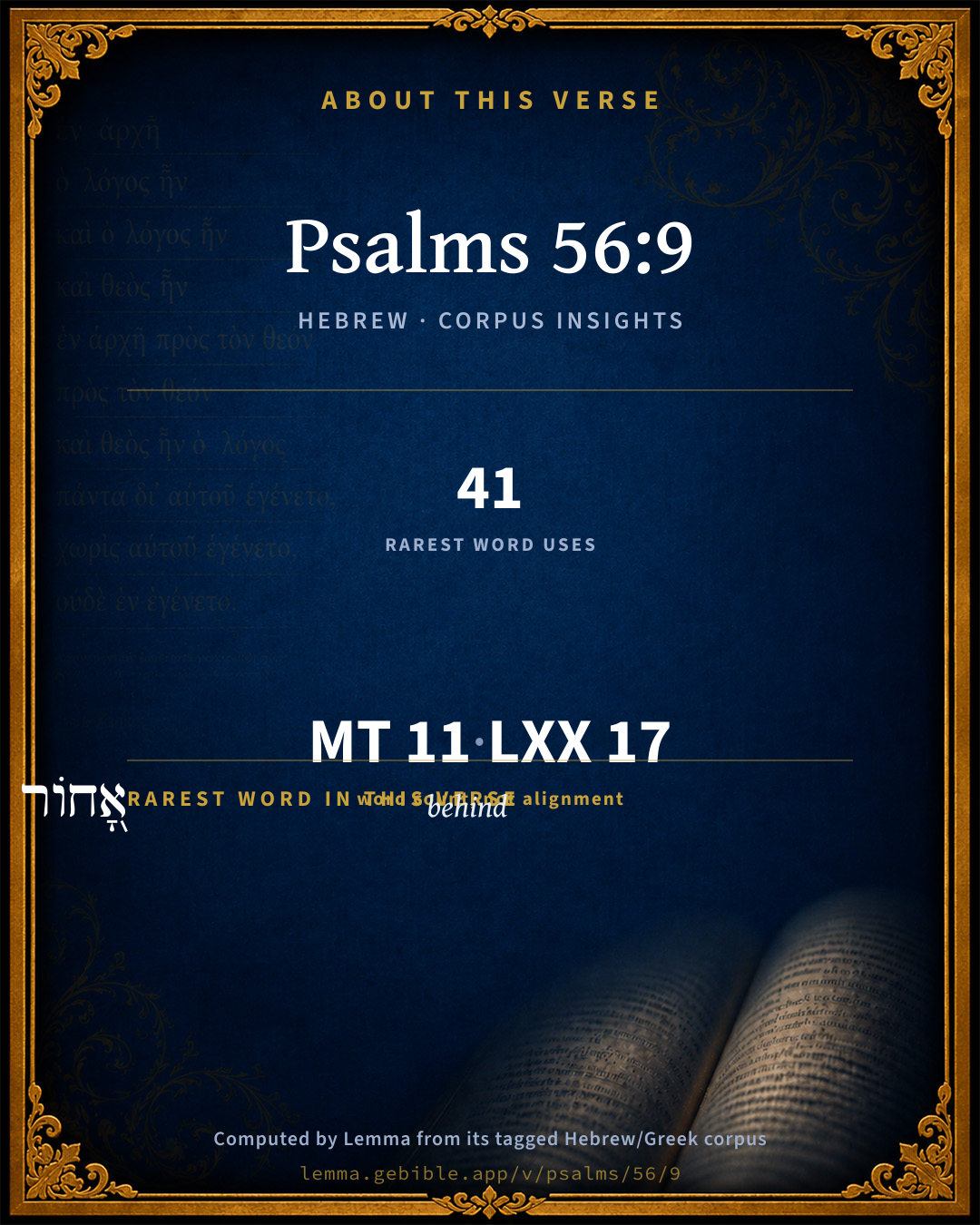
11
words
10
distinct lemmas
Wisdom
section

Shared distinctive vocabulary

אָ֭חוֹר behind H268 occurs in 41 verses of the Hebrew Bible. Also found in:

Grammatical profile

  • 4 verbs
  • 3 nouns
  • 1 pronoun
  • 1 preposition
  • 1 conjunction
  • 1 adverb

Verb forms

  • יָ֘שׁ֤וּבוּ Qal · Imperfect
  • אוֹיְבַ֣י Qal · Participle Active
  • אֶקְרָ֑א Qal · Imperfect
  • יָ֝דַ֗עְתִּי Qal · Perfect

Hebrew & Septuagint length

In English translation the verse runs 20 words from the Hebrew and 23 from the Septuagint (LXX English) — closely comparable.

A rough comparison of the two English renderings, which tokenize alike — not a word-level alignment.

Word counts can differ between the Hebrew and the Greek without any difference in meaning — e.g. the Hebrew direct-object marker אֵת has no separate Greek word, and Greek often adds the article ὁ.

In the original languages it is 11 Hebrew tokens and 17 Greek tokens — but the two are counted differently (Hebrew bundles its prefixes and suffixes into one token; the Greek is in lemma form), so that isn’t a like-for-like length.

Cross-references

13

Topical passages linked to Psalms 56:9 in the Treasury of Scripture Knowledge — connected by theme and wording, ordered by reader-vote popularity; previews shown in the World English Bible.

  • Romans 8:31 What then shall we say about these things? If God is for us, who can be against us?
  • Psalms 118:6 Yahweh is on my side. I will not be afraid. What can man do to me?
  • Psalms 46:11 Yahweh of Hosts is with us. The God of Jacob is our refuge. Selah.
  • Psalms 102:2 Don't hide your face from me in the day of my distress. Turn your ear to me. Answer me quickly in the day when I call.
  • Psalms 118:11–13 They surrounded me, yes, they surrounded me. In the name of Yahweh I indeed cut them off.
  • Isaiah 8:9–10 Make an uproar, O you peoples, and be broken in pieces! And give ear, all you of far countries: gird yourselves, and be broken in pieces! Gird yourselves, and be broken in pieces!
  • Psalms 9:3 When my enemies turn back, They stumble and perish in your presence.
  • Psalms 46:7 Yahweh of Hosts is with us. The God of Jacob is our refuge. Selah.
  • Jeremiah 33:3 Call to me, and I will answer you, and will show you great things, and difficult, which you don't know.
  • Psalms 27:2 When evil-doers came at me to eat up my flesh, Even my adversaries and my foes, they stumbled and fell.
  • John 18:6 When therefore he said to them, "I AM," they went backward, and fell to the ground.
  • Psalms 18:38–42 I will strike them through, so that they will not be able to rise. They shall fall under my feet.
  • Exodus 17:9–11 Moses said to Joshua, "Choose men for us, and go out, fight with Amalek. Tomorrow I will stand on the top of the hill with God's rod in my hand."

Cross-references courtesy of OpenBible.info (CC BY 4.0).

Hebrew and Greek witnesses Masoretic Hebrew ↔ Greek Septuagint

The same verse in the two great witnesses to the Old Testament, shown verse-for-verse.

You’re reading Greek Psalm 55 (Hebrew Psalm 56). The Septuagint counts the superscription, so verse numbers can differ from the Hebrew — chapter-level alignment, not verse-by-verse. Numbering follows Rahlfs.

These are two independent witnesses, not word-aligned to each other, and the Septuagint is shown in lemma (dictionary) form.

Hebrew Psalms 56:9 Masoretic · Westminster Leningrad Codex

אָ֥֨ז יָ֘שׁ֤וּבוּ אוֹיְבַ֣י אָ֭חוֹר בְּי֣וֹם אֶקְרָ֑א זֶה יָ֝דַ֗עְתִּי כִּֽי אֱלֹהִ֥ים לִֽי

Then my enemies shall turn back in the day that I call. I know this, that God is for me.

World English Bible · Public Domain

Greek LXX Greek Psalm 55:9 Septuagint · lemma form

ὁ ζωή ἐγώ ἐκἀγγέλλω σύ τίθημι ὁ δάκρυ ἐγώ ἐνώπιον σύ ὡς καί ἐν ὁ ἐπαγγελία σύ

Mine enemies shall be turned back, in the day wherein I shall call upon you; behold, I know that you are my God.

LXX2012 (modern English Septuagint) · Public Domain

Hebrew: Westminster Leningrad Codex (CC BY 4.0). Greek: Septuagint (public domain); English from LXX2012 (modern English Septuagint) (Public Domain). How the Septuagint differs from the Hebrew →

Commentary

Notes on Psalms 56:9 from classic Christian and Jewish commentators (each source and its license shown beneath its notes). The classic Christian expositions comment on the surrounding passage and are grouped to its opening verse, so a note may address several verses; the Jewish commentaries on the Tanakh (Rashi and others) are per-verse, so they appear only where the commentator wrote on this verse.

Lemma curates 59 commentaries, every one of them public domain or Creative Commons licensed, each selected and text-cleaned for this edition rather than reprinted as found. About our sources →

Trapp's Complete Commentary

John Trapp

Psa 56:9 When I cry [unto thee], then shall mine enemies turn back: this I know; for God [is] for me.

Ver. 9. When I cry unto thee, then shall mine enemies turn back] For how should they stand before so mighty a God? Of the power of prayer for the beating back of enemies, besides the Scripture, histories are full; that famous Victoria Halleluiatica for instance.

John Trapp, A Commentary or Exposition upon All the Books of the Old and New Testament (1647–1656) — public domain. Text from a community e-Sword module.

The Biblical Illustrator

Joseph S. Exell

Psa_56:9-11

When I cry unto Thee, then shall mine enemies turn back.

Prayer vanquishing enemies

I. This prayer implies the existence of conflict. David was pursued from place to place by: his adversaries. The Christian, too, has many enemies. Within him and around him.

II. This prayer supposes helplessness. The enemies which the Christian has to fight are numerous, potent and subtle; and he is perfect weakness.

III. A conviction that there is all needful help in God.

IV. Application to God for help. I cry unto Thee. Make me a conqueror, etc. This cry we must consider as secret, earnest and constant, and connected with confidence.

V. This prayer was successful. Then shall mine enemies turn back. This is expected from immutable promises (Isa_54:17; 2Pe_3:9). God will cause our pursuing enemies to turn back, for can they fight with omnipotence? Or He will give unto us grace, Divine armour, to enable us to stand and conquer in the evil day. Application.

1. How great the privilege of having an interest in the Divine favour.

2. How exposed and wretched is the sinner. (Helps for the Pulpit.)

The Biblical Illustrator, edited by Joseph S. Exell (c. 1880s–1900s) — public domain. Text from a community e-Sword module.

J. A. Alexander on Psalms

Joseph Addison Alexander

10. (Psa 56:9). Then shall my enemies turn back, in the day I call; this I know, that God is for me. The particle of time at the beginning of the verse has reference to what follows, in the day I call, but as this was to be connected closely with the last clause, the natural order of the sentence was inverted. Turn back, be repulsed, defeated, disappointed. See above, on Psa 7:11; Psa 9:3. in the day (that) I shall call: the ellipsis of the relative is equally common in Hebrew and in English. Call may mean simply call for help or pray; but some connect it with the last clause thus: in the day that I shall call (or cry as follows) "this I know," etc. There is also an ambiguity in the phrase this I know, which may either mean, "I know that my enemies shall thus turn back, because God is for me," or, "my enemies shall turn back when they hear me cry. This much I know, to wit, that God is for me." The last phrase may be also rendered to me he belongs to me, he is my God, which of course includes the idea of his favour or his being on the speaker's side.

Joseph Addison Alexander, The Psalms Translated and Explained (1850) — public domain. Text from a community e-Sword module.

Jamieson, Fausset & Brown

Robert Jamieson, A. R. Fausset & David Brown

God is for me--or, "on my side" (Psa 118:6; Psa 124:1-2); hence he is sure of the repulse of his foes.

Jamieson, Fausset & Brown — Commentary Critical and Explanatory on the Whole Bible (1871) — public domain (CC PDM 1.0). Text via the HelloAO Bible API.

Adam Clarke's Commentary

Verse 9. When I cry unto thee, then shall mine enemies turn back] As soon as they know that I call upon thee, then, knowing that thou wilt hear and save, my enemies will immediately take flight. The cry of faith and prayer to God is more dreadful to our spiritual foes than the war-whoop of the Indian is to his surprised brother savages.

This I know] I have often had experience of the Divine interposition; and I know it will be so now, for God is with me. He who has God WITH him need not fear the face of any adversary.

Adam Clarke's Commentary on the Bible (1810–1826) — public domain. Text from a community e-Sword/MySword module.

John Calvin's Commentaries

9. When I cry, then shall mine enemies turn back. Here he boasts of victory with even more confidence than formerly, specifying, as it were, the very moment of time when his enemies were to be turned back. He had no sensible evidence of their approaching destruction but from the firm reliance which he exercised upon the promise, he was able to anticipate the coming period, and resolved to wait for it with patience. Though God might make no haste to interpose, and might not scatter his enemies at the very instant when he prayed, he was confident that his prayers would not be disappointed: and his ground for believing this was just a conviction of the truth, that God never frustrates the prayers of his own children. With this conviction thoroughly fixed in his mind, he could moderate his anxieties, and calmly await the issue. It is instructive to notice, that David, when he would secure the obtainment of his request, does not pray in a hesitating or uncertain spirit, but with a confident assurance of his being heard. Having once reached this faith, he sets at defiance the devil and all the host of the ungodly.

John Calvin's Commentaries (1540-1563) — public domain. Text from the Calvin Translation Society English edition (1840s-50s) via the Christian Classics Ethereal Library (ccel.org). Calvin's coverage is partial (roughly two-thirds of the Bible); uncommented books and verses are honest gaps, never fabricated. The 19th-century editor's footnotes and remarks are omitted so the notes are faithfully Calvin's own voice.

The Cambridge Bible for Schools and Colleges

gen. ed. J. J. S. Perowne

9. Then shall mine enemies turn back in the day when I call:

This I know, that [or, for] God is on my side.

For the emphatic then cp. Psa_2:5. The certainty that God is on his side is the ground of his assurance that his enemies will be put to flight. Cp. Psa_9:3; Psa_118:6.

The Cambridge Bible for Schools and Colleges (gen. ed. J. J. S. Perowne; Cambridge University Press, 1878–1918) — public domain. Text from a community e-Sword module.

John Gill's Exposition

When I cry unto thee,.... In prayer;

then shall mine enemies turn back; great is the strength of prayer; the effectual fervent prayer of the righteous avails much against their enemies: when Moses lifted up his hands, Israel prevailed: the cases of Asa, Jehoshaphat, and Hezekiah, prove it; this David was assured of, and knew it to be true by experience, his prayer being often the prayer of faith in this respect;

this I know: for God is for me; he knew that when he prayed his enemies would flee; because God was on his side, who is greater than they; or by this he knew that God was for him, and was his God, by hearing his prayers, and causing his enemies to turn back: or, however, let things go how they will, this he was assured of, that he had a covenant interest in God, and who would be his God and guide even unto death.

John Gill's Exposition of the Whole Bible (1746–1763) — public domain (CC PDM 1.0). Text via the HelloAO Bible API.

Albert Barnes' Notes on the Bible

When I cry unto thee - This expresses strong confidence in prayer. The psalmist felt that he had only to cry unto God, to secure the overthrow of his enemies. God had all power, and his power would be put forth in answer to prayer.

Then shall mine enemies turn back - Then shall they cease to pursue and persecute me. He did not doubt that this would be the ultimate result - that this blessing would be conferred, though it might be delayed, and though his faith and patience might be greatly tried.

For God is for me - He is on my side; and he is with me in my wanderings. Compare the notes at Rom 8:31.

Albert Barnes' Notes on the Bible (1834–1885) — public domain. Text from a community e-Sword/MySword module.

Matthew Poole's English Annotations

When I have no other arms or force, which is my present case, my prayers shall be sufficient to overthrow mine enemies.

Matthew Poole's English Annotations on the Holy Bible (1683–1685) — public domain. Text from a community e-Sword/MySword module.

The Treasury of David

Charles H. Spurgeon

Ver. 9. When I cry unto thee, then shall mine enemies turn back. So soon as I pray they shall fly. So surely as I cry they shall be put to the rout.

"So swift is prayer to reach the sky,

So kind is God to me."

The machinery of prayer is not always visible, but it is most efficient. God inclines us to pray, we cry in anguish of heart, he hears, he acts, the enemy is turned back. What irresistible artillery is this which wins the battle as soon as its report is heard! What a God is this who harkens to the cry of his children, and in a moment delivers them from the mightiest adversaries!

This I know. This is one of the believer's certainties, his axioms, his infallible, indisputable verities.

For God is for me. This, we know, and we know, therefore, that none can be against us who are worth a moment's fear. "If God be for us, who can be against us?" Who will restrain prayer when it is so potent? Who will seek any other ally than God, who is instantly present so soon as we give the ordained signal, by which we testify both our need and our confidence?

Ver. 9. When I cry. The cry of faith and prayer to God is more dreadful to our spiritual foes than the war whoop of the Indian is to his surprised brother savages. Adam Clarke.

Ver. 9. (first clause). It was somewhat that when David prayed he was saved from his enemies. "I will call on the Lord: so shall I be saved from mine enemies" (2Sa 22:4); there is the defensive power of prayer; but it is more that it puts enemies to the foil. When I cry unto thee, then shall mine enemies turn back and be put to flight; there is the offensive power of prayer. In David's tower there was an armoury, thalpijoth, a place to hang swords with two edges, swords with two mouths (Canticles 4:4); a defensive and an offensive edge. Both edges must be used by such as seek safety. Prayer is a sword with two edges. "Put up thy sword into his place, "says Christ to Peter: "for all they that take the sword shall perish with the sword." Mt 22:52. But he that takes not this sword may happen to perish by the sword; and the drawing of this sword may save a man from perishing by the sword. Mark that last reason that our Saviour adds why Peter should put up his sword: "Thinkest thou that I cannot now pray to my Father, and he shall presently give me more than twelve legions of angels?" (Mt 22:53). As if he had said, If it were my mind to confound these mine enemies that now set upon me, I should not need thy sword to do it. I could pray to my Father, and could presently by prayer bring such forces into the field as should rout and scatter all mine enemies; hereby implying, that if he would, he could do his enemies more damage and mischief by his prayers against them than by the sword and all instruments of war. Prayer is twelve legions strong, yea, twelve legions of angels strong against enemies. Jeremiah Dyke (1620), in the Righteous Man's Tower.

Ver. 9. This I know. Faith goeth upon solid grounds, and is not a fallible conjecture, but a sure knowledge. David Dickson.

Ver. 9.

I. God is on the side of his people.

II. He is known to be on their side.

III. In answer to prayer he appears on their side.

IV. When he appears enemies flee.

Or--

I. The fact, God is for me.

II. The knowledge of that fact--This I know.

III. The use of that knowledge--When I cry, etc.

IV. The consequence of that use--Mine enemies turn

back.

G. R.

Psalms 56:10*

Charles H. Spurgeon's The Treasury of David (1869–1885) — public domain. Psalms only. Text from a community e-Sword/MySword module.

Whedon's Commentary on the Bible

Daniel D. Whedon

9. Here is the transition point of the psalm from sorrow and complaint to assured faith and praise.

When I cry—He dates the flight, the “turning backward” of his enemies, at the day of his earnest outcry to God.

This I know—He knew it by faith. God’s word had assured him by the mouth of Samuel, and his triumph is already a reality.

Daniel D. Whedon (gen. ed.), Commentary on the Old and New Testaments (1874–1909) — public domain. Text from a community e-Sword module.

The Pulpit Commentary

When I cry unto thee, then shall mine enemies turn back: this I know; for God is for me; literally, in the day that I call upon thee.

The Pulpit Commentary (1880–1919), ed. H.D.M. Spence-Jones & Joseph S. Exell — public domain. Text from a community e-Sword module.

unfoldingWord translationNotes

Door43 World Missions Community

will turn back

"will retreat" or "will turn and run away"

God is for me

This means that God favors him. In this context it implies that God fights against the psalmist's enemies in order to protect him. AT: "God is fighting for me" (See: Assumed Knowledge and Implicit Information)

What can anyone do to me?

Here a question is used to show that the psalmist is not afraid of people, because they cannot seriously harm him. This rhetorical question can be translated as a statement. AT: "People can do nothing to me!" or "People cannot harm me badly!" (See: Rhetorical Question)

translationWords

turn

call

know

God

word

praise

Yahweh

trust

fear

unfoldingWord translationNotes — © Distant Shores Media and the Door43 World Missions Community, licensed CC BY-SA 4.0. Source: git.door43.org/Door43/en_tn.

Rashi

Rabbi Shlomo Yitzchaki (Rashi)

You counted my wanderings You know the number of the places to which I wandered, to flee.

place my tears in Your flask Place my tears in Your flask, and let them be preserved before You.

Is it not in Your accounting Place them in Your accounting, to count them with the rest of my troubles. Menachem, however, associated it (p. 128) as an expression of an actual book.

Rashi on the Tanakh — English translations: “The Judaica Press complete Tanach with Rashi, translated by A. J. Rosenberg” (CC BY 4.0); “Pentateuch with Rashi's commentary by M. Rosenbaum and A.M. Silbermann, 1929-1934” (public domain); “The Metsudah Tanach series, Lakewood, N.J” (CC BY 4.0); and “The Book of Joshua, Metsudah Publications, 1997” (CC BY 4.0). Text via Sefaria.

Lesson kit

Teaching starters — assembled from the data on this page, not authored interpretation. Every prompt links to the verse data it draws on. Edit before teaching.

Psalms, in the Wisdom, opens this verse with 11 words (10 distinct Hebrew lemmas). Its most distinctive word is ʼâchôwr (“behind”). A historical commentator’s framing appears above. Read the whole chapter for the surrounding context.

Discussion questions

  1. How does “behind” (ʼâchôwr) shape what this verse is saying?
  2. Genesis 49:17 shares the word «behind» with this verse. How do the two illuminate each other?
  3. These translations render this verse differently; the difference is in the English rendering, not the original. What questions does that raise?
  4. The verb «יָ֘שׁ֤וּבוּ» is Qal Imperfect. How does its form color the action?
  5. Reading how Trapp's Complete Commentary and The Biblical Illustrator read this verse, where do the two commentators agree and where do they part?

Things to notice

Reading settings

Reading text

Shown beneath each verse's original-language words.

Old Testament
Old Testament edition

Read the OT as the Masoretic Hebrew (MT) or the Greek Septuagint (LXX).

English shown for the Greek Septuagint (in the Hebrew ↔ Greek comparison).

Comparing translations? Open the Compare panel on any verse page to stack up to four side by side.