
Proverbs 18:2

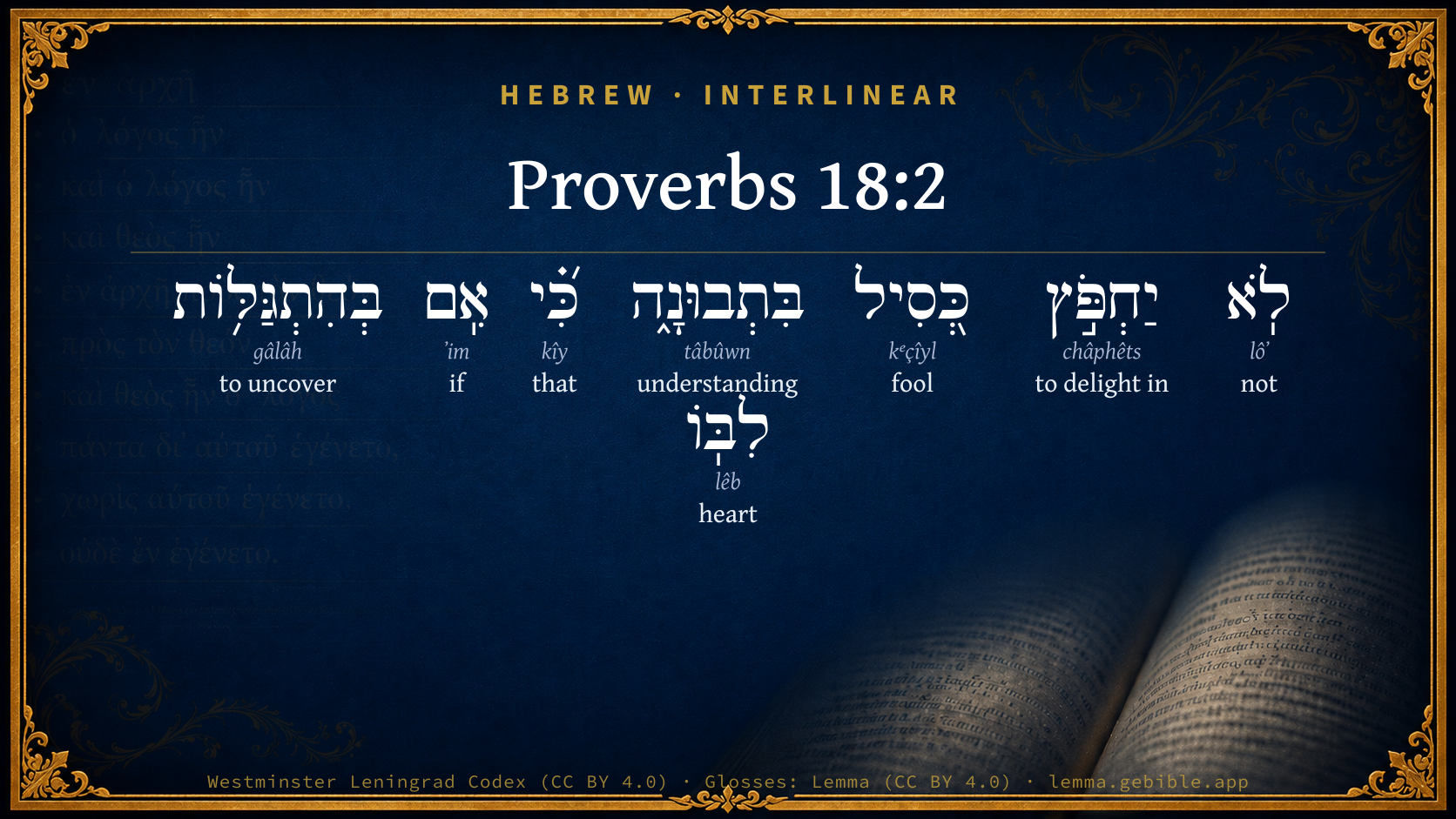
Hebrew (Westminster Leningrad Codex) Proverbs 18:2 appears in the Hebrew Old Testament. The text above is from the Westminster Leningrad Codex. Each word links to its Strong’s number, a concise gloss, and parsing drawn from the Open Scriptures Hebrew Bible morphology. Click any word for its full Brown-Driver-Briggs (BDB) entry.
Download image
Cite this verse

Proverbs 18:2 (World English Bible). Public Domain. Lemma interlinear Bible study tool, https://lemma.gebible.app/v/proverbs/18/2.

Show BibTeX & RIS
BibTeX
RIS
English Translation
A fool has no delight in understanding, But only in revealing his own opinion.
World English Bible · Public Domain
Download a study sheet

One document with this verse’s original text, its word-by-word gloss line, the meaning frame, cross-references with their text, attributed commentary, and full source and license credits — printable, and it pastes into notes with its structure intact.

This verse Autodidact and up

Study sheet (.html) Plain text (.txt)

A passage Seminary Student

Up to 50 verses in one chapter. A passage sheet keeps up to 6 commentary sources and 12 cross-references per verse, in the order this page ranks them, and says so on the sheet whenever that leaves anything out. Ask for a single verse and you get the Autodidact verse sheet above.

Everything on this page stays free to read, with no account — the sheet is a download of what is already on screen, not access to it.

Want to remove ads? Support Godless Engineer
Compare translations 3

The same verse in 3 English versions, stacked beneath the original-language interlinear above. Click any original word for its lexicon entry.

Each is an independent rendering of the whole verse — the interlinear is not word-aligned to these translations.

Highlighted words mark where these versions differ — a whole-verse word diff, not a word-by-word alignment.

  • World English Bible Public Domain
    A fool has no delight in understanding, But only in revealing his own opinion.
  • King James Version Public Domain
    A fool hath no delight in understanding, but that his heart may discover itself.
  • unfoldingWord Literal Text CC BY-SA 4.0
    A stupid one does not delight in understanding but rather in his heart revealing itself.

unfoldingWord Literal Text — © unfoldingWord, licensed CC BY-SA 4.0. Word-aligned USFM3 via Door43 (git.door43.org/unfoldingWord/en_ult).

Versions to compare (up to 4)

3 of 4 selected

Show all 18 translations

Every available English version of this verse, each an independent rendering of the whole verse.

  • World English Bible Public Domain
    A fool has no delight in understanding, But only in revealing his own opinion.
  • Berean Standard Bible Public Domain
    A fool does not delight in understanding, but only in airing his opinions.
  • Majority Standard Bible Public Domain
    A fool does not delight in understanding, but only in airing his opinions.
  • King James Version Public Domain
    A fool hath no delight in understanding, but that his heart may discover itself.
  • American Standard Version (1901) Public Domain
    A fool hath no delight in understanding, But only that his heart may reveal itself.
  • Revised Version (1885) Public Domain
    A fool hath no delight in understanding, but only that his heart may reveal itself.
  • Geneva Bible (1599) Public Domain
    A foole hath no delite in vnderstanding: but that his heart may be discouered.
  • Douay-Rheims (1899) Public Domain
    A fool receiveth not the words of prudence: unless thou say those things which are in his heart.
  • Young's Literal Translation Public Domain
    A fool delighteth not in understanding, But -- in uncovering his heart.
  • Literal Standard Version CC BY-SA 4.0
    A fool does not delight in understanding, || But in uncovering his heart.
  • Unlocked Literal Bible CC BY-SA 4.0
    A fool finds no pleasure in understanding, but only in revealing what is in his own heart.
  • unfoldingWord Literal Text CC BY-SA 4.0
    A stupid one does not delight in understanding but rather in his heart revealing itself.
  • Darby Bible Public Domain
    A fool hath no delight in understanding, but only that his heart may reveal itself.
  • World Messianic Bible Public Domain
    A fool has no delight in understanding, but only in revealing his own opinion.
  • Webster's Bible Public Domain
    A fool hath no delight in understanding, but that his heart may reveal itself.
  • Free Bible Version CC BY-SA 4.0
    Stupid people have no interest in trying to understand, they only want to express their opinions.
  • Bible in Basic English Public Domain
    A foolish man has no pleasure in good sense, but only to let what is in his heart come to light.
  • JPS Tanakh (1917) Public Domain
    A fool hath no delight in understanding, but only that his heart may lay itself bare.

Literal Standard Version (2020), Covenant Press — licensed CC BY-SA 4.0. Text via the HelloAO Bible API (eBible.org). Unlocked Literal Bible (unfoldingWord) — licensed CC BY-SA 4.0. Text via the HelloAO Bible API (eBible.org). unfoldingWord Literal Text — © unfoldingWord, licensed CC BY-SA 4.0. Word-aligned USFM3 via Door43 (git.door43.org/unfoldingWord/en_ult). Free Bible Version, Dr. Jonathan Gallagher — licensed CC BY-SA 4.0. Text via the HelloAO Bible API (eBible.org).

Word by word

More ways to search: Search by grammar → Find every occurrence → Compare this word →

Practice this passage: Drill this verse → Learn its vocabulary →

About this verse

These counts appear in no published source. They are computed here, from the morphology-tagged text and Lemma’s own curated glosses. What Lemma adds →

8
words
8
distinct lemmas
Wisdom
section

Shared distinctive vocabulary

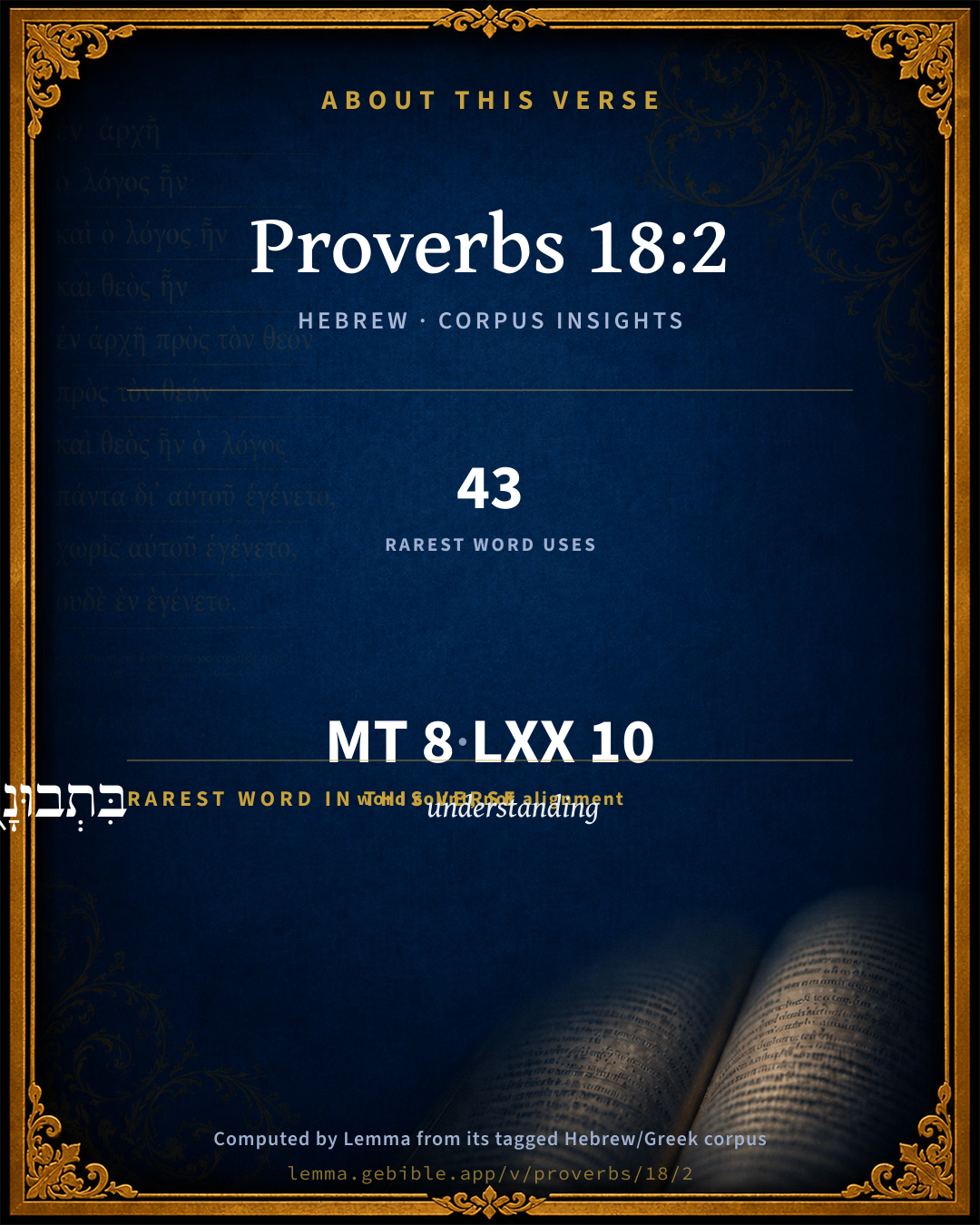
בִּתְבוּנָ֑ה understanding H8394 occurs in 42 verses of the Hebrew Bible. Also found in:

Grammatical profile

  • 2 verbs
  • 2 nouns
  • 1 adjective
  • 2 conjunctions
  • 1 particle

Verb forms

  • יַחְפֹּ֣ץ Qal · Imperfect
  • בְּהִתְגַּלּ֥וֹת Hithpael · Infinitive Construct

Hebrew & Septuagint length

In English translation the verse runs 14 words from the Hebrew and 15 from the Septuagint (LXX English) — closely comparable.

A rough comparison of the two English renderings, which tokenize alike — not a word-level alignment.

Word counts can differ between the Hebrew and the Greek without any difference in meaning — e.g. the Hebrew direct-object marker אֵת has no separate Greek word, and Greek often adds the article ὁ.

In the original languages it is 8 Hebrew tokens and 10 Greek tokens — but the two are counted differently (Hebrew bundles its prefixes and suffixes into one token; the Greek is in lemma form), so that isn’t a like-for-like length.

Cross-references

13

Topical passages linked to Proverbs 18:2 in the Treasury of Scripture Knowledge — connected by theme and wording, ordered by reader-vote popularity; previews shown in the World English Bible.

  • Proverbs 1:7 The fear of Yahweh is the beginning of knowledge; But the foolish despise wisdom and instruction.
  • Proverbs 12:23 A prudent man keeps his knowledge, But the hearts of fools proclaim foolishness.
  • Psalms 1:1–2 Blessed is the man who doesn't walk in the counsel of the wicked, Nor stand in the way of sinners, Nor sit in the seat of scoffers;
  • Proverbs 17:16 Why is there money in the hand of a fool to buy wisdom, Seeing he has no understanding?
  • Proverbs 13:16 Every prudent man acts from knowledge, But a fool exposes folly.
  • Ecclesiastes 10:3 Yes also, when the fool walks by the way, his understanding fails him, and he says to everyone that he is a fool.
  • 1 Corinthians 8:1 Now concerning things sacrificed to idols: We know that we all have knowledge. Knowledge puffs up, but love builds up.
  • Proverbs 1:22 "How long, you simple ones, will you love simplicity? How long will mockers delight themselves in mockery, And fools hate knowledge?
  • Matthew 8:34 Behold, all the city came out to meet Jesus. When they saw him, they begged that he would depart from their borders.
  • 1 Corinthians 14:12 So also you, since you are zealous for spiritual gifts, seek that you may abound to the building up of the assembly.
  • Philippians 1:15 Some indeed preach Christ even out of envy and strife, and some also out of good will.
  • 2 Peter 2:15–19 forsaking the right way, they went astray, having followed the way of Balaam the son of Beor, who loved the wages of wrong-doing;
  • Numbers 24:15–16 He took up his parable, and said, Balaam the son of Beor says, The man whose eye was closed says;

Cross-references courtesy of OpenBible.info (CC BY 4.0).

Hebrew and Greek witnesses Masoretic Hebrew ↔ Greek Septuagint

The same verse in the two great witnesses to the Old Testament, shown verse-for-verse.

These are two independent witnesses, not word-aligned to each other, and the Septuagint is shown in lemma (dictionary) form.

Hebrew Proverbs 18:2 Masoretic · Westminster Leningrad Codex

לֹֽא יַחְפֹּ֣ץ כְּ֭סִיל בִּתְבוּנָ֑ה כִּ֝֗י אִֽם בְּהִתְגַּלּ֥וֹת לִבּֽוֹ

A fool has no delight in understanding, But only in revealing his own opinion.

World English Bible · Public Domain

Greek LXX Proverbs 18:2 Septuagint · lemma form

οὐ χρεία ἔχω σοφία ἐνδεής φρήν μᾶλλον γάρ ἄγω ἀφροσύνη

A senseless man feels no need of wisdom, for he is rather led by folly.

LXX2012 (modern English Septuagint) · Public Domain

On this verse, The Pulpit Commentary discusses the Septuagint’s reading. Read the note in Commentary ↓

Hebrew: Westminster Leningrad Codex (CC BY 4.0). Greek: Septuagint (public domain); English from LXX2012 (modern English Septuagint) (Public Domain). How the Septuagint differs from the Hebrew →

Commentary

Notes on Proverbs 18:2 from classic Christian and Jewish commentators (each source and its license shown beneath its notes). The classic Christian expositions comment on the surrounding passage and are grouped to its opening verse, so a note may address several verses; the Jewish commentaries on the Tanakh (Rashi and others) are per-verse, so they appear only where the commentator wrote on this verse.

Lemma curates 59 commentaries, every one of them public domain or Creative Commons licensed, each selected and text-cleaned for this edition rather than reprinted as found. About our sources →

Trapp's Complete Commentary

John Trapp

Pro 18:2 A fool hath no delight in understanding, but that his heart may discover itself.

Ver. 2. A fool hath no delight in understanding, but that his heart may discover itself.] Or, In discovering his own heart - i.e., in following his own humour, against all that can be said to the contrary. He is wilful, and so stands as a stake in the midst of a stream; lets all pass by him, but he stands where he was. It is easier to deal with twenty men’s reasons, than with one man’s will. He hath made his conclusion, you may as soon remove a rock as him. Quicquid vult valde vult, quicquid vult sanctum est. His will is his rule, and when a man hath said and done his utmost to convince him by force of reason, he shall find him like a mill horse, just there in the evening where he began his morning circuit. Some think that Solomon here taxeth, not so much the wilfulness, as the vain gloriousness and ostentation of fond fools, who seem to delight in wisdom; but it is only for a name, and that they may, by setting their good parts a-sunning, gain the applause and admiration of the world, for men singularly qualified. But why should any affect the vain praises of men, and not rest content with the euge of a good conscience? The blessed Virgin was troubled, when truly praised of an angel. Moses had more glory by his veil than by his face. Christ, beside the veil of his humanity, says, "See you tell no man," &c.

John Trapp, A Commentary or Exposition upon All the Books of the Old and New Testament (1647–1656) — public domain. Text from a community e-Sword module.

Geneva Bible (1599)

Geneva Bible translators

That is, that he may talk licentiously of whatsoever cometh to mind.

Geneva Bible (1599) marginal notes — public domain. Text via Bolls.life.

Matthew Henry's Commentary

A fool may pretend to understanding, and to seek and intermeddle with the means of it, but, 1. He has no true delight in it; it is only to please his friends or save his credit; he does not love his book, nor his business, nor his Bible, nor his prayers; he would rather be playing the fool with his sports. Those who take no pleasure in learning or religion will make nothing to purpose of either. No progress is made in them if they are a task and a drudgery. 2. He has no good design in it, only that his heart may discover itself, that he may have something to make a show with, something wherewith to varnish his folly, that that may pass off the better, because he loves to hear himself talk.

Matthew Henry's Commentary on the Whole Bible (1708–1710) — public domain (CC PDM 1.0). Text via the HelloAO Bible API.

Jamieson, Fausset & Brown

Robert Jamieson, A. R. Fausset & David Brown

that his heart . . . itself--that is, takes pleasure in revealing his folly (Pro 12:23; Pro 15:2).

Jamieson, Fausset & Brown — Commentary Critical and Explanatory on the Whole Bible (1871) — public domain (CC PDM 1.0). Text via the HelloAO Bible API.

Adam Clarke's Commentary

Verse 2. But that his heart may discover itself.] It is a fact that most vain and foolish people are never satisfied in company, but in showing their own nonsense and emptiness. But this verse may be understood as confirming the view already given of the preceding, and may be translated thus: "But a fool doth not delight in understanding, though it should even manifest itself:" so I understand כי אם בהתגלות ki im behithgalloth. The separated person seeks understanding in every hidden thing, and feels his toil well repaid when he finds it, even after the most painful and expensive search: the other regards it not, though its secret springs should be laid open to him without toil or expense.

Adam Clarke's Commentary on the Bible (1810–1826) — public domain. Text from a community e-Sword/MySword module.

Ellicott's Commentary for English Readers

(2) But that his heart may discover itself—i.e., unless his cleverness can be displayed thereby; he does not prize understanding for itself, apart from his own interests.

A Bible Commentary for English Readers, edited by Charles John Ellicott (1878–1897) — public domain. Text from a community e-Sword module.

The Cambridge Bible for Schools and Colleges

gen. ed. J. J. S. Perowne

2. but that] The added word in R.V., but only that, brings out the force of the Heb.; q.d. so far from having any delight in understanding, his only delight is in blurting out his own ideas and opinions. There is perhaps, as Speaker’s Comm. suggests, an implied contrast with the “other form of egotism,” condemned in the preceding verse.

The Cambridge Bible for Schools and Colleges (gen. ed. J. J. S. Perowne; Cambridge University Press, 1878–1918) — public domain. Text from a community e-Sword module.

John Gill's Exposition

A fool hath no delight in understanding,.... In natural understanding, and in the improvement of his mind in it; he delights not in books, nor in the conversation of men of learning and sense: or in spiritual understanding, in the understanding of spiritual things; these are foolishness to a natural man; nor does he delight in reading the Scriptures, nor in hearing the word, and attendance on it in the house of God, but is weary of such exercises;

but that his heart may discover itself; and the folly that is in it: such men only desire to have some knowledge and understanding, to make a show of it, that they may be thought to be wise, and to be capable of talking of things as if they understood them, when it is only to the exposing of themselves and their ignorance; some persons attain to no more learning and knowledge than just to be capable to show that they are fools. Or, "but in the discovery of his heart" (k); he delights in discovering that; not the wisdom, but the folly that is in it.

(k) "sed in patefacere cor ejus", Vatablus; "sed in detectione cordis sui", Piscator; "sed sane ut enudet cor suum", Schultens.

John Gill's Exposition of the Whole Bible (1746–1763) — public domain (CC PDM 1.0). Text via the HelloAO Bible API.

Albert Barnes' Notes on the Bible

Another form of egotism. In “understanding,” i. e., self-knowledge, the “fool” finds no pleasure; but self-assertion, talking about himself and his own opinions, is his highest joy.

Albert Barnes' Notes on the Bible (1834–1885) — public domain. Text from a community e-Sword/MySword module.

Haydock's Catholic Bible Commentary

Heart. Conformable to his passions. (Calmet) --- Hebrew, "unless to lay open his heart." He wishes to appear wise, and to justify his wicked designs. (Haydock)

George Leo Haydock (1774–1849), Haydock's Catholic Family Bible and Commentary, 1859 edition — public domain. Excludes Psalms (Douay-Rheims chapter numbering differs from Protestant) and Deuterocanonical books (Catholic canon only).

Matthew Poole's English Annotations

In understanding; in getting sound and saving knowledge, either by his own study, or by the instructions of wise and good men.

But that his heart may discover itself. Heb. but (his delight is) in the discovery of his own heart, i.e. in uttering that folly and wickedness which is in his heart; being more forward to speak than to hear, which is one badge of a fool.

Matthew Poole's English Annotations on the Holy Bible (1683–1685) — public domain. Text from a community e-Sword/MySword module.

Whedon's Commentary on the Bible

Daniel D. Whedon

2. May discover itself — בהתגלות, (behithgalloth,) he will take pleasure in uncovering his heart; his chief pleasure is to hear himself talk, in doing which he discloses his folly. Of course it is not his “desire” to make his folly apparent, but such is the result of his conduct. In Pro_20:19, the same word is rendered revealeth. Compare Pro_12:23; Pro_13:16; Pro_15:2.

Daniel D. Whedon (gen. ed.), Commentary on the Old and New Testaments (1874–1909) — public domain. Text from a community e-Sword module.

The Pulpit Commentary

A fool hath no delight in understanding. This may mean that he takes no pleasure in the wisdom of others, is self-opinionated; or, it may be, does not care for understanding in itself, apart from the use which he can make of it. Vulgate, "The fool receives not the words of wisdom;" Septuagint, "A man of no sense has no need of wisdom." To try to teach a fool is to cast pearls before swine, and to give that which is holy unto dogs. But that his heart may discover itself; i.e. his only delight is in revealing his heart, displaying his un-wisdom and his foolish thoughts, as in Pro_12:28 Pro_13:16 Pro_15:2. He thinks that thus he is showing himself superior to others, and benefiting the world at large. The LXX gives the reason, "For rather by folly he is led.

HOMILIES BY W. CLARKSON Ver. 2. See homily on Pro_17:16, Pro_17:24. C.

The Pulpit Commentary (1880–1919), ed. H.D.M. Spence-Jones & Joseph S. Exell — public domain. Text from a community e-Sword module.

John Wesley's Explanatory Notes

Understanding - In getting sound and saving, knowledge. The discovery - In uttering that folly and wickedness which is in his heart.

John Wesley, Explanatory Notes Upon the Whole Bible (1754–1765) — public domain. Text via the GEBible commentary corpus.

Keil & Delitzsch

C. F. Keil & F. Delitzsch

2 The fool hath no delight in understanding;

But only that his heart may reveal itself therein.

The verb חפץ forms the fut. יחפּץ as well as יחפּץ; first the latter from חפץ, with the primary meaning, to bow, to bend down; then both forms as intransitive, to bend oneself to something, to be inclined to something, Arab. 'ṭf. (Fl.). תּבוּנה is here the intelligence which consists in the understanding of one's own deficiency, and of that which is necessary to meet it. The inclination of the fool goes not out after such intelligence, but (כּי אם־; according to Ben-Naphtali, כי־אם) only that his heart, i.e., the understanding which he thinks that he already possesses, may reveal itself, show itself publicly. He thinks thereby to show himself in his true greatness, and to render a weighty service to the world. This loquacity of the fool, proceeding from self-satisfaction, without self-knowledge, has already, Pro 12:23, and often, been reprimanded.

Keil & Delitzsch — Biblical Commentary on the Old Testament (1861–1891) — public domain (CC PDM 1.0). Text via the HelloAO Bible API. (Old Testament only.)

Kretzmann's Popular Commentary

Paul E. Kretzmann

v. 2. A fool hath no delight in understanding, his pleasure not being set that way, but that his heart may discover itself, display the wisdom which he imagines to be there, for he believes it to be his duty to let the world know his greatness in this respect.

Paul E. Kretzmann, Popular Commentary of the Bible (1921–1924) — public domain. Text from a community e-Sword module.

Rashi

Rabbi Shlomo Yitzchaki (Rashi)

but in revealing his heart But in the revelation of his heart. He wishes to reveal what is in his heart.

Rashi on the Tanakh — English translations: “The Judaica Press complete Tanach with Rashi, translated by A. J. Rosenberg” (CC BY 4.0); “Pentateuch with Rashi's commentary by M. Rosenbaum and A.M. Silbermann, 1929-1934” (public domain); “The Metsudah Tanach series, Lakewood, N.J” (CC BY 4.0); and “The Book of Joshua, Metsudah Publications, 1997” (CC BY 4.0). Text via Sefaria.

Lesson kit

Teaching starters — assembled from the data on this page, not authored interpretation. Every prompt links to the verse data it draws on. Edit before teaching.

Proverbs, in the Wisdom, opens this verse with 8 words (8 distinct Hebrew lemmas). Its most distinctive word is tâbûwn (“understanding”). A historical commentator’s framing appears above. Read the whole chapter for the surrounding context.

Discussion questions

  1. The word tâbûwn carries the sense “understanding.” How does it shape the verse?
  2. Exodus 31:3 shares the word «understanding» with this verse. How do the two illuminate each other?
  3. These translations render this verse differently; the difference is in the English rendering, not the original. What questions does that raise?
  4. The verb «יַחְפֹּ֣ץ» is Qal Imperfect. How does its form color the action?
  5. Reading how Trapp's Complete Commentary and Geneva Bible (1599) read this verse, where do the two commentators agree and where do they part?

Things to notice

Reading settings

Reading text

Shown beneath each verse's original-language words.

Old Testament
Old Testament edition

Read the OT as the Masoretic Hebrew (MT) or the Greek Septuagint (LXX).

English shown for the Greek Septuagint (in the Hebrew ↔ Greek comparison).

Comparing translations? Open the Compare panel on any verse page to stack up to four side by side.