Psalms 55:3

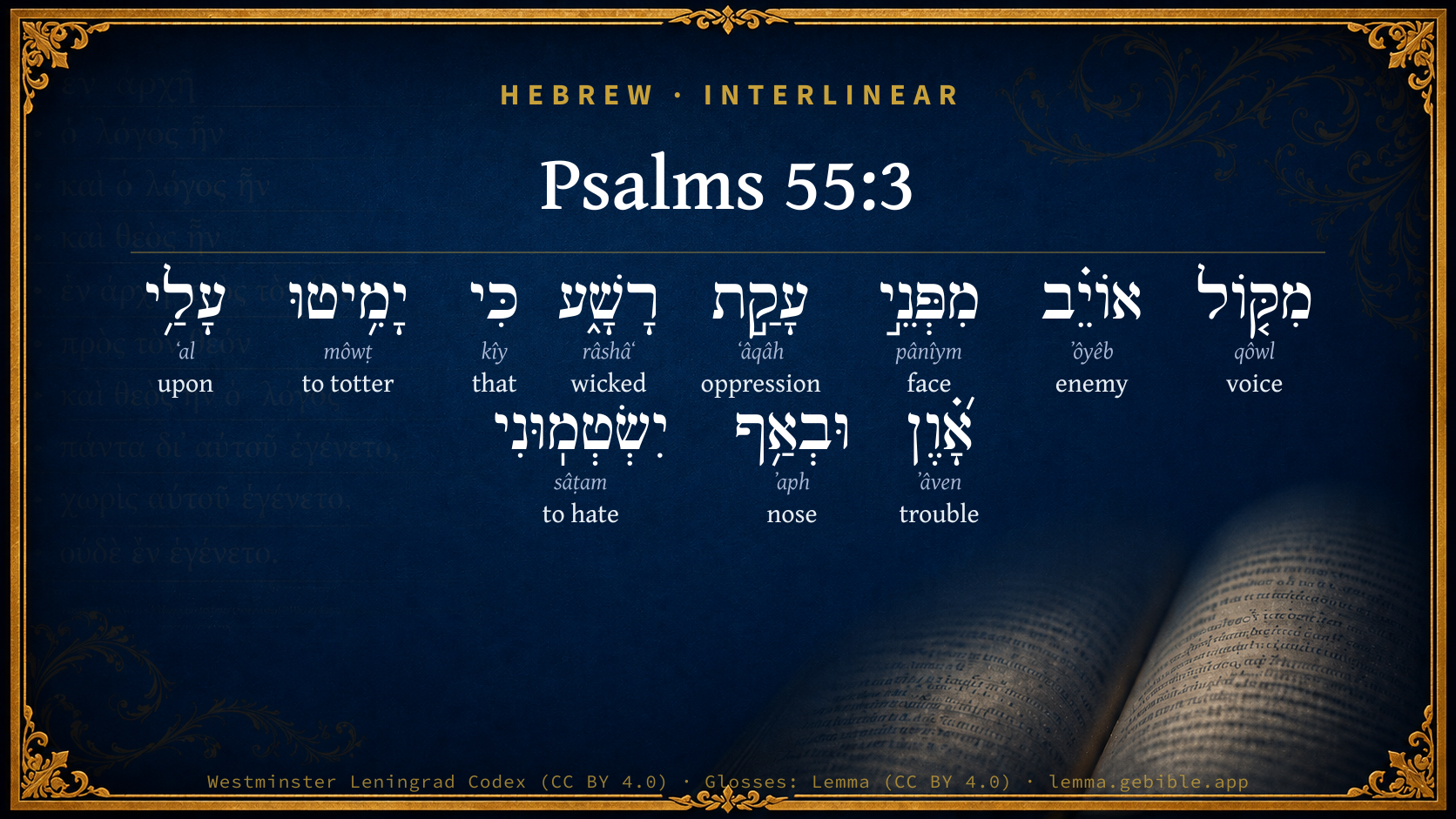
Hebrew (Westminster Leningrad Codex) Psalms 55:3 appears in the Hebrew Old Testament. The text above is from the Westminster Leningrad Codex. Each word links to its Strong’s number, a concise gloss, and parsing drawn from the Open Scriptures Hebrew Bible morphology. Click any word for its full Brown-Driver-Briggs (BDB) entry.
Download image
Cite this verse

Psalms 55:3 (World English Bible). Public Domain. Lemma interlinear Bible study tool, https://lemma.gebible.app/v/psalms/55/3.

Show BibTeX & RIS
BibTeX
RIS
English Translation
Because of the voice of the enemy, Because of the oppression of the wicked. For they bring suffering on me. In anger they hold a grudge against me.
World English Bible · Public Domain
Highlights
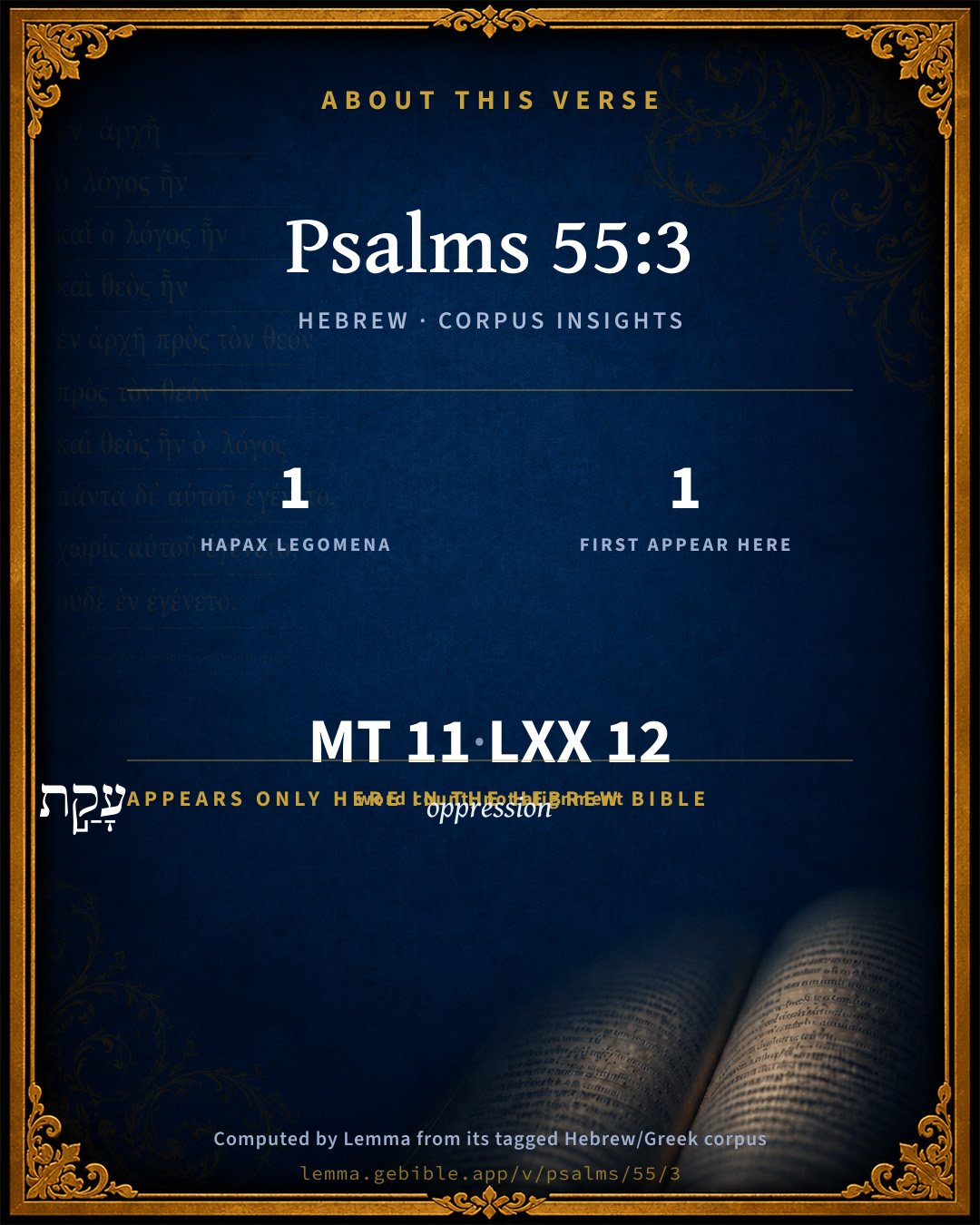
  • 1 hapax legomenon — only here in the Hebrew Bible
  • 1 first appearance in the Hebrew Bible
Full analysis ↓
Download a study sheet

One document with this verse’s original text, its word-by-word gloss line, the meaning frame, cross-references with their text, attributed commentary, and full source and license credits — printable, and it pastes into notes with its structure intact.

This verse Autodidact and up

Study sheet (.html) Plain text (.txt)

A passage Seminary Student

Up to 50 verses in one chapter. A passage sheet keeps up to 6 commentary sources and 12 cross-references per verse, in the order this page ranks them, and says so on the sheet whenever that leaves anything out. Ask for a single verse and you get the Autodidact verse sheet above.

Everything on this page stays free to read, with no account — the sheet is a download of what is already on screen, not access to it.

Want to remove ads? Support Godless Engineer
Compare translations 3

The same verse in 3 English versions, stacked beneath the original-language interlinear above. Click any original word for its lexicon entry.

Each is an independent rendering of the whole verse — the interlinear is not word-aligned to these translations.

Highlighted words mark where these versions differ — a whole-verse word diff, not a word-by-word alignment.

  • World English Bible Public Domain
    Because of the voice of the enemy, Because of the oppression of the wicked. For they bring suffering on me. In anger they hold a grudge against me.
  • King James Version Public Domain
    Because of the voice of the enemy, because of the oppression of the wicked: for they cast iniquity upon me, and in wrath they hate me.
  • unfoldingWord Literal Text CC BY-SA 4.0
    from the voice of the enemy, from the face of the oppression of the wicked. For they shake trouble onto me, and in nose they persecute me.

unfoldingWord Literal Text — © unfoldingWord, licensed CC BY-SA 4.0. Word-aligned USFM3 via Door43 (git.door43.org/unfoldingWord/en_ult).

Versions to compare (up to 4)

3 of 4 selected

Show all 17 translations

Every available English version of this verse, each an independent rendering of the whole verse.

  • World English Bible Public Domain
    Because of the voice of the enemy, Because of the oppression of the wicked. For they bring suffering on me. In anger they hold a grudge against me.
  • Berean Standard Bible Public Domain
    at the voice of the enemy, at the pressure of the wicked. For they release disaster upon me and revile me in their anger.
  • Majority Standard Bible Public Domain
    at the voice of the enemy, at the pressure of the wicked. For they bring down disaster upon me and resent me in their anger.
  • King James Version Public Domain
    Because of the voice of the enemy, because of the oppression of the wicked: for they cast iniquity upon me, and in wrath they hate me.
  • American Standard Version (1901) Public Domain
    Because of the voice of the enemy, Because of the oppression of the wicked; For they cast iniquity upon me, And in anger they persecute me.
  • Revised Version (1885) Public Domain
    Because of the voice of the enemy, because of the oppression of the wicked; for they cast iniquity upon me, and in anger they persecute me.
  • Geneva Bible (1599) Public Domain
    For the voyce of the enemie, and for the vexation of ye wicked, because they haue brought iniquitie vpon me, and furiously hate me.
  • Young's Literal Translation Public Domain
    Because of the voice of an enemy, Because of the oppression of the wicked, For they cause sorrow to move against me, And in anger they hate me.
  • Literal Standard Version CC BY-SA 4.0
    Because of the voice of an enemy, || Because of the oppression of the wicked, || For they cause sorrow to move against me, || And in anger they hate me.
  • Unlocked Literal Bible CC BY-SA 4.0
    because of the voice of my enemies, because of the oppression of the wicked; for they bring trouble on me and persecute me in anger.
  • unfoldingWord Literal Text CC BY-SA 4.0
    from the voice of the enemy, from the face of the oppression of the wicked. For they shake trouble onto me, and in nose they persecute me.
  • Darby Bible Public Domain
    Because of the voice of the enemy; because of the oppression of the wicked: for they cast iniquity upon me, and in anger they persecute me.
  • World Messianic Bible Public Domain
    because of the voice of the enemy, because of the oppression of the wicked. For they bring suffering on me. In anger they hold a grudge against me.
  • Webster's Bible Public Domain
    \\55:2\\Attend to me, and hear me: I mourn in my complaint, and make a noise;
  • Free Bible Version CC BY-SA 4.0
    For my enemies are screaming at me; the wicked are intimidating me. They rain down suffering on me, angrily assaulting me in their hatred.
  • Bible in Basic English Public Domain
    I am troubled because of the voice of the cruel ones, because of the loud cry of the evil-doers; for they put a weight of evil on me, and they are cruel in their hate for me.
  • JPS Tanakh (1917) Public Domain
    (55-4) Because of the voice of the enemy, because of the oppression of the wicked; for they cast mischief upon me, and in anger they persecute me.

Literal Standard Version (2020), Covenant Press — licensed CC BY-SA 4.0. Text via the HelloAO Bible API (eBible.org). Unlocked Literal Bible (unfoldingWord) — licensed CC BY-SA 4.0. Text via the HelloAO Bible API (eBible.org). unfoldingWord Literal Text — © unfoldingWord, licensed CC BY-SA 4.0. Word-aligned USFM3 via Door43 (git.door43.org/unfoldingWord/en_ult). Free Bible Version, Dr. Jonathan Gallagher — licensed CC BY-SA 4.0. Text via the HelloAO Bible API (eBible.org).

Word by word

More ways to search: Search by grammar → Find every occurrence → Compare this word →

Practice this passage: Drill this verse → Learn its vocabulary →

עָקַ֣ת
ʻâqâh
H6125
“oppression of”
Noun, Common, Feminine, Singular, Construct
Part of Speech
Noun
Type
Common
Gender
Feminine
Number
Singular
State
Construct
Full BDB Definition

Origin: from H5781

TWOT: 1585a

oppression, pressure
  1. מִקּ֤וֹל qôwl H6963 “from · voice of” Preposition + Noun, Common, Masculine, Singular, Construct
  2. אוֹיֵ֗ב ʼôyêb H341 “enemy” Verb, Qal, Participle Active, Masculine, Singular, Absolute
  3. מִפְּנֵ֣י pânîym H6440 “from · face(s) of” Preposition + Noun, Common, Both, Plural, Construct
  4. רָשָׁ֑ע râshâʻ H7563 “wicked” Adjective, Adjective, Masculine, Singular, Absolute
  5. כִּי kîy H3588 “that” Conjunction
  6. יָמִ֥יטוּ môwṭ H4131 “to totter” Verb, Hiphil, Imperfect, 3rd Person, Masculine, Plural
  7. עָלַ֥י ʻal H5921 “upon · me” Preposition + Suffix, Personal, 1st Person, Common, Singular
  8. אָ֝֗וֶן ʼâven H205 “trouble” Noun, Common, Masculine, Singular, Absolute
  9. וּבְאַ֥ף ʼaph H639 “and · in/at · nose” Conjunction + Preposition + Noun, Common, Masculine, Singular, Absolute
  10. יִשְׂטְמֽוּנִי sâṭam H7852 “to hate · me” Verb, Qal, Imperfect, 3rd Person, Masculine, Plural + Suffix, Personal, 1st Person, Common, Singular

About this verse

These counts appear in no published source. They are computed here, from the morphology-tagged text and Lemma’s own curated glosses. What Lemma adds →

11
words
11
distinct lemmas
Wisdom
section

Notable vocabulary

1 hapax legomenon — a word that appears only here in the entire Hebrew Bible:

  • עָקַ֣ת oppression H6125

First appearance in Scripture

This word makes its first canonical appearance in the Hebrew Bible here:

  • עָקַ֣ת oppression H6125

Shared distinctive vocabulary

יִשְׂטְמֽוּנִי to hate H7852 occurs in 6 verses of the Hebrew Bible. Also found in:

Grammatical profile

  • 3 verbs
  • 5 nouns
  • 1 adjective
  • 1 preposition
  • 1 conjunction

Verb forms

  • אוֹיֵ֗ב Qal · Participle Active
  • יָמִ֥יטוּ Hiphil · Imperfect
  • יִשְׂטְמֽוּנִי Qal · Imperfect

Hebrew & Septuagint length

In English translation the verse runs 28 words from the Hebrew and 27 from the Septuagint (LXX English) — closely comparable.

A rough comparison of the two English renderings, which tokenize alike — not a word-level alignment.

Word counts can differ between the Hebrew and the Greek without any difference in meaning — e.g. the Hebrew direct-object marker אֵת has no separate Greek word, and Greek often adds the article ὁ.

In the original languages it is 11 Hebrew tokens and 12 Greek tokens — but the two are counted differently (Hebrew bundles its prefixes and suffixes into one token; the Greek is in lemma form), so that isn’t a like-for-like length.

Cross-references

12

Topical passages linked to Psalms 55:3 in the Treasury of Scripture Knowledge — connected by theme and wording, ordered by reader-vote popularity; previews shown in the World English Bible.

  • 2 Samuel 16:7–8 Thus said Shimei when he cursed, Be gone, be gone, you man of blood, and base fellow:
  • Psalms 35:11 Unrighteous witnesses rise up. They ask me about things that I don't know about.
  • Psalms 27:12 Don't deliver me over to the desire of my adversaries, For false witnesses have risen up against me, Such as breathe out cruelty.
  • 2 Samuel 15:3 Absalom said to him, Behold, your matters are good and right; but there is no man deputized of the king to hear you.
  • 2 Samuel 19:19 He said to the king, Don't let my lord impute iniquity to me, neither do you remember that which your servant did perversely the day that my lord the king went out of Jerusalem, that the king should take it to his heart.
  • Psalms 12:5 "Because of the oppression of the weak and because of the groaning of the needy, I will now arise," says Yahweh; "I will set him in safety from those who malign him."
  • Psalms 17:9 From the wicked who oppress me, My deadly enemies, who surround me.
  • Psalms 54:3 For strangers have risen up against me. Violent men have sought after my soul. They haven't set God before them. Selah.
  • Psalms 71:11 Saying, "God has forsaken him. Pursue and take him, for no one will rescue him."
  • Psalms 73:8 They scoff and speak with malice. In arrogance, they threaten oppression.
  • Lamentations 3:34–36 To crush under foot all the prisoners of the earth,
  • Matthew 26:59 Now the chief priests, the elders, and the whole council sought false testimony against Jesus, that they might put him to death;

Cross-references courtesy of OpenBible.info (CC BY 4.0).

Hebrew and Greek witnesses Masoretic Hebrew ↔ Greek Septuagint

The same verse in the two great witnesses to the Old Testament, shown verse-for-verse.

You’re reading Greek Psalm 54 (Hebrew Psalm 55). The Septuagint counts the superscription, so verse numbers can differ from the Hebrew — chapter-level alignment, not verse-by-verse. Numbering follows Rahlfs.

These are two independent witnesses, not word-aligned to each other, and the Septuagint is shown in lemma (dictionary) form.

Hebrew Psalms 55:3 Masoretic · Westminster Leningrad Codex

מִקּ֤וֹל אוֹיֵ֗ב מִפְּנֵ֣י עָקַ֣ת רָשָׁ֑ע כִּי יָמִ֥יטוּ עָלַ֥י אָ֝֗וֶן וּבְאַ֥ף יִשְׂטְמֽוּנִי

Because of the voice of the enemy, Because of the oppression of the wicked. For they bring suffering on me. In anger they hold a grudge against me.

World English Bible · Public Domain

Greek LXX Greek Psalm 54:3 Septuagint · lemma form

προςἔχω ἐγώ καί εἰςἀκούω ἐγώ λυπέω ἐν ὁ ἀδολεσχία ἐγώ καί ταράσσω

because of the voice of the enemy, and because of the oppression of the sinner: for they brought iniquity against me, and were wrathfully angry with me.

LXX2012 (modern English Septuagint) · Public Domain

Hebrew: Westminster Leningrad Codex (CC BY 4.0). Greek: Septuagint (public domain); English from LXX2012 (modern English Septuagint) (Public Domain). How the Septuagint differs from the Hebrew →

Commentary

Notes on Psalms 55:3 from classic Christian and Jewish commentators (each source and its license shown beneath its notes). The classic Christian expositions comment on the surrounding passage and are grouped to its opening verse, so a note may address several verses; the Jewish commentaries on the Tanakh (Rashi and others) are per-verse, so they appear only where the commentator wrote on this verse.

Lemma curates 59 commentaries, every one of them public domain or Creative Commons licensed, each selected and text-cleaned for this edition rather than reprinted as found. About our sources →

Trapp's Complete Commentary

John Trapp

Psa 55:3 Because of the voice of the enemy, because of the oppression of the wicked: for they cast iniquity upon me, and in wrath they hate me.

Ver. 3. Because of the voice of the enemy] He may very well intend Shimei’s bitter revilings, 2Sa 16:5, &c.

For they cast iniquity upon me] They tumble it on me, as men do stones or anything else upon their besiegers, to endamage them; so did these, sin, shame, anything, upon innocent David, to make him odious.

And in wrath they hate me] Heb. they Satanically hate me.

John Trapp, A Commentary or Exposition upon All the Books of the Old and New Testament (1647–1656) — public domain. Text from a community e-Sword module.

J. A. Alexander on Psalms

Joseph Addison Alexander

4. (Psa 55:3). From the voice of the enemy, from before the persecution of the wicked; for they will shake over me iniquity, and in wrath will oppose me. He now declares from what his distress arises. The preposition, in Hebrew as in English, has a causal meaning, or at lest suggests a relation of cause and effect. From the voice, i.e. because of it. From before or from the face conveys the same idea still more strongly, by a kind of personification of the evil dreaded. Persecution of the wicked: compare the oppression of the enemy, in Psa 42:9. Shake over me, or cause to slide upon me, a striking figure for the wilful infliction of evil on another. Iniquity may here be put, as it sometimes is, for active wickedness towards others, the cause of suffering rather than suffering itself. With this clause compare Psa 41:8. Oppose me, be my adversaries, whether in the way of resistance or assault. The Hebrew verb is a cognate form to that from which comes Satan or the Adversary.

Joseph Addison Alexander, The Psalms Translated and Explained (1850) — public domain. Text from a community e-Sword module.

Geneva Bible (1599)

Geneva Bible translators

For the threatnings of Saul and his adherents.

They have defamed me as a wicked person, or they have imagined my destruction.

Geneva Bible (1599) marginal notes — public domain. Text via Bolls.life.

Jamieson, Fausset & Brown

Robert Jamieson, A. R. Fausset & David Brown

oppression--literally, "persecution."

they . . . iniquity--literally, "they make evil doings slide upon me."

Jamieson, Fausset & Brown — Commentary Critical and Explanatory on the Whole Bible (1871) — public domain (CC PDM 1.0). Text via the HelloAO Bible API.

Adam Clarke's Commentary

Verse 3. They cast iniquity upon me] To give a colourable pretense to their rebellion, they charge me with horrible crimes; as if they had said: Down with such a wretch; he is not fit to reign. Clamour against the person of the sovereign is always the watch-word of insurrection, in reference to rebellion.

Adam Clarke's Commentary on the Bible (1810–1826) — public domain. Text from a community e-Sword/MySword module.

Ellicott's Commentary for English Readers

(3) Oppressor.—This meaning of a rare word is secured from Amo_2:13.

Cast iniquity.—Better, roll mischief. The figure seems to be drawn from the practice of rolling stones down on an enemy from a height. In Psa_140:10 the same verb is used of rolling burning coals on a foe.

Hate me.—Better, persecute me.

A Bible Commentary for English Readers, edited by Charles John Ellicott (1878–1897) — public domain. Text from a community e-Sword module.

The Cambridge Bible for Schools and Colleges

gen. ed. J. J. S. Perowne

3. the voice of the enemy] Insulting, calumniating, threatening.

oppression] A peculiar word, found here only, meaning that his enemies hem him in or crush him down. Cp. the cognate verb in Amo_2:13.

3 b–5. He describes the nature of the persecution from which he is suffering, and its effect upon his spirits.

3 b. they cast iniquity upon me] Not, they charge me with crimes of which I am innocent: but, they hurl or roll mischief down upon me, a metaphor from the practice of rolling stones down upon an enemy. Cp. Psa_140:10 (of hot coals), and similar phrases in Psa_21:11; 2Sa_15:14.

and in wrath &c.] And in anger are they hostile unto me: (R.V. persecute me).

The Cambridge Bible for Schools and Colleges (gen. ed. J. J. S. Perowne; Cambridge University Press, 1878–1918) — public domain. Text from a community e-Sword module.

John Gill's Exposition

Because of the voice of the enemy,.... Of Absalom, as Arama; or of Ahithophel, who gave out he would smite the king only, Sa2 17:2; and so of any spiritual enemy, as sin, Satan, and the world, when they threaten dominion and tyranny; and of the Scribes and Pharisees reproaching Christ, as being a Samaritan, and having a devil, and doing his miracles by his assistance; menacing, insulting, and triumphing over him, when on the cross;

because of the oppression of the wicked; of Absalom or Ahithophel, as Arama; who conspired against David, and obliged him to quit his palace, and the city of Jerusalem; and is applicable to the troubles which surround the people of God, from every quarter, by wicked men, and to our Lord's being enclosed by them at the time of his Crucifixion, Psa 22:12;

for they cast iniquity upon me; laid things to his charge he knew not: so wicked men falsely accuse the good conversation of the saints; and so the Jews imputed crimes to Christ he was innocent of; as immorality, sedition, blasphemy, &c.

and in wrath they hate me; as they do all the people of God, because chosen and called, and separated from them: and so they did Christ, and with a mortal hatred, though without a cause.

John Gill's Exposition of the Whole Bible (1746–1763) — public domain (CC PDM 1.0). Text via the HelloAO Bible API.

Albert Barnes' Notes on the Bible

Because of the voice of the enemy - He now states the cause of his troubles. He had been, and was, unjustly treated by others. The particular idea in the word “voice” here is, that he was suffering from slanderous reproaches; from assaults which had been made on his character. He was charged with evil conduct, and the charge was made in such a manner that he could not meet it. The result was, that a series of calamities had come upon him which was quite overwhelming.

Because of the oppression of the wicked - The word here rendered “oppression” occurs nowhere else. The verb from which it is derived occurs twice, Amo 2:13 : “Behold, I am “pressed” under you as a cart is “pressed” that is full of sheaves.” The idea is that of crushing by a heavy weight; and hence, of crushing by affliction. The “wicked” alluded to here, if the supposition referred to in the Introduction about the occasion of the psalm is correct, were Absalom and those who were associated with him in the rebellion, particularly Ahithophel, who had showed himself false to David, and had united with his enemies in their purpose to drive him from his throne.

For they cast iniquity upon me - That is, they charge me with sin; they attempt to justify themselves in their treatment of me by accusing me of wrong-doing, or by endeavoring to satisfy themselves that I deserve to be treated in this manner. If this refers to the time of the rebellion of Absalom, the allusion would be to the charges, brought by him against his father, of severity and injustice in his administration, 2Sa 15:2-6.

And in wrath they hate me - In their indignation, in their excitement, they are full of hatred against me. This was manifested by driving him froth his throne and his home.

Albert Barnes' Notes on the Bible (1834–1885) — public domain. Text from a community e-Sword/MySword module.

Matthew Poole's English Annotations

The voice of the enemy, i.e. their clamours, and threats, and slanders, and insolent boastings; all which are hateful to thee, as well as injurious to me.

They cast iniquity upon me: the sense is, either,

1. They make me the great object of their wicked, and injurious, and mischievous practices; or,

2. They lay many crimes to my charge falsely, as if by my wickedness I was the cause of all my calamities.

They hate me; their anger and rage against me is no sudden and transitory passion, but is boiled up into malice and hatred.

Matthew Poole's English Annotations on the Holy Bible (1683–1685) — public domain. Text from a community e-Sword/MySword module.

The Treasury of David

Charles H. Spurgeon

Ver. 3. Because of the voice of the enemy. The enemy was vocal and voluble enough, and found a voice where his godly victim had nothing better than a "noise." Slander is seldom short of expression, it prates and prattles evermore. Neither David, nor our Lord, nor any of the saints were allowed to escape the attacks of venomous tongues, and this evil was in every case the cause of acute anguish.

Because of the oppression of the wicked: the unjust pressed and oppressed the righteous; like an intolerable burden they crushed them down, and brought them to their knees before the Lord. This is a thrice told story, and to the end of time it will be true; he that is born after the flesh will persecute him that is born after the Spirit. The great seed of the woman suffered from a bruised heel.

For they cast iniquity upon me, they black me with their soot bags, throw the dust of their lying over me, cast the vitriol of their calumny over me. They endeavour to trip me up, and if I do not fall they say I do.

And in wrath they hate me. With a hearty ill will they detested the holy man. It was no sleeping animosity, but a moral rancour which reigned in their bosoms. The reader needs not that we show how applicable this is to our Lord.

Ver. 3. Because of the voice of the enemy, there is their railing; because of the oppression of the wicked, there is their violent robbing him of his estate; they cast iniquity upon me, there are their slanderous traducings of him, and charging him with faults falsely; in wrath they hate me, there is their cruel seeking to kill. David Dickson.

Ver. 3. For they cast iniquity upon me. They tumble it on me, as men do stones or anything else upon their besiegers, to endamage them; so did these sin, shame, anything, upon innocent David, to make him odious. John Trapp.

None.

Psalms 55:4*

Charles H. Spurgeon's The Treasury of David (1869–1885) — public domain. Psalms only. Text from a community e-Sword/MySword module.

Whedon's Commentary on the Bible

Daniel D. Whedon

3. They cast iniquity upon me—The figure is borrowed from setting in motion, or casting down from a height, weighty stones, or other instruments of death, upon an enemy, as Psa_140:10. They had hurled iniquity upon him by false accusations, threats, and dark conspiracies. See 2Sa_15:7-8; 2Sa_19:19

Daniel D. Whedon (gen. ed.), Commentary on the Old and New Testaments (1874–1909) — public domain. Text from a community e-Sword module.

The Pulpit Commentary

Because of the voles of the enemy, because of the oppression of the wicked. Professor Cheyne says that by "the wicked" heathen men are primarily intended. But vr the word used is" the wicked man," in the simplest and widest sense. (see Psa_1:1, Psa_1:4, Psa_1:5, 6 7:9 9:16, etc.) For they cast iniquity upon me; or, "hurl wickedness at me" (Cheyne). And in wrath they hats me; rather, they persecute me (Hengstenberg, Kay, Cheyne, Revised Version).

The Pulpit Commentary (1880–1919), ed. H.D.M. Spence-Jones & Joseph S. Exell — public domain. Text from a community e-Sword module.

John Wesley's Explanatory Notes

Voice - Their clamours and threats, and slanders. Cast - They lay many crimes to my charge.

John Wesley, Explanatory Notes Upon the Whole Bible (1754–1765) — public domain. Text via the GEBible commentary corpus.

Rashi

Rabbi Shlomo Yitzchaki (Rashi)

I lament in my speech Heb. אריד, I will lament of my pain, as (Lam. 3:19): “Remember my affliction and my misery (ומרודי).” Also (Jud. 11:37): “and wail (וירדתי) upon the mountains.” Menachem (p. 162) interpreted אריד as an expression of ruling, as (Gen. 1:28): “and rule (ורדו) over the fish of the sea.” שּׂיחי is an expression of speech (Prov. 23:29): “He who talks too much (שיח).”

Rashi on the Tanakh — English translations: “The Judaica Press complete Tanach with Rashi, translated by A. J. Rosenberg” (CC BY 4.0); “Pentateuch with Rashi's commentary by M. Rosenbaum and A.M. Silbermann, 1929-1934” (public domain); “The Metsudah Tanach series, Lakewood, N.J” (CC BY 4.0); and “The Book of Joshua, Metsudah Publications, 1997” (CC BY 4.0). Text via Sefaria.

Lesson kit

Teaching starters — assembled from the data on this page, not authored interpretation. Every prompt links to the verse data it draws on. Edit before teaching.

Psalms, in the Wisdom, opens this verse with 11 words (11 distinct Hebrew lemmas). Its most distinctive word is ʻâqâh (“oppression”). A historical commentator’s framing appears above. Read the whole chapter for the surrounding context.

Discussion questions

  1. What does “oppression” (ʻâqâh) contribute to the verse as a whole?
  2. 1 word here appears nowhere else in the Hebrew Bible. Why might the author reach for such rare wording?
  3. This is the first place “oppression” appears in Scripture (first appears here). What does its debut here establish?
  4. How does Genesis 27:41, which shares the word «to hate», read alongside this verse?
  5. These translations render this verse differently. What is at stake in choosing one wording over another?
  6. «אוֹיֵ֗ב» is a Qal Participle Active verb. How does that grammatical form shape the action described?
  7. Compare how Trapp's Complete Commentary and J. A. Alexander on Psalms read this verse. Where do they agree or differ?

Things to notice

Reading settings

Reading text

Shown beneath each verse's original-language words.

Old Testament
Old Testament edition

Read the OT as the Masoretic Hebrew (MT) or the Greek Septuagint (LXX).

English shown for the Greek Septuagint (in the Hebrew ↔ Greek comparison).

Comparing translations? Open the Compare panel on any verse page to stack up to four side by side.