
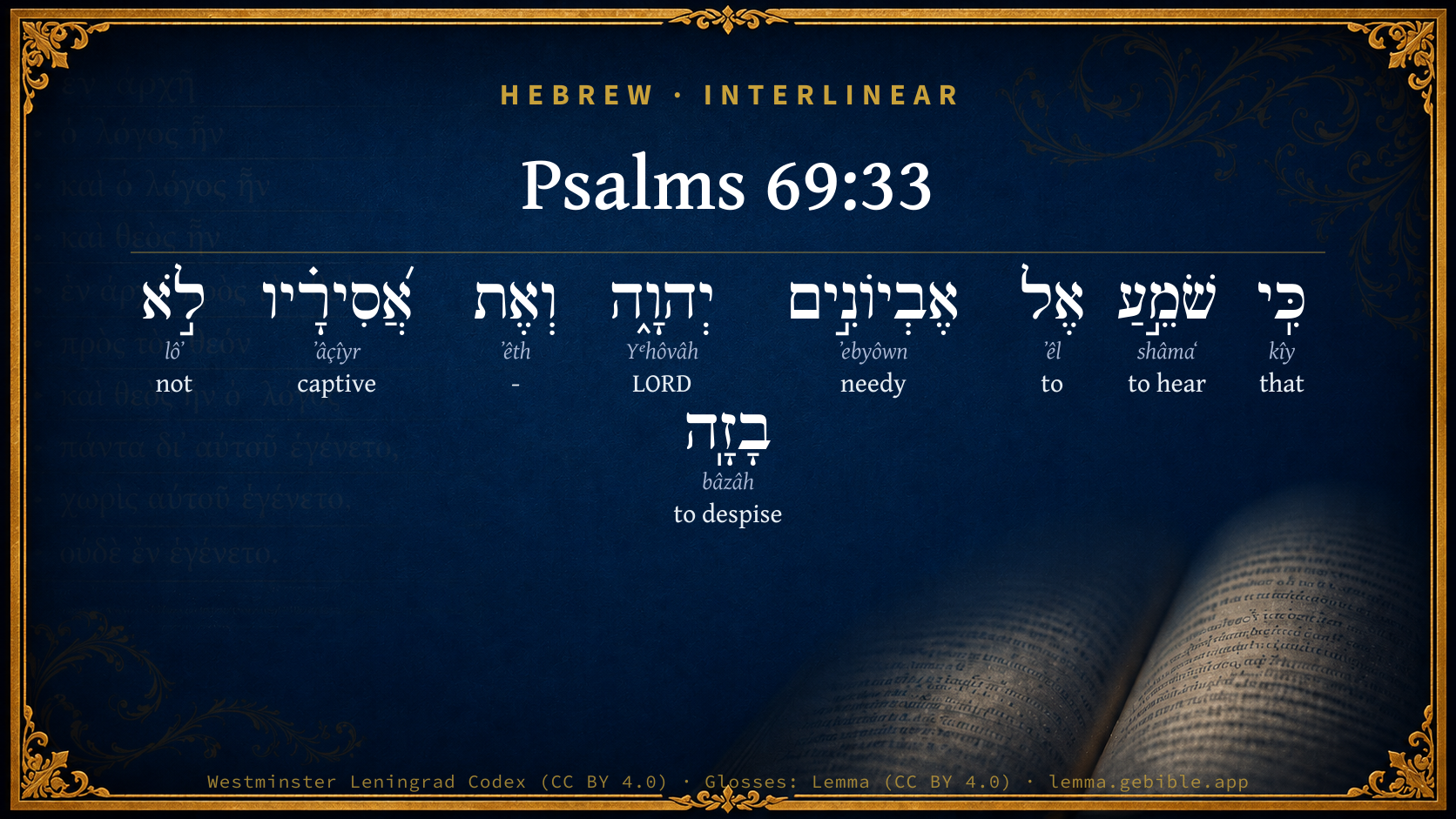
Psalms 69:33

Hebrew (Westminster Leningrad Codex) Psalms 69:33 appears in the Hebrew Old Testament. The text above is from the Westminster Leningrad Codex. Each word links to its Strong’s number, a concise gloss, and parsing drawn from the Open Scriptures Hebrew Bible morphology. Click any word for its full Brown-Driver-Briggs (BDB) entry.
Download image
Cite this verse

Psalms 69:33 (World English Bible). Public Domain. Lemma interlinear Bible study tool, https://lemma.gebible.app/v/psalms/69/33.

Show BibTeX & RIS
BibTeX
RIS
English Translation
For Yahweh hears the needy, And doesn't despise his captive people.
World English Bible · Public Domain
Download a study sheet

One document with this verse’s original text, its word-by-word gloss line, the meaning frame, cross-references with their text, attributed commentary, and full source and license credits — printable, and it pastes into notes with its structure intact.

This verse Autodidact and up

Study sheet (.html) Plain text (.txt)

A passage Seminary Student

Up to 50 verses in one chapter. A passage sheet keeps up to 6 commentary sources and 12 cross-references per verse, in the order this page ranks them, and says so on the sheet whenever that leaves anything out. Ask for a single verse and you get the Autodidact verse sheet above.

Everything on this page stays free to read, with no account — the sheet is a download of what is already on screen, not access to it.

Want to remove ads? Support Godless Engineer
Compare translations 3

The same verse in 3 English versions, stacked beneath the original-language interlinear above. Click any original word for its lexicon entry.

Each is an independent rendering of the whole verse — the interlinear is not word-aligned to these translations.

Highlighted words mark where these versions differ — a whole-verse word diff, not a word-by-word alignment.

  • World English Bible Public Domain
    For Yahweh hears the needy, And doesn't despise his captive people.
  • King James Version Public Domain
    For the LORD heareth the poor, and despiseth not his prisoners.
  • unfoldingWord Literal Text CC BY-SA 4.0
    For Yahweh is hearing the needy, and he does not despise his prisoners.

unfoldingWord Literal Text — © unfoldingWord, licensed CC BY-SA 4.0. Word-aligned USFM3 via Door43 (git.door43.org/unfoldingWord/en_ult).

Versions to compare (up to 4)

3 of 4 selected

Show all 18 translations

Every available English version of this verse, each an independent rendering of the whole verse.

  • World English Bible Public Domain
    For Yahweh hears the needy, And doesn't despise his captive people.
  • Berean Standard Bible Public Domain
    For the LORD listens to the needy and does not despise His captive people.
  • Majority Standard Bible Public Domain
    For the LORD listens to the needy and does not despise His captive people.
  • King James Version Public Domain
    For the LORD heareth the poor, and despiseth not his prisoners.
  • American Standard Version (1901) Public Domain
    For Jehovah heareth the needy, And despiseth not his prisoners.
  • Revised Version (1885) Public Domain
    For the LORD heareth the needy, and despiseth not his prisoners.
  • Geneva Bible (1599) Public Domain
    For the Lord heareth the poore, and despiseth not his prisoners.
  • Douay-Rheims (1899) Public Domain
    Let the poor see and rejoice: seek ye God, and your soul shall live.
  • Young's Literal Translation Public Domain
    For Jehovah hearkeneth unto the needy, And His bound ones He hath not despised.
  • Literal Standard Version CC BY-SA 4.0
    For YHWH listens to the needy, || And He has not despised His bound ones.
  • Unlocked Literal Bible CC BY-SA 4.0
    For Yahweh hears the needy and does not despise his prisoners.
  • unfoldingWord Literal Text CC BY-SA 4.0
    For Yahweh is hearing the needy, and he does not despise his prisoners.
  • Darby Bible Public Domain
    For Jehovah heareth the needy, and despiseth not his prisoners.
  • World Messianic Bible Public Domain
    For the LORD hears the needy, and doesn’t despise his captive people.
  • Webster's Bible Public Domain
    \\69:32\\The humble shall see this, and be glad: and your heart shall live that seek God.
  • Free Bible Version CC BY-SA 4.0
    God hears the poor, and he does not ignore his people who are in prison.
  • Bible in Basic English Public Domain
    For the ears of the Lord are open to the poor, and he takes thought for his prisoners.
  • JPS Tanakh (1917) Public Domain
    (69-34) For the LORD hearkeneth unto the needy, and despiseth not His prisoners.

Literal Standard Version (2020), Covenant Press — licensed CC BY-SA 4.0. Text via the HelloAO Bible API (eBible.org). Unlocked Literal Bible (unfoldingWord) — licensed CC BY-SA 4.0. Text via the HelloAO Bible API (eBible.org). unfoldingWord Literal Text — © unfoldingWord, licensed CC BY-SA 4.0. Word-aligned USFM3 via Door43 (git.door43.org/unfoldingWord/en_ult). Free Bible Version, Dr. Jonathan Gallagher — licensed CC BY-SA 4.0. Text via the HelloAO Bible API (eBible.org).

Word by word

More ways to search: Search by grammar → Find every occurrence → Compare this word →

Practice this passage: Drill this verse → Learn its vocabulary →

About this verse

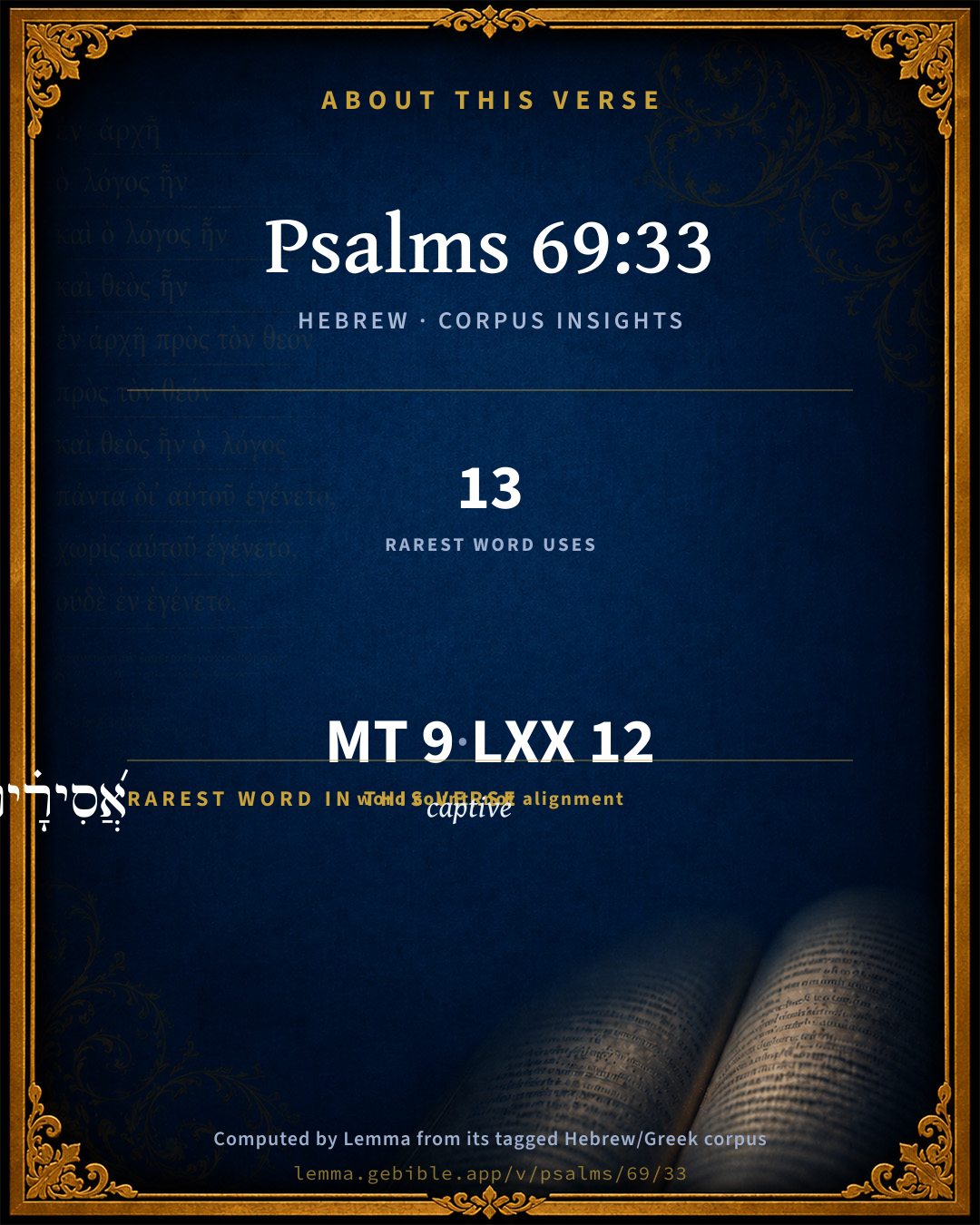
These counts appear in no published source. They are computed here, from the morphology-tagged text and Lemma’s own curated glosses. What Lemma adds →

9
words
9
distinct lemmas
Wisdom
section

Notable vocabulary

The rarest word here is אֲ֝סִירָ֗יו captive H615 — appearing just 13 times in the whole Hebrew Bible.

Shared distinctive vocabulary

אֲ֝סִירָ֗יו captive H615 occurs in 13 verses of the Hebrew Bible. Also found in:

Grammatical profile

  • 2 verbs
  • 2 nouns
  • 1 adjective
  • 1 preposition
  • 1 conjunction
  • 2 particles

Verb forms

  • שֹׁמֵ֣עַ Qal · Participle Active
  • בָזָֽה Qal · Perfect

Hebrew & Septuagint length

In English translation the verse runs 11 words from the Hebrew and 15 from the Septuagint (LXX English) — closely comparable.

A rough comparison of the two English renderings, which tokenize alike — not a word-level alignment.

Word counts can differ between the Hebrew and the Greek without any difference in meaning — e.g. the Hebrew direct-object marker אֵת has no separate Greek word, and Greek often adds the article ὁ.

In the original languages it is 9 Hebrew tokens and 12 Greek tokens — but the two are counted differently (Hebrew bundles its prefixes and suffixes into one token; the Greek is in lemma form), so that isn’t a like-for-like length.

Cross-references

16

Topical passages linked to Psalms 69:33 in the Treasury of Scripture Knowledge — connected by theme and wording, ordered by reader-vote popularity; previews shown in the World English Bible.

  • Psalms 68:6 God sets the lonely in families. He brings out the prisoners with singing, But the rebellious dwell in a sun-scorched land.
  • Acts 5:18–19 and laid hands on the apostles, and put them in public custody.
  • Zechariah 9:11–12 As for you also, Because of the blood of your covenant, I have set free your prisoners from the pit in which is no water.
  • Revelation 2:10 Don't be afraid of the things which you are about to suffer. Behold, the devil is about to throw some of you into prison, that you may be tested; and you will have oppression for ten days. Be faithful to death, and I will give you the crown of life.
  • Psalms 146:7 Who executes justice for the oppressed; Who gives food to the hungry. Yahweh frees the prisoners.
  • Luke 4:18 "The Spirit of the Lord is on me, Because he has anointed me to preach good news to the poor. He has sent me to heal the brokenhearted, To proclaim release to the captives, Recovering of sight to the blind, To deliver those who are crushed,
  • Psalms 12:5 "Because of the oppression of the weak and because of the groaning of the needy, I will now arise," says Yahweh; "I will set him in safety from those who malign him."
  • Ephesians 3:1 For this cause I, Paul, am the prisoner of Christ Jesus on behalf of you Gentiles,
  • Psalms 10:17 Yahweh, you have heard the desire of the humble. You will prepare their heart. You will cause your ear to hear,
  • Psalms 34:6 This poor man cried, and Yahweh heard him, And saved him out of all his troubles.
  • Psalms 102:17 He has responded to the prayer of the destitute, And has not despised their prayer.
  • Psalms 102:20 To hear the groans of the prisoner; To free those who are condemned to death;
  • Acts 12:4–11 When he had arrested him, he put him in prison, and delivered him to four squads of four soldiers each to guard him, intending to bring him out to the people after the Passover.
  • Psalms 72:12–14 For he will deliver the needy when he cries; The poor, who has no helper.
  • Psalms 107:10 Some sat in darkness and in the shadow of death, Being bound in affliction and iron,
  • Isaiah 66:2 For all these things has my hand made, and [so] all these things came to be, says Yahweh: but to this man will I look, even to him who is poor and of a contrite spirit, and who trembles at my word.

Cross-references courtesy of OpenBible.info (CC BY 4.0).

Hebrew and Greek witnesses Masoretic Hebrew ↔ Greek Septuagint

The same verse in the two great witnesses to the Old Testament, shown verse-for-verse.

You’re reading Greek Psalm 68 (Hebrew Psalm 69). The Septuagint counts the superscription, so verse numbers can differ from the Hebrew — chapter-level alignment, not verse-by-verse. Numbering follows Rahlfs.

These are two independent witnesses, not word-aligned to each other, and the Septuagint is shown in lemma (dictionary) form.

Hebrew Psalms 69:33 Masoretic · Westminster Leningrad Codex

כִּֽי שֹׁמֵ֣עַ אֶל אֶבְיוֹנִ֣ים יְהוָ֑ה וְאֶת אֲ֝סִירָ֗יו לֹ֣א בָזָֽה

For Yahweh hears the needy, And doesn't despise his captive people.

World English Bible · Public Domain

Greek LXX Greek Psalm 68:33 Septuagint · lemma form

ὁράω πτωχός καί εὐφραίνω ἐκζητέω ὁ θεός καί ζάω ὁ ψυχή σύ

For the Lord hears the poor, and does not set at nothing his fettered ones.

LXX2012 (modern English Septuagint) · Public Domain

Hebrew: Westminster Leningrad Codex (CC BY 4.0). Greek: Septuagint (public domain); English from LXX2012 (modern English Septuagint) (Public Domain). How the Septuagint differs from the Hebrew →

Commentary

Notes on Psalms 69:33 from classic Christian and Jewish commentators (each source and its license shown beneath its notes). The classic Christian expositions comment on the surrounding passage and are grouped to its opening verse, so a note may address several verses; the Jewish commentaries on the Tanakh (Rashi and others) are per-verse, so they appear only where the commentator wrote on this verse.

Lemma curates 59 commentaries, every one of them public domain or Creative Commons licensed, each selected and text-cleaned for this edition rather than reprinted as found. About our sources →

Trapp's Complete Commentary

John Trapp

Psa 69:33 For the LORD heareth the poor, and despiseth not his prisoners.

Ver. 33. For the Lord heareth the poor] He is the poor man’s king, the wronged man’s refuge; Trajan the emperor is renowned for this, that when he was mounted for a battle, he alighted again to bear the complaint of a poor woman that cried unto him for justice (Aeli. Spart.); and our Edward VI for this, that he would appoint certain hours to sit with the master of the requests, only to despatch the causes of the poor. God is much more to be magnified.

John Trapp, A Commentary or Exposition upon All the Books of the Old and New Testament (1647–1656) — public domain. Text from a community e-Sword module.

The Biblical Illustrator

Joseph S. Exell

Psa_69:33

For the Lord heareth the poor, and despiseth not His prisoners.

Poor prisoners

The Lord heareth the poor, spiritually poor. Let us notice first what this does not mean, in order to get clearly at what it does mean. I make no hesitation in saying that this consciousness of spiritual poverty is one of the mysteries of the kingdom of heaven, and none can understand it but those who, are experimentally led into the secret. First, it does not mean literal, mental nor moral poverty, but it consists in our sense of our natural, internal, spiritual worthlessness of character. You may be as moral as an angel, and still be destitute of spiritual life in the soul. Therefore the soul not united to Christ is not united to that that can give it access to God; it is not united to that that can bring upon it the approbation of God; it is not united to that that can save it. He died, the just for the unjust, to bring us to God. Therefore, while we prize good works, yet none of these things are of any use in the salvation of the soul; salvation is altogether a secret and another thing. Now, we go on to the literal prisoner. Some good people have been cast into prison through what other people have said about them;--they have been slandered and reproached, and it has been believed, and they have been cast into prison; but the Lord despiseth not His prisoners. Joseph was slandered--he was reproached, cast into prison; but the Lord did not despise him; the Lord was with him. And so the Lord turned, in one sense, the dungeon into a paradise; and by and by, when Joseph interpreted the dreams, he was exalted, and realized all that his visions predicted. But there is another class of prisoners, and that is those that get into prison by their own fault. Why, you are never going to say a word in favour of them, are you? Well, if not in favour of them, I can say a word in favour of the Lord; and if He is pleased to say a word in favour of them, I shall not differ from Him. Well, Jonah, you are got into prison, do you think you will ever get out again? You have got there by your own fault. But the Lord watched over him and took care of him, and the sea could not kill him, and the weeds could not kill him. He cried unto the Lord, and the Lord heard him, answered and delivered him, and make him accomplish his mission. So the Lord despiseth not His prisoners, even when they get into prison through their own fault. This is a God worth loving, worth worshipping, worth cleaving to. Samson got into prision by his own fault. You are not going to say a word in favour of him, are you? I would rather die Samsons death than I would die the death of the most sleek, the most polished Pharisee under the heavens, because they die, in enmity against God; but Samson died in sweet reconciliation to God, and obtained the victory God intended he should. He got into prison by his own fault: did the Lord leave him and despise him? No. When they were making sport of Samson he cried to God, for He heareth the poor; He despised not His prisoner. Let me be avenged of the Philistines for my two eyes. He bowed with all his might; the victory was wrought, his soul saved, God glorified; and if we are ashamed of these testimonies of Gods mercy, then I believe God will be ashamed of us. They are His prisoners because they are His people. Let us, then, not boast one over the other, but rather bear one anothers burdens, and so fulfil the law of Christ. (James Wells.)

Joy for prisoners

With what gratitude and joy should these intimations of hope be received by those who are naturally in so miserable a condition! It is a celebrated story that, when Titus Flaminius, at the public games, proclaimed the liberty of Greece, after it had been conquered by the Romans, the auditors were at first lost in a silent amazement, and then burst out into one continued shout for two hours together, Liberty! Liberty I Me-thinks such joy, and greater than this, should appear amongst miserable sinners when these proclamations for liberty are made. (T. Doddridge.)

The Biblical Illustrator, edited by Joseph S. Exell (c. 1880s–1900s) — public domain. Text from a community e-Sword module.

J. A. Alexander on Psalms

Joseph Addison Alexander

34. (Psa 69:33). For hearkening, habitually listening, (is) Jehovah to the poor, i.e. the poor among his people; the righteous, pious, or believing poor; nd his prisoners, those imprisoned in affliction by himself, or by human oppressors for his sake, he hath not despised, and therefore never will. The general inference here drawn from the speaker's own experience is the same as in Psa 22:24 above.

Joseph Addison Alexander, The Psalms Translated and Explained (1850) — public domain. Text from a community e-Sword module.

Geneva Bible (1599)

Geneva Bible translators

For as he delivered his servant David, so will he do all that are in distress, and call upon him.

Geneva Bible (1599) marginal notes — public domain. Text via Bolls.life.

Jamieson, Fausset & Brown

Robert Jamieson, A. R. Fausset & David Brown

prisoners--peculiarly liable to be despised.

Jamieson, Fausset & Brown — Commentary Critical and Explanatory on the Whole Bible (1871) — public domain (CC PDM 1.0). Text via the HelloAO Bible API.

Adam Clarke's Commentary

Verse 33. For the Lord heareth the poor] אביונים ebyonim, of the beggars. He perhaps refers here to the case of the captives, many of whom were reduced to the most abject state, so as to be obliged to beg bread from their heathen oppressors.

His prisoners.] The captives, shut up by his judgments in Chaldea, without any civil liberty, like culprits in a prison.

Adam Clarke's Commentary on the Bible (1810–1826) — public domain. Text from a community e-Sword/MySword module.

Ellicott's Commentary for English Readers

(33) For the Lord.—This and the following verses evidently bring the psalm within the circle of literature, of which Isa_65:17 seq., is the noblest example—the literature inspired by the hope of the restoration and of the rebuilding of Jerusalem.

A Bible Commentary for English Readers, edited by Charles John Ellicott (1878–1897) — public domain. Text from a community e-Sword module.

The Cambridge Bible for Schools and Colleges

gen. ed. J. J. S. Perowne

33. the poor] R.V. the needy, as Psa_9:18, Jer_20:13, and frequently.

his prisoners] Though He has cast them into the prison of captivity for their sins, He will not reject their prayers. Cp. Psa_22:24; Psa_102:17; Psa_102:20; Psa_107:10 ff. After the capture of the city in b.c. 597, all the best part of the nation was carried into captivity.

The Cambridge Bible for Schools and Colleges (gen. ed. J. J. S. Perowne; Cambridge University Press, 1878–1918) — public domain. Text from a community e-Sword module.

John Gill's Exposition

For the Lord heareth the poor,.... The prayer of the poor, as the Targum; of the poor disciples of Christ, who were together mourning, weeping, and praying, when their Lord was dead, and laid in the sepulchre, Mar 16:10; this epithet agrees with all the followers of Christ, who for the most part are literally poor, and are all of them so in a spiritual sense; they are poor in spirit, and are sensible of it; they are full of wants, and these daily return upon them; wherefore they constantly apply to the throne of grace for help in time of need; and the Lord regards them, his eye is upon them, his heart is towards them, his thoughts are about them, his ears are open to their cries, and his hand is ready to supply their wants;

and despiseth not his prisoners; the same disciples of Christ; who being assembled together, the doors were shut for fear of the Jews, Joh 20:19; it may be applied to such who are the Lord's prisoners; that is, for his sake, in a literal sense, as the Apostle Paul is called the prisoner of the Lord, Eph 3:1; and there were many, both under the Old and under the New Testament, that suffered imprisonment for their profession of religion; and these the Lord despises not, though men may, but highly esteems and honours; and it may be understood mystically and spiritually of such as are, in their nature state, prisoner of sin and Satan, and the law, and, when called, are prisoners of hope; these the Lord has a regard unto, and opens the prison doors and sets them at and directs them to the strong hold, Isa 49:9.

John Gill's Exposition of the Whole Bible (1746–1763) — public domain (CC PDM 1.0). Text via the HelloAO Bible API.

Albert Barnes' Notes on the Bible

For the Lord heareth the poor - The needy; the humble; the unprotected. The reference is to those who are in circumstances of want and distress. The truth stated here is in accordance with all that is said in the Scriptures. Compare the notes at Psa 34:6. See also Job 5:15; Psa 10:14; Psa 12:5; Psa 35:10; Psa 68:10.

And despiseth not his prisoners - He does not overlook them; he does not treat them as if they were worthy of no attention or regard. The word “prisoners” here may refer to those who are, as it were, bound by affliction under his own providential dealings; or to those who are oppressed, or are held as captives, or are thrown into prison, on his account. The particular reference here seems to be to David, and to those associated with him, who were straitened or deprived of their freedom in the cause of God.

Albert Barnes' Notes on the Bible (1834–1885) — public domain. Text from a community e-Sword/MySword module.

Matthew Poole's English Annotations

Those who are in prison, or any straits and afflictions for his sake; which is my case, Psa 69:7.

Matthew Poole's English Annotations on the Holy Bible (1683–1685) — public domain. Text from a community e-Sword/MySword module.

The Treasury of David

Charles H. Spurgeon

Ver. 33. For the Lord heareth the poor. The examples of David and David's Lord, and tens of thousands of the saints, all go to prove this. Monarchs of the nations are deaf to the poor, but the Sovereign of the Universe has a quick ear for the needy. None can be brought lower than was the Nazarene, but see how highly he is exalted: descend into what depths we may, the prayer hearing God can bring us up again.

And despiseth not his prisoners. Poor men have their liberty, but these are bound; however, they are God's prisoners, and, therefore, prisoners of hope. The captive in the dungeon is the lowest and least esteemed of men, but the Lord seeth not as man seeth; he visited those who are bound with chains, and proclaims a jail delivery for his afflicted. God despises no man, and no prayer that is honest and sincere. Distinctions of rank are nothing with him; the poor have the gospel preached to them, and the prisoners are loosed by his grace. Let all poor and needy ones hasten to seek his face, and to yield him their love.

Ver. 33. The Lord heareth the poor. The consolation is much greater when it is said, "The Lord heareth the poor, "than if it were written, He hath heard poor David. Musculus.

Ver. 33.

I. What the people of God are in their own esteem: "poor"

and "prisoners."

II. What they are in the divine esteem: not unnoticed; not

unheard; not despised.

Psalms 69:34*

Charles H. Spurgeon's The Treasury of David (1869–1885) — public domain. Psalms only. Text from a community e-Sword/MySword module.

The Pulpit Commentary

For the Lord heareth the poor. The "poor in spirit" are probably meant (comp. ver. 29). And despiseth not his prisoners. Those who suffer for his sake.

The Pulpit Commentary (1880–1919), ed. H.D.M. Spence-Jones & Joseph S. Exell — public domain. Text from a community e-Sword module.

John Wesley's Explanatory Notes

Prisoners - Those who are in prison or affliction for his sake.

John Wesley, Explanatory Notes Upon the Whole Bible (1754–1765) — public domain. Text via the GEBible commentary corpus.

Lesson kit

Teaching starters — assembled from the data on this page, not authored interpretation. Every prompt links to the verse data it draws on. Edit before teaching.

Psalms, in the Wisdom, opens this verse with 9 words (9 distinct Hebrew lemmas). Its most distinctive word is ʼâçîyr (“captive”). A historical commentator’s framing appears above. Read the whole chapter for the surrounding context.

Discussion questions

  1. How does “captive” (ʼâçîyr) shape what this verse is saying?
  2. How does Genesis 39:20, which shares the word «captive», read alongside this verse?
  3. These translations render this verse differently. What is at stake in choosing one wording over another?
  4. «שֹׁמֵ֣עַ» is a Qal Participle Active verb. How does that grammatical form shape the action described?
  5. Compare how Trapp's Complete Commentary and The Biblical Illustrator read this verse. Where do they agree or differ?

Things to notice

Reading settings

Reading text

Shown beneath each verse's original-language words.

Old Testament
Old Testament edition

Read the OT as the Masoretic Hebrew (MT) or the Greek Septuagint (LXX).

English shown for the Greek Septuagint (in the Hebrew ↔ Greek comparison).

Comparing translations? Open the Compare panel on any verse page to stack up to four side by side.