
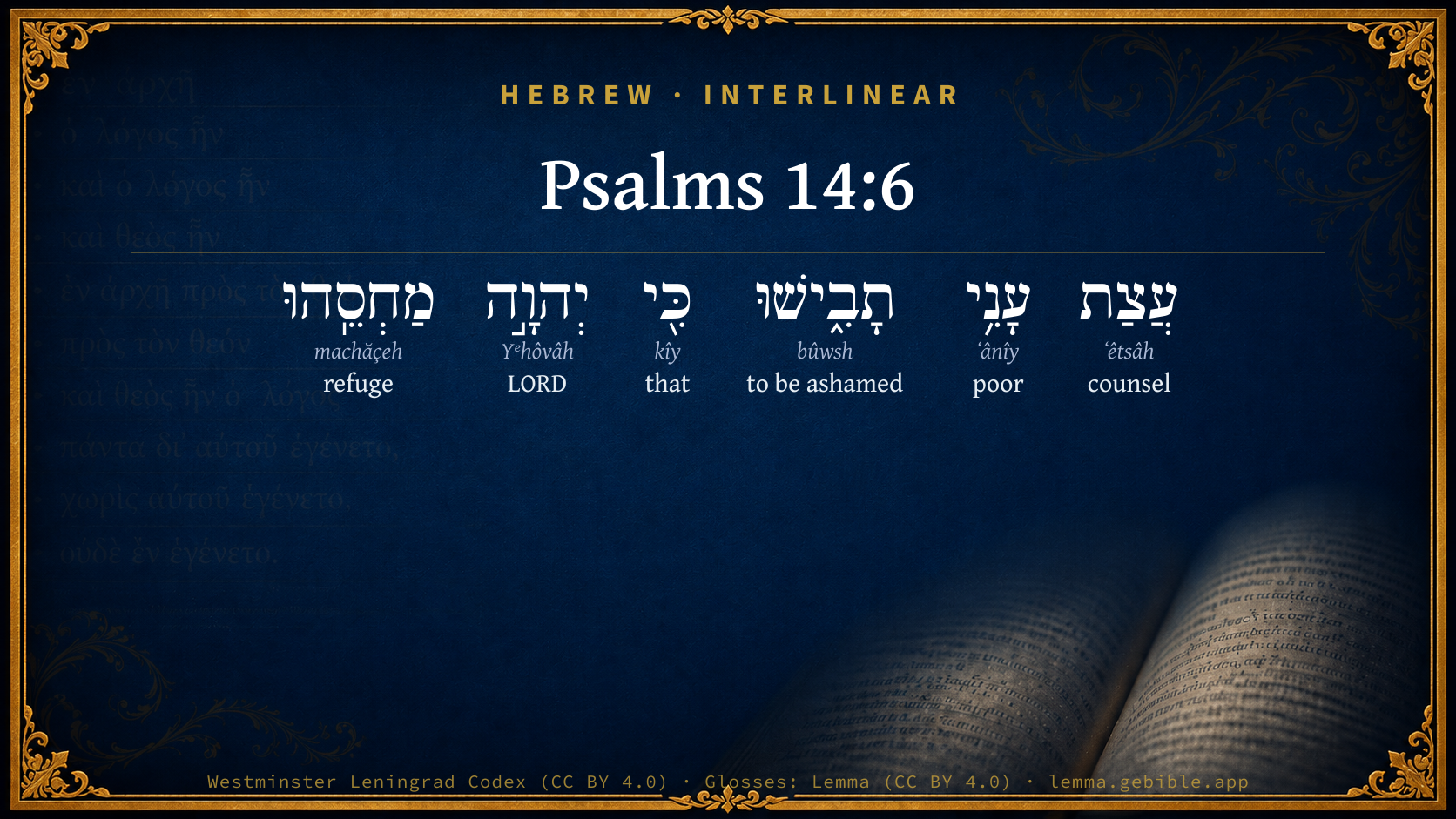
Psalms 14:6

Hebrew (Westminster Leningrad Codex) Psalms 14:6 appears in the Hebrew Old Testament. The text above is from the Westminster Leningrad Codex. Each word links to its Strong’s number, a concise gloss, and parsing drawn from the Open Scriptures Hebrew Bible morphology. Click any word for its full Brown-Driver-Briggs (BDB) entry.
Download image
Cite this verse

Psalms 14:6 (World English Bible). Public Domain. Lemma interlinear Bible study tool, https://lemma.gebible.app/v/psalms/14/6.

Show BibTeX & RIS
BibTeX
RIS
English Translation
You frustrate the plan of the poor, Because Yahweh is his refuge.
World English Bible · Public Domain
Download a study sheet

One document with this verse’s original text, its word-by-word gloss line, the meaning frame, cross-references with their text, attributed commentary, and full source and license credits — printable, and it pastes into notes with its structure intact.

This verse Autodidact and up

Study sheet (.html) Plain text (.txt)

A passage Seminary Student

Up to 50 verses in one chapter. A passage sheet keeps up to 6 commentary sources and 12 cross-references per verse, in the order this page ranks them, and says so on the sheet whenever that leaves anything out. Ask for a single verse and you get the Autodidact verse sheet above.

Everything on this page stays free to read, with no account — the sheet is a download of what is already on screen, not access to it.

Want to remove ads? Support Godless Engineer
Compare translations 3

The same verse in 3 English versions, stacked beneath the original-language interlinear above. Click any original word for its lexicon entry.

Each is an independent rendering of the whole verse — the interlinear is not word-aligned to these translations.

Highlighted words mark where these versions differ — a whole-verse word diff, not a word-by-word alignment.

  • World English Bible Public Domain
    You frustrate the plan of the poor, Because Yahweh is his refuge.
  • King James Version Public Domain
    Ye have shamed the counsel of the poor, because the LORD is his refuge.
  • unfoldingWord Literal Text CC BY-SA 4.0
    You shame the counsel of the afflicted, but Yahweh his refuge.

unfoldingWord Literal Text — © unfoldingWord, licensed CC BY-SA 4.0. Word-aligned USFM3 via Door43 (git.door43.org/unfoldingWord/en_ult).

Versions to compare (up to 4)

3 of 4 selected

Show all 18 translations

Every available English version of this verse, each an independent rendering of the whole verse.

  • World English Bible Public Domain
    You frustrate the plan of the poor, Because Yahweh is his refuge.
  • Berean Standard Bible Public Domain
    You sinners frustrate the plans of the oppressed, yet the LORD is their shelter.
  • Majority Standard Bible Public Domain
    You sinners frustrate the plans of the oppressed, yet the LORD is their shelter.
  • King James Version Public Domain
    Ye have shamed the counsel of the poor, because the LORD is his refuge.
  • American Standard Version (1901) Public Domain
    Ye put to shame the counsel of the poor, Because Jehovah is his refuge.
  • Revised Version (1885) Public Domain
    Ye put to shame the counsel of the poor, because the LORD is his refuge.
  • Geneva Bible (1599) Public Domain
    You haue made a mocke at the counsell of the poore, because the Lord is his trust.
  • Douay-Rheims (1899) Public Domain
    For the Lord is in the just generation: you have confounded the counsel of the poor man, but the Lord is his hope.
  • Young's Literal Translation Public Domain
    The counsel of the poor ye cause to stink, Because Jehovah `is' his refuge.
  • Literal Standard Version CC BY-SA 4.0
    You cause the counsel of the poor to stink, || Because YHWH [is] his refuge.
  • Unlocked Literal Bible CC BY-SA 4.0
    You want to humiliate the poor person even though Yahweh is his refuge.
  • unfoldingWord Literal Text CC BY-SA 4.0
    You shame the counsel of the afflicted, but Yahweh his refuge.
  • Darby Bible Public Domain
    Ye have shamed the counsel of the afflicted, because Jehovah [was] his refuge.
  • World Messianic Bible Public Domain
    You frustrate the plan of the poor, because the LORD is his refuge.
  • Webster's Bible Public Domain
    Ye have shamed the counsel of the poor, because the LORD is his refuge.
  • Free Bible Version CC BY-SA 4.0
    The wicked dismiss the plans of the poor people, but the Lord looks after them.
  • Bible in Basic English Public Domain
    You have put to shame the thoughts of the poor, but the Lord is his support.
  • JPS Tanakh (1917) Public Domain
    Ye would put to shame the counsel of the poor, but the LORD is his refuge.

Literal Standard Version (2020), Covenant Press — licensed CC BY-SA 4.0. Text via the HelloAO Bible API (eBible.org). Unlocked Literal Bible (unfoldingWord) — licensed CC BY-SA 4.0. Text via the HelloAO Bible API (eBible.org). unfoldingWord Literal Text — © unfoldingWord, licensed CC BY-SA 4.0. Word-aligned USFM3 via Door43 (git.door43.org/unfoldingWord/en_ult). Free Bible Version, Dr. Jonathan Gallagher — licensed CC BY-SA 4.0. Text via the HelloAO Bible API (eBible.org).

Word by word

More ways to search: Search by grammar → Find every occurrence → Compare this word →

Practice this passage: Drill this verse → Learn its vocabulary →

About this verse

These counts appear in no published source. They are computed here, from the morphology-tagged text and Lemma’s own curated glosses. What Lemma adds →

6
words
6
distinct lemmas
Wisdom
section

Notable vocabulary

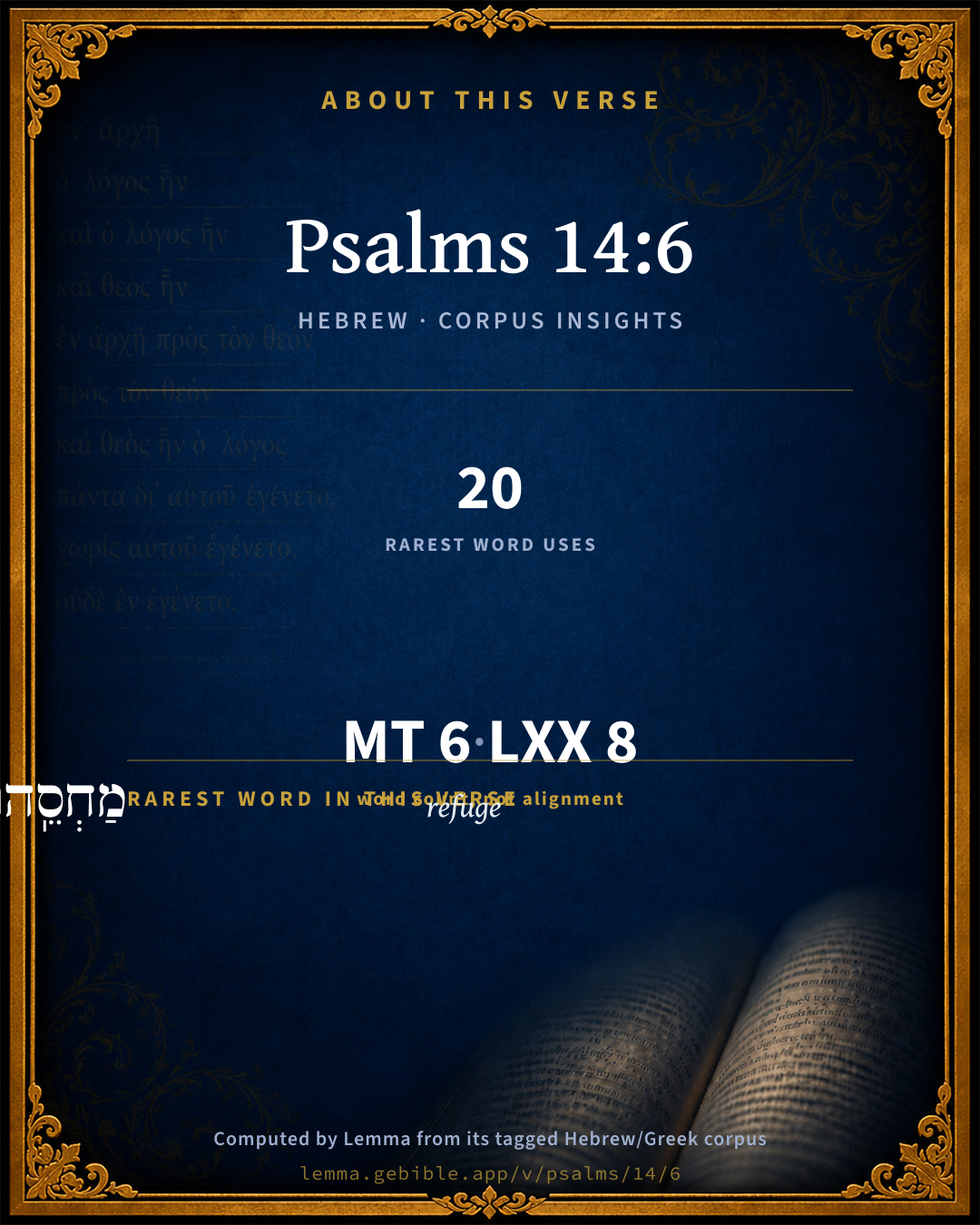
The rarest word here is מַחְסֵֽהוּ refuge H4268 — appearing just 20 times in the whole Hebrew Bible.

Shared distinctive vocabulary

מַחְסֵֽהוּ refuge H4268 occurs in 20 verses of the Hebrew Bible. Also found in:

Grammatical profile

  • 1 verb
  • 3 nouns
  • 1 adjective
  • 1 conjunction

Verb forms

  • תָבִ֑ישׁוּ Hiphil · Imperfect

Hebrew & Septuagint length

In English translation the verse runs 12 words from the Hebrew and 14 from the Septuagint (LXX English) — closely comparable.

A rough comparison of the two English renderings, which tokenize alike — not a word-level alignment.

Word counts can differ between the Hebrew and the Greek without any difference in meaning — e.g. the Hebrew direct-object marker אֵת has no separate Greek word, and Greek often adds the article ὁ.

In the original languages it is 6 Hebrew tokens and 8 Greek tokens — but the two are counted differently (Hebrew bundles its prefixes and suffixes into one token; the Greek is in lemma form), so that isn’t a like-for-like length.

Cross-references

14

Topical passages linked to Psalms 14:6 in the Treasury of Scripture Knowledge — connected by theme and wording, ordered by reader-vote popularity; previews shown in the World English Bible.

  • Psalms 9:9 Yahweh will also be a high tower for the oppressed; A high tower in times of trouble.
  • Psalms 4:2 You sons of men, how long shall my glory be turned into dishonor? Will you love vanity, and seek after falsehood? Selah.
  • Psalms 42:10 As with a sword in my bones, my adversaries reproach me, While they continually ask me, "Where is your God?"
  • Nehemiah 4:2–4 He spoke before his brothers and the army of Samaria, and said, What are these feeble Jews doing? will they fortify themselves? will they sacrifice? will they make an end in a day? will they revive the stones out of the heaps of rubbish, seeing they are burned?
  • Psalms 3:2 Many there are who say of my soul, "There is no help for him in God." Selah.
  • Psalms 22:7–8 All those who see me mock me. They insult me with their lips. They shake their heads, saying,
  • Psalms 40:17 But I am poor and needy; May the Lord think about me. You are my help and my deliverer. Don't delay, my God.
  • Psalms 46:1 God is our refuge and strength, A very present help in trouble.
  • Psalms 142:5 I cried to you, Yahweh. I said, "You are my refuge, My portion in the land of the living."
  • Isaiah 37:10–11 Thus shall you speak to Hezekiah king of Judah, saying, Don't let your God in whom you trust deceive you, saying, Jerusalem shall not be given into the hand of the king of Assyria.
  • Ezekiel 35:10 Because you have said, These two nations and these two countries shall be mine, and we will possess it; whereas Yahweh was there:
  • Daniel 3:15 Now if you are ready whenever you hear the sound of the horn, flute, zither, lyre, harp, pipe, and all kinds of music to you fall down and worship the image which I have made, [well]: but if you don't worship, you shall be cast the same hour into the midst of a burning fiery furnace; and who is that god that shall deliver you out of my hands?
  • Matthew 27:40–43 and saying, "You who destroy the temple, and build it in three days, save yourself! If you are the Son of God, come down from the cross!"
  • Hebrews 6:18 that by two immutable things, in which it is impossible for God to lie, we may have a strong encouragement, who have fled for refuge to take hold of the hope set before us.

Cross-references courtesy of OpenBible.info (CC BY 4.0).

Hebrew and Greek witnesses Masoretic Hebrew ↔ Greek Septuagint

The same verse in the two great witnesses to the Old Testament, shown verse-for-verse.

You’re reading Greek Psalm 13 (Hebrew Psalm 14). The Septuagint counts the superscription, so verse numbers can differ from the Hebrew — chapter-level alignment, not verse-by-verse. Numbering follows Rahlfs.

These are two independent witnesses, not word-aligned to each other, and the Septuagint is shown in lemma (dictionary) form.

Hebrew Psalms 14:6 Masoretic · Westminster Leningrad Codex

עֲצַת עָנִ֥י תָבִ֑ישׁוּ כִּ֖י יְהוָ֣ה מַחְסֵֽהוּ

You frustrate the plan of the poor, Because Yahweh is his refuge.

World English Bible · Public Domain

Greek LXX Greek Psalm 13:6 Septuagint · lemma form

βουλή πτωχός κατααἰσχύνω ὅτι κύριος ἐλπίς αὐτός εἰμί

You⌃ have shamed the counsel of the poor, because the Lord is his hope.

LXX2012 (modern English Septuagint) · Public Domain

Hebrew: Westminster Leningrad Codex (CC BY 4.0). Greek: Septuagint (public domain); English from LXX2012 (modern English Septuagint) (Public Domain). How the Septuagint differs from the Hebrew →

Commentary

Notes on Psalms 14:6 from classic Christian and Jewish commentators (each source and its license shown beneath its notes). The classic Christian expositions comment on the surrounding passage and are grouped to its opening verse, so a note may address several verses; the Jewish commentaries on the Tanakh (Rashi and others) are per-verse, so they appear only where the commentator wrote on this verse.

Lemma curates 59 commentaries, every one of them public domain or Creative Commons licensed, each selected and text-cleaned for this edition rather than reprinted as found. About our sources →

Trapp's Complete Commentary

John Trapp

Psa 14:6 Ye have shamed the counsel of the poor, because the LORD [is] his refuge.

Ver. 6. You have shamed the counsel of the poor] And thought to mock him out of his confidence, as Sennacherib did by Hezekiah, and the Jews by our Saviour. Religion was long since grown, as it is also at this day among many, not more a matter of form than of scorn. In our wretched days, as the Turks count all fools to be saints, so many with us account all saints to be fools. He is a fool, we say, that would be laughed out of his coat; but he were a double fool that would be laughed out of his skin, that would hazard his soul because loth to be laughed at.

Because the Lord is his refuge] Sed Iehovah Protector eius, because he runs to God by prayer, and commits himself wholly to him for direction and success in all his enterprises; Pudefacitis, id est, facitis ut videatur putidum, you jeer, and hold it an egregious silliness. You reject his confidence, and rely on the arm of flesh; which yet was never true to those that trusted unto it.

John Trapp, A Commentary or Exposition upon All the Books of the Old and New Testament (1647–1656) — public domain. Text from a community e-Sword module.

Joseph Benson's Commentary

Psa 14:6. You have shamed the counsel of the poor — Ye have desired and endeavoured to bring to shame, or to disappoint, the course which the godly poor man takes, and the resolution which he adopts, which is to trust in God, call upon his name, and proceed on in his way, which is a course and counsel very different from yours. Or, ye have reproached, or derided his counsel, as a foolish thing. Be cause the Lord is his refuge — This was the ground of their contempt and scorn, that the godly man lived by faith in God’s promise and providence. Or, but the Lord, &c. You reproach them, but God will own and protect them, and justify their counsel, which you deride.

Joseph Benson's Commentary on the Old and New Testaments (1811–1818) — public domain. Text from a community e-Sword module.

J. A. Alexander on Psalms

Joseph Addison Alexander

6. (Psa 14:6) The plan (or counsel) of the sufferer (the afflicted) ye will shame, because Jehovah is his refuge. The workers of iniquity are here addressed directly. The sufferer is the persecuted innocent. Poor is too restricted a translation. See above, on Psa 9:13; Psa 9:19 (12, 18). The plan or counsel is described in the last clause, to wit, that of trusting in Jehovah. This very trust is an object of contempt to the wicked. Until they are made to fear by the manifestation of God's presence with his people, they will continue to despise it. The Psalmist here seems to revert to the interval which should precede the divine interposition. As if he had said, You will one day be made to fear, but in the mean time you will shame the counsel of the poor. Some, however, give the Hebrew meaning its usual sense of putting to shame, disappointing, and understand the clause as an ironical concession: you may shame his counsel if you can.

Joseph Addison Alexander, The Psalms Translated and Explained (1850) — public domain. Text from a community e-Sword module.

Geneva Bible (1599)

Geneva Bible translators

You mock them that put their trust in God.

Geneva Bible (1599) marginal notes — public domain. Text via Bolls.life.

Adam Clarke's Commentary

Verse 6. Ye have shamed the counsel of the poor] Instead of תבישו tabishu, "Ye have shamed," Bishop Horsley proposes to read תבישם tabishem, and translates the clause thus: "The counsel of the helpless man shall put them to shame." But this is not authorized by MS. or version. There is no need for any change: the psalmist refers to the confidence which the afflicted people professed to have in God for their deliverance, which confidence the Babylonians turned into ridicule. The poor people took counsel together to expect help from God, and to wait patiently for it; and this counsel ye derided, because ye did not know - did not consider, that God was in the congregation of the righteous.

Adam Clarke's Commentary on the Bible (1810–1826) — public domain. Text from a community e-Sword/MySword module.

John Calvin's Commentaries

6. Ye deride the counsel of the poor. He inveighs against those giants who mock at the faithful for their simplicity, in calmly expecting, in their distresses, that God will show himself to be their deliverer. And, certainly, nothing seems more irrational to the flesh than to betake ourselves to God when yet he does not relieve us from our calamities; and the reason is, because the flesh judges of God only according to what it presently beholds of his grace. Whenever, therefore, unbelievers see the children of God overwhelmed with calamities, they reproach them for their groundless confidence, as it appears to them to be, and with sarcastic jeers laugh at the assured hope with which they rely upon God, from whom, notwithstanding, they receive no sensible aid. David, therefore, defies and derides this insolence of the wicked, and threatens that their mockery of the poor and the wretched, and their charging them with folly in depending upon the protection of God, and not sinking under their calamities, will be the cause of their destruction. At the same time, he teaches them that there is no resolution to which we can come which is better advised than the resolution to depend upon God, and that to repose on his salvation, and on the assistance which he hath promised us, even although we may be surrounded with calamities, is the highest wisdom.

John Calvin's Commentaries (1540-1563) — public domain. Text from the Calvin Translation Society English edition (1840s-50s) via the Christian Classics Ethereal Library (ccel.org). Calvin's coverage is partial (roughly two-thirds of the Bible); uncommented books and verses are honest gaps, never fabricated. The 19th-century editor's footnotes and remarks are omitted so the notes are faithfully Calvin's own voice.

Ellicott's Commentary for English Readers

(6) Counsel.—This confidence, this piety, this appeal addressed to the supreme Protector, is in this verse called the “counsel,” the “plan” of the sufferer, and the poet asks, “Would ye then make the sufferer blush for such a thought?” “No, for Jehovah is his refuge.” The Authorised Version has here missed the sense by rendering in the past tense.

A Bible Commentary for English Readers, edited by Charles John Ellicott (1878–1897) — public domain. Text from a community e-Sword module.

The Cambridge Bible for Schools and Colleges

gen. ed. J. J. S. Perowne

6. You have shamed] R.V., Ye put to shame. You deride the resort of the afflicted to Jehovah as mere folly. But the word usually means to frustrate or confound: and the line maybe explained, ‘Would ye frustrate the counsel of the poor! Nay! for Jehovah’ &c. Cp. R.V. marg., which gives But for Because.

the poor] Or, afflicted. Cp. Psa_9:12 : and Exo_3:7; Exo_3:17; Exo_4:31.

In Psalms 53 the equivalent of Psa_14:5-6 reads thus:

“For God hath scattered the bones of him that encampeth against thee;

Thou hast put them to shame, because God hath rejected them.”

The bones of Israel’s enemies lie bleaching upon the field of battle, where their bodies were left unburied (Eze_6:5). This can hardly be an anticipation of some future defeat. It must rather be an allusion to some historic event; and it at once suggests the miraculous annihilation of Sennacherib’s great army. The text appears to have been altered by the editor of Book II to introduce a reference to the most famous example in later times of the discomfiture of worldly arrogance venturing to measure its strength with Jehovah. With this reading it is clear that Psa_14:4 must refer to the nation and its enemies, not to oppressors and their victims within the nation.

The Cambridge Bible for Schools and Colleges (gen. ed. J. J. S. Perowne; Cambridge University Press, 1878–1918) — public domain. Text from a community e-Sword module.

John Gill's Exposition

You have shamed the counsel of the poor,.... The poor saints, the Lord's people, the generation of the righteous, who are generally the poor of this world; poor in spirit, and an afflicted people: and the counsel of them intends not the counsel which they give to others, but the counsel which they receive from the Lord, from the Spirit of counsel, which rests upon them, and with which they are guided; and this is to trust in the Lord, and to make him their refuge; and which is good advice, the best of counsel. Happy and safe are they that take it! But this is derided by wicked and ungodly men; they mock at the poor saints for it, and endeavour to shame them out of it; but hope makes not ashamed; see Psa 22:7;

because the Lord is his refuge: he betakes himself to him when all others fail; and finds him to be a refuge from the storm of impending calamities, and from all enemies.

John Gill's Exposition of the Whole Bible (1746–1763) — public domain (CC PDM 1.0). Text via the HelloAO Bible API.

Albert Barnes' Notes on the Bible

Ye have shamed - The address here is made directly to the wicked themselves, to show them the baseness of their own conduct, and, perhaps, in connection with the previous verse, to show them what occasion they had for fear. The idea in the verse seems to be, that as God was the protector of the “poor” who had come to him for “refuge,” and as they had “shamed the counsel of the poor” who had done this, they had real occasion for alarm. The phrase “ye have shamed” seems to mean that they had “despised” it, or had treated it with derision, that is, they had laughed at, or had mocked the purpose of the poor in putting their trust in Yahweh.

The counsel - The purpose, the plan, the act - of the poor; that is, in putting their trust in the Lord. They had derided this as vain and foolish, since they maintained that there was no God Psa 14:1. They therefore regarded such an act as mere illusion.

The poor - The righteous, considered as poor, or as afflicted. The word here rendered “poor” - עני ‛ânı̂y - means more properly, afflicted, distressed, needy. It is often rendered “afflicted,” Job 34:28; Psa 18:27; Psa 22:24; Psa 25:16; Psa 82:3; et al. in Psa 9:12; Psa 10:12 it is rendered “humble.” The common rendering, however, is “poor,” but it refers properly to the righteous, with the idea that they are afflicted, needy, and in humble circumstances. This is the idea here. The wicked had derided those who, in circumstances of poverty, depression, want, trial, had no other resource, and who had sought their comfort in God. These reproaches tended to take away their last consolation, and to cover them with confusion; it was proper, therefore, that they who had done this should be overwhelmed with fear. If there is anything which deserves punishment it is the act which would take away from the world the last hope of the wretched - “that there is a God.”

Because the Lord is his refuge - He has made the Lord his refuge. In his poverty, affliction, and trouble, he has come to God, and put his trust in him. This source of comfort, the doctrine of the wicked - that there “was no God” - tended to destroy. Atheism cuts off every hope of man, and leaves the wretched to despair. It would put out the last light that gleams on the earth, and cover the world with total and eternal night.

Albert Barnes' Notes on the Bible (1834–1885) — public domain. Text from a community e-Sword/MySword module.

Matthew Poole's English Annotations

Shamed, i.e. desired and endeavoured to bring it to shame, or disappoint it. Compare Psa 6:10. Or, ye have reproached or derided it, as a foolish thing.

The counsel of the poor, i.e. the cause which he hath taken to defend himself, which is not by lying, and, flattery, and violence, and all manner of wickedness, which is your counsel and usual practice, but by trusting in God, and keeping his way, and calling upon his name.

Because; this was the ground of their contempt and scorn, that he lived by faith in God’s promise and providence. Or, but, as in the foregoing verse. So there seems to be an elegant and fit opposition. You reproach them, but God will own and protect them, and justify their counsel which you deride.

Matthew Poole's English Annotations on the Holy Bible (1683–1685) — public domain. Text from a community e-Sword/MySword module.

The Treasury of David

Charles H. Spurgeon

Ver. 6. Notwithstanding their real cowardice, the wicked put on the lion's skin and lord it over the Lord's poor ones. Though fools themselves, they mock at the truly wise as if the folly were on their side; but this is what might be expected, for how should brutish minds appreciate excellence, and how can those who have owl's eyes admire the sun? The special point and butt of their jest seems to be the confidence of the godly in their Lord. What can your God do for you now? Who is that God who can deliver out of our hand? Where is the reward of all your praying and beseeching? Taunting questions of this sort they thrust into the faces of weak but gracious souls, and tempt them to feel ashamed of their refuge. Let us not be laughed out of our confidence by them, let us scorn their scorning and defy their jeers; we shall need to wait but a little, and then the Lord our refuge will avenge his own elect, and ease himself of his adversaries, who once made so light of him and of his people.

Ver. 6. Ye have shamed the counsel of the poor, because the Lord is his refuge. In the fifty-third Psalm it is, "Thou hast put them to shame, because God hath despised them." Of course, the allusion is totally different in each; in this Psalm it is the indignant remonstrance of the Psalmist with "the workers of iniquity" for undervaluing and putting God's poor to shame; the other affirms the final shame and confusion of the ungodly, and the contempt in which the Lord holds them. In either case it sweetly illustrates God's care of his poor, not merely the poor in spirit, but literally the poor and low ones, the oppressed and the injured. It is this character of God which is so conspicuously delineated in his word. We may look through all the Shasters and Vedas of the Hindu, the Koran of the Muslims, the legislation of the Greek, and the code of the Roman, aye, and the Talmud of the Jew, the bitterest of all; and not in one single line or page shall we find a vestige or trace of that tenderness, compassion, or sympathy for the wrongs, and oppressions, and trials, and sorrows of God's poor, which the Christian's Bible evidences in almost every page. Barton Bouchier.

Ver. 6. Ye have shamed. Every fool that saith in his heart there is no God, hath out of the same quiver a bolt to shoot at goodness. Barren Michal hath too many sons, who, like their mother, jeer at holy David. John Trapp.

Ver. 6. Ye have shamed, saith he, the counsel of the poor. There is nothing that wicked men do so despise as the making God a refugenothing which they scorn in their hearts like it. "They shame it, "saith he, "It is a thing to be cast out of all consideration. The wise man trusts in his wisdom, the strong man in his strength, the rich man in his riches; but this trusting in God is the most foolish thing in the world." The reasons of it are1. They know not God; and it is a foolish thing to trust one knows not whom. 2. They are enemies to God, and God is their enemy; and they account it a foolish thing to trust their enemy. 3. They know not the way of God's assistance and help. And4. They seek for such help, such assistance, such supplies, as God will not give; to be delivered, to serve their lusts; to be preserved, to execute their rage, filthiness, and folly. They have no other design or end of these things; and God will give none of them. And it is a foolish thing in any man to trust God to be preserved in sin. It is true, their folly is their wisdom, considering their state and condition. It is a folly to trust in God to live in sin, and despise the counsel of the poor. John Owen.

Ver. 6. Ye have made a mock of the counsel of the poor: and why? because the Lord is his trust. This is the very true cause, whatsoever other pretences there be. Whence observe this doctrine; that true godliness is that which breeds the quarrel between God's children and the wicked. Ungodly men may say what they list, as, namely, that they hate and dislike them for that they are proud and saucy in meddling with their betters; for that they are so scornful and disdainful towards their neighbours; for that they are malcontent, and turbulent, and I know not what; but the true reason is yielded by the Lord in this place, to wit, because they make him their stay and their confidence, and will not depend upon lying vanities as the men of the world do. John Dod.

Ver. 6. The Lord is his refuge. Be persuaded actually to hide yourselves with Jesus Christ. To have a hiding place and not to use it, is as bad as to want one; fly to Christ; run into the holes of this Rock. Ralph Robinson, 1656.

Ver. 6. The wisdom of making the Lord our refuge. John Owen.

Ver. 6. Describe,

1. The poor man here intended.

2. His counsel.

3. His reproach.

4. His refuge.

Ver. 6. Trust in God, a theme for mockery to fools only. Show its wisdom.

Psalms 14:7*

Ver. 6. Natural enough is this closing prayer, for what would so effectually convince atheists, overthrow persecutors, stay sin, and secure the godly, as the manifest appearance of Israel's great Salvation? The coming of Messiah was the desire of the godly in all ages, and though he has already come with a sin offering to purge away iniquity, we look for him to come a second time, to come without a sin offering unto salvation. O that these weary years would have an end! Why tarries he so long? He knows that sin abounds and that his people are down trodden; why comes he not to the rescue? His glorious advent will restore his ancient people from literal captivity, and his SPIRITUAL seed from spiritual sorrow. Wrestling Jacob and prevailing Israel shall alike rejoice before him when he is revealed as their salvation. O that he were come! What happy, holy, halcyon, heavenly days should we then see! But let us not count him slack, for behold he comes, he comes quickly! Blessed are all they that wait for him.

Charles H. Spurgeon's The Treasury of David (1869–1885) — public domain. Psalms only. Text from a community e-Sword/MySword module.

Whedon's Commentary on the Bible

Daniel D. Whedon

6. Shamed—Not only frustrated, but, by treating with derision, caused it to become reproachful.

Counsel of the poor—God’s afflicted ones. Their counsel, like that of the pious in all ages, was to fear Jehovah, to obey and trust him. It is the counsel of the suffering, witnessing Church to the proud and atheistic world, and it is a warning as well. The verse is regarded as elliptical, and should be read: “Ye may shame the counsel of the poor, [but in vain,] because the Lord is his refuge.”

Daniel D. Whedon (gen. ed.), Commentary on the Old and New Testaments (1874–1909) — public domain. Text from a community e-Sword module.

The Pulpit Commentary

Ye have shamed the counsel of the poor, because the Lord is his Refuge. The sense is obscure. Some translate, "Ye may shame the counsel of the poor (i.e. put it to shame, baffle it); but in vain; for the poor have a sure Refuge," and the ultimate triumph will belong to them. Others, "Ye pour contempt on the poor man"s counsel," or "resolve," because "the Lord is his Refuge;" i.e. ye contemn it, and deride it, just because it rests wholly on a belief in God, which you regard as folly (see ver. 1).

The Pulpit Commentary (1880–1919), ed. H.D.M. Spence-Jones & Joseph S. Exell — public domain. Text from a community e-Sword module.

John Wesley's Explanatory Notes

Because - This was the ground of their contempt, that he lived by faith in God's promise and providence.

John Wesley, Explanatory Notes Upon the Whole Bible (1754–1765) — public domain. Text via the GEBible commentary corpus.

Keil & Delitzsch

C. F. Keil & F. Delitzsch

The psalmist himself meets the oppressed full of joyous confidence, by reason of the self-manifestation of God in judgment, of which he is now become so confident and which so fills him with comfort. Instead of the sixth tristich, which we expected, we have another distich. The Hiph. הבישׁ with a personal object signifies: to put any one to shame, i.e., to bring it about that any one must be ashamed, e.g., Psa 44:8 (cf. Psa 53:6, where the accusative of the person has to be supplied), or absolutely: to act shamefully, as in the phrase used in Proverbs, בּן מיבישׁ (a prodigal son). It appears only here with a neuter accusative of the object, not in the signification to defame (Hitz.), - a meaning it never has (not even in Pro 13:5, where it is blended with הבאישׁ to make stinking, i.e., a reproach, Gen 34:30) - but to confound, put to shame = to frustrate (Hupf.), which is at once the most natural meaning in connection with עצת. But it is not to be rendered: ye put to shame, because..., for to what purpose is this statement with this inapplicable reason in support of it? The fut. תּבישׁוּ is used with a like shade of meaning as in Lev 19:17, and the imperative elsewhere; and כּי gives the reason for the tacitly implied clause, or if a line is really lost from the strophe, the lost clause (cf. Isa 8:9.): ye will not accomplish it. עצה is whatsoever the pious man, who as such suffers reproach, plans to do for the glory of his God, or even in accordance with the will of his God. All this the children of the world, who are in possession of worldly power, seek to frustrate; but viewed in the light of the final decision their attempt is futile: Jahve is his refuge, or, literally the place whither he flees to hide himself and finds a hiding or concealment (צל, Arab. dall, סתר, Arab. sitr, Arabic also drâ). מחסּהוּ has an orthophonic Dag., which obviates the necessity for the reading מחסּהוּ (cf. תּעלּים Psa 10:1, טעמּו Psa 34:1, לאסּר Psa 105:22, and similar instances).

Keil & Delitzsch — Biblical Commentary on the Old Testament (1861–1891) — public domain (CC PDM 1.0). Text via the HelloAO Bible API. (Old Testament only.)

Rashi

Rabbi Shlomo Yitzchaki (Rashi)

You put to shame the counsel of the poor You say that the counsel of Israel is shameful, for they trust in the Lord because He is their refuge.

Rashi on the Tanakh — English translations: “The Judaica Press complete Tanach with Rashi, translated by A. J. Rosenberg” (CC BY 4.0); “Pentateuch with Rashi's commentary by M. Rosenbaum and A.M. Silbermann, 1929-1934” (public domain); “The Metsudah Tanach series, Lakewood, N.J” (CC BY 4.0); and “The Book of Joshua, Metsudah Publications, 1997” (CC BY 4.0). Text via Sefaria.

Lesson kit

Teaching starters — assembled from the data on this page, not authored interpretation. Every prompt links to the verse data it draws on. Edit before teaching.

Psalms, in the Wisdom, opens this verse with 6 words (6 distinct Hebrew lemmas). Its most distinctive word is machăçeh (“refuge”). A historical commentator’s framing appears above. Read the whole chapter for the surrounding context.

Discussion questions

  1. The word machăçeh carries the sense “refuge.” How does it shape the verse?
  2. How does Job 24:8, which shares the word «refuge», read alongside this verse?
  3. These translations render this verse differently; the difference is in the English rendering, not the original. What questions does that raise?
  4. «תָבִ֑ישׁוּ» is a Hiphil Imperfect verb. How does that grammatical form shape the action described?
  5. Compare how Trapp's Complete Commentary and Joseph Benson's Commentary read this verse. Where do they agree or differ?

Things to notice

Reading settings

Reading text

Shown beneath each verse's original-language words.

Old Testament
Old Testament edition

Read the OT as the Masoretic Hebrew (MT) or the Greek Septuagint (LXX).

English shown for the Greek Septuagint (in the Hebrew ↔ Greek comparison).

Comparing translations? Open the Compare panel on any verse page to stack up to four side by side.