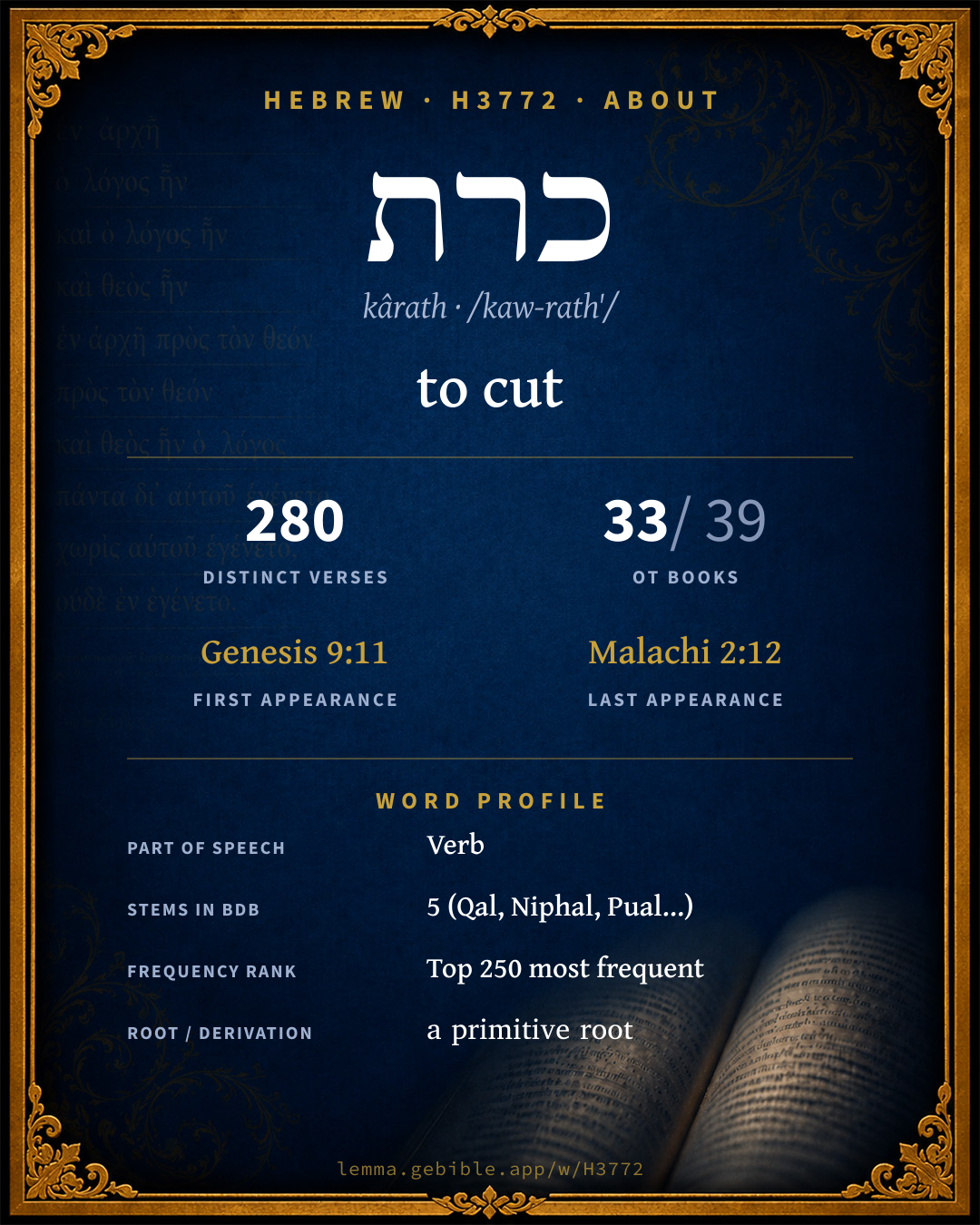
כָּרַת
to cut
also: cut off, cut down, cut out, eliminate fuller range ↓
Full lexicon entry — Brown-Driver-Briggs (BDB)
From Brown-Driver-Briggs (BDB)
Where this word appears
See every Qal verb in the Hebrew Bible →
Grammar key — what these labels mean
Part of speech
- Verb
- An action or state-of-being word.
- Preposition
- A relational word (e.g. “in,” “to,” “from”) governing a noun.
Stem
- Hiphil
- The causative active stem (“he caused / brought about”). Here: ‘cut off’
- Qal
- The basic, simple active stem — the plain form of the verb (“he wrote”). Here: ‘cut off’
- Niphal
- Usually the simple passive or reflexive of the Qal (“he was written”). Here: ‘be cut off’
- Hophal
- The passive counterpart of the Hiphil (“he was caused to…”).
- Pual
- The passive counterpart of the Piel. Here: ‘be cut off’
Form
- Sequential Perfect
- A perfect with prefixed waw continuing a preceding imperfect or command (waw-consecutive perfect).
- Sequential Imperfect
- An imperfect with prefixed waw — the standard past-narrative form (waw-consecutive imperfect).
- Imperfect
- An incomplete, ongoing, or future action (“he will / would write”).
- Perfect
- A completed action or state — Hebrew marks aspect (completeness) more than strict tense (“he wrote”).
- Infinitive Construct
- A bound verbal noun, frequently with prepositions (“to write / in writing”).
- Imperative
- A direct command (“write!”).
- Participle Active
- A verbal adjective expressing ongoing or characteristic action (“writing / one who writes”).
- Cohortative
- A first-person volitional form expressing wish or resolve (“let me / let us write”).
- Jussive
- A third- or second-person volitional form expressing wish or command (“let him write”).
- Infinitive Absolute
- An unbound verbal noun, often intensifying or standing in for a finite verb.
- Participle Passive
- A verbal adjective expressing action received (“written”).
State
- Absolute
- The independent form of a noun, not bound to a following word.
- Construct
- A noun bound to a following noun in a possessive / “of” relationship (the construct chain).
Person
- 1st Person
- The speaker (“I / we”).
- 3rd Person
- The one spoken about (“he / she / it / they”).
- 2nd Person
- The one addressed (“you”).
Gender
- Common
- Either gender — not distinguished for this form.
- Masculine
- Grammatically masculine.
- Feminine
- Grammatically feminine.
Number
- Singular
- One.
- Plural
- More than one (in Hebrew, generally three or more).
Grammatical forms 66 distinct
- Verb, Hiphil, Sequential Perfect, 1st Person, Common, Singular 28 times (10%)
- Verb, Qal, Sequential Imperfect, 3rd Person, Masculine, Singular 23 times (8%)
- Verb, Niphal, Imperfect, 3rd Person, Masculine, Singular 22 times (8%)
- Verb, Qal, Perfect, 3rd Person, Masculine, Singular 21 times (7%)
- Verb, Hiphil, Infinitive Construct 19 times (7%)
- Verb, Niphal, Sequential Perfect, 3rd Person, Feminine, Singular 15 times (5%)
- Verb, Qal, Perfect, 1st Person, Common, Singular 11 times (4%)
- Verb, Qal, Sequential Imperfect, 3rd Person, Masculine, Plural 9 times (3%)
+58 more forms (142 occurrences)
Parsed forms decoded from the imported morphology (morphhb / Westminster Leningrad Codex — WLC text public domain, morphhb tagging CC BY 4.0), counted across 290 parsed occurrences — not distinct verses.
Page 1 of 2 — showing verses 1–200 of 280 distinct verses where H3772 appears, across 33 books. Click any verse to open its interlinear word-by-word view. Verse text shown in the World English Bible for context — . Each verse’s Hebrew form is shown with its reference; the English is not keyword-highlighted, since the data carries no word-level English alignment. Use “Compare translations” on any verse to read it across multiple English versions. This concordance covers the Hebrew Bible; Septuagint (Greek Old Testament) occurrences are not indexed here.
Genesis 8 verses
- Genesis 9:11 יִכָּרֵ֧ת Niphal impf 3ms I will establish my covenant with you; neither will all flesh be cut off any more by the waters of the flood; neither will there any more be a flood to destroy the earth."
- Genesis 15:18 כָּרַ֧ת Qal pf 3ms In that day Yahweh made a covenant with Abram, saying, "To your seed have I given this land, from the river of Egypt to the great river, the river Euphrates:
- Genesis 17:14 וְ/נִכְרְתָ֛ה conj + Niphal wpf 3fs The uncircumcised male who is not circumcised in the flesh of his foreskin, that soul shall be cut off from his people. He has broken my covenant."
- Genesis 21:27 וַ/יִּכְרְת֥וּ conj + Qal wimpf 3mp Abraham took sheep and oxen, and gave them to Abimelech. Those two made a covenant.
- Genesis 21:32 וַ/יִּכְרְת֥וּ conj + Qal wimpf 3mp So they made a covenant at Beersheba. Abimelech rose up with Phicol, the captain of his host, and they returned into the land of the Philistines.
- Genesis 26:28 וְ/נִכְרְתָ֥ה conj + Qal coh 1cp They said, "We saw plainly that Yahweh was with you. We said, 'Let there now be an oath between us, even between us and you, and let us make a covenant with you,
- Genesis 31:44 נִכְרְתָ֥ה Qal coh 1cp Now come, let us make a covenant, you and I; and let it be for a witness between me and you."
- Genesis 41:36 תִכָּרֵ֥ת Niphal impf 3fs The food will be for a store to the land against the seven years of famine, which will be in the land of Egypt; that the land not perish through the famine."
Exodus 14 verses
- Exodus 4:25 וַ/תִּכְרֹת֙ conj + Qal wimpf 3fs Then Zipporah took a flint, and cut off the foreskin of her son, and cast it at his feet; and she said, "Surely you are a bridegroom of blood to me."
- Exodus 8:9 לְ/הַכְרִית֙ prep + Hiphil inf.cs Moses said to Pharaoh, "I give you the honor of setting the time that I should pray for you, and for your servants, and for your people, that the frogs be destroyed from you and your houses, and remain in the river only."
- Exodus 12:15 וְ/נִכְרְתָ֞ה conj + Niphal wpf 3fs Seven days shall you eat unleavened bread; even the first day you shall put away yeast out of your houses, for whoever eats leavened bread from the first day until the seventh day, that soul shall be cut off from Israel.
- Exodus 12:19 וְ/נִכְרְתָ֞ה conj + Niphal wpf 3fs Seven days shall there be no yeast found in your houses, for whoever eats that which is leavened, that soul shall be cut off from the congregation of Israel, whether he be a foreigner, or one who is born in the land.
- Exodus 23:32 תִכְרֹ֥ת Qal impf 2ms You shall make no covenant with them, nor with their gods.
- Exodus 24:8 כָּרַ֤ת Qal pf 3ms Moses took the blood, and sprinkled it on the people, and said, "Look, this is the blood of the covenant, which Yahweh has made with you concerning all these words."
- Exodus 30:33 וְ/נִכְרַ֖ת conj + Niphal wpf 3ms Whoever compounds any like it, or whoever puts any of it on a stranger, he shall be cut off from his people.'"
- Exodus 30:38 וְ/נִכְרַ֖ת conj + Niphal wpf 3ms Whoever shall make any like that, to smell of it, he shall be cut off from his people."
- Exodus 31:14 וְ/נִכְרְתָ֛ה conj + Niphal wpf 3fs You shall keep the Sabbath therefore; for it is holy to you. Everyone who profanes it shall surely be put to death; for whoever does any work therein, that soul shall be cut off from among his people.
- Exodus 34:10 כֹּרֵ֣ת Qal ptcp.act ms He said, "Behold, I make a covenant: before all your people I will do marvels, such as have not been worked in all the earth, nor in any nation; and all the people among which you are shall see the work of Yahweh; for it is an awesome thing that I do with you.
- Exodus 34:12 תִּכְרֹ֤ת Qal impf 2ms Be careful, lest you make a covenant with the inhabitants of the land where you are going, lest it be for a snare in the midst of you:
- Exodus 34:13 תִּכְרֹתֽוּ/ן Qal impf 2mp + sfx n but you shall break down their altars, and dash in pieces their pillars, and you shall cut down their Asherim;
- Exodus 34:15 תִּכְרֹ֥ת Qal impf 2ms Don't make a covenant with the inhabitants of the land, lest they play the prostitute after their gods, and sacrifice to their gods, and one call you and you eat of his sacrifice;
- Exodus 34:27 כָּרַ֧תִּי Qal pf 1cs Yahweh said to Moses, "Write you these words: for in accordance with these words I have made a covenant with you and with Israel."
Leviticus 20 verses
- Leviticus 7:20 וְ/נִכְרְתָ֛ה conj + Niphal wpf 3fs but the soul who eats of the flesh of the sacrifice of peace offerings, that belongs to Yahweh, having his uncleanness on him, that soul shall be cut off from his people.
- Leviticus 7:21 וְ/נִכְרְתָ֛ה conj + Niphal wpf 3fs When anyone touches any unclean thing, the uncleanness of man, or an unclean animal, or any unclean abomination, and eats some of the flesh of the sacrifice of peace offerings, which belong to Yahweh, that soul shall be cut off from his people.'"
- Leviticus 7:25 וְ/נִכְרְתָ֛ה conj + Niphal wpf 3fs For whoever eats the fat of the animal, of which men offer an offering made by fire to Yahweh, even the soul who eats it shall be cut off from his people.
- Leviticus 7:27 וְ/נִכְרְתָ֛ה conj + Niphal wpf 3fs Whoever it is who eats any blood, that soul shall be cut off from his people.'"
- Leviticus 17:4 וְ/נִכְרַ֛ת conj + Niphal wpf 3ms and hasn't brought it to the door of the Tent of Meeting, to offer it as an offering to Yahweh before the tabernacle of Yahweh: blood shall be imputed to that man. He has shed blood; and that man shall be cut off from among his people.
- Leviticus 17:9 וְ/נִכְרַ֛ת conj + Niphal wpf 3ms and doesn't bring it to the door of the Tent of Meeting, to sacrifice it to Yahweh; that man shall be cut off from his people.
- Leviticus 17:10 וְ/הִכְרַתִּ֥י conj + Hiphil wpf 1cs "'Any man of the house of Israel, or of the strangers who live as foreigners among them, who eats any kind of blood, I will set my face against that soul who eats blood, and will cut him off from among his people.
- Leviticus 17:14 יִכָּרֵֽת Niphal impf 3ms For as to the life of all flesh, its blood is with its life: therefore I said to the children of Israel, "You shall not eat the blood of any kind of flesh; for the life of all flesh is its blood. Whoever eats it shall be cut off."
- Leviticus 18:29 וְ/נִכְרְת֛וּ conj + Niphal wpf 3cp "'For whoever shall do any of these abominations, even the souls that do them shall be cut off from among their people.
- Leviticus 19:8 וְ/נִכְרְתָ֛ה conj + Niphal wpf 3fs but everyone who eats it shall bear his iniquity, because he has profaned the holy thing of Yahweh, and that soul shall be cut off from his people.
- Leviticus 20:3 וְ/הִכְרַתִּ֥י conj + Hiphil wpf 1cs I also will set my face against that person, and will cut him off from among his people because he has given of his seed to Molech, to defile my sanctuary, and to profane my holy name.
- Leviticus 20:5 וְ/הִכְרַתִּ֨י conj + Hiphil wpf 1cs then I will set my face against that man, and against his family, and will cut him off, and all who play the prostitute after him, to play the prostitute with Molech, from among their people.
- Leviticus 20:6 וְ/הִכְרַתִּ֥י conj + Hiphil wpf 1cs "'The person that turns to those who are mediums, and to the wizards, to play the prostitute after them, I will even set my face against that person, and will cut him off from among his people.
- Leviticus 20:17 וְ/נִ֨כְרְת֔וּ conj + Niphal wpf 3cp "'If a man takes his sister, his father's daughter, or his mother's daughter, and sees her nakedness, and she sees his nakedness; it is a shameful thing; and they shall be cut off in the sight of the children of their people: he has uncovered his sister's nakedness; he shall bear his iniquity.
- Leviticus 20:18 וְ/נִכְרְת֥וּ conj + Niphal pf 3cp "'If a man lies with a woman having her monthly period, and uncovers her nakedness; he has made naked her fountain, and she has uncovered the fountain of her blood: and both of them shall be cut off from among their people.
- Leviticus 22:3 וְ/נִכְרְתָ֞ה conj + Niphal wpf 3fs Tell them, 'If anyone of all your seed throughout your generations approaches the holy things, which the children of Israel make holy to Yahweh, having his uncleanness on him, that soul shall be cut off from before me. I am Yahweh.
- Leviticus 22:24 וְ/כָר֔וּת conj + Qal ptcp.pass ms That which has its testicles bruised, crushed, broken, or cut, you shall not offer to Yahweh; neither shall you do thus in your land.
- Leviticus 23:29 וְ/נִכְרְתָ֖ה conj + Niphal wpf 3fs For whoever it is who shall not deny himself in that same day; shall be cut off from his people.
- Leviticus 26:22 וְ/הִכְרִ֨יתָה֙ conj + Hiphil wpf 3fs I will send the wild animals among you, which will rob you of your children, destroy your cattle, and make you few in number; and your roads will become desolate.
- Leviticus 26:30 וְ/הִכְרַתִּי֙ conj + Hiphil wpf 1cs I will destroy your high places, and cut down your incense altars, and cast your dead bodies upon the bodies of your idols; and my soul will abhor you.
Numbers 9 verses
- Numbers 4:18 תַּכְרִ֕יתוּ Hiphil juss 2mp "Don't cut off the tribe of the families of the Kohathites from among the Levites;
- Numbers 9:13 וְ/נִכְרְתָ֛ה conj + Niphal wpf 3fs But the man who is clean, and is not on a journey, and fails to keep the Passover, that soul shall be cut off from his people. Because he didn't offer the offering of Yahweh in its appointed season, that man shall bear his sin.
- Numbers 11:33 יִכָּרֵ֑ת Niphal impf 3ms While the flesh was yet between their teeth, before it was chewed, the anger of Yahweh was kindled against the people, and Yahweh struck the people with a very great plague.
- Numbers 13:23 וַ/יִּכְרְת֨וּ conj + Qal wimpf 3mp They came to the valley of Eshcol, and cut down from there a branch with one cluster of grapes, and they bore it on a staff between two; [they brought] also of the pomegranates, and of the figs.
- Numbers 13:24 כָּרְת֥וּ Qal pf 3cp That place was called the valley of Eshcol, because of the cluster which the children of Israel cut down from there.
- Numbers 15:30 וְ/נִכְרְתָ֛ה conj + Niphal wpf 3fs But the soul who does anything with a high hand, whether he is home-born or a foreigner, the same blasphemes Yahweh; and that soul shall be cut off from among his people.
- Numbers 15:31 הִכָּרֵ֧ת תִּכָּרֵ֛ת Niphal inf.abs Niphal impf 3fs Because he has despised the word of Yahweh, and has broken his commandment, that soul shall utterly be cut off; his iniquity shall be on him.
- Numbers 19:13 וְ/נִכְרְתָ֛ה conj + Niphal wpf 3fs Whoever touches a dead person, the body of a man who has died, and doesn't purifies himself, defiles the tent of Yahweh; and that soul shall be cut off from Israel: because the water for impurity was not sprinkled on him, he shall be unclean; his uncleanness is yet on him.
- Numbers 19:20 וְ/נִכְרְתָ֛ה conj + Niphal wpf 3fs But the man who shall be unclean, and shall not purify himself, that soul shall be cut off from the midst of the assembly, because he has defiled the sanctuary of Yahweh: the water for impurity has not been sprinkled on him; he is unclean.
Deuteronomy 16 verses
- Deuteronomy 4:23 כָּרַ֖ת Qal pf 3ms Take heed to yourselves, lest you forget the covenant of Yahweh your God, which he made with you, and make you an engraved image in the form of anything which Yahweh your God has forbidden you.
- Deuteronomy 5:2 כָּרַ֥ת Qal pf 3ms Yahweh our God made a covenant with us in Horeb.
- Deuteronomy 5:3 כָּרַ֥ת Qal pf 3ms Yahweh didn't make this covenant with our fathers, but with us, even us, who are all of us here alive this day.
- Deuteronomy 7:2 תִכְרֹ֥ת Qal impf 2ms and when Yahweh your God shall deliver them up before you, and you shall strike them; then you shall utterly destroy them: you shall make no covenant with them, nor show mercy to them;
- Deuteronomy 9:9 כָּרַ֥ת Qal pf 3ms When I was gone up onto the mountain to receive the tables of stone, even the tables of the covenant which Yahweh made with you, then I stayed on the mountain forty days and forty nights; I did neither eat bread nor drink water.
- Deuteronomy 12:29 יַכְרִית֩ Hiphil impf 3ms When Yahweh your God shall cut off the nations from before you, where you go in to dispossess them, and you dispossess them, and dwell in their land;
- Deuteronomy 19:1 יַכְרִ֞ית Hiphil impf 3ms When Yahweh your God shall cut off the nations, whose land Yahweh your God gives you, and you succeed them, and dwell in their cities, and in their houses;
- Deuteronomy 19:5 לִ/כְרֹ֣ת prep + Qal inf.cs as when a man goes into the forest with his neighbor to hew wood, and his hand fetches a stroke with the axe to cut down the tree, and the head slips from the handle, and lights on his neighbor, so that he dies; he shall flee to one of these cities and live:
- Deuteronomy 20:19 תִכְרֹ֑ת Qal impf 2ms When you shall besiege a city a long time, in making war against it to take it, you shall not destroy the trees of it by wielding an axe against them; for you may eat of them, and you shall not cut them down; for is the tree of the field man, that it should be besieged of you?
- Deuteronomy 20:20 וְ/כָרָ֑תָּ conj + Qal wpf 2ms Only the trees of which you know that they are not trees for food, you shall destroy and cut them down; and you shall build bulwarks against the city that makes war with you, until it fall.
- Deuteronomy 23:1 וּ/כְר֥וּת conj + Qal ptcp.pass ms cs He who is wounded in the stones, or has his privy member cut off, shall not enter into the assembly of Yahweh.
- Deuteronomy 29:1 לִ/כְרֹ֛ת כָּרַ֥ת prep + Qal inf.cs Qal pf 3ms These are the words of the covenant which Yahweh commanded Moses to make with the children of Israel in the land of Moab, besides the covenant which he made with them in Horeb.
- Deuteronomy 29:12 כֹּרֵ֥ת Qal ptcp.act ms that you may enter into the covenant of Yahweh your God, and into his oath, which Yahweh your God makes with you this day;
- Deuteronomy 29:14 כֹּרֵת֙ Qal ptcp.act ms Neither with you only do I make this covenant and this oath,
- Deuteronomy 29:25 כָּרַ֣ת Qal pf 3ms Then men shall say, Because they forsook the covenant of Yahweh, the God of their fathers, which he made with them when he brought them forth out of the land of Egypt,
- Deuteronomy 31:16 כָּרַ֖תִּי Qal pf 1cs Yahweh said to Moses, Behold, you shall sleep with your fathers; and this people will rise up, and play the prostitute after the strange gods of the land, where they go to be among them, and will forsake me, and break my covenant which I have made with them.
Joshua 13 verses
- Joshua 3:13 יִכָּ֣רֵת֔וּ/ן Niphal impf 3mp + sfx n It shall come to pass, when the soles of the feet of the priests who bear the ark of Yahweh, the Lord of all the earth, shall rest in the waters of the Jordan, that the waters of the Jordan shall be cut off, even the waters that come down from above; and they shall stand in one heap.
- Joshua 3:16 נִכְרָ֑תוּ Niphal pf 3cp that the waters which came down from above stood, and rose up in one heap, a great way off, at Adam, the city that is beside Zarethan; and those that went down toward the sea of the Arabah, even the Salt Sea, were wholly cut off: and the people passed over right against Jericho.
- Joshua 4:7 נִכְרְת֜וּ נִכְרְת֖וּ Niphal pf 3cp Niphal pf 3cp then you shall tell them, Because the waters of the Jordan were cut off before the ark of the covenant of Yahweh; when it passed over the Jordan, the waters of the Jordan were cut off: and these stones shall be for a memorial to the children of Israel forever.
- Joshua 7:9 וְ/הִכְרִ֥יתוּ conj + Hiphil wpf 3cp For the Canaanites and all the inhabitants of the land will hear of it, and will compass us round, and cut off our name from the earth: and what will you do for your great name?
- Joshua 9:6 כִּרְתוּ Qal impv 2mp They went to Joshua to the camp at Gilgal, and said to him, and to the men of Israel, We are come from a far country: now therefore make you a covenant with us.
- Joshua 9:7 אכרות אֶֽכְרָת לְ/ךָ֥ Qal impf 1cs Qal impf 1cs prep + sfx pers 2ms The men of Israel said to the Hivites, What if you dwell among us; and how shall we make a covenant with you?
- Joshua 9:11 כִּרְתוּ Qal impv 2mp Our elders and all the inhabitants of our country spoke to us, saying, Take provision in your hand for the journey, and go to meet them, and tell them, We are your servants: and now make you a covenant with us.
- Joshua 9:15 וַ/יִּכְרֹ֥ת conj + Qal wimpf 3ms Joshua made peace with them, and made a covenant with them, to let them live: and the princes of the congregation swore to them.
- Joshua 9:16 כָּרְת֥וּ Qal pf 3cp It happened at the end of three days after they had made a covenant with them, that they heard that they were their neighbors, and that they lived among them.
- Joshua 9:23 יִכָּרֵ֨ת Niphal impf 3ms Now therefore you are cursed, and there shall never fail to be of you bondservants, both wood cutters and drawers of water for the house of my God.
- Joshua 11:21 וַ/יַּכְרֵ֤ת conj + Hiphil wimpf 3ms Joshua came at that time, and cut off the Anakim from the hill-country, from Hebron, from Debir, from Anab, and from all the hill-country of Judah, and from all the hill-country of Israel: Joshua utterly destroyed them with their cities.
- Joshua 23:4 הִכְרַ֔תִּי Hiphil pf 1cs Behold, I have allotted to you these nations that remain, to be an inheritance for your tribes, from the Jordan, with all the nations that I have cut off, even to the great sea toward the going down of the sun.
- Joshua 24:25 וַ/יִּכְרֹ֨ת conj + Qal wimpf 3ms So Joshua made a covenant with the people that day, and set them a statute and an ordinance in Shechem.
Judges 8 verses
- Judges 2:2 תִכְרְת֤וּ Qal impf 2mp and you shall make no covenant with the inhabitants of this land; you shall break down their altars. But you have not listened to my voice: why have you done this?
- Judges 4:24 הִכְרִ֔יתוּ Hiphil pf 3cp The hand of the children of Israel prevailed more and more against Jabin the king of Canaan, until they had destroyed Jabin king of Canaan.
- Judges 6:25 תִּכְרֹֽת Qal juss 2ms It happened the same night, that Yahweh said to him, Take your father's bull, even the second bull seven years old, and throw down the altar of Baal that your father has, and cut down the Asherah that is by it;
- Judges 6:26 תִּכְרֹֽת Qal impf 2ms and build an altar to Yahweh your God on the top of this stronghold, in the orderly manner, and take the second bull, and offer a burnt offering with the wood of the Asherah which you shall cut down.
- Judges 6:28 כֹּרָ֑תָה Pual pf 3fs When the men of the city arose early in the morning, behold, the altar of Baal was broken down, and the Asherah was cut down that was by it, and the second bull was offered on the altar that was built.
- Judges 6:30 כָרַ֖ת Qal pf 3ms Then the men of the city said to Joash, Bring out your son, that he may die, because he has broken down the altar of Baal, and because he has cut down the Asherah that was by it.
- Judges 9:48 וַ/יִּכְרֹת֙ conj + Qal wimpf 3ms Abimelech got him up to Mount Zalmon, he and all the people who were with him; and Abimelech took an axe in his hand, and cut down a bough from the trees, and took it up, and laid it on his shoulder: and he said to the people who were with him, What you have seen me do, make haste, and do as I have done.
- Judges 9:49 וַ/יִּכְרְת֨וּ conj + Qal wimpf 3mp All the people likewise cut down every man his bough, and followed Abimelech, and put them to the stronghold, and set the stronghold on fire on them; so that all the men of the tower of Shechem died also, about a thousand men and women.
Ruth 1 verse
1 Samuel 16 verses
- 1 Samuel 2:33 אַכְרִ֤ית Hiphil impf 1cs The man of yours, [whom] I shall not cut off from my altar, [shall be] to consume your eyes, and to grieve your heart; and all the increase of your house shall die in the flower of their age.
- 1 Samuel 5:4 כְּרֻתוֹת֙ Qal ptcp.pass fp When they arose early on the next day morning, behold, Dagon was fallen on his face to the ground before the ark of Yahweh; and the head of Dagon and both the palms of his hands [lay] cut off on the threshold; only [the stump of] Dagon was left to him.
- 1 Samuel 11:1 כְּרָת Qal impv 2ms Then Nahash the Ammonite came up, and encamped against Jabesh Gilead: and all the men of Jabesh said to Nahash, Make a covenant with us, and we will serve you.
- 1 Samuel 11:2 אֶכְרֹ֣ת Qal impf 1cs Nahash the Ammonite said to them, On this condition will I make it with you, that all your right eyes be put out; and I will lay it for a reproach on all Israel.
- 1 Samuel 17:51 וַ/יִּכְרָת conj + Qal wimpf 3ms Then David ran, and stood over the Philistine, and took his sword, and drew it out of the sheath of it, and killed him, and cut off his head therewith. When the Philistines saw that their champion was dead, they fled.
- 1 Samuel 18:3 וַ/יִּכְרֹ֧ת conj + Qal wimpf 3ms Then Jonathan and David made a covenant, because he loved him as his own soul.
- 1 Samuel 20:15 תַכְרִ֧ת בְּ/הַכְרִ֤ת Hiphil impf 2ms prep + Hiphil inf.cs but also you shall not cut off your kindness from my house forever; no, not when Yahweh has cut off the enemies of David everyone from the surface of the earth.
- 1 Samuel 20:16 וַ/יִּכְרֹ֥ת conj + Qal wimpf 3ms So Jonathan made a covenant with the house of David, [saying], Yahweh will require it at the hand of David's enemies.
- 1 Samuel 22:8 בִּ/כְרָת prep + Qal inf.cs that all of you have conspired against me, and there is none who discloses to me when my son makes a league with the son of Jesse, and there is none of you who is sorry for me, or discloses to me that my son has stirred up my servant against me, to lie in wait, as at this day?
- 1 Samuel 23:18 וַ/יִּכְרְת֧וּ conj + Qal wimpf 3mp They two made a covenant before Yahweh: and David abode in the wood, and Jonathan went to his house.
- 1 Samuel 24:4 וַ/יִּכְרֹ֛ת conj + Qal wimpf 3ms The men of David said to him, Behold, the day of which Yahweh said to you, Behold, I will deliver your enemy into your hand, and you shall do to him as it shall seem good to you. Then David arose, and cut off the skirt of Saul's robe secretly.
- 1 Samuel 24:5 כָּרַ֔ת Qal pf 3ms It happened afterward, that David's heart struck him, because he had cut off Saul's skirt.
- 1 Samuel 24:11 בְּ/כָרְתִ/י֩ prep + Qal inf.cs + sfx pers 1cs Moreover, my father, behold, yes, see the skirt of your robe in my hand; for in that I cut off the skirt of your robe, and didn't kill you, know you and see that there is neither evil nor disobedience in my hand, and I have not sinned against you, though you hunt after my life to take it.
- 1 Samuel 24:21 תַּכְרִ֥ית Hiphil impf 2ms Swear now therefore to me by Yahweh, that you will not cut off my seed after me, and that you will not destroy my name out of my father's house.
- 1 Samuel 28:9 הִכְרִ֛ית Hiphil pf 3ms The woman said to him, Behold, you know what Saul has done, how he has cut off those who have familiar spirits, and the wizards, out of the land: why then lay you a snare for my life, to cause me to die?
- 1 Samuel 31:9 וַֽ/יִּכְרְתוּ֙ conj + Qal wimpf 3mp They cut off his head, and stripped off his armor, and sent into the land of the Philistines round about, to carry the news to the house of their idols, and to the people.
2 Samuel 8 verses
- 2 Samuel 3:12 כָּרְתָ֤/ה Qal impv 2ms + sfx h Abner sent messengers to David on his behalf, saying, Whose is the land? saying [also], Make your league with me, and, behold, my hand shall be with you, to bring about all Israel to you.
- 2 Samuel 3:13 אֶכְרֹ֥ת Qal impf 1cs He said, Well; I will make a league with you; but one thing I require of you: that is, you shall not see my face, except you first bring Michal, Saul's daughter, when you come to see my face.
- 2 Samuel 3:21 וְ/יִכְרְת֤וּ conj + Qal impf 3mp Abner said to David, I will arise and go, and will gather all Israel to my lord the king, that they may make a covenant with you, and that you may reign over all that your soul desires. David sent Abner away; and he went in peace.
- 2 Samuel 3:29 יִכָּרֵ֣ת Niphal juss 3ms let it fall on the head of Joab, and on all his father's house; and let there not fail from the house of Joab one who has an issue, or who is a leper, or who leans on a staff, or who falls by the sword, or who lacks bread.
- 2 Samuel 5:3 וַ/יִּכְרֹ֣ת conj + Qal wimpf 3ms So all the elders of Israel came to the king to Hebron; and king David made a covenant with them in Hebron before Yahweh: and they anointed David king over Israel.
- 2 Samuel 7:9 וָ/אַכְרִ֥תָ/ה conj + Hiphil wimpf 1cs + sfx dem and I have been with you wherever you went, and have cut off all your enemies from before you; and I will make you a great name, like the name of the great ones who are in the earth.
- 2 Samuel 10:4 וַ/יִּכְרֹ֧ת conj + Qal wimpf 3ms So Hanun took David's servants, and shaved off the one half of their beards, and cut off their garments in the middle, even to their buttocks, and sent them away.
- 2 Samuel 20:22 וַֽ/יִּכְרְת֞וּ conj + Qal wimpf 3mp Then the woman went to all the people in her wisdom. They cut off the head of Sheba the son of Bichri, and threw it out to Joab. He blew the trumpet, and they were dispersed from the city, every man to his tent. Joab returned to Jerusalem to the king.
1 Kings 16 verses
- 1 Kings 2:4 יִכָּרֵ֤ת Niphal impf 3ms That Yahweh may establish his word which he spoke concerning me, saying, If your children take heed to their way, to walk before me in truth with all their heart and with all their soul, there shall not fail you (said he) a man on the throne of Israel.
- 1 Kings 5:6 וְ/יִכְרְתוּ לִ/כְרָת conj + Qal juss 3mp prep + Qal inf.cs Now therefore command you that they cut me cedar trees out of Lebanon; and my servants shall be with your servants; and I will give you hire for your servants according to all that you shall say: for you know that there is not among us any who knows how to cut timber like the Sidonians.
- 1 Kings 5:12 וַ/יִּכְרְת֥וּ conj + Qal wimpf 3mp Yahweh gave Solomon wisdom, as he promised him; and there was peace between Hiram and Solomon; and they two made a league together.
- 1 Kings 8:9 כָּרַ֤ת Qal pf 3ms There was nothing in the ark save the two tables of stone which Moses put there at Horeb, when Yahweh made a covenant with the children of Israel, when they came out of the land of Egypt.
- 1 Kings 8:21 כָּרַת֙ Qal pf 3ms There have I set a place for the ark, in which is the covenant of Yahweh, which he made with our fathers, when he brought them out of the land of Egypt.
- 1 Kings 8:25 יִכָּרֵ֨ת Niphal impf 3ms Now therefore, Yahweh, the God of Israel, keep with your servant David my father that which you have promised him, saying, There shall not fail you a man in my sight to sit on the throne of Israel, if only your children take heed to their way, to walk before me as you have walked before me.
- 1 Kings 9:5 יִכָּרֵ֤ת Niphal impf 3ms then I will establish the throne of your kingdom over Israel forever, according as I promised to David your father, saying, There shall not fail you a man on the throne of Israel.
- 1 Kings 9:7 וְ/הִכְרַתִּ֣י conj + Hiphil wpf 1cs then will I cut off Israel out of the land which I have given them; and this house, which I have made holy for my name, will I cast out of my sight; and Israel shall be a proverb and a byword among all peoples.
- 1 Kings 11:16 הִכְרִ֥ית Hiphil pf 3ms (for Joab and all Israel remained there six months, until he had cut off every male in Edom);
- 1 Kings 14:10 וְ/הִכְרַתִּ֤י conj + Hiphil wpf 1cs therefore, behold, I will bring evil on the house of Jeroboam, and will cut off from Jeroboam every man-child, him who is shut up and him who is left at large in Israel, and will utterly sweep away the house of Jeroboam, as a man sweeps away dung, until it be all gone.
- 1 Kings 14:14 יַכְרִ֛ית Hiphil impf 3ms Moreover Yahweh will raise him up a king over Israel, who shall cut off the house of Jeroboam that day: but what? even now.
- 1 Kings 15:13 וַ/יִּכְרֹ֤ת conj + Qal wimpf 3ms Also Maacah his mother he removed from being queen, because she had made an abominable image for an Asherah; and Asa cut down her image, and burnt it at the brook Kidron.
- 1 Kings 18:4 בְּ/הַכְרִ֣ית prep + Hiphil inf.cs for it was so, when Jezebel cut off the prophets of Yahweh, that Obadiah took one hundred prophets, and hid them by fifty in a cave, and fed them with bread and water.)
- 1 Kings 18:5 נַכְרִ֖ית Hiphil impf 1cp Ahab said to Obadiah, Go through the land, to all the springs of water, and to all the brooks: peradventure we may find grass and save the horses and mules alive, that we not lose all the animals.
- 1 Kings 20:34 וַ/יִּכְרָת conj + Qal wimpf 3ms [Ben Hadad] said to him, The cities which my father took from your father I will restore; and you shall make streets for you in Damascus, as my father made in Samaria. I, [said Ahab], will let you go with this covenant. So he made a covenant with him, and let him go.
- 1 Kings 21:21 וְ/הִכְרַתִּ֤י conj + Hiphil wpf 1cs Behold, I will bring evil on you, and will utterly sweep you away and will cut off from Ahab every man-child, and him who is shut up and him who is left at large in Israel:
2 Kings 10 verses
- 2 Kings 9:8 וְ/הִכְרַתִּ֤י conj + Hiphil pf 1cs For the whole house of Ahab shall perish; and I will cut off from Ahab every man-child, and him who is shut up and him who is left at large in Israel.
- 2 Kings 11:4 וַ/יִּכְרֹת֩ conj + Qal wimpf 3ms In the seventh year Jehoiada sent and fetched the captains over hundreds of the Carites and of the guard, and brought them to him into the house of Yahweh; and he made a covenant with them, and took an oath of them in the house of Yahweh, and shown them the king's son.
- 2 Kings 11:17 וַ/יִּכְרֹ֨ת conj + Qal wimpf 3ms Jehoiada made a covenant between Yahweh and the king and the people, that they should be Yahweh's people; between the king also and the people.
- 2 Kings 17:15 כָּרַ֣ת Qal pf 3ms They rejected his statutes, and his covenant that he made with their fathers, and his testimonies which he testified to them; and they followed vanity, and became vain, and [went] after the nations that were round about them, concerning whom Yahweh had charged those who they should not do like them.
- 2 Kings 17:35 וַ/יִּכְרֹ֨ת conj + Qal wimpf 3ms with whom Yahweh had made a covenant, and charged them, saying, You shall not fear other gods, nor bow yourselves to them, nor serve them, nor sacrifice to them:
- 2 Kings 17:38 כָּרַ֥תִּי Qal pf 1cs and the covenant that I have made with you you shall not forget; neither shall you fear other gods:
- 2 Kings 18:4 וְ/כָרַ֖ת conj + Qal pf 3ms He removed the high places, and broke the pillars, and cut down the Asherah: and he broke in pieces the brazen serpent that Moses had made; for to those days the children of Israel did burn incense to it; and he called it Nehushtan.
- 2 Kings 19:23 וְ/אֶכְרֹ֞ת conj + Qal impf 1cs By your messengers you have defied the Lord, and have said, With the multitude of my chariots am I come up to the height of the mountains, to the innermost parts of Lebanon; and I will cut down the tall cedars of it, and the choice fir trees of it; and I will enter into his farthest lodging-place, the forest of his fruitful field.
- 2 Kings 23:3 וַ/יִּכְרֹ֥ת conj + Qal wimpf 3ms The king stood by the pillar, and made a covenant before Yahweh, to walk after Yahweh, and to keep his commandments, and his testimonies, and his statutes, with all [his] heart, and all [his] soul, to confirm the words of this covenant that were written in this book: and all the people stood to the covenant.
- 2 Kings 23:14 וַ/יִּכְרֹ֖ת conj + Qal wimpf 3ms He broke in pieces the pillars, and cut down the Asherim, and filled their places with the bones of men.
1 Chronicles 4 verses
- 1 Chronicles 11:3 וַ/יִּכְרֹת֩ conj + Qal wimpf 3ms So all the elders of Israel came to the king to Hebron; and David made a covenant with them in Hebron before Yahweh; and they anointed David king over Israel, according to the word of Yahweh by Samuel.
- 1 Chronicles 16:16 כָּרַת֙ Qal pf 3ms [The covenant] which he made with Abraham, His oath to Isaac,
- 1 Chronicles 17:8 וָ/אַכְרִ֥ית conj + Hiphil wimpf 1cs and I have been with you wherever you have gone, and have cut off all your enemies from before you; and I will make you a name, like the name of the great ones who are in the earth.
- 1 Chronicles 19:4 וַ/יִּכְרֹ֧ת conj + Qal wimpf 3ms So Hanun took David's servants, and shaved them, and cut off their garments in the middle, even to their buttocks, and sent them away.
2 Chronicles 14 verses
- 2 Chronicles 2:8 לִ/כְר֖וֹת prep + Qal inf.cs Send me also cedar trees, fir trees, and algum trees, out of Lebanon; for I know that your servants know how to cut timber in Lebanon: and, behold, my servants shall be with your servants,
- 2 Chronicles 2:10 לְֽ/כֹרְתֵ֣י prep + Qal ptcp.act mp cs Behold, I will give to your servants, the cutters who cut timber, twenty thousand measures of beaten wheat, and twenty thousand measures of barley, and twenty thousand baths of wine, and twenty thousand baths of oil.
- 2 Chronicles 2:16 נִכְרֹ֨ת Qal impf 1cp and we will cut wood out of Lebanon, as much as you shall need; and we will bring it to you in floats by sea to Joppa; and you shall carry it up to Jerusalem.
- 2 Chronicles 5:10 כָּרַ֤ת Qal pf 3ms There was nothing in the ark save the two tables which Moses put [there] at Horeb, when Yahweh made a covenant with the children of Israel, when they came out of Egypt.
- 2 Chronicles 6:11 כָּרַ֖ת Qal pf 3ms There have I set the ark, in which is the covenant of Yahweh, which he made with the children of Israel.
- 2 Chronicles 6:16 יִכָּרֵ֨ת Niphal impf 3ms Now therefore, Yahweh, the God of Israel, keep with your servant David my father that which you have promised him, saying, There shall not fail you a man in my sight to sit on the throne of Israel, if only your children take heed to their way, to walk in my law as you have walked before me.
- 2 Chronicles 7:18 כָּרַ֗תִּי יִכָּרֵ֤ת Qal pf 1cs Niphal impf 3ms then I will establish the throne of your kingdom, according as I covenanted with David your father, saying, There shall not fail you a man to be ruler in Israel.
- 2 Chronicles 15:16 וַ/יִּכְרֹ֤ת conj + Qal wimpf 3ms Also Maacah, the mother of Asa the king, he removed from being queen, because she had made an abominable image for an Asherah; and Asa cut down her image, and made dust of it, and burnt it at the brook Kidron.
- 2 Chronicles 21:7 כָּרַ֖ת Qal pf 3ms However Yahweh would not destroy the house of David, because of the covenant that he had made with David, and as he promised to give a lamp to him and to his children always.
- 2 Chronicles 22:7 לְ/הַכְרִ֖ית prep + Hiphil inf.cs Now the destruction of Ahaziah was of God, in that he went to Joram: for when he was come, he went out with Jehoram against Jehu the son of Nimshi, whom Yahweh had anointed to cut off the house of Ahab.
- 2 Chronicles 23:3 וַ/יִּכְרֹ֨ת conj + Qal wimpf 3ms All the assembly made a covenant with the king in the house of God. He said to them, Behold, the king's son shall reign, as Yahweh has spoken concerning the sons of David.
- 2 Chronicles 23:16 וַ/יִּכְרֹ֤ת conj + Qal wimpf 3ms Jehoiada made a covenant between himself, and all the people, and the king, that they should be Yahweh's people.
- 2 Chronicles 29:10 לִ/כְר֣וֹת prep + Qal inf.cs Now it is in my heart to make a covenant with Yahweh, the God of Israel, that his fierce anger may turn away from us.
- 2 Chronicles 34:31 וַ/יִּכְרֹ֣ת conj + Qal wimpf 3ms The king stood in his place, and made a covenant before Yahweh, to walk after Yahweh, and to keep his commandments, and his testimonies, and his statutes, with all his heart, and with all his soul, to perform the words of the covenant that were written in this book.
Ezra 1 verse
Nehemiah 2 verses
- Nehemiah 9:8 וְ/כָר֨וֹת conj + Qal inf.abs and found his heart faithful before you, and made a covenant with him to give the land of the Canaanite, the Hittite, the Amorite, and the Perizzite, and the Jebusite, and the Girgashite, to give it to his seed, and have performed your words; for you are righteous.
- Nehemiah 9:38 כֹּרְתִ֥ים Qal ptcp.act mp Yet for all this we make a sure covenant, and write it; and our princes, our Levites, [and] our priests, seal to it.
Job 3 verses
- Job 14:7 יִ֭כָּרֵת Niphal impf 3ms "For there is hope for a tree, If it is cut down, that it will sprout again, That the tender branch of it will not cease.
- Job 31:1 כָּרַ֣תִּי Qal pf 1cs "I made a covenant with my eyes, How then should I look lustfully at a young woman?
- Job 41:4 הֲ/יִכְרֹ֣ת ptcl inter + Qal impf 3ms Will he make a covenant with you, That you should take him for a servant forever?
Psalms 14 verses
- Psalms 12:3 יַכְרֵ֣ת Hiphil juss 3ms May Yahweh cut off all flattering lips, And the tongue that boasts,
- Psalms 34:16 לְ/הַכְרִ֖ית prep + Hiphil inf.cs Yahweh's face is against those who do evil, To cut off the memory of them from the earth.
- Psalms 37:9 יִכָּרֵת֑וּ/ן Niphal impf 3mp + sfx n For evildoers shall be cut off, But those who wait for Yahweh shall inherit the land.
- Psalms 37:22 יִכָּרֵֽתוּ Niphal impf 3mp For such as are blessed by him shall inherit the land. Those who are cursed by him shall be cut off.
- Psalms 37:28 נִכְרָֽת Niphal pf 3ms For Yahweh loves justice, And doesn't forsake his saints. They are preserved forever, But the children of the wicked shall be cut off.
- Psalms 37:34 בְּ/הִכָּרֵ֖ת prep + Niphal inf.cs Wait for Yahweh, and keep his way, And he will exalt you to inherit the land. When the wicked are cut off, you shall see it.
- Psalms 37:38 נִכְרָֽתָה Niphal pf 3fs As for transgressors, they shall be destroyed together. The future of the wicked shall be cut off.
- Psalms 50:5 כֹּרְתֵ֖י Qal ptcp.act mp cs "Gather my saints together to me, Those who have made a covenant with me by sacrifice."
- Psalms 83:5 יִכְרֹֽתוּ Qal impf 3mp For they have conspired together with one mind. They form an alliance against you.
- Psalms 89:3 כָּרַ֣תִּֽי Qal pf 1cs "I have made a covenant with my chosen one, I have sworn to David, my servant,
- Psalms 101:8 לְ/הַכְרִ֥ית prep + Hiphil inf.cs Morning by morning, I will destroy all the wicked of the land; To cut off all the workers of iniquity from Yahweh's city.
- Psalms 105:9 כָּ֭רַת Qal pf 3ms The covenant which he made with Abraham, His oath to Isaac,
- Psalms 109:13 לְ/הַכְרִ֑ית prep + Hiphil inf.cs Let his posterity be cut off. In the generation following let their name be blotted out.
- Psalms 109:15 וְ/יַכְרֵ֖ת conj + Hiphil impf 3ms Let them be before Yahweh continually, That he may cut off the memory of them from the earth;
Proverbs 4 verses
- Proverbs 2:22 יִכָּרֵ֑תוּ Niphal impf 3mp But the wicked will be cut off from the land. The treacherous will be rooted out of it.
- Proverbs 10:31 תִּכָּרֵֽת Niphal impf 3fs The mouth of the righteous brings forth wisdom, But the perverse tongue will be cut off.
- Proverbs 23:18 תִכָּרֵֽת Niphal impf 3fs Indeed surely there is a future hope, And your hope will not be cut off.
- Proverbs 24:14 תִכָּרֵֽת Niphal impf 3fs So you shall know wisdom to be to your soul; If you have found it, then there will be a reward, Your hope will not be cut off.
Isaiah 18 verses
- Isaiah 9:14 וַ/יַּכְרֵ֨ת conj + Hiphil wimpf 3ms Therefore Yahweh will cut off from Israel head and tail, palm-branch and rush, in one day.
- Isaiah 10:7 וּ/לְ/הַכְרִ֥ית conj + prep + Hiphil inf.cs However he doesn't mean so, neither does his heart think so; but it is in his heart to destroy, and to cut off not a few nations.
- Isaiah 11:13 יִכָּרֵ֑תוּ Niphal impf 3mp The envy also of Ephraim shall depart, and those who vex Judah shall be cut off: Ephraim shall not envy Judah, and Judah shall not vex Ephraim.
- Isaiah 14:8 הַ/כֹּרֵ֖ת ptcl def.art + Qal ptcp.act ms Yes, the fir trees rejoice at you, [and] the cedars of Lebanon, [saying], Since you are laid low, no lumberjack is come up against us.
- Isaiah 14:22 וְ/הִכְרַתִּ֨י conj + Hiphil wpf 1cs I will rise up against them, says Yahweh of Hosts, and cut off from Babylon name and remnant, and son and son's son, says Yahweh.
- Isaiah 18:5 וְ/כָרַ֤ת conj + Qal pf 3ms For before the harvest, when the blossom is over, and the flower becomes a ripening grape, he will cut off the sprigs with pruning-hooks, and the spreading branches will he take away [and] cut down.
- Isaiah 22:25 וְ/נִכְרַת֙ conj + Niphal wpf 3ms In that day, says Yahweh of hosts, shall the nail that was fastened in a sure place give way; and it shall be hewn down, and fall; and the burden that was on it shall be cut off; for Yahweh has spoken it.
- Isaiah 28:15 כָּרַ֤תְנֽוּ Qal pf 1cp Because you have said, We have made a covenant with death, and with Sheol are we at agreement; when the overflowing scourge shall pass through, it shall not come to us; for we have made lies our refuge, and under falsehood have we hid ourselves:
- Isaiah 29:20 וְ/נִכְרְת֖וּ conj + Niphal wpf 3cp For the terrible one is brought to nothing, and the scoffer ceases, and all those who watch for iniquity are cut off;
- Isaiah 37:24 וְ/אֶכְרֹ֞ת conj + Qal impf 1cs By your servants have you defied the Lord, and have said, With the multitude of my chariots am I come up to the height of the mountains, to the innermost parts of Lebanon; and I will cut down the tall cedars of it, and the choice fir trees of it; and I will enter into its farthest height, the forest of its fruitful field;
- Isaiah 44:14 לִ/כְרָת prep + Qal inf.cs He cuts down cedars for himself, and takes the cypress and the oak, and strengthens for himself one among the trees of the forest: he plants a fir tree, and the rain nourishes it.
- Isaiah 48:9 הַכְרִיתֶֽ/ךָ Hiphil inf.cs + sfx pers 2ms For my name's sake will I defer my anger, and for my praise will I refrain for you, that I not cut you off.
- Isaiah 48:19 יִכָּרֵ֧ת Niphal impf 3ms your seed also had been as the sand, and the offspring of your loins like the grains of it: his name would not be cut off nor destroyed from before me.
- Isaiah 55:3 וְ/אֶכְרְתָ֤ה conj + Qal coh 1cs Turn your ear, and come to me; hear, and your soul shall live: and I will make an everlasting covenant with you, even the sure mercies of David.
- Isaiah 55:13 יִכָּרֵֽת Niphal impf 3ms Instead of the thorn shall come up the fir tree; and instead of the brier shall come up the myrtle tree: and it shall be to Yahweh for a name, for an everlasting sign that shall not be cut off.
- Isaiah 56:5 יִכָּרֵֽת Niphal impf 3ms To them will I give in my house and within my walls a memorial and a name better than of sons and of daughters; I will give them an everlasting name, that shall not be cut off.
- Isaiah 57:8 וַ/תִּכְרָת conj + Qal wimpf 2fs Behind the doors and the posts have you set up your memorial: for you have uncovered [yourself] to another than me, and are gone up; you have enlarged your bed, and made you a covenant with them: you loved their bed where you saw it.
- Isaiah 61:8 אֶכְר֥וֹת Qal impf 1cs For I, Yahweh, love justice, I hate robbery with iniquity; and I will give them their recompense in truth, and I will make an everlasting covenant with them.
Jeremiah 26 verses
About this entry
At a glance — auto-summarized from this page’s data, not written by a person. Every figure links to its source below. This summary describes the numbers; it doesn’t interpret them.
The Hebrew verb כרת centers on the idea of “to cut.” Its English rendering has broadened — “shall be cut off” classically, “cut” (unfoldingWord Literal Text) in modern versions; see the renderings breakdown. Spanning 280 verses in 33 books, it ranks among the common words of the Hebrew Bible. Its earliest occurrence is Genesis 9:11. Read the stem: it spans 5 stems, including Qal and Niphal. Dig into 280-verse concordance and the renderings breakdown below.
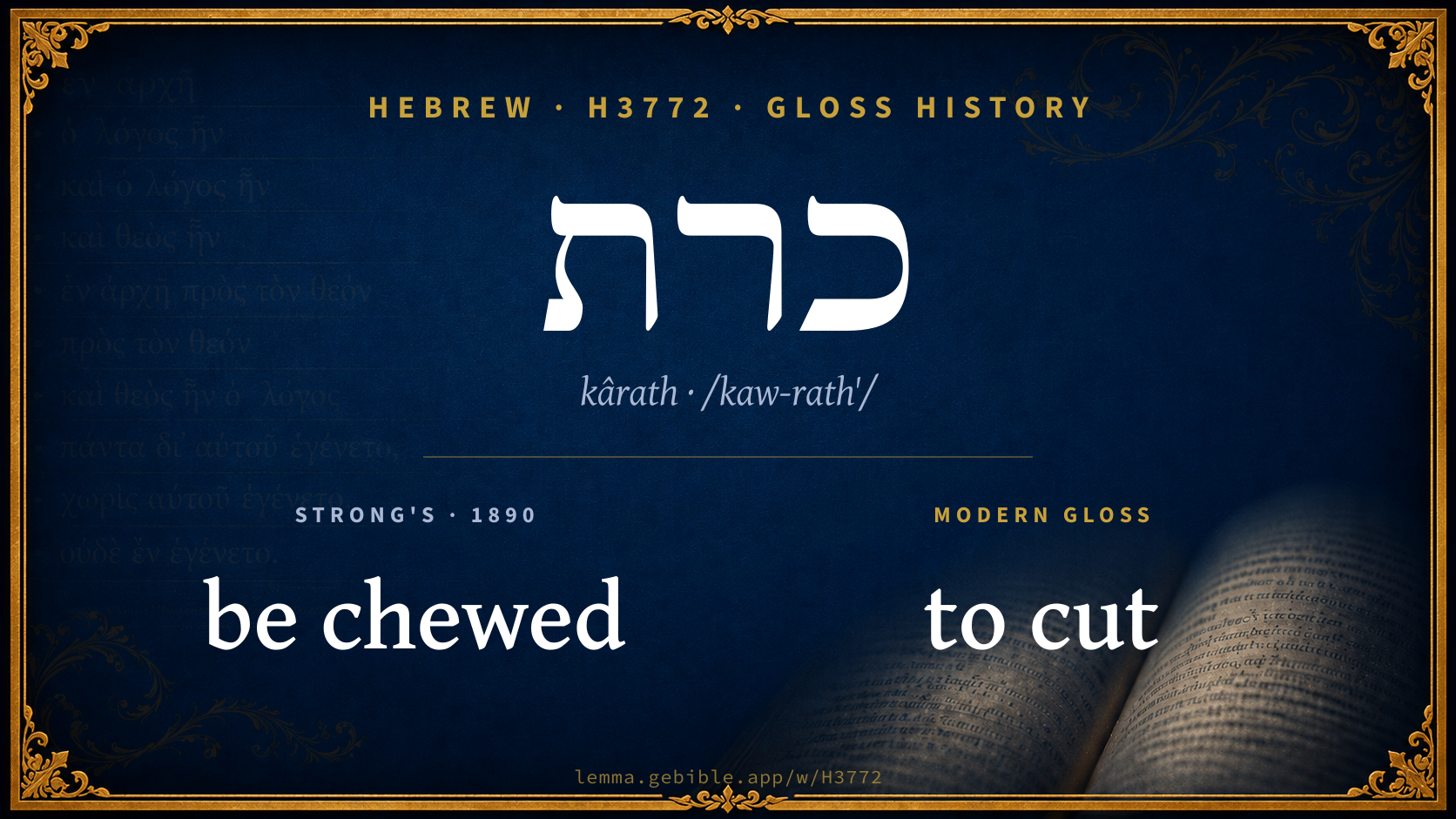
Gloss history
Strong's 1890 vs modern scholarship
About this word
Strong's H3772 catalogs a Hebrew word from the Hebrew Old Testament.
These counts are not copied from any lexicon or concordance. They are computed here, from the morphology-tagged Hebrew Old Testament. What Lemma adds →
- 280
- distinct verses
- The word appears in 280 distinct verses.
- 33 / 39
- OT books
- The word appears in 33 of 39 Old Testament books.
- #169
- by frequency
- Top 250 most frequent Hebrew words (rank 169 of 8,640 Hebrew words by occurrence).
View all 280 occurrences in the concordance →
By section of the Old Testament
By traditional corpus
Conventional, traditional groupings — biblical authorship is debated, so this is a traditional corpus grouping, not an authorship claim. Each share is this word’s portion of its verses in that division of the Hebrew canon. Each figure is a share of the word’s 280 distinct verses.
- Prophets (Nevi'im) 169 verses · 60%
- Torah (Pentateuch) 67 verses · 24%
- Writings (Ketuvim) 44 verses · 16%
How translations render this word
Counts come from each version’s own published word-to-Strong’s tagging or interlinear alignment — an approximate guide to how each version renders this word, not a word-level alignment the data otherwise carries. Because each total is that version’s own tagged count, the per-version totals vary from one another and need not match the appearance or distinct-verse counts above. These counts may also differ from a printed concordance because Lemma counts each distinctly tagged rendering and does not collapse phrase taggings into a single head-word total. This is a fixed set of word-tagged versions (KJV, ASV, BSB, ULT) and does not change with the reading translation you choose elsewhere. Each version’s license is shown beside its name below (and on Sources).
- King James Version: Shall be cut off 27×, Cut off 26×, Made 23×
- American Standard Version: Cut off 22×, Shall be cut off 22×, Made 20×
- Berean Standard Bible: Cut off 26×, Made 19×, I will cut off 16×
- unfoldingWord Literal Text: Cut 35×, Cut off 29×, Shall be cut off 21×
King James Version Public Domain
Renders H3772 across 288 tagged occurrences — most commonly:
Plus other, less common renderings. Plus 97 renderings that appear only once — usually multi-word phrases or single function words the recovered tagging swept in, not distinct renderings.
American Standard Version Public Domain
Renders H3772 across 288 tagged occurrences — most commonly:
Plus other, less common renderings. Plus 102 renderings that appear only once — usually multi-word phrases or single function words the recovered tagging swept in, not distinct renderings.
Berean Standard Bible Public Domain
Renders H3772 across 283 tagged occurrences — most commonly:
Plus other, less common renderings. Plus 80 renderings that appear only once — usually multi-word phrases or single function words the recovered tagging swept in, not distinct renderings. Not rendered by a distinct English word in 5 further occurrences.
unfoldingWord Literal Text CC BY-SA 4.0
Renders H3772 across 337 tagged occurrences — most commonly:
Plus other, less common renderings. Plus 67 renderings that appear only once — usually multi-word phrases or single function words the recovered tagging swept in, not distinct renderings.
29 senses and sub-senses in the full BDB
Hebrew verbs can shift meaning by stem (binyan): Qal is the basic action, Niphal is often passive or reflexive, Piel often intensifies or makes it factitive, and Hiphil is typically causative. The senses below are grouped under the stem BDB assigns to each. This entry also uses Pual (the passive of Piel) and Hophal (the passive of Hiphil).
What do BDB’s symbols mean?
BDB uses these scholarly abbreviations:
| Symbol | Meaning |
|---|---|
| 𝔊 | the Septuagint (the ancient Greek translation, LXX) |
| 𝔙 | the Vulgate (the Latin translation) |
| 𝔖 | the Syriac version (the Peshitta) |
| 𝔗 | the Targum (the Aramaic translation) |
| ψ | the Psalms |
| √ | root (the underlying root or stem) |
| ‖ | parallel passage (a synonymous or contrasted parallel) |
| † | the dagger: every passage where the word occurs is cited |
The 29 senses and sub-senses the full Brown-Driver-Briggs lexicon distinguishes for this word, in lexicon order (not ranked by frequency), with BDB’s own verbatim wording and sub-sense lettering. Shown in Hebrew script with BDB’s own scholarly abbreviations. The condensed entry is in the Lexicon Entry tab. See also the Forms in the corpus table below.
Qal
- Pf. כ׳ Gn 15:18 + 19 times; 2 ms. כָּרָ֑תָּ Dt 20:20; 1 s. כָּרַתִּי Ex 34:27 + 15 times; + 8 times Pf.; Impf. יִכְרֹת Jb 40:28 + 21 times; 2 ms. תִּכְרָת־ Is 57:8; 1 s. אֶכְרוֹת Is 61:8; 1 S 11:2; אֶכְרְתָה Is 55:3; 3 mpl. יִכְרֹ֑תוּ Ho 12:2 ψ 83:6; 1 pl. נִכְרְתָה Gn 26:28; 31:44; sf. נִכְרְתֶנּוּ Je 11:19; + 31 times Impf.; Imv. כְּרָת־ 1 S 11:1; כָּרְתָה 2 S 3:12; + 4 times Imv.; Inf. abs. כָּרֹת Ho 10:4; כָּרוֹת Ne 9:8; cstr. כְּרֹת Je 34:8 + 2 times; כְּרָת־ Is 44:14 + 2 times; כְּרוֹת 2 Ch 2:7; 29:10; sf. כָּרְתִי 1 S 24:12; Pt. act. כֹּרֵת Ex 34:10 + 3 times; + 3 times Pt. act.; pass. כָּרוּת Lv 22:24; cstr. כְּרוּת Dt 23:2; pl. כְּרֻת[וֹ]ת 1 K 7:12 + 3 times;— e.g. Genesis 15:18
- 1. cut off:
- a. things: c. acc. foreskin Ex 4:25 (J); privy member Lv 22:24 (H) Dt 23:2; cluster of grapes Nu 13:23, 24 (E); bough of tree Ju 9:48, 49; skirt 1 S 24:5, 6, 12; head of man 1 S 17:51; 31:9 2 S 20:22; garments 2 S 10:4 = 1 Ch 19:4; palms of hands 1 S 5:4; sprigs Is 18:5. e.g. Exodus 4:25
- b. persons, c. acc. pers. מִן loc. Je 11:19; 50:16. e.g. Jeremiah 11:19
- 2. cut down, c. acc. trees Dt 19:5; 20:19, 20; 2 K 19:23 = Is 37:24; Is 44:14 Je 6:6; 10:3; 22:7; 46:23 Ez 31:12; asherim Ex 34:13 (J) Ju 6:25, 26, 30; 1 K 15:13 = 2 Ch 15:16; 2 K 18:4; 23:14. e.g. Deuteronomy 19:5
- 3. hew, timber 1 K 5:20(×2) = 2 Ch 2:7, 15, Is 14:8; כֹּרְתֵי הָעֵצִים hewers of timber 2 Ch 2:9; כְּרֻת(וֹ)ת hewn beams 1 K 6:36; 7:2, 12. e.g. 1 Kings 5:20
- 4. כ׳ בְּרִית cut, or make a covenant (because of the cutting up and distribution of the flesh of the victim for eating in the sacrifice of the covenants, see בְּרִית); הָעֵגֶל אֲשֶׁר כ׳ the calf which they cut Je 34:18 (referring to Gn 15:10); עֲלֵי־זֶבַח ψ 50:5; abs. Gn 21:27, 32; 31:44 (E) 1 S 18:3; 1 K 5:26; Ho 10:4; c. אֶת with Gn 15:18; Ex 34:27; Dt 31:16 (J) Dt 5:3 28:69(×2); 29:13 2 S 3:12, 13, 21; 2 K 17:15, 35, 38; Is 28:15; Je 11:10; 31:31, 32, 33; 34:8, 13; Ez 17:13; Zc 11:10 ψ 105:9 = 1 Ch 16:16; c. עִם Gn 26:28 (J) Ex 24:8 (E) Dt 4:23; 5:2; 9:9; 29:11, 24; 1 K 8:21 = 2 Ch 6:11; 2 Ch 23:3 Ne 9:8; Ho 2:20; 12:2; Jb 40:28; בְּ׳ omitted 1 S 20:16; 22:8; 1 K 8:9 = 2 Ch 5:10; c. לְ Ex 23:32; 34:12, 15; Jos 9:6, 7, 11, 15, 16; 24:25 (JE) Dt 7:2; Ju 2:2; 1 S 11:1; 2 S 5:3; 1 K 20:34 2 K 11:4; 1 Ch 11:3; 2 Ch 21:7; 29:10; Ezr 10:3; Is 55:3; 61:8; Je 32:40; 34:18; Ez 34:25; 37:26; Jb 31:1 ψ 89:4; בְּ׳ omitted 1 S 11:2; 2 Ch 7:18; נֶגֶד Ex 34:10 (J); לִפְנֵי 1 S 23:18; 2 K 23:3 = 2 Ch 34:31 Je 34:15; בֵּין וּבֵין 2 K 11:17; 2 Ch 23:16; c. עַל against, ψ 83:6; אֲמָנָה is used for ברית Ne 10:1; and דָּבָר Hg 2:5. e.g. Jeremiah 34:18
- —וַתִּכְרָת־לָךְ מֵהֶם Is 57:8 is usually rendered as RV made for thee a covenant with them, with ellipsis of בּ׳ as above. But מִן is not used in such a construction. The clause is commonly regarded as corrupt by recent critics. Gr emends עִמָּהֶם for מֵהֶם, this is easiest and gives the usual construction; Du, followed by Buhl, reads וַתִּכְרִי after Ho 3:2. e.g. Isaiah 57:8
Niphal
- Pf. 3 ms. נכרת Jo 1:5 + 5 times; נִכְרָ֑ת Jo 1:16 + 2 times; 3 fs. נִכְרְתָה Gn 17:14 + 16 times; נִכְרָ֑תָה ψ 37:38; 2 ms. נִכְרַתָּ Ob 10; + 8 times Pf.; Impf. יִכָּרֵת Gn 9:11 + 21 times; יִכָּֽרֶת־ Ob 9; 3 mpl. יִכָּֽרְתוּ Zc 13:8; יִכָּרֵת֑וּן Jos 3:13 ψ 37:9; + 9 times Impf.; Inf. הִכָּרֵת Nu 15:31 ψ 37:34.— e.g. Joel 1:5
- 1. be cut off:
- a. of things, froward tongue Pr 10:31; burden from a nail Is 22:25; chariots Zc 9:10; dwelling Zp 3:7. e.g. Proverbs 10:31
- b. of persons, the people of the land by a famine (בְּ) Gn 41:36 (E); all flesh by waters of deluge (מִמֵּי) Gn 9:11 (P); the anointed Dn 9:26; enemies Is 11:13; Mi 5:8; the wicked Is 29:20; Ho 8:4; Na 2:1 ψ 37:9, 22, 28, 34, 38; Pr 2:22; others Ob 9, 10 Zp 1:11; Zc 13:8; 14:2. e.g. Genesis 41:36
- c. in the technical phrases of H and P וְנִכְרְתָה הַנֶּפֶשׁ ההיא that person shall be cut off (by death penalty) מֵעַמֶּיהָ Gn 17:14 Lv 7:20, 21, 25, 27; Nu 9:13; Lv 19:8; מִיִּשְׂרָאֵל Ex 12:15; Nu 19:13; מֵעֲדַת יִשְׂרָאֵל Ex 12:19; מִקֶּרֶב עַמֶּיהָ Ex 31:14; Nu 15:30 (עַמָּהּ); מִלְּפָנַי Lv 22:3; מִתּוֹךְ הַקָּהָל Nu 19:20; similarly with variation of subject Ex 30:33, 38; Lv 17:4, 9; 18:29; 20:18; 23:29, and with omission of word with מִן Lv 17:14; 20:17; Nu 15:31(×2). e.g. Genesis 17:14
- 2. be cut down, a tree Jb 14:7. e.g. Job 14:7
- 3. be chewed between the teeth Nu 11:33 (J). e.g. Numbers 11:33
- 4. be cut off, in a more general sense, fail: of waters Jos 3:13, 16 (JE) 4:7(×2) (D); new wine Jo 1:5; meat v 16; hope Pr 23:18; 24:14; a name Is 48:19; 56:5; Ru 4:10; a sign Is 55:13; faithfulness Je 7:28; לֹא יִכָּרֵת לְ׳ אִישׁ there shall not fail thee a man 1 K 2:4; 8:25 = 2 Ch 6:16; 1 K 9:5 = 2 Ch 7:18; Je 33:17; 18; 35:19; לא יכרת מן there shall not fail of Jos 9:23 (J) 2 S 3:29. e.g. Joshua 3:13
Pual
- Pf. כָּרַּת Ez 16:4; 3 fs. כֹּרָ֑תָה Ju 6:28;— e.g. Ezekiel 16:4
- 1. be cut off, navel string Ez 16:4. e.g. Ezekiel 16:4
- 2. be cut down, Asherah Ju 6:28. e.g. Judges 6:28
Hiphil
- Pf. הִכְרִית 1 S 28:9; 1 K 11:16; 3 fs. הִכְרִיתָה Lv 26:22; 1 s. הִכְרַתִּי Jos 23:4 + 32 times; + 4 times Pf.; Impf. יַכְרִית Dt 12:29 + 2 times; juss. יַכְרֵת ψ 12:4 + 4 times; 1 s. וָֽאַכְרִ֫תָה 2 S 7:9; 1 pl. sf. וְנַכְרִיתֶנָּה Je 48:2; + 9 times Impf.; Inf. הַכְרִית Je 44:8 + 15 times; הַכְרִת 1 S 20:15; + sf. 2 times— e.g. 1 Samuel 28:9
- 1. cut off, flattering lips ψ 12:4. e.g. Psalms 12:4
- 2. cut off, destroy the life of:
- a. animals c. acc., cattle Lv 26:22 (H); c. acc. and מִן frogs Ex 8:5 (J); horses Mi 5:9; Zc 9:10. e.g. Leviticus 26:22
- b. of men abs. ψ 109:13, by men, c. acc. enemies Ju 4:24; 1 S 24:22; 1 K 11:16; 14:14; 18:4; 2 Ch 22:7; Is 10:7; Ez 17:17 Ob 14; c. acc. and מִן enemies Jos 11:21; Je 48:2; the wicked ψ 101:8; a clan Nu 4:18 (P); young men by death Je 9:20; people by the sword Na 3:15; necromancers 1 S 28:9; the name Jos 7:9. e.g. Psalms 109:13
- c. of men, by God c. acc. (הַ)גּוֹיִם Dt 19:1; Jos 23:4 (D) Zp 3:6; various persons and things Is 48:9; Je 44:11; 51:62 Ez 25:16; 30:15; Zc 9:6; c. acc. and מִן Ez 25:7 Am 1:5, 8; 2:3; מֵאֶרֶץ Na 2:14 ψ 34:17 = 109:15; מִיִּשְׂרָאֵל Is 9:13; מִיַּד Mi 5:11; מִפָּנֶיךָ Dt 12:29; 2 S 7:9 = 1 Ch 17:8; מֵעַל פְּנֵי הָאֲדָמָה 1 S 20:15; 1 K 9:7; Zp 1:3; מִקֶּרֶב עַמּוֹ Lv 17:10; 20:3, 5, 6 (H); מִתּוֹךְ עַמִּי Ez 14:8; Ez says also הכ׳ מִן … אָדָם וּבְהֵמָה 14:13, 17, 19, 21; 25:13; 29:8; צדיק ורשׁע 21:8, 9; עבר ושׁב 35:7; c. acc. and לְ, cut off, to, or from Is 14:22; Je 44:7, 8; 47:4; כ׳ לְ׳ מַשְׁתִּין בְּקִיר 1 K 14:10; 21:21; 2 K 9:8; כ׳ ל׳ מעם מזבח 1 S 2:33; יַכְרֵת י׳ לָאִישׁ מֵאָֽהֳלֵי יַעֲקֹב Mal 2:12 may Yahweh cut off to the man—from the tents of Jacob. e.g. Deuteronomy 19:1
- 3. cut down, destroy, cities Mi 5:10, sun-pillars Lv 26:30 (H); and other things used in idolatry Na 1:14; Zp 1:4; מן הארץ Zc 13:2; מִקֶּרֶב Mi 5:12. e.g. Micah 5:10
- 4. take away, חֶסֶד מֵעִם kindness from 1 S 20:15. e.g. 1 Samuel 20:15
- 5. permit to perish, מֵהַבְּהֵמָה (some) of the cattle 1 K 18:5. e.g. 1 Kings 18:5
Hophal
- Pf. הָכְרַת מִנְחָה וָנֶסֶךְ מִבֵּית י׳ Jo 1:9. e.g. Joel 1:9
Senses from the full Brown-Driver-Briggs lexicon (Brown, Driver, Briggs; Oxford 1906 — public domain), digitized via Sefaria, supplemented by the OpenScriptures HebrewLexicon (CC BY 4.0). Full attribution on Sources.
Word origin
vb. cut off, cut down (NH id.; Assyrian karâtu, ii. hew off Dl HWB 357);—
— Brown-Driver-Briggs (Oxford 1906, public domain), digitized via Sefaria, supplemented by the OpenScriptures HebrewLexicon (CC BY 4.0). See Sources.
Origin: a primitive root
Jastrow Dictionary
A second Hebrew/Aramaic lexicon for comparison, covering Aramaic and post-biblical (Talmudic, Targumic, Midrashic) usage that the biblical-Hebrew BDB does not. Matched by lemma rather than by Strong’s number, so a lemma may carry more than one Jastrow headword (shown separately below), and the entries cover usage well beyond the Bible.
כְּרֵת
- , v. כְּרֵית
כָּרַת
- 1. to cut. Num. R. s. 16 ונקרא אשכול … לִכְרוֹת וכ׳ and he (Abraham’s ally) was named Eshkol (Cluster), on account of the cluster of grapes which the Israelites were destined to cut in his home.—Esp. to cut genitals, mutilate. Bekh. 33ᵇ נותק אחר כּוֹרֵת, v. נָתַק.—Part. pass. כָּרוּת. Ib.; a. fr.—כְּ׳ שפכה one that is mutilated at his membrum, v. שָׁפַךְ. Tosef. Yeb. XI, 2. Yeb. VIII, 2; a. fr.
- 2. [to draw a circle, place outside, cmp. meanings of חרם, ברי,] to cut off, excommunicate, v. כָּרֵת. Y. Bicc. II, beg. 64ᶜ; Y. Snh. XI, 30ᵇ צא … עונשין וכוֹרְתִים deduct twenty years up to which age the divine court neither punishes nor decrees excision.
- 3. to separate, divorce; to make final. Gitt. 21ᵇ; Succ. 24ᵇ (ref. to Deut. XXIV, 3) ספר כּוֹרְתָהּ וכ׳ the delivery of the deed divorces her and nothing else does. Ib. דבר הכּוֹרֵת בינו לבינה something (a condition) which (if fulfilled) severs definitely the connection between him and her (e.g. a condition that she will drink no wine for the next thirty days, after the lapse of which time the letter of divorce takes its effect retroactively, opp. to a condition that she will abstain from wine all the rest of her life in which case the letter of divorce cannot take effect).—Part. pass. כָּרוּת definite. Y. Gitt. VII, 48ᵈ כגט כ׳ הוא it is like a final divorce (taking effect immediately); Y. B. Bath. VIII, 16ᶜ top כ׳ הוא. Y. Gitt. III, 44ᵈ top; IX, 50ᵇ bot. זה כ׳ לשמה ווה כ׳ לשמה (not זו) this letter was definitely made out for this woman, and so was the other for the other woman. Ib. III, beg. 44ᶜ אלא שלא הי׳ לה כ׳ … ראשונה (strike out לה); a. fr.—3) to decide, make final. Ber. 4ᵃ; Snh. 16ᵇ (ref. to כְּרֵתִי as a symbolical name for the Urim and Tummim, or for the Sanhedrin) שכּוֹרְתִים את דבריהם they give definite and precise decisions; Midr. Till. to Ps. III כּוֹרְתֵי כריתות, v. כְּרִיתָה; a. e.—כ׳ בְּרִית (v. בְּרִית) to covenant, make a firm promise. Gen. R. s. 44 כָּרַתָּ ב׳ עם וכ׳ thou hast promised to Noah that thou wilt not destroy his descendants; Yalk. Gen. 76 כָּרַתָּה.—Part. pass. כָּרוּת, f. כְּרוּתָה. M. Kat. 18ᵃ, a. fr. ברית כ׳ לשפתים, v. בְּרִית. R. Hash. 17ᵇ ב׳ כ׳ לי"ג מדזת וכ׳ there is a solemn insurance given that the invocation of the thirteen divine attributes (Ex. XXXIV, 6, sq.) will never be without effect (ref. to Ex. XXXIV, 10).—Trnsf. ב׳ כ׳ it is a necessity, unavoidable. Nidd. 58ᵇ ב׳ כ׳ לו שכל וכ׳ whoever crushes it cannot help smelling it. e.g. Deuteronomy 24:3
- 1. to be cut, mutilated. Yeb. VIII, 2 (expl. כרות שפכה, Deut. XXIII, 2) כל שנ׳ הגיד when the membrum is mutilated. Ib. 75ᵇ נִכְרְתוּ ביצים when the testicles are cut out; a. fr.—2) to be covenanted. Sot. 37ᵇ שלא נִכְרְתוּ עליה וכ׳ upon which were not closed forty eight covenants; Tosef. ib. VIII, 11; a. fr. e.g. Deuteronomy 23:2
- 3. to be cut off, destroyed. Y. Peah I, 15ᵈ bot. (ref. to Num. XV, 31) מלמד שהנפש נִכְרָתָה ועונה בה which intimates that (the idolater’s) soul is cut off (through premature death, כָּרֵת), while her guilt remains with her (unexpiated by death); Snh. 64ᵇ (ref. to the emphasized expression הכרת תכ׳, Num. l. c.) הִכָּרֵת בעו"הז וכ׳ hiccareth refers to this world &c.; a. fr.—Verbal noun הִיכָּרֵת, v. כָּרֵת. e.g. Numbers 15:31
- to destroy, exterminate. Tanḥ. R’eh 7 והַכְרִיתֵם and exterminate them. Ib. כשיַכְרִית וכ׳ when the Lord … shall have destroyed …, you will enter. Tosef. Snh. IV, 5 להַכְרִית זרעו וכ׳ to exterminate the seed of Amalek; a. fr.
- to doom to destruction. Arakh. 15ᵇ שכבר כֵּרְתוֹ וכ׳ for David has doomed him &c. (ref. to Ps. XII, 4); Yalk. Lev. 559. e.g. Psalms 12:4
כְּרַת
- , esp. to separate, divorce. Gitt. 21ᵇ, a. fr. עידי מסירה כַּרְתֵי it is the witnesses of delivery (in whose presence the deed of divorce is handed to the wife) that effect the divorce (and the signature of the witnesses is unessential); opp. to עידי חתימה כרתי it is the signing witnesses &c.—Imper. כְּרוֹת (only in) כ׳ גיטא make the divorce final, definite (v. preced.). Ib. 9ᵃ היינו טעמא משום דלאו כ׳ ג׳ היא the reason (that the manumission of the slave is not lawful) is because the form was not in compliance with the rule, ‘make the divorce definite’; B. Bath. 150ᵇ
כָּרֵת
- (= הִכָּרֵת, v. כָּרַתNif.) excommunication, extermination; (in Talm. law) divine punishment through premature or sudden death, opp. to מיתה בידי אדם capital punishment. Snh. 60ᵇ זובח … כ׳ הוא is not slaughtering consecrated animals outside of the Temple punishable with extinction?, opp. קטלא death by execution. M. Kat. 28ᵃ מת בחמשים שנה זו היא מיתת כ׳ if one dies at the age of fifty, that is death of divine visitation; Y. Bicc. II, beg. 64ᶜ בהִיכָּרֵת; Treat. S’maḥ. III, 8 בהִכָּרֵת. Ib. 10 וכי מה מודיענו שמיתתם בהכרת what is there to indicate that they died by divine visitation?; Y. l. c. 64ᵈ top שהוא בהיכרת.—M. Kat. l. c. נפקי לי מכ׳ I have escaped the punishment of kareth (being sixty years old). Ib. כ׳ דשני the kareth of years, premature death; כ׳ דיומי the k. of days, sudden death. Ḥull. 31ᵃ עון כ׳ a transgression punishable with k., opp. איסור מיתה. Macc. III, 15 (23ᵃ) נפטרו מידי כְּרֵיתָן Ms. M. (ed. ידי כְּרִיתָתָם) are released from k. (which would otherwise await them). Ib. 13ᵇ ולמה יצאת כ׳ באחותו why is the punishment of k. specifically mentioned with reference to incest with a sister (Lev. XX, 17, being included in Lev. XVIII, 29)?—Gen. R. s. 28 (ref. to כְּרֵתִים, Zeph. II, 5, v. Targ. a. l.) גוי שהוא ראוי כ׳ a nation deserving extermination; (Yalk. Zeph. 567 ראוי לִיכָּרֵת); a. v. fr.—Pl. כְּרִיתוֹת (fr. כְּרִיתָה). Ker. I, 1 שלשים ושש כ׳ בתורה there are thirty six transgressions mentioned in the Torah as (eventually) punishable with kareth. Macc. III, 15, a. fr. חייבי כ׳ those on whose transgressions the penalty of k. is pronounced; a. fr.—K’rithoth, a treatise of the Mishnah, Tosefta, and Talmud Babli, of the Order of Kodashim. e.g. Leviticus 20:17
A Dictionary of the Targumim, the Talmud Babli and Yerushalmi, and the Midrashic Literature (Marcus Jastrow; London, Luzac, 1903) — Public Domain. Digitized via Sefaria. Digitized via Sefaria. Full attribution on Sources.
Forms in the corpus
The 195 distinct written forms H3772 takes in the Hebrew Bible, most frequent first — each parse links to that stem’s occurrences in the concordance. Hebrew forms include their vowel points and cantillation, so a single lemma takes many written forms.
The 60 most common forms are shown; 135 rarer forms follow in the full concordance.
Same root — word family
Other BDB entries built from the same root as H3772, grouped by Strong’s listed origin. These share a root / origin per the lexicon — not necessarily a shared meaning. Each links to that word’s own entry.
Derived from this word
Proper names from this root
People and places named from this root — a name, not an additional meaning of the word.
Compare all same-root words → Showing 4 of 5 — not the complete family. 2 of the same-root words are proper names (people or places). They share a root, not necessarily a meaning.
Septuagint verse parallels
This word appears in 262 verses that also exist in the Greek Old Testament (Septuagint), out of the 280 Hebrew verses it occurs in. You can read those verses in Greek by switching the Old Testament edition to the Septuagint.
Read these verses in the Septuagint
- Genesis 9:11
- Exodus 4:25
- Leviticus 7:20
- Numbers 4:18
- Deuteronomy 4:23
- Joshua 3:13
- Judges 2:2
- Ruth 4:10
- 1 Samuel 2:33
- 2 Samuel 3:12
- 1 Kings 2:4
- 2 Kings 9:8
This is a verse-level parallel only — the same verses exist in both the Hebrew and Greek Old Testaments. No word-level Hebrew↔Greek correspondence is claimed: the data carries no such alignment, so no Greek word is shown as this Hebrew word’s translation. Coverage is not total — the Septuagint omits the deuterocanon and renumbers the Psalms, so some Hebrew verses have no direct Greek parallel.