
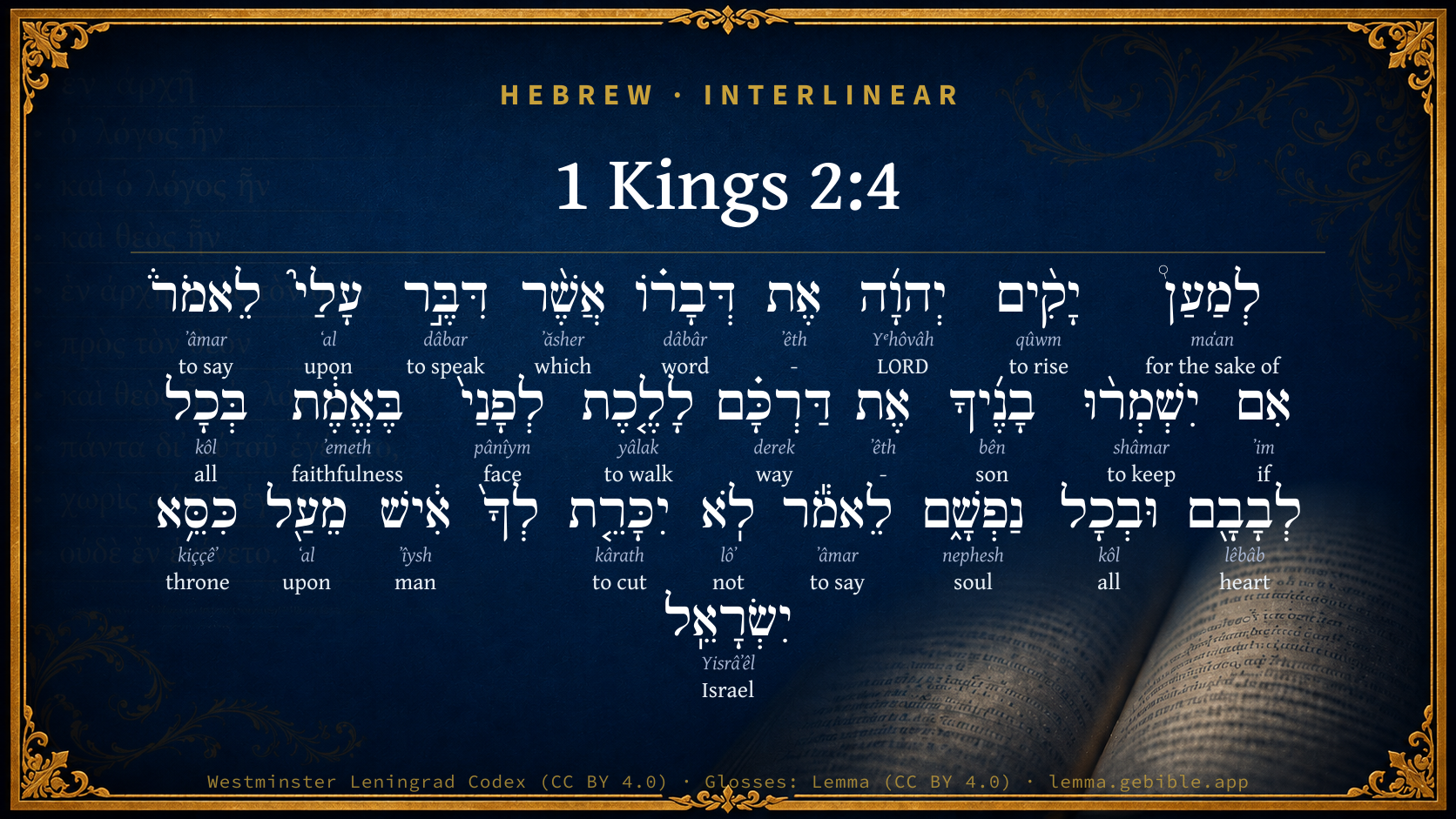
1 Kings 2:4

Hebrew (Westminster Leningrad Codex) 1 Kings 2:4 appears in the Hebrew Old Testament. The text above is from the Westminster Leningrad Codex. Each word links to its Strong’s number, a concise gloss, and parsing drawn from the Open Scriptures Hebrew Bible morphology. Click any word for its full Brown-Driver-Briggs (BDB) entry.
Download image
Cite this verse

1 Kings 2:4 (World English Bible). Public Domain. Lemma interlinear Bible study tool, https://lemma.gebible.app/v/1-kings/2/4.

Show BibTeX & RIS
BibTeX
RIS
English Translation
That Yahweh may establish his word which he spoke concerning me, saying, If your children take heed to their way, to walk before me in truth with all their heart and with all their soul, there shall not fail you (said he) a man on the throne of Israel.
World English Bible · Public Domain
Download a study sheet

One document with this verse’s original text, its word-by-word gloss line, the meaning frame, cross-references with their text, attributed commentary, and full source and license credits — printable, and it pastes into notes with its structure intact.

This verse Autodidact and up

Study sheet (.html) Plain text (.txt)

A passage Seminary Student

Up to 50 verses in one chapter. A passage sheet keeps up to 6 commentary sources and 12 cross-references per verse, in the order this page ranks them, and says so on the sheet whenever that leaves anything out. Ask for a single verse and you get the Autodidact verse sheet above.

Everything on this page stays free to read, with no account — the sheet is a download of what is already on screen, not access to it.

Want to remove ads? Support Godless Engineer
Compare translations 3

The same verse in 3 English versions, stacked beneath the original-language interlinear above. Click any original word for its lexicon entry.

Each is an independent rendering of the whole verse — the interlinear is not word-aligned to these translations.

Highlighted words mark where these versions differ — a whole-verse word diff, not a word-by-word alignment.

  • World English Bible Public Domain
    That Yahweh may establish his word which he spoke concerning me, saying, If your children take heed to their way, to walk before me in truth with all their heart and with all their soul, there shall not fail you (said he) a man on the throne of Israel.
  • King James Version Public Domain
    That the LORD may continue his word which he spake concerning me, saying, If thy children take heed to their way, to walk before me in truth with all their heart and with all their soul, there shall not fail thee (said he) a man on the throne of Israel.
  • unfoldingWord Literal Text CC BY-SA 4.0
    so that Yahweh may raise up his word, which he spoke about me, saying, ‘If your sons keep their way, to walk to my face in truth with all of their heart and with all of their soul,’ saying, ‘a man to you will not be cut off from upon the throne of Israel.’

unfoldingWord Literal Text — © unfoldingWord, licensed CC BY-SA 4.0. Word-aligned USFM3 via Door43 (git.door43.org/unfoldingWord/en_ult).

Versions to compare (up to 4)

3 of 4 selected

Show all 18 translations

Every available English version of this verse, each an independent rendering of the whole verse.

  • World English Bible Public Domain
    That Yahweh may establish his word which he spoke concerning me, saying, If your children take heed to their way, to walk before me in truth with all their heart and with all their soul, there shall not fail you (said he) a man on the throne of Israel.
  • Berean Standard Bible Public Domain
    and so that the LORD may fulfill His promise to me: ‘If your descendants take heed to walk faithfully before Me with all their heart and soul, you will never fail to have a man on the throne of Israel.’
  • Majority Standard Bible Public Domain
    and so that the LORD may fulfill His promise to me: ‘If your descendants take heed to walk faithfully before Me with all their heart and soul, you will never fail to have a man on the throne of Israel.’
  • King James Version Public Domain
    That the LORD may continue his word which he spake concerning me, saying, If thy children take heed to their way, to walk before me in truth with all their heart and with all their soul, there shall not fail thee (said he) a man on the throne of Israel.
  • American Standard Version (1901) Public Domain
    That Jehovah may establish his word which he spake concerning me, saying, If thy children take heed to their way, to walk before me in truth with all their heart and with all their soul, there shall not fail thee (said he) a man on the throne of Israel.
  • Revised Version (1885) Public Domain
    That the LORD may establish his word which he spake concerning me, saying, If thy children take heed to their way, to walk before me in truth with all their heart and with all their soul, there shall not fail thee (said he) a man on the throne of Israel.
  • Geneva Bible (1599) Public Domain
    That the Lord may confirme his worde which hee spake vnto me, saying, If thy sonnes take heede to their way, that they walke before me in trueth, with all their hearts, and with all their soules, thou shalt not (sayd he) want one of thy posteritie vpon the throne of Israel.
  • Douay-Rheims (1899) Public Domain
    That the Lord may confirm his words, which he hath spoken of me, saying: If thy children shall take heed to their ways, and shall walk before me in truth, with all their heart, and with all their soul, there shall not be taken away from thee a man on the throne of Israel.
  • Young's Literal Translation Public Domain
    so that Jehovah doth establish His word which He spake unto me, saying, If thy sons observe their way to walk before Me in truth, with all their heart, and with all their soul; saying, There is not cut off a man of thine from the throne of Israel.
  • Literal Standard Version CC BY-SA 4.0
    so that YHWH establishes His word which He spoke to me, saying, If your sons observe their way to walk before Me in truth, with all their heart, and with all their soul; saying, A man of yours is never cut off from the throne of Israel.
  • Unlocked Literal Bible CC BY-SA 4.0
    so that Yahweh may fulfill his word which he spoke concerning me, saying, 'If your sons carefully watch their conduct, to walk before me faithfully with all their heart and with all their soul, you will never cease to have a man on the throne of Israel.'
  • unfoldingWord Literal Text CC BY-SA 4.0
    so that Yahweh may raise up his word, which he spoke about me, saying, ‘If your sons keep their way, to walk to my face in truth with all of their heart and with all of their soul,’ saying, ‘a man to you will not be cut off from upon the throne of Israel.’
  • Darby Bible Public Domain
    that Jehovah may confirm his word which he spoke concerning me, saying, If thy sons take heed to their way, to walk before me in truth with all their heart and with all their soul, there shall not fail thee, said he, a man upon the throne of Israel.
  • World Messianic Bible Public Domain
    Then the LORD may establish his word which he spoke concerning me, saying, ‘If your children are careful of their way, to walk before me in truth with all their heart and with all their soul, there shall not fail you,’ he said, ‘a man on the throne of Israel.’
  • Webster's Bible Public Domain
    That the LORD may continue his word which he spoke concerning me, saying, If thy children take heed to their way, to walk before me in truth with all their heart and with all their soul, there shall not fail thee (said he) a man on the throne of Israel.
  • Free Bible Version CC BY-SA 4.0
    If so, then the Lord will keep his promise to me when he said: ‘If your descendants are to live right before me, faithfully and with complete commitment, then you will always have one of them on the throne of Israel.’
  • Bible in Basic English Public Domain
    So that the Lord may give effect to what he said of me, If your children give attention to their ways, living uprightly before me with all their heart and their soul, you will never be without a man to be king in Israel.
  • JPS Tanakh (1917) Public Domain
    that the LORD may establish His word which He spoke concerning me, saying: If thy children take heed to their way, to walk before Me in truth with all their heart and with all their soul, there shall not fail thee, said He, a man on the throne of Israel.

Literal Standard Version (2020), Covenant Press — licensed CC BY-SA 4.0. Text via the HelloAO Bible API (eBible.org). Unlocked Literal Bible (unfoldingWord) — licensed CC BY-SA 4.0. Text via the HelloAO Bible API (eBible.org). unfoldingWord Literal Text — © unfoldingWord, licensed CC BY-SA 4.0. Word-aligned USFM3 via Door43 (git.door43.org/unfoldingWord/en_ult). Free Bible Version, Dr. Jonathan Gallagher — licensed CC BY-SA 4.0. Text via the HelloAO Bible API (eBible.org).

Word by word

More ways to search: Search by grammar → Find every occurrence → Compare this word →

Practice this passage: Drill this verse → Learn its vocabulary →

בֶּאֱמֶ֔ת
ʼemeth
H571
“in/at · faithfulness”
Preposition + Noun, Common, Feminine, Singular, Absolute
Part of Speech
Preposition + Noun
Type
Common
Gender
Feminine
Number
Singular
State
Absolute
Full BDB Definition

Origin: contracted from H539

TWOT: 116k

firmness, faithfulness, truth (noun feminine) - sureness, reliability - stability, continuance - faithfulness, reliableness - truth - as spoken - of testimony and judgment - of divine instruction - truth as a body of ethical or religious knowledge - true doctrine - in truth, truly (adverb)
  1. לְמַעַן֩ maʻan H4616 “for the sake of” Preposition
  2. יָקִ֨ים qûwm H6965 “to rise” Verb, Hiphil, Imperfect, 3rd Person, Masculine, Singular
  3. יְהוָ֜ה Yᵉhôvâh H3068 “LORD” Noun, Proper
  4. אֶת ʼêth H853 “-” Particle, Direct Object
  5. דְּבָר֗וֹ dâbâr H1697 “word · his” Noun, Common, Masculine, Singular, Construct + Suffix, Personal, 3rd Person, Masculine, Singular
  6. אֲשֶׁ֨ר ʼăsher H834 “which” Particle, Relative
  7. דִּבֶּ֣ר dâbar H1696 “to speak” Verb, Piel, Perfect, 3rd Person, Masculine, Singular
  8. עָלַי֮ ʻal H5921 “upon · me” Preposition + Suffix, Personal, 1st Person, Common, Singular
  9. לֵאמֹר֒ ʼâmar H559 “to say” Preposition + Verb, Qal, Infinitive Construct
  10. אִם ʼim H518 “if” Conjunction
  11. יִשְׁמְר֨וּ shâmar H8104 “to keep” Verb, Qal, Imperfect, 3rd Person, Masculine, Plural
  12. בָנֶ֜יךָ bên H1121 “sons · your” Noun, Common, Masculine, Plural, Construct + Suffix, Personal, 2nd Person, Masculine, Singular
  13. אֶת ʼêth H853 “-” Particle, Direct Object
  14. דַּרְכָּ֗ם derek H1870 “way · their” Noun, Common, Both, Singular, Construct + Suffix, Personal, 3rd Person, Masculine, Plural
  15. לָלֶ֤כֶת yâlak H3212 “to walk” Preposition + Verb, Qal, Infinitive Construct
  16. לְפָנַי֙ pânîym H6440 “to/for · face(s) · my” Preposition + Noun, Common, Both, Plural, Construct + Suffix, Personal, 1st Person, Common, Singular
  17. בְּכָל kôl H3605 “in/at · all of” Preposition + Noun, Common, Masculine, Singular, Construct
  18. לְבָבָ֖ם lêbâb H3824 “heart · their” Noun, Common, Masculine, Singular, Construct + Suffix, Personal, 3rd Person, Masculine, Plural
  19. וּבְכָל kôl H3605 “and · in/at · all of” Conjunction + Preposition + Noun, Common, Masculine, Singular, Construct
  20. נַפְשָׁ֑ם nephesh H5315 “soul · their” Noun, Common, Both, Singular, Construct + Suffix, Personal, 3rd Person, Masculine, Plural
  21. לֵאמֹ֕ר ʼâmar H559 “to say” Preposition + Verb, Qal, Infinitive Construct
  22. לֹֽא lôʼ H3808 “not” Particle, Negative
  23. יִכָּרֵ֤ת kârath H3772 “to cut” Verb, Niphal, Imperfect, 3rd Person, Masculine, Singular
  24. אִ֔ישׁ ʼîysh H376 “man” Noun, Common, Masculine, Singular, Absolute
  25. מֵעַ֖ל ʻal H5921 “from · upon” Preposition + Preposition
  26. כִּסֵּ֥א kiççêʼ H3678 “throne of” Noun, Common, Masculine, Singular, Construct
  27. יִשְׂרָאֵֽל Yisrâʼêl H3478 “Israel” Noun, Proper

About this verse

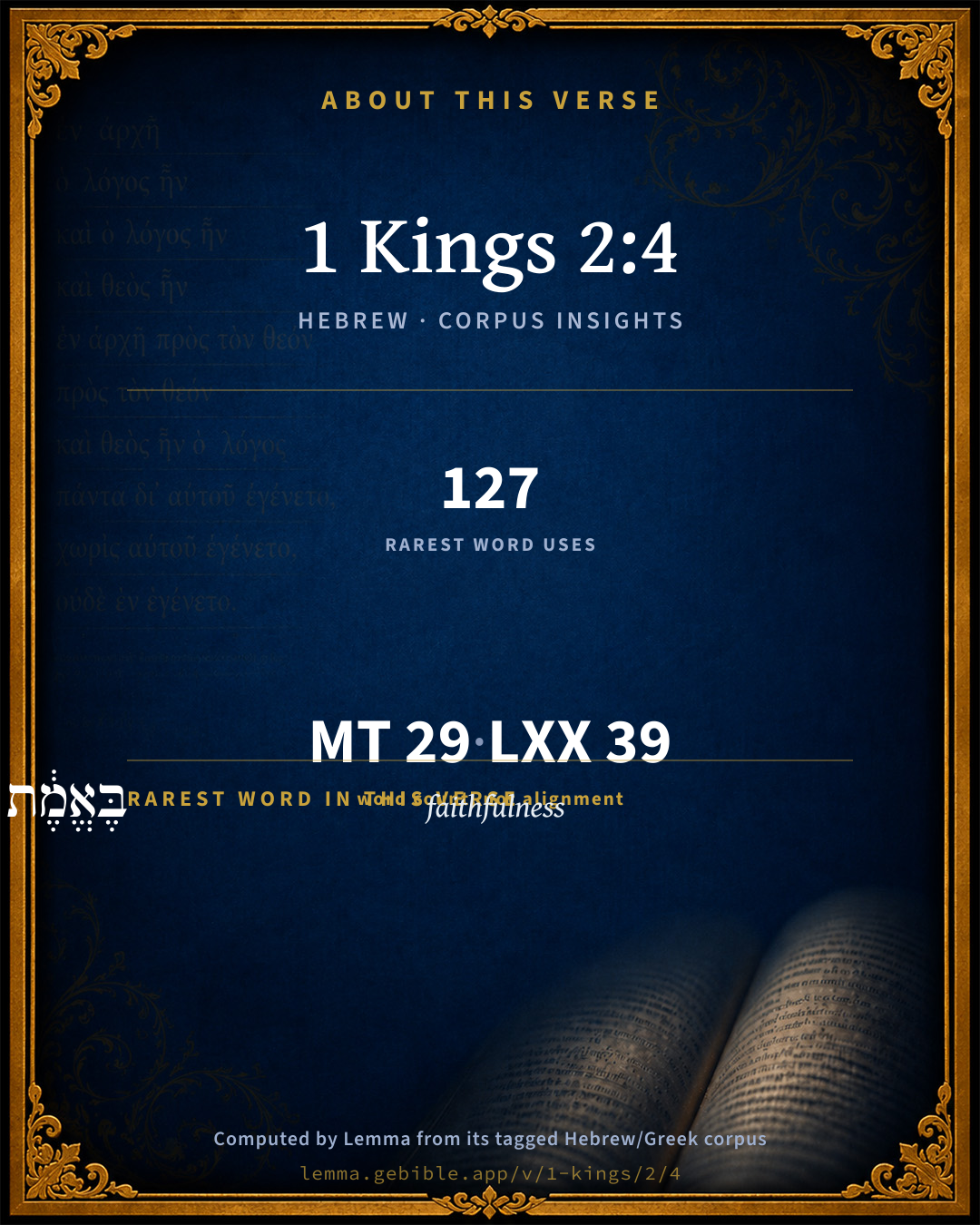
These counts appear in no published source. They are computed here, from the morphology-tagged text and Lemma’s own curated glosses. What Lemma adds →

29
words
24
distinct lemmas
Historical
section

Grammatical profile

  • 7 verbs
  • 13 nouns
  • 4 prepositions
  • 1 conjunction
  • 4 particles

Verb forms

  • יָקִ֨ים Hiphil · Imperfect
  • דִּבֶּ֣ר Piel · Perfect
  • לֵאמֹר֒ Qal · Infinitive Construct
  • יִשְׁמְר֨וּ Qal · Imperfect
  • לָלֶ֤כֶת Qal · Infinitive Construct
  • לֵאמֹ֕ר Qal · Infinitive Construct
  • יִכָּרֵ֤ת Niphal · Imperfect

Repetition

Words recur within this verse — often emphatic in Hebrew:

  • עָלַי֮ upon H5921 ×2
  • לֵאמֹר֒ to say H559 ×2
  • בְּכָל all H3605 ×2

Hebrew & Septuagint length

In English translation the verse runs 49 words from the Hebrew and 46 from the Septuagint (LXX English) — closely comparable.

A rough comparison of the two English renderings, which tokenize alike — not a word-level alignment.

Word counts can differ between the Hebrew and the Greek without any difference in meaning — e.g. the Hebrew direct-object marker אֵת has no separate Greek word, and Greek often adds the article ὁ.

In the original languages it is 29 Hebrew tokens and 39 Greek tokens — but the two are counted differently (Hebrew bundles its prefixes and suffixes into one token; the Greek is in lemma form), so that isn’t a like-for-like length.

Cross-references

32

Topical passages linked to 1 Kings 2:4 in the Treasury of Scripture Knowledge — connected by theme and wording, ordered by reader-vote popularity; previews shown in the World English Bible.

  • 2 Kings 20:3 Remember now, Yahweh, I beg you, how I have walked before you in truth and with a perfect heart, and have done that which is good in your sight. Hezekiah wept sore.
  • 2 Samuel 7:25 Now, Yahweh God, the word that you have spoken concerning your servant, and concerning his house, confirm you it forever, and do as you have spoken.
  • 1 Kings 8:25 Now therefore, Yahweh, the God of Israel, keep with your servant David my father that which you have promised him, saying, There shall not fail you a man in my sight to sit on the throne of Israel, if only your children take heed to their way, to walk before me as you have walked before me.
  • Psalms 132:11–12 Yahweh has sworn to David in truth. He will not turn from it: "I will set the fruit of your body on your throne.
  • Matthew 22:37 Jesus said to him, "'You shall love the Lord your God with all your heart, and with all your soul, and with all your mind.'
  • Psalms 89:29–37 I will also make his seed endure forever, And his throne as the days of heaven.
  • John 15:9–10 Even as the Father has loved me, I also have loved you. Remain in my love.
  • Genesis 17:1 When Abram was ninety-nine years old, Yahweh appeared to Abram, and said to him, "I am God Almighty. Walk before me, and be blameless.
  • Genesis 18:19 For I have known him, to the end that he may command his children and his household after him, that they may keep the way of Yahweh, to do righteousness and justice; to the end that Yahweh may bring on Abraham that which he has spoken of him."
  • Leviticus 26:3 "'If you walk in my statutes, and keep my commandments, and do them;
  • Deuteronomy 6:5 and you shall love Yahweh your God with all your heart, and with all your soul, and with all your might.
  • Deuteronomy 7:12 It shall happen, because you listen to these ordinances, and keep and do them, that Yahweh your God will keep with you the covenant and the loving kindness which he swore to your fathers:
  • Deuteronomy 10:12 Now, Israel, what does Yahweh your God require of you, but to fear Yahweh your God, to walk in all his ways, and to love him, and to serve Yahweh your God with all your heart and with all your soul,
  • Deuteronomy 11:13 It shall happen, if you shall listen diligently to my commandments which I command you this day, to love Yahweh your God, and to serve him with all your heart and with all your soul,
  • 2 Samuel 7:11–16 and [as] from the day that I commanded judges to be over my people Israel; and I will cause you to rest from all your enemies. Moreover Yahweh tells you that Yahweh will make you a house.
  • 1 Kings 3:3 Solomon loved Yahweh, walking in the statutes of David his father: only he sacrificed and burnt incense in the high places.
  • 1 Kings 3:14 If you will walk in my ways, to keep my statutes and my commandments, as your father David did walk, then I will lengthen your days.
  • 1 Kings 8:23 and he said, Yahweh, the God of Israel, there is no God like you, in heaven above, or on earth beneath; who keep covenant and loving kindness with your servants, who walk before you with all their heart;
  • 1 Kings 9:5 then I will establish the throne of your kingdom over Israel forever, according as I promised to David your father, saying, There shall not fail you a man on the throne of Israel.
  • 2 Kings 23:3 The king stood by the pillar, and made a covenant before Yahweh, to walk after Yahweh, and to keep his commandments, and his testimonies, and his statutes, with all [his] heart, and all [his] soul, to confirm the words of this covenant that were written in this book: and all the people stood to the covenant.
  • 2 Kings 23:25 Like him was there no king before him, who turned to Yahweh with all his heart, and with all his soul, and with all his might, according to all the law of Moses; neither after him arose there any like him.
  • 1 Chronicles 17:11–15 It shall happen, when your days are fulfilled that you must go to be with your fathers, that I will set up your seed after you, who shall be of your sons; and I will establish his kingdom.
  • 1 Chronicles 22:9–11 Behold, a son shall be born to you, who shall be a man of rest; and I will give him rest from all his enemies round about; for his name shall be Solomon, and I will give peace and quietness to Israel in his days:
  • 1 Chronicles 28:5–7 Of all my sons (for Yahweh has given me many sons), he has chosen Solomon my son to sit on the throne of the kingdom of Yahweh over Israel.
  • 1 Chronicles 28:9 You, Solomon my son, know the God of your father, and serve him with a perfect heart and with a willing mind; for Yahweh searches all hearts, and understands all the imaginations of the thoughts: if you seek him, he will be found of you; but if you forsake him, he will cast you off forever.
  • 2 Chronicles 17:3 Yahweh was with Jehoshaphat, because he walked in the first ways of his father David, and didn't seek the Baals,
  • Psalms 37:9 For evildoers shall be cut off, But those who wait for Yahweh shall inherit the land.
  • Psalms 37:22 For such as are blessed by him shall inherit the land. Those who are cursed by him shall be cut off.
  • Zechariah 14:2 For I will gather all nations against Jerusalem to battle; and the city will be taken, the houses rifled, and the women ravished. half of the city will go out into captivity, and the rest of the people will not be cut off from the city.
  • Luke 1:6 They were both righteous before God, walking blamelessly in all the commandments and ordinances of the Lord.
  • Jude 1:20–21 But you, beloved, keep building up yourselves on your most holy faith, praying in the Holy Spirit.
  • Jude 1:24 Now to him who is able to keep them from stumbling, and to present you faultless before the presence of his glory in great joy,

Cross-references courtesy of OpenBible.info (CC BY 4.0).

Hebrew and Greek witnesses Masoretic Hebrew ↔ Greek Septuagint

The same verse in the two great witnesses to the Old Testament, shown verse-for-verse.

These are two independent witnesses, not word-aligned to each other, and the Septuagint is shown in lemma (dictionary) form.

Hebrew 1 Kings 2:4 Masoretic · Westminster Leningrad Codex

לְמַעַן֩ יָקִ֨ים יְהוָ֜ה אֶת דְּבָר֗וֹ אֲשֶׁ֨ר דִּבֶּ֣ר עָלַי֮ לֵאמֹר֒ אִם יִשְׁמְר֨וּ בָנֶ֜יךָ אֶת דַּרְכָּ֗ם לָלֶ֤כֶת לְפָנַי֙ בֶּאֱמֶ֔ת בְּכָל לְבָבָ֖ם וּבְכָל נַפְשָׁ֑ם לֵאמֹ֕ר לֹֽא יִכָּרֵ֤ת לְךָ֙ אִ֔ישׁ מֵעַ֖ל כִּסֵּ֥א יִשְׂרָאֵֽל

That Yahweh may establish his word which he spoke concerning me, saying, If your children take heed to their way, to walk before me in truth with all their heart and with all their soul, there shall not fail you (said he) a man on the throne of Israel.

World English Bible · Public Domain

Greek LXX 1 Kings 2:4 Septuagint · lemma form

ἵνα ἵστημι κύριος ὁ λόγος αὐτός ὅς λαλέω λέγω ἐάν φυλάσσω ὁ υἱός σύ ὁ ὁδός αὐτός πορεύομαι ἐνώπιον ἐγώ ἐν ἀλήθεια ἐν ὅλος καρδία αὐτός καί ἐν ὅλος ψυχή αὐτός λέγω οὐ ἐκὀλεθρεύω σύ ἀνήρ ἐπάνωθεν θρόνος ἰσραήλ

that the Lord may confirm his word which he spoke, saying, If your children shall take heed to their way to walk before me in truth with all their heart, I promise you, saying, there shall not fail you a man on the throne of Israel.

LXX2012 (modern English Septuagint) · Public Domain

On this verse, The Cambridge Bible for Schools and Colleges discusses the Septuagint’s reading. Read the note in Commentary ↓

Hebrew: Westminster Leningrad Codex (CC BY 4.0). Greek: Septuagint (public domain); English from LXX2012 (modern English Septuagint) (Public Domain). How the Septuagint differs from the Hebrew →

Targum (Aramaic paraphrase)

1

The Targum is the ancient Jewish Aramaic paraphrase of the Hebrew Scriptures — an interpretive translation, not the Hebrew text itself. Onkelos (literal) and Pseudo-Jonathan (expansive) render the Torah, and Jonathan the Prophets. Coverage is partial: where no permissively-licensed English translation exists for a verse, only the Aramaic is shown. This is verse-level text, not a word-by-word alignment to the Hebrew.

  1. Targum Jonathan Prophets (Joshua–Malachi)
    בְּדִיל דִי יְקַיֵם יְיָ יַת פִּתְגָמוֹהִי דִי מַלֵיל עֲלַי לְמֵימָר אִם יִטְרוּן בְּנָךְ יַת אָרְחֵיהוֹן לִמְהַךְ קֳדָמַי בִּקְשׁוֹט בְּכָל לִבְּהוֹן וּבְכָל נַפְשֵׁיהוֹן לְמֵימַר לָא יִפְּסוֹק לָךְ גְבַר מֵעַל כּוּרְסֵי מַלְכוּתָא דְיִשְׂרָאֵל:

    (no public-domain English translation for this verse)

    Targum Jonathan — Aramaic: “Mikraot Gedolot” (public domain). English: “Sefaria Community Translation” (CC0 1.0 (public-domain dedication)); “London "Chaldee Paraphrase," 1871” (public domain). Text via Sefaria.

Commentary

Notes on 1 Kings 2:4 from classic Christian and Jewish commentators (each source and its license shown beneath its notes). The classic Christian expositions comment on the surrounding passage and are grouped to its opening verse, so a note may address several verses; the Jewish commentaries on the Tanakh (Rashi and others) are per-verse, so they appear only where the commentator wrote on this verse.

Lemma curates 59 commentaries, every one of them public domain or Creative Commons licensed, each selected and text-cleaned for this edition rather than reprinted as found. About our sources →

Trapp's Complete Commentary

John Trapp

1Ki 2:4 That the LORD may continue his word which he spake concerning me, saying, If thy children take heed to their way, to walk before me in truth with all their heart and with all their soul, there shall not fail thee (said he) a man on the throne of Israel.

Ver. 4. If thy children take heed to their way.] Walking circumspectly and by rule; not at random, at all adventures. Here observe that God’s promises are with a condition; which is as an oar in a boat, or stern of a ship, and turneth the promise another way.

John Trapp, A Commentary or Exposition upon All the Books of the Old and New Testament (1647–1656) — public domain. Text from a community e-Sword module.

Geneva Bible (1599)

Geneva Bible translators

And without hypocrisy.

Hebrew, a man shall not be cut off to thee from off the throne.

Geneva Bible (1599) marginal notes — public domain. Text via Bolls.life.

Jamieson, Fausset & Brown

Robert Jamieson, A. R. Fausset & David Brown

there shall not fail thee . . . a man on the throne of Israel--a reference to the promise made to David of the sovereignty being vested perpetually in his lineage (Sa2 7:11-16), which was confirmed to Solomon afterwards (see Kg1 9:5), and repeated with reference to its spiritual meaning long after (Jer 33:17).

Jamieson, Fausset & Brown — Commentary Critical and Explanatory on the Whole Bible (1871) — public domain (CC PDM 1.0). Text via the HelloAO Bible API.

Adam Clarke's Commentary

Verse 4. That the Lord may continue his word] The prosperity which God has promised to grant to my family will depend on their faithfulness to the good they receive; if they live to God, they shall sit for ever on the throne of Israel. But alas! they did not; and God's justice cut off the entail made by his mercy.

Adam Clarke's Commentary on the Bible (1810–1826) — public domain. Text from a community e-Sword/MySword module.

The Cambridge Bible for Schools and Colleges

gen. ed. J. J. S. Perowne

4. that the Lord may continue his word] The verb is most commonly rendered ‘establish’ and may be so translated here. Cf. 1Sa_1:23 where the same phrase occurs. The sense is of confirming and ratifying what has previously been promised. David is here looking forward to the generations that shall come after him, which fact the A. V. has endeavoured to make clear by the rendering ‘continue’. The word, or promise, alluded to is found 2Sa_7:25-29.

saying, If thy children take heed to their way] In the passage just mentioned where the promise is recorded there are none of these conditions specified; but we are sure that God’s promise was not an unconditional one, and in his Psalms (Psa_132:12) David has expressly made mention of the condition in words very similar to this verse.

there shall not fail thee (said he) a man on the throne of Israel] The Heb. is literally ‘there shall not be cut off unto thee a man from upon the throne of Israel’; and the same phrase occurs afterwards ch. 1Ki_8:25, 1Ki_9:5, and in other parts of the Bible. The sense is ‘there never shall be wanting some one of thy race to sit on the throne.’ The promise was made to David’s line, and was fulfilled; for as long as the kingdom of Judah existed the family of David were kings.

There is no word in the Hebrew for the parenthetic ‘said he,’ but the clause is preceded by the word usually rendered ‘saying,’ which seems to have been introduced by some scribe from the earlier part of the verse. The LXX. translates the Hebrew literally (i.e. repeating λέγων); the Vulgate notices neither the ‘saying’ nor ‘said he’.

The Cambridge Bible for Schools and Colleges (gen. ed. J. J. S. Perowne; Cambridge University Press, 1878–1918) — public domain. Text from a community e-Sword module.

John Gill's Exposition

That the Lord may continue his word which he spake concerning me,.... his word of promise concerning the kingdom of David, and the succession of it, and confirm and establish it:

saying, if thy children take heed to their way; they are directed to walk in, even the way of the Lord, and not turn to the right hand or the left:

to walk before me in truth: in the sincerity and integrity of their hearts, according to the word of truth, and under the influence of the spirit of truth:

with all their heart, and with all their soul; in the most cordial manner, with the strongest affection and zeal; with all eagerness and earnestness; with their whole hearts engaged in every duty performed by them: then the Lord said,

there shall not fail thee a man on the throne of Israel; one to succeed him in the throne; this, with respect to his throne, literally considered, was conditional; but, spiritually considered, was absolute, and had its fulfilment in the Messiah, whose throne is for ever; see Luk 1:32.

John Gill's Exposition of the Whole Bible (1746–1763) — public domain (CC PDM 1.0). Text via the HelloAO Bible API.

Albert Barnes' Notes on the Bible

That the Lord may continue his word - The original promise given to David indirectly, through Nathan 2Sa 7:11-17, and apparently unconditional, afterward was made conditional upon continued obedience. (See the margin reference “f.”) David reminds Solomon of this, in order to impress upon him a powerful motive to continue faithful and obedient.

Albert Barnes' Notes on the Bible (1834–1885) — public domain. Text from a community e-Sword/MySword module.

Haydock's Catholic Bible Commentary

Truth and sincerity. (Calmet) --- This promise was made, 2 Kings vii. 16. (Menochius)

George Leo Haydock (1774–1849), Haydock's Catholic Family Bible and Commentary, 1859 edition — public domain. Excludes Psalms (Douay-Rheims chapter numbering differs from Protestant) and Deuterocanonical books (Catholic canon only).

Matthew Poole's English Annotations

Confirm his word, i.e. fulfil his promise, the condition upon which it was suspended being performed.

Take heed to their ways, i.e. diligently observe all their actions, to order them according to God’s word.

To walk before me; to live as those that have God before their eyes, and endeavour to approve themselves to him.

In truth; not only in pretence and show, but truly and sincerely. With all their heart, and with all their soul, i.e. universally, freely, and fervently.

There shall not fail thee a man on the throne of Israel; the succession shall be continued in thy line without any interruption.

Matthew Poole's English Annotations on the Holy Bible (1683–1685) — public domain. Text from a community e-Sword/MySword module.

Whedon's Commentary on the Bible

Daniel D. Whedon

4. His word which he spake concerning me — See 2Sa_7:11-16, and notes there.

Daniel D. Whedon (gen. ed.), Commentary on the Old and New Testaments (1874–1909) — public domain. Text from a community e-Sword module.

The Pulpit Commentary

That the Lord may continue rather, "establish" (ut confirmet), as it is rendered in 2Sa_7:25, where this same word of promise is spoken of. Cf. 1Ki_8:26 His word which He spake concerning me by the mouth of Nathan, 2Sa_7:12-17 (cf.; Psa_89:4) or David may refer to some subsequent promise made to him directly. In the promise of 2Sa 7. there is no mention of any stipulations, "If thy children," etc. But both here and in Psa_122:1, 1Ki_8:25, special prominence is given to the condition (dum se bene gesserint) which no doubt was understood, if not expressed, when the promise was first made), saying, If thy children take heed to lit., "keep," same word as in vers. 2, 3 their way, to walk before me in truth with all their heart and with all their soul there shall not fail thee lit., "be cut off to thee," as marg. (cf. 1Sa_2:29; Jos_9:23) This word does not occur in the original promise made through Nathan. But it does occur in subsequent versions of the promise, 1Ki_8:25, 1Ki_9:5, as well as here a strong presumption that the promise must have been repeated to David in another shape said he, a man on the throne of Israel.

But this thought that the permanence of his dynasty depended on the faithful observance of the law as it is written in the book of Moses (i.e., in all its details), seems to have reminded the dying man that he himself had not always kept the statutes he was urging his successor to keep. It had been his duty as king, as the power ordained of God, to visit all violations of the law of God with their appropriate penalties; and this duty, in some instances at least, had been neglected. For the law of Moses, reaffirming the primaeval law which formed part of the so called "precepts of Noah" (Genesis 6) that ix. blood must be expiated by blood enjoined, with singular emphasis and distinctness, the death of the murderer (Num_35:16, Num_35:17, Num_35:18, Num_35:19, Num_35:30-33; Exo_21:14) It declared that so long as murder remained unpunished, the whole land was defiled and under a curse. (Num_35:33) And it gave the king no power to pardon, no discretion in the matter. Until the red stain of blood was washed out "by the blood of him that shed it" the Divine Justice was not satisfied, and a famine or pestilence or sword might smite the land. Now, David knew all this: he could not fail to know it, for he had seen his country, a few years before, visited by a famine because of the unavenged blood of the Gibeonites. (2Sa_21:1) And yet, one notorious and infamous murderer had not been put to death. The assassin of Abner and of Amasa still polluted the earth, still occupied a distinguished position, and defied punishment. But if the law of Moses was to be kept, then, whatever it might cost, and however painful it might be, (Deu_19:13) he must die; and David, for the welfare of his kingdom, the stability of his throne, and above all, the honour of God, must require his death. No doubt it had often burdened his mind, especially during these last days of feebleness, the thought that punishment had been so long delayed; and therefore, as he sees the end approaching, he feels that he must enjoin upon his successor the fulfilment of that duty which he had been too "weak" to discharge. (2Sa_3:39) Hence he proceeds,

The Pulpit Commentary (1880–1919), ed. H.D.M. Spence-Jones & Joseph S. Exell — public domain. Text from a community e-Sword module.

John Wesley's Explanatory Notes

Confirm his word - Fulfil his promise, the condition upon which it was suspended, being performed.

John Wesley, Explanatory Notes Upon the Whole Bible (1754–1765) — public domain. Text via the GEBible commentary corpus.

Lesson kit

Teaching starters — assembled from the data on this page, not authored interpretation. Every prompt links to the verse data it draws on. Edit before teaching.

1 Kings, in the Historical, opens this verse with 29 words (24 distinct Hebrew lemmas). Its most distinctive word is ʼemeth (“faithfulness”). A historical commentator’s framing appears above. Read the whole chapter for the surrounding context.

Discussion questions

  1. The word ʼemeth carries the sense “faithfulness.” How does it shape the verse?
  2. How does 2 Kings 20:3, which shares this passage’s theme, read alongside this verse?
  3. What does the repetition of “upon” (2× in this one verse) do in this verse?
  4. The translations on this page render this verse differently — a whole-verse word diff, not a word-by-word alignment. What might account for the different wordings?
  5. «יָקִ֨ים» is a Hiphil Imperfect verb. How does that grammatical form shape the action described?
  6. Compare how Trapp's Complete Commentary and Geneva Bible (1599) read this verse. Where do they agree or differ?

Things to notice

Reading settings

Reading text

Shown beneath each verse's original-language words.

Old Testament
Old Testament edition

Read the OT as the Masoretic Hebrew (MT) or the Greek Septuagint (LXX).

English shown for the Greek Septuagint (in the Hebrew ↔ Greek comparison).

Comparing translations? Open the Compare panel on any verse page to stack up to four side by side.