
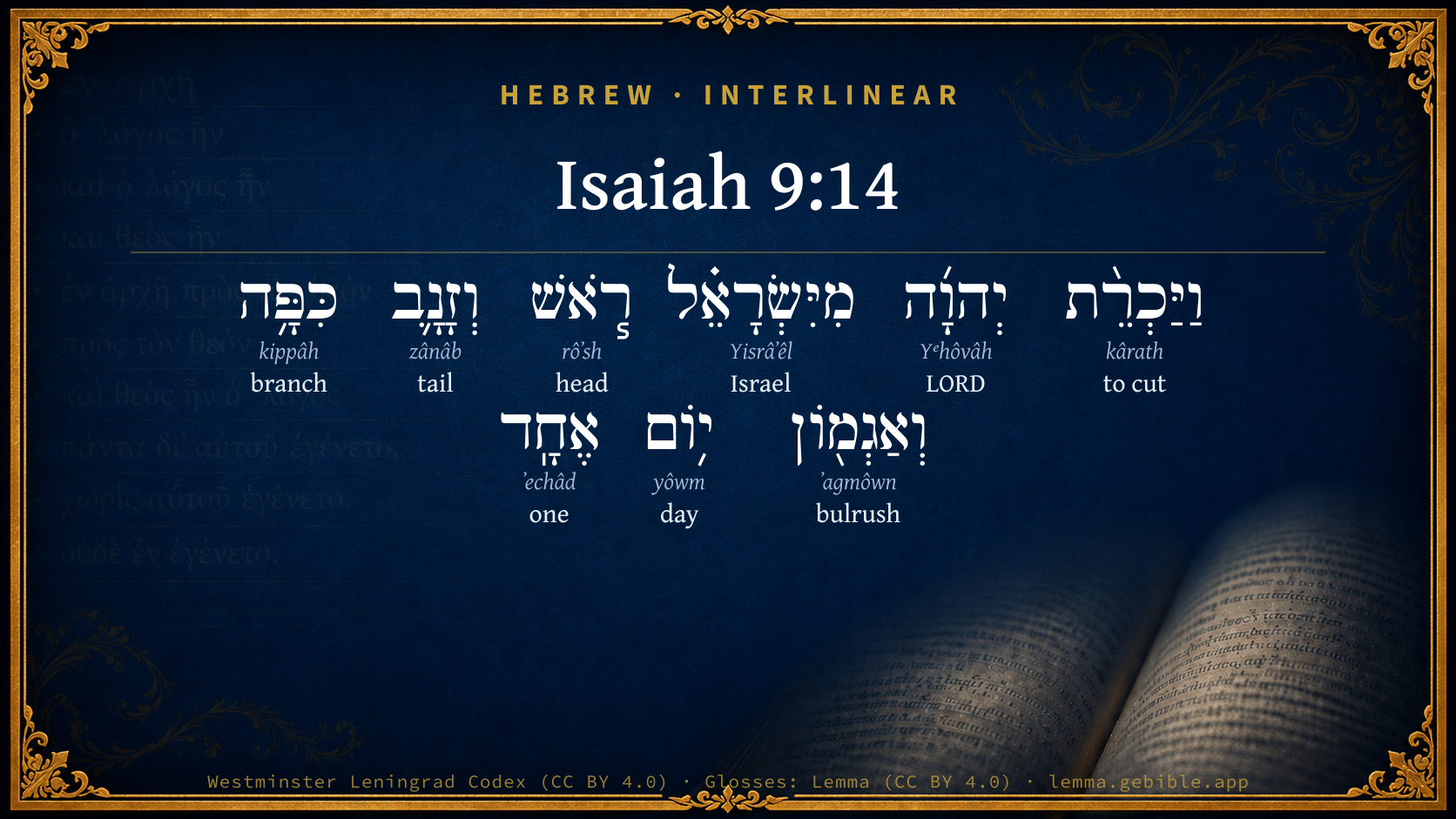
Isaiah 9:14

Hebrew (Westminster Leningrad Codex) Isaiah 9:14 appears in the Hebrew Old Testament. The text above is from the Westminster Leningrad Codex. Each word links to its Strong’s number, a concise gloss, and parsing drawn from the Open Scriptures Hebrew Bible morphology. Click any word for its full Brown-Driver-Briggs (BDB) entry.
Download image
Cite this verse

Isaiah 9:14 (World English Bible). Public Domain. Lemma interlinear Bible study tool, https://lemma.gebible.app/v/isaiah/9/14.

Show BibTeX & RIS
BibTeX
RIS
English Translation
Therefore Yahweh will cut off from Israel head and tail, palm-branch and rush, in one day.
World English Bible · Public Domain
Download a study sheet

One document with this verse’s original text, its word-by-word gloss line, the meaning frame, cross-references with their text, attributed commentary, and full source and license credits — printable, and it pastes into notes with its structure intact.

This verse Autodidact and up

Study sheet (.html) Plain text (.txt)

A passage Seminary Student

Up to 50 verses in one chapter. A passage sheet keeps up to 6 commentary sources and 12 cross-references per verse, in the order this page ranks them, and says so on the sheet whenever that leaves anything out. Ask for a single verse and you get the Autodidact verse sheet above.

Everything on this page stays free to read, with no account — the sheet is a download of what is already on screen, not access to it.

Want to remove ads? Support Godless Engineer
Compare translations 3

The same verse in 3 English versions, stacked beneath the original-language interlinear above. Click any original word for its lexicon entry.

Each is an independent rendering of the whole verse — the interlinear is not word-aligned to these translations.

Highlighted words mark where these versions differ — a whole-verse word diff, not a word-by-word alignment.

  • World English Bible Public Domain
    Therefore Yahweh will cut off from Israel head and tail, palm-branch and rush, in one day.
  • King James Version Public Domain
    Therefore the LORD will cut off from Israel head and tail, branch and rush, in one day.
  • unfoldingWord Literal Text CC BY-SA 4.0
    So Yahweh will cut off from Israel head and tail, palm branch and reed, one day.

unfoldingWord Literal Text — © unfoldingWord, licensed CC BY-SA 4.0. Word-aligned USFM3 via Door43 (git.door43.org/unfoldingWord/en_ult).

Versions to compare (up to 4)

3 of 4 selected

Show all 18 translations

Every available English version of this verse, each an independent rendering of the whole verse.

  • World English Bible Public Domain
    Therefore Yahweh will cut off from Israel head and tail, palm-branch and rush, in one day.
  • Berean Standard Bible Public Domain
    So the LORD will cut off Israel’s head and tail, both palm branch and reed in a single day.
  • Majority Standard Bible Public Domain
    So the LORD will cut off Israel’s head and tail, both palm branch and reed in a single day.
  • King James Version Public Domain
    Therefore the LORD will cut off from Israel head and tail, branch and rush, in one day.
  • American Standard Version (1901) Public Domain
    Therefore Jehovah will cut off from Israel head and tail, palm-branch and rush, in one day.
  • Revised Version (1885) Public Domain
    Therefore the LORD will cut off from Israel head and tail, palm-branch and rush, in one day.
  • Geneva Bible (1599) Public Domain
    Therefore will the Lord cut off from Israel head and taile, branche and rush in one day.
  • Douay-Rheims (1899) Public Domain
    And the Lord shall destroy out of Israel the head and the tail, him that bendeth down, and him that holdeth back, in one day.
  • Young's Literal Translation Public Domain
    And Jehovah cutteth off from Israel head and tail, Branch and reed -- the same day,
  • Literal Standard Version CC BY-SA 4.0
    And YHWH cuts off head and tail from Israel, || Branch and reed—the same day.
  • Unlocked Literal Bible CC BY-SA 4.0
    Therefore Yahweh will cut off from Israel head and tail, palm branch and reed, in one day.
  • unfoldingWord Literal Text CC BY-SA 4.0
    So Yahweh will cut off from Israel head and tail, palm branch and reed, one day.
  • Darby Bible Public Domain
    And Jehovah will cut off from Israel head and tail, palm-branch and rush, in one day:
  • World Messianic Bible Public Domain
    Therefore the LORD will cut off from Israel head and tail, palm branch and reed, in one day.
  • Webster's Bible Public Domain
    Therefore the LORD will cut off from Israel head and tail, branch and rush, in one day.
  • Free Bible Version CC BY-SA 4.0
    So in just a single day the Lord will chop off Israel's head and tail, palm branch and reed.
  • Bible in Basic English Public Domain
    For this cause the Lord took away from Israel head and tail, high and low, in one day.
  • JPS Tanakh (1917) Public Domain
    (9-13) Therefore the LORD doth cut off from Israel head and tail, palm-branch and rush, in one day.

Literal Standard Version (2020), Covenant Press — licensed CC BY-SA 4.0. Text via the HelloAO Bible API (eBible.org). Unlocked Literal Bible (unfoldingWord) — licensed CC BY-SA 4.0. Text via the HelloAO Bible API (eBible.org). unfoldingWord Literal Text — © unfoldingWord, licensed CC BY-SA 4.0. Word-aligned USFM3 via Door43 (git.door43.org/unfoldingWord/en_ult). Free Bible Version, Dr. Jonathan Gallagher — licensed CC BY-SA 4.0. Text via the HelloAO Bible API (eBible.org).

Word by word

More ways to search: Search by grammar → Find every occurrence → Compare this word →

Practice this passage: Drill this verse → Learn its vocabulary →

About this verse

These counts appear in no published source. They are computed here, from the morphology-tagged text and Lemma’s own curated glosses. What Lemma adds →

9
words
9
distinct lemmas
Prophets
section

Notable vocabulary

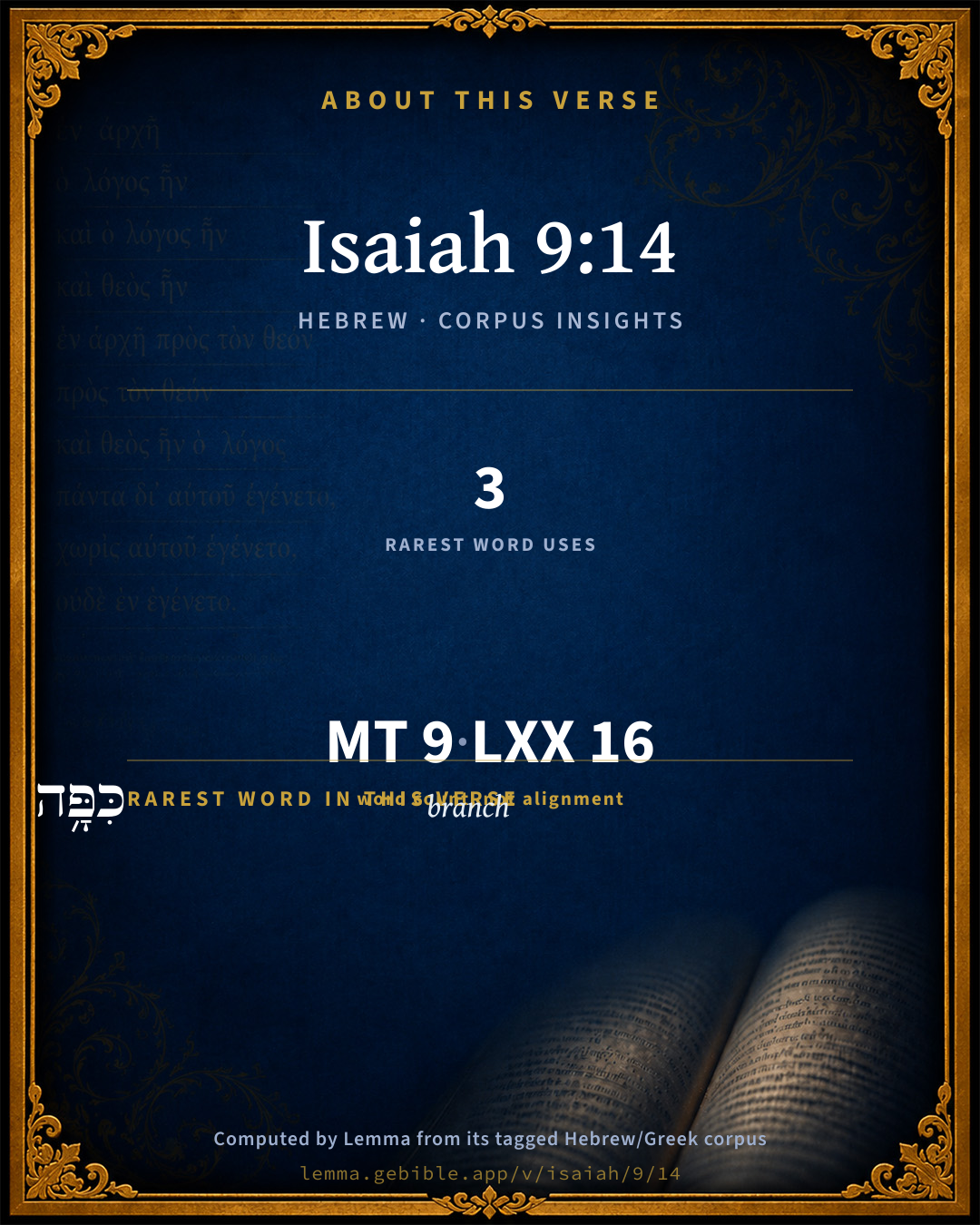
The rarest word here is כִּפָּ֥ה branch H3712 — appearing just 3 times in the whole Hebrew Bible.

Shared distinctive vocabulary

כִּפָּ֥ה branch H3712 occurs in 3 verses of the Hebrew Bible. Also found in:

Grammatical profile

  • 1 verb
  • 7 nouns
  • 1 adjective

Verb forms

  • וַיַּכְרֵ֨ת Hiphil · Sequential Imperfect

Hebrew & Septuagint length

In English translation the verse runs 16 words from the Hebrew and 17 from the Septuagint (LXX English) — closely comparable.

A rough comparison of the two English renderings, which tokenize alike — not a word-level alignment.

Word counts can differ between the Hebrew and the Greek without any difference in meaning — e.g. the Hebrew direct-object marker אֵת has no separate Greek word, and Greek often adds the article ὁ.

In the original languages it is 9 Hebrew tokens and 16 Greek tokens — but the two are counted differently (Hebrew bundles its prefixes and suffixes into one token; the Greek is in lemma form), so that isn’t a like-for-like length.

Cross-references

25

Topical passages linked to Isaiah 9:14 in the Treasury of Scripture Knowledge — connected by theme and wording, ordered by reader-vote popularity; previews shown in the World English Bible.

  • Isaiah 19:15 Neither shall there be for Egypt any work, which head or tail, palm-branch or rush, may do.
  • Revelation 18:8 Therefore in one day her plagues will come: death, mourning, and famine; and she will be utterly burned with fire; for the Lord God who has judged her is strong.
  • 2 Kings 17:6–20 In the ninth year of Hoshea the king of Assyria took Samaria, and carried Israel away to Assyria, and placed them in Halah, and on the Habor, the river of Gozan, and in the cities of the Medes.
  • Isaiah 3:2–3 The mighty man, The man of war, The judge, The prophet, The diviner, The elder,
  • Isaiah 30:13 therefore this iniquity shall be to you as a breach ready to fall, swelling out in a high wall, whose breaking comes suddenly in an instant.
  • Hosea 1:4 Yahweh said to him, "Call his name Jezreel; for yet a little while, and I will avenge the blood of Jezreel on the house of Jehu, and will cause the kingdom of the house of Israel to cease.
  • Hosea 1:6 She conceived again, and bore a daughter. Then he said to him, "Call her name Lo-Ruhamah; for I will no longer have mercy on the house of Israel, that I should in any way pardon them.
  • Hosea 1:9 He said, "Call his name Lo-Ammi; for you are not my people, and I will not be yours.
  • Hosea 4:5 You will stumble in the day, And the prophet will also stumble with you in the night; And I will destroy your mother.
  • Hosea 5:12–14 Therefore I am to Ephraim like a moth, And to the house of Judah like rottenness.
  • Hosea 8:8 Israel is swallowed up. Now they are among the nations like a worthless thing.
  • Hosea 9:11–17 As for Ephraim, their glory will fly away like a bird. There will be no birth, none with child, and no conception.
  • Hosea 10:15 So Bethel will do to you because of your great wickedness. At daybreak the king of Israel will be destroyed.
  • Hosea 13:3 Therefore they will be like the morning cloud, And like the dew that passes away early, Like the chaff that is driven with the whirlwind out of the threshing floor, And like the smoke out of the chimney.
  • Amos 2:14–16 Flight will perish from the swift; And the strong won't strengthen his force; Neither shall the mighty deliver himself;
  • Amos 3:12 Thus says Yahweh: "As the shepherd rescues out of the mouth of the lion two legs, Or a piece of an ear, So shall the children of Israel be rescued who sit in Samaria on the corner of a couch, And on the silken cushions of a bed."
  • Amos 5:2–3 "The virgin of Israel has fallen; She shall rise no more. She is cast down on her land; There is no one to raise her up."
  • Amos 6:11 "For, behold, Yahweh commands, and the great house will be smashed to pieces, And the little house into bits.
  • Amos 7:8–9 Yahweh said to me, "Amos, what do you see?" I said, "A plumb line." Then the Lord said, "Behold, I will set a plumb line in the midst of my people Israel. I will not again pass by them any more.
  • Amos 7:17 Therefore thus says Yahweh: 'Your wife shall be a prostitute in the city, and your sons and your daughters shall fall by the sword, and your land shall be divided by line; and you yourself shall die in a land that is unclean, and Israel shall surely be led away captive out of his land.'"
  • Amos 9:1–9 I saw the Lord standing beside the altar, and he said, "Strike the tops of the pillars, that the thresholds may shake; and break them in pieces on the head of all of them; and I will kill the last of them with the sword: there shall not one of them flee away, and there shall not one of them escape.
  • Micah 1:6–8 Therefore I will make Samaria like a rubble heap of the field, Like places for planting vineyards; And I will pour down its stones into the valley, And I will uncover its foundations.
  • Revelation 18:10 standing far away for the fear of her torment, saying, 'Woe, woe, the great city, Babylon, the strong city! For your judgment has come in one hour.'
  • Revelation 18:17 For in an hour such great riches are made desolate.' Every shipmaster, and everyone who sails anywhere, and mariners, and as many as gain their living by sea, stood far away,
  • Isaiah 10:17 The light of Israel will be for a fire, and his Holy One for a flame; and it will burn and devour his thorns and his briers in one day.

Cross-references courtesy of OpenBible.info (CC BY 4.0).

Hebrew and Greek witnesses Masoretic Hebrew ↔ Greek Septuagint

The same verse in the two great witnesses to the Old Testament, shown verse-for-verse.

These are two independent witnesses, not word-aligned to each other, and the Septuagint is shown in lemma (dictionary) form.

Hebrew Isaiah 9:14 Masoretic · Westminster Leningrad Codex

וַיַּכְרֵ֨ת יְהוָ֜ה מִיִּשְׂרָאֵ֗ל רֹ֧אשׁ וְזָנָ֛ב כִּפָּ֥ה וְאַגְמ֖וֹן י֥וֹם אֶחָֽד

Therefore Yahweh will cut off from Israel head and tail, palm-branch and rush, in one day.

World English Bible · Public Domain

Greek LXX Isaiah 9:14 Septuagint · lemma form

πρεσβύτης καί ὁ ὁ πρόσωπον θαυμάζω οὗτος ὁ ἀρχή καί προφήτης διδάσκω ἄνομος οὗτος ὁ οὐρά

So the Lord took away from Israel the head and tail, great and small, in one day:

LXX2012 (modern English Septuagint) · Public Domain

On this verse, John Gill's Exposition discusses the Septuagint’s reading. Read the note in Commentary ↓

Hebrew: Westminster Leningrad Codex (CC BY 4.0). Greek: Septuagint (public domain); English from LXX2012 (modern English Septuagint) (Public Domain). How the Septuagint differs from the Hebrew →

Targum (Aramaic paraphrase)

1

The Targum is the ancient Jewish Aramaic paraphrase of the Hebrew Scriptures — an interpretive translation, not the Hebrew text itself. Onkelos (literal) and Pseudo-Jonathan (expansive) render the Torah, and Jonathan the Prophets. Coverage is partial: where no permissively-licensed English translation exists for a verse, only the Aramaic is shown. This is verse-level text, not a word-by-word alignment to the Hebrew.

  1. Targum Jonathan Prophets (Joshua–Malachi)
    סָב וּנְסִיב אַפִּין הוּא רֵישָׁא וְסָפַר מַלִיף שְׁקַר הוּא חֲלָשָׁא:

    The ancient and honourable one, he is the head, and the scribe that teaches lies, he is the feeble one.

    Targum Jonathan — Aramaic: “Mikraot Gedolot” (public domain). English: “Sefaria Community Translation” (CC0 1.0 (public-domain dedication)); “London "Chaldee Paraphrase," 1871” (public domain). Text via Sefaria.

Commentary

Notes on Isaiah 9:14 from classic Christian and Jewish commentators (each source and its license shown beneath its notes). The classic Christian expositions comment on the surrounding passage and are grouped to its opening verse, so a note may address several verses; the Jewish commentaries on the Tanakh (Rashi and others) are per-verse, so they appear only where the commentator wrote on this verse.

Lemma curates 59 commentaries, every one of them public domain or Creative Commons licensed, each selected and text-cleaned for this edition rather than reprinted as found. About our sources →

The Cambridge Bible for Schools and Colleges

gen. ed. J. J. S. Perowne

14. Render: And (so) Jehovah cut off from Israel head and tail, palm-branch and rush, in one day. head and tail] i.e. leader and follower, a proverbial expression, like the next phrase.

15 is almost universally regarded as an erroneous explanation of Isa_9:14 and therefore a gloss; but this is not quite certain. False prophets were frequently guilty of following where they pretended to lead (1Ki_22:6; Eze_13:10) and might be very appropriately described as the “tail.” The verse may be objected to on account of its somewhat prosaic character, but the strophe is not complete without it.

The ancient and honourable] see on Isa_3:2-3.

The Cambridge Bible for Schools and Colleges (gen. ed. J. J. S. Perowne; Cambridge University Press, 1878–1918) — public domain. Text from a community e-Sword module.

Trapp's Complete Commentary

John Trapp

Isa 9:14 Therefore the LORD will cut off from Israel head and tail, branch and rush, in one day.

Ver. 14. Head and tail,] i.e., High and low {a} {as Isa 9:15} Here he compareth Israel, non sine morsu, to a beast with a long tail, for the perverseness of their practices. Or else to the serpent amphisbaena, which stingeth both with head and tail.

Branch and rush.] Strong and feeble. A "branch," or bough, hath some tack in it; a "rush" is a spongy, unsubstantial substance.

{a} Mεγαν και μικρον. - Sept. Parvi properemus et ampli.

John Trapp, A Commentary or Exposition upon All the Books of the Old and New Testament (1647–1656) — public domain. Text from a community e-Sword module.

The Biblical Illustrator

Joseph S. Exell

Isa_9:14

Therefore the Lord will cut off from Israel head and tall, branch and rush, in one day

God giving account of His actions

I.

THE GROUND OR OCCASION OF THE JUDGMENT in the particle therefore. Wherefore? (Isa_9:13). The cause which is here expressed may be conceived to proceed in the way of a three-fold gradation.

1. Of their simple impiety. Sin is the meritorious cause of all punishment.

2. Of their additional impenitency. Those that sin and so thoroughly provoke Gods anger against themselves, by repentance may happily divert and appease it. But the people in the text turned not to Him that smote them. And this made their judgment to be so much the surer to them. Impenitency seems in a manner to own and justify sin and stand in the commission of it. Further, it does in a manner trespass upon all the attributes of God, which it either questions or vilifies. The omniscience of God, as to the deserts of sin (Psa_94:7). The truth of God, as to the threats of sin (2Pe_3:4). The justice of God, as to the punishing of sin, The power of God, as to me executing of judgment.

3. Of their continued obstinacy. They did not seek the Lord of hosts.

II. THE JUDGMENT ITSELF. (T. Horton, D. D.)

Gods judgment on Israel

I. THE DENUNCIATION OF IT.

1. The Author of it. The Lord.

(1) His sovereignty and power. It is He only that is able to punish; it is He only that hath all men and creatures under His command.

(2) His purity. There are none who are so fit to punish others as those who are innocent persons.

2. The nature of it. The Lord will cut off. From correction He passes to destruction. First, He cuts them short; and if that will do no good upon them, He cuts them off. First the pruning knife, then the axe. There is a two-fold sword which God makes use of for cutting with, before He proceeds to cut off; the sword of His mouth, i.e., the Word of God, and the sword of His hand, i.e., the rod of God. He will.

(1) A word of premonition. Despise not Gods gracious hints and admonitions of judgment beforehand.

(2) A word of procrastination. God is slow to anger.

(3) A word of resolution. God will not be always willing; He will be at last doing.

3. The subject of it. If Israel shall provoke God by their impenitency and obstinacy against Him, even Israel shall be punished and cut off by Him 1Pe_4:17).

II. THE EXTENT OF IT. That we have expressed in a double metaphor; the one from the nature of the head and the tail; the other from the nature of a tree, in the branches and roots: both of them coming to one and the same purpose. Whereby we have signified to us the universality and impartiality of the destruction which is here threatened; it shall be of so general an extent, as to reach to all sorts of persons, high and low, rich and poor, great and small, to one as well as to another.

1. The metaphor taken from a body in the head and the tail. We may reduce it by way of explication to a threefold rank of--

(1) Age: old and young.

(2) Estate: rich and poor.

(3) Place or authority: governors and governed; magistrates, ministers, and those who are subordinate and in subjection to them.

2. The metaphor taken from the nature of a tree or plant: the branch and the rush. It is not said the branch and the root, because the Lord reserved a remnant which should be spared by Him. But the branch and the rush; the branch as an emblem of usefulness--persons of parts and employments; the rush as a note of unfruitfulness--idle and unprofitable persons. The branch is a note of strength and solidity; the rush of weakness and inconstancy. The branch (in like manner as the head) is a note of supremacy, the rush of meanness, In the execution of public judgments for the impenitency and incorrigibleness of a nation, Gods hand is indifferent and impartial; He will spare no ranks or sorts or conditions of people at all

III. THE TIME OR SEASON OF IT. In one day. It is a day--

1. In regard of the certainty of it, as that which is set and fixed.

2. In regard of the suddenness, as that which is speedy and soon accomplished. (T. Horton, D. D.)

Judgment obliterates classifications

Branch and rush--the allusion is to the beauteous palm tree: it shall be cut down notwithstanding its beauty; and the rush--the common growths round about it, entangled roots, poor miserable shrubs that crowd and cumber the earth--branch and rush cannot stand before Gods sword and fire: everything that is wrong goes down in a common destruction. Judgment obliterates our classifications. (J. Parker, D. D.)

The Biblical Illustrator, edited by Joseph S. Exell (c. 1880s–1900s) — public domain. Text from a community e-Sword module.

Jamieson, Fausset & Brown

Robert Jamieson, A. R. Fausset & David Brown

head and tail--proverbial for the highest and lowest (Deu 28:13, Deu 28:44).

branch and rush--another image for the same thought (Isa 19:15). The branch is elevated on the top of the tree: the rush is coarse and low.

Jamieson, Fausset & Brown — Commentary Critical and Explanatory on the Whole Bible (1871) — public domain (CC PDM 1.0). Text via the HelloAO Bible API.

Adam Clarke's Commentary

Verse 14. In one day.] Thirteen MSS. of Kennicott and De Rossi read ביום beyom, in a day; and another has a rasure in the place of the letter ב beth.

Adam Clarke's Commentary on the Bible (1810–1826) — public domain. Text from a community e-Sword/MySword module.

Ellicott's Commentary for English Readers

(14) Head and tail, branch and rush . . .—The “branch” is strictly that of the palm-tree, which in its stately height answered to the nobles of the land, while the “rush,” the emblem of a real or affected lowliness (Isa_58:5) represented the “mean man” of Isa_2:9. The same proverbial formula meets us in Isa_19:15.

A Bible Commentary for English Readers, edited by Charles John Ellicott (1878–1897) — public domain. Text from a community e-Sword module.

John Gill's Exposition

Therefore the Lord will cut off from Israel head and tail,.... The former of these is afterwards interpreted of "the ancient and honourable", men in high places, civil magistrates, judges, governors, and elders of the people, the king as supreme, and all subordinate officers; and so the Targum,

"the Lord will destroy from Israel the prince and the ruler;''

and the latter is interpreted of the false prophet. The people of Israel are compared to a beast with a tail, being so sadly degenerated and corrupted; as the Romish antichrist, in both his capacities, civil and ecclesiastical, is compared to a beast; the one being the head, and the other the tail, Rev 13:1 and Rome Pagan to a dragon with a tail, Rev 12:3 and the Saracens and Turks to locusts with tails like the tails of scorpions, Rev 9:10,

branch and rush, in one day. The Septuagint render it, "great and small"; and so the Arabic version; the first word intending the great men of the nation, in flourishing circumstances, like branches of trees; the latter the common, people, like reeds and rushes, weak and feeble; so Kimchi explains them,

"the strong and the weak;''

though the Targum interprets both of the governor and lord; and so Jarchi says they signify kings and governors; but Aben Ezra renders the word root and branch; and so they may denote the utter destruction of the people of Israel, fathers and children, high and low, rich and poor. See Mal 4:1.

John Gill's Exposition of the Whole Bible (1746–1763) — public domain (CC PDM 1.0). Text via the HelloAO Bible API.

Albert Barnes' Notes on the Bible

Will cut off head and tail - This is a proverbial expression, which is explained in the following verse; see also Deu 28:13-14. The head is often used to denote those in honor and authority. The tail is an expression applicable to the lower ranks, and would commonly indicate more than simply the common people. It would imply contempt; a state of great abjectness and meanness.

Branch and rush - This is also a proverbial expression, meaning the highest and lowest; see the note at Isa 19:15. The word here translated branch, means properly the bough or top of the palm tree. The palm grew to a great height before it gave out any branches, and hence, the image is a beautiful one to denote those high in office and authority. The word rush means the coarse, long-jointed reed, that grows in marshes - an apt emblem of the base and worthless classes of society.

Albert Barnes' Notes on the Bible (1834–1885) — public domain. Text from a community e-Sword/MySword module.

Haydock's Catholic Bible Commentary

Him. Hebrew, "the branch and the rush." (Calmet) --- Septuagint, "the great and the small."

George Leo Haydock (1774–1849), Haydock's Catholic Family Bible and Commentary, 1859 edition — public domain. Excludes Psalms (Douay-Rheims chapter numbering differs from Protestant) and Deuterocanonical books (Catholic canon only).

Matthew Poole's English Annotations

Head and tail; high and low, honourable and contemptible, as the next verse explains it.

Branch; the goodly branches of tall and strong trees, the mighty and noble.

Rush; the bulrush, the weakest and meanest persons.

In one day; all together, one as well as another, without any distinction.

Matthew Poole's English Annotations on the Holy Bible (1683–1685) — public domain. Text from a community e-Sword/MySword module.

The Pulpit Commentary

Head and tail, branch and rush; i.e. the whole nation, from the highest to the lowest. The "branch" intended is the "palm branch," at once lofty in position and the most glorious form of vegetable life Psa_92:12; Song of Son_7:7, Son_7:8, etc.); the "rush" is the simple "sedge" that grows, not only low on the ground, but in the "mire". (Job_8:11) The same expression occurs again in Isa_19:15.

Vers. 14-17. Man in God"s view.

There are three classes among mankind in reference to whom we here learn the thought and feeling of God. We infer from what is stated in the text

I HIS SPECIAL INTEREST IN THE YOUNG. Things had come to such a state, the natural order of things was so reversed, that "the Lord would have no joy in their young men" (ver. 17). Hence we may fairly argue that the common and normal condition is that in which God has joy in the young. It is a strange and unnatural thing to him, that which is altogether alien to his own disposition, to take no deep and Divine interest in them. God has the young people in his thought, in his affection; they are the objects of his peculiar regard and tender interest. He is seeking their true welfare; he is addressing himself to them in the terms and the tones of fatherly love. There is nothing more pleasing in his eyes than the response which the young heart makes to his inviting voice.

II HIS PECULIAR TENDERNESS TOWARD THE AFFLICTED. It is a sign of the very extremity of the Divine displeasure that the Lord will not even "have mercy on the fatherless and widows." The rebelliousness of Israel must have been great indeed, her iniquity heinous and aggravated indeed, to bring about a conclusion so startling and so strange as that. For it is the most wide departure from the constant thought and habit of the Most High. It is in his heart of pity to show peculiar kindness to his afflicted children. Those who are in sorrow commonly receive the precious sympathy of their fellow-men; this may fail, but it is certainly insufficient. Then the wounded spirit finds refuge in the sympathy of Christ; it has the strongest assurance of his presence, his pity, his succor. (Psa_103:13 Heb_4:15, etc.)

III HIS SEVERITY TOWARD THE FALSE. The prophet regarded himself as being at the head of the nation, and expected to be so regarded by others. But not so did the Lord regard him if he were false to his vocation. In the Divine view he was not the distinguished bough waving from the top of the palm tree; he was the coarse reed that grew in the rank marshes (see vers. 14, 15).

1. Any and every dissembler is hateful to God. He denounces the hypocrite, wherever he is found (ver. 17).

2. But the false teacher is the object of especial Divine displeasure. "The prophet that teacheth lies is the tail." Be it remembered that the prophet is now, what he was then, the man who professes to speak for God ; that if, making this profession, we publish that which is error rather than truth, we do two things which are most deplorable. In the first place we draw down on ourselves the awful anger of the righteous Ruler; and in the Second place we slay those whom we pretend to heal: they "that are led (misled) of us are destroyed" (ver. 16). To receive religious error into the soul is to be poisoned with a deadly drug; guilty indeed is the hand that administers it. C.

The Pulpit Commentary (1880–1919), ed. H.D.M. Spence-Jones & Joseph S. Exell — public domain. Text from a community e-Sword module.

The Preacher's Complete Homiletical Commentary

Joseph S. Exell (gen. ed.)

TRUE NATIONAL GREATNESS

Isa_19:1-3; Isa_19:14. The burden of Egypt, &c.

The prophecies of Isaiah take a wide range, embrace the fortunes of almost every nation, however remote, with whom the Israelites were brought into common relation, whether of policy or commerce—Moab, Damascus, Tyre, Babylon, Ethiopia, Egypt. The prophet records the political and social phenomena of his day, not with the eye of a mere statesman or diplomatist, but as reviewing the moral as well as the political aspects of things, the eternal governing laws as well as the fitful moods and changes of a nation’s life, the spiritual as well as the material forces of the world.

Israel, in their dread of the great Assyrian monarchy, often cast wistful eyes towards Egypt, where they hoped to find a sure and powerful ally. The Egyptians accepted their subsidies, but thought they consulted their own interests best by observing what has been called amongst ourselves a “masterly inactivity.” Their strength was to sit still. They had a large standing army; but, as Rabshakeh showed, on a memorable occasion, that he knew (chap. Isa_36:6) the nation, with all its outward semblance of prosperity, was being eaten up with a thousand moral and social cankers, which corrupted the very source of all national life. This chapter lays bare those wounds and bruises and putrefying sores.

1. There was a day when Egypt had been famous for its wisdom. This wisdom had become a thing of the past (Isa_19:11-12).

2. There was no unity of purpose, no coherence of action in the body politic. The true ideas of the family, of the municipality, of the nation, were lost. Every man was fighting against his brother (Isa_19:2). It is history eternally repeating itself; it is the lament of Thucydides over Greece; of Horace, Livy, and Tacitus over the corruption of guilty imperialism, and over the absence of the masculine, simple, republican virtues of ancient Rome.

3. With the decay of public virtue comes the decay of public spirit, and then soon follows the decay of national strength. Then comes what these old Hebrew seers called the “judgment;” God coming out of His place to visit the earth; anarchy, internal dissolution, collapse, conquest by the foreigner; the giving over of the nation into the hand of a cruel lord; the establishment of a military despotism.

It were easy to point these remarks elsewhere, but let us look at home. Many feel that during the last decade of years or more England has been parting with many of her old traditions. Some of those principles which were merely corrupt remnants of a social and political system which has passed away—feudalism—we have undoubtedly gained by losing. But there are others which we have lost, or are fast losing, to the great detriment of the commonwealth. The high sense of duty to the State overruling the sense of interest in the individual citizen; the true measure of a nation’s wealth and greatness, not by its revenue in pounds sterling, but by its revenue in the healthy bodies, and honest hearts, and pure, healthy homes of the people; the noble, self-sacrificing spirit of devotion to the call of duty; the principle of right recognised as a higher principle than that of expediency; a temper of loyalty in the strict sense of the word, of willing obedience to the law and those who represent the law; strict commercial integrity, and not the tricks of trade which have been generated by an unwholesome competition—these are maxims of ancient wisdom which made England great, and the loss of which will make England small. Our greatness, whatever it has been, has not rested so much upon material forces, but, like Israel’s of old, upon moral. We can only hope that our position among the peoples will be maintained as long as we hold fast the principles by which it was won. These privileges are not things of chance, but the direct result of moral laws as immutable and irreversible as the laws which govern the physical world. God send us statesmen who will turn the nation’s mind away from delusive and partisan aims, and direct them seriously to efforts which may unite us all in one great crusade against evil; in which every soldier might certainly feel that he was fighting under the banner of Christ, in a righteous war, for objects which surely have a place in the redemption which Christ accomplished for the world.—Bishop Fraser: Christian World Pulpit, vol. xvii. pp. 177, 178.

The Preacher's Complete Homiletical Commentary (gen. ed. Joseph S. Exell; Funk & Wagnalls, c. 1892) — public domain (pre-1929). A full-Bible homiletical/sermon-outline anthology covering 65 of 66 books (2 John is absent from the source module). Text from a community e-Sword module.

John Wesley's Explanatory Notes

Head - High and low. Branch - The goodly branches of tall trees, the mighty and noble. Rush - The bulrush, the weakest and meanest persons. One day - All together, one as well as another.

John Wesley, Explanatory Notes Upon the Whole Bible (1754–1765) — public domain. Text via the GEBible commentary corpus.

J. A. Alexander on Isaiah

Joseph Addison Alexander

The next stroke mentioned is a sudden destruction among all ranks of the people, the extremes being designated by two figures drawn from the animal and vegetable world. And Jehovah has cut of from Israel head and tail, branch and rush, in one day. The allusion here is to a branch of the palm-tree or the tree itself. This tree, though now rare in the Holy Land, abounded there of old, especially in the southern part, where several places were named after it (Deu 34:3 2Ch 20:2). Hence it appears on Roman coins as the symbol of Judea. It is highly esteemed in the east, both for beauty and utility. Its branches grow near the top of its lofty trunk and bend towards the ground, as its leaves do also, with a gentle curvature, resembling that of a hand partly closed, from which peculiarity the Hebrew name and the Latin palma seem to be derived. Palm and rush denote that which is superior and inferior, including every class in the community.

Joseph Addison Alexander, The Prophecies of Isaiah (1846–1847; New York: Scribner, 1870–1878) — public domain. Text from a community e-Sword module.

Ibn Ezra

Rabbi Abraham ibn Ezra

The ancient, etc. Now the prophet explains that both head and root signify the old; the tail and the rush signify the false prophet.

Ibn Ezra on the Tanakh — English translations: “Sefaria Community Translation” (CC0 1.0 (public-domain dedication)); “Yalkut, Sifsei Chachomim Chumash, Metsudah Publications, 2009” (CC BY 4.0); and “Commentary of Ibn Ezra on Isaiah - trans. by M. Friedlander, 1873” (public domain). Text via Sefaria.

Lesson kit

Teaching starters — assembled from the data on this page, not authored interpretation. Every prompt links to the verse data it draws on. Edit before teaching.

Isaiah, in the Prophets, opens this verse with 9 words (9 distinct Hebrew lemmas). Its most distinctive word is kippâh (“branch”). A historical commentator’s framing appears above. Read the whole chapter for the surrounding context.

Discussion questions

  1. How does “branch” (kippâh) shape what this verse is saying?
  2. How does Job 15:32, which shares the word «branch», read alongside this verse?
  3. These translations render this verse differently. What is at stake in choosing one wording over another?
  4. «וַיַּכְרֵ֨ת» is a Hiphil Sequential Imperfect verb. How does that grammatical form shape the action described?
  5. Compare how The Cambridge Bible for Schools and Colleges and Trapp's Complete Commentary read this verse. Where do they agree or differ?

Things to notice

Reading settings

Reading text

Shown beneath each verse's original-language words.

Old Testament
Old Testament edition

Read the OT as the Masoretic Hebrew (MT) or the Greek Septuagint (LXX).

English shown for the Greek Septuagint (in the Hebrew ↔ Greek comparison).

Comparing translations? Open the Compare panel on any verse page to stack up to four side by side.