
Exodus 24:8

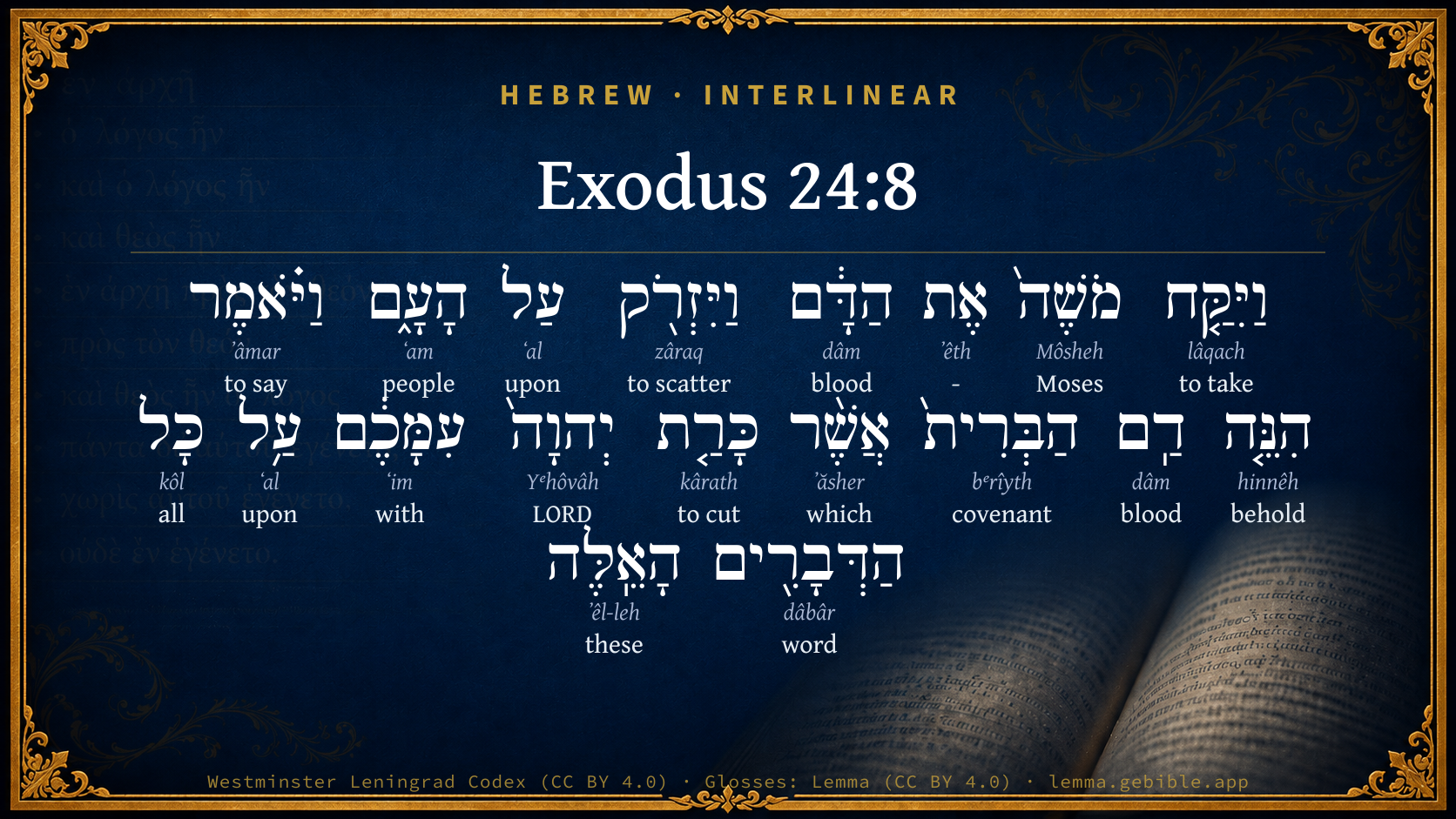
Hebrew (Westminster Leningrad Codex) Exodus 24:8 appears in the Hebrew Old Testament. The text above is from the Westminster Leningrad Codex. Each word links to its Strong’s number, a concise gloss, and parsing drawn from the Open Scriptures Hebrew Bible morphology. Click any word for its full Brown-Driver-Briggs (BDB) entry.
Download image
Cite this verse

Exodus 24:8 (World English Bible). Public Domain. Lemma interlinear Bible study tool, https://lemma.gebible.app/v/exodus/24/8.

Show BibTeX & RIS
BibTeX
RIS
English Translation
Moses took the blood, and sprinkled it on the people, and said, "Look, this is the blood of the covenant, which Yahweh has made with you concerning all these words."
World English Bible · Public Domain
Download a study sheet

One document with this verse’s original text, its word-by-word gloss line, the meaning frame, cross-references with their text, attributed commentary, and full source and license credits — printable, and it pastes into notes with its structure intact.

This verse Autodidact and up

Study sheet (.html) Plain text (.txt)

A passage Seminary Student

Up to 50 verses in one chapter. A passage sheet keeps up to 6 commentary sources and 12 cross-references per verse, in the order this page ranks them, and says so on the sheet whenever that leaves anything out. Ask for a single verse and you get the Autodidact verse sheet above.

Everything on this page stays free to read, with no account — the sheet is a download of what is already on screen, not access to it.

Want to remove ads? Support Godless Engineer
Compare translations 3

The same verse in 3 English versions, stacked beneath the original-language interlinear above. Click any original word for its lexicon entry.

Each is an independent rendering of the whole verse — the interlinear is not word-aligned to these translations.

Highlighted words mark where these versions differ — a whole-verse word diff, not a word-by-word alignment.

  • World English Bible Public Domain
    Moses took the blood, and sprinkled it on the people, and said, "Look, this is the blood of the covenant, which Yahweh has made with you concerning all these words."
  • King James Version Public Domain
    And Moses took the blood, and sprinkled it on the people, and said, Behold the blood of the covenant, which the LORD hath made with you concerning all these words.
  • unfoldingWord Literal Text CC BY-SA 4.0
    And Moses took the blood and sprinkled it onto the people. And he said, “Behold! The blood of the covenant that Yahweh has cut with you according to all of these words.”

unfoldingWord Literal Text — © unfoldingWord, licensed CC BY-SA 4.0. Word-aligned USFM3 via Door43 (git.door43.org/unfoldingWord/en_ult).

Versions to compare (up to 4)

3 of 4 selected

Show all 18 translations

Every available English version of this verse, each an independent rendering of the whole verse.

  • World English Bible Public Domain
    Moses took the blood, and sprinkled it on the people, and said, "Look, this is the blood of the covenant, which Yahweh has made with you concerning all these words."
  • Berean Standard Bible Public Domain
    So Moses took the blood, sprinkled it on the people, and said, “This is the blood of the covenant that the LORD has made with you in accordance with all these words.”
  • Majority Standard Bible Public Domain
    So Moses took the blood, splattered it on the people, and said, “This is the blood of the covenant that the LORD has made with you in accordance with all these words.”
  • King James Version Public Domain
    And Moses took the blood, and sprinkled it on the people, and said, Behold the blood of the covenant, which the LORD hath made with you concerning all these words.
  • American Standard Version (1901) Public Domain
    And Moses took the blood, and sprinkled it on the people, and said, Behold the blood of the covenant, which Jehovah hath made with you concerning all these words.
  • Revised Version (1885) Public Domain
    And Moses took the blood, and sprinkled it on the people, and said, Behold the blood of the covenant, which the LORD hath made with you concerning all these words.
  • Geneva Bible (1599) Public Domain
    Then Moses tooke the blood, and sprinkled it on the people, and said, Behold, the blood of the couenant, which the Lord hath made with you concerning all these things.
  • Douay-Rheims (1899) Public Domain
    And he took the blood and sprinkled it upon the people, and he said: This is the blood of the covenant which the Lord hath made with you concerning all these words.
  • Young's Literal Translation Public Domain
    And Moses taketh the blood, and sprinkleth on the people, and saith, `Lo, the blood of the covenant which Jehovah hath made with you, concerning all these things.'
  • Literal Standard Version CC BY-SA 4.0
    And Moses takes the blood and sprinkles [it] on the people, and says, “Behold, the blood of the covenant which YHWH has made with you, concerning all these things.”
  • Unlocked Literal Bible CC BY-SA 4.0
    Then Moses took the blood and sprinkled it onto the people. He said, “This is the blood of the covenant that Yahweh has made with you by giving you this promise with all these words.”
  • unfoldingWord Literal Text CC BY-SA 4.0
    And Moses took the blood and sprinkled it onto the people. And he said, “Behold! The blood of the covenant that Yahweh has cut with you according to all of these words.”
  • Darby Bible Public Domain
    And Moses took the blood, and sprinkled [it] on the people, and said, Behold the blood of the covenant that Jehovah has made with you concerning all these words.
  • World Messianic Bible Public Domain
    Moses took the blood, and sprinkled it on the people, and said, “Look, this is the blood of the covenant, which the LORD has made with you concerning all these words.”
  • Webster's Bible Public Domain
    And Moses took the blood, and sprinkled it on the people, and said, Behold, the blood of the covenant, which the LORD hath made with you concerning all these words.
  • Free Bible Version CC BY-SA 4.0
    So Moses took the blood, sprinkled it on the people, and said, “Look, this is the blood of the agreement that the Lord has made with you following these terms.”
  • Bible in Basic English Public Domain
    Then Moses took the blood and let it come on the people, and said, This blood is the sign of the agreement which the Lord has made with you in these words.
  • JPS Tanakh (1917) Public Domain
    And Moses took the blood, and sprinkled it on the people, and said: 'Behold the blood of the covenant, which the LORD hath made with you in agreement with all these words.'

Literal Standard Version (2020), Covenant Press — licensed CC BY-SA 4.0. Text via the HelloAO Bible API (eBible.org). Unlocked Literal Bible (unfoldingWord) — licensed CC BY-SA 4.0. Text via the HelloAO Bible API (eBible.org). unfoldingWord Literal Text — © unfoldingWord, licensed CC BY-SA 4.0. Word-aligned USFM3 via Door43 (git.door43.org/unfoldingWord/en_ult). Free Bible Version, Dr. Jonathan Gallagher — licensed CC BY-SA 4.0. Text via the HelloAO Bible API (eBible.org).

Word by word

More ways to search: Search by grammar → Find every occurrence → Compare this word →

Practice this passage: Drill this verse → Learn its vocabulary →

וַיִּזְרֹ֖ק
zâraq
H2236
“and · to scatter”
Conjunction + Verb, Qal, Sequential Imperfect, 3rd Person, Masculine, Singular
Part of Speech
Conjunction + Verb
Stem
Qal
Form
Sequential Imperfect
Person
3rd Person
Gender
Masculine
Number
Singular
Full BDB Definition

Origin: a primitive root

TWOT: 585

to scatter, sprinkle, toss, throw, scatter abundantly, strew - (Qal) to scatter, sprinkle, toss - (Pual) to be sprinkled
  1. וַיִּקַּ֤ח lâqach H3947 “and · to take” Conjunction + Verb, Qal, Sequential Imperfect, 3rd Person, Masculine, Singular
  2. מֹשֶׁה֙ Môsheh H4872 “Moses” Noun, Proper
  3. אֶת ʼêth H853 “-” Particle, Direct Object
  4. הַדָּ֔ם dâm H1818 “the · blood” Particle, Definite Article + Noun, Common, Masculine, Singular, Absolute
  5. עַל ʻal H5921 “upon” Preposition
  6. הָעָ֑ם ʻam H5971 “the · people” Particle, Definite Article + Noun, Common, Masculine, Singular, Absolute
  7. וַיֹּ֗אמֶר ʼâmar H559 “and · to say” Conjunction + Verb, Qal, Sequential Imperfect, 3rd Person, Masculine, Singular
  8. הִנֵּ֤ה hinnêh H2009 “behold” Particle, Demonstrative
  9. דַֽם dâm H1818 “blood of” Noun, Common, Masculine, Singular, Construct
  10. הַבְּרִית֙ bᵉrîyth H1285 “the · covenant” Particle, Definite Article + Noun, Common, Feminine, Singular, Absolute
  11. אֲשֶׁ֨ר ʼăsher H834 “which” Particle, Relative
  12. כָּרַ֤ת kârath H3772 “to cut” Verb, Qal, Perfect, 3rd Person, Masculine, Singular
  13. יְהוָה֙ Yᵉhôvâh H3068 “LORD” Noun, Proper
  14. עִמָּכֶ֔ם ʻim H5973 “with · you” Preposition + Suffix, Personal, 2nd Person, Masculine, Plural
  15. עַ֥ל ʻal H5921 “upon” Preposition
  16. כָּל kôl H3605 “all of” Noun, Common, Masculine, Singular, Construct
  17. הַדְּבָרִ֖ים dâbâr H1697 “the · words” Particle, Definite Article + Noun, Common, Masculine, Plural, Absolute
  18. הָאֵֽלֶּה ʼêl-leh H428 “the · these” Particle, Definite Article + Pronoun, Demonstrative, Common, Plural

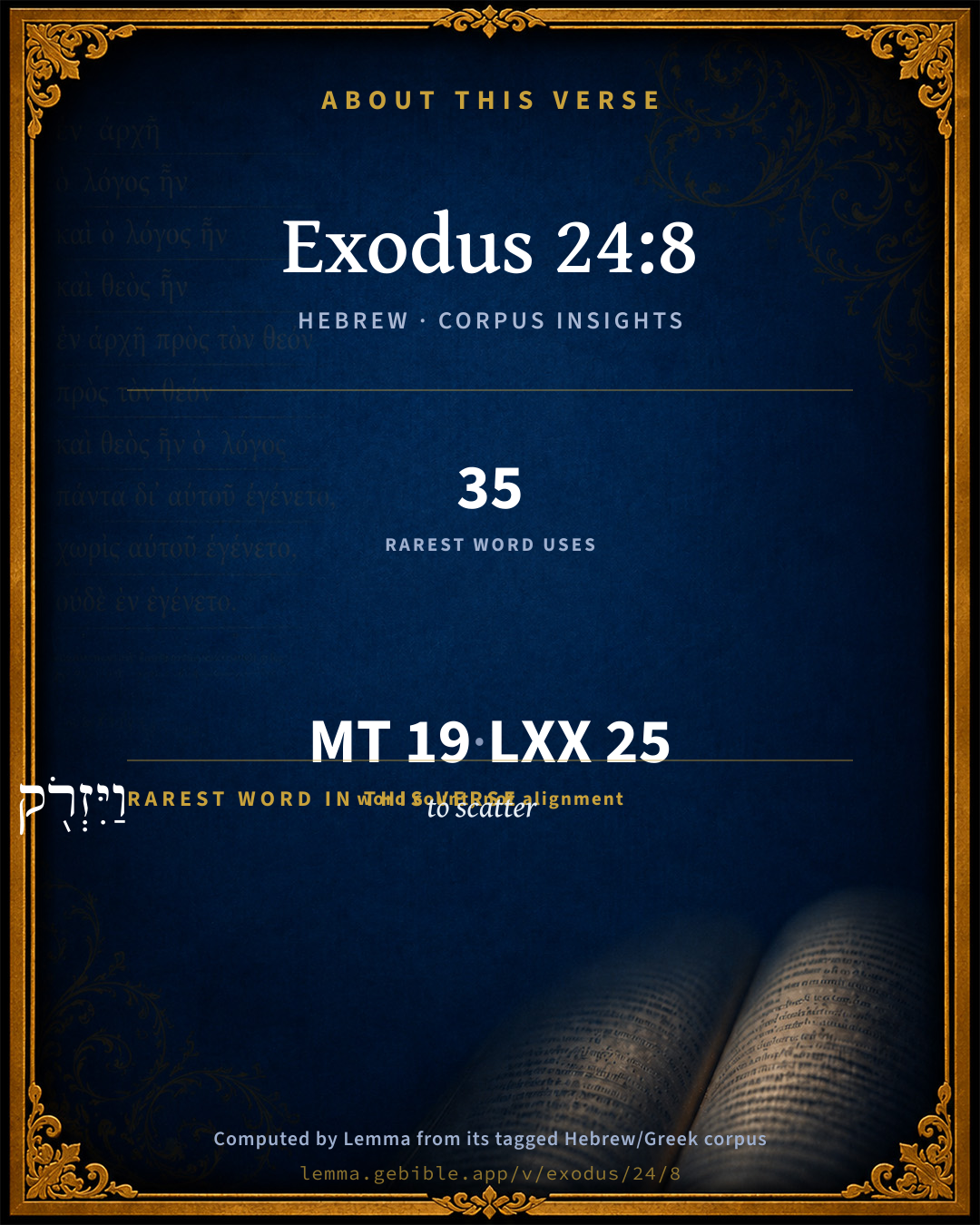
About this verse

These counts appear in no published source. They are computed here, from the morphology-tagged text and Lemma’s own curated glosses. What Lemma adds →

19
words
17
distinct lemmas
Pentateuch
section

Shared distinctive vocabulary

וַיִּזְרֹ֖ק to scatter H2236 occurs in 33 verses of the Hebrew Bible. Also found in:

Grammatical profile

  • 4 verbs
  • 8 nouns
  • 1 pronoun
  • 3 prepositions
  • 3 particles

Verb forms

  • וַיִּקַּ֤ח Qal · Sequential Imperfect
  • וַיִּזְרֹ֖ק Qal · Sequential Imperfect
  • וַיֹּ֗אמֶר Qal · Sequential Imperfect
  • כָּרַ֤ת Qal · Perfect

Repetition

Words recur within this verse — often emphatic in Hebrew:

  • הַדָּ֔ם blood H1818 ×2
  • עַל upon H5921 ×2

Hebrew & Septuagint length

In English translation the verse runs 30 words from the Hebrew and 30 from the Septuagint (LXX English) — the same length.

A rough comparison of the two English renderings, which tokenize alike — not a word-level alignment.

Word counts can differ between the Hebrew and the Greek without any difference in meaning — e.g. the Hebrew direct-object marker אֵת has no separate Greek word, and Greek often adds the article ὁ.

In the original languages it is 19 Hebrew tokens and 25 Greek tokens — but the two are counted differently (Hebrew bundles its prefixes and suffixes into one token; the Greek is in lemma form), so that isn’t a like-for-like length.

Cross-references

14

Topical passages linked to Exodus 24:8 in the Treasury of Scripture Knowledge — connected by theme and wording, ordered by reader-vote popularity; previews shown in the World English Bible.

  • Hebrews 10:4–5 For it is impossible that the blood of bulls and goats should take away sins.
  • Exodus 24:6 Moses took half of the blood and put it in basins, and half of the blood he sprinkled on the altar.
  • Ezekiel 36:25 I will sprinkle clean water on you, and you shall be clean: from all your filthiness, and from all your idols, will I cleanse you.
  • Matthew 26:28 for this is my blood of the new covenant, which is poured out for many for the remission of sins.
  • 1 Corinthians 11:25 In the same way he also took the cup, after supper, saying, "This cup is the new covenant in my blood. Do this, as often as you drink, in memory of me."
  • Hebrews 13:20 Now may the God of peace, who brought again from the dead the great shepherd of the sheep with the blood of an eternal covenant, our Lord Jesus,
  • Mark 14:24 He said to them, "This is my blood of the new covenant, which is poured out for many.
  • Hebrews 9:18–21 Therefore even the first covenant has not been dedicated without blood.
  • 1 Peter 1:2 according to the foreknowledge of God the Father, in sanctification of the Spirit, that you may obey Jesus Christ and be sprinkled in his blood: Grace to you and peace be multiplied.
  • Zechariah 9:11 As for you also, Because of the blood of your covenant, I have set free your prisoners from the pit in which is no water.
  • Luke 22:20 Likewise, he took the cup after supper, saying, "This cup is the new covenant in my blood, which is poured out for you.
  • Isaiah 52:15 so shall he sprinkle many nations; kings shall shut their mouths at him: for that which had not been told them shall they see; and that which they had not heard shall they understand.
  • Ephesians 1:7 in whom we have our redemption through his blood, the forgiveness of our trespasses, according to the riches of his grace,
  • Leviticus 8:30 Moses took some of the anointing oil, and some of the blood which was on the altar, and sprinkled it on Aaron, on his garments, and on his sons, and on his sons' garments with him, and sanctified Aaron, his garments, and his sons, and his sons' garments with him.

Cross-references courtesy of OpenBible.info (CC BY 4.0).

Hebrew and Greek witnesses Masoretic Hebrew ↔ Greek Septuagint

The same verse in the two great witnesses to the Old Testament, shown verse-for-verse.

These are two independent witnesses, not word-aligned to each other, and the Septuagint is shown in lemma (dictionary) form.

Hebrew Exodus 24:8 Masoretic · Westminster Leningrad Codex

וַיִּקַּ֤ח מֹשֶׁה֙ אֶת הַדָּ֔ם וַיִּזְרֹ֖ק עַל הָעָ֑ם וַיֹּ֗אמֶר הִנֵּ֤ה דַֽם הַבְּרִית֙ אֲשֶׁ֨ר כָּרַ֤ת יְהוָה֙ עִמָּכֶ֔ם עַ֥ל כָּל הַדְּבָרִ֖ים הָאֵֽלֶּה

Moses took the blood, and sprinkled it on the people, and said, "Look, this is the blood of the covenant, which Yahweh has made with you concerning all these words."

World English Bible · Public Domain

Greek LXX Exodus 24:8 Septuagint · lemma form

λαμβάνω δέ μωυσῆς ὁ αἷμα κατασκεδάζω ὁ λαός καί εἶπον ἰδού ὁ αἷμα ὁ διαθήκη ὅς διατίθημι κύριος πρός σύ περί πᾶς ὁ λόγος οὗτος

And Moses took the blood and sprinkled it upon the people, and said, Behold the blood of the covenant, which the Lord has made with you concerning all these words.

LXX2012 (modern English Septuagint) · Public Domain

Hebrew: Westminster Leningrad Codex (CC BY 4.0). Greek: Septuagint (public domain); English from LXX2012 (modern English Septuagint) (Public Domain). How the Septuagint differs from the Hebrew →

Targum (Aramaic paraphrase)

2

The Targum is the ancient Jewish Aramaic paraphrase of the Hebrew Scriptures — an interpretive translation, not the Hebrew text itself. Onkelos (literal) and Pseudo-Jonathan (expansive) render the Torah, and Jonathan the Prophets. Coverage is partial: where no permissively-licensed English translation exists for a verse, only the Aramaic is shown. This is verse-level text, not a word-by-word alignment to the Hebrew.

  1. Targum Onkelos Torah (Genesis–Deuteronomy)
    וּנְסִיב משֶׁה יָת דְמָא וּזְרַק עַל מַדְבְּחָא לְכַפָּרָא עַל עַמָא וַאֲמַר הָא דֵין דָם קְיָמָא דִגְזַר יְיָ עִמְכוֹן עַל כָּל פִּתְגָמַיָא הָאִלֵין:

    (no public-domain English translation for this verse)

    Targum Onkelos — Aramaic: “Onkelos Genesis” (public domain); “Onkelos Exodus” (public domain); “Onkelos Leviticus” (public domain); “Onkelos Numbers” (public domain); “Onkelos Deuteronomy” (public domain). English: “Sefaria Community Translation” (CC0 1.0 (public-domain dedication)); “J.W. Etheridge. The Targums of Onkelos and Jonathan Ben Uzziel on the Pentateuch. London: Longmans, Green, 1862” (public domain). Text via Sefaria.

  2. Targum Pseudo-Jonathan Torah (Genesis–Deuteronomy)
    וּנְסֵיב משֶׁה יַת פַּלְגוּת דְּמָא דִבְמִזְרְקַיָא וְדָרֵיק עַל מַדְבְּחָא לְכַפָּרָא עַל עַמָּא וַאֲמַר הָא דֵין אֲדַם קְיָימָא דִגְזַר יְיָ עִמְכוֹן עַל כָּל פִּתְגָמַיָא הָאִילֵן

    And Mosheh took half of the blood which was in the basins, and sprinkled upon the altar, to expiate the people, and said, Behold, this is the blood of the Covenant which the Lord hath made with you upon all these words.

    Targum Pseudo-Jonathan — Aramaic: “Targum Jonathan on Genesis” (public domain); “Targum Jonathan on Exodus” (public domain); “Targum Jonathan on Leviticus” (public domain); “Targum Jonathan on Numbers” (public domain); “Targum Jonathan on Deuteronomy” (public domain). English: “The Targum of Jonathan ben Uzziel, trans. J. W. Etheridge, London, 1862” (public domain). Text via Sefaria.

Commentary

Notes on Exodus 24:8 from classic Christian and Jewish commentators (each source and its license shown beneath its notes). The classic Christian expositions comment on the surrounding passage and are grouped to its opening verse, so a note may address several verses; the Jewish commentaries on the Tanakh (Rashi and others) are per-verse, so they appear only where the commentator wrote on this verse.

Lemma curates 59 commentaries, every one of them public domain or Creative Commons licensed, each selected and text-cleaned for this edition rather than reprinted as found. About our sources →

Trapp's Complete Commentary

John Trapp

Exo 24:8 And Moses took the blood, and sprinkled [it] on the people, and said, Behold the blood of the covenant, which the LORD hath made with you concerning all these words.

Ver. 8. On the people.] The representative people, the elders: or, as others will, the twelve pillars. {See Trapp on "Exo 24:4"}

John Trapp, A Commentary or Exposition upon All the Books of the Old and New Testament (1647–1656) — public domain. Text from a community e-Sword module.

Tyndale Open Study Notes

Tyndale Open Resources

24:8 Look, this blood confirms the covenant (literally behold the blood of the covenant): Jesus repeated this sentence almost verbatim at the Last Supper (Matt 26:28), when he said, “This is my blood, which confirms the covenant” (literally “This is my blood of the covenant”). See also Heb 9:20.

Tyndale Open Study Notes — © Tyndale Open Resources, licensed CC BY-SA 4.0. Text via the HelloAO Bible API.

Geneva Bible (1599)

Geneva Bible translators

Which blood signifieth that the covenant broken cannot be satisfied without blood shedding.

Geneva Bible (1599) marginal notes — public domain. Text via Bolls.life.

Jamieson, Fausset & Brown

Robert Jamieson, A. R. Fausset & David Brown

Moses took the blood, and sprinkled it on the people--probably on the twelve pillars, as representing the people (also the book, Heb 9:19), and the act was accompanied by a public proclamation of its import. It was setting their seal to the covenant (compare Co1 11:25). It must have been a deeply impressive, as well as instructive scene, for it taught the Israelites that the covenant was made with them only through the sprinkling of blood--that the divine acceptance of themselves and services, was only by virtue of an atoning sacrifice, and that even the blessings of the national covenant were promised and secured to them only through grace. The ceremonial, however, had a further and higher significance, as is shown by the apostle (see as above).

Jamieson, Fausset & Brown — Commentary Critical and Explanatory on the Whole Bible (1871) — public domain (CC PDM 1.0). Text via the HelloAO Bible API.

Ellicott's Commentary for English Readers

(8) And Moses took the blood, and sprinkled it . . . —Half of the blood had been sprinkled upon the altar, which symbolised Jehovah; the other half was now sprinkled upon the people, or rather upon their representatives—the elders and others who stood nearest to Moses. Thus the two parties to the covenant, sprinkled with the blood of the same sacrifices, were brought into sacramental union. Rites somewhat similar, involving blood communion, were common throughout the East in connection with covenants (Horn. Il. iii. 298, xix. 252; Herod. I. 74, iii. 8, iv. 70; Xen. Anab. ii. 2, § 9; Lucian. Toxar. 37; Pomp. Mel. ii. 1; Tac. Ann. xii. 47; &c), and were regarded as adding to their force and sacredness.

On the people.—It has been suggested (Abarbarnel) that the blood was really sprinkled on the twelve pillars which represented the people; but the words used scarcely seem to admit of such an interpretation. The writer of the Epistle to the Hebrews understood the passage as declaring that the people were sprinkled (Heb_9:19).

A Bible Commentary for English Readers, edited by Charles John Ellicott (1878–1897) — public domain. Text from a community e-Sword module.

The Cambridge Bible for Schools and Colleges

gen. ed. J. J. S. Perowne

8. the blood of the covenant] the blood by which the covenant is ratified. Cf. Heb_9:20; Heb_12:24 (noting vv. 18–21); 1Pe_1:2, with Hort’s note (p. 23 f.); and the ‘blood of the’ new ‘covenant,’ founded by Christ, Mat_26:28 = Mar_14:24 (cf. Luk_22:20, 1Co_11:25).

concerning] upon (the basis of). The marg. paraphrases correctly.

9–11 (J). The sequel to vv. 1–2. Moses and Aaron, Nadab and Abihu, and seventy elders, as directed in v. 1, go up into the mount, and have a vision of Jehovah’s glory.

The Cambridge Bible for Schools and Colleges (gen. ed. J. J. S. Perowne; Cambridge University Press, 1878–1918) — public domain. Text from a community e-Sword module.

John Gill's Exposition

And Moses took the blood,.... The other half of the blood which was in the basins:

and sprinkled it on the people; not on the whole body of the people, who could not be brought nigh enough, and were too numerous to be all sprinkled with it; though the apostle so expresses it, a part being put for the whole, Heb 9:19 either this was sprinkled on the young men that offered the sacrifices in the name of all the people; or on the seventy elders, as the heads of them, so Aben Ezra; or upon the twelve pillars, which answered to the twelve tribes, and represented them as the altar did the Lord:

and said, behold the blood of the covenant, which the Lord hath made with you concerning all these words; being a ratification of the covenant on both sides, having been sprinkled both upon the altar, and upon the people. In allusion to which, the blood of Christ is sometimes called the blood of sprinkling, and which, sprinkled upon the mercy seat, calls for pardon for men; and sprinkled on their consciences, speaks peace and pardon to them, and cleanses from all sin; and sometimes the blood of the everlasting covenant, the covenant of grace made with him, by which it is ratified and confirmed; and our Lord may have regard to this rite and mode of expression in Mat 26:28.

John Gill's Exposition of the Whole Bible (1746–1763) — public domain (CC PDM 1.0). Text via the HelloAO Bible API.

Albert Barnes' Notes on the Bible

The blood which sealed the covenant was the blood of burnt offerings and peace offerings. The sin-offering Lev. 4 had not yet been instituted. That more complicated view of human nature which gave to the sin-offering its meaning, had yet to be developed by the law, which was now only receiving its ratification. The covenant between Yahweh and His people therefore took precedence of the operation of the law, by which came the knowledge of sin. Rom 3:20.

Upon the people - Either upon the elders or those who stood foremost; or, upon the twelve pillars representing the Twelve tribes, as the first half had been cast upon the altar, which witnessed to the presence of Yahweh. The blood thus divided between the two parties to the covenant signified the sacramental union between the Lord and His people. Cf. Psa 50:5; Zec 9:11.

Albert Barnes' Notes on the Bible (1834–1885) — public domain. Text from a community e-Sword/MySword module.

Haydock's Catholic Bible Commentary

Covenant. Thus Christ confirmed the new covenant, by the effusion of his blood. (Tirinus) --- This is daily renewed upon our altars for ever. (Calmet) --- Our Saviour alludes to this transaction in the consecration of the chalice. (Du Hamel) --- If wine alone had been substituted instead of blood, the figure would have surpassed the reality. (Isichius.) (Worthington)

George Leo Haydock (1774–1849), Haydock's Catholic Family Bible and Commentary, 1859 edition — public domain. Excludes Psalms (Douay-Rheims chapter numbering differs from Protestant) and Deuterocanonical books (Catholic canon only).

Matthew Poole's English Annotations

Moses took the blood; the other half of the blood, which was put in the basons for this end, Exo 24:6.

On the people; either upon the twelve pillars representing the people; or upon the people’s representatives, to wit, the elders mentioned Exo 24:1, as when the people are commanded to lay on their hands, the elders do it in their name and stead, Lev 4:15; Deu 21:2; or upon those of the people which are nearest him, which was imputed to all the rest, and was to be taken by them as if it had reached unto them all. Now this sprinkling of the blood upon the people did signify,

1. Their ratification of the covenant on their parts, and their secret wishing of the effusion of their own blood if they did not keep it.

2. Their sprinkling of their consciences with the blood of Christ, and their obtaining redemption, justification, and access to God through it alone. See Heb 9:20,22; 13:20.

The blood of the covenant, whereby the covenant is made and confirmed, as was usual both in Scripture, Mat 26:28; Luk 22:20, and among heathens.

Matthew Poole's English Annotations on the Holy Bible (1683–1685) — public domain. Text from a community e-Sword/MySword module.

The Pulpit Commentary

Moses then proceeded to the final act He took the blood from the basins, and sprinkled it not certainly upon all the people, who numbered above two millions but upon their leaders and representatives, the "elders" and other chief men, drawn up at the head of each tribe, and thus brought within his reach. It has been supposed by some that he merely sprinkled the blood on the twelve pillars, as representing the twelve tribes; but, had this been the case, the expression in the text would probably have been different. We read, in the Epistle to the Hebrews, that he "sprinkled both the book, and all the people". (Heb_9:19) As he sprinkled, he said, Behold the blood of the covenant, etc. It was a common practice among the nations of antiquity to seal covenants with blood. Sometimes the blood was that of a victim, and the two parties to the covenant prayed, that, if they broke it, his fate might be theirs (Hom. 1l. 3:298; 19:252; Lev 1:24 Lev 21:45; etc.) Sometimes it was the blood of the two parties themselves, who each drank of the other"s blood, and thereby contracted a blood-relationship, which would have made their breaking the covenant more unpardonable (Heb 1:74; Heb 4:70; Tacit. Ann. 12:47). Moses seems to have followed neither practice at all closely, but, adopting simply the principle that a covenant required to be sealed with blood, to have arranged the details as he thought best. By the sprinkling of both the altar and the people the two parties to the covenant were made partakers of one and the same blood, and so brought into a sort of sacramental union.

The Pulpit Commentary (1880–1919), ed. H.D.M. Spence-Jones & Joseph S. Exell — public domain. Text from a community e-Sword module.

Rashi

Rabbi Shlomo Yitzchaki (Rashi)

ויזרק means sprinkling — he sprinkled it on the people (not he threw it against the people, as this word might imply; cf. e. g., Exodus 9:8: וזרקו משה השמימה). The Targum, however, renders it by: and he poured it (the blood) upon the altar as atonement for (על) the people, adding the words “upon the altar”, and taking על העם to denote “on behalf of the people”, i. e. he poured it out to atone for the people.

Rashi on the Tanakh — English translations: “The Judaica Press complete Tanach with Rashi, translated by A. J. Rosenberg” (CC BY 4.0); “Pentateuch with Rashi's commentary by M. Rosenbaum and A.M. Silbermann, 1929-1934” (public domain); “The Metsudah Tanach series, Lakewood, N.J” (CC BY 4.0); and “The Book of Joshua, Metsudah Publications, 1997” (CC BY 4.0). Text via Sefaria.

Lesson kit

Teaching starters — assembled from the data on this page, not authored interpretation. Every prompt links to the verse data it draws on. Edit before teaching.

Exodus, in the Pentateuch, opens this verse with 19 words (17 distinct Hebrew lemmas). Its most distinctive word is zâraq (“to scatter”). A historical commentator’s framing appears above. Read the whole chapter for the surrounding context.

Discussion questions

  1. The word zâraq carries the sense “to scatter.” How does it shape the verse?
  2. Exodus 9:8 shares the word «to scatter» with this verse. How do the two illuminate each other?
  3. “blood” occurs 2× in this one verse. What is the effect of the repetition?
  4. The translations on this page render this verse differently — a whole-verse word diff, not a word-by-word alignment. What might account for the different wordings?
  5. The verb «וַיִּקַּ֤ח» is Qal Sequential Imperfect. How does its form color the action?
  6. Reading how Trapp's Complete Commentary and Tyndale Open Study Notes read this verse, where do the two commentators agree and where do they part?

Things to notice

Reading settings

Reading text

Shown beneath each verse's original-language words.

Old Testament
Old Testament edition

Read the OT as the Masoretic Hebrew (MT) or the Greek Septuagint (LXX).

English shown for the Greek Septuagint (in the Hebrew ↔ Greek comparison).

Comparing translations? Open the Compare panel on any verse page to stack up to four side by side.