Joshua 9:7

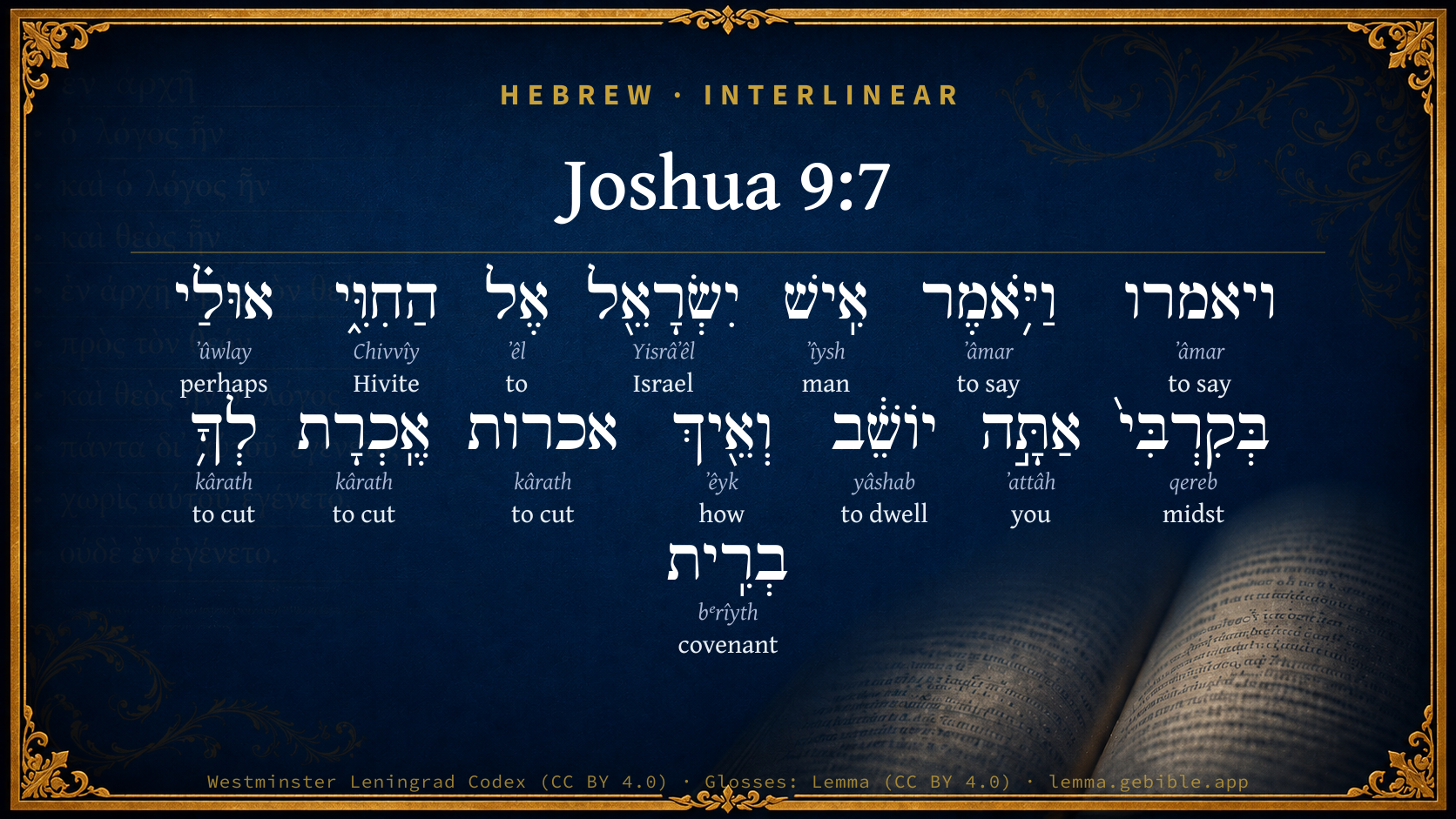
Hebrew (Westminster Leningrad Codex) Joshua 9:7 appears in the Hebrew Old Testament. The text above is from the Westminster Leningrad Codex. Each word links to its Strong’s number, a concise gloss, and parsing drawn from the Open Scriptures Hebrew Bible morphology. Click any word for its full Brown-Driver-Briggs (BDB) entry.
Download image
Cite this verse

Joshua 9:7 (World English Bible). Public Domain. Lemma interlinear Bible study tool, https://lemma.gebible.app/v/joshua/9/7.

Show BibTeX & RIS
BibTeX
RIS
English Translation
The men of Israel said to the Hivites, What if you dwell among us; and how shall we make a covenant with you?
World English Bible · Public Domain
Download a study sheet

One document with this verse’s original text, its word-by-word gloss line, the meaning frame, cross-references with their text, attributed commentary, and full source and license credits — printable, and it pastes into notes with its structure intact.

This verse Autodidact and up

Study sheet (.html) Plain text (.txt)

A passage Seminary Student

Up to 50 verses in one chapter. A passage sheet keeps up to 6 commentary sources and 12 cross-references per verse, in the order this page ranks them, and says so on the sheet whenever that leaves anything out. Ask for a single verse and you get the Autodidact verse sheet above.

Everything on this page stays free to read, with no account — the sheet is a download of what is already on screen, not access to it.

Want to remove ads? Support Godless Engineer
Compare translations 3

The same verse in 3 English versions, stacked beneath the original-language interlinear above. Click any original word for its lexicon entry.

Each is an independent rendering of the whole verse — the interlinear is not word-aligned to these translations.

Highlighted words mark where these versions differ — a whole-verse word diff, not a word-by-word alignment.

  • World English Bible Public Domain
    The men of Israel said to the Hivites, What if you dwell among us; and how shall we make a covenant with you?
  • King James Version Public Domain
    And the men of Israel said unto the Hivites, Peradventure ye dwell among us; and how shall we make a league with you?
  • unfoldingWord Literal Text CC BY-SA 4.0
    And a man of Israel said to the Hivite, “Perhaps you dwelling among us. Then how can I cut a covenant with you?”

unfoldingWord Literal Text — © unfoldingWord, licensed CC BY-SA 4.0. Word-aligned USFM3 via Door43 (git.door43.org/unfoldingWord/en_ult).

Versions to compare (up to 4)

3 of 4 selected

Show all 18 translations

Every available English version of this verse, each an independent rendering of the whole verse.

  • World English Bible Public Domain
    The men of Israel said to the Hivites, What if you dwell among us; and how shall we make a covenant with you?
  • Berean Standard Bible Public Domain
    But the men of Israel said to the Hivites, “Perhaps you dwell near us. How can we make a treaty with you?”
  • Majority Standard Bible Public Domain
    But the men of Israel said to the Hivites, “Perhaps you dwell near us. How can we make a treaty with you?”
  • King James Version Public Domain
    And the men of Israel said unto the Hivites, Peradventure ye dwell among us; and how shall we make a league with you?
  • American Standard Version (1901) Public Domain
    And the men of Israel said unto the Hivites, Peradventure ye dwell among us; and how shall we make a covenant with you?
  • Revised Version (1885) Public Domain
    And the men of Israel said unto the Hivites, Peradventure ye dwell among us; and how shall we make a covenant with you?
  • Geneva Bible (1599) Public Domain
    Then the men of Israel said vnto the Hiuites, It may be that thou dwellest among vs, how then can I make a league with thee?
  • Douay-Rheims (1899) Public Domain
    Perhaps you dwell in the land which falls to our lot; if so, we can make no league with you.
  • Young's Literal Translation Public Domain
    and the men of Israel say unto the Hivite, `It may be in our midst ye are dwelling, and how do we make with thee a covenant?'
  • Literal Standard Version CC BY-SA 4.0
    and the men of Israel say to the Hivite, “It may be [that] you are dwelling in our midst, so how do we make a covenant with you?”
  • Unlocked Literal Bible CC BY-SA 4.0
    The men of Israel said to the Hivites, “Perhaps you live near us. How can we make a covenant with you?”
  • unfoldingWord Literal Text CC BY-SA 4.0
    And a man of Israel said to the Hivite, “Perhaps you dwelling among us. Then how can I cut a covenant with you?”
  • Darby Bible Public Domain
    And the men of Israel said to the Hivite, Perhaps thou dwellest in the midst of us, and how should I make a covenant with thee?
  • World Messianic Bible Public Domain
    The men of Israel said to the Hivites, “What if you live among us? How could we make a covenant with you?”
  • Webster's Bible Public Domain
    And the men of Israel said to the Hivites, It may be ye dwell among us; and how shall we make a league with you?
  • Free Bible Version CC BY-SA 4.0
    But the Israelites said to the Hivites, “Maybe you live close by. If you do, we cannot make a treaty with you.”
  • Bible in Basic English Public Domain
    And the men of Israel said to the Hivites, It may be that you are living among us; how then may we make an agreement with you?
  • JPS Tanakh (1917) Public Domain
    And the men of Israel said unto the Hivites: 'Peradventure ye dwell among us; and how shall we make a covenant with you?'

Literal Standard Version (2020), Covenant Press — licensed CC BY-SA 4.0. Text via the HelloAO Bible API (eBible.org). Unlocked Literal Bible (unfoldingWord) — licensed CC BY-SA 4.0. Text via the HelloAO Bible API (eBible.org). unfoldingWord Literal Text — © unfoldingWord, licensed CC BY-SA 4.0. Word-aligned USFM3 via Door43 (git.door43.org/unfoldingWord/en_ult). Free Bible Version, Dr. Jonathan Gallagher — licensed CC BY-SA 4.0. Text via the HelloAO Bible API (eBible.org).

Word by word

More ways to search: Search by grammar → Find every occurrence → Compare this word →

Practice this passage: Drill this verse → Learn its vocabulary →

הַחִוִּ֑י
Chivvîy
H2340
“the · Hivite”
Particle, Definite Article + Noun, Gentilic, Masculine, Singular, Absolute
Part of Speech
Particle + Noun
Type
Gentilic
Gender
Masculine
Number
Singular
State
Absolute
Full BDB Definition

Origin: perhaps from H2333

TWOT: None

Hivite = "villagers" - 6th generation of descendants of Canaan, the son of Ham, who were living in northern Canaan near Mount Hermon at the time of the conquest
  1. ויאמרו ʼâmar H559 “and · to say” Conjunction + Verb, Qal, Sequential Imperfect, 3rd Person, Masculine, Plural
  2. וַיֹּ֥אמֶר ʼâmar H559 “and · to say” Conjunction + Verb, Qal, Sequential Imperfect, 3rd Person, Masculine, Singular
  3. אִֽישׁ ʼîysh H376 “man of” Noun, Common, Masculine, Singular, Construct
  4. יִשְׂרָאֵ֖ל Yisrâʼêl H3478 “Israel” Noun, Proper
  5. אֶל ʼêl H413 “to” Preposition
  6. אוּלַ֗י ʼûwlay H194 “perhaps” Adverb
  7. בְּקִרְבִּי֙ qereb H7130 “in/at · midst · my” Preposition + Noun, Common, Masculine, Singular, Construct + Suffix, Personal, 1st Person, Common, Singular
  8. אַתָּ֣ה ʼattâh H859 “you” Pronoun, Personal, 2nd Person, Masculine, Singular
  9. יוֹשֵׁ֔ב yâshab H3427 “dwelling” Verb, Qal, Participle Active, Masculine, Singular, Absolute
  10. וְאֵ֖יךְ ʼêyk H349 “and · how” Conjunction + Particle, Interrogative
  11. אכרות kârath H3772 “to cut” Verb, Qal, Imperfect, 1st Person, Common, Singular
  12. אֶֽכְרָת kârath H3772 “to cut” Verb, Qal, Imperfect, 1st Person, Common, Singular
  13. לְךָ֥ kârath H3772 “to/for · you” Preposition + Suffix, Personal, 2nd Person, Masculine, Singular
  14. בְרִֽית bᵉrîyth H1285 “covenant” Noun, Common, Feminine, Singular, Absolute

About this verse

These counts appear in no published source. They are computed here, from the morphology-tagged text and Lemma’s own curated glosses. What Lemma adds →

15
words
12
distinct lemmas
Historical
section

Notable vocabulary

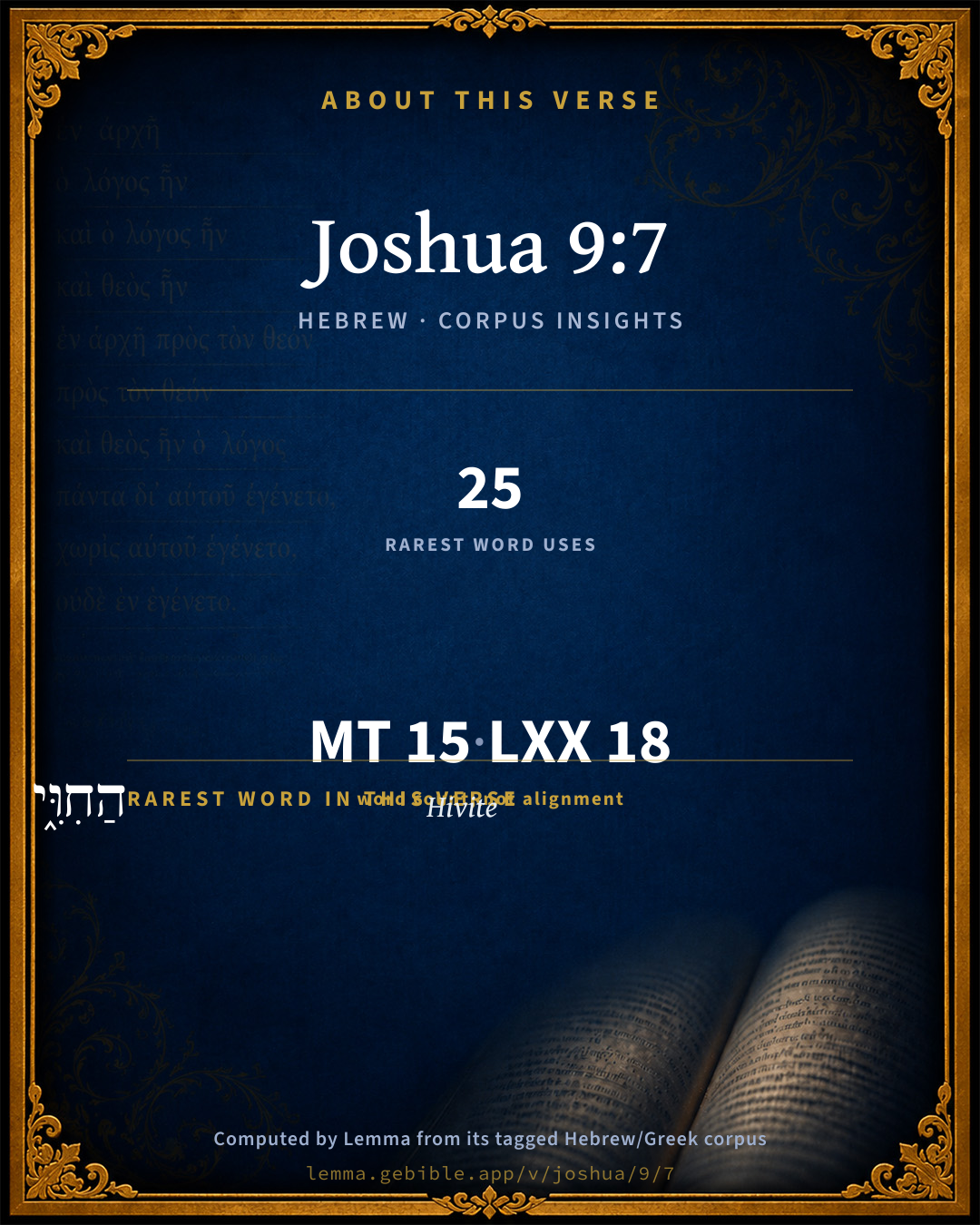
The rarest word here is הַחִוִּ֑י Hivite H2340 — appearing just 25 times in the whole Hebrew Bible.

Shared distinctive vocabulary

הַחִוִּ֑י Hivite H2340 occurs in 25 verses of the Hebrew Bible. Also found in:

Grammatical profile

  • 5 verbs
  • 5 nouns
  • 1 pronoun
  • 2 prepositions
  • 1 adverb
  • 1 particle

Verb forms

  • ויאמרו Qal · Sequential Imperfect
  • וַיֹּ֥אמֶר Qal · Sequential Imperfect
  • יוֹשֵׁ֔ב Qal · Participle Active
  • אכרות Qal · Imperfect
  • אֶֽכְרָת Qal · Imperfect

Repetition

Words recur within this verse — often emphatic in Hebrew:

  • אכרות to cut H3772 ×3
  • ויאמרו to say H559 ×2

Hebrew & Septuagint length

In English translation the verse runs 23 words from the Hebrew and 23 from the Septuagint (LXX English) — the same length.

A rough comparison of the two English renderings, which tokenize alike — not a word-level alignment.

Word counts can differ between the Hebrew and the Greek without any difference in meaning — e.g. the Hebrew direct-object marker אֵת has no separate Greek word, and Greek often adds the article ὁ.

In the original languages it is 15 Hebrew tokens and 18 Greek tokens — but the two are counted differently (Hebrew bundles its prefixes and suffixes into one token; the Greek is in lemma form), so that isn’t a like-for-like length.

Cross-references

11

Topical passages linked to Joshua 9:7 in the Treasury of Scripture Knowledge — connected by theme and wording, ordered by reader-vote popularity; previews shown in the World English Bible.

  • Joshua 11:19 There was not a city that made peace with the children of Israel, save the Hivites the inhabitants of Gibeon: they took all in battle.
  • Judges 2:2 and you shall make no covenant with the inhabitants of this land; you shall break down their altars. But you have not listened to my voice: why have you done this?
  • Genesis 10:17 the Hivite, the Arkite, the Sinite,
  • Genesis 34:2 Shechem the son of Hamor the Hivite, the prince of the land, saw her. He took her, lay with her, and humbled her.
  • Exodus 3:8 I have come down to deliver them out of the hand of the Egyptians, and to bring them up out of that land to a good and large land, to a land flowing with milk and honey; to the place of the Canaanite, the Hittite, the Amorite, the Perizzite, the Hivite, and the Jebusite.
  • Exodus 23:31–33 I will set your border from the Red Sea even to the sea of the Philistines, and from the wilderness to the River; for I will deliver the inhabitants of the land into your hand, and you shall drive them out before you.
  • Exodus 34:12 Be careful, lest you make a covenant with the inhabitants of the land where you are going, lest it be for a snare in the midst of you:
  • Numbers 33:52 then you shall drive out all the inhabitants of the land from before you, and destroy all their figured [stones], and destroy all their molten images, and demolish all their high places:
  • Deuteronomy 7:2–3 and when Yahweh your God shall deliver them up before you, and you shall strike them; then you shall utterly destroy them: you shall make no covenant with them, nor show mercy to them;
  • Deuteronomy 20:16 But of the cities of these peoples, that Yahweh your God gives you for an inheritance, you shall save alive nothing that breathes;
  • Joshua 9:1 It happened, when all the kings who were beyond the Jordan, in the hill-country, and in the lowland, and on all the shore of the great sea in front of Lebanon, the Hittite, and the Amorite, the Canaanite, the Perizzite, the Hivite, and the Jebusite, heard of it;

Cross-references courtesy of OpenBible.info (CC BY 4.0).

Hebrew and Greek witnesses Masoretic Hebrew ↔ Greek Septuagint

The same verse in the two great witnesses to the Old Testament, shown verse-for-verse.

These are two independent witnesses, not word-aligned to each other, and the Septuagint is shown in lemma (dictionary) form.

Hebrew Joshua 9:7 Masoretic · Westminster Leningrad Codex

ויאמרו וַיֹּ֥אמֶר אִֽישׁ יִשְׂרָאֵ֖ל אֶל הַחִוִּ֑י אוּלַ֗י בְּקִרְבִּי֙ אַתָּ֣ה יוֹשֵׁ֔ב וְאֵ֖יךְ אכרות אֶֽכְרָת לְךָ֥ בְרִֽית

The men of Israel said to the Hivites, What if you dwell among us; and how shall we make a covenant with you?

World English Bible · Public Domain

Greek LXX Joshua 9:7 Septuagint · lemma form

καί εἶπον ὁ υἱός ἰσραήλ πρός ὁ χορραῖος ὁράω μή ἐν ἐγώ καταοἰκέω καί πῶς σύ διατίθημι διαθήκη

And the children of Israel said to the Chorrhaean, Peradventure you dwell among us; and how should I make a covenant with you?

LXX2012 (modern English Septuagint) · Public Domain

Hebrew: Westminster Leningrad Codex (CC BY 4.0). Greek: Septuagint (public domain); English from LXX2012 (modern English Septuagint) (Public Domain). How the Septuagint differs from the Hebrew →

Targum (Aramaic paraphrase)

1

The Targum is the ancient Jewish Aramaic paraphrase of the Hebrew Scriptures — an interpretive translation, not the Hebrew text itself. Onkelos (literal) and Pseudo-Jonathan (expansive) render the Torah, and Jonathan the Prophets. Coverage is partial: where no permissively-licensed English translation exists for a verse, only the Aramaic is shown. This is verse-level text, not a word-by-word alignment to the Hebrew.

  1. Targum Jonathan Prophets (Joshua–Malachi)
    וַאֲמַרוּ אֱנַשׁ יִשְׂרָאֵל לְחִוָאָה דִלְמָא בֵּינָנָא אַתּוּן יַתְבוּן וְאֵיכְדֵין נִגְזַר לְכוֹן קְיָם:

    (no public-domain English translation for this verse)

    Targum Jonathan — Aramaic: “Mikraot Gedolot” (public domain). English: “Sefaria Community Translation” (CC0 1.0 (public-domain dedication)); “London "Chaldee Paraphrase," 1871” (public domain). Text via Sefaria.

Commentary

Notes on Joshua 9:7 from classic Christian and Jewish commentators (each source and its license shown beneath its notes). The classic Christian expositions comment on the surrounding passage and are grouped to its opening verse, so a note may address several verses; the Jewish commentaries on the Tanakh (Rashi and others) are per-verse, so they appear only where the commentator wrote on this verse.

Lemma curates 59 commentaries, every one of them public domain or Creative Commons licensed, each selected and text-cleaned for this edition rather than reprinted as found. About our sources →

Trapp's Complete Commentary

John Trapp

Jos 9:7 And the men of Israel said unto the Hivites, Peradventure ye dwell among us; and how shall we make a league with you?

Ver. 7. Peradventure ye dwell among us.] Certe qui caret ne decipiatur, vi cavet dum etiam caret.

John Trapp, A Commentary or Exposition upon All the Books of the Old and New Testament (1647–1656) — public domain. Text from a community e-Sword module.

Joseph Benson's Commentary

Jos 9:7-8. The men of Israel said to the Hivites — That is, the Gibeonites, who were Hivites, Jos 11:19. Peradventure you dwell among us — That is, in this land, and so are of that people with whom we are forbidden to make any league or covenant. They said — We are thy servants — We desire a league with you upon your own terms; we are ready to accept of any conditions. Joshua said, From whence come ye? — For this free and general concession gave him cause to suspect that they were Canaanites.

Joseph Benson's Commentary on the Old and New Testaments (1811–1818) — public domain. Text from a community e-Sword module.

Tyndale Open Study Notes

Tyndale Open Resources

9:7-8 The name Hivites is known only from the Bible and refers to a non-Semitic ethnic group that lived in various parts of Canaan (see Gen 34:2; 36:2; Exod 23:23, 28). • How do we know you don’t live nearby? Israel’s leaders raised the possibility of deception. Joshua followed the Gibeonites’ evasive reply by asking two direct questions. However, Joshua could have received a direct answer by consulting the Lord (Josh 9:14).

Tyndale Open Study Notes — © Tyndale Open Resources, licensed CC BY-SA 4.0. Text via the HelloAO Bible API.

Geneva Bible (1599)

Geneva Bible translators

For the Gibeonites and the Hivites were all one people.

Geneva Bible (1599) marginal notes — public domain. Text via Bolls.life.

Jamieson, Fausset & Brown

Robert Jamieson, A. R. Fausset & David Brown

the men of Israel said unto the Hivites, Peradventure ye dwell among us--The answer of the Israelites implied that they had no discretion, that their orders were imperative, and that if the strangers belonged to any of the native tribes, the idea of an alliance with them was unlawful since God had forbidden it (Exo 23:32; Exo 34:12; Deu 7:2).

Jamieson, Fausset & Brown — Commentary Critical and Explanatory on the Whole Bible (1871) — public domain (CC PDM 1.0). Text via the HelloAO Bible API.

Adam Clarke's Commentary

Verse 7. Peradventure ye dwell among us] It is strange they should have had such a suspicion, as the Gibeonites had acted so artfully; and it is as strange that, having such a suspicion, they acted with so little caution.

Adam Clarke's Commentary on the Bible (1810–1826) — public domain. Text from a community e-Sword/MySword module.

Ellicott's Commentary for English Readers

(7) Peradventure ye dwell among us; and how shall we make a league with you?—Literally, Peradventure thou art a dweller in the midst of me; and how shall I make a covenant with thee? The Israelites assume the ownership of Canaan as already theirs.

A Bible Commentary for English Readers, edited by Charles John Ellicott (1878–1897) — public domain. Text from a community e-Sword module.

The Cambridge Bible for Schools and Colleges

gen. ed. J. J. S. Perowne

7. the Hivites] Comp. Jos_11:19; 2Sa_21:2.

The Cambridge Bible for Schools and Colleges (gen. ed. J. J. S. Perowne; Cambridge University Press, 1878–1918) — public domain. Text from a community e-Sword module.

John Gill's Exposition

And the men of Israel said unto the Hivites,.... Though they did not know them to be such, but as they afterwards appeared to be the Hivites, as the Gibeonites were, they are here so called, see Jos 11:19. The name signifies "serpents"; according to a Derash, or mystical exposition, mentioned by Kimchi, the Gibeonites are so called, because they did the work of the serpent; that is to say, they deceived the Israelites, as the serpent deceived Eve:

peradventure ye dwell among us; of which they had some suspicion:

and how shall we make a league with you? which they were forbid to do with any of the seven nations, Deu 7:2.

John Gill's Exposition of the Whole Bible (1746–1763) — public domain (CC PDM 1.0). Text via the HelloAO Bible API.

Albert Barnes' Notes on the Bible

Compare the marginal references.

Albert Barnes' Notes on the Bible (1834–1885) — public domain. Text from a community e-Sword/MySword module.

Haydock's Catholic Bible Commentary

You. The Gabaonites addressed themselves to the first whom they met in the camp; and these made this remark to them before they were brought into the presence of Josue. The Israelites could make no league with the Chanaanites, as with equals, but only on condition that the latter should embrace the true religion, and acknowledge the dominion of the former. (Grotius) (Exodus xxiii. 32., and Deuteronomy vii. 2.)

George Leo Haydock (1774–1849), Haydock's Catholic Family Bible and Commentary, 1859 edition — public domain. Excludes Psalms (Douay-Rheims chapter numbering differs from Protestant) and Deuterocanonical books (Catholic canon only).

Matthew Poole's English Annotations

The Hivites, i.e. the Gibeonites, who were Hivites, Jos 11:19.

Among us, i.e. in this land, and so are of that people with whom we are forbidden to make any league or covenant, Exo 23:32,33; Deu 7:2; 20:15,16.

Matthew Poole's English Annotations on the Holy Bible (1683–1685) — public domain. Text from a community e-Sword/MySword module.

Whedon's Commentary on the Bible

Daniel D. Whedon

7. Said unto the Hivites — The inhabitants of Gibeon were Hivites. See Jos_11:19.

Peradventure ye dwell among us — The suspicions of the Hebrews are awakened, as they well might have been, Their Canaanitish speech must have betrayed them.

How shall we make a league with you? — This question strongly implies the impossibility of such an act, because it had been expressly forbidden, (Exo_23:32; Exo_34:12; Deu_7:2,) on the ground of the ensnaring and corrupting influence of pagan allies.

Daniel D. Whedon (gen. ed.), Commentary on the Old and New Testaments (1874–1909) — public domain. Text from a community e-Sword module.

The Pulpit Commentary

And the men of Israel said. The Keri here has the singular number instead of the Chethibh plural, in consequence of Israel speaking of itself collectively in the word yBirqiB and of the singular vyai. But this last with a plural verb, as a noun of multitude, occurs in the historical books in places too numerous to mention. See, for instance, 1Sa_14:22, just as in many passages, e.g., Exo_23:32 Exo_34:12 Deu_7:2, in reference to neighbouring nations, on account of the polluting influence their example had exercised, (Num_25:1-3) and was sure to exercise, as the subsequent history of the Israelites from Judges 2 onwards, proves.

The Pulpit Commentary (1880–1919), ed. H.D.M. Spence-Jones & Joseph S. Exell — public domain. Text from a community e-Sword module.

John Wesley's Explanatory Notes

The Hivites - That is, the Gibeonites who were Hivites, chap. xi, 19. Among us - That is, in this land, and so are of that people with whom we are forbidden to make any league or covenant.

John Wesley, Explanatory Notes Upon the Whole Bible (1754–1765) — public domain. Text via the GEBible commentary corpus.

Rashi

Rabbi Shlomo Yitzchaki (Rashi)

Maybe you really live in our midst. Perhaps you are of those who dwell in the land. said, but it is read וַיאמַר אִישׁ “the man of Yisroel said.” They all spoke together as a single person who had doubts about the truth of their presentation.

Rashi on the Tanakh — English translations: “The Judaica Press complete Tanach with Rashi, translated by A. J. Rosenberg” (CC BY 4.0); “Pentateuch with Rashi's commentary by M. Rosenbaum and A.M. Silbermann, 1929-1934” (public domain); “The Metsudah Tanach series, Lakewood, N.J” (CC BY 4.0); and “The Book of Joshua, Metsudah Publications, 1997” (CC BY 4.0). Text via Sefaria.

Lesson kit

Teaching starters — assembled from the data on this page, not authored interpretation. Every prompt links to the verse data it draws on. Edit before teaching.

Joshua, in the Historical, opens this verse with 15 words (12 distinct Hebrew lemmas). Its most distinctive word is Chivvîy (“Hivite”). A historical commentator’s framing appears above. Read the whole chapter for the surrounding context.

Discussion questions

  1. How does “Hivite” (Chivvîy) shape what this verse is saying?
  2. Genesis 10:17 shares the word «Hivite» with this verse. How do the two illuminate each other?
  3. “to cut” occurs 3× in this one verse. What is the effect of the repetition?
  4. These translations render this verse differently; the difference is in the English rendering, not the original. What questions does that raise?
  5. The verb «ויאמרו» is Qal Sequential Imperfect. How does its form color the action?
  6. Reading how Trapp's Complete Commentary and Joseph Benson's Commentary read this verse, where do the two commentators agree and where do they part?

Things to notice

Reading settings

Reading text

Shown beneath each verse's original-language words.

Old Testament
Old Testament edition

Read the OT as the Masoretic Hebrew (MT) or the Greek Septuagint (LXX).

English shown for the Greek Septuagint (in the Hebrew ↔ Greek comparison).

Comparing translations? Open the Compare panel on any verse page to stack up to four side by side.