Jeremiah 9:21

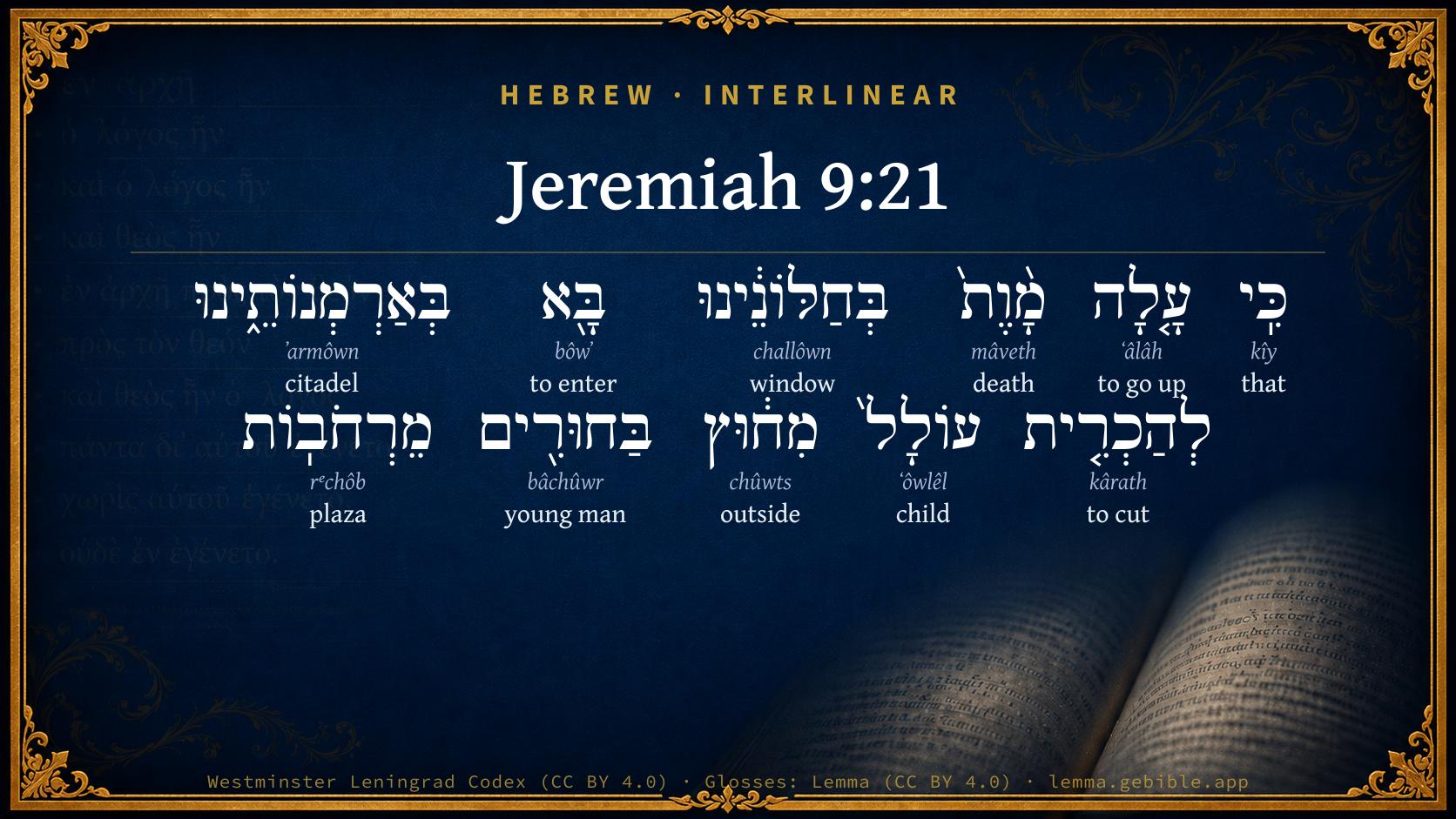
Hebrew (Westminster Leningrad Codex) Jeremiah 9:21 appears in the Hebrew Old Testament. The text above is from the Westminster Leningrad Codex. Each word links to its Strong’s number, a concise gloss, and parsing drawn from the Open Scriptures Hebrew Bible morphology. Click any word for its full Brown-Driver-Briggs (BDB) entry.
Download image
Cite this verse

Jeremiah 9:21 (World English Bible). Public Domain. Lemma interlinear Bible study tool, https://lemma.gebible.app/v/jeremiah/9/21.

Show BibTeX & RIS
BibTeX
RIS
English Translation
For death is come up into our windows, it is entered into our palaces; to cut off the children from outside, [and] the young men from the streets.
World English Bible · Public Domain
Download a study sheet

One document with this verse’s original text, its word-by-word gloss line, the meaning frame, cross-references with their text, attributed commentary, and full source and license credits — printable, and it pastes into notes with its structure intact.

This verse Autodidact and up

Study sheet (.html) Plain text (.txt)

A passage Seminary Student

Up to 50 verses in one chapter. A passage sheet keeps up to 6 commentary sources and 12 cross-references per verse, in the order this page ranks them, and says so on the sheet whenever that leaves anything out. Ask for a single verse and you get the Autodidact verse sheet above.

Everything on this page stays free to read, with no account — the sheet is a download of what is already on screen, not access to it.

Want to remove ads? Support Godless Engineer
Compare translations 3

The same verse in 3 English versions, stacked beneath the original-language interlinear above. Click any original word for its lexicon entry.

Each is an independent rendering of the whole verse — the interlinear is not word-aligned to these translations.

Highlighted words mark where these versions differ — a whole-verse word diff, not a word-by-word alignment.

  • World English Bible Public Domain
    For death is come up into our windows, it is entered into our palaces; to cut off the children from outside, [and] the young men from the streets.
  • King James Version Public Domain
    For death is come up into our windows, and is entered into our palaces, to cut off the children from without, and the young men from the streets.
  • unfoldingWord Literal Text CC BY-SA 4.0
    For death has come up into our windows, it has entered into our palaces, to cut off children from outside, young men from the open plazas.

unfoldingWord Literal Text — © unfoldingWord, licensed CC BY-SA 4.0. Word-aligned USFM3 via Door43 (git.door43.org/unfoldingWord/en_ult).

Versions to compare (up to 4)

3 of 4 selected

Show all 18 translations

Every available English version of this verse, each an independent rendering of the whole verse.

  • World English Bible Public Domain
    For death is come up into our windows, it is entered into our palaces; to cut off the children from outside, [and] the young men from the streets.
  • Berean Standard Bible Public Domain
    For death has climbed in through our windows; it has entered our fortresses to cut off the children from the streets, the young men from the town squares.
  • Majority Standard Bible Public Domain
    For death has climbed in through our windows; it has entered our fortresses to cut off the children from the streets, the young men from the town squares.
  • King James Version Public Domain
    For death is come up into our windows, and is entered into our palaces, to cut off the children from without, and the young men from the streets.
  • American Standard Version (1901) Public Domain
    For death is come up into our windows, it is entered into our palaces; to cut off the children from without, `and' the young men from the streets.
  • Revised Version (1885) Public Domain
    For death is come up into our windows, it is entered into our palaces; to cut off the children from without, and the young men from the streets.
  • Geneva Bible (1599) Public Domain
    For death is come vp into our windowes, and is entred into our palaces, to destroy the children without, and the yong men in the streetes.
  • Douay-Rheims (1899) Public Domain
    For death is come up through our windows, it is entered into our houses to destroy the children from without, the young men from the streets.
  • Young's Literal Translation Public Domain
    For death hath come up into our windows, It hath come into our palaces, To cut off the suckling from without, Young men from the broad places.
  • Literal Standard Version CC BY-SA 4.0
    For death has come up into our windows, || It has come into our palaces, || To cut off the suckling from outside, || Young men from the broad places.
  • Unlocked Literal Bible CC BY-SA 4.0
    For death has come through our windows; it goes into our palaces. It destroys children from outside, and young men in the city squares.
  • unfoldingWord Literal Text CC BY-SA 4.0
    For death has come up into our windows, it has entered into our palaces, to cut off children from outside, young men from the open plazas.
  • Darby Bible Public Domain
    For death is come up through our windows, is entered into our palaces, to cut off the children from the street, the young men from the broadways.
  • World Messianic Bible Public Domain
    For death has come up into our windows. It has entered into our palaces to cut off the children from outside, and the young men from the streets.
  • Webster's Bible Public Domain
    For death hath come up into our windows, and hath entered into our palaces, to cut off the children from without, and the young men from the streets.
  • Free Bible Version CC BY-SA 4.0
    Death has slipped in through our windows; it has come into our fortresses. It has killed the children playing in the streets and the young people gathering in the town squares.
  • Bible in Basic English Public Domain
    For death has come up into our windows, forcing its way into our great houses; cutting off the children in the streets and the young men in the wide places.
  • JPS Tanakh (1917) Public Domain
    (9-20) 'For death is come up into our windows, it is entered into our palaces, to cut off the children from the street, and the young men from the broad places. —

Literal Standard Version (2020), Covenant Press — licensed CC BY-SA 4.0. Text via the HelloAO Bible API (eBible.org). Unlocked Literal Bible (unfoldingWord) — licensed CC BY-SA 4.0. Text via the HelloAO Bible API (eBible.org). unfoldingWord Literal Text — © unfoldingWord, licensed CC BY-SA 4.0. Word-aligned USFM3 via Door43 (git.door43.org/unfoldingWord/en_ult). Free Bible Version, Dr. Jonathan Gallagher — licensed CC BY-SA 4.0. Text via the HelloAO Bible API (eBible.org).

Word by word

More ways to search: Search by grammar → Find every occurrence → Compare this word →

Practice this passage: Drill this verse → Learn its vocabulary →

עוֹלָל֙
ʻôwlêl
H5768
“child”
Noun, Common, Masculine, Singular, Absolute
Part of Speech
Noun
Type
Common
Gender
Masculine
Number
Singular
State
Absolute
Full BDB Definition

Origin: from H5763

TWOT: 1579c

child, boy
  1. כִּֽי kîy H3588 “that” Conjunction
  2. עָ֤לָה ʻâlâh H5927 “to go up” Verb, Qal, Perfect, 3rd Person, Masculine, Singular
  3. מָ֨וֶת֙ mâveth H4194 “death” Noun, Common, Masculine, Singular, Absolute
  4. בְּחַלּוֹנֵ֔ינוּ challôwn H2474 “in/at · windows · our” Preposition + Noun, Common, Both, Plural, Construct + Suffix, Personal, 1st Person, Common, Plural
  5. בָּ֖א bôwʼ H935 “to enter” Verb, Qal, Perfect, 3rd Person, Masculine, Singular
  6. בְּאַרְמְנוֹתֵ֑ינוּ ʼarmôwn H759 “in/at · citadels · our” Preposition + Noun, Common, Masculine, Plural, Construct + Suffix, Personal, 1st Person, Common, Plural
  7. לְהַכְרִ֤ית kârath H3772 “to cut” Preposition + Verb, Hiphil, Infinitive Construct
  8. מִח֔וּץ chûwts H2351 “from · outside” Preposition + Noun, Common, Masculine, Singular, Absolute
  9. בַּחוּרִ֖ים bâchûwr H970 “young men” Noun, Common, Masculine, Plural, Absolute
  10. מֵרְחֹבֽוֹת rᵉchôb H7339 “from · plazas” Preposition + Noun, Common, Feminine, Plural, Absolute

About this verse

These counts appear in no published source. They are computed here, from the morphology-tagged text and Lemma’s own curated glosses. What Lemma adds →

11
words
11
distinct lemmas
Prophets
section

Notable vocabulary

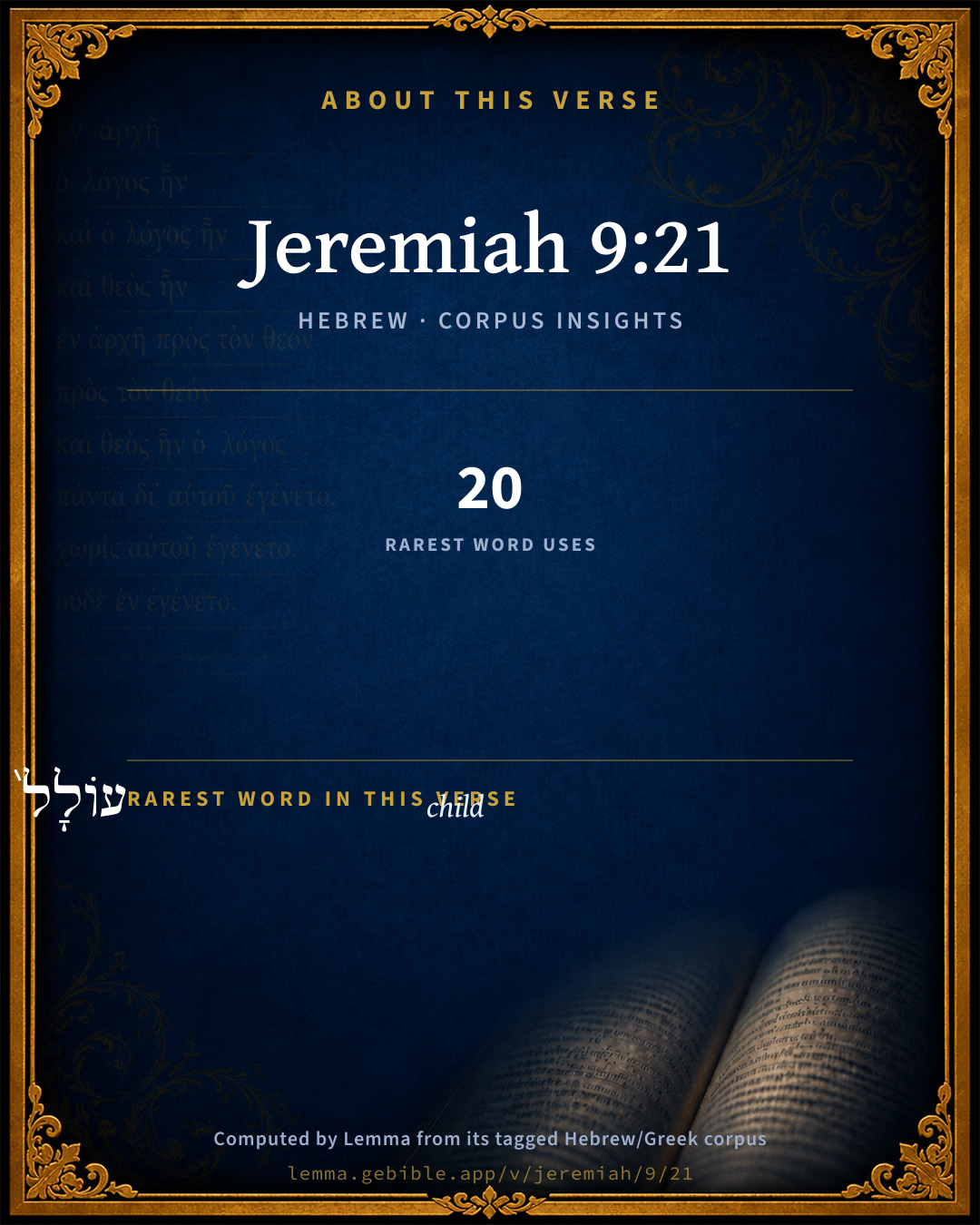
The rarest word here is עוֹלָל֙ child H5768 — appearing just 20 times in the whole Hebrew Bible.

Shared distinctive vocabulary

עוֹלָל֙ child H5768 occurs in 20 verses of the Hebrew Bible. Also found in:

Grammatical profile

  • 3 verbs
  • 7 nouns
  • 1 conjunction

Verb forms

  • עָ֤לָה Qal · Perfect
  • בָּ֖א Qal · Perfect
  • לְהַכְרִ֤ית Hiphil · Infinitive Construct

Cross-references

6

Topical passages linked to Jeremiah 9:21 in the Treasury of Scripture Knowledge — connected by theme and wording, ordered by reader-vote popularity; previews shown in the World English Bible.

  • Jeremiah 6:11 Therefore I am full of the wrath of Yahweh; I am weary with holding in: pour it out on the children in the street, and on the assembly of young men together; for even the husband with the wife shall be taken, the aged with him who is full of days.
  • 2 Chronicles 36:17 Therefore he brought on them the king of the Chaldeans, who killed their young men with the sword in the house of their sanctuary, and had no compassion on young man or virgin, old man or gray-headed: he gave them all into his hand.
  • Jeremiah 15:7 I have winnowed them with a fan in the gates of the land; I have bereaved [them] of children, I have destroyed my people; they didn't return from their ways.
  • Ezekiel 9:5–6 To the others he said in my hearing, Go you through the city after him, and strike: don't let your eye spare, neither have you pity;
  • Ezekiel 21:14–15 You therefore, son of man, prophesy, and strike your hands together; and let the sword be doubled the third time, the sword of the deadly wounded: it is the sword of the great one who is deadly wounded, which enters into their chambers.
  • Amos 6:10–11 "When a man's relative carries him, even he who burns him, to bring bodies out of the house, and asks him who is in the innermost parts of the house, 'Is there yet any with you?' And he says, 'No;' then he will say, 'Hush! Indeed we must not mention the name of Yahweh.'

Cross-references courtesy of OpenBible.info (CC BY 4.0).

Hebrew and Greek witnesses Masoretic Hebrew ↔ Greek Septuagint

The same verse in the two great witnesses to the Old Testament, shown verse-for-verse.

These are two independent witnesses, not word-aligned to each other, and the Septuagint is shown in lemma (dictionary) form.

Hebrew Jeremiah 9:21 Masoretic · Westminster Leningrad Codex

כִּֽי עָ֤לָה מָ֨וֶת֙ בְּחַלּוֹנֵ֔ינוּ בָּ֖א בְּאַרְמְנוֹתֵ֑ינוּ לְהַכְרִ֤ית עוֹלָל֙ מִח֔וּץ בַּחוּרִ֖ים מֵרְחֹבֽוֹת

For death is come up into our windows, it is entered into our palaces; to cut off the children from outside, [and] the young men from the streets.

World English Bible · Public Domain

Greek LXX Structure differs

In the Septuagint, Jeremiah is about an eighth shorter than the Hebrew and arranges its material differently — the Oracles Against the Nations (Hebrew chapters 46–51) appear in the middle of the Greek book, after 25:13. Because the chapter and verse boundaries do not line up, a verse-for-verse comparison with the Hebrew is not shown.

A verse-for-verse comparison isn’t shown here because the chapters and verses don’t line up. Switch to the LXX edition with the MT / LXX toggle above to read the Greek directly.

On this verse, John Gill's Exposition discusses the Septuagint’s reading. Read the note in Commentary ↓

Hebrew: Westminster Leningrad Codex (CC BY 4.0). Greek: Septuagint (public domain); English from a public-domain English Septuagint. How the Septuagint differs from the Hebrew →

Targum (Aramaic paraphrase)

1

The Targum is the ancient Jewish Aramaic paraphrase of the Hebrew Scriptures — an interpretive translation, not the Hebrew text itself. Onkelos (literal) and Pseudo-Jonathan (expansive) render the Torah, and Jonathan the Prophets. Coverage is partial: where no permissively-licensed English translation exists for a verse, only the Aramaic is shown. This is verse-level text, not a word-by-word alignment to the Hebrew.

  1. Targum Jonathan Prophets (Joshua–Malachi)
    אִתְנַבֵּי כִּדְנַן אֲמַר יְיָ וְתִתְרְמֵי נְבֵלְתָּא דֶאֱנָשָׁא כְּזֵיבַל מְבַדַר עַל אַפֵּי חַקְלָא וְכַעֲמִירָא מִבָּתַר חַצָדָא וְלֵית דִמְכַנֵשׁ:

    (no public-domain English translation for this verse)

    Targum Jonathan — Aramaic: “Mikraot Gedolot” (public domain). English: “Sefaria Community Translation” (CC0 1.0 (public-domain dedication)); “London "Chaldee Paraphrase," 1871” (public domain). Text via Sefaria.

Commentary

Notes on Jeremiah 9:21 from classic Christian and Jewish commentators (each source and its license shown beneath its notes). The classic Christian expositions comment on the surrounding passage and are grouped to its opening verse, so a note may address several verses; the Jewish commentaries on the Tanakh (Rashi and others) are per-verse, so they appear only where the commentator wrote on this verse.

Lemma curates 59 commentaries, every one of them public domain or Creative Commons licensed, each selected and text-cleaned for this edition rather than reprinted as found. About our sources →

Trapp's Complete Commentary

John Trapp

Jer 9:21 For death is come up into our windows, [and] is entered into our palaces, to cut off the children from without, [and] the young men from the streets.

Ver. 21. For death is come up into our windows,] i.e., The killing Chaldees break in upon us at any place of entrance, doors or windows. {Joe 2:9 Joh 10:1} The ancients give us warning here to see to our senses - those windows of wickedness - that sin get not into the soul thereby, and death by sin.

John Trapp, A Commentary or Exposition upon All the Books of the Old and New Testament (1647–1656) — public domain. Text from a community e-Sword module.

The Biblical Illustrator

Joseph S. Exell

Jer_9:21

For death is come up into our windows.

Death an invading enemy

I. Cruel.

1. Strikes at the dearest objects of our affection.

2. Robs us of our most useful men.

3. Drags us from the dearest things of the heart, occupation, social circles, cherished plans, etc.

4. Reduces our bodies to dust.

II. Unremitting. Active in every--

1. Man.

2. Family.

3. Community.

4. Nation.

III. Subtle. Fights in ambush, steals into house, poisons food, makes air pestiferous, etc.

IV. Resistless. All that science, art, wealth, and caution can do has failed.

V. Ubiquitous. In waves of air, on billows of deep, in valleys, on mountain, river, and brook, forest and flowers; whole earth his dominion.

VI. Conquerable. Christ has conquered death--

1. In His own resurrection.

2. In His power on minds of disciples. (Homilist.)

The Biblical Illustrator, edited by Joseph S. Exell (c. 1880s–1900s) — public domain. Text from a community e-Sword module.

Geneva Bible (1599)

Geneva Bible translators

Signifying, that there is no means to deliver the wicked from God’s judgments: but when they think to be most sure, and most far off, then they are soonest taken.

Geneva Bible (1599) marginal notes — public domain. Text via Bolls.life.

Jamieson, Fausset & Brown

Robert Jamieson, A. R. Fausset & David Brown

death . . . windows--The death-inflicting soldiery, finding the doors closed, burst in by the windows.

to cut off . . . children from . . . streets--Death cannot be said to enter the windows to cut off the children in the streets, but to cut them off, so as no more to play in the streets without (Zac 8:5).

Jamieson, Fausset & Brown — Commentary Critical and Explanatory on the Whole Bible (1871) — public domain (CC PDM 1.0). Text via the HelloAO Bible API.

Adam Clarke's Commentary

Verse 21. For death is come up into our windows] Here DEATH is personified, and represented as scaling their wall; and after having slain the playful children without, and the vigorous youth employed in the labours of the field, he is now come into the private houses, to destroy the aged and infirm; and into the palaces, to destroy the king and the princes.

Adam Clarke's Commentary on the Bible (1810–1826) — public domain. Text from a community e-Sword/MySword module.

John Calvin's Commentaries

And by way of explanation he adds, For death has ascended into our windows There is here a kind of derision; for the Jews, as it has been said, had falsely promised to themselves a perpetual impunity; and therefore the Prophet adopts here a most suitable comparison. For as they sleep securely, who with closed doors seem to themselves to be beyond the reach of danger; so the Jews at that time despised God and all his judgments, as though the doors of their houses were closed. Hence the Prophet says, that death had entered in through the windows; and he thus derides their folly for thinking that they could escape the hand of God, because their gates were shut, as though. God’s power could not ascend above the clouds nor enter through their windows, when the doors were closed. In short, he intimates that the doors would not be opened by God; for though he might not be disposed to break them, he could yet immediately ascend into the windows. We now apprehend the Prophet’s design in saying, that death had entered through the windows.

And what he adds respecting palaces bears the same import; as though he had said, “Were our houses even fortified, and were they not. only commodious habitations, but made like citadels, yet God could not be excluded; for his power can penetrate through the highest and the thickest walls, so that a palace is to him like the weakest and frailest cottage.” We hence see that by this comparison he checks that foolisll confidence by which the Jews had deceived themselves, and by which they were as yet inebriated. Death then has ascended into our windows, etc.

He then adds, To cut off the young, or children, from the public ways, and the youths from the streets By these words he sets forth the dreadfulness of the calamity; for the youths would not be able to defend themselves by their own strength; for by בחורים, bechurim, he means the most robust. Even these would not be able to repel the onset of their enemies; though in the flower of their age, yet their rigor, however strong, would not protect them, nor would children and infants be spared. We see that two things are here set forth by the Prophet, — that the assaults of their enemies would be so violent, that young men would in vain resist them, as their vigor would avail them nothing, — and then that such would be the cruelty of their enemies, that no regard would be shewn for age, for they would put to death even infants newly born. It follows —

John Calvin's Commentaries (1540-1563) — public domain. Text from the Calvin Translation Society English edition (1840s-50s) via the Christian Classics Ethereal Library (ccel.org). Calvin's coverage is partial (roughly two-thirds of the Bible); uncommented books and verses are honest gaps, never fabricated. The 19th-century editor's footnotes and remarks are omitted so the notes are faithfully Calvin's own voice.

Ellicott's Commentary for English Readers

(21) Death is come up into our windows.—“Death” stands here, as in Jer_15:2, specifically for the pestilence, which is to add its horrors to those of the famine and the sword, and which creeps in with its fatal taint at the windows, even though the invader is for a time kept at bay, and cuts off the children who else would play “without,” sc., in the court-yard of the house, and the “young men” who else would gather, as were their wont, in the streets or the open places of the city. The Hebrew word rehoboth (comp. Gen_26:22) answers to “piazza,” “square,” “market-place,” rather than to our street.

A Bible Commentary for English Readers, edited by Charles John Ellicott (1878–1897) — public domain. Text from a community e-Sword module.

The Cambridge Bible for Schools and Colleges

gen. ed. J. J. S. Perowne

21. is come up] Cp. Joe_2:9.

palaces] See on Jer_6:5.

from without] Cp. Zec_8:5.

The Cambridge Bible for Schools and Colleges (gen. ed. J. J. S. Perowne; Cambridge University Press, 1878–1918) — public domain. Text from a community e-Sword module.

John Gill's Exposition

For death is come up into our windows,.... Their doors being shut, bolted, and barred, they thought themselves safe, but were not; the Chaldeans scaled their walls, broke in at the tops of their houses, or at their windows, and destroyed them: for the invasion of the enemy, and the manner of their entrance into them, seem to be described. Death is here represented as a person, as it sometimes is in Scripture; see Rev 6:8 and as coming suddenly and unawares upon men, and from whom there is no escape, or any way and method of keeping him out; bolts and bars will not do; he can climb up, and go in at the window:

and is entered into our palaces; the houses of their principal men, which were well built, and most strongly fortified, these could not keep out the enemy: and death spares none, high nor low, rich nor poor; it enters the palaces of great men, as well as the cottages of the poor. The Septuagint version is, "it is entered into our land"; and so the Arabic version; only it places the phrase, "into our land", in the preceding clause; and that of "into", or "through our windows", in this:

to cut off the children from without, and the young men from the streets; these words are not strictly to be connected with the preceding, as though they pressed the end of death, ascending up to the windows, and entering palaces, to cut off such as were in the streets; but the words are a proposition of themselves, as the distinctive accent "athnach" shows; and must be supplied after this manner, and passing through them it goes on, "to cut off", &c. and so aptly describes the invading enemy climbing the walls of the city, entering at windows, or tops of houses, upon or near the walls; and, having destroyed all within, goes forth into the streets, where children were at play, and slays them and into courts or markets, where young men were employed in business, and destroys them. The Jews (e) interpret it of famine.

(e) T. Bab. Bava Kama, fol. 60. 2.

John Gill's Exposition of the Whole Bible (1746–1763) — public domain (CC PDM 1.0). Text via the HelloAO Bible API.

Haydock's Catholic Bible Commentary

For. This was the song. (Calmet) --- Streets. Death spares none. The least suspecting fall. (Haydock) --- It enters by the windows, if the doors be shut, Joel ii. 8.

George Leo Haydock (1774–1849), Haydock's Catholic Family Bible and Commentary, 1859 edition — public domain. Excludes Psalms (Douay-Rheims chapter numbering differs from Protestant) and Deuterocanonical books (Catholic canon only).

Matthew Poole's English Annotations

Death is come up; the unavoidableness of the ruin is expressed metaphorically, Eze 21:14; Jer 6:5, most likely alluding to the violent and universal storming of a city, Jer 5:10, wherein there is no respect had to sex, youth, or age. Several other allusions. See English Annotations. The Chaldeans are here understood by death, as bringing death wherever they come; a metonymy of the effect.

To cut off the children from without; no safety within or without; the enemy shall cut off all, not only those at home, but even those that are conversing or playing in the streets, which most commonly young men and children are, Jer 6:11.

Matthew Poole's English Annotations on the Holy Bible (1683–1685) — public domain. Text from a community e-Sword/MySword module.

Whedon's Commentary on the Bible

Daniel D. Whedon

21. Death is come up into our windows — Implying his resistlessness, and the universality of his conquests. He comes in by all avenues. As the result of his work there are no children… without, nor young men in the streets. Silence and death bear undisputed sway.

Daniel D. Whedon (gen. ed.), Commentary on the Old and New Testaments (1874–1909) — public domain. Text from a community e-Sword module.

The Pulpit Commentary

Death is come up, etc. "Death," equivalent to "pestilence", (as Jer_15:2) the most dreaded foe of a besieged population. (For the figure, comp. Joe_2:9) The children from without. The ideal of Zechariah is that "the streets of the city should be full of boys and girls playing in the streets thereof" (viii. 5). But the pitiless reaper, Death, shall cut off even "the playful child from the street" (so we might render more literally). Streets, in the parallel clause, means the "broad places" where men congregate to toll the news.

The death of the wicked contrary to nature.

Various respects in which this is so: it is sudden; it defies all the resources of comfort and protection; it is untimely, and cuts off the young in their bloom the children for the fathers" sin, the hope of the nation and the family. "Death will not, as an enemy lurking without, attack those only who venture out to him, but will assault the people, penetrating into all their houses, to fetch his sacrifices" (Naegelsbach, in Lunge). Why so?

I IT IS BECAUSE THE LAWS OF GOD AND OF NATURE HAVE BEEN SHAMEFULLY VIOLATED.

II THE TRIAL AND PUNISHMENT OF THE CONFIRMED SINNER ARE SWIFTLY REMOVED TO ANOTHER JUDGMENT-SEAT.

III IT IS INTENDED AS A DEMONSTRATION AGAINST EVIL AND A TERROR TO EVILDOERS. M.

Vers. 21, 22. Death"s doings.

Behold

I DEATH"S CARNIVAL. In many an ancient continental city you may see portrayed in still vivid colors, on the roofs of their covered bridges, across on that of the old bridge at Lucerne, on the walls of their churches, and elsewhere, the grim" Dance of Death." These verses remind of those paintings, and tell in yet more fearful form of Death"s dread carnival. With what diabolic zest he is represented at his work here! He is shown to us, not as coming in in ordinary manner to the sick-chamber, where his coming has long been expected and may even be welcomed; but as breaking in roughly, unexpectedly, cruelly, like a thief coming in at the windows. Nor as drawing near to the poor, the defenseless, the miserable; but entering into our palaces, the abode of the great, the rich, the strong. Nor as calling home those whose day"s work is done, who have lived their life, and to whom eventide has long ago arrived; but as cutting ruthlessly down the dear young children in the very blossom of their days. Nor as ridding the earth of the cruel and vile; but tearing from us the innocent, the children. Nor are vigor, strength, and promise any more a defense against him than decrepit old age; for "the young men" are his victims even as others. And no multitude of slain will satiate him. Ver. 22 represents the numbers of the dead as so great that they have to be left unburied and uncared for to rot upon the open field. It is true that this frightful picture is taken from the awful experiences of a besieged city, but with slight modifications it is true everywhere and always. This life is the carnival of Death. What are men but a long succession of mourners? As the poet saysOur hearts like muffled drums are beating Funeral marches to the grave.

And when we contemplate the cruel consequences of this carnival of Death, which is going on still, the mind and heart reel, and faith in the fatherhood of God would fade utterly out of men"s souls were it not that in brighter colors still the Word of God portrays

II DEATH"S CONQUEROR. Christ has abolished death. The broken pillar, the turned-down torch, the "Vale, vale, in aeternum vale," of the old Pagan world, have now no appropriateness because no truth. Death is sorrow still, even to those who believe in him who is "the Resurrection and the Life;" but it is not and cannot be that hopeless, unutterable, unfathomable woe which it was till he came who hath abolished death. No doubt this terrible verse (Ver. 21), which tells of Death"s dread doings, is yet far more true than we would like it to be, and often and often, in the blank desolation and shattered hopes which earth"s bereavements bring to us, we fail to derive all the consolation and help which Death"s glorious Conqueror has given to us. But, nevertheless, he has given them, and it is true that "Blessed are the dead which die in the Lord." Let us see to it that we are, by a living abiding trust, "in the Lord," and then, though we sorrow, and sorrow bitterly still, yet it will not be, it is not, "as those that have no hope. C.

The Pulpit Commentary (1880–1919), ed. H.D.M. Spence-Jones & Joseph S. Exell — public domain. Text from a community e-Sword module.

John Wesley's Explanatory Notes

Death - The unavoidableness of the ruin is expressed metaphorically, alluding to the storming of a city, wherein there is no respect had to sex, youth, or age.

John Wesley, Explanatory Notes Upon the Whole Bible (1754–1765) — public domain. Text via the GEBible commentary corpus.

Keil & Delitzsch

C. F. Keil & F. Delitzsch

The numbers of the dead will be so great, that the bodies will be left lying unburied. The concluding touch to this awful picture is introduced by the formula, "Speak: Thus saith the Lord," as a distinct word from God to banish all doubt of the truth of the statement. This formula is interposed parenthetically, so that the main idea of the clause is joined by ו cop. to Jer 9:20. This ו is not to be deleted as a gloss, as it is by Ew. and others, because it is not found in the lxx. With "as dung," cf. Jer 8:2; Jer 16:4. עמיר, prop. a bundle of stalks, grasped by the hand and cut, then = עמר, sheaf. As a sheaf behind the reaper, which nobody gathers, i.e., which is left to lie unheeded, is not brought by the reaper into the barn. The point of the simile is in the lying unheeded. Strange to say, Graf and Ng. propose to refer the "none gathereth" not to the sheaf of the shearer, but to the dead bodies: whereas the reaper piles the sheaves upon the waggon ad brings them to the threshing-floor, the corpses are left ungathered.

Keil & Delitzsch — Biblical Commentary on the Old Testament (1861–1891) — public domain (CC PDM 1.0). Text via the HelloAO Bible API. (Old Testament only.)

unfoldingWord translationNotes

Door43 World Missions Community

General Information:

Here Yahweh is saying what the people of Judah will say when he destroys the land.

For death has come through our windows ... young men in the city squares

The people of Judah will compare death to a person who can climb in windows to attack the people inside and attacks people in the palaces, streets, and city squares. (See: Personification)

palaces

fancy houses where kings live. Death will come to rich and poor alike.

city squares

marketplaces

This is Yahweh's declaration

Yahweh speaks of himself by name to express the certainty of what he is declaring. See how you translated this in Jeremiah 1:8. AT: "This is what Yahweh has declared" or "This is what I, Yahweh, have declared" (See: First, Second, or Third Person)

the corpses of men will fall like dung ... like grain stalks after the reapers

These two phrases mean the same thing and emphasize the large number dead bodies. AT: "dead bodies will fall all over the place" (See: Parallelism)

corpses of men will fall like dung in the fields

This describes the great number of people who will die, by comparing their bodies to dung that falls in the fields. AT: "dead bodies will drop everywhere like animal dung falls all over the fields" (See: Simile)

like grain stalks after the reapers

This describes the great number of people who will die, by comparing their bodies to cut stalks of grain. AT: "like stalks of grain fall everywhere after the farmers cut them down" (See: Simile)

there will be no one to gather them

"there will be nobody to gather the dead bodies"

translationWords

die

dung

grain

unfoldingWord translationNotes — © Distant Shores Media and the Door43 World Missions Community, licensed CC BY-SA 4.0. Source: git.door43.org/Door43/en_tn.

Lesson kit

Teaching starters — assembled from the data on this page, not authored interpretation. Every prompt links to the verse data it draws on. Edit before teaching.

Jeremiah, in the Prophets, opens this verse with 11 words (11 distinct Hebrew lemmas). Its most distinctive word is ʻôwlêl (“child”). A historical commentator’s framing appears above. Read the whole chapter for the surrounding context.

Discussion questions

  1. The word ʻôwlêl carries the sense “child.” How does it shape the verse?
  2. How does 1 Samuel 15:3, which shares the word «child», read alongside this verse?
  3. These translations render this verse differently; the difference is in the English rendering, not the original. What questions does that raise?
  4. «עָ֤לָה» is a Qal Perfect verb. How does that grammatical form shape the action described?
  5. Compare how Trapp's Complete Commentary and The Biblical Illustrator read this verse. Where do they agree or differ?

Things to notice

Reading settings

Reading text

Shown beneath each verse's original-language words.

Old Testament
Old Testament edition

Read the OT as the Masoretic Hebrew (MT) or the Greek Septuagint (LXX).

English shown for the Greek Septuagint (in the Hebrew ↔ Greek comparison).

Comparing translations? Open the Compare panel on any verse page to stack up to four side by side.