Isaiah 11:13

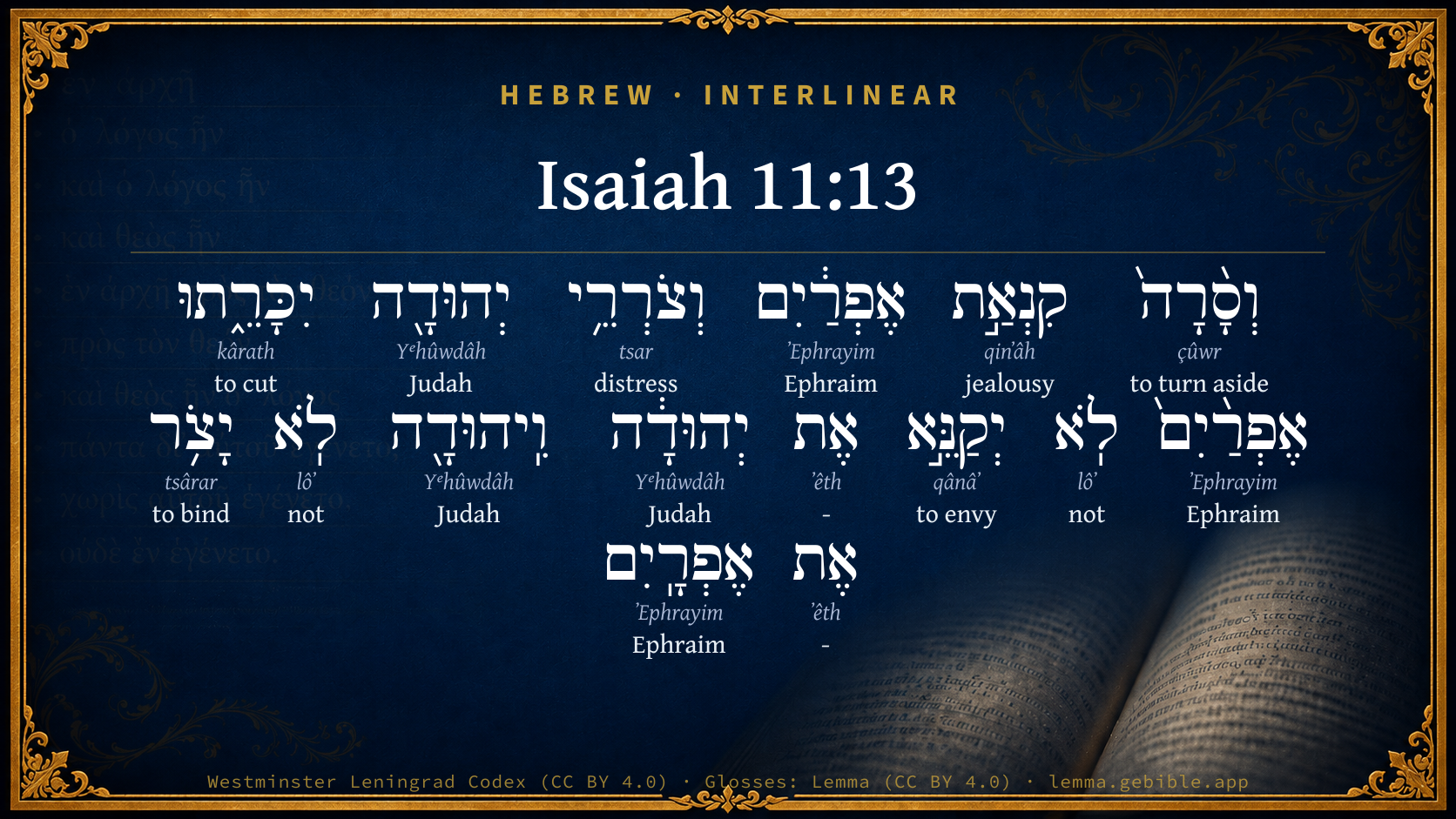
Hebrew (Westminster Leningrad Codex) Isaiah 11:13 appears in the Hebrew Old Testament. The text above is from the Westminster Leningrad Codex. Each word links to its Strong’s number, a concise gloss, and parsing drawn from the Open Scriptures Hebrew Bible morphology. Click any word for its full Brown-Driver-Briggs (BDB) entry.
Download image
Cite this verse

Isaiah 11:13 (World English Bible). Public Domain. Lemma interlinear Bible study tool, https://lemma.gebible.app/v/isaiah/11/13.

Show BibTeX & RIS
BibTeX
RIS
English Translation
The envy also of Ephraim shall depart, and those who vex Judah shall be cut off: Ephraim shall not envy Judah, and Judah shall not vex Ephraim.
World English Bible · Public Domain
Download a study sheet

One document with this verse’s original text, its word-by-word gloss line, the meaning frame, cross-references with their text, attributed commentary, and full source and license credits — printable, and it pastes into notes with its structure intact.

This verse Autodidact and up

Study sheet (.html) Plain text (.txt)

A passage Seminary Student

Up to 50 verses in one chapter. A passage sheet keeps up to 6 commentary sources and 12 cross-references per verse, in the order this page ranks them, and says so on the sheet whenever that leaves anything out. Ask for a single verse and you get the Autodidact verse sheet above.

Everything on this page stays free to read, with no account — the sheet is a download of what is already on screen, not access to it.

Want to remove ads? Support Godless Engineer
Compare translations 3

The same verse in 3 English versions, stacked beneath the original-language interlinear above. Click any original word for its lexicon entry.

Each is an independent rendering of the whole verse — the interlinear is not word-aligned to these translations.

Highlighted words mark where these versions differ — a whole-verse word diff, not a word-by-word alignment.

  • World English Bible Public Domain
    The envy also of Ephraim shall depart, and those who vex Judah shall be cut off: Ephraim shall not envy Judah, and Judah shall not vex Ephraim.
  • King James Version Public Domain
    The envy also of Ephraim shall depart, and the adversaries of Judah shall be cut off: Ephraim shall not envy Judah, and Judah shall not vex Ephraim.
  • unfoldingWord Literal Text CC BY-SA 4.0
    And the envy of Ephraim will turn aside, and the hostile of Judah will be cut off. Ephraim will not envy Judah, and Judah will not be hostile to Ephraim.

unfoldingWord Literal Text — © unfoldingWord, licensed CC BY-SA 4.0. Word-aligned USFM3 via Door43 (git.door43.org/unfoldingWord/en_ult).

Versions to compare (up to 4)

3 of 4 selected

Show all 18 translations

Every available English version of this verse, each an independent rendering of the whole verse.

  • World English Bible Public Domain
    The envy also of Ephraim shall depart, and those who vex Judah shall be cut off: Ephraim shall not envy Judah, and Judah shall not vex Ephraim.
  • Berean Standard Bible Public Domain
    Then the jealousy of Ephraim will depart, and the adversaries of Judah will be cut off. Ephraim will no longer envy Judah, nor will Judah harass Ephraim.
  • Majority Standard Bible Public Domain
    Then the jealousy of Ephraim will depart, and the adversaries of Judah will be cut off. Ephraim will no longer envy Judah, nor will Judah harass Ephraim.
  • King James Version Public Domain
    The envy also of Ephraim shall depart, and the adversaries of Judah shall be cut off: Ephraim shall not envy Judah, and Judah shall not vex Ephraim.
  • American Standard Version (1901) Public Domain
    The envy also of Ephraim shall depart, and they that vex Judah shall be cut off: Ephraim shall not envy Judah, and Judah shall not vex Ephraim.
  • Revised Version (1885) Public Domain
    The envy also of Ephraim shall depart, and they that vex Judah shall be cut off: Ephraim shall not envy Judah, and Judah shall not vex Ephraim.
  • Geneva Bible (1599) Public Domain
    The hatred also of Ephraim shall depart, and the aduersaries of Iudah shalbe cut off: Ephraim shall not enuie Iudah, neither shall Iudah vexe Ephraim:
  • Douay-Rheims (1899) Public Domain
    And the envy of Ephraim shall be taken away, and the enemies of Juda shall perish: Ephraim shall not envy Juda, and Juda shall not fight against Ephraim.
  • Young's Literal Translation Public Domain
    And turned aside hath the envy of Ephraim, And the adversaries of Judah are cut off, Ephraim doth not envy Judah, And Judah doth not distress Ephraim.
  • Literal Standard Version CC BY-SA 4.0
    And has turned aside the envy of Ephraim, || And the adversaries of Judah are cut off, || Ephraim does not envy Judah, || And Judah does not distress Ephraim.
  • Unlocked Literal Bible CC BY-SA 4.0
    He will turn aside the envy of Ephraim, and hostilities of Judah will be cut off. Ephraim will not envy Judah, and Judah will no longer be hostile to Ephraim.
  • unfoldingWord Literal Text CC BY-SA 4.0
    And the envy of Ephraim will turn aside, and the hostile of Judah will be cut off. Ephraim will not envy Judah, and Judah will not be hostile to Ephraim.
  • Darby Bible Public Domain
    And the envy of Ephraim shall depart, and the troublers of Judah shall be cut off; Ephraim will not envy Judah, and Judah will not trouble Ephraim:
  • World Messianic Bible Public Domain
    The envy also of Ephraim will depart, and those who persecute Judah will be cut off. Ephraim won’t envy Judah, and Judah won’t persecute Ephraim.
  • Webster's Bible Public Domain
    The envy also of Ephraim shall depart, and the adversaries of Judah shall be cut off: Ephraim shall not envy Judah, and Judah shall not distress Ephraim.
  • Free Bible Version CC BY-SA 4.0
    Ephraim's jealousy will disappear, and Judah's enemies will be destroyed; Ephraim won't be jealous of Judah, and Judah won't treat Ephraim as an enemy.
  • Bible in Basic English Public Domain
    And the envy of Ephraim will be gone, and those who make trouble for Judah will come to an end: Ephraim will have no more envy of Judah, and there will be an end of Judah's hate for Ephraim.
  • JPS Tanakh (1917) Public Domain
    The envy also of Ephraim shall depart, and they that harass Judah shall be cut off; Ephraim shall not envy Judah, and Judah shall not vex Ephraim.

Literal Standard Version (2020), Covenant Press — licensed CC BY-SA 4.0. Text via the HelloAO Bible API (eBible.org). Unlocked Literal Bible (unfoldingWord) — licensed CC BY-SA 4.0. Text via the HelloAO Bible API (eBible.org). unfoldingWord Literal Text — © unfoldingWord, licensed CC BY-SA 4.0. Word-aligned USFM3 via Door43 (git.door43.org/unfoldingWord/en_ult). Free Bible Version, Dr. Jonathan Gallagher — licensed CC BY-SA 4.0. Text via the HelloAO Bible API (eBible.org).

Word by word

More ways to search: Search by grammar → Find every occurrence → Compare this word →

Practice this passage: Drill this verse → Learn its vocabulary →

יְקַנֵּ֣א
qânâʼ
H7065
“to envy”
Verb, Piel, Imperfect, 3rd Person, Masculine, Singular
Part of Speech
Verb
Stem
Piel
Form
Imperfect
Person
3rd Person
Gender
Masculine
Number
Singular
Full BDB Definition

Origin: a primitive root

TWOT: 2038

to envy, be jealous, be envious, be zealous - (Piel) - to be jealous of - to be envious of - to be zealous for - to excite to jealous anger - (Hiphil) to provoke to jealous anger, cause jealousy
  1. וְסָ֨רָה֙ çûwr H5493 “and · to turn aside” Conjunction + Verb, Qal, Sequential Perfect, 3rd Person, Feminine, Singular
  2. קִנְאַ֣ת qinʼâh H7068 “jealousy of” Noun, Common, Feminine, Singular, Construct
  3. אֶפְרַ֔יִם ʼEphrayim H669 “Ephraim” Noun, Proper
  4. וְצֹרְרֵ֥י tsar H6862 “and · distress” Conjunction + Verb, Qal, Participle Active, Masculine, Plural, Construct
  5. יְהוּדָ֖ה Yᵉhûwdâh H3063 “Judah” Noun, Proper
  6. יִכָּרֵ֑תוּ kârath H3772 “to cut” Verb, Niphal, Imperfect, 3rd Person, Masculine, Plural
  7. אֶפְרַ֨יִם֙ ʼEphrayim H669 “Ephraim” Noun, Proper
  8. לֹֽא lôʼ H3808 “not” Particle, Negative
  9. אֶת ʼêth H853 “-” Particle, Direct Object
  10. יְהוּדָ֔ה Yᵉhûwdâh H3063 “Judah” Noun, Proper
  11. וִֽיהוּדָ֖ה Yᵉhûwdâh H3063 “and · Judah” Conjunction + Noun, Proper
  12. לֹֽא lôʼ H3808 “not” Particle, Negative
  13. יָצֹ֥ר tsârar H6887 “to bind” Verb, Qal, Imperfect, 3rd Person, Masculine, Singular
  14. אֶת ʼêth H853 “-” Particle, Direct Object
  15. אֶפְרָֽיִם ʼEphrayim H669 “Ephraim” Noun, Proper

About this verse

These counts appear in no published source. They are computed here, from the morphology-tagged text and Lemma’s own curated glosses. What Lemma adds →

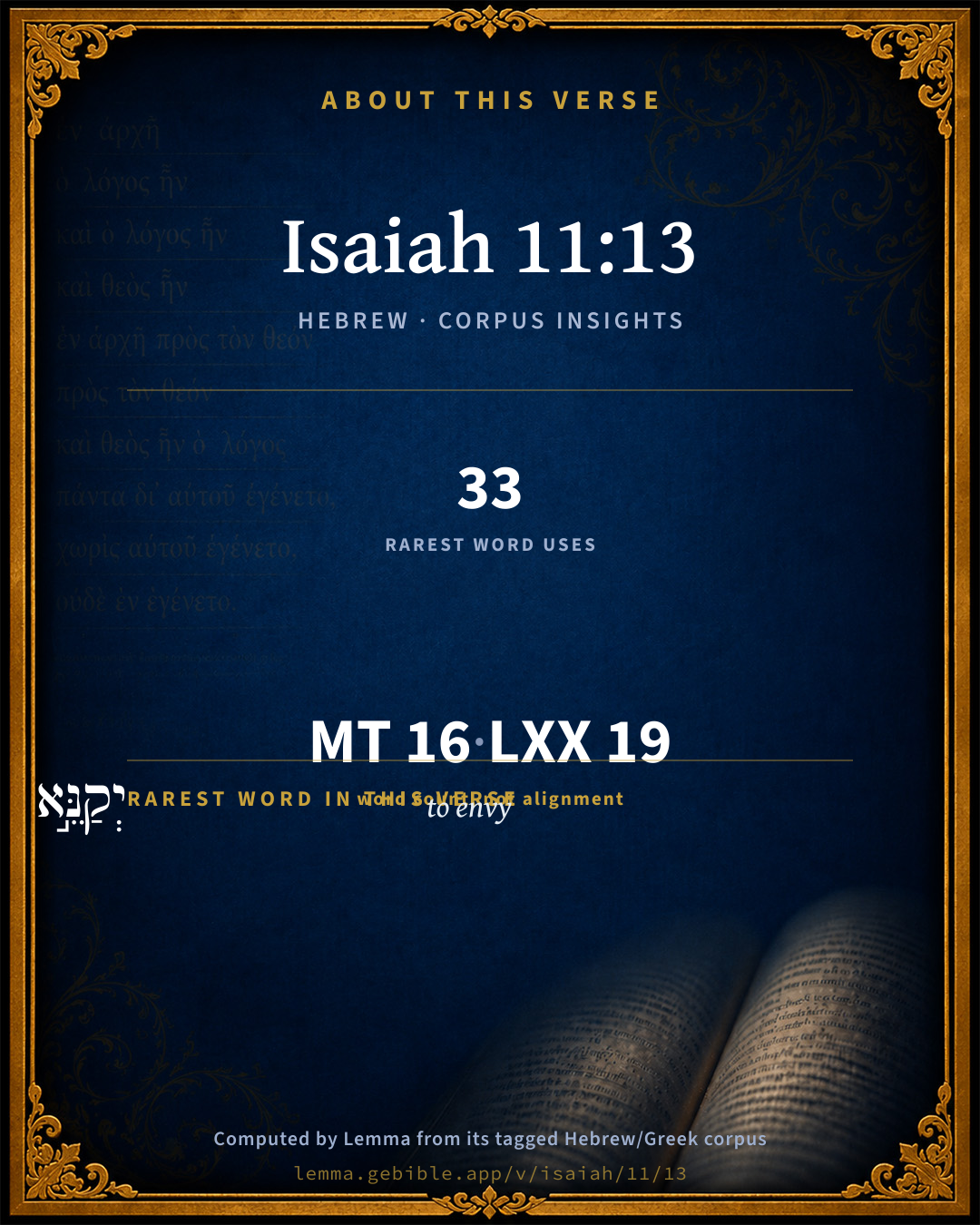
16
words
10
distinct lemmas
Prophets
section

Shared distinctive vocabulary

יְקַנֵּ֣א to envy H7065 occurs in 28 verses of the Hebrew Bible. Also found in:

Grammatical profile

  • 5 verbs
  • 7 nouns
  • 4 particles

Verb forms

  • וְסָ֨רָה֙ Qal · Sequential Perfect
  • וְצֹרְרֵ֥י Qal · Participle Active
  • יִכָּרֵ֑תוּ Niphal · Imperfect
  • יְקַנֵּ֣א Piel · Imperfect
  • יָצֹ֥ר Qal · Imperfect

Repetition

Words recur within this verse — often emphatic in Hebrew:

  • אֶפְרַ֔יִם Ephraim H669 ×3
  • יְהוּדָ֖ה Judah H3063 ×3
  • לֹֽא not H3808 ×2

Hebrew & Septuagint length

In English translation the verse runs 27 words from the Hebrew and 27 from the Septuagint (LXX English) — the same length.

A rough comparison of the two English renderings, which tokenize alike — not a word-level alignment.

Word counts can differ between the Hebrew and the Greek without any difference in meaning — e.g. the Hebrew direct-object marker אֵת has no separate Greek word, and Greek often adds the article ὁ.

In the original languages it is 16 Hebrew tokens and 19 Greek tokens — but the two are counted differently (Hebrew bundles its prefixes and suffixes into one token; the Greek is in lemma form), so that isn’t a like-for-like length.

Cross-references

5

Topical passages linked to Isaiah 11:13 in the Treasury of Scripture Knowledge — connected by theme and wording, ordered by reader-vote popularity; previews shown in the World English Bible.

  • Jeremiah 3:18 In those days the house of Judah shall walk with the house of Israel, and they shall come together out of the land of the north to the land that I gave for an inheritance to your fathers.
  • Ezekiel 37:16–24 You, son of man, take one stick, and write on it, For Judah, and for the children of Israel his companions: then take another stick, and write on it, For Joseph, the stick of Ephraim, and [for] all the house of Israel his companions:
  • Hosea 1:11 The children of Judah and the children of Israel will be gathered together, and they will appoint themselves one head, and will go up from the land; for great will be the day of Jezreel.
  • Isaiah 9:21 Manasseh, Ephraim; and Ephraim, Manasseh; and they together shall be against Judah. For all this his anger is not turned away, but his hand is stretched out still.
  • Isaiah 7:1–6 It happened in the days of Ahaz the son of Jotham, the son of Uzziah, king of Judah, that Rezin the king of Syria, and Pekah the son of Remaliah, king of Israel, went up to Jerusalem to war against it, but could not prevail against it.

Cross-references courtesy of OpenBible.info (CC BY 4.0).

Hebrew and Greek witnesses Masoretic Hebrew ↔ Greek Septuagint

The same verse in the two great witnesses to the Old Testament, shown verse-for-verse.

These are two independent witnesses, not word-aligned to each other, and the Septuagint is shown in lemma (dictionary) form.

Hebrew Isaiah 11:13 Masoretic · Westminster Leningrad Codex

וְסָ֨רָה֙ קִנְאַ֣ת אֶפְרַ֔יִם וְצֹרְרֵ֥י יְהוּדָ֖ה יִכָּרֵ֑תוּ אֶפְרַ֨יִם֙ לֹֽא יְקַנֵּ֣א אֶת יְהוּדָ֔ה וִֽיהוּדָ֖ה לֹֽא יָצֹ֥ר אֶת אֶפְרָֽיִם

The envy also of Ephraim shall depart, and those who vex Judah shall be cut off: Ephraim shall not envy Judah, and Judah shall not vex Ephraim.

World English Bible · Public Domain

Greek LXX Isaiah 11:13 Septuagint · lemma form

καί ἀποαἱρέω ὁ ζῆλος ἐφράιμ καί ὁ ἐχθρός ιουδα ἀποὀλλύω ἐφράιμ οὐ ζηλόω ἰούδας καί ἰούδας οὐ θλίβω ἐφράιμ

And the envy of Ephraim shall be taken away, and the enemies of Juda shall perish: Ephraim shall not envy Juda, and Juda shall not afflict Ephraim.

LXX2012 (modern English Septuagint) · Public Domain

Hebrew: Westminster Leningrad Codex (CC BY 4.0). Greek: Septuagint (public domain); English from LXX2012 (modern English Septuagint) (Public Domain). How the Septuagint differs from the Hebrew →

Targum (Aramaic paraphrase)

1

The Targum is the ancient Jewish Aramaic paraphrase of the Hebrew Scriptures — an interpretive translation, not the Hebrew text itself. Onkelos (literal) and Pseudo-Jonathan (expansive) render the Torah, and Jonathan the Prophets. Coverage is partial: where no permissively-licensed English translation exists for a verse, only the Aramaic is shown. This is verse-level text, not a word-by-word alignment to the Hebrew.

  1. Targum Jonathan Prophets (Joshua–Malachi)
    וְתֶעְדֵי קִנְאֲתָא דְבֵית אֶפְרַיִם וְדִמְעִיקִין לִדְבֵית יְהוּדָה יִשְׁתֵּיצוּן דְבֵית אֶפְרַיִם לָא יְקַנוּן בִּדְבֵית יְהוּדָה וּדְבֵית יְהוּדָה לָא יְעִיקוּן לִדְבֵית אֶפְרָיִם:

    The envy of the house of Ephraim shall depart, and those that oppress the house of Judah shall come to an end: those of the house of Ephraim shall not envy the house of Judah; and those of the house of Judah shall not oppress the house of Ephraim.

    Targum Jonathan — Aramaic: “Mikraot Gedolot” (public domain). English: “Sefaria Community Translation” (CC0 1.0 (public-domain dedication)); “London "Chaldee Paraphrase," 1871” (public domain). Text via Sefaria.

Commentary

Notes on Isaiah 11:13 from classic Christian and Jewish commentators (each source and its license shown beneath its notes). The classic Christian expositions comment on the surrounding passage and are grouped to its opening verse, so a note may address several verses; the Jewish commentaries on the Tanakh (Rashi and others) are per-verse, so they appear only where the commentator wrote on this verse.

Lemma curates 59 commentaries, every one of them public domain or Creative Commons licensed, each selected and text-cleaned for this edition rather than reprinted as found. About our sources →

Trapp's Complete Commentary

John Trapp

Isa 11:13 The envy also of Ephraim shall depart, and the adversaries of Judah shall be cut off: Ephraim shall not envy Judah, and Judah shall not vex Ephraim.

Ver. 13. The envy also of Ephraim shall depart.] The fierce wrath or deadly feud that was between the ten revolted tribes of Judah, the like whereunto was between England and Scotland, and in England between the houses of York and Lancaster; in which last mentioned dissension were slain eighty princes of royal blood, and twice as many natives of England as were lost in the two conquests of France. {a} This emulation and hatred of Ephraim against Judah was to be abolished by Christ. {b} {Eze 37:17} The disciples, being of various tribes, were all of one heart and of one soul. {Act 4:32} Neither was there any controversy at all among them, as one ancient Greek copy addeth to that forecited text. {c}

{a} Dan. Hist., 249.

{b} Discimus sub Christo finem sore simultatum et odiorum. - Oecol.

{c} Beza ex Beda.

John Trapp, A Commentary or Exposition upon All the Books of the Old and New Testament (1647–1656) — public domain. Text from a community e-Sword module.

The Biblical Illustrator

Joseph S. Exell

Isa_11:13

The envy also of Ephraim shall depart

Judah and Ephraim

Jacob, in his prophetic statement of the fortunes of his sons, disregards the right of primogeniture, and gives the preeminence to Judah and Joseph, and in the family of the latter to the younger son Ephraim.

Hence, from the time of the exodus, these two were regarded as the leading tribes of Israel. Judah was much more numerous than Ephraim, took precedence during the journey in the wilderness, and received the largest portion in the promises land. But Joshua was an Ephraimite; and Shiloh, where the tabernacle long stood, was probably within the limits of the same tribe. The ambitious jealousy of the Ephraimites towards other tribes appears in their conduct to Gideon and Jephthah. Their special jealousy of Judah showed itself in their temporary refusal to submit to David after the death of Saul, in their adherence to Absalom against his father, and in the readiness with which they joined in the revolt of Jeroboam, who was himself of the tribe of Ephraim. This schism was, therefore, not a sudden or fortuitous occurrence, but the natural result of causes which had long been working. The mutual relation of the two kingdoms is expressed in the recorded fact that there was war between Rehoboam and Jeroboam, and between Asa and Baasha all their days. Exceptions to the general rule, as in the case of Ahab and Jehoshaphat, were rare, and a departure from the principles and ordinary feelings of the parties. The ten tribes, which assumed the name of Israel after the division, and perhaps before it, regarded the smaller and less warlike state with a contempt which is well expressed by Jehoash in his parable of the cedar and the thistle, unless the feeling there displayed be rather personal than national. On the other hand, Judah justly regarded Israel as guilty not only of political revolt, but of religious apostasy, and the jealousy of Ephraim towards Judah would, of course, be increased by the fact that Jehovah had forsaken the tabernacle of Shiloh, that He refused the tabernacle of Joseph, and chose not the tribe of Ephraim, but chose the tribe of Judah, the Mount Zion which He loved. (J. A. Alexander.)

The Biblical Illustrator, edited by Joseph S. Exell (c. 1880s–1900s) — public domain. Text from a community e-Sword module.

Joseph Benson's Commentary

Isa 11:13-14. The envy also of Ephraim shall depart, &c. — Ephraim here stands for the ten tribes and the prophet alludes to the great emulations and contentions which had subsisted between them and Judah: but his intention is to set forth the spiritual state of the Jews after their conversion to the faith of the gospel, which he predicts, 1st, “That all envy shall be extinguished among them, and a true brotherly love shall fill their souls; and, 2d, That, joined to the Gentiles, they shall strenuously defend the cause of Christ and his kingdom against the enemies and opposers of it.” Ephraim shall not envy Judah, &c. — Not only all outward hostilities shall cease, but also their inward animosities. But they shall fly upon the shoulders, &c. — This is a metaphor taken from birds and beasts of prey, which commonly fasten on the shoulders of cattle. They shall spoil them of the east together — They shall subdue them; which is to be understood of the spiritual victory which the Messiah should obtain by his apostles, ministers, and people, over all nations, in bringing them to the obedience of his gospel. For it is the manner of the prophets to speak of the spiritual things of the gospel under such figurative representations. Indeed, as a late writer observes, this fourteenth verse can be understood in no other than a spiritual and mystical sense, to signify that those who are called by the gospel, and converted to Christ, shall be full of zeal for his glory, and shall labour with all their might to reduce to the obedience of Christ all individuals and nations around them.

Joseph Benson's Commentary on the Old and New Testaments (1811–1818) — public domain. Text from a community e-Sword module.

Keil & Delitzsch

C. F. Keil & F. Delitzsch

But this calls to mind the present rent in the unity of the nation; and the third question very naturally arises, whether this rent will continue. The answer to this is given in Isa 11:13 : "And the jealousy of Ephraim is removed, and the adversaries of Judah are cut off; Ephraim will not show jealousy towards Judah, and Judah will not oppose Ephraim." As the suffix and genitive after tzōrēr are objective in every other instance (e.g., Amo 5:12), tzorerē Yehudâh must mean, not those members of Judah who are hostile to Ephraim, as Ewald, Knobel, and others suppose, but those members of Ephraim who are hostile to Judah, as Umbreit and Schegg expound it. In Isa 11:13 the prophet has chiefly in his mind the old feeling of enmity cherished by the northern tribes, more especially those of Joseph, towards the tribe of Judah, which issued eventually in the division of the kingdom. It is only in Isa 11:13 that he predicts the termination of the hostility of Judah towards Ephraim. The people, when thus brought home again, would form one fraternally united nation, whilst all who broke the peace of this unity would be exposed to the immediate judgment of God (yiccârēthu, will be cut off).

Keil & Delitzsch — Biblical Commentary on the Old Testament (1861–1891) — public domain (CC PDM 1.0). Text via the HelloAO Bible API. (Old Testament only.)

Tyndale Open Study Notes

Tyndale Open Resources

11:13 jealousy between Israel and Judah: The two kingdoms had become enemies during Judah’s war with the alliance of Syria and Israel (see 7:1-12). In the future, they would cooperate in joint military expeditions.

Tyndale Open Study Notes — © Tyndale Open Resources, licensed CC BY-SA 4.0. Text via the HelloAO Bible API.

Geneva Bible (1599)

Geneva Bible translators

Here he describeth the consent that shall be in his Church, and their victory against their enemies.

Geneva Bible (1599) marginal notes — public domain. Text via Bolls.life.

Jamieson, Fausset & Brown

Robert Jamieson, A. R. Fausset & David Brown

envy . . . of Ephraim . . . Judah--which began as early as the time (Jdg 8:1; Jdg 12:1, &c.). Joshua had sprung from, and resided among the Ephraimites (Num 13:9; Jos 19:50); the sanctuary was with them for a time (Jos 18:1). The jealousy increased subsequently (Sa2 2:8, &c.; Sa2 19:41; Sa2 20:2; Sa2 3:10); and even before David's time (Sa1 11:8; Sa1 15:4), they had appropriated to themselves the national name Israel. It ended in disruption (Kg1 11:26, &c.; 1Ki. 12:1-33; compare Kg2 14:9; Psa. 78:56-71).

adversaries of Judah--rather, "the adversaries from Judah"; those of Judah hostile to the Ephraimites [MAURER]. The parallelism "the envy of Ephraim," namely, against Judah, requires this, as also what follows; namely, "Ephraim shall not envy Judah, and Judah shall not vex Ephraim" (Eze 37:15, Eze 37:17, Eze 37:19).

Jamieson, Fausset & Brown — Commentary Critical and Explanatory on the Whole Bible (1871) — public domain (CC PDM 1.0). Text via the HelloAO Bible API.

Adam Clarke's Commentary

Verse 13. The adversaries of Judah - "And the enmity of Judah"] צררים tsorerim. Postulat pars posterior versus, ut intelligantur inimicitiae Judae in Ephraimum: et potest (צררים tsorerim) inimicitiam notare, ut (נחומים nichumim) poenitentiam, Ho 11:8.-SECKER.

Adam Clarke's Commentary on the Bible (1810–1826) — public domain. Text from a community e-Sword/MySword module.

Ellicott's Commentary for English Readers

(13) The envy also of Ephraim shall depart . . .—The prophet’s vision of the future would not have been complete if national unity had not been included in it. He looked back on the history of the past, and saw almost from the first the deep line of cleavage between north and south, Israel and Judah. Century by century the chasm had grown deeper and wider; sub-sections of antagonism had increased its bitterness (Isa_9:21); but in the times of the Christ the sense of unity should be stronger than the old hostilities. The prophet’s hope connects itself with Hezekiah’s efforts after a restored unity (2Ch_30:1-12). The “envy” of Ephraim “is, as the parallelism shows, that of which Ephraim was the object. By a subtle turn of thought, however, the latter half of the verse represents Ephraim as not feeling envy or ill-will against Judah, i.e., he is neither object nor subject, and Judah, free from its own adversaries, is no longer an adversary to Ephraim.

A Bible Commentary for English Readers, edited by Charles John Ellicott (1878–1897) — public domain. Text from a community e-Sword module.

The Cambridge Bible for Schools and Colleges

gen. ed. J. J. S. Perowne

13. The parallelism seems to demand that the adversaries of Judah be explained as gen. of the subject (those in Judah that are adversaries to Ephraim). This is not very natural, but it is certainly better than to take envy of Ephraim as gen. of obj. (envy felt by Judah towards Ephraim).

shall not vex] shall not oppress. It is the verb of which “adversaries” is the participle. The ascription of “oppression” to Judah and “envy” to Ephraim is hardly consistent with the relative importance of the two states previous to 722. At the same time there seems to be here a clear allusion to ch. Isa_9:9-12; Isa_9:20.

13, 14. The healing of the breach between the Northern and Southern kingdoms, and their joint conquest of the neighbouring peoples.

The Cambridge Bible for Schools and Colleges (gen. ed. J. J. S. Perowne; Cambridge University Press, 1878–1918) — public domain. Text from a community e-Sword module.

John Gill's Exposition

The envy also of Ephraim shall depart,.... With which it envied Judah, on account of the kingdom of the house of David, and the temple being in that tribe; not that this is the thing intended, only alluded to; the meaning is, that whatever envy or jealousy subsisted in the Gentile against the Jew, or in the Jew against the Gentile, should be no more, when gathered into one Gospel church state; or whatever of this kind has appeared in one Christian church, or denomination among Christians, against another, shall cease, when the Gospel in its power and purity shall more generally take place, and the earth shall be filled with it:

and the adversaries of Judah, or of God's professing people,

shall be cut off; and be no more, as the Turks and Papists:

Ephraim shall not envy Judah, and Judah shall not vex Ephraim; this is repeated for the confirmation of it; and the sense is, that all animosities, contentions, and discords, shall cease among the people of God, and there shall be entire peace and harmony among them. Jarchi interprets this of the two Messiahs, Messiah ben Joseph, and Messiah ben Judah, the Jews dream of.

John Gill's Exposition of the Whole Bible (1746–1763) — public domain (CC PDM 1.0). Text via the HelloAO Bible API.

Albert Barnes' Notes on the Bible

The envy also - The word “envy” here, is used in the sense of “hatred,” or the hatred which arose from the “ambition” of Ephraim, and from the “prosperity” of Judah. Ephraim here, is the name for the kingdom of Israel, or the ten tribes. The reasons of their envy and enmity toward Judah, all arising from their ambition, were the following:

(1) This tribe, in connection with those which were allied to it, constituted a very large and flourishing part of the Jewish nation. They were, therefore, envious of any other tribe that claimed any superiority, and particularly jealous of Judah.

(2) They occupied a central and commanding position in Judea, and naturally claimed the pre-eminence over the tribes on the north.

(3) They had been formerly highly favored by the abode of the ark and the tabernacle among them, and, on that account, claimed to be the natural “head” of the nation; Jos 18:1, Jos 18:8, Jos 18:10; Jdg 18:31; Jdg 21:19; 1Sa 1:3, 1Sa 1:24.

(4) When Saul was king, though he was of the tribe of Benjamin 1Sa 9:2, they submitted peaceably to his reign, because the Benjaminites were in alliance with them, and adjacent to them. But when Saul died, and the kingdom passed into the hands of David, of the tribe of Judah, their natural rival, thus exalting that powerful tribe, they became dissatisfied and restless. David kept the nation united; but on his death, they threw off the yoke of his successor, and became a separate kingdom. From this time, their animosities and strifes became an importer and painful part of the history of the Jewish nation, until the kingdom of Ephraim was removed. The language here is evidently figurative, and means, that in the time here referred to under the messiah, the causes of animosity, before existing, would cease; that contentions between those who are, by nature, brethren, and who ought to evince the spirit of brethren, would come to an end; and that those animosities and strike would be succeeded by a state of amity and peace. When the scattered Jews shall be regathered to God under the Messiah, all the contentions among them shall cease, and they shall be united under one king and prince. All the causes of contention which had so long existed, and which had produced such disastrous results, would come to an end. The strifes and contentions of these two kingdoms, once belonging to the same nation, and descended from the same ancestors - the painful and protracted “family broil” - was the object that most prominently attracted the attention, then, of the prophets of God. The most happy idea of future blessedness which was presented to the mind of the prophet, was that period when all this should cease, and when, under the Messiah, all should be harmony and love.

And the adversaries of Judah shall be cut off - That is, Judah shall be safe; the people of God shall be delivered from their enemies - referring to the future period under the Messiah, when the church should be universally prosperous.

Judah shall not vex Ephraim - Shall not oppress, disturb, or oppose. There shall be peace between them. The church prospers only when contentions and strifes cease; when Christians lay aside their animosities, and love as brethren, and are “united” in the great work of spreading the gospel around the world. That time will yet come. When that time comes, the kingdom of the Son of God will be established. “Until” that time, it will be in vain that the effort is made to bring the world to the knowledge of the truth; or if not wholly in vain, the efforts of Christians who seek the conversion of the world will be retarded, embarrassed, and greatly enfeebled. How devoutly, therefore, should every friend of the Redeemer pray, that all causes of strife may cease, and that his people may be united, as the heart of one man, in the effort to bring the whole world to the knowledge of the truth.

Albert Barnes' Notes on the Bible (1834–1885) — public domain. Text from a community e-Sword/MySword module.

Haydock's Catholic Bible Commentary

Away. Under Ezechias the Israelites began to join with Juda. But they did it more cordially after their return from Babylon.

George Leo Haydock (1774–1849), Haydock's Catholic Family Bible and Commentary, 1859 edition — public domain. Excludes Psalms (Douay-Rheims chapter numbering differs from Protestant) and Deuterocanonical books (Catholic canon only).

Matthew Poole's English Annotations

Of Ephraim, i.e. of the ten tribes, frequently called by the name of Ephraim, as hath been already and frequently observed, between whom and Judah there were great emulations and contentions. Shall depart; of enemies they shall be made friends, and of wolves lambs, as was said before on Isa 11:6; they shall be united together in one church, under the Messiah, keeping the unity of the Spirit in the bond of peace.

The adversaries of Judah; not the body of Ephraim, for they are supposed to be reconciled, and they shall not be cut off, but live in love with Judah, as we see by the next clause; but those few of them which possibly may continue in their enmity against them, together with all the rest of their adversaries.

Ephraim shall not envy Judah, and Judah shall not vex Ephraim; not only all outward hostilities shall cease, but also their inward animosities.

Matthew Poole's English Annotations on the Holy Bible (1683–1685) — public domain. Text from a community e-Sword/MySword module.

Whedon's Commentary on the Bible

Daniel D. Whedon

13. Envy… of Ephraim shall depart, etc. — Here the enmity once existing between the two kingdoms is selected in poetic phrase to denote all old jealousy and envy as coming to an end. All are to be united in harmonious and happy society, and to become true subjects of Messiah. This settles the third point, namely, that the continuance of the rent in Israel is to cease in the fulness of the Messiah’s time.

Daniel D. Whedon (gen. ed.), Commentary on the Old and New Testaments (1874–1909) — public domain. Text from a community e-Sword module.

The Pulpit Commentary

The envy also of Ephraim shall depart. In the kingdom of the Prince of Peace there shall no longer be quarrels or jealousies among the members. Old feuds shall be put aside; the northern and southern tribes shall agree together, and there shall be peace and harmony throughout the entire Church. Adversaries of Judah. If any such remain among the Ephraimites, Divine vengeance shall "cut them off," that there be no open disturbance of the harmony.

Vers. 13-16. Conditions of victory.

These verses probably point to the time when all Israel shall be gathered into the fold of the gospel, and when" their fullness" shall contribute largely to the conversion of the Gentile world. (see Ro 11) But we may take a more practical view of the subject if we regard it thus; we have pictures of

I PRESENT SPIRITUAL ANARCHY. The people of God everywhere dispersed, the theocracy broken up, the temple destroyed, the Law unobserved, the heathen triumphant, all this a vivid picture of the "kingdom of God" in a state of dissolution: truth unrecognized, commandments disobeyed, conscience perverted, the Divine will disregarded, God himself unknown in the world.

II THE ULTIMATE ESTABLISHMENT OF THE DIVINE KINGDOM. The restoration of Israel as depicted here, whether it be to their own land and their ancient institutions or whether it be to their true place in the spiritual purpose of God, may speak to us of that grand consummation of human hope, when the kingdom of our God shall be reestablished upon earth; when that kingdom, which is not the enforcement of any ecclesiastical regime, or the observance of any rules of diet or of devotion, but righteousness, and peace, and joy in the Holy Ghost", (Rom_14:17) shall take the place of" the kingdom of this world," which is iniquity, unrest, and death.

III THE CONDITIONS OF ITS ATTAINMENT. These are threefold.

1. The disappearance of fratricidal strife. (Ver. 3.) What Judah and Ephraim were in old theocratic times, that neighboring Churches or Christian comrades have been to one another all through these Christian centuries." Sadly must the Lord of love have looked down on his heritage, the purchase of his sorrow and his death, and have seen the envies and the jealousies, the hatreds and the cruelties, which have marked and marred the intercourse of his disciples. No progress of his blessed kingdom can be expected in any community when they whose relations should be beautified by concord are all disfigured by enmity and strife. Let Christian Churches cease to hope for any results from their preaching or their praying, so long as bitterness blights the heart, and contention characterizes the Church. (see Mat_5:24) There is no effort, there is no sacrifice, which it is not worth while for any Christian society to make in order that it may wrench out "the root of bitterness" which, while it remains, will neutralize all devotion, and make all zeal to be "nothing worth.

2. Active co-operation among the people of God. They Ephraim and Judah together shall fly... they shall spell... they shall lay their hand," etc. (ver. 14). Their united forces were to prevail over the bands of the enemy, and to secure victory on every side. So shall it be in the spiritual campaign. It will be when all the Churches of Christ unite, not indeed in any one visible amalgam, but in well-concerted action, joining heartily against the common foe, going out together against ignorance, unbelief, ungodliness, vice, indecision, and all the long train of sin; it will then be found that the enemy will be subdued, and victory be secured.

3. Divine energy working on the side of truth, (Vers. 15, 16.) As the Lord interposed on behalf of Israel in one deliverance, and would do so in another, by his overcoming might making the pathway from Egypt and the highway from Assyria, so will he interpose on behalf of the spiritual forces which are doing his work in the world. He will make that possible and practicable which seems impossible and impracticable; will enable the champions of his cause to go where it seems hopeless for them to penetrate, and to conquer where victory seems utterly out of reach. Therefore

(1) let prayer be earnest,

(2) let the heart be hopeful,

(3) let effort be energetic and persistent. C.

The Pulpit Commentary (1880–1919), ed. H.D.M. Spence-Jones & Joseph S. Exell — public domain. Text from a community e-Sword module.

John Wesley's Explanatory Notes

Ephraim - Of the ten tribes, frequently called by the name of Ephraim. Of enemies they shall be made friends. The adversaries - Not the body of Ephraim, for they are supposed to be reconciled, and they shall not be cut off, but live in love with Judah, as we see by the next clause; but those few of them who continue in their enmity together with all the rest of their adversaries.

John Wesley, Explanatory Notes Upon the Whole Bible (1754–1765) — public domain. Text via the GEBible commentary corpus.

J. A. Alexander on Isaiah

Joseph Addison Alexander

“And the envy of Ephraim shall depart (or cease), and the enemies of Judah shall be cut off. Ephraim shall not envy Judah, and Judah shall not vex (oppress or harass) Ephraim.” Jacob, in his prophetic statement of the fortunes of his sons, disregards the rights of primogeniture and gives the pre-eminence to Judah and Joseph, (Gen 49:8-12; Gen 49:22-26) and in the family of the latter to the younger son Ephraim (Gen 48:19). Hence from the time of the exodus, these two were regarded as the leading tribes of Israel. Judah was much more numerous than Ephraim (Num 1:27; Num 1:33) took precedence during the journey in the wilderness (Num 2:3; Num 10:14), and received the largest portion in the promised land. But Joshua was an Ephraimite (Num 13:8), and Shiloh, where the tabernacle long stood (Jos 18:1; 1Sa 4:3) was probably within the limits of the same tribe. The ambitious jealousy of the Ephraimites towards other tribes appears in their conduct to Gideon and Jephthah (Jdg 8:1; Jdg 12:1). Their special jealousy of Judah showed itself in their temporary refusal to submit to David after the death of Saul, in their adherence to Absalom against his father, and in the readiness with which they joined in the revolt of Jeroboam, who was himself of the tribe of Ephraim (1Ki 11:26). This schism was, therefore, not a sudden or fortuitous occurrence, but the natural result of causes which had long been working.

The mutual relation of the two kingdoms is expressed in the recorded fact, that there was war between Rehoboam and Jeroboam, and between Asa and Baasha, all their days (1Ki 14:30; 1Ki 15:16). Exceptions to the general rule, as in the case of Ahab and Jehoshaphat, were rare, and a departure from the principles and ordinary feelings of the parties. The ten tribes, which assumed the name of Israel after the division, and perhaps before it, regarded the smaller and less warlike state with a contempt which is well expressed by Jehoash in his parable of the cedar and the thistle (2Ki 14:9), unless the feeling there displayed be rather personal than national. On the other hand, Judah justly regarded Israel as guilty, not only of political revolt, but of religious apostasy, (Psa 78:9-11), and the jealousy of Ephraim towards Judah would of course be increased by the fact that Jehovah had forsaken the tabernacle of Shiloh (Psa 78:60), refused the tabernacle of Joseph, and chose not the tribe of Ephraim, but chose the tribe of Judah, the Mount Zion which He loved (ib. vs. 67, 68).

This view of the matter will serve to explain why it is that when the Prophet would foretell a state of harmony and peace, he does so by declaring that the hereditary and proverbial enmity of Judah and Israel should cease. It also explains why he lays so much more stress upon the envy of Ephraim than upon the enmity of Judah, viz. because the latter was only an indulgence of unhallowed feeling, to which, in the other case, were superadded open rebellion and apostasy from God. Hence the first three members of the verse before us speak of Ephraim’s enmity to Judah, and only the fourth of Judah’s enmity to Ephraim; as if it had occurred to the Prophet, that although it was Ephraim whose disposition needed chiefly to be changed, yet Judah also had a change to undergo, which is therefore intimated in the last clause, as a kind of after-thought. “The envy of Ephraim against Judah shall depart; the enemies of Judah (in the kingdom of the ten tribes) shall be cut off; Ephraim shall no more envy Judah; yes, and Judah in its turn shall cease to vex Ephraim.” That this prophecy was not fulfilled in the return from exile, is sufficiently notorious. That it had not been fulfilled when Christ came, is plain from the continued enmity between the Jews, Samaritans, and Galileans. The only fulfillment it has ever had is in the abolition of all national and sectional distinctions in the Christian church (Gal 3:27; Gal 3:29; Gal 5:6) to which converted Jews as well as others must submit. Its full accomplishment is yet to come, in the re-union of the tribes of Israel under Christ their common head (Hos 1:11).

Joseph Addison Alexander, The Prophecies of Isaiah (1846–1847; New York: Scribner, 1870–1878) — public domain. Text from a community e-Sword module.

Rashi

Rabbi Shlomo Yitzchaki (Rashi)

Ephraim shall not envy Judah The Messiah, the son of David, and the Messiah, the son of Joseph, shall not envy each other.

Rashi on the Tanakh — English translations: “The Judaica Press complete Tanach with Rashi, translated by A. J. Rosenberg” (CC BY 4.0); “Pentateuch with Rashi's commentary by M. Rosenbaum and A.M. Silbermann, 1929-1934” (public domain); “The Metsudah Tanach series, Lakewood, N.J” (CC BY 4.0); and “The Book of Joshua, Metsudah Publications, 1997” (CC BY 4.0). Text via Sefaria.

Ibn Ezra

Rabbi Abraham ibn Ezra

The envy also of Ephraim, etc. Ephraim will not be jealous, that Messiah will be of the tribe of Judah; or, if Hezekiah be the person here indicated, that his kingdom will be strengthened.

And the adversaries of Judah. The enemies of Israel generally; if the prophecy refers to Hezekiah, Aram is to be understood. Shall not vex Ephraim, by taking revenge for their hostilities in the days of Pekah.

Ibn Ezra on the Tanakh — English translations: “Sefaria Community Translation” (CC0 1.0 (public-domain dedication)); “Yalkut, Sifsei Chachomim Chumash, Metsudah Publications, 2009” (CC BY 4.0); and “Commentary of Ibn Ezra on Isaiah - trans. by M. Friedlander, 1873” (public domain). Text via Sefaria.

Lesson kit

Teaching starters — assembled from the data on this page, not authored interpretation. Every prompt links to the verse data it draws on. Edit before teaching.

Isaiah, in the Prophets, opens this verse with 16 words (10 distinct Hebrew lemmas). Its most distinctive word is qânâʼ (“to envy”). A historical commentator’s framing appears above. Read the whole chapter for the surrounding context.

Discussion questions

  1. The word qânâʼ carries the sense “to envy.” How does it shape the verse?
  2. How does Genesis 26:14, which shares the word «to envy», read alongside this verse?
  3. What does the repetition of “Ephraim” (3× in this one verse) do in this verse?
  4. These translations render this verse differently. What is at stake in choosing one wording over another?
  5. «וְסָ֨רָה֙» is a Qal Sequential Perfect verb. How does that grammatical form shape the action described?
  6. Compare how Trapp's Complete Commentary and The Biblical Illustrator read this verse. Where do they agree or differ?

Things to notice

Reading settings

Reading text

Shown beneath each verse's original-language words.

Old Testament
Old Testament edition

Read the OT as the Masoretic Hebrew (MT) or the Greek Septuagint (LXX).

English shown for the Greek Septuagint (in the Hebrew ↔ Greek comparison).

Comparing translations? Open the Compare panel on any verse page to stack up to four side by side.