
Psalms 83:5

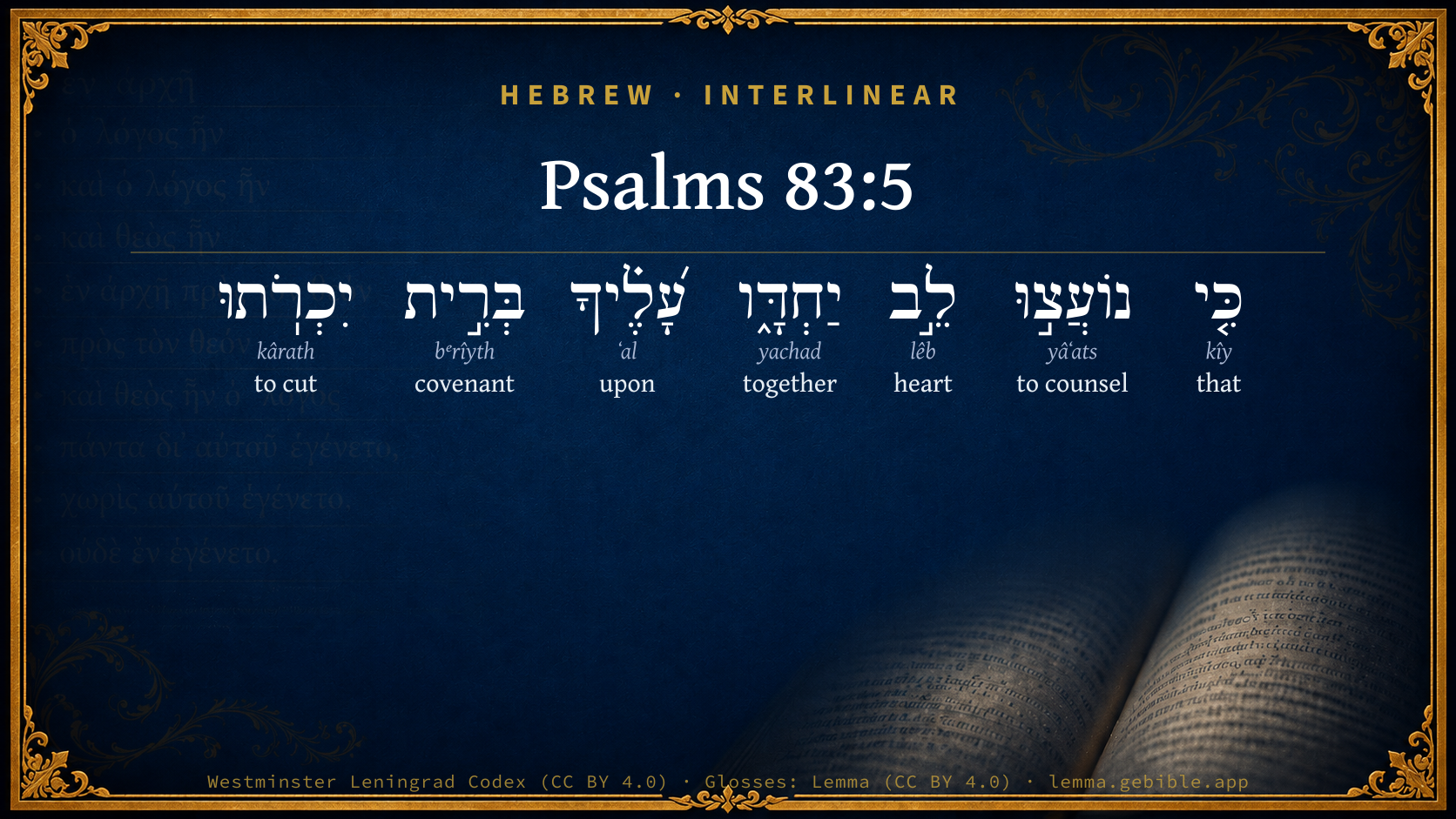
Hebrew (Westminster Leningrad Codex) Psalms 83:5 appears in the Hebrew Old Testament. The text above is from the Westminster Leningrad Codex. Each word links to its Strong’s number, a concise gloss, and parsing drawn from the Open Scriptures Hebrew Bible morphology. Click any word for its full Brown-Driver-Briggs (BDB) entry.
Download image
Cite this verse

Psalms 83:5 (World English Bible). Public Domain. Lemma interlinear Bible study tool, https://lemma.gebible.app/v/psalms/83/5.

Show BibTeX & RIS
BibTeX
RIS
English Translation
For they have conspired together with one mind. They form an alliance against you.
World English Bible · Public Domain
Download a study sheet

One document with this verse’s original text, its word-by-word gloss line, the meaning frame, cross-references with their text, attributed commentary, and full source and license credits — printable, and it pastes into notes with its structure intact.

This verse Autodidact and up

Study sheet (.html) Plain text (.txt)

A passage Seminary Student

Up to 50 verses in one chapter. A passage sheet keeps up to 6 commentary sources and 12 cross-references per verse, in the order this page ranks them, and says so on the sheet whenever that leaves anything out. Ask for a single verse and you get the Autodidact verse sheet above.

Everything on this page stays free to read, with no account — the sheet is a download of what is already on screen, not access to it.

Want to remove ads? Support Godless Engineer
Compare translations 3

The same verse in 3 English versions, stacked beneath the original-language interlinear above. Click any original word for its lexicon entry.

Each is an independent rendering of the whole verse — the interlinear is not word-aligned to these translations.

Highlighted words mark where these versions differ — a whole-verse word diff, not a word-by-word alignment.

  • World English Bible Public Domain
    For they have conspired together with one mind. They form an alliance against you.
  • King James Version Public Domain
    For they have consulted together with one consent: they are confederate against thee:
  • unfoldingWord Literal Text CC BY-SA 4.0
    For they have conspired against you, heart together; they have cut a covenant:

unfoldingWord Literal Text — © unfoldingWord, licensed CC BY-SA 4.0. Word-aligned USFM3 via Door43 (git.door43.org/unfoldingWord/en_ult).

Versions to compare (up to 4)

3 of 4 selected

Show all 18 translations

Every available English version of this verse, each an independent rendering of the whole verse.

  • World English Bible Public Domain
    For they have conspired together with one mind. They form an alliance against you.
  • Berean Standard Bible Public Domain
    For with one mind they plot together, they form an alliance against You—
  • Majority Standard Bible Public Domain
    For with one mind they plot together; they form an alliance against You—
  • King James Version Public Domain
    For they have consulted together with one consent: they are confederate against thee:
  • American Standard Version (1901) Public Domain
    For they have consulted together with one consent; Against thee do they make a covenant:
  • Revised Version (1885) Public Domain
    For they have consulted together with one consent; against thee do they make a covenant:
  • Geneva Bible (1599) Public Domain
    For they haue consulted together in heart, and haue made a league against thee:
  • Douay-Rheims (1899) Public Domain
    They have said: Come and let us destroy them, so that they be not a nation: and let the name of Israel be remembered no more.
  • Young's Literal Translation Public Domain
    For they consulted in heart together, Against Thee a covenant they make,
  • Literal Standard Version CC BY-SA 4.0
    For they consulted in heart together, || They make a covenant against You,
  • Unlocked Literal Bible CC BY-SA 4.0
    They have schemed together with one strategy; against you they have made an alliance.
  • unfoldingWord Literal Text CC BY-SA 4.0
    For they have conspired against you, heart together; they have cut a covenant:
  • Darby Bible Public Domain
    For they have consulted together with one heart: they have made an alliance together against thee.
  • World Messianic Bible Public Domain
    For they have conspired together with one mind. They form an alliance against you.
  • Webster's Bible Public Domain
    \\83:4\\They have said, Come, and let us cut them off from being a nation; that the name of Israel may be no more in remembrance.
  • Free Bible Version CC BY-SA 4.0
    They all agree in their conspiracy; they've made a treaty together to attack you—
  • Bible in Basic English Public Domain
    For they have all come to an agreement; they are all joined together against you:
  • JPS Tanakh (1917) Public Domain
    (83-6) For they have consulted together with one consent; against Thee do they make a covenant;

Literal Standard Version (2020), Covenant Press — licensed CC BY-SA 4.0. Text via the HelloAO Bible API (eBible.org). Unlocked Literal Bible (unfoldingWord) — licensed CC BY-SA 4.0. Text via the HelloAO Bible API (eBible.org). unfoldingWord Literal Text — © unfoldingWord, licensed CC BY-SA 4.0. Word-aligned USFM3 via Door43 (git.door43.org/unfoldingWord/en_ult). Free Bible Version, Dr. Jonathan Gallagher — licensed CC BY-SA 4.0. Text via the HelloAO Bible API (eBible.org).

Word by word

More ways to search: Search by grammar → Find every occurrence → Compare this word →

Practice this passage: Drill this verse → Learn its vocabulary →

About this verse

These counts appear in no published source. They are computed here, from the morphology-tagged text and Lemma’s own curated glosses. What Lemma adds →

7
words
7
distinct lemmas
Wisdom
section

Grammatical profile

  • 2 verbs
  • 2 nouns
  • 1 preposition
  • 1 conjunction
  • 1 adverb

Verb forms

  • נוֹעֲצ֣וּ Niphal · Perfect
  • יִכְרֹֽתוּ Qal · Imperfect

Hebrew & Septuagint length

In English translation the verse runs 14 words from the Hebrew and 16 from the Septuagint (LXX English) — closely comparable.

A rough comparison of the two English renderings, which tokenize alike — not a word-level alignment.

Word counts can differ between the Hebrew and the Greek without any difference in meaning — e.g. the Hebrew direct-object marker אֵת has no separate Greek word, and Greek often adds the article ὁ.

Cross-references

11

Topical passages linked to Psalms 83:5 in the Treasury of Scripture Knowledge — connected by theme and wording, ordered by reader-vote popularity; previews shown in the World English Bible.

  • Psalms 2:2 The kings of the earth take a stand, And the rulers take counsel together, Against Yahweh, and against his anointed, saying,
  • Revelation 17:13 These have one mind, and they give their power and authority to the beast.
  • Isaiah 8:9–10 Make an uproar, O you peoples, and be broken in pieces! And give ear, all you of far countries: gird yourselves, and be broken in pieces! Gird yourselves, and be broken in pieces!
  • Revelation 19:19 I saw the beast, and the kings of the earth, and their armies, gathered together to make war against him who sat on the horse, and against his army.
  • Joshua 10:3–5 Therefore Adoni-zedek king of Jerusalem sent to Hoham king of Hebron, and to Piram king of Jarmuth, and to Japhia king of Lachish, and to Debir king of Eglon, saying,
  • 2 Samuel 10:6–8 When the children of Ammon saw that they were become odious to David, the children of Ammon sent and hired the Syrians of Beth Rehob, and the Syrians of Zobah, twenty thousand footmen, and the king of Maacah with one thousand men, and the men of Tob twelve thousand men.
  • Proverbs 21:30 There is no wisdom nor understanding Nor counsel against Yahweh.
  • Isaiah 7:2 It was told the house of David, saying, "Syria is allied with Ephraim." His heart trembled, and the heart of his people, as the trees of the forest tremble with the wind.
  • Isaiah 7:5–7 Because Syria, Ephraim, and the son of Remaliah, have plotted evil against you, saying,
  • John 11:47–53 The chief priests therefore and the Pharisees gathered a council, and said, "What are we doing? For this man does many signs.
  • Acts 23:12–13 When it was day, some of the Jews banded together, and bound themselves under a curse, saying that they would neither eat nor drink until they had killed Paul.

Cross-references courtesy of OpenBible.info (CC BY 4.0).

Hebrew and Greek witnesses Masoretic Hebrew ↔ Greek Septuagint

The same verse in the two great witnesses to the Old Testament, shown verse-for-verse.

You’re reading Greek Psalm 82 (Hebrew Psalm 83). The Septuagint counts the superscription, so verse numbers can differ from the Hebrew — chapter-level alignment, not verse-by-verse. Numbering follows Rahlfs.

These are two independent witnesses, not word-aligned to each other, and the Septuagint is shown in lemma (dictionary) form.

Hebrew Psalms 83:5 Masoretic · Westminster Leningrad Codex

כִּ֤י נוֹעֲצ֣וּ לֵ֣ב יַחְדָּ֑ו עָ֝לֶ֗יךָ בְּרִ֣ית יִכְרֹֽתוּ

For they have conspired together with one mind. They form an alliance against you.

World English Bible · Public Domain

Greek LXX Greek Psalm 82:5 Septuagint · lemma form

εἶπον δεῦτε καί ἐκὀλεθρεύω αὐτός ἐκ ἔθνος καί οὐ μή μιμνήσκω ὁ ὄνομα ἰσραήλ ἔτι

For they have taken counsel together with one consent: they have made a confederacy against you;

LXX2012 (modern English Septuagint) · Public Domain

Hebrew: Westminster Leningrad Codex (CC BY 4.0). Greek: Septuagint (public domain); English from LXX2012 (modern English Septuagint) (Public Domain). How the Septuagint differs from the Hebrew →

Commentary

Notes on Psalms 83:5 from classic Christian and Jewish commentators (each source and its license shown beneath its notes). The classic Christian expositions comment on the surrounding passage and are grouped to its opening verse, so a note may address several verses; the Jewish commentaries on the Tanakh (Rashi and others) are per-verse, so they appear only where the commentator wrote on this verse.

Lemma curates 59 commentaries, every one of them public domain or Creative Commons licensed, each selected and text-cleaned for this edition rather than reprinted as found. About our sources →

Trapp's Complete Commentary

John Trapp

Psa 83:5 For they have consulted together with one consent: they are confederate against thee:

Ver. 5. They have consulted together with one consent] Heb. with one heart, concorditer, as if they had all but one heart. This was not unity, but conspiracy; such as is that of Papists, Rev 17:13-14.

They are confederate against thee] Heb. They have stricken a covenant, viz. with oaths and solemn ceremonies, cutting the sacrifice in twain, and passing between the parts thereof, as Jer 34:18. - caesa iungebant foedera porca (Virg. Æneid. 8).

John Trapp, A Commentary or Exposition upon All the Books of the Old and New Testament (1647–1656) — public domain. Text from a community e-Sword module.

Tyndale Open Study Notes

Tyndale Open Resources

83:5-8 signed a treaty: The allies agreed to fight against God and his people. The nations that are named in the alliance were situated around Israel and Judah.

Tyndale Open Study Notes — © Tyndale Open Resources, licensed CC BY-SA 4.0. Text via the HelloAO Bible API.

Geneva Bible (1599)

Geneva Bible translators

By all secret means.

They thought to have subverted thy counsel wherein the perpetuity of the Church was established.

Geneva Bible (1599) marginal notes — public domain. Text via Bolls.life.

Adam Clarke's Commentary

Verse 5. They have consulted together with one consent] With a united heart, לב יחדו leb yachdav, Their heart and soul are in the work.

They are confederate against thee] "They have made a covenant," ברית יכריתו berith yachrithu, "they have cut the covenant sacrifice." They have slain an animal, divided him in twain, and passed between the pieces of the victim; and have thus bound themselves to accomplish their purpose.

Adam Clarke's Commentary on the Bible (1810–1826) — public domain. Text from a community e-Sword/MySword module.

John Calvin's Commentaries

5 For they have consulted with the heart together. The multiplied hosts which united their powers together to oppose the Church of God and to effect her overthrow, are here enumerated. As so many nations, formed into one powerful confederacy, were bent on the destruction of a kingdom not greatly distinguished by its power, the miraculous aid of God was indispensably necessary for the deliverance of a people who, in such extremity, were altogether unable to defend themselves. In circumstances apparently as hopeless good king Asa gave utterance to that truly magnanimous reflection:

“Lord, it is nothing with thee to help whether with many, or with them that have no power: help us, O Lord our God! for we rest on thee, and in thy name we go against this multitudes” (1 Chronicles 14:11.)

The same Spirit who inspired that pious king with such invincible fortitude dictated this psalm for the benefit of the whole Church, to encourage her with unhesitating confidence to betake herself to God for aid. And in our own day he sets before us these words, in order that no danger or difficulty may prevent us from calling upon God. When the whole world may conspire together against us, we have as it were a wall of brass for the defense of Christ’s kingdom in these words, “Why do the heathen rage?” etc., (Psalm 2:1.)

It will be in no small degree profitable to us to contemplate this as an example in which we have represented to us, as in a mirror what has been the lot of the Church of God from the beginning. This, if rightly reflected upon, will keep us at the present day from being unduly dejected when we witness the whole world in array against us. We see how the Pope has inflamed the whole world against us with diabolical rage. Hence it is, that in whatever direction we turn our eyes, we meet with just so many hostile armies to destroy us. But when we have once arrived at a settled persuasion that no strange thing happens to us, the contemplation of the condition of the Church in old time will strengthen us for continuing in the exercise of patience until God suddenly display his power, which is perfectly able, without any created aid, to frustrate all the attempts of the world.

To remove from the minds of the godly all misgivings as to whether help is ready to be imparted to them from heaven, the prophet distinctly affirms that those who molest the Church are chargeable with making war against God, who has taken her under his protection. The principle upon which God declares that he will be our helper is contained in these words,

“He that toucheth you, toucheth the apple of mine eye,” (Zechariah 2:8.)

And what is said in another psalm concerning the patriarchs, is equally applicable to all true believers,

“Touch not mine anointed, and do my prophets no harm,” (Psalm 105:15.)

He will have the anointing with which he has anointed us to be, as it were, a buckler to keep us in perfect safety. The nations here enumerated did not avowedly make war against him; but as, when he sees his servants unrighteously assaulted, he interposes himself between them and their enemies to bear the blows aimed at them, they are here justly represented as having entered into a league against God The case is analogous to that of the Papists in the present day. If any were to ask them, when they hold consultations for the express purpose of accomplishing our destruction, Whether they were stronger than God? they would immediately reply, That they had no intention whatever of assaulting heaven in imitation of the giants of old. But God having declared that every injury which is done to us is an assault upon him, we may, as from a watch-tower, behold in the distance by the eye of faith the approach of that destruction of which the votaries of Antichrist shall have at length the sad and melancholy experience.

The expression, to consult with the heart, is by some explained, to deliberate with the greatest exertion and earnestness of mind. Thus it is quite common for us to say, that a thing is done with the heart which is done with earnestness and ardor of mind. But this expression is rather intended to denote the hidden crafty devices complained of a little before.

Some interpreters refer the tents of Edom to warlike furniture, and understand the words as meaning, that these enemies came well equipped and provided with tents for prolonging the war; but the allusion seems rather to be to the custom which prevailed among those nations of dwelling in tents. It is, however, a hyperbolical form of expression; as if it had been said, So great was their eagerness to engage in this war, that they might be said even to pluck their tents from the places where they were pitched.

I do not intend to enter curiously into a discussion concerning the respective nations here named, the greater part of them being familiarly known from the frequency with which they are spoken of in the sacred Scriptures. When it is said that Assur and the rest were an arm to the sons of Lot, this is evidently an additional aggravation of the wickedness of the sons of Lot. It would have been an act of unnatural cruelty for them to have aided foreign nations against their own kindred. But when they themselves are the first to sound the trumpet, and when of their own suggestion they invite the aid of the Assyrians and other nations to destroy their own brethren, ought not such barbarous inhumanity to call forth the deepest detestation? Josephus himself records, that the Israelites had passed through their borders without doing them any harm, sparing their own blood according to the express command of God. When the Moabites and Ammonites then knew that their brethren the Jews spared them, remembering that they were of the same blood, and sprung from one common parentage, ought they not also to have reciprocated so much kindness on their part as not to have embarked in any hostile enterprise against them? But it is, as it were, the destiny of the Church, not only to be assailed by external enemies, but to suffer far greater trouble at the hands of false brethren. At the present day, none are more furiously mad against us than counterfeit Christians.

John Calvin's Commentaries (1540-1563) — public domain. Text from the Calvin Translation Society English edition (1840s-50s) via the Christian Classics Ethereal Library (ccel.org). Calvin's coverage is partial (roughly two-thirds of the Bible); uncommented books and verses are honest gaps, never fabricated. The 19th-century editor's footnotes and remarks are omitted so the notes are faithfully Calvin's own voice.

Ellicott's Commentary for English Readers

(5) They are confederate.—Literally, they have cut a covenant, from the custom described in Gen_15:17. (Comp. the Greek δρκια τέμνειν.)

Against thee.—God and “His hidden ones” are one, a truth preparing the way for that grander truth of the identification of the Son of man with all needing help or pity in Matthew 25

A Bible Commentary for English Readers, edited by Charles John Ellicott (1878–1897) — public domain. Text from a community e-Sword module.

The Cambridge Bible for Schools and Colleges

gen. ed. J. J. S. Perowne

5. they are confederate against thee] Lit., against thee do they make a covenant. Cp. Psa_83:2.

5–8. An enumeration of the confederate peoples. From the southeast come the Edomites, who inhabited the mountainous region between the Dead Sea and the Gulf of Akaba, and the Ishmaelites, who roamed over the deserts from the borders of Egypt to the north-west shore of the Persian Gulf (Gen_25:18): from the east of the Dead Sea come the Moabites, and from the north-east the Hagarenes or Hagrites who lived in the neighbourhood of the Hauran, east of Gilead (1Ch_5:10; 1Ch_5:19-20);—they are mentioned in the inscriptions of Sennacherib along with the Nabatheans. Gebal is not the Gebal of Eze_27:9 to the north of Tyre (Byblus), but the northern part of the mountains of Edom, southward of the Dead Sea, a district known to Pliny as Gebalene. The Ammonites, ancient and bitter foes of Israel, come from their home beyond the Jordan, the Amalekites from the southern deserts between the Arabah and the Mediterranean. The maritime states of the Philistines on the west and Tyre on the north have joined them, and even the remote Assyria sends a contingent to support the confederacy.

The Cambridge Bible for Schools and Colleges (gen. ed. J. J. S. Perowne; Cambridge University Press, 1878–1918) — public domain. Text from a community e-Sword module.

John Gill's Exposition

For they have consulted together with one consent,.... Or "heart" (e); wicked men are cordial to one another, and united in their counsels against the people of God, and his interest: whatever things they may disagree in, they agree in this, to oppose the cause and interest of true religion, or to persecute the church and people of God: Herod and Pontius Pilate are instances of this:

they are confederate against thee; or have made a covenant against thee (f); the covenant they had entered into among themselves, being against the Lord's people, was against him; and such a covenant and agreement can never stand; for there is no wisdom, nor understanding, nor counsel against the Lord, Pro 21:30. This the psalmist mentions to engage the Lord in the quarrel of his people, and not be still, and act a neutral part; since those were his enemies, and confederates against him, and they are next particularly named.

(e) "corde", Pagninus, Montanus; "ex corde", Tigurine version, Musculus, Gejerus; "cordicitus", Cocceius. (f) "foedus adversus te icerunt", Tigurine version; "contra te foedus pepigerunt", Junius & Tremellius, Piscator, Gejerus; so Musculus, Cocceius, Michaelis.

John Gill's Exposition of the Whole Bible (1746–1763) — public domain (CC PDM 1.0). Text via the HelloAO Bible API.

Albert Barnes' Notes on the Bible

For they have consulted together with one consent - Margin, as in Hebrew, heart. There is no division in their counsels on this subject. They have one desire - one purpose - in regard to the matter. Pilate and Herod were made friends together against Christ Luk 23:12; and the world, divided and hostile on other matters, has been habitually united in its opposition to Christ and to a pure and spiritual religion.

They are confederate against thee - literally, “They cut a covenant against thee;” that is, they ratify such a covenant, compact, league - referring to the manner in which bargains and agreements were ratified by cutting in pieces a victim sacrificed on such occasions; that is, by giving to such a transaction the solemnity of a religious sanction. Gen 15:10; Jer 34:18-19. See Bochart, Hieroz. i. 35. The meaning here is, that they had entered into this agreement in the most solemn manner, under the sanctions of religion.

Albert Barnes' Notes on the Bible (1834–1885) — public domain. Text from a community e-Sword/MySword module.

Matthew Poole's English Annotations

They have laid aside all their private quarrels and animosities, and agreed together against thee.

Matthew Poole's English Annotations on the Holy Bible (1683–1685) — public domain. Text from a community e-Sword/MySword module.

The Treasury of David

Charles H. Spurgeon

Ver. 5. For they have consulted together with one consent. They are hearty and unanimous in their designs. They seem to have but one heart, and that a fierce one, against the chosen people and their God.

They are confederate against thee. At the Lord himself they aim through the sides of his saints. They make a covenant, and ratify it with blood, resolutely banding themselves together to war with the Mighty God.

Ver. 5. For they have consulted together with one consent. Margin, as in Hebrew, heart. There is no division in their counsels on this subject. They have one desire one purpose in regard to the matter. Pilate and Herod were made friends together against Christ (Lu 23:12); and the world divided and hostile in other matters, has been habitually united in its opposition to Christ and to a pure and spiritual religion. Albert Barnes.

Ver. 5. They have consulted together with one consent, etc. To push on this unholy war, they lay their heads together, and their horns, and their hearts too. Fas est et ab hoste doceri. Do the enemies of the church act with one consent to destroy it? Are the kings of the earth of one mind to give their power and honour to the beast? And shall not the church's friends be unanimous in serving her interests? If Herod and Pilate are made friends that they may join in crucifying Christ, sure Paul and Barnabas, Paul and Peter, will soon be made friends, that they may join in preaching Christ. Matthew Henry.

Ver. 5. They have consulted together, etc. Though there may fall out a private grudge betwixt such as are wicked, yet they will all agree and unite against the saints: if two greyhounds are snarling at a bone, yet put up a hare between them, and they will leave the bone, and follow after the hare; so, if wicked men have private differences amongst themselves, yet if the godly be near them, they will leave snarling at one another, and will pursue after the godly. Thomas Watson.

Ver. 5. They are confederate against thee. "They have made a covenant, "vtyrkytyrk berith yachriths, "they have cut the covenant sacrifice." They have slain an animal, divided him in twain, and passed between the pieces of the victim; and have thus bound themselves to accomplish their purpose. Adam Clarke.

Ver. 5. The confederacies of evils against the saints.

Psalms 83:6*

Charles H. Spurgeon's The Treasury of David (1869–1885) — public domain. Psalms only. Text from a community e-Sword/MySword module.

Whedon's Commentary on the Bible

Daniel D. Whedon

5. Consulted together with one consent—Hebrew, Consulted with the heart, showing their earnestness and unanimity. The enemies of the Church are well agreed on the one point—enmity to God.

Against thee—It is God’s cause; the enemies of the Church are his enemies.

Daniel D. Whedon (gen. ed.), Commentary on the Old and New Testaments (1874–1909) — public domain. Text from a community e-Sword module.

The Pulpit Commentary

For they have consulted together with one consent (comp. ver. 3). They are confederate against thee; literally, have entered into a covenant against thee. A formal treaty seems to be intended.

The tabernacles of Edom. Edom was always among the bitterest of Israel"s enemies, and naturally took a part in almost every combination that was made against them. Though sometimes subjugated, (2Sa_8:14 1Ki_11:15, 1Ki_11:16) it continued hostile during the whole period of Israelite and Jewish history. Hence the constant denunciations of the prophets. (Isa_11:14 Jer_27:3 Jer_49:7-22 Eze_25:12-14 Joe_3:19 Amo_9:12 Oba_1:6-18 Mal_1:4) And the Ishmaelites. The Ishmaelites were the chief inhabitants of Northern Arabia. (Gen_25:13-18) They do not often appear among Israel"s enemies. Of Moab. Moab, on the contrary, is a persistent adversary. (see Num_22:6 Jud 3:12-30 1Sa_14:47 2Sa_8:2 2Ki_1:1 2Ki_3:4-27 2Ch_20:1-10) And the Hagarenes. The "Hagarenes," or "Hagarites," are only mentioned here and in 1Ch_5:10, 1Ch_5:19-22. They were probably a branch of the Ishmaelites, named after Hagar, Ishmael"s mother. (Gen_25:12) Their name occurs among those of Aramman tribes in the Assyrian inscriptions.

The Pulpit Commentary (1880–1919), ed. H.D.M. Spence-Jones & Joseph S. Exell — public domain. Text from a community e-Sword module.

Keil & Delitzsch

C. F. Keil & F. Delitzsch

Instead of לב אחד, Ch1 12:38, it is deliberant corde unâ, inasmuch as יחדּו on the one hand gives intensity to the reciprocal signification of the verb, and on the other lends the adjectival notion to לב. Of the confederate peoples the chronicler (2 Chr. 20) mentions the Moabites, the Ammonites, the inhabitants of Mount Ser, and the Me(unim, instead of which Josephus, Antiq. ix. 1. 2, says: a great body of Arabians. This crowd of peoples comes from the other side of the Dead Sea, מאדם (as it is to be read in Psa 83:2 in the chronicler instead of מארם, cf. on Psa 60:2); the territory of Edom, which is mentioned first by the poet, was therefore the rendezvous. The tents of Edom and of the Ishmaelites are (cf. Arab. ahl, people) the people themselves who live in tents. Moreover, too, the poet ranges the hostile nations according to their geographical position. The seven first named from Edom to Amalek, which still existed at the time of the psalmist (for the final destruction of the Amalekites by the Simeonites, Ch1 4:42., falls at an indeterminate period prior to the Exile), are those out of the regions east and south-east of the Dead Sea. According to Gen 25:18, the Ishmaelites had spread from Higz through the peninsula of Sinai beyond the eastern and southern deserts as far up as the countries under the dominion of Assyria. The Hagarenes dwelt in tents from the Persian Gulf as far as the east of Gilead (Ch1 5:10) towards the Euphrates. גּבל, Arab. jbâl, is the name of the people inhabiting the mountains situated in the south of the Dead Sea, that is to say, the northern Seritish mountains. Both Gebl and also, as it appears, the Amalek intended here according to Gen 36:12 (cf. Josephus, Antiq. ii. 1. 2: Ἀμαληκῖτις, a part of Idumaea), belong to the wide circuit of Edom. Then follow the Philistines and Phoenicians, the two nations of the coast of the Mediterranean, which also appear in Amo 1:1-15 (cf. Joel 3) as making common cause with the Edomites against Israel. Finally Asshur, the nation of the distant north-east, here not as yet appearing as a principal power, but strengthening (vid., concerning זרוע, an arm = assistance, succour, Gesenius, Thesaurus, p. 433b) the sons of Lot, i.e., the Moabites and Ammonites, with whom the enterprise started, and forming a powerful reserve for them. The music bursts forth angrily at the close of this enumeration, and imprecations discharge themselves in the following strophe.

Keil & Delitzsch — Biblical Commentary on the Old Testament (1861–1891) — public domain (CC PDM 1.0). Text via the HelloAO Bible API. (Old Testament only.)

Lesson kit

Teaching starters — assembled from the data on this page, not authored interpretation. Every prompt links to the verse data it draws on. Edit before teaching.

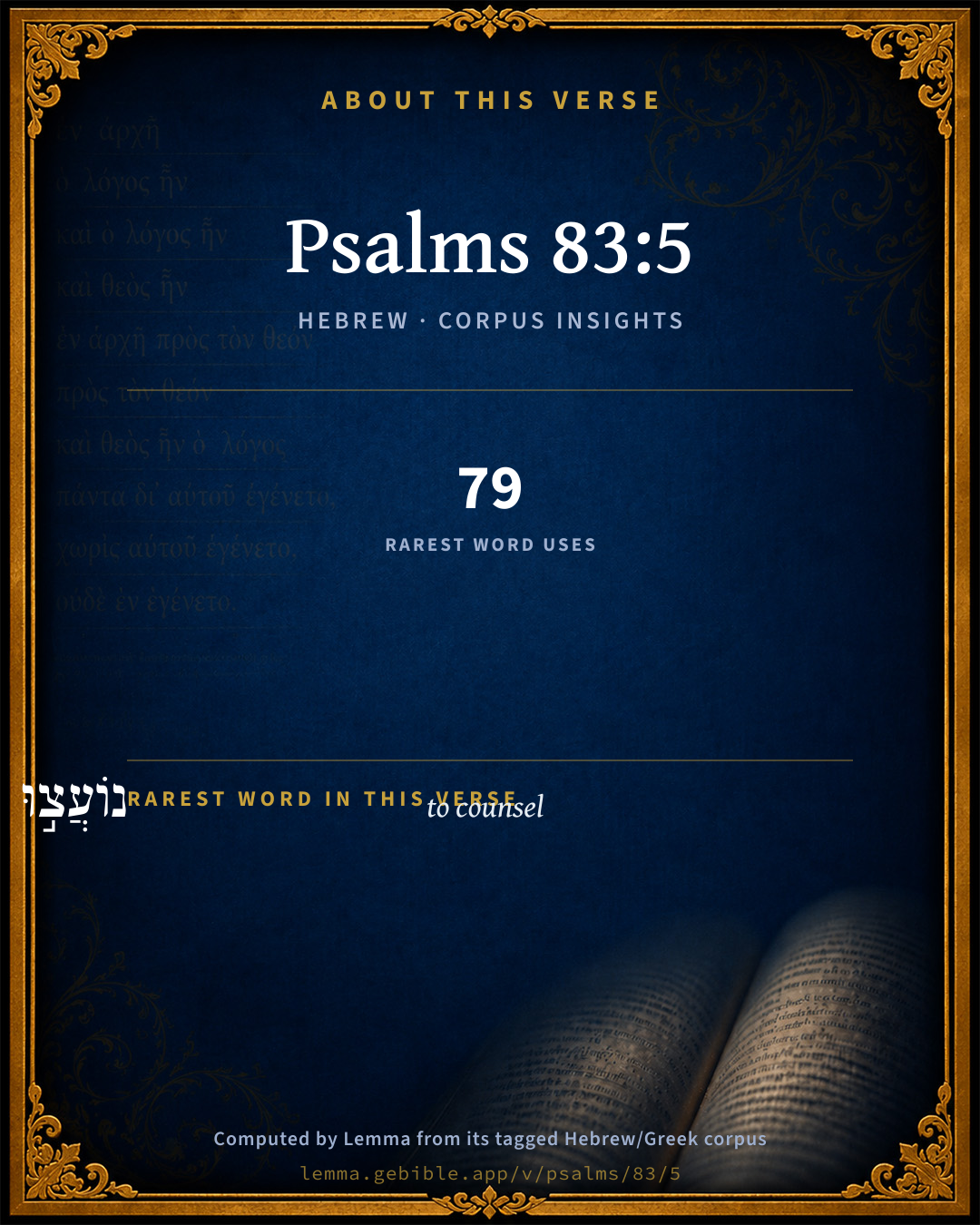
Psalms, in the Wisdom, opens this verse with 7 words (7 distinct Hebrew lemmas). Its most distinctive word is yâʻats (“to counsel”). A historical commentator’s framing appears above. Read the whole chapter for the surrounding context.

Discussion questions

  1. What does “to counsel” (yâʻats) contribute to the verse as a whole?
  2. Psalms 2:2 shares this passage’s theme. How do the two illuminate each other?
  3. The translations on this page render this verse differently — a whole-verse word diff, not a word-by-word alignment. What might account for the different wordings?
  4. The verb «נוֹעֲצ֣וּ» is Niphal Perfect. How does its form color the action?
  5. Reading how Trapp's Complete Commentary and Tyndale Open Study Notes read this verse, where do the two commentators agree and where do they part?

Things to notice

Reading settings

Reading text

Shown beneath each verse's original-language words.

Old Testament
Old Testament edition

Read the OT as the Masoretic Hebrew (MT) or the Greek Septuagint (LXX).

English shown for the Greek Septuagint (in the Hebrew ↔ Greek comparison).

Comparing translations? Open the Compare panel on any verse page to stack up to four side by side.