
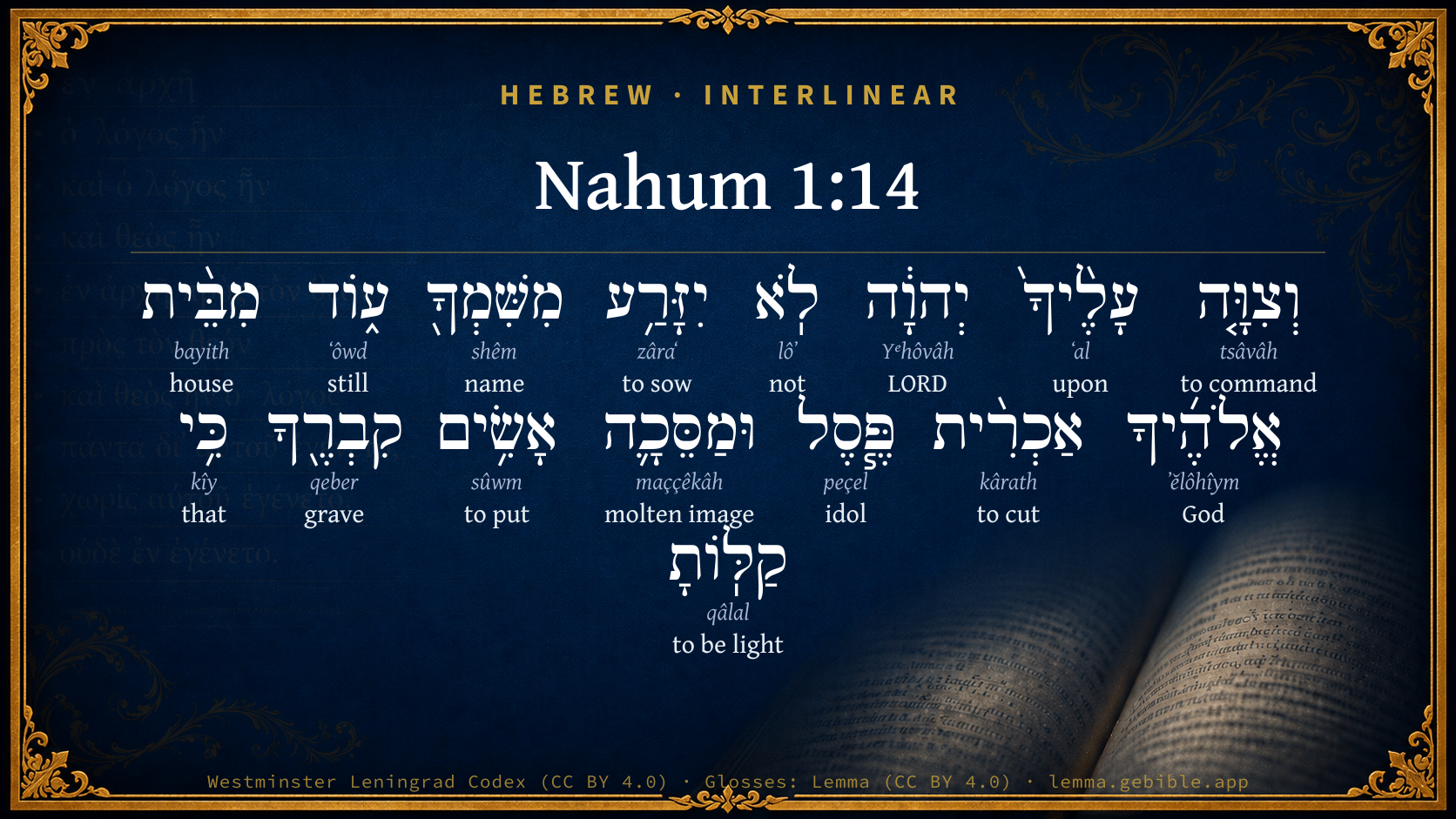
Nahum 1:14

Hebrew (Westminster Leningrad Codex) Nahum 1:14 appears in the Hebrew Old Testament. The text above is from the Westminster Leningrad Codex. Each word links to its Strong’s number, a concise gloss, and parsing drawn from the Open Scriptures Hebrew Bible morphology. Click any word for its full Brown-Driver-Briggs (BDB) entry.
Download image
Cite this verse

Nahum 1:14 (World English Bible). Public Domain. Lemma interlinear Bible study tool, https://lemma.gebible.app/v/nahum/1/14.

Show BibTeX & RIS
BibTeX
RIS
English Translation
Yahweh has commanded concerning you: "No more descendants will bear your name. Out of the house of your gods, will I cut off the engraved image and the molten image. I will make your grave, for you are vile."
World English Bible · Public Domain
Download a study sheet

One document with this verse’s original text, its word-by-word gloss line, the meaning frame, cross-references with their text, attributed commentary, and full source and license credits — printable, and it pastes into notes with its structure intact.

This verse Autodidact and up

Study sheet (.html) Plain text (.txt)

A passage Seminary Student

Up to 50 verses in one chapter. A passage sheet keeps up to 6 commentary sources and 12 cross-references per verse, in the order this page ranks them, and says so on the sheet whenever that leaves anything out. Ask for a single verse and you get the Autodidact verse sheet above.

Everything on this page stays free to read, with no account — the sheet is a download of what is already on screen, not access to it.

Want to remove ads? Support Godless Engineer
Compare translations 3

The same verse in 3 English versions, stacked beneath the original-language interlinear above. Click any original word for its lexicon entry.

Each is an independent rendering of the whole verse — the interlinear is not word-aligned to these translations.

Highlighted words mark where these versions differ — a whole-verse word diff, not a word-by-word alignment.

  • World English Bible Public Domain
    Yahweh has commanded concerning you: "No more descendants will bear your name. Out of the house of your gods, will I cut off the engraved image and the molten image. I will make your grave, for you are vile."
  • King James Version Public Domain
    And the LORD hath given a commandment concerning thee, that no more of thy name be sown: out of the house of thy gods will I cut off the graven image and the molten image: I will make thy grave; for thou art vile.
  • unfoldingWord Literal Text CC BY-SA 4.0
    And Yahweh has commanded concerning you: “One will not be sown from your name any more. I will cut off the carved figures and the cast metal figures from the house of your gods. I will prepare your graves, for you are worthless.”

unfoldingWord Literal Text — © unfoldingWord, licensed CC BY-SA 4.0. Word-aligned USFM3 via Door43 (git.door43.org/unfoldingWord/en_ult).

Versions to compare (up to 4)

3 of 4 selected

Show all 18 translations

Every available English version of this verse, each an independent rendering of the whole verse.

  • World English Bible Public Domain
    Yahweh has commanded concerning you: "No more descendants will bear your name. Out of the house of your gods, will I cut off the engraved image and the molten image. I will make your grave, for you are vile."
  • Berean Standard Bible Public Domain
    The LORD has issued a command concerning you, O Nineveh: “There will be no descendants to carry on your name. I will cut off the carved image and cast idol from the house of your gods; I will prepare your grave, for you are contemptible.”
  • Majority Standard Bible Public Domain
    The LORD has issued a command concerning you, O Nineveh: “There will be no descendants to carry on your name. I will cut off the carved image and cast idol from the house of your gods; I will prepare your grave, for you are contemptible.”
  • King James Version Public Domain
    And the LORD hath given a commandment concerning thee, that no more of thy name be sown: out of the house of thy gods will I cut off the graven image and the molten image: I will make thy grave; for thou art vile.
  • American Standard Version (1901) Public Domain
    And Jehovah hath given commandment concerning thee, that no more of thy name be sown: out of the house of thy gods will I cut off the graven image and the molten image; I will make thy grave; for thou art vile.
  • Revised Version (1885) Public Domain
    And the LORD hath given commandment concerning thee, that no more of thy name be sown: out of the house of thy gods will I cut off the graven image and the molten image; I will make thy grave; for thou art vile.
  • Geneva Bible (1599) Public Domain
    And the Lord hath giuen a commandement concerning thee, that no more of thy name be sowen: out of the house of thy gods will I cut off the grauen, and the molten image: I will make it thy graue for thee, for thou art vile.
  • Douay-Rheims (1899) Public Domain
    And the Lord will give a commandment concerning thee, that no more of thy name shall be sown: I will destroy the graven and molten thing out of the house of thy God, I will make it thy grave, for thou art disgraced.
  • Young's Literal Translation Public Domain
    And commanded concerning thee hath Jehovah, `No more of thy name doth spread abroad, From the house of thy gods I cut off graven and molten image, I appoint thy grave, for thou hast been vile.
  • Literal Standard Version CC BY-SA 4.0
    And YHWH has commanded concerning you, || “No more of your name spreads abroad, || I cut off carved and molten image from the house of your gods, || I appoint your grave, for you have been vile.”
  • Unlocked Literal Bible CC BY-SA 4.0
    Yahweh has given a command about you, Nineveh: “There will be no more descendants bearing your name. I will cut off the carved figures and the cast metal figures from the houses of your gods. I will dig your graves, for you are contemptible.”
  • unfoldingWord Literal Text CC BY-SA 4.0
    And Yahweh has commanded concerning you: “One will not be sown from your name any more. I will cut off the carved figures and the cast metal figures from the house of your gods. I will prepare your graves, for you are worthless.”
  • Darby Bible Public Domain
    And Jehovah hath given commandment concerning thee, that no more of thy name be sown: out of the house of thy god will I cut off the graven image, and the molten image: I will prepare thy grave; for thou art vile.
  • World Messianic Bible Public Domain
    The LORD has commanded concerning you: “No more descendants will bear your name. Out of the house of your gods, I will cut off the engraved image and the molten image. I will make your grave, for you are vile.”
  • Webster's Bible Public Domain
    And the LORD hath given a commandment concerning thee, that no more of thy name be sown: out of the house of thy gods will I cut off the graven image and the molten image: I will make thy grave; for thou art vile.
  • Free Bible Version CC BY-SA 4.0
    This is what the Lord has ordered concerning you. You will have no descendants to carry on your name. I will destroy the gods in your temples, all the wooden and metal idols. I am digging your grave, for you are depraved.
  • Bible in Basic English Public Domain
    The Lord has given an order about you, that no more of your name are to be planted: from the house of your gods I will have the pictured and metal images cut off; I will make your last resting-place a place of shame; for you are completely evil.
  • JPS Tanakh (1917) Public Domain
    And the LORD hath given commandment concerning thee, that no more of thy name be sown; out of the house of thy god will I cut off the graven image and the molten image; I will make thy grave; for thou art become worthless.

Literal Standard Version (2020), Covenant Press — licensed CC BY-SA 4.0. Text via the HelloAO Bible API (eBible.org). Unlocked Literal Bible (unfoldingWord) — licensed CC BY-SA 4.0. Text via the HelloAO Bible API (eBible.org). unfoldingWord Literal Text — © unfoldingWord, licensed CC BY-SA 4.0. Word-aligned USFM3 via Door43 (git.door43.org/unfoldingWord/en_ult). Free Bible Version, Dr. Jonathan Gallagher — licensed CC BY-SA 4.0. Text via the HelloAO Bible API (eBible.org).

Word by word

More ways to search: Search by grammar → Find every occurrence → Compare this word →

Practice this passage: Drill this verse → Learn its vocabulary →

וּמַסֵּכָ֛ה
maççêkâh
H4541
“and · molten image”
Conjunction + Noun, Common, Feminine, Singular, Absolute
Part of Speech
Conjunction + Noun
Type
Common
Gender
Feminine
Number
Singular
State
Absolute
Full BDB Definition

Origin: from H5258

TWOT: 1375c , 1376a

a pouring, libation, molten metal, cast image, drink offering - libation (with covenant sacrifice) - molten metal, molten image, molten gods - web, covering, veil, woven stuff
  1. וְצִוָּ֤ה tsâvâh H6680 “and · to command” Conjunction + Verb, Piel, Perfect, 3rd Person, Masculine, Singular
  2. עָלֶ֨יךָ֙ ʻal H5921 “upon · you” Preposition + Suffix, Personal, 2nd Person, Masculine, Singular
  3. יְהוָ֔ה Yᵉhôvâh H3068 “LORD” Noun, Proper
  4. לֹֽא lôʼ H3808 “not” Particle, Negative
  5. יִזָּרַ֥ע zâraʻ H2232 “to sow” Verb, Niphal, Imperfect, 3rd Person, Masculine, Singular
  6. מִשִּׁמְךָ֖ shêm H8034 “from · name · your” Preposition + Noun, Common, Masculine, Singular, Construct + Suffix, Personal, 2nd Person, Masculine, Singular
  7. ע֑וֹד ʻôwd H5750 “still” Adverb
  8. מִבֵּ֨ית bayith H1004 “from · house of” Preposition + Noun, Common, Masculine, Singular, Construct
  9. אֱלֹהֶ֜יךָ ʼĕlôhîym H430 “God(s) · your” Noun, Common, Masculine, Plural, Construct + Suffix, Personal, 2nd Person, Masculine, Singular
  10. אַכְרִ֨ית kârath H3772 “to cut” Verb, Hiphil, Imperfect, 1st Person, Common, Singular
  11. פֶּ֧סֶל peçel H6459 “idol” Noun, Common, Masculine, Singular, Absolute
  12. אָשִׂ֥ים sûwm H7760 “to put” Verb, Qal, Imperfect, 1st Person, Common, Singular
  13. קִבְרֶ֖ךָ qeber H6913 “grave · your” Noun, Common, Masculine, Singular, Construct + Suffix, Personal, 2nd Person, Masculine, Singular
  14. כִּ֥י kîy H3588 “that” Conjunction
  15. קַלּֽוֹתָ qâlal H7043 “to be light” Verb, Qal, Perfect, 2nd Person, Masculine, Singular

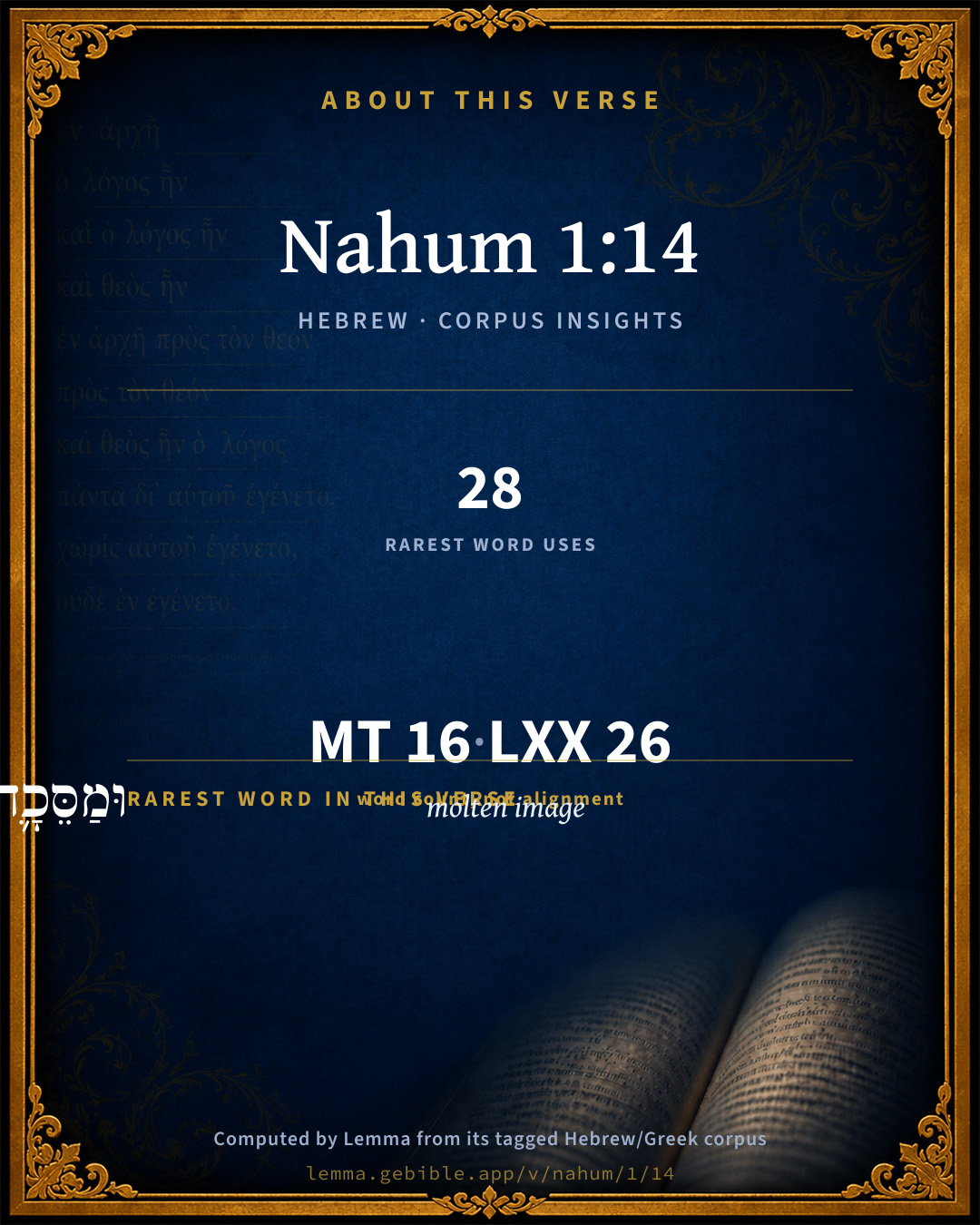
About this verse

These counts appear in no published source. They are computed here, from the morphology-tagged text and Lemma’s own curated glosses. What Lemma adds →

16
words
16
distinct lemmas
Prophets
section

Shared distinctive vocabulary

וּמַסֵּכָ֛ה molten image H4541 occurs in 28 verses of the Hebrew Bible. Also found in:

Grammatical profile

  • 5 verbs
  • 7 nouns
  • 1 preposition
  • 1 conjunction
  • 1 adverb
  • 1 particle

Verb forms

  • וְצִוָּ֤ה Piel · Perfect
  • יִזָּרַ֥ע Niphal · Imperfect
  • אַכְרִ֨ית Hiphil · Imperfect
  • אָשִׂ֥ים Qal · Imperfect
  • קַלּֽוֹתָ Qal · Perfect

Hebrew & Septuagint length

In English translation the verse runs 39 words from the Hebrew and 45 from the Septuagint (LXX English) — closely comparable.

A rough comparison of the two English renderings, which tokenize alike — not a word-level alignment.

Word counts can differ between the Hebrew and the Greek without any difference in meaning — e.g. the Hebrew direct-object marker אֵת has no separate Greek word, and Greek often adds the article ὁ.

In the original languages it is 16 Hebrew tokens and 26 Greek tokens — but the two are counted differently (Hebrew bundles its prefixes and suffixes into one token; the Greek is in lemma form), so that isn’t a like-for-like length.

Cross-references

17

Topical passages linked to Nahum 1:14 in the Treasury of Scripture Knowledge — connected by theme and wording, ordered by reader-vote popularity; previews shown in the World English Bible.

  • Psalms 109:13 Let his posterity be cut off. In the generation following let their name be blotted out.
  • Micah 5:13 I will cut off your engraved images and your pillars out of your midst; And you shall no more worship the work of your hands.
  • Proverbs 10:7 The memory of the righteous is blessed, But the name of the wicked will rot.
  • Isaiah 46:1–2 Bel bows down, Nebo stoops; their idols are on the animals, and on the cattle: the things that you carried about are made a load, a burden to the weary [animal].
  • 2 Kings 19:37 It happened, as he was worshipping in the house of Nisroch his god, that Adrammelech and Sharezer struck him with the sword: and they escaped into the land of Ararat. Esar Haddon his son reigned in his place.
  • Psalms 71:3 Be to me a rock of refuge to which I may always go. Give the command to save me, For you are my rock and my fortress.
  • Ezekiel 32:22–23 Asshur is there and all her company; her graves are round about her; all of them slain, fallen by the sword;
  • Exodus 12:12 For I will go through the land of Egypt in that night, and will strike all the firstborn in the land of Egypt, both man and animal. Against all the gods of Egypt I will execute judgments: I am Yahweh.
  • Leviticus 26:30 I will destroy your high places, and cut down your incense altars, and cast your dead bodies upon the bodies of your idols; and my soul will abhor you.
  • 1 Samuel 3:13 For I have told him that I will judge his house forever, for the iniquity which he knew, because his sons did bring a curse on themselves, and he didn't restrain them.
  • 2 Chronicles 32:21 Yahweh sent an angel, who cut off all the mighty men of valor, and the leaders and captains, in the camp of the king of Assyria. So he returned with shame of face to his own land. When he was come into the house of his god, those who came forth from his own bowels killed him there with the sword.
  • Isaiah 14:20–22 You shall not be joined with them in burial, because you have destroyed your land, you have killed your people; the seed of evil-doers shall not be named forever.
  • Isaiah 19:1 The burden of Egypt. Behold, Yahweh rides on a swift cloud, and comes to Egypt: and the idols of Egypt shall tremble at his presence; and the heart of Egypt shall melt in the midst of it.
  • Isaiah 33:13 Hear, you who are far off, what I have done; and, you who are near, acknowledge my might.
  • Jeremiah 50:2 Declare you among the nations and publish, and set up a standard; publish, and don't conceal: say, Babylon is taken, Bel is disappointed, Merodach is dismayed; her images are disappointed, her idols are dismayed.
  • Daniel 11:21 In his place shall stand up a contemptible person, to whom they had not given the honor of the kingdom: but he shall come in time of security, and shall obtain the kingdom by flatteries.
  • Nahum 3:4–6 because of the multitude of the prostitution of the alluring prostitute, the mistress of witchcraft, who sells nations through her prostitution, and families through her witchcraft.

Cross-references courtesy of OpenBible.info (CC BY 4.0).

Hebrew and Greek witnesses Masoretic Hebrew ↔ Greek Septuagint

The same verse in the two great witnesses to the Old Testament, shown verse-for-verse.

These are two independent witnesses, not word-aligned to each other, and the Septuagint is shown in lemma (dictionary) form.

Hebrew Nahum 1:14 Masoretic · Westminster Leningrad Codex

וְצִוָּ֤ה עָלֶ֨יךָ֙ יְהוָ֔ה לֹֽא יִזָּרַ֥ע מִשִּׁמְךָ֖ ע֑וֹד מִבֵּ֨ית אֱלֹהֶ֜יךָ אַכְרִ֨ית פֶּ֧סֶל וּמַסֵּכָ֛ה אָשִׂ֥ים קִבְרֶ֖ךָ כִּ֥י קַלּֽוֹתָ

Yahweh has commanded concerning you: "No more descendants will bear your name. Out of the house of your gods, will I cut off the engraved image and the molten image. I will make your grave, for you are vile."

World English Bible · Public Domain

Greek LXX Nahum 1:14 Septuagint · lemma form

καί ἐντελέω ὑπέρ σύ κύριος οὐ σπείρω ἐκ ὁ ὄνομα σύ ἔτι ἐκ οἶκος θεός σύ ἐκὀλεθρεύω ὁ γλυπτός καί χωνευτός τίθημι ταφή σύ ὅτι ταχύς

And the Lord shall give a command concerning you; there shall no more of your name be scattered: I will utterly destroy the graven images out of the house of your god, and the molten images: I will make your grave; for they are swift.

LXX2012 (modern English Septuagint) · Public Domain

On this verse, The Pulpit Commentary discusses the Septuagint’s reading. Read the note in Commentary ↓

Hebrew: Westminster Leningrad Codex (CC BY 4.0). Greek: Septuagint (public domain); English from LXX2012 (modern English Septuagint) (Public Domain). How the Septuagint differs from the Hebrew →

Targum (Aramaic paraphrase)

1

The Targum is the ancient Jewish Aramaic paraphrase of the Hebrew Scriptures — an interpretive translation, not the Hebrew text itself. Onkelos (literal) and Pseudo-Jonathan (expansive) render the Torah, and Jonathan the Prophets. Coverage is partial: where no permissively-licensed English translation exists for a verse, only the Aramaic is shown. This is verse-level text, not a word-by-word alignment to the Hebrew.

  1. Targum Jonathan Prophets (Joshua–Malachi)
    וִיפַקֵיד עֲלָךְ יְיָ אַתְּ מַלְכָּא דְאַתּוּר וְלָא יְהֵי דָכְרָן מִשְׁמָךְ עוֹד מִבֵּית טַעֲוָתָךְ אֱשֵׁיצֵי צְלַם וּמַתְּכָא תַּמָן אֲשַׁוֵי קִבְרָךְ אֲרֵי קַלִילָא דָא קֳדָמָי:

    (no public-domain English translation for this verse)

    Targum Jonathan — Aramaic: “Mikraot Gedolot” (public domain). English: “Sefaria Community Translation” (CC0 1.0 (public-domain dedication)); “London "Chaldee Paraphrase," 1871” (public domain). Text via Sefaria.

Commentary

Notes on Nahum 1:14 from classic Christian and Jewish commentators (each source and its license shown beneath its notes). The classic Christian expositions comment on the surrounding passage and are grouped to its opening verse, so a note may address several verses; the Jewish commentaries on the Tanakh (Rashi and others) are per-verse, so they appear only where the commentator wrote on this verse.

Lemma curates 59 commentaries, every one of them public domain or Creative Commons licensed, each selected and text-cleaned for this edition rather than reprinted as found. About our sources →

Trapp's Complete Commentary

John Trapp

Nah 1:14 And the LORD hath given a commandment concerning thee, [that] no more of thy name be sown: out of the house of thy gods will I cut off the graven image and the molten image: I will make thy grave; for thou art vile.

Ver. 14. And the Lord hath given a commandment] sc. To his upper and lower forces, for he is Lord of hosts, commander-in-chief of all creatures.

Against thee] O Sennacherib, devoted to destruction for thine intolerable pride and cruelty. God resisteth the proud, Jas 4:6, he setteth himself in battle array against him, as the word αντιτασσεται signifieth, commanding all his creatures to fall on; and no wonder. For whereas all other vices flee from God, pride alone fleeth in his face; casteth down the gauntlet of defiance, and maketh head against him. Hence his hatred of a proud person.

That no more of thy name be sown] i.e. That no more children be born to thee, so Lyra expounds it; that thy posterity perish, so Gualther. This must needs be grievous to proud and ambitious persons, who promise themselves a kind of immortality here in their posterity, and that there shall be a perpetual succession of their name in this world. "Their inward thought is, that their houses shall continue for ever; they call their lands after their own names," Psa 49:11. But their "lamp shall be put out in obscure darkness," Pro 20:20, there shall be - Nullus, cui lampada tradant. Others sense the text thus: Thou shalt no more be talked of; but the memory of thy name shall be utterly extinct. "The face of the Lord is against them that do evil, to cut off the remembrance of them from the earth," Psa 34:16. See Isa 10:12-13 Jer 49:33. Sennacherib had done great exploits, till he lifted up his hand against heaven he had been very victorious and famous; but now lies wrapped up in the sheet of shame, and is made an instance of Divine vengeance, even among the heathen; for so Herodotus, tells us, that in Egypt there was Sennacherib’s statue erected, with this inscription: Let whosoever looketh upon me learn to fear God, ’Eμε τις εισοριων ευσεβης εστω (Her. l. 2). He lifted up himself against his Creator and Father; he is therefore slain by his own children. He thought to overturn the true service of God; he is therefore slain at his idol worship. He went about to destroy the house of God; he is therefore destroyed in the house of his god, Isa 37:38.

Out of the house of thy gods will I cut off the graven image] This those superstitious heathens held a great loss, a sore affliction. It is reported of the people of the East Indies, in the isle of Ceylon, that having an ape’s tooth got from them, which was a consecrated thing by them, they offered an incredible mass of treasure to recover it. What a noise made Micah after his ephod and images! Jdg 18:24, and Laban after his teraphim! Gen 31:19, and the men of Ophrah for their altar and grove! Jdg 6:30. And what a price set Papists on their pictures and trinkets!

I will make thy grave] sc. Of thine idol temple, polluted by thy slaughter therein, and so converted into a sepulchre for thee. There is a story (but of no great authority) that Sennacherib, after his shameful return out of Judea, demanding of some about him what might be the reason that the unresistible God of heaven so favoured the Jewish nation, as he had found by sad experience, answer was given him, that Abraham, from whom they descended, sacrificed unto him his only son, which purchased this protection to his progeny. If that will win him, saith he, I will spare him two of my sons, to procure him to be on my side: which Sharezer and Adrammelech, his sons, hearing of, prevented their own deaths by slaying him. It is more likely that they laid wicked hands upon their father either out of ambition or discontent for the loss of the army (Castal. Annot.). Howsoever, God made use of their cruelty for the just punishment of Sennacherib; and is here therefore said to have commanded it. After this cruel war arose among Sennacherib’s sons, which were the utter overthrow of that nation, and laid them open as a prey to the kings of Babylon, as Xenophon writeth.

For thou art vile] Worthless and weightless. All wicked men are so, be they never so great, Psa 15:4 Dan 11:21, "In his estate shall stand up a vile person," that is, Antiochus Epiphanes, the great King of Syria, whom the Samaritans in flattery styled, The mighty god. It is virtue only that ennobles. Them that honour God he will honour; but they that "despise him shall be lightly esteemed," 1Sa 2:30. Contempt shall be their portion, and "with ignominy reproach," Pro 18:3. Here, then, the prophet threateneth the same that Joel had done, Joe 2:20, "His stink shall come up, and ill savour shall, come up, because he hath done the great things," i.e. he hath attempted to do them, but was hindered from heaven. God put a hook in his nose and a bridle in his lips, and turned him back to Nineveh; where, within less than fifty days after, he was slain by his two sons, Tob 1:21; and although his third son, Esarhaddon, reigned in his stead, yet he soon after lost both his life and his kingdom, which was devolved to the Babylonians, and all the royal race of Assyria was rooted out. Antiochus Epiphanes-Vile person

John Trapp, A Commentary or Exposition upon All the Books of the Old and New Testament (1647–1656) — public domain. Text from a community e-Sword module.

Joseph Benson's Commentary

Nah 1:14. And the Lord hath given a commandment — God hath determined, concerning thee, that no more of thy name be sown — The meaning of this seems to be, God had decreed that Sennacherib’s family should not long preserve their royal dignity. His son and successor, Esar- haddon, was now probably at man’s estate, for he succeeded his father in a little time after his defeat, (2Ki 19:37,) and reigned with great prosperity for many years. But his next successor, or the next but one, was dispossessed of his kingdom by Nabopolassar, father to Nebuchadnezzar, whose family enjoyed the empire of Assyria, or Babylon, as it came then to be called, till the conquest of it by Cyrus. Out of the house of thy gods will I cut off the graven image, &c. — All the images which thou worshippest will I destroy. The army of the enemy shall lay all waste, and not spare even the images of thy gods. I will make thy grave, &c. — The sense must be supplied from the former sentence: as if he had said, The house of thine idol shall become thy grave. There Sennacherib was dishonourably slain by his own sons, and there, some suppose, he was buried. For thou art vile — Held in no esteem, not even by thine own offspring, but disgracefully murdered by them, as having lost all interest even in their natural affection. Or the words may be interpreted of the ignominious fall of the Assyrian monarchy itself, upon the ruins of which that of Babylon was raised. Observe, reader, those that make themselves vile by scandalous sins, God will make vile by shameful punishments.

Joseph Benson's Commentary on the Old and New Testaments (1811–1818) — public domain. Text from a community e-Sword module.

Tyndale Open Study Notes

Tyndale Open Resources

1:14 no more children: Nineveh would be completely annihilated. Cutting off a person’s name and leaving him without a descendant meant utterly destroying him (1 Sam 24:21; Job 18:17; Isa 14:22). • None of Assyria’s venerated gods could deliver Nineveh from God’s death sentence. • God was already preparing a grave for Nineveh and directing Assyria’s enemies to destroy the city. Assyria’s proud cities fell one by one to the combined attacks of the Chaldeans, the Medes, and the Ummanmanda. Nineveh itself fell in 612 BC.

Tyndale Open Study Notes — © Tyndale Open Resources, licensed CC BY-SA 4.0. Text via the HelloAO Bible API.

Geneva Bible (1599)

Geneva Bible translators

Meaning, Sennacherib, who should have no more children, but be slain in the house of his gods, 2 Kings 19:36, 37.

Geneva Bible (1599) marginal notes — public domain. Text via Bolls.life.

Jamieson, Fausset & Brown

Robert Jamieson, A. R. Fausset & David Brown

that no more of thy name be sown--that no more of thy seed, bearing thy name, as kings of Nineveh, be propagated; that thy dynasty become extinct, namely, on the destruction of Nineveh here foretold; "thee" means the king of Assyria.

will I cut off . . . graven image--The Medes under Cyaxares, the joint destroyers of Nineveh with the Babylonians, hated idolatry, and would delight in destroying its idols. As the Assyrians had treated the gods of other nations, so their own should be treated (Kg2 19:18). The Assyrian palaces partook of a sacred character [LAYARD]; so that "house of thy gods" may refer to the palace. At Khorsabad there is remaining a representation of a man cutting an idol to pieces.

I will make thy grave--rather, "I will make it (namely, 'the house of thy gods,' that is, 'Nisroch') thy grave" (Kg2 19:37; Isa 37:38). Thus, by Sennacherib's being slain in it, Nisroch's house should be defiled. Neither thy gods, nor thy temple, shall save thee; but the latter shall be thy sepulchre.

thou art vile--or, thou art lighter than due weight (Dan 5:27; compare Job 31:6) [MAURER].

Jamieson, Fausset & Brown — Commentary Critical and Explanatory on the Whole Bible (1871) — public domain (CC PDM 1.0). Text via the HelloAO Bible API.

Adam Clarke's Commentary

Verse 14. No more of thy name be sown] No more of you shall be carried away into captivity.

I will make thy grave; for thou art vile] I think this is an address to the Assyrians, and especially to Sennacherib. The text is no obscure intimation of the fact. The house of his gods is to be his grave: and we know that while he was worshipping in the house of his god Nisroch, his two sons, Adrammelech and Sharezer, smote him there that he died, 2Kg 19:37.

Adam Clarke's Commentary on the Bible (1810–1826) — public domain. Text from a community e-Sword/MySword module.

John Calvin's Commentaries

Nahum explains more clearly, and without a figure, what he had previously said of darkness, — that the kingdom of Nineveh would be so overturned, that it could never recruit its strength and return again to its pristine state. He indeed addresses the king himself, but under his person he includes no doubt the whole kingdom.

Commanded then has Jehovah, he says, respecting thee, let there not be sown of thy name; that is, God has so decreed, that the memory of thy name shall not survive: for to sow from the name of one, is to extend his fame. When, therefore, God entirely exterminates a race from the world, or when he obliterates a nation, he is said to command that there should not be sown of such a name; that is, that there should be no propagation of that name. In short, our Prophet denounces on the Assyrians a ruin, from which they were never to rise again. And when such a command is ascribed to God, it means, that by the sole bidding of God both nations and kingdoms are propagated, and are also abolished and destroyed: for what is said of individuals ought to be extended to all nations, ‘Seed, or the fruit of the womb,’ as it is said in the Psalms, ‘is the peculiar gift of God,’ (Psalm 127.) For how comes it, that many are without children, while others have a large and a numerous family, except that God blesses some, and makes others barren? The same is to be thought of nations; the Lord propagates them and preserves their memory; but when it seems good to him, he reduces them to nothing, so that no seed remains. And when the Prophet testifies, that this is the command of Jehovah, he confirms the faith of the Israelites and of the Jews, that they might not doubt, but that the Assyrians would perish without any hope of restoration; for it was so decreed by Heaven.

He afterwards adds, From the house, or from the temple, of thy gods will I cut off graven images. It is probable, and it is the commonly received opinion, that the Prophet alludes here to Sennacherib, who was slain in the temple of his idol by his own sons, shortly after his return from Judea, when the siege of the holy city was miraculously raised through the instrumentality of an angel. As then he was slain in the temple, and it was by his murder profaned, I am inclined to receive what almost all others maintain, that there is here a reference to his person: but, at the same time, the Prophet no doubt describes, under the person of one king, the destruction and ruin of the whole kingdom. Gods indeed, did at that time make known what he had determined respecting the empire of Nineveh and all the Assyrians; for from this event followed also the change, that Nebuchodonosor transferred the empire to Babylon, and that the whole race, and every one who assumed power, became detestable. When, therefore, the Assyrians were torn by intestine discords, it was an easy matter for the Chaldeans to conquer them. Hence the Prophet does not here predict respecting one king only; but as his murder was, as it were, a prelude of the common ruin, the Prophet relates this history as being worthy of being remembered, — that the temple would be profaned by the murder of Sennacherib, and that then the monarchy would be soon transferred to the Chaldeans.

When he says, I will appoint thy sepulcher, he connects this clause with the former; for how was it that idols were cut off from that temple, except that that tragic deed rendered the place detestable? For there is no one who feels not a horror at such a base crime as that of children killing their father with their own hands. We know when a proud woman at Rome ordered her chariot to be drawn over the dead body of her father, the road was counted polluted. So also the temple was no doubt viewed as polluted by the murder of the king. Then these two clauses ought to be read together, that God would cut off idols and graven images from the temple, — and then, that the sepulcher of Sennacherib would be there.

He adds, For thou art execrable I have rendered קלות, kolut, a thing to be abominated. It may indeed be referred to that history; but I take it by itself as meaning, that Sennacherib was to be abominable, and not he alone, but also the whole royal family, and the monarchy of Nineveh. For it is not consistent, as we have said already, to say, that all these things refer to the person of Sennacherib; for the Prophet speaks of the destruction of the city and nation, and that generally; at the same time, this does not prevent him from referring, as it were, in passing, to the person of Sennacherib.

It must, at the same time, be noticed, that the vain confidence, which the Assyrian kings placed in their idols and graven images, is here indirectly reproved; for we know that idolaters not only confide in their own strength, but that a part of their hope is also founded on their superstitions. Hence the Prophet says, that their temple was to be profaned by God, so that no aid would remain to the Assyrians, to the kings themselves any more than to the whole people. Let us proceed —

John Calvin's Commentaries (1540-1563) — public domain. Text from the Calvin Translation Society English edition (1840s-50s) via the Christian Classics Ethereal Library (ccel.org). Calvin's coverage is partial (roughly two-thirds of the Bible); uncommented books and verses are honest gaps, never fabricated. The 19th-century editor's footnotes and remarks are omitted so the notes are faithfully Calvin's own voice.

Ellicott's Commentary for English Readers

(14) And the Lord hath given.—Sudden changes of person are a common feature in Hebrew poetry. The denunciation of the Assyrian here passes from the third to the second person. Sennacherib is told that the royal line of Nineveh is to be suddenly exterminated—a prediction accomplished when his great-grandson Saracus, the last king of Nineveh, destroyed himself in despair. He is also told that the Assyrian idols are destined to destruction, and that their very temple is to witness his own death; the prophet’s expression being, I will make it thy grave: for thou art found worthless (lit. “light in the balance “—comp. Dan_5:27). “And it came to pass as he was worshipping in the house of Nisroch his god that Adrammelech and Sharezer his sons smote him with the sword” (Isa_37:33). The allusion to Sennacherib’s death in the temple of Nisroch appears to us unassailable. That it was admitted in the earliest times is shown by the accentuation and the translation given by the Targum. Keil’s explanation that the “Assyrian power personified “is addressed, and that “I am preparing thy grave” is the true rendering, simply emasculates this vigorous passage. If, as is probable, Sennacherib’s death had already occurred, it would be strange indeed that Nahum should make no mention of this memorable instance of Divine retribution, while at the same time using words so capable of bearing the allusion.

A Bible Commentary for English Readers, edited by Charles John Ellicott (1878–1897) — public domain. Text from a community e-Sword module.

The Cambridge Bible for Schools and Colleges

gen. ed. J. J. S. Perowne

14. Asshur is addressed.

house of thy gods] Perhaps: thy god.

I will make thy grave] This, according to a common use of the pron., might mean: a grave for thee, consign thee to the grave. More naturally Syr., I will make it thy grave, i.e. probably, the house of thy god. Bickell, turning the phrase “for thou art vile” into a noun by some change of consonants, educes the sense: I will make thy graves to be dunghills. The word “dunghill” is Syr. and Targumic.

15 (Heb_2:1). The ancient foe of Israel is no more, and those who announce his downfall hasten over the mountains proclaiming the good tidings. Judah is bidden hold her feasts, and fulfil her vows, made in the days of her adversity. The same words virtually occur in Isa_52:7. The phrase “perform (pay) vows” is common in the Psalms and later literature, but is found also in early prose, e.g. 2Sa_15:7-8.

the wicked] Or, the wicked one, Heb. belial, the wrongdoer; whether Asshur personified or the king of Assyria.

pass through thee] Cf. Joe_3:17; Zec_9:8.

The Cambridge Bible for Schools and Colleges (gen. ed. J. J. S. Perowne; Cambridge University Press, 1878–1918) — public domain. Text from a community e-Sword module.

John Gill's Exposition

And the Lord hath given a commandment concerning thee,.... This is directed to Sennacherib king of Assyria, as the Targum expresses it; and so Jarchi and Kimchi; and signifies the decree of God concerning him, what he had determined to do with him, and how things would be ordered in Providence towards him, agreeably to his design and resolution:

that no more of thy name be sown; which is not to be understood that he should have no son and heir to succeed him; for Esarhaddon his son reigned in his stead, Kg2 19:37; and after him, according to Ptolemy's canon, Saosduchinus and Chyniladanus but the memory of his name should no be spread in the earth; or the fame of it, with any marks of honour and glory, but of shame and disgrace. So the Targum,

"neither shall be any memory of thy name any more:''

out of the house of thy gods will I cut of the graven image and the molten image; called "the house of Nisroch his god", Kg2 19:37; where he was slain; and some say that after that it ceased to be a place of worship, being polluted with his blood. Josephus (t) calls it his own temple, where he usually worshipped, for which he had a peculiar regard, and for his god Nisroch; but who this deity was is not certain. Selden says (u), he knew nothing, nor had read anything of him, but what is mentioned in the Scripture. Some of the Jewish writers (w) take it to be a plank of Noah's ark; and Mr. Basnage (x) is of opinion that it is Janus represented by Noah's ark, who had two faces, before and behind; a fit emblem of Noah, who saw two worlds, one before, and another after the flood. Some say Dagon the god of the Philistines is meant, which is not likely; See Gill on Isa 37:38; but, be he who he will, there were other idols besides him, both graven and molten, in this temple, as is here expressed; very probably here stood an image of Belus or Pul, the first Assyrian monarch, and who; was deified; and perhaps Adrammelech the god of the Sepharvites was another, since one of Sennacherib's sons bore this name; and it was usual with the Assyrians, Chaldeans, and Babylonians, to give the names of their gods to their princes, or insert them in theirs: here also might be the Assyrian Venus, Derceto, Semiramis, and others: fishes also were worshipped by the Assyrians, in honour of Derceto; and doves in remembrance of Semiramis, said to be nourished by one in her infancy, and turned into one at her death; hence those creatures became sacred in Assyria, and were not suffered to be touched and killed, as Philo observed at Askelon; See Gill on Hos 11:11; and Lucian (y) at Hieropolis in Syria; where, he says, of all birds, they think the dove most holy; so that they count it very unlawful to touch them; and if by chance they do, they reckon themselves unclean that whole day; hence you may see them frequently in their houses conversing familiarly with them, generally feeding on the ground, without any fear; and he also says (z) the Assyrians sacrifice to a dove, and which he must have known, since he himself was an Assyrian, as he tells us; but, whatever these graven and molten images were, it is here predicted they should be utterly demolished. The sense is, that whereas Sennacherib's empire should be destroyed, and his capital taken, the temple where he worshipped would be defaced, and all his gods he gloried of, all his images, both graven and molten, would be cut to pieces, falling into the conqueror's hands, as was usual in such cases; these would not be able to defend him or his, or secure them from the vengeance of God, whom he had blasphemed:

I will make thy grave, for thou art vile: the Targum is,

"there will I put thy grave;''

that is, in the house of thy god, as Aben Ezra, Jarchi, Kimchi, and Ben Melech, interpret it; where he was slain by two of his sons, as before observed; and this judgment came upon him by the will of God, because he was a loose vile creature; because he had vilified the true God, and reproached him, as unable to deliver Hezekiah and his people out of his hands. The Targum paraphrases it,

"because this is easy before me;''

what the Lord could easily do, make his idol temple his grave; or, however, take away his life, and lay his honour in the dust: or it may be rendered, "I will put upon thy grave that thou art vile" (a); he, who thought to have a superb monument over his grave, and an epitaph inscribed on it to his immortal honour, as kings used to have; this shall be the sepulchral inscription,

"here lies a vile, wicked, and contemptible man;''

so Abarbinel. There was a statue of this king in an Egyptian temple, as Herodotus (b) relates, according, as many think, with this inscription on it,

"whosoever looks on me, let him be religious;''

though I rather think it was a statue of Sethon the priest of Vulcan, and last king of Egypt. Here ends the first chapter in some Hebrew copies, and in the Syriac and Arabic versions, and in Aben Ezra.

(t) Antiqu. l. 10. c. 1. sect. 5. (u) De Dis Syris, Syntagm. 2. c. 10. p. 329. (w) Vid. Jarchi in Isaiam, c. 37, 38. (x) In Calmet's Dictionary, in the word "Samaritans". (y) De Dea Syria. (z) In Jupiter Tragoedus. (a) . (b) , . Euterpe, sive l. 2. c. 141.

John Gill's Exposition of the Whole Bible (1746–1763) — public domain (CC PDM 1.0). Text via the HelloAO Bible API.

Albert Barnes' Notes on the Bible

And the Lord hath given a commandment concerning thee, O Assyrian - In the word “I have afflicted thee,” the land of Israel is addressed, as usual in Hebrew, in the feminine; here, a change of gender in Hebrew shows the person addressed to be different. : “By His command alone, and the word of His power, He cut off the race of the Assyrian, as he says in Wisdom, of Egypt, “Thine Almighty word leaped down from heaven, out of Thy royal throne; as a fierce man of war into the midst of a land of destruction, and brought Thine unfeigned commandment as a sharp sword, and standing up filled all things with death,” (Wisd. 18:15, 16), or else it may be, He gave command to the Angels His Ministers. God commands beforehand, that, when it comes to pass, it may be known “that not by chance,” nor by the will of man, “nor without His judgment but by the sentence of God” the blow came.

No move of thy name be sown - As Isaiah saith, “the seed of evildoers shall never be renowned” Isa 14:20. He prophesies, not the immediate but the absolute cessation of the Assyrian line. If the prophecy was uttered at the time of Sennacherib’s invasion, seventeen years before his death, not Esarhaddon only, but his son Asshurbanipal also, whose career of personal conquest, the last glory of the house of the Sargonides and of the empire, began immediately upon his father’s reign of thirteen years, was probably already born. Asshurbanipal in this case would only have been thirty-one, at the beginning of his energetic reign, and would have died in his fifty-second year. After him followed only an inglorious twenty-two years. The prophet says, “the Lord hath commanded.” The decree as to Ahab’s house was fulfilled in the person of his second son, as to Jeroboam and Baasha in their sons. It waited its appointed time, but was fulfilled in the complete excision of the doomed race.

Out of the house of thy gods will I cut off graven image and molten image - As thou hast done to others Isa 37:19, it shall be done to thee. : “And when even the common objects of worship of the Assyrian and Chaldean were not spared, what would be the ruin of the whole city!” So little shall thy gods help thee, that “there shalt thou be punished, where thou hopest for aid. ‘Graven and molten image’ shall be thy grave; amid altar and oblations, as thou worshipest idols,” thanking them for thy deliverance, “shall thy unholy blood be shed,” as it was by his sons Adrammelech and Sharezer. Isa 37:38. “I will make it thy grave” ; , what God makes remains immovable, cannot be changed. But He “maketh thy grave” in hell, where not only that rich man in the Gospel hath his grave; but all who are or have been like him, and especially thou, O Asshur, of whom it is written, “Asshur is there and all her company; his graves are about him: all of them slain, fallen by the sword. Whose graves are set in the sides of the pit and her company is round about her grave: all of them slain, fallen by the sword, which caused terror in the land of the living” Eze 32:22-23. “Graven and molten image,” the idols which men adore, the images of their vanity, the created things which they worship instead of the true God (as they whose god is their belly), in which they busy themselves in this life, shall be their destruction in the Day of Judgment.

For thou art vile - Thou honoredst thyself and dishonoredst God, so shalt thou be dishonored , as He saith, “Them that honor Me I will honor, and they that despise Me shall be lightly esteemed” 1Sa 2:30. So when he had said to Edom, “thou art greatly despised” Oba 1:2, he adds the ground of it, “The pride of thine heart hath deceived thee. For thou art vile” Oba 1:3. Great, honored, glorious as Assyria or its ruler were in the eyes of men, the prophet tells him, what he was in himself, being such in the eyes of God, light, empty, as Daniel said to Belshazzar, “Thou art weighed in the balances, and found wanting” Dan 5:27, of no account, vile .

Albert Barnes' Notes on the Bible (1834–1885) — public domain. Text from a community e-Sword/MySword module.

Haydock's Catholic Bible Commentary

Commandment. That is, a decree concerning thee, O king of Ninive, thy seed shall fail, &c. (Challoner) --- His son Asarhaddon succeeded; but soon the line was extinct. (Worthington) --- No alarm shall be spread by thee. --- Grave. Sennacherib was slain in the temple: (Isaias xxxvii. 38.; Calmet) or the idols were deemed unclean by the victors. (Eurip.[Euripides?] Troad.) (Haydock)

George Leo Haydock (1774–1849), Haydock's Catholic Family Bible and Commentary, 1859 edition — public domain. Excludes Psalms (Douay-Rheims chapter numbering differs from Protestant) and Deuterocanonical books (Catholic canon only).

Matthew Poole's English Annotations

The Lord, God of Israel, against whom thou imaginest evil, hath given a commandment; determined with himself, and given charge to the Medes, which in due season they will observe, and, with assistance of the Chaldeans, will fitly execute.

Concerning thee, or against thee, Sennacherib; thy royal family, and the whole kingdom of Assyria. That no more of thy name be sown: though Esar-haddon, son to this Sennacherib, did succeed his father, yet may it be rather said he was never sown. he never took root, but was like seed that, falling on the surface of the earth, there withers and dies; or else, none shall bear thy name and title, but hereafter thy kingdom shall be swallowed up by the power, and silenced in the name, of the Babylonian or Chaldean monarchy.

The house of thy gods; temples built for their heathenish worship.

Gods; idols, intimating the number of them, and the chiefest of them.

I will cut off; destroy and abolish; so idolatrous conquerors were God’s servants to cut off idolatrous worship and idols of the conquered nations: so did this Sennacherib destroy the idols of the conquered, 2Ki 18:33,34; Isa 37:19; so should they do against the Assyrian idols, who were appointed of God to waste Nineveh.

Cut off the graven image: either it respecteth the universal destruction of the idols, all cut off, not one left; or rather some one more noted, depended on, worshipped, called Nisroch, Isa 37:38, by some thought to be the sun; but nothing in particular is elsewhere recorded of this idol, or its worship.

And the molten image: added either to intimate that all idols should fall in the future ruin of the kingdom, or to let us know that neither the worth of the metal of which the image was made, and the curiosity of the work, nor yet the pretext of sacred as a god, should be any safeguard to it.

I will make thy grave; thou shalt not have a royal, magnificent tomb made by thy successor, or such as honour thee, but thou shalt be either buried in obscurity, or else thy tomb shall relate thy vileness, as it is reported it did by this inscription under Sennacherib’s statue in an Egyptian temple, Eις εμε ορων ευσεβης εστω, Learn to fear God who lookest on me.

For thou art vile; despised since thy defeat before Jerusalem; or rather hast been a vile, profane despiser of God, whom thou hast blasphemed and reproached, and an oppressor of men, whom thou hast slain or enslaved, unworthy of life, and unworthy of a grave when dead.

Matthew Poole's English Annotations on the Holy Bible (1683–1685) — public domain. Text from a community e-Sword/MySword module.

The Pulpit Commentary

Concerning thee. The prophet addresses the Assyrian, and announces God"s purpose concerning him. That no more of thy name be sown. There is no special reference to Sennacherib in this or the next clause, but the prophet means that the Assyrian people and name shall become extinct. Out of the house of thy gods. (Isa_37:38, whore the murder of Sennacherib in the temple of Nisroch is mentioned) An account of the religion of the Assyrians will be found in Layard, "Nineveh and its Remains," vol. 2Ch 7. Graven image; carved out of wood or stone. Molten; cast in metal. The two terms comprise every kind of idol, as Deu_27:15 Jud_1:17:3. The Assyrians used to destroy the images of the gods worshipped by conquered nations. (2Ki_19:18) Bonomi ("Nineveh and its Palaces," p. 163) gives a picture of soldiers cutting up the image of some foreign deity, and carrying away the pieces. So should it now be done unto their gods. I will make thy grave. I will consign thee, O Assyrian, and thy idols to oblivion. (Eze_32:22, etc.) It is not, "I will make it, the temple, thy grave," as those who see a reference to the death of Sennacherib (2Ki_19:37) render it; but, "I prepare thy grave I doom thee to destruction. The reason is given: For thou art vile; quia inhonoratus es (Vulgate): oti taceiv , "for they are swift" (Septuagint). The word is also translated "light," weighed in the balances, and found wanting, as Dan_5:27.

The Pulpit Commentary (1880–1919), ed. H.D.M. Spence-Jones & Joseph S. Exell — public domain. Text from a community e-Sword module.

John Wesley's Explanatory Notes

Thee - Thee, Sennacherib, and the whole kingdom of Assyria. Be sown - None shall bear thy name, and title; but thy kingdom shall be swallowed up.

John Wesley, Explanatory Notes Upon the Whole Bible (1754–1765) — public domain. Text via the GEBible commentary corpus.

unfoldingWord translationNotes

Door43 World Missions Community

I will cut off the carved figures and the cast metal figures from the houses of your gods

Yahweh speaks of destroying the Assyrian idols as if he were cutting them off, like a person would cut a branch from a tree. The word "house" is a metonym for the temples in which the people worshiped these idols. AT: "I will destroy the carved figures and the cast metal figures that are in the temples of your gods" (See: Metaphor and Metonymy)

I will dig your graves

It is implied that Yahweh will also bury them in the graves that he digs for them. AT: "I will dig your graves and bury you in them" (See: Assumed Knowledge and Implicit Information)

translationWords

Yahweh

command

Nineveh

descend

name

cut off

image

grave

unfoldingWord translationNotes — © Distant Shores Media and the Door43 World Missions Community, licensed CC BY-SA 4.0. Source: git.door43.org/Door43/en_tn.

Rashi

Rabbi Shlomo Yitzchaki (Rashi)

And the Lord shall command concerning you—Now the king of Assyria is being addressed.

No more [offspring] Of your name shall be sown—No king shall arise from you.

I will make your grave—I will make the house of your god your grave, for you shall flee there to escape, and there you shall be slain, as your father was slain in the temple of Nisroch, his god.

for you have become worthless—in My eyes.

Rashi on the Tanakh — English translations: “The Judaica Press complete Tanach with Rashi, translated by A. J. Rosenberg” (CC BY 4.0); “Pentateuch with Rashi's commentary by M. Rosenbaum and A.M. Silbermann, 1929-1934” (public domain); “The Metsudah Tanach series, Lakewood, N.J” (CC BY 4.0); and “The Book of Joshua, Metsudah Publications, 1997” (CC BY 4.0). Text via Sefaria.

Lesson kit

Teaching starters — assembled from the data on this page, not authored interpretation. Every prompt links to the verse data it draws on. Edit before teaching.

Nahum, in the Prophets, opens this verse with 16 words (16 distinct Hebrew lemmas). Its most distinctive word is maççêkâh (“molten image”). A historical commentator’s framing appears above. Read the whole chapter for the surrounding context.

Discussion questions

  1. What does “molten image” (maççêkâh) contribute to the verse as a whole?
  2. How does Exodus 32:4, which shares the word «molten image», read alongside this verse?
  3. These translations render this verse differently; the difference is in the English rendering, not the original. What questions does that raise?
  4. «וְצִוָּ֤ה» is a Piel Perfect verb. How does that grammatical form shape the action described?
  5. Compare how Trapp's Complete Commentary and Joseph Benson's Commentary read this verse. Where do they agree or differ?

Things to notice

Reading settings

Reading text

Shown beneath each verse's original-language words.

Old Testament
Old Testament edition

Read the OT as the Masoretic Hebrew (MT) or the Greek Septuagint (LXX).

English shown for the Greek Septuagint (in the Hebrew ↔ Greek comparison).

Comparing translations? Open the Compare panel on any verse page to stack up to four side by side.