
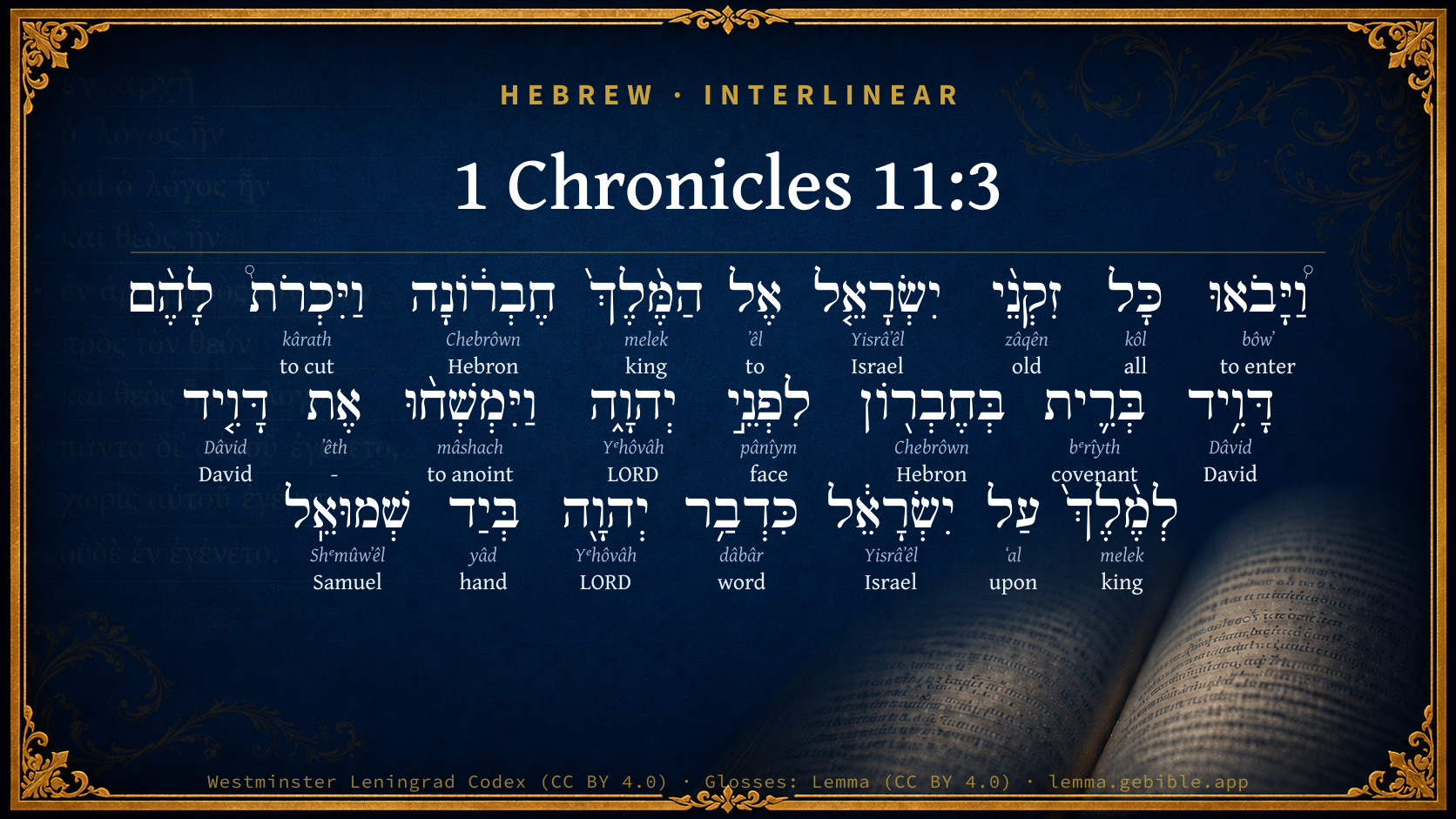
1 Chronicles 11:3

Hebrew (Westminster Leningrad Codex) 1 Chronicles 11:3 appears in the Hebrew Old Testament. The text above is from the Westminster Leningrad Codex. Each word links to its Strong’s number, a concise gloss, and parsing drawn from the Open Scriptures Hebrew Bible morphology. Click any word for its full Brown-Driver-Briggs (BDB) entry.
Download image
Cite this verse

1 Chronicles 11:3 (World English Bible). Public Domain. Lemma interlinear Bible study tool, https://lemma.gebible.app/v/1-chronicles/11/3.

Show BibTeX & RIS
BibTeX
RIS
English Translation
So all the elders of Israel came to the king to Hebron; and David made a covenant with them in Hebron before Yahweh; and they anointed David king over Israel, according to the word of Yahweh by Samuel.
World English Bible · Public Domain
Download a study sheet

One document with this verse’s original text, its word-by-word gloss line, the meaning frame, cross-references with their text, attributed commentary, and full source and license credits — printable, and it pastes into notes with its structure intact.

This verse Autodidact and up

Study sheet (.html) Plain text (.txt)

A passage Seminary Student

Up to 50 verses in one chapter. A passage sheet keeps up to 6 commentary sources and 12 cross-references per verse, in the order this page ranks them, and says so on the sheet whenever that leaves anything out. Ask for a single verse and you get the Autodidact verse sheet above.

Everything on this page stays free to read, with no account — the sheet is a download of what is already on screen, not access to it.

Want to remove ads? Support Godless Engineer
Compare translations 3

The same verse in 3 English versions, stacked beneath the original-language interlinear above. Click any original word for its lexicon entry.

Each is an independent rendering of the whole verse — the interlinear is not word-aligned to these translations.

Highlighted words mark where these versions differ — a whole-verse word diff, not a word-by-word alignment.

  • World English Bible Public Domain
    So all the elders of Israel came to the king to Hebron; and David made a covenant with them in Hebron before Yahweh; and they anointed David king over Israel, according to the word of Yahweh by Samuel.
  • King James Version Public Domain
    Therefore came all the elders of Israel to the king to Hebron; and David made a covenant with them in Hebron before the LORD; and they anointed David king over Israel, according to the word of the LORD by Samuel.
  • unfoldingWord Literal Text CC BY-SA 4.0
    And all of the elders of Israel came to the king at Hebron, and David cut for them a covenant in Hebron to the face of Yahweh. And they anointed David as king over Israel, according to the word of Yahweh by the hand of Samuel.

unfoldingWord Literal Text — © unfoldingWord, licensed CC BY-SA 4.0. Word-aligned USFM3 via Door43 (git.door43.org/unfoldingWord/en_ult).

Versions to compare (up to 4)

3 of 4 selected

Show all 18 translations

Every available English version of this verse, each an independent rendering of the whole verse.

  • World English Bible Public Domain
    So all the elders of Israel came to the king to Hebron; and David made a covenant with them in Hebron before Yahweh; and they anointed David king over Israel, according to the word of Yahweh by Samuel.
  • Berean Standard Bible Public Domain
    So all the elders of Israel came to the king at Hebron, where David made a covenant with them before the LORD. And they anointed him king over Israel, according to the word of the LORD through Samuel.
  • Majority Standard Bible Public Domain
    So all the elders of Israel came to the king at Hebron, where David made a covenant with them before the LORD. And they anointed him king over Israel, according to the word of the LORD through Samuel.
  • King James Version Public Domain
    Therefore came all the elders of Israel to the king to Hebron; and David made a covenant with them in Hebron before the LORD; and they anointed David king over Israel, according to the word of the LORD by Samuel.
  • American Standard Version (1901) Public Domain
    So all the elders of Israel came to the king to Hebron; and David made a covenant with them in Hebron before Jehovah; and they anointed David king over Israel, according to the word of Jehovah by Samuel.
  • Revised Version (1885) Public Domain
    So all the elders of Israel came to the king to Hebron; and David made a covenant with them in Hebron before the LORD; and they anointed David king over Israel, according to the word of the LORD by the hand of Samuel.
  • Geneva Bible (1599) Public Domain
    So came all the Elders of Israel to the King to Hebron, and Dauid made a couenant with them in Hebron before the Lord. And they anoynted Dauid King ouer Israel, according to the word of the Lord by the hand of Samuel.
  • Douay-Rheims (1899) Public Domain
    So all the ancients of Israel came to the king to Hebron, and David made a covenant with them before the Lord: and they anointed him king over Israel, according to the word of the Lord which he spoke in the hand of Samuel.
  • Young's Literal Translation Public Domain
    And all the elders of Israel come in unto the king to Hebron, and David maketh with them a covenant in Hebron before Jehovah, and they anoint David for king over Israel, according to the word of Jehovah by the hand of Samuel.
  • Literal Standard Version CC BY-SA 4.0
    And all [the] elderly of Israel come to the king at Hebron, and David makes a covenant with them in Hebron before YHWH, and they anoint David for king over Israel, according to the word of YHWH by the hand of Samuel.
  • Unlocked Literal Bible CC BY-SA 4.0
    So all the elders of Israel came to the king at Hebron, and David made a covenant with them before Yahweh. They anointed David king over Israel. In this way, the word of Yahweh that had been declared by Samuel came true.
  • unfoldingWord Literal Text CC BY-SA 4.0
    And all of the elders of Israel came to the king at Hebron, and David cut for them a covenant in Hebron to the face of Yahweh. And they anointed David as king over Israel, according to the word of Yahweh by the hand of Samuel.
  • Darby Bible Public Domain
    And all the elders of Israel came to the king to Hebron; and David made a covenant with them in Hebron before Jehovah; and they anointed David king over Israel according to the word of Jehovah through Samuel.
  • World Messianic Bible Public Domain
    So all the elders of Israel came to the king to Hebron; and David made a covenant with them in Hebron before the LORD. They anointed David king over Israel, according to the LORD’s word by Samuel.
  • Webster's Bible Public Domain
    Therefore came all the elders of Israel to the king to Hebron; and David made a covenant with them in Hebron before the LORD; and they anointed David king over Israel, according to the word of the LORD by Samuel.
  • Free Bible Version CC BY-SA 4.0
    All the elders of Israel came to the king at Hebron, and David made a solemn agreement with them before the Lord. There they anointed David as king of Israel, as the Lord had promised through Samuel.
  • Bible in Basic English Public Domain
    So all the responsible men of Israel came to the king at Hebron; and David made an agreement with them in Hebron before the Lord; and they put the holy oil on David and made him king over Israel, as the Lord had said by Samuel.
  • JPS Tanakh (1917) Public Domain
    So all the elders of Israel came to the king to Hebron; and David made a covenant with them in Hebron before the LORD; and they anointed David king over Israel, according to the word of the LORD by the hand of Samuel.

Literal Standard Version (2020), Covenant Press — licensed CC BY-SA 4.0. Text via the HelloAO Bible API (eBible.org). Unlocked Literal Bible (unfoldingWord) — licensed CC BY-SA 4.0. Text via the HelloAO Bible API (eBible.org). unfoldingWord Literal Text — © unfoldingWord, licensed CC BY-SA 4.0. Word-aligned USFM3 via Door43 (git.door43.org/unfoldingWord/en_ult). Free Bible Version, Dr. Jonathan Gallagher — licensed CC BY-SA 4.0. Text via the HelloAO Bible API (eBible.org).

Word by word

More ways to search: Search by grammar → Find every occurrence → Compare this word →

Practice this passage: Drill this verse → Learn its vocabulary →

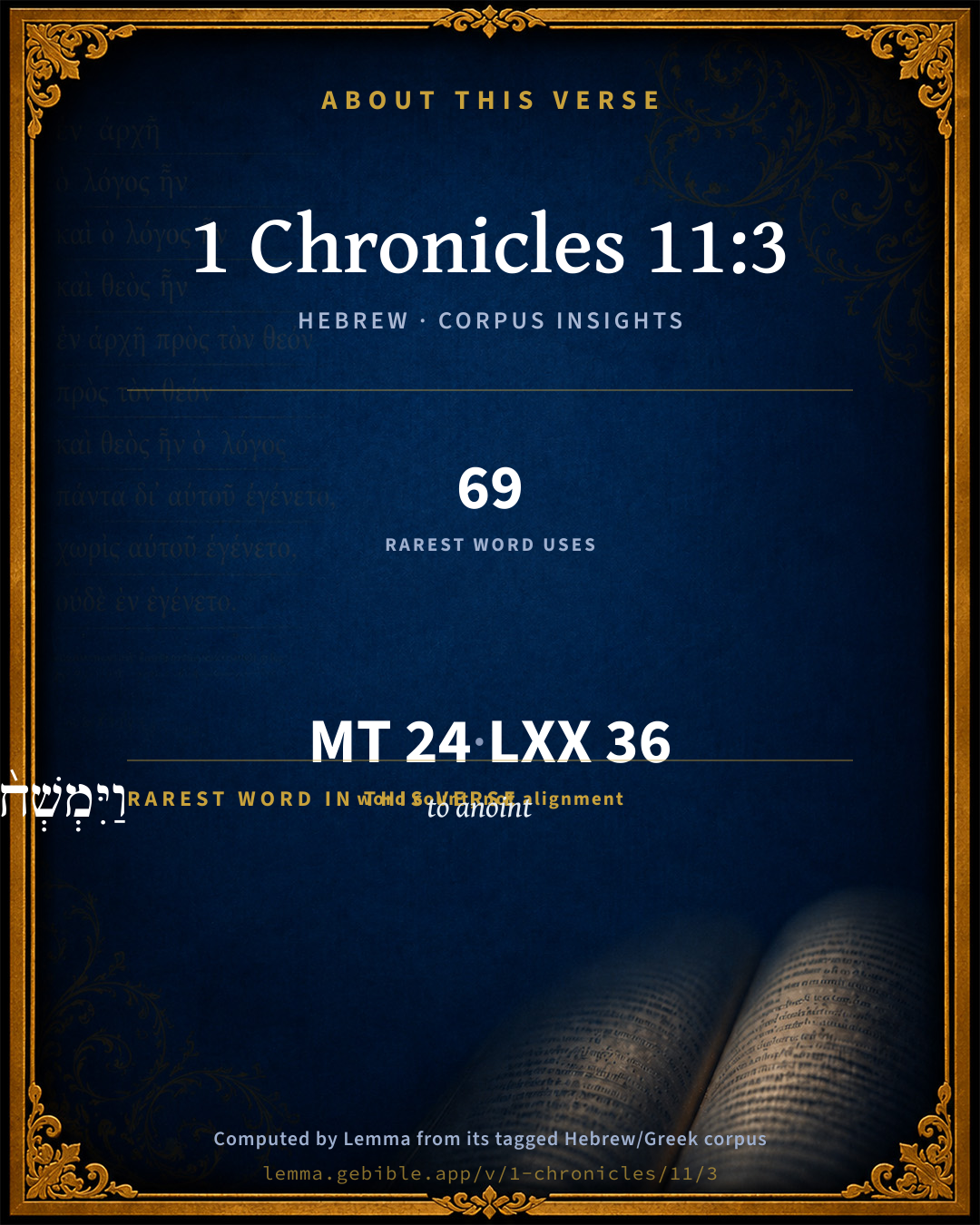
וַיִּמְשְׁח֨וּ
mâshach
H4886
“and · to anoint”
Conjunction + Verb, Qal, Sequential Imperfect, 3rd Person, Masculine, Plural
Part of Speech
Conjunction + Verb
Stem
Qal
Form
Sequential Imperfect
Person
3rd Person
Gender
Masculine
Number
Plural
Full BDB Definition

Origin: a primitive root

TWOT: 1255

to smear, anoint, spread a liquid - (Qal) - to smear - to anoint (as consecration) - to anoint, consecrate - (Niphal) to be anointed
  1. וַ֠יָּבֹאוּ bôwʼ H935 “and · to enter” Conjunction + Verb, Qal, Sequential Imperfect, 3rd Person, Masculine, Plural
  2. כָּל kôl H3605 “all of” Noun, Common, Masculine, Singular, Construct
  3. זִקְנֵ֨י zâqên H2205 “old of” Adjective, Adjective, Masculine, Plural, Construct
  4. יִשְׂרָאֵ֤ל Yisrâʼêl H3478 “Israel” Noun, Proper
  5. אֶל ʼêl H413 “to” Preposition
  6. הַמֶּ֨לֶךְ֙ melek H4428 “the · king” Particle, Definite Article + Noun, Common, Masculine, Singular, Absolute
  7. חֶבְר֔וֹנָה Chebrôwn H2275 “Hebron · toward” Noun, Proper + Suffix, Demonstrative
  8. וַיִּכְרֹת֩ kârath H3772 “and · to cut” Conjunction + Verb, Qal, Sequential Imperfect, 3rd Person, Masculine, Singular
  9. דָּוִ֥יד Dâvid H1732 “David” Noun, Proper
  10. בְּרִ֛ית bᵉrîyth H1285 “covenant” Noun, Common, Feminine, Singular, Absolute
  11. בְּחֶבְר֖וֹן Chebrôwn H2275 “in/at · Hebron” Preposition + Noun, Proper
  12. לִפְנֵ֣י pânîym H6440 “to/for · face(s) of” Preposition + Noun, Common, Both, Plural, Construct
  13. יְהוָ֑ה Yᵉhôvâh H3068 “LORD” Noun, Proper
  14. אֶת ʼêth H853 “-” Particle, Direct Object
  15. דָּוִ֤יד Dâvid H1732 “David” Noun, Proper
  16. לְמֶ֨לֶךְ֙ melek H4428 “to/for · king” Preposition + Noun, Common, Masculine, Singular, Absolute
  17. עַל ʻal H5921 “upon” Preposition
  18. יִשְׂרָאֵ֔ל Yisrâʼêl H3478 “Israel” Noun, Proper
  19. כִּדְבַ֥ר dâbâr H1697 “like/as · word of” Preposition + Noun, Common, Masculine, Singular, Construct
  20. יְהוָ֖ה Yᵉhôvâh H3068 “LORD” Noun, Proper
  21. בְּיַד yâd H3027 “in/at · hand of” Preposition + Noun, Common, Both, Singular, Construct
  22. שְׁמוּאֵֽל Shᵉmûwʼêl H8050 “Samuel” Noun, Proper

About this verse

These counts appear in no published source. They are computed here, from the morphology-tagged text and Lemma’s own curated glosses. What Lemma adds →

24
words
18
distinct lemmas
Historical
section

Grammatical profile

  • 3 verbs
  • 16 nouns
  • 1 adjective
  • 3 prepositions
  • 1 particle

Verb forms

  • וַ֠יָּבֹאוּ Qal · Sequential Imperfect
  • וַיִּכְרֹת֩ Qal · Sequential Imperfect
  • וַיִּמְשְׁח֨וּ Qal · Sequential Imperfect

Repetition

Words recur within this verse — often emphatic in Hebrew:

  • יִשְׂרָאֵ֤ל Israel H3478 ×2
  • הַמֶּ֨לֶךְ֙ king H4428 ×2
  • חֶבְר֔וֹנָה Hebron H2275 ×2
  • דָּוִ֥יד David H1732 ×2
  • יְהוָ֑ה LORD H3068 ×2

Hebrew & Septuagint length

In English translation the verse runs 38 words from the Hebrew and 43 from the Septuagint (LXX English) — closely comparable.

A rough comparison of the two English renderings, which tokenize alike — not a word-level alignment.

Word counts can differ between the Hebrew and the Greek without any difference in meaning — e.g. the Hebrew direct-object marker אֵת has no separate Greek word, and Greek often adds the article ὁ.

In the original languages it is 24 Hebrew tokens and 36 Greek tokens — but the two are counted differently (Hebrew bundles its prefixes and suffixes into one token; the Greek is in lemma form), so that isn’t a like-for-like length.

Cross-references

13

Topical passages linked to 1 Chronicles 11:3 in the Treasury of Scripture Knowledge — connected by theme and wording, ordered by reader-vote popularity; previews shown in the World English Bible.

  • 1 Samuel 16:1 Yahweh said to Samuel, How long will you mourn for Saul, seeing I have rejected him from being king over Israel? fill your horn with oil, and go: I will send you to Jesse the Bethlehemite; for I have provided me a king among his sons.
  • 1 Samuel 16:12–13 He sent, and brought him in. Now he was ruddy, and withal of a beautiful face, and goodly to look on. Yahweh said, Arise, anoint him; for this is he.
  • 2 Samuel 2:4 The men of Judah came, and there they anointed David king over the house of Judah. They told David, saying, The men of Jabesh Gilead were those who buried Saul.
  • 2 Samuel 5:3 So all the elders of Israel came to the king to Hebron; and king David made a covenant with them in Hebron before Yahweh: and they anointed David king over Israel.
  • 1 Samuel 15:28 Samuel said to him, Yahweh has torn the kingdom of Israel from you this day, and has given it to a neighbor of yours who is better than you.
  • 1 Samuel 16:3 Call Jesse to the sacrifice, and I will show you what you shall do: and you shall anoint to me him whom I name to you.
  • 1 Samuel 28:17 Yahweh has done to you, as he spoke by me: and Yahweh has torn the kingdom out of your hand, and given it to your neighbor, even to David.
  • Judges 11:11 Then Jephthah went with the elders of Gilead, and the people made him head and chief over them: and Jephthah spoke all his words before Yahweh in Mizpah.
  • 1 Samuel 11:15 All the people went to Gilgal; and there they made Saul king before Yahweh in Gilgal; and there they offered sacrifices of peace-offerings before Yahweh; and there Saul and all the men of Israel rejoiced greatly.
  • 1 Samuel 23:18 They two made a covenant before Yahweh: and David abode in the wood, and Jonathan went to his house.
  • 2 Kings 11:17 Jehoiada made a covenant between Yahweh and the king and the people, that they should be Yahweh's people; between the king also and the people.
  • 2 Kings 23:30 His servants carried him in a chariot dead from Megiddo, and brought him to Jerusalem, and buried him in his own tomb. The people of the land took Jehoahaz the son of Josiah, and anointed him, and made him king in his father's place.
  • 2 Chronicles 23:3 All the assembly made a covenant with the king in the house of God. He said to them, Behold, the king's son shall reign, as Yahweh has spoken concerning the sons of David.

Cross-references courtesy of OpenBible.info (CC BY 4.0).

Hebrew and Greek witnesses Masoretic Hebrew ↔ Greek Septuagint

The same verse in the two great witnesses to the Old Testament, shown verse-for-verse.

These are two independent witnesses, not word-aligned to each other, and the Septuagint is shown in lemma (dictionary) form.

Hebrew 1 Chronicles 11:3 Masoretic · Westminster Leningrad Codex

וַ֠יָּבֹאוּ כָּל זִקְנֵ֨י יִשְׂרָאֵ֤ל אֶל הַמֶּ֨לֶךְ֙ חֶבְר֔וֹנָה וַיִּכְרֹת֩ לָהֶ֨ם דָּוִ֥יד בְּרִ֛ית בְּחֶבְר֖וֹן לִפְנֵ֣י יְהוָ֑ה וַיִּמְשְׁח֨וּ אֶת דָּוִ֤יד לְמֶ֨לֶךְ֙ עַל יִשְׂרָאֵ֔ל כִּדְבַ֥ר יְהוָ֖ה בְּיַד שְׁמוּאֵֽל

So all the elders of Israel came to the king to Hebron; and David made a covenant with them in Hebron before Yahweh; and they anointed David king over Israel, according to the word of Yahweh by Samuel.

World English Bible · Public Domain

Greek LXX 1 Chronicles 11:3 Septuagint · lemma form

καί ἔρχομαι πᾶς πρεσβύτερος ἰσραήλ πρός ὁ βασιλεύς εἰς χεβρων καί διατίθημι αὐτός ὁ βασιλεύς δαυίδ διαθήκη ἐν χεβρων ἐναντίον κύριος καί χρίω ὁ δαυίδ εἰς βασιλεύς ἐπί ἰσραήλ κατά ὁ λόγος κύριος διά χείρ σαμουηλ

And all the elders of Israel came to the king to Chebron; and king David made a covenant with them in Chebron before the Lord: and they anointed David to be king over Israel, according to the word of the Lord by Samuel.

LXX2012 (modern English Septuagint) · Public Domain

On this verse, Haydock's Catholic Bible Commentary discusses the Septuagint’s reading. Read the note in Commentary ↓

Hebrew: Westminster Leningrad Codex (CC BY 4.0). Greek: Septuagint (public domain); English from LXX2012 (modern English Septuagint) (Public Domain). How the Septuagint differs from the Hebrew →

Commentary

Notes on 1 Chronicles 11:3 from classic Christian and Jewish commentators (each source and its license shown beneath its notes). The classic Christian expositions comment on the surrounding passage and are grouped to its opening verse, so a note may address several verses; the Jewish commentaries on the Tanakh (Rashi and others) are per-verse, so they appear only where the commentator wrote on this verse.

Lemma curates 59 commentaries, every one of them public domain or Creative Commons licensed, each selected and text-cleaned for this edition rather than reprinted as found. About our sources →

Trapp's Complete Commentary

John Trapp

1Ch 11:3 Therefore came all the elders of Israel to the king to Hebron; and David made a covenant with them in Hebron before the LORD; and they anointed David king over Israel, according to the word of the LORD by Samuel.

Ver. 3. Therefore came, &c.] See on 2Sa 5:3.

John Trapp, A Commentary or Exposition upon All the Books of the Old and New Testament (1647–1656) — public domain. Text from a community e-Sword module.

Ellicott's Commentary for English Readers

(3) Therefore came all the elders of Israel.—The assembly of elders, the Senate of Israel, make a contract with David concerning his prerogative and the rights of his people, thus formally determining “the manner of the kingdom.” (Comp. 1Sa_8:9 seq., 1Sa_10:25.) Representative institutions appear to have been the rule in the best period of Israel’s national existence. The elders or hereditary heads of the tribal subdivisions met in council to discuss and settle matters of national concern. (Comp. 1Ch_12:23.)

Before the Lord.—In the presence of the high priest, and perhaps before the ark; comp. Exo_21:6; 1Sa_2:25, where the priestly nudge is called God, as representing the authority of the Divine judge (Exo_22:28).

According to the word of the Lord by Samuel.—A reflection added by the chronicler, and based upon the facts related in 1Sa_15:28; 1Sa_16:1-13.

A Bible Commentary for English Readers, edited by Charles John Ellicott (1878–1897) — public domain. Text from a community e-Sword module.

The Cambridge Bible for Schools and Colleges

gen. ed. J. J. S. Perowne

3. made a covenant] i.e. gave them a charter in which he promised to respect existing rights; cp. 1Sa_10:25 (Samuel writes the “manner” of the kingdom).

before the Lord] One method of entering into a covenant “before the Lord” was to pass between the parts of a sacrificed animal; cp. Jer_34:18-19.

Chron. has nothing here corresponding with 2Sa_5:4-5; but cp. 1Ch_29:27.

The Cambridge Bible for Schools and Colleges (gen. ed. J. J. S. Perowne; Cambridge University Press, 1878–1918) — public domain. Text from a community e-Sword module.

Haydock's Catholic Bible Commentary

Which he spoke, is not expressed in Hebrew or Septuagint. Samuel complied with the injunction, by anointing David, 1 Kings xvi. 13. He also wrote an account of this memorable transaction, which translated the sceptre from one family to another. (Haydock) --- It is, on this account, that the author here takes particular notice of God’s decree. (Kennicott)

George Leo Haydock (1774–1849), Haydock's Catholic Family Bible and Commentary, 1859 edition — public domain. Excludes Psalms (Douay-Rheims chapter numbering differs from Protestant) and Deuterocanonical books (Catholic canon only).

The Pulpit Commentary

Made a covenant before the Lord. A forcible use of this phrase occurs in Jud_1:11:11. It implies that the engagement was ratified in the presence of a holy place, a holy vessel of the sanctuary, or a holy person (1Sa_21:6, 1Sa_21:7; Jos_18:8; Lev_1:5) Whether the tabernacle was now at Hebron is doubtful, but the two priests, Abiathar and Zadok, were. They anointed David. The first time of David"s being anointed (1Sa_16:1, 1Sa_16:13) Samuel the prophet officiated. The second time (2Sa_2:4) was when the "men of Judah" anointed him king over "the house of Judah." This third time when David was anointed king over the united people, it was at all events at the special instance of "all the elders of Israel," although who officiated on these two last occasions is not mentioned. According to the word of the Lord by Samuel. The sentence marks the complete fulfilment of what had been foreshadowed in 1Sa_16:12, 1Sa_16:13; and it may probably have been the more carefully introduced by the compiler of Chronicles, in consideration of the absence from his own work of previous details and of the previous anointings of David.

Vers. 3-10.

The throne of justice and security.

These verses are morally and essentially connected with one another. They speak of one thing the "making of David king." And we may notice in them

I THE FORM THAT REPRESENTED THIS. The most ancient Scriptures enrich us with the knowledge of the very earliest customs of men. Many of these may be obsolete. But two things are remarkable respecting them, viz.

(1) how some of them remain, and with but slightly altered dress;

(2) how those that do not remain often embodied some principle to which all growth of time has shown a growing importance to belong. These earliest customs of men, recorded in Scripture, seem, further, not only to have embodied certain principles, but passed, as they often were, beneath the eye of God, we may feel that they did something more they enshrined with a real sacredness and invested with a special honour the principle that was to last and to gain in significance when the outer shell of custom or form was withered to nothing. The ceremony which set forth the making of a king of Israel was that of anointing. This was the third time David had been anointed. But these successive acts of anointing were not vain repetitions. The first was his private anointing, by Samuel, according to God"s word and according to God"s private call. (1Sa_16:1, 1Sa_16:12, 1Sa_16:13) The second was when David became king over Judah, and when the call and the willing consent of his fellow-men, and of those up to this time his fellow-citizens, were added to the Divine appointment. (2Sa_2:4) And the third was on the occasion before us, when the heads of the whole people, with hearty unanimity, added the sanction of their presence and consent. Now, therefore, the anointing was finally performed. It was a ceremony, but not one destitute of meaning and of usefulness. It marked David to the eyes of all the nation as their "feeder and ruler," appointed of God, accepted of themselves. And it reminded himself of the solemn responsibility laid upon him to fulfil his duty to men as under the commands of God.

II THE CONDITION PRECEDENT TO IT. "David made a covenant with them before the Lord." Beyond doubt, the choice and the call and the ordination of David were all of God. Beyond doubt, nothing could be safer or better for all the people than to accept his deed and appointment unquestioningly. But there are ever an earthly order and a visible sign of some kind for us men, answering to the Divine will These God does not only permit, but, as we believe, he enjoins them. It is another indication of the fact that God would ever be lifting our level nearer his own. The exact matter of the covenant is not here given us, nor in fact in any of the parallel places. Yet with very little hesitation we may say that we hear the echoes of it from the deathbed of David. (2Sa_23:2-5) It consisted of a solemn mutual engagement he "to rule just, ruling in the fear of God;" they to follow and obey. God"s covenants with man at any and every time are of the nature of free promises of mercy and grace, but of what in their very nature require the loving acceptance and use of them to impart availingness to them and to keep them availing, and this is the only kind of condition attaching to them no meritorious condition. But in the fact of this covenant being made, and in the fact of its being so explicitly recorded, we have an evidence of God"s condescending attention to our mutual relations. Though he it is who with sovereign right elects and with the right of a sovereign voice calls one and another to pre-eminent place and authority over us, yet he bids us see and watch the thing that is transpiring, and insist upon the right and just being done, and he submits his own choice to the verdict of the conscience of his people. We have a great ecclesiastical principle, in embryo, as we might suppose, an instance of God"s royal conge delire, entrusted to the elders of all Israel, and not formally put into effect by these until his own chosen one has entered into a covenant with them.

III THE MORAL SUPPORTS NECESSARY TO THIS KINGMAKING. Remarkable, and in some respects even unique, as was the raising of David to be king, in this final appointment and anointing of him, yet it follows the lines of any other high appointment to command of one man amongst his fellow-men. He is not really and for ever to be hedged in as a divinity, nor of divinity, except as this highest power works by human agency. The higher such a position is, the more necessary is it that it be not artificially dissevered from the aid, the approval, the moral influence of others. The exalted individual"s temptation to forget this, and even to override it, has very often been unceremoniously enough called to account and fiercely rebuked. The hierarchy that obtains in human society, in the human family, may be accepted as an incontestible fact, and, therefore so far forth as authorized of nature. But neither ought this to be strained or exaggerated. Much less are we to create, favour, or permit violent gaps between rank and rank, class and class. The most insensible gradations from rank to rank and class to class make the strongest, safest society. History proves, by instances almost innumerable, that to disbelieve and affront this principle is disaster, but to set it at nought and defy it is to court destruction, and that without remedy. We must not overlook the significance of the expression that "the chief of the mighty men whom David had" neither held themselves aloof from him nor were held at a distance by him in his new greatness. They stood near the throne. They helped to uphold its dignity and the authority of him who sat upon it. There is really no such thing as actual irresponsibility between man and man. None is so strong as to be able to beast himself independent of the help, the love, the good opinion of his fellow-men. Conscience only can claim for itself the prerogative of freedom to do and speak as though irresponsible to man, but even these noblest displays of human power and virtue do not practically deliver from the consequences and the patent fact of responsibility; while in all inferior attempts the power is weakness, and the travestie of the virtue is the licence of vice. But no, David"s mighty men strenuously held by him, and they were in turn seconded by the entire of an enthusiastic and faithful people. Their one combined aim was to put stability into his kingdom and to make him a strong and prosperous king. And it was all "according to the word of the Lord concerning Israel." Happy king! happy people! David had not to pay the very common penalty of exaltedness and empire. The people were a willing people in the day of his power. Would that it may last, last to the end must have been the ardent wish of every patriot that day the humble prayer of every earnest, spiritual Israelite!

David"s accession.

With this chapter commences another part of this Book of Chronicles, which, from this point onwards, is occupied with the reign, the character, and the exploits of David, King of Judah and Israel. His accession, related in this verse, occupies accordingly a position of interest and significance in the narrative. The point especially deserving notice in the language of this verse is the combination of Divine and human agency in the nomination of David to the throne. This combination, especially apparent in the history of theocratic Israel, is really discernible by the reflecting mind in all the events of life and history. Observe

I THE HUMAN AGENCY which led to David"s accession to the throne. To many eyes no other than human agency was visible.

1. His own character and services marked David out as the one only ruler whom Israel could select and trust. Born a shepherd, he had yet within him the heart and the future of a king.

2. A popular election effected his elevation. It was the wish of "all Israel" that David should take the responsibilities of rule. In his election the old adage was verifiedVox populi vox Dei.

3. A senatorial requisition sanctioned and enforced the popular nomination. "All the elders of Israel" came to David, to express the general feeling and to prefer formally the national request. The appointment of the king was not the work of a moment of enthusiasm, was not the caprice of a mob; it was the deliberate act of the wisest and the noblest in the land.

II THE DIVINE CAUSE of David"s appointment to the throne. This may not have been apparent to all, but it is acknowledged with justice by the sacred historian.

1. A Divine prediction led to Davids accession. The language of the people is very noticeable: "The Lord thy God said unto thee, Thou shalt feed my people Israel, and thou shalt be ruler over my people Israel.

2. A prophetic designation foreshadowed it. The appointment, so we read, was made "according to the word of the Lord by Samuel" The same inspired seer who anointed Saul was directed to nominate his immediate successor.

3. A religious covenant ratified the nomination of David. When he "made a covenant with them in Hebron before the Lord," he acted in accordance with his religious convictions, but he acted also in a manner harmonizing with the theocratic position of Israel. Church and state were not merely allied, they were identical. Nothing more natural than that a sacred ceremony should accompany the public and political act. There is no trace of selfish ambition on David"s part. He acknowledged the tremendous responsibilities of reigning. And in the sight of Jehovah his subjects undertook to co-operate with the monarch in seeking the general good.

PRACTICAL LESSONS of great value are suggested by this passage.

1. In all human history and biography there is a blending of the human andthe Divine. Worldly men are in danger of looking only to "second causes;" possibly religious men may sometimes overlook these in an exclusive regard to the one great Divine Agent. We should seek the Divine in the human.

2. Elevation to great power involves great responsibility: A man who canthink only of his own pleasure or magnificence, when Providence raises him to an exalted station, is not merely irreligious, he is unreasonable and unreflecting.

3. Social and political duties can only be discharged aright when fulfilled ina devout and prayerful spirit. The more responsible our position, the greater our need of a sincere confidence in the supreme Lord who is the supreme Guide of man. T.

The Pulpit Commentary (1880–1919), ed. H.D.M. Spence-Jones & Joseph S. Exell — public domain. Text from a community e-Sword module.

Rashi

Rabbi Shlomo Yitzchaki (Rashi)

and David made with them a covenant Like the covenant that Jehoiada made, as it is written (II Kings 11:17): “And Jehoiada enacted the covenant between the Lord and between the king and between the people, to be the people of the Lord.” The meaning is [that they agreed] to be servants of the Lord, and also “between the king and between the people,” to be his servants according to the king’s judgment, and also that the king should do according to the law for his servants; to wage their wars.

before the Lord But is it not so that the Tabernacle was not in Hebron? What then is the meaning of “before the Lord”? Wherever people make a stipulation or enact a covenant, the Omnipresent is there. A similar instance [is found] in [the case of] Jephthah: (Jud. 11:11): “before the Lord in Mizpah.” [Another] similar instance (Lev. 5:21): “and commits an act of treachery against the Lord by making a denial to his neighbor,” as is explained in Torath Kohanim (ad loc.).

Rashi on the Tanakh — English translations: “The Judaica Press complete Tanach with Rashi, translated by A. J. Rosenberg” (CC BY 4.0); “Pentateuch with Rashi's commentary by M. Rosenbaum and A.M. Silbermann, 1929-1934” (public domain); “The Metsudah Tanach series, Lakewood, N.J” (CC BY 4.0); and “The Book of Joshua, Metsudah Publications, 1997” (CC BY 4.0). Text via Sefaria.

Lesson kit

Teaching starters — assembled from the data on this page, not authored interpretation. Every prompt links to the verse data it draws on. Edit before teaching.

1 Chronicles, in the Historical, opens this verse with 24 words (18 distinct Hebrew lemmas). Its most distinctive word is mâshach (“to anoint”). A historical commentator’s framing appears above. Read the whole chapter for the surrounding context.

Discussion questions

  1. How does “to anoint” (mâshach) shape what this verse is saying?
  2. 1 Samuel 16:1 shares this passage’s theme. How do the two illuminate each other?
  3. “Israel” occurs 2× in this one verse. What is the effect of the repetition?
  4. These translations render this verse differently. What is at stake in choosing one wording over another?
  5. The verb «וַ֠יָּבֹאוּ» is Qal Sequential Imperfect. How does its form color the action?
  6. Reading how Trapp's Complete Commentary and Ellicott's Commentary for English Readers read this verse, where do the two commentators agree and where do they part?

Things to notice

Reading settings

Reading text

Shown beneath each verse's original-language words.

Old Testament
Old Testament edition

Read the OT as the Masoretic Hebrew (MT) or the Greek Septuagint (LXX).

English shown for the Greek Septuagint (in the Hebrew ↔ Greek comparison).

Comparing translations? Open the Compare panel on any verse page to stack up to four side by side.