
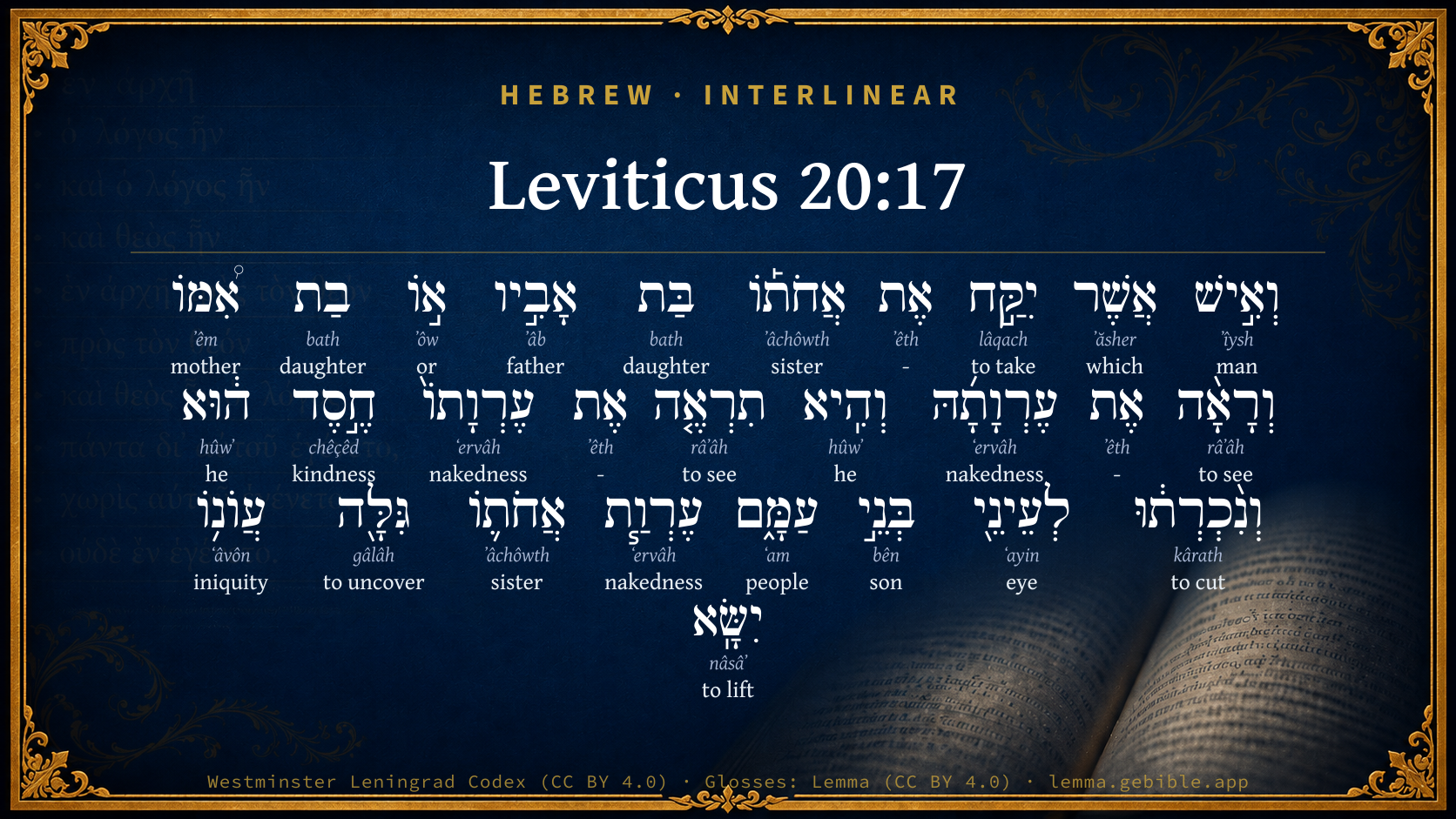
Leviticus 20:17

Hebrew (Westminster Leningrad Codex) Leviticus 20:17 appears in the Hebrew Old Testament. The text above is from the Westminster Leningrad Codex. Each word links to its Strong’s number, a concise gloss, and parsing drawn from the Open Scriptures Hebrew Bible morphology. Click any word for its full Brown-Driver-Briggs (BDB) entry.
Download image
Cite this verse

Leviticus 20:17 (World English Bible). Public Domain. Lemma interlinear Bible study tool, https://lemma.gebible.app/v/leviticus/20/17.

Show BibTeX & RIS
BibTeX
RIS
English Translation
"'If a man takes his sister, his father's daughter, or his mother's daughter, and sees her nakedness, and she sees his nakedness; it is a shameful thing; and they shall be cut off in the sight of the children of their people: he has uncovered his sister's nakedness; he shall bear his iniquity.
World English Bible · Public Domain
Download a study sheet

One document with this verse’s original text, its word-by-word gloss line, the meaning frame, cross-references with their text, attributed commentary, and full source and license credits — printable, and it pastes into notes with its structure intact.

This verse Autodidact and up

Study sheet (.html) Plain text (.txt)

A passage Seminary Student

Up to 50 verses in one chapter. A passage sheet keeps up to 6 commentary sources and 12 cross-references per verse, in the order this page ranks them, and says so on the sheet whenever that leaves anything out. Ask for a single verse and you get the Autodidact verse sheet above.

Everything on this page stays free to read, with no account — the sheet is a download of what is already on screen, not access to it.

Want to remove ads? Support Godless Engineer
Compare translations 3

The same verse in 3 English versions, stacked beneath the original-language interlinear above. Click any original word for its lexicon entry.

Each is an independent rendering of the whole verse — the interlinear is not word-aligned to these translations.

Highlighted words mark where these versions differ — a whole-verse word diff, not a word-by-word alignment.

  • World English Bible Public Domain
    "'If a man takes his sister, his father's daughter, or his mother's daughter, and sees her nakedness, and she sees his nakedness; it is a shameful thing; and they shall be cut off in the sight of the children of their people: he has uncovered his sister's nakedness; he shall bear his iniquity.
  • King James Version Public Domain
    And if a man shall take his sister, his father's daughter, or his mother's daughter, and see her nakedness, and she see his nakedness; it is a wicked thing; and they shall be cut off in the sight of their people: he hath uncovered his sister's nakedness; he shall bear his iniquity.
  • unfoldingWord Literal Text CC BY-SA 4.0
    And a man who takes his sister, the daughter of his father or the daughter of his mother, and he sees her nakedness, and she herself sees his nakedness—it a disgrace. And they shall be cut off in the eyes of the sons of their people. The nakedness of his sister he has uncovered; he shall bear his iniquity.

unfoldingWord Literal Text — © unfoldingWord, licensed CC BY-SA 4.0. Word-aligned USFM3 via Door43 (git.door43.org/unfoldingWord/en_ult).

Versions to compare (up to 4)

3 of 4 selected

Show all 18 translations

Every available English version of this verse, each an independent rendering of the whole verse.

  • World English Bible Public Domain
    "'If a man takes his sister, his father's daughter, or his mother's daughter, and sees her nakedness, and she sees his nakedness; it is a shameful thing; and they shall be cut off in the sight of the children of their people: he has uncovered his sister's nakedness; he shall bear his iniquity.
  • Berean Standard Bible Public Domain
    If a man marries his sister, whether the daughter of his father or of his mother, and they have sexual relations, it is a disgrace. They must be cut off in the sight of their people. He has uncovered the nakedness of his sister; he shall bear his iniquity.
  • Majority Standard Bible Public Domain
    If a man marries his sister, whether the daughter of his father or of his mother, and they have sexual relations, it is a disgrace. They must be cut off in the sight of their people. He has uncovered the nakedness of his sister; he shall bear his iniquity.
  • King James Version Public Domain
    And if a man shall take his sister, his father's daughter, or his mother's daughter, and see her nakedness, and she see his nakedness; it is a wicked thing; and they shall be cut off in the sight of their people: he hath uncovered his sister's nakedness; he shall bear his iniquity.
  • American Standard Version (1901) Public Domain
    And if a man shall take his sister, his father's daughter, or his mother's daughter, and see her nakedness, and she see his nakedness; it is a shameful thing; and they shall be cut off in the sight of the children of their people: he hath uncovered his sister's nakedness; he shall bear his iniquity.
  • Revised Version (1885) Public Domain
    And if a man shall take his sister, his father’s daughter, or his mother’s daughter, and see her nakedness, and she see his nakedness; it is a shameful thing; and they shall be cut off in the sight of the children of their people: he hath uncovered his sister’s nakedness; he shall bear his iniquity.
  • Geneva Bible (1599) Public Domain
    Also the man that taketh his sister, his fathers daughter, or his mothers daughter, and seeth her shame and she seeth his shame, it is villenie: therefore they shall be cut off in the sight of their people, because he hath vncouered his sisters shame, he shall beare his iniquitie.
  • Douay-Rheims (1899) Public Domain
    If any man take his sister, the daughter of his father, or the daughter of his mother, and see her nakedness, and she behold her brother's shame: they have committed a crime: they shall be slain, in the sight of their people, because they have discovered one another's nakedness, and they shall bear their iniquity.
  • Young's Literal Translation Public Domain
    `And a man who taketh his sister, a daughter of his father or daughter of his mother, and he hath seen her nakedness, and she seeth his nakedness: it is a shame; and they have been cut off before the eyes of the sons of their people; the nakedness of his sister he hath uncovered; his iniquity he beareth.
  • Literal Standard Version CC BY-SA 4.0
    And a man who takes his sister, a daughter of his father or daughter of his mother, and he has seen her nakedness, and she sees his nakedness—it is a shame; and they have been cut off before the eyes of the sons of their people; he has uncovered the nakedness of his sister; he bears his iniquity.
  • Unlocked Literal Bible CC BY-SA 4.0
    If a man sleeps with his sister, a daughter of his father or a daughter of his mother, and he uncovers her nakedness, and she sees his nakedness, it is a shameful thing. They must be cut off from the presence of their people, because he has slept with his sister. He must carry his guilt.
  • unfoldingWord Literal Text CC BY-SA 4.0
    And a man who takes his sister, the daughter of his father or the daughter of his mother, and he sees her nakedness, and she herself sees his nakedness—it a disgrace. And they shall be cut off in the eyes of the sons of their people. The nakedness of his sister he has uncovered; he shall bear his iniquity.
  • Darby Bible Public Domain
    And if a man take his sister, his father's daughter, or his mother's daughter, and see her nakedness, and she see his nakedness, that is a disgrace; and they shall be cut off before the eyes of the children of their people: he hath uncovered his sister's nakedness; he shall bear his iniquity.
  • World Messianic Bible Public Domain
    “‘If a man takes his sister—his father’s daughter, or his mother’s daughter—and sees her nakedness, and she sees his nakedness, it is a shameful thing. They shall be cut off in the sight of the children of their people. He has uncovered his sister’s nakedness. He shall bear his iniquity.
  • Webster's Bible Public Domain
    And if a man shall take his sister, his father's daughter, or his mother's daughter, and see her nakedness, and she see his nakedness; it is a wicked thing; and they shall be cut off in the sight of their people: he hath uncovered his sister's nakedness; he shall bear his iniquity.
  • Free Bible Version CC BY-SA 4.0
    A man who marries his sister, whether she's his father's daughter or his mother's daughter, and they have sex, has done something shameful. They must be expelled from their people in front of everybody. He has brought shame on his sister; he bears the responsibility for his punishment.
  • Bible in Basic English Public Domain
    And if a man takes his sister, daughter of his father or his mother, and has sex relations with her and she with him, it is an act of shame: they are to be cut off before the children of their people; he has had sex relations with his sister, and his sin will be on him.
  • JPS Tanakh (1917) Public Domain
    And if a man shall take his sister, his father's daughter, or his mother's daughter, and see her nakedness, and she see his nakedness: it is a shameful thing; and they shall be cut off in the sight of the children of their people: he hath uncovered his sister's nakedness; he shall bear his iniquity.

Literal Standard Version (2020), Covenant Press — licensed CC BY-SA 4.0. Text via the HelloAO Bible API (eBible.org). Unlocked Literal Bible (unfoldingWord) — licensed CC BY-SA 4.0. Text via the HelloAO Bible API (eBible.org). unfoldingWord Literal Text — © unfoldingWord, licensed CC BY-SA 4.0. Word-aligned USFM3 via Door43 (git.door43.org/unfoldingWord/en_ult). Free Bible Version, Dr. Jonathan Gallagher — licensed CC BY-SA 4.0. Text via the HelloAO Bible API (eBible.org).

Word by word

More ways to search: Search by grammar → Find every occurrence → Compare this word →

Practice this passage: Drill this verse → Learn its vocabulary →

עֶרְוָתָ֜הּ
ʻervâh
H6172
“nakedness · her”
Noun, Common, Feminine, Singular, Construct + Suffix, Personal, 3rd Person, Feminine, Singular
Part of Speech
Noun
Type
Common
Gender
Feminine
Number
Singular
State
Construct
Full BDB Definition

Origin: from H6168

TWOT: 1692b

nakedness, nudity, shame, pudenda - pudenda (implying shameful exposure) - nakedness of a thing, indecency, improper behaviour - exposed, undefended (figuratively)
  1. וְאִ֣ישׁ ʼîysh H376 “and · man” Conjunction + Noun, Common, Masculine, Singular, Absolute
  2. אֲשֶׁר ʼăsher H834 “which” Particle, Relative
  3. יִקַּ֣ח lâqach H3947 “to take” Verb, Qal, Imperfect, 3rd Person, Masculine, Singular
  4. אֶת ʼêth H853 “-” Particle, Direct Object
  5. אֲחֹת֡וֹ ʼâchôwth H269 “sister · his” Noun, Common, Feminine, Singular, Construct + Suffix, Personal, 3rd Person, Masculine, Singular
  6. בַּת bath H1323 “daughter of” Noun, Common, Feminine, Singular, Construct
  7. אָבִ֣יו ʼâb H1 “father · his” Noun, Common, Masculine, Singular, Construct + Suffix, Personal, 3rd Person, Masculine, Singular
  8. א֣וֹ ʼôw H176 “or” Conjunction
  9. בַת bath H1323 “daughter of” Noun, Common, Feminine, Singular, Construct
  10. אִ֠מּוֹ ʼêm H517 “mother · his” Noun, Common, Feminine, Singular, Construct + Suffix, Personal, 3rd Person, Masculine, Singular
  11. וְרָאָ֨ה râʼâh H7200 “and · to see” Conjunction + Verb, Qal, Sequential Perfect, 3rd Person, Masculine, Singular
  12. אֶת ʼêth H853 “-” Particle, Direct Object
  13. וְהִֽיא hûwʼ H1931 “and · he” Conjunction + Pronoun, Personal, 3rd Person, Feminine, Singular
  14. תִרְאֶ֤ה râʼâh H7200 “to see” Verb, Qal, Imperfect, 3rd Person, Feminine, Singular
  15. אֶת ʼêth H853 “-” Particle, Direct Object
  16. עֶרְוָתוֹ֙ ʻervâh H6172 “nakedness · his” Noun, Common, Feminine, Singular, Construct + Suffix, Personal, 3rd Person, Masculine, Singular
  17. חֶ֣סֶד chêçêd H2617 “kindness” Noun, Common, Masculine, Singular, Absolute
  18. ה֔וּא hûwʼ H1931 “he” Pronoun, Personal, 3rd Person, Masculine, Singular
  19. וְנִ֨כְרְת֔וּ kârath H3772 “and · to cut” Conjunction + Verb, Niphal, Sequential Perfect, 3rd Person, Common, Plural
  20. לְעֵינֵ֖י ʻayin H5869 “to/for · eyes of” Preposition + Noun, Common, Both, Dual, Construct
  21. בְּנֵ֣י bên H1121 “sons of” Noun, Common, Masculine, Plural, Construct
  22. עַמָּ֑ם ʻam H5971 “people · their” Noun, Common, Masculine, Singular, Construct + Suffix, Personal, 3rd Person, Masculine, Plural
  23. עֶרְוַ֧ת ʻervâh H6172 “nakedness of” Noun, Common, Feminine, Singular, Construct
  24. אֲחֹת֛וֹ ʼâchôwth H269 “sister · his” Noun, Common, Feminine, Singular, Construct + Suffix, Personal, 3rd Person, Masculine, Singular
  25. גִּלָּ֖ה gâlâh H1540 “to uncover” Verb, Piel, Perfect, 3rd Person, Masculine, Singular
  26. עֲוֺנ֥וֹ ʻâvôn H5771 “iniquity · his” Noun, Common, Both, Singular, Construct + Suffix, Personal, 3rd Person, Masculine, Singular
  27. יִשָּֽׂא nâsâʼ H5375 “to lift” Verb, Qal, Imperfect, 3rd Person, Masculine, Singular

About this verse

These counts appear in no published source. They are computed here, from the morphology-tagged text and Lemma’s own curated glosses. What Lemma adds →

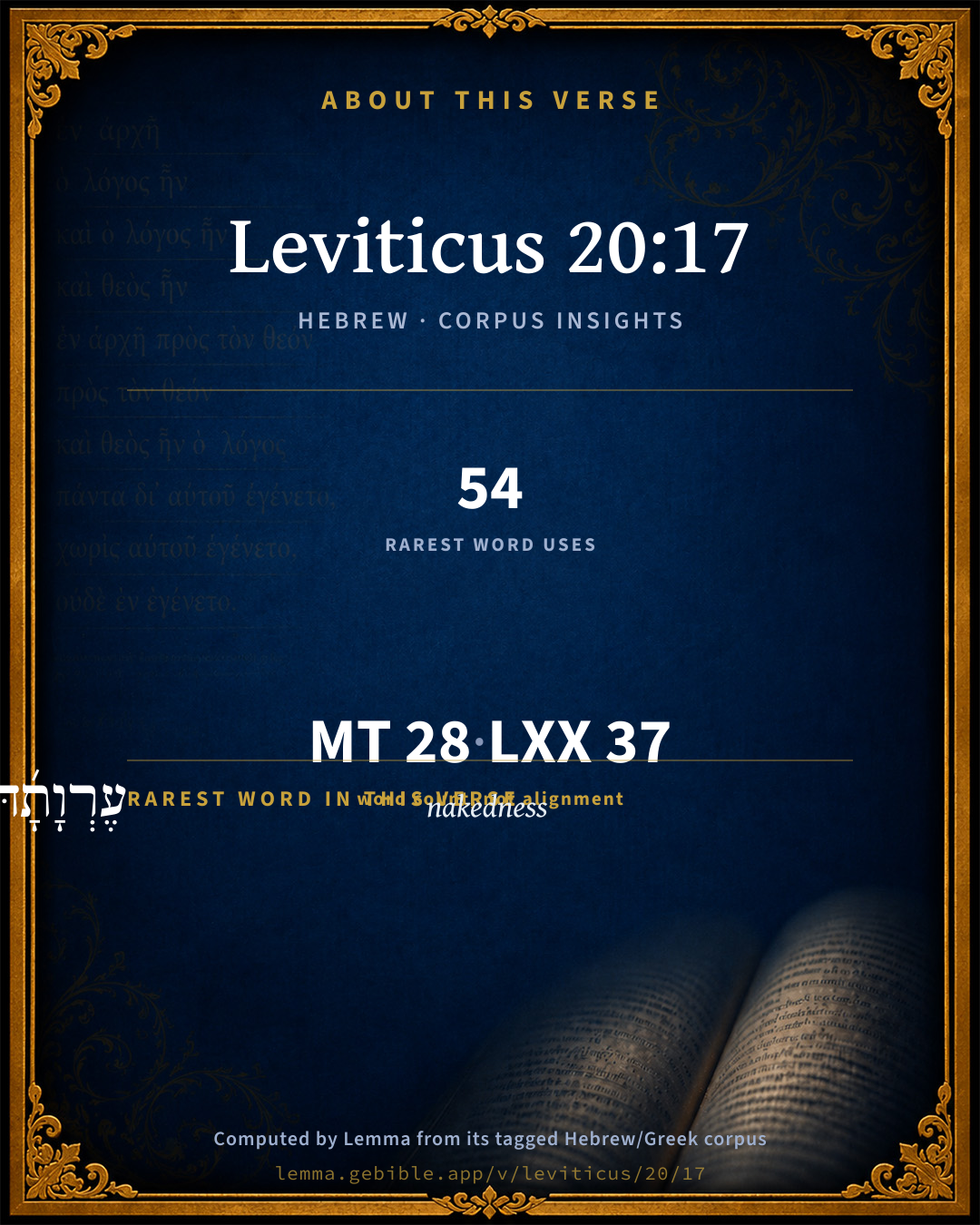
28
words
20
distinct lemmas
Pentateuch
section

Shared distinctive vocabulary

עֶרְוָתָ֜הּ nakedness H6172 occurs in 40 verses of the Hebrew Bible. Also found in:

Grammatical profile

  • 6 verbs
  • 15 nouns
  • 2 pronouns
  • 1 conjunction
  • 4 particles

Verb forms

  • יִקַּ֣ח Qal · Imperfect
  • וְרָאָ֨ה Qal · Sequential Perfect
  • תִרְאֶ֤ה Qal · Imperfect
  • וְנִ֨כְרְת֔וּ Niphal · Sequential Perfect
  • גִּלָּ֖ה Piel · Perfect
  • יִשָּֽׂא Qal · Imperfect

Repetition

Words recur within this verse — often emphatic in Hebrew:

  • עֶרְוָתָ֜הּ nakedness H6172 ×3
  • אֲחֹת֡וֹ sister H269 ×2
  • בַּת daughter H1323 ×2
  • וְרָאָ֨ה to see H7200 ×2
  • וְהִֽיא he H1931 ×2

Hebrew & Septuagint length

In English translation the verse runs 53 words from the Hebrew and 47 from the Septuagint (LXX English) — closely comparable.

A rough comparison of the two English renderings, which tokenize alike — not a word-level alignment.

Word counts can differ between the Hebrew and the Greek without any difference in meaning — e.g. the Hebrew direct-object marker אֵת has no separate Greek word, and Greek often adds the article ὁ.

In the original languages it is 28 Hebrew tokens and 37 Greek tokens — but the two are counted differently (Hebrew bundles its prefixes and suffixes into one token; the Greek is in lemma form), so that isn’t a like-for-like length.

Cross-references

5

Topical passages linked to Leviticus 20:17 in the Treasury of Scripture Knowledge — connected by theme and wording, ordered by reader-vote popularity; previews shown in the World English Bible.

  • Leviticus 18:9 "'You shall not uncover the nakedness of your sister, the daughter of your father, or the daughter of your mother, whether born at home, or born abroad.
  • Deuteronomy 27:22 Cursed be he who lies with his sister, the daughter of his father, or the daughter of his mother. All the people shall say, Amen.
  • Genesis 20:12 Moreover she is indeed my sister, the daughter of my father, but not the daughter of my mother; and she became my wife.
  • 2 Samuel 13:12 She answered him, No, my brother, do not force me; for no such thing ought to be done in Israel. Don't you do this folly.
  • Ezekiel 22:11 One has committed abomination with his neighbor's wife; and another has lewdly defiled his daughter-in-law; and another in you has humbled his sister, his father's daughter.

Cross-references courtesy of OpenBible.info (CC BY 4.0).

Hebrew and Greek witnesses Masoretic Hebrew ↔ Greek Septuagint

The same verse in the two great witnesses to the Old Testament, shown verse-for-verse.

These are two independent witnesses, not word-aligned to each other, and the Septuagint is shown in lemma (dictionary) form.

Hebrew Leviticus 20:17 Masoretic · Westminster Leningrad Codex

וְאִ֣ישׁ אֲשֶׁר יִקַּ֣ח אֶת אֲחֹת֡וֹ בַּת אָבִ֣יו א֣וֹ בַת אִ֠מּוֹ וְרָאָ֨ה אֶת עֶרְוָתָ֜הּ וְהִֽיא תִרְאֶ֤ה אֶת עֶרְוָתוֹ֙ חֶ֣סֶד ה֔וּא וְנִ֨כְרְת֔וּ לְעֵינֵ֖י בְּנֵ֣י עַמָּ֑ם עֶרְוַ֧ת אֲחֹת֛וֹ גִּלָּ֖ה עֲוֺנ֥וֹ יִשָּֽׂא

"'If a man takes his sister, his father's daughter, or his mother's daughter, and sees her nakedness, and she sees his nakedness; it is a shameful thing; and they shall be cut off in the sight of the children of their people: he has uncovered his sister's nakedness; he shall bear his iniquity.

World English Bible · Public Domain

Greek LXX Leviticus 20:17 Septuagint · lemma form

ὅς ἐάν λαμβάνω ὁ ἀδελφή αὐτός ἐκ πατήρ αὐτός ἤ ἐκ μήτηρ αὐτός καί ὁράω ὁ ἀσχημοσύνη αὐτός καί οὗτος ὁράω ὁ ἀσχημοσύνη αὐτός ὄνειδος εἰμί ἐκὀλεθρεύω ἐνώπιον υἱός γένος αὐτός ἀσχημοσύνη ἀδελφή αὐτός ἀποκαλύπτω ἁμαρτία κομίζω

Whosoever shall take his sister by his father or by his mother, and shall see her nakedness, and she see his nakedness, it is a reproach: they shall be destroyed before the children of their family; he has uncovered his sister's nakedness, they shall bear their sin.

LXX2012 (modern English Septuagint) · Public Domain

Hebrew: Westminster Leningrad Codex (CC BY 4.0). Greek: Septuagint (public domain); English from LXX2012 (modern English Septuagint) (Public Domain). How the Septuagint differs from the Hebrew →

Targum (Aramaic paraphrase)

2

The Targum is the ancient Jewish Aramaic paraphrase of the Hebrew Scriptures — an interpretive translation, not the Hebrew text itself. Onkelos (literal) and Pseudo-Jonathan (expansive) render the Torah, and Jonathan the Prophets. Coverage is partial: where no permissively-licensed English translation exists for a verse, only the Aramaic is shown. This is verse-level text, not a word-by-word alignment to the Hebrew.

  1. Targum Onkelos Torah (Genesis–Deuteronomy)
    וּגְבַר דִי יִסַב יָת אֲחָתֵהּ בַּת אֲבוּהִי אוֹ בַת אִמֵהּ וְיֶחֱזֵי יָת עֶרְיְתַהּ וְהִיא תֶחֱזֵי יָת עֶרְיְתֵהּ קְלָנָא הוּא וְיִשְׁתֵּיצוּן לְעֵינֵי בְּנֵי עַמְהוֹן עֶרְיַת אֲחָתֵהּ גַלִי חוֹבֵהּ יְקַבֵּל

    (no public-domain English translation for this verse)

    Targum Onkelos — Aramaic: “Onkelos Genesis” (public domain); “Onkelos Exodus” (public domain); “Onkelos Leviticus” (public domain); “Onkelos Numbers” (public domain); “Onkelos Deuteronomy” (public domain). English: “Sefaria Community Translation” (CC0 1.0 (public-domain dedication)); “J.W. Etheridge. The Targums of Onkelos and Jonathan Ben Uzziel on the Pentateuch. London: Longmans, Green, 1862” (public domain). Text via Sefaria.

  2. Targum Pseudo-Jonathan Torah (Genesis–Deuteronomy)
    וּגְבַר דִי יְשַׁמֵשׁ עִם אַחֲתֵיהּ בְּרַת אָבוֹי אוֹ בְּרַת אִימֵיהּ וְיִבְזֵי יַת עֶרְיְיתָהּ וְהִיא תִבְזֵי יַת עֶרְיְיתֵיהּ גְנַיי הוּא אֲרוּם חִסְדָא עֲבָדִית עִם קַדְמָאֵי מִן בִּגְלַל דְיִתְמְלֵי עַלְמָא מִנְהוֹן עַד לָא אִיתְיְהִיב קְיָימָא בְּעַלְמָא וּמִן דְאִתְיְהִיב קְיָימָא בְּעַלְמָא כָּל דְיֶעֱבַד כְּדֵין וְיִשְׁתֵּיצוּן בְּמוֹתָנָא וְחָמְיַין בְּבִישְׁתְּהוֹן בְּנֵי עַמְהוֹן מְטוֹל דְעֶרְיַית אַחְתֵיהּ בְּזֵי חוֹבֵיהּ יְקַבֵּל

    And if a man lie with his sister, his father's daughter, or the daughter of his mother, and he dishonour her nakedness, it is depravity: for I showed mercy with the first ones, on behalf of the peopling of the world by them, while as yet I had not promulged the law in the world: but after the law hath been declared in the world, every one who committeth these things shall be destroyed by mortality, and the children of their people shall witness their punishment; for he who hath dishonoured the nakedness of his sister shall be guilty of death.

    Targum Pseudo-Jonathan — Aramaic: “Targum Jonathan on Genesis” (public domain); “Targum Jonathan on Exodus” (public domain); “Targum Jonathan on Leviticus” (public domain); “Targum Jonathan on Numbers” (public domain); “Targum Jonathan on Deuteronomy” (public domain). English: “The Targum of Jonathan ben Uzziel, trans. J. W. Etheridge, London, 1862” (public domain). Text via Sefaria.

Commentary

Notes on Leviticus 20:17 from classic Christian and Jewish commentators (each source and its license shown beneath its notes). The classic Christian expositions comment on the surrounding passage and are grouped to its opening verse, so a note may address several verses; the Jewish commentaries on the Tanakh (Rashi and others) are per-verse, so they appear only where the commentator wrote on this verse.

Lemma curates 59 commentaries, every one of them public domain or Creative Commons licensed, each selected and text-cleaned for this edition rather than reprinted as found. About our sources →

Trapp's Complete Commentary

John Trapp

Lev 20:17 And if a man shall take his sister, his father’s daughter, or his mother’s daughter, and see her nakedness, and she see his nakedness; it [is] a wicked thing; and they shall be cut off in the sight of their people: he hath uncovered his sister’s nakedness; he shall bear his iniquity.

Ver. 17. And see her nakedness.] In the Pope’s war against the Albigenses, those ancient French Protestants, when the bishops had taken a great town yielded to them, they commanded the inhabitants, both men and women, to depart stark naked, Partibus illis, quae honeste nominari non possunt, sanctorum illorum cruciatorum oculis expositis, saith Rivet, {a} not suffering them to hide from the impure eyes of those pope holy fathers those parts that nature would have covered. David that had faulted in looking lustfully on bathing Bathsheba, prays hard, after he had smarted for it, "Turn away mine eyes from beholding vanity," &c. {Psa 119:37}

“ Cur aliquid vidi, cur noxia lumina feci? ” - Ovid.

See Hab 2:15. Of looking comes lusting, especially when they do σκοτειν, which is the apostle’s word, {2Co 4:14} so look, as the archer at the mark.

It is a wicked thing.] Heb., An impiety or reproach: Chesed, it is called, per antiphrasin. That may have a good name, the nature whereof is so ill that it is not to be named.

{a} Jesuita Vapulans., p. 331.

John Trapp, A Commentary or Exposition upon All the Books of the Old and New Testament (1647–1656) — public domain. Text from a community e-Sword module.

Joseph Benson's Commentary

Lev 20:17. See her nakedness — In this and several of the following verses, uncovering nakedness plainly appears to mean not marriage, but fornication or adultery.

Joseph Benson's Commentary on the Old and New Testaments (1811–1818) — public domain. Text from a community e-Sword module.

Tyndale Open Study Notes

Tyndale Open Resources

20:17 a shameful disgrace: Proper conduct brings honor both to individuals and to their households; improper conduct brings shame. • Both parties are cut off (see 7:20-21), but the man will be punished (see 5:1; 18:6).

Tyndale Open Study Notes — © Tyndale Open Resources, licensed CC BY-SA 4.0. Text via the HelloAO Bible API.

Geneva Bible (1599)

Geneva Bible translators

Hebrew, in the eyes of the children of their people.

Geneva Bible (1599) marginal notes — public domain. Text via Bolls.life.

Ellicott's Commentary for English Readers

(17) Take his sister.—See Lev_18:9.

A Bible Commentary for English Readers, edited by Charles John Ellicott (1878–1897) — public domain. Text from a community e-Sword module.

John Gill's Exposition

And if a man shall take his sister, his father's daughter, or his mother's daughter,.... Take her to be his wife, or commit lewdness with her, whether she be his sister by both father and mother's side, or whether by one only, either way she is his sister, and it is not lawful to marry her, or lie with her, see Lev 18:9,

and see her nakedness, and she see his nakedness; which is not to be understood of an immodest view, exposing to each other what should not be seen, and pleasing themselves wills such obscene sights, but of the act of lying together, for so it is afterwards explained by a phrase frequently used to express that action by; and it denotes, as Aben Ezra observes, their mutual consent and agreement in it:

it is a wicked thing; and by no means to be done; it is a breach of a former law, it is a scandalous and reproachful thing, and the word is sometimes used for reproach, as in Pro 14:34,

and they shall be cut off in the sight of their people; by death, either by the hand of the civil magistrate, or by the hand of God, by the pestilence, as the Targum of Jonathan; Ben Gersom interprets it, of their dying childless, as in some following cases, Lev 20:20,

he hath uncovered his sister's nakedness; or lay with her, which explains a preceding clause:

he shall bear his iniquity; the punishment of it, and he alone, as Aben Ezra observes.

John Gill's Exposition of the Whole Bible (1746–1763) — public domain (CC PDM 1.0). Text via the HelloAO Bible API.

Albert Barnes' Notes on the Bible

Cut off ... - See Exo 31:14 note. The more full expression here used probably refers to some special form of public excommunication, accompanied, it may be, by expulsion from the camp.

Albert Barnes' Notes on the Bible (1834–1885) — public domain. Text from a community e-Sword/MySword module.

Haydock's Catholic Bible Commentary

A crime. Hebrew chesed, commonly signifies an act of piety or goodness, as if Moses intended to insinuate that such marriages were at first lawful. (Thalmud; Selden, Jur. v. 8.) But a softer term is used to denote a great impiety, as the Hebrews say to bless, when they mean to curse, or to blaspheme; (Calmet) and the Greeks call the furies Eumenides, or "the good-natured." --- One another’s. Hebrew, "He hath uncovered his sister’s," &c. Whether they saw what was indecent or not, if they admitted of any unlawful commerce, they were to be stoned to death. (Haydock)

George Leo Haydock (1774–1849), Haydock's Catholic Family Bible and Commentary, 1859 edition — public domain. Excludes Psalms (Douay-Rheims chapter numbering differs from Protestant) and Deuterocanonical books (Catholic canon only).

Matthew Poole's English Annotations

Seeing is here understood, either,

1. Properly, and so God would cut off the occasions of further filthiness. Or rather,

2. Improperly, for touching her or lying with her; for,

1. The sense of seeing is oft put for other senses, as for hearing, Gen 42:1, compared with Act 7:12; Exo 20:18 Rev 1:12; and for touching, as Joh 20:25,29.

2. That act is expressed by words parallel to this of seeing, as by uncovering, or discovering, and by knowing, Gen 4:1.

3. So it is directly explained in the following words,

he hath uncovered his sister’s nakedness, which manifestly signifies lying with her.

4. It is not probable that an equal punishment would have been appointed to an immodest sight, and to the highest act of filthiness.

5. Nor seems there to be any reason why this crime should be restrained to this rather than to any other relations, when it was as great, yea, a greater crime in some other relations. In the sight of their people, i.e. publicly, for the terror and caution of others.

Matthew Poole's English Annotations on the Holy Bible (1683–1685) — public domain. Text from a community e-Sword/MySword module.

Whedon's Commentary on the Bible

Daniel D. Whedon

17. Sister — See Lev_18:9; Lev_18:11, notes.

Wicked thing — Properly a disgrace.

Daniel D. Whedon (gen. ed.), Commentary on the Old and New Testaments (1874–1909) — public domain. Text from a community e-Sword module.

John Wesley's Explanatory Notes

See her nakedness - In this and several of the following verses, uncovering nakedness plainly appears to mean not marriage, but fornication or adultery.

John Wesley, Explanatory Notes Upon the Whole Bible (1754–1765) — public domain. Text via the GEBible commentary corpus.

unfoldingWord translationNotes

Door43 World Missions Community

a man sleeps with

This is a polite way of saying that he had sex with his sister. Some languages use more direct phrases such as "a man had sex with." (See: Euphemism)

a daughter of his father or a daughter of his mother

This means a man cannot sleep with his sister, even if she has a different mother or father. The full meaning of this statement can be made explicit. AT: "whether it is his full sister or half-sister" (See: Assumed Knowledge and Implicit Information)

must be cut off from

A person being excluded from his community is spoken of as if he had been cut off from his people, as one would cut a piece of cloth or cut a branch from a tree. This can be translated in active form. See how you translated this idea in Leviticus 7:20. AT: "that person may no longer live among his people" or "you must separate that person from his people" (See: Metaphor and Active or Passive)

He must carry his guilt

This phrase means the man is responsibile for his sin. AT: "He is responsible for his sin" or "You must punish him" (See: Idiom)

menstrual period

the time when a woman bleeds from her womb

he has uncovered the flow of her blood, the source of her blood

This phrase compares having sex with a woman during her menstrual period to removing the cover off of something that should remain hidden. The fact that this was a shameful thing to do can be stated clearly. AT: "he has done a shameful thing by by uncovering the flow of her blood" (See: Metaphor and Assumed Knowledge and Implicit Information)

Both the man and woman must be cut off

It can be stated clearly why this must be done. AT: "Because they have done this shameful thing, both the man and woman must be cut off" (See: Assumed Knowledge and Implicit Information)

translationWords

had relations with

sister

ancestor

shame

cut off

people group

guilt

blood

unfoldingWord translationNotes — © Distant Shores Media and the Door43 World Missions Community, licensed CC BY-SA 4.0. Source: git.door43.org/Door43/en_tn.

Rashi

Rabbi Shlomo Yitzchaki (Rashi)

חסד הוא IT IS A WICKED THING — It is an Aramaic expression, the Hebrew חרפה (disgrace) being in that language חסודא (cf. Onkelos on Genesis 34:14). A Midrashic explanation of it (of חסד הוא) is; If you should say, "But Cain married his sister!" then I reply, Cain's case was an exceptional one; an act of kindness (חסד) was done by the Omnipresent in order that His world might be built up through him (i. e. He made the propagation of the human race possible through this union), as it is said (Psalms 89:3) "The world was built up through חסד, loving-kindness" (Sifra, Kedoshim, Chapter 11 11; Sanhedrin 58b).

Rashi on the Tanakh — English translations: “The Judaica Press complete Tanach with Rashi, translated by A. J. Rosenberg” (CC BY 4.0); “Pentateuch with Rashi's commentary by M. Rosenbaum and A.M. Silbermann, 1929-1934” (public domain); “The Metsudah Tanach series, Lakewood, N.J” (CC BY 4.0); and “The Book of Joshua, Metsudah Publications, 1997” (CC BY 4.0). Text via Sefaria.

Ramban (Nachmanides)

Rabbi Moshe ben Nachman (Ramban / Nachmanides)

AND IF A MAN ‘YIKACH’ (SHALL TAKE) HIS SISTER. Scripture mentions the term kichah [“taking,” which generally denotes the taking of a woman as a wife] in the case of a sister, although betrothal to her is not valid, because a brother and sister sleep together in one house, and when his desire overpowers him, he takes her and draws her to himself, and he does not have to come to her as one does to a woman who is a harlot. Similarly it is the way of Scripture to use the term “taking” in the case of all those with whom one remains alone, for a wife and her mother, [a wife] and her son’s daughter and her daughter’s daughter, a wife and her sister, Verse 18. and a brother’s wife are all [found] with him in one house [hence Scripture uses the term “taking” in each of these cases]. For a similar reason Scripture uses this expression in the following verse, A man shall not ‘take’ his father’s wife. The expression and he see her nakedness is an euphemism, since Scripture modifies its expression in speaking of forbidden relationships. Sometimes it calls sexual intercourse “uncovering of nakedness,” as it says in the case of most of the forbidden women, thou shalt not uncover her nakedness, for it is the way of those who commit fornication to uncover her skirts, similar to that which is said, and I will uncover thy skirts upon thy face; and at times it calls it “entering,” thus: If any man take a wife, and go in unto her, and hate her; to come in unto us; and he came in unto her, and she conceived by him., 38:18. Many times Scripture calls it “lying,” and here it refers to it as “seeing,” since brother and sister lodge together and there is no need for uncovering of skirts. Similarly Scripture uses the euphemism “knowing,” as in the following expressions: And the man knew Eve his wife;, 4:1. and he knew her again no more;, 38:26. a virgin, neither had any man known her., 24:16. And Scripture states [here in the verse before us] and she see his nakedness, meaning to say that she too desired his nakedness in her heart and consented thereto. Now it mentions these expressions only in the case of a sister, because in all forbidden relations when a man approaches a woman for the purpose of uncovering her nakedness, it is generally with her consent, and otherwise she can remove herself from him and cry for help, but in the case of a brother [and sister] who lodge together, it may be that it was done without her knowledge, and therefore Scripture mentioned that she too “saw his nakedness.”

IT IS ‘CHESED.’ In the opinion of the commentators ). chesed here means “shame,” because all people will naturally be ashamed of this ugly sin, this being used here as in the Aramaic language, for Onkelos translated, for that were ‘a disgrace’ unto us, “for that were chisudo unto us.” Yonathan ben Uziel also translated and I will lay it for ‘a reproach,’ “[and I will lay it for] chisudo.” And in the language of the Sages [we find]: “Because shechasdo (he shamed him) in public.” Similarly, lest he that heareth it ‘y’chasedcha’ means “lest he cause you shame upon your revealing the secret of another.”And they shall be cut off in the sight of the children of their people. The intention thereof is as follows: “You have done this secretly, but G-d will reveal your sin by bringing upon you a punishment before all the children of your people.” He mentioned this with reference to a sin which is done in utmost secrecy, but it applies as well to all [sins punishable by] excision, as I have mentioned. He hath uncovered his sister’s nakedness; he shall bear his iniquity. This means that if he had uncovered his sister’s nakedness against her will, he alone shall bear his iniquity, as Rabbi Abraham ibn Ezra commented. But in my opinion the expression he hath uncovered his sister’s nakedness; he shall bear his iniquity means that each one of those mentioned [will bear the iniquity], just like the expression for he hath made naked his near kin; they shall bear their iniquity. The correct interpretation of the word chesed [it is ‘chesed’] appears to me to be according to its plain sense [“goodness,” “kindness”]. So also is the opinion of our Rabbis. 11:9. “It is ‘chesed.’ And if you should say: ‘But Cain did marry his sister!’ It is for this reason that Scripture states, it is ‘chesed’ [an act of kindness — done by the Creator in order that the world be built up], for the world from its very start was created only by kindness, as it is said, The world was built up through kindness” (Psalms 89:3). The verse is thus stating that the brother’s kinship is kindness, and it is not proper for the uncovering of nakedness. Thus in the case of other relations Scripture mentions that the reason [for the prohibition of sexual intercourse] is because they are next of kin, but in the case of a brother [and sister] it mentions as the reason the kindness which should be among them. The word ish [and if ‘a man’ shall take his sister] thus draws along with it a similar word [so that the expression it is ‘chesed’ becomes “it is ish chesed,” meaning: “it is a man who should have acted kindly to her, but he did the contrary, and hence his punishment is severe”]. Or it may be that [the expression it is ‘chesed’] is like: and I am prayer [which means: “and I am ‘a man of’ prayer”; for thou art precious things [which means: “for thou art ‘a man of’ precious things”]; Behold, I am against thee, O arrogance [which means: “‘man of’ arrogance”], in all of which cases the word ish (man) is missing [and here too that word is omitted, as if it were to say: “it is ish chesed,” as explained above]. Or it may be that Scripture in these cases refers to these men by their qualities [as if to say, “kindness personifies the brother,” “I am all prayer,” “he is all preciousness,” or “arrogance personified”. Thus Scripture is stating, And if a man shall take his sister … and see her nakedness … he is [to have been] the man of kindness, and they shall be cut off, for he hath uncovered his sister’s nakedness; he shall bear his iniquity. Thus He mentioned that the brother should have been the merciful man who doeth good to his own soul, but he was cruel and troubled his own flesh. For he should have done the kindness to her that brothers do, to give her in marriage to a husband, but he blemished and troubled her. Scripture ascribes the fault in such cases to the male, just as it is said, he hath uncovered his brother’s [wife’s] nakedness; they shall be childless [and likewise here too it states, ‘he’ hath uncovered his sister’s nakedness]. Similarly it is my opinion that the expression, lest he that heareth it ‘y’chasedcha’ means “lest he that hears it will remove from you all kindness, because you have not shown kindness to your friend who entrusted you with his secret.” [The word y’chasedcha here meaning “remove kindness”] is like: l’dashno [the root of which deshen in its primary sense means “to cover with ashes,” but also has the opposite meaning of “removing the ashes”]; and all mine increase ‘t’shareish’ [which, in its ordinary form, would mean “to take root,” but also has the opposite meaning of “rooting out”], and similar cases. [Likewise, y’chasedcha which is of the root chesed, kindness, means in the verse quoted “remove kindness,” and does not mean “shame.”] For it appears to me unlikely that the word chesed in the Sacred Language should bear such opposite meanings [as “kindness” and “shame”], when Scriptural texts abound in the praise of chesed and use it in prayers. The term chisudo, however, in Aramaic is another matter. Even that language differentiates between the two usages; “kindness” is translated chisdo, Onkelos translates: “and He showed him [Joseph] chisdo” (mercy, kindness). and “shame” is translated chisudo. Now Rabbeinu Chananel wrote that ‘chesed’ to any people is sin means “reproach” [i.e., that sin is “a reproach” to any people]. But in my opinion this too is an expression of contrast [as will be explained]. For “righteousness” and chesed are mentioned in that verse [thus: Righteousness exalteth a nation, but ‘chesed’ to any people is sin], these being twin terms mentioned in all places, as for example: he that followeth after righteousness and ‘chesed;’, 21:21. that I am the Eternal who exercises ‘chesed,’ justice, and righteousness in the earth. Rather, the meaning of the verse in my opinion is as follows: “Righteousness if practiced exalteth a nation, but ‘chesed’ (mercy, kindness) is a reproach to any people if it fails to practice it.” Thus the verse is stating that upon righteousness and mercy depends the elevation or the decline of any people. Or it may be [that the verse is] stating: “Righteousness exalts any individual nation that practices it, while many nations sin by their failure to do mercy.” A similar example of such a verse is the one immediately preceding it: In the heart of him that hath discernment, wisdom resteth; but in the inward part of fools it maketh itself known, the meaning of which is that “it makes itself known that [wisdom] is not there,” for all who see them recognize by their deeds that they are fools and there is no understanding in them. These two verses [thus express their thoughts in their second half] in a negative manner. if it does not practice it. In the inward part of fools it makes itself known that wisdom does not rest therein.Emor

Ramban (Nachmanides) on the Tanakh — English translation: “Commentary on the Torah by Ramban (Nachmanides). Translated and annotated by Charles B. Chavel. New York, Shilo Pub. House, 1971-1976” (CC BY 4.0). Text via Sefaria.

Lesson kit

Teaching starters — assembled from the data on this page, not authored interpretation. Every prompt links to the verse data it draws on. Edit before teaching.

Leviticus, in the Pentateuch, opens this verse with 28 words (20 distinct Hebrew lemmas). Its most distinctive word is ʻervâh (“nakedness”). A historical commentator’s framing appears above. Read the whole chapter for the surrounding context.

Discussion questions

  1. The word ʻervâh carries the sense “nakedness.” How does it shape the verse?
  2. Genesis 9:22 shares the word «nakedness» with this verse. How do the two illuminate each other?
  3. “nakedness” occurs 3× in this one verse. What is the effect of the repetition?
  4. These translations render this verse differently; the difference is in the English rendering, not the original. What questions does that raise?
  5. The verb «יִקַּ֣ח» is Qal Imperfect. How does its form color the action?
  6. Reading how Trapp's Complete Commentary and Joseph Benson's Commentary read this verse, where do the two commentators agree and where do they part?

Things to notice

Reading settings

Reading text

Shown beneath each verse's original-language words.

Old Testament
Old Testament edition

Read the OT as the Masoretic Hebrew (MT) or the Greek Septuagint (LXX).

English shown for the Greek Septuagint (in the Hebrew ↔ Greek comparison).

Comparing translations? Open the Compare panel on any verse page to stack up to four side by side.