
Numbers 11:33

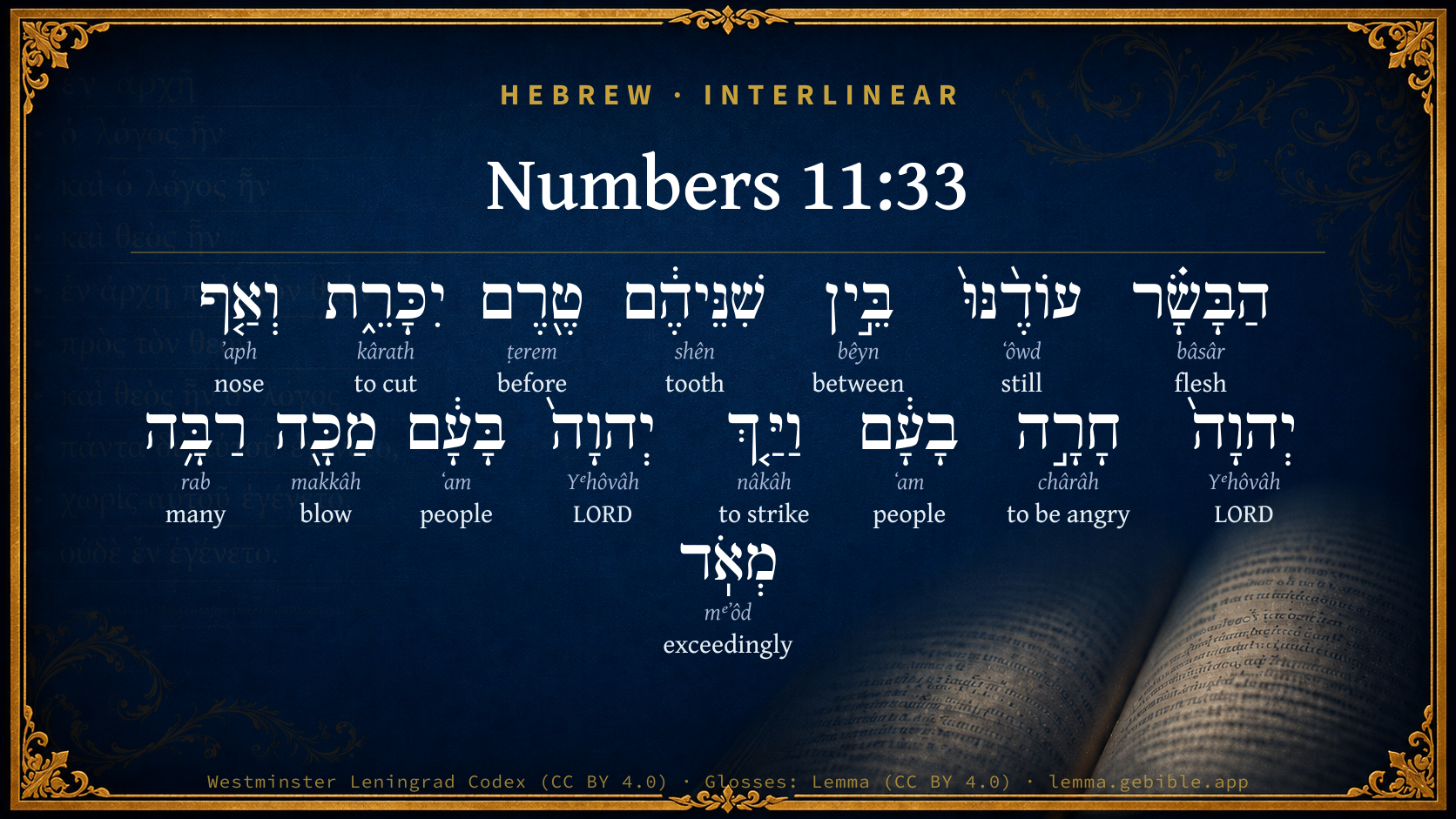
Hebrew (Westminster Leningrad Codex) Numbers 11:33 appears in the Hebrew Old Testament. The text above is from the Westminster Leningrad Codex. Each word links to its Strong’s number, a concise gloss, and parsing drawn from the Open Scriptures Hebrew Bible morphology. Click any word for its full Brown-Driver-Briggs (BDB) entry.
Download image
Cite this verse

Numbers 11:33 (World English Bible). Public Domain. Lemma interlinear Bible study tool, https://lemma.gebible.app/v/numbers/11/33.

Show BibTeX & RIS
BibTeX
RIS
English Translation
While the flesh was yet between their teeth, before it was chewed, the anger of Yahweh was kindled against the people, and Yahweh struck the people with a very great plague.
World English Bible · Public Domain
Download a study sheet

One document with this verse’s original text, its word-by-word gloss line, the meaning frame, cross-references with their text, attributed commentary, and full source and license credits — printable, and it pastes into notes with its structure intact.

This verse Autodidact and up

Study sheet (.html) Plain text (.txt)

A passage Seminary Student

Up to 50 verses in one chapter. A passage sheet keeps up to 6 commentary sources and 12 cross-references per verse, in the order this page ranks them, and says so on the sheet whenever that leaves anything out. Ask for a single verse and you get the Autodidact verse sheet above.

Everything on this page stays free to read, with no account — the sheet is a download of what is already on screen, not access to it.

Want to remove ads? Support Godless Engineer
Compare translations 3

The same verse in 3 English versions, stacked beneath the original-language interlinear above. Click any original word for its lexicon entry.

Each is an independent rendering of the whole verse — the interlinear is not word-aligned to these translations.

Highlighted words mark where these versions differ — a whole-verse word diff, not a word-by-word alignment.

  • World English Bible Public Domain
    While the flesh was yet between their teeth, before it was chewed, the anger of Yahweh was kindled against the people, and Yahweh struck the people with a very great plague.
  • King James Version Public Domain
    And while the flesh was yet between their teeth, ere it was chewed, the wrath of the LORD was kindled against the people, and the LORD smote the people with a very great plague.
  • unfoldingWord Literal Text CC BY-SA 4.0
    The flesh still between their teeth, before it was cut off, and the nose of Yahweh burned against the people, and Yahweh struck the people an exceedingly great striking,

unfoldingWord Literal Text — © unfoldingWord, licensed CC BY-SA 4.0. Word-aligned USFM3 via Door43 (git.door43.org/unfoldingWord/en_ult).

Versions to compare (up to 4)

3 of 4 selected

Show all 18 translations

Every available English version of this verse, each an independent rendering of the whole verse.

  • World English Bible Public Domain
    While the flesh was yet between their teeth, before it was chewed, the anger of Yahweh was kindled against the people, and Yahweh struck the people with a very great plague.
  • Berean Standard Bible Public Domain
    But while the meat was still between their teeth, before it was chewed, the anger of the LORD burned against the people, and the LORD struck them with a severe plague.
  • Majority Standard Bible Public Domain
    But while the meat was still between their teeth, before it was chewed, the anger of the LORD burned against the people, and the LORD struck them with a severe plague.
  • King James Version Public Domain
    And while the flesh was yet between their teeth, ere it was chewed, the wrath of the LORD was kindled against the people, and the LORD smote the people with a very great plague.
  • American Standard Version (1901) Public Domain
    While the flesh was yet between their teeth, ere it was chewed, the anger of Jehovah was kindled against the people, and Jehovah smote the people with a very great plague.
  • Revised Version (1885) Public Domain
    While the flesh was yet between their teeth, ere it was chewed, the anger of the LORD was kindled against the people, and the LORD smote the people with a very great plague.
  • Geneva Bible (1599) Public Domain
    While the flesh was yet betweene their teeth, before it was chewed, euen the wrath of the Lord was kindled against the people, and the Lord smote the people with an exceeding great plague.
  • Douay-Rheims (1899) Public Domain
    As yet the flesh was between their teeth, neither had that kind of meat failed: when behold the wrath of the Lord being provoked against the people, struck them with an exceeding great plague.
  • Young's Literal Translation Public Domain
    The flesh is yet between their teeth -- it is not yet cut off -- and the anger of Jehovah hath burned among the people, and Jehovah smiteth among the people -- a very great smiting;
  • Literal Standard Version CC BY-SA 4.0
    The flesh is yet between their teeth—it is not yet cut off—and the anger of YHWH has burned among the people, and YHWH strikes [with] a very great striking among the people;
  • Unlocked Literal Bible CC BY-SA 4.0
    While the meat was still between their teeth, while they were chewing it, Yahweh became angry at them. He attacked the people with a very great disease.
  • unfoldingWord Literal Text CC BY-SA 4.0
    The flesh still between their teeth, before it was cut off, and the nose of Yahweh burned against the people, and Yahweh struck the people an exceedingly great striking,
  • Darby Bible Public Domain
    The flesh was yet between their teeth, before it was chewed, when the wrath of Jehovah was kindled against the people, and Jehovah smote the people with a very great plague.
  • World Messianic Bible Public Domain
    While the meat was still between their teeth, before it was chewed, the LORD’s anger burned against the people, and the LORD struck the people with a very great plague.
  • Webster's Bible Public Domain
    And while the flesh was yet between their teeth, ere it was chewed, the wrath of the LORD was kindled against the people, and the LORD smote the people with a very great plague.
  • Free Bible Version CC BY-SA 4.0
    But while the people were still biting into the meat, before they even chewed it down, the Lord showed his burning anger against them, killing some of them with a severe disease.
  • Bible in Basic English Public Domain
    But while the meat was still between their teeth, before it was tasted, the wrath of the Lord was moved against the people and he sent a great outburst of disease on them.
  • JPS Tanakh (1917) Public Domain
    While the flesh was yet between their teeth, ere it was chewed, the anger of the LORD was kindled against the people, and the LORD smote the people with a very great plague.

Literal Standard Version (2020), Covenant Press — licensed CC BY-SA 4.0. Text via the HelloAO Bible API (eBible.org). Unlocked Literal Bible (unfoldingWord) — licensed CC BY-SA 4.0. Text via the HelloAO Bible API (eBible.org). unfoldingWord Literal Text — © unfoldingWord, licensed CC BY-SA 4.0. Word-aligned USFM3 via Door43 (git.door43.org/unfoldingWord/en_ult). Free Bible Version, Dr. Jonathan Gallagher — licensed CC BY-SA 4.0. Text via the HelloAO Bible API (eBible.org).

Word by word

More ways to search: Search by grammar → Find every occurrence → Compare this word →

Practice this passage: Drill this verse → Learn its vocabulary →

מַכָּ֖ה
makkâh
H4347
“blow”
Noun, Common, Feminine, Singular, Absolute
Part of Speech
Noun
Type
Common
Gender
Feminine
Number
Singular
State
Absolute
Full BDB Definition

Origin: from H5221

TWOT: 1364d

blow, wound, slaughter - blow, stripe - beating, scourging - wound - slaughter - defeat, conquest - plague
  1. הַבָּשָׂ֗ר bâsâr H1320 “the · flesh” Particle, Definite Article + Noun, Common, Masculine, Singular, Absolute
  2. עוֹדֶ֨נּוּ֙ ʻôwd H5750 “still · his” Adverb + Suffix, Personal, 3rd Person, Masculine, Singular
  3. בֵּ֣ין bêyn H996 “between” Preposition
  4. שִׁנֵּיהֶ֔ם shên H8127 “teeth · their” Noun, Common, Both, Dual, Construct + Suffix, Personal, 3rd Person, Masculine, Plural
  5. טֶ֖רֶם ṭerem H2962 “before” Adverb
  6. יִכָּרֵ֑ת kârath H3772 “to cut” Verb, Niphal, Imperfect, 3rd Person, Masculine, Singular
  7. וְאַ֤ף ʼaph H639 “and · nose of” Conjunction + Noun, Common, Masculine, Singular, Construct
  8. יְהוָה֙ Yᵉhôvâh H3068 “LORD” Noun, Proper
  9. חָרָ֣ה chârâh H2734 “to be angry” Verb, Qal, Perfect, 3rd Person, Masculine, Singular
  10. בָעָ֔ם ʻam H5971 “in/at the · people” Preposition, Determined + Noun, Common, Masculine, Singular, Absolute
  11. וַיַּ֤ךְ nâkâh H5221 “and · to strike” Conjunction + Verb, Hiphil, Sequential Imperfect, 3rd Person, Masculine, Singular
  12. יְהוָה֙ Yᵉhôvâh H3068 “LORD” Noun, Proper
  13. בָּעָ֔ם ʻam H5971 “in/at the · people” Preposition, Determined + Noun, Common, Masculine, Singular, Absolute
  14. רַבָּ֥ה rab H7227 “many” Adjective, Adjective, Feminine, Singular, Absolute
  15. מְאֹֽד mᵉʼôd H3966 “exceedingly” Adverb

About this verse

These counts appear in no published source. They are computed here, from the morphology-tagged text and Lemma’s own curated glosses. What Lemma adds →

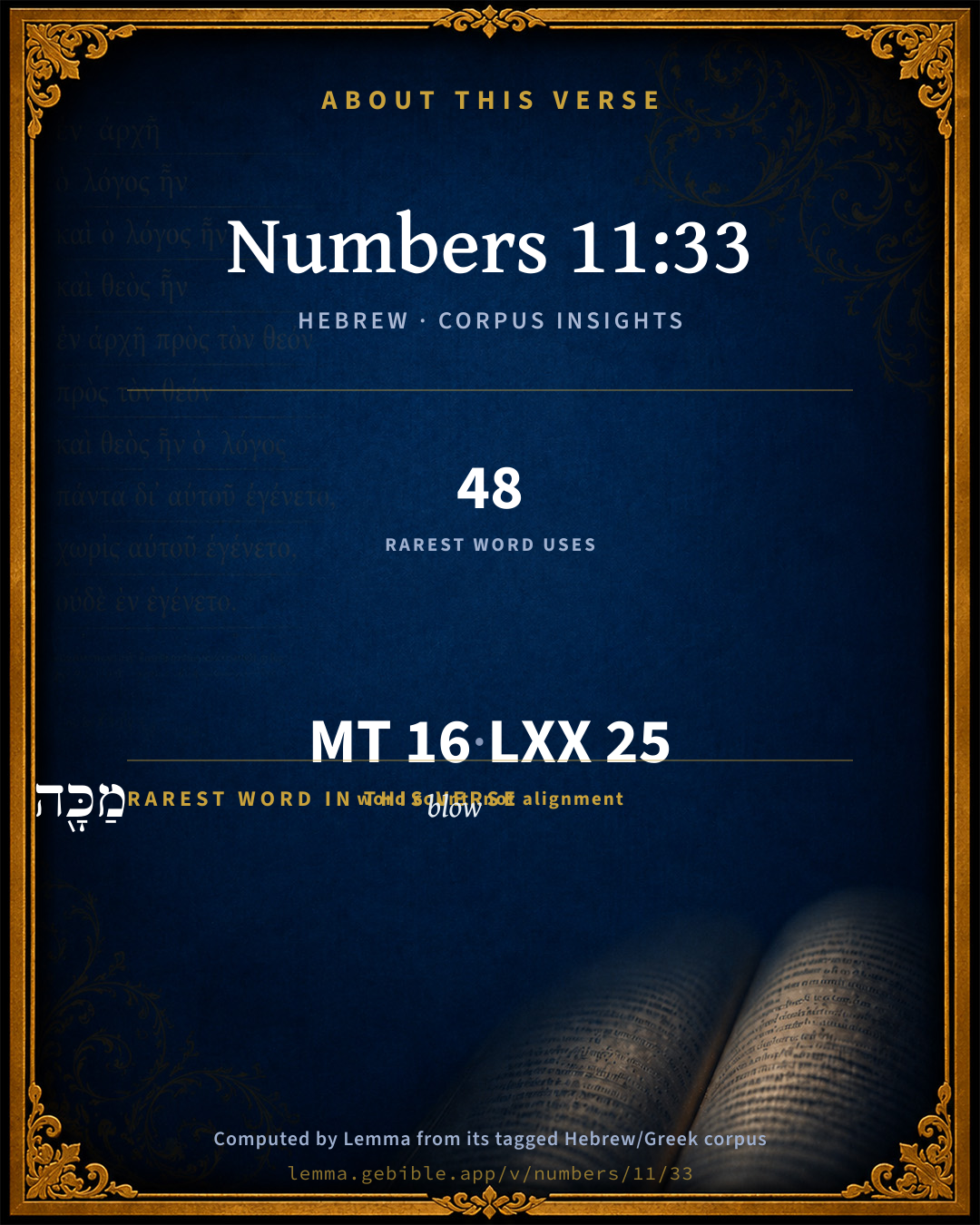
16
words
14
distinct lemmas
Pentateuch
section

Shared distinctive vocabulary

מַכָּ֖ה blow H4347 occurs in 46 verses of the Hebrew Bible. Also found in:

Grammatical profile

  • 3 verbs
  • 8 nouns
  • 1 adjective
  • 1 preposition
  • 3 adverbs

Verb forms

  • יִכָּרֵ֑ת Niphal · Imperfect
  • חָרָ֣ה Qal · Perfect
  • וַיַּ֤ךְ Hiphil · Sequential Imperfect

Repetition

Words recur within this verse — often emphatic in Hebrew:

  • יְהוָה֙ LORD H3068 ×2
  • בָעָ֔ם people H5971 ×2

Hebrew & Septuagint length

In English translation the verse runs 31 words from the Hebrew and 29 from the Septuagint (LXX English) — closely comparable.

A rough comparison of the two English renderings, which tokenize alike — not a word-level alignment.

Word counts can differ between the Hebrew and the Greek without any difference in meaning — e.g. the Hebrew direct-object marker אֵת has no separate Greek word, and Greek often adds the article ὁ.

In the original languages it is 16 Hebrew tokens and 25 Greek tokens — but the two are counted differently (Hebrew bundles its prefixes and suffixes into one token; the Greek is in lemma form), so that isn’t a like-for-like length.

Cross-references

5

Topical passages linked to Numbers 11:33 in the Treasury of Scripture Knowledge — connected by theme and wording, ordered by reader-vote popularity; previews shown in the World English Bible.

  • Psalms 78:30–31 They didn't turn from their cravings. Their food was yet in their mouths,
  • Psalms 106:14–15 But gave in to craving in the desert, And tested God in the wasteland.
  • Numbers 16:49 Now those who died by the plague were fourteen thousand and seven hundred, besides those who died about the matter of Korah.
  • Numbers 25:9 Those who died by the plague were twenty-four thousand.
  • Deuteronomy 28:27 Yahweh will strike you with the boil of Egypt, and with the tumors, and with the scurvy, and with the itch, of which you can not be healed.

Cross-references courtesy of OpenBible.info (CC BY 4.0).

Hebrew and Greek witnesses Masoretic Hebrew ↔ Greek Septuagint

The same verse in the two great witnesses to the Old Testament, shown verse-for-verse.

These are two independent witnesses, not word-aligned to each other, and the Septuagint is shown in lemma (dictionary) form.

Hebrew Numbers 11:33 Masoretic · Westminster Leningrad Codex

הַבָּשָׂ֗ר עוֹדֶ֨נּוּ֙ בֵּ֣ין שִׁנֵּיהֶ֔ם טֶ֖רֶם יִכָּרֵ֑ת וְאַ֤ף יְהוָה֙ חָרָ֣ה בָעָ֔ם וַיַּ֤ךְ יְהוָה֙ בָּעָ֔ם מַכָּ֖ה רַבָּ֥ה מְאֹֽד

While the flesh was yet between their teeth, before it was chewed, the anger of Yahweh was kindled against the people, and Yahweh struck the people with a very great plague.

World English Bible · Public Domain

Greek LXX Numbers 11:33 Septuagint · lemma form

ὁ κρέας ἔτι εἰμί ἐν ὁ ὀδούς αὐτός πρίν ἤ ἐκλείπω καί κύριος θυμόω εἰς ὁ λαός καί πατάσσω κύριος ὁ λαός πληγή μέγας σφόδρα

The flesh was yet between their teeth, before it failed, when the Lord was angry with the people, and the Lord struck the people with a very great plague.

LXX2012 (modern English Septuagint) · Public Domain

Hebrew: Westminster Leningrad Codex (CC BY 4.0). Greek: Septuagint (public domain); English from LXX2012 (modern English Septuagint) (Public Domain). How the Septuagint differs from the Hebrew →

Targum (Aramaic paraphrase)

2

The Targum is the ancient Jewish Aramaic paraphrase of the Hebrew Scriptures — an interpretive translation, not the Hebrew text itself. Onkelos (literal) and Pseudo-Jonathan (expansive) render the Torah, and Jonathan the Prophets. Coverage is partial: where no permissively-licensed English translation exists for a verse, only the Aramaic is shown. This is verse-level text, not a word-by-word alignment to the Hebrew.

  1. Targum Onkelos Torah (Genesis–Deuteronomy)
    בִּשְׂרָא עַד כְּעַן בֵּין שִׁנֵיהוֹן עַד לָא פְסַק וְרָגְזָא דַיְיָ תְּקֵיף בְּעַמָא וּקְטַל יְיָ בְּעַמָא קְטוֹל סַגִי לַחֲדָא

    (no public-domain English translation for this verse)

    Targum Onkelos — Aramaic: “Onkelos Genesis” (public domain); “Onkelos Exodus” (public domain); “Onkelos Leviticus” (public domain); “Onkelos Numbers” (public domain); “Onkelos Deuteronomy” (public domain). English: “Sefaria Community Translation” (CC0 1.0 (public-domain dedication)); “J.W. Etheridge. The Targums of Onkelos and Jonathan Ben Uzziel on the Pentateuch. London: Longmans, Green, 1862” (public domain). Text via Sefaria.

  2. Targum Pseudo-Jonathan Torah (Genesis–Deuteronomy)
    רַשִׁיעַיָא הֲווֹן אָכְלִין מִן בִּשְרָא וּלְמַאן דְיַהֲבִית לְהוֹן לָא הֲווֹן מְכָרְכִין בִּישְרָא עַד כְּדוֹן הֲוָה בֵּינֵי כַּכֵיהוֹן עַד לָא פָסַק וְרוּגְזָא דַיְיָ תַּקִיף בְּרִשְׁעֵי עַמָא וּקְטֵיל יְיָ בְּעַמָא קְטוֹל סַגִי לַחֲדָא

    The wicked ate of the flesh, yet offered no thanksgiving to Him who had given it to them: but while the flesh was between their teeth, and not consumed, the anger of the Lord waxed strong against the evil people, and the Lord slew the people with a very great mortality.

    Targum Pseudo-Jonathan — Aramaic: “Targum Jonathan on Genesis” (public domain); “Targum Jonathan on Exodus” (public domain); “Targum Jonathan on Leviticus” (public domain); “Targum Jonathan on Numbers” (public domain); “Targum Jonathan on Deuteronomy” (public domain). English: “The Targum of Jonathan ben Uzziel, trans. J. W. Etheridge, London, 1862” (public domain). Text via Sefaria.

Commentary

Notes on Numbers 11:33 from classic Christian and Jewish commentators (each source and its license shown beneath its notes). The classic Christian expositions comment on the surrounding passage and are grouped to its opening verse, so a note may address several verses; the Jewish commentaries on the Tanakh (Rashi and others) are per-verse, so they appear only where the commentator wrote on this verse.

Lemma curates 59 commentaries, every one of them public domain or Creative Commons licensed, each selected and text-cleaned for this edition rather than reprinted as found. About our sources →

Joseph Benson's Commentary

Num 11:33. The Lord smote the people with a very great plague — With a pestilence, say some, with a consumption, say others. But it seems more probable that it was by some untimely death, which was the effect of their own gluttony and intemperance. This seems to agree best with the threatening, Num 11:20. God was pleased, in a great measure, to overlook their first murmuring, about a year before, when he sent them the manna, because they were then under great necessity, being really pinched with hunger; whereas now that they were fed with bread from heaven, they cried for meat, not from need, but mere wantonness, and that after much experience of God’s care and kindness, after he had pardoned their former sins, and after he had made known his laws to them in a most solemn and terrible manner. Besides, the longer God exercises forbearance, the more is the offender’s guilt aggravated, if he remain impenitent. Reader, remember, “the goodness of God leads thee to repentance,” and take heed that thou do not, “after thy hardness and impenitent heart, treasure up to thyself wrath against the day of wrath!”

Joseph Benson's Commentary on the Old and New Testaments (1811–1818) — public domain. Text from a community e-Sword module.

Jamieson, Fausset & Brown

Robert Jamieson, A. R. Fausset & David Brown

while the flesh was yet between their teeth, ere it was chewed--literally, "cut off"; that is, before the supply of quails, which lasted a month (Num 11:20), was exhausted. The probability is, that their stomachs, having been long inured to manna (a light food), were not prepared for so sudden a change of regimen--a heavy, solid diet of animal food, of which they seem to have partaken to so intemperate a degree as to produce a general surfeit, and fatal consequences. On a former occasion their murmurings for flesh were raised (Exo 16:1-8) because they were in want of food. Here they proceeded, not from necessity, but wanton, lustful desire; and their sin, in the righteous judgment of God, was made to carry its own punishment.

Jamieson, Fausset & Brown — Commentary Critical and Explanatory on the Whole Bible (1871) — public domain (CC PDM 1.0). Text via the HelloAO Bible API.

Adam Clarke's Commentary

Verse 33. The wrath of the Lord was kindled] In what way, and with what effects, we cannot precisely determine. Some heavy judgment fell upon those murmurers and complainers, but of what kind the sacred writer says nothing.

Adam Clarke's Commentary on the Bible (1810–1826) — public domain. Text from a community e-Sword/MySword module.

Ellicott's Commentary for English Readers

(33) With a very great plague.—The noun, maccah. plague, is cognate to the verb which is rendered smote. It is frequently used of a stroke inflicted by God, as, e.g., pestilence or any epidemic sickness. A surfeit, such as that in which the Israelites had indulged, especially under the circumstances in which they were placed, would naturally produce a considerable amount of sickness. Here, then, as in the account of the plagues of Egypt and in other parts of the sacred history, the natural and the supernatural are closely combined.

A Bible Commentary for English Readers, edited by Charles John Ellicott (1878–1897) — public domain. Text from a community e-Sword module.

The Cambridge Bible for Schools and Colleges

gen. ed. J. J. S. Perowne

33. ere it was chewed] ere it came to an end, i.e. before the supply of flesh ran short.

The Cambridge Bible for Schools and Colleges (gen. ed. J. J. S. Perowne; Cambridge University Press, 1878–1918) — public domain. Text from a community e-Sword module.

John Gill's Exposition

And while the flesh was yet between their teeth,.... When they had just got it into their mouths, and were about to bite it:

ere it was chewed; or "cut off"; or cut into pieces by the "incisores", or fore teeth, and then ground by the "molares", or grinders, and so became fit to be swallowed. Both quails and locusts were eaten as food; the former is a fat and delicious fowl, and the latter, some sorts of them, at least, were allowed clean food for the Jews, and were fed on by many people:

the wrath of the Lord was kindled against the people; for their lusting after flesh, and despising the manna:

and the Lord smote the people with a very great plague; the pestilence, as Aben Ezra; or with fire, as Bochart (e), who gives the following reasons why the people were so severely punished now, and not before, when they murmured on a like account; because their sin's were greater, and more aggravated, they falling again into the same sin which had been forgiven them; and besides, they were before pressed with famine, now they had a plenty of manna every day; and also were better instructed, having received the law, which was not yet given when they were just come out of Egypt. Sulpitius (f) the historian says, 23,000 perished at this time.

(e) Ut supra, (Hierozoic. par. 2. l. 1. c. 15.) col. 109.

John Gill's Exposition of the Whole Bible (1746–1763) — public domain (CC PDM 1.0). Text via the HelloAO Bible API.

Haydock's Catholic Bible Commentary

Plague of fire, ver. 3, Psalm lxxvii. 21. (Cornelius a Lapide) --- Failed, after the month was expired. (Menochius) --- They had been accustomed to live upon manna, which was a light food, during the space of a year; and now eating greedily of this flesh, their stomachs were overcharged, and they died of an indigestion. (Calmet) --- The Rabbins say, God punished their gluttony by death, and obliged the rest of the Hebrews to abstain from all flesh, except from that of the peace-offerings, till they entered the promised land. (Selden, Syn. 2, 4.)

George Leo Haydock (1774–1849), Haydock's Catholic Family Bible and Commentary, 1859 edition — public domain. Excludes Psalms (Douay-Rheims chapter numbering differs from Protestant) and Deuterocanonical books (Catholic canon only).

Matthew Poole's English Annotations

Chewed, Heb. cut off, to wit, from their mouths, which is here understood, and expressed Joe 1:5, i.e. ere it was taken away, as the flocks are said to be cut off from the fold, Hab 3:17, when they are lost and perished. The sense is, before they had done eating their quails, which lasted for a month, as appears from Num 11:20.

A very great plague; whether it was leanness sent into them, Psa 106:15, whereby the food was deprived of its nourishing power, which it hath only from God’s blessing; or surfeit, a punishment most suitable to their sin, and most likely to follow their intemperate desire and use of this food; or the pestilence; it is not much material: but a great and sore plague unquestionably it was.

Quest. Why did God so sorely punish the people’s murmuring and complaining for lack of flesh here, when he spared them after the same sin, Exo 16?

Answ. Because this sin was a far greater sin than that, and aggravated with worse circumstances; as proceeding not from necessity, as that did, when as yet they had no food, but from mere lust and wantonness, when they had manna constantly given them; as committed after large experience of God’s care and kindness, after God had pardoned their former sins, and after God had in a solemn and terrible manner made known his laws and duty to them.

Matthew Poole's English Annotations on the Holy Bible (1683–1685) — public domain. Text from a community e-Sword/MySword module.

Whedon's Commentary on the Bible

Daniel D. Whedon

33. While the flesh… teeth — Before the flesh was chewed and swallowed, the wrath of Jehovah burned against the people, not as Knobel supposes, as the effect of the excessive quantity of quails eaten, producing giddiness and convulsions, but as a manifest judgment direct from God, by which a great multitude were suddenly swept away.

The wrath of the Lord was kindled — This phrase is no sign of a lower conception of God than the Lord Jesus gives. Wrath is an integral part of love, when the lover is perfectly holy and the loved are unholy. The most terrible anger is that of perfect meekness, as expressed in that solemn paradox of the apostle of love, “the wrath of the Lamb.” God was angry with Israel because he loved them, and desired their love for their own good. The fact of his choice of Israel for his own, and the intensity of his love, were shown no less by his anger at their sin than by the blessings which crowned obedience.

Great plague — The Hebrew for plague signifies a stroke. It does not here indicate any particular disease, but a sudden and widespread destruction of human life.

Daniel D. Whedon (gen. ed.), Commentary on the Old and New Testaments (1874–1909) — public domain. Text from a community e-Sword module.

The Pulpit Commentary

And while the flesh was yet between their teeth, ere it was chewed. If this were taken in the most literal sense, it would mean that no one of the people had time to swallow a single morsel of the coveted food ere he was stricken down by the Divine visitation. We can scarcely imagine, however, that such was the ease in every single instance. It would indeed appear as if they had with one consent postponed the enjoyment of eating the quails until they had gathered as huge a quantity for future use as possible; as if in defiance and contempt of the Divine warning that their greed would turn to satiety and loathing (see verses 19 and 32). If this were so, then the feast to which they so eagerly looked forward would begin throughout the camps on the second night, and the visitation of God might well have had the sudden and simultaneous character attributed to it here and in Psa_78:30, Psa_78:31. At any rate the statement of the text positively excludes the idea that they went on eating quails for a whole month, according to the promise (or threat) of verse 20. There was flesh enough to have secured the literal fulfillment of that promise by gorging them for a whole month; but it is evident that the Divine wrath anticipated any such tardy revenges, and smote its victims in the very moment of their keenest gratification. The Lord smote the people with a very great plague. Both ancients and moderns state that the flesh of quails is unwholesome (cf. Pliny, 10:23), but this appears to have no very valid foundation. Unquestionably quails eaten for a month by people unused to a flesh diet would produce many and fatal sicknesses; but there is no room for any such natural results here. Whatever form the plague may have taken, it was as clearly supernatural in its suddenness and intensity as the supply of quails itself. We do not know anything as to who were smitten, or how many; the Psalmist tells us that they were "the fattest" and "the chosen in Israel, and we may naturally suppose that those who had been foremost in the lusting and the murmuring were foremost in the ruin which followed.

The Pulpit Commentary (1880–1919), ed. H.D.M. Spence-Jones & Joseph S. Exell — public domain. Text from a community e-Sword module.

John Wesley's Explanatory Notes

Chewed - Hebrew. cut off, namely from their mouths. A very great plague - Probably the pestilence. But the sense is, before they had done eating their quails, which lasted for a month. Why did God so sorely punish the peoples murmuring for flesh here, when he spared them after the same sin, Exod. xvi, 12. Because this was a far greater sin, and aggravated with worse circumstances; proceeding not from necessity, as that did, when as yet they had no food, but from mere wantonness, when they had Manna constantly given them; committed after large experience of God's care and kindness, after God had pardoned their former sins, and after God had in a solemn and terrible manner made known his laws to them.

John Wesley, Explanatory Notes Upon the Whole Bible (1754–1765) — public domain. Text via the GEBible commentary corpus.

Keil & Delitzsch

C. F. Keil & F. Delitzsch

But while the flesh was still between their teeth, and before it was ground, i.e., masticated, the wrath of the Lord burned against them, and produced among the people a very great destruction. This catastrophe is not to be regarded as "the effect of the excessive quantity of quails that they had eaten, on account of the quails feeding upon things which are injurious to man, so that eating the flesh of quails produces convulsions and giddiness (for proofs, see Bochart, Hieroz. ii. pp. 657ff.)," as Knobel supposes, but as an extraordinary judgment inflicted by God upon the greedy people, by which a great multitude of people were suddenly swept away.

Keil & Delitzsch — Biblical Commentary on the Old Testament (1861–1891) — public domain (CC PDM 1.0). Text via the HelloAO Bible API. (Old Testament only.)

unfoldingWord translationNotes

Door43 World Missions Community

While the meat was still between their teeth, while they were chewing it

These two phrases mean basically the same thing. Together they emphasize that God punished them immediately, even while they were eating the meat. AT: "While they were still eating the meat" (See: Parallelism)

That place was named Kibroth Hattaavah

This can be stated in active form. AT: "They named that place Kibroth Hattaavah" (See: Active or Passive and How to Translate Names)

Hazeroth

This is the name of a place in the desert. (See: How to Translate Names)

translationWords

anger

bury

unfoldingWord translationNotes — © Distant Shores Media and the Door43 World Missions Community, licensed CC BY-SA 4.0. Source: git.door43.org/Door43/en_tn.

Rashi

Rabbi Shlomo Yitzchaki (Rashi)

טרם יכרת Translate this as the Targum does: עד דלא פסק whilst it (the flesh, the supply of flesh) had not yet ceased. Another explanation is: one had not yet time to bite it through with his teeth before his soul departed (Sifrei Bamidbar 98).

Rashi on the Tanakh — English translations: “The Judaica Press complete Tanach with Rashi, translated by A. J. Rosenberg” (CC BY 4.0); “Pentateuch with Rashi's commentary by M. Rosenbaum and A.M. Silbermann, 1929-1934” (public domain); “The Metsudah Tanach series, Lakewood, N.J” (CC BY 4.0); and “The Book of Joshua, Metsudah Publications, 1997” (CC BY 4.0). Text via Sefaria.

Lesson kit

Teaching starters — assembled from the data on this page, not authored interpretation. Every prompt links to the verse data it draws on. Edit before teaching.

Numbers, in the Pentateuch, opens this verse with 16 words (14 distinct Hebrew lemmas). Its most distinctive word is makkâh (“blow”). A historical commentator’s framing appears above. Read the whole chapter for the surrounding context.

Discussion questions

  1. How does “blow” (makkâh) shape what this verse is saying?
  2. Leviticus 26:21 shares the word «blow» with this verse. How do the two illuminate each other?
  3. “LORD” occurs 2× in this one verse. What is the effect of the repetition?
  4. These translations render this verse differently. What is at stake in choosing one wording over another?
  5. The verb «יִכָּרֵ֑ת» is Niphal Imperfect. How does its form color the action?
  6. Reading how Joseph Benson's Commentary and Jamieson, Fausset & Brown read this verse, where do the two commentators agree and where do they part?

Things to notice

Reading settings

Reading text

Shown beneath each verse's original-language words.

Old Testament
Old Testament edition

Read the OT as the Masoretic Hebrew (MT) or the Greek Septuagint (LXX).

English shown for the Greek Septuagint (in the Hebrew ↔ Greek comparison).

Comparing translations? Open the Compare panel on any verse page to stack up to four side by side.