
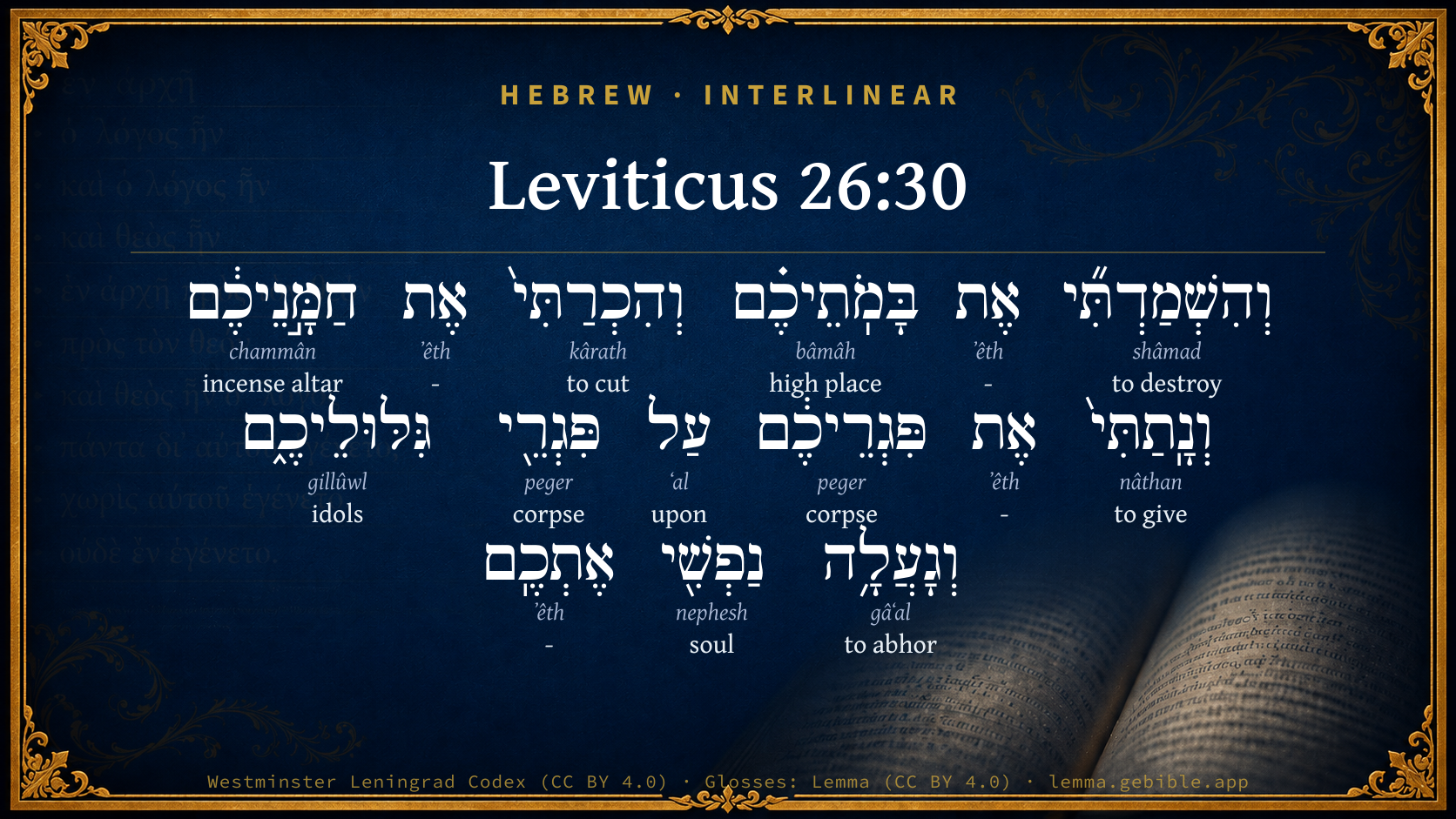
Leviticus 26:30

Hebrew (Westminster Leningrad Codex) Leviticus 26:30 appears in the Hebrew Old Testament. The text above is from the Westminster Leningrad Codex. Each word links to its Strong’s number, a concise gloss, and parsing drawn from the Open Scriptures Hebrew Bible morphology. Click any word for its full Brown-Driver-Briggs (BDB) entry.
Download image
Cite this verse

Leviticus 26:30 (World English Bible). Public Domain. Lemma interlinear Bible study tool, https://lemma.gebible.app/v/leviticus/26/30.

Show BibTeX & RIS
BibTeX
RIS
English Translation
I will destroy your high places, and cut down your incense altars, and cast your dead bodies upon the bodies of your idols; and my soul will abhor you.
World English Bible · Public Domain
Highlights
  • 3 first appearances in the Hebrew Bible
Full analysis ↓
Download a study sheet

One document with this verse’s original text, its word-by-word gloss line, the meaning frame, cross-references with their text, attributed commentary, and full source and license credits — printable, and it pastes into notes with its structure intact.

This verse Autodidact and up

Study sheet (.html) Plain text (.txt)

A passage Seminary Student

Up to 50 verses in one chapter. A passage sheet keeps up to 6 commentary sources and 12 cross-references per verse, in the order this page ranks them, and says so on the sheet whenever that leaves anything out. Ask for a single verse and you get the Autodidact verse sheet above.

Everything on this page stays free to read, with no account — the sheet is a download of what is already on screen, not access to it.

Want to remove ads? Support Godless Engineer
Compare translations 3

The same verse in 3 English versions, stacked beneath the original-language interlinear above. Click any original word for its lexicon entry.

Each is an independent rendering of the whole verse — the interlinear is not word-aligned to these translations.

Highlighted words mark where these versions differ — a whole-verse word diff, not a word-by-word alignment.

  • World English Bible Public Domain
    I will destroy your high places, and cut down your incense altars, and cast your dead bodies upon the bodies of your idols; and my soul will abhor you.
  • King James Version Public Domain
    And I will destroy your high places, and cut down your images, and cast your carcasses upon the carcasses of your idols, and my soul shall abhor you.
  • unfoldingWord Literal Text CC BY-SA 4.0
    And I will destroy your high places, and I will cut down your incense altars, and I will pile your corpses on the corpses of your idols, and my soul will detest you.

unfoldingWord Literal Text — © unfoldingWord, licensed CC BY-SA 4.0. Word-aligned USFM3 via Door43 (git.door43.org/unfoldingWord/en_ult).

Versions to compare (up to 4)

3 of 4 selected

Show all 18 translations

Every available English version of this verse, each an independent rendering of the whole verse.

  • World English Bible Public Domain
    I will destroy your high places, and cut down your incense altars, and cast your dead bodies upon the bodies of your idols; and my soul will abhor you.
  • Berean Standard Bible Public Domain
    I will destroy your high places, cut down your incense altars, and heap your lifeless bodies on the lifeless remains of your idols; and My soul will despise you.
  • Majority Standard Bible Public Domain
    I will destroy your high places, cut down your incense altars, and heap your lifeless bodies on the lifeless remains of your idols; and My soul will despise you.
  • King James Version Public Domain
    And I will destroy your high places, and cut down your images, and cast your carcasses upon the carcasses of your idols, and my soul shall abhor you.
  • American Standard Version (1901) Public Domain
    And I will destroy your high places, and cut down your sun-images, and cast your dead bodies upon the bodies of your idols; and my soul shall abhor you.
  • Revised Version (1885) Public Domain
    And I will destroy your high places, and cut down your sun-images, and cast your carcases upon the carcases of your idols; and my soul shall abhor you.
  • Geneva Bible (1599) Public Domain
    I will also destroy your hye places, and cut away your images, and cast your carkeises vpon the bodies of your idoles, and my soule shall abhorre you.
  • Douay-Rheims (1899) Public Domain
    I will destroy your high places, and break your idols. You shall fall among the ruins of your idols, and my soul shall abhor you.
  • Young's Literal Translation Public Domain
    And I have destroyed your high places, and cut down your images, and have put your carcases on the carcases of your idols, and My soul hath loathed you;
  • Literal Standard Version CC BY-SA 4.0
    And I have destroyed your high places, and cut down your images, and have put your carcasses on the carcasses of your idols, and My soul has loathed you;
  • Unlocked Literal Bible CC BY-SA 4.0
    I will destroy your high places, cut down your incense altars, and throw your corpses on the corpses of your idols, and I myself will abhor you.
  • unfoldingWord Literal Text CC BY-SA 4.0
    And I will destroy your high places, and I will cut down your incense altars, and I will pile your corpses on the corpses of your idols, and my soul will detest you.
  • Darby Bible Public Domain
    And I will lay waste your high places, and cut down your sun-pillars, and cast your carcases upon the carcases of your idols; and my soul shall abhor you.
  • World Messianic Bible Public Domain
    I will destroy your high places, and cut down your incense altars, and cast your dead bodies upon the bodies of your idols; and my soul will abhor you.
  • Webster's Bible Public Domain
    And I will destroy your high places, and cut down your images, and cast your carcasses upon the carcasses of your idols, and my soul shall abhor you.
  • Free Bible Version CC BY-SA 4.0
    I will destroy your high places of worship, smash your altars of incense, and pile up your dead bodies on what remains of your idols, which also have no life at all. I will really despise you.
  • Bible in Basic English Public Domain
    And I will send destruction on your high places, overturning your perfume altars, and will put your dead bodies on your broken images, and my soul will be turned from you in disgust.
  • JPS Tanakh (1917) Public Domain
    And I will destroy your high places, and cut down your sun-pillars, and cast your carcasses upon the carcasses of your idols; and My soul shall abhor you.

Literal Standard Version (2020), Covenant Press — licensed CC BY-SA 4.0. Text via the HelloAO Bible API (eBible.org). Unlocked Literal Bible (unfoldingWord) — licensed CC BY-SA 4.0. Text via the HelloAO Bible API (eBible.org). unfoldingWord Literal Text — © unfoldingWord, licensed CC BY-SA 4.0. Word-aligned USFM3 via Door43 (git.door43.org/unfoldingWord/en_ult). Free Bible Version, Dr. Jonathan Gallagher — licensed CC BY-SA 4.0. Text via the HelloAO Bible API (eBible.org).

Word by word

More ways to search: Search by grammar → Find every occurrence → Compare this word →

Practice this passage: Drill this verse → Learn its vocabulary →

חַמָּ֣נֵיכֶ֔ם
chammân
H2553
“incense altars · your”
Noun, Common, Masculine, Plural, Construct + Suffix, Personal, 2nd Person, Masculine, Plural
Part of Speech
Noun
Type
Common
Gender
Masculine
Number
Plural
State
Construct
Full BDB Definition

Origin: from H2535

TWOT: TWOT- 677d

incense altar, sun-pillar, idol, image - used in idolatrous worship
  1. וְהִשְׁמַדְתִּ֞י shâmad H8045 “and · to destroy” Conjunction + Verb, Hiphil, Sequential Perfect, 1st Person, Common, Singular
  2. אֶת ʼêth H853 “-” Particle, Direct Object
  3. בָּמֹֽתֵיכֶ֗ם bâmâh H1116 “high places · your” Noun, Common, Feminine, Plural, Construct + Suffix, Personal, 2nd Person, Masculine, Plural
  4. וְהִכְרַתִּי֙ kârath H3772 “and · to cut” Conjunction + Verb, Hiphil, Sequential Perfect, 1st Person, Common, Singular
  5. אֶת ʼêth H853 “-” Particle, Direct Object
  6. וְנָֽתַתִּי֙ nâthan H5414 “and · to give” Conjunction + Verb, Qal, Sequential Perfect, 1st Person, Common, Singular
  7. אֶת ʼêth H853 “-” Particle, Direct Object
  8. פִּגְרֵיכֶ֔ם peger H6297 “corpses · your” Noun, Common, Masculine, Plural, Construct + Suffix, Personal, 2nd Person, Masculine, Plural
  9. עַל ʻal H5921 “upon” Preposition
  10. פִּגְרֵ֖י peger H6297 “corpses of” Noun, Common, Masculine, Plural, Construct
  11. גִּלּוּלֵיכֶ֑ם gillûwl H1544 “idols · your” Noun, Common, Masculine, Plural, Construct + Suffix, Personal, 2nd Person, Masculine, Plural
  12. וְגָעֲלָ֥ה gâʻal H1602 “and · to abhor” Conjunction + Verb, Qal, Sequential Perfect, 3rd Person, Feminine, Singular
  13. נַפְשִׁ֖י nephesh H5315 “soul · my” Noun, Common, Both, Singular, Construct + Suffix, Personal, 1st Person, Common, Singular
  14. אֶתְכֶֽם ʼêth H853 “- · you” Particle, Direct Object + Suffix, Personal, 2nd Person, Masculine, Plural

About this verse

These counts appear in no published source. They are computed here, from the morphology-tagged text and Lemma’s own curated glosses. What Lemma adds →

15
words
11
distinct lemmas
Pentateuch
section

Notable vocabulary

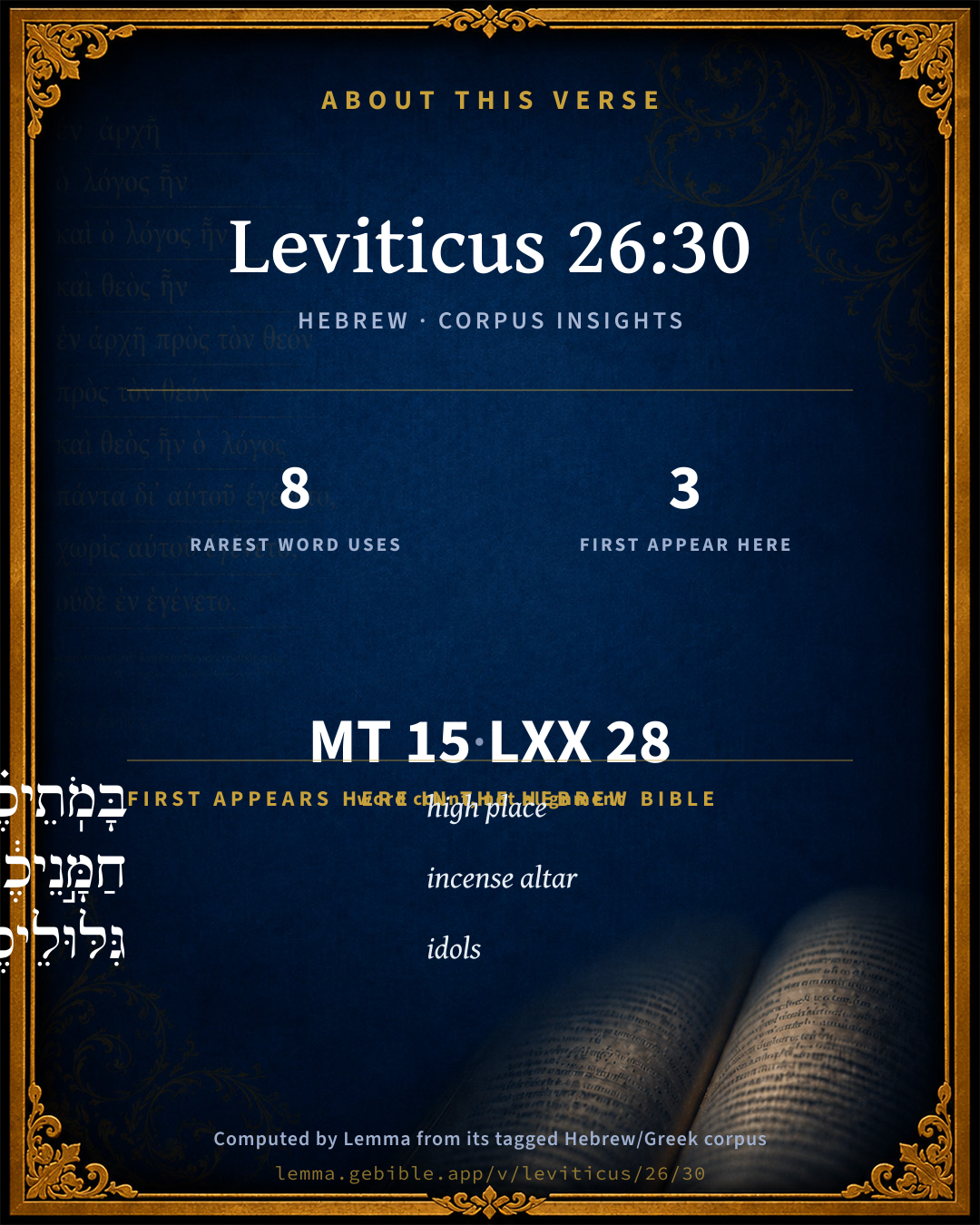
The rarest word here is חַמָּ֣נֵיכֶ֔ם incense altar H2553 — appearing just 8 times in the whole Hebrew Bible.

First appearance in Scripture

These words make their first canonical appearance in the Hebrew Bible here:

  • בָּמֹֽתֵיכֶ֗ם high place H1116
  • חַמָּ֣נֵיכֶ֔ם incense altar H2553
  • גִּלּוּלֵיכֶ֑ם idols H1544

Shared distinctive vocabulary

חַמָּ֣נֵיכֶ֔ם incense altar H2553 occurs in 8 verses of the Hebrew Bible. Also found in:

Grammatical profile

  • 4 verbs
  • 6 nouns
  • 1 preposition
  • 4 particles

Verb forms

  • וְהִשְׁמַדְתִּ֞י Hiphil · Sequential Perfect
  • וְהִכְרַתִּי֙ Hiphil · Sequential Perfect
  • וְנָֽתַתִּי֙ Qal · Sequential Perfect
  • וְגָעֲלָ֥ה Qal · Sequential Perfect

Repetition

A word recurs within this verse — often emphatic in Hebrew:

  • פִּגְרֵיכֶ֔ם corpse H6297 ×2

Hebrew & Septuagint length

In English translation the verse runs 29 words from the Hebrew and 35 from the Septuagint (LXX English) — closely comparable.

A rough comparison of the two English renderings, which tokenize alike — not a word-level alignment.

Word counts can differ between the Hebrew and the Greek without any difference in meaning — e.g. the Hebrew direct-object marker אֵת has no separate Greek word, and Greek often adds the article ὁ.

In the original languages it is 15 Hebrew tokens and 28 Greek tokens — but the two are counted differently (Hebrew bundles its prefixes and suffixes into one token; the Greek is in lemma form), so that isn’t a like-for-like length.

Cross-references

18

Topical passages linked to Leviticus 26:30 in the Treasury of Scripture Knowledge — connected by theme and wording, ordered by reader-vote popularity; previews shown in the World English Bible.

  • 2 Kings 23:20 He killed all the priests of the high places that were there, on the altars, and burned men's bones on them; and he returned to Jerusalem.
  • Isaiah 27:9 Therefore by this shall the iniquity of Jacob be forgiven, and this is all the fruit of taking away his sin: that he makes all the stones of the altar as chalk stones that are beaten in sunder, [so that] the Asherim and the sun-images shall rise no more.
  • Ezekiel 6:3–6 and say, You mountains of Israel, hear the word of the Lord Yahweh: Thus says the Lord Yahweh to the mountains and to the hills, to the watercourses and to the valleys: Behold, I, even I, will bring a sword on you, and I will destroy your high places.
  • Ezekiel 6:13 You shall know that I am Yahweh, when their slain men shall be among their idols round about their altars, on every high hill, on all the tops of the mountains, and under every green tree, and under every thick oak, the places where they offered sweet savor to all their idols.
  • Leviticus 20:23 You shall not walk in the customs of the nation, which I am casting out before you: for they did all these things, and therefore I abhorred them.
  • Leviticus 26:11 I will set my tent among you: and my soul won't abhor you.
  • Leviticus 26:15 and if you shall reject my statutes, and if your soul abhors my ordinances, so that you will not do all my commandments, but break my covenant;
  • 1 Kings 13:2 He cried against the altar by the word of Yahweh, and said, altar, altar, thus says Yahweh: Behold, a son shall be born to the house of David, Josiah by name; and on you shall he sacrifice the priests of the high places who burn incense on you, and men's bones shall they burn on you.
  • 2 Kings 23:8 He brought all the priests out of the cities of Judah, and defiled the high places where the priests had burned incense, from Geba to Beersheba; and he broke down the high places of the gates that were at the entrance of the gate of Joshua the governor of the city, which were on a man's left hand at the gate of the city.
  • 2 Kings 23:16 As Josiah turned himself, he spied the tombs that were there in the mountain; and he sent, and took the bones out of the tombs, and burned them on the altar, and defiled it, according to the word of Yahweh which the man of God proclaimed, who proclaimed these things.
  • 2 Chronicles 14:3–5 for he took away the foreign altars, and the high places, and broke down the pillars, and hewed down the Asherim,
  • 2 Chronicles 23:17 All the people went to the house of Baal, and broke it down, and broke his altars and his images in pieces, and killed Mattan the priest of Baal before the altars.
  • 2 Chronicles 31:1 Now when all this was finished, all Israel who were present went out to the cities of Judah, and broke in pieces the pillars, and hewed down the Asherim, and broke down the high places and the altars out of all Judah and Benjamin, in Ephraim also and Manasseh, until they had destroyed them all. Then all the children of Israel returned, every man to his possession, into their own cities.
  • 2 Chronicles 34:3–7 For in the eighth year of his reign, while he was yet young, he began to seek after the God of David his father; and in the twelfth year he began to purge Judah and Jerusalem from the high places, and the Asherim, and the engraved images, and the molten images.
  • Psalms 78:58–59 For they provoked him to anger with their high places, And moved him to jealousy with their engraved images.
  • Psalms 89:38 But you have rejected and spurned. You have been angry with your anointed.
  • Jeremiah 8:1–3 At that time, says Yahweh, they shall bring out the bones of the kings of Judah, and the bones of his princes, and the bones of the priests, and the bones of the prophets, and the bones of the inhabitants of Jerusalem, out of their graves;
  • Jeremiah 14:19 Have you utterly rejected Judah? has your soul loathed Zion? why have you struck us, and there is no healing for us? We looked for peace, but no good came; and for a time of healing, and, behold, dismay!

Cross-references courtesy of OpenBible.info (CC BY 4.0).

Hebrew and Greek witnesses Masoretic Hebrew ↔ Greek Septuagint

The same verse in the two great witnesses to the Old Testament, shown verse-for-verse.

These are two independent witnesses, not word-aligned to each other, and the Septuagint is shown in lemma (dictionary) form.

Hebrew Leviticus 26:30 Masoretic · Westminster Leningrad Codex

וְהִשְׁמַדְתִּ֞י אֶת בָּמֹֽתֵיכֶ֗ם וְהִכְרַתִּי֙ אֶת חַמָּ֣נֵיכֶ֔ם וְנָֽתַתִּי֙ אֶת פִּגְרֵיכֶ֔ם עַל פִּגְרֵ֖י גִּלּוּלֵיכֶ֑ם וְגָעֲלָ֥ה נַפְשִׁ֖י אֶתְכֶֽם

I will destroy your high places, and cut down your incense altars, and cast your dead bodies upon the bodies of your idols; and my soul will abhor you.

World English Bible · Public Domain

Greek LXX Leviticus 26:30 Septuagint · lemma form

καί ἐρημόω ὁ στήλη σύ καί ἐκὀλεθρεύω ὁ ξύλινος χειροποίητος σύ καί τίθημι ὁ κῶλον σύ ἐπί ὁ κῶλον ὁ εἴδωλον σύ καί προςὀχθίζω ὁ ψυχή ἐγώ σύ

And I will render your pillars desolate, and will utterly destroy your wooden images made with hands; and I will lay your carcasses on the carcasses of your idols, and my soul shall loathe you.

LXX2012 (modern English Septuagint) · Public Domain

Hebrew: Westminster Leningrad Codex (CC BY 4.0). Greek: Septuagint (public domain); English from LXX2012 (modern English Septuagint) (Public Domain). How the Septuagint differs from the Hebrew →

Targum (Aramaic paraphrase)

2

The Targum is the ancient Jewish Aramaic paraphrase of the Hebrew Scriptures — an interpretive translation, not the Hebrew text itself. Onkelos (literal) and Pseudo-Jonathan (expansive) render the Torah, and Jonathan the Prophets. Coverage is partial: where no permissively-licensed English translation exists for a verse, only the Aramaic is shown. This is verse-level text, not a word-by-word alignment to the Hebrew.

  1. Targum Onkelos Torah (Genesis–Deuteronomy)
    וֶאֱשֵׁיצֵי יָת בָּמָתֵיכוֹן וֶאֱקַצֵץ יָת חֲנִיסְנְסֵיכוֹן וְאֶתֵּן יָת פִּגְרֵיכוֹן עַל פִּגוּר טַעֲוָתְכוֹן וִירַחֵק מֵימְרִי יָתְכוֹן

    (no public-domain English translation for this verse)

    Targum Onkelos — Aramaic: “Onkelos Genesis” (public domain); “Onkelos Exodus” (public domain); “Onkelos Leviticus” (public domain); “Onkelos Numbers” (public domain); “Onkelos Deuteronomy” (public domain). English: “Sefaria Community Translation” (CC0 1.0 (public-domain dedication)); “J.W. Etheridge. The Targums of Onkelos and Jonathan Ben Uzziel on the Pentateuch. London: Longmans, Green, 1862” (public domain). Text via Sefaria.

  2. Targum Pseudo-Jonathan Torah (Genesis–Deuteronomy)
    וְאֵישֵׁיצֵי יַת בָּמוֹתֵיכוֹן וְאִפְכַר יַת מְנַחֲשֵׁיכוֹן וּקְסָמֵיכוֹן וְאֶשַׁוֵי יַת פִּגְרֵיכוֹן רְמָאִין עַל פִּגְרֵי טַעֲוָותֵיכוֹן וְתִירְחֵק מֵימְרִי יַתְכוֹן

    And I will destroy your high places, and overthrow your diviners and your enchanters, and your carcases will I cast away with the carcases of your idols, and My Word shall abhor you.

    Targum Pseudo-Jonathan — Aramaic: “Targum Jonathan on Genesis” (public domain); “Targum Jonathan on Exodus” (public domain); “Targum Jonathan on Leviticus” (public domain); “Targum Jonathan on Numbers” (public domain); “Targum Jonathan on Deuteronomy” (public domain). English: “The Targum of Jonathan ben Uzziel, trans. J. W. Etheridge, London, 1862” (public domain). Text via Sefaria.

Commentary

Notes on Leviticus 26:30 from classic Christian and Jewish commentators (each source and its license shown beneath its notes). The classic Christian expositions comment on the surrounding passage and are grouped to its opening verse, so a note may address several verses; the Jewish commentaries on the Tanakh (Rashi and others) are per-verse, so they appear only where the commentator wrote on this verse.

Lemma curates 59 commentaries, every one of them public domain or Creative Commons licensed, each selected and text-cleaned for this edition rather than reprinted as found. About our sources →

Trapp's Complete Commentary

John Trapp

Lev 26:30 And I will destroy your high places, and cut down your images, and cast your carcases upon the carcases of your idols, and my soul shall abhor you.

Ver. 30. Upon the carcasses.] Or, Stumps and shivers of your idols overturned. {Jer 16:18 Eze 4:3-7} Thus in Ket’s conspiracy, those rebels of Norfolk, that brought with them into the field the pyx under his canopy in a cart, not without masses, crosses, banners, candlesticks, &c., all which trumpery, together with their breaden god, was tumbled in the dirt, amidst the carcasses of their late idolatrous worshippers. {a}

{a} Act. and Mon., fol. 1190.

John Trapp, A Commentary or Exposition upon All the Books of the Old and New Testament (1647–1656) — public domain. Text from a community e-Sword module.

Joseph Benson's Commentary

Lev 26:30. Your high places — In which you will sacrifice after the manner of the heathen. And cut down your images — חמניכם, chamanechem; some would translate this, your temples of the sun; from חמה, chammah, heat, or the sun. But although they worshipped the host of heaven, 2

Kings Lev 17:16; and 2Ch 33:3-5; and we read of altars dedicated to them, and of horses and chariots of the sun, 2Ki 23:11; it does not appear that they ever had any temples dedicated to the sun, unless the chariots of the sun might be so called, which some have understood to be domus vel sacella facta instar curruum, little chapels made after the form of chariots. Buxtorf renders the word, translated images in this verse, subdiales statuæ, statues placed in the open air, and exposed to the sun; and quotes R. Salomon as describing them to be images which they placed on the roofs of their houses, and termed חמנים, chammanim. Carcasses of your idols — Hebrews your dung-hill idols, from גללgalal, dung. Le Clerc understands it of those animals which the Israelites had worshipped, in imitation of the Egyptians; and is of opinion, that God here threatens, that if ever they relapsed into that beastly idolatry, their carcasses should be shamefully exposed in the streets with the carcasses of their idols. But the word carcasses may signify the ruins of their idols in general; the broken pieces of their images. Or this word may be made use of to signify that their idols, how specious soever, or glorious in their eyes, were in truth but lifeless and contemptible carcasses, and should be so far from helping them, that they should be thrown down and broken with them, and both should lie together in a forlorn and loathsome state. See a similar threatening, Eze 6:4-13; and Jer 8:1-2. It was in part fulfilled by Josiah, 2Ch 34:5; and 2Ki 23:20.

Joseph Benson's Commentary on the Old and New Testaments (1811–1818) — public domain. Text from a community e-Sword module.

The Expositor's Bible

THE LAW OF THE TITHE

Lev_26:30-33

"And all the tithe of the land, whether of the seed of the land or of the fruit of the tree, is the Lords: it is holy unto the Lord. And if a man will redeem aught of his tithe, he shall add unto it the fifth part thereof. And all the tithe of the herd or the flock, whatsoever passeth under the rod, the tenth shall be holy unto the Lord. He shall not search whether it be good or bad, neither shall he change it: and if he change it at all, then both it and that for which it is changed shall be holy; it shall not be redeemed."

Last of all these exclusions from the vow is mentioned the tithe. "Whether of the seed of the land, or of the herd, or of the flock," it is declared to be "holy unto the Lord; it is the Lords." That because of this it cannot be given to the Lord by a special vow, although not formally stated, is self-evident. No man can give away what belongs to another, or give God what He has already. In Num_18:21 it is said that this tenth should be given "unto the children of Levi for the service of the tent of meeting."

Most extraordinary is the contention of Wellhausen and others, that since in Deuteronomy no tithe is mentioned other than of the product of the land, therefore, because of the mention here also of a tithe of the herd and the flock, we must infer that we have here a late interpolation into the "priest code," marking a time when now the exactions of the priestly caste had been extended to the utmost limit. This is not the place to go into the question of the relation of the law of Deuteronomy to that which we have here; but we should rather, with Dillmann, from the same premisses argue the exact opposite, namely, that we have here the very earliest form of the tithe law. For that an ordinance so extending the rights of the priestly class should have been "smuggled" into the Sinaitic laws after the days of Nehemiah, as Wellhausen, Reuss, and Kuenen suppose, is simply "unthinkable"; while, on the other hand, when we find already in Gen_28:22 Jacob promising unto the Lord the tenth of all that He should give him, at a time when he was living the life of a nomad herdsman, it is inconceivable that he should have meant "all, excepting the increase of the flocks and herds," which were his chief possession.

The truth is that the dedication of a tithe, in various forms, as an acknowledgment of dependence upon and reverence to God, is one of the most widely-spread and best-attested practices of the most remote antiquity. We read of it among the Romans, the Greeks, the ancient Pelasgians, the Carthaginians, and the Phoenicians; and in the Pentateuch, in full accord with all this, we find not only Jacob, as in the passage cited, but, at a yet earlier time, Abraham, more than four hundred years before Moses, giving tithes to Melchizedek. The law, in the exact form in which we have it here, is therefore in perfect harmony with all that we know of the customs both of the Hebrews and surrounding peoples, from a time even much earlier than that of the Exodus.

Very naturally the reference to the tithe, as thus from of old belonging to the Lord, and therefore incapable of being vowed, gives occasion to other regulations respecting it. Like unclean animals, houses, and lands which had been vowed, so also the tithe, or any part of it, might be redeemed by the individual for his own use, upon payment of the usual mulct of one-fifth additional to its assessed value. So also it is further ordered, with special regard to the tithe of the herd and the flock, "that whatsoever passeth under the rod," i.e., whatever is counted, as the manner was, by being made to pass into or out of the fold under the herdsmans staff, "the tenth" - that is, every tenth animal as in its turn it comes-"shall be holy to theLord." The owner was not to search whether the animal thus selected was good or bad, nor change it, so as to give the Lord a poorer animal, and keep a better one for himself; and if he broke this law, then, as in the case of the unclean beast vowed, as the penalty he was to forfeit to the sanctuary both the original and its attempted substitute, and also lose the right of redemption.

A very practical question emerges just here, as to the continued obligation of this law of the tithe. Although we hear nothing of the tithe in the first Christian centuries, it began to be advocated in the fourth century by Jerome, Augustine, and others, and, as is well known, the system of ecclesiastical tithing soon became established as the law of the Church. Although the system by no means disappeared with the Reformation, but passed from the Roman into the Reformed Churches, yet the modern spirit has become more and more adverse to the mediaeval system, till, with the progressive hostility in society to all connection of the Church and the State, and in the Church the development of a sometimes exaggerated voluntaryism, tithing as a system seems likely to disappear altogether, as it has already from the most of Christendom.

But in consequence of this, and the total severance of the Church from the State, in the United States and the Dominion of Canada, the necessity of securing adequate provision for the maintenance and extension of the Church, is more and more directing the attention of those concerned in the practical economics of the Church, to this venerable institution of the tithe as the solution of many difficulties. Among such there are many who, while quite opposed to any enforcement of a law of tithing for the benefit of the Church by the civil power, nevertheless earnestly maintain that the law of the tithe, as we have it here, is of permanent obligation and binding on the conscience of every Christian. What is the truth in the matter? in particular, what is the teaching of the New Testament?

In attempting to settle for ourselves this question, it is to be observed, in order to clear thinking on this subject, that in the law of the tithe as here declared there are two elements-the one moral, the other legal, -which should be carefully distinguished. First and fundamental is the principle that it is our duty to set apart to God a certain fixed proportion of our income. The other and-technically speaking-positive element in the law is that which declares that the proportion to be given to the Lord is precisely one tenth. Now, of these two, the first principle is distinctly recognised and reaffirmed in the New Testament as of continued validity in this dispensation; while, on the other hand, as to the precise proportion of our income to be thus set apart for the Lord, the New Testament writers are everywhere silent.

As regards the first principle, the Apostle Paul, writing to the Corinthians, orders that "on the first day of the week"-the day of the primitive Christian worship-"everyone shall lay by him in store, as God hath prospered him." He adds that he had given the same command also to the Churches of Galatia. {1Co_16:1-2} This most clearly gives apostolic sanction to the fundamental principle of the tithe, namely, that a definite portion of our income should be set apart for God. While, on the other hand, neither in this connection, where a mention of the law of the tithe might naturally have been expected, if it had been still binding as to the letter, nor in any other place does either the Apostle Paul or any other New Testament writer intimate that the Levitical law, requiring the precise proportion of a tenth, was still in force; -a fact which is the more noteworthy that so much is said of the duty of Christian benevolence.

To this general statement with regard to the testimony of the New Testament on this subject, the words of our Lord to the Pharisees, {Mat_23:23} regarding their tithing of "mint and anise and cummin"-"these ye ought to have done"-cannot be taken as an exception, or as proving that the law is binding for this dispensation; for the simple reason that the present dispensation had not at that time yet begun, and those to whom He spoke were still under the Levitical law, the authority of which He there reaffirms. From these facts we conclude that the law of these verses, in so far as it requires the setting apart to God of a certain definite proportion of our income, is doubtless of continued and lasting obligation; but that, in so far as it requires from all alike the exact proportion of one tenth, it is binding on the conscience no longer.

Nor is it difficult to see why the New Testament should not lay down this or any other precise proportion of giving to income, as a universal law. It is only according to the characteristic usage of the New Testament law to leave to the individual conscience very much regarding the details of worship and conduct, which under the Levitical law was regulated by specific rules; which the Apostle Paul explains {Gal_4:1-5} by reference to the fact that the earlier method was intended for and adapted to a lower and more immature stage of religious development; even as a child, during his minority, is kept under guardians and stewards, from whose authority, when he comes of age, he is free.

But, still further, it seems to be often forgotten by those who argue for the present and permanent obligation of this law, that it was here for the first time formally appointed by God as a binding law, in connection with a certain divinely instituted system of theocratic government, which, if carried out, would, as we have seen, effectively prevent excessive accumulations of wealth in the hands of individuals, and thus secure for the Israelites, in a degree the world has never seen, an equal distribution of property. In such a system it is evident that it would be possible to exact a certain fixed and definite proportion of income for sacred purposes, with the certainty that the requirement would work with perfect justice and fairness to all. But with us, social and economic conditions are so very different, wealth is so very unequally distributed, that no such law as that of the tithe could be made to work otherwise than unequally and unfairly. To the very poor it must often be a heavy burden; to the very rich, a proportion so small as to be a practical exemption. While, for the former, the law, if insisted on, would sometimes require a poor man to take bread out of the mouth of wife and children, it would still leave the millionaire with thousands to spend on needless luxuries. The latter might often more easily give nine tenths of his income than the former could give one twentieth.

It is thus no surprising thing that the inspired men who laid the foundations of the New Testament Church did not reaffirm the law of the tithe as to the letter. And yet, on the other hand, let us not forget that the law of the tithe, as regards the moral element of the law, is still in force. It forbids the Christian to leave, as so often, the amount he will give for the Lords work, to impulse and caprice. Statedly and conscientiously he is to "lay by him in store as the Lord hath prospered him." If any ask how much should the proportion be, one might say that by fair inference the tenth might safely be taken as an average minimum of giving, counting rich and poor together. But the New Testament {2Co_8:7; 2Co_8:9} answers after a different and most characteristic manner: "See that ye abound in this grace For ye know the grace of our Lord Jesus Christ, that, though He was rich, yet for your sakes He became poor, that ye through His poverty might become rich." Let there be but regular and systematic giving to the Lords work, under the law of a fixed proportion of gifts to income, and under the holy inspiration of this sacred remembrance of the grace of our Lord, and then the Lords treasury will never be empty, nor the Lord be robbed of His tithe.

And so hereupon the book of Leviticus closes with the formal declaration- referring, no doubt, strictly speaking, to the regulations of this lastchapter-that "these are the commandments, which the Lord commanded Moses for the children of Israel in mount Sinai." The words as explicitly assert Mosaic origin and authority for these last laws of the book, as the opening words asserted the same for the law of the offerings with which it begins. The significance of these repeated declarations respecting the origin and authority of the laws contained in this book has been repeatedly pointed out, and nothing further need be added here.

To sum up all:-what the Lord, in this book of Leviticus, has said, was not for Israel alone. The supreme lesson of this law is for men now, for the Church of the New Testament as well. For the individual and for the nation, HOLINESS, consisting in full consecration of body and soul to the Lord, and separation from all that defileth, is the Divine ideal, to the attainment of which Jew and Gentile alike are called. And the only way of its attainment is through the atoning Sacrifice, and the mediation of the High Priest appointed of God; and the only evidence of its attainment is a joyful obedience, hearty and unreserved, to all the commandments of God. For us all it stands written: "YE SHALL BE HOLY; FOR I, JEHOVAH, YOUR GOD, AM HOLY."

William Robertson Nicoll, ed., The Expositor's Bible (London: Hodder & Stoughton, 1887–1910) — public domain. 65 of 66 books (1 Corinthians is not separately keyed, as that volume carries no machine-parseable verse references); section-level commentary keyed to the opening verse. Introductory and overview sections not keyed to a specific passage are excluded.

Tyndale Open Study Notes

Tyndale Open Resources

26:30 The pagan shrines mentioned here were the infamous “high places” built on hilltops (see 2 Kgs 18:4). These shrines incorporated elements from pre-Israelite religions into Israel’s worship and challenged the Temple for religious authority. • places of worship (Hebrew khamman): Perhaps “incense altars.” Some of these altars were used in Baal worship (2 Chr 34:4).

Tyndale Open Study Notes — © Tyndale Open Resources, licensed CC BY-SA 4.0. Text via the HelloAO Bible API.

Geneva Bible (1599)

Geneva Bible translators

Or, carrions.

Geneva Bible (1599) marginal notes — public domain. Text via Bolls.life.

Jamieson, Fausset & Brown

Robert Jamieson, A. R. Fausset & David Brown

I will destroy your high places--Consecrated enclosures on the tops of mountains, or on little hillocks, raised for practising the rites of idolatry.

cut down your images--According to some, those images were made in the form of chariots (Kg2 23:11); according to others, they were of a conical form, like small pyramids. Reared in honor of the sun, they were usually placed on a very high situation, to enable the worshippers to have a better view of the rising sun. They were forbidden to the Israelites, and when set up, ordered to be destroyed.

cast your carcases upon the carcases of your idols, &c.--Like the statues of idols, which, when broken, lie neglected and contemned, the Jews during the sieges and subsequent captivity often wanted the rites of sepulture.

Jamieson, Fausset & Brown — Commentary Critical and Explanatory on the Whole Bible (1871) — public domain (CC PDM 1.0). Text via the HelloAO Bible API.

Ellicott's Commentary for English Readers

(30) And I will destroy your high places.—Though these eminences were also used for the worship of Jehovah (Jdg_6:25-26; Jdg_13:16-23; 1Sa_7:10; 1Ki_3:2; 2Ki_12:3; 1Ch_21:26, &c.), the context shows that the high places here are such as were dedicated to idolatrous worship (Num_22:41; Num_33:52; Deu_12:2; Jos_13:17, &c.). By the destruction of these places of idolatrous worship, the Israelites would see how utterly worthless those deities were whom they preferred to the God who had wrought such signal redemption for them.

And cut down your images.—Better, and cut down your sun-images, or solar-statues, that is, idolatrous pillars of the sun-god (Isa_17:8; 2Ch_14:5; 2Ch_34:7).

And cast your carcases upon the carcases of your idols.—Nothing could show a greater contempt both for the idol-worshippers and the idols than the picture here given. When the apostate Israelites have succumbed to the sword, famine, and pestilence, they will not even have a seemly burial, but their carcases will be mixed up with the shattered remains of their gods, and thus form one dunghill. Similar is the picture given by Ezekiel, “Your altars shall be desolate, and your images shall be broken, and I will cast down your slain men before your idols, and I will lay the dead carcases of the children of Israel before their idols, and I will scatter your bones round about your altars” (Eze_6:4-5).

A Bible Commentary for English Readers, edited by Charles John Ellicott (1878–1897) — public domain. Text from a community e-Sword module.

The Cambridge Bible for Schools and Colleges

gen. ed. J. J. S. Perowne

30. high places] places on which the Israelites anciently practised their worship, and often carried on idolatrous rites in connexion with it. They at first used hills or mountains, and afterwards mounds or platforms. Such idolatrous high places were destroyed by Josiah (2Ki_23:5-20), but the worship of Jehovah on them (1Ki_22:43; 2Ki_15:35) continued till the Exile.

sun-images] rather, sun-pillars, probably emblems of a Phoenician deity, Baal-Ḥammân, ‘Lord of the sun’s heat.’ See Skinner (C.B.) on Isa_17:8.

idols] The Heb. word is a favourite one with Ezekiel (Eze_6:5, etc.). It is a term of contempt, probably meaning blocks, shapeless things.

The Cambridge Bible for Schools and Colleges (gen. ed. J. J. S. Perowne; Cambridge University Press, 1878–1918) — public domain. Text from a community e-Sword module.

John Gill's Exposition

I will make your cities waste,.... By suffering the enemy to besiege them, enter into them, and plunder them, and destroy the houses in them, and reduce them to the most desolate condition, as Jerusalem, their metropolis, was more than once:

and bring your sanctuaries unto desolation; the temple, so called from the several apartments in it, the court, the holy place, and the most holy; or rather both sanctuaries or temples are intended, the first built by Solomon, and destroyed by Nebuchadnezzar; the second rebuilt by Zerubbabel, and adorned by Herod, and reduced to ashes by Titus Vespasian: the Jews understand this of their synagogues, which were many both in Jerusalem, and in other parts of their country, but cannot be intended, since it follows:

and I will not smell the savour of your sweet odours: of their incense offered on the altar of incense; or the savour of their offerings, as the Targum of Jonathan, of their burnt offerings, and the fat of their other offerings burnt on the altar of burnt offering; signifying, that these would not be acceptable to him, or he smell a savour of rest in them; see Gen 8:21; now these were only offered in the temple, not in synagogues.

John Gill's Exposition of the Whole Bible (1746–1763) — public domain (CC PDM 1.0). Text via the HelloAO Bible API.

Haydock's Catholic Bible Commentary

Places. The temple of Solomon was built on Mount Moria or Sion. The Persians sacrificed upon the mountains, and the Romans and Athenians built their most magnificent temples on the highest parts of their respective cities. --- Idols. Hebrew chammanim, denotes the chariots dedicated to the sun; (4 Kings xxiii. 11,) or the pyreia, or enclosures for the sacred fire, in honour of the god Homanus, (Strabo xv.) whose name is probably derived from this Hebrew word, (Calmet) as well as Hammon, a title of Jupiter. (Menochius) --- Ruins. Hebrew, "and cast your carcasses upon the carcasses of your gods of dirt, and my soul shall vomit you out." The Egyptians embalmed the carcasses of their sacred animals. God threatens that, if his people be so stupid as to adore them, they shall die, and be deprived of sepulture.

George Leo Haydock (1774–1849), Haydock's Catholic Family Bible and Commentary, 1859 edition — public domain. Excludes Psalms (Douay-Rheims chapter numbering differs from Protestant) and Deuterocanonical books (Catholic canon only).

Matthew Poole's English Annotations

Your high places, in which you will sacrifice after the manner of the heathens. See Lev 19:26; Num 33:52.

Your images; or, your images of the sun, made for the honour and worshipping of the sun, and having some resemblance to it. See 2Ch 34:7. Under this one kind of idolatry, famous and frequent in those times and places, he contains all the rest. The carcasses of your idols; so he calls them, either to signify that their idols, how specious soever or glorious in their eyes, were in truth but lifeless and contemptible carcasses, having eyes, but see not, &c., Psa 115:5, or to show that their idols should be so far from helping them, that they should be thrown down and broken with them, and both should lie together in a forlorn and loathsome state.

Matthew Poole's English Annotations on the Holy Bible (1683–1685) — public domain. Text from a community e-Sword/MySword module.

Whedon's Commentary on the Bible

Daniel D. Whedon

30. I will destroy your high places — These were probably artificial eminences on which idol worshippers set up the statues of their gods.

Images — These were sun-pillars or sun-statues, standing on the altars of Baal. Your carcasses shall be denied decent sepulture, and shall share the shame of your dethroned idols.

Daniel D. Whedon (gen. ed.), Commentary on the Old and New Testaments (1874–1909) — public domain. Text from a community e-Sword module.

John Wesley's Explanatory Notes

High places - In which you will sacrifice after the manner of the Heathens. The carcases of your idols - So he calls them, either to signify that their idols how specious soever or glorious in their eyes, were in truth but lifeless and contemptible carcases; or to shew that their idols should be so far from helping them, that they should be thrown down and broken with them, and both should lie together in a forlorn and loathsome state.

John Wesley, Explanatory Notes Upon the Whole Bible (1754–1765) — public domain. Text via the GEBible commentary corpus.

Rashi

Rabbi Shlomo Yitzchaki (Rashi)

במתיכם YOUR HIGH PLACES — towers and castles.

חמניכם SUN IMAGES — a kind of idols which they used to set on their roofs; and because they were placed in the sun (חמה) they are called “sun images” (חמנים) (Sifra, Kedoshim, Section 1 11).

ונתתי את פגריכם AND I WILL CAST YOUR CARCASSES [UPON THE CARCASSES OF YOUR IDOLS] —[This actually happened, for it is related (Sifra, Bechukotai, Chapter 6 4; Sanhedrin 63b) that] people were once swollen from starvation during a siege, and yet they took their idols from their bosom and kissed them, and whilst they were so doing each person’s belly burst open and he fell to the ground upon it (the idol).

וגעלה נפשי אתכם AND MY SOUL SHALL LOATHE YOU — This refers to the departure of the Shechinah from their midst (Sifra, Bechukotai, Chapter 6 4).

Rashi on the Tanakh — English translations: “The Judaica Press complete Tanach with Rashi, translated by A. J. Rosenberg” (CC BY 4.0); “Pentateuch with Rashi's commentary by M. Rosenbaum and A.M. Silbermann, 1929-1934” (public domain); “The Metsudah Tanach series, Lakewood, N.J” (CC BY 4.0); and “The Book of Joshua, Metsudah Publications, 1997” (CC BY 4.0). Text via Sefaria.

Sforno

Rabbi Ovadia Sforno

I will set your corpses — when they are in a city under siege, as it was related regarding Eliyahu the righteous who found a starving child. When he told him, “Say Shema Yisrael and you will live,” the boy answered, “Hush. One must never mention the name of Hashem.” He then took his idol out of his bosom and kissed it and died upon it.

Sforno on the Tanakh — English translation: “Yalkut, Sifsei Chachomim Chumash, Metsudah Publications, 2009” (CC BY 4.0). Text via Sefaria.

Lesson kit

Teaching starters — assembled from the data on this page, not authored interpretation. Every prompt links to the verse data it draws on. Edit before teaching.

Leviticus, in the Pentateuch, opens this verse with 15 words (11 distinct Hebrew lemmas). Its most distinctive word is chammân (“incense altar”). A historical commentator’s framing appears above. Read the whole chapter for the surrounding context.

Discussion questions

  1. How does “incense altar” (chammân) shape what this verse is saying?
  2. 3 words make their first appearance in Scripture here. What does this debut establish?
  3. How does 2 Chronicles 14:5, which shares the word «incense altar», read alongside this verse?
  4. What does the repetition of “corpse” (2× in this one verse) do in this verse?
  5. The translations on this page render this verse differently — a whole-verse word diff, not a word-by-word alignment. What might account for the different wordings?
  6. «וְהִשְׁמַדְתִּ֞י» is a Hiphil Sequential Perfect verb. How does that grammatical form shape the action described?
  7. Compare how Trapp's Complete Commentary and Joseph Benson's Commentary read this verse. Where do they agree or differ?

Things to notice

Reading settings

Reading text

Shown beneath each verse's original-language words.

Old Testament
Old Testament edition

Read the OT as the Masoretic Hebrew (MT) or the Greek Septuagint (LXX).

English shown for the Greek Septuagint (in the Hebrew ↔ Greek comparison).

Comparing translations? Open the Compare panel on any verse page to stack up to four side by side.