
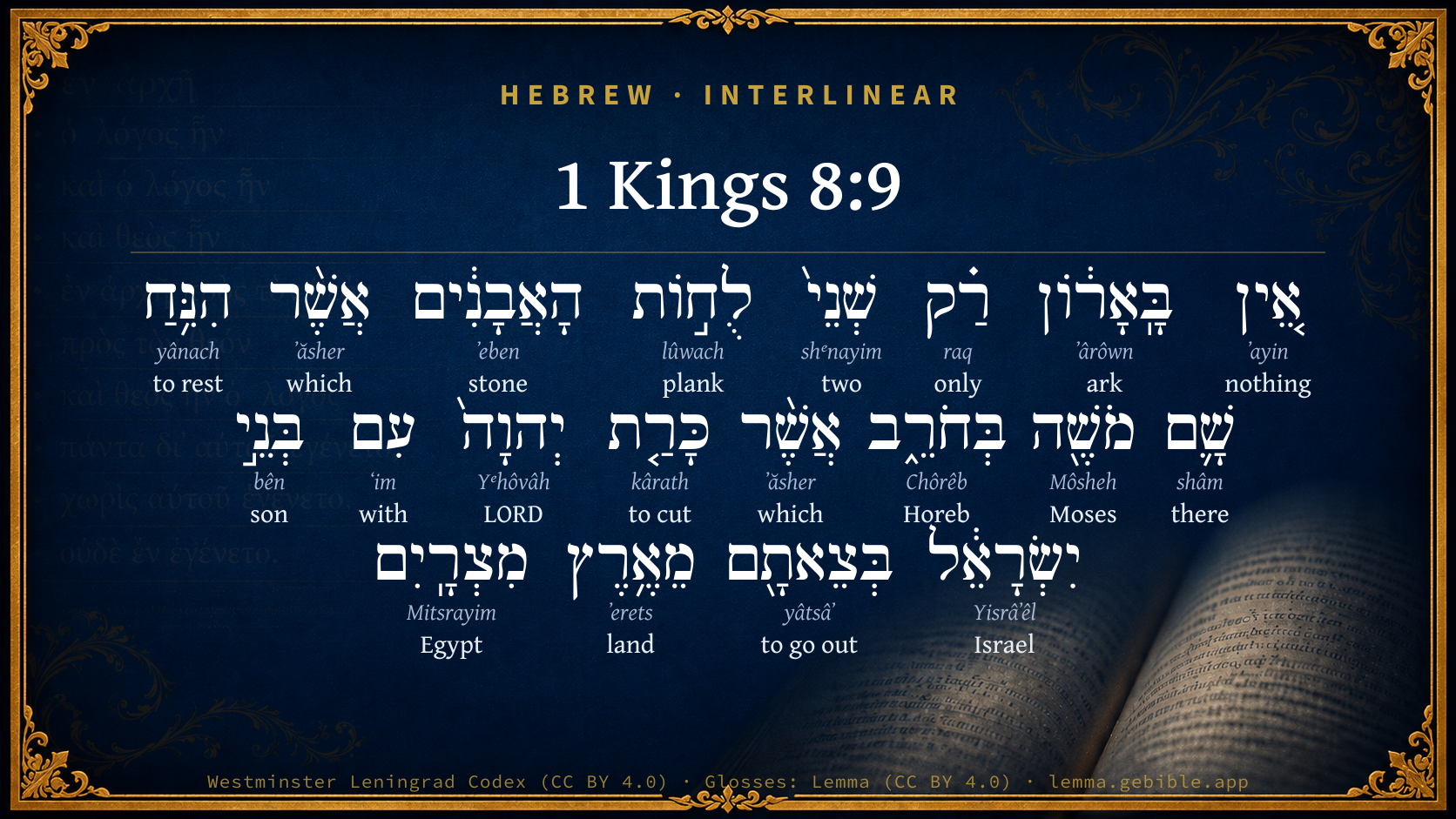
1 Kings 8:9

Hebrew (Westminster Leningrad Codex) 1 Kings 8:9 appears in the Hebrew Old Testament. The text above is from the Westminster Leningrad Codex. Each word links to its Strong’s number, a concise gloss, and parsing drawn from the Open Scriptures Hebrew Bible morphology. Click any word for its full Brown-Driver-Briggs (BDB) entry.
Download image
Cite this verse

1 Kings 8:9 (World English Bible). Public Domain. Lemma interlinear Bible study tool, https://lemma.gebible.app/v/1-kings/8/9.

Show BibTeX & RIS
BibTeX
RIS
English Translation
There was nothing in the ark save the two tables of stone which Moses put there at Horeb, when Yahweh made a covenant with the children of Israel, when they came out of the land of Egypt.
World English Bible · Public Domain
Download a study sheet

One document with this verse’s original text, its word-by-word gloss line, the meaning frame, cross-references with their text, attributed commentary, and full source and license credits — printable, and it pastes into notes with its structure intact.

This verse Autodidact and up

Study sheet (.html) Plain text (.txt)

A passage Seminary Student

Up to 50 verses in one chapter. A passage sheet keeps up to 6 commentary sources and 12 cross-references per verse, in the order this page ranks them, and says so on the sheet whenever that leaves anything out. Ask for a single verse and you get the Autodidact verse sheet above.

Everything on this page stays free to read, with no account — the sheet is a download of what is already on screen, not access to it.

Want to remove ads? Support Godless Engineer
Compare translations 3

The same verse in 3 English versions, stacked beneath the original-language interlinear above. Click any original word for its lexicon entry.

Each is an independent rendering of the whole verse — the interlinear is not word-aligned to these translations.

Highlighted words mark where these versions differ — a whole-verse word diff, not a word-by-word alignment.

  • World English Bible Public Domain
    There was nothing in the ark save the two tables of stone which Moses put there at Horeb, when Yahweh made a covenant with the children of Israel, when they came out of the land of Egypt.
  • King James Version Public Domain
    There was nothing in the ark save the two tables of stone, which Moses put there at Horeb, when the LORD made a covenant with the children of Israel, when they came out of the land of Egypt.
  • unfoldingWord Literal Text CC BY-SA 4.0
    Nothing in the Box except the two tablets of stone that Moses had placed there at Horeb, where Yahweh cut with the sons of Israel when they came out from the land of Egypt.

unfoldingWord Literal Text — © unfoldingWord, licensed CC BY-SA 4.0. Word-aligned USFM3 via Door43 (git.door43.org/unfoldingWord/en_ult).

Versions to compare (up to 4)

3 of 4 selected

Show all 18 translations

Every available English version of this verse, each an independent rendering of the whole verse.

  • World English Bible Public Domain
    There was nothing in the ark save the two tables of stone which Moses put there at Horeb, when Yahweh made a covenant with the children of Israel, when they came out of the land of Egypt.
  • Berean Standard Bible Public Domain
    There was nothing in the ark except the two stone tablets that Moses had placed in it at Horeb, where the LORD had made a covenant with the Israelites after they had come out of the land of Egypt.
  • Majority Standard Bible Public Domain
    There was nothing in the ark except the two stone tablets that Moses had placed in it at Horeb, where the LORD had made a covenant with the Israelites after they had come out of the land of Egypt.
  • King James Version Public Domain
    There was nothing in the ark save the two tables of stone, which Moses put there at Horeb, when the LORD made a covenant with the children of Israel, when they came out of the land of Egypt.
  • American Standard Version (1901) Public Domain
    There was nothing in the ark save the two tables of stone which Moses put there at Horeb, when Jehovah made a covenant with the children of Israel, when they came out of the land of Egypt.
  • Revised Version (1885) Public Domain
    There was nothing in the ark save the two tables of stone which Moses put there at Horeb, when the LORD made a covenant with the children of Israel, when they came out of the land of Egypt.
  • Geneva Bible (1599) Public Domain
    Nothing was in the Arke saue the two tables of stone which Moses had put there at Horeb, where the Lord made a couenant with the children of Israel, when he brought them out of the land of Egypt.
  • Douay-Rheims (1899) Public Domain
    Now in the ark there was nothing else but the two tables of stone, which Moses put there at Horeb, when the Lord made a covenant with the children of Israel, when they came out of the land of Egypt.
  • Young's Literal Translation Public Domain
    There is nothing in the ark, only the two tables of stone which Moses put there in Horeb, when Jehovah covenanted with the sons of Israel in their going out of the land of Egypt.
  • Literal Standard Version CC BY-SA 4.0
    There is nothing in the Ark, only the two tablets of stone which Moses put there in Horeb when YHWH covenanted with the sons of Israel in their going out of the land of Egypt.
  • Unlocked Literal Bible CC BY-SA 4.0
    There was nothing in the ark except the two tablets of stone that Moses had put there at Horeb, when Yahweh made a covenant with the people of Israel when they came out of the land of Egypt.
  • unfoldingWord Literal Text CC BY-SA 4.0
    Nothing in the Box except the two tablets of stone that Moses had placed there at Horeb, where Yahweh cut with the sons of Israel when they came out from the land of Egypt.
  • Darby Bible Public Domain
    There was nothing in the ark save the two tables of stone which Moses placed there at Horeb, when Jehovah made [a covenant] with the children of Israel, when they came out of the land of Egypt.
  • World Messianic Bible Public Domain
    There was nothing in the ark except the two stone tablets which Moses put there at Horeb, when the LORD made a covenant with the children of Israel, when they came out of the land of Egypt.
  • Webster's Bible Public Domain
    There was nothing in the ark save the two tables of stone, which Moses deposited there at Horeb, when the LORD made a covenant with the children of Israel, when they came out of the land of Egypt.
  • Free Bible Version CC BY-SA 4.0
    There was nothing in the Ark apart from the two tablets of stone that Moses had placed in it at Horeb, where the Lord had made an agreement with the Israelites after they came out of the land of Egypt.
  • Bible in Basic English Public Domain
    There was nothing in the ark but the two flat stones which Moses put there at Horeb, where the Lord made an agreement with the children of Israel when they came out of the land of Egypt.
  • JPS Tanakh (1917) Public Domain
    There was nothing in the ark save the two tables of stone which Moses put there at Horeb, when the LORD made a covenant with the children of Israel when they came out of the land of Egypt.

Literal Standard Version (2020), Covenant Press — licensed CC BY-SA 4.0. Text via the HelloAO Bible API (eBible.org). Unlocked Literal Bible (unfoldingWord) — licensed CC BY-SA 4.0. Text via the HelloAO Bible API (eBible.org). unfoldingWord Literal Text — © unfoldingWord, licensed CC BY-SA 4.0. Word-aligned USFM3 via Door43 (git.door43.org/unfoldingWord/en_ult). Free Bible Version, Dr. Jonathan Gallagher — licensed CC BY-SA 4.0. Text via the HelloAO Bible API (eBible.org).

Word by word

More ways to search: Search by grammar → Find every occurrence → Compare this word →

Practice this passage: Drill this verse → Learn its vocabulary →

בְּחֹרֵ֑ב
Chôrêb
H2722
“in/at · Horeb”
Preposition + Noun, Proper
Part of Speech
Preposition + Noun
Type
Proper
Full BDB Definition

Origin: from H2717

TWOT: 731c

Horeb = "desert" - another name for Mount Sinai from which God gave the law to Moses and the Israelites
  1. אֵ֚ין ʼayin H369 “nothing” Particle, Negative
  2. בָּֽאָר֔וֹן ʼârôwn H727 “in/at the · ark” Preposition, Determined + Noun, Common, Both, Singular, Absolute
  3. רַ֗ק raq H7535 “only” Particle, Accusative
  4. שְׁנֵי֙ shᵉnayim H8147 “two” Adjective, Cardinal number, Masculine, Dual, Construct
  5. לֻח֣וֹת lûwach H3871 “planks of” Noun, Common, Masculine, Plural, Construct
  6. הָאֲבָנִ֔ים ʼeben H68 “the · stones” Particle, Definite Article + Noun, Common, Feminine, Plural, Absolute
  7. אֲשֶׁ֨ר ʼăsher H834 “which” Particle, Relative
  8. הִנִּ֥חַ yânach H3240 “to rest” Verb, Hiphil, Perfect, 3rd Person, Masculine, Singular
  9. שָׁ֛ם shâm H8033 “there” Adverb
  10. מֹשֶׁ֖ה Môsheh H4872 “Moses” Noun, Proper
  11. אֲשֶׁ֨ר ʼăsher H834 “which” Particle, Relative
  12. כָּרַ֤ת kârath H3772 “to cut” Verb, Qal, Perfect, 3rd Person, Masculine, Singular
  13. יְהוָה֙ Yᵉhôvâh H3068 “LORD” Noun, Proper
  14. עִם ʻim H5973 “with” Preposition
  15. בְּנֵ֣י bên H1121 “sons of” Noun, Common, Masculine, Plural, Construct
  16. יִשְׂרָאֵ֔ל Yisrâʼêl H3478 “Israel” Noun, Proper
  17. בְּצֵאתָ֖ם yâtsâʼ H3318 “in/at · to go out · them” Preposition + Verb, Qal, Infinitive Construct + Suffix, Personal, 3rd Person, Masculine, Plural
  18. מֵאֶ֥רֶץ ʼerets H776 “from · land of” Preposition + Noun, Common, Both, Singular, Construct
  19. מִצְרָֽיִם Mitsrayim H4714 “Egypt” Noun, Proper

About this verse

These counts appear in no published source. They are computed here, from the morphology-tagged text and Lemma’s own curated glosses. What Lemma adds →

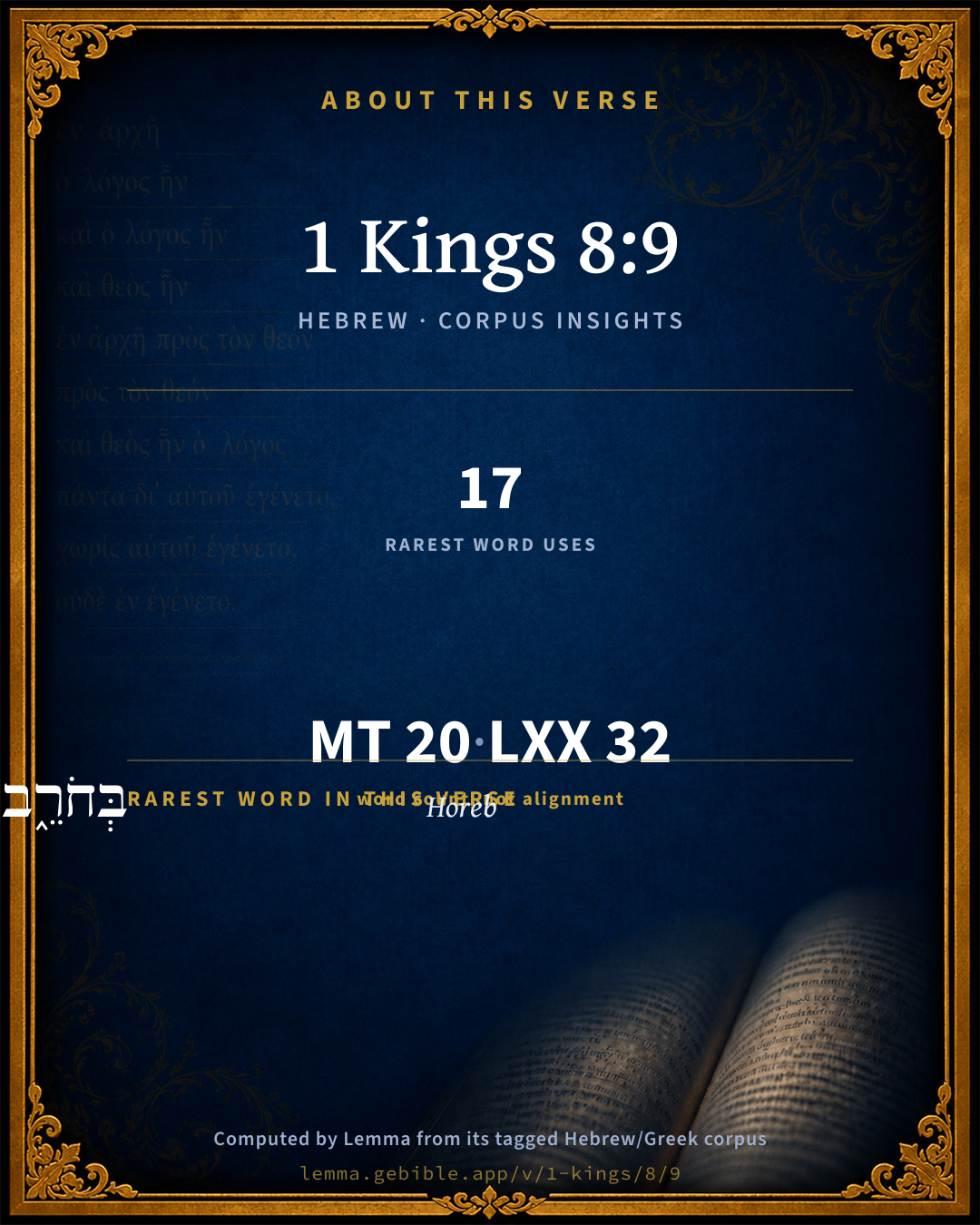
20
words
19
distinct lemmas
Historical
section

Notable vocabulary

The rarest word here is בְּחֹרֵ֑ב Horeb H2722 — appearing just 17 times in the whole Hebrew Bible.

Shared distinctive vocabulary

בְּחֹרֵ֑ב Horeb H2722 occurs in 17 verses of the Hebrew Bible. Also found in:

Grammatical profile

  • 3 verbs
  • 10 nouns
  • 1 adjective
  • 1 preposition
  • 1 adverb
  • 4 particles

Verb forms

  • הִנִּ֥חַ Hiphil · Perfect
  • כָּרַ֤ת Qal · Perfect
  • בְּצֵאתָ֖ם Qal · Infinitive Construct

Repetition

A word recurs within this verse — often emphatic in Hebrew:

  • אֲשֶׁ֨ר which H834 ×2

Hebrew & Septuagint length

In English translation the verse runs 37 words from the Hebrew and 45 from the Septuagint (LXX English) — closely comparable.

A rough comparison of the two English renderings, which tokenize alike — not a word-level alignment.

Word counts can differ between the Hebrew and the Greek without any difference in meaning — e.g. the Hebrew direct-object marker אֵת has no separate Greek word, and Greek often adds the article ὁ.

In the original languages it is 20 Hebrew tokens and 32 Greek tokens — but the two are counted differently (Hebrew bundles its prefixes and suffixes into one token; the Greek is in lemma form), so that isn’t a like-for-like length.

Cross-references

23

Topical passages linked to 1 Kings 8:9 in the Treasury of Scripture Knowledge — connected by theme and wording, ordered by reader-vote popularity; previews shown in the World English Bible.

  • Exodus 25:21 You shall put the mercy seat on top of the ark, and in the ark you shall put the testimony that I will give you.
  • Hebrews 9:4 having a golden altar of incense, and the ark of the covenant overlaid on all sides with gold, in which was a golden pot holding the manna, Aaron's rod that budded, and the tables of the covenant;
  • Exodus 40:20 He took and put the testimony into the ark, and set the poles on the ark, and put the mercy seat above on the ark.
  • Deuteronomy 10:2–5 I will write on the tables the words that were on the first tables which you broke, and you shall put them in the ark.
  • Exodus 34:27–28 Yahweh said to Moses, "Write you these words: for in accordance with these words I have made a covenant with you and with Israel."
  • Deuteronomy 4:13 He declared to you his covenant, which he commanded you to perform, even the ten commandments; and he wrote them on two tables of stone.
  • 2 Chronicles 5:10 There was nothing in the ark save the two tables which Moses put [there] at Horeb, when Yahweh made a covenant with the children of Israel, when they came out of Egypt.
  • 2 Chronicles 7:1–3 Now when Solomon had made an end of praying, the fire came down from heaven, and consumed the burnt offering and the sacrifices; and the glory of Yahweh filled the house.
  • Exodus 13:21 Yahweh went before them by day in a pillar of cloud, to lead them on their way, and by night in a pillar of fire, to give them light, that they might go by day and by night:
  • Exodus 14:24 It happened in the morning watch, that Yahweh looked out on the host of the Egyptians through the pillar of fire and of cloud, and confused the Egyptian army.
  • Exodus 16:10 It happened, as Aaron spoke to the whole congregation of the children of Israel, that they looked toward the wilderness, and, behold, the glory of Yahweh appeared in the cloud.
  • Exodus 16:33 Moses said to Aaron, "Take a pot, and put an omer-full of manna in it, and lay it up before Yahweh, to be kept throughout your generations."
  • Exodus 24:7–8 He took the book of the covenant and read it in the hearing of the people, and they said, "All that Yahweh has spoken will we do, and be obedient."
  • Exodus 24:16–18 The glory of Yahweh settled on Mount Sinai, and the cloud covered it six days. The seventh day he called to Moses out of the midst of the cloud.
  • Exodus 40:34–35 Then the cloud covered the tent of meeting, and the glory of Yahweh filled the tent.
  • Leviticus 16:2 and Yahweh said to Moses, "Tell Aaron your brother, not to come at all times into the Most Holy Place within the veil, before the mercy seat which is on the ark; lest he die: for I will appear in the cloud on the mercy seat.
  • Numbers 9:15 On the day that the tabernacle was raised up, the cloud covered the tabernacle, even the Tent of the Testimony: and at evening it was over the tabernacle as it were the appearance of fire, until morning.
  • Numbers 17:10 Yahweh said to Moses, Put back the rod of Aaron before the testimony, to be kept for a token against the children of rebellion; that you may make an end of their murmurings against me, that they not die.
  • Deuteronomy 31:26 Take this book of the law, and put it by the side of the ark of the covenant of Yahweh your God, that it may be there for a witness against you.
  • 1 Kings 8:21 There have I set a place for the ark, in which is the covenant of Yahweh, which he made with our fathers, when he brought them out of the land of Egypt.
  • 2 Chronicles 5:13–14 it happened, when the trumpeters and singers were as one, to make one sound to be heard in praising and thanking Yahweh; and when they lifted up their voice with the trumpets and cymbals and instruments of music, and praised Yahweh, [saying], For he is good; for his loving kindness endures forever; that then the house was filled with a cloud, even the house of Yahweh,
  • Ezekiel 10:4 The glory of Yahweh mounted up from the cherub, [and stood] over the threshold of the house; and the house was filled with the cloud, and the court was full of the brightness of Yahweh's glory.
  • Revelation 15:8 The temple was filled with smoke from the glory of God, and from his power. No one was able to enter into the temple, until the seven plagues of the seven angels would be finished.

Cross-references courtesy of OpenBible.info (CC BY 4.0).

Hebrew and Greek witnesses Masoretic Hebrew ↔ Greek Septuagint

The same verse in the two great witnesses to the Old Testament, shown verse-for-verse.

These are two independent witnesses, not word-aligned to each other, and the Septuagint is shown in lemma (dictionary) form.

Hebrew 1 Kings 8:9 Masoretic · Westminster Leningrad Codex

אֵ֚ין בָּֽאָר֔וֹן רַ֗ק שְׁנֵי֙ לֻח֣וֹת הָאֲבָנִ֔ים אֲשֶׁ֨ר הִנִּ֥חַ שָׁ֛ם מֹשֶׁ֖ה בְּחֹרֵ֑ב אֲשֶׁ֨ר כָּרַ֤ת יְהוָה֙ עִם בְּנֵ֣י יִשְׂרָאֵ֔ל בְּצֵאתָ֖ם מֵאֶ֥רֶץ מִצְרָֽיִם

There was nothing in the ark save the two tables of stone which Moses put there at Horeb, when Yahweh made a covenant with the children of Israel, when they came out of the land of Egypt.

World English Bible · Public Domain

Greek LXX 1 Kings 8:9 Septuagint · lemma form

οὐ εἰμί ἐν ὁ κιβωτός πλήν δύο πλάξ λίθινος πλάξ ὁ διαθήκη ὅς τίθημι ἐκεῖ μωυσῆς ἐν χωρηβ ὅς διατίθημι κύριος μετά ὁ υἱός ἰσραήλ ἐν ὁ ἐκπορεύομαι αὐτός ἐκ γῆ αἴγυπτος

There was nothing in the ark except the two tables of stone, the tables of the covenant which Moses put there in Choreb, which tables the Lord made as a covenant with the children of Israel in their going forth from the land of Egypt.

LXX2012 (modern English Septuagint) · Public Domain

On this verse, The Cambridge Bible for Schools and Colleges discusses the Septuagint’s reading. Read the note in Commentary ↓

Hebrew: Westminster Leningrad Codex (CC BY 4.0). Greek: Septuagint (public domain); English from LXX2012 (modern English Septuagint) (Public Domain). How the Septuagint differs from the Hebrew →

Targum (Aramaic paraphrase)

1

The Targum is the ancient Jewish Aramaic paraphrase of the Hebrew Scriptures — an interpretive translation, not the Hebrew text itself. Onkelos (literal) and Pseudo-Jonathan (expansive) render the Torah, and Jonathan the Prophets. Coverage is partial: where no permissively-licensed English translation exists for a verse, only the Aramaic is shown. This is verse-level text, not a word-by-word alignment to the Hebrew.

  1. Targum Jonathan Prophets (Joshua–Malachi)
    לֵית בַּאֲרוֹנָא לְחוֹד תְּרֵין לוּחֵי אַבְנַיָא דְאַצְנַע תַּמָן מֹשֶׁה בְּחוֹרֵב דִי עִלַוֵיהוֹן כְּתִיבִין עַשְׂרָא פִּתְגָמֵי קְיָמָא דִגְזַר יְיָ עִם בְּנֵי יִשְׂרָאֵל בְּמִפַּקְהוֹן מֵאַרְעָא דְמִצְרָיִם:

    (no public-domain English translation for this verse)

    Targum Jonathan — Aramaic: “Mikraot Gedolot” (public domain). English: “Sefaria Community Translation” (CC0 1.0 (public-domain dedication)); “London "Chaldee Paraphrase," 1871” (public domain). Text via Sefaria.

Commentary

Notes on 1 Kings 8:9 from classic Christian and Jewish commentators (each source and its license shown beneath its notes). The classic Christian expositions comment on the surrounding passage and are grouped to its opening verse, so a note may address several verses; the Jewish commentaries on the Tanakh (Rashi and others) are per-verse, so they appear only where the commentator wrote on this verse.

Lemma curates 59 commentaries, every one of them public domain or Creative Commons licensed, each selected and text-cleaned for this edition rather than reprinted as found. About our sources →

Trapp's Complete Commentary

John Trapp

1Ki 8:9 [There was] nothing in the ark save the two tables of stone, which Moses put there at Horeb, when the LORD made [a covenant] with the children of Israel, when they came out of the land of Egypt.

Ver. 9. There was nothing in the ark save the two tables.] That is, Nothing of the book of the law, saith Vatablus, but the decalogue: the pot of manna and Aaron’s rod were also in the ark, {Heb 9:4} though Junius holdeth that εν η there relateth not to κιβωτου the ark, but to σκηνη the tabernacle.

John Trapp, A Commentary or Exposition upon All the Books of the Old and New Testament (1647–1656) — public domain. Text from a community e-Sword module.

Joseph Benson's Commentary

1Ki 8:9. There was nothing in the ark, &c. — Strictly and properly speaking. But in a looser sense, the pot of manna, and Aaron’s rod were also in or by it, (Heb 9:4,) being placed by Moses, as God commanded, (Num 17:10,) before the ark of the testimony, in the most holy place.

Joseph Benson's Commentary on the Old and New Testaments (1811–1818) — public domain. Text from a community e-Sword module.

Tyndale Open Study Notes

Tyndale Open Resources

8:9 The focus on the two stone tablets that Moses placed in the Ark (cp. 8:21; see Exod 25:21; Deut 31:26) suggests that Solomon had in mind both a renewal of the Mosaic covenant and the Temple dedication.

Tyndale Open Study Notes — © Tyndale Open Resources, licensed CC BY-SA 4.0. Text via the HelloAO Bible API.

Geneva Bible (1599)

Geneva Bible translators

For it is like that the enemies when they had the Ark in their hands, took away the rod of Aaron and the pot with Manna.

Geneva Bible (1599) marginal notes — public domain. Text via Bolls.life.

Jamieson, Fausset & Brown

Robert Jamieson, A. R. Fausset & David Brown

There was nothing in the ark save the two tables of stone--Nothing else was ever in the ark, the articles mentioned (Heb 9:4) being not in, but by it, being laid in the most holy place before the testimony (Exo 16:33; Num 17:10).

Jamieson, Fausset & Brown — Commentary Critical and Explanatory on the Whole Bible (1871) — public domain (CC PDM 1.0). Text via the HelloAO Bible API.

Adam Clarke's Commentary

Verse 9. Save the two tables of stone] See Clarke on Heb 9:4.

Adam Clarke's Commentary on the Bible (1810–1826) — public domain. Text from a community e-Sword/MySword module.

Ellicott's Commentary for English Readers

(9) There was nothing.—The emphasis of this (repeated in 2Ch_5:10) is remarkable, and seems intended to make it clear that the various things laid up “before the testimony”—the pot of manna (Exo_16:33-34), the rod of Aaron (Num_17:10), the copy of the Law (Deu_31:24-26)—were not in the ark, but (as in the last case is actually stated), at “the side of the ark.” Unless any change afterwards took place—which is highly improbable—this clear statement must determine the interpretation of the well-known passage in the Epistle to the Hebrews (1Ki_9:4), in which no stress need be laid on the literal accuracy of the word “wherein;” for its purpose is simply a general description of the Temple, its chief parts, and its most sacred furniture. The command to deposit the tables in the ark is recorded in Exo_25:16, and the actual deposit of them there in Exo_40:20, immediately after the erection of the Tabernacle.

There is something singularly impressive in the especial hallowing of the granite tables of the Law of Righteousness, as the most sacred of all the revelations of the Nature of God; thus indissolubly binding together religion and morality, and showing that God is best known to man, not in His omnipotence, or even in His infinite wisdom, which man can only in slight degree imitate, but in His moral nature, as the very Truth and Righteousness, of which all that in man is called true and righteous is but the reflection. The one main object of all prophetic teaching was to bring out the truth here implied, thus writing the law on the heart and on the mind (Jer_31:33), and rebuking moral evil at least as strongly as religious error and apostasy. The very name of the Messiah for whom they prepared is “Jehovah our righteousness” (Jer_23:6).

A Bible Commentary for English Readers, edited by Charles John Ellicott (1878–1897) — public domain. Text from a community e-Sword module.

The Cambridge Bible for Schools and Colleges

gen. ed. J. J. S. Perowne

9. There was nothing in the ark save the two tables of stone] We read in Heb_9:4 that in the ark of the covenant ‘was the golden pot that had manna, and Aaron’s rod that budded’ as well as the tables of the covenant, and we may be sure that the writer there speaks according to tradition. The Old Testament narrative (Exo_16:34) says that the pot of manna was laid up ‘before the testimony’ and the same expression is used (Num_17:10) concerning Aaron’s rod. This does not define whether they were put inside or on the outside of the ark. But it is most probable that during the time when the ark was moved from place to place they were kept inside it, but as soon as it was placed within the Temple they were removed. For the tables of stone were alone intended to be stored in the ark, being ‘the testimony (Exo_25:16) which God had given to Israel.’ The other things would still be ‘before the testimony’ if they were placed outside.

when the Lord made a covenant] There is no word for ‘covenant’ in the Hebrew, but the verb is the technical term used in this sense, meaning literally ‘to cut’ in allusion to the sacrifices which usually accompanied covenant-making. No doubt by this time the verb alone had come to have the sense of ‘making a covenant.’ So the italics of the A. V. are rather misleading. The same verb without any noun following is found in this sense 1Sa_11:2; 1Sa_20:16; 1Sa_20:18 and in other places. The verse is a little expanded but not changed in sense in the LXX.

Josephus adds here an account of the other furniture of the Temple, with the position which it occupied, and adds, what no doubt he had seen in his own time, that the brazen altar stood before the shrine, straight opposite the outer door, so that when that was thrown open the altar was visible, and the priestly acts and the completion of the sacrifice could all be seen. This is, in a way, a comment on 1Ki_8:8. The people outside could see through all the length of the holy place, but only one coming near to the partition, could, when the door into the most holy was open, notice the extended heads of the staves.

The Cambridge Bible for Schools and Colleges (gen. ed. J. J. S. Perowne; Cambridge University Press, 1878–1918) — public domain. Text from a community e-Sword module.

John Gill's Exposition

There was nothing in the ark, save the two tables of stone which Moses put there at Horeb,.... That is, there were no other writings; or, as Ben Gersom says, no other part of the law, but the decalogue otherwise he observes there were in it Aaron's rod and the pot of manna, according to Heb 9:4 though the particle there may be rendered "at", or "with", or "by"; see Gill on Heb 9:4 and so they might be not within it, but in some place on the sides of it, see Deu 31:26,

when the Lord made a covenant with the children of Israel, when they came out of the land of Egypt; about two months after.

John Gill's Exposition of the Whole Bible (1746–1763) — public domain (CC PDM 1.0). Text via the HelloAO Bible API.

Albert Barnes' Notes on the Bible

Comparing this statement with Heb 9:4, it would seem that Solomon, now that the sacred chest had reached its final resting-place, and stood in a large chamber surrounded by tables 2Ch 4:8, removed the pot of manna and the rod from the interior, and set them elsewhere in the holy of holies.

Albert Barnes' Notes on the Bible (1834–1885) — public domain. Text from a community e-Sword/MySword module.

Haydock's Catholic Bible Commentary

Nothing else, &c. There was nothing else but the tables of the law within the ark. But on the outside of the ark, or near the ark, were also the rod of Aaron, and a golden urn with manna, Hebrews ix. 4. (Challoner) (Worthington) --- These might have been in the ark while it was not fixed: but after the temple was built, all but the tables were placed in the treasury; where, we find, the book of the law was discovered, under Joas, Deuteronomy xxxi. 26., and 2 Paralipomenon xxxiv. 14. Others think that, in the days of St. Paul, the rod, &c., might have been reposited in the ark, though they had not been admitted at the time when this book was written. (Bellarmine, &c.) --- But we have no assurance that the ark was ever placed in the second temple; and Josephus informs us, that when the Romans destroyed the temple, "there was noting at all" in the sanctuary. (Calmet) --- In area might easily signify ad, or juxta arcam, "near the ark." (Salien)

George Leo Haydock (1774–1849), Haydock's Catholic Family Bible and Commentary, 1859 edition — public domain. Excludes Psalms (Douay-Rheims chapter numbering differs from Protestant) and Deuterocanonical books (Catholic canon only).

Matthew Poole's English Annotations

Nothing in the ark; strictly and properly: for in a more large sense, as in is oft taken for by or near, as is confessed, and hath been proved before; so the pot of manna and Aaron’s rod were also in it, Heb 9:4, i.e. by it, to wit, in the most holy place, before the ark of the testimony, where God commanded Moses to put them, as it is expressed, Exo 16:33,34; Num 17:10, and not strictly in it. But of this more, God assisting, on Heb 9:4.

Matthew Poole's English Annotations on the Holy Bible (1683–1685) — public domain. Text from a community e-Sword/MySword module.

Whedon's Commentary on the Bible

Daniel D. Whedon

9. Nothing in the ark save the two tables — These were apparently all, according to the Old Testament writers, that was ever placed in the ark. The pot of manna and Aaron’s rod were laid up before the Testimony, (Exo_16:34; Num_17:10,) but this alone leaves it undecided whether they were placed in the ark or by the side of it. According to Heb_11:4, however, they were in the ark, which also held the Testimony; and this latter passage doubtless expresses the Jewish traditional view of their position before the Lord and before the Testimony, as stated in the passages referred to in Exodus and Numbers. The pot and the rod had probably become lost during the ark’s captivity among the Philistines.

Daniel D. Whedon (gen. ed.), Commentary on the Old and New Testaments (1874–1909) — public domain. Text from a community e-Sword module.

The Pulpit Commentary

There was nothing in the ark save the two tables of stone which Moses put there. (Exo_25:16 Exo_40:20 Deu_10:5) This statement appears to be at variance with Heb_9:4, which mentions "the golden pot that had manna, and Aaron"s rod that budded," as in the ark, along with "the tables of the covenant." And it is to be observed that, while our text excludes these relics from the ark (temp. Solomon), no other scripture save that just cited expressly includes them. Exo_16:34 and Num_17:10 they are commanded to be laid up "before the testimony," words which no doubt may mean, as they were long interpreted to mean, "before the tables of testimony in the ark observe, the words are "before the testimony," not "before the ark but which are now generally thought to import "in front of the ark which con-rained the testimony." We know the book of the law was put "at the side (dXmi) of the ark", (Deu_31:26) and hence it is held by some that the golden pot, etc., occupied a similar position. It seems preferable, however, considering the distinct statement of St. Paul, or the author of the Epistle to the Hebrews, which, to say the least, embodies Jewish tradition, to adhere to the ancient interpretation that the golden pot of manna and Aaron"s rod were in the ark. And this in no wise conflicts with the statement of the text, for these treasures might well have been removed by the Philistines, whose first thought, we may be sure, would be to open their new acquisition. It is not improbable, indeed, that the object of the men of Bethshemesh in looking into the ark was to see whether these treasures were still there. For if the golden pot ever was in the ark, we can hardly suppose it would escape the rapacity of the Philistines, who would leave the two tables of stone as things of no value. Indeed, it is just possible that the trespass offering, the golden mice, etc., were designed as a return for the golden pot which had been removed. And the statement of the text, "there was nothing," etc., almost implies that there had been something there at one time. (see Alford on Heb_9:4) It seem probable, therefore, that the golden pot and Aaron"s rod were originally deposited "before the testimony" in the ark; that they were removed during its captivity; (1Sa_5:6) and that the sacrilege was discovered at Bethshemesh. (1Sa_6:19) This last mentioned episode explains how it came to be known that "there was nothing," etc. It is hardly likely after that memorable visitation that Solomon could have opened the ark and taken out the two relics, as Rawlinson suggests. Nor have we any warrant for the view that the mercy seat, with the cherubs, was removed to make way for a new lid without them, and so the interior of the ark was disclosed to view (Stanley) at Horeb. (See Exo_3:1 Exo_17:6 Exo_33:6 1Ki_19:8) This name, which means dry ground, desert, would appear to have belonged to two or three different places in the wilderness. But as the name of the place where the law was given and the covenant with God made (Deu_4:10, Deu_4:13) it became subsequently a nomen generale for the whole of the Sinaitic region (Dict. Bib. 3. p. 1326). Here the mount of the law is clearly meant when Heb. which, rva is occasionally found in the sense of quum, as in Deu_11:6 Psa_139:15 2Ch_35:20; of. 1Ki_9:10 (Gesen., Thessalonians, s.v.) the Lord made a covenant Heb. cut; see note on 1Ki_5:12. tyriB is to be understood. Same ellipsis in 1Sa_20:16 1Sa_22:8 with the children of Israel when they came Heb. in their coming out of the land of Egypt. Exo_34:27, 28 Deu_4:13

The Pulpit Commentary (1880–1919), ed. H.D.M. Spence-Jones & Joseph S. Exell — public domain. Text from a community e-Sword module.

John Wesley's Explanatory Notes

Nothing - Strictly and properly: but in a more large sense, the pot of manna, and Aaron's rod were also in it, Heb. ix, 4, that is, by it, in the most holy place, before the ark of the testimony, where God commanded Moses to put them.

John Wesley, Explanatory Notes Upon the Whole Bible (1754–1765) — public domain. Text via the GEBible commentary corpus.

unfoldingWord translationNotes

Door43 World Missions Community

It came about that

This phrase is used here to mark an important event in the story. If your language has a way for doing this, you could consider using it here.

translationWords

ark

Moses

Horeb

Yahweh

covenant

Israel

Egypt

priest

holy place

temple

servant

glory

house

unfoldingWord translationNotes — © Distant Shores Media and the Door43 World Missions Community, licensed CC BY-SA 4.0. Source: git.door43.org/Door43/en_tn.

Lesson kit

Teaching starters — assembled from the data on this page, not authored interpretation. Every prompt links to the verse data it draws on. Edit before teaching.

1 Kings, in the Historical, opens this verse with 20 words (19 distinct Hebrew lemmas). Its most distinctive word is Chôrêb (“Horeb”). A historical commentator’s framing appears above. Read the whole chapter for the surrounding context.

Discussion questions

  1. How does “Horeb” (Chôrêb) shape what this verse is saying?
  2. Exodus 3:1 shares the word «Horeb» with this verse. How do the two illuminate each other?
  3. “which” occurs 2× in this one verse. What is the effect of the repetition?
  4. These translations render this verse differently; the difference is in the English rendering, not the original. What questions does that raise?
  5. The verb «הִנִּ֥חַ» is Hiphil Perfect. How does its form color the action?
  6. Reading how Trapp's Complete Commentary and Joseph Benson's Commentary read this verse, where do the two commentators agree and where do they part?

Things to notice

Reading settings

Reading text

Shown beneath each verse's original-language words.

Old Testament
Old Testament edition

Read the OT as the Masoretic Hebrew (MT) or the Greek Septuagint (LXX).

English shown for the Greek Septuagint (in the Hebrew ↔ Greek comparison).

Comparing translations? Open the Compare panel on any verse page to stack up to four side by side.