Joshua 9:23

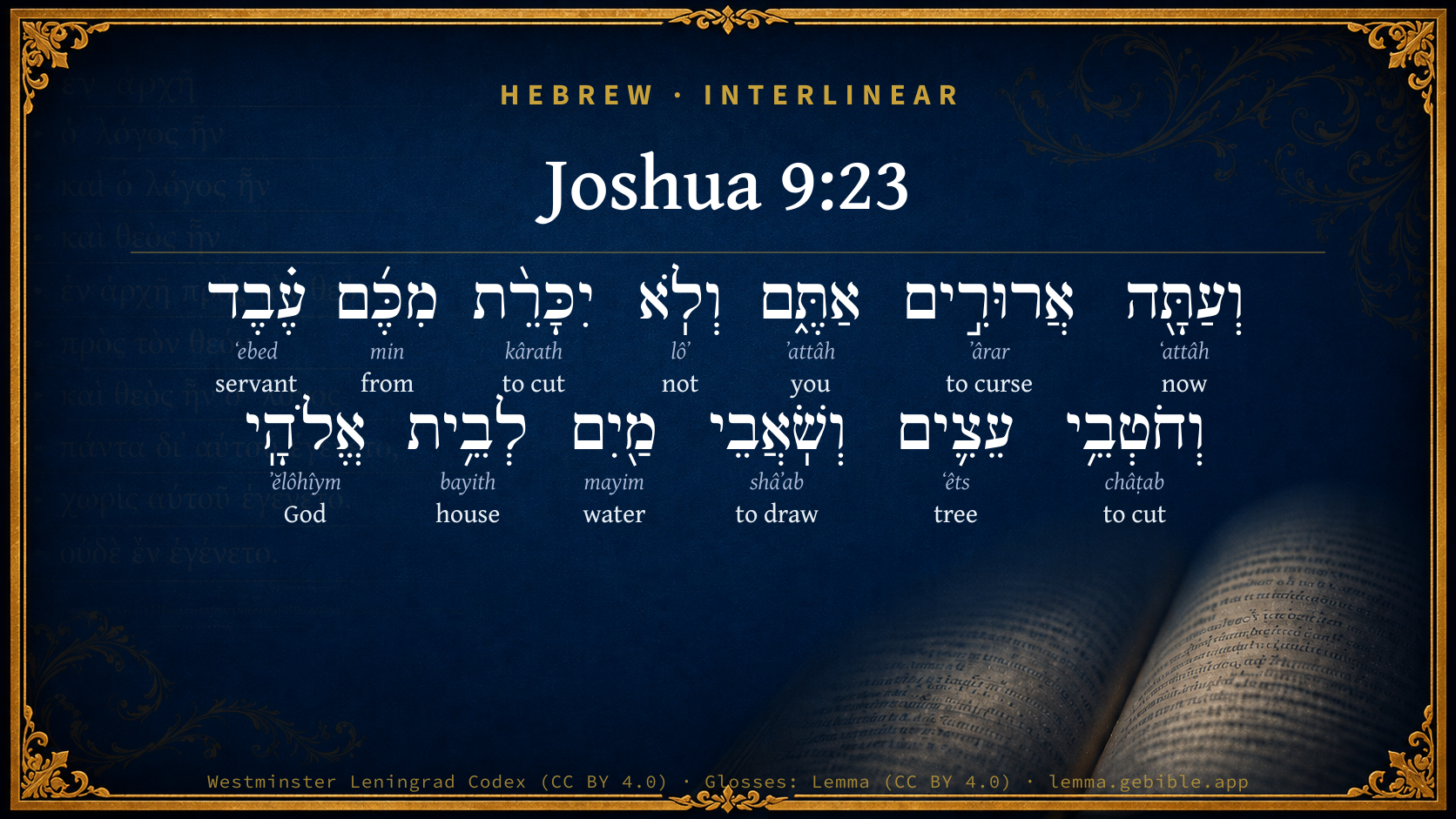
Hebrew (Westminster Leningrad Codex) Joshua 9:23 appears in the Hebrew Old Testament. The text above is from the Westminster Leningrad Codex. Each word links to its Strong’s number, a concise gloss, and parsing drawn from the Open Scriptures Hebrew Bible morphology. Click any word for its full Brown-Driver-Briggs (BDB) entry.
Download image
Cite this verse

Joshua 9:23 (World English Bible). Public Domain. Lemma interlinear Bible study tool, https://lemma.gebible.app/v/joshua/9/23.

Show BibTeX & RIS
BibTeX
RIS
English Translation
Now therefore you are cursed, and there shall never fail to be of you bondservants, both wood cutters and drawers of water for the house of my God.
World English Bible · Public Domain
Download a study sheet

One document with this verse’s original text, its word-by-word gloss line, the meaning frame, cross-references with their text, attributed commentary, and full source and license credits — printable, and it pastes into notes with its structure intact.

This verse Autodidact and up

Study sheet (.html) Plain text (.txt)

A passage Seminary Student

Up to 50 verses in one chapter. A passage sheet keeps up to 6 commentary sources and 12 cross-references per verse, in the order this page ranks them, and says so on the sheet whenever that leaves anything out. Ask for a single verse and you get the Autodidact verse sheet above.

Everything on this page stays free to read, with no account — the sheet is a download of what is already on screen, not access to it.

Want to remove ads? Support Godless Engineer
Compare translations 3

The same verse in 3 English versions, stacked beneath the original-language interlinear above. Click any original word for its lexicon entry.

Each is an independent rendering of the whole verse — the interlinear is not word-aligned to these translations.

Highlighted words mark where these versions differ — a whole-verse word diff, not a word-by-word alignment.

  • World English Bible Public Domain
    Now therefore you are cursed, and there shall never fail to be of you bondservants, both wood cutters and drawers of water for the house of my God.
  • King James Version Public Domain
    Now therefore ye are cursed, and there shall none of you be freed from being bondmen, and hewers of wood and drawers of water for the house of my God.
  • unfoldingWord Literal Text CC BY-SA 4.0
    And now you are cursed, and none of you shall be cut off a slave and hewers of wood and drawers of water for the house of my God.”

unfoldingWord Literal Text — © unfoldingWord, licensed CC BY-SA 4.0. Word-aligned USFM3 via Door43 (git.door43.org/unfoldingWord/en_ult).

Versions to compare (up to 4)

3 of 4 selected

Show all 18 translations

Every available English version of this verse, each an independent rendering of the whole verse.

  • World English Bible Public Domain
    Now therefore you are cursed, and there shall never fail to be of you bondservants, both wood cutters and drawers of water for the house of my God.
  • Berean Standard Bible Public Domain
    Now therefore you are under a curse and will perpetually serve as woodcutters and water carriers for the house of my God.”
  • Majority Standard Bible Public Domain
    Now therefore you are under a curse and will perpetually serve as woodcutters and water carriers for the house of my God.”
  • King James Version Public Domain
    Now therefore ye are cursed, and there shall none of you be freed from being bondmen, and hewers of wood and drawers of water for the house of my God.
  • American Standard Version (1901) Public Domain
    Now therefore ye are cursed, and there shall never fail to be of you bondmen, both hewers of wood and drawers of water for the house of my God.
  • Revised Version (1885) Public Domain
    Now therefore ye are cursed, and there shall never fail to be of you bondmen, both hewers of wood and drawers of water for the house of my God.
  • Geneva Bible (1599) Public Domain
    Now therefore ye are cursed, and there shall none of you be freed from being bondmen, and hewers of wood, and drawers of water for the house of my God.
  • Douay-Rheims (1899) Public Domain
    Therefore you shall be under a curse, and your race shall always be hewers of wood, and carriers of water unto the house of my God.
  • Young's Literal Translation Public Domain
    and now, cursed are ye, and none of you is cut off `from being' a servant, even hewers of wood and drawers of water, for the house of my God.'
  • Literal Standard Version CC BY-SA 4.0
    And now you are cursed, and none of you is cut off [from being] a servant, even hewers of wood and drawers of water, for the house of my God.”
  • Unlocked Literal Bible CC BY-SA 4.0
    Now, because of this, you are cursed and some of you will always be slaves, those who cut wood and draw water for the house of my God.”
  • unfoldingWord Literal Text CC BY-SA 4.0
    And now you are cursed, and none of you shall be cut off a slave and hewers of wood and drawers of water for the house of my God.”
  • Darby Bible Public Domain
    And now ye are cursed, and ye shall never cease to be bondmen, and hewers of wood, and drawers of water for the house of my God.
  • World Messianic Bible Public Domain
    Now therefore you are cursed, and some of you will never fail to be slaves, both wood cutters and drawers of water for the house of my God.”
  • Webster's Bible Public Domain
    Now therefore ye are cursed, and there shall none of you be freed from being bond-men, and hewers of wood and drawers of water for the house of my God.
  • Free Bible Version CC BY-SA 4.0
    Consequently you are under a curse. From now on you shall forever be servants, woodcutters and water-carriers for the house of my God.”
  • Bible in Basic English Public Domain
    Now because of this you are cursed, and you will for ever be our servants, cutting wood and getting water for the house of my God.
  • JPS Tanakh (1917) Public Domain
    Now therefore ye are cursed, and there shall never fail to be of you bondmen, both hewers of wood and drawers of water for the house of my God.'

Literal Standard Version (2020), Covenant Press — licensed CC BY-SA 4.0. Text via the HelloAO Bible API (eBible.org). Unlocked Literal Bible (unfoldingWord) — licensed CC BY-SA 4.0. Text via the HelloAO Bible API (eBible.org). unfoldingWord Literal Text — © unfoldingWord, licensed CC BY-SA 4.0. Word-aligned USFM3 via Door43 (git.door43.org/unfoldingWord/en_ult). Free Bible Version, Dr. Jonathan Gallagher — licensed CC BY-SA 4.0. Text via the HelloAO Bible API (eBible.org).

Word by word

More ways to search: Search by grammar → Find every occurrence → Compare this word →

Practice this passage: Drill this verse → Learn its vocabulary →

וְחֹטְבֵ֥י
châṭab
H2404
“and · cutting”
Conjunction + Verb, Qal, Participle Active, Masculine, Plural, Construct
Part of Speech
Conjunction + Verb
Stem
Qal
Form
Participle Active
Gender
Masculine
Number
Plural
State
Construct
Full BDB Definition

Origin: a primitive root

TWOT: 639

to cut, gather - (Qal) to cut, gather (wood) - (Pual) to cut, carve
  1. וְעַתָּ֖ה ʻattâh H6258 “and · now” Conjunction + Adverb
  2. אֲרוּרִ֣ים ʼârar H779 “cursed” Verb, Qal, Participle Passive, Masculine, Plural, Absolute
  3. אַתֶּ֑ם ʼattâh H859 “you” Pronoun, Personal, 2nd Person, Masculine, Plural
  4. וְלֹֽא lôʼ H3808 “and · not” Conjunction + Particle, Negative
  5. יִכָּרֵ֨ת kârath H3772 “to cut” Verb, Niphal, Imperfect, 3rd Person, Masculine, Singular
  6. מִכֶּ֜ם min H4480 “from · you” Preposition + Suffix, Personal, 2nd Person, Masculine, Plural
  7. עֶ֗בֶד ʻebed H5650 “servant” Noun, Common, Masculine, Singular, Absolute
  8. עֵצִ֛ים ʻêts H6086 “trees” Noun, Common, Masculine, Plural, Absolute
  9. וְשֹֽׁאֲבֵי shâʼab H7579 “and · drawing” Conjunction + Verb, Qal, Participle Active, Masculine, Plural, Construct
  10. מַ֖יִם mayim H4325 “water(s)” Noun, Common, Masculine, Plural, Absolute
  11. לְבֵ֥ית bayith H1004 “to/for · house of” Preposition + Noun, Common, Masculine, Singular, Construct
  12. אֱלֹהָֽי ʼĕlôhîym H430 “God(s) · my” Noun, Common, Masculine, Plural, Construct + Suffix, Personal, 1st Person, Common, Singular

About this verse

These counts appear in no published source. They are computed here, from the morphology-tagged text and Lemma’s own curated glosses. What Lemma adds →

13
words
13
distinct lemmas
Historical
section

Notable vocabulary

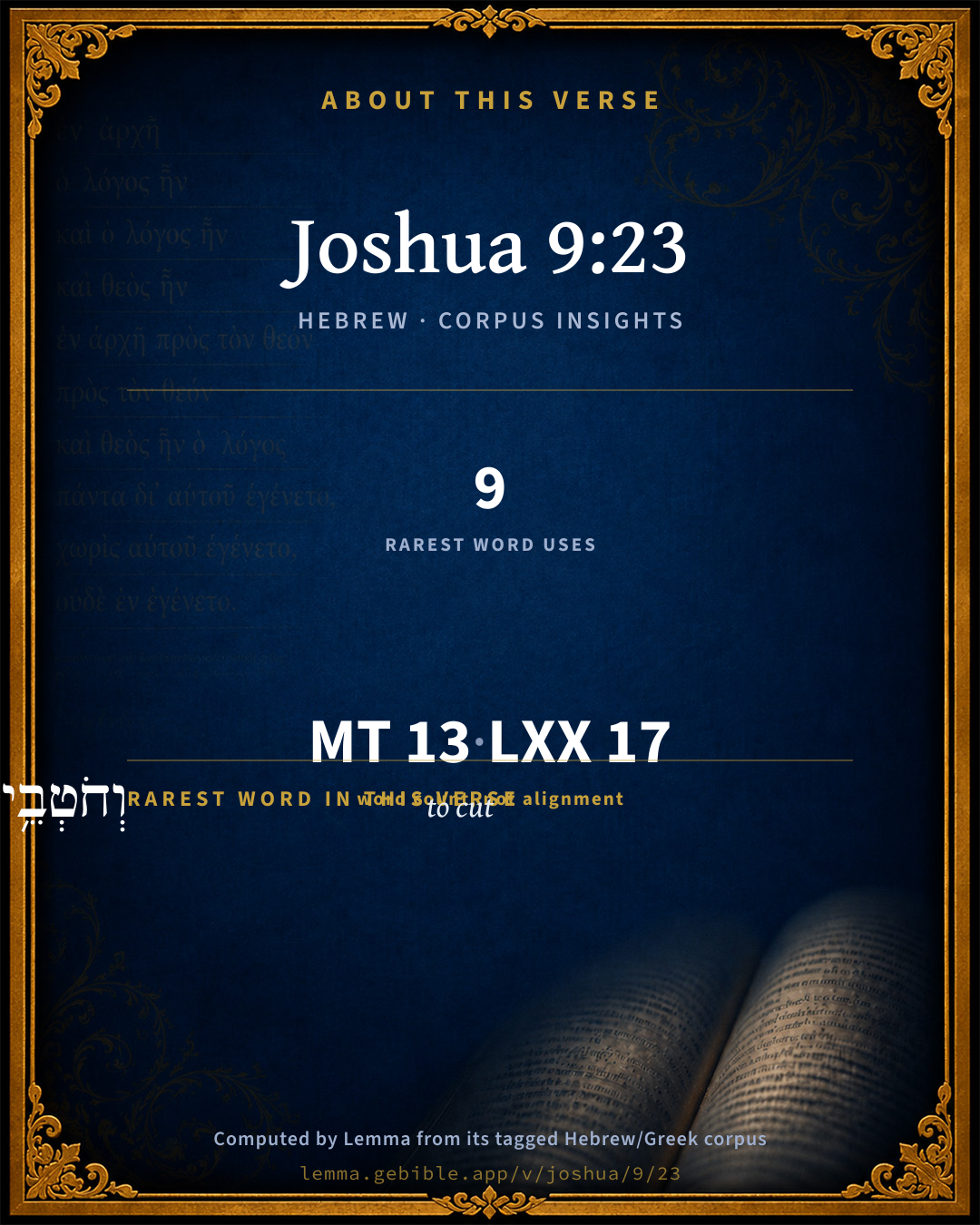
The rarest word here is וְחֹטְבֵ֥י to cut H2404 — appearing just 9 times in the whole Hebrew Bible.

Shared distinctive vocabulary

וְחֹטְבֵ֥י to cut H2404 occurs in 9 verses of the Hebrew Bible. Also found in:

Grammatical profile

  • 4 verbs
  • 5 nouns
  • 1 pronoun
  • 1 preposition
  • 1 adverb
  • 1 particle

Verb forms

  • אֲרוּרִ֣ים Qal · Participle Passive
  • יִכָּרֵ֨ת Niphal · Imperfect
  • וְחֹטְבֵ֥י Qal · Participle Active
  • וְשֹֽׁאֲבֵי Qal · Participle Active

Hebrew & Septuagint length

In English translation the verse runs 28 words from the Hebrew and 28 from the Septuagint (LXX English) — the same length.

A rough comparison of the two English renderings, which tokenize alike — not a word-level alignment.

Word counts can differ between the Hebrew and the Greek without any difference in meaning — e.g. the Hebrew direct-object marker אֵת has no separate Greek word, and Greek often adds the article ὁ.

In the original languages it is 13 Hebrew tokens and 17 Greek tokens — but the two are counted differently (Hebrew bundles its prefixes and suffixes into one token; the Greek is in lemma form), so that isn’t a like-for-like length.

Cross-references

4

Topical passages linked to Joshua 9:23 in the Treasury of Scripture Knowledge — connected by theme and wording, ordered by reader-vote popularity; previews shown in the World English Bible.

  • Joshua 9:21 The princes said to them, Let them live: so they became wood cutters and drawers of water to all the congregation, as the princes had spoken to them.
  • Genesis 9:25–26 He said, "Cursed be Canaan; A servant of servants will he be to his brothers."
  • Leviticus 27:28–29 "'Notwithstanding, no devoted thing, that a man shall devote to Yahweh of all that he has, whether of man or animal, or of the field of his possession, shall be sold or redeemed: every devoted thing is most holy to Yahweh.
  • Joshua 9:27 That day Joshua made those wood cutters and drawers of water for the congregation, and for the altar of Yahweh, to this day, in the place which he should choose.

Cross-references courtesy of OpenBible.info (CC BY 4.0).

Hebrew and Greek witnesses Masoretic Hebrew ↔ Greek Septuagint

The same verse in the two great witnesses to the Old Testament, shown verse-for-verse.

These are two independent witnesses, not word-aligned to each other, and the Septuagint is shown in lemma (dictionary) form.

Hebrew Joshua 9:23 Masoretic · Westminster Leningrad Codex

וְעַתָּ֖ה אֲרוּרִ֣ים אַתֶּ֑ם וְלֹֽא יִכָּרֵ֨ת מִכֶּ֜ם עֶ֗בֶד וְחֹטְבֵ֥י עֵצִ֛ים וְשֹֽׁאֲבֵי מַ֖יִם לְבֵ֥ית אֱלֹהָֽי

Now therefore you are cursed, and there shall never fail to be of you bondservants, both wood cutters and drawers of water for the house of my God.

World English Bible · Public Domain

Greek LXX Joshua 9:23 Septuagint · lemma form

καί νῦν ἐπικατάρατος εἰμί οὐ μή ἐκλείπω ἐκ σύ δοῦλος οὐδέ ξυλοκόπος ἐγώ καί ὁ θεός ἐγώ

And now you⌃ are cursed: there shall not fail of you a slave, or a hewer of wood, or a drawer of water to me and my God.

LXX2012 (modern English Septuagint) · Public Domain

Hebrew: Westminster Leningrad Codex (CC BY 4.0). Greek: Septuagint (public domain); English from LXX2012 (modern English Septuagint) (Public Domain). How the Septuagint differs from the Hebrew →

Targum (Aramaic paraphrase)

1

The Targum is the ancient Jewish Aramaic paraphrase of the Hebrew Scriptures — an interpretive translation, not the Hebrew text itself. Onkelos (literal) and Pseudo-Jonathan (expansive) render the Torah, and Jonathan the Prophets. Coverage is partial: where no permissively-licensed English translation exists for a verse, only the Aramaic is shown. This is verse-level text, not a word-by-word alignment to the Hebrew.

  1. Targum Jonathan Prophets (Joshua–Malachi)
    וּכְעַן לִיטִין אַתּוּן וְלָא יִפְסְקוּן מִנְכוֹן עַבְדִין וּמְלַקְטֵי אָעִין וּמָלָן מַיָא לְבֵית מַקְדְשָׁא דֶאֱלָהֵי:

    (no public-domain English translation for this verse)

    Targum Jonathan — Aramaic: “Mikraot Gedolot” (public domain). English: “Sefaria Community Translation” (CC0 1.0 (public-domain dedication)); “London "Chaldee Paraphrase," 1871” (public domain). Text via Sefaria.

Commentary

Notes on Joshua 9:23 from classic Christian and Jewish commentators (each source and its license shown beneath its notes). The classic Christian expositions comment on the surrounding passage and are grouped to its opening verse, so a note may address several verses; the Jewish commentaries on the Tanakh (Rashi and others) are per-verse, so they appear only where the commentator wrote on this verse.

Lemma curates 59 commentaries, every one of them public domain or Creative Commons licensed, each selected and text-cleaned for this edition rather than reprinted as found. About our sources →

Trapp's Complete Commentary

John Trapp

Jos 9:23 Now therefore ye [are] cursed, and there shall none of you be freed from being bondmen, and hewers of wood and drawers of water for the house of my God.

Ver. 23. Now therefore ye are cursed,] viz., With Cannaan’s curse, "A servant of servants," &c., which yet afterwards God turned to a blessing. See on Ezr 2:43 Gen 9:25, and observe that it was literally fulfilled in these Canaanites.

John Trapp, A Commentary or Exposition upon All the Books of the Old and New Testament (1647–1656) — public domain. Text from a community e-Sword module.

Tyndale Open Study Notes

Tyndale Open Resources

9:23 The Gibeonites were cursed, meaning they were diminished to the status of servants. • At that time, the house of . . . God was the Tabernacle; later, it was the Temple at Jerusalem.

Tyndale Open Study Notes — © Tyndale Open Resources, licensed CC BY-SA 4.0. Text via the HelloAO Bible API.

Geneva Bible (1599)

Geneva Bible translators

For the uses of the Tabernacle and of the temple when it shall be built.

Geneva Bible (1599) marginal notes — public domain. Text via Bolls.life.

Adam Clarke's Commentary

Verse 23. Now therefore ye are cursed] Does not this refer to what was pronounced by Noah, Ge 9:26, against Ham and his posterity? Did not the curse of Ham imply slavery, and nothing else? Cursed be Canaan, a servant of servants shall he be; and does it not sufficiently appear that nothing else than perpetual slavery is implied in the curse of the Gibeonites? They were brought, no doubt, under tribute; performed the meanest offices for the Israelites, being in the same circumstances with the servile class of Hindoos called the Chetrees; had their national importance annihilated, and yet were never permitted to incorporate themselves with the Israelites. And we may reasonably suppose that this was the purpose of God relative to all the Canaanitish nations: those who would not renounce their idolatry, c., were to be extirpated those who did were to be preserved alive, on condition of becoming tributary, and serving as slaves. See Clarke on De 20:17.

Hewers of wood and drawers of water] The disgrace of this state lay not in the laboriousness of it, but in its being the common employment of the females; if the ancient customs among the same people were such as prevail now. The most intelligent travellers in those countries represent collecting wood for fuel, and carrying water, as the peculiar employment of the females. The Arab women of Barbary do so, according to Dr. Shaw. The daughters of the Turcomans in Palestine are employed, according to D'Arvieux, in fetching wood and water for the accommodation of their respective families. From these circumstances Mr. Harmer reasons thus: "The bitterness of the doom of the Gibeonites does not seem to have consisted in the laboriousness of the service enjoined them, for it was usual for women and children to perform what was required of them; but its degrading them from the characteristic employment of men, that of bearing arms; and condemning them and their posterity for ever to the employment of females. The not receiving them as allies was bitter; the disarming them who had been warriors, and condemning them to the employment of females, was worse; but the extending this degradation to their posterity, was bitterest of all. It is no wonder that in these circumstances they are said to have been cursed." - Obs., vol. iv., p. 297.

Adam Clarke's Commentary on the Bible (1810–1826) — public domain. Text from a community e-Sword/MySword module.

Ellicott's Commentary for English Readers

(23) Bondmen, and hewers of wood and drawers of water for the house of my God.—The precedent established in regard to the Gibeonites appears to have been followed by Solomon in his dealings with all the remnant of the doomed nations of Canaan who were not destroyed. (See 1Ki_9:20-21; 2Ch_8:7-8.) It is thought that they are to be recognised in the Nethinim of Ezra and Nehemiah, who come after the Levites, singers, and porters in the enumeration of the restored captives (Ezr_2:43). Compare also the mention of Solomon’s servants (Ezr_2:58), whose children are coupled with the Nethinim. The existence of this large body of Canaanites should be remembered in considering the edict of the law of Moses, that the seven nations were to be destroyed. The sentence was clearly not executed on the mass of the non-resisting population.

A Bible Commentary for English Readers, edited by Charles John Ellicott (1878–1897) — public domain. Text from a community e-Sword module.

The Cambridge Bible for Schools and Colleges

gen. ed. J. J. S. Perowne

23. ye are cursed] Comp. Gen_9:25.

The Cambridge Bible for Schools and Colleges (gen. ed. J. J. S. Perowne; Cambridge University Press, 1878–1918) — public domain. Text from a community e-Sword module.

John Gill's Exposition

Now therefore ye are cursed,.... Appear to be the posterity of cursed Canaan, and, notwithstanding the artifice used, should not be exempted from the curse denounced on Canaan: "a servant of servants shall he be unto his brethren", Gen 9:25; as these Gibeonites were; they became the servants of the Levites, who were servants to the priests; and they seemed to be spared in Providence, that that part of the curse on Canaan might be fulfilled: "and Canaan shall be his servant"; the servant of Shem, from whom the Israelites sprang, Gen 9:25; though the curse was turned into a blessing to the Gibeonites, since though their post and office was mean, yet they had a place in the sanctuary of the Lord, and opportunity of learning the law of God, and understanding the true religion, worship, and knowledge of God, and were an emblem and pledge of the reception of the Gentiles into the church of God:

and there shall none of you be freed from being bondmen; which the oath taken did not oblige Joshua, and the princes, to exempt them from, only to let them live, Jos 9:15,

and hewers of wood and drawers of water for the house of my God; which explains what is meant by the "congregation", and who might purposely choose that phrase, to make the people more easy; but their work, as assigned them by Joshua, was not to hew wood and draw water for every one's private use, only for the service of the sanctuary, which in some sense was the service of the congregation; and a great deal of work there was to be done of this kind, much wood to hew for keeping the fire of the altar continually burning, and for boiling the flesh of the peace offerings, and the like, and much water to draw for various uses, for the washing of the priests and the sacrifices, and various other things.

John Gill's Exposition of the Whole Bible (1746–1763) — public domain (CC PDM 1.0). Text via the HelloAO Bible API.

Haydock's Catholic Bible Commentary

Curse. Hebrew, "you are cursed, and there shall be none of you freed from being bondmen;" (Haydock) you are a part of those nations which are under an anathema, and you deserve to be severely punished. (Calmet) --- But we shall fulfil our engagements with you, only in punishment for your craftiness: (Haydock) you must submit to change your religion, (Calmet) which will be your greatest blessing, (Haydock) and to perform the meanest offices, which may be considered as a sort of curse. It is thought that some recompense was allowed the Gabaonites for their labour. (Serarius, q. 17.) --- This sentence was probably pronounced at Galgal, (Calmet) though we might as well conclude that Josue would wait till he came to Gabaon, before he arraigned the people, as no doubt they would make the best of their way out of the camp, as soon as they had obtained their request. (Haydock) --- Water. Slaves of the meanest condition were employed in these offices, Deuteronomy xxix. 11. (Atheneus x. 22.)

George Leo Haydock (1774–1849), Haydock's Catholic Family Bible and Commentary, 1859 edition — public domain. Excludes Psalms (Douay-Rheims chapter numbering differs from Protestant) and Deuterocanonical books (Catholic canon only).

Matthew Poole's English Annotations

Ye are cursed; you shall not escape the curse of God, which by Divine sentence belongs to all the Canaanites, who are a people devoted by God to ruin, but only change the quality of it; you shall feel that curse of bondage and servitude, which is proper to your race by virtue of that ancient decree, Gen 9:25; you shall live indeed, but in a poor, vile, and miserable condition.

There shall none of you be freed from being bond-men; the slavery which is upon you shall be entailed to your posterity.

Hewers of wood and drawers of water for the house of my God: this only service they mention here, because it was their principal and most durable servitude, being first in the tabernacle, and then in the temple, whence they were called Nethinims, 1Ch 9:2; Ezr 2:43; whereas their servitude to the whole congregation would in a great measure cease when the Israelites were dispersed to their several habitations.

Matthew Poole's English Annotations on the Holy Bible (1683–1685) — public domain. Text from a community e-Sword/MySword module.

Whedon's Commentary on the Bible

Daniel D. Whedon

23. Ye are cursed — Bondage, even to the best of masters and to the most honourable kind of labour, is a curse. If slavery were ever a blessing to a pagan nation, by bringing it into a knowledge of the true religion, this would have been such a case; but Joshua pronounces even such bondage, though far above chattel slavery, a curse.

Daniel D. Whedon (gen. ed.), Commentary on the Old and New Testaments (1874–1909) — public domain. Text from a community e-Sword module.

The Pulpit Commentary

There shall none of you be freed from being bondmen. Literally, as margin, there shall not be cut off from you a servant, as in 2Sa_3:29, and 1Ki_2:4. The sense is, "you shall not cease to be servants." The term "bondmen" is somewhat too strong. The db, was usually a bondman among the Hebrews, but not always. (see 1Sa_29:3 1Ki_11:26, etc.) But the Gibeonites were to be employed forever in servile work. Hewing of wood and drawing of water was a task frequently imposed on the strangers (probably captives) dwelling among the Israelites, as we learn from Deu_29:11. We are not directly told that, as Keil and others have stated, the "lowest of the people" had to perform this office. It is, however, implied that the stranger who performed it occupied the lowest social station in the community. "Si qui tales sunt in nobis, quorum tides tantummodo habet ut ad Ecclesiam veniant, et inclinent caput suum sacerdotibus, officia exhibeant, servos Dei honorent, ad ornatum quoque altaris vel Ecclesiae aliquid conferant, non tamen adhibeant studium ut etiam mores suos excolant, actus emendent, vitia deponant, castitatem colant, iracundiam mitigent, avaritiam reprirnant, rapacitatem refrenant, maleloquia et stultiloquia, vel scurrilitatem et obtrectationum venena ex ore suo non adimant, sciant sibi, qui tales sunt, qui emendare se nolunt, sed in his usque in senectutem ultimam perseverant, partem sortemque at Jesu Domino cum Gabaonitis esse tribuendam" (Orig., Horn. 10 on Joshua).

The Pulpit Commentary (1880–1919), ed. H.D.M. Spence-Jones & Joseph S. Exell — public domain. Text from a community e-Sword module.

John Wesley's Explanatory Notes

Ye are cursed - You shall not escape the curse of God which by divine sentence belongs to all the Canaanites; but only change the quality of it, you shall feel that curse of bondage, which is proper to your race by virtue of that ancient decree, Gen. ix, 25. Bond-men - The slavery, which is upon you shall be entailed on your posterity. The house of my God - This only service they mention here, because it was their durable servitude, being first in the tabernacle, and then in the temple, whence they were called Nethinim, 1 Chron. ix, 2 Ezra ii, 43, whereas their servitude to the whole congregation in a great measure ceased when the Israelites were dispersed to their several habitations.

John Wesley, Explanatory Notes Upon the Whole Bible (1754–1765) — public domain. Text via the GEBible commentary corpus.

Lesson kit

Teaching starters — assembled from the data on this page, not authored interpretation. Every prompt links to the verse data it draws on. Edit before teaching.

Joshua, in the Historical, opens this verse with 13 words (13 distinct Hebrew lemmas). Its most distinctive word is châṭab (“to cut”). A historical commentator’s framing appears above. Read the whole chapter for the surrounding context.

Discussion questions

  1. What does “to cut” (châṭab) contribute to the verse as a whole?
  2. Deuteronomy 19:5 shares the word «to cut» with this verse. How do the two illuminate each other?
  3. These translations render this verse differently; the difference is in the English rendering, not the original. What questions does that raise?
  4. The verb «אֲרוּרִ֣ים» is Qal Participle Passive. How does its form color the action?
  5. Reading how Trapp's Complete Commentary and Tyndale Open Study Notes read this verse, where do the two commentators agree and where do they part?

Things to notice

Reading settings

Reading text

Shown beneath each verse's original-language words.

Old Testament
Old Testament edition

Read the OT as the Masoretic Hebrew (MT) or the Greek Septuagint (LXX).

English shown for the Greek Septuagint (in the Hebrew ↔ Greek comparison).

Comparing translations? Open the Compare panel on any verse page to stack up to four side by side.