
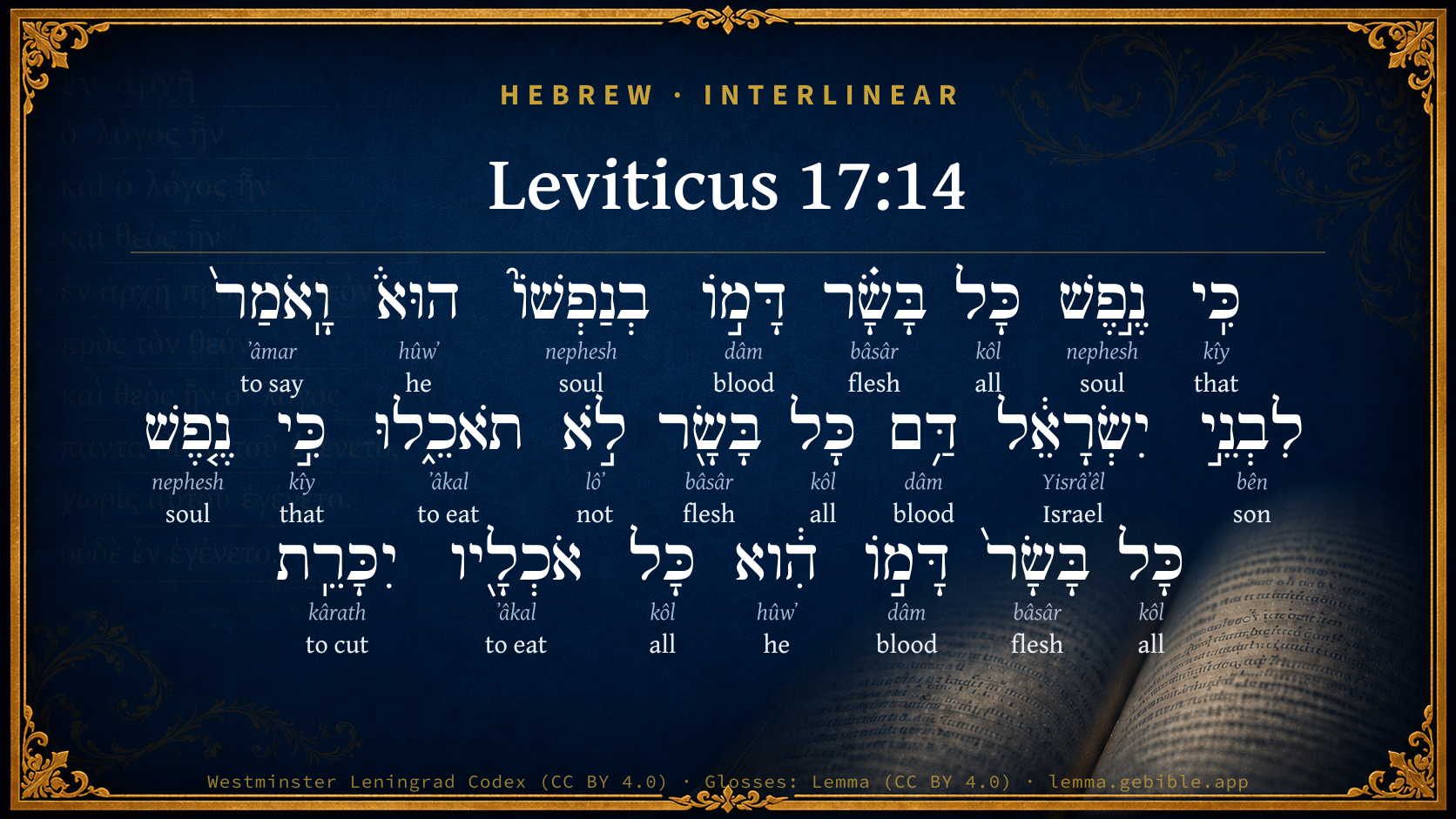
Leviticus 17:14

Hebrew (Westminster Leningrad Codex) Leviticus 17:14 appears in the Hebrew Old Testament. The text above is from the Westminster Leningrad Codex. Each word links to its Strong’s number, a concise gloss, and parsing drawn from the Open Scriptures Hebrew Bible morphology. Click any word for its full Brown-Driver-Briggs (BDB) entry.
Download image
Cite this verse

Leviticus 17:14 (World English Bible). Public Domain. Lemma interlinear Bible study tool, https://lemma.gebible.app/v/leviticus/17/14.

Show BibTeX & RIS
BibTeX
RIS
English Translation
For as to the life of all flesh, its blood is with its life: therefore I said to the children of Israel, "You shall not eat the blood of any kind of flesh; for the life of all flesh is its blood. Whoever eats it shall be cut off."
World English Bible · Public Domain
Download a study sheet

One document with this verse’s original text, its word-by-word gloss line, the meaning frame, cross-references with their text, attributed commentary, and full source and license credits — printable, and it pastes into notes with its structure intact.

This verse Autodidact and up

Study sheet (.html) Plain text (.txt)

A passage Seminary Student

Up to 50 verses in one chapter. A passage sheet keeps up to 6 commentary sources and 12 cross-references per verse, in the order this page ranks them, and says so on the sheet whenever that leaves anything out. Ask for a single verse and you get the Autodidact verse sheet above.

Everything on this page stays free to read, with no account — the sheet is a download of what is already on screen, not access to it.

Want to remove ads? Support Godless Engineer
Compare translations 3

The same verse in 3 English versions, stacked beneath the original-language interlinear above. Click any original word for its lexicon entry.

Each is an independent rendering of the whole verse — the interlinear is not word-aligned to these translations.

Highlighted words mark where these versions differ — a whole-verse word diff, not a word-by-word alignment.

  • World English Bible Public Domain
    For as to the life of all flesh, its blood is with its life: therefore I said to the children of Israel, "You shall not eat the blood of any kind of flesh; for the life of all flesh is its blood. Whoever eats it shall be cut off."
  • King James Version Public Domain
    For it is the life of all flesh; the blood of it is for the life thereof: therefore I said unto the children of Israel, Ye shall eat the blood of no manner of flesh: for the life of all flesh is the blood thereof: whosoever eateth it shall be cut off.
  • unfoldingWord Literal Text CC BY-SA 4.0
    for the life of all flesh, its blood, its life is in it. And I said to the sons of Israel, “The blood of any flesh you shall not eat, for the life of all flesh, it is its blood. All who eat it shall be cut off.”

unfoldingWord Literal Text — © unfoldingWord, licensed CC BY-SA 4.0. Word-aligned USFM3 via Door43 (git.door43.org/unfoldingWord/en_ult).

Versions to compare (up to 4)

3 of 4 selected

Show all 18 translations

Every available English version of this verse, each an independent rendering of the whole verse.

  • World English Bible Public Domain
    For as to the life of all flesh, its blood is with its life: therefore I said to the children of Israel, "You shall not eat the blood of any kind of flesh; for the life of all flesh is its blood. Whoever eats it shall be cut off."
  • Berean Standard Bible Public Domain
    For the life of all flesh is its blood. Therefore I have told the Israelites, ‘You must not eat the blood of any living thing, because the life of all flesh is its blood; whoever eats it must be cut off.’
  • Majority Standard Bible Public Domain
    For the life of all flesh is its blood. Therefore I have told the Israelites, ‘You must not eat the blood of any living thing, because the life of all flesh is its blood; whoever eats it must be cut off.’
  • King James Version Public Domain
    For it is the life of all flesh; the blood of it is for the life thereof: therefore I said unto the children of Israel, Ye shall eat the blood of no manner of flesh: for the life of all flesh is the blood thereof: whosoever eateth it shall be cut off.
  • American Standard Version (1901) Public Domain
    For as to the life of all flesh, the blood thereof is `all one' with the life thereof: therefore I said unto the children of Israel, Ye shall eat the blood of no manner of flesh; for the life of all flesh is the blood thereof: whosoever eateth it shall be cut off.
  • Revised Version (1885) Public Domain
    For as to the life of all flesh, the blood thereof is all one with the life thereof: therefore I said unto the children of Israel, Ye shall eat the blood of no manner of flesh: for the life of all flesh is the blood thereof: whosoever eateth it shall be cut off.
  • Geneva Bible (1599) Public Domain
    For ye life of all flesh is his blood, it is ioyned with his life: therefore I sayd vnto the children of Israel, Ye shall eate the blood of no flesh: for the life of al flesh is the blood thereof: whosoeuer eateth it, shalbe cut off.
  • Douay-Rheims (1899) Public Domain
    For the life of all flesh is in the blood: therefore I said to the children of Israel: You shall not eat the blood of any flesh at all, because the life of the flesh is in the blood, and whosoever eateth it, shall be cut off.
  • Young's Literal Translation Public Domain
    for `it is' the life of all flesh, its blood is for its life; and I say to the sons of Israel, Blood of any flesh ye do not eat, for the life of all flesh is its blood; any one eating it is cut off.
  • Literal Standard Version CC BY-SA 4.0
    for [it is] the life of all flesh, its blood is for its life; and I say to the sons of Israel: You do not eat [the] blood of any flesh, for the life of all flesh is its blood; anyone eating it is cut off.
  • Unlocked Literal Bible CC BY-SA 4.0
    For the life of each creature is its blood. That is why I said to the people of Israel, “You must not eat the blood of any creature, for the life of every living creature is its blood. Whoever eats it must be cut off.”
  • unfoldingWord Literal Text CC BY-SA 4.0
    for the life of all flesh, its blood, its life is in it. And I said to the sons of Israel, “The blood of any flesh you shall not eat, for the life of all flesh, it is its blood. All who eat it shall be cut off.”
  • Darby Bible Public Domain
    for as to the life of all flesh, its blood is the life in it; and I have said unto the children of Israel, Of the blood of no manner of flesh shall ye eat, for the life of all flesh is its blood: whoever eateth it shall be cut off.
  • World Messianic Bible Public Domain
    For as to the life of all flesh, its blood is with its life. Therefore I said to the children of Israel, “You shall not eat the blood of any kind of flesh; for the life of all flesh is its blood. Whoever eats it shall be cut off.”
  • Webster's Bible Public Domain
    For it is the life of all flesh, the blood of it is for the life of it; therefore I said to the children of Israel, Ye shall eat the blood of no manner of flesh: for the life of all flesh is its blood: whoever eateth it shall be cut off.
  • Free Bible Version CC BY-SA 4.0
    for life is in the body's blood. That's why I have warned the Israelites: You are not allowed to eat the blood of anything living, for life is in the body's blood. Anyone who eats it must be expelled.
  • Bible in Basic English Public Domain
    For the blood is the life of all flesh: and so I have said to the children of Israel, You may not take any sort of blood as food, and any man who does so will be cut of.
  • JPS Tanakh (1917) Public Domain
    For as to the life of all flesh, the blood thereof is all one with the life thereof; therefore I said unto the children of Israel: Ye shall eat the blood of no manner of flesh; for the life of all flesh is the blood thereof; whosoever eateth it shall be cut off.

Literal Standard Version (2020), Covenant Press — licensed CC BY-SA 4.0. Text via the HelloAO Bible API (eBible.org). Unlocked Literal Bible (unfoldingWord) — licensed CC BY-SA 4.0. Text via the HelloAO Bible API (eBible.org). unfoldingWord Literal Text — © unfoldingWord, licensed CC BY-SA 4.0. Word-aligned USFM3 via Door43 (git.door43.org/unfoldingWord/en_ult). Free Bible Version, Dr. Jonathan Gallagher — licensed CC BY-SA 4.0. Text via the HelloAO Bible API (eBible.org).

Word by word

More ways to search: Search by grammar → Find every occurrence → Compare this word →

Practice this passage: Drill this verse → Learn its vocabulary →

בָּשָׂ֗ר
bâsâr
H1320
“flesh”
Noun, Common, Masculine, Singular, Absolute
Part of Speech
Noun
Type
Common
Gender
Masculine
Number
Singular
State
Absolute
Full BDB Definition

Origin: from H1319

TWOT: 291a

flesh - of the body - of humans - of animals - the body itself - male organ of generation (euphemism) - kindred, blood-relations - flesh as frail or erring (man against God) - all living things - animals - mankind
  1. כִּֽי kîy H3588 “that” Conjunction
  2. נֶ֣פֶשׁ nephesh H5315 “soul of” Noun, Common, Both, Singular, Construct
  3. כָּל kôl H3605 “all of” Noun, Common, Masculine, Singular, Construct
  4. דָּמ֣וֹ dâm H1818 “blood · his” Noun, Common, Masculine, Singular, Construct + Suffix, Personal, 3rd Person, Masculine, Singular
  5. בְנַפְשׁוֹ֮ nephesh H5315 “in/at · soul · his” Preposition + Noun, Common, Both, Singular, Construct + Suffix, Personal, 3rd Person, Masculine, Singular
  6. הוּא֒ hûwʼ H1931 “he” Pronoun, Personal, 3rd Person, Masculine, Singular
  7. וָֽאֹמַר֙ ʼâmar H559 “and · to say” Conjunction + Verb, Qal, Sequential Imperfect, 1st Person, Common, Singular
  8. לִבְנֵ֣י bên H1121 “to/for · sons of” Preposition + Noun, Common, Masculine, Plural, Construct
  9. יִשְׂרָאֵ֔ל Yisrâʼêl H3478 “Israel” Noun, Proper
  10. דַּ֥ם dâm H1818 “blood of” Noun, Common, Masculine, Singular, Construct
  11. כָּל kôl H3605 “all of” Noun, Common, Masculine, Singular, Construct
  12. בָּשָׂ֖ר bâsâr H1320 “flesh” Noun, Common, Masculine, Singular, Absolute
  13. לֹ֣א lôʼ H3808 “not” Particle, Negative
  14. תֹאכֵ֑לוּ ʼâkal H398 “to eat” Verb, Qal, Imperfect, 2nd Person, Masculine, Plural
  15. כִּ֣י kîy H3588 “that” Conjunction
  16. נֶ֤פֶשׁ nephesh H5315 “soul of” Noun, Common, Both, Singular, Construct
  17. כָּל kôl H3605 “all of” Noun, Common, Masculine, Singular, Construct
  18. בָּשָׂר֙ bâsâr H1320 “flesh” Noun, Common, Masculine, Singular, Absolute
  19. דָּמ֣וֹ dâm H1818 “blood · his” Noun, Common, Masculine, Singular, Construct + Suffix, Personal, 3rd Person, Masculine, Singular
  20. הִ֔וא hûwʼ H1931 “he” Pronoun, Personal, 3rd Person, Feminine, Singular
  21. כָּל kôl H3605 “all of” Noun, Common, Masculine, Singular, Construct
  22. אֹכְלָ֖יו ʼâkal H398 “eating · him” Verb, Qal, Participle Active, Masculine, Plural, Construct + Suffix, Personal, 3rd Person, Masculine, Singular
  23. יִכָּרֵֽת kârath H3772 “to cut” Verb, Niphal, Imperfect, 3rd Person, Masculine, Singular

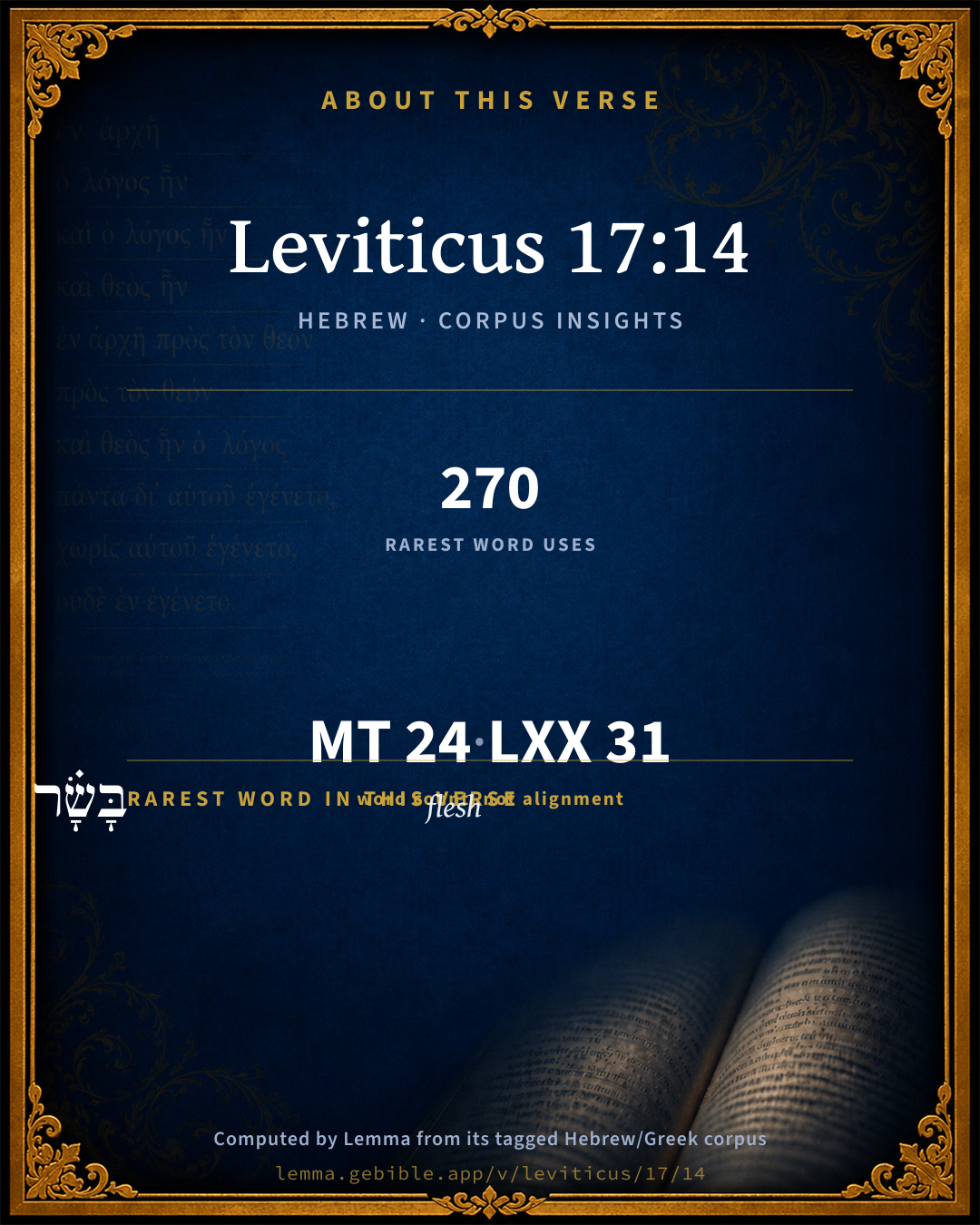
About this verse

These counts appear in no published source. They are computed here, from the morphology-tagged text and Lemma’s own curated glosses. What Lemma adds →

24
words
12
distinct lemmas
Pentateuch
section

Grammatical profile

  • 4 verbs
  • 15 nouns
  • 2 pronouns
  • 2 conjunctions
  • 1 particle

Verb forms

  • וָֽאֹמַר֙ Qal · Sequential Imperfect
  • תֹאכֵ֑לוּ Qal · Imperfect
  • אֹכְלָ֖יו Qal · Participle Active
  • יִכָּרֵֽת Niphal · Imperfect

Repetition

Words recur within this verse — often emphatic in Hebrew:

  • כָּל all H3605 ×4
  • נֶ֣פֶשׁ soul H5315 ×3
  • בָּשָׂ֗ר flesh H1320 ×3
  • דָּמ֣וֹ blood H1818 ×3
  • תֹאכֵ֑לוּ to eat H398 ×2
  • כִּֽי that H3588 ×2
  • הוּא֒ he H1931 ×2

Hebrew & Septuagint length

In English translation the verse runs 49 words from the Hebrew and 43 from the Septuagint (LXX English) — closely comparable.

A rough comparison of the two English renderings, which tokenize alike — not a word-level alignment.

Word counts can differ between the Hebrew and the Greek without any difference in meaning — e.g. the Hebrew direct-object marker אֵת has no separate Greek word, and Greek often adds the article ὁ.

In the original languages it is 24 Hebrew tokens and 31 Greek tokens — but the two are counted differently (Hebrew bundles its prefixes and suffixes into one token; the Greek is in lemma form), so that isn’t a like-for-like length.

Cross-references

3

Topical passages linked to Leviticus 17:14 in the Treasury of Scripture Knowledge — connected by theme and wording, ordered by reader-vote popularity; previews shown in the World English Bible.

  • Genesis 9:4 But flesh with the life of it, the blood of it, you shall not eat.
  • Deuteronomy 12:23 Only be sure that you don't eat the blood: for the blood is the life; and you shall not eat the life with the flesh.
  • Leviticus 17:11–12 For the life of the flesh is in the blood; and I have given it to you on the altar to make atonement for your souls: for it is the blood that makes atonement by reason of the life.

Cross-references courtesy of OpenBible.info (CC BY 4.0).

Hebrew and Greek witnesses Masoretic Hebrew ↔ Greek Septuagint

The same verse in the two great witnesses to the Old Testament, shown verse-for-verse.

These are two independent witnesses, not word-aligned to each other, and the Septuagint is shown in lemma (dictionary) form.

Hebrew Leviticus 17:14 Masoretic · Westminster Leningrad Codex

כִּֽי נֶ֣פֶשׁ כָּל בָּשָׂ֗ר דָּמ֣וֹ בְנַפְשׁוֹ֮ הוּא֒ וָֽאֹמַר֙ לִבְנֵ֣י יִשְׂרָאֵ֔ל דַּ֥ם כָּל בָּשָׂ֖ר לֹ֣א תֹאכֵ֑לוּ כִּ֣י נֶ֤פֶשׁ כָּל בָּשָׂר֙ דָּמ֣וֹ הִ֔וא כָּל אֹכְלָ֖יו יִכָּרֵֽת

For as to the life of all flesh, its blood is with its life: therefore I said to the children of Israel, "You shall not eat the blood of any kind of flesh; for the life of all flesh is its blood. Whoever eats it shall be cut off."

World English Bible · Public Domain

Greek LXX Leviticus 17:14 Septuagint · lemma form

ὁ γάρ ψυχή πᾶς σάρξ αἷμα αὐτός εἰμί καί εἶπον ὁ υἱός ἰσραήλ αἷμα πᾶς σάρξ οὐ ἐσθίω ὅτι ὁ ψυχή πᾶς σάρξ αἷμα αὐτός εἰμί πᾶς ὁ ἐσθίω αὐτός ἐκὀλεθρεύω

For the blood of all flesh is its life; and I said to the children of Israel, You⌃ shall not eat the blood of any flesh, for the life of all flesh is its blood: every one that eats it shall be destroyed.

LXX2012 (modern English Septuagint) · Public Domain

Hebrew: Westminster Leningrad Codex (CC BY 4.0). Greek: Septuagint (public domain); English from LXX2012 (modern English Septuagint) (Public Domain). How the Septuagint differs from the Hebrew →

Targum (Aramaic paraphrase)

2

The Targum is the ancient Jewish Aramaic paraphrase of the Hebrew Scriptures — an interpretive translation, not the Hebrew text itself. Onkelos (literal) and Pseudo-Jonathan (expansive) render the Torah, and Jonathan the Prophets. Coverage is partial: where no permissively-licensed English translation exists for a verse, only the Aramaic is shown. This is verse-level text, not a word-by-word alignment to the Hebrew.

  1. Targum Onkelos Torah (Genesis–Deuteronomy)
    אֲרֵי נְפַשׁ כָּל בִּסְרָא דְמֵהּ בְּנַפְשֵׁהּ הוּא וַאֲמָרִית לִבְנֵי יִשְׂרָאֵל דַם כָּל בִּסְרָא לָא תֵיכְלוּן אֲרֵי נְפַשׁ כָּל בִּסְרָא דְמֵהּ הִיא כָּל דְיֵיכְלִנֵהּ יִשְׁתֵּיצֵי

    (no public-domain English translation for this verse)

    Targum Onkelos — Aramaic: “Onkelos Genesis” (public domain); “Onkelos Exodus” (public domain); “Onkelos Leviticus” (public domain); “Onkelos Numbers” (public domain); “Onkelos Deuteronomy” (public domain). English: “Sefaria Community Translation” (CC0 1.0 (public-domain dedication)); “J.W. Etheridge. The Targums of Onkelos and Jonathan Ben Uzziel on the Pentateuch. London: Longmans, Green, 1862” (public domain). Text via Sefaria.

  2. Targum Pseudo-Jonathan Torah (Genesis–Deuteronomy)
    אֲרוּם קִיוּם נְפַשׁ כָּל בִּישְרָא אַדְמֵיהּ בְּנַפְשֵׁיהּ הוּא וַאֲמָרִית לִבְנֵי יִשְרָאֵל אֲדַם כָּל בִּישְרָא לָא תֵיכְלוּן אֲרוּם קִיוּם נְפַשׁ כָּל בִּישְרָא אַדְמֵיהּ הוּא כָּל מַן דְיֵכְלִינֵיהּ יִשְׁתֵּיצֵי

    Because the subsistence of the life of all flesh is its blood; it is its life; and I have told the sons of Israel, You shall not eat the blood of any flesh; for the subsistence of the life of all flesh is its blood: whosoever among you eateth it shall be destroyed.

    Targum Pseudo-Jonathan — Aramaic: “Targum Jonathan on Genesis” (public domain); “Targum Jonathan on Exodus” (public domain); “Targum Jonathan on Leviticus” (public domain); “Targum Jonathan on Numbers” (public domain); “Targum Jonathan on Deuteronomy” (public domain). English: “The Targum of Jonathan ben Uzziel, trans. J. W. Etheridge, London, 1862” (public domain). Text via Sefaria.

Commentary

Notes on Leviticus 17:14 from classic Christian and Jewish commentators (each source and its license shown beneath its notes). The classic Christian expositions comment on the surrounding passage and are grouped to its opening verse, so a note may address several verses; the Jewish commentaries on the Tanakh (Rashi and others) are per-verse, so they appear only where the commentator wrote on this verse.

Lemma curates 59 commentaries, every one of them public domain or Creative Commons licensed, each selected and text-cleaned for this edition rather than reprinted as found. About our sources →

Trapp's Complete Commentary

John Trapp

Lev 17:14 For [it is] the life of all flesh; the blood of it [is] for the life thereof: therefore I said unto the children of Israel, Ye shall eat the blood of no manner of flesh: for the life of all flesh [is] the blood thereof: whosoever eateth it shall be cut off.

Ver. 14. Is the blood,] i.e., Is in the blood, and goeth out together with it.

John Trapp, A Commentary or Exposition upon All the Books of the Old and New Testament (1647–1656) — public domain. Text from a community e-Sword module.

Geneva Bible (1599)

Geneva Bible translators

Or, living creature.

Geneva Bible (1599) marginal notes — public domain. Text via Bolls.life.

Adam Clarke's Commentary

Verse 14. Ye shall eat the blood of no manner of flesh] Independently of the moral reasons given above, we may add,

1. That blood, being highly alkalescent, especially in hot climates, is subject to speedy putrefaction.

2. That it affords a gross nutriment, being very difficult of digestion, so much so that bull's blood was used in ancient times as poison, "Its extreme viscidity rendering it totally indigestible by the powers of the human stomach."

3. It is allowed that when blood was used in this country in great quantities, the scurvy was more frequent than at other times.

4. It appears from history that those nations who lived most on it were very fierce, savage, and barbarous, such as the Scythians, Tartars, Arabs of the desert, the Scandinavians, &c., &c., some of whom drank the blood of their enemies, making cups of their sculls!

Adam Clarke's Commentary on the Bible (1810–1826) — public domain. Text from a community e-Sword/MySword module.

Ellicott's Commentary for English Readers

(14) For it is the life of all flesh . . . —Better, for the soul of all flesh is its blood, in, or through, its soul, that is, the sacredness of the blood arises from the fact that it contains the vital principle of all animal life. Or this clause may be rendered, for the life of all flesh is its blood in, or during, its life, that is, the life of all creatures consists in its blood; but only as long as the blood contains this life, for when it is dried up, or coagulated, the life has passed away from it.

For the life of all flesh.—Better, for the soul of all flesh (see Lev_17:11), that is, even of those wild animals which, in contradistinction to the sacrificial quadrupeds, must not be offered upon the altar, the blood constitutes the vital principle.

A Bible Commentary for English Readers, edited by Charles John Ellicott (1878–1897) — public domain. Text from a community e-Sword module.

John Gill's Exposition

For it is the life of all flesh,.... Of every animal:

the blood of it is for the life thereof; for the production, preservation, and continuance of life; that on which life depends, as Jarchi observes:

therefore I said unto the children of Israel, ye shall eat the blood of no manner of flesh; of beasts or birds, whose flesh was fit for food; but their blood was not to be eaten, for the reasons before given:

for the life of all flesh is the blood thereof; which is repeated, that it might be observed and taken notice of, as that in which the force of the reason lay for giving this law:

whosoever eateth it shall be cut off; by death, whether he be an Israelite or a proselyte of righteousness; wherefore if this law was now in force, its penalty also would be continued, whereas it is not, and which shows the abrogation of it. Also See Gill on Lev 17:4.

John Gill's Exposition of the Whole Bible (1746–1763) — public domain (CC PDM 1.0). Text via the HelloAO Bible API.

unfoldingWord translationNotes

Door43 World Missions Community

the life of each creature is its blood

This means that the blood is enables the creature to be alive. The full meaning of this statement can be made clear. AT: "each creature is able to live because of its blood" (See: Assumed Knowledge and Implicit Information)

Whoever eats it must be cut off

A person being excluded from his community is spoken of as if he had been cut off from his people, as one would cut a piece of cloth or cut a branch from a tree. This can be translated in active form. AT: "Whoever eats blood may no longer live among his people" or "You must separate from his people anyone who eats blood" (See: Metaphor and Active or Passive)

translationWords

creature

cut off

unfoldingWord translationNotes — © Distant Shores Media and the Door43 World Missions Community, licensed CC BY-SA 4.0. Source: git.door43.org/Door43/en_tn.

Rashi

Rabbi Shlomo Yitzchaki (Rashi)

דמו בנפשו הוא means its blood represents its life (במקום הנפש), in as much as its life is depending on it.

כי נפש כל בשר דמו הוא means the life is (is identical with) the blood; דם and בשר are masculine, נפש is feminine.

Rashi on the Tanakh — English translations: “The Judaica Press complete Tanach with Rashi, translated by A. J. Rosenberg” (CC BY 4.0); “Pentateuch with Rashi's commentary by M. Rosenbaum and A.M. Silbermann, 1929-1934” (public domain); “The Metsudah Tanach series, Lakewood, N.J” (CC BY 4.0); and “The Book of Joshua, Metsudah Publications, 1997” (CC BY 4.0). Text via Sefaria.

Ramban (Nachmanides)

Rabbi Moshe ben Nachman (Ramban / Nachmanides)

THE BLOOD THEREOF IS ‘B’NAFSHO’ (ALL ONE WITH THE LIFE THEREOF). “Its blood represents its life, since life is dependent upon the blood.” This is Rashi’s language. But it is not correct. Rather, it is possible to explain that the word b’nafsho here means “in its body,” Scripture thus stating, “for as to the life of all flesh, it is the blood in its body.” Similarly [we find the word nefesh meaning “body” in these verses]: ‘Nafsho’ (his person) was laid in iron; seventy ‘nefesh’ (persons); he [the Nazirite] shall not come near to a dead ‘nefesh,’ meaning “a body,” since “the body” of anyone that is possessed of a nefesh (soul) is also called nefesh.In my opinion Scripture mentioned three expressions with reference to blood, which constitute but one reason. First it stated, For the life of the flesh is in the blood. Then it changed and said [in Verse 14 before us], For as to the life of all flesh, the blood thereof is all one with the life thereof, meaning to say that the blood is the life, and the life is in the blood, as both are mixed together, similarly to wine when diluted with water, in which case the water is in the wine and the wine in the water, and each one is “in” the other. Afterwards it explained [in the second half of Verse 14 before us, stating for the life of all flesh is the blood thereof], that the blood is the very life, meaning to say that both have become one inseparable substance, so that you can never find blood without life nor life without blood, as is known of the air which originates in the heart, that it is the hyly from which proceed all dispositions [of man], supplying the substance which gives nutrition and makes blood, and it is the blood which in turn creates it and sustains it. [The relationship between life and blood is thus] like that of matter and form in all physical creatures, where the one cannot be found without the other. Now our Rabbis interpreted the three punishments of excision which Scripture mentioned with reference to blood in the following way: “One verse prohibits the eating of that blood with which life escapes [when cutting the throat of the offering, since it has been given for atonement upon the altar]; one verse prohibits the eating of blood which escapes when slaughtering [an ordinary, unconsecrated animal], and one verse prohibits the eating of blood, that [of a fowl or wild animal, which when slaughtered] must be covered.” This saying of the Rabbis explains why the punishment of excision was mentioned three times, but the reason for the different Scriptural expressions concerning the life and the blood [of the animal] is as I have explained.

Ramban (Nachmanides) on the Tanakh — English translation: “Commentary on the Torah by Ramban (Nachmanides). Translated and annotated by Charles B. Chavel. New York, Shilo Pub. House, 1971-1976” (CC BY 4.0). Text via Sefaria.

Lesson kit

Teaching starters — assembled from the data on this page, not authored interpretation. Every prompt links to the verse data it draws on. Edit before teaching.

Leviticus, in the Pentateuch, opens this verse with 24 words (12 distinct Hebrew lemmas). Its most distinctive word is bâsâr (“flesh”). A historical commentator’s framing appears above. Read the whole chapter for the surrounding context.

Discussion questions

  1. What does “flesh” (bâsâr) contribute to the verse as a whole?
  2. How does Genesis 9:4, which shares this passage’s theme, read alongside this verse?
  3. What does the repetition of “all” (4× in this one verse) do in this verse?
  4. These translations render this verse differently; the difference is in the English rendering, not the original. What questions does that raise?
  5. «וָֽאֹמַר֙» is a Qal Sequential Imperfect verb. How does that grammatical form shape the action described?
  6. Compare how Trapp's Complete Commentary and Geneva Bible (1599) read this verse. Where do they agree or differ?

Things to notice

Reading settings

Reading text

Shown beneath each verse's original-language words.

Old Testament
Old Testament edition

Read the OT as the Masoretic Hebrew (MT) or the Greek Septuagint (LXX).

English shown for the Greek Septuagint (in the Hebrew ↔ Greek comparison).

Comparing translations? Open the Compare panel on any verse page to stack up to four side by side.