
Deuteronomy 29:14

Hebrew (Westminster Leningrad Codex) Deuteronomy 29:14 appears in the Hebrew Old Testament. The text above is from the Westminster Leningrad Codex. Each word links to its Strong’s number, a concise gloss, and parsing drawn from the Open Scriptures Hebrew Bible morphology. Click any word for its full Brown-Driver-Briggs (BDB) entry.
Download image
Cite this verse

Deuteronomy 29:14 (World English Bible). Public Domain. Lemma interlinear Bible study tool, https://lemma.gebible.app/v/deuteronomy/29/14.

Show BibTeX & RIS
BibTeX
RIS
English Translation
Neither with you only do I make this covenant and this oath,
World English Bible · Public Domain
Download a study sheet

One document with this verse’s original text, its word-by-word gloss line, the meaning frame, cross-references with their text, attributed commentary, and full source and license credits — printable, and it pastes into notes with its structure intact.

This verse Autodidact and up

Study sheet (.html) Plain text (.txt)

A passage Seminary Student

Up to 50 verses in one chapter. A passage sheet keeps up to 6 commentary sources and 12 cross-references per verse, in the order this page ranks them, and says so on the sheet whenever that leaves anything out. Ask for a single verse and you get the Autodidact verse sheet above.

Everything on this page stays free to read, with no account — the sheet is a download of what is already on screen, not access to it.

Want to remove ads? Support Godless Engineer
Compare translations 3

The same verse in 3 English versions, stacked beneath the original-language interlinear above. Click any original word for its lexicon entry.

Each is an independent rendering of the whole verse — the interlinear is not word-aligned to these translations.

Highlighted words mark where these versions differ — a whole-verse word diff, not a word-by-word alignment.

  • World English Bible Public Domain
    Neither with you only do I make this covenant and this oath,
  • King James Version Public Domain
    Neither with you only do I make this covenant and this oath;
  • unfoldingWord Literal Text CC BY-SA 4.0
    and not only with you am I cutting this covenant and this oath,

unfoldingWord Literal Text — © unfoldingWord, licensed CC BY-SA 4.0. Word-aligned USFM3 via Door43 (git.door43.org/unfoldingWord/en_ult).

Versions to compare (up to 4)

3 of 4 selected

Show all 18 translations

Every available English version of this verse, each an independent rendering of the whole verse.

  • World English Bible Public Domain
    Neither with you only do I make this covenant and this oath,
  • Berean Standard Bible Public Domain
    I am making this covenant and this oath not only with you,
  • Majority Standard Bible Public Domain
    I am making this covenant and this oath not only with you,
  • King James Version Public Domain
    Neither with you only do I make this covenant and this oath;
  • American Standard Version (1901) Public Domain
    Neither with you only do I make this covenant and this oath,
  • Revised Version (1885) Public Domain
    Neither with you only do I make this covenant and this oath;
  • Geneva Bible (1599) Public Domain
    Neither make I this couenant, and this othe with you onely,
  • Douay-Rheims (1899) Public Domain
    Neither with you only do I make this covenant, and confirm these oaths,
  • Young's Literal Translation Public Domain
    `And not with you alone am I making this covenant and this oath;
  • Literal Standard Version CC BY-SA 4.0
    And I am not making this covenant and this oath with you alone,
  • Unlocked Literal Bible CC BY-SA 4.0
    For it is not only with you that I am making this covenant and this oath—
  • unfoldingWord Literal Text CC BY-SA 4.0
    and not only with you am I cutting this covenant and this oath,
  • Darby Bible Public Domain
    Neither with you only do I make this covenant and this oath,
  • World Messianic Bible Public Domain
    Neither do I make this covenant and this oath with you only,
  • Webster's Bible Public Domain
    Neither with you only do I make this covenant and this oath;
  • Free Bible Version CC BY-SA 4.0
    It's not only with you that the Lord is making this agreement and solemn promise,
  • Bible in Basic English Public Domain
    And not with you only do I make this agreement and this oath;
  • JPS Tanakh (1917) Public Domain
    (29-13) Neither with you only do I make this covenant and this oath;

Literal Standard Version (2020), Covenant Press — licensed CC BY-SA 4.0. Text via the HelloAO Bible API (eBible.org). Unlocked Literal Bible (unfoldingWord) — licensed CC BY-SA 4.0. Text via the HelloAO Bible API (eBible.org). unfoldingWord Literal Text — © unfoldingWord, licensed CC BY-SA 4.0. Word-aligned USFM3 via Door43 (git.door43.org/unfoldingWord/en_ult). Free Bible Version, Dr. Jonathan Gallagher — licensed CC BY-SA 4.0. Text via the HelloAO Bible API (eBible.org).

Word by word

More ways to search: Search by grammar → Find every occurrence → Compare this word →

Practice this passage: Drill this verse → Learn its vocabulary →

הָאָלָ֖ה
ʼâlâh
H423
“the · oath”
Particle, Definite Article + Noun, Common, Feminine, Singular, Absolute
Part of Speech
Particle + Noun
Type
Common
Gender
Feminine
Number
Singular
State
Absolute
Full BDB Definition

Origin: from H422

TWOT: 91a

oath - oath of covenant - curse - from God - from men - execration
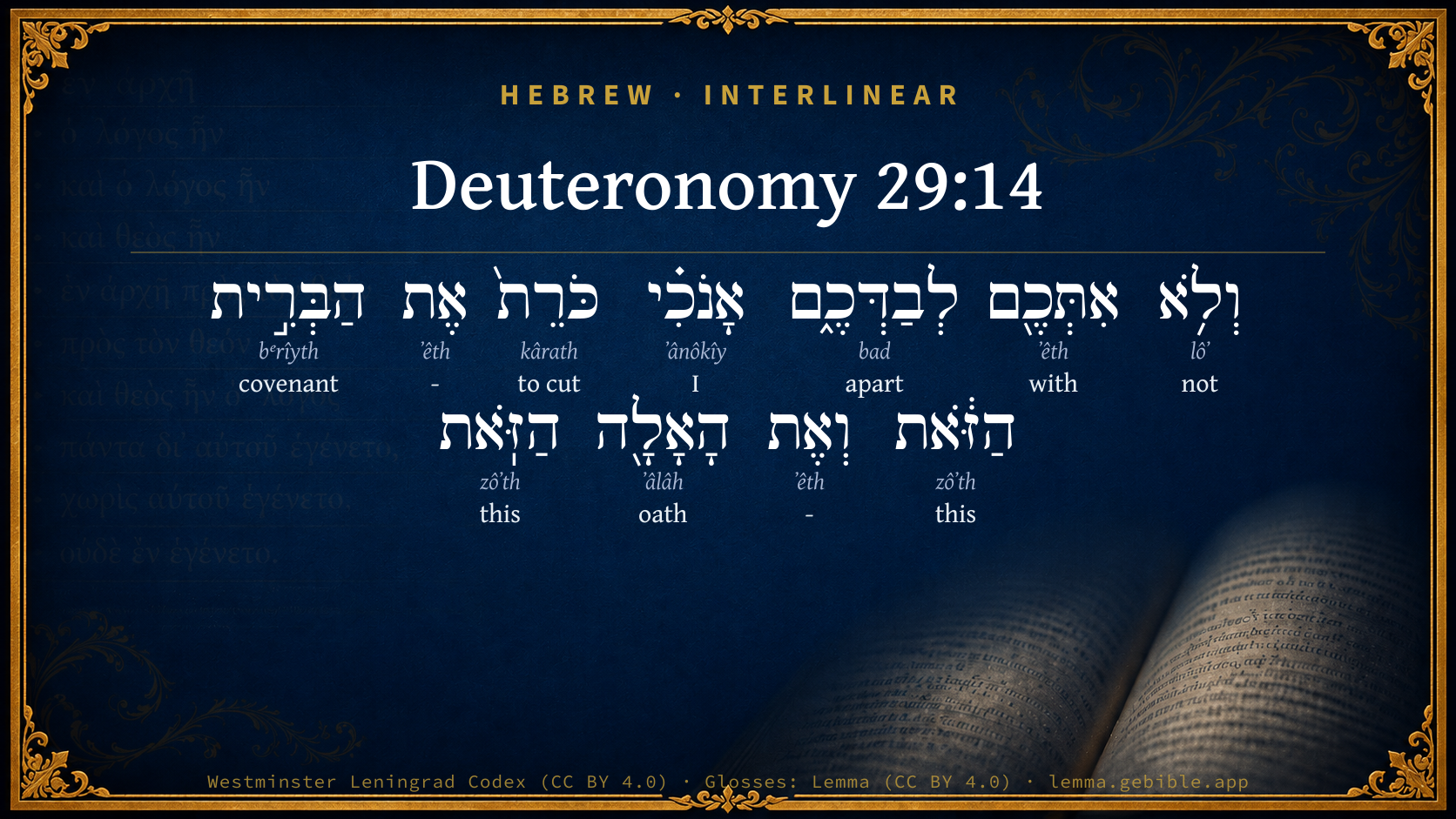
  1. וְלֹ֥א lôʼ H3808 “and · not” Conjunction + Particle, Negative
  2. אִתְּכֶ֖ם ʼêth H854 “with · you” Preposition + Suffix, Personal, 2nd Person, Masculine, Plural
  3. לְבַדְּכֶ֑ם bad H905 “to/for · apart · your” Preposition + Noun, Common, Masculine, Singular, Construct + Suffix, Personal, 2nd Person, Masculine, Plural
  4. אָנֹכִ֗י ʼânôkîy H595 “I” Pronoun, Personal, 1st Person, Common, Singular
  5. כֹּרֵת֙ kârath H3772 “cutting” Verb, Qal, Participle Active, Masculine, Singular, Absolute
  6. אֶת ʼêth H853 “-” Particle, Direct Object
  7. הַבְּרִ֣ית bᵉrîyth H1285 “the · covenant” Particle, Definite Article + Noun, Common, Feminine, Singular, Absolute
  8. הַזֹּ֔את zôʼth H2063 “the · this” Particle, Definite Article + Pronoun, Demonstrative, Feminine, Singular
  9. וְאֶת ʼêth H853 “and · -” Conjunction + Particle, Direct Object
  10. הַזֹּֽאת zôʼth H2063 “the · this” Particle, Definite Article + Pronoun, Demonstrative, Feminine, Singular

About this verse

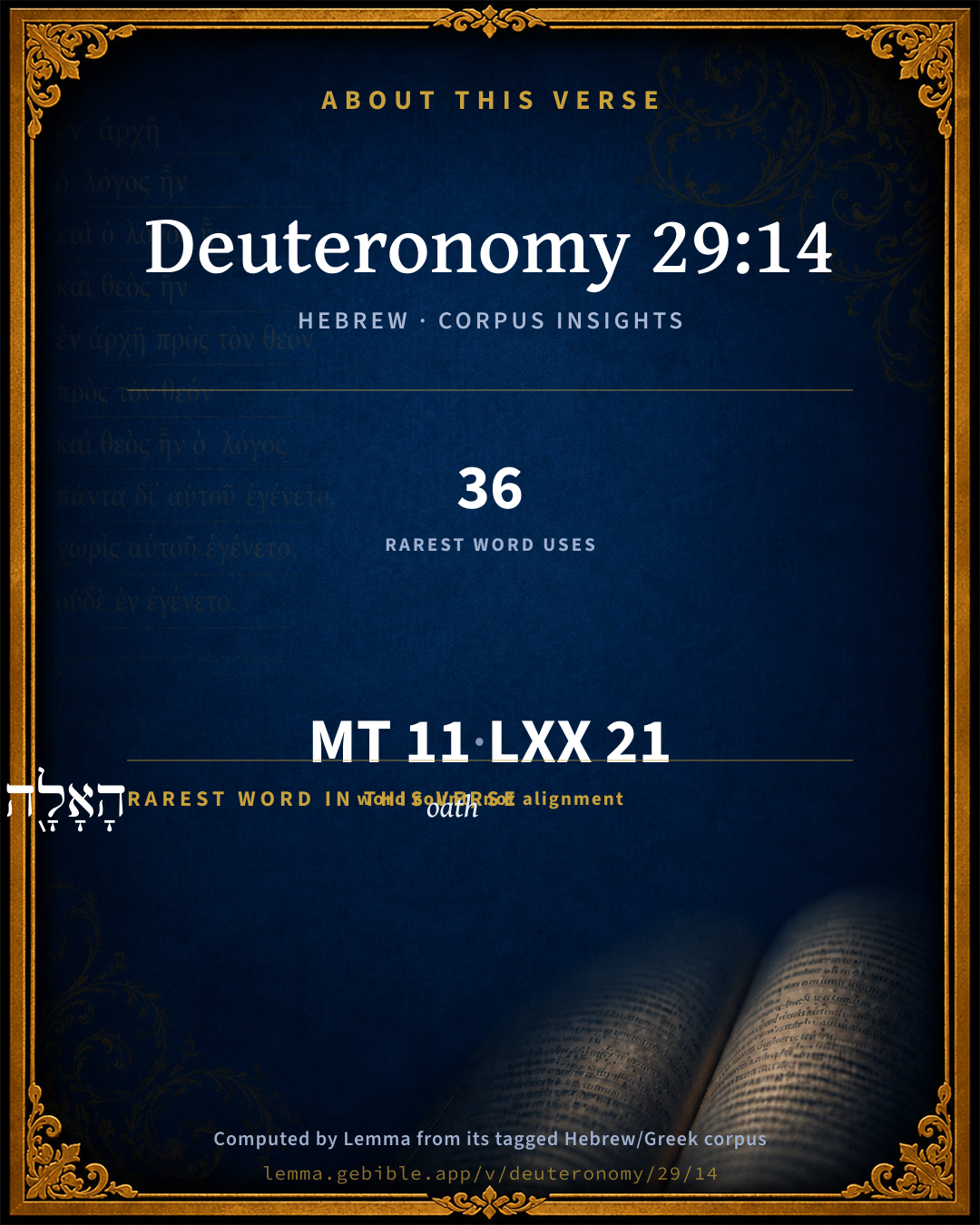
These counts appear in no published source. They are computed here, from the morphology-tagged text and Lemma’s own curated glosses. What Lemma adds →

11
words
9
distinct lemmas
Pentateuch
section

Shared distinctive vocabulary

הָאָלָ֖ה oath H423 occurs in 32 verses of the Hebrew Bible. Also found in:

Grammatical profile

  • 1 verb
  • 3 nouns
  • 3 pronouns
  • 1 preposition
  • 3 particles

Verb forms

  • כֹּרֵת֙ Qal · Participle Active

Repetition

A word recurs within this verse — often emphatic in Hebrew:

  • הַזֹּ֔את this H2063 ×2

Hebrew & Septuagint length

In English translation the verse runs 12 words from the Hebrew and 13 from the Septuagint (LXX English) — closely comparable.

A rough comparison of the two English renderings, which tokenize alike — not a word-level alignment.

Word counts can differ between the Hebrew and the Greek without any difference in meaning — e.g. the Hebrew direct-object marker אֵת has no separate Greek word, and Greek often adds the article ὁ.

In the original languages it is 11 Hebrew tokens and 21 Greek tokens — but the two are counted differently (Hebrew bundles its prefixes and suffixes into one token; the Greek is in lemma form), so that isn’t a like-for-like length.

Cross-references

2

Topical passages linked to Deuteronomy 29:14 in the Treasury of Scripture Knowledge — connected by theme and wording, ordered by reader-vote popularity; previews shown in the World English Bible.

  • Jeremiah 31:31–34 Behold, the days come, says Yahweh, that I will make a new covenant with the house of Israel, and with the house of Judah:
  • Hebrews 8:7–12 For if that first covenant had been faultless, then no place would have been sought for a second.

Cross-references courtesy of OpenBible.info (CC BY 4.0).

Hebrew and Greek witnesses Masoretic Hebrew ↔ Greek Septuagint

The same verse in the two great witnesses to the Old Testament, shown verse-for-verse.

These are two independent witnesses, not word-aligned to each other, and the Septuagint is shown in lemma (dictionary) form.

Hebrew Deuteronomy 29:14 Masoretic · Westminster Leningrad Codex

וְלֹ֥א אִתְּכֶ֖ם לְבַדְּכֶ֑ם אָנֹכִ֗י כֹּרֵת֙ אֶת הַבְּרִ֣ית הַזֹּ֔את וְאֶת הָאָלָ֖ה הַזֹּֽאת

Neither with you only do I make this covenant and this oath,

World English Bible · Public Domain

Greek LXX Deuteronomy 29:14 Septuagint · lemma form

ἀλλά καί ὁ ὧδε εἰμί μετά ἐγώ σήμερον ἐναντίον κύριος ὁ θεός σύ καί ὁ μή εἰμί μετά ἐγώ ὧδε σήμερον

And I do not appoint to you alone this covenant and this oath;

LXX2012 (modern English Septuagint) · Public Domain

Hebrew: Westminster Leningrad Codex (CC BY 4.0). Greek: Septuagint (public domain); English from LXX2012 (modern English Septuagint) (Public Domain). How the Septuagint differs from the Hebrew →

Targum (Aramaic paraphrase)

2

The Targum is the ancient Jewish Aramaic paraphrase of the Hebrew Scriptures — an interpretive translation, not the Hebrew text itself. Onkelos (literal) and Pseudo-Jonathan (expansive) render the Torah, and Jonathan the Prophets. Coverage is partial: where no permissively-licensed English translation exists for a verse, only the Aramaic is shown. This is verse-level text, not a word-by-word alignment to the Hebrew.

  1. Targum Onkelos Torah (Genesis–Deuteronomy)
    אֲרֵי יָת מָן דְאִיתוֹהִי הָכָא עִמָנָא קָאֵם יוֹמָא דֵין קֳדָם יְיָ אֱלָהָנָא וְיָת מָן דְלֵיתוֹהִי הָכָא עִמָנָא יוֹמָא דֵין

    (no public-domain English translation for this verse)

    Targum Onkelos — Aramaic: “Onkelos Genesis” (public domain); “Onkelos Exodus” (public domain); “Onkelos Leviticus” (public domain); “Onkelos Numbers” (public domain); “Onkelos Deuteronomy” (public domain). English: “Sefaria Community Translation” (CC0 1.0 (public-domain dedication)); “J.W. Etheridge. The Targums of Onkelos and Jonathan Ben Uzziel on the Pentateuch. London: Longmans, Green, 1862” (public domain). Text via Sefaria.

  2. Targum Pseudo-Jonathan Torah (Genesis–Deuteronomy)
    אֲרוּם יַת כָּל דָרַיָא דְקָמוּן מִן יוֹמֵי עַלְמָא כֻּלְהוֹן הִנוּן דְקַיְימִין הָכָא עִמָנָא יוֹמָנָא קֳדָם יְיָ אֱלָהָנָא וְיַת כָּל דָרַיָא דַעֲתִידִין לְמֵיקוּם עַד סוֹף כָּל עַלְמָא כּוּלְהוֹן הִינוּן קַיְימִין הָכָא עִמָן יוֹמָנָא

    but all the generations which have arisen from the days of old stand with us today before the Lord our God, and all the generations which are to arise unto the end of the world, all of them stand with us here this day.

    Targum Pseudo-Jonathan — Aramaic: “Targum Jonathan on Genesis” (public domain); “Targum Jonathan on Exodus” (public domain); “Targum Jonathan on Leviticus” (public domain); “Targum Jonathan on Numbers” (public domain); “Targum Jonathan on Deuteronomy” (public domain). English: “The Targum of Jonathan ben Uzziel, trans. J. W. Etheridge, London, 1862” (public domain). Text via Sefaria.

Commentary

Notes on Deuteronomy 29:14 from classic Christian and Jewish commentators (each source and its license shown beneath its notes). The classic Christian expositions comment on the surrounding passage and are grouped to its opening verse, so a note may address several verses; the Jewish commentaries on the Tanakh (Rashi and others) are per-verse, so they appear only where the commentator wrote on this verse.

Lemma curates 59 commentaries, every one of them public domain or Creative Commons licensed, each selected and text-cleaned for this edition rather than reprinted as found. About our sources →

Ellicott's Commentary for English Readers

(14, 15) Neither with you only . . . but . . . also with him that is not here with us this day—i.e., “also with generations yet to be” (Rashi).

A Bible Commentary for English Readers, edited by Charles John Ellicott (1878–1897) — public domain. Text from a community e-Sword module.

The Cambridge Bible for Schools and Colleges

gen. ed. J. J. S. Perowne

14, 15. Cp. Deu_5:3. Deu_29:15 is better rendered, but at once with him that standeth here … and with him that is not here with us this day.

The Cambridge Bible for Schools and Colleges (gen. ed. J. J. S. Perowne; Cambridge University Press, 1878–1918) — public domain. Text from a community e-Sword module.

John Gill's Exposition

Neither with you only do I make this covenant and this oath. That is, Moses; for he was ordered to make this covenant with them in the name of the Lord; what promises of good things, or declarations of his mind and will, God would make, Moses was to deliver to them; and what was required of them he would inform them of. Aben Ezra interprets it, not only you, but those that will come after you, your sons and your sons' sons.

Neither with you only do I make this covenant and this oath. That is, Moses; for he was ordered to make this covenant with them in the name of the Lord; what promises of good things, or declarations of his mind and will, God would make, Moses was to deliver to them; and what was required of them he would inform them of. Aben Ezra interprets it, not only you, but those that will come after you, your sons and your sons' sons.

Deuteronomy 29:15

deu 29:15

deu 29:15

deu 29:15But with him that standeth here with us this day before the Lord our God,.... Who are before specified according to their dignity, age, sex, and station of life; or rather, "but as with him that standeth", &c.

and so with him that is not here with us this day; detained at home by illness and indisposition of body, or by one providence or another; so that they could not come out of their tents, and make their appearance before the tabernacle; though Jarchi interprets this of the people of future generations.

John Gill's Exposition of the Whole Bible (1746–1763) — public domain (CC PDM 1.0). Text via the HelloAO Bible API.

Whedon's Commentary on the Bible

Daniel D. Whedon

14-15. Neither with you only — Moses here impresses upon the people that the covenant is not merely with those he is addressing, but also with their descendants. “For the promise is unto you, and to your children, and to all them that are afar off.” Act_2:39.

Daniel D. Whedon (gen. ed.), Commentary on the Old and New Testaments (1874–1909) — public domain. Text from a community e-Sword module.

The Pulpit Commentary

Vers. 14-28. The government of God all-embracing.

The detective force in God"s kingdom is perfect. Escape through the meshes of his Law is an impossibility. Every defaulter is within the custody of the Omniscient Eye. Arraignment, conviction, and execution proceed (sometimes leisurely) with the precision and certitude of irresistible law. In this paragraph

I WE LEARN THE ORGANIC UNITY OF THE NATION. Every individual is a member of the community an integral part of the kingdom. No man liveth unto himself." A citizen of an empire cannot demean himself as he please. He is bound to consider the well-being of the body politic. Hence Moses affirmed that the covenant made with the elders and officers present was a covenant also made with those not present. Whoever elected to share in the security and triumphs of the nation was bound to share in its obligations. We cannot belong to society and claim exemption from its laws. The individual is bound by the decisions of the nation.

II WE LEARN THE GREAT USES OF EXPERIENCE. "Ye have seen their abominations." To a generation that had not seen the obscenities, impurities, and social corruptions of idolatry, it would be difficult to convey an adequate idea of the evil. It was, therefore, of the first importance that the experience of the Hebrews who had come up from Egypt should mold and inspire the convictions of the younger generation. Those who had seen the abominations of Egypt, felt its oppressions, and taken part in uprooting the corrupt races of Canaan, ought to have cherished a deep sense of the value of this covenant with God. The evil against which they solemnly leagued they knew to be a curse to men and an abhorrence to Jehovah. If only the treasures of experience were garnered and utilized, they would be worth more than mountains of silver and gold.

III WE LEARN THE DECEPTIVE FLATTERIES OF SIN. "I shall have peace, though I walk in the imagination of mine heart.

1. The transgressor is intensely selfish. He plots for himself, and thinks only of his comfort. "I shall have peace.

2. The transgressor is essentially blind. He imagines that although all others may be detected, he shall escape. He sees no immediate danger. He vainly fancies that his evil course is sagacious, and will bring prompt returns of advantage.

3. The transgressor is a practical atheist. Because human magistrates or human witnesses may not discover his crime, he concludes that God will not. In fact, he leaves God out of the calculation. He lays his plans and carries them as if there were no God. The great sin of men is this, viz. that "God is not in all their thoughts." Sin seldom appears in its true color in this life. It is ashamed of its own fruits. It promises its dupes the fruits of righteousness. The creed of this world is that men "may gather grapes from thorns, and figs from thistles.

IV WE LEARN THAT GOD"S DETECTIVES NEVER FAIL. "The Lord will not spare him." The secret conspiracy of the heart shall be proclaimed upon the housetops. If the culprit hide in the darkest den of a populous city, thence will Jehovah"s arm drag him forth. "He besets us behind and before." If he be alone in his guilt, he is the more to blame, since he has no help or encouragement from others. All social influences have been deterrent from evil; but he has resisted them all with his obstinate folly. He has been singular in his sin; he shall be singular in his suffering. Against him the anger of Jehovah will burn with a white heat of justice. All the vials of righteous wrath shall be emptied on that guilty head. His name shall perish. He shall be "separated unto evil." The nation shall loathe him. The universe shall be banded together to punish him.

V WE LEARN THAT THE EFFECT OF PUBLIC RETRIBUTION IS TO MAKE LUMINOUS GOD"S RIGHTEOUSNESS. God delights in earth"s fertility. He finds pleasure in fruits and flowers. But his delight in the fruits and flowers of the soul is so much greater, that he will blast all the beauty and fertility of earth in order to produce in men the fruits of holiness. His police force is enormous. Pestilence and earthquake, volcanic flame and electricity, human armies and microscopic insects, execute his judicial word. And the effect upon mankind is to excite inquiry. Wherefore this demolition and curse? Some solid reason must exist for this complete reversal of former blessing. The contrast is eloquent with meaning. The flames of Sodom shed a luster on the Divine righteousness. The barren hills, with mute yet mournful tongue, declare God"s faithfulness. A broken covenant explains it all! The hills shall flee; the stars shall fade; but not a word from Jehovah"s lips shall ever miscarry. The sleepless sword of judicial vengeance shall pursue to the death every false thing. D.

The Pulpit Commentary (1880–1919), ed. H.D.M. Spence-Jones & Joseph S. Exell — public domain. Text from a community e-Sword module.

unfoldingWord translationNotes

Door43 World Missions Community

I am making

Here "I" refers to Yahweh. "Yahweh is making"

standing here with us

Here "us" refers to Moses and the people of Israel.

those who are not here

"our future descendants, who are not here"

we lived

"we were slaves"

translationWords

covenant

oath

God

life

Egypt

nation

unfoldingWord translationNotes — © Distant Shores Media and the Door43 World Missions Community, licensed CC BY-SA 4.0. Source: git.door43.org/Door43/en_tn.

Rashi

Rabbi Shlomo Yitzchaki (Rashi)

ואת אשר איננו פה [NOT WITH YOU ALONE DO I MAKE THIS COVENANT … BUT WITH HIM THAT STANDETH HERE …] AND ALSO WITH HIM THAT IS NOT HERE — i.e. with the generations that will be in future (i.e. Moses is not referring to persons who happened to be absent from the assembly, for it states, v. 10, that all were present: “You are standing this day all of you before the Lord”) (Midrash Tanchuma, Nitzavim 3).

Rashi on the Tanakh — English translations: “The Judaica Press complete Tanach with Rashi, translated by A. J. Rosenberg” (CC BY 4.0); “Pentateuch with Rashi's commentary by M. Rosenbaum and A.M. Silbermann, 1929-1934” (public domain); “The Metsudah Tanach series, Lakewood, N.J” (CC BY 4.0); and “The Book of Joshua, Metsudah Publications, 1997” (CC BY 4.0). Text via Sefaria.

Ramban (Nachmanides)

Rabbi Moshe ben Nachman (Ramban / Nachmanides)

AND ALSO WITH HIM THAT IS NOT WITH US THIS DAY — “that is, also with the future generations.

Ramban (Nachmanides) on the Tanakh — English translation: “Commentary on the Torah by Ramban (Nachmanides). Translated and annotated by Charles B. Chavel. New York, Shilo Pub. House, 1971-1976” (CC BY 4.0). Text via Sefaria.

Lesson kit

Teaching starters — assembled from the data on this page, not authored interpretation. Every prompt links to the verse data it draws on. Edit before teaching.

Deuteronomy, in the Pentateuch, opens this verse with 11 words (9 distinct Hebrew lemmas). Its most distinctive word is ʼâlâh (“oath”). A historical commentator’s framing appears above. Read the whole chapter for the surrounding context.

Discussion questions

  1. What does “oath” (ʼâlâh) contribute to the verse as a whole?
  2. How does Genesis 24:41, which shares the word «oath», read alongside this verse?
  3. What does the repetition of “this” (2× in this one verse) do in this verse?
  4. The translations on this page render this verse differently — a whole-verse word diff, not a word-by-word alignment. What might account for the different wordings?
  5. «כֹּרֵת֙» is a Qal Participle Active verb. How does that grammatical form shape the action described?
  6. Compare how Ellicott's Commentary for English Readers and The Cambridge Bible for Schools and Colleges read this verse. Where do they agree or differ?

Things to notice

Reading settings

Reading text

Shown beneath each verse's original-language words.

Old Testament
Old Testament edition

Read the OT as the Masoretic Hebrew (MT) or the Greek Septuagint (LXX).

English shown for the Greek Septuagint (in the Hebrew ↔ Greek comparison).

Comparing translations? Open the Compare panel on any verse page to stack up to four side by side.