
2 Kings 11:4

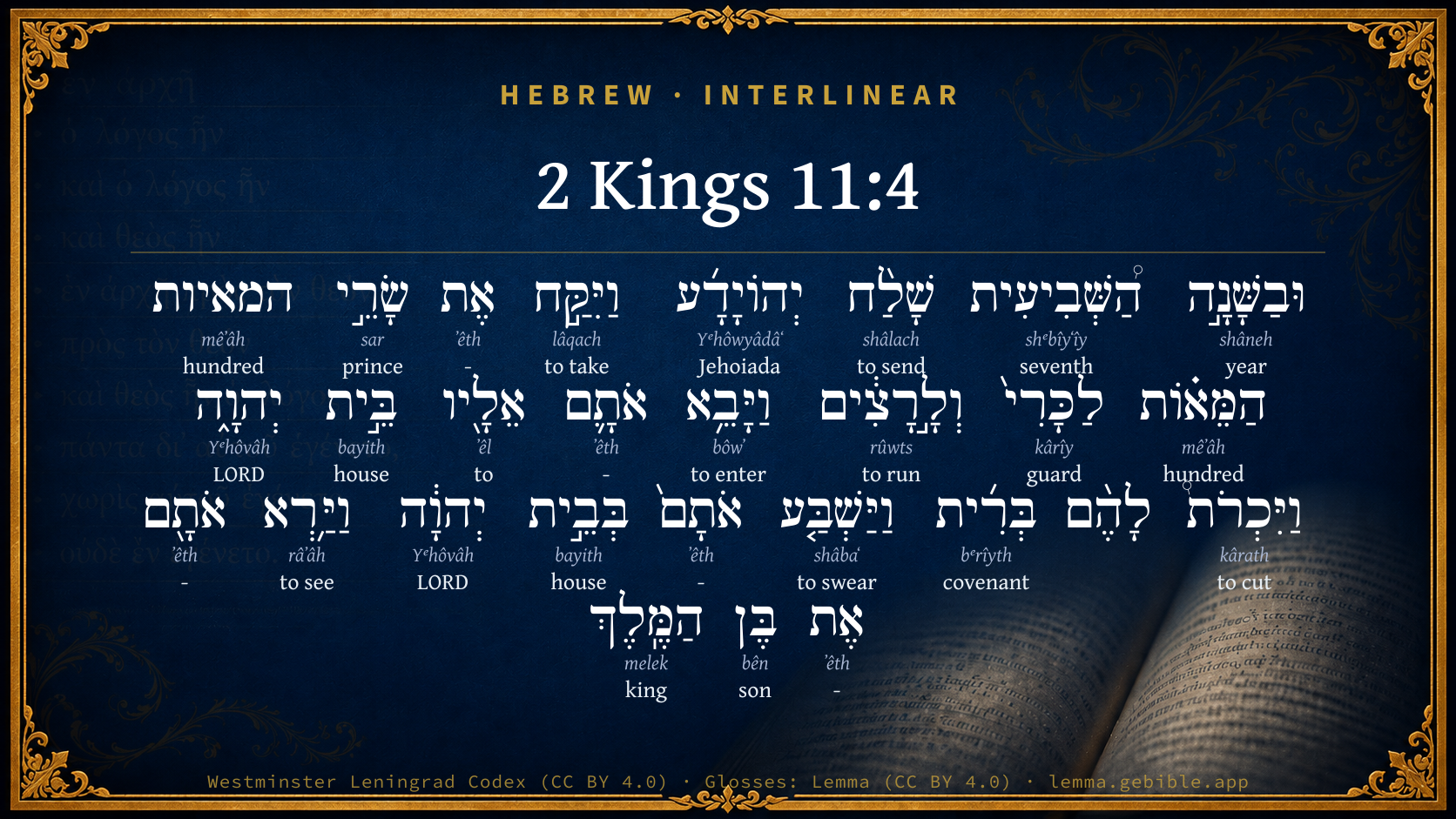
Hebrew (Westminster Leningrad Codex) 2 Kings 11:4 appears in the Hebrew Old Testament. The text above is from the Westminster Leningrad Codex. Each word links to its Strong’s number, a concise gloss, and parsing drawn from the Open Scriptures Hebrew Bible morphology. Click any word for its full Brown-Driver-Briggs (BDB) entry.
Download image
Cite this verse

2 Kings 11:4 (World English Bible). Public Domain. Lemma interlinear Bible study tool, https://lemma.gebible.app/v/2-kings/11/4.

Show BibTeX & RIS
BibTeX
RIS
English Translation
In the seventh year Jehoiada sent and fetched the captains over hundreds of the Carites and of the guard, and brought them to him into the house of Yahweh; and he made a covenant with them, and took an oath of them in the house of Yahweh, and shown them the king's son.
World English Bible · Public Domain
Download a study sheet

One document with this verse’s original text, its word-by-word gloss line, the meaning frame, cross-references with their text, attributed commentary, and full source and license credits — printable, and it pastes into notes with its structure intact.

This verse Autodidact and up

Study sheet (.html) Plain text (.txt)

A passage Seminary Student

Up to 50 verses in one chapter. A passage sheet keeps up to 6 commentary sources and 12 cross-references per verse, in the order this page ranks them, and says so on the sheet whenever that leaves anything out. Ask for a single verse and you get the Autodidact verse sheet above.

Everything on this page stays free to read, with no account — the sheet is a download of what is already on screen, not access to it.

Want to remove ads? Support Godless Engineer
Compare translations 3

The same verse in 3 English versions, stacked beneath the original-language interlinear above. Click any original word for its lexicon entry.

Each is an independent rendering of the whole verse — the interlinear is not word-aligned to these translations.

Highlighted words mark where these versions differ — a whole-verse word diff, not a word-by-word alignment.

  • World English Bible Public Domain
    In the seventh year Jehoiada sent and fetched the captains over hundreds of the Carites and of the guard, and brought them to him into the house of Yahweh; and he made a covenant with them, and took an oath of them in the house of Yahweh, and shown them the king's son.
  • King James Version Public Domain
    And the seventh year Jehoiada sent and fetched the rulers over hundreds, with the captains and the guard, and brought them to him into the house of the LORD, and made a covenant with them, and took an oath of them in the house of the LORD, and showed them the king's son.
  • unfoldingWord Literal Text CC BY-SA 4.0
    And in the seventh year, Jehoiada sent, and he took the commanders of hundreds to the Carite and to the runners, and he brought them to himself at the house of Yahweh. And he cut a covenant with them, and he made them swear in the house of Yahweh, and he showed them the son of the king.

unfoldingWord Literal Text — © unfoldingWord, licensed CC BY-SA 4.0. Word-aligned USFM3 via Door43 (git.door43.org/unfoldingWord/en_ult).

Versions to compare (up to 4)

3 of 4 selected

Show all 18 translations

Every available English version of this verse, each an independent rendering of the whole verse.

  • World English Bible Public Domain
    In the seventh year Jehoiada sent and fetched the captains over hundreds of the Carites and of the guard, and brought them to him into the house of Yahweh; and he made a covenant with them, and took an oath of them in the house of Yahweh, and shown them the king's son.
  • Berean Standard Bible Public Domain
    Then in the seventh year, Jehoiada sent for the commanders of hundreds, the Carites, and the guards, and had them brought into the house of the LORD. There he made a covenant with them and put them under oath. He showed them the king’s son
  • Majority Standard Bible Public Domain
    Then in the seventh year, Jehoiada sent for the commanders of hundreds, the Carites, and the guards, and had them brought into the house of the LORD. There he made a covenant with them and put them under oath. He showed them the king’s son
  • King James Version Public Domain
    And the seventh year Jehoiada sent and fetched the rulers over hundreds, with the captains and the guard, and brought them to him into the house of the LORD, and made a covenant with them, and took an oath of them in the house of the LORD, and showed them the king's son.
  • American Standard Version (1901) Public Domain
    And in the seventh year Jehoiada sent and fetched the captains over hundreds of the Carites and of the guard, and brought them to him into the house of Jehovah; and he made a covenant with them, and took an oath of them in the house of Jehovah, and showed them the king's son.
  • Revised Version (1885) Public Domain
    And in the seventh year Jehoiada sent and fetched the captains over hundreds, of the Carites and of the guard, and brought them to him into the house of the LORD; and he made a covenant with them, and took an oath of them in the house of the LORD, and shewed them the king’s son.
  • Geneva Bible (1599) Public Domain
    And the seuenth yeere Iehoiada sent and tooke the captaines ouer hundreths, with other captaines and them of the garde, and caused them to come vnto him into the house of the Lord, and made a couenant with them, and tooke an othe of them in the house of the Lord, and shewed them the Kings sonne.
  • Douay-Rheims (1899) Public Domain
    And in the seventh year Joiada seat, and taking the centurions and the soldiers, brought them in to him into the temple of the Lord, and made a covenant with them: and taking an oath of them in the house of the Lord, shewed them the king's son:
  • Young's Literal Translation Public Domain
    And in the seventh year hath Jehoiada sent and taketh the heads of the hundreds, of the executioners and of the runners, and bringeth them in unto him, to the house of Jehovah, and maketh with them a covenant, and causeth them to swear in the house of Jehovah, and sheweth them the son of the king,
  • Literal Standard Version CC BY-SA 4.0
    And in the seventh year Jehoiada has sent and takes the heads of the hundreds, of the executioners and of the runners, and brings them to him, into the house of YHWH, and makes a covenant with them, and causes them to swear in the house of YHWH, and shows them the son of the king,
  • Unlocked Literal Bible CC BY-SA 4.0
    In the seventh year, Jehoiada sent messages and brought the commanders of hundreds of the Carites and of the guard, and brought them to himself, into the temple of Yahweh. He made a covenant with them, and he made them swear an oath in the house of Yahweh. Then he showed them the king's son.
  • unfoldingWord Literal Text CC BY-SA 4.0
    And in the seventh year, Jehoiada sent, and he took the commanders of hundreds to the Carite and to the runners, and he brought them to himself at the house of Yahweh. And he cut a covenant with them, and he made them swear in the house of Yahweh, and he showed them the son of the king.
  • Darby Bible Public Domain
    And in the seventh year Jehoiada sent and fetched the captains of the hundreds, of the bodyguard and the couriers, and brought them to him into the house of Jehovah, and made a covenant with them, and took an oath of them in the house of Jehovah, and shewed them the king's son.
  • World Messianic Bible Public Domain
    In the seventh year Jehoiada sent and fetched the captains over hundreds of the Carites and of the guard, and brought them to him into the LORD’s house; and he made a covenant with them, and made a covenant with them in the LORD’s house, and showed them the king’s son.
  • Webster's Bible Public Domain
    And in the seventh year Jehoiada sent and took the rulers over hundreds, with the captains and the guard, and brought them to him into the house of the LORD, and made a covenant with them, and took an oath of them in the house of the LORD, and showed them the king's son.
  • Free Bible Version CC BY-SA 4.0
    In the seventh year, Jehoiada sent for the commanders of hundreds, the Carites, and the guards, and brought them into the Lord's Temple. He made an agreement with them and made them swear an oath. There in the Lord's Temple he showed them the king's son
  • Bible in Basic English Public Domain
    Then in the seventh year, Jehoiada sent for the captains of hundreds of the Carians, and the armed men, and taking them into the house of the Lord, made an agreement with them, and made them take an oath in the house of the Lord, and let them see the king's son.
  • JPS Tanakh (1917) Public Domain
    And in the seventh year Jehoiada sent and fetched the captains over hundreds, of the Carites and of the guard, and brought them to him into the house of the LORD; and he made a covenant with them, and took an oath of them in the house of the LORD, and showed them the king's son.

Literal Standard Version (2020), Covenant Press — licensed CC BY-SA 4.0. Text via the HelloAO Bible API (eBible.org). Unlocked Literal Bible (unfoldingWord) — licensed CC BY-SA 4.0. Text via the HelloAO Bible API (eBible.org). unfoldingWord Literal Text — © unfoldingWord, licensed CC BY-SA 4.0. Word-aligned USFM3 via Door43 (git.door43.org/unfoldingWord/en_ult). Free Bible Version, Dr. Jonathan Gallagher — licensed CC BY-SA 4.0. Text via the HelloAO Bible API (eBible.org).

Word by word

More ways to search: Search by grammar → Find every occurrence → Compare this word →

Practice this passage: Drill this verse → Learn its vocabulary →

לַכָּרִי֙
kârîy
H3746
“to/for the · guard”
Preposition, Determined + Noun, Gentilic, Masculine, Singular, Absolute
Part of Speech
Preposition + Noun
Type
Gentilic
Gender
Masculine
Number
Singular
State
Absolute
Full BDB Definition

Origin: perhaps an abridged plural of H3733 in the sense of leader (of the flock)

TWOT: None

a group of foreign mercenary soldiers serving as a bodyguard for king David; also executioners
  1. וּבַשָּׁנָ֣ה shâneh H8141 “and · in/at the · year” Conjunction + Preposition, Determined + Noun, Common, Feminine, Singular, Absolute
  2. הַ֠שְּׁבִיעִית shᵉbîyʻîy H7637 “the · seventh” Particle, Definite Article + Adjective, Ordinal number, Feminine, Singular, Absolute
  3. שָׁלַ֨ח shâlach H7971 “to send” Verb, Qal, Perfect, 3rd Person, Masculine, Singular
  4. יְהוֹיָדָ֜ע Yᵉhôwyâdâʻ H3077 “Jehoiada” Noun, Proper
  5. וַיִּקַּ֣ח lâqach H3947 “and · to take” Conjunction + Verb, Qal, Sequential Imperfect, 3rd Person, Masculine, Singular
  6. אֶת ʼêth H853 “-” Particle, Direct Object
  7. שָׂרֵ֣י sar H8269 “princes of” Noun, Common, Masculine, Plural, Construct
  8. המאיות mêʼâh H3967 “the · hundred” Particle, Definite Article + Adjective, Cardinal number, Both, Plural, Absolute
  9. הַמֵּא֗וֹת mêʼâh H3967 “the · hundred” Particle, Definite Article + Adjective, Cardinal number, Both, Plural, Absolute
  10. וְלָ֣רָצִ֔ים rûwts H7323 “and · to/for the · running” Conjunction + Preposition, Determined + Verb, Qal, Participle Active, Masculine, Plural, Absolute
  11. וַיָּבֵ֥א bôwʼ H935 “and · to enter” Conjunction + Verb, Hiphil, Sequential Imperfect, 3rd Person, Masculine, Singular
  12. אֹתָ֛ם ʼêth H853 “- · them” Particle, Direct Object + Suffix, Personal, 3rd Person, Masculine, Plural
  13. אֵלָ֖יו ʼêl H413 “to · him” Preposition + Suffix, Personal, 3rd Person, Masculine, Singular
  14. בֵּ֣ית bayith H1004 “house of” Noun, Common, Masculine, Singular, Construct
  15. יְהוָ֑ה Yᵉhôvâh H3068 “LORD” Noun, Proper
  16. וַיִּכְרֹת֩ kârath H3772 “and · to cut” Conjunction + Verb, Qal, Sequential Imperfect, 3rd Person, Masculine, Singular
  17. בְּרִ֜ית bᵉrîyth H1285 “covenant” Noun, Common, Feminine, Singular, Absolute
  18. וַיַּשְׁבַּ֤ע shâbaʻ H7650 “and · to swear” Conjunction + Verb, Hiphil, Sequential Imperfect, 3rd Person, Masculine, Singular
  19. אֹתָם֙ ʼêth H853 “- · them” Particle, Direct Object + Suffix, Personal, 3rd Person, Masculine, Plural
  20. בְּבֵ֣ית bayith H1004 “in/at · house of” Preposition + Noun, Common, Masculine, Singular, Construct
  21. יְהוָ֔ה Yᵉhôvâh H3068 “LORD” Noun, Proper
  22. וַיַּ֥רְא râʼâh H7200 “and · to see” Conjunction + Verb, Hiphil, Sequential Imperfect, 3rd Person, Masculine, Singular
  23. אֹתָ֖ם ʼêth H853 “- · them” Particle, Direct Object + Suffix, Personal, 3rd Person, Masculine, Plural
  24. אֶת ʼêth H853 “-” Particle, Direct Object
  25. בֶּן bên H1121 “son of” Noun, Common, Masculine, Singular, Construct
  26. הַמֶּֽלֶךְ melek H4428 “the · king” Particle, Definite Article + Noun, Common, Masculine, Singular, Absolute

About this verse

These counts appear in no published source. They are computed here, from the morphology-tagged text and Lemma’s own curated glosses. What Lemma adds →

28
words
20
distinct lemmas
Historical
section

Notable vocabulary

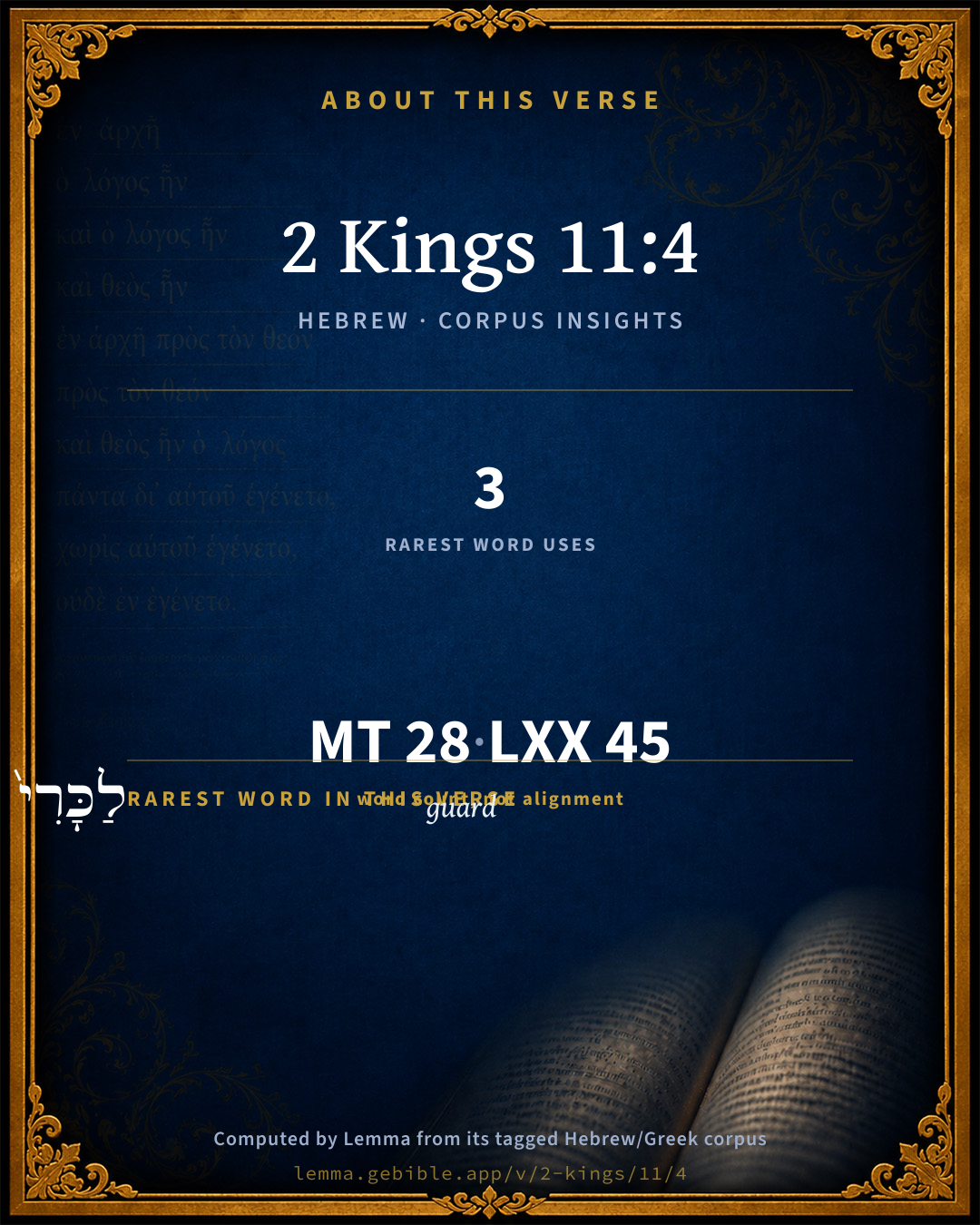
The rarest word here is לַכָּרִי֙ guard H3746 — appearing just 3 times in the whole Hebrew Bible.

Shared distinctive vocabulary

לַכָּרִי֙ guard H3746 occurs in 3 verses of the Hebrew Bible. Also found in:

Grammatical profile

  • 7 verbs
  • 11 nouns
  • 3 adjectives
  • 2 prepositions
  • 5 particles

Verb forms

  • שָׁלַ֨ח Qal · Perfect
  • וַיִּקַּ֣ח Qal · Sequential Imperfect
  • וְלָ֣רָצִ֔ים Qal · Participle Active
  • וַיָּבֵ֥א Hiphil · Sequential Imperfect
  • וַיִּכְרֹת֩ Qal · Sequential Imperfect
  • וַיַּשְׁבַּ֤ע Hiphil · Sequential Imperfect
  • וַיַּ֥רְא Hiphil · Sequential Imperfect

Repetition

Words recur within this verse — often emphatic in Hebrew:

  • המאיות hundred H3967 ×2
  • בֵּ֣ית house H1004 ×2
  • יְהוָ֑ה LORD H3068 ×2

Hebrew & Septuagint length

In English translation the verse runs 53 words from the Hebrew and 50 from the Septuagint (LXX English) — closely comparable.

A rough comparison of the two English renderings, which tokenize alike — not a word-level alignment.

Word counts can differ between the Hebrew and the Greek without any difference in meaning — e.g. the Hebrew direct-object marker אֵת has no separate Greek word, and Greek often adds the article ὁ.

In the original languages it is 28 Hebrew tokens and 45 Greek tokens — but the two are counted differently (Hebrew bundles its prefixes and suffixes into one token; the Greek is in lemma form), so that isn’t a like-for-like length.

Cross-references

19

Topical passages linked to 2 Kings 11:4 in the Treasury of Scripture Knowledge — connected by theme and wording, ordered by reader-vote popularity; previews shown in the World English Bible.

  • 2 Kings 11:9 The captains over hundreds did according to all that Jehoiada the priest commanded; and they took every man his men, those who were to come in on the Sabbath, with those who were to go out on the Sabbath, and came to Jehoiada the priest.
  • 2 Kings 11:19 He took the captains over hundreds, and the Carites, and the guard, and all the people of the land; and they brought down the king from the house of Yahweh, and came by the way of the gate of the guard to the king's house. He sat on the throne of the kings.
  • 2 Kings 11:17 Jehoiada made a covenant between Yahweh and the king and the people, that they should be Yahweh's people; between the king also and the people.
  • 2 Chronicles 15:12 They entered into the covenant to seek Yahweh, the God of their fathers, with all their heart and with all their soul;
  • Genesis 50:25 Joseph took an oath of the children of Israel, saying, "God will surely visit you, and you shall carry up my bones from here."
  • Joshua 24:25 So Joshua made a covenant with the people that day, and set them a statute and an ordinance in Shechem.
  • 1 Samuel 18:3 Then Jonathan and David made a covenant, because he loved him as his own soul.
  • 1 Samuel 23:18 They two made a covenant before Yahweh: and David abode in the wood, and Jonathan went to his house.
  • 1 Kings 18:10 As Yahweh your God lives, there is no nation or kingdom, where my lord has not sent to seek you: and when they said, He is not here, he took an oath of the kingdom and nation, that they didn't find you.
  • 2 Kings 23:3 The king stood by the pillar, and made a covenant before Yahweh, to walk after Yahweh, and to keep his commandments, and his testimonies, and his statutes, with all [his] heart, and all [his] soul, to confirm the words of this covenant that were written in this book: and all the people stood to the covenant.
  • 1 Chronicles 9:13 and their brothers, heads of their fathers' houses, one thousand seven hundred sixty; very able men for the work of the service of the house of God.
  • 2 Chronicles 23:1–21 In the seventh year Jehoiada strengthened himself, and took the captains of hundreds, Azariah the son of Jeroham, and Ishmael the son of Jehohanan, and Azariah the son of Obed, and Maaseiah the son of Adaiah, and Elishaphat the son of Zichri, into covenant with him.
  • 2 Chronicles 29:10 Now it is in my heart to make a covenant with Yahweh, the God of Israel, that his fierce anger may turn away from us.
  • 2 Chronicles 34:31–32 The king stood in his place, and made a covenant before Yahweh, to walk after Yahweh, and to keep his commandments, and his testimonies, and his statutes, with all his heart, and with all his soul, to perform the words of the covenant that were written in this book.
  • Nehemiah 5:12 Then said they, We will restore them, and will require nothing of them; so will we do, even as you say. Then I called the priests, and took an oath of them, that they would do according to this promise.
  • Nehemiah 9:38 Yet for all this we make a sure covenant, and write it; and our princes, our Levites, [and] our priests, seal to it.
  • Nehemiah 10:29 They joined with their brothers, their nobles, and entered into a curse, and into an oath, to walk in God's law, which was given by Moses the servant of God, and to observe and do all the commandments of Yahweh our Lord, and his ordinances and his statutes;
  • Acts 5:24 Now when the high priest, the captain of the temple, and the chief priests heard these words, they were very perplexed about them and what might become of this.
  • Acts 5:26 Then the captain went with the officers, and brought them without violence, for they were afraid that the people might stone them.

Cross-references courtesy of OpenBible.info (CC BY 4.0).

Hebrew and Greek witnesses Masoretic Hebrew ↔ Greek Septuagint

The same verse in the two great witnesses to the Old Testament, shown verse-for-verse.

These are two independent witnesses, not word-aligned to each other, and the Septuagint is shown in lemma (dictionary) form.

Hebrew 2 Kings 11:4 Masoretic · Westminster Leningrad Codex

וּבַשָּׁנָ֣ה הַ֠שְּׁבִיעִית שָׁלַ֨ח יְהוֹיָדָ֜ע וַיִּקַּ֣ח אֶת שָׂרֵ֣י המאיות הַמֵּא֗וֹת לַכָּרִי֙ וְלָ֣רָצִ֔ים וַיָּבֵ֥א אֹתָ֛ם אֵלָ֖יו בֵּ֣ית יְהוָ֑ה וַיִּכְרֹת֩ לָהֶ֨ם בְּרִ֜ית וַיַּשְׁבַּ֤ע אֹתָם֙ בְּבֵ֣ית יְהוָ֔ה וַיַּ֥רְא אֹתָ֖ם אֶת בֶּן הַמֶּֽלֶךְ

In the seventh year Jehoiada sent and fetched the captains over hundreds of the Carites and of the guard, and brought them to him into the house of Yahweh; and he made a covenant with them, and took an oath of them in the house of Yahweh, and shown them the king's son.

World English Bible · Public Domain

Greek LXX 2 Kings 11:4 Septuagint · lemma form

καί ἐν ὁ ἔτος ὁ ἕβδομος ἀποστέλλω ιωδαε ὁ ἱερεύς καί λαμβάνω ὁ ἑκατόνταρχος ὁ χορρι καί ὁ ρασιμ καί ἀποἄγω αὐτός πρός αὐτός εἰς οἶκος κύριος καί διατίθημι αὐτός διαθήκη κύριος καί ὁρκίζω αὐτός ἐνώπιον κύριος καί δεικνύω αὐτός ιωδαε ὁ υἱός ὁ βασιλεύς

And in the seventh year Jodae sent and took the captains of hundreds of the Chorri and of the Rhasim, and brought them to him into the house of the Lord, and made a covenant of the Lord with them, and adjured them, and Jodae showed them the king's son.

LXX2012 (modern English Septuagint) · Public Domain

On this verse, Keil & Delitzsch discusses the Septuagint’s reading. Read the note in Commentary ↓

Hebrew: Westminster Leningrad Codex (CC BY 4.0). Greek: Septuagint (public domain); English from LXX2012 (modern English Septuagint) (Public Domain). How the Septuagint differs from the Hebrew →

Targum (Aramaic paraphrase)

1

The Targum is the ancient Jewish Aramaic paraphrase of the Hebrew Scriptures — an interpretive translation, not the Hebrew text itself. Onkelos (literal) and Pseudo-Jonathan (expansive) render the Torah, and Jonathan the Prophets. Coverage is partial: where no permissively-licensed English translation exists for a verse, only the Aramaic is shown. This is verse-level text, not a word-by-word alignment to the Hebrew.

  1. Targum Jonathan Prophets (Joshua–Malachi)
    וּבְשַׁתָּא שְׁבִיעֲתָא שְׁלַח יְהוֹיָדָע וּדְבַר יַת רַבָּנֵי מַאֲוָתָא לְגִבָּרַיָא וּלְרָהֲטַיָא וְאָעֵיל יַתְהוֹן לְוָתֵיהּ לְבֵית מַקְדְשָׁא דַייָ וּגְזַר לְהוֹן קְיָם וְאוֹמֵי יַתְהוֹן בְּבֵית מַקְדְשָׁא דַייָ וְאַחְזֵי יַתְהוֹן יַת בַּר מַלְכָּא:

    (no public-domain English translation for this verse)

    Targum Jonathan — Aramaic: “Mikraot Gedolot” (public domain). English: “Sefaria Community Translation” (CC0 1.0 (public-domain dedication)); “London "Chaldee Paraphrase," 1871” (public domain). Text via Sefaria.

Commentary

Notes on 2 Kings 11:4 from classic Christian and Jewish commentators (each source and its license shown beneath its notes). The classic Christian expositions comment on the surrounding passage and are grouped to its opening verse, so a note may address several verses; the Jewish commentaries on the Tanakh (Rashi and others) are per-verse, so they appear only where the commentator wrote on this verse.

Lemma curates 59 commentaries, every one of them public domain or Creative Commons licensed, each selected and text-cleaned for this edition rather than reprinted as found. About our sources →

Matthew Henry's Commentary

Six years Athaliah tyrannised. We have not a particular account of her reign; no doubt it was of a piece with the beginning. While Jehu was extirpating the worship of Baal in Israel, she was establishing it in Judah, as appears, Ch2 24:7. The court and kingdom of Judah had been debauched by their alliance with the house of Ahab, and now one of that house is a curse and a plague to both: sinful friendships speed no better. All this while, Joash lay hid, entitled to a crown and intended for it, and yet buried alive in obscurity. Though the sons and heirs of heaven are now hidden, the world knows them not (Jo1 3:1), yet the time is fixed when they shall appear in glory, as Joash in his seventh year; by that time he was ready to be shown, not a babe, but, having served his first apprenticeship to life and arrived at his first climacterical year, he had taken a good step towards manhood; by that time the people had grown weary of Athaliah's tyranny and ripe for a revolution. How that revolution was effected we are here told.

I. The manager of this great affair was Jehoiada the priest, probably the high priest, or at least the sagan (as the Jews called him) or suffragan to the high priest. By his birth and office he was a man in authority, whom the people were bound by the law to observe and obey, especially when there was no rightful king upon the throne, Deu 17:12. By marriage he was allied to the royal family, and, if all the seed-royal were destroyed, his wife, as daughter to Joram, had a better title to the crown than Athaliah had. By his eminent gifts and graces he was fitted to serve his country, and better service he could not do it than to free it from Athaliah's usurpation; and we have reason to think he did not make this attempt till he had first asked counsel of God and known his mind, either by prophets or Urim, perhaps by both.

II. The management was very discreet and as became so wise and good a man as Jehoiada was.

1. He concerted the matter with the rulers of hundreds and the captains, the men in office, ecclesiastical, civil, and military; he got them to him to the temple, consulted with them, laid before them the grievances they at present laboured under, gave them an oath of secresy, and, finding them free and forward to join with him, showed them the king's son (Kg2 11:4), and so well satisfied were they with his fidelity that they saw no reason to suspect an imposition. We may well think what a pleasing surprise it was to the good people among them, who feared that the house and lineage of David were quite cut off, to find such a spark as this in the embers.

2. He posted the priests and Levites, who were more immediately under his direction, in the several avenues to the temple, to keep the guard, putting them under the command of the rulers of hundreds, Kg2 11:9. David had divided the priests into courses, which waited by turns. Every sabbath-day morning a new company came into waiting, but the company of the foregoing week did not go out of waiting till the sabbath evening, so that on the sabbath day, when double service was to be done, there was a double number to do it, both those that were to come in and those that were to go out. These Jehoiada employed to attend on this great occasion; he armed them out of the magazines of the temple with David's spears and shields, either his own or those he had taken from his enemies, which he devoted to God's honour, Kg2 11:10. If they were old and unfashionable, yet those that used them might, by their being David's, be reminded of God's covenant with him, which they were now acting in the defence of. Two things they were ordered to do: - (1.) To protect the young king from being insulted; they must keep the watch of the king's house (Kg2 11:5), compass the king, and be with him (Kg2 11:8), to guard him from Athaliah's partizans, for still there were those that thirsted after royal blood. (2.) To preserve the holy temple from being profaned by the concourse of people that would come together on this occasion (Kg2 11:6): Keep the watch of the house, that it be neither broken through nor broken down, and so strangers should crowd in, or such as were unclean. He was not so zealous for the projected revolution as to forget his religion. In times of the greatest hurry care must be taken, Ne detrimentum capiat ecclesia - That the holy things of God be not trenched upon. It is observable that Jehoiada appointed to each his place as well as his work (Kg2 11:6, Kg2 11:7), for good order contributes very much to the expediting and accomplishing of any great enterprise. Let every man know, and keep, and make good, his post, and then the work will be done quickly.

3. When the guards were fixed, then the king was brought forth, Kg2 11:12. Rejoice greatly, O daughter of Sion! for even in thy holy mountain thy king appears, a child indeed, but not such a one as brings a woe upon the land, for he is the son of nobles, the son of David (Ecc 10:17) - a child indeed, but he had a good guardian, and, which was better, a good God, to go to. Jehoiada, without delay, proceeded to the coronation of this young king; for, though he was not yet capable of despatching business, he would be growing up towards it by degrees. This was done with great solemnity, Kg2 11:12. (1.) In token of his being invested with kingly power, he put the crown upon him, though it was yet too large and heavy for his head. The regalia, it is probable, were kept in the temple, and so the crown was ready at hand. (2.) In token of his obligation to govern by law, and to make the word of God his rule, he gave him the testimony, put into his hand a Bible, in which he must read all the days of his life, Deu 17:18, Deu 17:19. (3.) In token of his receiving the Spirit, to qualify him for this great work to which he before was called, he anointed him. Though notice is taken of the anointing of the kings only in case of interruption, as here, and in Solomon's case, yet I know not but the ceremony might be used for all their kings, at least those of the house of David, because their royalty was typical of Christ's, who was to be anointed above his fellows, above all the sons of David. (4.) In token of the people's acceptance of him and subjection to his government, they clapped their hands for joy, and expressed their hearty good wishes to him: Let the king live; and thus they made him king, made him their king, consented to, and concurred with, the divine appointment. They had reason to rejoice in the period now put to Athaliah's tyranny, and the prospect they had of the restoration and establishment of religion by a king under the tuition of so good a man as Jehoiada. They had reason to bid him welcome to the crown whose right it was, and to pray, Let him live, concerning him who came to them as life from the dead and in whom the house of David was to live. With such acclamations of joy and satisfaction must the kingdom of Christ be welcomed into our hearts when his throne is set up there and Satan the usurper is deposed. Hosanna, blessed is he that comes: clap hands, and say, "Let King Jesus live, for ever live and reign, in my soul, and in all the world;" it is promised (Psa 72:15), He shall live, and prayer shall be made for him, and his kingdom, continually.

Matthew Henry's Commentary on the Whole Bible (1708–1710) — public domain (CC PDM 1.0). Text via the HelloAO Bible API.

Jamieson, Fausset & Brown

Robert Jamieson, A. R. Fausset & David Brown

HE IS MADE KING. (Kg2 11:4-12)

the seventh year--namely, of the reign of Athaliah, and the rescue of Jehoash.

Jehoiada sent and fetched the rulers, &c.--He could scarcely have obtained such a general convocation except at the time, or on pretext, of a public and solemn festival. Having revealed to them the secret of the young king's preservation and entered into a covenant with them for the overthrow of the tyrant, he then arranged with them the plan and time of carrying their plot into execution (see on 2Ch. 22:10-23:21). The conduct of Jehoiada, who acted the leading and chief part in this conspiracy, admits of an easy and full justification; for, while Athaliah was a usurper, and belonged to a race destined by divine denunciation to destruction, even his own wife had a better and stronger claim to the throne; the sovereignty of Judah had been divinely appropriated to the family of David, and therefore the young prince on whom it was proposed to confer the crown, possessed an inherent right to it, of which a usurper could not deprive him. Moreover, Jehoiada was most probably the high priest, whose official duty it was to watch over the due execution of God's laws, and who in his present movement, was encouraged and aided by the countenance and support of the chief authorities, both civil and ecclesiastical, in the country. In addition to all these considerations, he seems to have been directed by an impulse of the Divine Spirit, through the counsels and exhortations of the prophets of the time.

Jamieson, Fausset & Brown — Commentary Critical and Explanatory on the Whole Bible (1871) — public domain (CC PDM 1.0). Text via the HelloAO Bible API.

Trapp's Complete Commentary

John Trapp

2Ki 11:4 And the seventh year Jehoiada sent and fetched the rulers over hundreds, with the captains and the guard, and brought them to him into the house of the LORD, and made a covenant with them, and took an oath of them in the house of the LORD, and shewed them the king’s son.

Ver. 4. And the seventh year.] When now the young prince was full seven years old, {2Ki 11:21} and able to say - as Grave Maurice did to the States when they doubted to choose him their general, because young - Tandem fit sureulus arbor, a twig in time comes to be a tall tree, might he have but princely education and dignity.

Jehoiada sent and fetched the rulers over hundreds.] Five of them only at first, {2Ch 23:1-2} and then many other Levites, and chief of the fathers of Israel (ibid.), to whom he communicated the matter, and by whom he wrought upon the rest to join, and yield their best assistance.

John Trapp, A Commentary or Exposition upon All the Books of the Old and New Testament (1647–1656) — public domain. Text from a community e-Sword module.

Joseph Benson's Commentary

2Ki 11:4. With the captains and the guard — The chief commanders of the soldiery, and those that had been the former king’s guard; for it is not likely that he would dare to call the guard of the present queen: and it is probable that the former could not well brook the dominion of a woman, and that woman a foreigner. And brought them into the house of the Lord — Into the courts of that house; for into the house itself, strictly speaking, none but the priests or Levites might enter. And showed them the king’s son — He discovered to them the true heir of the crown, and they entered into a covenant to restore him, which they confirmed with an oath.

Joseph Benson's Commentary on the Old and New Testaments (1811–1818) — public domain. Text from a community e-Sword module.

Whedon's Commentary on the Bible

Daniel D. Whedon

FALL OF ATHALIAH, AND ELEVATION OF JOASH TO THE THRONE, 2Ki_11:4-21.

4. The seventh year — The seventh year of Joash’s age. Compare 2Ki_11:21.

Rulers over hundreds — Their names are given in 2Ch_23:1-2, together with the statement that the Levites out of all the cities of Judah, and the chief fathers of Israel, were gathered together at Jerusalem. These rulers of hundreds were probably officers of the army, having charge of a hundred men.

Captains and the guard — Gesenius renders these words, executioners and runners; which composed an important part of the bodyguard of the king. Others explain the word rendered captains, כרי Carians, that is, the men of Caria, in Asia Minor, who, like the Cretans, were wont to serve as lifeguards to the ancient Asiatic rulers. See on Cherethites and Pelethites. 2Sa_8:18.

Made a covenant… took an oath — These expressions explain each other. Jehoiada made a covenant with them by binding them under a solemn oath to help him carry out his plans of ruining Athaliah, and setting the youthful Joash on the throne. The high priest was wise enough to know that in carrying out a plan of so vast moment he must have the confidence and support of all the men of power. Athaliah’s regency was doubtless oppressive and unpopular, and the leading minds of the kingdom were glad to have it come to an end.

Daniel D. Whedon (gen. ed.), Commentary on the Old and New Testaments (1874–1909) — public domain. Text from a community e-Sword module.

The Preacher's Complete Homiletical Commentary

Joseph S. Exell (gen. ed.)

CRITICAL AND EXPLANATORY NOTES.—

2Ki_11:4. And the seventh year Jehoiada sent, &c.—There are numerous points of difference between this account and its parallel in the Chronicles; but probably both accounts are summarised records of a longer original account. Their divergences are not disagreements.

2Ki_11:5. The watch of the king’s house—This בֵּית הַמֶּלֶךְ must be, not the royal palace, but part of the temple buildings occupied by Joash, the young king.

2Ki_11:12. Gave him the testimony—Presented to him the הָעֵדוֹת, book of the law, as the rule of his personal conduct and royal government, for “The Testimony” (Exo_25:21; Exo_16:34) was the law for rulers as well as for those ruled (Deu_17:18, sq.).

2Ki_11:14. Athaliah cried, Treason! Treason!—Josephus supplies the record that she went from her own palace attended by her troops (μετὰ τῆς ἰδίας στρατιᾶς), but that these troops were prevented going with her into the temple.

2Ki_11:16. And they laid hands on her—Though the Sept., Vulg., Luther, and others take the words as the A. V. gives them; yet the Chald., Syr., Kimchi, Maurer, and others render יָשִׂימוּ לָהּ יָרַיִם. They made for her two sides—i.e., they opened in ranks on both sides for her to pass through.

HOMILETICS OF 2Ki_11:4-16

THE RESTORATION OF REGAL AND NATIONAL RIGHTS

The coronation of the youthful Joash was not a revolutionary act, but the just and legal restoration of a right that had been cruelly wrested from him. Athaliah was the revolutionary, and the wrong her usurpation had inflicted sank deep into the national conscience. The usurper was hated while she was feared, and the ease with which her overthrow was accomplished showed the slight hold she had on the popular affection. There was none who had the courage or the disposition to defend her. From this paragraph we learn That the restoration of regal and national rights—

I. Is often the work of one capable and resolute mind. Jehoiada, the high priest, was in every way a remarkable man for his time. He was evidently not influenced by selfish and ambitious motives, or he might have aimed to raise his own wife Jehosheba to the throne, who, as the sister of Ahaziah, had certainly a better and stronger claim than Athaliah. But as the servant of Jehovah, he was more concerned to carry out the Divine purpose; and he was no doubt strengthened in his resolve by the counsels and exhortations of the prophets of the time. He showed great shrewdness and capacity in the way in which he managed every detail in the restoration of the line of David to the throne of Judah.

1. He knew the right time to act. “The seventh year” (2Ki_11:4). He had narrowly watched the course of events, he carefully estimated the influence of Athaliah and the true feeling of the nation, and had sufficient reasons why he should not act before or after the period he fixed upon. It may seem to us that, as the king was but a child, a few years either way could make but little difference. But Jehoiada was a man “who had understanding of the times, to know what Israel ought to do” (1Ch_12:32). In all great national movements much wisdom and insight are needed in order not unduly to precipitate or delay the right moment to act. Many a great battle has been lost by not knowing when to attack, or when to wait.

2. He wins over the leading representatives of the nation (2Ki_11:4). He consults all classes—civil, military, and ecclesiastical—and when the day of trial comes, he is surrounded and sustained by an enthusiastic and united people. He succeeded in convincing the national conscience of the existence of a great wrong, and the people rallied round him to seek its redress. “Men’s hearts,” says Carlyle, “ought not be set against one another, but set with one another, and all against the evil thing only.”

3. He makes elaborate provision against possible defeat (2Ki_11:5-11). He took advantage of a public and solemn festival, when a great number might assemble in the neighbourhood of the temple without suspicion; he secured two relays of Levites within the temple; he transformed the priests into soldiers, and furnished them with weapons that David had deposited in the temple years before, little dreaming that they would be used to defend his throne under such circumstances; and he surrounded the boy-king with a strong bodyguard.

“When any great designs thou dost intend,

Think on the means, the manner, and the end.”

The prudence and foresight of Jehoiada not only indicated his ability, but ensured success. A great man cannot be more nobly employed than when he is planning the best means to promote the prosperity and elevation of his own country.

II. Is accomplished with becoming ceremonies, and attended with demonstrations of public joy (2Ki_11:12).

1. There was the coronation. “He put the crown upon him.” The kings of Judah generally succeeded each other with little, if any ceremony, the solemn inauguration of the founder of the dynasty being usually considered sufficient for his descendants. The only kings whose accession was attended with ceremonial observances were Saul, the first king; David, the first of his line; Solomon, who had an elder brother aspiring to the crown; and now Joash, in whose person the broken line was restored. By this it is seen that the coronation was rather an exceptional than a customary ceremony, resorted to only when peculiar circumstances seemed to require the solemn public recognition which it involved (Kitto).

2. There was the solemn anointing. “They made him king and anointed him.” There is nothing in the law respecting the anointing of kings. It speaks only of high priests; but as Samuel anointed the two first kings, and as it was an ancient custom to anoint them, this came to be regarded as an essential part of the ceremony. The king was anointed in the form of a diadem encircling his head, to show that he was the head of the people; but the high priest was anointed in the form of a cross, one line drawn in the oil running down his forehead, crossed by another line drawn between his eyebrows.

3. There was the recognition of the Divine law. “And gave him the testimony.” The book of the law was put into the royal hands, and while he held it, he entered into a covenant with God to observe and keep His commandments as set forth therein. The king does more honour to himself than to the Word of God when he openly accepts that Word as the guide and directory of his regal career.

4. There was the public rejoicing. “And they clapped their hands and said, God save the King.” The feeling of the people, so long suppressed, breaks out in joyous acclamation.

“One hour of joy dispels the cares

And sufferings of a thousand years.”

Little joys, says Richter, refresh us constantly like housebread, and never bring disgust: joys are our wings, and sorrows are our spurs. Well might the people be glad—they saw in the restoration of their king the restoration of the national rights of which they had been wickedly defrauded.

III. Is made the more secure by the ignominious overthrow of the usurper (2Ki_11:13-16). The noise of the people reached the ears of Athaliah in her palace. What did it all mean? Had she a presentiment that it boded no good to her and her rule? Prompted by the undaunted spirit that animated her mother Jezebel to the last, she determined to ascertain for herself the cause of the tumult. Unguarded and alone she entered the temple, and the scene that met her gaze revealed the true state of affairs. She must have felt her fate was sealed. Her wild shrieks were unheeded: no one lifted a finger in her defence. She was seized, hurried beyond the precincts of the temple, which was not to be desecrated with her blood, and was instantly slain. Her overthrow was complete; and the throne of Joash was firmly established.

“Though usurpers sway the rule a while,

Yet heaven is just, and time suppresseth wrongs.”—Shakespeare.

LESSONS:—

1. No government is strong that is not based on the affections of the people.

2. Time and the providence of God are always on the side of right.

3. The purpose of God, though hidden and apparently defeated for a time, will inevitably come to the front.

GERM NOTES ON THE VERSES

2Ki_11:4-12. Joash’s elevation to the throne. I. How it was determined upon and prepared. Jehoiada took the initiative, for it was his right and duty. It was no rebellion and conspiracy against a just authority, but a fact by itself. Rebels violate law and right in order that they may rule: Jehoiada restored law and right, and did not wish to rule; he remained what he was. He conducted himself with courage, but also with wisdom and prudence.

II. How it was carried out and accomplished. With the participation and approval of the different classes of the entire people, without conspiracy, bloodshed, or violence; in the house of God whose servant the king was; the crown and the law were given into his hands; he was anointed—significant symbols of his calling as king of the people of God.

2Ki_11:4. Jehoiada a faithful priest. It is not hard to proclaim the word of God when the mighty and great of this world hold to it; but the faithfulness which is needed in the stewards of God’s mysteries is that which will not be stayed or impaired when the great of this world despise and persecute the word, which will sail against the wind of courtly or popular favour, and will persevere in patience. The servants of the Church in the New Testament have not the same calling as the high priests in the Old, so that they have not to meddle with worldly affairs. Where spiritual and worldly authority go hand in hand, where both unite for the sake of God and for His cause, there the Lord gives blessing and prosperity.—Lange.

2Ki_11:10. New uses for old trophies. After Solomon had built the temple, the trophies of David’s victories were hung up there. So they adorned the walls. So they illustrated the valour of noble sires. So they served to kindle emulation in the breasts of true-hearted sons. Thus it was while generations sprung up and passed away; till at length other days dawned, darker scenes transpired, and sadder things filled up the chronicles of the nation. I. It is well for us to hang all our trophies in the house of the Lord. We, too, are warriors. Every genuine Christian has to fight. Sometimes we have victories, a presage of that final victory we shall enjoy with our Great Captain for ever. We have been defeated when we have gone in our own strength; but when we have been victorious it has always been because the strength of the Lord was put forth for our deliverance. Hang up the shield, hang up the spear, let Jehovah’s name be exalted. Bring forth the forgotten memorials of loving-kindness, expose them to public view, put them before your mind’s eye, gratefully remember them, lovingly praise Him and magnify His name. If we have any victories, let all the trophies be dedicated to the Lord. II. These trophies may come in useful at such times as we cannot foresee, and under such circumstances as we wot not of. When in after years David hung up the swords and shields which he had taken from Philistine heroes, he did not surmise that one of his descendants, of the seed royal, would find the need to employ his own, his grandsire’s, or further back from himself—his forefather’s trophies—in order to establish himself on the throne. In all the battles we fight, the trophies we win should be stored, for they may come in for future use. There is no experience of a Christian that will not have some ultimate service to render him. You know not what may be the history of your life, it is unfinished yet; if you did know, you would see that in this present trial there is a preparation for some future emergency, which will enable you to come out of it in triumph. The shields and spears of David are hung up for future action. III. Ancient weapons are good for present use. Turn to the seventy-seventh Psalm, and you have a battle there. By looking through this psalm you will see David’s shields and spears, and will soon learn how to screen yourself with the one, and how to do exploits with the other. The first weapon he drew out of the scabbard was the weapon of all prayer—another, that of remembering God—another, the teaching of tradition (he “considered the days of old”)—another, his own experience—another an appeal to God’s mercy (Psalms 51). But the great master weapon was the blood—“Purge me with hyssop,” &c. Let sins come on, and let them be more than the hairs of my head, loftier than mountains, and deeper than the unfathomed ocean; let them come on. God’s flaming wrath behind them, hell itself coming to devour me; yet if I can but take the cross and hold it up before me, if I can plead the precious blood, I shall be safe, and prove a conqueror. See that in all your fights you use the old, old weapons of David himself—his shields and spears—by these same weapons shall you also win the day. IV. Did not David herein pre figure Him that was to come—David Son and David’s Lord? Jesus Christ our King, has hung up many shields and spears in the house of the Lord. Sin—Christ has borne it in himself, endured its penalty, and overcome it; he has hung up the handwriting of ordinances that was against us, as a trophy in the house of the Lord. Satan, our great foe—He met him foot to foot in the wilderness, and discomfited him—met him in the garden—overcame him on the cross. Now hell, too, is vanquished—Christ is Lord. Death, too, the last enemy—Christ hath taken spoils from him. And the enmity of the human heart. How many of these enmities has Christ hung up in the hall, for he has conquered that enmity, and made the hater into a lover. There are some great sinners at this day who are wonderful tokens of the power of His love. What will heaven be when all of us shall be trophies of His power to save!—C. H. Spurgeon.

2Ki_11:11. The true safe-guard of a king.

1. Not the weapons of the military.

2. But the legality and righteousness of his claims.

3. The respect and affection of his people.

4. The overshadowing presence and blessing of Jehovah.

2Ki_11:12. How a bright morning became a dark night—a lesson for the young. The priest Jehoiada was a very wise man, and the young king had sense enough to be led by him; with his death began sins and misfortunes which ended the life and the glory of king Joash. LEARN:—

1. That a good start is not everything. It does not follow, because as boys and girls you live in a comfortable home and have all you want, that it will be always so. Joash was a king, and of course had many delightful things even when a child; but he came to know the want of them before his death. There is a wretched tramp on the roads to-day, who will sleep in the casual ward of some workhouse, who has had a better education than the master of the place. There are lads in the forecastle of merchant ships whose real names are not those entered on the ship’s books, but who might have been graduates at Oxford if they had chosen to do well. Have a care, boys and girls, lest the comforts you now have be exchanged for self-made misery, and the good start only land you in darker depths than you would otherwise have known. LEARN:—

2. That crowns do not make kings.The boy never was the ruler of the country. His uncle was master. Solomon says something about a jewel in a swine’s snout; that seems a strange place to put a jewel, but you might as well look for it there as expect a coarse nature to become gentle because it is wearing a fine coat. Perhaps you have yet to learn that power means much more than strength. Joash was crowned; but when the old man died his real self came to the front. He chose foolish companions, turned aside to sin, caused the son of his benefactor to be murdered (2Ch_24:21), and finished his poor vain life in shame, and was buried away from his kingly ancestors, while the priest was laid among those who ruled the land (ib., 2Ch_11:16 and 25). It will pay us to think, when we are tempted to do wrong—How will this appear when I am dead? What will people say as they carry me to my grave? Have you some gift which, like that crown on Joash’s head, lifts you up above your companions? Be it money, strength, beauty, or learning, it will only make you kingly and keep you crowned, as you use it in the service of God, and in unselfish efforts to make others good and happy.—T. Champness.

—The oil wherewith he was anointed signified his designation to that high service and those endowments from heaven that might enable him to so great a function. The crown wherewith he was adorned signified that glory and majesty which should both encourage and attend his princely cares. The book of the testimony signified the divine rules and directions whereto he must frame his heart and actions in the wielding of that crown. These three—the oil, the crown, the testimony—that is, inward powers, outward magnificence, true piety and justice—make up a perfect prince. None of these may be wanting. If there be not a due calling of God, and abilities meet for that greatness, the oil faileth: if there be not a majestic grace and royalty that may command reverence, the crown is missing: if there be not a careful respect to the law of God as the absolute guide of all counsels and determinations, the testimony is neglected: all of them concurring make both king and people happy.—Bp. Hall.

2Ki_11:13-16. Athaliah’s fall. I. Her last appearance. She comes boldly and impudently into the midst of the people, blinded to their disposition towards her. Insolently relying on her imagined majesty, she commands resistance to the movement which is in progress—a faithful type of many tyrants. Pride goes before a fall. II. Her terrible end. Abandoned, despised, and hated by all the people, who rejoice over her fall, she goes to meet her doom, and receives the fate which her deeds deserve. She is punished by that by which she has sinned. Sedition! treason! is the cry of Joram, Jezebel, and Athaliah, and of all those who are themselves most to blame for it (Act_16:5).—Lange.

2Ki_11:14. O Athaliah! to whom dost thou complain? They are thy just executioners wherewith thou art encompassed. If it be treason to set up the true heir of Ahaziah, thou appealest to thy traitors—the treason was thine; theirs is justice. The time is now come of thy reckonings for all the royal blood of Judah which thy ambition shed. Wonder rather at the patience of this long forbearance than the rigour of this execution.

2Ki_11:16. How like is Athaliah to her mother Jezebel! as in conditions and carriage, so even in death. Both killed violently, both killed under their own walls, both slain with treason in their mouths, both slain in the entrance of a changed government; one trode on by the horses, the other slain in the horsegate; both paid their own blood for the innocent blood of others.—Bp. Hall.

The Preacher's Complete Homiletical Commentary (gen. ed. Joseph S. Exell; Funk & Wagnalls, c. 1892) — public domain (pre-1929). A full-Bible homiletical/sermon-outline anthology covering 65 of 66 books (2 John is absent from the source module). Text from a community e-Sword module.

Keil & Delitzsch

C. F. Keil & F. Delitzsch

Dethronement of Athaliah and Coronation of Joash (compare the account in 2 Chron 23, which is more elaborate in several points).

(Note: In both accounts we have only short extracts preserved from a common and more complete original, the extracts having been made quite independently of one another and upon different plans. Hence the apparent discrepancies, which have arisen partly from the incompleteness of the two abridged accounts, and partly from the different points of view from which the extracts were made, but which contain no irreconcilable contradictions. The assertion of De Wette, which has been repeated by Thenius and Bertheau, that the chronicler distorted the true state of the case to favour the Levites, rests upon a misinterpretation of our account, based upon arbitrary assumptions, as I have already shown in my apologetischer Versuch ber die Chronik (p. 361ff.).)

Kg2 11:4

In the seventh year of Athaliah's reign, Jehoiada sent for the captains of the king's body-guard to come to him into the temple, and concluded a covenant with them, making them swear and showing them the king's son, namely, to dethrone the tyrant Athaliah and set the king's son upon the throne. המּאיות שׂרי, centuriones, military commanders of the executioners and runners, i.e., of the royal body-guard. The Chethb מאיות may be explained from the fact that מאה is abridged from מאיה (vid., Ewald, 267, d.). On ורצים כּרי = והפּלתי הכּרתי (Kg1 1:38) see the Comm. on Sa2 8:18; and on ל as a periphrasis of the genitive, see Ewald, 292, a. In Ch2 23:1-3 the chronicler not only gives the names of these captains, but relates still more minutely that they went about in the land and summoned the Levites and heads of families in Israel to Jerusalem, probably under the pretext of a festal celebration; whereupon Jehoiada concluded a covenant with the persons assembled, to ensure their assistance in the execution of his plan.

Kg2 11:5-8

Jehoiada then communicated to those initiated into the plan the necessary instructions for carrying it out, assigning them the places which they were to occupy. "The third part of you that come on the Sabbath (i.e., mount guard) shall keep the guard of the king's house (ושׁמרי is a corruption of ושׁמרוּ), and the third part shall be at the gate Sur, and the third part at the gate behind the runners, and (ye) shall keep guard over the house for defence; and the two parts of you, (namely) all who depart on the Sabbath, shall keep the guard of the house of Jehovah for the king; and ye shall surround the king round about, every one with his weapons in his hand; and whoever presses into the ranks shall be slain, and shall be with the king when he goes out and in," i.e., in all his steps. The words השּׁבּת בּאי השּׁבּ and השּׁבּת יצאי, "those coming and those going out on the Sabbath," denote the divisions of the watch, those who performed duty on the Sabbath and those who were relieved on the Sabbath; not the military guard at the palace however, but the temple-guard, which consisted of Levites. For David had divided the priests and Levites into classes, every one of which had to perform service for a week and was relieved on the Sabbath: compare 1 Chron 23-26 with Josephus (Ant. vii. 14, 7), who expressly says that every one of the twenty-four classes of priests had to attend to the worship of God "for eight days, from Sabbath to Sabbath," also with Luk 1:5. On the other hand, we do not know that there was any similar division and obligation to serve in connection with the royal body-guard or with the army. The current opinion, that by those who come on the Sabbath and those who go out on the Sabbath we are to understand the king's halberdiers or the guard of the palace, is therefore proved to be unfounded and untenable. And if there could be any doubt on the matter, it would be removed by Kg2 11:7 and Kg2 11:10. According to Kg2 11:7, two parts of those who went away (were relieved) on the Sabbath were to undertake the guarding of the house of Jehovah about the king, i.e., to keep guard over that room in the temple where the king then was. Could Jehoiada have used the royal body-guard, that was being relieved from guarding the palace, for such a purpose as this? Who can imagine that this is a credible thing? According to Kg2 11:10, Jehoiada gave to the captains over a hundred the weapons of king David, which were in the house of Jehovah. Did the palace-guard then return without weapons? In Ch2 23:4, "those coming on the Sabbath" are correctly described as the priests and Levites coming on the Sabbath, i.e., the priests and Levites who entered upon their week's duty at the temple on the Sabbath. According to this explanation of the words, which is the only one that can be grammatically sustained, the facts were as follows: "When Jehoiada had initiated the captains of the royal halberdiers, and with their help the heads of families of the people generally, into his plan of raising the youthful Joash to the throne and dethroning Athaliah, he determined to carry out the affair chiefly with the help of the priests and Levites who entered upon their duty in the temple on the Sabbath, and of those who left or were relived at the same time, and entrusted the command over these men to the captains of the royal halberdiers, that they might occupy the approaches to the temple with the priests and Levites under their command, so as to prevent the approach of any military from the king's palace and protect the youthful king. These captains had come to the temple without weapons, to avoid attracting attention. Jehoiada therefore gave them the weapons of king David that were kept in the temple.

With regard to the distribution of the different posts, the fact that two-thirds are spoken of first of all in Kg2 11:5, Kg2 11:6, and then two parts in Kg2 11:7, occasions no difficulty. For the two-thirds mentioned in Kg2 11:5, Kg2 11:6 were those who came on the Sabbath, whereas the "two divisions" (היּדות שׁתּי) referred to in Kg2 11:7 were all who went away on the Sabbath. Consequently the priests and Levites, who came on the Sabbath and entered upon the week's service, were divided into three sections; and those who should have been relieved, but were detained, into two. Probably the number of those who came this time to perform service at the temple was much larger than usual, as the priests were initiated into Jehoiada's secret; so that it was possible to make three divisions of those who arrived, whereas those who were about to depart could only be formed into two. The three divisions of those who were entering upon duty are also distinctly mentioned in the Chronicles; whereas, instead of the two divisions of those who were relieved, "all the people" are spoken of. The description of the different posts which were assigned to these several companies causes some difficulty. In general, so much is clearly indicated in Kg2 11:7 and Kg2 11:8, that the two divisions of those who were relieved on the Sabbath were to keep guard over the young king in the house of Jehovah, and therefore to remain in the inner spaces of the temple-court for his protection; whereas the three divisions of those who were entering upon duty were charged with the occupation of the external approaches to the temple. One-third was to "keep watch over the king's house," i.e., to observe whatever had to be observed in relation to the king's palace; not to occupy the king's palace, or to keep guard in the citadel at the palace gate (Thenius), but to keep watch towards the royal palace, i.e., to post themselves so that no one could force a way into the temple, with which the indefinite המּלך בּבית in the Chronicles harmonizes, if we only translate it "against (at) the king's house." The idea that the palace was guarded is precluded not only by Kg2 11:13, according to which Athaliah came out of the palace to the people to the house of Jehovah, which she would not have been able to do if the palace had been guarded, but also by the circumstance that, according to Kg2 11:19, the chief men were in the temple with the whole of the (assembled) people, and did not go out of the house of Jehovah into the king's house till after the anointing of Joash and the death of Athaliah. The other third was to station itself at the gate Sur (סוּר), or, according to the Chronicles, Yesod (יסוד), foundation-gate. There is no doubt as to the identity of the gate Sur and the gate Yesod; only we cannot decide whether one of these names has simply sprung from a copyist's error, or whether the gate had two different names. The name יסוד שׁער, foundation-gate, suggests a gate in the outer court of the temple, at the hollow of either the Tyropoeon or the Kedron; for the context precludes our thinking of a palace gate. The third division was to be posted "at the gate behind the runners;" or, as it is stated in Kg2 11:19, "at the gate of the runners." It is very evident from Kg2 11:19 that this gate led from the temple-court to the royal palace upon Zion, and was therefore on the western side of the court of the temple. This also follows from Kg2 11:4 of the Chronicles, according to which this division was to act as "doorkeepers of the thresholds" (הסּפּים לשׁערי), i.e., to keep guard at the gate of the thresholds. For we may safely infer, from a comparison with Ch1 9:19, that הסּפּים were the thresholds of the ascent to the temple. The last clause, "and shall keep guard over the house for defence," refers to all three divisions, and serves to define with greater precision the object for which they were stationed there. מסּח is not a proper name (lxx, Luther, and others), but an appellative in the sense of defence or resistance, from נסח, depellere. The meaning is, that they were to guard the house, to keep off the people, and not to let any of the party of Athaliah force a way into the temple. - In Kg2 11:7, הש יצאי כּל is an explanatory apposition to בּכם ot היּדות וּשׁתּי, "and the two parts in (of) you," namely, all who go out on the Sabbath, i.e., are relieved from duty. Their task, to observe the watch of the house of Jehovah with regard to the king, is more precisely defined in Kg2 11:8 as signifying, that they were to surround the king with weapons in their hands, and slay every one who attempted to force a way into their ranks. וּבבאו בּצאתו, i.e., in all his undertakings, or in all his steps; ובוא צאת being applied to the actions and pursuits of a man, as in Deu 28:6; Deu 31:2, etc. (see the Comm. on Num 27:17). Thenius has explained this incorrectly: "in his going out of the temple and entering into the palace."

Kg2 11:9-11

The execution of these plans. The high priest gave the captains "the spears and shields (שׁלטים: see at Sa2 8:7) which (belonged) to king David, that were in the house of Jehovah," i.e., the weapons which David had presented to the sanctuary as dedicatory offerings. Instead of החנית we ought probably to read החניתת (cf. Mic 4:3; Isa 2:4), after the החניתים of the Chronicles, since the collective force of הנית is very improbable in prose, and a ת might easily drop out through a copyist's error. Jehoiada gave the captains weapons from the temple, because, as has been already observed, they had come unarmed, and not, as Thenius imagines, to provide them with old and sacred weapons instead of their ordinary ones. In Kg2 11:11 the position of all the divisions is given in a comprehensive manner, for the purpose of appending the further course of the affair, namely, the coronation of the king. "Thus the halberdiers stood, every one with his weapons in his hand, from the right wing of the house to the left wing, towards the altar (of burnt-offering) and the (temple-) house, round about the king," i.e., to cover the king on all sides. For it is evident that we are not to understand סביב על־המּלך as signifying the encircling of the king, from the statement in Kg2 11:12, according to which Jehoiada did not bring out the king's son till after the men had taken up their positions. The use of הרצים, to signify the captains with the armed priests and Levites put under their command for this purpose, is an uncommon one, but it may be explained from the fact that רצים had retained the general meaning of royal halberdiers; and the priests and Levites under the command of the captains of the royal body-guard by this very act discharged the duty of the royal body-guard itself. The chronicler has used the indefinite expression כּל-haa`aam, the whole of the people assembled in the temple-court.

Kg2 11:12

After the approaches to the temple had all been occupied in this manner, Jehoiada brought out the king's son from his home in the temple; or, he brought him forth, set the crown upon him, and handed him the testimony, i.e., the book of the law, as the rule of his life and action as king, according to the precept in Deu 17:18-19. ואת־העדוּת is connected with את־הנּזר עליו יתּן, because עליו יתּן has the general meaning "delivered to him, handed him," and does not specially affirm the putting on of the crown. ימליכוּ, they made him king. The subject is the persons present, through, as a matter of course, the anointing was performed by Jehoiada and the priests, as the Chronicles expressly affirm. Clapping the hands was a sign of joyful acclamation, like the cry, "Long live the king" (cf. Kg1 1:39).

Kg2 11:13-14

Death of Athaliah. - Kg2 11:13, Kg2 11:14. As soon as Athaliah heard the loud rejoicing of the people, she came to the people into the temple, and when she saw the youthful king in his standing-place surrounded by the princes, the trumpeters, and the whole of the people, rejoicing and blowing the trumpets, she rent her clothes with horror, and cried out, Conspiracy, conspiracy! העם הרצין does not mean the people running together, but the original reading in the text was probably והעם הרצין, the people and the halberdiers, and the Vav dropped out through an oversight of the copyist. By הרצין we are to understand the captains of the halberdiers with the armed Levites, as in Kg2 11:11; and העם is the people who had assembled besides (cf. Kg2 11:19). In the Chronicles המּלך והמהללים הרצים is in apposition to העם: the noise of the people, the halberdiers, and those who praised the king. The עמּוּד, upon which the king stood, was not a pillar, but an elevated standing-place (suggestus) for the king at the eastern gate of the inner court (בּמּבוא, Ch2 23:13 compared with Eze 46:2), when he visited the temple on festive occasions (cf. Kg2 23:3), and it was most probably identical with the brazen scaffold (כּיּור) mentioned in Ch2 6:13, which would serve to explain כּמּשׁפּט, "according to the right" (Angl. V. "as the manner was"). השּׂרים are not merely the captains mentioned in Kg2 11:4, Kg2 11:9, and Kg2 11:10, but these together with the rest of the assembled heads of the nation (האבות ראשׁי, Ch2 13:2). החצצרות, the trumpets, the trumpeters. The reference is to the Levitical musicians mentioned in Ch1 13:8; Ch1 15:24, etc.; for they are distinguished from וגו כּל־העם, "all the people of the land rejoicing and blowing the trumpets," i.e., not all the military men of the land who were present in Jerusalem (Thenius), but the mass of the people present in the temple (Bertheau).

Kg2 11:15

Jehoiada then commanded the captains החיל פּקדי, those placed over the army, i.e., the armed men of the Levites, to lead out Athaliah between the ranks, and to slay every one who followed her, i.e., who took her part (המת, inf. abs. instead of imperative); for, as is added supplementarily in explanation of this command, the priest had (previously) said: "Let her not be slain in the house of Jehovah." The temple was not to be defiled with the blood of the usurper and murderess.

Kg2 11:16

Thus they made way for her on both sides, or, according to the correct explanation given by the Chaldee, ידים להּ ישׂימוּ, they formed lines (Spalier, fences) and escorted her back, and she came by the way of the horses' entrance into the palace, and was there put to death. הסּוּסים מבוא is explained in the Chronicles by הסּוּסים שׁער מבוא, entrance of the horse-gate. The entrance for the horses, i.e., the way which led to the royal mews, is not to be identified with the horse-gate mentioned in Neh 3:28; for this was a gate in the city wall, whereas the road from the temple to the royal mews, which were no doubt near the palace, was inside the wall.

Kg2 11:17-18

Renewal of the covenant, extermination of the worship of Baal, and entrance of the king into the palace. - Kg2 11:17. After Jehoash was crowned and Athaliah put to death, Jehoiada concluded the covenant (1) between Jehovah on the one hand and the king and people on the other, and (2) between the king and the people. The former was simply a renewal of the covenant which the Lord had made with Israel through Moses (Ex 24), whereby the king and the people bound themselves ליהוה לעם להיות, i.e., to live as the people of the Lord, or to keep His law (cf. Deu 4:20; Deu 27:9-10), and was based upon the "testimony" handed to the king. This covenant naturally led to the covenant between the king and the people, whereby the king bound himself to rule his people according to the law of the Lord, and the people vowed that they would be obedient and subject to the king as the ruler appointed by the Lord (cf. Sa2 5:3). The renewal of the covenant with the Lord was necessary, because under the former kings the people had fallen away from the Lord and served Baal. The immediate consequence of the renewal of the covenant, therefore, was the extermination of the worship of Baal, which is mentioned at once in Kg2 11:18, although its proper place in order of time is after Kg2 11:18. All the people (הארץ כּל־עם, as in Kg2 11:14) went to the temple of Baal, threw down his altars, broke his images (the columns of Baal and Astarte) rightly, i.e., completely (היטב as in Deu 9:21), and slew the priest Mattan, probably the chief priest of Baal, before his altars. That the temple of Baal stood within the limits of the sanctuary, i.e., of the temple of Jehovah (Thenius), cannot be shown to be probable either from Ch2 24:7 or from the last clause of this verse. (For Ch2 24:7 see the fuller remarks on Kg2 12:5.) The words "and the priest set overseers over the house of Jehovah" do not affirm that Jehoiada created the office of overseer over the temple for the purpose of guarding against a fresh desecration of the temple by idolatry (Thenius), but simply that he appointed overseers over the temple, namely, priests and Levites entrusted with the duty of watching over the performance of worship according to the precepts of the law, as is more minutely described in Kg2 11:18, Kg2 11:19.

Keil & Delitzsch — Biblical Commentary on the Old Testament (1861–1891) — public domain (CC PDM 1.0). Text via the HelloAO Bible API. (Old Testament only.)

Tyndale Open Study Notes

Tyndale Open Resources

11:4 Jehoiada knew that what he was doing was treasonous (11:14), and he was not sure that he could trust the men he was enlisting as his co-conspirators, so he had them swear an oath of loyalty before he revealed to them the existence of the rightful heir to the throne of Judah. These men went out to the towns of Judah and brought the Levites and heads of families to the Temple in Jerusalem, where they made a covenant with Joash (2 Chr 23:3). • The Carite mercenaries, from the Aegean, served as bodyguards for the king (2 Sam 20:23).

Tyndale Open Study Notes — © Tyndale Open Resources, licensed CC BY-SA 4.0. Text via the HelloAO Bible API.

Geneva Bible (1599)

Geneva Bible translators

The chief priest, Jehosheba’s husband.

Geneva Bible (1599) marginal notes — public domain. Text via Bolls.life.

Adam Clarke's Commentary

Verse 4. And the seventh year Jehoiada sent] He had certainly sounded them all, and brought them into the interests of the young king, before this time; the plot having been laid, and now ripe for execution, he brings the chief officers of the army and those of the body guard into the temple, and there binds them by an oath of secrecy, and shows them the king's son, in whose behalf they are to rise.

Adam Clarke's Commentary on the Bible (1810–1826) — public domain. Text from a community e-Sword/MySword module.

Ellicott's Commentary for English Readers

(4) And the seventh year.—When perhaps discontent at Athalialύ’s tyranny had reached a climax.

Jehoiada.—The high priest (2Ki_11:9). The curious fact that his rank is not specified hero upon the first mention of his name, suggests the inference that in the original authority of this narrative he had been mentioned as high priest, and husband of Jehosheba, at the outset of the story, as in 2Ch_22:11.

The rulers over hundreds, with the captains and the guard.—Rather, the centurions of the Carians and the Couriers—i.e., the officers commanding the royal guard. The terms rendered “Carians” and “Couriers” are obscure. Thenius prefers to translate the first “executioners.” (Comp. Notes on 1Ki_1:38; 2Sa_8:18; 2Sa_15:18; 2Sa_16:6; 1Ch_18:17.) Thenius argues against the idea that so patriotic and pious a king as David could have employed foreign and heathen soldiers as his body-guard. But did not David himself serve as a mercenary with Achish, king of Gath, and commit his parents to the care of the king of Moab? And would not the mercenaries who enlisted in the guard of the Israelite sovereigns adopt the religion of their new country? (Comp. the case of Uriah the Hittite.) The apparently gentilic ending of the words rendered “Cherethites and Pelethites” in Samuel, and that rendered “captains” in this place, Thenius explains as marking an adjective denoting position or class. It may be so, but sub judice lis est.

Made a covenant with them.—The chronicler gives the names of the centurions. His account of the whole transaction, while generally coinciding with that given here, presents certain striking differences, of which the most salient is the prominence assigned to the priests and Levites in the matter. These deviations are explicable on the assumption that the chronicler drew his information from a large historical compilation somewhat later than the Books of Kings, and containing much more than they contain, though mainly based upon the same annalistic sources. The compilors of the two canonical histories were determined in their choice of materials and manner of treatment by their individual aims and points of view, which differed considerably. (See the Introductions to Kings and Chronicles.) At the same time, it must not be forgotten that the account before us is the older and more original, and, therefore, the more valuable regarded as mere history.

A Bible Commentary for English Readers, edited by Charles John Ellicott (1878–1897) — public domain. Text from a community e-Sword module.

The Cambridge Bible for Schools and Colleges

gen. ed. J. J. S. Perowne

4–16. Jehoiada the priest makes Joash king, and Athaliah is put to death (2Ch_23:1-15)

4. And the [R.V. in the] seventh year] So Chronicles. Jehoiada’s name is introduced very abruptly and without any specification of his office till we come to verse 9. This points to an early date for the document from which the compiler of Kings made his extracts. It is only when the events are somewhat recent that the names of important actors in them can be introduced without some description.

fet the rulers [R.V. captains] over hundreds] The change in R.V. makes the passage conform to Deu_1:15 where the various subdivisions of the officers are mentioned. For other allusions thereto cf. Exo_18:21; Exo_18:25, and when the more military character had been introduced 1Sa_8:12; 1Sa_22:7; 2Sa_18:1. In the parallel passage A.V. has ‘captains’ 2Ch_23:1. Fet is the constant preterite of ‘fetch’ in the English of A.V. For similar instances of dropping the ‘ch’ of the present, compare the preterites of catch and search, which, as far as sound is concerned, might be written caut and saut.

with the captains and the guard] R.V. of the Carites and of the guard. Here both nouns are in a construction which shews that the captains over hundreds belonged to both the classes of men here mentioned. Hence, as the word rendered ‘guard’ is literally ‘runners’ and applies to the royal body-guard, so the ‘Carites’ are thought to be a similar class. The word only occurs in this chapter verses 4 and 19 and in 2Sa_20:23, where the Keri (marginal reading) substitutes ‘Cherethites’. As in that passage the Carites, or Cherethites, and Pelethites formed David’s guard, so at this time there appear to have been similar body-guards attached to the palace in Jerusalem. The word may be derived from a verb which marks them as ‘executioners’, which office was performed, as we see from many instances, by those in immediate attendance on the king.

These officers were strictly military, and it is worth notice that the compiler in Chronicles, who is usually thought to lay most stress on, and give most importance to, what was done by the priests and Levites, yet at this point is very careful to notice the names of these five soldiers ‘Azariah the son of Jeroham, and Ishmael the son of Jehohanan, and Azariah the son of Obed, and Maaseiah the son of Adaiah, and Elishaphat the son of Zichri’, while he gives no such prominence to the names of any of the priests or Levites, except the chief actor Jehoiada.

into the house of the Lord] We can see from such passages as Jer_35:2, where the prophet is bidden to bring the Rechabites ‘into the house of the Lord, into one of the chambers’ that the rooms by which the temple was surrounded were used for meetings such as the one here described.

and made a covenant with them] In 2 Chronicles we are told how these officers were first employed: ‘They went about in Judah and gathered the Levites out of all the cities of Judah and the chief of the fathers of Israel (R.V. heads of fathers’ houses in Israel), and they came to Jerusalem. Jehoiada sent them to the persons with whom, by reason of his office, he would have the greatest influence, but the operations were ultimately to be under the command of the captains of the guard.

The Cambridge Bible for Schools and Colleges (gen. ed. J. J. S. Perowne; Cambridge University Press, 1878–1918) — public domain. Text from a community e-Sword module.

John Gill's Exposition

And the seventh year Jehoiada sent and fetched the rulers over hundreds, with the captains and the guard,.... This was the husband of Jehosheba, who was high priest, Ch2 22:11 these

rulers over hundreds were not those appointed over the people for civil affairs, as by the advice of Jethro, but over the priests and Levites in their courses; five of whom are mentioned by name, and were employed in gathering together the Levites, and the chief of the fathers, throughout all the cities of Judah, Ch2 23:1, and the "captains" here are the heads of the fathers there, who were the heads of the courses they were sent to gather; and the "guard", those of the late king, whom Athaliah had turned out of their post, and took in others in their room, unless rather the temple guard is meant:

and brought them to him into the house of the Lord; the temple, that part of it where was the court of the priests and Levites:

and made a covenant with them; to join with him, assist him, and stand by him in the restoration of the king, and the reformation of the kingdom:

and took an oath of them in the house of the Lord; to keep secrecy, and be faithful to him:

and showed them the king's son; for the truth of which he could produce his wife, the sister of the late king, and also the nurse of this child with him.

John Gill's Exposition of the Whole Bible (1746–1763) — public domain (CC PDM 1.0). Text via the HelloAO Bible API.

Albert Barnes' Notes on the Bible

See the marginal reference.

The captains - The word used here and in 2Ki 11:19, הא־כרי ha-kârı̂y, designates a certain part of the royal guard, probably that which in the earlier times was known under the name of Cherethites 1Ki 1:38. Others see in the term an ethnic name - “Carians,” who seem certainly to have been much inclined to take service as mercenaries from an early date. Render the whole passage thus - “And in the seventh year Jehoiada sent and fetched the centurions of the Carians and the guardsmen (literally, ‘runners, ‘ 2Ki 10:25), etc.”

Albert Barnes' Notes on the Bible (1834–1885) — public domain. Text from a community e-Sword/MySword module.

Haydock's Catholic Bible Commentary

Year, of the age of Joas, ver. 21. (Menochius) --- Centurions. Five in number of the tribe of Levi, (Menochius) commanding each 100 men. Hebrew adds "the rams," (Calmet) to denote "the captains (Protestants) and the runners," or guards. (Haydock) --- Joiada was a man of great authority, virtue and discretion; so that he was able to manage this delicate affair, and no one gave information to Athalia, as she was detested. The Levites and principal men of Juda were admonished, underhand, to be present on the day appointed. The quality of high priest, and the known probity and zeal for the public good, which were conspicuous in Joiada, as well as his being so nearly related to the lawful heir to the crown, made the people readily come forward. (Calmet)

George Leo Haydock (1774–1849), Haydock's Catholic Family Bible and Commentary, 1859 edition — public domain. Excludes Psalms (Douay-Rheims chapter numbering differs from Protestant) and Deuterocanonical books (Catholic canon only).

Matthew Poole's English Annotations

If this action of Jehoiada’s seem strange and irregular, this was no ordinary case, but there were divers peculiar things in it, as, that Athaliah was a mere usurper, having no pretence of right to the crown, and one of that wicked house which God had particularly, and by name, devoted to destruction: that Jehoiada’s wife was nearer allied, and had more right to the crown, than Athaliah: that thee crown of Judah was by Divine appointment appropriated to the sons of David; and therefore the right of the crown was inherently in him whom Jehoiada set up, which right her usurpation could not exclude: that Jehoiada was not a mere private person, but the husband of the king’s aunt; and probably the high priest, to whom it belonged in great part to see the laws of God executed: that Jehoiada did not act alone in the business, but had the consent and concurrence of the chief rulers, both civil and ecclesiastical: and besides all this, that it is conceived that he had a special motion of God’s Spirit, or the direction and encouragement of the prophets of that time. So that this action cannot be drawn into a precedent for succeeding times, and for other kingdoms.

The rulers over hundreds; of whom see Exo 18:25. Of these there were five which are named, 2Ch 23:1. And these were either,

1. Civil or military officers. But then such small officers could not have stood him in much stead. And why did he not rather engage captains of thousands, or greater persons, whom doubtless he might easily have brought into this confederacy? Or rather,

2. Priests or Levites of eminency, as their work showeth, 2Ki 11:5-7; 2Ch 23:1,2, and their distinction from the

captains and guard. The captains, or princes, or nobles, or commanders; such as he knew were weary of her idolatrous and tyrannical government, and faithful to their king.

The guard; possibly those who had been the former king’s guard, who had been displaced by Athaliah, as persons whose fidelity she suspected.

Into the house of the Lord, i.e. into the courts of that house, which oft come under the name of the house, or temple of the Lord; for into the house none but the priests or Levites might enter.

Made a covenant with them, to restore the king to his kingdom, and religion to its purity.

Took an oath of them, for their secrecy and fidelity in the present design.

Matthew Poole's English Annotations on the Holy Bible (1683–1685) — public domain. Text from a community e-Sword/MySword module.

The Pulpit Commentary

Vers. 4-16. Conspiracy of Jehoiada. After waiting, impatiently we may be sure, for six long years, and seeing the young prince grow from an infant to a boy of seven years of age, Jehoiada deemed that the time was come to venture on an effort. It was necessary for him to make his arrangements beforehand with great care. His first step was to sound the captains of the royal guard. To these men, five in number, (2Ch_23:1) he sent secretly, and in-wired them to confer with him in the temple on important business. Finding them well disposed to adopt his views, he revealed to them the fact that Joash had escaped the massacre of Ahaziah"s sons, and was still living, even allowing them to see him. The result of the interview was that they put themselves at Jehoiada"s disposal, and agreed to take their orders from him (ver. 4). Jehoiada then proceeded to his second step. Either distrusting the body-guard which the captains commanded, or regarding it as insufficient in numbers, he gave them orders to visit the various cities of Judea, and collect from them a strong force of Levites and other trusty persons, and bring them to Jerusalem, (2Ch_23:2) where he would give them their orders. This was done successfully, and, as it would seem, without in any way rousing the suspicions of Athaliah. A day was fixed for proclaiming Joash king; the guard and the Levites were skillfully disposed about the temple and the palace; the king was brought up, crowned, anointed, and saluted as monarch, with noisy acclamations (ver. 12). The noise was heard in the palace, and Athaliah went forth, with a few attendants, to inquire the reason of it. Following the sound, she came to the temple, and entered it, when she saw what was going on, and cried out, "Treason! Treason!" By Jehoiada"s order the guards seized her, conducted her out of the temple, and slew her (vers. 13-16).

And the seventh year literally, and in the seventh year; i.e. in the course of itJehoiada sent and fetched the rulers over hundreds, with the captains and the guard; rather, the captains over hundreds (or, centurions) of the Carites and the guard (see the Revised Version). The "Carites," here first named, are generally regarded as identical with the Cherethites of earlier times (2Sa_8:18; 1Ki_1:38; 1Ch_18:17) They were undoubtedly a particular portion of the royal guard, and may, perhaps, as many suppose, have been "Caftan" mercenaries, though we have no other evidence that the Carians had adopted the mercenary life so early as the time of Athaliah. Still, as their devotion to it had passed into a proverb when Archilochus wrote (B.C. 700-660), it is quite possible that they had begun the practice acentury or two earlier. When Jehoiada is said to have "sent and fetched" the centurions, we must understand that he secretly invited them, and that they consented to come. He could not possibly have any authority over them, so as to require their attendance. The names of the five centurions, together with their fathers" names, were put on record by the writer of Chronicles, (2Ch_23:1) whose account of the revolution is in many respects fuller than that in Kings. And brought them to him into the house of the Lord as the safest place for an interview which had to be kept secret from the queenand made a covenant with them, and took an oath of them in the house of the Lord. We can easily understand that the soldiers, who had been willing to serve Athaliah under the notion that the house of David was extinct, might waver in their allegiance so soon as they heard that a scion of the old royal stock survived, and could be produced at a moment"s notice. Their traditions would attach them to David and his seed, not to the house of Ahab. And showed them the king"s son. Having bound the centurions by a solemn covenant to the cause of the young king, Jehoiada introduced them into his presence. He had, no doubt, previously sworn them to secrecy.

Vers. 4-19. Jehoiada an example of a faithful and wise high priest under trying circumstances. The history of the Jewish kingdom from the time of Saul to the Captivity furnishes but few examples of remarkable high priests. Zadok and Abiathar were personages of some importance in the time of David, and left behind them a name for zeal and fidelity; but otherwise no man of eminence had arisen among the high priests until Jehoiada. This may be partly accounted for by the fact that the high priesthood was hereditary, not elective; but still more by the nature of the office, which was not such as to bring its holder into historical prominence in quiet times. Jehoiada"s opportunity for distinction arose from the difficult circumstances in which he was placed. Holding the office of high priest when the throne was usurped and religion outraged by Athaliah, it devolved on him to rescue Church and state alike from peril, and to counter-work the wicked schemes of an enemy alike bold and unscrupulous. He could not prevent the destruction of the royal stock by Athaliah, which was a crime so unnatural that none could have anticipated it; but he did what he could. At the peril of his life he saved one prince, concealed him from prying eyes, protected him, bred him up secretly, and did not allow his existence to be even suspected. In faith and patience he waited till the infant had become a boy of an age to interest people, and till Athaliah had lest the affections of all classes of her subjects. He then organized a counter-revolution to the one effected by Athaliah, with the greatest prudence, caution, and sagacity. It would have been easy to gather partisans and raise a revolt; but Jehoiada shrank from the horrors of a civil war, and from the risk of losing his precious charge by a stray shot or a chance sword-thrust. He therefore set to work to detach Athaliah"s supporters from her cause by the peaceful method of persuasion. First he gained over the captains of her guard, then through them the rank-and-file, finally the "chief fathers" of Israel in the various cities. (2Ch_23:2) Doubting the sufficiency of this force, he farther summoned to his aid a large body of Levites. And all this he did so secretly as to create no alarm, to arouse no suspicion. When the time for action came, he made his arrangements with the most consummate skill. He could not, indeed, have foreseen that Athaliah would so play into his hand, as she did, by coming within the temple walls with few or no attendants; but he had taken his measures in such a way as to make failure impossible, and to reduce to a minimum the probability of tumult or armed resistance. It was an indication of extraordinary prudence and political wisdom to be able to effect a complete revolution, both in Church and state, at the cost of two lives, both of them clearly forfeit by the Law of Moses. Up to this time, Jehoiada"s wisdom had been chiefly conspicuous. Henceforth it is his fidelity that draws our admiration. Aiming at nothing for himself, his first thought is for the honor of God, and therefore he renews the Mosaic covenant; his next for the welfare of his country, and therefore he makes king and people mutually swear to each other; has third for the honor of true religion, and therefore he destroys the temple of Baal, and inaugurates afresh the Jehovistic service. As Bahr says, "If ever a man stood pure and blameless in the midst of such a bold, difficult, and far-reaching enterprise, then Jehoiada, the ideal Israelitish priest, did so here." The after-life of Jehoiada is less remarkable (2Ki_12:2-16; 2Ch_24:2-14) but not unworthy of his earlier reputation.

HOMILIES BY J. ORR

Vers. 4-21. The coronation of Joash.

For six years Athaliah was dominant in Israel. Jehoiada meanwhile kept his secret well. Least of all did the usurping queen suspect that a legitimate heir to the throne was in hiding in the temple almost at her own palace door. Her reign must have grown well-nigh unendurable to the people, when they were so willing as the event proved to throw it off. At the six years" end Jehoiada prepared for his coup d"etat.

I JEHOIADA"S PREPARATIONS.

1. Joash produced. The good priest found it necessary to proceed with caution. His measures were taken with skill and secrecy. He first took into his confidence the five centurions of the life-guards, made them swear an oath of fidelity, then produced the king, and showed him to them. The soldiers entered into his plan at once. The risks were enormous, but God"s shield was around this one remaining "lamp" of David"s house, and did not allow its tremulous light to be extinguished. The boy-king was the feeble ark that bore the fortunes of David"s house and of Messianic promise. Had he perished, God"s Word would have fallen to the ground. The Chronicler tells how the captains of hundreds went forth and secretly spread among the Levites and chief of the fathers of Israel the tidings that there was still a living heir of David"s line, and how these came to Jerusalem, and saw the young king too. (2Ch_23:2, 2Ch_23:3) It is remarkable that a fact known to so many persons did not in some way leak out. But the people were of one heart and one soul, and Athaliah was left in her false security without a single friend to warn her of her danger.

2. The events sabbath. The day chosen for the public production of the king was probably a feast-day. Otherwise the large concourse of people from all parts of the land could hardly have failed to attract attention. It was a sabbath and a high day better the day, the better the deed." What was contemplated was indeed a revolution, and might involve bloodshed; but it was also a reviving of the fallen theocracy, a replanting of the red of Jesse, and therefore fit work for the sabbath. Nothing that favorably affects the fortunes of the kingdom of God is out of place on the sabbath day. Jehoiada made careful strategic preparations, combining apparently the Levites who went on and off duty in the temple with the life-guards under the captains, and assigning to different companies their respective posts.

3. The place and temple guarded. Guards were told off both for the "king"s house" and for the temple.

(1) those who entered on duty on the sabbath were divided into three parts, and posted round the palace. One third was posted at the principal entrance; a second third at "the gate Sur perhaps a side gate and the remaining third was placed at a gate which communicated with the temple (ver. 19), where the guards or "runners" were usually stationed.

(2) Those, again, who went off duty on the sabbath were placed within the court of the temple, stretching across from side to side, to guard the person of the king. To these weapons were given from David"s spears and shields, which were in the temple of the Lord. While trusting in God, Jehoiada thus took every human precaution. Faith and works co-operate in God"s service. Our dependence should be as entirely in God as if human means were unavailing, yet our use of means should be as diligent as if everything depended on their employment.

II THE KING CROWNED.

1. The safety of the kings person. When the young king Joash was brought forth, and placed on a raised stand in the temple court, his guard stood firmly around him, each man clutching his weapon. The instructions were that any person attempting to break through the ranks should at once be slain. The person of David"s son was too precious to be left without an effectual guard. Yet more effectual is the guard which God places round his sons. (Psa_34:6, Psa_34:7)

2. The ceremony of coronation. The act of coronation of the child-king was then proceeded with. Jehoiada presided at the ceremony.

(1) The crown visible symbol of royal office was placed upon his head. God"s priest could well preside at the coronation of God"s king. As son of David, Joash was the legitimate heir of the throne. Royal authority is from God, and investiture at the hands of God"s ministers is our acknowledgment of this. Only those who rule by Divine favor can look for a blessing on their crown.

(2) He had put upon his head "the testimony," i.e. the Law of Moses, by which kings of Judah and Israel were to be guided. (Deu_17:18-20) Finely are both the crown and the book presented to the king, that he might be not only mighty, but also wise, or, as we may say, know God"s Word and right. Thus, even now, we make kings with a sword and book (Luther). The highest in the land are not above the authority of God"s Word. He by whom "kings reign" is mightier than the mightiest, and requires from the monarch the same allegiance as from the humblest of his subjects. A nation is happy, prosperous, and blessed only when God"s Law is made the rule of its policy and the foundation of its government. (Deu_4:6-8)

(3) He was anointed with oil. For where God gives office he gives also qualification for that office. Oil is the symbol of the Holy Spirit. The Word without the Spirit to interpret it, and to give strength for obedience to it, is useless. Kings need the grace of God for the discharge of their duties as much as, even more than, ordinary people. Jesus is God"s King, "anointed with the oil of gladness above his fellows". (Heb_1:9)

(4) He was acknowledged as king by popular acclamation. "They clapped their hands and said, God save the king!" The Divine choice was ratified by the free election of the people. While kingly, like all other authority, is derived from God, a throne is only strong when it rests on the loyal affection of the body of the people.

III THE DEATH OF ATHALIAH.

1. The shout of a king. Athaliah, though queen of Judah, was not a worshipper of the God of Judah. While the scenes above described were being transacted, she was either in her own "house of Baal," or in the palace. But now the ringing shouts of the people apprised her that something was wrong. The sight of the guards posted round her palace would add to her alarms. She hastened to the temple, and there beheld a spectacle which told her that her hour was come. The young Joash was standing on his platform, the crown on his head, the captains and trumpeters around him, while the air rang with the joyful huzzas of the people, with the notes of the silver trumpets, and with cries of "Let the king live!" Only in part could Athaliah read the meaning of the scene, for she did not know who this crowned boy was. But she saw enough to tell her that the loyalty of the people had found a new center, and that her power was gone. The rejoicings of the people would be gall and wormwood to her heart, for they told her, not only that it was all over with her authority, but that the people were glad it was so. How swiftly, as by a bolt from a clear sky, does retribution often fall upon the wicked! An hour before Athaliah had no suspicion of any calamity. She had but to speak, and guards and servants were ready to yield her all obedience; now her authority has departed like a pricked bubble, and she stands helpless among a multitude none so poor as to do her reverence. The passage is an illustration of the proverb, "When the righteous are in authority, the people rejoice; but when the wicked beareth rule, the people mourn". (Pro_29:2)

2. Treason to a traitress. When Athaliah saw what was being done, heard the shouts, and witnessed the rejoicings, she rent her garments, and cried, "Treason! Treason!" Treason is an act or series of acts designed to compass the overthrow of a constituted government, and is generally held to be punishable by death, It is wicked and illegitimate governments which make most of the crime of treason, and most severely enforce the penalties against it. Yet it is plain that these penalties are justified only on the supposition that the government against which the treason is directed is a legitimate one. A government which is itself born and bred of treason has no moral justification for punishing treason in others. Athaliah was queen, not by God"s will, but in defiance of all right and morality. She had usurped the throne, and killed (or thought she had killed) the rightful heirs to it. Treason against such a government, itself the offspring of the blackest treachery, was not a crime, but might be the highest duty. Still, as if some horrid iniquity was being practiced, the traitress rends her clothes, and cries, "Treason!" Her own treason is unthought of; she sees only the treason of her enemies. Is not this state of mind too common? Men are loud in denouncing transgressions which they themselves are flagrantly guilty of. They point to the mote in another"s eye, without reflecting on the beam in their own. Callous as to their own falsehood, selfishness, and dishonesty, they detect in an instant, and loudly denounce, the same vices in their neighbors, especially when practiced towards themselves. It is this which renders them inexcusable. For the power to detect sin in others implies a knowledge of the law which condemns the person judging if he does the same things. (Rom_2:1)

3. Just retribution. The order of Jehoiada was that if any one ventured to follow Athaliah, he was to be killed with the sword. But no one seems to have shown any pity for the fallen queen. The downfall of her power was thus complete. A new government having been constituted, her own attempt to excite rebellion now fell under the category of treason, and was punishable. Jehoiada gives orders for her being taken beyond the temple bounds, and there slain. We see hands laid upon her, and she is led away, or goes, "by the way by the which the horses come into the king"s house," and in that place of stables meets her death. An inglorious end! But what glory can we look for to crown a career of sin? In Athaliah, the last member of Ahab"s cursed house met a deserved doom. Judgment against the sinner may not always be executed speedily, but the stroke will surely fall at last. (Ecc_8:11)

IV A COVENANT WITH JEHOVAH.

1. The covenant with God renewed. The people had received, as if from heaven, a new king of the line of David, and the moment was auspicious for a new covenant being entered into, and formally ratified, with God. It is good when special mercies are made an occasion of renewal of vows. The covenant promoted by Jehoiada wan twofold.

(1) It was a covenant between the king and people and Jehovah. In this transaction they solemnly pledged themselves to be the Lord"s people. National covenanting is only appropriate when it springs from the spontaneous impulse of the masses of the people. Among the Hebrews, who, by the very form of their national existence, were a people in covenant with Jehovah, such renewal of religious vows was specially suitable. The idea of a "people of the Lord" is now embodied, not in a national form, but in the Church of Christ. Great is the honor of forming part of this "chosen generation," this "royal priesthood," this "holy nation," this "peculiar people", (1Pe_2:9) and we should often recall the fact to ourselves, and make it the basis of new consecration.

(2) It was a covenant between the king and the people. He, on his part, would pledge himself to maintain the government according to the Law of God; and they, on theirs, would promise him loyalty and obedience. Happy is it, when rulers and people stand in this bond of mutual confidence!

2. Zeal in religious reform. The earnest spirit awakened by this solemn act of covenant immediately showed itself in zealous efforts for the removal of abuses. We read that, not one or two, but "all the people of the land," set themselves to reforming, work.

(1) They went into the house of Baal, and brake it down. A house of Baal in Jerusalem, and possibly on the temple hill, was a deliberate insult to Jehovah. No respect for the beauty or costliness of the building was allowed to save it from destruction. When higher interests are involved, artistic and sentimental considerations must go to the wall.

(2) They brake in pieces "thoroughly" Baal"s altars and images. Idolatry was to be thoroughly rooted out in accordance with the word of the testimony. (Deu_12:1-3)

(3) They slew Mattan, the high priest of Baal. By the Law of Israel his life was forfeited through the practice of idolatry.

(4) They restored the worship of the temple. This is implied in the statement, "The priest appointed officers over the house of the Lord." It is evident from the next chapter that the temple service had been allowed to become greatly disorganized. The zeal of these reformers had, therefore, its positive side. They sought to build up as well as cast down. The false worship of God was replaced by the true. Court fashion goes a long way in determining preferences in religion. When Athaliah worshipped Baal, it was fashionable to neglect Jehovah; now that Joash restored the worship of Jehovah, people flocked back to the temple. Those in high stations have great responsibilities, and not least for the examples they set in religion.

3. The joy of the people. Joash was now escorted in grand procession to the palace of his fathers. Athaliah was dead, and he sat on the throne of the kings. Joy filled the people"s hearts, and quiet reigned in the city. When godliness is victorious, it diffuses peace and gladness through all minds. J.O.

The Pulpit Commentary (1880–1919), ed. H.D.M. Spence-Jones & Joseph S. Exell — public domain. Text from a community e-Sword module.

John Wesley's Explanatory Notes

The house - Into the courts of that house, for into the house none but the priests or Levites might enter.

John Wesley, Explanatory Notes Upon the Whole Bible (1754–1765) — public domain. Text via the GEBible commentary corpus.

unfoldingWord translationNotes

Door43 World Missions Community

Connecting Statement:

This continues the story of what happens after Joash, the son of King Azahiah, was hidden in the temple after all King Azahiah's other descendants were killed.

In the seventh year

"In the seventh year of Athaliah's reign" or "In year 7 of Athaliah's reign" (See: Numbers)

Jehoiada

the high priest (See: How to Translate Names)

the commanders of hundreds

The phrases "commander of hundreds" is probably an official title for a military officer. Possible meanings are 1) the word "hundreds" represents the exact amount of soldiers that each of these commanders led. AT: "the commanders of 100 soldiers" or 2) the word translated as "hundreds" does not represent an exact number, but is the name of a military division. AT: "the commanders of military divisions" (See: Numbers)

Carites

This is the name of a particular group of the royal guards.

brought them to himself

"had them come to meet with him." Jehoiada, the high priest, had these military men report to him at the temple.

Then he showed them the king's son

Jehoiada revealed to them that Joash, King Azahiah's son, was still alive.

translationWords

Jehoiada

send

commander

temple

covenant

oath

command

Sabbath

gate

unfoldingWord translationNotes — © Distant Shores Media and the Door43 World Missions Community, licensed CC BY-SA 4.0. Source: git.door43.org/Door43/en_tn.

Rashi

Rabbi Shlomo Yitzchaki (Rashi)

The mighty warriors. The officers of the hundreds of the mighty warriors and the officers of the hundreds of the runners. The expression כָּרִי is used, and not כָּרִים, because [כָּרִי] is a noun, [meaning] a company of mighty warriors, barned, in O.F.

He made a covenant with them. That they will help him in crowning the king’s son.

Rashi on the Tanakh — English translations: “The Judaica Press complete Tanach with Rashi, translated by A. J. Rosenberg” (CC BY 4.0); “Pentateuch with Rashi's commentary by M. Rosenbaum and A.M. Silbermann, 1929-1934” (public domain); “The Metsudah Tanach series, Lakewood, N.J” (CC BY 4.0); and “The Book of Joshua, Metsudah Publications, 1997” (CC BY 4.0). Text via Sefaria.

Lesson kit

Teaching starters — assembled from the data on this page, not authored interpretation. Every prompt links to the verse data it draws on. Edit before teaching.

2 Kings, in the Historical, opens this verse with 28 words (20 distinct Hebrew lemmas). Its most distinctive word is kârîy (“guard”). A historical commentator’s framing appears above. Read the whole chapter for the surrounding context.

Discussion questions

  1. How does “guard” (kârîy) shape what this verse is saying?
  2. 2 Samuel 20:23 shares the word «guard» with this verse. How do the two illuminate each other?
  3. “hundred” occurs 2× in this one verse. What is the effect of the repetition?
  4. These translations render this verse differently; the difference is in the English rendering, not the original. What questions does that raise?
  5. The verb «שָׁלַ֨ח» is Qal Perfect. How does its form color the action?
  6. Reading how Matthew Henry's Commentary and Jamieson, Fausset & Brown read this verse, where do the two commentators agree and where do they part?

Things to notice

Reading settings

Reading text

Shown beneath each verse's original-language words.

Old Testament
Old Testament edition

Read the OT as the Masoretic Hebrew (MT) or the Greek Septuagint (LXX).

English shown for the Greek Septuagint (in the Hebrew ↔ Greek comparison).

Comparing translations? Open the Compare panel on any verse page to stack up to four side by side.