
2 Chronicles 15:16

Hebrew (Westminster Leningrad Codex) 2 Chronicles 15:16 appears in the Hebrew Old Testament. The text above is from the Westminster Leningrad Codex. Each word links to its Strong’s number, a concise gloss, and parsing drawn from the Open Scriptures Hebrew Bible morphology. Click any word for its full Brown-Driver-Briggs (BDB) entry.
Download image
Cite this verse

2 Chronicles 15:16 (World English Bible). Public Domain. Lemma interlinear Bible study tool, https://lemma.gebible.app/v/2-chronicles/15/16.

Show BibTeX & RIS
BibTeX
RIS
English Translation
Also Maacah, the mother of Asa the king, he removed from being queen, because she had made an abominable image for an Asherah; and Asa cut down her image, and made dust of it, and burnt it at the brook Kidron.
World English Bible · Public Domain
Download a study sheet

One document with this verse’s original text, its word-by-word gloss line, the meaning frame, cross-references with their text, attributed commentary, and full source and license credits — printable, and it pastes into notes with its structure intact.

This verse Autodidact and up

Study sheet (.html) Plain text (.txt)

A passage Seminary Student

Up to 50 verses in one chapter. A passage sheet keeps up to 6 commentary sources and 12 cross-references per verse, in the order this page ranks them, and says so on the sheet whenever that leaves anything out. Ask for a single verse and you get the Autodidact verse sheet above.

Everything on this page stays free to read, with no account — the sheet is a download of what is already on screen, not access to it.

Want to remove ads? Support Godless Engineer
Compare translations 3

The same verse in 3 English versions, stacked beneath the original-language interlinear above. Click any original word for its lexicon entry.

Each is an independent rendering of the whole verse — the interlinear is not word-aligned to these translations.

Highlighted words mark where these versions differ — a whole-verse word diff, not a word-by-word alignment.

  • World English Bible Public Domain
    Also Maacah, the mother of Asa the king, he removed from being queen, because she had made an abominable image for an Asherah; and Asa cut down her image, and made dust of it, and burnt it at the brook Kidron.
  • King James Version Public Domain
    And also concerning Maachah the mother of Asa the king, he removed her from being queen, because she had made an idol in a grove: and Asa cut down her idol, and stamped it, and burnt it at the brook Kidron.
  • unfoldingWord Literal Text CC BY-SA 4.0
    And also Maacah, the mother of King Asa, he took her away from being queen, because she made to Asherah an abominable image. And Asa cut down her abominable image, and crushed and burned at the brook Kidron.

unfoldingWord Literal Text — © unfoldingWord, licensed CC BY-SA 4.0. Word-aligned USFM3 via Door43 (git.door43.org/unfoldingWord/en_ult).

Versions to compare (up to 4)

3 of 4 selected

Show all 18 translations

Every available English version of this verse, each an independent rendering of the whole verse.

  • World English Bible Public Domain
    Also Maacah, the mother of Asa the king, he removed from being queen, because she had made an abominable image for an Asherah; and Asa cut down her image, and made dust of it, and burnt it at the brook Kidron.
  • Berean Standard Bible Public Domain
    King Asa also removed his grandmother Maacah from her position as queen mother because she had made a detestable Asherah pole. Asa chopped down the pole, crushed it, and burned it in the Kidron Valley.
  • Majority Standard Bible Public Domain
    King Asa also removed his grandmother Maacah from her position as queen mother because she had made a detestable Asherah pole. Asa chopped down the pole, crushed it, and burned it in the Kidron Valley.
  • King James Version Public Domain
    And also concerning Maachah the mother of Asa the king, he removed her from being queen, because she had made an idol in a grove: and Asa cut down her idol, and stamped it, and burnt it at the brook Kidron.
  • American Standard Version (1901) Public Domain
    And also Maacah, the mother of Asa the king, he removed from being queen, because she had made an abominable image for an Asherah; and Asa cut down her image, and made dust of it, and burnt it at the brook Kidron.
  • Revised Version (1885) Public Domain
    And also Maacah the mother of Asa the king, he removed her from being queen, because she had made an abominable image for an Asherah; and Asa cut down her image, and made dust of it, and burnt it at the brook Kidron.
  • Geneva Bible (1599) Public Domain
    And King Asa deposed Maachah his mother from her regencie, because she had made an idole in a groue: and Asa brake downe her idole, and stamped it, and burnt it at the brooke Kidron.
  • Douay-Rheims (1899) Public Domain
    Moreover Maacha the mother of king Asa he deposed from the royal authority, because she had made in a grove an idol of Priapus: and he entirely destroyed it, and breaking it into pieces, burnt it at the torrent Cedron.
  • Young's Literal Translation Public Domain
    And also Maachah, mother of Asa the king -- he hath removed her from `being' mistress, in that she hath made for a shrine a horrible thing, and Asa cutteth down her horrible thing, and beateth `it' small, and burneth `it' by the brook Kidron:
  • Literal Standard Version CC BY-SA 4.0
    And also Maachah, mother of Asa the king—he has removed her from [being] mistress, in that she has made for an Asherah a horrible thing, and Asa cuts down her horrible thing, and beats [it] small, and burns [it] by the Brook of Kidron:
  • Unlocked Literal Bible CC BY-SA 4.0
    He also removed Maacah, his grandmother, from being queen, because she had made a disgusting figure out of an Asherah pole. Asa cut down the disgusting figure, ground it to dust and burned it at the brook Kidron.
  • unfoldingWord Literal Text CC BY-SA 4.0
    And also Maacah, the mother of King Asa, he took her away from being queen, because she made to Asherah an abominable image. And Asa cut down her abominable image, and crushed and burned at the brook Kidron.
  • Darby Bible Public Domain
    And also Maachah, the mother of Asa the king, he removed from being queen, because she had made an idol for the Asherah; and Asa cut down her idol, and stamped it, and burned it in the valley Kidron.
  • World Messianic Bible Public Domain
    Also Maacah, the mother of Asa the king, he removed from being queen mother, because she had made an abominable image for an Asherah; so Asa cut down her image, ground it into dust, and burned it at the brook Kidron.
  • Webster's Bible Public Domain
    And also concerning Maachah the mother of Asa the king, he removed her from being queen, because she had made an idol in a grove: and Asa cut down her idol, and stamped it, and burnt it at the brook Kidron.
  • Free Bible Version CC BY-SA 4.0
    King Asa also removed Maacah from her position as queen mother for making an offensive Asherah pole. Asa cut down her vile idol, crushed it up, and burned it in the Kidron Valley.
  • Bible in Basic English Public Domain
    And Asa would not let Maacah, his mother, be queen, because she had made a disgusting image for Asherah; and Asa had her image cut down and broken up and burned by the stream Kidron.
  • JPS Tanakh (1917) Public Domain
    And also Maacah the mother of Asa the king, he removed her from being queen, because she had made an abominable image for an Asherah; and Asa cut down her image, and made dust of it, and burnt it at the brook Kidron.

Literal Standard Version (2020), Covenant Press — licensed CC BY-SA 4.0. Text via the HelloAO Bible API (eBible.org). Unlocked Literal Bible (unfoldingWord) — licensed CC BY-SA 4.0. Text via the HelloAO Bible API (eBible.org). unfoldingWord Literal Text — © unfoldingWord, licensed CC BY-SA 4.0. Word-aligned USFM3 via Door43 (git.door43.org/unfoldingWord/en_ult). Free Bible Version, Dr. Jonathan Gallagher — licensed CC BY-SA 4.0. Text via the HelloAO Bible API (eBible.org).

Word by word

More ways to search: Search by grammar → Find every occurrence → Compare this word →

Practice this passage: Drill this verse → Learn its vocabulary →

מִפְלָ֑צֶת
miphletseth
H4656
“horrible thing”
Noun, Common, Feminine, Singular, Absolute
Part of Speech
Noun
Type
Common
Gender
Feminine
Number
Singular
State
Absolute
Full BDB Definition

Origin: from H6426

TWOT: 1778b

horrid thing, horrible thing
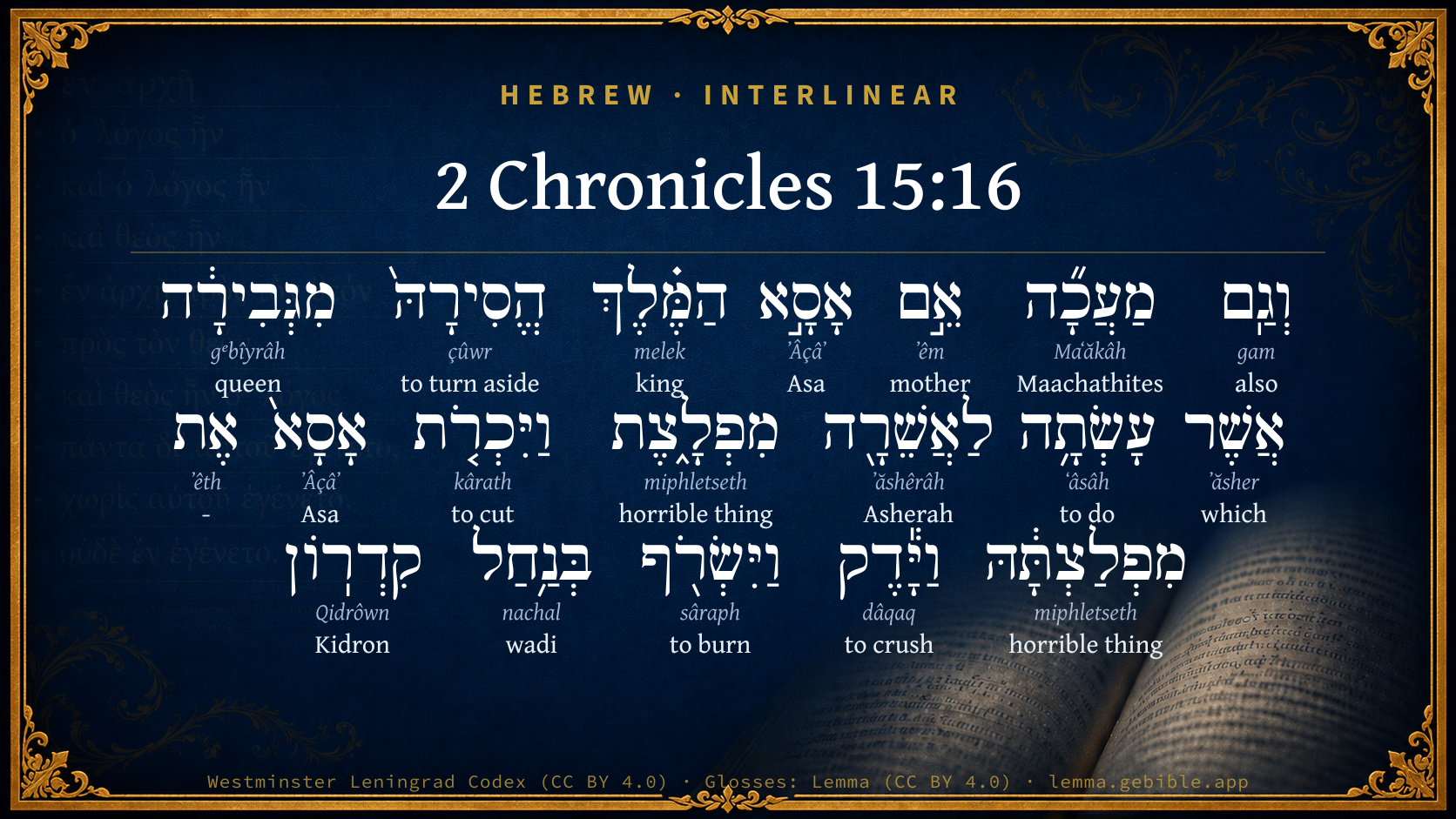
  1. וְגַֽם gam H1571 “and · also” Conjunction + Particle, Accusative
  2. מַעֲכָ֞ה Maʻăkâh H4601 “Maachathites” Noun, Proper
  3. אֵ֣ם ʼêm H517 “mother of” Noun, Common, Feminine, Singular, Construct
  4. אָסָ֣א ʼÂçâʼ H609 “Asa” Noun, Proper
  5. הַמֶּ֗לֶךְ melek H4428 “the · king” Particle, Definite Article + Noun, Common, Masculine, Singular, Absolute
  6. הֱסִירָהּ֙ çûwr H5493 “to turn aside · her” Verb, Hiphil, Perfect, 3rd Person, Masculine, Singular + Suffix, Personal, 3rd Person, Feminine, Singular
  7. מִגְּבִירָ֔ה gᵉbîyrâh H1377 “from · queen” Preposition + Noun, Common, Feminine, Singular, Absolute
  8. אֲשֶׁר ʼăsher H834 “which” Particle, Relative
  9. עָשְׂתָ֥ה ʻâsâh H6213 “to do” Verb, Qal, Perfect, 3rd Person, Feminine, Singular
  10. לַאֲשֵׁרָ֖ה ʼăshêrâh H842 “to/for · Asherah” Preposition + Noun, Proper
  11. וַיִּכְרֹ֤ת kârath H3772 “and · to cut” Conjunction + Verb, Qal, Sequential Imperfect, 3rd Person, Masculine, Singular
  12. אָסָא֙ ʼÂçâʼ H609 “Asa” Noun, Proper
  13. אֶת ʼêth H853 “-” Particle, Direct Object
  14. מִפְלַצְתָּ֔הּ miphletseth H4656 “horrible thing · her” Noun, Common, Feminine, Singular, Construct + Suffix, Personal, 3rd Person, Feminine, Singular
  15. וַיָּ֕דֶק dâqaq H1854 “and · to crush” Conjunction + Verb, Hiphil, Sequential Imperfect, 3rd Person, Masculine, Singular
  16. וַיִּשְׂרֹ֖ף sâraph H8313 “and · to burn” Conjunction + Verb, Qal, Sequential Imperfect, 3rd Person, Masculine, Singular
  17. בְּנַ֥חַל nachal H5158 “in/at · wadi of” Preposition + Noun, Common, Masculine, Singular, Construct
  18. קִדְרֽוֹן Qidrôwn H6939 “Kidron” Noun, Proper

About this verse

These counts appear in no published source. They are computed here, from the morphology-tagged text and Lemma’s own curated glosses. What Lemma adds →

19
words
17
distinct lemmas
Historical
section

Notable vocabulary

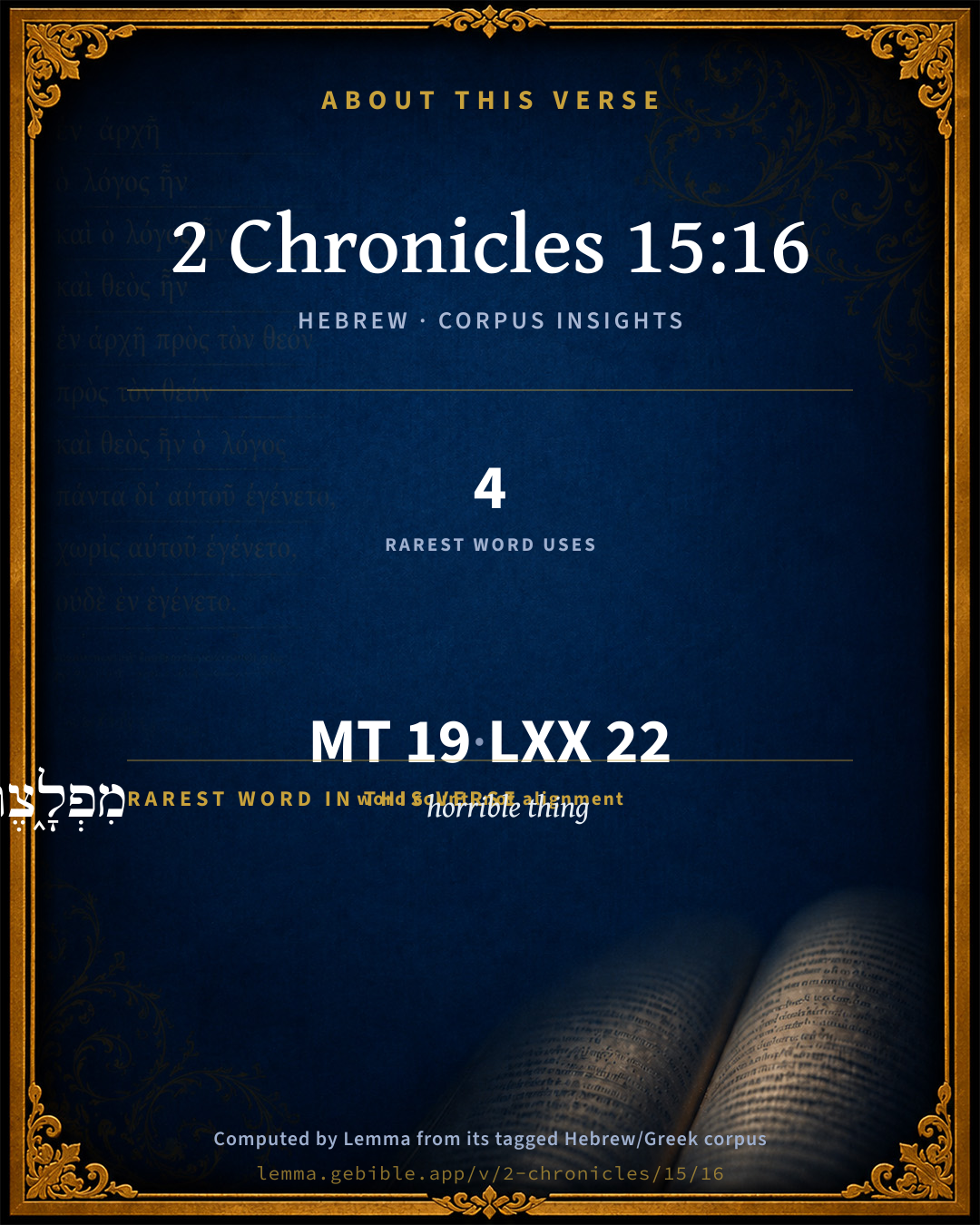
The rarest word here is מִפְלָ֑צֶת horrible thing H4656 — appearing just 4 times in the whole Hebrew Bible.

Shared distinctive vocabulary

מִפְלָ֑צֶת horrible thing H4656 occurs in 2 verses of the Hebrew Bible. Also found in:

Grammatical profile

  • 5 verbs
  • 11 nouns
  • 3 particles

Verb forms

  • הֱסִירָהּ֙ Hiphil · Perfect
  • עָשְׂתָ֥ה Qal · Perfect
  • וַיִּכְרֹ֤ת Qal · Sequential Imperfect
  • וַיָּ֕דֶק Hiphil · Sequential Imperfect
  • וַיִּשְׂרֹ֖ף Qal · Sequential Imperfect

Repetition

Words recur within this verse — often emphatic in Hebrew:

  • אָסָ֣א Asa H609 ×2
  • מִפְלָ֑צֶת horrible thing H4656 ×2

Hebrew & Septuagint length

In English translation the verse runs 41 words from the Hebrew and 25 from the Septuagint (LXX English) — the Septuagint runs noticeably shorter here. See the side-by-side →

A rough comparison of the two English renderings, which tokenize alike — not a word-level alignment.

Word counts can differ between the Hebrew and the Greek without any difference in meaning — e.g. the Hebrew direct-object marker אֵת has no separate Greek word, and Greek often adds the article ὁ.

In the original languages it is 19 Hebrew tokens and 22 Greek tokens — but the two are counted differently (Hebrew bundles its prefixes and suffixes into one token; the Greek is in lemma form), so that isn’t a like-for-like length.

Cross-references

21

Topical passages linked to 2 Chronicles 15:16 in the Treasury of Scripture Knowledge — connected by theme and wording, ordered by reader-vote popularity; previews shown in the World English Bible.

  • 1 Kings 15:13–24 Also Maacah his mother he removed from being queen, because she had made an abominable image for an Asherah; and Asa cut down her image, and burnt it at the brook Kidron.
  • Exodus 34:13 but you shall break down their altars, and dash in pieces their pillars, and you shall cut down their Asherim;
  • 1 Kings 15:2 Three years reigned he in Jerusalem: and his mother's name was Maacah the daughter of Abishalom.
  • 1 Kings 15:10 Forty-one years reigned he in Jerusalem: and his mother's name was Maacah the daughter of Abishalom.
  • 2 Kings 23:6 He brought out the Asherah from the house of Yahweh, outside of Jerusalem, to the brook Kidron, and burned it at the brook Kidron, and beat it to dust, and cast the dust of it on the graves of the common people.
  • 2 Kings 23:15 Moreover the altar that was at Bethel, and the high place which Jeroboam the son of Nebat, who made Israel to sin, had made, even that altar and the high place he broke down; and he burned the high place and beat it to dust, and burned the Asherah.
  • Exodus 32:20 He took the calf which they had made, and burnt it with fire, ground it to powder, and scattered it on the water, and made the children of Israel drink of it.
  • Exodus 32:27–28 He said to them, "Thus says Yahweh, the God of Israel, 'Every man put his sword on his thigh, and go back and forth from gate to gate throughout the camp, and every man kill his brother, and every man his companion, and every man his neighbor."
  • Leviticus 26:30 I will destroy your high places, and cut down your incense altars, and cast your dead bodies upon the bodies of your idols; and my soul will abhor you.
  • Deuteronomy 7:5 But thus shall you deal with them: you shall break down their altars, and dash in pieces their pillars, and hew down their Asherim, and burn their engraved images with fire.
  • Deuteronomy 7:25–26 The engraved images of their gods shall you burn with fire: you shall not covet the silver or the gold that is on them, nor take it to you, lest you be snared therein; for it is an abomination to Yahweh your God.
  • Deuteronomy 9:21 I took your sin, the calf which you had made, and burnt it with fire, and stamped it, grinding it very small, until it was as fine as dust: and I cast the dust of it into the brook that descended out of the mountain.
  • Deuteronomy 13:6–8 If your brother, the son of your mother, or your son, or your daughter, or the wife of your bosom, or your friend, who is as your own soul, entice you secretly, saying, Let us go and serve other gods, which you have not known, you, nor your fathers;
  • Deuteronomy 33:9 Who said of his father, and of his mother, I have not seen him; Neither did he acknowledge his brothers, Nor knew he his own children: For they have observed your word, Keep your covenant.
  • 2 Kings 23:12 The altars that were on the roof of the upper chamber of Ahaz, which the kings of Judah had made, and the altars which Manasseh had made in the two courts of the house of Yahweh, did the king break down, and beat [them] down from there, and cast the dust of them into the brook Kidron.
  • 2 Chronicles 14:2–5 Asa did that which was good and right in the eyes of Yahweh his God:
  • 2 Chronicles 34:7 He broke down the altars, and beat the Asherim and the engraved images into powder, and hewed down all the sun-images throughout all the land of Israel, and returned to Jerusalem.
  • Zechariah 13:3 It will happen that, when anyone still prophesies, then his father and his mother who bore him will tell him, 'You must die, because you speak lies in the name of Yahweh;' and his father and his mother who bore him will stab him when he prophesies.
  • Mark 3:21 When his friends heard it, they went out to seize him: for they said, "He is insane."
  • Mark 3:31–35 His mother and his brothers came, and standing outside, they sent to him, calling him.
  • 2 Corinthians 5:16 Therefore we know no one after the flesh from now on. Even though we have known Christ after the flesh, yet now we know him so no more.

Cross-references courtesy of OpenBible.info (CC BY 4.0).

Hebrew and Greek witnesses Masoretic Hebrew ↔ Greek Septuagint

The same verse in the two great witnesses to the Old Testament, shown verse-for-verse.

Here the Septuagint runs noticeably shorter than the Hebrew — LXX2012 (modern English Septuagint) 25 words vs World English Bible 41. A rough length comparison of the two English translations, not a word-level alignment — read both below.

These are two independent witnesses, not word-aligned to each other, and the Septuagint is shown in lemma (dictionary) form.

Hebrew 2 Chronicles 15:16 Masoretic · Westminster Leningrad Codex

וְגַֽם מַעֲכָ֞ה אֵ֣ם אָסָ֣א הַמֶּ֗לֶךְ הֱסִירָהּ֙ מִגְּבִירָ֔ה אֲשֶׁר עָשְׂתָ֥ה לַאֲשֵׁרָ֖ה מִפְלָ֑צֶת וַיִּכְרֹ֤ת אָסָא֙ אֶת מִפְלַצְתָּ֔הּ וַיָּ֕דֶק וַיִּשְׂרֹ֖ף בְּנַ֥חַל קִדְרֽוֹן

Also Maacah, the mother of Asa the king, he removed from being queen, because she had made an abominable image for an Asherah; and Asa cut down her image, and made dust of it, and burnt it at the brook Kidron.

World English Bible · Public Domain

Greek LXX 2 Chronicles 15:16 Septuagint · lemma form

καί ὁ μααχα ὁ μήτηρ αὐτός μεταἵστημι ὁ μή εἰμί ὁ ἀστάρτη λειτουργέω καί κατακόπτω ὁ εἴδωλον καί κατακαύω ἐν χειμάροος κεδρων

And he removed Maacha his mother from being priestess to Astarte; and he cut down the idol, and burnt it in the brook of Kedron.

LXX2012 (modern English Septuagint) · Public Domain

On this verse, John Gill's Exposition discusses the Septuagint’s reading. Read the note in Commentary ↓

Hebrew: Westminster Leningrad Codex (CC BY 4.0). Greek: Septuagint (public domain); English from LXX2012 (modern English Septuagint) (Public Domain). How the Septuagint differs from the Hebrew →

Commentary

Notes on 2 Chronicles 15:16 from classic Christian and Jewish commentators (each source and its license shown beneath its notes). The classic Christian expositions comment on the surrounding passage and are grouped to its opening verse, so a note may address several verses; the Jewish commentaries on the Tanakh (Rashi and others) are per-verse, so they appear only where the commentator wrote on this verse.

Lemma curates 59 commentaries, every one of them public domain or Creative Commons licensed, each selected and text-cleaned for this edition rather than reprinted as found. About our sources →

Ellicott's Commentary for English Readers

(16) And also concerning Maachah.—2Ch_15:16-18 are a duplicate of 1Ki_15:13-15, with a few unimportant variations. See the commentary there.

The mother of Asa the king—i.e., his grandmother. (See 2Ch_13:2; and 1Ki_15:13). Others have supposed that Maachah the mother of Abijah, and Maachah the “mother” of Asa, were different persons, the former being the daughter of Absalom, the latter the daughter of Uriel of Gibeah. There are really no grounds for this. Maachah, the mother of Abijah, enjoyed the rank of queen-mother not only during his short reign of three years, but also during that of her grandson Asa, until deposed by him on account of her idolatry.

Queen.—Gebîrah, lady, mistress; but always used of a queen. Compare the position of Athaliah (2Ch_22:2).

An idol.—Miphlètseth; a thing of fear; a horror; a term only found here and in 1Ki_15:13. (Not as Merx suggests, nor a phallus, as others think. Comp. the cognate words in Job_9:6; Job_21:6; Jer_49:16.)

In a grove.—Rather, for Ashçrah (2Ki_17:16).

Stamped it.—Crashed it. A detail added by the chronicler. So Moses treated the golden calf (Exo_32:20); and Josiah the high place at Bethel (2Ki_23:15).

A Bible Commentary for English Readers, edited by Charles John Ellicott (1878–1897) — public domain. Text from a community e-Sword module.

Trapp's Complete Commentary

John Trapp

2Ch 15:16 And also [concerning] Maachah the mother of Asa the king, he removed her from [being] queen, because she had made an idol in a grove: and Asa cut down her idol, and stamped [it], and burnt [it] at the brook Kidron.

Ver. 16. And also concerning Maachah.] See on 1Ki 15:13.

He removed her from being queen.] Or, From being chief priest, in sacris meplezethi, to that abominable grove idol, which had its name from trembling or terrifying, or from the horrible villainies committed at those roguish rites of Priapus; not unlike those other of Anubis, where Decius Mundus abused that noble Roman matron Paulina, whom he could not bring to his lure by any money. {a}

{a} Joseph.

John Trapp, A Commentary or Exposition upon All the Books of the Old and New Testament (1647–1656) — public domain. Text from a community e-Sword module.

Joseph Benson's Commentary

2Ch 15:16. And also concerning Maachah — Of this and the following verses, see on 1Ki 15:13-15.

Joseph Benson's Commentary on the Old and New Testaments (1811–1818) — public domain. Text from a community e-Sword module.

Tyndale Open Study Notes

Tyndale Open Resources

15:16 The queen mother was the first lady of the realm, usually holding the office as long as she lived. When she died, the title passed to the mother of the heir apparent. There is no indication that the queen mother held official duties, but she wielded considerable influence. • Asherah is well known from Canaanite literature as the wife of the god El and the mother of seventy children, including Baal. The image made of her quite possibly had prominent sexual characteristics, a common attribute of Canaanite images. • his grandmother: Literally his mother. The term “mother” can be used generically for any female ancestor. See 11:20, where Maacah is listed as the mother of Abijah (Asa’s father).

Tyndale Open Study Notes — © Tyndale Open Resources, licensed CC BY-SA 4.0. Text via the HelloAO Bible API.

Geneva Bible (1599)

Geneva Bible translators

Or grandmother: and herein he showed that he lacked zeal, for she ought to have died both by the covenant, as verse 13, and by the Law of God: but he gave place to foolish pity and would also seem after a sort to satisfy the Law.

Geneva Bible (1599) marginal notes — public domain. Text via Bolls.life.

Adam Clarke's Commentary

Verse 16. Concerning Maachah] See the matter fully explained in Clarke's note on "1Ki 15:13".

The Jews imagine that Maachah repented, and her name became changed into Michaiah, daughter of Uriel of Gibeah; and that this was done that there might be no mention of her former name, lest it should be a reproach to her: but we have already seen another gloss on this name. See on 2Ch 11:20.

Adam Clarke's Commentary on the Bible (1810–1826) — public domain. Text from a community e-Sword/MySword module.

The Cambridge Bible for Schools and Colleges

gen. ed. J. J. S. Perowne

16–19 (1Ki_15:13-15). Other Religious Measures of Asa

16. And also concerning Maachah] R.V. And also Maacah. “Maacah the daughter of Abishalom” is described as the mother of Abijam (Abijah) In 1Ki_15:2 and as the mother of Asa in 1Ki_15:10, although Asa is described as the son of Abijam (Abijah) in 1Ki_15:8. Most probably Maacah was the grandmother of Asa but retained her position as queen-mother during two reigns, i.e. until removed by Asa.

from being queen] R.V. mg., from being queen-mother.

an idol] R.V. an abominable image. On 1Ki_15:13 Robertson Smith (Religion of the Semites p. 188, note) suggests that the Asherah itself (cp. 2Ch_14:3 note) was partly carved into a kind of image, “a grisly object.” For the present passage see next note.

in a grove] R.V. mg. (rightly as representing the meaning of the Chronicler) for Asherah, Asherah being here and in a few other passages (1Ki_18:19; 2Ki_21:7; 2Ki_23:4; 2Ki_23:7) to be translated as the name of a goddess, about whom however next to nothing is known. According to some scholars the Chronicler was mistaken in imagining that “Ashçrâh” was anything more than a common noun denoting the wooden symbol of a goddess. We must of course translate according to the meaning of the Chronicler whether he has fallen into an error or not. Cp. note on 2Ch_14:3.

cut down her idol, and stamped it] R.V. cut down her image, and made dust of it.

the brook Kidron] On the east of Jerusalem, an unclean place; cp. 2Ki_23:4, “in the fields of Kidron.” Bädeker, p. 96.

The Cambridge Bible for Schools and Colleges (gen. ed. J. J. S. Perowne; Cambridge University Press, 1878–1918) — public domain. Text from a community e-Sword module.

John Gill's Exposition

And also concerning Maachah the mother of Asa the king,.... Or rather his grandmother, Kg1 15:10,

he removed her from being queen; the Septuagint version is, "that she should not minister to Astarte"; which was the goddess of the Zidonians; of this and the two next verses; see Gill on Kg1 15:13, Kg1 15:14, Kg1 15:15.

John Gill's Exposition of the Whole Bible (1746–1763) — public domain (CC PDM 1.0). Text via the HelloAO Bible API.

Haydock's Catholic Bible Commentary

Mother, or grandmother. (Calmet) --- There were perhaps two of the name, and Abia had married one as well as Roboam. (Menochius) --- Deposed, &c. Hebrew, "from being queen." Septuagint, "he removed Maacha,...that she should not minister to Astarte; and he cut the idol in pieces, and burnt it," &c. (Haydock) --- Syriac, "because she had celebrated a feast to idols." But it seems she had set up a stone, which Asa burnt. See 3 Kings xv. 13. (Calmet) --- Priapus is added by the Vulgate to explain [the] Hebrew, "the idol of, or in the grove," (Haydock) Asera or Astarte. (Calmet)

George Leo Haydock (1774–1849), Haydock's Catholic Family Bible and Commentary, 1859 edition — public domain. Excludes Psalms (Douay-Rheims chapter numbering differs from Protestant) and Deuterocanonical books (Catholic canon only).

Matthew Poole's English Annotations

Of this and the following verses, See Poole "1Ki 15:2", See Poole "1Ki 15:10", See Poole "1Ki 15:14", See Poole "1Ki 15:15".

Matthew Poole's English Annotations on the Holy Bible (1683–1685) — public domain. Text from a community e-Sword/MySword module.

Whedon's Commentary on the Bible

Daniel D. Whedon

16-18. These verses are identical with 1Ki_15:13-15, where see notes.

Daniel D. Whedon (gen. ed.), Commentary on the Old and New Testaments (1874–1909) — public domain. Text from a community e-Sword module.

The Pulpit Commentary

Maachah the mother of Asa; i.e. the grandmother (2Ch_11:20-22 2Ch_13:2; 1Ki_15:2, 1Ki_15:10, 1Ki_15:13) of Asa; and the statement amounts to this, that Asa removed her from the dignity she had enjoyed, with all its influences of "queen-mother." An idol in a grove. This, probably, literally translated, says, a hideous fright for, i.e. in place of Asherah, i.e. Ashtoreth, or Astarte; but some translate to Asherah. The word we translate "a hideous fright" (txlpmi) occurs only here and in the parallel, (1Ki_15:13) and its derivation root guides to this rendering; but some give it the idea of an object of reverent fear among idols. Asa cut down. So it was enjoined. (Exo_34:13-15) And stamped it; Hebrew, Qd,y; w; hiph. of qqd; ; the meaning being "stamped it" in the dust, from its upright position, finally burning it. The word is used in 2Ch_34:4, 2Ch_34:7; 2Ki_23:6, 2Ki_23:15; Exo_30:36; Mic_4:13. The word used in the parallel is "cut off;" or "cut down; of course also preparatory to burning. At the brook Kidron. The Kidron was a torrent rather than a brook. It flowed between Jerusalem and the Mount of Olives, and finally emptied itself into the Dead Sea. The references to Kidron in the Old Testament are interesting, hut all reinvested with heightened interest from those in the New Testament. (Joh_18:1, compared with what the parallels infer; Mar_14:26; Luk_22:39) The first two references in the Old Testament are 2Sa_15:23; 1Ki_2:37. Passing these, the present place, with its parallel, brings the Kidren valley next under notice as, the place of destruction for Maachah"s obscene phallic abomination, and then (2Ki_11:16) as the place where Athalish was destroyed. Its associations are similar when spoken of in 2Ki_13:4, 2Ki_13:6, 2Ki_13:12; 2Ch_29:16 2Ch_30:14, becoming the "regular receptacle for the impurities and abominations of the idol-worship, when removed from the temple and destroyed by the adherents of Jehovah." In the time of Josiah, this valley was the common burying-place of the city (2Ki_23:6; Jer_26:23 Jer_31:40) (For Robinson"s description of the modern state of the Kidron valley, see Dr. Smith"s Bible Dictionary," 2:14-16).

The Pulpit Commentary (1880–1919), ed. H.D.M. Spence-Jones & Joseph S. Exell — public domain. Text from a community e-Sword module.

Scofield Reference Notes

C. I. Scofield

mother i.e. grandmother. 1Ki 15:13,

grove

(See Scofield "Deu 16:21"). See Scofield "Jdg 3:7".

The Scofield Reference Bible (1917 edition), notes by C. I. Scofield — public domain. Text from a community e-Sword module.

unfoldingWord translationNotes

Door43 World Missions Community

a disgusting figure

This phrase refers to an idol.

Asa cut down the disgusting figure, ground it ... and burned it

Since Asa was king, he may have told his officials to cut down the figure. AT: "Asa made his workers cut down the disgusting figure, grind it ... and burn it" (See: Metonymy)

But the high places were not taken out of Israel

This can be stated in active form. AT: "But Asa did not command the people to take the high places out of Israel" (See: Active or Passive)

Asa's heart was completely devoted

The heart represents the person. AT: "Asa was completely devoted" (See: Synecdoche)

all his days

This refers to the whole period of time that Asa lived. AT: "the whole time that he lived" or "throughout his whole life" (See: Idiom)

translationWords

queen

Asherah

high place

Israel

unfoldingWord translationNotes — © Distant Shores Media and the Door43 World Missions Community, licensed CC BY-SA 4.0. Source: git.door43.org/Door43/en_tn.

Rashi

Rabbi Shlomo Yitzchaki (Rashi)

And also Maacah, King Asa’s mother he deposed from [being] the queen because she had made a frightful image for an asherah to gratify her lust. [מִפְלֶצֶת means] מַפְלֵא לֵצוּתָא. It carried lasciviousness to an extreme. She made herself a phallus for the image, and would copulate with it.

Rashi on the Tanakh — English translations: “The Judaica Press complete Tanach with Rashi, translated by A. J. Rosenberg” (CC BY 4.0); “Pentateuch with Rashi's commentary by M. Rosenbaum and A.M. Silbermann, 1929-1934” (public domain); “The Metsudah Tanach series, Lakewood, N.J” (CC BY 4.0); and “The Book of Joshua, Metsudah Publications, 1997” (CC BY 4.0). Text via Sefaria.

Lesson kit

Teaching starters — assembled from the data on this page, not authored interpretation. Every prompt links to the verse data it draws on. Edit before teaching.

2 Chronicles, in the Historical, opens this verse with 19 words (17 distinct Hebrew lemmas). Its most distinctive word is miphletseth (“horrible thing”). The Greek Septuagint runs shorter here. A historical commentator’s framing appears above. Read the whole chapter for the surrounding context.

Discussion questions

  1. The word miphletseth carries the sense “horrible thing.” How does it shape the verse?
  2. How does 1 Kings 15:13, which shares the word «horrible thing», read alongside this verse?
  3. What does the repetition of “Asa” (2× in this one verse) do in this verse?
  4. The Septuagint runs shorter here than the Hebrew. What might account for the difference?
  5. These translations render this verse differently. What is at stake in choosing one wording over another?
  6. «הֱסִירָהּ֙» is a Hiphil Perfect verb. How does that grammatical form shape the action described?
  7. Compare how Ellicott's Commentary for English Readers and Trapp's Complete Commentary read this verse. Where do they agree or differ?

Things to notice

Reading settings

Reading text

Shown beneath each verse's original-language words.

Old Testament
Old Testament edition

Read the OT as the Masoretic Hebrew (MT) or the Greek Septuagint (LXX).

English shown for the Greek Septuagint (in the Hebrew ↔ Greek comparison).

Comparing translations? Open the Compare panel on any verse page to stack up to four side by side.