Deuteronomy 5:3

Hebrew (Westminster Leningrad Codex) Deuteronomy 5:3 appears in the Hebrew Old Testament. The text above is from the Westminster Leningrad Codex. Each word links to its Strong’s number, a concise gloss, and parsing drawn from the Open Scriptures Hebrew Bible morphology. Click any word for its full Brown-Driver-Briggs (BDB) entry.
Download image
Cite this verse

Deuteronomy 5:3 (World English Bible). Public Domain. Lemma interlinear Bible study tool, https://lemma.gebible.app/v/deuteronomy/5/3.

Show BibTeX & RIS
BibTeX
RIS
English Translation
Yahweh didn't make this covenant with our fathers, but with us, even us, who are all of us here alive this day.
World English Bible · Public Domain
Download a study sheet

One document with this verse’s original text, its word-by-word gloss line, the meaning frame, cross-references with their text, attributed commentary, and full source and license credits — printable, and it pastes into notes with its structure intact.

This verse Autodidact and up

Study sheet (.html) Plain text (.txt)

A passage Seminary Student

Up to 50 verses in one chapter. A passage sheet keeps up to 6 commentary sources and 12 cross-references per verse, in the order this page ranks them, and says so on the sheet whenever that leaves anything out. Ask for a single verse and you get the Autodidact verse sheet above.

Everything on this page stays free to read, with no account — the sheet is a download of what is already on screen, not access to it.

Want to remove ads? Support Godless Engineer
Compare translations 3

The same verse in 3 English versions, stacked beneath the original-language interlinear above. Click any original word for its lexicon entry.

Each is an independent rendering of the whole verse — the interlinear is not word-aligned to these translations.

Highlighted words mark where these versions differ — a whole-verse word diff, not a word-by-word alignment.

  • World English Bible Public Domain
    Yahweh didn't make this covenant with our fathers, but with us, even us, who are all of us here alive this day.
  • King James Version Public Domain
    The LORD made not this covenant with our fathers, but with us, even us, who are all of us here alive this day.
  • unfoldingWord Literal Text CC BY-SA 4.0
    Yahweh did not cut this covenant with our fathers, but with us, those of us here today, all who are living.

unfoldingWord Literal Text — © unfoldingWord, licensed CC BY-SA 4.0. Word-aligned USFM3 via Door43 (git.door43.org/unfoldingWord/en_ult).

Versions to compare (up to 4)

3 of 4 selected

Show all 18 translations

Every available English version of this verse, each an independent rendering of the whole verse.

  • World English Bible Public Domain
    Yahweh didn't make this covenant with our fathers, but with us, even us, who are all of us here alive this day.
  • Berean Standard Bible Public Domain
    He did not make this covenant with our fathers, but with all of us who are alive here today.
  • Majority Standard Bible Public Domain
    He did not make this covenant with our fathers, but with all of us who are alive here today.
  • King James Version Public Domain
    The LORD made not this covenant with our fathers, but with us, even us, who are all of us here alive this day.
  • American Standard Version (1901) Public Domain
    Jehovah made not this covenant with our fathers, but with us, even us, who are all of us here alive this day.
  • Revised Version (1885) Public Domain
    The LORD made not this covenant with our fathers, but with us, even us, who are all of us here alive this day.
  • Geneva Bible (1599) Public Domain
    The Lord made not this couenant with our fathers onely, but with vs, euen with vs all here aliue this day.
  • Douay-Rheims (1899) Public Domain
    He made not the covenant with our fathers, but with us, who are now present and living.
  • Young's Literal Translation Public Domain
    not with our fathers hath Jehovah made this covenant, but with us; we -- these -- here to-day -- all of us alive.
  • Literal Standard Version CC BY-SA 4.0
    YHWH has not made this covenant with our fathers, but with us, we—these here—all of us living today.
  • Unlocked Literal Bible CC BY-SA 4.0
    Yahweh did not make this covenant with our ancestors, but with us, all of us alive here today.
  • unfoldingWord Literal Text CC BY-SA 4.0
    Yahweh did not cut this covenant with our fathers, but with us, those of us here today, all who are living.
  • Darby Bible Public Domain
    Not with our fathers did Jehovah make this covenant, but with us, [even] us, those [who are] here alive all of us this day.
  • World Messianic Bible Public Domain
    The LORD didn’t make this covenant with our fathers, but with us, even us, who are all of us here alive today.
  • Webster's Bible Public Domain
    The LORD made not this covenant with our fathers, but with us, even us, who are all of us here alive this day.
  • Free Bible Version CC BY-SA 4.0
    He didn't make this agreement with our fathers, but with us, all of those who are still alive today.
  • Bible in Basic English Public Domain
    The Lord did not make this agreement with our fathers but with us, who are all living and present here today.
  • JPS Tanakh (1917) Public Domain
    The LORD made not this covenant with our fathers, but with us, even us, who are all of us here alive this day.

Literal Standard Version (2020), Covenant Press — licensed CC BY-SA 4.0. Text via the HelloAO Bible API (eBible.org). Unlocked Literal Bible (unfoldingWord) — licensed CC BY-SA 4.0. Text via the HelloAO Bible API (eBible.org). unfoldingWord Literal Text — © unfoldingWord, licensed CC BY-SA 4.0. Word-aligned USFM3 via Door43 (git.door43.org/unfoldingWord/en_ult). Free Bible Version, Dr. Jonathan Gallagher — licensed CC BY-SA 4.0. Text via the HelloAO Bible API (eBible.org).

Word by word

More ways to search: Search by grammar → Find every occurrence → Compare this word →

Practice this passage: Drill this verse → Learn its vocabulary →

פֹ֛ה
pôh
H6311
“here”
Adverb
Part of Speech
Adverb
Full BDB Definition

Origin: probably from a primitive inseparable particle "p" (of demonstrative force) and H1931

TWOT: 1739

here, from here, hither - here - hither
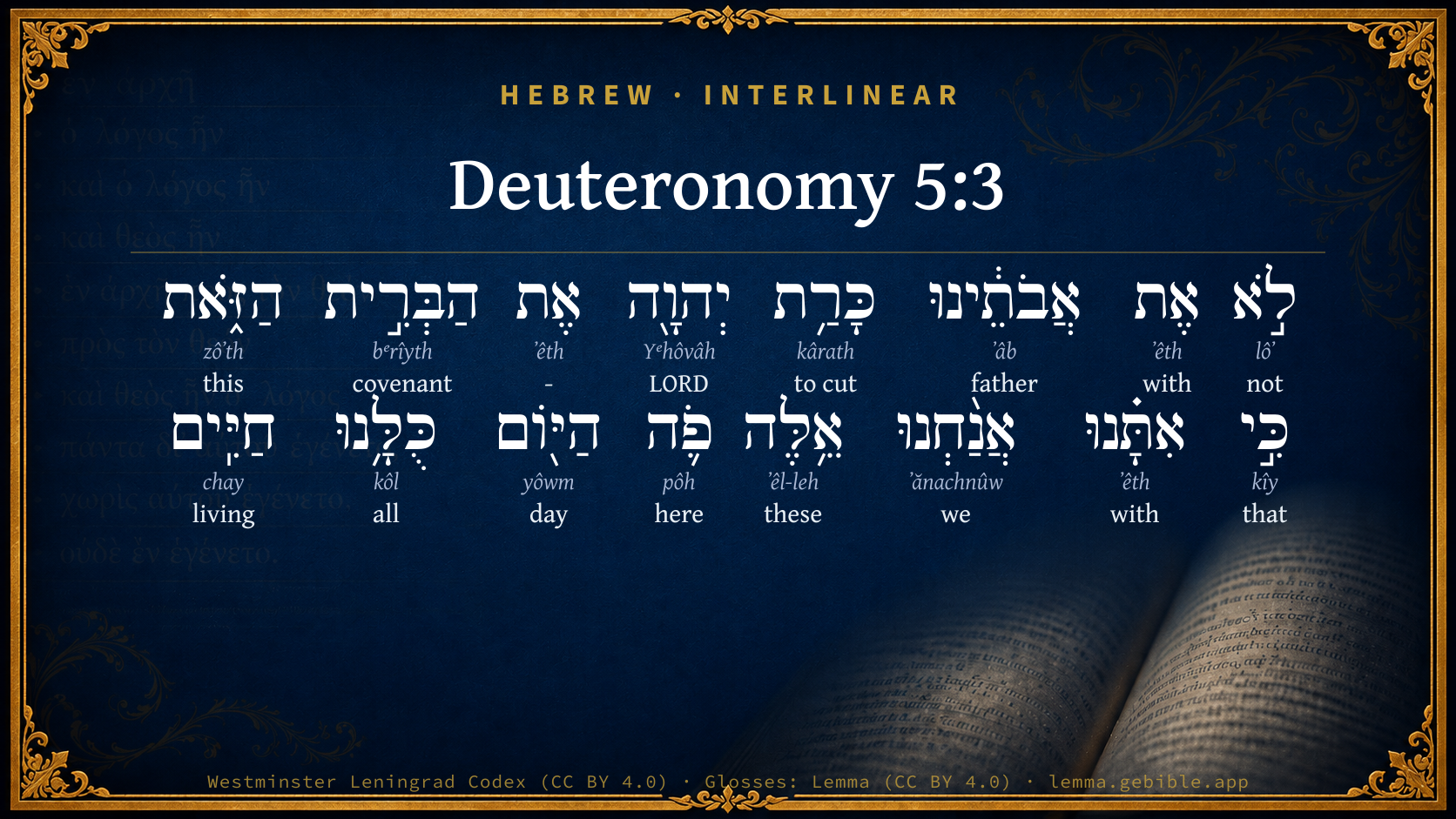
  1. לֹ֣א lôʼ H3808 “not” Particle, Negative
  2. אֶת ʼêth H854 “with” Preposition
  3. אֲבֹתֵ֔ינוּ ʼâb H1 “fathers · our” Noun, Common, Masculine, Plural, Construct + Suffix, Personal, 1st Person, Common, Plural
  4. כָּרַ֥ת kârath H3772 “to cut” Verb, Qal, Perfect, 3rd Person, Masculine, Singular
  5. יְהוָ֖ה Yᵉhôvâh H3068 “LORD” Noun, Proper
  6. אֶת ʼêth H853 “-” Particle, Direct Object
  7. הַבְּרִ֣ית bᵉrîyth H1285 “the · covenant” Particle, Definite Article + Noun, Common, Feminine, Singular, Absolute
  8. הַזֹּ֑את zôʼth H2063 “the · this” Particle, Definite Article + Pronoun, Demonstrative, Feminine, Singular
  9. כִּ֣י kîy H3588 “that” Conjunction
  10. אִתָּ֗נוּ ʼêth H854 “with · us” Preposition + Suffix, Personal, 1st Person, Common, Plural
  11. אֲנַ֨חְנוּ ʼănachnûw H587 “we” Pronoun, Personal, 1st Person, Common, Plural
  12. אֵ֥לֶּה ʼêl-leh H428 “these” Pronoun, Demonstrative, Common, Plural
  13. הַיּ֖וֹם yôwm H3117 “the · day” Particle, Definite Article + Noun, Common, Masculine, Singular, Absolute
  14. כֻּלָּ֥נוּ kôl H3605 “all · our” Noun, Common, Masculine, Singular, Construct + Suffix, Personal, 1st Person, Common, Plural
  15. חַיִּֽים chay H2416 “living” Adjective, Adjective, Masculine, Plural, Absolute

About this verse

These counts appear in no published source. They are computed here, from the morphology-tagged text and Lemma’s own curated glosses. What Lemma adds →

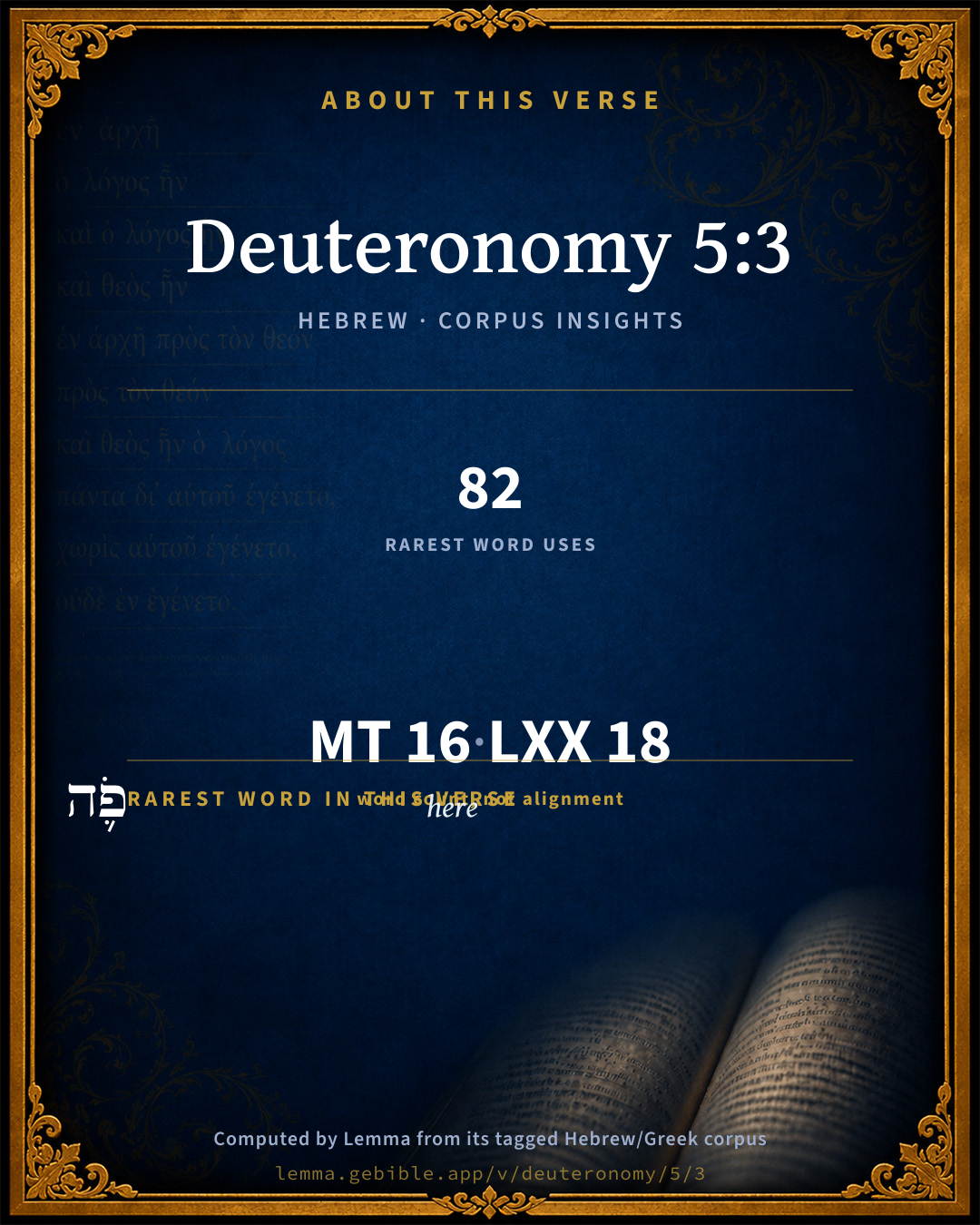
16
words
15
distinct lemmas
Pentateuch
section

Grammatical profile

  • 1 verb
  • 5 nouns
  • 1 adjective
  • 3 pronouns
  • 2 prepositions
  • 1 conjunction
  • 1 adverb
  • 2 particles

Verb forms

  • כָּרַ֥ת Qal · Perfect

Repetition

A word recurs within this verse — often emphatic in Hebrew:

  • אֶת with H854 ×2

Hebrew & Septuagint length

In English translation the verse runs 22 words from the Hebrew and 20 from the Septuagint (LXX English) — closely comparable.

A rough comparison of the two English renderings, which tokenize alike — not a word-level alignment.

Word counts can differ between the Hebrew and the Greek without any difference in meaning — e.g. the Hebrew direct-object marker אֵת has no separate Greek word, and Greek often adds the article ὁ.

In the original languages it is 16 Hebrew tokens and 18 Greek tokens — but the two are counted differently (Hebrew bundles its prefixes and suffixes into one token; the Greek is in lemma form), so that isn’t a like-for-like length.

Cross-references

8

Topical passages linked to Deuteronomy 5:3 in the Treasury of Scripture Knowledge — connected by theme and wording, ordered by reader-vote popularity; previews shown in the World English Bible.

  • Deuteronomy 29:10–15 You stand this day all of you before Yahweh your God; your heads, your tribes, your elders, and your officers, even all the men of Israel,
  • Genesis 17:7 I will establish my covenant between me and you and your seed after you throughout their generations for an everlasting covenant, to be a God to you and to your seed after you.
  • Genesis 17:21 But my covenant I establish with Isaac, whom Sarah will bear to you at this set time in the next year."
  • Psalms 105:8–10 He has remembered his covenant forever, The word which he commanded to a thousand generations,
  • Jeremiah 32:38–40 and they shall be my people, and I will be their God:
  • Matthew 13:17 For most assuredly I tell you that many prophets and righteous men desired to see the things which you see, and didn't see them; and to hear the things which you hear, and didn't hear them.
  • Galatians 3:17–21 Now I say this. A covenant confirmed beforehand by God in Christ, the law, which came four hundred thirty years after, does not annul, so as to make the promise of no effect.
  • Hebrews 8:8–9 For finding fault with them, he said, "Behold, the days come," says the Lord, "That I will make a new covenant with the house of Israel and with the house of Judah;

Cross-references courtesy of OpenBible.info (CC BY 4.0).

Hebrew and Greek witnesses Masoretic Hebrew ↔ Greek Septuagint

The same verse in the two great witnesses to the Old Testament, shown verse-for-verse.

These are two independent witnesses, not word-aligned to each other, and the Septuagint is shown in lemma (dictionary) form.

Hebrew Deuteronomy 5:3 Masoretic · Westminster Leningrad Codex

לֹ֣א אֶת אֲבֹתֵ֔ינוּ כָּרַ֥ת יְהוָ֖ה אֶת הַבְּרִ֣ית הַזֹּ֑את כִּ֣י אִתָּ֗נוּ אֲנַ֨חְנוּ אֵ֥לֶּה פֹ֛ה הַיּ֖וֹם כֻּלָּ֥נוּ חַיִּֽים

Yahweh didn't make this covenant with our fathers, but with us, even us, who are all of us here alive this day.

World English Bible · Public Domain

Greek LXX Deuteronomy 5:3 Septuagint · lemma form

οὐ ὁ πατήρ σύ διατίθημι κύριος ὁ διαθήκη οὗτος ἀλλά ἤ πρός σύ σύ ὧδε πᾶς ζάω σήμερον

The Lord did not make this covenant with your fathers, but with you: you⌃ are all here alive this day.

LXX2012 (modern English Septuagint) · Public Domain

Hebrew: Westminster Leningrad Codex (CC BY 4.0). Greek: Septuagint (public domain); English from LXX2012 (modern English Septuagint) (Public Domain). How the Septuagint differs from the Hebrew →

Targum (Aramaic paraphrase)

2

The Targum is the ancient Jewish Aramaic paraphrase of the Hebrew Scriptures — an interpretive translation, not the Hebrew text itself. Onkelos (literal) and Pseudo-Jonathan (expansive) render the Torah, and Jonathan the Prophets. Coverage is partial: where no permissively-licensed English translation exists for a verse, only the Aramaic is shown. This is verse-level text, not a word-by-word alignment to the Hebrew.

  1. Targum Onkelos Torah (Genesis–Deuteronomy)
    לָא עִם אֲבְהָתָנָא גְזַר יְיָ יָת קְיָמָא הָדָא אֶלָהֵן עִמָנָא אֲנַחְנָא אִלֵין הָכָא יוֹמָא דֵין כֻּלָנָא קַיָמִין

    (no public-domain English translation for this verse)

    Targum Onkelos — Aramaic: “Onkelos Genesis” (public domain); “Onkelos Exodus” (public domain); “Onkelos Leviticus” (public domain); “Onkelos Numbers” (public domain); “Onkelos Deuteronomy” (public domain). English: “Sefaria Community Translation” (CC0 1.0 (public-domain dedication)); “J.W. Etheridge. The Targums of Onkelos and Jonathan Ben Uzziel on the Pentateuch. London: Longmans, Green, 1862” (public domain). Text via Sefaria.

  2. Targum Pseudo-Jonathan Torah (Genesis–Deuteronomy)
    לָא עִם אַבְהָתָנָא גְזַר יְיָ יַת קְיָימָא הָדֵין אֱלָהֵן עִמָנָא אֲנַחְנָא אִלֵין הָכָא יוֹמָא דֵין כּוּלָנָא חַיִּין וְקַיָּימִין

    not with our fathers did the Lord confirm this covenant, but with us, who are all of us here this day alive and abiding.

    Targum Pseudo-Jonathan — Aramaic: “Targum Jonathan on Genesis” (public domain); “Targum Jonathan on Exodus” (public domain); “Targum Jonathan on Leviticus” (public domain); “Targum Jonathan on Numbers” (public domain); “Targum Jonathan on Deuteronomy” (public domain). English: “The Targum of Jonathan ben Uzziel, trans. J. W. Etheridge, London, 1862” (public domain). Text via Sefaria.

Commentary

Notes on Deuteronomy 5:3 from classic Christian and Jewish commentators (each source and its license shown beneath its notes). The classic Christian expositions comment on the surrounding passage and are grouped to its opening verse, so a note may address several verses; the Jewish commentaries on the Tanakh (Rashi and others) are per-verse, so they appear only where the commentator wrote on this verse.

Lemma curates 59 commentaries, every one of them public domain or Creative Commons licensed, each selected and text-cleaned for this edition rather than reprinted as found. About our sources →

Trapp's Complete Commentary

John Trapp

Deu 5:3 The LORD made not this covenant with our fathers, but with us, [even] us, who [are] all of us here alive this day.

Ver. 3. With our fathers,] i.e., With our fathers only. Or if it be understood of all the foregoing patriarchs, then it is to be expounded by Gal 3:17.

John Trapp, A Commentary or Exposition upon All the Books of the Old and New Testament (1647–1656) — public domain. Text from a community e-Sword module.

Joseph Benson's Commentary

Deu 5:3. The Lord made not this covenant with our fathers — That is, with our remote progenitors, with Abraham, Isaac, and Jacob, but with us, their descendants: or if it be understood as spoken of their immediate parents, it means, according to the Hebrew idiom, Not with our fathers only, but with us also, as Gen 32:28, Thy name shall be called no more Jacob, but Israel; that is, not only Jacob, but Israel, or Israel preferably to Jacob. Moses might truly say, God made this covenant with them then present before him; for a great part of them, even all who were under twenty years of age, when God gave the law on mount Sinai, were at Horeb; and, as God foreknew that their parents would die in the wilderness for their unbelief and murmuring, and would have comparatively little profit from that covenant, he especially intended it for those who should enter Canaan, and who, with their posterity, should be governed and benefited by it from generation to generation.

Joseph Benson's Commentary on the Old and New Testaments (1811–1818) — public domain. Text from a community e-Sword module.

Geneva Bible (1599)

Geneva Bible translators

Some read, God made not this covenant, that is, in such ample forth and with such signs and wonders.

Geneva Bible (1599) marginal notes — public domain. Text via Bolls.life.

Jamieson, Fausset & Brown

Robert Jamieson, A. R. Fausset & David Brown

The Lord made not this covenant with our fathers, but with us--The meaning is, "not with our fathers" only, "but with us" also, assuming it to be "a covenant" of grace. It may mean "not with our fathers" at all, if the reference is to the peculiar establishment of the covenant of Sinai; a law was not given to them as to us, nor was the covenant ratified in the same public manner and by the same solemn sanctions. Or, finally, the meaning may be "not with our fathers" who died in the wilderness, in consequence of their rebellion, and to whom God did not give the rewards promised only to the faithful; but "with us," who alone, strictly speaking, shall enjoy the benefits of this covenant by entering on the possession of the promised land.

Jamieson, Fausset & Brown — Commentary Critical and Explanatory on the Whole Bible (1871) — public domain (CC PDM 1.0). Text via the HelloAO Bible API.

Adam Clarke's Commentary

Verse 3. The Lord made not this covenant with our fathers (only) but with us (also.)

Adam Clarke's Commentary on the Bible (1810–1826) — public domain. Text from a community e-Sword/MySword module.

Ellicott's Commentary for English Readers

(3) Not . . . with our fathers, but with us.—That is, according to the usage of the Hebrew language in drawing contrasts, not only with our fathers (who actually heard it), but with us also, who were in the loins of our fathers, and for whom the covenant was intended no less than for them; and, in fact, every man who was above forty-two at the time of this discourse might actually remember the day at Sinai.

A Bible Commentary for English Readers, edited by Charles John Ellicott (1878–1897) — public domain. Text from a community e-Sword module.

The Cambridge Bible for Schools and Colleges

gen. ed. J. J. S. Perowne

3. not … with our fathers] Rather, forefathers, i.e. the Patriarchs—‘those great Grandfathers of thy Church1[119]—with whom, however, D recognises a previous covenant, Deu_4:31, Deu_7:12, Deu_8:18. The immediate fathers of the generation had all passed away before the entry into Moab, according to Deu_2:14 f. Here it is said emphatically that those with whom the covenant at Ḥoreb had been made were still all—us, all of us—alive here this day. Dillmann meets the contradiction by taking Deu_2:14 f. as a later gloss. Others find in it a proof of the difference of authorship between the first discourses Deu_1:6 to Deu_4:49 and the present series; but this still leaves unsolved the difference within the former between Deu_1:30 and Deu_2:14 f. A more probable explanation is that the speaker is made to ignore the tradition of the death of those who had been adults at Ḥoreb (of which the author cannot well have been ignorant) for rhetorical purposes: (1) to emphasise the contrast between the Patriarchs and Israel after the Exodus; and (2) to emphasise the new responsibility which the Ḥoreb covenant had laid on the latter, in all its successive generations. What Dillmann on Deu_1:30 says of the previous discourse is true of this one (cp. Deu_11:2-7): ‘In the whole discourse Moses conceives the present generation as identical with the previous one.’

[119] Donne, The Litanie, vii.

The Cambridge Bible for Schools and Colleges (gen. ed. J. J. S. Perowne; Cambridge University Press, 1878–1918) — public domain. Text from a community e-Sword module.

John Gill's Exposition

The Lord talked with you face to face in the mount,.... Meaning, not in that free, friendly, and familiar manner, in which he sometimes talked with Moses, of whom this phrase is used, Exo 33:11, but publicly, audibly, clearly, and distinctly, or without the interposition of another; he did not speak to them by Moses, but to them themselves; he talked to them without a middle person between them, as Aben Ezra expresses it: without making use of one to relate to them what he said; but he talked to them directly, personally:

out of the midst of the fire; in which he descended, and with which the mountain was burning all the time he was speaking; which made it very awful and terrible, and pointed at the terrors of the legal dispensation.

John Gill's Exposition of the Whole Bible (1746–1763) — public domain (CC PDM 1.0). Text via the HelloAO Bible API.

Albert Barnes' Notes on the Bible

The “fathers” are, as in Deu 4:37, the patriarchs, Abraham, Isaac, and Jacob. With them God did indeed make a covenant, but not the particular covenant now in question. The responsibilites of this later covenant, made at Sinai by the nation as a nation, attached in their day and generation to those whom Moses was addressing.

Albert Barnes' Notes on the Bible (1834–1885) — public domain. Text from a community e-Sword/MySword module.

Haydock's Catholic Bible Commentary

Fathers, the ancient patriarchs, who were not favoured in such a signal manner. (Menochius) --- Though many of those who had heard the words of God at Horeb, were dead, and had not enjoyed the full benefit of the covenant, some still remained, and the children of the deceased were about to enter the land which had been there promised. (Haydock) --- God did not make a covenant with the Patriarchs only, but also with their posterity at Horeb. (Du Hamel)

George Leo Haydock (1774–1849), Haydock's Catholic Family Bible and Commentary, 1859 edition — public domain. Excludes Psalms (Douay-Rheims chapter numbering differs from Protestant) and Deuterocanonical books (Catholic canon only).

Matthew Poole's English Annotations

With our fathers; either,

1. Not only with them, the word only being here understood, as it is Gen 32:28; 35:10; 1Sa 8:7; Jer 7:19; 31:34; Mat 9:13. Or,

2. Not at all with them. But then the word covenant is not here to be taken for the covenant of grace in general, for so it was made with their fathers, Exo 2:24, but for this particular and mixed dispensation of the covenant at Sinai, as appears both by the foregoing and following words.

All of us here alive this day: he saith not, that all who made that covenant at Sinai are now alive, for many of them were dead, but that this covenant was made with all that are now alive, which is most true, for it was made with the elder sort of them in their own persons, and with the rest in their parents, who did covenant for them; for this phrase,

with us, is put exclusively as to their fathers, but not as to their posterity, as is evident from the nature of the covenant, Act 2:39, and course of the story.

Matthew Poole's English Annotations on the Holy Bible (1683–1685) — public domain. Text from a community e-Sword/MySword module.

Whedon's Commentary on the Bible

Daniel D. Whedon

3. Not… with our fathers — Not with Abraham, Isaac, and Jacob was the covenant of which Moses speaks made, but with their descendants who came up out of the land of bondage. A covenant had been made with their fathers, but this covenant was made at Sinai, and, though nearly forty years had passed, there were those among the hearers who could recall the scenes connected with its announcement.

Daniel D. Whedon (gen. ed.), Commentary on the Old and New Testaments (1874–1909) — public domain. Text from a community e-Sword module.

John Wesley's Explanatory Notes

Not with our fathers - Only: but with us, who are all alive - He saith not, that all who made the covenant at Sinai are now alive, but this covenant was made with all that are now alive; which is most true, for it was made with the elders in their persons, and with the rest in their parents, who covenanted for them.

John Wesley, Explanatory Notes Upon the Whole Bible (1754–1765) — public domain. Text via the GEBible commentary corpus.

Rashi

Rabbi Shlomo Yitzchaki (Rashi)

לא את אבתינו NOT WITH OUR FATHERS — i.e. not with them alone, כרת ה׳ וגו׳ DID THE LORD MAKE [THIS COVENANT], כי אתנו BUT WITH US etc.

Rashi on the Tanakh — English translations: “The Judaica Press complete Tanach with Rashi, translated by A. J. Rosenberg” (CC BY 4.0); “Pentateuch with Rashi's commentary by M. Rosenbaum and A.M. Silbermann, 1929-1934” (public domain); “The Metsudah Tanach series, Lakewood, N.J” (CC BY 4.0); and “The Book of Joshua, Metsudah Publications, 1997” (CC BY 4.0). Text via Sefaria.

Lesson kit

Teaching starters — assembled from the data on this page, not authored interpretation. Every prompt links to the verse data it draws on. Edit before teaching.

Deuteronomy, in the Pentateuch, opens this verse with 16 words (15 distinct Hebrew lemmas). Its most distinctive word is pôh (“here”). A historical commentator’s framing appears above. Read the whole chapter for the surrounding context.

Discussion questions

  1. What does “here” (pôh) contribute to the verse as a whole?
  2. How does Deuteronomy 29:10–15, which shares this passage’s theme, read alongside this verse?
  3. What does the repetition of “with” (2× in this one verse) do in this verse?
  4. These translations render this verse differently. What is at stake in choosing one wording over another?
  5. «כָּרַ֥ת» is a Qal Perfect verb. How does that grammatical form shape the action described?
  6. Compare how Trapp's Complete Commentary and Joseph Benson's Commentary read this verse. Where do they agree or differ?

Things to notice

Reading settings

Reading text

Shown beneath each verse's original-language words.

Old Testament
Old Testament edition

Read the OT as the Masoretic Hebrew (MT) or the Greek Septuagint (LXX).

English shown for the Greek Septuagint (in the Hebrew ↔ Greek comparison).

Comparing translations? Open the Compare panel on any verse page to stack up to four side by side.