Nehemiah 9:38

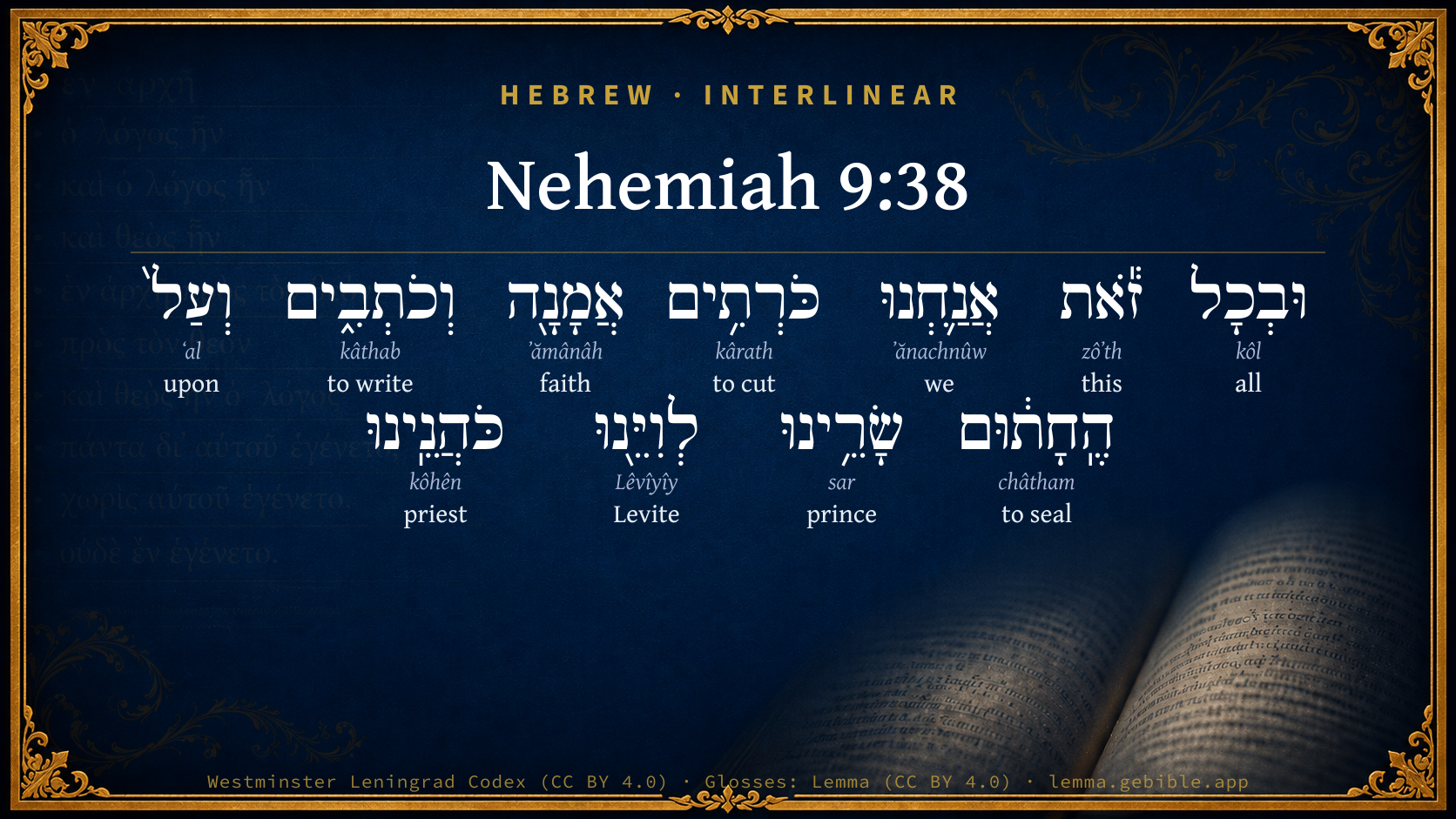
Hebrew (Westminster Leningrad Codex) Nehemiah 9:38 appears in the Hebrew Old Testament. The text above is from the Westminster Leningrad Codex. Each word links to its Strong’s number, a concise gloss, and parsing drawn from the Open Scriptures Hebrew Bible morphology. Click any word for its full Brown-Driver-Briggs (BDB) entry.
Download image
Cite this verse

Nehemiah 9:38 (World English Bible). Public Domain. Lemma interlinear Bible study tool, https://lemma.gebible.app/v/nehemiah/9/38.

Show BibTeX & RIS
BibTeX
RIS
English Translation
Yet for all this we make a sure covenant, and write it; and our princes, our Levites, [and] our priests, seal to it.
World English Bible · Public Domain
Highlights
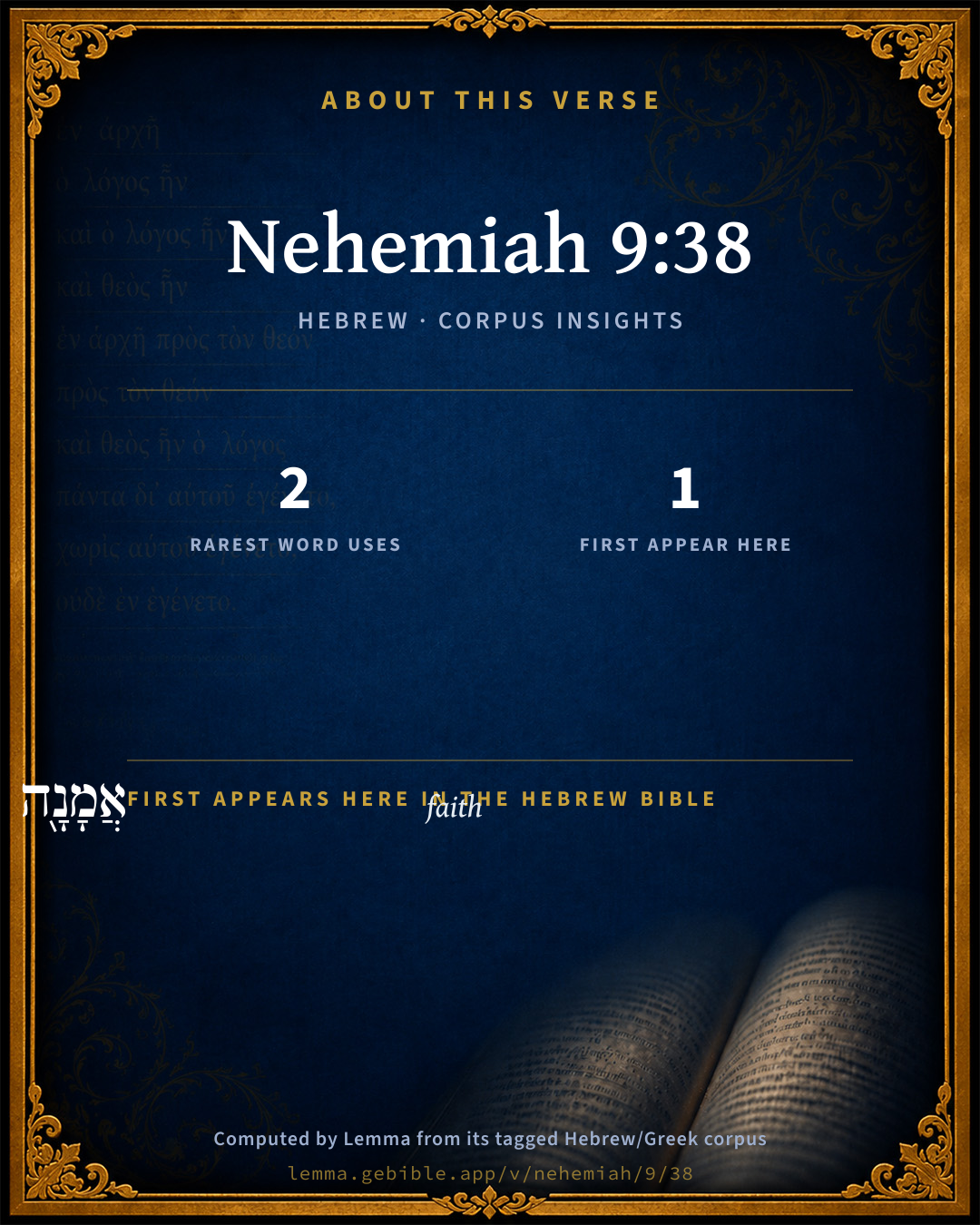
  • 1 first appearance in the Hebrew Bible
Full analysis ↓
Download a study sheet

One document with this verse’s original text, its word-by-word gloss line, the meaning frame, cross-references with their text, attributed commentary, and full source and license credits — printable, and it pastes into notes with its structure intact.

This verse Autodidact and up

Study sheet (.html) Plain text (.txt)

A passage Seminary Student

Up to 50 verses in one chapter. A passage sheet keeps up to 6 commentary sources and 12 cross-references per verse, in the order this page ranks them, and says so on the sheet whenever that leaves anything out. Ask for a single verse and you get the Autodidact verse sheet above.

Everything on this page stays free to read, with no account — the sheet is a download of what is already on screen, not access to it.

Want to remove ads? Support Godless Engineer
Compare translations 3

The same verse in 3 English versions, stacked beneath the original-language interlinear above. Click any original word for its lexicon entry.

Each is an independent rendering of the whole verse — the interlinear is not word-aligned to these translations.

Highlighted words mark where these versions differ — a whole-verse word diff, not a word-by-word alignment.

  • World English Bible Public Domain
    Yet for all this we make a sure covenant, and write it; and our princes, our Levites, [and] our priests, seal to it.
  • King James Version Public Domain
    And because of all this we make a sure covenant, and write it; and our princes, Levites, and priests, seal unto it.
  • unfoldingWord Literal Text CC BY-SA 4.0
    And in all of this, we are cutting a faithful covenant, and writing even on a sealed document our leaders, our Levites, our priests.”

unfoldingWord Literal Text — © unfoldingWord, licensed CC BY-SA 4.0. Word-aligned USFM3 via Door43 (git.door43.org/unfoldingWord/en_ult).

Versions to compare (up to 4)

3 of 4 selected

Show all 18 translations

Every available English version of this verse, each an independent rendering of the whole verse.

  • World English Bible Public Domain
    Yet for all this we make a sure covenant, and write it; and our princes, our Levites, [and] our priests, seal to it.
  • Berean Standard Bible Public Domain
    In view of all this, we make a binding agreement, putting it in writing and sealing it with the names of our leaders, Levites, and priests.”
  • Majority Standard Bible Public Domain
    In view of all this, we make a binding agreement, putting it in writing and sealing it with the names of our leaders, Levites, and priests.”
  • King James Version Public Domain
    And because of all this we make a sure covenant, and write it; and our princes, Levites, and priests, seal unto it.
  • American Standard Version (1901) Public Domain
    And yet for all this we make a sure covenant, and write it; and our princes, our Levites, `and' our priests, seal unto it.
  • Revised Version (1885) Public Domain
    And yet for all this we make a sure covenant, and write it; and our princes, our Levites, and our priests, seal unto it.
  • Geneva Bible (1599) Public Domain
    Now because of all this we make a sure couenant, and write it, and our princes, our Leuites and our Priestes seale vnto it.
  • Douay-Rheims (1899) Public Domain
    and because of all this we ourselves make a covenant, and write it, and our princes, our Levites, and our priests sign it.
  • Young's Literal Translation Public Domain
    And for all this we are making a stedfast covenant, and are writing, and over him who is sealed `are' our heads, our Levites, our priests.'
  • Literal Standard Version CC BY-SA 4.0
    And for all this we are making a steadfast covenant, || And are writing, || And over him who is sealed || [Are] our heads, our Levites, [and] our priests.”
  • Unlocked Literal Bible CC BY-SA 4.0
    Because of all this, we make a firm covenant in writing. On the sealed document are the names of our princes, Levites, and priests.”
  • unfoldingWord Literal Text CC BY-SA 4.0
    And in all of this, we are cutting a faithful covenant, and writing even on a sealed document our leaders, our Levites, our priests.”
  • Darby Bible Public Domain
    And because of all this we make a sure covenant, and write it; and our princes, our Levites, [and] our priests are at the sealing.
  • World Messianic Bible Public Domain
    Yet for all this, we make a sure covenant, and write it; and our princes, our Levites, and our priests, seal it.”
  • Webster's Bible Public Domain
    And because of all this we make a sure covenant, and write it; and our princes, Levites, and priests, set their seals to it.
  • Free Bible Version CC BY-SA 4.0
    In response the people declared, “Considering all this, we are making a solemn agreement, putting it in writing. It is sealed by our leaders, Levites, and priests.”
  • Bible in Basic English Public Domain
    And because of all this we are making an agreement in good faith, and putting it in writing; and our rulers, our Levites, and our priests are putting their names to it.
  • JPS Tanakh (1917) Public Domain
    (10-1) And yet for all this we make a sure covenant, and subscribe it; and our princes, our Levites, and our priests, set their seal unto it.

Literal Standard Version (2020), Covenant Press — licensed CC BY-SA 4.0. Text via the HelloAO Bible API (eBible.org). Unlocked Literal Bible (unfoldingWord) — licensed CC BY-SA 4.0. Text via the HelloAO Bible API (eBible.org). unfoldingWord Literal Text — © unfoldingWord, licensed CC BY-SA 4.0. Word-aligned USFM3 via Door43 (git.door43.org/unfoldingWord/en_ult). Free Bible Version, Dr. Jonathan Gallagher — licensed CC BY-SA 4.0. Text via the HelloAO Bible API (eBible.org).

Word by word

More ways to search: Search by grammar → Find every occurrence → Compare this word →

Practice this passage: Drill this verse → Learn its vocabulary →

אֲמָנָ֖ה
ʼămânâh
H548
“faith”
Noun, Common, Feminine, Singular, Absolute
Part of Speech
Noun
Type
Common
Gender
Feminine
Number
Singular
State
Absolute
Full BDB Definition

Origin: from H543

TWOT: 116h

faith, support, sure, certain - of a covenant - of financial support
  1. וּבְכָל kôl H3605 “and · in/at · all of” Conjunction + Preposition + Noun, Common, Masculine, Singular, Construct
  2. זֹ֕את zôʼth H2063 “this” Pronoun, Demonstrative, Feminine, Singular
  3. אֲנַ֛חְנוּ ʼănachnûw H587 “we” Pronoun, Personal, 1st Person, Common, Plural
  4. כֹּרְתִ֥ים kârath H3772 “cutting” Verb, Qal, Participle Active, Masculine, Plural, Absolute
  5. וְכֹתְבִ֑ים kâthab H3789 “and · writing” Conjunction + Verb, Qal, Participle Active, Masculine, Plural, Absolute
  6. וְעַל֙ ʻal H5921 “and · upon” Conjunction + Preposition
  7. הֶֽחָת֔וּם châtham H2856 “the · sealed” Particle, Definite Article + Verb, Qal, Participle Passive, Masculine, Singular, Absolute
  8. שָׂרֵ֥ינוּ sar H8269 “princes · our” Noun, Common, Masculine, Plural, Construct + Suffix, Personal, 1st Person, Common, Plural
  9. לְוִיֵּ֖נוּ Lêvîyîy H3881 “Levites · our” Noun, Gentilic, Masculine, Plural, Construct + Suffix, Personal, 1st Person, Common, Plural
  10. כֹּהֲנֵֽינוּ kôhên H3548 “priests · our” Noun, Common, Masculine, Plural, Construct + Suffix, Personal, 1st Person, Common, Plural

About this verse

These counts appear in no published source. They are computed here, from the morphology-tagged text and Lemma’s own curated glosses. What Lemma adds →

11
words
11
distinct lemmas
Historical
section

Notable vocabulary

The rarest word here is אֲמָנָ֖ה faith H548 — appearing just 2 times in the whole Hebrew Bible.

First appearance in Scripture

This word makes its first canonical appearance in the Hebrew Bible here:

  • אֲמָנָ֖ה faith H548

Shared distinctive vocabulary

אֲמָנָ֖ה faith H548 occurs in 2 verses of the Hebrew Bible. Also found in:

Grammatical profile

  • 3 verbs
  • 5 nouns
  • 2 pronouns
  • 1 preposition

Verb forms

  • כֹּרְתִ֥ים Qal · Participle Active
  • וְכֹתְבִ֑ים Qal · Participle Active
  • הֶֽחָת֔וּם Qal · Participle Passive

Cross-references

8

Topical passages linked to Nehemiah 9:38 in the Treasury of Scripture Knowledge — connected by theme and wording, ordered by reader-vote popularity; previews shown in the World English Bible.

  • Nehemiah 10:1 Now those who sealed were: Nehemiah the governor, the son of Hacaliah, and Zedekiah,
  • 2 Chronicles 34:31 The king stood in his place, and made a covenant before Yahweh, to walk after Yahweh, and to keep his commandments, and his testimonies, and his statutes, with all his heart, and with all his soul, to perform the words of the covenant that were written in this book.
  • Ezra 10:3 Now therefore let us make a covenant with our God to put away all the wives, and such as are born of them, according to the counsel of my lord, and of those who tremble at the commandment of our God; and let it be done according to the law.
  • Nehemiah 10:29 They joined with their brothers, their nobles, and entered into a curse, and into an oath, to walk in God's law, which was given by Moses the servant of God, and to observe and do all the commandments of Yahweh our Lord, and his ordinances and his statutes;
  • 2 Kings 23:3 The king stood by the pillar, and made a covenant before Yahweh, to walk after Yahweh, and to keep his commandments, and his testimonies, and his statutes, with all [his] heart, and all [his] soul, to confirm the words of this covenant that were written in this book: and all the people stood to the covenant.
  • 2 Chronicles 23:16 Jehoiada made a covenant between himself, and all the people, and the king, that they should be Yahweh's people.
  • 2 Chronicles 29:10 Now it is in my heart to make a covenant with Yahweh, the God of Israel, that his fierce anger may turn away from us.
  • 2 Chronicles 15:12–13 They entered into the covenant to seek Yahweh, the God of their fathers, with all their heart and with all their soul;

Cross-references courtesy of OpenBible.info (CC BY 4.0).

Hebrew and Greek witnesses Masoretic Hebrew ↔ Greek Septuagint

The same verse in the two great witnesses to the Old Testament, shown verse-for-verse.

These are two independent witnesses, not word-aligned to each other, and the Septuagint is shown in lemma (dictionary) form.

Hebrew Nehemiah 9:38 Masoretic · Westminster Leningrad Codex

וּבְכָל זֹ֕את אֲנַ֛חְנוּ כֹּרְתִ֥ים אֲמָנָ֖ה וְכֹתְבִ֑ים וְעַל֙ הֶֽחָת֔וּם שָׂרֵ֥ינוּ לְוִיֵּ֖נוּ כֹּהֲנֵֽינוּ

Yet for all this we make a sure covenant, and write it; and our princes, our Levites, [and] our priests, seal to it.

World English Bible · Public Domain

Greek LXX Structure differs

The Septuagint has no separate book of Nehemiah. Its Greek text is the second half of Esdras B (2 Esdras), chapters 11–23; Ezra is the first half (1–10).

A verse-for-verse comparison isn’t shown here because the chapters and verses don’t line up. Switch to the LXX edition with the MT / LXX toggle above to read the Greek directly.

On this verse, The Cambridge Bible for Schools and Colleges discusses the Septuagint’s reading. Read the note in Commentary ↓

Hebrew: Westminster Leningrad Codex (CC BY 4.0). Greek: Septuagint (public domain); English from a public-domain English Septuagint. How the Septuagint differs from the Hebrew →

Commentary

Notes on Nehemiah 9:38 from classic Christian and Jewish commentators (each source and its license shown beneath its notes). The classic Christian expositions comment on the surrounding passage and are grouped to its opening verse, so a note may address several verses; the Jewish commentaries on the Tanakh (Rashi and others) are per-verse, so they appear only where the commentator wrote on this verse.

Lemma curates 59 commentaries, every one of them public domain or Creative Commons licensed, each selected and text-cleaned for this edition rather than reprinted as found. About our sources →

The Cambridge Bible for Schools and Colleges

gen. ed. J. J. S. Perowne

38. Chap. Neh_10:1 in Heb.; so Luther. The A.V. and R.V. follow the division of the Vulg. and LXX.

And because of all this] R.V. And yet for all this. R.V. marg. ‘Or, because of’. The relation of this sentence to the preceding confession is not certain. This uncertainty has given rise to the doubt whether chap. 9 should not have closed at Neh_9:37. The English translation treats the verse as the concluding sentence of the Confession. The A.V. rendering ‘And because of all this’ refers back to the whole summary of Israelite history (7–37), i.e. ‘because of Jehovah’s mercy in spite of our disobedience.’ The R.V. rendering ‘And yet for all this’ refers especially to the concluding words, describing the sorrows and afflictions which had come upon the people, i.e. ‘And yet in spite of all this oppression our faith in God’s mercy is unshaken, and in proof thereof we sign the covenant.’ This explanation, which is preferable, seems to derive support from other passages where the same prep. and pron. occur. Cf. Isa_5:25; Isa_9:12, ‘For all this his anger is not turned away.’ Job_1:22, ‘In all this Job sinned not.’

The view that the verse resumes the narrative of Neh_9:1-5 is very improbable on account of the use of the 1st pers. plur., which has not been employed in this section (chaps. 8 and 9).

The Massoretic division into chapters, which begins chap. 10 with this verse, severs the connexion with the previous verses. It was perhaps considered that a more considerable break should be introduced between the conclusion of the Confession and the signing of the Covenant. The Massoretes regarded the present verse as Nehemiah’s preface to the new section.

sure] R.V. marg. ‘Or, faithful’. The words ‘a sure covenant’ render the Hebrew ‘’emanah,’ which elsewhere in the O. T. is only found in Neh_11:23, ‘a settled provision’ (marg. ‘a sure ordinance’). The regular phrase for ‘making’ (lit. ‘cutting’) a covenant (cf. Neh_9:8) occurs; and there can be no doubt of its meaning here. LXX. διατιθέμεθα πίστιν. Vulg. ‘percutimus foedus.’ The Covenant is not between Ezra and the people, but between the people and Jehovah.

our princes, Levites, and priests] R.V. our princes, our Levites, and our priests. The position of the Levites between the ‘princes’ and the ‘priests’ deserves notice, as it illustrates the prominence of the Levites in the movement.

seal unto it] R.V. marg. ‘Or, are at the sealing’. The A.V. rendering suggests the idea of a seal being affixed by each of the chief representatives. But the meaning is rather that the document having been prepared and rendered official by the addition of the seal, the leaders of the people were ‘upon’ the sealed writing, viz. they either appended signatures as witnesses, or made marks to endorse the document and to testify to their approval. In many of the Assyrian tablets, recording business transactions, the marks of the thumb-nails of the witnesses still attest the fact of their presence and approbation.

The National confession (Neh_9:5-38) is thus brought to a conclusion in Neh_9:38 as abruptly as it was begun in Neh_9:5. It consists of four portions, (1) Neh_9:5, the opening ascription; (2) 6–31, the summary of Israel’s religious history; (3) 32–37, the prayer of deprecation and submission; (4) 38, the announcement of the national covenant. This strikingly practical termination of the Confession is very characteristic of the movement headed by Ezra and Nehemiah. Repentance is to take shape in immediate action.

The summary of past history should be compared with that in Psalms 105, 106, 135, 136. It is expressed for the most part in general terms. The only individuals of the chosen people mentioned by name are Abram (Neh_9:7), and Moses (Neh_9:14); but the events recorded in the Pentateuch which are here alluded to are numerous—(1) the call of Abram from Ur; (2) the change of name to Abraham; (3) the covenant with Abraham; (4) the overthrow of Pharaoh and the crossing of the Red Sea; (5) the pillar of cloud and fire; (6) the giving of the law on Mt Sinai; (7) manna; (8) water from the rock; (9) the golden calf; (10) the defeat of Sihon and Og. The possession of the land (Neh_9:24-25) and the sending of the judges (Neh_9:27) are mentioned, but with much less definiteness.

It is strange that we have no mention of Joshua, Samuel, David or Solomon. But very probably the reason of the omission is that the contents of the Pentateuch in the age of Nehemiah were alone regarded as sacred Scripture. Reference to subsequent events and later names would not carry the same weight. These would not be so familiar to the people, and would not carry with them the authority of Divine teaching which already belonged to the ‘Law.’

The Cambridge Bible for Schools and Colleges (gen. ed. J. J. S. Perowne; Cambridge University Press, 1878–1918) — public domain. Text from a community e-Sword module.

Trapp's Complete Commentary

John Trapp

Neh 9:38 And because of all this we make a sure [covenant], and write [it]; and our princes, Levites, [and] priests, seal [unto it].

Ver. 38. And because of all this] Our sin and misery.

We make a sure covenant] See Ezr 10:3.

And write it] Littera scripta manet, A written letter abides.

And our princes, Levites, and priests, seal unto it] In the room and name of all the rest, who have sworn and will perform it, that we will keep thy righteous judgments.

John Trapp, A Commentary or Exposition upon All the Books of the Old and New Testament (1647–1656) — public domain. Text from a community e-Sword module.

The Biblical Illustrator

Joseph S. Exell

Neh_9:38

And because of all this, we make a sure covenant, and write it.

Covenanting with God

It may be asked, Are Christians of the present day expected to enter into such covenants? To this we reply both yes and no. Yes, if regard be had to true heart-consecration to the Lord. No, if it be a mere matter of form, a source of bondage or a minister to spiritual pride. If we mistake not, some of the Churches of New England have a form of covenant which each new adherent is required to sign, and we know that the esteemed President Edwards advocated the making of written covenants between individual Christians and the Almighty. In reference to this each must exercise his own judgment as before God. (W. P. Lockhart.)

.

The Biblical Illustrator, edited by Joseph S. Exell (c. 1880s–1900s) — public domain. Text from a community e-Sword module.

Joseph Benson's Commentary

Neh 9:38. Because of all this we make a sure covenant — Considering all this, they resolved to renew their covenant with God for better obedience, which they promise as the only remedy to procure perfect deliverance. And to make it more effectual, they seem to have declared this in the presence of God, at the conclusion of the foregoing confession and prayer. And write it — It was but of little consequence what such a refractory people promised, even in writing; for what regard would they have to their own hand-writing, who regarded not the ten commandments, written on tables of stone by the finger of God? It was, however, very useful that there should be a public instrument to convince them of their impiety, that they might be publicly confounded if they proved perfidious deserters, by showing them their engagements, under their own hands, to future fidelity. And our princes, Levites, and priests, seal unto it — Thus they would become witnesses against themselves if they dealt deceitfully.

Joseph Benson's Commentary on the Old and New Testaments (1811–1818) — public domain. Text from a community e-Sword module.

Whedon's Commentary on the Bible

Daniel D. Whedon

THE SEALED COVENANT, Neh_9:38 to Neh_10:27.

38. Because of all this — In view of the people’s profound humiliation and penitence, as expressed in the preceding prayer. This verse properly belongs to chapter 10.

We make a sure covenant — For the purpose of preserving and perpetuating the excellent feeling that now prevailed, the whole community entered at once into a written covenant to separate themselves from the heathen and remain true to Jehovah.

Seal unto it — The word rendered seal is the passive participle sealed, and is evidently used in the sense of sealed instrument. Thus, literally, and upon the sealed, (document,) were our princes, Levites, priests; that is, the sealed instrument bore their names or signatures. Such solemn sealing of documents to ratify a treaty or covenant has been a custom in all ages.

Daniel D. Whedon (gen. ed.), Commentary on the Old and New Testaments (1874–1909) — public domain. Text from a community e-Sword module.

Tyndale Open Study Notes

Tyndale Open Resources

9:38–10:39 The people, embracing the prayer, renewed their dedication to God and his word. They signed their names to indicate their commitment (9:38–10:27) and took an oath to live by the covenant (10:28-39).

9:38 making a solemn promise . . . putting it in writing: These actions indicate a serious vow of faithfulness to the covenant. The sealed document had legal standing.

Tyndale Open Study Notes — © Tyndale Open Resources, licensed CC BY-SA 4.0. Text via the HelloAO Bible API.

Geneva Bible (1599)

Geneva Bible translators

Thus by affliction they promise to keep God’s commandments, whereunto they could not be brought by God’s great benefits.

Geneva Bible (1599) marginal notes — public domain. Text via Bolls.life.

Jamieson, Fausset & Brown

Robert Jamieson, A. R. Fausset & David Brown

we make a sure covenant, and write--that is, subscribe or sign it. This written document would exercise a wholesome influence in restraining their backslidings or in animating them to duty, by being a witness against them if in the future they were unfaithful to their engagements.

Next: Nehemiah Chapter 10

Jamieson, Fausset & Brown — Commentary Critical and Explanatory on the Whole Bible (1871) — public domain (CC PDM 1.0). Text via the HelloAO Bible API.

Adam Clarke's Commentary

Verse 38. Our princes, Levites, and priests, seal unto it.] Persuaded that we have brought all the miseries upon ourselves by our transgressions, feeling much and fearing more, we make a covenant with thee to devote ourselves to thy service; to do with us as thou pleasest. From this sealing we learn that at this time the government of the Jews was a mixed aristocracy; composed of the nobles for the civil department, and the priests and Levites for the ecclesiastical.

This was not mixing the Church with the state, or the state with the Church: both were separate, yet both mutually supported each other. The state never attempted to model the Church according to its own mind; because the Church had been founded and regulated by God, and neither its creed nor its ordinances could be changed. The Church did not meddle with the state, to give it new laws, new ordinances, or new officers. Therefore the one could not be jealous of the other. Where this state of things prevails, every public blessing may be expected. In every state God says to the governors and the governed: "Render to Caesar the things which are Caesar's, and to GOD the things which are GOD's."

Adam Clarke's Commentary on the Bible (1810–1826) — public domain. Text from a community e-Sword/MySword module.

Ellicott's Commentary for English Readers

(38) Because of all this.—On the ground of this confession, and to prove our sincerity.

Seal unto it.—On the sealed [document]. Each party impressed his seal on moist clay, which was then hardened. Sometimes these seals were attached to the document by separate strings. In Nehemiah 11, “those who sealed” is, literally, those on the sealed [documents], in the plural.

A Bible Commentary for English Readers, edited by Charles John Ellicott (1878–1897) — public domain. Text from a community e-Sword module.

John Gill's Exposition

And because of all this,.... Of all this distress, and that it might be removed, and be clear of it; or "in all this distress and evil", as Jarchi and Aben Ezra, in the midst of it all:

we make a sure covenant; or faithfully promise to observe the law of God, and particularly put away strange wives, and not intermarry with the people of the land:

and write it; that it may remain and be a testimony against them should they break it, being their own handwriting:

and our princes, Levites, and priests, seal unto it; as witnesses of it, and thereby binding themselves to observe the same things; their names that sealed are given in the next chapter.

Next: Nehemiah Chapter 10

John Gill's Exposition of the Whole Bible (1746–1763) — public domain (CC PDM 1.0). Text via the HelloAO Bible API.

Albert Barnes' Notes on the Bible

Seal unto it - The exact force of the phrase used is doubtful; but its general sense must be that the classes named took part in the sealing. It was usual in the East to authenticate covenants by appending the seals of those who were parties to them (see Jer 32:10).

Albert Barnes' Notes on the Bible (1834–1885) — public domain. Text from a community e-Sword/MySword module.

Haydock's Catholic Bible Commentary

Because. Or "considering all these things," as chastisements due to our transgressions, we are resolved now to reform our conduct, (Haydock) and to comply more exactly with the covenant, which we will now solemnly renew. A copy was probably deposited in the temple, signed by the princes, (Calmet) in the name of all. (Haydock) --- Malachy (Malachias i. 4.) seems to allude to this covenant. (Calmet)

George Leo Haydock (1774–1849), Haydock's Catholic Family Bible and Commentary, 1859 edition — public domain. Excludes Psalms (Douay-Rheims chapter numbering differs from Protestant) and Deuterocanonical books (Catholic canon only).

Matthew Poole's English Annotations

Because of all this; because all this misery lies upon us for our sins, we do heartily repent of them, and resolve to forsake them. Or, we faithfully promise and engage ourselves to future obedience.

Matthew Poole's English Annotations on the Holy Bible (1683–1685) — public domain. Text from a community e-Sword/MySword module.

The Pulpit Commentary

Because of all this. Because of our past sins and their punishment to prevent a recurrence of similar conduct and similar afflictions. We... seal unto it. In the East it is always the seal that authenticates a document. Babylonian documents were often stamped with half a dozen seals or more. These were impressed upon the moist clay, and then the clay was baked. Sometimes each party to the contract stamped his seal upon a separate piece of sealing clay, which he then attached to the document by means of a string (Layard, "Nineveh and Babylon," p. 154). Any number of seals could be attached in this way.

The Pulpit Commentary (1880–1919), ed. H.D.M. Spence-Jones & Joseph S. Exell — public domain. Text from a community e-Sword module.

John Wesley's Explanatory Notes

Sure covenant, &c. - It was sealed and left upon record, that it might be a witness against them, if they dealt deceitfully.

John Wesley, Explanatory Notes Upon the Whole Bible (1754–1765) — public domain. Text via the GEBible commentary corpus.

Scofield Reference Notes

C. I. Scofield

seal

See Neh 10:1.

The Scofield Reference Bible (1917 edition), notes by C. I. Scofield — public domain. Text from a community e-Sword module.

unfoldingWord translationNotes

Door43 World Missions Community

Connecting Statement:

In these verses, the Levites continue to praise Yahweh in the presence of the people of Israel.

Because of all this

because the people had disobeyed and Yahweh had punished them

On the sealed document are the names

The reader should understand that the men wrote their names on the document before it was sealed.

translationWords

covenant

seal

name

prince

Levi

priest

unfoldingWord translationNotes — © Distant Shores Media and the Door43 World Missions Community, licensed CC BY-SA 4.0. Source: git.door43.org/Door43/en_tn.

Lesson kit

Teaching starters — assembled from the data on this page, not authored interpretation. Every prompt links to the verse data it draws on. Edit before teaching.

Nehemiah, in the Historical, opens this verse with 11 words (11 distinct Hebrew lemmas). Its most distinctive word is ʼămânâh (“faith”). A historical commentator’s framing appears above. Read the whole chapter for the surrounding context.

Discussion questions

  1. What does “faith” (ʼămânâh) contribute to the verse as a whole?
  2. This is the first place “faith” appears in Scripture (first appears here). What does its debut here establish?
  3. How does Nehemiah 11:23, which shares the word «faith», read alongside this verse?
  4. These translations render this verse differently; the difference is in the English rendering, not the original. What questions does that raise?
  5. «כֹּרְתִ֥ים» is a Qal Participle Active verb. How does that grammatical form shape the action described?
  6. Compare how The Cambridge Bible for Schools and Colleges and Trapp's Complete Commentary read this verse. Where do they agree or differ?

Things to notice

Reading settings

Reading text

Shown beneath each verse's original-language words.

Old Testament
Old Testament edition

Read the OT as the Masoretic Hebrew (MT) or the Greek Septuagint (LXX).

English shown for the Greek Septuagint (in the Hebrew ↔ Greek comparison).

Comparing translations? Open the Compare panel on any verse page to stack up to four side by side.