
Numbers 19:20

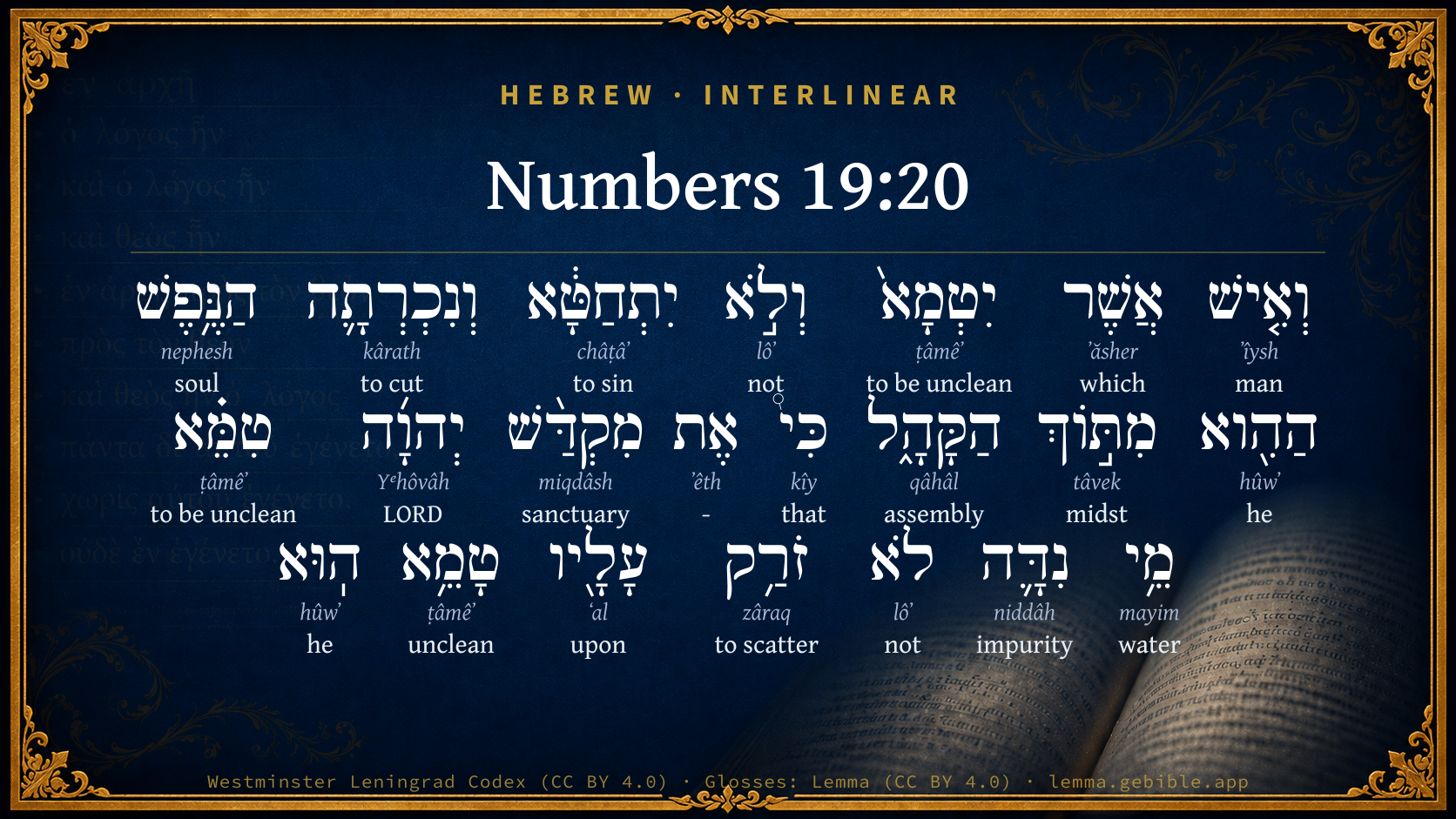
Hebrew (Westminster Leningrad Codex) Numbers 19:20 appears in the Hebrew Old Testament. The text above is from the Westminster Leningrad Codex. Each word links to its Strong’s number, a concise gloss, and parsing drawn from the Open Scriptures Hebrew Bible morphology. Click any word for its full Brown-Driver-Briggs (BDB) entry.
Download image
Cite this verse

Numbers 19:20 (World English Bible). Public Domain. Lemma interlinear Bible study tool, https://lemma.gebible.app/v/numbers/19/20.

Show BibTeX & RIS
BibTeX
RIS
English Translation
But the man who shall be unclean, and shall not purify himself, that soul shall be cut off from the midst of the assembly, because he has defiled the sanctuary of Yahweh: the water for impurity has not been sprinkled on him; he is unclean.
World English Bible · Public Domain
Download a study sheet

One document with this verse’s original text, its word-by-word gloss line, the meaning frame, cross-references with their text, attributed commentary, and full source and license credits — printable, and it pastes into notes with its structure intact.

This verse Autodidact and up

Study sheet (.html) Plain text (.txt)

A passage Seminary Student

Up to 50 verses in one chapter. A passage sheet keeps up to 6 commentary sources and 12 cross-references per verse, in the order this page ranks them, and says so on the sheet whenever that leaves anything out. Ask for a single verse and you get the Autodidact verse sheet above.

Everything on this page stays free to read, with no account — the sheet is a download of what is already on screen, not access to it.

Want to remove ads? Support Godless Engineer
Compare translations 3

The same verse in 3 English versions, stacked beneath the original-language interlinear above. Click any original word for its lexicon entry.

Each is an independent rendering of the whole verse — the interlinear is not word-aligned to these translations.

Highlighted words mark where these versions differ — a whole-verse word diff, not a word-by-word alignment.

  • World English Bible Public Domain
    But the man who shall be unclean, and shall not purify himself, that soul shall be cut off from the midst of the assembly, because he has defiled the sanctuary of Yahweh: the water for impurity has not been sprinkled on him; he is unclean.
  • King James Version Public Domain
    But the man that shall be unclean, and shall not purify himself, that soul shall be cut off from among the congregation, because he hath defiled the sanctuary of the LORD: the water of separation hath not been sprinkled upon him; he is unclean.
  • unfoldingWord Literal Text CC BY-SA 4.0
    And a man who is unclean and does not purify himself, that soul shall be cut off from the midst of the assembly, for he has made the sanctuary of Yahweh unclean. The water of impurity has not been sprinkled on him; he unclean.

unfoldingWord Literal Text — © unfoldingWord, licensed CC BY-SA 4.0. Word-aligned USFM3 via Door43 (git.door43.org/unfoldingWord/en_ult).

Versions to compare (up to 4)

3 of 4 selected

Show all 18 translations

Every available English version of this verse, each an independent rendering of the whole verse.

  • World English Bible Public Domain
    But the man who shall be unclean, and shall not purify himself, that soul shall be cut off from the midst of the assembly, because he has defiled the sanctuary of Yahweh: the water for impurity has not been sprinkled on him; he is unclean.
  • Berean Standard Bible Public Domain
    But if a person who is unclean does not purify himself, he will be cut off from the assembly, because he has defiled the sanctuary of the LORD. The water of purification has not been sprinkled on him; he is unclean.
  • Majority Standard Bible Public Domain
    But if a person who is unclean does not purify himself, he will be cut off from the assembly, because he has defiled the sanctuary of the LORD. The water of purification has not been sprinkled on him; he is unclean.
  • King James Version Public Domain
    But the man that shall be unclean, and shall not purify himself, that soul shall be cut off from among the congregation, because he hath defiled the sanctuary of the LORD: the water of separation hath not been sprinkled upon him; he is unclean.
  • American Standard Version (1901) Public Domain
    But the man that shall be unclean, and shall not purify himself, that soul shall be cut off from the midst of the assembly, because he hath defiled the sanctuary of Jehovah: the water for impurity hath not been sprinkled upon him; he is unclean.
  • Revised Version (1885) Public Domain
    But the man that shall be unclean, and shall not purify himself, that soul shall be cut off from the midst of the assembly, because he hath defiled the sanctuary of the LORD: the water of separation hath not been sprinkled upon him; he is unclean.
  • Geneva Bible (1599) Public Domain
    But the man that is vncleane and purifieth not himselfe, that person shalbe cut off from among the Congregation, because hee hath defiled the Sanctuarie of the Lord: and the sprinkling water hath not bene sprinkled vpon him: therefore shall he be vncleane.
  • Douay-Rheims (1899) Public Domain
    If any man be not expiated after this rite, his soul shall perish out of the midst of the church: because he hath profaned the sanctuary of the Lord, and was not sprinkled with the water of purification.
  • Young's Literal Translation Public Domain
    `And the man who is unclean, and doth not cleanse himself, even that person hath been cut off from the midst of the assembly; for the sanctuary of Jehovah he hath defiled; water of separation is not sprinkled upon him; he `is' unclean.
  • Literal Standard Version CC BY-SA 4.0
    And the man who is unclean and does not cleanse himself, indeed, that person has been cut off from the midst of the assembly; for he has defiled the sanctuary of YHWH; water of separation is not sprinkled on him; he [is] unclean.
  • Unlocked Literal Bible CC BY-SA 4.0
    But anyone who remains unclean, who refuses to purify himself—that person will be cut off from the community, because he has defiled Yahweh's sanctuary. The water for impurity has not been sprinkled on him; he remains unclean.
  • unfoldingWord Literal Text CC BY-SA 4.0
    And a man who is unclean and does not purify himself, that soul shall be cut off from the midst of the assembly, for he has made the sanctuary of Yahweh unclean. The water of impurity has not been sprinkled on him; he unclean.
  • Darby Bible Public Domain
    And the man that is unclean, and doth not purify himself, that soul shall be cut off from the midst of the congregation, for he hath defiled the sanctuary of Jehovah: the water of separation hath not been sprinkled on him: he is unclean.
  • World Messianic Bible Public Domain
    But the man who shall be unclean, and shall not purify himself, that soul shall be cut off from among the assembly, because he has defiled the sanctuary of the LORD. The water for impurity has not been sprinkled on him. He is unclean.
  • Webster's Bible Public Domain
    But the man that shall be unclean, and shall not purify himself, that soul shall be cut off from among the congregation, because he hath defiled the sanctuary of the LORD: the water of separation hath not been sprinkled upon him: he is unclean.
  • Free Bible Version CC BY-SA 4.0
    But if you don't purify yourself, you will be expelled from the Israelites, because you have made the Tabernacle of the Lord unclean. The water of purification hasn't been sprinkled on you, and you remain unclean.
  • Bible in Basic English Public Domain
    But the man who, being unclean, does not make himself clean in this way, will be cut off from the meeting of the people, because he has made the holy place of the Lord unclean: the water has not been put on him, he is unclean.
  • JPS Tanakh (1917) Public Domain
    But the man that shall be unclean, and shall not purify himself, that soul shall be cut off from the midst of the assembly, because he hath defiled the sanctuary of the LORD; the water of sprinkling hath not been dashed against him: he is unclean.

Literal Standard Version (2020), Covenant Press — licensed CC BY-SA 4.0. Text via the HelloAO Bible API (eBible.org). Unlocked Literal Bible (unfoldingWord) — licensed CC BY-SA 4.0. Text via the HelloAO Bible API (eBible.org). unfoldingWord Literal Text — © unfoldingWord, licensed CC BY-SA 4.0. Word-aligned USFM3 via Door43 (git.door43.org/unfoldingWord/en_ult). Free Bible Version, Dr. Jonathan Gallagher — licensed CC BY-SA 4.0. Text via the HelloAO Bible API (eBible.org).

Word by word

More ways to search: Search by grammar → Find every occurrence → Compare this word →

Practice this passage: Drill this verse → Learn its vocabulary →

נִדָּ֛ה
niddâh
H5079
“impurity”
Noun, Common, Feminine, Singular, Absolute
Part of Speech
Noun
Type
Common
Gender
Feminine
Number
Singular
State
Absolute
Full BDB Definition

Origin: from H5074

TWOT: 1302a

impurity, filthiness, menstruous, set apart - impurity - of ceremonial impurity - of menstruation - impure thing (figuratively) - of idolatry, immorality
  1. וְאִ֤ישׁ ʼîysh H376 “and · man” Conjunction + Noun, Common, Masculine, Singular, Absolute
  2. אֲשֶׁר ʼăsher H834 “which” Particle, Relative
  3. יִטְמָא֙ ṭâmêʼ H2930 “to be unclean” Verb, Qal, Imperfect, 3rd Person, Masculine, Singular
  4. וְלֹ֣א lôʼ H3808 “and · not” Conjunction + Particle, Negative
  5. יִתְחַטָּ֔א châṭâʼ H2398 “to sin” Verb, Hithpael, Imperfect, 3rd Person, Masculine, Singular
  6. וְנִכְרְתָ֛ה kârath H3772 “and · to cut” Conjunction + Verb, Niphal, Sequential Perfect, 3rd Person, Feminine, Singular
  7. הַנֶּ֥פֶשׁ nephesh H5315 “the · soul” Particle, Definite Article + Noun, Common, Both, Singular, Absolute
  8. הַהִ֖וא hûwʼ H1931 “the · he” Particle, Definite Article + Pronoun, Personal, 3rd Person, Feminine, Singular
  9. מִתּ֣וֹךְ tâvek H8432 “from · midst of” Preposition + Noun, Common, Masculine, Singular, Construct
  10. הַקָּהָ֑ל qâhâl H6951 “the · assembly” Particle, Definite Article + Noun, Common, Masculine, Singular, Absolute
  11. כִּי֩ kîy H3588 “that” Conjunction
  12. אֶת ʼêth H853 “-” Particle, Direct Object
  13. מִקְדַּ֨שׁ miqdâsh H4720 “sanctuary of” Noun, Common, Masculine, Singular, Construct
  14. יְהוָ֜ה Yᵉhôvâh H3068 “LORD” Noun, Proper
  15. טִמֵּ֗א ṭâmêʼ H2930 “to be unclean” Verb, Piel, Perfect, 3rd Person, Masculine, Singular
  16. מֵ֥י mayim H4325 “water(s) of” Noun, Common, Masculine, Plural, Construct
  17. לֹא lôʼ H3808 “not” Particle, Negative
  18. זֹרַ֥ק zâraq H2236 “to scatter” Verb, Qal Passive, Perfect, 3rd Person, Masculine, Singular
  19. עָלָ֖יו ʻal H5921 “upon · him” Preposition + Suffix, Personal, 3rd Person, Masculine, Singular
  20. טָמֵ֥א ṭâmêʼ H2931 “unclean” Adjective, Adjective, Masculine, Singular, Absolute
  21. הֽוּא hûwʼ H1931 “he” Pronoun, Personal, 3rd Person, Masculine, Singular

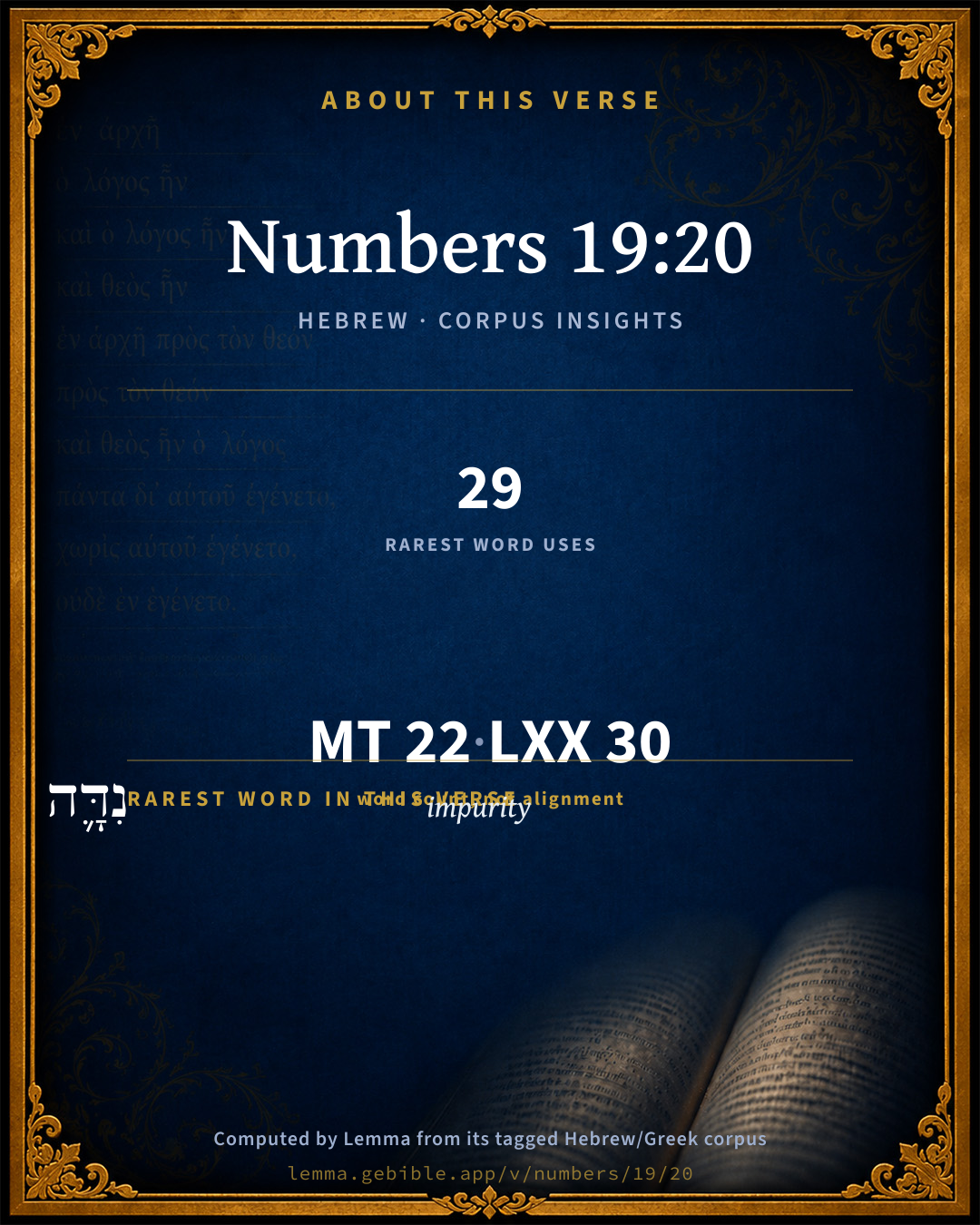
About this verse

These counts appear in no published source. They are computed here, from the morphology-tagged text and Lemma’s own curated glosses. What Lemma adds →

22
words
19
distinct lemmas
Pentateuch
section

Shared distinctive vocabulary

נִדָּ֛ה impurity H5079 occurs in 24 verses of the Hebrew Bible. Also found in:

Grammatical profile

  • 5 verbs
  • 8 nouns
  • 1 adjective
  • 2 pronouns
  • 1 preposition
  • 1 conjunction
  • 4 particles

Verb forms

  • יִטְמָא֙ Qal · Imperfect
  • יִתְחַטָּ֔א Hithpael · Imperfect
  • וְנִכְרְתָ֛ה Niphal · Sequential Perfect
  • טִמֵּ֗א Piel · Perfect
  • זֹרַ֥ק Qal Passive · Perfect

Repetition

Words recur within this verse — often emphatic in Hebrew:

  • יִטְמָא֙ to be unclean H2930 ×2
  • וְלֹ֣א not H3808 ×2
  • הַהִ֖וא he H1931 ×2

Hebrew & Septuagint length

In English translation the verse runs 45 words from the Hebrew and 47 from the Septuagint (LXX English) — closely comparable.

A rough comparison of the two English renderings, which tokenize alike — not a word-level alignment.

Word counts can differ between the Hebrew and the Greek without any difference in meaning — e.g. the Hebrew direct-object marker אֵת has no separate Greek word, and Greek often adds the article ὁ.

In the original languages it is 22 Hebrew tokens and 30 Greek tokens — but the two are counted differently (Hebrew bundles its prefixes and suffixes into one token; the Greek is in lemma form), so that isn’t a like-for-like length.

Cross-references

8

Topical passages linked to Numbers 19:20 in the Treasury of Scripture Knowledge — connected by theme and wording, ordered by reader-vote popularity; previews shown in the World English Bible.

  • Genesis 17:14 The uncircumcised male who is not circumcised in the flesh of his foreskin, that soul shall be cut off from his people. He has broken my covenant."
  • Numbers 19:13 Whoever touches a dead person, the body of a man who has died, and doesn't purifies himself, defiles the tent of Yahweh; and that soul shall be cut off from Israel: because the water for impurity was not sprinkled on him, he shall be unclean; his uncleanness is yet on him.
  • Mark 16:16 He who believes and is baptized will be saved; but he who disbelieves will be condemned.
  • Numbers 15:30 But the soul who does anything with a high hand, whether he is home-born or a foreigner, the same blasphemes Yahweh; and that soul shall be cut off from among his people.
  • Acts 13:39–41 and by him everyone who believes is justified from all things, from which you could not be justified by the law of Moses.
  • Romans 2:4–5 Or do you despise the riches of his goodness, forbearance, and patience, not knowing that the goodness of God leads you to repentance?
  • 2 Peter 3:14 Therefore, beloved, seeing that you look for these things, be diligent to be found in peace, without blemish and blameless in his sight.
  • Revelation 22:11 He who acts unjustly, let him act unjustly still. He who is filthy, let him be filthy still. He who is righteous, let him do righteousness still. He who is holy, let him be holy still."

Cross-references courtesy of OpenBible.info (CC BY 4.0).

Hebrew and Greek witnesses Masoretic Hebrew ↔ Greek Septuagint

The same verse in the two great witnesses to the Old Testament, shown verse-for-verse.

These are two independent witnesses, not word-aligned to each other, and the Septuagint is shown in lemma (dictionary) form.

Hebrew Numbers 19:20 Masoretic · Westminster Leningrad Codex

וְאִ֤ישׁ אֲשֶׁר יִטְמָא֙ וְלֹ֣א יִתְחַטָּ֔א וְנִכְרְתָ֛ה הַנֶּ֥פֶשׁ הַהִ֖וא מִתּ֣וֹךְ הַקָּהָ֑ל כִּי֩ אֶת מִקְדַּ֨שׁ יְהוָ֜ה טִמֵּ֗א מֵ֥י נִדָּ֛ה לֹא זֹרַ֥ק עָלָ֖יו טָמֵ֥א הֽוּא

But the man who shall be unclean, and shall not purify himself, that soul shall be cut off from the midst of the assembly, because he has defiled the sanctuary of Yahweh: the water for impurity has not been sprinkled on him; he is unclean.

World English Bible · Public Domain

Greek LXX Numbers 19:20 Septuagint · lemma form

καί ἄνθρωπος ὅς ἐάν μιαίνω καί μή ἀποἁγνίζω ἐκὀλεθρεύω ὁ ψυχή ἐκεῖνος ἐκ μέσος ὁ συναγωγή ὅτι ὁ ἅγιος κύριος μιαίνω ὅτι ὕδωρ ῥαντισμός οὐ περιῥαντίζω ἐπί αὐτός ἀκάθαρτος εἰμί

And whatever man shall be defiled and shall not purify himself, that soul shall be cut off from the midst of the congregation, because he has defiled the holy things of the Lord, because the water of sprinkling has not been sprinkled upon him; he is unclean.

LXX2012 (modern English Septuagint) · Public Domain

Hebrew: Westminster Leningrad Codex (CC BY 4.0). Greek: Septuagint (public domain); English from LXX2012 (modern English Septuagint) (Public Domain). How the Septuagint differs from the Hebrew →

Targum (Aramaic paraphrase)

2

The Targum is the ancient Jewish Aramaic paraphrase of the Hebrew Scriptures — an interpretive translation, not the Hebrew text itself. Onkelos (literal) and Pseudo-Jonathan (expansive) render the Torah, and Jonathan the Prophets. Coverage is partial: where no permissively-licensed English translation exists for a verse, only the Aramaic is shown. This is verse-level text, not a word-by-word alignment to the Hebrew.

  1. Targum Onkelos Torah (Genesis–Deuteronomy)
    וּגְבַר דִי יִסְתָּאֵב וְלָא יַדֵי עֲלוֹהִי וְיִשְׁתֵּיצֵי אֱנָשָׁא הַהוּא מִגוֹ קְהָלָא אֲרֵי יָת מַקְדְשָׁא דַיְיָ סָאֵיב מֵי אַדָיוּתָא לָא אִזְדְרִיקוּ עֲלוֹהִי מְסָאָבּ הוּא

    (no public-domain English translation for this verse)

    Targum Onkelos — Aramaic: “Onkelos Genesis” (public domain); “Onkelos Exodus” (public domain); “Onkelos Leviticus” (public domain); “Onkelos Numbers” (public domain); “Onkelos Deuteronomy” (public domain). English: “Sefaria Community Translation” (CC0 1.0 (public-domain dedication)); “J.W. Etheridge. The Targums of Onkelos and Jonathan Ben Uzziel on the Pentateuch. London: Longmans, Green, 1862” (public domain). Text via Sefaria.

  2. Targum Pseudo-Jonathan Torah (Genesis–Deuteronomy)
    וּגְבַר דְיִסְתָּאַב וְלָא יַדֵי עֲלוֹי וְיִשְׁתֵּיצֵי בַר נְשָׁא הַהוּא מִגוֹ קְהָלָא אֲרוּם יַת מַקְדְשָׁא דַיְיָ סָאִיב מֵי אַדְיוּתָא לָא אִזְדְרִיקוּ עֲלוֹי מְסָאָב הוּא

    But the unclean man who will not be sprinkled, that man shall be cut off from among the congregation, because he hath defiled the sanctuary of the Lord; the water of sprinkling hath not been sprinkled upon him, he is unclean.

    Targum Pseudo-Jonathan — Aramaic: “Targum Jonathan on Genesis” (public domain); “Targum Jonathan on Exodus” (public domain); “Targum Jonathan on Leviticus” (public domain); “Targum Jonathan on Numbers” (public domain); “Targum Jonathan on Deuteronomy” (public domain). English: “The Targum of Jonathan ben Uzziel, trans. J. W. Etheridge, London, 1862” (public domain). Text via Sefaria.

Commentary

Notes on Numbers 19:20 from classic Christian and Jewish commentators (each source and its license shown beneath its notes). The classic Christian expositions comment on the surrounding passage and are grouped to its opening verse, so a note may address several verses; the Jewish commentaries on the Tanakh (Rashi and others) are per-verse, so they appear only where the commentator wrote on this verse.

Lemma curates 59 commentaries, every one of them public domain or Creative Commons licensed, each selected and text-cleaned for this edition rather than reprinted as found. About our sources →

Joseph Benson's Commentary

Num 19:20-21. That shall not purify himself — Shall contemptuously refuse to submit to this way of purification. Shall wash his clothes — Because he is unclean. It is strange, that the same water should cleanse one person, and defile another. But God would have it so, to teach us that it did not cleanse by any virtue in itself, or in the work done, but only by virtue of God’s appointment; and to show that the efficacy of God’s ordinances doth not depend upon the person or quality of his ministers, because the same person who was polluted himself could and did, in the use of God’s appointed means, cleanse others. He that toucheth the water — Either by sprinkling of it, or by being sprinkled with it; for even he that was cleansed by it was not fully cleansed as soon as he was sprinkled, but only at the even of that day.

Joseph Benson's Commentary on the Old and New Testaments (1811–1818) — public domain. Text from a community e-Sword module.

John Gill's Exposition

But the man that shall be unclean,.... By touching any dead body, bone, or grave:

and shall not purify himself; with the water of purification:

that soul shall be cut off from among the congregation: See Gill on Num 19:13.

because he hath defiled the sanctuary of the Lord: by going into it in his uncleanness:

the water of separation hath not been sprinkled upon him, he is unclean; and will remain so, for nothing else could purify him, see Num 19:13.

John Gill's Exposition of the Whole Bible (1746–1763) — public domain (CC PDM 1.0). Text via the HelloAO Bible API.

Haydock's Catholic Bible Commentary

Church, or assembly of the people. (Haydock) --- He shall be put to death by the judges, or by God. (Menochius)

George Leo Haydock (1774–1849), Haydock's Catholic Family Bible and Commentary, 1859 edition — public domain. Excludes Psalms (Douay-Rheims chapter numbering differs from Protestant) and Deuterocanonical books (Catholic canon only).

Matthew Poole's English Annotations

Shall not purify himself, i.e, shall contemptuously refuse to submit to this way of purification.

Matthew Poole's English Annotations on the Holy Bible (1683–1685) — public domain. Text from a community e-Sword/MySword module.

Whedon's Commentary on the Bible

Daniel D. Whedon

20. Shall be cut off — See Lev_7:20. This is an emphatic repetition of the threatening in Num_19:13. See note.

Daniel D. Whedon (gen. ed.), Commentary on the Old and New Testaments (1874–1909) — public domain. Text from a community e-Sword module.

John Wesley's Explanatory Notes

That shall not purify himself - Shall contemptuously refuse to submit to this way of purification.

John Wesley, Explanatory Notes Upon the Whole Bible (1754–1765) — public domain. Text via the GEBible commentary corpus.

unfoldingWord translationNotes

Door43 World Missions Community

General Information:

The ideas of "clean" and "purify" represent being acceptable to God. (See: Metaphor)

General Information:

The ideas of "unclean," "defile," and "impurity," represent not being acceptable to God. (See: Metaphor)

that person will be cut off

Here the phrase "be cut off" means to be disowned and sent away. See how you translated this in Numbers 9:13. AT: "That person must be sent away" or "you must send that person away" (See: Metaphor and Active or Passive)

The water for impurity has not been sprinkled on him

This can be stated in active form. AT: "No one has sprinkled the water for impurity on him" (See: Active or Passive)

the water for impurity

"the water that is sprinkled on impure things to make them pure" or "the water for making things pure." See how you translated this in Numbers 19:13

translationWords

cut off

defile

Yahweh

sanctuary

law, laws

unfoldingWord translationNotes — © Distant Shores Media and the Door43 World Missions Community, licensed CC BY-SA 4.0. Source: git.door43.org/Door43/en_tn.

Rashi

Rabbi Shlomo Yitzchaki (Rashi)

ואיש אשר יטמא וגו׳ AND THE MAN THAT IS UNCLEAN [AND DOES NOT PURIFY HIMSELF … HATH DEFILED THE SANCTUARY OF THE LORD] — If the Sanctuary is mentioned why is the Tabernacle also mentioned (in v. 13 “he hath defiled the Tabernacle of the Lord”)? etc., as is set forth in Treatise Shevuot 16b.

Rashi on the Tanakh — English translations: “The Judaica Press complete Tanach with Rashi, translated by A. J. Rosenberg” (CC BY 4.0); “Pentateuch with Rashi's commentary by M. Rosenbaum and A.M. Silbermann, 1929-1934” (public domain); “The Metsudah Tanach series, Lakewood, N.J” (CC BY 4.0); and “The Book of Joshua, Metsudah Publications, 1997” (CC BY 4.0). Text via Sefaria.

Ramban (Nachmanides)

Rabbi Moshe ben Nachman (Ramban / Nachmanides)

HE HATH DEFILED THE SANCTUARY OF THE ETERNAL. Scripture mentioned this [punishment of] excision without explanation, that one who is impure may not enter the Sanctuary or Tabernacle. saying, he hath defiled the Tabernacle of the Eternal, (Tabernacle), and the same law applies of course to the mikdash (Sanctuary), mentioned here in Verse 20. Ramban here uses the terms interchangeably; and later on explains why the law is mentioned twice. because He had already warned us against defiling the Sanctuary, just as He said, she shall touch no hallowed thing, nor come into the Sanctuary. For since He mentioned [this prohibition] there in dealing with a lesser degree of impurity, namely, that of a woman after childbirth in the days of her purification, which is a natural event for her, it [is self-understood that it] applies equally to all impure persons. He has also mentioned the [requirement of] immersion [in a ritual pool for purposes of purification], saying, but if he wash them not [i.e., the garments which have become unclean], nor bathe his flesh, then he shall bear his iniquity, 17:16. that is to say, he will bear his iniquity if he transgresses [the law and does] that which he is admonished not to do [i.e., if he eats holy food or enters the Sanctuary whilst he is still impure, or when he is wearing impure garments]. Therefore He stated here in respect of the impurity [conveyed] by a corpse that whosoever touches the dead (Tabernacle), and the same law applies of course to the mikdash (Sanctuary), mentioned here in Verse 20. Ramban here uses the terms interchangeably; and later on explains why the law is mentioned twice. and purifieth not himself [with the waters of purification], even though he washes his clothes and bathes himself in water, is [nonetheless] considered one who defiles the Tabernacle, just as if he had not immersed himself [in a ritual pool] at all. Thus it was only necessary to mention that the purification [by means of sprinkling the waters of purification] prevents him from becoming pure [if he did not sprinkle them upon himself, even if he washed his clothes and bathed himself in water], this being the meaning of the expression, his impurity is yet upon him, (Tabernacle), and the same law applies of course to the mikdash (Sanctuary), mentioned here in Verse 20. Ramban here uses the terms interchangeably; and later on explains why the law is mentioned twice. that is to say, even though he has immersed himself [in a ritual pool] like all other impure people, he still remains impure, because the water of sprinkling hath not been sprinkled upon him. (Tabernacle), and the same law applies of course to the mikdash (Sanctuary), mentioned here in Verse 20. Ramban here uses the terms interchangeably; and later on explains why the law is mentioned twice.It is possible that the verse is referring to the man [mentioned above, who had become defiled by the corpse], and the meaning thereof is as follows: “whosoever toucheth the dead, even the body of any man that is dead, and purifieth not himself — ‘he who’ hath defiled the Tabernacle of the Eternal shall be cut off from Israel.” There are similar cases where the letter shin or the word asher [defining the nature of a relationship such as: who, which, that, etc.] is missing, [as in the following verses]: l’chol yavo g’vurathecha [which is to be understood as: l’chol — asher — yavo g’vurathecha — Thy might to every one ‘that’ is to come]; v’chol yesh lo (and all he had) he put into his hand [which is to be understood as: v’chol — asher — yesh lo — and all ‘that’ he had he put into his hand]; eth haderech yeilchu bah [which is understood as: eth haderech — asher — yeilchu bah — the way ‘in which’ they must walk]. There are many such verses. And the meaning of the expression ‘ki’ he hath defiled the Sanctuary of the Eternal is “‘when’ he has defiled the Sanctuary of the Eternal,” [this usage of the word ki being similar to that found in the verse]: ‘ki’ a bird’s nest chance to be before thee [which means: “‘when’ a bird’s nest chance to be before thee”], and [it is like] its many companion-verses.Now Scripture mentions here [the punishment of] excision twice [once in Verse 13 in connection with defiling the Tabernacle, and again in Verse 20 in connection with the Sanctuary]. In the opinion of our Rabbis this is in order to declare him liable for defiling the Tabernacle of the Tent of Meeting, and also for the Sanctuary, i.e., the Permanent House [the Temple in Jerusalem]. According to the plain meaning [of Scripture] it may be that eth mikdash Hashem [usually translated: the Sanctuary of the Eternal] refers to the holy offerings. For He had already declared that he that eateth of the flesh of the sacrifice of peace-offerings, which pertain unto the Eternal, having his impurity upon him, is liable to excision; therefore He now declared furthermore that [in the case of impurity conveyed through a corpse] even if [the impure person] immerses himself [in a ritual pool] he is still liable [to that punishment], if he does not purify himself on the third and seventh day [with the waters of purification, before he eats of the holy offerings]. The meaning, then, of mikdash Hashem [literally: the “Sanctuary” of the Eternal] will be [as if it said]: kod’shei Hashem (the “holy things” of the Eternal), as in the expression eth mik’dsho mimenu [literally: “the Sanctuary thereof,” which really means: eth kodsho mimenu — “the hallowed part thereof”]. Thus the [punishment of] excision mentioned in [this] section refers to [entering] the Sanctuary [whilst impure, as stated above in Verse 13], and [eating] its hallowed offerings [in such a state, as mentioned in this verse here].The correct interpretation appears to me to be that [implied] by the literal meaning [of Scripture], namely that the first [mention of] excision [in Verse 13] refers to one who [actually] touches the corpse, as He said, Whosoever toucheth the dead, even the body of any man that is dead, and the second [mention thereof, i.e., in Verse 20 here] applies to those who were rendered impure by ohel but did not [actually] touch the bone or the grave; for the meaning of [the expression] but the man that shall be unclean, and shall not purify himself is: “but the man that shall be unclean by any of these means [mentioned in Verses 14-16] and shall not purify himself, [that soul shall be cut off from the midst of the assembly].” By way of the Truth [the mystic teachings of the Cabala], it is possible that the expression mikdash Hashem is alluding to the Sanctuary of the Sanctuary.

Ramban (Nachmanides) on the Tanakh — English translation: “Commentary on the Torah by Ramban (Nachmanides). Translated and annotated by Charles B. Chavel. New York, Shilo Pub. House, 1971-1976” (CC BY 4.0). Text via Sefaria.

Lesson kit

Teaching starters — assembled from the data on this page, not authored interpretation. Every prompt links to the verse data it draws on. Edit before teaching.

Numbers, in the Pentateuch, opens this verse with 22 words (19 distinct Hebrew lemmas). Its most distinctive word is niddâh (“impurity”). A historical commentator’s framing appears above. Read the whole chapter for the surrounding context.

Discussion questions

  1. How does “impurity” (niddâh) shape what this verse is saying?
  2. Leviticus 12:2 shares the word «impurity» with this verse. How do the two illuminate each other?
  3. “to be unclean” occurs 2× in this one verse. What is the effect of the repetition?
  4. These translations render this verse differently; the difference is in the English rendering, not the original. What questions does that raise?
  5. The verb «יִטְמָא֙» is Qal Imperfect. How does its form color the action?
  6. Reading how Joseph Benson's Commentary and John Gill's Exposition read this verse, where do the two commentators agree and where do they part?

Things to notice

Reading settings

Reading text

Shown beneath each verse's original-language words.

Old Testament
Old Testament edition

Read the OT as the Masoretic Hebrew (MT) or the Greek Septuagint (LXX).

English shown for the Greek Septuagint (in the Hebrew ↔ Greek comparison).

Comparing translations? Open the Compare panel on any verse page to stack up to four side by side.