
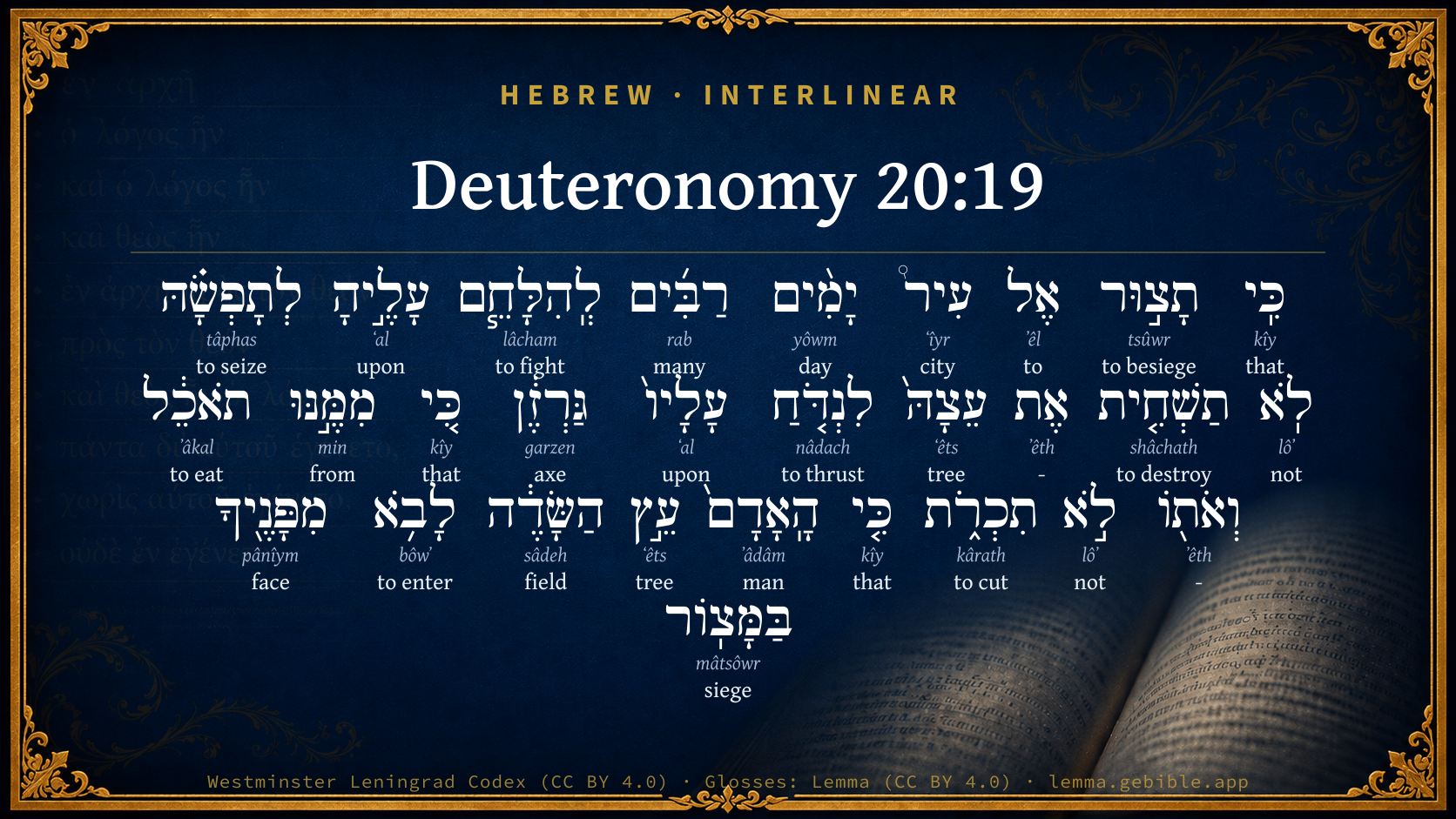
Deuteronomy 20:19

Hebrew (Westminster Leningrad Codex) Deuteronomy 20:19 appears in the Hebrew Old Testament. The text above is from the Westminster Leningrad Codex. Each word links to its Strong’s number, a concise gloss, and parsing drawn from the Open Scriptures Hebrew Bible morphology. Click any word for its full Brown-Driver-Briggs (BDB) entry.
Download image
Cite this verse

Deuteronomy 20:19 (World English Bible). Public Domain. Lemma interlinear Bible study tool, https://lemma.gebible.app/v/deuteronomy/20/19.

Show BibTeX & RIS
BibTeX
RIS
English Translation
When you shall besiege a city a long time, in making war against it to take it, you shall not destroy the trees of it by wielding an axe against them; for you may eat of them, and you shall not cut them down; for is the tree of the field man, that it should be besieged of you?
World English Bible · Public Domain
Highlights
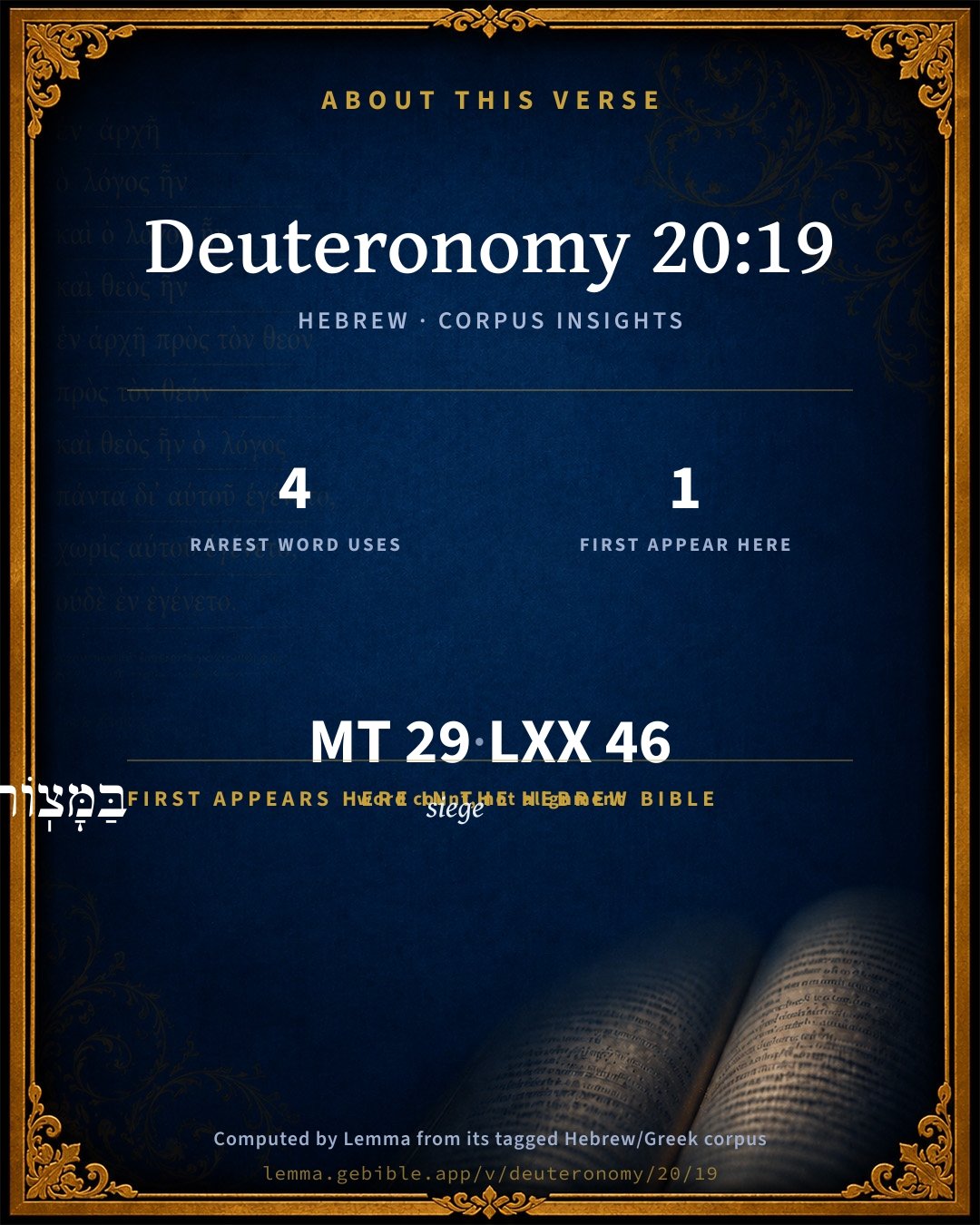
  • 1 first appearance in the Hebrew Bible
Full analysis ↓
Download a study sheet

One document with this verse’s original text, its word-by-word gloss line, the meaning frame, cross-references with their text, attributed commentary, and full source and license credits — printable, and it pastes into notes with its structure intact.

This verse Autodidact and up

Study sheet (.html) Plain text (.txt)

A passage Seminary Student

Up to 50 verses in one chapter. A passage sheet keeps up to 6 commentary sources and 12 cross-references per verse, in the order this page ranks them, and says so on the sheet whenever that leaves anything out. Ask for a single verse and you get the Autodidact verse sheet above.

Everything on this page stays free to read, with no account — the sheet is a download of what is already on screen, not access to it.

Want to remove ads? Support Godless Engineer
Compare translations 3

The same verse in 3 English versions, stacked beneath the original-language interlinear above. Click any original word for its lexicon entry.

Each is an independent rendering of the whole verse — the interlinear is not word-aligned to these translations.

Highlighted words mark where these versions differ — a whole-verse word diff, not a word-by-word alignment.

  • World English Bible Public Domain
    When you shall besiege a city a long time, in making war against it to take it, you shall not destroy the trees of it by wielding an axe against them; for you may eat of them, and you shall not cut them down; for is the tree of the field man, that it should be besieged of you?
  • King James Version Public Domain
    When thou shalt besiege a city a long time, in making war against it to take it, thou shalt not destroy the trees thereof by forcing an axe against them: for thou mayest eat of them, and thou shalt not cut them down (for the tree of the field is man's life) to employ them in the siege:
  • unfoldingWord Literal Text CC BY-SA 4.0
    When you lay siege to a city many days, battling against it to capture it, you shall not destroy its trees by wielding an ax against it, for you shall eat from them, and you shall not cut them down. For is the tree of the field a man to come from your face in the siege?

unfoldingWord Literal Text — © unfoldingWord, licensed CC BY-SA 4.0. Word-aligned USFM3 via Door43 (git.door43.org/unfoldingWord/en_ult).

Versions to compare (up to 4)

3 of 4 selected

Show all 18 translations

Every available English version of this verse, each an independent rendering of the whole verse.

  • World English Bible Public Domain
    When you shall besiege a city a long time, in making war against it to take it, you shall not destroy the trees of it by wielding an axe against them; for you may eat of them, and you shall not cut them down; for is the tree of the field man, that it should be besieged of you?
  • Berean Standard Bible Public Domain
    When you lay siege to a city for an extended time while fighting against it to capture it, you must not destroy its trees by putting an axe to them, because you can eat their fruit. You must not cut them down. Are the trees of the field human, that you should besiege them?
  • Majority Standard Bible Public Domain
    When you lay siege to a city for an extended time while fighting against it to capture it, you must not destroy its trees by putting an axe to them, because you can eat their fruit. You must not cut them down. Are the trees of the field human, that you should besiege them?
  • King James Version Public Domain
    When thou shalt besiege a city a long time, in making war against it to take it, thou shalt not destroy the trees thereof by forcing an axe against them: for thou mayest eat of them, and thou shalt not cut them down (for the tree of the field is man's life) to employ them in the siege:
  • American Standard Version (1901) Public Domain
    When thou shalt besiege a city a long time, in making war against it to take it, thou shalt not destroy the trees thereof by wielding an axe against them; for thou mayest eat of them, and thou shalt not cut them down; for is the tree of the field man, that it should be besieged of thee?
  • Revised Version (1885) Public Domain
    When thou shalt besiege a city a long time, in making war against it to take it, thou shalt not destroy the trees thereof by wielding an axe against them; for thou mayest eat of them, and thou shalt not cut them down; for is the tree of the field man, that it should be besieged of thee?
  • Geneva Bible (1599) Public Domain
    When thou hast besieged a citie long time, and made warre against it to take it, destroy not the trees therof, by smiting an axe into them: for thou mayest eate of them: therfore thou shalt not cut them downe to further thee in the siege, (for the tree of the field is mans life)
  • Douay-Rheims (1899) Public Domain
    When thou hast besieged a city a long time, and hath compassed it with bulwarks to take it, thou shalt not cut down the trees that may be eaten of, neither shalt thou spoil the country round about with axes: for it is a tree, and not a man, neither can it increase the number of them that fight against thee.
  • Young's Literal Translation Public Domain
    `When thou layest siege unto a city many days, to fight against it, to capture it, thou dost not destroy its trees to force an axe against them, for of them thou dost eat, and them thou dost not cut down -- for man's `is' the tree of the field -- to go in at thy presence in the siege.
  • Literal Standard Version CC BY-SA 4.0
    When you lay siege to a city [for] many days to fight against it, to capture it, you do not destroy its trees to force an axe against them, for you eat of them, and you do not cut them down—for the tree of the field [is] man’s—to go in at your presence in the siege.
  • Unlocked Literal Bible CC BY-SA 4.0
    When you will besiege a city for a long time, as you wage war against it to capture it, you must not destroy its trees by wielding an ax against them. For you may eat from them, so you must not cut them down. For is the tree of the field a man whom you should besiege?
  • unfoldingWord Literal Text CC BY-SA 4.0
    When you lay siege to a city many days, battling against it to capture it, you shall not destroy its trees by wielding an ax against it, for you shall eat from them, and you shall not cut them down. For is the tree of the field a man to come from your face in the siege?
  • Darby Bible Public Domain
    When thou shalt besiege a city many days, in making war against it to take it, thou shalt not destroy the trees thereof by lifting up an axe against them; for thou canst eat of them; and thou shalt not cut them down, for is the tree of the field a man that it should be besieged?
  • World Messianic Bible Public Domain
    When you shall besiege a city a long time, in making war against it to take it, you shall not destroy its trees by wielding an ax against them; for you may eat of them. You shall not cut them down, for is the tree of the field man, that it should be besieged by you?
  • Webster's Bible Public Domain
    When thou shalt besiege a city a long time in making war against it to take it, thou shalt not destroy the trees of it by forcing an ax against them; for thou mayest eat of them: and thou shalt not cut them down (for the tree of the field is man's life) to employ them in the siege:
  • Free Bible Version CC BY-SA 4.0
    Now when you lay siege to a town and it goes on for a long time as you fight to capture it, don't destroy the fruit trees there. You can eat their fruit. Don't cut them down. Are the trees in the orchard human beings that you should also attack?
  • Bible in Basic English Public Domain
    If in war a town is shut in by your armies for a long time, do not let its trees be cut down and made waste; for their fruit will be your food; are the trees of the countryside men for you to take up arms against them?
  • JPS Tanakh (1917) Public Domain
    When thou shalt besiege a city a long time, in making war against it to take it, thou shalt not destroy the trees thereof by wielding an axe against them; for thou mayest eat of them, but thou shalt not cut them down; for is the tree of the field man, that it should be besieged of thee?

Literal Standard Version (2020), Covenant Press — licensed CC BY-SA 4.0. Text via the HelloAO Bible API (eBible.org). Unlocked Literal Bible (unfoldingWord) — licensed CC BY-SA 4.0. Text via the HelloAO Bible API (eBible.org). unfoldingWord Literal Text — © unfoldingWord, licensed CC BY-SA 4.0. Word-aligned USFM3 via Door43 (git.door43.org/unfoldingWord/en_ult). Free Bible Version, Dr. Jonathan Gallagher — licensed CC BY-SA 4.0. Text via the HelloAO Bible API (eBible.org).

Word by word

More ways to search: Search by grammar → Find every occurrence → Compare this word →

Practice this passage: Drill this verse → Learn its vocabulary →

גַּרְזֶ֔ן
garzen
H1631
“axe”
Noun, Common, Masculine, Singular, Absolute
Part of Speech
Noun
Type
Common
Gender
Masculine
Number
Singular
State
Absolute
Full BDB Definition

Origin: from H1629

TWOT: 379a

axe
  1. כִּֽי kîy H3588 “that” Conjunction
  2. תָצ֣וּר tsûwr H6696 “to besiege” Verb, Qal, Imperfect, 2nd Person, Masculine, Singular
  3. אֶל ʼêl H413 “to” Preposition
  4. עִיר֩ ʻîyr H5892 “city” Noun, Common, Feminine, Singular, Absolute
  5. יָמִ֨ים yôwm H3117 “days” Noun, Common, Masculine, Plural, Absolute
  6. רַבִּ֜ים rab H7227 “many” Adjective, Adjective, Masculine, Plural, Absolute
  7. לְֽהִלָּחֵ֧ם lâcham H3898 “to fight” Preposition + Verb, Niphal, Infinitive Construct
  8. עָלֶ֣יהָ ʻal H5921 “upon · her” Preposition + Suffix, Personal, 3rd Person, Feminine, Singular
  9. לְתָפְשָׂ֗הּ tâphas H8610 “to seize · her” Preposition + Verb, Qal, Infinitive Construct + Suffix, Personal, 3rd Person, Feminine, Singular
  10. לֹֽא lôʼ H3808 “not” Particle, Negative
  11. תַשְׁחִ֤ית shâchath H7843 “to destroy” Verb, Hiphil, Imperfect, 2nd Person, Masculine, Singular
  12. אֶת ʼêth H853 “-” Particle, Direct Object
  13. עֵצָהּ֙ ʻêts H6086 “tree · her” Noun, Common, Masculine, Singular, Construct + Suffix, Personal, 3rd Person, Feminine, Singular
  14. לִנְדֹּ֤חַ nâdach H5080 “to thrust” Preposition + Verb, Qal, Infinitive Construct
  15. עָלָיו֙ ʻal H5921 “upon · him” Preposition + Suffix, Personal, 3rd Person, Masculine, Singular
  16. כִּ֚י kîy H3588 “that” Conjunction
  17. מִמֶּ֣נּוּ min H4480 “from · us” Preposition + Suffix, Personal, 1st Person, Common, Plural
  18. תֹאכֵ֔ל ʼâkal H398 “to eat” Verb, Qal, Imperfect, 2nd Person, Masculine, Singular
  19. וְאֹת֖וֹ ʼêth H853 “and · - · him” Conjunction + Particle, Direct Object + Suffix, Personal, 3rd Person, Masculine, Singular
  20. לֹ֣א lôʼ H3808 “not” Particle, Negative
  21. תִכְרֹ֑ת kârath H3772 “to cut” Verb, Qal, Imperfect, 2nd Person, Masculine, Singular
  22. כִּ֤י kîy H3588 “that” Conjunction
  23. הָֽאָדָם֙ ʼâdâm H120 “man” Particle, Interrogative + Noun, Common, Masculine, Singular, Absolute
  24. עֵ֣ץ ʻêts H6086 “tree of” Noun, Common, Masculine, Singular, Construct
  25. הַשָּׂדֶ֔ה sâdeh H7704 “the · field” Particle, Definite Article + Noun, Common, Masculine, Singular, Absolute
  26. לָבֹ֥א bôwʼ H935 “to enter” Preposition + Verb, Qal, Infinitive Construct
  27. מִפָּנֶ֖יךָ pânîym H6440 “from · face(s) · your” Preposition + Noun, Common, Both, Plural, Construct + Suffix, Personal, 2nd Person, Masculine, Singular
  28. בַּמָּצֽוֹר mâtsôwr H4692 “in/at the · siege” Preposition, Determined + Noun, Common, Masculine, Singular, Absolute

About this verse

These counts appear in no published source. They are computed here, from the morphology-tagged text and Lemma’s own curated glosses. What Lemma adds →

29
words
23
distinct lemmas
Pentateuch
section

Notable vocabulary

The rarest word here is גַּרְזֶ֔ן axe H1631 — appearing just 4 times in the whole Hebrew Bible.

First appearance in Scripture

This word makes its first canonical appearance in the Hebrew Bible here:

  • בַּמָּצֽוֹר siege H4692

Shared distinctive vocabulary

גַּרְזֶ֔ן axe H1631 occurs in 4 verses of the Hebrew Bible. Also found in:

Grammatical profile

  • 8 verbs
  • 9 nouns
  • 1 adjective
  • 4 prepositions
  • 3 conjunctions
  • 4 particles

Verb forms

  • תָצ֣וּר Qal · Imperfect
  • לְֽהִלָּחֵ֧ם Niphal · Infinitive Construct
  • לְתָפְשָׂ֗הּ Qal · Infinitive Construct
  • תַשְׁחִ֤ית Hiphil · Imperfect
  • לִנְדֹּ֤חַ Qal · Infinitive Construct
  • תֹאכֵ֔ל Qal · Imperfect
  • תִכְרֹ֑ת Qal · Imperfect
  • לָבֹ֥א Qal · Infinitive Construct

Repetition

Words recur within this verse — often emphatic in Hebrew:

  • עָלֶ֣יהָ upon H5921 ×2
  • עֵצָהּ֙ tree H6086 ×2
  • כִּֽי that H3588 ×3
  • לֹֽא not H3808 ×2

Hebrew & Septuagint length

In English translation the verse runs 59 words from the Hebrew and 63 from the Septuagint (LXX English) — closely comparable.

A rough comparison of the two English renderings, which tokenize alike — not a word-level alignment.

Word counts can differ between the Hebrew and the Greek without any difference in meaning — e.g. the Hebrew direct-object marker אֵת has no separate Greek word, and Greek often adds the article ὁ.

In the original languages it is 29 Hebrew tokens and 46 Greek tokens — but the two are counted differently (Hebrew bundles its prefixes and suffixes into one token; the Greek is in lemma form), so that isn’t a like-for-like length.

Cross-references

6

Topical passages linked to Deuteronomy 20:19 in the Treasury of Scripture Knowledge — connected by theme and wording, ordered by reader-vote popularity; previews shown in the World English Bible.

  • Matthew 3:10 "Even now the axe lies at the root of the trees. Therefore, every tree that doesn't bring forth good fruit is cut down, and cast into the fire.
  • Matthew 21:19 Seeing a fig tree by the road, he came to it, and found nothing on it but leaves. He said to it, "Let there be no fruit from you forever!" Immediately the fig tree withered away.
  • Deuteronomy 26:6 The Egyptians dealt ill with us, and afflicted us, and laid on us hard bondage:
  • Matthew 7:15–20 "Beware of false prophets, who come to you in sheep's clothing, but inwardly are ravening wolves.
  • Luke 13:7–9 He said to the vine dresser, 'Behold, these three years I have come looking for fruit on this fig tree, and found none. Cut it down. Why does it waste the soil?'
  • John 15:2–8 Every branch in me that doesn't bear fruit, he takes away. Every branch that bears fruit, he prunes, that it may bear more fruit.

Cross-references courtesy of OpenBible.info (CC BY 4.0).

Hebrew and Greek witnesses Masoretic Hebrew ↔ Greek Septuagint

The same verse in the two great witnesses to the Old Testament, shown verse-for-verse.

These are two independent witnesses, not word-aligned to each other, and the Septuagint is shown in lemma (dictionary) form.

Hebrew Deuteronomy 20:19 Masoretic · Westminster Leningrad Codex

כִּֽי תָצ֣וּר אֶל עִיר֩ יָמִ֨ים רַבִּ֜ים לְֽהִלָּחֵ֧ם עָלֶ֣יהָ לְתָפְשָׂ֗הּ לֹֽא תַשְׁחִ֤ית אֶת עֵצָהּ֙ לִנְדֹּ֤חַ עָלָיו֙ גַּרְזֶ֔ן כִּ֚י מִמֶּ֣נּוּ תֹאכֵ֔ל וְאֹת֖וֹ לֹ֣א תִכְרֹ֑ת כִּ֤י הָֽאָדָם֙ עֵ֣ץ הַשָּׂדֶ֔ה לָבֹ֥א מִפָּנֶ֖יךָ בַּמָּצֽוֹר

When you shall besiege a city a long time, in making war against it to take it, you shall not destroy the trees of it by wielding an axe against them; for you may eat of them, and you shall not cut them down; for is the tree of the field man, that it should be besieged of you?

World English Bible · Public Domain

Greek LXX Deuteronomy 20:19 Septuagint · lemma form

ἐάν δέ περι καταἵζω περί πόλις ἡμέρα πολύς ἐκπολεμέω αὐτός εἰς κατάληψις αὐτός οὐ ἐκὀλεθρεύω ὁ δένδρον αὐτός ἐπιβάλλω ἐπί αὐτός σίδηρος ἀλλά ἤ ἀπό αὐτός ἐσθίω αὐτός δέ οὐ ἐκκόπτω μή ἄνθρωπος ὁ ξύλον ὁ ἐν ὁ ἀγρός εἰςἔρχομαι ἀπό πρόσωπον σύ εἰς ὁ χάραξ

And if you should besiege a city many days to prevail against it by war to take it, you shall not destroy its trees, by applying an iron tool to them, but you shall eat of it, and shall not cut it down: Is the tree that is in the field a man, to enter before you into the work of the siege?

LXX2012 (modern English Septuagint) · Public Domain

On this verse, The Cambridge Bible for Schools and Colleges discusses the Septuagint’s reading. Read the note in Commentary ↓

Hebrew: Westminster Leningrad Codex (CC BY 4.0). Greek: Septuagint (public domain); English from LXX2012 (modern English Septuagint) (Public Domain). How the Septuagint differs from the Hebrew →

Targum (Aramaic paraphrase)

2

The Targum is the ancient Jewish Aramaic paraphrase of the Hebrew Scriptures — an interpretive translation, not the Hebrew text itself. Onkelos (literal) and Pseudo-Jonathan (expansive) render the Torah, and Jonathan the Prophets. Coverage is partial: where no permissively-licensed English translation exists for a verse, only the Aramaic is shown. This is verse-level text, not a word-by-word alignment to the Hebrew.

  1. Targum Onkelos Torah (Genesis–Deuteronomy)
    אֲרֵי תְצוּר לְקַרְתָּא יוֹמִין סַגִיאִין לַאֲגָחָא עֲלַהּ לְמִכְבְּשַׁהּ לָא תְחַבֵּל יָת אִילָנַהּ לַאֲרָמָא עֲלוֹהִי פַּרְזְלָא אֲרֵי מִנֵה תֵּיכוּל וְיָתֵהּ לָא תְקוּץ אֲרֵי לָא כַאֲנָשָׁא אִילַן חַקְלָא לְמֵיעַל מְקָדָמָךְ בִּצְיָרָא

    (no public-domain English translation for this verse)

    Targum Onkelos — Aramaic: “Onkelos Genesis” (public domain); “Onkelos Exodus” (public domain); “Onkelos Leviticus” (public domain); “Onkelos Numbers” (public domain); “Onkelos Deuteronomy” (public domain). English: “Sefaria Community Translation” (CC0 1.0 (public-domain dedication)); “J.W. Etheridge. The Targums of Onkelos and Jonathan Ben Uzziel on the Pentateuch. London: Longmans, Green, 1862” (public domain). Text via Sefaria.

  2. Targum Pseudo-Jonathan Torah (Genesis–Deuteronomy)
    אֲרוּם תַּקְפוּן עַל קַרְתָּא כָּל יוֹמֵי שִׁבְעֲתָא לְאַגָּחָא קְרָבָא עֲלָהּ לְמִכְבְּשָׁהּ בְּשַׁבַּתָּא לָא תְחַבְּלוּן יַת אִילָנַיָהָא לְמֵישְׁדָא עֲלוֹי מָן דְּפַרְזְלָא אֲרוּם מִפֵּירוֹי תֵיכְלוּן וְיָתֵיהּ לָא תְקוּצוּן אֲרוּם לָא בְּבַר נַשׁ אִילָן דְּאַנְפֵּי בָרָא לִמְטַמְרָא מִקָּמֵיכוֹן בִּצְיָירָא

    When you beleaguer a city all the seven days to war against it, to subdue it on the Sabbath, you shall not destroy the trees thereof by bringing against them (an instrument of) iron; that you may eat its fruit, cut it not down; for a tree on the face of the field is not as a man to be hidden (put out of sight) before you in the siege.

    Targum Pseudo-Jonathan — Aramaic: “Targum Jonathan on Genesis” (public domain); “Targum Jonathan on Exodus” (public domain); “Targum Jonathan on Leviticus” (public domain); “Targum Jonathan on Numbers” (public domain); “Targum Jonathan on Deuteronomy” (public domain). English: “The Targum of Jonathan ben Uzziel, trans. J. W. Etheridge, London, 1862” (public domain). Text via Sefaria.

Commentary

Notes on Deuteronomy 20:19 from classic Christian and Jewish commentators (each source and its license shown beneath its notes). The classic Christian expositions comment on the surrounding passage and are grouped to its opening verse, so a note may address several verses; the Jewish commentaries on the Tanakh (Rashi and others) are per-verse, so they appear only where the commentator wrote on this verse.

Lemma curates 59 commentaries, every one of them public domain or Creative Commons licensed, each selected and text-cleaned for this edition rather than reprinted as found. About our sources →

The Cambridge Bible for Schools and Colleges

gen. ed. J. J. S. Perowne

19. besiege … a long time] From this and build bulwarks in Deu_20:19, we see that Israel were already familiar with siege-operations and did not depend on carrying a city by immediate storm, as the nomad Semites were obliged to do or retire.

in making war against it to take it] Curiously redundant.

by wielding an axe against them] The vb as in Deu_19:5.

for thou mayest] Or, but. Even here a utilitarian reason is given.

for is the tree of the field man …?] or human. So according to LXX and other versions. The Heb. pointing, which omits the interrogative, gives no sense.

that it should be besieged of thee] Lit. that it should come into siege before thee: the technical phrase, 2Ki_24:10; 2Ki_25:2. Cp. our state of siege.

The Cambridge Bible for Schools and Colleges (gen. ed. J. J. S. Perowne; Cambridge University Press, 1878–1918) — public domain. Text from a community e-Sword module.

Trapp's Complete Commentary

John Trapp

Deu 20:19 When thou shalt besiege a city a long time, in making war against it to take it, thou shalt not destroy the trees thereof by forcing an axe against them: for thou mayest eat of them, and thou shalt not cut them down (for the tree of the field [is] man’s [life]) to employ [them] in the siege:

Ver. 19. Thou shalt not cut them down.] Fruit trees might not be destroyed. Doth God take care for trees? It was to teach us, that if we bring forth fruit fit for God’s taste and relish, sanctifying God and Christ in our hearts, we shall not be destroyed. Oaks bring forth apples, such as they are, and acorns, but not fit for meat.

John Trapp, A Commentary or Exposition upon All the Books of the Old and New Testament (1647–1656) — public domain. Text from a community e-Sword module.

The Biblical Illustrator

Joseph S. Exell

Deu_20:19

Thou shalt not destroy the trees.

Cutting down fruit trees

It will be observed that this instruction is given to the Jews in the event of their going to war against any city. No question of mere horticulture arises in connection with this injunction. It is wantonness that is forbidden; it is not art that is decried. Trees that did not bear fruit were of course available for war, but trees that could be used for purposes of sustaining human life were to be regarded as in a sense sacred and inviolable. A prohibition of this kind is charged with lofty moral significance. When men go to war they are in hot blood; everything seems to go down before the determination to repulse the enemy and to establish a great victory. But here men in their keenest excitement are to discriminate between one thing and another, and are not to permit themselves to turn the exigencies of war into an excuse for wantonness or for the destruction of property that bears an intimate relation to human sustenance. Dropping all that is merely incidental in the instruction, the moral appeal to ourselves is perfect in completeness and dignity. Civilisation has turned human life into a daily war. We live in the midst of contentions, rivalries, oppositions, and fierce conflicts of every kind, and God puts down His law in the very midst of our life, and calls upon us to regulate everything by its sacredness. God has not left human life in a state of chaos; His boundaries are round about it; His written and unwritten laws constitute its restraints, its rewards, and its penalties; and even war in its most violent form is not to blind our eyes to the claims of God. Men say that all is fair in love and war, but this proverbial morality has no sanction in Holy Scripture. We are too apt to plead the exigency of circumstances in extenuation of acts that would not have otherwise been committed. It is evident that there are points in life at which circumstances must triumph or law must be maintained. Thus an appeal is made to reason and conscience nearly every day. When the human or the Divine must go down, the Christian ought to have no hesitation as to his choice. Victories maybe bought at too high a price. He who gives fruit-bearing trees in exchange for his triumphs may be said to have paid his soul for the prizes of this world. The young life, boastful of its energy, insists upon having its pleasures, cost what they may, and the old man is left to ruminate that in his youth he won his victories by cutting down his fruit trees. Two views may be taken of the circumstances and objects by which we are surrounded; the one is the highest view of their possible uses, and the other the low view which contents itself with immediate advantages. The wood of the fruit tree might be as useful as any other wood for keeping back an enemy or serving as a defence; but the fruit tree was never meant for that purpose, and to apply it in that direction is to oppose the intention of God. We are to look at the highest uses of all things--a fruit tree for fruit; a flower for beauty; a bird for music; a rock for building. Power and right are not co-equal terms. We have the power to cut down fruit trees, but not the right; we have the power to mislead the blind, but not the right; we have the power to prostitute our talents, but not the right. The right is often the more difficult course as to its process, but the difficulty of the process is forgotten in the heaven of its issue. To have the power of cutting down fruit trees is to have the power of inflicting great mischief upon society. A man may show great power in cutting down a fruit tree, but he may show still greater power in refusing to do so. The first power is merely physical, the second power is of the nature of Gods omnipotence. Forbearance is often the last point of power. To love an enemy is to show greater strength than could possibly be shown by burning up himself and his house, and leaving nothing behind but the smoking ashes. There are times when even fruit trees are to be cut down. Perhaps this is hardly clear on the first putting of it. The meaning is that fruit tree may cease to be a fruit tree. When Jesus came to the fig tree and found on it nothing but leaves, He doomed it to perpetual barrenness, and it withered away. Even the husbandman pleaded that if the fruit tree did not bear fruit after one more trial it should be cut down as a cumberer of the ground. Fruit trees are not to be kept in the ground simply because in years long past they did bear fruit. Trees are only available according to the fruit which they bear today. Herein is My Father glorified, that ye bear much fruit. (J. Parker, D. D.)

Fruit or timber

A fruit tree may be used for timber, or it may be kept for fruit. In the legislation of Moses there is a command which directs the Hebrews to spare the fruit trees of the Promised Land. Moses knew that the land would be occupied by conquest. The Hebrews would have to besiege many of its towns and cities before they could enter them. For the siege they would require timber, and would be apt to destroy the groves of olives and palms and oranges, which have always been the wealth of Palestine. Inasmuch as they were expecting to find their homes in these conquered towns and cities, it was very important that the fruit trees should be preserved.

1. Lifes opportunities and institutions are our fruit trees. They may be used for timber, or they may be preserved for fruit. It is possible to exhaust their power and vitality now, or they may be protected and developed, and made to yield fruit from generation to generation. The law of Moses--and his words here, or elsewhere, are confirmed by other portions of Holy Scripture--commands men to regard the future. Lifes advantages are designed for those who shall come after us, as well as for those who now enjoy them. We are only stewards. Our interest is but a life interest. The future most not be sacrificed to the present.

2. Yet how often this sacrifice is witnessed! When I see a man who is making a fortune by dishonest practices, I feel that he is converting fruit trees into timber; when I see a young Christian, who is absorbed in all the gaieties of social life, eager for the dance and the card party and the race, I feel that he is turning his fruit trees into timber; when I see a schoolboy who refuses the education which his father offers him, I feel that he is raising an axe against the fruit trees; when I hear a man say that his business will be ruined if he becomes a Christian, I look about me to see what he is building with the timber of his fruit trees; when I meet with individuals who are neglecting the salvation of their souls for the sake of worldly pleasure, I tremble for the fruit trees; when I hear distant nations calling in vain for the Gospel, and then realise that the Church has wealth and influence, I wonder if the fruit trees are used for timber.

3. There are many ways of violating this law. The axe is busy all the time. Our fruit trees are constantly sacrificed. For men too often prefer a present gratification to a future good; and they try and gain the whole world, even at the risk of losing their immortal souls. The rich man of the parable did so, and Lazarus did not. And by and by the one was comforted and the other was tormented.

4. In our regard for the Sabbath this principle has place and importance. The Sabbath is a fruit tree. It may be converted into timber. If you have a journey to make, you can use the Sabbath; if yon have any work to accomplish, you can employ the hours of holy time; if you wish to live for pleasure, you can count the days of pleasure in a week seven instead of six. A present and temporary advantage may thus be gained. But how about the future? Is it right or wise to break in upon the sanctity of the Sabbath? Can we prosper, can the nation prosper, without this holy day? Yet if we secularise the day now, there will soon be no Sabbath left; and when the Sabbath disappears, will not freedom disappear also, and will not the comfort of our happy homes be gone? (H. M. Booth.)

.

The Biblical Illustrator, edited by Joseph S. Exell (c. 1880s–1900s) — public domain. Text from a community e-Sword module.

Joseph Benson's Commentary

Deu 20:19. Thou shalt not destroy the trees — Which is to be understood of a general destruction of them, not of cutting down some few of them, as the convenience of the siege might require. Man’s life — The sustenance or support of his life.

Joseph Benson's Commentary on the Old and New Testaments (1811–1818) — public domain. Text from a community e-Sword module.

Keil & Delitzsch

C. F. Keil & F. Delitzsch

When they besieged a town a long time to conquer it, they were not to destroy its trees, to swing the axe upon them. That we are to understand by עצהּ the fruit-trees in the environs and gardens of the town, is evident from the motive appended: "for of them (ממּנּוּ refers to עץ as a collective) thou eatest, and thou shalt not hew them down." The meaning is: thou mayest suppress and destroy the men, but not the trees which supply thee with food. "For is the tree of the field a man, that it should come into siege before thee?" This is evidently the only suitable interpretation of the difficult words השּׂדה עץ האדם כּי, and the one which has been expressed by all the older commentators, though in different ways. But it is one which can only be sustained grammatically by adopting the view propounded by Clericus and others: viz., by pointing the noun האדם with ה interrog., instead of האדם, and taking אדם as the object, which its position in the sentence fully warrants (cf. Ewald, 324, b. and 306, b.). The Masoretic punctuation is founded upon the explanation given by Aben Ezra, "Man is a tree of the field, i.e., lives upon and is fed by the fruits of the trees," which Schultz expresses in this way, "Man is bound up with the tree of the field, i.e., has his life in, or from, the tree of the field," - an explanation, however, which cannot be defended by appealing to Deu 24:6; Ecc 12:13; Eze 12:10, as these three passages are of a different kind. In no way whatever can האדם be taken as the subject of the sentence, as this would not give any rational meaning. And if it were rendered as the object, in such sense as this, The tree of the field is a thing or affair of man, it would hardly have the article.

Deu 20:20

"Only the trees which thou knowest that they are not trees of eating (i.e., do not bear edible fruits), mayest thou hew down, and build a rampart against the town till it come down," i.e., fall down from its eminence. For ירד as applied to the falling or sinking of lofty fortifications, see Deu 28:52; Isa 32:19. מצור, compressing or forcing down; hence, as applied to towns, במּצור בּוא, to come into siege, i.e., to be besieged (Deu 20:19; Kg2 24:10; Kg2 25:2). In Deu 20:20 it is used to denote the object, viz., the means of hemming in a town, i.e., the besieging rampart (cf. Eze 4:2).

Keil & Delitzsch — Biblical Commentary on the Old Testament (1861–1891) — public domain (CC PDM 1.0). Text via the HelloAO Bible API. (Old Testament only.)

Tyndale Open Study Notes

Tyndale Open Resources

20:19 do not cut down the trees: Ordinarily, trees might be cut down during a war so the enemy could not benefit from them. However, since the Israelites were occupying the enemy’s former land, the trees could be of use to them.

Tyndale Open Study Notes — © Tyndale Open Resources, licensed CC BY-SA 4.0. Text via the HelloAO Bible API.

Geneva Bible (1599)

Geneva Bible translators

Some read, For man shall be instead of the tree of the field, to come out in the siege against thee.

Geneva Bible (1599) marginal notes — public domain. Text via Bolls.life.

Jamieson, Fausset & Brown

Robert Jamieson, A. R. Fausset & David Brown

thou shalt not destroy the trees thereof by forcing an axe against them--In a protracted siege, wood would be required for various purposes, both for military works and for fuel. But fruit-bearing trees were to be carefully spared; and, indeed, in warm countries like India, where the people live much more on fruit than we do, the destruction of a fruit tree is considered a sort of sacrilege.

Jamieson, Fausset & Brown — Commentary Critical and Explanatory on the Whole Bible (1871) — public domain (CC PDM 1.0). Text via the HelloAO Bible API.

Adam Clarke's Commentary

Verse 19. (For the tree of the field is man's life) to employ them in the siege] The original is exceedingly obscure, and has been variously translated, כי האדם עץ השדה לבא מפניך במצור ki haadam ets hassadeh labo mippaneycha bammatsor. The following are the chief versions: For, O man, the trees of the field are for thee to employ THEM in the siege - or, For it is man, and the tree of the field, that must go before thee for a bulwark - or, For it is a tree, and not men, to increase the number of those who come against thee to the siege - or, lastly, The tree of the field (is as) a man, to go before thy face for a bulwark. The sense is sufficiently clear, though the strict grammatical meaning of the words cannot be easily ascertained: it was a merciful provision to spare all fruit-bearing trees, because they yielded the fruit which supported man's life; and it was sound policy also, for even the conquerors must perish if the means of life were cut off.

It is diabolic cruelty to add to the miseries of war the horrors of famine; and this is done where the trees of the field are cut down, the dykes broken to drown the land, the villages burnt, and the crops wilfully spoiled. O execrable war! subversive of all the charities of life!

THERE are several curious particulars in these verses:

1. The people had the most positive assurances from God that their enemies should not be able to prevail against them by strength, numbers, nor stratagem, because God should go with them to lead and direct them, and should fight for them; and against his might none could prevail.

2. All such interferences were standing proofs of the being of God, of his especial providence, and of the truth of their religion.

3. Though God promised them such protection, yet they were to expect it in the diligent use of their own prudence and industry. The priests, the officers, and the people, had their respective parts to act in this business; if they did their duty respectively, God would take care that they should be successful. Those who will not help themselves with the strength which God has already given them, shall not have any farther assistance from him. In all such cases, the parable of the talents affords an accurate rule.

4. Their going to war against their enemies must not deprive them of mercy and tenderness towards their brethren. He who had built a house and had not yet dwelt in it, who had planted a vineyard and had not eaten of its fruits, who had betrothed a wife and had not yet taken her to his house, was not obliged to go to battle, lest he should fall in the war, and the fruits of his industry and affection be enjoyed by others. He who was faint-hearted was also permitted to return, lest he should give way in the heat of battle, and his example have a fatal influence on others.

Adam Clarke's Commentary on the Bible (1810–1826) — public domain. Text from a community e-Sword/MySword module.

John Gill's Exposition

When thou shalt besiege a city a long time, in making war against it to take it,.... Before it will surrender; it holding out the siege a considerable time: the Hebrew text says, "many days" (c); which the Targum of Jonathan interprets of all the seven days, to make war against it, in order to subdue it on the sabbath day. Jarchi observes, that "days" signify two, and "many" three; hence it is said, they do not besiege cities of the Gentiles less than three days before the sabbath; and he also says it teaches that peace is opened or proclaimed two or three days first:

thou shall not destroy the trees thereof by forcing an axe against them; that is, not cut them down with an axe, such trees as were without the city, and in the power of the besiegers: what sort of trees are meant appears by what follows:

for thou mayest eat of them; the fruit of them, which shows them to be fruit trees, and gives a reason for not cutting them down, since they would be useful in supplying them with what was agreeable to eat:

and thou shalt not cut them down to employ them in the siege; in building bulwarks and batteries, and making of machines to cast out stones, and the like, to the annoyance of the besieged; which might as well or better be made of other trees, as in the next verse:

for the tree of the field is man's life; by the fruit of which, among other things, his life is supported and maintained: but some give a different version and sense of this clause, for the tree of the field is man (d), or is man's; it is his property; but this is not a sufficient reason why it should not be cut down, whether the property of the besieger, in whose hand it is, or of the besieged, to whom it belonged: or, "for, is the tree of the field a man" (e)? that has given any reason of being thus used? no; it is no cause of the war, nor of the holding out of the siege; and had it a voice, as Josephus (f) observes, it would complain of injury done it, and apologize for itself. Some supply the negative, "for the tree of the field is not a man"; so the Targum of Onkelos, as well as makes it a comparative form of speech;"for not as a man is the tree of the field, to come out against thee in a siege;''the Targum of Jonathan is,

"for not as a man is the tree of the field, to be hid from you in a siege;''or, as some in Aben Ezra express it,"it is not as a man, that it should flee from before thee;''it can neither annoy thee, nor get out of thy way; and therefore to lift up an axe against it, to cut it down, as if it was a man, and an enemy that stood in the way, is ridiculous and weak; though the sense of the said writer himself is the same with that of our version; but what seems best is to read the words, "for, O man, of the trees of the field" (there is enough of them) to bring "before thee for a bulwark" (g); to make use of, without cutting down fruit trees: though some understand it metaphorically, that as the tree of the field is, so is man, or should be, bring forth fruit, that he may not be cut down; see Mat 3:10. Plutarch (h) relates, that it was forbidden the worshippers of Osiris to destroy garden trees.

(c) "diebus multis", Pagninus, Montanus, Tigurine version, &c. (d) "quia homo lignum agri", Montanus; "quoniam homo est arbor agri", Drusius. (e) "An putas lignum agri esse hominem?" Munster; "num enim homo est arbor?" Fagius. (f) Antiqu. l. 4. c. 8. sect. 42. (g) Vid. Reinbeck de Accent. Heb. p. 326. (h) De lside, p. 365.

John Gill's Exposition of the Whole Bible (1746–1763) — public domain (CC PDM 1.0). Text via the HelloAO Bible API.

Haydock's Catholic Bible Commentary

Not a man. Hebrew, "the tree of the field, man." Which the Protestants supply, "is man’s life to employ them in the siege." Septuagint, "is the tree....a man?" (Haydock) --- We might render the Hebrew, "as for the tree of the field, it shall come to thy assistance in the siege," ver. 20. (Haydock) --- They are "like men," and may be of great service in making warlike engines. They are here contrasted with fruit-trees, which must not be cut down, unless they be in the way, or of service to the enemy. All other things of the same nature, as houses, corn, water, &c., must be spared, as well as those who do not bear arms. Yet God ordered the houses to be demolished in the war with the Moabites, 4 Kings iii. 19. (Calmet) --- Pythagoras enjoins his disciples not to spoil a fruit tree. Jamblic and the greatest generals have complied with this advice. (Calmet)

George Leo Haydock (1774–1849), Haydock's Catholic Family Bible and Commentary, 1859 edition — public domain. Excludes Psalms (Douay-Rheims chapter numbering differs from Protestant) and Deuterocanonical books (Catholic canon only).

Matthew Poole's English Annotations

The trees thereof, to wit, the fruit trees, as appears from the following words; which is to be understood of a general destruction of them, not of the cutting down of some few of them, as the conveniency of the siege might require.

Man’s life, i.e. the sustenance or support of his life, as life is taken Deu 24:6. But this place may be otherwise translated, as it is in the margin of our English Bibles: For, O man, (the Hebrew letter he being here the note of a vocative case, as it is Psa 9:7)

the tree (or trees, the singular number for the plural, as is common) of the field is (or ought, as the Hebrew lamed is used Est 9:1; Psa 62:10) to be employed in the siege; or, as it is in the Hebrew, to go before thy face, i.e. to make fences for thy security, in the siege.

The trees of the field: I here understand not its general signification of all trees, including fruit-bearing trees, as that phrase is commonly used, but in its more special and distinct signification, for unfruitful trees, as it is taken Isa 55:12; or such as grow only in open fields, such as are elsewhere called the trees of the wood, 1Ch 16:33; Isa 7:2, or the trees of the forest, Son 2:3; Isa 10:19, which are opposed to the trees of the gardens, Gen 3:2,8; Ec 2:5; Eze 31:9; as the flower of the field, Psa 103:15; Isa 40:6, and the lilies of the field, Mat 6:28, are opposed to those that grow in gardens, and are preserved and cultivated by the gardener’s art and care. And so it is a very proper argument to dissuade from the destroying of fruit trees, because the wild and unfruitful trees were sufficient for the use of the siege. And this sense fitly agrees with the following words, where the concession or grant, which here is delivered in more ambiguous terms, of the tree of the field, is repeated and explained concerning the trees which thou knowest that they be not trees for meat.

Matthew Poole's English Annotations on the Holy Bible (1683–1685) — public domain. Text from a community e-Sword/MySword module.

Whedon's Commentary on the Bible

Daniel D. Whedon

19. Not destroy the trees — In the besieging of cities there was to be no wanton destruction of property. The fruit trees in the gardens of the environs were not to be cut down. War, as anciently carried on, was terrible. Life and property, except so far as they could be of service to the conqueror, were to be destroyed. Moses, with these stern laws prevalent, aims to introduce a gentler and more lenient usage into the military code.

For the tree… is man’s life — The Hebrew expression is difficult of translation. Ewald, Knobel, Keil, and others render it as a question, Is the tree of the field a man, that it come in siege before thee? But this translation, which follows the Septuagint, requires a different pointing of the Hebrew text. The literal rendering of the passage is, Man is the tree of the field — that is, he lives and is supported by the fruits of trees. Our Authorized Version gives the substantial sense.

Daniel D. Whedon (gen. ed.), Commentary on the Old and New Testaments (1874–1909) — public domain. Text from a community e-Sword module.

The Pulpit Commentary

To employ them in the siege; literally, to come, i.e. that they should come into the siege before thee, i.e. either as thine adversary or to be used by thee for the siege. For the tree of the field is man"s life. This may mean that the tree supplies food for the sustenance of man"s life. But as the words stand in the text, they can only be rendered thus: "For the man s a tree of the field." This gives no good sense, or indeed, any sense at all; and hence it is proposed to alter the reading of the text so as to produce a meaning that shall be acceptable. From an early period the expedient has been resorted to of reading the clause interrogatively, and, instead of regarding it as parenthetical, connecting it with the following words, thus: "Is the tree of the field a man to come into siege before thee?" So the LXX, Rashi, etc. It has been thought that only a very slight change in the punctuation is required to justify this rendering ( instead of but more than this is acquired: the subject and object are hereby reversed, and this is more than can be allowed. From an early period also it has been proposed to read the clause as a negation, "For the tree of the field is not a man to come into siege before thee." So the Targum of Onkelos, Abarbanel, Vulgate, etc. The sense here is substantially the same as in the preceding, and the same general objection applies to both. To both also it may be objected that by this way of taking the passage Moses is made to utter a sentiment at once puerile and irrelevant; for what need to declare formally, or in effect, that a tree is not a man? and what reason is there in this for not cutting down fruit trees any more than other trees? In the margin of the Authorized Version an alternative rendering is proposed, "O man, the tree of the field is to be employed in the siege." But admitting this as a possible rendering, it is exposed to the objection, on the one hand, that it is improbable that in a prosaic address like this an explanatory appeal would be introduced; and on the other, that it is inconceivable that Moses would in this casual and startling way anticipate what he goes on in the next sentence to express deliberately and clearly. The passage has probably suffered at the hands of a transcriber, and the text as we have it is corrupt. The sense put upon it in the Authorized Version is that suggested by Ibn Ezra, and in the absence of anything better this may be accepted. The fruit tree is man"s life, as it furnishes that by which life is sustained, just as, in Deu_24:6, the millstone is called a man"s life, inasmuch as it supplies the means of life.

The Pulpit Commentary (1880–1919), ed. H.D.M. Spence-Jones & Joseph S. Exell — public domain. Text from a community e-Sword module.

John Wesley's Explanatory Notes

Thou shalt not destroy - Which is to be understood of a general destruction of them, not of the cutting down some few of them, as the conveniency of the siege might require. Man's life - The sustenance or support of his life.

John Wesley, Explanatory Notes Upon the Whole Bible (1754–1765) — public domain. Text via the GEBible commentary corpus.

unfoldingWord translationNotes

Door43 World Missions Community

General Information:

Moses continues speaking to the people of Israel.

wage war

"fight in a war"

by wielding an ax against them

"by cutting down the trees with an ax"

For is the tree of the field a man whom you should besiege?

This rhetorical question is to remind the people of what they should already know. This question can be translated as a statement. AT: "For fruit trees are not people, so they are not your enemy." (See: Rhetorical Question)

you know are not trees for food

"you know are not trees that grow fruit to eat"

siege works

These are tools and structures, such as ladders and towers, that are needed to lay siege to a city.

until it falls

This is an idiom. AT: "until the people of the city lose the war" (See: Idiom)

it falls

Here "it" refers to the city which represents the people of the city. (See: Metonymy)

translationWords

siege

ax

know

unfoldingWord translationNotes — © Distant Shores Media and the Door43 World Missions Community, licensed CC BY-SA 4.0. Source: git.door43.org/Door43/en_tn.

Rashi

Rabbi Shlomo Yitzchaki (Rashi)

ימים [WHEN THOU SHALT BESIEGE A CITY] ימים DAYS — The plural implies at least two days,

רבים MANY must imply at least three days (cf. Rashi on Leviticus 15:25). From here they (the Rabbis) derived the law that the siege of a heathen city must not be commenced less than three days before the Sabbath, and it (this verse) teaches you that the opening up (the invitation to make) peace (v. 10) must be repeated two or three days, for so it states, (II Samuel 1:1) “And David abode two days (ימים שנים) in Ziklag” (Sifrei Devarim 200:4; Shabbat 19a). And Scripture is speaking here of a war which is not obligatory upon them (Sifrei Devarim 200:1).

כי האדם עץ השדה FOR IS THE TREE OF THE FIELD A MAN [THAT IT SHOULD BE BESIEGED BY THEE]? — כי has here the meaning of “possibly”, “perhaps” (cf. Rashi on Exodus 23:5) — is the tree of the field perhaps a man who is able to withdraw within the besieged city from before you, that it should be chastised by the suffering of famine and thirst like the inhabitants of the city? Why should you destroy it?

Rashi on the Tanakh — English translations: “The Judaica Press complete Tanach with Rashi, translated by A. J. Rosenberg” (CC BY 4.0); “Pentateuch with Rashi's commentary by M. Rosenbaum and A.M. Silbermann, 1929-1934” (public domain); “The Metsudah Tanach series, Lakewood, N.J” (CC BY 4.0); and “The Book of Joshua, Metsudah Publications, 1997” (CC BY 4.0). Text via Sefaria.

Ramban (Nachmanides)

Rabbi Moshe ben Nachman (Ramban / Nachmanides)

FOR IS THE TREE OF THE FIELD A MAN? Rabbi Abraham ibn Ezra has explained it well, that the purport of the verse is as follows: “for thou mayest eat of it, for the man is the tree of the field [i.e., man is dependent on the fruit-tree for food], and thou shalt not cut it down that it be used by you in the siege. And the meaning of the expression for the man is the tree of the field is like for he taketh a man to pledge” [which means, “when he takes away a man’s tools and means of earning a livelihood in security for a debt, it is as if the man’s very life is being taken from him,” and here too it means “for the tree of the field is man’s life” because his life depends on it]. But in the opinion of our Rabbis, it is permissible to cut down a fruit-tree to build a bulwark, and the statement of the Torah, Only trees which thou knowest that they are not trees for food etc. is to assign priority, meaning that a fruitless tree should be cut down prior to a fruit-tree. If so, the meaning of the section, in their opinion, is that the Torah warned, Thou shalt not destroy the trees to cut them down destructively, not for the purpose of the siege, as is the custom of armies [to cut down trees needlessly]. And the reason for it is that warriors destroy a city and its environs in the hope of conquering it, as it says, and ye shall fell every good tree, and stop all fountains of water. You are not to do so, to destroy it, for you are to trust in G-d that He will deliver it into your hand. For the man is the tree of the field, for you will eat of its fruit and live, and through it the city will be besieged by you, meaning to say, you will eat from it after conquering the city, and also when you are encamped, engaged in the siege, you should do likewise. And the meaning of the expression, them thou mayest destroy and cut down is that you are permitted to cut them down to build bulwarks and also to destroy them until it be subdued, for sometimes the destruction [of the trees] is for the purpose of capturing the city; for example, when the people of the city go out and fetch the wood thereof, or they hide there in the forest to fight against them, or when the trees are a refuge and a covert to the city from stones of stumbling., 8:14.

Ramban (Nachmanides) on the Tanakh — English translation: “Commentary on the Torah by Ramban (Nachmanides). Translated and annotated by Charles B. Chavel. New York, Shilo Pub. House, 1971-1976” (CC BY 4.0). Text via Sefaria.

Lesson kit

Teaching starters — assembled from the data on this page, not authored interpretation. Every prompt links to the verse data it draws on. Edit before teaching.

Deuteronomy, in the Pentateuch, opens this verse with 29 words (23 distinct Hebrew lemmas). Its most distinctive word is garzen (“axe”). A historical commentator’s framing appears above. Read the whole chapter for the surrounding context.

Discussion questions

  1. What does “axe” (garzen) contribute to the verse as a whole?
  2. This is the first place “siege” appears in Scripture (first appears here). What does its debut here establish?
  3. How does Deuteronomy 19:5, which shares the word «axe», read alongside this verse?
  4. What does the repetition of “upon” (2× in this one verse) do in this verse?
  5. These translations render this verse differently. What is at stake in choosing one wording over another?
  6. «תָצ֣וּר» is a Qal Imperfect verb. How does that grammatical form shape the action described?
  7. Compare how The Cambridge Bible for Schools and Colleges and Trapp's Complete Commentary read this verse. Where do they agree or differ?

Things to notice

Reading settings

Reading text

Shown beneath each verse's original-language words.

Old Testament
Old Testament edition

Read the OT as the Masoretic Hebrew (MT) or the Greek Septuagint (LXX).

English shown for the Greek Septuagint (in the Hebrew ↔ Greek comparison).

Comparing translations? Open the Compare panel on any verse page to stack up to four side by side.