
Joshua 3:16

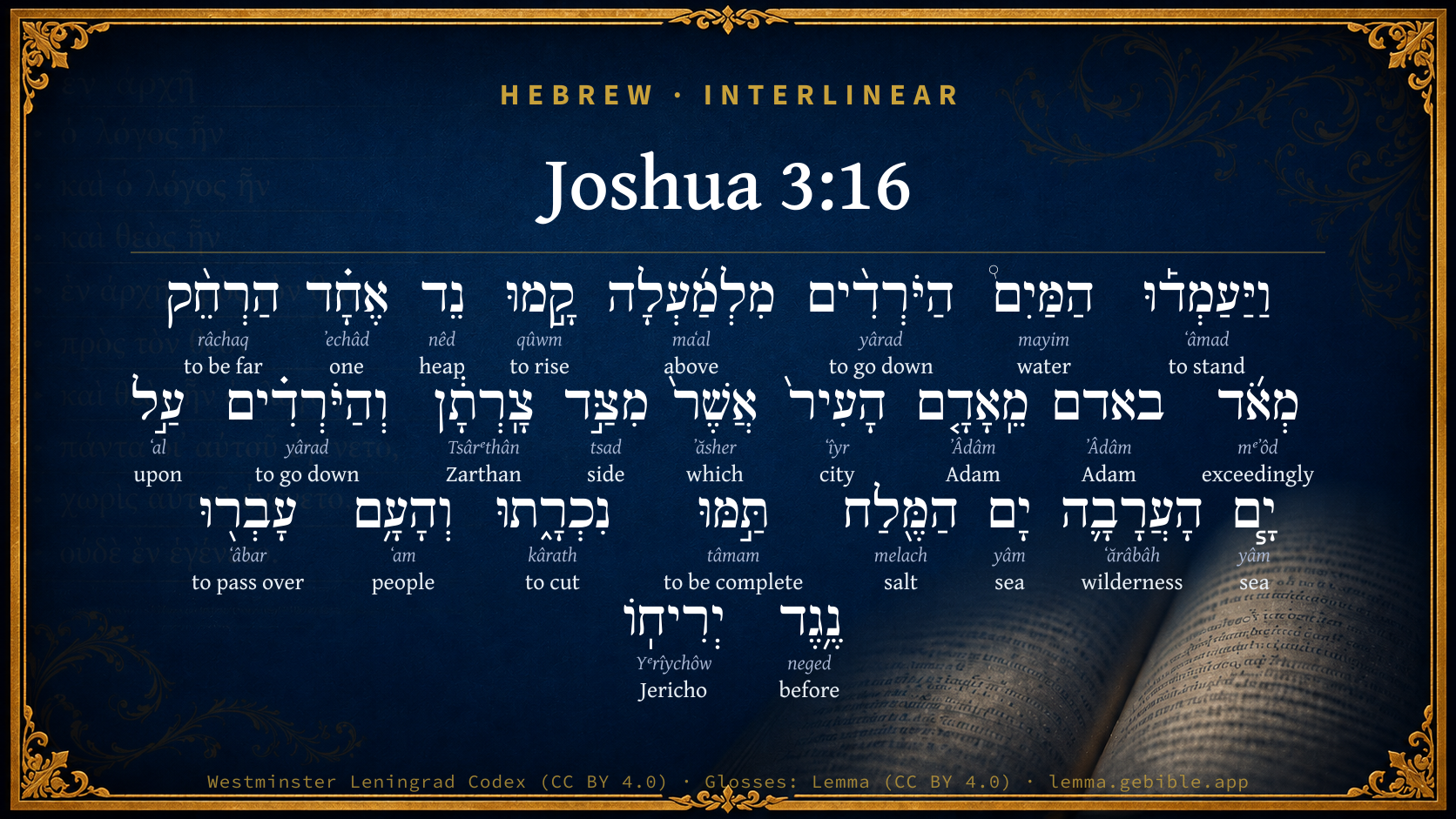
Hebrew (Westminster Leningrad Codex) Joshua 3:16 appears in the Hebrew Old Testament. The text above is from the Westminster Leningrad Codex. Each word links to its Strong’s number, a concise gloss, and parsing drawn from the Open Scriptures Hebrew Bible morphology. Click any word for its full Brown-Driver-Briggs (BDB) entry.
Download image
Cite this verse

Joshua 3:16 (World English Bible). Public Domain. Lemma interlinear Bible study tool, https://lemma.gebible.app/v/joshua/3/16.

Show BibTeX & RIS
BibTeX
RIS
English Translation
that the waters which came down from above stood, and rose up in one heap, a great way off, at Adam, the city that is beside Zarethan; and those that went down toward the sea of the Arabah, even the Salt Sea, were wholly cut off: and the people passed over right against Jericho.
World English Bible · Public Domain
Highlights
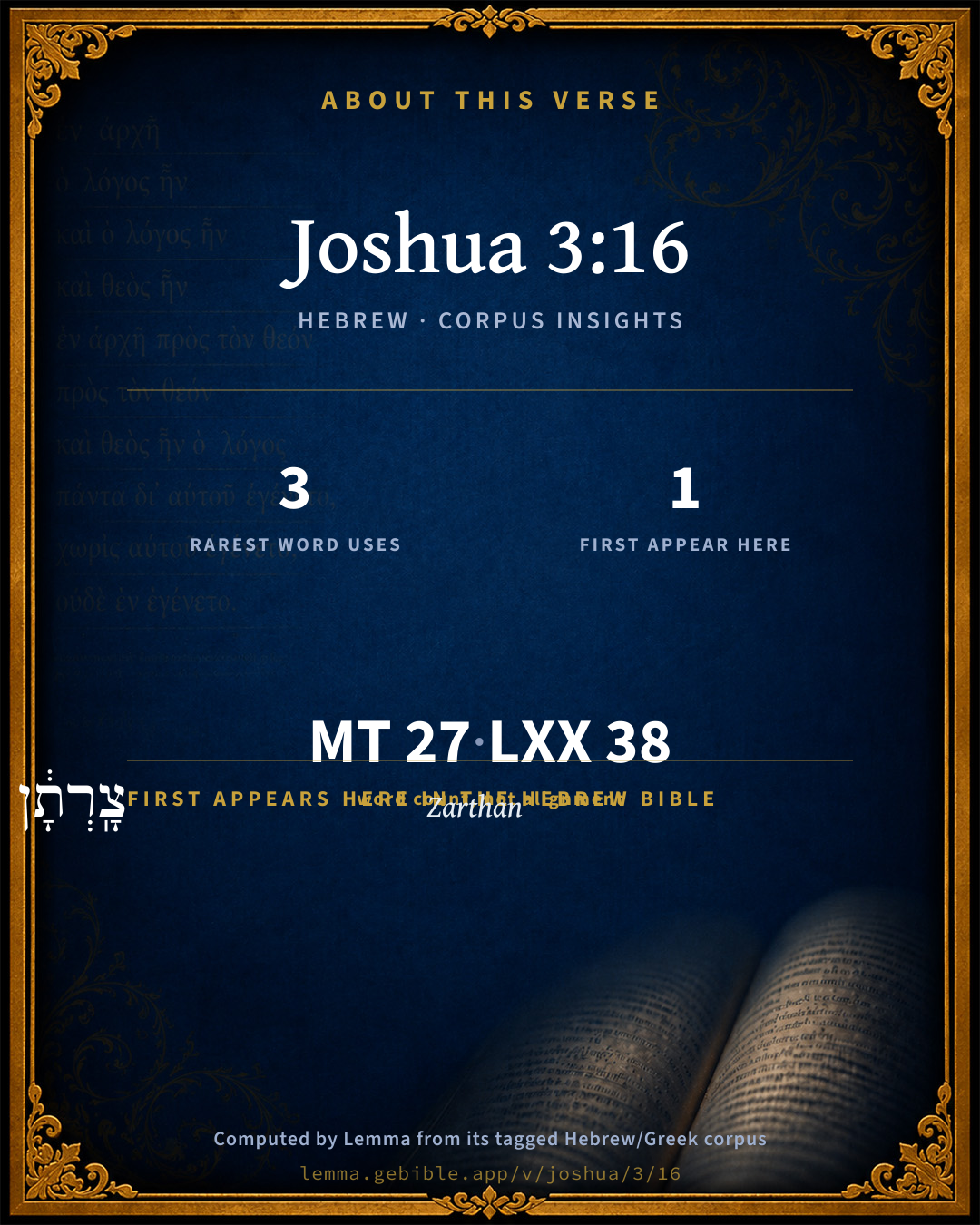
  • 1 first appearance in the Hebrew Bible
Full analysis ↓
Download a study sheet

One document with this verse’s original text, its word-by-word gloss line, the meaning frame, cross-references with their text, attributed commentary, and full source and license credits — printable, and it pastes into notes with its structure intact.

This verse Autodidact and up

Study sheet (.html) Plain text (.txt)

A passage Seminary Student

Up to 50 verses in one chapter. A passage sheet keeps up to 6 commentary sources and 12 cross-references per verse, in the order this page ranks them, and says so on the sheet whenever that leaves anything out. Ask for a single verse and you get the Autodidact verse sheet above.

Everything on this page stays free to read, with no account — the sheet is a download of what is already on screen, not access to it.

Want to remove ads? Support Godless Engineer
Compare translations 3

The same verse in 3 English versions, stacked beneath the original-language interlinear above. Click any original word for its lexicon entry.

Each is an independent rendering of the whole verse — the interlinear is not word-aligned to these translations.

Highlighted words mark where these versions differ — a whole-verse word diff, not a word-by-word alignment.

  • World English Bible Public Domain
    that the waters which came down from above stood, and rose up in one heap, a great way off, at Adam, the city that is beside Zarethan; and those that went down toward the sea of the Arabah, even the Salt Sea, were wholly cut off: and the people passed over right against Jericho.
  • King James Version Public Domain
    That the waters which came down from above stood and rose up upon an heap very far from the city Adam, that is beside Zaretan: and those that came down toward the sea of the plain, even the salt sea, failed, and were cut off: and the people passed over right against Jericho.
  • unfoldingWord Literal Text CC BY-SA 4.0
    Then the waters coming down from above stood. They rose up, one heap, at a great distance away, at Adam, the city that beside Zarethan, and those going down to the sea of Arabah, the Sea of Salt, were completely cut off. (Now the people crossed over opposite Jericho.)

unfoldingWord Literal Text — © unfoldingWord, licensed CC BY-SA 4.0. Word-aligned USFM3 via Door43 (git.door43.org/unfoldingWord/en_ult).

Versions to compare (up to 4)

3 of 4 selected

Show all 18 translations

Every available English version of this verse, each an independent rendering of the whole verse.

  • World English Bible Public Domain
    that the waters which came down from above stood, and rose up in one heap, a great way off, at Adam, the city that is beside Zarethan; and those that went down toward the sea of the Arabah, even the Salt Sea, were wholly cut off: and the people passed over right against Jericho.
  • Berean Standard Bible Public Domain
    the flowing water stood still. It backed up as far upstream as Adam, a city in the area of Zarethan, while the water flowing toward the Sea of the Arabah (the Salt Sea) was completely cut off. So the people crossed over opposite Jericho.
  • Majority Standard Bible Public Domain
    the flowing water stood still. It backed up as far upstream as Adam, a city in the area of Zarethan, while the water flowing toward the Sea of the Arabah (the Salt Sea) was completely cut off. So the people crossed over opposite Jericho.
  • King James Version Public Domain
    That the waters which came down from above stood and rose up upon an heap very far from the city Adam, that is beside Zaretan: and those that came down toward the sea of the plain, even the salt sea, failed, and were cut off: and the people passed over right against Jericho.
  • American Standard Version (1901) Public Domain
    that the waters which came down from above stood, and rose up in one heap, a great way off, at Adam, the city that is beside Zarethan; and those that went down toward the sea of the Arabah, even the Salt Sea, were wholly cut off: and the people passed over right against Jericho.
  • Revised Version (1885) Public Domain
    that the waters which came down from above stood, and rose up in one heap, a great way off, at Adam, the city that is beside Zarethan: and those that went down toward the sea of the Arabah, even the Salt Sea, were wholly cut off: and the people passed over right against Jericho.
  • Geneva Bible (1599) Public Domain
    Then the waters that came downe from aboue, stayed and rose vpon an heape and departed farre from the citie of Adam, that was beside Zaretan: but the waters that came downe towarde the Sea of the wildernes, euen the salt Sea, failed, and were cut off: so the people went right ouer against Iericho.
  • Douay-Rheims (1899) Public Domain
    The waters that came down from above stood in one place, and swelling up like a mountain, were seen afar off from the city that is called Adom, to the place of Sarthan: but those that were beneath, ran down into the sea of the wilderness (which now is called the Dead Sea) until they wholly failed.
  • Young's Literal Translation Public Domain
    that the waters stand; those coming down from above have risen -- one heap, very far above Adam the city, which `is' at the side of Zaretan; and those going down by the sea of the plain, the Salt Sea, have been completely cut off; and the people have passed through over-against Jericho;
  • Literal Standard Version CC BY-SA 4.0
    that the waters stand; those coming down from above have risen—one heap, very far above Adam, the city which [is] at the side of Zaretan; and those going down by the Sea of the Plain (the Salt Sea), have been completely cut off; and the people have passed through opposite Jericho;
  • Unlocked Literal Bible CC BY-SA 4.0
    the waters that flowed down from upstream stood up in one heap. The water stopped flowing from a great distance. The waters stopped flowing from Adam, the city that is beside Zarethan, all the way down to the sea of the Negev, the Salt Sea. The people crossed over near Jericho.
  • unfoldingWord Literal Text CC BY-SA 4.0
    Then the waters coming down from above stood. They rose up, one heap, at a great distance away, at Adam, the city that beside Zarethan, and those going down to the sea of Arabah, the Sea of Salt, were completely cut off. (Now the people crossed over opposite Jericho.)
  • Darby Bible Public Domain
    the waters which flowed down from above stood [and] rose up in a heap, very far, by Adam, the city that is beside Zaretan; and those that flowed down towards the sea of the plain, the salt sea, were completely cut off. And the people went over opposite to Jericho.
  • World Messianic Bible Public Domain
    the waters which came down from above stood, and rose up in one heap a great way off, at Adam, the city that is beside Zarethan; and those that went down toward the sea of the Arabah, even the Salt Sea, were wholly cut off. Then the people passed over near Jericho.
  • Webster's Bible Public Domain
    That the waters which came down from above stood and rose up in a heap very far from the city Adam, that is beside Zaretan; and those that came down towards the sea of the plain, even the salt sea, failed, and were cut off: and the people passed over right against Jericho.
  • Free Bible Version CC BY-SA 4.0
    The water piled up a long way upstream, at the town of Adam, near Zarethan, while downstream no more water flowed into the Dead Sea. So the people crossed over, opposite Jericho.
  • Bible in Basic English Public Domain
    Then the waters flowing down from higher up were stopped and came together in a mass a long way back at Adam, a town near Zarethan; and the waters flowing down to the sea of the Arabah, the Salt Sea, were cut off: and the people went across opposite Jericho.
  • JPS Tanakh (1917) Public Domain
    that the waters which came down from above stood, and rose up in one heap, a great way off from Adam, the city that is beside Zarethan; and those that went down toward the sea of the Arabah, even the Salt Sea, were wholly cut off; and the people passed over right against Jericho.

Literal Standard Version (2020), Covenant Press — licensed CC BY-SA 4.0. Text via the HelloAO Bible API (eBible.org). Unlocked Literal Bible (unfoldingWord) — licensed CC BY-SA 4.0. Text via the HelloAO Bible API (eBible.org). unfoldingWord Literal Text — © unfoldingWord, licensed CC BY-SA 4.0. Word-aligned USFM3 via Door43 (git.door43.org/unfoldingWord/en_ult). Free Bible Version, Dr. Jonathan Gallagher — licensed CC BY-SA 4.0. Text via the HelloAO Bible API (eBible.org).

Word by word

More ways to search: Search by grammar → Find every occurrence → Compare this word →

Practice this passage: Drill this verse → Learn its vocabulary →

צָֽרְתָ֔ן
Tsârᵉthân
H6891
“Zarthan”
Noun, Proper
Part of Speech
Noun
Type
Proper
Full BDB Definition

Origin: perhaps for H6868

TWOT: None

Zarthan or Zaretan = "their distress" - a place in the Jordan valley where the river parted for Israel to pass over for the conquest of Canaan - site unknown
  1. וַיַּעַמְד֡וּ ʻâmad H5975 “and · to stand” Conjunction + Verb, Qal, Sequential Imperfect, 3rd Person, Masculine, Plural
  2. הַמַּיִם֩ mayim H4325 “the · water(s)” Particle, Definite Article + Noun, Common, Masculine, Plural, Absolute
  3. הַיֹּרְדִ֨ים yârad H3381 “the · going down” Particle, Definite Article + Verb, Qal, Participle Active, Masculine, Plural, Absolute
  4. מִלְמַ֜עְלָה maʻal H4605 “from · to/for · above · toward” Preposition + Preposition + Adverb + Suffix, Demonstrative
  5. קָ֣מוּ qûwm H6965 “to rise” Verb, Qal, Perfect, 3rd Person, Common, Plural
  6. נֵד nêd H5067 “heap” Noun, Common, Masculine, Singular, Absolute
  7. אֶחָ֗ד ʼechâd H259 “one” Adjective, Cardinal number, Masculine, Singular, Absolute
  8. הַרְחֵ֨ק râchaq H7368 “to be far” Verb, Hiphil, Infinitive Absolute
  9. מְאֹ֜ד mᵉʼôd H3966 “exceedingly” Adverb
  10. באדם ʼÂdâm H121 “in/at the · Adam” Preposition, Determined + Noun, Proper
  11. מֵֽאָדָ֤ם ʼÂdâm H121 “from · Adam” Preposition + Noun, Proper
  12. הָעִיר֙ ʻîyr H5892 “the · city” Particle, Definite Article + Noun, Common, Feminine, Singular, Absolute
  13. אֲשֶׁר֙ ʼăsher H834 “which” Particle, Relative
  14. מִצַּ֣ד tsad H6654 “from · side of” Preposition + Noun, Common, Masculine, Singular, Construct
  15. וְהַיֹּרְדִ֗ים yârad H3381 “and · the · going down” Conjunction + Particle, Definite Article + Verb, Qal, Participle Active, Masculine, Plural, Absolute
  16. עַ֣ל ʻal H5921 “upon” Preposition
  17. יָ֧ם yâm H3220 “sea of” Noun, Common, Masculine, Singular, Construct
  18. הָעֲרָבָ֛ה ʻărâbâh H6160 “the · wilderness” Particle, Definite Article + Noun, Common, Feminine, Singular, Absolute
  19. יָם yâm H3220 “sea of” Noun, Common, Masculine, Singular, Construct
  20. הַמֶּ֖לַח melach H4417 “the · salt” Particle, Definite Article + Noun, Common, Masculine, Singular, Absolute
  21. תַּ֣מּוּ tâmam H8552 “to be complete” Verb, Qal, Perfect, 3rd Person, Common, Plural
  22. נִכְרָ֑תוּ kârath H3772 “to cut” Verb, Niphal, Perfect, 3rd Person, Common, Plural
  23. וְהָעָ֥ם ʻam H5971 “and · the · people” Conjunction + Particle, Definite Article + Noun, Common, Masculine, Singular, Absolute
  24. עָבְר֖וּ ʻâbar H5674 “to pass over” Verb, Qal, Perfect, 3rd Person, Common, Plural
  25. נֶ֥גֶד neged H5048 “before” Preposition
  26. יְרִיחֽוֹ Yᵉrîychôw H3405 “Jericho” Noun, Proper

About this verse

These counts appear in no published source. They are computed here, from the morphology-tagged text and Lemma’s own curated glosses. What Lemma adds →

27
words
24
distinct lemmas
Historical
section

Notable vocabulary

The rarest word here is צָֽרְתָ֔ן Zarthan H6891 — appearing just 3 times in the whole Hebrew Bible.

First appearance in Scripture

This word makes its first canonical appearance in the Hebrew Bible here:

  • צָֽרְתָ֔ן Zarthan H6891

Shared distinctive vocabulary

צָֽרְתָ֔ן Zarthan H6891 occurs in 3 verses of the Hebrew Bible. Also found in:

Grammatical profile

  • 8 verbs
  • 13 nouns
  • 1 adjective
  • 2 prepositions
  • 2 adverbs
  • 1 particle

Verb forms

  • וַיַּעַמְד֡וּ Qal · Sequential Imperfect
  • הַיֹּרְדִ֨ים Qal · Participle Active
  • קָ֣מוּ Qal · Perfect
  • הַרְחֵ֨ק Hiphil · Infinitive Absolute
  • וְהַיֹּרְדִ֗ים Qal · Participle Active
  • תַּ֣מּוּ Qal · Perfect
  • נִכְרָ֑תוּ Niphal · Perfect
  • עָבְר֖וּ Qal · Perfect

Repetition

Words recur within this verse — often emphatic in Hebrew:

  • הַיֹּרְדִ֨ים to go down H3381 ×2
  • באדם Adam H121 ×2
  • יָ֧ם sea H3220 ×2

Hebrew & Septuagint length

In English translation the verse runs 54 words from the Hebrew and 48 from the Septuagint (LXX English) — closely comparable.

A rough comparison of the two English renderings, which tokenize alike — not a word-level alignment.

Word counts can differ between the Hebrew and the Greek without any difference in meaning — e.g. the Hebrew direct-object marker אֵת has no separate Greek word, and Greek often adds the article ὁ.

In the original languages it is 27 Hebrew tokens and 38 Greek tokens — but the two are counted differently (Hebrew bundles its prefixes and suffixes into one token; the Greek is in lemma form), so that isn’t a like-for-like length.

Cross-references

15

Topical passages linked to Joshua 3:16 in the Treasury of Scripture Knowledge — connected by theme and wording, ordered by reader-vote popularity; previews shown in the World English Bible.

  • Joshua 3:13 It shall come to pass, when the soles of the feet of the priests who bear the ark of Yahweh, the Lord of all the earth, shall rest in the waters of the Jordan, that the waters of the Jordan shall be cut off, even the waters that come down from above; and they shall stand in one heap.
  • Genesis 14:3 All these joined together in the valley of Siddim (the same is the Salt Sea).
  • 1 Kings 4:12 Baana the son of Ahilud, in Taanach and Megiddo, and all Beth-shean which is beside Zarethan, beneath Jezreel, from Beth-shean to Abel Meholah, as far as beyond Jokmeam;
  • 1 Kings 7:46 In the plain of the Jordan did the king cast them, in the clay ground between Succoth and Zarethan.
  • Numbers 34:3 then your south quarter shall be from the wilderness of Zin along by the side of Edom, and your south border shall be from the end of the Salt Sea eastward;
  • Deuteronomy 1:1 These are the words which Moses spoke to all Israel beyond the Jordan in the wilderness, in the Arabah over against Suph, between Paran, and Tophel, and Laban, and Hazeroth, and Dizahab.
  • Psalms 114:3 The sea saw it, and fled. The Jordan was driven back.
  • Deuteronomy 3:17 the Arabah also, and the Jordan and the border [of it], from Chinnereth even to the sea of the Arabah, the Salt Sea, under the slopes of Pisgah eastward.
  • Joshua 15:2 Their south border was from the uttermost part of the Salt Sea, from the bay that looks southward;
  • Psalms 29:10 Yahweh sat enthroned at the Flood. Yes, Yahweh sits as King forever.
  • Psalms 66:6 He turned the sea into dry land. They went through the river on foot. There, we rejoiced in him.
  • Psalms 74:15 You opened up spring and stream. You dried up mighty rivers.
  • Psalms 77:19 Your way was through the sea; Your paths through the great waters. Your footsteps were not known.
  • Matthew 8:26–27 He said to them, "Why are you fearful, oh you of little faith?" Then he got up, rebuked the wind and the sea, and there was a great calm.
  • Matthew 14:24–33 But the boat was now in the middle of the sea, distressed by the waves, for the wind was contrary.

Cross-references courtesy of OpenBible.info (CC BY 4.0).

Hebrew and Greek witnesses Masoretic Hebrew ↔ Greek Septuagint

The same verse in the two great witnesses to the Old Testament, shown verse-for-verse.

These are two independent witnesses, not word-aligned to each other, and the Septuagint is shown in lemma (dictionary) form.

Hebrew Joshua 3:16 Masoretic · Westminster Leningrad Codex

וַיַּעַמְד֡וּ הַמַּיִם֩ הַיֹּרְדִ֨ים מִלְמַ֜עְלָה קָ֣מוּ נֵד אֶחָ֗ד הַרְחֵ֨ק מְאֹ֜ד באדם מֵֽאָדָ֤ם הָעִיר֙ אֲשֶׁר֙ מִצַּ֣ד צָֽרְתָ֔ן וְהַיֹּרְדִ֗ים עַ֣ל יָ֧ם הָעֲרָבָ֛ה יָם הַמֶּ֖לַח תַּ֣מּוּ נִכְרָ֑תוּ וְהָעָ֥ם עָבְר֖וּ נֶ֥גֶד יְרִיחֽוֹ

that the waters which came down from above stood, and rose up in one heap, a great way off, at Adam, the city that is beside Zarethan; and those that went down toward the sea of the Arabah, even the Salt Sea, were wholly cut off: and the people passed over right against Jericho.

World English Bible · Public Domain

Greek LXX Joshua 3:16 Septuagint · lemma form

καί ἵστημι ὁ ὕδωρ ὁ καταβαίνω ἄνωθεν ἵστημι πῆγμα εἷς ἀποἵστημι μακράν σφόδρα σφοδρῶς ἕως μέρος καριαθιαριμ ὁ δέ καταβαίνω καταβαίνω εἰς ὁ θάλασσα ἀραβά θάλασσα ἅλς ἕως εἰς ὁ τέλος ἐκλείπω καί ὁ λαός ἵστημι ἀπέναντι ιεριχω

then the waters that came down from above stopped; there stood one solid heap very far off, as far as the region of Kariathiarim, and the lower part came down to the sea of Araba, the salt sea, till it completely failed; and the people stood opposite Jericho.

LXX2012 (modern English Septuagint) · Public Domain

On this verse, Haydock's Catholic Bible Commentary discusses the Septuagint’s reading. Read the note in Commentary ↓

Hebrew: Westminster Leningrad Codex (CC BY 4.0). Greek: Septuagint (public domain); English from LXX2012 (modern English Septuagint) (Public Domain). How the Septuagint differs from the Hebrew →

Targum (Aramaic paraphrase)

1

The Targum is the ancient Jewish Aramaic paraphrase of the Hebrew Scriptures — an interpretive translation, not the Hebrew text itself. Onkelos (literal) and Pseudo-Jonathan (expansive) render the Torah, and Jonathan the Prophets. Coverage is partial: where no permissively-licensed English translation exists for a verse, only the Aramaic is shown. This is verse-level text, not a word-by-word alignment to the Hebrew.

  1. Targum Jonathan Prophets (Joshua–Malachi)
    וְקָמוּ מַיָא דְנַחְתִין מִלְעֵילָא קָמוּ רוּקְבָא חָד רְחִיקִין לַחֲדָא מֵאָדָם קַרְתָּא דְבִסְטַר צָרְתָן וּדְנַחֲתִין לְיַמָא דְמֵישְׁרָא לְיַמָא דְמִלְחָא שְׁלִימוּ פְּסָקוּ וְעַמָא עֲבָרוּ לָקֳבֵיל יְרֵיחוֹ:

    (no public-domain English translation for this verse)

    Targum Jonathan — Aramaic: “Mikraot Gedolot” (public domain). English: “Sefaria Community Translation” (CC0 1.0 (public-domain dedication)); “London "Chaldee Paraphrase," 1871” (public domain). Text via Sefaria.

Commentary

Notes on Joshua 3:16 from classic Christian and Jewish commentators (each source and its license shown beneath its notes). The classic Christian expositions comment on the surrounding passage and are grouped to its opening verse, so a note may address several verses; the Jewish commentaries on the Tanakh (Rashi and others) are per-verse, so they appear only where the commentator wrote on this verse.

Lemma curates 59 commentaries, every one of them public domain or Creative Commons licensed, each selected and text-cleaned for this edition rather than reprinted as found. About our sources →

The Cambridge Bible for Schools and Colleges

gen. ed. J. J. S. Perowne

16. the waters which came down from above] Let us try to realise the scene;—

(a) At a distance of about 2000 cubits, or a mile, from the river stood the great mass of the army (Jos_3:4).

(b) On the broken edge of the river were the priests bearing on their shoulders the sacred Ark;

(c) As soon as the feet of the priests were “dipped in the brim of the water,” the flow of the stream was arrested;

(d) Far up, beyond where they stood, at the city of Adam, that is beside Zaretan, about 30 miles from the place where the host was encamped, the waters which rushed down from above “stood and rose upon an heap,” drawn up by the Divine Hand;

(e) At the same moment the waters that came down toward the Salt Sea “failed and were cut off” (Jos_3:16), and thus from north to south the waters were “driven backwards” (Psa_114:3), and the dry river-bed was exposed to view.

from the city Adam] is a correction of the text. The Hebrew has, at the city Adam, which was situated, it is thought, where now we find the ford Damieh with remains of a bridge of the Roman period (Van de Velde, Narrative, 11. 322).

beside Zaretan] Or, more correctly, Zarthan (1Ki_4:12; 1Ki_7:46), the situation of which is unknown, but it is thought to have been near Succoth, at the mouth of the Jabbok (1Ki_7:46). By some it has been identified with the modern Surtabeh, an isolated hill some 17 miles above Jericho, where high rocks compress the Jordan Valley within its narrowest limits, and seem almost to throw a barrier across it.

the sea of the plain] This name, which also occurs in Deu_3:17; Deu_4:49, is used for the Dead Sea, the waters of which are clear, but strongly tinctured with salt, and fatal to fish.

failed] “The scene presented is of the descending stream,’ not ‘parted asunder,’ as we generally fancy, but as the Psalm (Psa_114:3) expresses it, ‘turned backwards;’ the whole bed of the river left dry from north to south, through its long windings; the huge stones lying bare here and there, imbedded in the soft bottom; or the shingly pebbles drifted along the course of the channel.” Stanley’s Lectures, p. 232.

The Cambridge Bible for Schools and Colleges (gen. ed. J. J. S. Perowne; Cambridge University Press, 1878–1918) — public domain. Text from a community e-Sword module.

Trapp's Complete Commentary

John Trapp

Jos 3:16 That the waters which came down from above stood [and] rose up upon an heap very far from the city Adam, that [is] beside Zaretan: and those that came down toward the sea of the plain, [even] the salt sea, failed, [and] were cut off: and the people passed over right against Jericho.

Ver. 16. That is beside Zaretan.] A city in the tribe of Ephraim, {1Ki 4:12; 1Ki 7:46} called also Zererath in Jdg 7:22, and Zereda in 1Ki 11:26.

Failed, and were cut off.] Quickly perished in the lake Asphaltites, or Dead Sea, Tanquam si repente fuissent dissectae gladio, ut Job 6:15, as if they had been suddenly cut in twain with a sword, {a}

And the people passed over.] Not by bridges or boats, but on foot, dry shod, though in such an inundation.

Right over against Jericho.] The place being therehence called Bethabara, as some think, {Joh 1:28} or Traiectum, the place of passage. Here baptism was first administered, {Joh 1:28} where it had been foreshadowed. Christ is the true Bethabara. {Eph 2:18}

{a} Tremell.

John Trapp, A Commentary or Exposition upon All the Books of the Old and New Testament (1647–1656) — public domain. Text from a community e-Sword module.

Joseph Benson's Commentary

Jos 3:16. Adam — The city of Adam, being more obscure, is described by its nearness to a more known place, then eminent, but now unknown. The meaning is, that the waters were stopped in their course at that place, and so kept at a distance from the Israelites while they passed over. Against Jericho — Here God carried them over, because this part was, 1st, The strongest, as having in its neighbourhood an eminent city, a potent king, and a stout and warlike people. 2d, The most pleasant and fruitful, and therefore more convenient both for the refreshment of the Israelites after their long and tedious marches, and for their encouragement.

Joseph Benson's Commentary on the Old and New Testaments (1811–1818) — public domain. Text from a community e-Sword module.

Tyndale Open Study Notes

Tyndale Open Resources

3:16 Two wonders occurred. First, the water . . . began backing up above Adam (about twenty-five miles away). Second, the entire bed of the river was dry, as remaining water drained to the Dead Sea.

Tyndale Open Study Notes — © Tyndale Open Resources, licensed CC BY-SA 4.0. Text via the HelloAO Bible API.

Jamieson, Fausset & Brown

Robert Jamieson, A. R. Fausset & David Brown

the waters which came down from above--that is, the Sea of Galilee

stood and rose up upon a heap--"in a heap," a firm, compact barrier (Exo 15:8; Psa 78:13);

very far--high up the stream;

from the city Adam, that is beside Zaretan--near mount Sartabeh, in the northern part of the Ghor (Kg1 7:46); that is, a distance of thirty miles from the Israelitish encampment; and

those that came down toward the sea of the desert--the Dead Sea--were cut off (Psa 114:2-3). The river was thus dried up as far as the eye could reach. This was a stupendous miracle; Jordan takes its name, "the Descender," from the force of its current, which, after passing the Sea of Galilee, becomes greatly increased as it plunges through twenty-seven "horrible rapids and cascades," besides a great many lesser through a fall of a thousand feet, averaging from four to five miles an hour [LYNCH]. When swollen "in time of harvest," it flows with a vastly accelerated current.

the people passed over right against Jericho--The exact spot is unknown; but it cannot be that fixed by Greek tradition--the pilgrims' bathing-place--both because it is too much to the north, and the eastern banks are there sheer precipices ten or fifteen feet high.

Jamieson, Fausset & Brown — Commentary Critical and Explanatory on the Whole Bible (1871) — public domain (CC PDM 1.0). Text via the HelloAO Bible API.

Adam Clarke's Commentary

Verse 16. Rose up upon a heap] That is, they continued to accumulate, filling up the whole of the channel toward the source, and the adjacent ground over which they were now spread, to a much greater depth, the power of God giving a contrary direction to the current. We need not suppose them to be gathered up like a mountain, instar montis, as the Vulgate expresses it, but that they continued to flow back in the course of the channel; and ere they could have reached the lake of Gennesareth, where they might have been easily accumulated, the whole Israelitish army would have all got safely to the opposite side.

Very far from the city Adam - beside Zaretan] Where these places were it is difficult to say. The city Adam is wholly unknown. From 1Kg 4:12 we learn that Zartanah was below Jezreel near Bethshean, or Scythopolis, and not far from Succoth, 1Kg 7:46. And it appears from Ge 33:17, Jos 13:27, that Succoth lay on the east side of Jordan, not far from the lake of Gennesareth; and probably Adam was on the same side to the north of Succoth. It is probable that the Israelites crossed the Jordan near Bethabara, where John baptized, Joh 1:28, and which probably had its name, the house of passage, from this very circumstance. After all, it is extremely difficult to ascertain the exact situation of these places, as in the lapse of upwards of 3,000 years the face of the country must have been materially changed. Seas, rivers, and mountains, change not; and though we cannot ascertain the spot, it is sufficiently evident that we can come near to the place. It has been considered a lame objection against the truth of the Iliad that the situation of Troy cannot now be exactly ascertained. There are even many ancient cities and considerable towns in Europe, that, though they still bear their former names, do not occupy the same spot. There are not a few of those even in England; among such Norwich, Salisbury, c., may be ranked, neither of which is in its primitive situation.

Right against Jericho.] It would be impossible for the whole camp to pass over in the space opposite to Jericho, as they must have taken up some miles in breadth, besides the 2,000 cubits which were left on the right between them and the ark but the river was divided opposite to Jericho, and there the camp began to pass over.

Adam Clarke's Commentary on the Bible (1810–1826) — public domain. Text from a community e-Sword/MySword module.

Ellicott's Commentary for English Readers

(16) Very far from the city Adam, that is beside Zaretan.—The written text is “in Adam,” but the Masorites read it “from Adam.” The reading makes no difference to the literal fact. The two prepositions, in and from, express the same thought. The heap of water stood up as it were in Adam. From Adam to the place where Israel crossed, the river-bed was dry—the heap was as far away as Adam, but as it was not actually in the city, the word in was most likely altered to from. The more difficult reading, in, may very possibly be the best. For Zaretan see 1Ki_4:12; 1Ki_7:46. Adam, as the name of a city, does not occur elsewhere. The meaning of the fact has been well pointed out by Bishop Wordsworth on this place. Zaretan was beneath Jezreel, but has not been identified. Adam has been thought to be at the ford Damieh, thirty miles away.

A Bible Commentary for English Readers, edited by Charles John Ellicott (1878–1897) — public domain. Text from a community e-Sword module.

John Gill's Exposition

That the waters which came down from above,.... Above where the priests' feet rested, and which came down from Mount Lebanon, and the fountains of Jordan northward:

stood and rose up upon an heap; they stopped their current, and as the water came down they rose up on high, and made one vast heap of waters:

very far from the city of Adam, that is, beside Zaretan; the Cetib, or textual reading, is, "in Adam the city"; we follow the marginal reading, "from Adam": both readings, as is usually, if not always the case, are to be received; and the meaning is, that this heap of waters, though the river was at a considerable distance from Adam; yet through the overflow of it, it reached to, and was "in Adam": this city was in Perea, on the other side Jordan, that side on which the Israelites were before their passage; and Zaretan, which is supposed to be the same with Zartanah, and Zarthan, Kg1 4:12, was on this side, in the tribe of Manasseh; and the sense is, not that Adam was on the side of Zaretan, or near it, for it was on the other side of the river; and according to the Talmudists (a) was twelve miles from it; but the construction is with the word "heap", "which heap was on the side of Zaretan"; it was there where the waters were heaped up; it seems as if they reached on the one side to Adam, and on the other side to Zaretan:

and those that came down towards the sea of the plain, even the salt sea, failed, and were cut off; those waters, which were below where the priests' feet rested, ran down into the lake Asphaltites, where Sodom and Gomorrah formerly stood, the sea of the plain, or vale of Siddim, Gen 14:3; sometimes called the dead sea, and here the salt sea, its water being exceeding salt; so, Mr. Maundrell, the above mentioned traveller (b) testifies on his own knowledge;"the water of the lake (the lake Asphaltites, or dead sea, says he) was very limpid, and salt to the highest degree; and not only salt, but also extreme bitter and nauseous;''

so that these waters running down thither, and those above stopped, made a dry channel for sixteen or eighteen miles: and the people passed over right against Jericho; which was the city Joshua had in view to attack first, and had sent spies thither to get intelligence of it, and the disposition of the people in it: See Gill on Jos 2:1.

(a) T. Hieros. Sotah, fol. 21. 4. (b) Maundrell, ut supra, (Journel from Aleppo to Jerusalem) p. 84. Ed. 7.

John Gill's Exposition of the Whole Bible (1746–1763) — public domain (CC PDM 1.0). Text via the HelloAO Bible API.

Albert Barnes' Notes on the Bible

The passage should run “rose up, an heap far away, by Adam, the city which is beside Zarthan.”

The city of Adam is not named elsewhere, and Zarthan (mentioned here and in marginal references.) has also disappeared. It is, however, probably connected with the modern Kurn Sartabeh (Horn of Sartabeh), the name given to a lofty and isolated hill some 17 miles on the river above Jericho.

Albert Barnes' Notes on the Bible (1834–1885) — public domain. Text from a community e-Sword/MySword module.

Haydock's Catholic Bible Commentary

Mountain. Hebrew, "heap or bottle." The billows were forced to roll back almost as far as the lake of Genesareth, where Sarthan stands, about twenty leagues above Jericho. --- Sarthan. Hebrew, "rose up on a heap, very far from (or to) the city of Adom, that is beside Sarthan." The situation of Adom can only be ascertained by that of Sarthan, which was near Bethsan, or Scythopolis, (3 Kings iv. 12,) in the vale of Jezrahel, on the Jordan. Many copies of the Septuagint read Cariathiarim, though it was six or seven leagues up the country, west of Jericho. (Calmet) --- The swelling billows might perhaps be seen from this place. (Haydock) --- But it could not properly determine how far the waters rolled back. (Calmet) --- Failed. Hebrew, "and those that came down toward the sea of the plain, (or of Araba, which means a desert, fit only for pasturage) the salt sea, failed were cut off" from the waters above Jericho. The Jordan after running three miles in the lake of Sodom, without mixing its waters, becomes at last reluctantly confounded with it. Velut invitus...postremo ebibitur, aquasque laudatas perdit, pestilentibus mixtus. (Pliny, [Natural History?] v. 15.)

George Leo Haydock (1774–1849), Haydock's Catholic Family Bible and Commentary, 1859 edition — public domain. Excludes Psalms (Douay-Rheims chapter numbering differs from Protestant) and Deuterocanonical books (Catholic canon only).

Matthew Poole's English Annotations

The waters rose up upon an heap; which having been affirmed by heathen writers to have been done by magicians, it is great impudence to disbelieve or doubt of God’s power to do it.

Adam, that is beside Zaretan: the city Adam being more obscure, is described by its nearness to a more known place, Zaretan, or Zarthan, which some think is the same place mentioned 1Ki 4:12; 7:46; but it rather seems to have been another place then eminent, but now unknown, as many thousands are. The meaning is, that the waters were stopped in their course at that place, and so kept at a due distance from the Israelites whilst they passed over.

Right against Jericho; here God carried them over, because this part was,

1. The strongest, as having in its neighbourhood an eminent city, a potent king, and a stout and warlike people.

2. The most pleasant and fruitful, and therefore more convenient both for the refreshment of the Israelites after their long and tedious marches, and for their encouragement to their present expedition.

Matthew Poole's English Annotations on the Holy Bible (1683–1685) — public domain. Text from a community e-Sword/MySword module.

Whedon's Commentary on the Bible

Daniel D. Whedon

16. The city Adam, that is beside Zaretan — It is impossible to locate these cities; no traces of them remain. The latter city is elsewhere more correctly spelled Zarthan. There is in the Hebrew a marginal reading which is generally preferred by the critics: “The waters stood and rose up upon one heap very far off — by Adam, the city that is by the side of Zarthan.”

In accordance with this reading many commentators suppose that the entire channel of the Jordan was dry for many miles above the place of crossing, and that the waters were rolled back and piled up in a place many miles distant towards, or near, the Sea of Tiberias. The following is Stanley’s graphic description: “On the broken edge of the swollen stream the band of priests stood, with the ark on their shoulders. Suddenly the full bed of the Jordan was dried before them. High up the river, far, far away, in Adam, (that is, at a distance of thirty miles from the encampment,) the waters stood which ‘descended’ from the heights above; stood, and rose up as if gathered into a waterskin, as if in a barrier or heap, as if congealed, (LXX;) and those that descended toward the Sea of the Desert, the Salt Sea, failed, and were cut off. Thus the scene presented is of the ‘descending stream,’ (Jordan, etymologically, means the Descender,) not parted asunder, as we generally fancy, but, as the Psalm expresses it, ( Psa_114:3,) ‘turned backwards;’ the whole bed of the river left dry from north to south, through its long windings; the huge stones lying bare here and there, embedded in the soft bottom; or the shingly pebbles drifted along the course of the channel.” To this theory of the miracle, which is also that of Dr. A. Clarke, we object. We see no reason for heaping up the waters in a far-distant place where there were no Hebrew witnesses.

Daniel D. Whedon (gen. ed.), Commentary on the Old and New Testaments (1874–1909) — public domain. Text from a community e-Sword module.

The Pulpit Commentary

Stood and rose up upon a heap. Literally, "stood they rose up, one heap." The narrative assumes a poetic form here. (cf. Exo_15:8, 9 Jud_1:5:27) Very far from the city Adam. The Masorites have corrected the text here. The original text has for which the suggested Keri is sdame. But the correction is needless. It is better to render, "they rose up, one heap, very far off, at the city Adam." The city Adam is nowhere else mentioned in Scripture, The LXX appears to have read daom daom instead of sdame daom, for it translates sfodra sfodrwv . This reading of the LXX shows that the correction, though it obscures the sense, is of great antiquity, and that the site of Adam was then quite unknown. Knobel would place it either just south of the Jabbok, where the ford Damieh now exists, or at Eduma, now Daumeh, twelve German miles east of Neapolis. The former is generally accepted now, and Conder ("Handbook," p. 241) identifies it with Admah, (see Gen_14:2) in the plain or ciccar of Jordan. That is beside Zaretan. Called Zarthan in the original, (cf. 1Ki_4:12 1Ki_7:46) and Zeredatha, in 2Ch_4:17. Some read Zeredatha for Zererath in Jud_1:7:22. Knobel supposes, and not without some probability, that Zereda, Jeroboam"s birthplace, is the same as this. It was in the plain of Jordan, not far from Succoth, at the mouth of the Jabbok. The LXX here reads Kariayiareim , i.e., either Kiriathaim or Kirjath-jearim, but without authority. Delitzsch and Knobel suppose the spot to be Kurn, or Karn (i.e., horn) Sartabeh, near the ford Damieh , where the Jordan valley is at its narrowest, and the rocks stretch forward so as almost to meet. They fix on this spot, partly from the suitability of the situation for such an arresting of the waters, partly from its agreement with the situation of Zarthan, as described in the Scriptures. Vandevelde agrees with them. There was an Adami and a Zartanath higher up the river near Bethshean, which some have supposed to be meant, (see Jos_19:33 1Ki_4:12) but these lay entirely out of Joshua"s line of march. The sea of the plain. Rather the sea of the hbr (yalassan Araba , LXX), or desert. (so Deu_3:17 Deu_4:49 2Ki_14:25; see also Deu_1:1) The term is applied by the Hebrews and Arabs to any sterile region, and thence to the sterile depression which borders on the Jordan, extending from the lake of Tiberias southward. The Arabs now apply the term el ghor to the part between Tiberias and the Dead Sea, and reserve the term Arabah for the desert valley, or wady, which extends thence to the Red Sea. So Gesen., "Thesaurus," s.v.; and Robinson, "Bibl. Res." The word translated plain in Gen_13:10 is rKKi, a word of very different signification. (see also "Shephelah" and "Emek," Jos_10:40 Jos_11:2) The salt sea. This sea is called the Dead Sea from the immobility of its waters, as well as from the apparent absence of all life within them. "Some of our party," says Canon Tristram," employed themselves in searching, but without avail, for life in the Dead Sea." It lies at a level of more than 1, 300 feet below the level of the Mediterranean. Its waters are thus described by Dr. Thomson: "The water is perfectly clear and transparent. The taste is bitter and salt, far beyond that of the ocean. It acts upon the tongue and mouth like alum; smarts in the eye like camphor; produces a burning, pricking sensation." The specific gravity of its waters is very great, and bathers find a great difficulty in swimming in it from the unusual buoyancy of the water. This is caused by the very large quantity of saline matter held in solution from the salt hills in the neighbourhood. One of them, Jebel Usdum, is described by Canon Tristram as "a solid mass of rock salt," and the water in its vicinity as "syrup of chloride of sodium," that is to say, of common salt. So also Bartlett, "Egypt and Palestine," p. 451. The statement that no bird can fly across its waters is a fable. The fullest account of the various attempts some of them fatal to explore the Dead Sea are to be found in Ritter"s "Geography of Palestine," vol. 3. Canon Tristram explored the western side thoroughly, while Mr. Macgregor"s canoe voyage, described in his "Rob Roy on the Jordan," gives a number of most interesting details. In Ritter"s work will also be found some valuable observations on the physical geography of the district, on the geological formation of the basin of the Dead Sea, together with two papers, one by M. Terreil and the other by M. Lartet, on the chemical composition of the Dead Sea waters. Failed and were cut off. Literally, were completed, were cut off, i.e., were completely cut off, so that the supply of water failed, and the channel of the Jordan to the southward, and to the northward as far as Zaretan, became dry ground. (see also Psa_114:3)

HOMILIES BY R. GLOVER Ver. 16. The crisis of life.

There is only one date in history transcending this in importance the date when, across a vaster Jordan, the dividing line between heaven and earth, God came in the person of a little babe to make a conquest of world of promise. The year of the founding of Rome, the flight of Mohammed, the invasion of the Saxons, the irruption of the Gauls into Italy, the Norman Conquest, the War of Independence in America, the French Revolution what date can compare with this crossing of the Jordan by a people only a generation free from slavery, ignorant of their own destiny, crossing with a hope of finding an earthly home, but with no dream of the world wide usefulness which would crown their history? The beginning of the history of Canaan! Invasions do not generally contribute much to the well being of mankind, and frequently are as evanescent in their results as they are disastrous in their immediate miseries. Successive invasions of the great monarchies of Persia and Babylon have left little but a lesson on the vanity of human glory. Successive invasions of India have left their traces chiefly in those caste distinctions, each step of which tells of a class lorded over by a class above it on the strength of a conquest completely made and long enforced. But the invasion of Canaan hallowed a land, gave God an earthly throne, started what was, with all its faults, a model commonwealth, and gave a home to a people which, with all its backslidings, was still "a kingdom of priests" to mankind. Consider a few features of this great event. And first consider the illustration afforded here of

I THE CRISES OF LIFE. Our life is built up of acts, every one of them important. They, made by our character, react on our character and make it. And in the sense that it contributes to an enduring result in character, no act is little. But there are times specially solemn in our life, when the roads which invite us diverge at a large angle, and are such that each step we take on the one makes return to the other more difficult. And if a man is made by his ordinary acts, much more is he made by his crisis acts. If a nation"s character is moulded by its acts, much more by its crisis acts. Here there is a crisis reached in Israel"s history very analogous to the first great crisis, when they passed the Red Sea. Shall they or shall they not commit then selves to the struggle with the seven nations of Canaan some with what seemed impregnable fastnesses, some with chariots of iron, some conspicuous for gigantic stature? Jordan accentuates the question. To cross it is to commit themselves to a course condemned by ten out of twelve of the spies sent out forty years before, is to hazard everything on the chance of battle, is to have no retreat, is to win or lose all things. It was a crisis on which their national future hung. It needed crisis virtue. Let them hang back and their enthusiasm would evaporate, their unity break up; they would fall off into a number of nomadic tribes, and probably degenerate into a people like the Ishmaelites, without any of that consecutive progress and self-contained strength that constitutes a history. Let them go forward, and to remotest ages and countries mankind is blessed by the national history that takes a forward stride and reaches a stouter solidity by their new departure. Happily, they had crisis virtue; at least, a sufficient amount of faith to let them venture to make them obedient to faithful leaders, and united in their purpose to obey the guidance of their God. And meeting the crisis, they accepted its duty, with results of perpetual usefulness, and left us a testimony as to the solemnity of all such junctures and the blessedness of meeting them aright. The kind of juncture that comes to us you will recognise from your own experience. They vary in their kind, but all have this in common, that they summon a man to some higher duty, some better life, some bolder enterprise, and put before him "an open door;" that to decline them is to degenerate into a poorer character and more sordid life, while to accept them is to rise to "newness of life." Their variety, indeed, is striking. Sometimes it is a great mercy that comes to a man, meant to wake him to a sense of the fatherliness of God, and to win him by the gentle constraints of gratitude to filial duty; to cure grumbling or to destroy despair. If he meets this crisis well, he passes to a higher level of gentler, kinder, gracious thoughts and purposes; and a sense of debtorship to man and an overflowing gratitude to God are the abiding results of the crisis of a great mercy. Sometimes the crisis is the revelation of a duty. Some sudden turn in our experience devolves on us a duty hitherto discharged by others; or some new duty arising from a fresh contingency. It may be a duty of Christian mercy to some overtaken in calamity. It may be that a slumbering conscience or an indolent mind has been awaked to the discernment of God"s requirements. It may be that with some growth of years or development of thought and feeling we see we owe some duty to our Saviour and our fellow men hitherto not due from us or not known to us. This is a crisis not to be overlooked. Hitherto there was comparative unimportance in the neglect of this duty. It was a "time of ignorance God winked at." But to neglect it now, when it stands out eminent and clear, would be to cast off the Divine Master, and to be guilty of unfaithfulness to the Lord that bought us; while to do this would strengthen the bond that binds you to God and man, would result in enlargement of heart, ennoblement of purpose, strengthening of conscience, and enjoyment of peace. Sometimes the crisis is a temptation, pressing on the spirit on every side, and by guile, clamor, terrors, and allurements compelling its divergence from the path of duty. I need not enumerate other kinds of crises. Let me only urge that, in whatever way the crisis come, we meet it manfully. When you come to Jordan see that you cross over it. God will not fail you if you do not fail yourself.

II I ask you to observe, secondly, THE CREED FOR A CRISIS. It is given us here: one of those beautiful instances of faith in which noble hearts find at once their expression and their sustenance. Here is one couched in a name of God. Here are two significant titles, neither of them in common use previously: He calls God "the living God," and "the God of the whole earth." Once only is the former of these names retold in Scripture before this use of it, and the other is not found in use until long after. They are, therefore, not traditional words a parrot might have used, but great original words which register the truth Joshua had conquered for himself. And if we would meet our crisis, when it comes, as nobly and grandly as Joshua met his, we must try and get his creed of two articles.

1. We must believe God is the living God, for all do not believe that; not that they would formulate the idea that on such a day God died, and has not been heard of since. But the general feeling is, He is as good as dead. A distant God, without living eye to mark our necessities, without living hand to help us, without a living heart to feel for our distresses. And if Joshua had been of that creed there would have probably been no passage of the Jordan, and no victory of Jericho, and no conquest of the land. But by the ever extending obedience or experiences of his life he had learned this mighty secret that God is alive, is here, gives their bias to all events, can hear a prayer, can save a soul, can cleave a passage through sea or river.

2. And the second was like to it. He deemed God the Lord of all the earth. No local deity, like those heathen deities whose sovereignty was often as limited as a German duchy; no limited being; but master of all powers of nature, master of all tribes of men, with the government upon His shoulder of all things; able to open a path where all passage seemed denied; so that his and Israel s future would not depend on their own wisdom, strength, or fortunes, but would depend supremely on. the favour of God. Aye, and that is the sort of creed which we all need for the crises we have to face. God living and reigning; earth alive with His presence and His work; all events dependent on His will. Oh, let us catch from heroic souls at least their creed. Their faith, which works such wonders, must be the true faith. God IS living, His heart is alive with tenderness. He is not the great grave into which all things fall, but the great fount of life from which all things live. So alive that He could become incarnate and take infinite trouble to redeem us. So alive He is here today, ready to help us. If you suspect the creed of priests, here is a layman, a soldier, a hero; this is the first article of His creed. Have you that creed? If not, pray for a large enough heart to hold it. And especially if you are in any crisis of your life; for if in any crisis of our life we assume in our despair that, so far as we are concerned, God is dead, or unable to control the elements of nature, the fair results of all opportunity are lost because it passes unused. If you have come to Jordan, cross over it; and if you want strength to do it, find it in this creed: God is the living God, and the Lord of all the earth. And observe lastly

III CRISIS GRACE comes wherever there is crisis faith and obedience. It is a strange story, in its circumstantiality, that of the dividing of the Jordan. The baring of the bed of the river, the water gathering for thirty miles up by the sudden arrestment of its flow into a lake like Loch Lomond in size and form, while below the point of transit it flows away as if its career was ended. There is interest in all explanations that are suggested; in that, for instance, which, combining the destruction of the walls of Jericho with this dividing of the river, and both with the numerous traces of volcanic action in the neighbourhood, and demonstrable changes in the river bed, sees here the action of an earthquake, upheaving the bed, and thus for a day or so making of all the deep valley of the Jordan above it a temporary lake. But there is more importance in our marking the fact and its lessons than in our being able to explain the mode. Does Joshua believe God to be the living God? "According to his faith it is Him." And with all Divine energy of love He comes nigh to help them that trust in Him, laws of nature and forces of nature notwithstanding. Such faith never goes dishonoured; and we ought to mark it for our comfort in life. God is not dead; lie is living still, as fresh for working miracles as when He divided Jordan, and as sure to open up our way, and to lend supernatural aid to simple faith, as when Israel halted before Jordan. Our hope must not be limited within the sphere of what is obviously possible according to laws of nature. I should think God never in any miracle broke the usual laws, but only employed unusual forces. And He does the impossible still making weakness strong, despair victorious; healing the sick, saving the lost, giving victory and success. The supernatural is not contranatural, but blends kindly with nature; and whenever in the crises of our life there is the obedience which honours God and the faith that trusts Him, there is specifically supernatural help and grace making the grandest deliverance and achievements possible. Our lives might be perpetual miracles, and every day behold the impossible achieved, and the insurmountable surmounted with blessed ease. Is there some stern crisis on you now? Do not faint. There is crisis grace for all who have faith enough to admit and act on it. Let it in, and even though Jordan be at the flood you will pass over as on dry land. G.

The Pulpit Commentary (1880–1919), ed. H.D.M. Spence-Jones & Joseph S. Exell — public domain. Text from a community e-Sword module.

John Wesley's Explanatory Notes

Adam - The city Adam being more obscure, is described by its nearness to a more known place, then eminent, but now unknown. The meaning is, that the waters were stopped in their course at that place, and so kept at a distance from the Israelites whilst they passed over. Against Jericho - Here God carried them over, because this part was,

1. The strongest, as having in its neighbourhood an eminent city, a potent king, and a stout and war-like people.

2. The most pleasant and fruitful, and therefore more convenient both for the refreshment of the Israelites after their long and tedious marches, and for their encouragement.

John Wesley, Explanatory Notes Upon the Whole Bible (1754–1765) — public domain. Text via the GEBible commentary corpus.

Rashi

Rabbi Shlomo Yitzchaki (Rashi)

A great distance from the place they stood. There the waters were cut off.

From Odom. [Adom] was the name of the city.

Descended. Those waters that had descended from above that had previously flowed downstream.

Were completely cut off. They continued flowing on their course as do all the streams that flow into the sea, which ended their course.

Rashi on the Tanakh — English translations: “The Judaica Press complete Tanach with Rashi, translated by A. J. Rosenberg” (CC BY 4.0); “Pentateuch with Rashi's commentary by M. Rosenbaum and A.M. Silbermann, 1929-1934” (public domain); “The Metsudah Tanach series, Lakewood, N.J” (CC BY 4.0); and “The Book of Joshua, Metsudah Publications, 1997” (CC BY 4.0). Text via Sefaria.

Lesson kit

Teaching starters — assembled from the data on this page, not authored interpretation. Every prompt links to the verse data it draws on. Edit before teaching.

Joshua, in the Historical, opens this verse with 27 words (24 distinct Hebrew lemmas). Its most distinctive word is Tsârᵉthân (“Zarthan”). A historical commentator’s framing appears above. Read the whole chapter for the surrounding context.

Discussion questions

  1. How does “Zarthan” (Tsârᵉthân) shape what this verse is saying?
  2. The word “Zarthan” first appears here in Scripture. What is being introduced at this debut?
  3. 1 Kings 4:12 shares the word «Zarthan» with this verse. How do the two illuminate each other?
  4. “to go down” occurs 2× in this one verse. What is the effect of the repetition?
  5. These translations render this verse differently. What is at stake in choosing one wording over another?
  6. The verb «וַיַּעַמְד֡וּ» is Qal Sequential Imperfect. How does its form color the action?
  7. Reading how The Cambridge Bible for Schools and Colleges and Trapp's Complete Commentary read this verse, where do the two commentators agree and where do they part?

Things to notice

Reading settings

Reading text

Shown beneath each verse's original-language words.

Old Testament
Old Testament edition

Read the OT as the Masoretic Hebrew (MT) or the Greek Septuagint (LXX).

English shown for the Greek Septuagint (in the Hebrew ↔ Greek comparison).

Comparing translations? Open the Compare panel on any verse page to stack up to four side by side.