
Deuteronomy 7:2

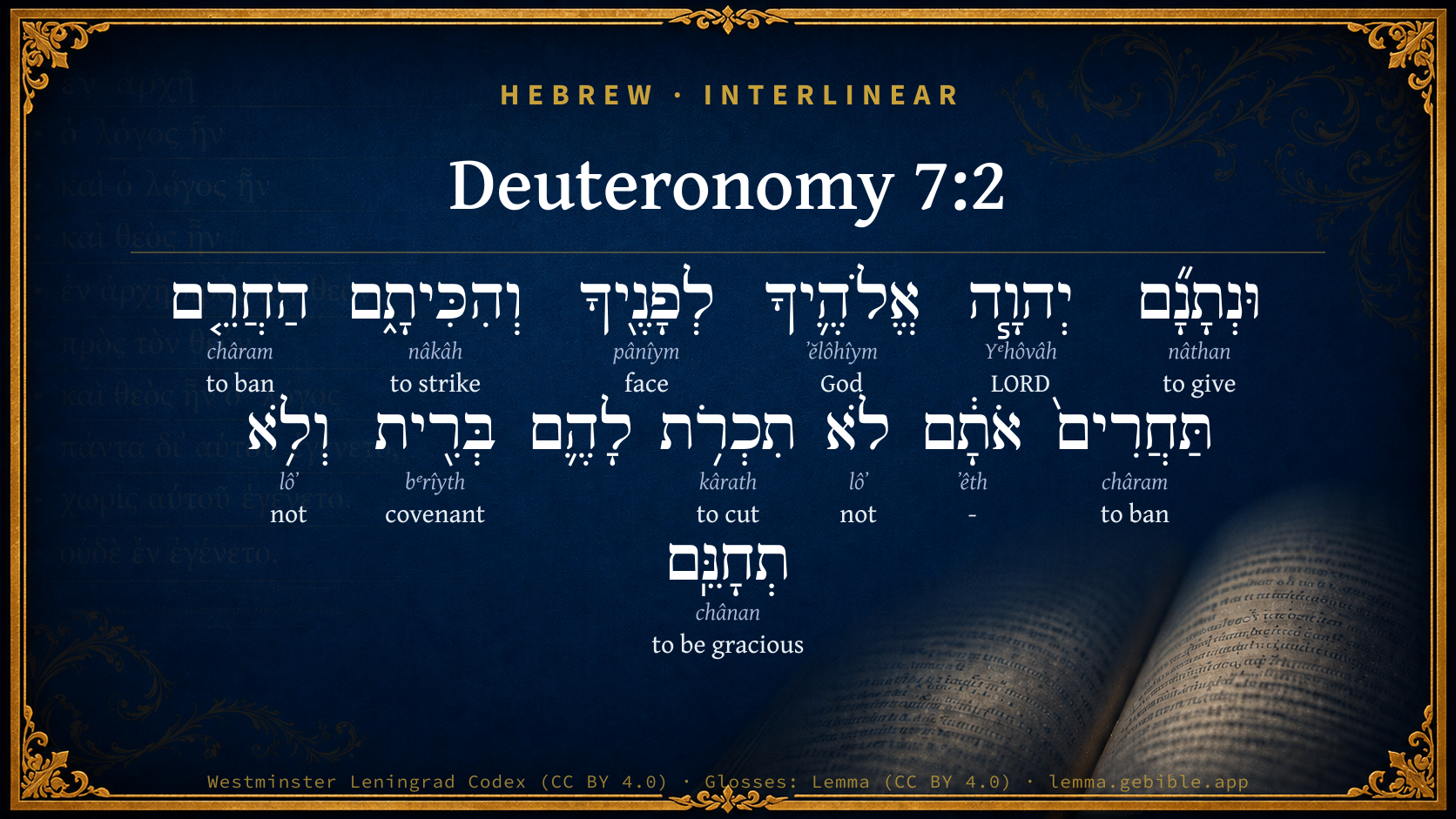
Hebrew (Westminster Leningrad Codex) Deuteronomy 7:2 appears in the Hebrew Old Testament. The text above is from the Westminster Leningrad Codex. Each word links to its Strong’s number, a concise gloss, and parsing drawn from the Open Scriptures Hebrew Bible morphology. Click any word for its full Brown-Driver-Briggs (BDB) entry.
Download image
Cite this verse

Deuteronomy 7:2 (World English Bible). Public Domain. Lemma interlinear Bible study tool, https://lemma.gebible.app/v/deuteronomy/7/2.

Show BibTeX & RIS
BibTeX
RIS
English Translation
and when Yahweh your God shall deliver them up before you, and you shall strike them; then you shall utterly destroy them: you shall make no covenant with them, nor show mercy to them;
World English Bible · Public Domain
Download a study sheet

One document with this verse’s original text, its word-by-word gloss line, the meaning frame, cross-references with their text, attributed commentary, and full source and license credits — printable, and it pastes into notes with its structure intact.

This verse Autodidact and up

Study sheet (.html) Plain text (.txt)

A passage Seminary Student

Up to 50 verses in one chapter. A passage sheet keeps up to 6 commentary sources and 12 cross-references per verse, in the order this page ranks them, and says so on the sheet whenever that leaves anything out. Ask for a single verse and you get the Autodidact verse sheet above.

Everything on this page stays free to read, with no account — the sheet is a download of what is already on screen, not access to it.

Want to remove ads? Support Godless Engineer
Compare translations 3

The same verse in 3 English versions, stacked beneath the original-language interlinear above. Click any original word for its lexicon entry.

Each is an independent rendering of the whole verse — the interlinear is not word-aligned to these translations.

Highlighted words mark where these versions differ — a whole-verse word diff, not a word-by-word alignment.

  • World English Bible Public Domain
    and when Yahweh your God shall deliver them up before you, and you shall strike them; then you shall utterly destroy them: you shall make no covenant with them, nor show mercy to them;
  • King James Version Public Domain
    And when the LORD thy God shall deliver them before thee; thou shalt smite them, and utterly destroy them; thou shalt make no covenant with them, nor show mercy unto them:
  • unfoldingWord Literal Text CC BY-SA 4.0
    and Yahweh your God will give them to your face, and you shall strike them down, devoting, you shall devote them. Do not cut with them a covenant, and do not show them favor.

unfoldingWord Literal Text — © unfoldingWord, licensed CC BY-SA 4.0. Word-aligned USFM3 via Door43 (git.door43.org/unfoldingWord/en_ult).

Versions to compare (up to 4)

3 of 4 selected

Show all 18 translations

Every available English version of this verse, each an independent rendering of the whole verse.

  • World English Bible Public Domain
    and when Yahweh your God shall deliver them up before you, and you shall strike them; then you shall utterly destroy them: you shall make no covenant with them, nor show mercy to them;
  • Berean Standard Bible Public Domain
    and when the LORD your God has delivered them over to you to defeat them, then you must devote them to complete destruction. Make no treaty with them and show them no mercy.
  • Majority Standard Bible Public Domain
    and when the LORD your God has delivered them over to you to defeat them, then you must devote them to complete destruction. Make no treaty with them and show them no mercy.
  • King James Version Public Domain
    And when the LORD thy God shall deliver them before thee; thou shalt smite them, and utterly destroy them; thou shalt make no covenant with them, nor show mercy unto them:
  • American Standard Version (1901) Public Domain
    and when Jehovah thy God shall deliver them up before thee, and thou shalt smite them; then thou shalt utterly destroy them: thou shalt make no covenant with them, nor show mercy unto them;
  • Revised Version (1885) Public Domain
    and when the LORD thy God shall deliver them up before thee, and thou shalt smite them; then thou shalt utterly destroy them; thou shalt make no covenant with them, nor shew mercy unto them:
  • Geneva Bible (1599) Public Domain
    And the Lord thy God shall giue them before thee, then thou shalt smite them: thou shalt vtterly destroy them: thou shalt make no couenant with them, nor haue compassion on them,
  • Douay-Rheims (1899) Public Domain
    And the Lord thy God shall have delivered them to thee, thou shalt utterly destroy them. Thou shalt make no league with them, nor shew mercy to them:
  • Young's Literal Translation Public Domain
    and Jehovah thy God hath given them before thee, and thou hast smitten them -- thou dost utterly devote them -- thou dost not make with them a covenant, nor dost thou favour them.
  • Literal Standard Version CC BY-SA 4.0
    and your God YHWH has given them before you, then you have struck them—you utterly devote them—you do not make a covenant with them, nor do you favor them.
  • Unlocked Literal Bible CC BY-SA 4.0
    It is Yahweh your God who gives them over to you when you defeat them, and then you must completely destroy them. You will make no covenant with them, and show them no mercy.
  • unfoldingWord Literal Text CC BY-SA 4.0
    and Yahweh your God will give them to your face, and you shall strike them down, devoting, you shall devote them. Do not cut with them a covenant, and do not show them favor.
  • Darby Bible Public Domain
    and when Jehovah thy God shall give them up before thee and thou shalt smite them, then shalt thou utterly destroy them: thou shalt make no covenant with them, nor shew mercy unto them.
  • World Messianic Bible Public Domain
    and when the LORD your God delivers them up before you, and you strike them, then you shall utterly destroy them. You shall make no covenant with them, nor show mercy to them.
  • Webster's Bible Public Domain
    And when the LORD thy God shall deliver them before thee, thou shalt smite them and utterly destroy them, thou shalt make no covenant with them, nor show mercy to them:
  • Free Bible Version CC BY-SA 4.0
    When the Lord your God has handed them over to you to defeat them, then you must set them apart for destruction. Don't make any peace treaty with them and don't show them any mercy.
  • Bible in Basic English Public Domain
    And when the Lord has given them up into your hands and you have overcome them, give them up to complete destruction: make no agreement with them, and have no mercy on them:
  • JPS Tanakh (1917) Public Domain
    and when the LORD thy God shall deliver them up before thee, and thou shalt smite them; then thou shalt utterly destroy them; thou shalt make no covenant with them, nor show mercy unto them;

Literal Standard Version (2020), Covenant Press — licensed CC BY-SA 4.0. Text via the HelloAO Bible API (eBible.org). Unlocked Literal Bible (unfoldingWord) — licensed CC BY-SA 4.0. Text via the HelloAO Bible API (eBible.org). unfoldingWord Literal Text — © unfoldingWord, licensed CC BY-SA 4.0. Word-aligned USFM3 via Door43 (git.door43.org/unfoldingWord/en_ult). Free Bible Version, Dr. Jonathan Gallagher — licensed CC BY-SA 4.0. Text via the HelloAO Bible API (eBible.org).

Word by word

More ways to search: Search by grammar → Find every occurrence → Compare this word →

Practice this passage: Drill this verse → Learn its vocabulary →

הַחֲרֵ֤ם
châram
H2763
“to ban”
Verb, Hiphil, Infinitive Absolute
Part of Speech
Verb
Stem
Hiphil
Form
Infinitive Absolute
Full BDB Definition

Origin: a primitive root

TWOT: 744 , 745

to ban, devote, destroy utterly, completely destroy, dedicate for destruction, exterminate - (Hiphil) - to prohibit (for common use), ban - to consecrate, devote, dedicate for destruction - to exterminate, completely destroy - (Hophal) - to be put under the ban, be devoted to destruction - to be devoted, be forfeited - to be completely destroyed - to split, slit, mutilate (a part of the body) - (Qal) to mutilate - (Hiphil) to divide
  1. וּנְתָנָ֞ם nâthan H5414 “and · to give · them” Conjunction + Verb, Qal, Sequential Perfect, 3rd Person, Masculine, Singular + Suffix, Personal, 3rd Person, Masculine, Plural
  2. יְהוָ֧ה Yᵉhôvâh H3068 “LORD” Noun, Proper
  3. אֱלֹהֶ֛יךָ ʼĕlôhîym H430 “God(s) · your” Noun, Common, Masculine, Plural, Construct + Suffix, Personal, 2nd Person, Masculine, Singular
  4. לְפָנֶ֖יךָ pânîym H6440 “to/for · face(s) · your” Preposition + Noun, Common, Both, Plural, Construct + Suffix, Personal, 2nd Person, Masculine, Singular
  5. וְהִכִּיתָ֑ם nâkâh H5221 “and · to strike · them” Conjunction + Verb, Hiphil, Sequential Perfect, 2nd Person, Masculine, Singular + Suffix, Personal, 3rd Person, Masculine, Plural
  6. תַּחֲרִים֙ châram H2763 “to ban” Verb, Hiphil, Imperfect, 2nd Person, Masculine, Singular
  7. אֹתָ֔ם ʼêth H853 “- · them” Particle, Direct Object + Suffix, Personal, 3rd Person, Masculine, Plural
  8. לֹא lôʼ H3808 “not” Particle, Negative
  9. תִכְרֹ֥ת kârath H3772 “to cut” Verb, Qal, Imperfect, 2nd Person, Masculine, Singular
  10. בְּרִ֖ית bᵉrîyth H1285 “covenant” Noun, Common, Feminine, Singular, Absolute
  11. וְלֹ֥א lôʼ H3808 “and · not” Conjunction + Particle, Negative
  12. תְחָנֵּֽם chânan H2603 “to be gracious · them” Verb, Qal, Imperfect, 2nd Person, Masculine, Singular + Suffix, Personal, 3rd Person, Masculine, Plural

About this verse

These counts appear in no published source. They are computed here, from the morphology-tagged text and Lemma’s own curated glosses. What Lemma adds →

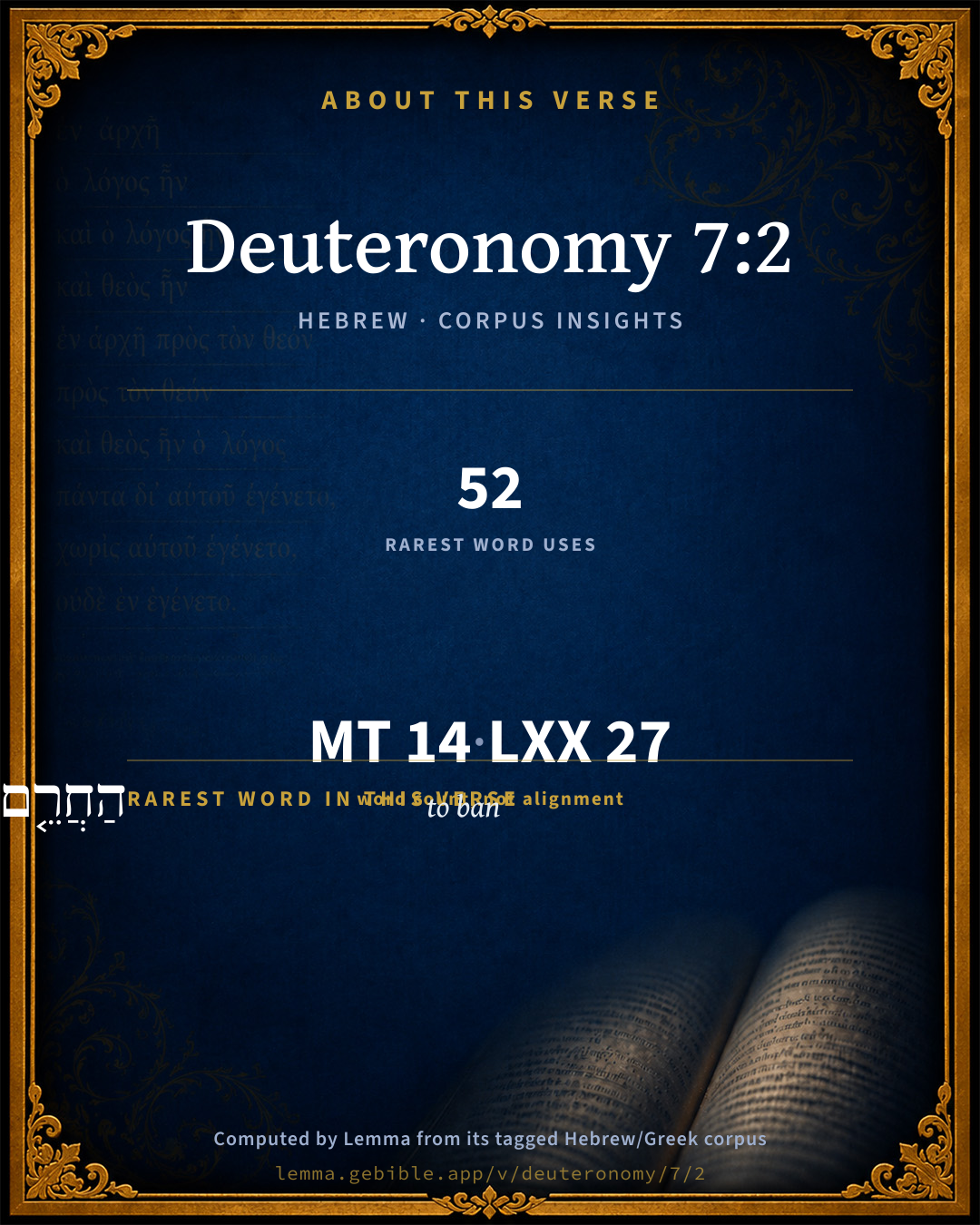
14
words
11
distinct lemmas
Pentateuch
section

Shared distinctive vocabulary

הַחֲרֵ֤ם to ban H2763 occurs in 48 verses of the Hebrew Bible. Also found in:

Grammatical profile

  • 6 verbs
  • 4 nouns
  • 1 preposition
  • 3 particles

Verb forms

  • וּנְתָנָ֞ם Qal · Sequential Perfect
  • וְהִכִּיתָ֑ם Hiphil · Sequential Perfect
  • הַחֲרֵ֤ם Hiphil · Infinitive Absolute
  • תַּחֲרִים֙ Hiphil · Imperfect
  • תִכְרֹ֥ת Qal · Imperfect
  • תְחָנֵּֽם Qal · Imperfect

Repetition

Words recur within this verse — often emphatic in Hebrew:

  • הַחֲרֵ֤ם to ban H2763 ×2
  • לֹא not H3808 ×2

Hebrew & Septuagint length

In English translation the verse runs 34 words from the Hebrew and 34 from the Septuagint (LXX English) — the same length.

A rough comparison of the two English renderings, which tokenize alike — not a word-level alignment.

Word counts can differ between the Hebrew and the Greek without any difference in meaning — e.g. the Hebrew direct-object marker אֵת has no separate Greek word, and Greek often adds the article ὁ.

In the original languages it is 14 Hebrew tokens and 27 Greek tokens — but the two are counted differently (Hebrew bundles its prefixes and suffixes into one token; the Greek is in lemma form), so that isn’t a like-for-like length.

Cross-references

29

Topical passages linked to Deuteronomy 7:2 in the Treasury of Scripture Knowledge — connected by theme and wording, ordered by reader-vote popularity; previews shown in the World English Bible.

  • Exodus 23:32–33 You shall make no covenant with them, nor with their gods.
  • Judges 2:2 and you shall make no covenant with the inhabitants of this land; you shall break down their altars. But you have not listened to my voice: why have you done this?
  • Deuteronomy 20:16–17 But of the cities of these peoples, that Yahweh your God gives you for an inheritance, you shall save alive nothing that breathes;
  • Leviticus 27:28–29 "'Notwithstanding, no devoted thing, that a man shall devote to Yahweh of all that he has, whether of man or animal, or of the field of his possession, shall be sold or redeemed: every devoted thing is most holy to Yahweh.
  • Deuteronomy 23:14 for Yahweh your God walks in the midst of your camp, to deliver you, and to give up your enemies before you; therefore shall your camp be holy, that he may not see an unclean thing in you, and turn away from you.
  • Joshua 2:14 The men said to her, Our life for yours, if you don't utter this our business; and it shall be, when Yahweh gives us the land, that we will deal kindly and truly with you.
  • Joshua 10:30 and Yahweh delivered it also, and the king of it, into the hand of Israel; and he struck it with the edge of the sword, and all the souls who were therein; he left none remaining in it; and he did to the king of it as he had done to the king of Jericho.
  • Joshua 11:11–12 They struck all the souls who were therein with the edge of the sword, utterly destroying them; there was none left who breathed: and he burnt Hazor with fire.
  • Genesis 14:20 and blessed be God Most High, who has delivered your enemies into your hand." Abram gave him a tenth of all.
  • Exodus 34:12–16 Be careful, lest you make a covenant with the inhabitants of the land where you are going, lest it be for a snare in the midst of you:
  • Numbers 33:52 then you shall drive out all the inhabitants of the land from before you, and destroy all their figured [stones], and destroy all their molten images, and demolish all their high places:
  • Deuteronomy 3:3 So Yahweh our God delivered into our hand Og also, the king of Bashan, and all his people: and we struck him until none was left to him remaining.
  • Deuteronomy 7:23–24 But Yahweh your God will deliver them up before you, and will confuse them with a great confusion, until they be destroyed.
  • Deuteronomy 13:8 you shall not consent to him, nor listen to him; neither shall your eye pity him, neither shall you spare, neither shall you conceal him:
  • Deuteronomy 20:10–11 When you draw near to a city to fight against it, then proclaim peace to it.
  • Joshua 6:17–25 The city shall be devoted, even it and all that is therein, to Yahweh: only Rahab the prostitute shall live, she and all who are with her in the house, because she hid the messengers that we sent.
  • Joshua 8:24 It happened, when Israel had made an end of killing all the inhabitants of Ai in the field, in the wilderness in which they pursued them, and they were all fallen by the edge of the sword, until they were consumed, that all Israel returned to Ai, and struck it with the edge of the sword.
  • Joshua 9:18–21 The children of Israel didn't strike them, because the princes of the congregation had sworn to them by Yahweh, the God of Israel. All the congregation murmured against the princes.
  • Joshua 9:24 They answered Joshua, and said, Because it was certainly told your servants, how that Yahweh your God commanded his servant Moses to give you all the land, and to destroy all the inhabitants of the land from before you; therefore we were sore afraid for our lives because of you, and have done this thing.
  • Joshua 10:24–25 It happened, when they brought forth those kings to Joshua, that Joshua called for all the men of Israel, and said to the chiefs of the men of war who went with him, Come near, put your feet on the necks of these kings. They came near, and put their feet on the necks of them.
  • Joshua 10:28 Joshua took Makkedah on that day, and struck it with the edge of the sword, and the king of it: he utterly destroyed them and all the souls who were therein; he left none remaining; and he did to the king of Makkedah as he had done to the king of Jericho.
  • Joshua 10:32 and Yahweh delivered Lachish into the hand of Israel; and he took it on the second day, and struck it with the edge of the sword, and all the souls who were therein, according to all that he had done to Libnah.
  • Joshua 10:40 So Joshua struck all the land, the hill-country, and the South, and the lowland, and the slopes, and all their kings: he left none remaining, but he utterly destroyed all that breathed, as Yahweh, the God of Israel, commanded.
  • Joshua 10:42 All these kings and their land did Joshua take at one time, because Yahweh, the God of Israel, fought for Israel.
  • Joshua 21:44 Yahweh gave them rest round about, according to all that he swore to their fathers: and there stood not a man of all their enemies before them; Yahweh delivered all their enemies into their hand.
  • Judges 1:4 Judah went up; and Yahweh delivered the Canaanites and the Perizzites into their hand: and they struck of them in Bezek ten thousand men.
  • Judges 1:24 The watchers saw a man come forth out of the city, and they said to him, Show us, we pray you, the entrance into the city, and we will deal kindly with you.
  • 2 Samuel 21:2 The king called the Gibeonites, and said to them (now the Gibeonites were not of the children of Israel, but of the remnant of the Amorites; and the children of Israel had sworn to them: and Saul sought to kill them in his zeal for the children of Israel and Judah);
  • Exodus 22:20 "He who sacrifices to any god, except to Yahweh only, shall be utterly destroyed.

Cross-references courtesy of OpenBible.info (CC BY 4.0).

Hebrew and Greek witnesses Masoretic Hebrew ↔ Greek Septuagint

The same verse in the two great witnesses to the Old Testament, shown verse-for-verse.

These are two independent witnesses, not word-aligned to each other, and the Septuagint is shown in lemma (dictionary) form.

Hebrew Deuteronomy 7:2 Masoretic · Westminster Leningrad Codex

וּנְתָנָ֞ם יְהוָ֧ה אֱלֹהֶ֛יךָ לְפָנֶ֖יךָ וְהִכִּיתָ֑ם הַחֲרֵ֤ם תַּחֲרִים֙ אֹתָ֔ם לֹא תִכְרֹ֥ת לָהֶ֛ם בְּרִ֖ית וְלֹ֥א תְחָנֵּֽם

and when Yahweh your God shall deliver them up before you, and you shall strike them; then you shall utterly destroy them: you shall make no covenant with them, nor show mercy to them;

World English Bible · Public Domain

Greek LXX Deuteronomy 7:2 Septuagint · lemma form

καί παραδίδωμι αὐτός κύριος ὁ θεός σύ εἰς ὁ χείρ σύ καί πατάσσω αὐτός ἀφανισμός ἀπο ἀναἵζω αὐτός οὐ διατίθημι πρός αὐτός διαθήκη οὐδέ μή ἐλεέω αὐτός

and the Lord your God shall deliver them into your hands, then you shall strike them: you shall utterly destroy them: you shall not make a covenant with them, neither shall you⌃ pity them:

LXX2012 (modern English Septuagint) · Public Domain

Hebrew: Westminster Leningrad Codex (CC BY 4.0). Greek: Septuagint (public domain); English from LXX2012 (modern English Septuagint) (Public Domain). How the Septuagint differs from the Hebrew →

Targum (Aramaic paraphrase)

2

The Targum is the ancient Jewish Aramaic paraphrase of the Hebrew Scriptures — an interpretive translation, not the Hebrew text itself. Onkelos (literal) and Pseudo-Jonathan (expansive) render the Torah, and Jonathan the Prophets. Coverage is partial: where no permissively-licensed English translation exists for a verse, only the Aramaic is shown. This is verse-level text, not a word-by-word alignment to the Hebrew.

  1. Targum Onkelos Torah (Genesis–Deuteronomy)
    וְיִמְסְרִנוּן יְיָ אֱלָהָךְ קֳדָמָךְ וְתִמְחִנוּן גַמָרָא תְגַמַר יָתְהוֹן לָא תִגְזַר לְהוֹן קְיָם וְלָא תְרַחַם עֲלֵיהוֹן

    (no public-domain English translation for this verse)

    Targum Onkelos — Aramaic: “Onkelos Genesis” (public domain); “Onkelos Exodus” (public domain); “Onkelos Leviticus” (public domain); “Onkelos Numbers” (public domain); “Onkelos Deuteronomy” (public domain). English: “Sefaria Community Translation” (CC0 1.0 (public-domain dedication)); “J.W. Etheridge. The Targums of Onkelos and Jonathan Ben Uzziel on the Pentateuch. London: Longmans, Green, 1862” (public domain). Text via Sefaria.

  2. Targum Pseudo-Jonathan Torah (Genesis–Deuteronomy)
    וְיִמְסְרִינוּן יְיָ אֱלָהָכוֹן קֳדָמֵיכוֹן וְתִמְחִינוּן גַּמָרָא תְּגַמְרוּן יַתְהוֹן בְּשַׁמַתָּא דַיְיָ לָא תִגְזְרוּן לְהוֹן קְיָים וְלָא תְרַחֲמוּן עֲלֵיהוֹן

    and the Lord your God will deliver them up before you, then shall you blot them out and utterly consume them by the curse of the Lord. You shall strike no covenant with them, nor have pity upon them.

    Targum Pseudo-Jonathan — Aramaic: “Targum Jonathan on Genesis” (public domain); “Targum Jonathan on Exodus” (public domain); “Targum Jonathan on Leviticus” (public domain); “Targum Jonathan on Numbers” (public domain); “Targum Jonathan on Deuteronomy” (public domain). English: “The Targum of Jonathan ben Uzziel, trans. J. W. Etheridge, London, 1862” (public domain). Text via Sefaria.

Commentary

Notes on Deuteronomy 7:2 from classic Christian and Jewish commentators (each source and its license shown beneath its notes). The classic Christian expositions comment on the surrounding passage and are grouped to its opening verse, so a note may address several verses; the Jewish commentaries on the Tanakh (Rashi and others) are per-verse, so they appear only where the commentator wrote on this verse.

Lemma curates 59 commentaries, every one of them public domain or Creative Commons licensed, each selected and text-cleaned for this edition rather than reprinted as found. About our sources →

Trapp's Complete Commentary

John Trapp

Deu 7:2 And when the LORD thy God shall deliver them before thee; thou shalt smite them, [and] utterly destroy them; thou shalt make no covenant with them, nor shew mercy unto them:

Ver. 2. Nor show mercy unto them.] Their iniquity was now full; {Gen 15:16} they filled the land with filthiness, from corner to corner; {Ezr 9:11} they were ripe for the sickle, ready for the vintage of God’s wrath, which now came upon them to the utmost.

John Trapp, A Commentary or Exposition upon All the Books of the Old and New Testament (1647–1656) — public domain. Text from a community e-Sword module.

Joseph Benson's Commentary

Deu 7:2. Thou shalt smite and utterly destroy them — That is, in case they continued obstinate in their idolatry, they were to be destroyed, as nations, or bodies politic. But if they forsook their idolatry, and became sincere proselytes to the true religion, they would then be proper objects of forgiveness, as being true penitents. For, says God himself, by Jeremiah, (Jer 7:8,) At what instant I shall speak concerning a nation to destroy it, if that nation turn from their evil, I will repent of the evil which I thought to do unto them. Thou shalt make no covenant with them — See Exo 23:32; Exo 24:12. To make a covenant with and to spare such incurable idolaters, would have been cruelty to themselves and their posterity.

Joseph Benson's Commentary on the Old and New Testaments (1811–1818) — public domain. Text from a community e-Sword module.

Geneva Bible (1599)

Geneva Bible translators

Into thy power.

Geneva Bible (1599) marginal notes — public domain. Text via Bolls.life.

Jamieson, Fausset & Brown

Robert Jamieson, A. R. Fausset & David Brown

thou shalt smite them, and utterly destroy them; thou shalt make no covenant with them--This relentless doom of extermination which God denounced against those tribes of Canaan cannot be reconciled with the attributes of the divine character, except on the assumption that their gross idolatry and enormous wickedness left no reasonable hope of their repentance and amendment. If they were to be swept away like the antediluvians or the people of Sodom and Gomorrah, as incorrigible sinners who had filled up the measure of their iniquities, it mattered not to them in what way the judgment was inflicted; and God, as the Sovereign Disposer, had a right to employ any instruments that pleased Him for executing His judgments. Some think that they were to be exterminated as unprincipled usurpers of a country which God had assigned to the posterity of Eber and which had been occupied ages before by wandering shepherds of that race, till, on the migration of Jacob's family into Egypt through the pressure of famine, the Canaanites overspread the whole land, though they had no legitimate claim to it, and endeavored to retain possession of it by force. In this view their expulsion was just and proper. The strict prohibition against contracting any alliances with such infamous idolaters was a prudential rule, founded on the experience that "evil communications corrupt good manners" [Co1 15:33], and its importance or necessity was attested by the unhappy examples of Solomon and others in the subsequent history of Israel.

Jamieson, Fausset & Brown — Commentary Critical and Explanatory on the Whole Bible (1871) — public domain (CC PDM 1.0). Text via the HelloAO Bible API.

Adam Clarke's Commentary

Verse 2. Thou shalt smite them, c.] These idolatrous nations were to be utterly destroyed, and all the others also which were contiguous to the boundaries of the promised land, provided they did not renounce their idolatry and receive the true faith: for if they did not, then no covenant was to be made with them on any secular or political consideration whatever no mercy was to be shown to them, because the cup of their iniquity also was now full; and they must either embrace, heartily embrace, the true religion, or be cut off.

Adam Clarke's Commentary on the Bible (1810–1826) — public domain. Text from a community e-Sword/MySword module.

Ellicott's Commentary for English Readers

(2) And when the Lord thy God shall deliver them before thee. . . .—It would be possible to read, “Then the Lord thy God shall deliver them before thee, and thou shalt smite.” Or the sentence might also be divided thus: “When the Lord thy God shall bring thee in, and shall have delivered the nations from before thee, and thou hast smitten them, then thou shalt utterly destroy them”—i.e., shalt make them chêrem, a devoted or accursed thing. Perhaps this last way of dividing the clauses is, upon the whole, to be preferred. But in any case it should be noted that Jehovah’s deliverance of the nations into Israel’s hand is to precede their defeat and extermination. Indiscriminate attack and massacre are not to be thought of. (See for a further Note on this, Joshua 13) All the operations described in Joshua—the sieges of Jericho and Ai, the southern campaign and the northern campaign—were alike undertaken under Divine direction. The same may be said of the battles in Moses’ lifetime, whether against Amalek, Sihon, Og, Arad, or Midian. The same is true of the judges, and of David’s operations against the Philistines after he came to the throne (2Sa_5:19, &c). The principle was acknowledged by Ahab in his attack on Ramoth-gilead (1 Kings 22).

Thou shalt make no covenant with them.—The reason for this is too obvious to need comment. If Israelites and idolaters were united—still more if they were intermingled in marriage—there was an end to the distinction of race and religion—an end to the supremacy of Israel or the isolation of the people of Jehovah, as exhibiting His Law and the blessings of His government to mankind. It must be remembered, however, that the isolation here commanded was only a means to an end; it was not the end itself. It may be further observed that as soon as the danger of idolatry was at an end, the isolation of Israel in a great measure ceased. The object of giving the people a land of their own, and supremacy among the surrounding nations, was to enable them to develop the religion which was to prepare the way for Christianity. When the religious principles of the nation were sufficiently fixed to make their political supremacy unnecessary, this supremacy was taken away.

A Bible Commentary for English Readers, edited by Charles John Ellicott (1878–1897) — public domain. Text from a community e-Sword module.

The Cambridge Bible for Schools and Colleges

gen. ed. J. J. S. Perowne

2. deliver them up before] See on Deu_1:8.

thou shall utterly destroy them] put to the ban, herem. See on Deu_2:34.

make no covenant with them] no treaty or alliance; so in JE, Exo_23:32; Exo_34:12; cp. Jos_9:6, 1Sa_11:1 ff. (instances of such).

The Cambridge Bible for Schools and Colleges (gen. ed. J. J. S. Perowne; Cambridge University Press, 1878–1918) — public domain. Text from a community e-Sword module.

John Gill's Exposition

And when the Lord thy God shall deliver them before thee,.... Into their hands:

thou shalt smite them, and utterly destroy them; men, women, and children; which was ordered not merely to make way and room for the people of Israel to inherit their land, but as a punishment for capital crimes they had been guilty of, such as idolatry, incest, murder, &c. wherefore though they were reprieved for a while for Israel's sake, till their time was come to possess the land, they were at length righteously punished; which observed, abates the seeming severity exercised upon them:

thou shalt make no covenant with them; to dwell in their cities and houses, and enjoy their lands and estates, on any condition whatever; and though they did make a league with the Gibeonites, that was obtained by fraud, they pretending not to be of the land of Canaan, but to come from a very distant country:

nor show mercy unto them; by sparing their lives, bestowing any favours upon them, or giving them any help and assistance when in distress: the Jews extend this to all other Heathen nations besides these seven; wherefore, if an Israelite, as Maimonides (z) says, should see a Gentile perishing, or plunged into a river, he may not take him out, nor administer medicine to a sick person. Hence Juvenal (a) the poet upbraids them with their unkindness and incivility; and says that Moses delivered it as a Jewish law, in a secret volume of his, perhaps referring to this book of Deuteronomy, that the Jews might not direct a poor traveller in his way unless he was one of their religion, nor one athirst to a fountain of water; and which led Tacitus (b), the Heathen historian, to make this remark upon them, that they entertained an hostile hatred against all other people.

(z) Hilchot Abodath Cochabim, c. 10. sect. 1, 2. (a) "Non monstrare vias", &c. Satyr 14. (b) Hist l. 5. c. 5.

John Gill's Exposition of the Whole Bible (1746–1763) — public domain (CC PDM 1.0). Text via the HelloAO Bible API.

Haydock's Catholic Bible Commentary

League. Yet Josue, (ix. 3,) by mistake, entered into one with the Gabaonites, and observed it; (Haydock) whence we may conclude, that only such leagues are forbidden as would leave these nations in possession of their lands and idols, chap. xx. 10., and xxiii. 6. With foreign nations it was lawful to make leagues defensive and offensive, as David, Asa, and the Machabees did with Hiram, Benadad, and the Romans, 3 Kings xv. 18, &c. If the Hebrews were so hostile to the nations of Chanaan, it was in execution of God’s decree, who had sentenced them to die; and Tacitus hence unjustly inferred, that they hated all but their own nation. See Grotius, Jur. ii. 15. --- Them. This was ill executed. (Josephus, [Antiquities?] xiii. 13.) (Judges i.) (Menochius)

George Leo Haydock (1774–1849), Haydock's Catholic Family Bible and Commentary, 1859 edition — public domain. Excludes Psalms (Douay-Rheims chapter numbering differs from Protestant) and Deuterocanonical books (Catholic canon only).

Matthew Poole's English Annotations

No covenant with them, to spare them, or permit them to dwell with thee in the land. Other nations had more favour, but these were for their great wickedness, and for the good of Israel, devoted to utter destruction.

Matthew Poole's English Annotations on the Holy Bible (1683–1685) — public domain. Text from a community e-Sword/MySword module.

Whedon's Commentary on the Bible

Daniel D. Whedon

2. Smite them, and utterly destroy them — Thou shalt treat them as accursed — as devoted to utter destruction. These nations had filled up the measure of their iniquity before Jehovah. They and all the forms of their debasing idolatry were to be obliterated from the land.

Daniel D. Whedon (gen. ed.), Commentary on the Old and New Testaments (1874–1909) — public domain. Text from a community e-Sword module.

unfoldingWord translationNotes

Door43 World Missions Community

General Information:

Moses continues to tell the people of Israel Yahweh's words as if the Israelites are one person. (See: Forms of You)

gives them over to you

Moses speaks of victory as if it were a physical object one person could give to another. AT: "enables you to defeat them" (See: Metaphor)

you defeat them

Here "them" refers to the seven nations from Deuteronomy 7:1.

translationWords

Yahweh

God

covenant

mercy

unfoldingWord translationNotes — © Distant Shores Media and the Door43 World Missions Community, licensed CC BY-SA 4.0. Source: git.door43.org/Door43/en_tn.

Rashi

Rabbi Shlomo Yitzchaki (Rashi)

ולא תחנם means, THOU SHALT NOT ASCRIBE GRACE (חן) TO THEM: it is forbidden to a person to say “How beautiful is this heathen”. Another explanation: thou shalt not grant them a חניה, an encampment (a settlement) in the land (Avodah Zarah 20a).

Rashi on the Tanakh — English translations: “The Judaica Press complete Tanach with Rashi, translated by A. J. Rosenberg” (CC BY 4.0); “Pentateuch with Rashi's commentary by M. Rosenbaum and A.M. Silbermann, 1929-1934” (public domain); “The Metsudah Tanach series, Lakewood, N.J” (CC BY 4.0); and “The Book of Joshua, Metsudah Publications, 1997” (CC BY 4.0). Text via Sefaria.

Lesson kit

Teaching starters — assembled from the data on this page, not authored interpretation. Every prompt links to the verse data it draws on. Edit before teaching.

Deuteronomy, in the Pentateuch, opens this verse with 14 words (11 distinct Hebrew lemmas). Its most distinctive word is châram (“to ban”). A historical commentator’s framing appears above. Read the whole chapter for the surrounding context.

Discussion questions

  1. The word châram carries the sense “to ban.” How does it shape the verse?
  2. Exodus 22:20 shares the word «to ban» with this verse. How do the two illuminate each other?
  3. “to ban” occurs 2× in this one verse. What is the effect of the repetition?
  4. These translations render this verse differently; the difference is in the English rendering, not the original. What questions does that raise?
  5. The verb «וּנְתָנָ֞ם» is Qal Sequential Perfect. How does its form color the action?
  6. Reading how Trapp's Complete Commentary and Joseph Benson's Commentary read this verse, where do the two commentators agree and where do they part?

Things to notice

Reading settings

Reading text

Shown beneath each verse's original-language words.

Old Testament
Old Testament edition

Read the OT as the Masoretic Hebrew (MT) or the Greek Septuagint (LXX).

English shown for the Greek Septuagint (in the Hebrew ↔ Greek comparison).

Comparing translations? Open the Compare panel on any verse page to stack up to four side by side.