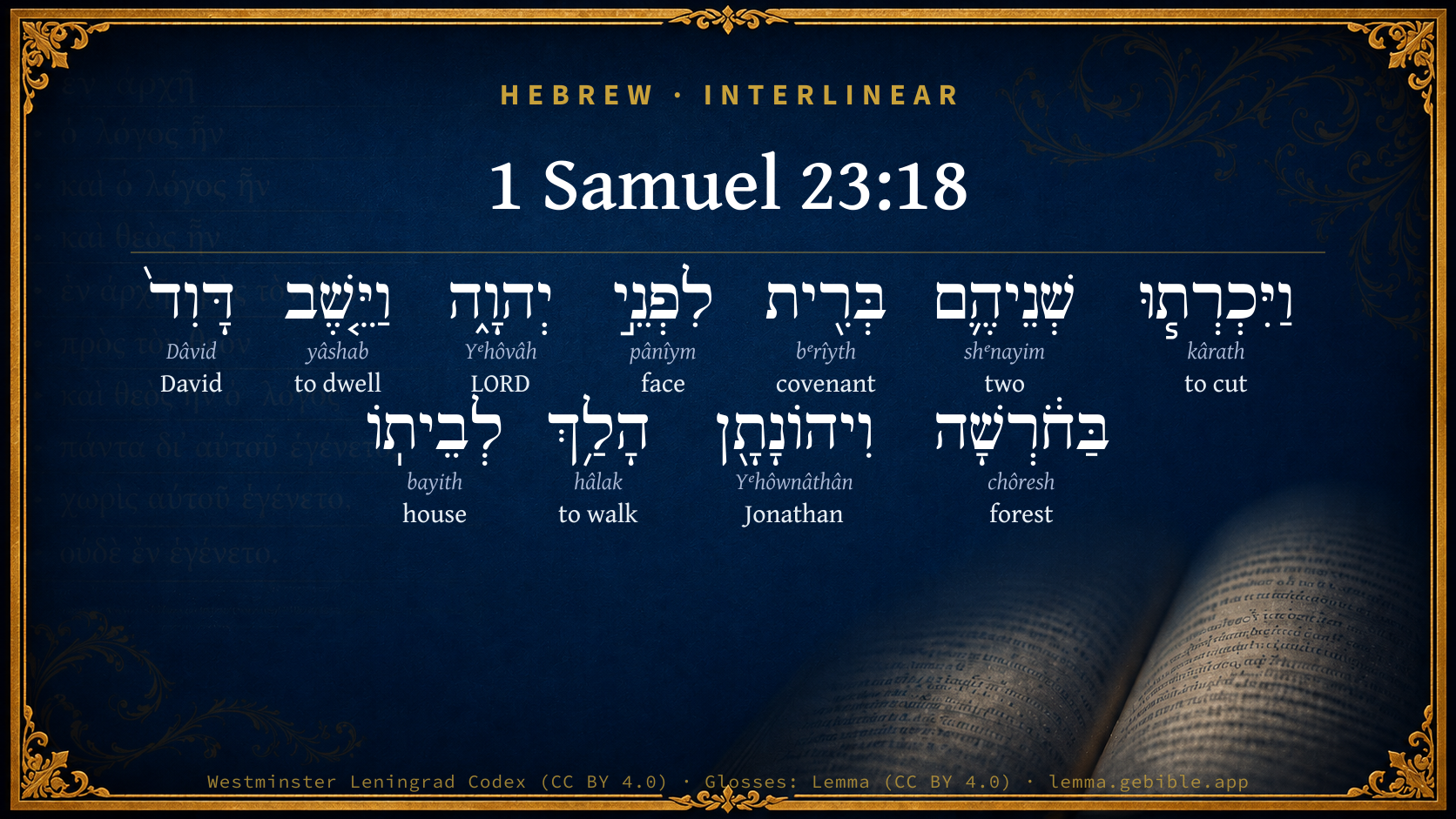
1 Samuel 23:18

Hebrew (Westminster Leningrad Codex) 1 Samuel 23:18 appears in the Hebrew Old Testament. The text above is from the Westminster Leningrad Codex. Each word links to its Strong’s number, a concise gloss, and parsing drawn from the Open Scriptures Hebrew Bible morphology. Click any word for its full Brown-Driver-Briggs (BDB) entry.
Download image
Cite this verse

1 Samuel 23:18 (World English Bible). Public Domain. Lemma interlinear Bible study tool, https://lemma.gebible.app/v/1-samuel/23/18.

Show BibTeX & RIS
BibTeX
RIS
English Translation
They two made a covenant before Yahweh: and David abode in the wood, and Jonathan went to his house.
World English Bible · Public Domain
Download a study sheet

One document with this verse’s original text, its word-by-word gloss line, the meaning frame, cross-references with their text, attributed commentary, and full source and license credits — printable, and it pastes into notes with its structure intact.

This verse Autodidact and up

Study sheet (.html) Plain text (.txt)

A passage Seminary Student

Up to 50 verses in one chapter. A passage sheet keeps up to 6 commentary sources and 12 cross-references per verse, in the order this page ranks them, and says so on the sheet whenever that leaves anything out. Ask for a single verse and you get the Autodidact verse sheet above.

Everything on this page stays free to read, with no account — the sheet is a download of what is already on screen, not access to it.

Want to remove ads? Support Godless Engineer
Compare translations 3

The same verse in 3 English versions, stacked beneath the original-language interlinear above. Click any original word for its lexicon entry.

Each is an independent rendering of the whole verse — the interlinear is not word-aligned to these translations.

Highlighted words mark where these versions differ — a whole-verse word diff, not a word-by-word alignment.

  • World English Bible Public Domain
    They two made a covenant before Yahweh: and David abode in the wood, and Jonathan went to his house.
  • King James Version Public Domain
    And they two made a covenant before the LORD: and David abode in the wood, and Jonathan went to his house.
  • unfoldingWord Literal Text CC BY-SA 4.0
    And the two of them cut a covenant to the face of Yahweh. And David stayed in the forest, and Jonathan went to his house.

unfoldingWord Literal Text — © unfoldingWord, licensed CC BY-SA 4.0. Word-aligned USFM3 via Door43 (git.door43.org/unfoldingWord/en_ult).

Versions to compare (up to 4)

3 of 4 selected

Show all 18 translations

Every available English version of this verse, each an independent rendering of the whole verse.

  • World English Bible Public Domain
    They two made a covenant before Yahweh: and David abode in the wood, and Jonathan went to his house.
  • Berean Standard Bible Public Domain
    So the two of them made a covenant before the LORD. And David remained in Horesh, while Jonathan went home.
  • Majority Standard Bible Public Domain
    So the two of them made a covenant before the LORD. And David remained in Horesh, while Jonathan went home.
  • King James Version Public Domain
    And they two made a covenant before the LORD: and David abode in the wood, and Jonathan went to his house.
  • American Standard Version (1901) Public Domain
    And they two made a covenant before Jehovah: and David abode in the wood, and Jonathan went to his house.
  • Revised Version (1885) Public Domain
    And they two made a covenant before the LORD: and David abode in the wood, and Jonathan went to his house.
  • Geneva Bible (1599) Public Domain
    So they twaine made a couenant before ye Lord: and Dauid did remaine in the wood: but Ionathan went to his house.
  • Douay-Rheims (1899) Public Domain
    And the two made a covenant before the Lord: and David abode in the wood: but Jonathan returned to his house.
  • Young's Literal Translation Public Domain
    And they make a covenant both of them before Jehovah; and David abideth in the forest, and Jonathan hath gone to his house.
  • Literal Standard Version CC BY-SA 4.0
    And both of them make a covenant before YHWH; and David abides in the forest, and Jonathan has gone to his house.
  • Unlocked Literal Bible CC BY-SA 4.0
    They made a covenant before Yahweh. David remained at Horesh, and Jonathan went home.
  • unfoldingWord Literal Text CC BY-SA 4.0
    And the two of them cut a covenant to the face of Yahweh. And David stayed in the forest, and Jonathan went to his house.
  • Darby Bible Public Domain
    And they two made a covenant before Jehovah; and David abode in the wood, and Jonathan went to his house.
  • World Messianic Bible Public Domain
    They both made a covenant before the LORD. Then David stayed in the woods and Jonathan went to his house.
  • Webster's Bible Public Domain
    And they two made a covenant before the LORD: and David abode in the wood, and Jonathan went to his house.
  • Free Bible Version CC BY-SA 4.0
    The two of them made an agreement before the Lord. David stayed in Horesh and Jonathan went home.
  • Bible in Basic English Public Domain
    And the two of them made an agreement before the Lord: and David went on living in Horesh, and Jonathan went back to his house.
  • JPS Tanakh (1917) Public Domain
    And they two made a covenant before the LORD; and David abode in the wood, and Jonathan went to his house.

Literal Standard Version (2020), Covenant Press — licensed CC BY-SA 4.0. Text via the HelloAO Bible API (eBible.org). Unlocked Literal Bible (unfoldingWord) — licensed CC BY-SA 4.0. Text via the HelloAO Bible API (eBible.org). unfoldingWord Literal Text — © unfoldingWord, licensed CC BY-SA 4.0. Word-aligned USFM3 via Door43 (git.door43.org/unfoldingWord/en_ult). Free Bible Version, Dr. Jonathan Gallagher — licensed CC BY-SA 4.0. Text via the HelloAO Bible API (eBible.org).

Word by word

More ways to search: Search by grammar → Find every occurrence → Compare this word →

Practice this passage: Drill this verse → Learn its vocabulary →

בַּחֹ֔רְשָׁה
chôresh
H2793
“in/at the · forest”
Preposition, Determined + Noun, Proper
Part of Speech
Preposition + Noun
Type
Proper
Full BDB Definition

Origin: from H2790

TWOT: 762a

wood, wooded height, forest, wooded area
  1. וַיִּכְרְת֧וּ kârath H3772 “and · to cut” Conjunction + Verb, Qal, Sequential Imperfect, 3rd Person, Masculine, Plural
  2. שְׁנֵיהֶ֛ם shᵉnayim H8147 “two · their” Adjective, Cardinal number, Masculine, Dual, Construct + Suffix, Personal, 3rd Person, Masculine, Plural
  3. בְּרִ֖ית bᵉrîyth H1285 “covenant” Noun, Common, Feminine, Singular, Absolute
  4. לִפְנֵ֣י pânîym H6440 “to/for · face(s) of” Preposition + Noun, Common, Both, Plural, Construct
  5. יְהוָ֑ה Yᵉhôvâh H3068 “LORD” Noun, Proper
  6. וַיֵּ֤שֶׁב yâshab H3427 “and · to dwell” Conjunction + Verb, Qal, Sequential Imperfect, 3rd Person, Masculine, Singular
  7. דָּוִד֙ Dâvid H1732 “David” Noun, Proper
  8. וִיהוֹנָתָ֖ן Yᵉhôwnâthân H3083 “and · Jonathan” Conjunction + Noun, Proper
  9. הָלַ֥ךְ hâlak H1980 “to walk” Verb, Qal, Perfect, 3rd Person, Masculine, Singular
  10. לְבֵיתֽוֹ bayith H1004 “to/for · house · his” Preposition + Noun, Common, Masculine, Singular, Construct + Suffix, Personal, 3rd Person, Masculine, Singular

About this verse

These counts appear in no published source. They are computed here, from the morphology-tagged text and Lemma’s own curated glosses. What Lemma adds →

11
words
11
distinct lemmas
Historical
section

Notable vocabulary

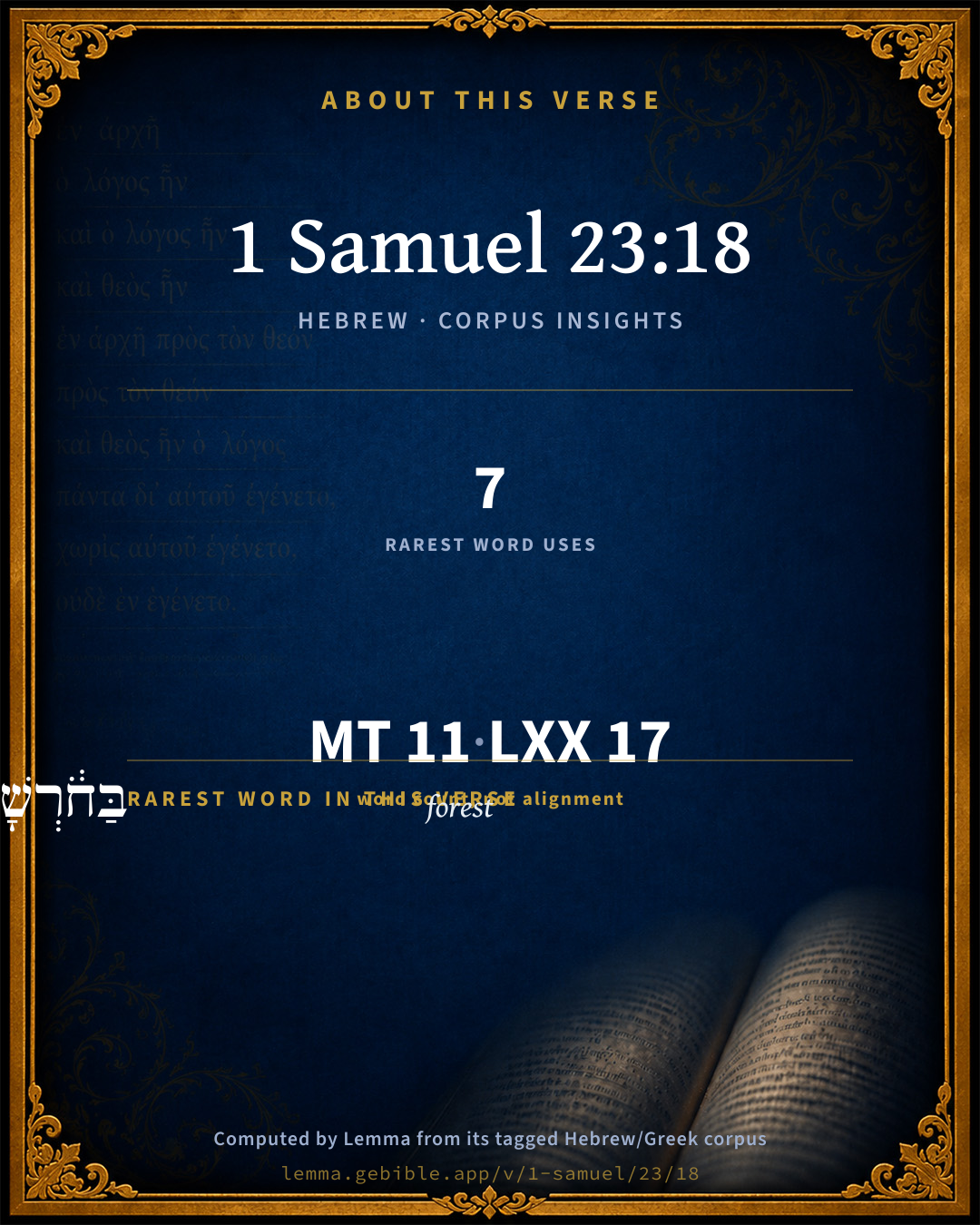
The rarest word here is בַּחֹ֔רְשָׁה forest H2793 — appearing just 7 times in the whole Hebrew Bible.

Shared distinctive vocabulary

בַּחֹ֔רְשָׁה forest H2793 occurs in 7 verses of the Hebrew Bible. Also found in:

Grammatical profile

  • 3 verbs
  • 7 nouns
  • 1 adjective

Verb forms

  • וַיִּכְרְת֧וּ Qal · Sequential Imperfect
  • וַיֵּ֤שֶׁב Qal · Sequential Imperfect
  • הָלַ֥ךְ Qal · Perfect

Hebrew & Septuagint length

In English translation the verse runs 19 words from the Hebrew and 20 from the Septuagint (LXX English) — closely comparable.

A rough comparison of the two English renderings, which tokenize alike — not a word-level alignment.

Word counts can differ between the Hebrew and the Greek without any difference in meaning — e.g. the Hebrew direct-object marker אֵת has no separate Greek word, and Greek often adds the article ὁ.

In the original languages it is 11 Hebrew tokens and 17 Greek tokens — but the two are counted differently (Hebrew bundles its prefixes and suffixes into one token; the Greek is in lemma form), so that isn’t a like-for-like length.

Cross-references

5

Topical passages linked to 1 Samuel 23:18 in the Treasury of Scripture Knowledge — connected by theme and wording, ordered by reader-vote popularity; previews shown in the World English Bible.

  • 1 Samuel 18:3 Then Jonathan and David made a covenant, because he loved him as his own soul.
  • 1 Samuel 20:42 Jonathan said to David, Go in peace, because we have sworn both of us in the name of Yahweh, saying, Yahweh shall be between me and you, and between my seed and your seed, forever. He arose and departed: and Jonathan went into the city.
  • 2 Samuel 21:7 But the king spared Mephibosheth, the son of Jonathan the son of Saul, because of Yahweh's oath that was between them, between David and Jonathan the son of Saul.
  • 2 Samuel 9:1 David said, Is there yet any who is left of the house of Saul, that I may show him kindness for Jonathan's sake?
  • 1 Samuel 20:12–17 Jonathan said to David, Yahweh, the God of Israel, [be witness]: when I have sounded my father about this time tomorrow, [or] the third day, behold, if there be good toward David, shall I not then send to you, and disclose it to you?

Cross-references courtesy of OpenBible.info (CC BY 4.0).

Hebrew and Greek witnesses Masoretic Hebrew ↔ Greek Septuagint

The same verse in the two great witnesses to the Old Testament, shown verse-for-verse.

These are two independent witnesses, not word-aligned to each other, and the Septuagint is shown in lemma (dictionary) form.

Hebrew 1 Samuel 23:18 Masoretic · Westminster Leningrad Codex

וַיִּכְרְת֧וּ שְׁנֵיהֶ֛ם בְּרִ֖ית לִפְנֵ֣י יְהוָ֑ה וַיֵּ֤שֶׁב דָּוִד֙ בַּחֹ֔רְשָׁה וִיהוֹנָתָ֖ן הָלַ֥ךְ לְבֵיתֽוֹ

They two made a covenant before Yahweh: and David abode in the wood, and Jonathan went to his house.

World English Bible · Public Domain

Greek LXX 1 Samuel 23:18 Septuagint · lemma form

καί διατίθημι ἀμφότεροι διαθήκη ἐνώπιον κύριος καί καταἧμαι δαυίδ ἐν καινή καί ιωναθαν ἀποἔρχομαι εἰς οἶκος αὐτός

So they both made a covenant before the Lord; and David lived in Caene, and Jonathan went to his home.

LXX2012 (modern English Septuagint) · Public Domain

Hebrew: Westminster Leningrad Codex (CC BY 4.0). Greek: Septuagint (public domain); English from LXX2012 (modern English Septuagint) (Public Domain). How the Septuagint differs from the Hebrew →

Targum (Aramaic paraphrase)

1

The Targum is the ancient Jewish Aramaic paraphrase of the Hebrew Scriptures — an interpretive translation, not the Hebrew text itself. Onkelos (literal) and Pseudo-Jonathan (expansive) render the Torah, and Jonathan the Prophets. Coverage is partial: where no permissively-licensed English translation exists for a verse, only the Aramaic is shown. This is verse-level text, not a word-by-word alignment to the Hebrew.

  1. Targum Jonathan Prophets (Joshua–Malachi)
    וּגְזָרוּ תַרְוֵיהוֹן קְיָם קֳדָם יְיָ וִיתֵיב דָוִד בַּחוֹרְשָׁא וִיהוֹנָתָן אֲזַל לְבֵיתֵיהּ:

    (no public-domain English translation for this verse)

    Targum Jonathan — Aramaic: “Mikraot Gedolot” (public domain). English: “Sefaria Community Translation” (CC0 1.0 (public-domain dedication)); “London "Chaldee Paraphrase," 1871” (public domain). Text via Sefaria.

Commentary

Notes on 1 Samuel 23:18 from classic Christian and Jewish commentators (each source and its license shown beneath its notes). The classic Christian expositions comment on the surrounding passage and are grouped to its opening verse, so a note may address several verses; the Jewish commentaries on the Tanakh (Rashi and others) are per-verse, so they appear only where the commentator wrote on this verse.

Lemma curates 59 commentaries, every one of them public domain or Creative Commons licensed, each selected and text-cleaned for this edition rather than reprinted as found. About our sources →

Trapp's Complete Commentary

John Trapp

1Sa 23:18 And they two made a covenant before the LORD: and David abode in the wood, and Jonathan went to his house.

Ver. 18. And they two made a covenant.] This is the second time, for more assurance; or, as Lyra reckoneth, the third: (1.) In the house; (2.) {1Sa 18:3} In the field; {1Sa 20:5} (3.) Here in the wood. Let us oft renew and reinforce our covenants with God, that we may the better observe them: all will be found little enough.

John Trapp, A Commentary or Exposition upon All the Books of the Old and New Testament (1647–1656) — public domain. Text from a community e-Sword module.

Joseph Benson's Commentary

1Sa 23:18. They two made a covenant before the Lord — We have reason here to admire the sincere friendship of Jonathan, which remained so unshaken to David in all events, as well in his adversity and dangers, as in his prosperity and successes. It is to be observed, that, after making this covenant, they never came together again, that we find, in this world.

Joseph Benson's Commentary on the Old and New Testaments (1811–1818) — public domain. Text from a community e-Sword module.

Tyndale Open Study Notes

Tyndale Open Resources

23:18 their solemn pact: See 18:3-4; 20:12-17. • Jonathan returned home: This was probably the last time David and Jonathan saw each other.

Tyndale Open Study Notes — © Tyndale Open Resources, licensed CC BY-SA 4.0. Text via the HelloAO Bible API.

The Cambridge Bible for Schools and Colleges

gen. ed. J. J. S. Perowne

18. to his house] Home to Gibeah, where Saul was (1Sa_23:19). It was the final parting of the friends.

The Cambridge Bible for Schools and Colleges (gen. ed. J. J. S. Perowne; Cambridge University Press, 1878–1918) — public domain. Text from a community e-Sword module.

John Gill's Exposition

And they two made a covenant before the Lord,.... Renewed the covenant they had before made in the name and fear of God, and before him as a witness of it. Kimchi and Abarbinel interpret this phrase:

before the Lord, of the covenant being made before Abiathar, with the Urim and Thummim in his hand; and so Jerom (p), before Gad the prophet, and Abiathar who wore the ephod:

and David abode in the wood; being a proper place for him for secrecy and safety:

and Jonathan went to his house; in Gibeah; and these two dear and cordial friends never saw one another more, as is highly probable.

(p) Trad. Heb. in lib. Reg. fol. 76. K.

John Gill's Exposition of the Whole Bible (1746–1763) — public domain (CC PDM 1.0). Text via the HelloAO Bible API.

Haydock's Catholic Bible Commentary

Lord, Gad or Abiathar being present. (St. Jerome) --- This is the third time they had confirmed their alliance, to satisfy their love. (Menochius)

George Leo Haydock (1774–1849), Haydock's Catholic Family Bible and Commentary, 1859 edition — public domain. Excludes Psalms (Douay-Rheims chapter numbering differs from Protestant) and Deuterocanonical books (Catholic canon only).

Matthew Poole's English Annotations

They two made a covenant, i.e. renewed their former covenant before the Lord; setting themselves as in God’s presence, and calling upon him to be witness between them.

Matthew Poole's English Annotations on the Holy Bible (1683–1685) — public domain. Text from a community e-Sword/MySword module.

Whedon's Commentary on the Bible

Daniel D. Whedon

18. They two made a covenant before the Lord — Alone in the wilderness of Ziph, and probably at the still hour of night, with none but Jehovah to witness, they solemnly renewed the covenant in which they had bound themselves twice before. 1Sa_18:30; 1Sa_20:16. This was the last time that Jonathan and the son of Jesse met.

Daniel D. Whedon (gen. ed.), Commentary on the Old and New Testaments (1874–1909) — public domain. Text from a community e-Sword module.

John Wesley's Explanatory Notes

Made a covenant - They then parted, and never came together again, that we find, in this world.

John Wesley, Explanatory Notes Upon the Whole Bible (1754–1765) — public domain. Text via the GEBible commentary corpus.

Keil & Delitzsch

C. F. Keil & F. Delitzsch

After these encouraging words, they two made a covenant before Jehovah: i.e., they renewed the covenant which they had already made by another solemn oath; after which Jonathan returned home, but David remained in the wood.

The treachery of the Ziphites forms a striking contrast to Jonathan's treatment of David. They went up to Gibeah to betray to Saul the fact that David was concealed in the wood upon their mountain heights, and indeed "upon the hill Hachilah, which lies to the south of the waste." The hill of Ziph is a flattened hill standing by itself, of about a hundred feet in height. "There is no spot from which you can obtain a better view of David's wanderings backwards and forwards in the desert than from the hill of Ziph, which affords a true panorama. The Ziphites could see David and his men moving to and fro in the mountains of the desert of Ziph, and could also perceive how he showed himself in the distance upon the hill Hachilah on the south side of Ziph (which lies to the right by the desert); whereupon they sent as quickly as possible to Saul, and betrayed to him the hiding-place of his enemy" (v. de Velde, ii. pp. 104-5). Jeshimon does not refer here to the waste land on the north-eastern coast of the Dead Sea, as in Num 21:20; Num 23:28, but to the western side of that sea, which is also desert.

Sa1 23:20 reads literally thus: "And now, according to all the desire of thy soul, O king, to come down (from Gibeah, which stood upon higher ground), come down, and it is in us to deliver him (David) into the hand of the king."

Keil & Delitzsch — Biblical Commentary on the Old Testament (1861–1891) — public domain (CC PDM 1.0). Text via the HelloAO Bible API. (Old Testament only.)

Lesson kit

Teaching starters — assembled from the data on this page, not authored interpretation. Every prompt links to the verse data it draws on. Edit before teaching.

1 Samuel, in the Historical, opens this verse with 11 words (11 distinct Hebrew lemmas). Its most distinctive word is chôresh (“forest”). A historical commentator’s framing appears above. Read the whole chapter for the surrounding context.

Discussion questions

  1. How does “forest” (chôresh) shape what this verse is saying?
  2. 1 Samuel 23:15 shares the word «forest» with this verse. How do the two illuminate each other?
  3. The translations on this page render this verse differently — a whole-verse word diff, not a word-by-word alignment. What might account for the different wordings?
  4. The verb «וַיִּכְרְת֧וּ» is Qal Sequential Imperfect. How does its form color the action?
  5. Reading how Trapp's Complete Commentary and Joseph Benson's Commentary read this verse, where do the two commentators agree and where do they part?

Things to notice

Reading settings

Reading text

Shown beneath each verse's original-language words.

Old Testament
Old Testament edition

Read the OT as the Masoretic Hebrew (MT) or the Greek Septuagint (LXX).

English shown for the Greek Septuagint (in the Hebrew ↔ Greek comparison).

Comparing translations? Open the Compare panel on any verse page to stack up to four side by side.