Leviticus 18:29

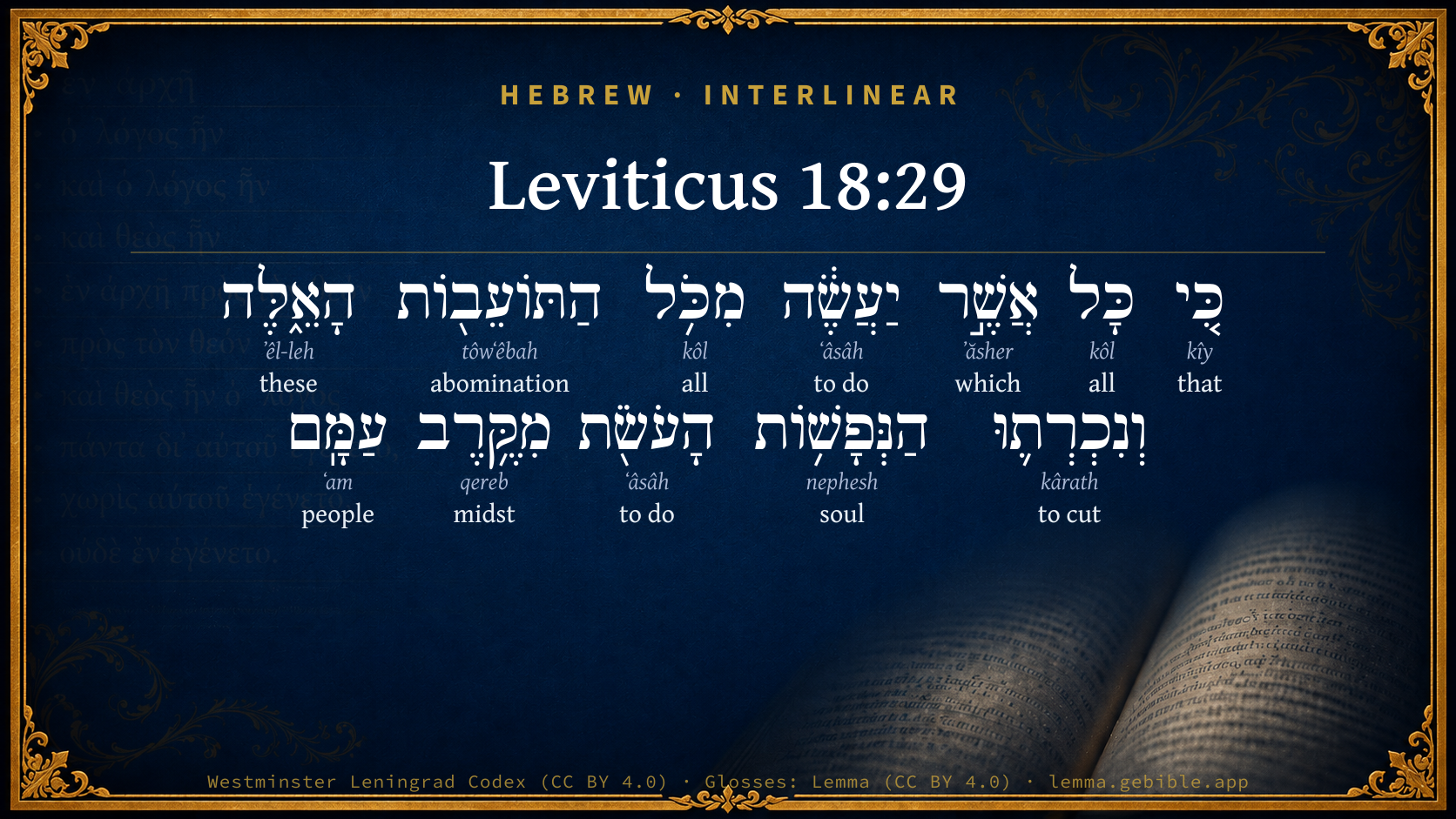
Hebrew (Westminster Leningrad Codex) Leviticus 18:29 appears in the Hebrew Old Testament. The text above is from the Westminster Leningrad Codex. Each word links to its Strong’s number, a concise gloss, and parsing drawn from the Open Scriptures Hebrew Bible morphology. Click any word for its full Brown-Driver-Briggs (BDB) entry.
Download image
Cite this verse

Leviticus 18:29 (World English Bible). Public Domain. Lemma interlinear Bible study tool, https://lemma.gebible.app/v/leviticus/18/29.

Show BibTeX & RIS
BibTeX
RIS
English Translation
"'For whoever shall do any of these abominations, even the souls that do them shall be cut off from among their people.
World English Bible · Public Domain
Download a study sheet

One document with this verse’s original text, its word-by-word gloss line, the meaning frame, cross-references with their text, attributed commentary, and full source and license credits — printable, and it pastes into notes with its structure intact.

This verse Autodidact and up

Study sheet (.html) Plain text (.txt)

A passage Seminary Student

Up to 50 verses in one chapter. A passage sheet keeps up to 6 commentary sources and 12 cross-references per verse, in the order this page ranks them, and says so on the sheet whenever that leaves anything out. Ask for a single verse and you get the Autodidact verse sheet above.

Everything on this page stays free to read, with no account — the sheet is a download of what is already on screen, not access to it.

Want to remove ads? Support Godless Engineer
Compare translations 3

The same verse in 3 English versions, stacked beneath the original-language interlinear above. Click any original word for its lexicon entry.

Each is an independent rendering of the whole verse — the interlinear is not word-aligned to these translations.

Highlighted words mark where these versions differ — a whole-verse word diff, not a word-by-word alignment.

  • World English Bible Public Domain
    "'For whoever shall do any of these abominations, even the souls that do them shall be cut off from among their people.
  • King James Version Public Domain
    For whosoever shall commit any of these abominations, even the souls that commit them shall be cut off from among their people.
  • unfoldingWord Literal Text CC BY-SA 4.0
    For anyone who does any of these abominations—the people who do will be cut off from the midst of their people.

unfoldingWord Literal Text — © unfoldingWord, licensed CC BY-SA 4.0. Word-aligned USFM3 via Door43 (git.door43.org/unfoldingWord/en_ult).

Versions to compare (up to 4)

3 of 4 selected

Show all 18 translations

Every available English version of this verse, each an independent rendering of the whole verse.

  • World English Bible Public Domain
    "'For whoever shall do any of these abominations, even the souls that do them shall be cut off from among their people.
  • Berean Standard Bible Public Domain
    Therefore anyone who commits any of these abominations must be cut off from among his people.
  • Majority Standard Bible Public Domain
    Therefore anyone who commits any of these abominations must be cut off from among his people.
  • King James Version Public Domain
    For whosoever shall commit any of these abominations, even the souls that commit them shall be cut off from among their people.
  • American Standard Version (1901) Public Domain
    For whosoever shall do any of these abominations, even the souls that do them shall be cut off from among their people.
  • Revised Version (1885) Public Domain
    For whosoever shall do any of these abominations, even the souls that do them shall be cut off from among their people.
  • Geneva Bible (1599) Public Domain
    For whosoeuer shall commit any of these abominations, the persons that doe so, shall bee cut off from among their people.
  • Douay-Rheims (1899) Public Domain
    Every soul that shall commit any of these abominations, shall perish from the midst of his people.
  • Young's Literal Translation Public Domain
    for any one who doth `any' of all these abominations -- even the persons who are doing `so', have been cut off from the midst of their people;
  • Literal Standard Version CC BY-SA 4.0
    for anyone who does [any] of all these abominations—even the persons who are doing [so]—have been cut off from the midst of their people;
  • Unlocked Literal Bible CC BY-SA 4.0
    Whoever does any of these detestable things, the persons who do such things will be cut off from among their people.
  • unfoldingWord Literal Text CC BY-SA 4.0
    For anyone who does any of these abominations—the people who do will be cut off from the midst of their people.
  • Darby Bible Public Domain
    For whoever committeth any of these abominations,... the souls that commit them shall be cut off from among their people.
  • World Messianic Bible Public Domain
    “‘For whoever shall do any of these abominations, even the souls that do them shall be cut off from among their people.
  • Webster's Bible Public Domain
    For whoever shall commit any of these abominations, even the souls that commit them shall be cut off from among their people.
  • Free Bible Version CC BY-SA 4.0
    Consequently anyone who does any of these disgusting things must be expelled from their people.
  • Bible in Basic English Public Domain
    For all those who do any of these disgusting things will be cut off from among their people.
  • JPS Tanakh (1917) Public Domain
    For whosoever shall do any of these abominations, even the souls that do them shall be cut off from among their people.

Literal Standard Version (2020), Covenant Press — licensed CC BY-SA 4.0. Text via the HelloAO Bible API (eBible.org). Unlocked Literal Bible (unfoldingWord) — licensed CC BY-SA 4.0. Text via the HelloAO Bible API (eBible.org). unfoldingWord Literal Text — © unfoldingWord, licensed CC BY-SA 4.0. Word-aligned USFM3 via Door43 (git.door43.org/unfoldingWord/en_ult). Free Bible Version, Dr. Jonathan Gallagher — licensed CC BY-SA 4.0. Text via the HelloAO Bible API (eBible.org).

Word by word

More ways to search: Search by grammar → Find every occurrence → Compare this word →

Practice this passage: Drill this verse → Learn its vocabulary →

הַתּוֹעֵב֖וֹת
tôwʻêbah
H8441
“the · abominations”
Particle, Definite Article + Noun, Common, Feminine, Plural, Absolute
Part of Speech
Particle + Noun
Type
Common
Gender
Feminine
Number
Plural
State
Absolute
Full BDB Definition

Origin: act part of H8581

TWOT: 2530a

a disgusting thing, abomination, abominable - in ritual sense (of unclean food, idols, mixed marriages) - in ethical sense (of wickedness etc)
  1. כִּ֚י kîy H3588 “that” Conjunction
  2. כָּל kôl H3605 “all of” Noun, Common, Masculine, Singular, Construct
  3. אֲשֶׁ֣ר ʼăsher H834 “which” Particle, Relative
  4. יַעֲשֶׂ֔ה ʻâsâh H6213 “to do” Verb, Qal, Imperfect, 3rd Person, Masculine, Singular
  5. מִכֹּ֥ל kôl H3605 “from · all of” Preposition + Noun, Common, Masculine, Singular, Construct
  6. הָאֵ֑לֶּה ʼêl-leh H428 “the · these” Particle, Definite Article + Pronoun, Demonstrative, Common, Plural
  7. וְנִכְרְת֛וּ kârath H3772 “and · to cut” Conjunction + Verb, Niphal, Sequential Perfect, 3rd Person, Common, Plural
  8. הַנְּפָשׁ֥וֹת nephesh H5315 “the · souls” Particle, Definite Article + Noun, Common, Both, Plural, Absolute
  9. הָעֹשֹׂ֖ת ʻâsâh H6213 “the · doing” Particle, Definite Article + Verb, Qal, Participle Active, Feminine, Plural, Absolute
  10. מִקֶּ֥רֶב qereb H7130 “from · midst of” Preposition + Noun, Common, Masculine, Singular, Construct
  11. עַמָּֽם ʻam H5971 “people · their” Noun, Common, Masculine, Singular, Construct + Suffix, Personal, 3rd Person, Masculine, Plural

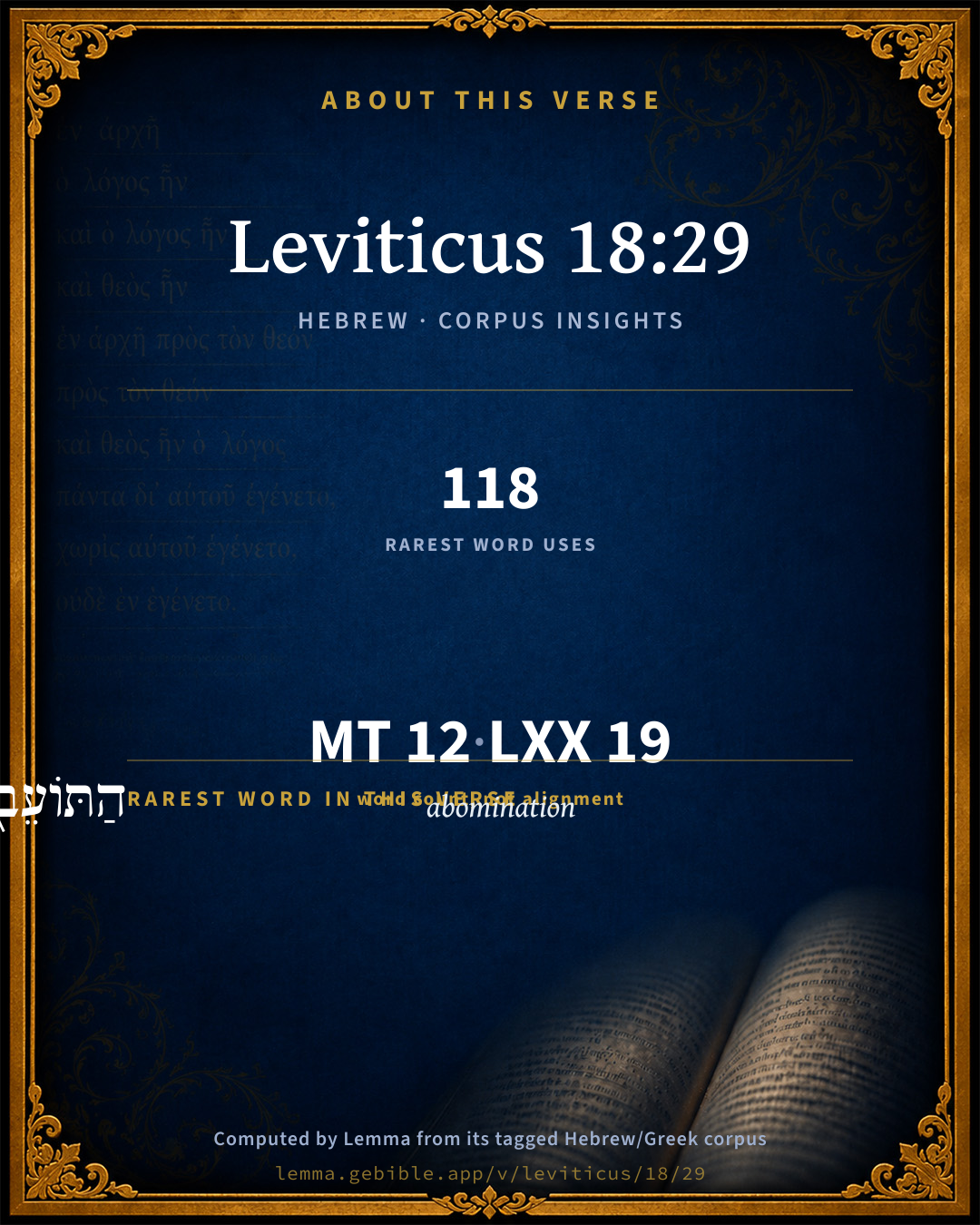
About this verse

These counts appear in no published source. They are computed here, from the morphology-tagged text and Lemma’s own curated glosses. What Lemma adds →

12
words
10
distinct lemmas
Pentateuch
section

Grammatical profile

  • 3 verbs
  • 6 nouns
  • 1 pronoun
  • 1 conjunction
  • 1 particle

Verb forms

  • יַעֲשֶׂ֔ה Qal · Imperfect
  • וְנִכְרְת֛וּ Niphal · Sequential Perfect
  • הָעֹשֹׂ֖ת Qal · Participle Active

Repetition

Words recur within this verse — often emphatic in Hebrew:

  • כָּל all H3605 ×2
  • יַעֲשֶׂ֔ה to do H6213 ×2

Hebrew & Septuagint length

In English translation the verse runs 22 words from the Hebrew and 20 from the Septuagint (LXX English) — closely comparable.

A rough comparison of the two English renderings, which tokenize alike — not a word-level alignment.

Word counts can differ between the Hebrew and the Greek without any difference in meaning — e.g. the Hebrew direct-object marker אֵת has no separate Greek word, and Greek often adds the article ὁ.

In the original languages it is 12 Hebrew tokens and 19 Greek tokens — but the two are counted differently (Hebrew bundles its prefixes and suffixes into one token; the Greek is in lemma form), so that isn’t a like-for-like length.

Cross-references

3

Topical passages linked to Leviticus 18:29 in the Treasury of Scripture Knowledge — connected by theme and wording, ordered by reader-vote popularity; previews shown in the World English Bible.

  • Exodus 12:15 Seven days shall you eat unleavened bread; even the first day you shall put away yeast out of your houses, for whoever eats leavened bread from the first day until the seventh day, that soul shall be cut off from Israel.
  • Leviticus 17:10 "'Any man of the house of Israel, or of the strangers who live as foreigners among them, who eats any kind of blood, I will set my face against that soul who eats blood, and will cut him off from among his people.
  • Leviticus 20:6 "'The person that turns to those who are mediums, and to the wizards, to play the prostitute after them, I will even set my face against that person, and will cut him off from among his people.

Cross-references courtesy of OpenBible.info (CC BY 4.0).

Hebrew and Greek witnesses Masoretic Hebrew ↔ Greek Septuagint

The same verse in the two great witnesses to the Old Testament, shown verse-for-verse.

These are two independent witnesses, not word-aligned to each other, and the Septuagint is shown in lemma (dictionary) form.

Hebrew Leviticus 18:29 Masoretic · Westminster Leningrad Codex

כִּ֚י כָּל אֲשֶׁ֣ר יַעֲשֶׂ֔ה מִכֹּ֥ל הַתּוֹעֵב֖וֹת הָאֵ֑לֶּה וְנִכְרְת֛וּ הַנְּפָשׁ֥וֹת הָעֹשֹׂ֖ת מִקֶּ֥רֶב עַמָּֽם

"'For whoever shall do any of these abominations, even the souls that do them shall be cut off from among their people.

World English Bible · Public Domain

Greek LXX Leviticus 18:29 Septuagint · lemma form

ὅτι πᾶς ὅς ἄν ποιέω ἀπό πᾶς ὁ βδέλυγμα οὗτος ἐκὀλεθρεύω ὁ ψυχή ὁ ποιέω ἐκ ὁ λαός αὐτός

For whoever shall do any of these abominations, the souls that do them shall be destroyed from among their people.

LXX2012 (modern English Septuagint) · Public Domain

Hebrew: Westminster Leningrad Codex (CC BY 4.0). Greek: Septuagint (public domain); English from LXX2012 (modern English Septuagint) (Public Domain). How the Septuagint differs from the Hebrew →

Targum (Aramaic paraphrase)

2

The Targum is the ancient Jewish Aramaic paraphrase of the Hebrew Scriptures — an interpretive translation, not the Hebrew text itself. Onkelos (literal) and Pseudo-Jonathan (expansive) render the Torah, and Jonathan the Prophets. Coverage is partial: where no permissively-licensed English translation exists for a verse, only the Aramaic is shown. This is verse-level text, not a word-by-word alignment to the Hebrew.

  1. Targum Onkelos Torah (Genesis–Deuteronomy)
    אֲרֵי כָּל דִי יַעְבֵּד מִכֹּל תּוֹעֶבְתָּא הָאִלֵין וְיִשְׁתֵּיצוּן נַפְשָׁתָא דְיַעְבְּדוּן מִגוֹ עַמְהוֹן

    (no public-domain English translation for this verse)

    Targum Onkelos — Aramaic: “Onkelos Genesis” (public domain); “Onkelos Exodus” (public domain); “Onkelos Leviticus” (public domain); “Onkelos Numbers” (public domain); “Onkelos Deuteronomy” (public domain). English: “Sefaria Community Translation” (CC0 1.0 (public-domain dedication)); “J.W. Etheridge. The Targums of Onkelos and Jonathan Ben Uzziel on the Pentateuch. London: Longmans, Green, 1862” (public domain). Text via Sefaria.

  2. Targum Pseudo-Jonathan Torah (Genesis–Deuteronomy)
    אֲרוּם כָּל מַאן דְיֶעֱבַד חֲדָא מִכָּל תּוֹעֵיבְתָּא הָאִילֵין וְיִשְׁתֵּיצְיַין נַפְשָׁתָא דִיעַבְדוּן הֵכְדֵין מִגוֹ עַמְמֵיהֶן

    For whoever committeth any one of these abominations, the souls who do so shall be destroyed from among their people.

    Targum Pseudo-Jonathan — Aramaic: “Targum Jonathan on Genesis” (public domain); “Targum Jonathan on Exodus” (public domain); “Targum Jonathan on Leviticus” (public domain); “Targum Jonathan on Numbers” (public domain); “Targum Jonathan on Deuteronomy” (public domain). English: “The Targum of Jonathan ben Uzziel, trans. J. W. Etheridge, London, 1862” (public domain). Text via Sefaria.

Commentary

Notes on Leviticus 18:29 from classic Christian and Jewish commentators (each source and its license shown beneath its notes). The classic Christian expositions comment on the surrounding passage and are grouped to its opening verse, so a note may address several verses; the Jewish commentaries on the Tanakh (Rashi and others) are per-verse, so they appear only where the commentator wrote on this verse.

Lemma curates 59 commentaries, every one of them public domain or Creative Commons licensed, each selected and text-cleaned for this edition rather than reprinted as found. About our sources →

Trapp's Complete Commentary

John Trapp

Lev 18:29 For whosoever shall commit any of these abominations, even the souls that commit [them] shall be cut off from among their people.

Ver. 29. The souls.] That is, the persons. The soul is the man.

John Trapp, A Commentary or Exposition upon All the Books of the Old and New Testament (1647–1656) — public domain. Text from a community e-Sword module.

Joseph Benson's Commentary

Lev 18:29. Cut off — This phrase therefore, of cutting off, is to be understood variously, either of ecclesiastical or civil punishment, according to the differing natures of the offences for which it was inflicted.

Joseph Benson's Commentary on the Old and New Testaments (1811–1818) — public domain. Text from a community e-Sword module.

Geneva Bible (1599)

Geneva Bible translators

Either by the civil sword or by some plague that God will send upon such.

Geneva Bible (1599) marginal notes — public domain. Text via Bolls.life.

Jamieson, Fausset & Brown

Robert Jamieson, A. R. Fausset & David Brown

the souls that commit them shall be cut off--This strong denunciatory language is applied to all the crimes specified in the chapter without distinction: to incest as truly as to bestiality, and to the eleven cases of affinity [Lev 18:7-16], as fully as to the six of consanguinity [Lev 18:17-20]. Death is the punishment sternly denounced against all of them. No language could be more explicit or universal; none could more strongly indicate intense loathing and abhorrence.

Jamieson, Fausset & Brown — Commentary Critical and Explanatory on the Whole Bible (1871) — public domain (CC PDM 1.0). Text via the HelloAO Bible API.

Ellicott's Commentary for English Readers

(29) For whosoever shall commit.—This clause, according to the interpretation which obtained during the second Temple, particularises every individual, and is intended to indicate that any one, whether it be male or female, who is guilty, will incur the punishment prescribed for these sins.

Shall be cut off.—That is, in case the transgression escapes the ken of the tribunal, God himself will inflict the punishment upon the criminals, since some of the crimes specified in this chapter are, according to Leviticus 20, to be visited with death by the hand of man.

A Bible Commentary for English Readers, edited by Charles John Ellicott (1878–1897) — public domain. Text from a community e-Sword module.

John Gill's Exposition

For whosoever shall commit any of these abominations,.... Before particularly forbid, any of them, be it which it will, they all being very heinous and vile, and especially these last mentioned:

even the souls that commit them; whether male or female, as Jarchi observes; for the above things concern them both for the most part, however some one, and some another; and though most, if not all the said crimes are committed by the members of the body, yet since under the influence and direction of the soul, the commission of them is attributed to that, and the punishment threatened respects both:

shall be cut off from among the people; be removed from their church state, and deprived of ecclesiastical privileges, and from their civil state, and reckoned no more of the commonwealth of Israel; and if known and convicted, to be punished by the civil magistrate, and if not, by the immediate hand of God.

John Gill's Exposition of the Whole Bible (1746–1763) — public domain (CC PDM 1.0). Text via the HelloAO Bible API.

Haydock's Catholic Bible Commentary

People. Hebrew hammam. The same temporal punishment is inflicted upon all the aforesaid crimes, though they were not all equally grievous. The smallest of them deserved to be treated with such severity, to prevent the spreading of such contagious vices. (Haydock) --- The regulations respecting marriage, were not immutable, or all determined by the law of nature, which admits of no dispensation. Only those relations in a right line, and the first in the collateral line, can be esteemed of this description. (Du Hamel) --- If Protestants maintain, that all these regulations of Moses are part of the natural law, and bind Christians, they must also allow that a person must marry the widow of his deceased brother, if he has left no children, Deuteronomy xxv. God would never have established this general rule for his people, if it were in opposition to the natural law; which is clear and obvious to all people by the light of reason, according to Aristotle. (Polit. 2.) Neither would so many holy men have violated this law without reproof, if it had prohibited the marriages of two sisters, of aunts, &c. See Genesis xxix.; Exodus vi. 20. God never dispensed in the right line; (1 Corinthians v. 1) and such relations, or even people in the first collateral degree of consanguinity, marrying, are punished with death, chap. xx. Whereas those in the second degree, or in the first of affinity, undergo a smaller punishment; which shews that the transgression, in both cases, is not against the law of nature. No man ever undertook to dispense with the marriage of brothers and sisters; though Beza lays this to the charge of Pope Martin V. But the person alluded to, only obtained leave to retain the sister of her whom he had privately dishonoured, when his marriage could not be dissolved without great scandal. (St. Antonin. 3. p. tit. i. 11.) As, therefore, some of these impediments were introduced by the positive ceremonial law of the Jews, which was abrogated by Jesus Christ, they have no other force at present than what they derive from the authority of Christian republics, which have adopted some and changed others, appointing, in some countries, death for the punishment of theft, and not of adultery, though the old law enjoined the reverse. See chap. xx. 10, and Genesis xxxviii. 24; Exodus xxii. 1. The Church may, therefore, surely dispense with those laws which she has enacted. (Worthington) (Council of Trent, Session xxiv. 3.) --- She has indeed restricted marriage between relations to the fourth degree included, both of consanguinity and of affinity. See the Council of Lateran, under Innocent III. But she will not allow people to marry their aunts, brothers’ widows, or sisters of their deceased wife, as the Jews do. (Tirinus)

George Leo Haydock (1774–1849), Haydock's Catholic Family Bible and Commentary, 1859 edition — public domain. Excludes Psalms (Douay-Rheims chapter numbering differs from Protestant) and Deuterocanonical books (Catholic canon only).

Matthew Poole's English Annotations

To wit, by death to be inflicted by the magistrates, as it is apparent in case of idolatry with Moloch or other false gods; and in case of the magistrates neglect, by God himself. This phrase therefore of cutting off is to be understood variously, as many other phrases are, either of ecclesiastical, or civil and corporal punishment, according to the differing natures of the offences for which it is inflicted.

Matthew Poole's English Annotations on the Holy Bible (1683–1685) — public domain. Text from a community e-Sword/MySword module.

John Wesley's Explanatory Notes

Cut off - This phrase therefore of cutting off, is to be understood variously, either of ecclesiastical, or civil punishment, according to the differing natures of the offenses for which it is inflicted.

John Wesley, Explanatory Notes Upon the Whole Bible (1754–1765) — public domain. Text via the GEBible commentary corpus.

unfoldingWord translationNotes

Door43 World Missions Community

General Information:

Yahweh finishes telling Moses what the people must not do.

the persons ... will be cut off from among their people

People being excluded from the community is spoken of as if they had been cut off from their people, as one would cut a piece of cloth or cut a branch from a tree. This can be translated in active form. AT: "the persons ... may no longer live among their people" or "you must separate the persons ... from their people" (See: Metaphor and Active or Passive)

which were practiced here before you

This can be translated in active form. AT: "which the people did here before you came" (See: Active or Passive)

by them

Here "them" refers to the detestable customs.

translationWords

detest

cut off

command

Yahweh

God

unfoldingWord translationNotes — © Distant Shores Media and the Door43 World Missions Community, licensed CC BY-SA 4.0. Source: git.door43.org/Door43/en_tn.

Rashi

Rabbi Shlomo Yitzchaki (Rashi)

העשת‏‎ הנפשות ‎‏‎‎EVEN THE SOULS THAT SHALL DO THEM [SHALL BE CUT OFF] — Both men and women are implied by the plural הנפשות (in contrast to the sing. יעשה in the beginning of the verse) (Sifra, Acharei Mot, Chapter 13 20).

Rashi on the Tanakh — English translations: “The Judaica Press complete Tanach with Rashi, translated by A. J. Rosenberg” (CC BY 4.0); “Pentateuch with Rashi's commentary by M. Rosenbaum and A.M. Silbermann, 1929-1934” (public domain); “The Metsudah Tanach series, Lakewood, N.J” (CC BY 4.0); and “The Book of Joshua, Metsudah Publications, 1997” (CC BY 4.0). Text via Sefaria.

Ramban (Nachmanides)

Rabbi Moshe ben Nachman (Ramban / Nachmanides)

AND THE SOULS THAT DO THEM SHALL BE CUT OFF FROM AMONG THEIR PEOPLE. “His offspring is cut off, and his [own] days are shortened.” This is Rashi’s language. Now in the matters of excision mentioned in the Torah there are three different expressions. One is that which states, that man shall be cut off;, Verses 4 and 9. This form of expression is found in connection with slaughtering or bringing offerings outside the Sanctuary Court. a second one is that which says, and the souls which do them shall be cut off, or that soul shall be cut off from before Me;, 17:10) etc. and a third form of expression is that which states, that soul shall utterly be cut off, his iniquity shall be upon him. Now of a [a person doing work on] the Day of Atonement Scripture states, that soul will I destroy from among his people, and on this the Rabbis commented in the Sifra: 14:4. “Excision is mentioned in many places in Scripture. But I do not know what it is. Now that it says, and I will destroy, it teaches that excision means ‘destruction’ [of the soul].”The explanation of the subject is as follows. If someone eats forbidden fat or blood and he is [still] a righteous person whose merits outweigh [his sins], but he could not control his desire for it, and thus stumbled in this sin, his days will be shortened and he will die in his youth before reaching old age, which is sixty years, but his soul is not destined for destruction; (see Note 448 above), yet since the merits of this man outweigh his sins, his soul will not be destroyed. In other words, the punishment of destruction of the soul applies only if his sins outweigh his merits, as a result of his having eaten forbidden fat or blood, as explained further on in the text. rather, its portion will be in the World of Souls in accordance with the person’s good deeds, since he was a righteous man, and he will also have a portion in the World to Come, which is the world after the resurrection. Of this case it is said, that man shall be cut off., Verses 4 and 9. This form of expression is found in connection with slaughtering or bringing offerings outside the Sanctuary Court. But [in the case of] one who, as a result of this grave sin, now has more sins [in gravity] than his merits, the punishment of excision for this weighty transgression affects the soul that sins after it is separated from the body, and it is cut off from life in the World of Souls. It is with reference to those liable to this form of excision that Scripture alludes, in saying, that soul shall be cut off from before Me., 17:10) etc. And it is further written [in this connection], that soul will I destroy from among his people. These sinners do not suffer bodily excision [as is the case in the first type mentioned above], but may sometimes live to reach many days, even old age and hoary heads, as it is written, and there is a wicked man that prolongeth his life in his evil-doing. It is this which our Rabbis have said: “But he whose sins outweigh his merits, including a non-Jew who sins with his body” is also mentioned there in the Talmud in this connection. But that is defined there as “the head (of him) that puts on no Tefilin (phylactery).” It may be that Ramban omitted mentioning this here, since his essential intention is to explain the types of excision mentioned in Scripture, which fit in with the example mentioned further on in the text, since the punishment for immorality is expressly stated even for the Canaanites. who sins with his body — and Rav Papa said that this refers to a particular sin, that is to say, one who commits incest with one of the forbidden relations — these descend to Gehenna and they are punished for twelve months; after twelve months their bodies are destroyed, and their souls burnt, and the winds scatter [their ashes] under the soles of the feet of the righteous etc.” And there is a still more stringent form of excision, where both the body is cut off [from life in this world] and the soul [even from life in the World to Come]. It is of this [third kind of excision mentioned above] that it is said, Because he hath despised the word of the Eternal, and hath broken His commandment, that soul ‘hikareith tikareith’ (shall be utterly cut off), his iniquity shall be upon him. And the Rabbis interpreted it: “‘Hikareith’ (he shall be cut off) in this world; ‘tikareith’ (he shall be cut off) in the World to Come,” meaning to say that he shall die in his youth, and his life shall be as that of the depraved in that his soul will not share in the life after the resurrection and he will have no portion in the World to Come. This double expression of excision is not stated in the Torah except in matters of idolatry and blasphemy. Our Rabbis have further interpreted in Tractate Shebuoth: “Because he hath despised the word of the Eternal. This refers to one who throws off the yoke, [i.e., he denies the essential principle of the religion], and perverts the sense of the Torah. And he hath broken His commandment. This is one who breaks the covenant of the flesh” [i.e., circumcision]. But this does not apply to all cases where excision is mentioned, it being explained there in the Gemara that the double expression of ‘hikareith tikareith’ (he shall utterly be cut off) does not apply to all other people who are liable to excision by law of the Torah, except for those derived by interpretation of this verse; since this verse refers to a blasphemer and a worshipper of idols, and the Rabbis added by interpretations, those who deny the essential principle [of G-d’s existence], and those hardened wicked ones [mentioned above]. This is similar to that which is said of them in the tradition, and it is here used as a term referring to the books of the Scriptures which come after the Five Books of Moses, because they are words of “tradition” received from the prophets. for their worm shall not die, neither shall their fire be quenched. These are the ones who are enumerated in the Mishnah and in the Beraitha: “And these are they that have no share in the World to Come.” And so also it appears, that not all those liable to excision are punishable by the death of their offspring, except for those where the word aririm (childless) is mentioned. And it is possible that all forbidden [sexual] relationships have been likened to each other [in this respect of the punishment, namely death of the offspring], but in the case of other sins for which excision is incurred, such as for eating forbidden fat and blood, we do not have [this aspect of punishment].Now Rabbi Abraham ibn Ezra commented:, 23:30. “There is a difference between ‘v’ha’avad’ti’ (and I will destroy) and ‘v’nichr’thah’ (it shall be cut off), 17:10) etc. and I could not explain.” The learned scholar [Rabbi Abraham] thought that the soul that is “destroyed” is destroyed for ever, and the one that is “cut off” is denied life for a time, and yet doth G-d not take away life. Know and understand that the forms of excision mentioned with reference to the soul, constitute a great [source for] trust in the existence of souls after death, and the granting of reward in the World of Souls. For in His saying, blessed be He, and that soul shall be cut off from among his people, or that soul shall be cut off from before Me, 17:10) etc. it denotes that the soul that sinneth shall be cut off in its iniquity, but other souls that did not sin, will exist before Him in the splendor on high. It is for this reason that He explains, that soul … its iniquity shall be upon it, for it is the sin that is in it which will cause it to be cut off. And the meaning of the matter is that the soul of man is the lamp of the Eternal, which has been breathed into our nostrils out of the mouth of the Most High, and the spirit of G-d, as it is said, And He breathed into his nostrils the breath of life; and so it remains in its [original] state and does not die [with the death of the body], for it is not a composite [of the four elements] so that it be subject to the law of existence and decomposition, as are all components. But the existence of the soul is fitting [for all time], living forever as do the Separate Intelligences. Therefore Scripture did not need to state that as a reward for [fulfillment of] the commandments the soul will exist [after the death of the body, for it is self-understood that it will exist from a knowledge of the nature of the soul], but instead it states that as a punishment for sins, the soul will be desecrated and defiled, and become cut off from its proper existence. This is the sense of the expression kareth (cutting off) which the Torah uses, intimating that it is like a branch cut off from the tree, from the roots of which it derives its nourishment. It is this which our Rabbis have said:, 112. “From among his people — but his people are in peace.” For the cutting off of the soul that sinneth, proves the existence of all other souls that do not sin, these being his people [mentioned in the verse] which are in peace. And we have already explained. that all assurances of the Torah, whether for reward or punishment, are all miraculous in nature, and are of the type of hidden miracles, the Torah always promising [certain blessings] in a non-natural manner [which result not from the processes of nature, but because of the observance of the law], and warning against [consequences which result not from the processes of nature, but as punishment for our violation of the law]. Therefore He warned here of kareth which is of a miraculous nature [since in the natural order of things the soul should exist forever], and did not promise the eternal existence of the soul [as a reward for observance of the commandments], since that is its natural state.Now there are thirty-six sins for which the Torah prescribed excision as a punishment, many of them being in connection with prohibitions of forbidden sexual relationships, that is to say, forbidden sexual intercourse. Similarly, punishments of death imposed by the court for forbidden sexual intercourse, are sixteen. 15:10-11. But there is no death penalty at all for eating forbidden foods. The reason why these great punishments, such as death by the court and excision [by Heaven] are [imposed] for forbidden sexual relationships, is because immorality is something very abhorrent to the Torah, as is mentioned in this section and in many places of Scripture. The Sages always mention “idolatry, immorality, and bloodshed” [as being the three gravest sins], mentioning immorality after idolatry and before bloodshed [thus showing the greatness of the sin, in that it is mentioned immediately after idolatry]. This is like that which the Rabbis have said: “The G-d of these people [i.e., the Israelites] abhors lewdness.” There is also one of the great secrets of creation in this matter. And the Rabbi [Moshe ben Maimon] wrote in the Moreh Nebuchim: “Because man’s temptation to sexual intercourse is great, and because of the strong [natural] desire for it, which can cause many stumblings, a great punishment was needed in order to discipline people.” This also is true.Kedoshim

Ramban (Nachmanides) on the Tanakh — English translation: “Commentary on the Torah by Ramban (Nachmanides). Translated and annotated by Charles B. Chavel. New York, Shilo Pub. House, 1971-1976” (CC BY 4.0). Text via Sefaria.

Lesson kit

Teaching starters — assembled from the data on this page, not authored interpretation. Every prompt links to the verse data it draws on. Edit before teaching.

Leviticus, in the Pentateuch, opens this verse with 12 words (10 distinct Hebrew lemmas). Its most distinctive word is tôwʻêbah (“abomination”). A historical commentator’s framing appears above. Read the whole chapter for the surrounding context.

Discussion questions

  1. What does “abomination” (tôwʻêbah) contribute to the verse as a whole?
  2. Exodus 12:15 shares this passage’s theme. How do the two illuminate each other?
  3. “all” occurs 2× in this one verse. What is the effect of the repetition?
  4. These translations render this verse differently. What is at stake in choosing one wording over another?
  5. The verb «יַעֲשֶׂ֔ה» is Qal Imperfect. How does its form color the action?
  6. Reading how Trapp's Complete Commentary and Joseph Benson's Commentary read this verse, where do the two commentators agree and where do they part?

Things to notice

Reading settings

Reading text

Shown beneath each verse's original-language words.

Old Testament
Old Testament edition

Read the OT as the Masoretic Hebrew (MT) or the Greek Septuagint (LXX).

English shown for the Greek Septuagint (in the Hebrew ↔ Greek comparison).

Comparing translations? Open the Compare panel on any verse page to stack up to four side by side.