
2 Chronicles 21:7

Hebrew (Westminster Leningrad Codex) 2 Chronicles 21:7 appears in the Hebrew Old Testament. The text above is from the Westminster Leningrad Codex. Each word links to its Strong’s number, a concise gloss, and parsing drawn from the Open Scriptures Hebrew Bible morphology. Click any word for its full Brown-Driver-Briggs (BDB) entry.
Download image
Cite this verse

2 Chronicles 21:7 (World English Bible). Public Domain. Lemma interlinear Bible study tool, https://lemma.gebible.app/v/2-chronicles/21/7.

Show BibTeX & RIS
BibTeX
RIS
English Translation
However Yahweh would not destroy the house of David, because of the covenant that he had made with David, and as he promised to give a lamp to him and to his children always.
World English Bible · Public Domain
Download a study sheet

One document with this verse’s original text, its word-by-word gloss line, the meaning frame, cross-references with their text, attributed commentary, and full source and license credits — printable, and it pastes into notes with its structure intact.

This verse Autodidact and up

Study sheet (.html) Plain text (.txt)

A passage Seminary Student

Up to 50 verses in one chapter. A passage sheet keeps up to 6 commentary sources and 12 cross-references per verse, in the order this page ranks them, and says so on the sheet whenever that leaves anything out. Ask for a single verse and you get the Autodidact verse sheet above.

Everything on this page stays free to read, with no account — the sheet is a download of what is already on screen, not access to it.

Want to remove ads? Support Godless Engineer
Compare translations 3

The same verse in 3 English versions, stacked beneath the original-language interlinear above. Click any original word for its lexicon entry.

Each is an independent rendering of the whole verse — the interlinear is not word-aligned to these translations.

Highlighted words mark where these versions differ — a whole-verse word diff, not a word-by-word alignment.

  • World English Bible Public Domain
    However Yahweh would not destroy the house of David, because of the covenant that he had made with David, and as he promised to give a lamp to him and to his children always.
  • King James Version Public Domain
    Howbeit the LORD would not destroy the house of David, because of the covenant that he had made with David, and as he promised to give a light to him and to his sons for ever.
  • unfoldingWord Literal Text CC BY-SA 4.0
    But Yahweh was not willing to destroy the house of David on account of the covenant which he had cut with David; and just as he said to give to him a lamp and to his sons all the days.

unfoldingWord Literal Text — © unfoldingWord, licensed CC BY-SA 4.0. Word-aligned USFM3 via Door43 (git.door43.org/unfoldingWord/en_ult).

Versions to compare (up to 4)

3 of 4 selected

Show all 18 translations

Every available English version of this verse, each an independent rendering of the whole verse.

  • World English Bible Public Domain
    However Yahweh would not destroy the house of David, because of the covenant that he had made with David, and as he promised to give a lamp to him and to his children always.
  • Berean Standard Bible Public Domain
    Yet the LORD was unwilling to destroy the house of David, because of the covenant He had made with David, and since He had promised to maintain a lamp for David and his descendants forever.
  • Majority Standard Bible Public Domain
    Yet the LORD was unwilling to destroy the house of David, because of the covenant He had made with David, and since He had promised to maintain a lamp for David and his descendants forever.
  • King James Version Public Domain
    Howbeit the LORD would not destroy the house of David, because of the covenant that he had made with David, and as he promised to give a light to him and to his sons for ever.
  • American Standard Version (1901) Public Domain
    Howbeit Jehovah would not destroy the house of David, because of the covenant that he had made with David, and as he promised to give a lamp to him and to his children alway.
  • Revised Version (1885) Public Domain
    Howbeit the LORD would not destroy the house of David, because of the covenant that he had made with David, and as he promised to give a lamp to him and to his children alway.
  • Geneva Bible (1599) Public Domain
    Howbeit the Lord would not destroy the house of Dauid, because of the couenant that he had made with Dauid, and because he had promised to giue a light to him, and to his sonnes for euer.
  • Douay-Rheims (1899) Public Domain
    But the Lord would not destroy the house of David: because of the covenant which he had made with him: and because he had promised to give a lamp to him, and to his sons for ever.
  • Young's Literal Translation Public Domain
    and Jehovah hath not been willing to destroy the house of David, for the sake of the covenant that He made with David, and as He had said to give to him a lamp, and to his sons -- all the days.
  • Literal Standard Version CC BY-SA 4.0
    and YHWH has not been willing to destroy the house of David, for the sake of the covenant that He made with David, and as He had said to give a lamp to him and to his sons [for] all the days.
  • Unlocked Literal Bible CC BY-SA 4.0
    However, Yahweh did not wish to destroy the house of David, because of the covenant that he had made with David; he had promised that he would always give life to him and his descendants.
  • unfoldingWord Literal Text CC BY-SA 4.0
    But Yahweh was not willing to destroy the house of David on account of the covenant which he had cut with David; and just as he said to give to him a lamp and to his sons all the days.
  • Darby Bible Public Domain
    But Jehovah would not destroy the house of David, because of the covenant that he had made with David, and as he had promised to give to him always a lamp, and to his sons.
  • World Messianic Bible Public Domain
    However the LORD would not destroy David’s house, because of the covenant that he had made with David, and as he promised to give a lamp to him and to his children always.
  • Webster's Bible Public Domain
    Yet the LORD would not destroy the house of David, because of the covenant that he had made with David, and as he promised to give a light to him and to his sons for ever.
  • Free Bible Version CC BY-SA 4.0
    However, the Lord did not want to destroy David's line because of the agreement he had made with David, and he had promised that David's descendants would rule forever like an ever-burning lamp.
  • Bible in Basic English Public Domain
    But it was not the Lord's purpose to send destruction on the family of David, because of the agreement he had made with David, when he said he would give to him and to his sons a light for ever.
  • JPS Tanakh (1917) Public Domain
    Howbeit the LORD would not destroy the house of David, because of the covenant that He had made with David, and as He promised to give a lamp to him and to his children alway.

Literal Standard Version (2020), Covenant Press — licensed CC BY-SA 4.0. Text via the HelloAO Bible API (eBible.org). Unlocked Literal Bible (unfoldingWord) — licensed CC BY-SA 4.0. Text via the HelloAO Bible API (eBible.org). unfoldingWord Literal Text — © unfoldingWord, licensed CC BY-SA 4.0. Word-aligned USFM3 via Door43 (git.door43.org/unfoldingWord/en_ult). Free Bible Version, Dr. Jonathan Gallagher — licensed CC BY-SA 4.0. Text via the HelloAO Bible API (eBible.org).

Word by word

More ways to search: Search by grammar → Find every occurrence → Compare this word →

Practice this passage: Drill this verse → Learn its vocabulary →

נִ֛יר
nîyr
H5216
“lamp”
Noun, Common, Masculine, Singular, Absolute
Part of Speech
Noun
Type
Common
Gender
Masculine
Number
Singular
State
Absolute
Full BDB Definition

Origin: from a primitive root [see H5214 ; H5135 ] properly, meaning to glisten

TWOT: 1333b

lamp
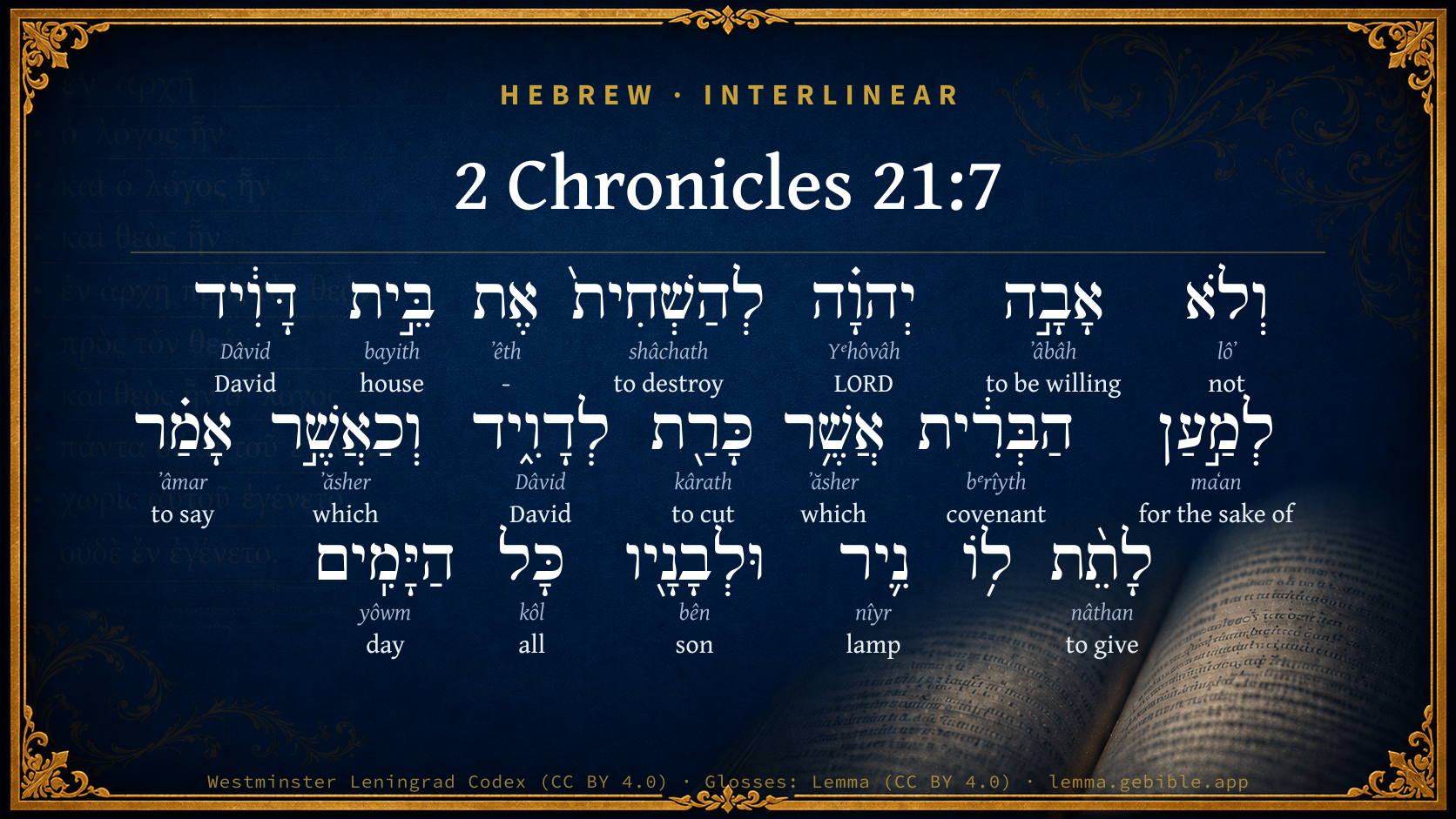
  1. וְלֹא lôʼ H3808 “and · not” Conjunction + Particle, Negative
  2. אָבָ֣ה ʼâbâh H14 “to be willing” Verb, Qal, Perfect, 3rd Person, Masculine, Singular
  3. יְהוָ֗ה Yᵉhôvâh H3068 “LORD” Noun, Proper
  4. לְהַשְׁחִית֙ shâchath H7843 “to destroy” Preposition + Verb, Hiphil, Infinitive Construct
  5. אֶת ʼêth H853 “-” Particle, Direct Object
  6. בֵּ֣ית bayith H1004 “house of” Noun, Common, Masculine, Singular, Construct
  7. דָּוִ֔יד Dâvid H1732 “David” Noun, Proper
  8. לְמַ֣עַן maʻan H4616 “for the sake of” Preposition
  9. הַבְּרִ֔ית bᵉrîyth H1285 “the · covenant” Particle, Definite Article + Noun, Common, Feminine, Singular, Absolute
  10. אֲשֶׁ֥ר ʼăsher H834 “which” Particle, Relative
  11. כָּרַ֖ת kârath H3772 “to cut” Verb, Qal, Perfect, 3rd Person, Masculine, Singular
  12. לְדָוִ֑יד Dâvid H1732 “to/for · David” Preposition + Noun, Proper
  13. וְכַאֲשֶׁ֣ר ʼăsher H834 “and · like/as · which” Conjunction + Preposition + Particle, Relative
  14. אָמַ֗ר ʼâmar H559 “to say” Verb, Qal, Perfect, 3rd Person, Masculine, Singular
  15. לָתֵ֨ת nâthan H5414 “to give” Preposition + Verb, Qal, Infinitive Construct
  16. וּלְבָנָ֖יו bên H1121 “and · to/for · sons · his” Conjunction + Preposition + Noun, Common, Masculine, Plural, Construct + Suffix, Personal, 3rd Person, Masculine, Singular
  17. כָּל kôl H3605 “all of” Noun, Common, Masculine, Singular, Construct
  18. הַיָּמִֽים yôwm H3117 “the · days” Particle, Definite Article + Noun, Common, Masculine, Plural, Absolute

About this verse

These counts appear in no published source. They are computed here, from the morphology-tagged text and Lemma’s own curated glosses. What Lemma adds →

20
words
17
distinct lemmas
Historical
section

Shared distinctive vocabulary

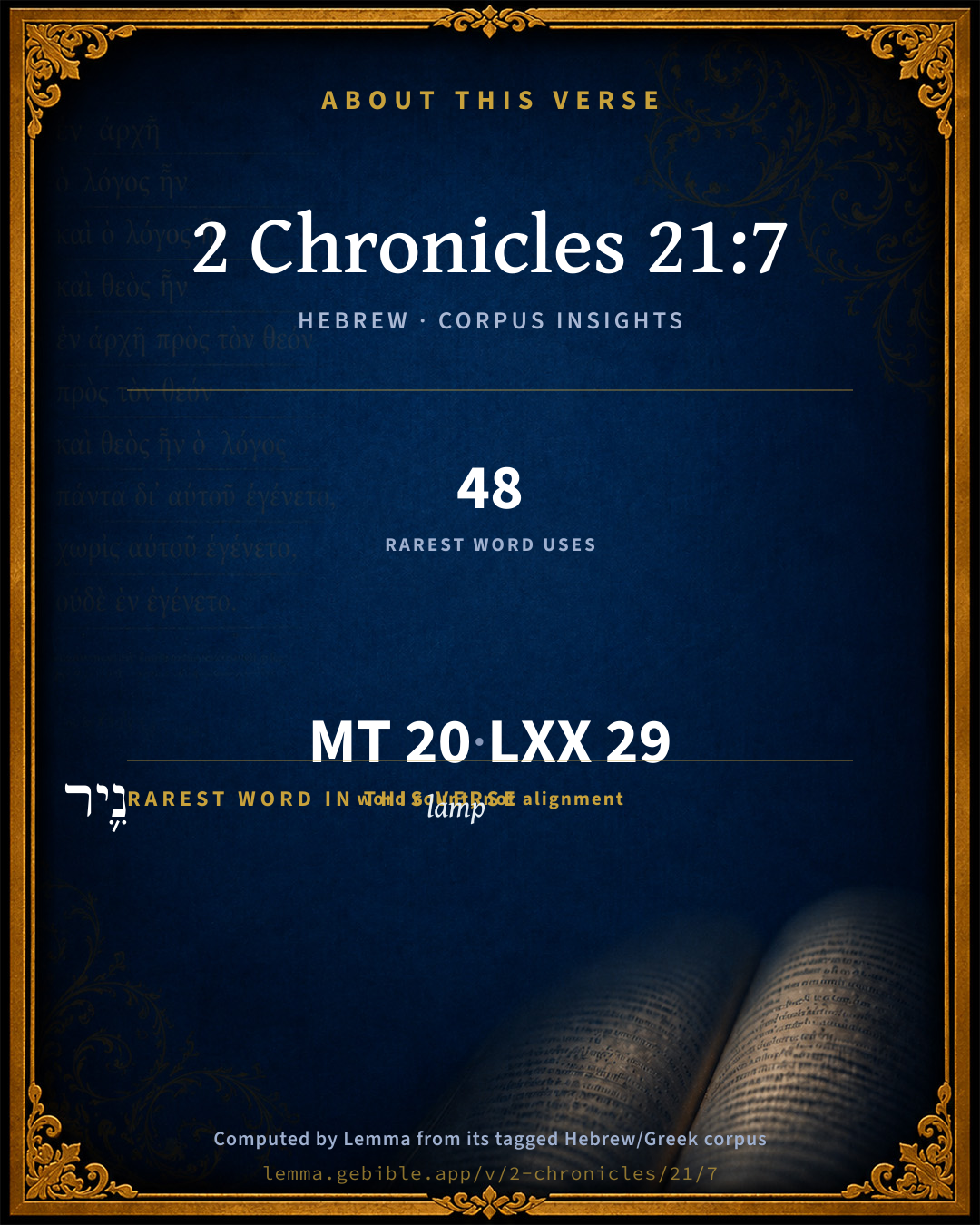
נִ֛יר lamp H5216 occurs in 42 verses of the Hebrew Bible. Also found in:

Grammatical profile

  • 5 verbs
  • 9 nouns
  • 2 prepositions
  • 4 particles

Verb forms

  • אָבָ֣ה Qal · Perfect
  • לְהַשְׁחִית֙ Hiphil · Infinitive Construct
  • כָּרַ֖ת Qal · Perfect
  • אָמַ֗ר Qal · Perfect
  • לָתֵ֨ת Qal · Infinitive Construct

Repetition

Words recur within this verse — often emphatic in Hebrew:

  • דָּוִ֔יד David H1732 ×2
  • אֲשֶׁ֥ר which H834 ×2

Hebrew & Septuagint length

In English translation the verse runs 34 words from the Hebrew and 39 from the Septuagint (LXX English) — closely comparable.

A rough comparison of the two English renderings, which tokenize alike — not a word-level alignment.

Word counts can differ between the Hebrew and the Greek without any difference in meaning — e.g. the Hebrew direct-object marker אֵת has no separate Greek word, and Greek often adds the article ὁ.

In the original languages it is 20 Hebrew tokens and 29 Greek tokens — but the two are counted differently (Hebrew bundles its prefixes and suffixes into one token; the Greek is in lemma form), so that isn’t a like-for-like length.

Cross-references

15

Topical passages linked to 2 Chronicles 21:7 in the Treasury of Scripture Knowledge — connected by theme and wording, ordered by reader-vote popularity; previews shown in the World English Bible.

  • 1 Kings 11:36 To his son will I give one tribe, that David my servant may have a lamp always before me in Jerusalem, the city which I have chosen me to put my name there.
  • Psalms 132:17–18 There I will make the horn of David to bud. I have ordained a lamp for my anointed.
  • 2 Samuel 7:12–17 When your days are fulfilled, and you shall sleep with your fathers, I will set up your seed after you, who shall proceed out of your bowels, and I will establish his kingdom.
  • Luke 1:69 And has raised up a horn of salvation for us in the house of his servant David
  • Luke 1:79 To shine on those who sit in darkness and the shadow of death; To guide our feet into the way of peace."
  • 1 Kings 11:13 However I will not tear away all the kingdom; but I will give one tribe to your son, for David my servant's sake, and for Jerusalem's sake which I have chosen.
  • 2 Samuel 21:17 But Abishai the son of Zeruiah helped him, and struck the Philistine, and killed him. Then the men of David swore to him, saying, You shall go no more out with us to battle, that you don't quench the lamp of Israel.
  • 2 Samuel 23:5 Most assuredly my house is not so with God; Yet he has made with me an everlasting covenant, Ordered in all things, and sure: For it is all my salvation, and all [my] desire, Although he doesn't make it grow.
  • 2 Kings 8:19 However Yahweh would not destroy Judah, for David his servant's sake, as he promised him to give to him a lamp for his children always.
  • 2 Chronicles 22:11 But Jehoshabeath, the daughter of the king, took Joash the son of Ahaziah, and stole him away from among the king's sons who were slain, and put him and his nurse in the bedchamber. So Jehoshabeath, the daughter of king Jehoram, the wife of Jehoiada the priest (for she was the sister of Ahaziah), hid him from Athaliah, so that she didn't kill him.
  • Psalms 89:28–34 I will keep my loving kindness for him forevermore. My covenant will stand firm with him.
  • Psalms 89:39 You have renounced the covenant of your servant. You have defiled his crown in the dust.
  • Psalms 132:11 Yahweh has sworn to David in truth. He will not turn from it: "I will set the fruit of your body on your throne.
  • Isaiah 7:6–7 "Let's go up against Judah, and tear it apart, and let's divide it among ourselves, and set up a king in the midst of it, even the son of Tabeel."
  • Jeremiah 33:20–26 Thus says Yahweh: If you can break my covenant of the day, and my covenant of the night, so that there shall not be day and night in their season;

Cross-references courtesy of OpenBible.info (CC BY 4.0).

Hebrew and Greek witnesses Masoretic Hebrew ↔ Greek Septuagint

The same verse in the two great witnesses to the Old Testament, shown verse-for-verse.

These are two independent witnesses, not word-aligned to each other, and the Septuagint is shown in lemma (dictionary) form.

Hebrew 2 Chronicles 21:7 Masoretic · Westminster Leningrad Codex

וְלֹא אָבָ֣ה יְהוָ֗ה לְהַשְׁחִית֙ אֶת בֵּ֣ית דָּוִ֔יד לְמַ֣עַן הַבְּרִ֔ית אֲשֶׁ֥ר כָּרַ֖ת לְדָוִ֑יד וְכַאֲשֶׁ֣ר אָמַ֗ר לָתֵ֨ת ל֥וֹ נִ֛יר וּלְבָנָ֖יו כָּל הַיָּמִֽים

However Yahweh would not destroy the house of David, because of the covenant that he had made with David, and as he promised to give a lamp to him and to his children always.

World English Bible · Public Domain

Greek LXX 2 Chronicles 21:7 Septuagint · lemma form

καί οὐ βούλομαι κύριος ἐκὀλεθρεύω ὁ οἶκος δαυίδ διά ὁ διαθήκη ὅς διατίθημι ὁ δαυίδ καί ὡς εἶπον αὐτός δίδωμι αὐτός λύχνος καί ὁ υἱός αὐτός πᾶς ὁ ἡμέρα

nevertheless the Lord would not utterly destroy the house of David, because of the covenant which he made with David, and as he said to him that he would give a light to him and his sons for ever.

LXX2012 (modern English Septuagint) · Public Domain

On this verse, Ellicott's Commentary for English Readers discusses the Septuagint’s reading. Read the note in Commentary ↓

Hebrew: Westminster Leningrad Codex (CC BY 4.0). Greek: Septuagint (public domain); English from LXX2012 (modern English Septuagint) (Public Domain). How the Septuagint differs from the Hebrew →

Commentary

Notes on 2 Chronicles 21:7 from classic Christian and Jewish commentators (each source and its license shown beneath its notes). The classic Christian expositions comment on the surrounding passage and are grouped to its opening verse, so a note may address several verses; the Jewish commentaries on the Tanakh (Rashi and others) are per-verse, so they appear only where the commentator wrote on this verse.

Lemma curates 59 commentaries, every one of them public domain or Creative Commons licensed, each selected and text-cleaned for this edition rather than reprinted as found. About our sources →

Trapp's Complete Commentary

John Trapp

2Ch 21:7 Howbeit the LORD would not destroy the house of David, because of the covenant that he had made with David, and as he promised to give a light to him and to his sons for ever.

Ver. 7. As he promised to give a light to him.] Successionem stirpis regiae et splendidae. Out of this "light," or lamp, came at length that "Sun of righteousness," "the Light of the world," Christ Jesus. See on 2Ki 8:19.

John Trapp, A Commentary or Exposition upon All the Books of the Old and New Testament (1647–1656) — public domain. Text from a community e-Sword module.

Adam Clarke's Commentary

Verse 7. To give a light to him] To give him a descendant.

Adam Clarke's Commentary on the Bible (1810–1826) — public domain. Text from a community e-Sword/MySword module.

Ellicott's Commentary for English Readers

(7) The Lord would not destroy the house of David . . .—An exegetical (not arbitrary, as Thenius asserts) expansion of “The Lord would not destroy Judah, for the sake of David his servant” (Kings).

The covenant that he had made with David.—Literally, for David. So Isa_55:3, “I will make an everlasting covenant for you, even the sure mercies of David.” This construction is generally used of the stronger imposing conditions on the weaker. (Comp. Jos_9:6; 1Sa_11:1-2.) In the Pentateuch, God makes a covenant with (im or eth) His people (Gen_15:16; Exo_24:8).

To give a light to him and to his sons.—Literally, a lamp. Some critics find another “deviation” here, and render 1Ki_8:19, “to give a lamp to him in respect of his sons.” But many Hebrew MSS., and the LXX., Vulg., and Targum of that passage, read, “and to his sons,” as here. Syriac, “On account of the oaths which he sware to David, to give to him a burning lamp, and to his sons all the days.”

For ever.—All the days.

A Bible Commentary for English Readers, edited by Charles John Ellicott (1878–1897) — public domain. Text from a community e-Sword module.

The Cambridge Bible for Schools and Colleges

gen. ed. J. J. S. Perowne

7. the house of David] In 2 Kin. Judah, a term sparingly used in Chron.; cp. 2Ch_11:3 (note).

a light] R.V. a lamp. Thus figuratively applied the Heb. word is written nîr; ordinarily “lamp” is nçr in Heb.

for ever] R.V. alway (as in 2 Kin.). Heb. literally, “all the days.”

The Cambridge Bible for Schools and Colleges (gen. ed. J. J. S. Perowne; Cambridge University Press, 1878–1918) — public domain. Text from a community e-Sword module.

Haydock's Catholic Bible Commentary

Lamp; heir and successor. C. Psalm cxxxi. 17.

George Leo Haydock (1774–1849), Haydock's Catholic Family Bible and Commentary, 1859 edition — public domain. Excludes Psalms (Douay-Rheims chapter numbering differs from Protestant) and Deuterocanonical books (Catholic canon only).

Matthew Poole's English Annotations

Because of the covenant that he had made with David; for which, in 2Ki 8:19, it is for David his servant’s sake, i.e. not for David’s merits, but for God’s free promise and covenant, as it is here explained.

Matthew Poole's English Annotations on the Holy Bible (1683–1685) — public domain. Text from a community e-Sword/MySword module.

The Pulpit Commentary

The covenant a light his sons for ever (so 2Sa_7:12, 2Sa_7:13, 2Sa_7:15, 16 23:5; 1Ki_8:20, 1Ki_8:24, 1Ki_8:25; 1Ch_22:10; Psa_132:11, Psa_132:12; Isa_55:3; Act_13:34)

The Pulpit Commentary (1880–1919), ed. H.D.M. Spence-Jones & Joseph S. Exell — public domain. Text from a community e-Sword module.

Rashi

Rabbi Shlomo Yitzchaki (Rashi)

a kingdom - Heb. נִיר. Its meaning is a yoke over Israel.

Rashi on the Tanakh — English translations: “The Judaica Press complete Tanach with Rashi, translated by A. J. Rosenberg” (CC BY 4.0); “Pentateuch with Rashi's commentary by M. Rosenbaum and A.M. Silbermann, 1929-1934” (public domain); “The Metsudah Tanach series, Lakewood, N.J” (CC BY 4.0); and “The Book of Joshua, Metsudah Publications, 1997” (CC BY 4.0). Text via Sefaria.

Lesson kit

Teaching starters — assembled from the data on this page, not authored interpretation. Every prompt links to the verse data it draws on. Edit before teaching.

2 Chronicles, in the Historical, opens this verse with 20 words (17 distinct Hebrew lemmas). Its most distinctive word is nîyr (“lamp”). A historical commentator’s framing appears above. Read the whole chapter for the surrounding context.

Discussion questions

  1. What does “lamp” (nîyr) contribute to the verse as a whole?
  2. Exodus 25:37 shares the word «lamp» with this verse. How do the two illuminate each other?
  3. “David” occurs 2× in this one verse. What is the effect of the repetition?
  4. These translations render this verse differently. What is at stake in choosing one wording over another?
  5. The verb «אָבָ֣ה» is Qal Perfect. How does its form color the action?
  6. Reading how Trapp's Complete Commentary and Adam Clarke's Commentary read this verse, where do the two commentators agree and where do they part?

Things to notice

Reading settings

Reading text

Shown beneath each verse's original-language words.

Old Testament
Old Testament edition

Read the OT as the Masoretic Hebrew (MT) or the Greek Septuagint (LXX).

English shown for the Greek Septuagint (in the Hebrew ↔ Greek comparison).

Comparing translations? Open the Compare panel on any verse page to stack up to four side by side.