
Leviticus 20:18

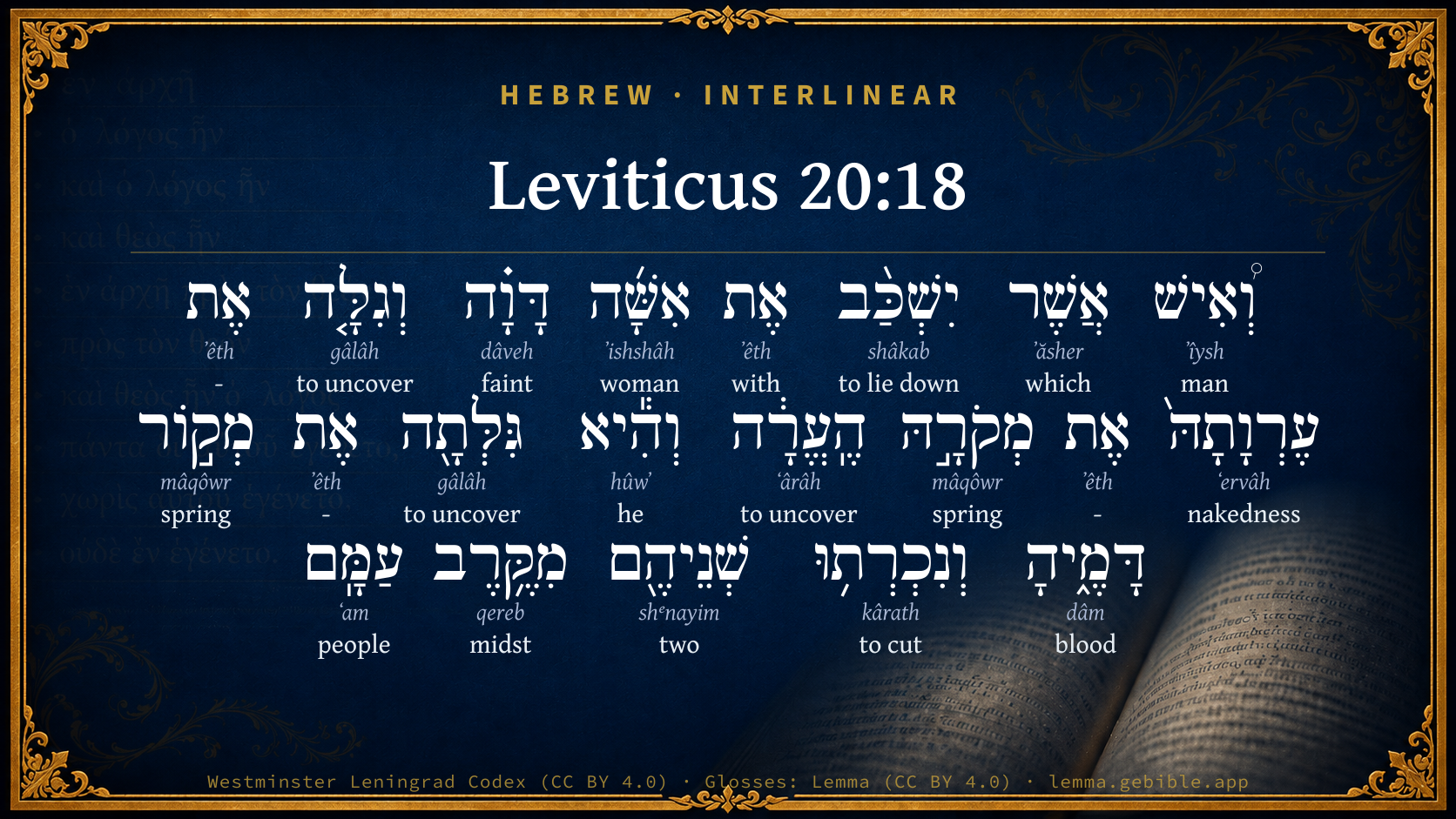
Hebrew (Westminster Leningrad Codex) Leviticus 20:18 appears in the Hebrew Old Testament. The text above is from the Westminster Leningrad Codex. Each word links to its Strong’s number, a concise gloss, and parsing drawn from the Open Scriptures Hebrew Bible morphology. Click any word for its full Brown-Driver-Briggs (BDB) entry.
Download image
Cite this verse

Leviticus 20:18 (World English Bible). Public Domain. Lemma interlinear Bible study tool, https://lemma.gebible.app/v/leviticus/20/18.

Show BibTeX & RIS
BibTeX
RIS
English Translation
"'If a man lies with a woman having her monthly period, and uncovers her nakedness; he has made naked her fountain, and she has uncovered the fountain of her blood: and both of them shall be cut off from among their people.
World English Bible · Public Domain
Download a study sheet

One document with this verse’s original text, its word-by-word gloss line, the meaning frame, cross-references with their text, attributed commentary, and full source and license credits — printable, and it pastes into notes with its structure intact.

This verse Autodidact and up

Study sheet (.html) Plain text (.txt)

A passage Seminary Student

Up to 50 verses in one chapter. A passage sheet keeps up to 6 commentary sources and 12 cross-references per verse, in the order this page ranks them, and says so on the sheet whenever that leaves anything out. Ask for a single verse and you get the Autodidact verse sheet above.

Everything on this page stays free to read, with no account — the sheet is a download of what is already on screen, not access to it.

Want to remove ads? Support Godless Engineer
Compare translations 3

The same verse in 3 English versions, stacked beneath the original-language interlinear above. Click any original word for its lexicon entry.

Each is an independent rendering of the whole verse — the interlinear is not word-aligned to these translations.

Highlighted words mark where these versions differ — a whole-verse word diff, not a word-by-word alignment.

  • World English Bible Public Domain
    "'If a man lies with a woman having her monthly period, and uncovers her nakedness; he has made naked her fountain, and she has uncovered the fountain of her blood: and both of them shall be cut off from among their people.
  • King James Version Public Domain
    And if a man shall lie with a woman having her sickness, and shall uncover her nakedness; he hath discovered her fountain, and she hath uncovered the fountain of her blood: and both of them shall be cut off from among their people.
  • unfoldingWord Literal Text CC BY-SA 4.0
    And a man who lies with a sick woman—and he has uncovered her nakedness; he has exposed her flow, and she herself has uncovered the flow of her blood. And two of them shall be cut off from among their people.

unfoldingWord Literal Text — © unfoldingWord, licensed CC BY-SA 4.0. Word-aligned USFM3 via Door43 (git.door43.org/unfoldingWord/en_ult).

Versions to compare (up to 4)

3 of 4 selected

Show all 18 translations

Every available English version of this verse, each an independent rendering of the whole verse.

  • World English Bible Public Domain
    "'If a man lies with a woman having her monthly period, and uncovers her nakedness; he has made naked her fountain, and she has uncovered the fountain of her blood: and both of them shall be cut off from among their people.
  • Berean Standard Bible Public Domain
    If a man lies with a menstruating woman and has sexual relations with her, he has exposed the source of her flow, and she has uncovered the source of her blood. Both of them must be cut off from among their people.
  • Majority Standard Bible Public Domain
    If a man lies with a menstruating woman and has sexual relations with her, he has exposed the source of her flow, and she has uncovered the source of her blood. Both of them must be cut off from among their people.
  • King James Version Public Domain
    And if a man shall lie with a woman having her sickness, and shall uncover her nakedness; he hath discovered her fountain, and she hath uncovered the fountain of her blood: and both of them shall be cut off from among their people.
  • American Standard Version (1901) Public Domain
    And if a man shall lie with a woman having her sickness, and shall uncover her nakedness; he hath made naked her fountain, and she hath uncovered the fountain of her blood: and both of them shall be cut off from among their people.
  • Revised Version (1885) Public Domain
    And if a man shall lie with a woman having her sickness, and shall uncover her nakedness; he hath made naked her fountain, and she hath uncovered the fountain of her blood: and both of them shall be cut off from among their people.
  • Geneva Bible (1599) Public Domain
    The man also that lyeth with a woman hauing her disease, and vncouereth her shame, and openeth her fountaine, and she open the foutaine of her blood, they shall bee euen both cut off from among their people.
  • Douay-Rheims (1899) Public Domain
    If any man lie with a woman in her flowers, and uncover her nakedness, and she open the fountain of her blood, both shall be destroyed out of the midst of their people.
  • Young's Literal Translation Public Domain
    `And a man who lieth with a sick woman, and hath uncovered her nakedness, her fountain he hath made bare, and she hath uncovered the fountain of her blood, -- even both of them have been cut off from the midst of their people.
  • Literal Standard Version CC BY-SA 4.0
    And a man who lies with a sick woman and has uncovered her nakedness, her fountain he has made bare, and she has uncovered the fountain of her blood—even both of them have been cut off from the midst of their people.
  • Unlocked Literal Bible CC BY-SA 4.0
    If a man sleeps with a woman during her menstrual period and has slept with her, he has uncovered the flow of her blood, the source of her blood. Both the man and woman must be cut off from among their people.
  • unfoldingWord Literal Text CC BY-SA 4.0
    And a man who lies with a sick woman—and he has uncovered her nakedness; he has exposed her flow, and she herself has uncovered the flow of her blood. And two of them shall be cut off from among their people.
  • Darby Bible Public Domain
    And if a man shall lie with a woman in her infirmity, and uncover her nakedness, her flux doth he lay bare, and she hath uncovered the fountain of her blood; and both of them shall be cut off from among their people.
  • World Messianic Bible Public Domain
    “‘If a man lies with a woman having her monthly period, and uncovers her nakedness, he has made her fountain naked, and she has uncovered the fountain of her blood. Both of them shall be cut off from among their people.
  • Webster's Bible Public Domain
    And if a man shall lie with a woman having her sickness, and shall uncover her nakedness; he hath discovered her fountain, and she hath uncovered the fountain of her blood: and both of them shall be cut off from among their people.
  • Free Bible Version CC BY-SA 4.0
    A man who has sex with a woman having her period has exposed where her blood flow comes from, and she has too. They must both be expelled from their people.
  • Bible in Basic English Public Domain
    And if a man has sex relations with a woman at the time when she is unwell, he has seen her fountain and she has let the fountain of her blood be uncovered, and the two of them are to be cut off from among their people.
  • JPS Tanakh (1917) Public Domain
    And if a man shall lie with a woman having her sickness, and shall uncover her nakedness — he hath made naked her fountain, and she hath uncovered the fountain of her blood — both of them shall be cut off from among their people.

Literal Standard Version (2020), Covenant Press — licensed CC BY-SA 4.0. Text via the HelloAO Bible API (eBible.org). Unlocked Literal Bible (unfoldingWord) — licensed CC BY-SA 4.0. Text via the HelloAO Bible API (eBible.org). unfoldingWord Literal Text — © unfoldingWord, licensed CC BY-SA 4.0. Word-aligned USFM3 via Door43 (git.door43.org/unfoldingWord/en_ult). Free Bible Version, Dr. Jonathan Gallagher — licensed CC BY-SA 4.0. Text via the HelloAO Bible API (eBible.org).

Word by word

More ways to search: Search by grammar → Find every occurrence → Compare this word →

Practice this passage: Drill this verse → Learn its vocabulary →

דָּוָ֗ה
dâveh
H1739
“faint”
Adjective, Adjective, Feminine, Singular, Absolute
Part of Speech
Adjective
Type
Adjective
Gender
Feminine
Number
Singular
State
Absolute
Full BDB Definition

Origin: from H1738

TWOT: 411b

faint, unwell - faint, weak - unwell, menstruous
  1. וְ֠אִישׁ ʼîysh H376 “and · man” Conjunction + Noun, Common, Masculine, Singular, Absolute
  2. אֲשֶׁר ʼăsher H834 “which” Particle, Relative
  3. יִשְׁכַּ֨ב shâkab H7901 “to lie down” Verb, Qal, Imperfect, 3rd Person, Masculine, Singular
  4. אֶת ʼêth H854 “with” Preposition
  5. אִשָּׁ֜ה ʼishshâh H802 “woman” Noun, Common, Feminine, Singular, Absolute
  6. וְגִלָּ֤ה gâlâh H1540 “and · to uncover” Conjunction + Verb, Piel, Perfect, 3rd Person, Masculine, Singular
  7. אֶת ʼêth H853 “-” Particle, Direct Object
  8. עֶרְוָתָהּ֙ ʻervâh H6172 “nakedness · her” Noun, Common, Feminine, Singular, Construct + Suffix, Personal, 3rd Person, Feminine, Singular
  9. אֶת ʼêth H853 “-” Particle, Direct Object
  10. מְקֹרָ֣הּ mâqôwr H4726 “spring · her” Noun, Common, Masculine, Singular, Construct + Suffix, Personal, 3rd Person, Feminine, Singular
  11. הֶֽעֱרָ֔ה ʻârâh H6168 “to uncover” Verb, Hiphil, Perfect, 3rd Person, Masculine, Singular
  12. וְהִ֕יא hûwʼ H1931 “and · he” Conjunction + Pronoun, Personal, 3rd Person, Feminine, Singular
  13. גִּלְּתָ֖ה gâlâh H1540 “to uncover” Verb, Piel, Perfect, 3rd Person, Feminine, Singular
  14. אֶת ʼêth H853 “-” Particle, Direct Object
  15. מְק֣וֹר mâqôwr H4726 “spring of” Noun, Common, Masculine, Singular, Construct
  16. דָּמֶ֑יהָ dâm H1818 “blood · her” Noun, Common, Masculine, Plural, Construct + Suffix, Personal, 3rd Person, Feminine, Singular
  17. וְנִכְרְת֥וּ kârath H3772 “and · to cut” Conjunction + Verb, Niphal, Perfect, 3rd Person, Common, Plural
  18. שְׁנֵיהֶ֖ם shᵉnayim H8147 “two · their” Adjective, Cardinal number, Masculine, Dual, Construct + Suffix, Personal, 3rd Person, Masculine, Plural
  19. מִקֶּ֥רֶב qereb H7130 “from · midst of” Preposition + Noun, Common, Masculine, Singular, Construct
  20. עַמָּֽם ʻam H5971 “people · their” Noun, Common, Masculine, Singular, Construct + Suffix, Personal, 3rd Person, Masculine, Plural

About this verse

These counts appear in no published source. They are computed here, from the morphology-tagged text and Lemma’s own curated glosses. What Lemma adds →

21
words
17
distinct lemmas
Pentateuch
section

Notable vocabulary

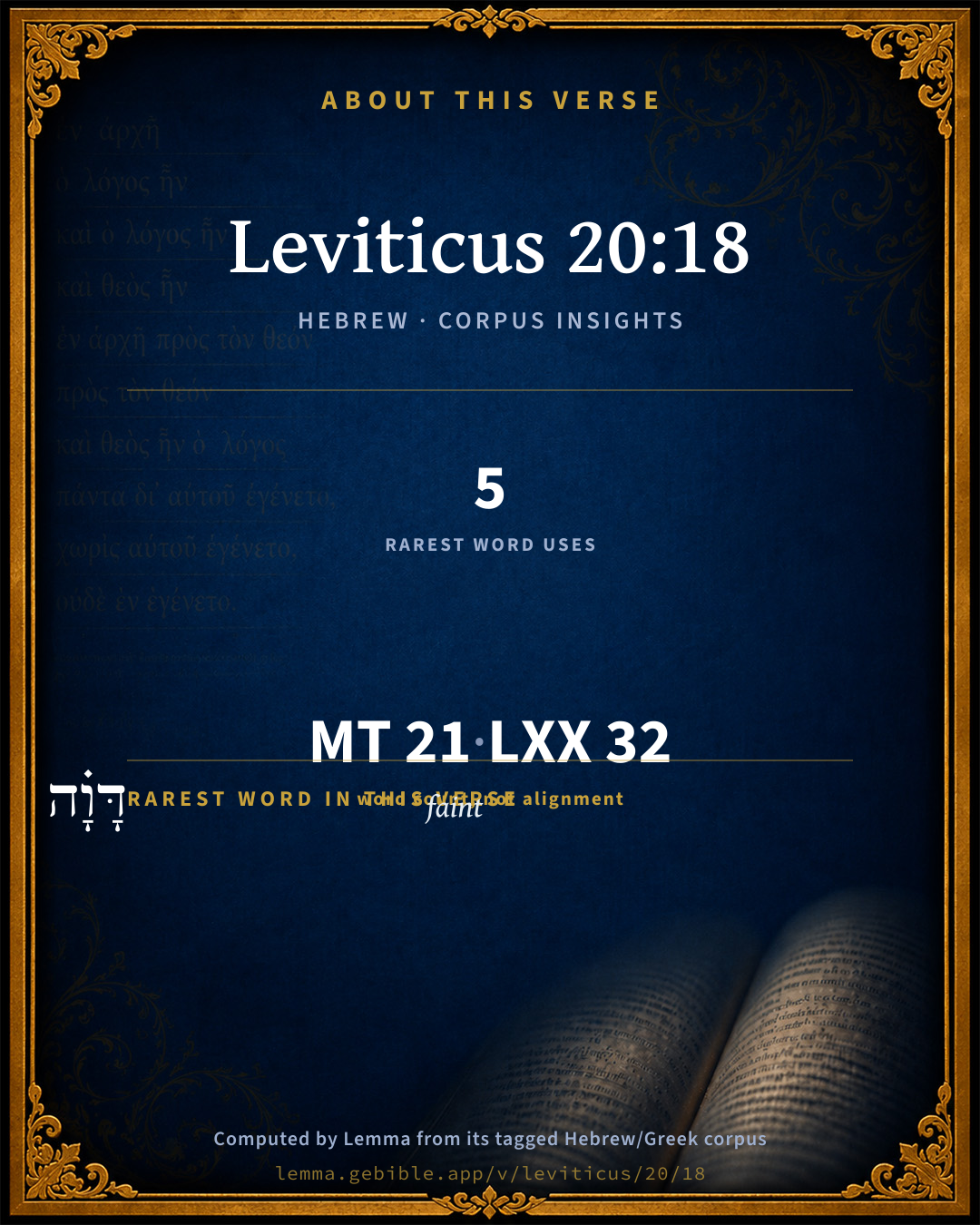
The rarest word here is דָּוָ֗ה faint H1739 — appearing just 5 times in the whole Hebrew Bible.

Shared distinctive vocabulary

דָּוָ֗ה faint H1739 occurs in 5 verses of the Hebrew Bible. Also found in:

Grammatical profile

  • 5 verbs
  • 8 nouns
  • 2 adjectives
  • 1 pronoun
  • 1 preposition
  • 4 particles

Verb forms

  • יִשְׁכַּ֨ב Qal · Imperfect
  • וְגִלָּ֤ה Piel · Perfect
  • הֶֽעֱרָ֔ה Hiphil · Perfect
  • גִּלְּתָ֖ה Piel · Perfect
  • וְנִכְרְת֥וּ Niphal · Perfect

Repetition

Words recur within this verse — often emphatic in Hebrew:

  • וְגִלָּ֤ה to uncover H1540 ×2
  • מְקֹרָ֣הּ spring H4726 ×2

Hebrew & Septuagint length

In English translation the verse runs 42 words from the Hebrew and 43 from the Septuagint (LXX English) — closely comparable.

A rough comparison of the two English renderings, which tokenize alike — not a word-level alignment.

Word counts can differ between the Hebrew and the Greek without any difference in meaning — e.g. the Hebrew direct-object marker אֵת has no separate Greek word, and Greek often adds the article ὁ.

In the original languages it is 21 Hebrew tokens and 32 Greek tokens — but the two are counted differently (Hebrew bundles its prefixes and suffixes into one token; the Greek is in lemma form), so that isn’t a like-for-like length.

Cross-references

4

Topical passages linked to Leviticus 20:18 in the Treasury of Scripture Knowledge — connected by theme and wording, ordered by reader-vote popularity; previews shown in the World English Bible.

  • Leviticus 15:24 "'If any man lies with her, and her monthly flow is on him, he shall be unclean seven days; and every bed whereon he lies shall be unclean.
  • Leviticus 18:19 "'You shall not approach a woman to uncover her nakedness, as long as she is impure by her uncleanness.
  • Ezekiel 18:6 and has not eaten on the mountains, neither has lifted up his eyes to the idols of the house of Israel, neither has defiled his neighbor's wife, neither has come near to a woman in her impurity,
  • Ezekiel 22:10 In you have they uncovered their fathers' nakedness; in you have they humbled her who was unclean in her impurity.

Cross-references courtesy of OpenBible.info (CC BY 4.0).

Hebrew and Greek witnesses Masoretic Hebrew ↔ Greek Septuagint

The same verse in the two great witnesses to the Old Testament, shown verse-for-verse.

These are two independent witnesses, not word-aligned to each other, and the Septuagint is shown in lemma (dictionary) form.

Hebrew Leviticus 20:18 Masoretic · Westminster Leningrad Codex

וְ֠אִישׁ אֲשֶׁר יִשְׁכַּ֨ב אֶת אִשָּׁ֜ה דָּוָ֗ה וְגִלָּ֤ה אֶת עֶרְוָתָהּ֙ אֶת מְקֹרָ֣הּ הֶֽעֱרָ֔ה וְהִ֕יא גִּלְּתָ֖ה אֶת מְק֣וֹר דָּמֶ֑יהָ וְנִכְרְת֥וּ שְׁנֵיהֶ֖ם מִקֶּ֥רֶב עַמָּֽם

"'If a man lies with a woman having her monthly period, and uncovers her nakedness; he has made naked her fountain, and she has uncovered the fountain of her blood: and both of them shall be cut off from among their people.

World English Bible · Public Domain

Greek LXX Leviticus 20:18 Septuagint · lemma form

καί ἀνήρ ὅς ἄν κοιμάω μετά γυνή ἀπο καταἧμαι καί ἀποκαλύπτω ὁ ἀσχημοσύνη αὐτός ὁ πηγή αὐτός ἀποκαλύπτω καί οὗτος ἀποκαλύπτω ὁ ῥύσις ὁ αἷμα αὐτός ἐκὀλεθρεύω ἀμφότεροι ἐκ ὁ γένος αὐτός

And whatever man shall lie with a woman that is set apart for a flux, and shall uncover her nakedness, he has uncovered her fountain, and she has uncovered the flux of her blood: they shall both be destroyed from among their generation.

LXX2012 (modern English Septuagint) · Public Domain

Hebrew: Westminster Leningrad Codex (CC BY 4.0). Greek: Septuagint (public domain); English from LXX2012 (modern English Septuagint) (Public Domain). How the Septuagint differs from the Hebrew →

Targum (Aramaic paraphrase)

2

The Targum is the ancient Jewish Aramaic paraphrase of the Hebrew Scriptures — an interpretive translation, not the Hebrew text itself. Onkelos (literal) and Pseudo-Jonathan (expansive) render the Torah, and Jonathan the Prophets. Coverage is partial: where no permissively-licensed English translation exists for a verse, only the Aramaic is shown. This is verse-level text, not a word-by-word alignment to the Hebrew.

  1. Targum Onkelos Torah (Genesis–Deuteronomy)
    וּגְבַר דִי יִשְׁכּוּב יָת אִתְּתָא סוֹאֲבָתָא וִיגַלֵי יָת עֶרְיְתַהּ יָת קְלָנַהּ גַלִי וְהִיא תְגַלֵי יָת סוֹאֲבַת דְמָהָא וְיִשְׁתֵּיצוּן תַּרְוֵיהוֹן מִגוֹ עַמְהוֹן

    (no public-domain English translation for this verse)

    Targum Onkelos — Aramaic: “Onkelos Genesis” (public domain); “Onkelos Exodus” (public domain); “Onkelos Leviticus” (public domain); “Onkelos Numbers” (public domain); “Onkelos Deuteronomy” (public domain). English: “Sefaria Community Translation” (CC0 1.0 (public-domain dedication)); “J.W. Etheridge. The Targums of Onkelos and Jonathan Ben Uzziel on the Pentateuch. London: Longmans, Green, 1862” (public domain). Text via Sefaria.

  2. Targum Pseudo-Jonathan Torah (Genesis–Deuteronomy)
    וּגְבַר דִי יְשַׁמֵשׁ עִם אִתְּתָא דְוָותָא וּבְזֵי יַת עִרְיְיתָהּ וְיַת מַבּוּעַ אֲדַם סוּבְתָא בְּזֵי וְהִיא בָּזִית יַת מַבּוּעַ אַדְמָהָא וְיִשְׁתֵּיצוּן תַּרְוֵיהוֹן בְּמוֹתָנָא מִגוֹ עַמְהֶן

    And a man who lieth with a woman who is unclean, and dishonoureth her nakedness, they shall both of them be destroyed by a plague from among their people.

    Targum Pseudo-Jonathan — Aramaic: “Targum Jonathan on Genesis” (public domain); “Targum Jonathan on Exodus” (public domain); “Targum Jonathan on Leviticus” (public domain); “Targum Jonathan on Numbers” (public domain); “Targum Jonathan on Deuteronomy” (public domain). English: “The Targum of Jonathan ben Uzziel, trans. J. W. Etheridge, London, 1862” (public domain). Text via Sefaria.

Commentary

Notes on Leviticus 20:18 from classic Christian and Jewish commentators (each source and its license shown beneath its notes). The classic Christian expositions comment on the surrounding passage and are grouped to its opening verse, so a note may address several verses; the Jewish commentaries on the Tanakh (Rashi and others) are per-verse, so they appear only where the commentator wrote on this verse.

Lemma curates 59 commentaries, every one of them public domain or Creative Commons licensed, each selected and text-cleaned for this edition rather than reprinted as found. About our sources →

Trapp's Complete Commentary

John Trapp

Lev 20:18 And if a man shall lie with a woman having her sickness, and shall uncover her nakedness; he hath discovered her fountain, and she hath uncovered the fountain of her blood: and both of them shall be cut off from among their people.

Ver. 18-20. See on Lev 18:1-30.

John Trapp, A Commentary or Exposition upon All the Books of the Old and New Testament (1647–1656) — public domain. Text from a community e-Sword module.

Geneva Bible (1599)

Geneva Bible translators

Or, flowers.

Geneva Bible (1599) marginal notes — public domain. Text via Bolls.life.

Ellicott's Commentary for English Readers

(18) Having her sickness.—See Lev_15:24; Lev_18:19.

A Bible Commentary for English Readers, edited by Charles John Ellicott (1878–1897) — public domain. Text from a community e-Sword module.

John Gill's Exposition

And if a man shall lie with a woman having her sickness,.... Her monthly courses, which make her weak and languid, which is forbidden, Lev 18:19; this is not to be understood of a man's lying with his wife ignorantly, when in such a condition, for this being the case, he was only unclean seven days, Lev 15:24; whereas this made him and her liable to cutting off, as in an after clause; but of his lying with her, knowing this to be the case with her, and of which she could not be ignorant, and therefore both liable to the same punishment; or else of any other man lying with her, or of any man lying with any woman, married or unmarried, being in such circumstances:

and shall uncover her nakedness; that is, have carnal knowledge of her:

he hath discovered her fountain; from whence her issue of blood flows: and she hath uncovered the fountain of her blood; freely and willingly, as Aben Ezra observes; for if she had been forced, he alone would have been cut off; but both these phrases put together show agreement in this matter, that they both had knowledge of her case, and both consented to commit the sin:

and both of them shall be cut off from among their people; by death, either by the hand of the civil magistrate, the case being known and proved, or else by the hand of God being known by mortality or the pestilence, as the Targum of Jonathan, or they should die childless; See Gill on Lev 20:17.

John Gill's Exposition of the Whole Bible (1746–1763) — public domain (CC PDM 1.0). Text via the HelloAO Bible API.

Haydock's Catholic Bible Commentary

People, if the action become public; otherwise the man may be purified, chap xv. 24. This intemperance was by a positive law declared a mortal offence in the Jews, though in itself it might be venial. (Sanchez ix. 21.) The text shews that the woman here gives her consent. --- And she open. Hence she deserves to die, for exposing herself and her children to great danger. (Haydock)

George Leo Haydock (1774–1849), Haydock's Catholic Family Bible and Commentary, 1859 edition — public domain. Excludes Psalms (Douay-Rheims chapter numbering differs from Protestant) and Deuterocanonical books (Catholic canon only).

Matthew Poole's English Annotations

If a man shall lie with a woman, wittingly and willingly. See on Lev 15:24; 18:19.

Her sisters, i.e. her monthly infirmity. Her fountain, or her issue. Thus the fountain of blood in Mar 5:29, is the issue of blood, Luk 8:44, the fountain put for the stream, the cause for the effect, which is common.

Matthew Poole's English Annotations on the Holy Bible (1683–1685) — public domain. Text from a community e-Sword/MySword module.

Whedon's Commentary on the Bible

Daniel D. Whedon

18. With a woman having her sickness — Since the Hebrew has but one term for woman and wife, this precept, with its dreadful penalty of extermination, must apply to conjugal intercourse during menstruation. This offence against purity is accounted among the crying sins of Israel, ranking with idol-worship, adultery, and violation of a father’s wife.

Eze_18:6; Eze_22:10.

Both… shall be cut off — They shall both be put to death, though in this case the man is chiefly guilty. Any less stringent safeguard of the wife’s health might have been ineffectual. It is difficult for modern moralists to adjust their ethical notions to all the requirements of the ceremonial law.

Daniel D. Whedon (gen. ed.), Commentary on the Old and New Testaments (1874–1909) — public domain. Text from a community e-Sword module.

Rashi

Rabbi Shlomo Yitzchaki (Rashi)

הערה means HE HATH UNCOVERED. Similarly the term ערוה everywhere denotes "uncovering". The ו in the word ערוה nakedness, is inserted in the root ערה in order to form a noun of it, just as the noun זעוה, "trembling", is of the same derivation as זע in the phrase (Esther 5:9) "and he stood not up and did not tremble (זע)". Similarly, אחוה "brotherhood", is of the same derivation as אח, brother. As for this term "uncovering" our Rabbis differ in the meaning they give to it (Yevamot 55b). Some say that it is the mere contact of the tip of the organ, while others say that it is the insertion of the tip.

Rashi on the Tanakh — English translations: “The Judaica Press complete Tanach with Rashi, translated by A. J. Rosenberg” (CC BY 4.0); “Pentateuch with Rashi's commentary by M. Rosenbaum and A.M. Silbermann, 1929-1934” (public domain); “The Metsudah Tanach series, Lakewood, N.J” (CC BY 4.0); and “The Book of Joshua, Metsudah Publications, 1997” (CC BY 4.0). Text via Sefaria.

Lesson kit

Teaching starters — assembled from the data on this page, not authored interpretation. Every prompt links to the verse data it draws on. Edit before teaching.

Leviticus, in the Pentateuch, opens this verse with 21 words (17 distinct Hebrew lemmas). Its most distinctive word is dâveh (“faint”). A historical commentator’s framing appears above. Read the whole chapter for the surrounding context.

Discussion questions

  1. What does “faint” (dâveh) contribute to the verse as a whole?
  2. How does Leviticus 15:33, which shares the word «faint», read alongside this verse?
  3. What does the repetition of “to uncover” (2× in this one verse) do in this verse?
  4. These translations render this verse differently; the difference is in the English rendering, not the original. What questions does that raise?
  5. «יִשְׁכַּ֨ב» is a Qal Imperfect verb. How does that grammatical form shape the action described?
  6. Compare how Trapp's Complete Commentary and Geneva Bible (1599) read this verse. Where do they agree or differ?

Things to notice

Reading settings

Reading text

Shown beneath each verse's original-language words.

Old Testament
Old Testament edition

Read the OT as the Masoretic Hebrew (MT) or the Greek Septuagint (LXX).

English shown for the Greek Septuagint (in the Hebrew ↔ Greek comparison).

Comparing translations? Open the Compare panel on any verse page to stack up to four side by side.