1 Samuel 24:21

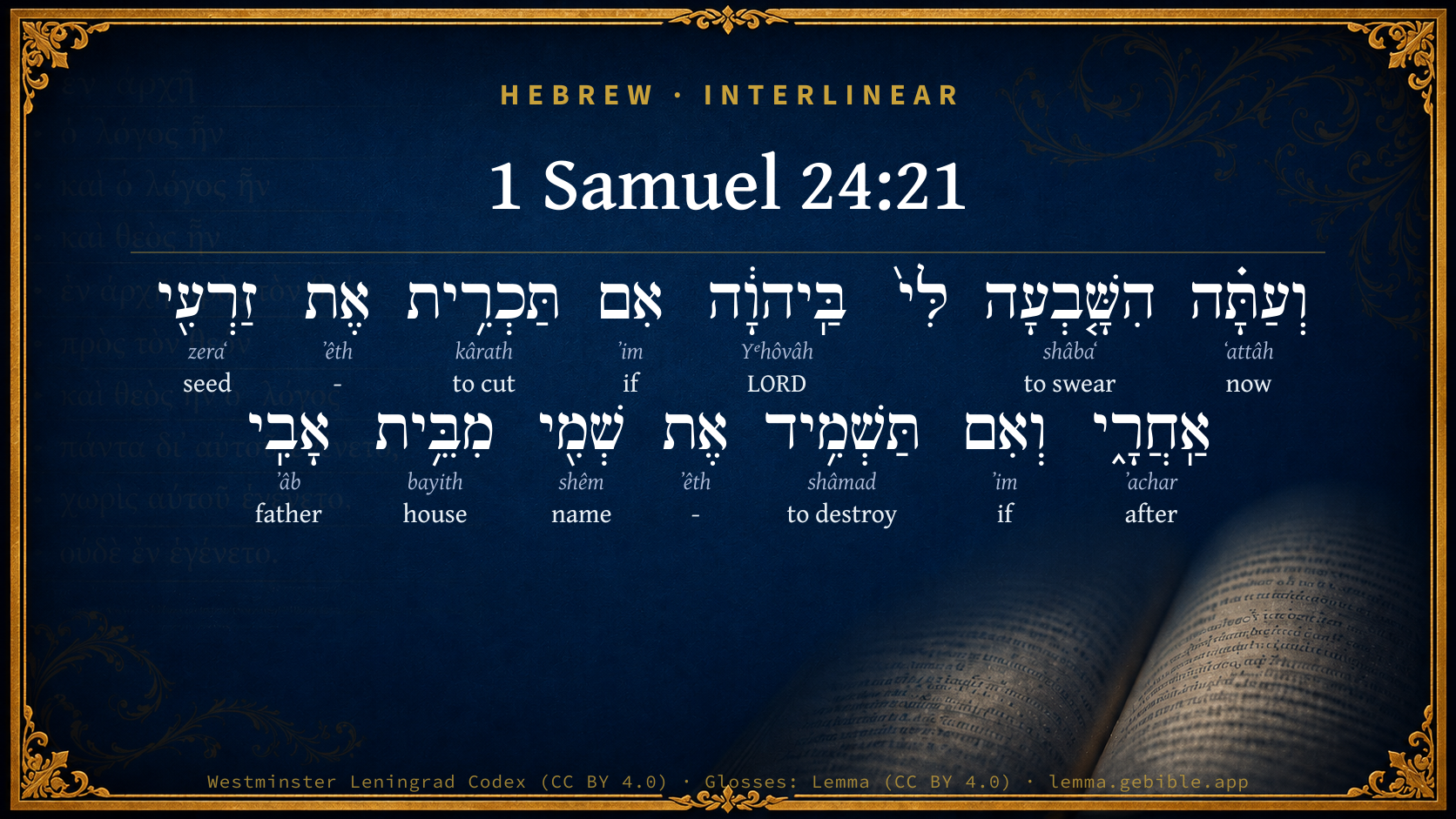
Hebrew (Westminster Leningrad Codex) 1 Samuel 24:21 appears in the Hebrew Old Testament. The text above is from the Westminster Leningrad Codex. Each word links to its Strong’s number, a concise gloss, and parsing drawn from the Open Scriptures Hebrew Bible morphology. Click any word for its full Brown-Driver-Briggs (BDB) entry.
Download image
Cite this verse

1 Samuel 24:21 (World English Bible). Public Domain. Lemma interlinear Bible study tool, https://lemma.gebible.app/v/1-samuel/24/21.

Show BibTeX & RIS
BibTeX
RIS
English Translation
Swear now therefore to me by Yahweh, that you will not cut off my seed after me, and that you will not destroy my name out of my father's house.
World English Bible · Public Domain
Download a study sheet

One document with this verse’s original text, its word-by-word gloss line, the meaning frame, cross-references with their text, attributed commentary, and full source and license credits — printable, and it pastes into notes with its structure intact.

This verse Autodidact and up

Study sheet (.html) Plain text (.txt)

A passage Seminary Student

Up to 50 verses in one chapter. A passage sheet keeps up to 6 commentary sources and 12 cross-references per verse, in the order this page ranks them, and says so on the sheet whenever that leaves anything out. Ask for a single verse and you get the Autodidact verse sheet above.

Everything on this page stays free to read, with no account — the sheet is a download of what is already on screen, not access to it.

Want to remove ads? Support Godless Engineer
Compare translations 3

The same verse in 3 English versions, stacked beneath the original-language interlinear above. Click any original word for its lexicon entry.

Each is an independent rendering of the whole verse — the interlinear is not word-aligned to these translations.

Highlighted words mark where these versions differ — a whole-verse word diff, not a word-by-word alignment.

  • World English Bible Public Domain
    Swear now therefore to me by Yahweh, that you will not cut off my seed after me, and that you will not destroy my name out of my father's house.
  • King James Version Public Domain
    Swear now therefore unto me by the LORD, that thou wilt not cut off my seed after me, and that thou wilt not destroy my name out of my father's house.
  • unfoldingWord Literal Text CC BY-SA 4.0
    And now, swear to me by Yahweh, if you shall cut off my seed after me, and if you shall destroy my name from the house of my father!”

unfoldingWord Literal Text — © unfoldingWord, licensed CC BY-SA 4.0. Word-aligned USFM3 via Door43 (git.door43.org/unfoldingWord/en_ult).

Versions to compare (up to 4)

3 of 4 selected

Show all 18 translations

Every available English version of this verse, each an independent rendering of the whole verse.

  • World English Bible Public Domain
    Swear now therefore to me by Yahweh, that you will not cut off my seed after me, and that you will not destroy my name out of my father's house.
  • Berean Standard Bible Public Domain
    So now, swear to me by the LORD that you will not cut off my descendants or wipe out my name from my father’s house.”
  • Majority Standard Bible Public Domain
    So now, swear to me by the LORD that you will not cut off my descendants or wipe out my name from my father’s house.”
  • King James Version Public Domain
    Swear now therefore unto me by the LORD, that thou wilt not cut off my seed after me, and that thou wilt not destroy my name out of my father's house.
  • American Standard Version (1901) Public Domain
    Swear now therefore unto me by Jehovah, that thou wilt not cut off my seed after me, and that thou wilt not destroy my name out of my father's house.
  • Revised Version (1885) Public Domain
    Swear now therefore unto me by the LORD, that thou wilt not cut off my seed after me, and that thou wilt not destroy my name out of my father’s house.
  • Geneva Bible (1599) Public Domain
    For now behold, I know that thou shalt be King, and that the kingdome of Israel shall be stablished in thine hand.
  • Douay-Rheims (1899) Public Domain
    And now as I know that thou shalt surely be king, and have the kingdom of Israel in thy hand:
  • Young's Literal Translation Public Domain
    and, now, swear to me by Jehovah -- thou dost not cut off my seed after me, nor dost thou destroy my name from the house of my father.'
  • Literal Standard Version CC BY-SA 4.0
    and now, swear to me by YHWH [that] you do not cut off my seed after me, nor do you destroy my name from the house of my father.”
  • Unlocked Literal Bible CC BY-SA 4.0
    Swear to me by Yahweh that you will not cut off my descendants after me, and that you will not destroy my name out of my father's house.”
  • unfoldingWord Literal Text CC BY-SA 4.0
    And now, swear to me by Yahweh, if you shall cut off my seed after me, and if you shall destroy my name from the house of my father!”
  • Darby Bible Public Domain
    Swear now therefore to me by Jehovah, that thou wilt not cut off my seed after me, and that thou wilt not destroy my name out of my father's house.
  • World Messianic Bible Public Domain
    Swear now therefore to me by the LORD that you will not cut off my offspring after me, and that you will not destroy my name out of my father’s house.”
  • Webster's Bible Public Domain
    \\24:20\\And now, behold, I know well that thou wilt surely be king, and that the kingdom of Israel will be established in thy hand.
  • Free Bible Version CC BY-SA 4.0
    Now swear to me by the Lord that you will not destroy my descendants who follow me, and that you will not wipe out my name from my family line.”
  • Bible in Basic English Public Domain
    And now I am certain that you will be king, and that the kingdom of Israel will be made strong under your authority.
  • JPS Tanakh (1917) Public Domain
    (24-22) Swear now therefore unto me by the LORD, that thou wilt not cut off my seed after me, and that thou wilt not destroy my name out of my father's house.'

Literal Standard Version (2020), Covenant Press — licensed CC BY-SA 4.0. Text via the HelloAO Bible API (eBible.org). Unlocked Literal Bible (unfoldingWord) — licensed CC BY-SA 4.0. Text via the HelloAO Bible API (eBible.org). unfoldingWord Literal Text — © unfoldingWord, licensed CC BY-SA 4.0. Word-aligned USFM3 via Door43 (git.door43.org/unfoldingWord/en_ult). Free Bible Version, Dr. Jonathan Gallagher — licensed CC BY-SA 4.0. Text via the HelloAO Bible API (eBible.org).

Word by word

More ways to search: Search by grammar → Find every occurrence → Compare this word →

Practice this passage: Drill this verse → Learn its vocabulary →

תַּשְׁמִ֥יד
shâmad
H8045
“to destroy”
Verb, Hiphil, Imperfect, 2nd Person, Masculine, Singular
Part of Speech
Verb
Stem
Hiphil
Form
Imperfect
Person
2nd Person
Gender
Masculine
Number
Singular
Full BDB Definition

Origin: a primitive root

TWOT: 2406

to destroy, exterminate, be destroyed, be exterminated - (Niphal) - to be annihilated, be exterminated - to be destroyed, be devastated - (Hiphil) - to annihilate, exterminate - to destroy
  1. וְעַתָּ֗ה ʻattâh H6258 “and · now” Conjunction + Adverb
  2. הִשָּׁ֤בְעָה shâbaʻ H7650 “swear” Verb, Niphal, Imperative, 2nd Person, Masculine, Singular + Suffix, h
  3. בַּֽיהוָ֔ה Yᵉhôvâh H3068 “in/at · LORD” Preposition + Noun, Proper
  4. אִם ʼim H518 “if” Conjunction
  5. תַּכְרִ֥ית kârath H3772 “to cut” Verb, Hiphil, Imperfect, 2nd Person, Masculine, Singular
  6. אֶת ʼêth H853 “-” Particle, Direct Object
  7. זַרְעִ֖י zeraʻ H2233 “seed · my” Noun, Common, Masculine, Singular, Construct + Suffix, Personal, 1st Person, Common, Singular
  8. אַֽחֲרָ֑י ʼachar H310 “after · me” Preposition + Suffix, Personal, 1st Person, Common, Singular
  9. וְאִם ʼim H518 “and · if” Conjunction + Conjunction
  10. אֶת ʼêth H853 “-” Particle, Direct Object
  11. שְׁמִ֖י shêm H8034 “name · my” Noun, Common, Masculine, Singular, Construct + Suffix, Personal, 1st Person, Common, Singular
  12. מִבֵּ֥ית bayith H1004 “from · house of” Preposition + Noun, Common, Masculine, Singular, Construct
  13. אָבִֽי ʼâb H1 “father · my” Noun, Common, Masculine, Singular, Construct + Suffix, Personal, 1st Person, Common, Singular

About this verse

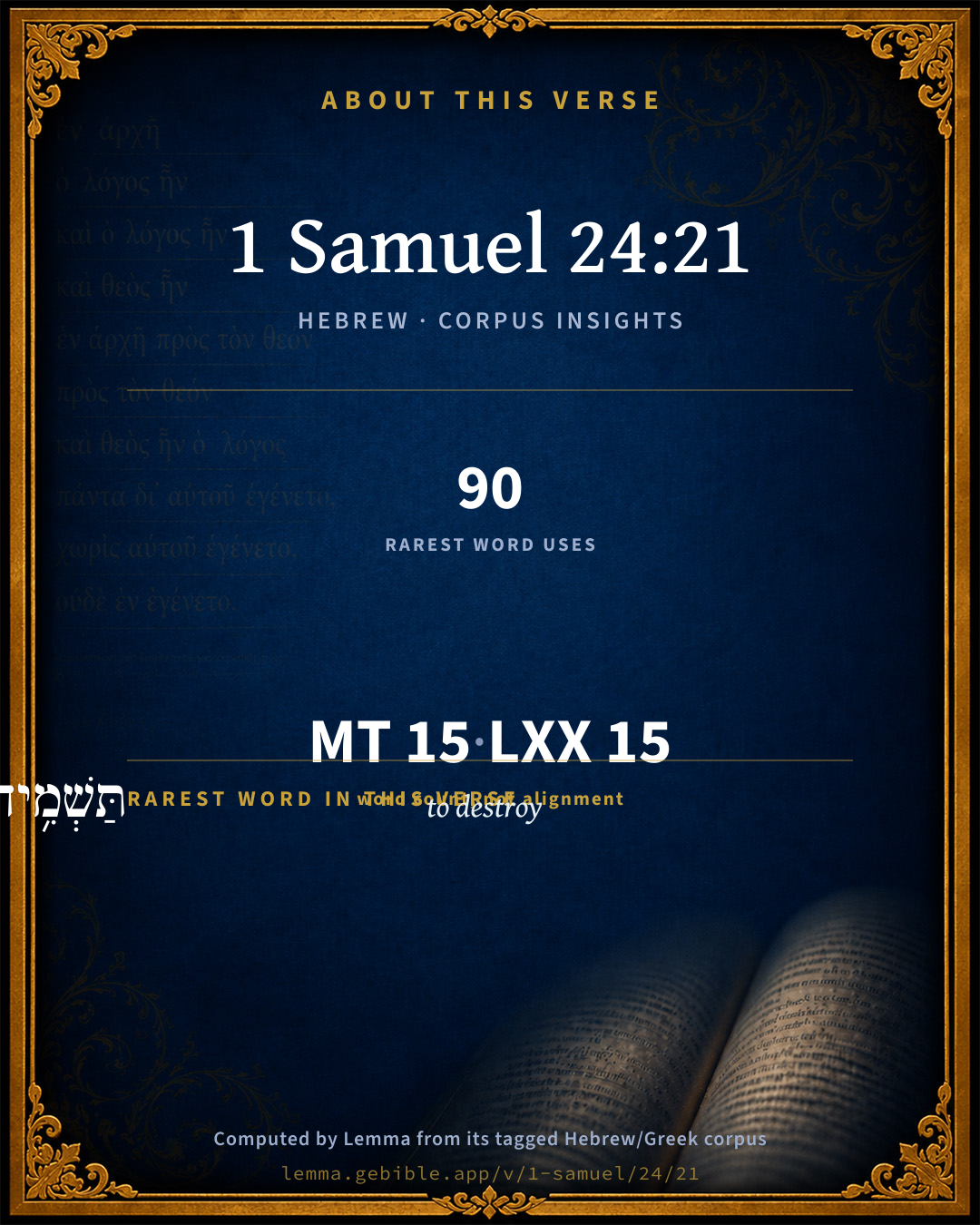
These counts appear in no published source. They are computed here, from the morphology-tagged text and Lemma’s own curated glosses. What Lemma adds →

15
words
12
distinct lemmas
Historical
section

Grammatical profile

  • 3 verbs
  • 5 nouns
  • 2 prepositions
  • 2 conjunctions
  • 1 adverb
  • 2 particles

Verb forms

  • הִשָּׁ֤בְעָה Niphal · Imperative
  • תַּכְרִ֥ית Hiphil · Imperfect
  • תַּשְׁמִ֥יד Hiphil · Imperfect

Repetition

A word recurs within this verse — often emphatic in Hebrew:

  • אִם if H518 ×2

Hebrew & Septuagint length

In English translation the verse runs 30 words from the Hebrew and 21 from the Septuagint (LXX English) — the Septuagint runs noticeably shorter here. See the side-by-side →

A rough comparison of the two English renderings, which tokenize alike — not a word-level alignment.

Word counts can differ between the Hebrew and the Greek without any difference in meaning — e.g. the Hebrew direct-object marker אֵת has no separate Greek word, and Greek often adds the article ὁ.

In the original languages it is 15 Hebrew tokens and 15 Greek tokens — but the two are counted differently (Hebrew bundles its prefixes and suffixes into one token; the Greek is in lemma form), so that isn’t a like-for-like length.

Cross-references

6

Topical passages linked to 1 Samuel 24:21 in the Treasury of Scripture Knowledge — connected by theme and wording, ordered by reader-vote popularity; previews shown in the World English Bible.

  • Genesis 21:23 Now therefore swear to me here by God that you will not deal falsely with me, nor with my son, nor with my son's son. But according to the kindness that I have done to you, you shall do to me, and to the land in which you have lived as a foreigner."
  • 2 Samuel 21:6–8 let seven men of his sons be delivered to us, and we will hang them up to Yahweh in Gibeah of Saul, the chosen of Yahweh. The king said, I will give them.
  • 1 Samuel 20:14–17 You shall not only while yet I live show me the loving kindness of Yahweh, that I not die;
  • Genesis 31:48 Laban said, "This heap is witness between me and you this day." Therefore it was named Galeed
  • Genesis 31:53 The God of Abraham, and the God of Nahor, the God of their father, judge between us." Then Jacob swore by the fear of his father, Isaac.
  • Hebrews 6:16 For men indeed swear by a greater one, and in every dispute of theirs the oath is final for confirmation.

Cross-references courtesy of OpenBible.info (CC BY 4.0).

Hebrew and Greek witnesses Masoretic Hebrew ↔ Greek Septuagint

The same verse in the two great witnesses to the Old Testament, shown verse-for-verse.

Here the Septuagint runs noticeably shorter than the Hebrew — LXX2012 (modern English Septuagint) 21 words vs World English Bible 30. A rough length comparison of the two English translations, not a word-level alignment — read both below.

These are two independent witnesses, not word-aligned to each other, and the Septuagint is shown in lemma (dictionary) form.

Hebrew 1 Samuel 24:21 Masoretic · Westminster Leningrad Codex

וְעַתָּ֗ה הִשָּׁ֤בְעָה לִּי֙ בַּֽיהוָ֔ה אִם תַּכְרִ֥ית אֶת זַרְעִ֖י אַֽחֲרָ֑י וְאִם תַּשְׁמִ֥יד אֶת שְׁמִ֖י מִבֵּ֥ית אָבִֽי

Swear now therefore to me by Yahweh, that you will not cut off my seed after me, and that you will not destroy my name out of my father's house.

World English Bible · Public Domain

Greek LXX 1 Samuel 24:21 Septuagint · lemma form

καί νῦν ἰδού ἐγώ γιγνώσκω ὅτι βασιλεύω βασιλεύω καί ἵστημι ἐν χείρ σύ βασιλεία ἰσραήλ

And now, behold, I know that you shall surely reign, and the kingdom of Israel shall be established in your hand.

LXX2012 (modern English Septuagint) · Public Domain

Hebrew: Westminster Leningrad Codex (CC BY 4.0). Greek: Septuagint (public domain); English from LXX2012 (modern English Septuagint) (Public Domain). How the Septuagint differs from the Hebrew →

Targum (Aramaic paraphrase)

1

The Targum is the ancient Jewish Aramaic paraphrase of the Hebrew Scriptures — an interpretive translation, not the Hebrew text itself. Onkelos (literal) and Pseudo-Jonathan (expansive) render the Torah, and Jonathan the Prophets. Coverage is partial: where no permissively-licensed English translation exists for a verse, only the Aramaic is shown. This is verse-level text, not a word-by-word alignment to the Hebrew.

  1. Targum Jonathan Prophets (Joshua–Malachi)
    וּכְעַן הָא יָדַעְנָא אֲרֵי מִמְלַךְ תִּמְלַךְ וְתִתְקַיֵים בִּידָךְ מַלְכוּתָא דְיִשְׂרָאֵל:

    (no public-domain English translation for this verse)

    Targum Jonathan — Aramaic: “Mikraot Gedolot” (public domain). English: “Sefaria Community Translation” (CC0 1.0 (public-domain dedication)); “London "Chaldee Paraphrase," 1871” (public domain). Text via Sefaria.

Commentary

Notes on 1 Samuel 24:21 from classic Christian and Jewish commentators (each source and its license shown beneath its notes). The classic Christian expositions comment on the surrounding passage and are grouped to its opening verse, so a note may address several verses; the Jewish commentaries on the Tanakh (Rashi and others) are per-verse, so they appear only where the commentator wrote on this verse.

Lemma curates 59 commentaries, every one of them public domain or Creative Commons licensed, each selected and text-cleaned for this edition rather than reprinted as found. About our sources →

Trapp's Complete Commentary

John Trapp

1Sa 24:21 Swear now therefore unto me by the LORD, that thou wilt not cut off my seed after me, and that thou wilt not destroy my name out of my father’s house.

Ver. 21. That thou wilt not cut off my seed.] His care of posterity’s good was commendable; but till now he had taken a very ill course for them; as that Roman tyrant had done, whom when the people slew together with his children, they cried out, Of so ill a litter, not one whelp is to be left alive.

John Trapp, A Commentary or Exposition upon All the Books of the Old and New Testament (1647–1656) — public domain. Text from a community e-Sword module.

Tyndale Open Study Notes

Tyndale Open Resources

24:21-22 Now swear to me . . . you will not kill my family: Having descendants was a way that Saul’s name would endure among the living. David had already sworn such an oath with Jonathan (20:14-17).

Tyndale Open Study Notes — © Tyndale Open Resources, licensed CC BY-SA 4.0. Text via the HelloAO Bible API.

Geneva Bible (1599)

Geneva Bible translators

Though this tyrant saw and confessed the favor of God toward David, yet he ceaseth not to persecute him against his own conscience.

Geneva Bible (1599) marginal notes — public domain. Text via Bolls.life.

Adam Clarke's Commentary

Verse 21. Swear now] Saul knew that an oath would bind David, though it was insufficient to bind himself; see 1Sa 19:6. He had sworn to his son Jonathan that David should not be slain; and yet sought by all means in his power to destroy him!

Adam Clarke's Commentary on the Bible (1810–1826) — public domain. Text from a community e-Sword/MySword module.

Ellicott's Commentary for English Readers

(21) Swear now therefore unto me.—So strongly was Saul convinced at this moment that David would at no distant period of time occupy the throne of Israel that he entreated him, when that day should come, not to destroy all his (Saul’s) children. This barbarous custom has been always too common a practice in the jealous East. It seems to have been equally dreaded by Jonathan, who made—it will be remembered—this condition of mercy to be shown by David in his day of power to his (Jonathan’s) children a part of the solemn covenant concluded between them. (See 1Sa_20:15.) In the frequent dynastic changes which took place in the kingdom of Israel, we have instances of such wholesale massacres of the royal family of the fallen house. (See 1Ki_15:29, where Baasha slew King Nadab, the son of Jeroboam, and took his throne. Then Baasha, we read, “smote all the house of Jeroboam; he left not to Jeroboam any that breathed; “and in 1Ki_16:11, where Zimri murdered his master, King Baasha. Zimri, “as soon as he sat on his throne, slew all the house of Baasha: he left him not one, neither of his kinsfolks, nor of his friends.”) A similar massacre is described, only with more ghastly details, in 2 Kings 10, where “Jehu slew all that remained to Ahab in Samaria.” There the story is peculiarly an Oriental scene of history, with the seventy baskets containing the seventy heads of princes presented as an acceptable offering to the new stern king of Israel—Jehu. It was, therefore, no vain dread of what might happen in the future which made King Saul ask this of David. Doubtless the fear of some such awful catastrophe happening to his own loved children and friends was no small part of the punishment of Saul.

A Bible Commentary for English Readers, edited by Charles John Ellicott (1878–1897) — public domain. Text from a community e-Sword module.

The Cambridge Bible for Schools and Colleges

gen. ed. J. J. S. Perowne

21. Swear now, &c] Saul pledges his successor not to follow the barbarous Oriental custom. See on 1Sa_20:14.

The Cambridge Bible for Schools and Colleges (gen. ed. J. J. S. Perowne; Cambridge University Press, 1878–1918) — public domain. Text from a community e-Sword module.

John Gill's Exposition

Swear now therefore unto me by the Lord,.... By the Word of the Lord, as the, Targum:

that thou wilt not cut off my seed after me; as was usually done in despotic governments in the eastern countries, and is at this day, when one is advanced to the throne of another, by whom issue is left, who may be rivals and competitors with him:

and that thou wilt not destroy my name out of my father's house; by cutting off his seed, the same thing in different words repeated, for the confirmation of it; children bear the names of their fathers, and by them their memory is perpetuated, and cutting off them is destroying the name of their parents.

John Gill's Exposition of the Whole Bible (1746–1763) — public domain (CC PDM 1.0). Text via the HelloAO Bible API.

Albert Barnes' Notes on the Bible

Swear now ... - The same request which Jonathan made 1Sa 20:15. The deep, genealogical feeling of the Israelites breaks out here as so often elsewhere.

Albert Barnes' Notes on the Bible (1834–1885) — public domain. Text from a community e-Sword/MySword module.

Matthew Poole's English Annotations

Thou wilt not cut off my seed after me; as princes use to destroy their competitors, and those that have any hopes of or pretence to their crown; and Saul had endeavoured to destroy David for the same reason, and therefore he feared a retaliation.

Thou wilt not destroy my name, to wit, by cutting off my seed. So it is the same thing repeated in other words, as is usual in Scripture.

Matthew Poole's English Annotations on the Holy Bible (1683–1685) — public domain. Text from a community e-Sword/MySword module.

unfoldingWord translationNotes

Door43 World Missions Community

you will not cut off my descendants after me

"you will not kill my sons and their families." It was common for a new king who was not from the previous family line to kill off all the children of the former king to prevent any of them from challenging him for the throne.

you will not destroy my name out of my father's house

It is important for each family in Israel to have descendants from generation to generation carrying on the family name and land inheritance. AT: "you will not destroy my family and descendants" or "you will allow my family to live" (See: Metonymy)

David and his men

"David and his army"

translationWords

oath

Yahweh

descend

name

ancestor

house

David

Saul (OT)

stronghold

unfoldingWord translationNotes — © Distant Shores Media and the Door43 World Missions Community, licensed CC BY-SA 4.0. Source: git.door43.org/Door43/en_tn.

Rashi

Rabbi Shlomo Yitzchaki (Rashi)

I know that you will surely reign. For I see that the Holy One, Blessed is He, saves you from my hand. The Midrash Aggadah states, that Shmuel gave him this sign, that the one who tears his robe will reign after him.

Rashi on the Tanakh — English translations: “The Judaica Press complete Tanach with Rashi, translated by A. J. Rosenberg” (CC BY 4.0); “Pentateuch with Rashi's commentary by M. Rosenbaum and A.M. Silbermann, 1929-1934” (public domain); “The Metsudah Tanach series, Lakewood, N.J” (CC BY 4.0); and “The Book of Joshua, Metsudah Publications, 1997” (CC BY 4.0). Text via Sefaria.

Lesson kit

Teaching starters — assembled from the data on this page, not authored interpretation. Every prompt links to the verse data it draws on. Edit before teaching.

1 Samuel, in the Historical, opens this verse with 15 words (12 distinct Hebrew lemmas). Its most distinctive word is shâmad (“to destroy”). The Greek Septuagint runs shorter here. A historical commentator’s framing appears above. Read the whole chapter for the surrounding context.

Discussion questions

  1. How does “to destroy” (shâmad) shape what this verse is saying?
  2. How does Genesis 21:23, which shares this passage’s theme, read alongside this verse?
  3. What does the repetition of “if” (2× in this one verse) do in this verse?
  4. The Septuagint runs shorter here than the Hebrew. What might account for the difference?
  5. The translations on this page render this verse differently — a whole-verse word diff, not a word-by-word alignment. What might account for the different wordings?
  6. «הִשָּׁ֤בְעָה» is a Niphal Imperative verb. How does that grammatical form shape the action described?
  7. Compare how Trapp's Complete Commentary and Tyndale Open Study Notes read this verse. Where do they agree or differ?

Things to notice

Reading settings

Reading text

Shown beneath each verse's original-language words.

Old Testament
Old Testament edition

Read the OT as the Masoretic Hebrew (MT) or the Greek Septuagint (LXX).

English shown for the Greek Septuagint (in the Hebrew ↔ Greek comparison).

Comparing translations? Open the Compare panel on any verse page to stack up to four side by side.