
Psalms 89:3

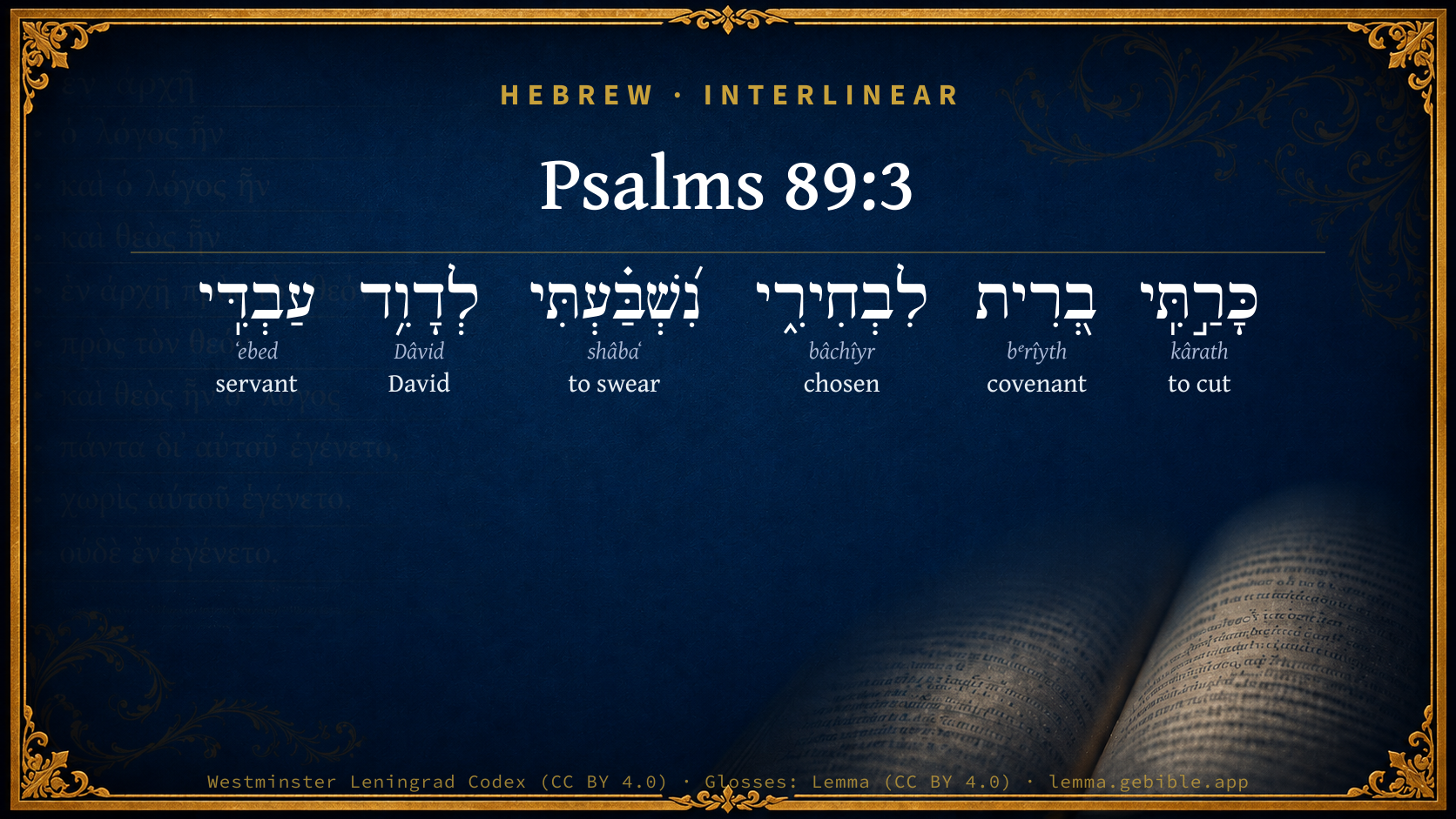
Hebrew (Westminster Leningrad Codex) Psalms 89:3 appears in the Hebrew Old Testament. The text above is from the Westminster Leningrad Codex. Each word links to its Strong’s number, a concise gloss, and parsing drawn from the Open Scriptures Hebrew Bible morphology. Click any word for its full Brown-Driver-Briggs (BDB) entry.
Download image
Cite this verse

Psalms 89:3 (World English Bible). Public Domain. Lemma interlinear Bible study tool, https://lemma.gebible.app/v/psalms/89/3.

Show BibTeX & RIS
BibTeX
RIS
English Translation
"I have made a covenant with my chosen one, I have sworn to David, my servant,
World English Bible · Public Domain
Download a study sheet

One document with this verse’s original text, its word-by-word gloss line, the meaning frame, cross-references with their text, attributed commentary, and full source and license credits — printable, and it pastes into notes with its structure intact.

This verse Autodidact and up

Study sheet (.html) Plain text (.txt)

A passage Seminary Student

Up to 50 verses in one chapter. A passage sheet keeps up to 6 commentary sources and 12 cross-references per verse, in the order this page ranks them, and says so on the sheet whenever that leaves anything out. Ask for a single verse and you get the Autodidact verse sheet above.

Everything on this page stays free to read, with no account — the sheet is a download of what is already on screen, not access to it.

Want to remove ads? Support Godless Engineer
Compare translations 3

The same verse in 3 English versions, stacked beneath the original-language interlinear above. Click any original word for its lexicon entry.

Each is an independent rendering of the whole verse — the interlinear is not word-aligned to these translations.

Highlighted words mark where these versions differ — a whole-verse word diff, not a word-by-word alignment.

  • World English Bible Public Domain
    "I have made a covenant with my chosen one, I have sworn to David, my servant,
  • King James Version Public Domain
    I have made a covenant with my chosen, I have sworn unto David my servant,
  • unfoldingWord Literal Text CC BY-SA 4.0
    “I have cut a covenant with my chosen; I have sworn to David my servant:

unfoldingWord Literal Text — © unfoldingWord, licensed CC BY-SA 4.0. Word-aligned USFM3 via Door43 (git.door43.org/unfoldingWord/en_ult).

Versions to compare (up to 4)

3 of 4 selected

Show all 18 translations

Every available English version of this verse, each an independent rendering of the whole verse.

  • World English Bible Public Domain
    "I have made a covenant with my chosen one, I have sworn to David, my servant,
  • Berean Standard Bible Public Domain
    You said, “I have made a covenant with My chosen one, I have sworn to David My servant:
  • Majority Standard Bible Public Domain
    You said, “I have made a covenant with My chosen one, I have sworn to David My servant:
  • King James Version Public Domain
    I have made a covenant with my chosen, I have sworn unto David my servant,
  • American Standard Version (1901) Public Domain
    I have made a covenant with my chosen, I have sworn unto David my servant:
  • Revised Version (1885) Public Domain
    I have made a covenant with my chosen, I have sworn unto David my servant;
  • Geneva Bible (1599) Public Domain
    I haue made a couenant with my chosen: I haue sworne to Dauid my seruant,
  • Douay-Rheims (1899) Public Domain
    For thou hast said: Mercy shall be built up for ever in the heavens: thy truth shall be prepared in them.
  • Young's Literal Translation Public Domain
    I have made a covenant for My chosen, I have sworn to David My servant:
  • Literal Standard Version CC BY-SA 4.0
    I have made a covenant for My chosen, || I have sworn to My servant David:
  • Unlocked Literal Bible CC BY-SA 4.0
    “I have made a covenant with my chosen one, I have made an oath to David my servant.
  • unfoldingWord Literal Text CC BY-SA 4.0
    “I have cut a covenant with my chosen; I have sworn to David my servant:
  • Darby Bible Public Domain
    I have made a covenant with mine elect, I have sworn unto David my servant:
  • World Messianic Bible Public Domain
    “I have made a covenant with my chosen one, I have sworn to David, my servant,
  • Webster's Bible Public Domain
    \\89:2\\For I have said, Mercy shall be built up for ever: thy faithfulness wilt thou establish in the very heavens.
  • Free Bible Version CC BY-SA 4.0
    You said, “I have made an agreement with my chosen one, I gave a binding promise to my servant David:
  • Bible in Basic English Public Domain
    I have made an agreement with the man of my selection, I have made an oath to David my servant;
  • JPS Tanakh (1917) Public Domain
    (89-4) I have made a covenant with My chosen, I have sworn unto David My servant:

Literal Standard Version (2020), Covenant Press — licensed CC BY-SA 4.0. Text via the HelloAO Bible API (eBible.org). Unlocked Literal Bible (unfoldingWord) — licensed CC BY-SA 4.0. Text via the HelloAO Bible API (eBible.org). unfoldingWord Literal Text — © unfoldingWord, licensed CC BY-SA 4.0. Word-aligned USFM3 via Door43 (git.door43.org/unfoldingWord/en_ult). Free Bible Version, Dr. Jonathan Gallagher — licensed CC BY-SA 4.0. Text via the HelloAO Bible API (eBible.org).

Word by word

More ways to search: Search by grammar → Find every occurrence → Compare this word →

Practice this passage: Drill this verse → Learn its vocabulary →

About this verse

These counts appear in no published source. They are computed here, from the morphology-tagged text and Lemma’s own curated glosses. What Lemma adds →

6
words
6
distinct lemmas
Wisdom
section

Notable vocabulary

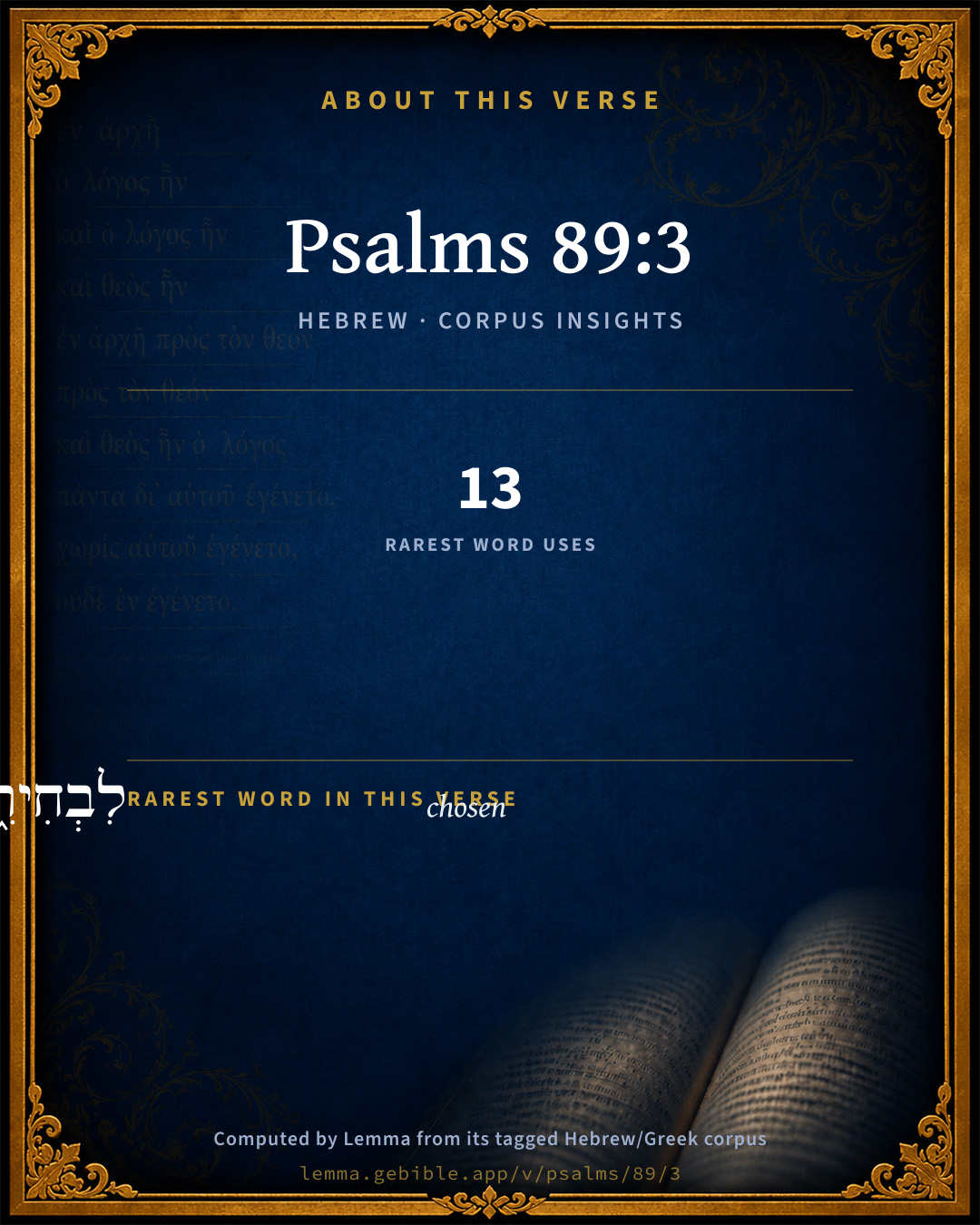
The rarest word here is לִבְחִירִ֑י chosen H972 — appearing just 13 times in the whole Hebrew Bible.

Shared distinctive vocabulary

לִבְחִירִ֑י chosen H972 occurs in 13 verses of the Hebrew Bible. Also found in:

Grammatical profile

  • 2 verbs
  • 3 nouns
  • 1 adjective

Verb forms

  • כָּרַ֣תִּֽי Qal · Perfect
  • נִ֝שְׁבַּ֗עְתִּי Niphal · Perfect

Hebrew & Septuagint length

In English translation the verse runs 16 words from the Hebrew and 14 from the Septuagint (LXX English) — closely comparable.

A rough comparison of the two English renderings, which tokenize alike — not a word-level alignment.

Word counts can differ between the Hebrew and the Greek without any difference in meaning — e.g. the Hebrew direct-object marker אֵת has no separate Greek word, and Greek often adds the article ὁ.

Cross-references

21

Topical passages linked to Psalms 89:3 in the Treasury of Scripture Knowledge — connected by theme and wording, ordered by reader-vote popularity; previews shown in the World English Bible.

  • Psalms 132:11 Yahweh has sworn to David in truth. He will not turn from it: "I will set the fruit of your body on your throne.
  • 2 Samuel 7:10–16 I will appoint a place for my people Israel, and will plant them, that they may dwell in their own place, and be moved no more; neither shall the children of wickedness afflict them any more, as at the first,
  • Psalms 89:28 I will keep my loving kindness for him forevermore. My covenant will stand firm with him.
  • 2 Samuel 23:5 Most assuredly my house is not so with God; Yet he has made with me an everlasting covenant, Ordered in all things, and sure: For it is all my salvation, and all [my] desire, Although he doesn't make it grow.
  • 1 Kings 8:16 Since the day that I brought forth my people Israel out of Egypt, I chose no city out of all the tribes of Israel to build a house, that my name might be there; but I chose David to be over my people Israel.
  • Psalms 89:34–35 I will not break my covenant, Nor alter what my lips have uttered.
  • Jeremiah 33:20–21 Thus says Yahweh: If you can break my covenant of the day, and my covenant of the night, so that there shall not be day and night in their season;
  • Acts 2:30 Therefore, being a prophet, and knowing that God had sworn with an oath to him that of the fruit of his body, according to the flesh, he would raise up the Christ to sit on his throne,
  • Hebrews 7:21 (for they indeed have been made priests without an oath), but he with an oath by him that says of him, "The Lord swore and will not change his mind, 'You are a priest forever, According to the order of Melchizedek'".
  • 2 Samuel 3:9 God do so to Abner, and more also, if, as Yahweh has sworn to David, I don't do even so to him;
  • Isaiah 55:3 Turn your ear, and come to me; hear, and your soul shall live: and I will make an everlasting covenant with you, even the sure mercies of David.
  • Jeremiah 30:9 but they shall serve Yahweh their God, and David their king, whom I will raise up to them.
  • Ezekiel 34:23–24 I will set up one shepherd over them, and he shall feed them, even my servant David; he shall feed them, and he shall be their shepherd.
  • Hosea 3:5 Afterward the children of Israel shall return, and seek Yahweh their God, and David their king, and shall come with trembling to Yahweh and to his blessings in the last days.
  • Matthew 12:18–21 "Behold, my servant whom I have chosen; My beloved in whom my soul is well pleased: I will put my Spirit on him. He will proclaim justice to the Gentiles.
  • Luke 1:32–33 He will be great, and will be called the Son of the Most High. The Lord God will give him the throne of his father, David,
  • Psalms 78:70 He also chose David his servant, And took him from the sheepfolds;
  • Psalms 89:39 You have renounced the covenant of your servant. You have defiled his crown in the dust.
  • Isaiah 42:1 Behold, my servant, whom I uphold; my chosen, in whom my soul delights: I have put my Spirit on him; he will bring forth justice to the Gentiles.
  • Matthew 3:17 Behold, a voice out of the heavens said, "This is my beloved Son, with whom I am well pleased."
  • Psalms 89:19 Then you spoke in vision to your saints, And said, "I have bestowed strength on the warrior. I have exalted a young man from the people.

Cross-references courtesy of OpenBible.info (CC BY 4.0).

Hebrew and Greek witnesses Masoretic Hebrew ↔ Greek Septuagint

The same verse in the two great witnesses to the Old Testament, shown verse-for-verse.

You’re reading Greek Psalm 88 (Hebrew Psalm 89). The Septuagint counts the superscription, so verse numbers can differ from the Hebrew — chapter-level alignment, not verse-by-verse. Numbering follows Rahlfs.

These are two independent witnesses, not word-aligned to each other, and the Septuagint is shown in lemma (dictionary) form.

Hebrew Psalms 89:3 Masoretic · Westminster Leningrad Codex

כָּרַ֣תִּֽי בְ֭רִית לִבְחִירִ֑י נִ֝שְׁבַּ֗עְתִּי לְדָוִ֥ד עַבְדִּֽי

"I have made a covenant with my chosen one, I have sworn to David, my servant,

World English Bible · Public Domain

Greek LXX Greek Psalm 88:3 Septuagint · lemma form

ὅτι εἶπον εἰς ὁ αἰών ἔλεος οἰκοδομέω ἐν ὁ οὐρανός ἑτοιμάζω ὁ ἀλήθεια σύ

I made a covenant with my chosen ones, I swore to David my servant.

LXX2012 (modern English Septuagint) · Public Domain

On this verse, Albert Barnes' Notes on the Bible discusses the Septuagint’s reading. Read the note in Commentary ↓

Hebrew: Westminster Leningrad Codex (CC BY 4.0). Greek: Septuagint (public domain); English from LXX2012 (modern English Septuagint) (Public Domain). How the Septuagint differs from the Hebrew →

Commentary

Notes on Psalms 89:3 from classic Christian and Jewish commentators (each source and its license shown beneath its notes). The classic Christian expositions comment on the surrounding passage and are grouped to its opening verse, so a note may address several verses; the Jewish commentaries on the Tanakh (Rashi and others) are per-verse, so they appear only where the commentator wrote on this verse.

Lemma curates 59 commentaries, every one of them public domain or Creative Commons licensed, each selected and text-cleaned for this edition rather than reprinted as found. About our sources →

Trapp's Complete Commentary

John Trapp

Psa 89:3 I have made a covenant with my chosen, I have sworn unto David my servant,

Ver. 3. I have made a covenant with my chosen] i.e. With Christ (who is God’s elect one, Isa 42:1), and in him with all his people, Eph 1:4.

I have sworn unto David] The father and figure of Christ, who is frequently called David, and is here chiefly to be understood. O happy we, for whose sake God hath sworn! saith Tertullian; and O most wretched, if we believe him not thus swearing!

John Trapp, A Commentary or Exposition upon All the Books of the Old and New Testament (1647–1656) — public domain. Text from a community e-Sword module.

Joseph Benson's Commentary

Psa 89:3-5. I have made a covenant with my chosen — With David, whom I have chosen to the kingdom. Thy seed will I establish for ever, &c. — I will perpetuate the kingdom to thy posterity; which was promised upon condition, and was literally accomplished in Christ, who was of the seed of David. And the heavens shall praise thy wonders — That is, the inhabitants of heaven, the holy angels, who clearly discern and constantly adore thy mercy and faithfulness; when men upon earth are filled with doubts and perplexities about it. Thy faithfulness also — Understand, shall be praised; (which supplements are usual in Scripture;) in the congregation of the saints — Either, 1st, Of thy saints on earth in their public assemblies; who always acknowledge and celebrate thy truth, though they cannot always discern the footsteps of it: or, rather, 2d, Of the angels in heaven, of whom he speaks in the foregoing clause; and who are often called saints, or holy ones.

Joseph Benson's Commentary on the Old and New Testaments (1811–1818) — public domain. Text from a community e-Sword module.

J. A. Alexander on Psalms

Joseph Addison Alexander

4. (Psa 89:3) I have ratified a covenant with my chosen (one); I have sworn unto David my servant. These are the words of God himself, though not ex-pressly so described, as in Psa 89:19 below. We have here a summary statement of the substance of the promise in 2 Samuel 7, upon which this and the other Messianic psalms are founded. Ratified a covenant, see above, on Psa 50:5. With my chosen, literally to my chosen, as in the parallel expression, because what is here called a covenant was really a conditional promise or engagement upon God's part. My servant, i.e. my chosen and appointed instrument in executing my designs. See above, on Psa 18:1, and compare Psa 86:16.

Joseph Addison Alexander, The Psalms Translated and Explained (1850) — public domain. Text from a community e-Sword module.

Tyndale Open Study Notes

Tyndale Open Resources

89:3-4 The psalmist restates God’s covenant with David (see also 89:19-37).

89:3 The Lord has sworn by his own holiness (89:35; see 110:4).

Tyndale Open Study Notes — © Tyndale Open Resources, licensed CC BY-SA 4.0. Text via the HelloAO Bible API.

unfoldingWord translationNotes

Door43 World Missions Community

I have made a covenant with my chosen one

You can make explicit that "chosen one" refers to David. AT: "I made a promise to David, the one I chose" (See: Assumed Knowledge and Implicit Information)

I have made

Yahweh is speaking in Psa 89:3-4.

I will establish your descendants forever

Yahweh always causing one of David's descendants to be king is spoken of as if David's descendants are a building that Yahweh will build and make firm. (See: Metaphor)

I will establish your throne through all generations

Here "throne" represents the power to rule as king. The psalmist speaks of God promising that one of David's descendants will always rule as king as if God will build David's throne and make it firm. AT: "I will make sure that one of your descendants will rule as king over every generation of my people" (See: Metonymy and Metaphor)

Selah

This may be a musical term that tells people how to sing or play their instruments here. Some translations write the Hebrew word, and some translations do not include it. See how you translated this in Psalms 3:2. (See: Copy or Borrow Words)

translationWords

covenant

chosen one

oath

David

servant

descend

throne

generation

unfoldingWord translationNotes — © Distant Shores Media and the Door43 World Missions Community, licensed CC BY-SA 4.0. Source: git.door43.org/Door43/en_tn.

Geneva Bible (1599)

Geneva Bible translators

The Prophet showeth what was the promise of God, whereon he grounded his faith.

Geneva Bible (1599) marginal notes — public domain. Text via Bolls.life.

Adam Clarke's Commentary

Verse 3. I have made a covenant with my chosen] I have made a covenant with Abraham, Isaac, and Jacob; and renewed it with Moses and Joshua in reference to the Israelites in general: but I have made one with David in especial relation to himself and posterity, of whom, according to the flesh, the Christ is to come. And this is the covenant with David: -

Adam Clarke's Commentary on the Bible (1810–1826) — public domain. Text from a community e-Sword/MySword module.

John Calvin's Commentaries

3 I have made a covenant with my chosen. The more effectually to confirm himself and all the godly in the faith of the Divine promise, he introduces God himself as speaking and sanctioning, by his authority, what had been said in the preceding verse. As faith ought to depend on the Divine promise, this manner of speaking, by which God is represented as coming forward and alluring us to himself by his own voice, is more forcible than if the prophet himself had simply stated the fact. And when God in this way anticipates us, we cannot be charged with rashness in coming familiarly to him; even as, on the contrary, without His word we have no ground to presume that he will be gracious to us, or to hope, at the mere suggestion of our own fancy, for what he has not promised. Moreover, the truth of the promise is rendered still more irrefragable, when God declares that he had made a covenant with his servant David, ratified by his own solemn oath. It having been customary in ancient times to engrave leagues and covenants on tables of brass, a metaphor is here used borrowed from this practice. God applies to David two titles of distinction, calling him both his chosen and his servant. Those who would refer the former appellation to Abraham do not sufficiently attend to the style of the Book of Psalms, in which it is quite common for one thing to be repeated twice. David is called the chosen of God, because God of his own good pleasure, and from no other cause, preferred him not only to the posterity of Saul, and many distinguished personages, but even to his own brethren. If, therefore, the cause or origin of this covenant is sought for, we must necessarily fall back upon the Divine election.

The name of servant, which follows immediately after, is not to be understood as implying that David by his services merited any thing at the hand of God. He is called God’s servant in respect of the royal dignity, into which he had not rashly thrust himself, having been invested with the government by God, and having undertaken it in obedience to his lawful call. When, however, we consider what the covenant summarily contains, we conclude that the prophet has not improperly applied it to his own use, and to the use of the whole people; for God did not enter into it with David individually, but had an eye to the whole body of the Church, which would exist from age to age. The sentence, I will establish thy throne for ever, is partly to be understood of Solomon, and the rest of David’s successors; but the prophet well knew that perpetuity or everlasting duration, in the strict and proper sense, could be verified only in Christ. In ordaining one man to be king, God assuredly did not have a respect to one house alone, while he forgot and neglected the people with whom he had before made his covenant in the person of Abraham; but he conferred the sovereign power upon David and his children, that they might rule for the common good of all the rest, until the throne might be truly established by the advent of Christ.

John Calvin's Commentaries (1540-1563) — public domain. Text from the Calvin Translation Society English edition (1840s-50s) via the Christian Classics Ethereal Library (ccel.org). Calvin's coverage is partial (roughly two-thirds of the Bible); uncommented books and verses are honest gaps, never fabricated. The 19th-century editor's footnotes and remarks are omitted so the notes are faithfully Calvin's own voice.

Ellicott's Commentary for English Readers

(3) I have sworn.—The prophetic passage (2Sa_7:12, seq.) is in the poet’s mind.

A Bible Commentary for English Readers, edited by Charles John Ellicott (1878–1897) — public domain. Text from a community e-Sword module.

The Cambridge Bible for Schools and Colleges

gen. ed. J. J. S. Perowne

3, 4. These verses contain the sum of the promise to David and his seed (2Sa_7:5 ff.) which is expanded in Psa_89:19 ff. It is in relation to this promise in particular that the poet intends to sing of God’s lovingkindness and faithfulness. Almost every word is taken from the narrative of 2 Samuel 7. For ‘David my servant’ see Psa_89:5; Psa_89:8; Psa_89:26, and cp. Psa_89:19-21; Psa_89:25; Psa_89:27-29 : for ‘establish’ see Psa_89:12-13; Psa_89:16; Psa_89:26 : for ‘for ever’ see Psa_89:13; Psa_89:16; Psa_89:24; Psa_89:26; Psa_89:29 : for ‘seed’ and ‘throne’ see Psa_89:12-13; Psa_89:16 : for ‘build’ see Psa_89:27. ‘Chosen’ represents Psa_89:8 (cp. Psa_78:70 f.). ‘Covenant’ however does not belong to the phraseology of 2 Samuel 7 (but see 2Sa_23:5); nor is the promise spoken of there as confirmed by an oath.

The introduction of God as the speaker without any prefatory ‘Thou hast said’ is surprisingly abrupt. It is possible that the word has dropped out. But Hebrew leaves much to be understood, and misunderstanding is here impossible.

The Cambridge Bible for Schools and Colleges (gen. ed. J. J. S. Perowne; Cambridge University Press, 1878–1918) — public domain. Text from a community e-Sword module.

John Gill's Exposition

Thy seed will I establish for ever,.... Meaning not the natural seed of David, at least not only them; whose family was indeed preserved, though in very low circumstances, until the Messiah came, who sprung from thence, Luk 1:27, but the spiritual seed of Christ, to whom it was promised that he should have a seed, and should see and enjoy it, and which should endure for ever; see Psa 89:29, and so he always has had a seed to serve him in all generations, in the worst of times, and will; and who are established in him, and will be kept and preserved by him, and whom he will present to his Father, saying, "Lo, I and the children whom thou hast given me", Heb 2:13.

and build up thy throne to all generations; and this shows that the passage is not to be understood literally of David, and of his temporal throne and kingdom, which did not last many generations; but of the spiritual throne and kingdom of the Messiah, who sprung from him, called the throne of his father David, whose throne is for ever and ever, and whose kingdom is an everlasting kingdom, Luk 1:32, Psa 45:6, his throne is in the heavens, where he will reign until all enemies are put under his feet; and it is also in the midst of his church, and in the hearts of his people, where he reigns as King of saints; and he is on the same throne with his Father; it is the same with his, as to glory, power, and authority; on this he will sit, and judge the world at the last day; and on it he will reign with his people a thousand years, in the New Jerusalem state, and after that to all eternity, Rev 3:21.

Selah. See Gill on Psa 3:2.

John Gill's Exposition of the Whole Bible (1746–1763) — public domain (CC PDM 1.0). Text via the HelloAO Bible API.

Albert Barnes' Notes on the Bible

I have made a covenant with my chosen - With my chosen one; that is, with David. The original is in the singular number, though by the Septuagint, and the Vulgate, and by Luther, it is rendered in the plural - chosen ones - elect. This is undoubtedly the language of God himself, though it is not expressly ascribed to him. The design is to describe the solemn promise which God had made to David and to his posterity. Compare Psa 78:70-71. See also, on the use of the phrase “made a covenant,” see Psa 50:5, note; Psa 83:5, note.

I have sworn unto David my servant - I have taken a solemn oath in regard to him. The substance of the oath is stated in the next verse. The promise referred to is found in 2Sa 7:11-16.

Albert Barnes' Notes on the Bible (1834–1885) — public domain. Text from a community e-Sword/MySword module.

Matthew Poole's English Annotations

With my chosen; with David, whom I have chosen to the kingdom.

Matthew Poole's English Annotations on the Holy Bible (1683–1685) — public domain. Text from a community e-Sword/MySword module.

The Treasury of David

Charles H. Spurgeon

Ver. 3. I have made a covenant with my chosen, I have sworn unto David my servant. This was the ground of the Psalmist's confidence in God's mercy and truth, for he knew that the Lord had made a covenant of grace with David and his seed, and confirmed it by an oath. Here he quotes the very words of God, which were revealed to him by the Holy Spirit, and are a condensation of the original covenant in 2Sa 7:1-29. Well might he write in the former verse, "I have said", when he knew that Jehovah had said, "I have sworn." David was the Lord's elect, and with him a covenant was made, which ran along in the line of his seed until it received a final and never ending fulfilment in "the Son of David." David's house must be royal: as long as there was a sceptre in Judah, David's seed must be the only rightful dynasty; the great "King of the Jews" died with that title above his head in the three current languages of the then known world, and at this day he is owned as king by men of every tongue. The oath sworn to David has not been broken, though the temporal crown is no longer worn, for in the covenant itself his kingdom was spoken of as enduring for ever. In Christ Jesus there is a covenant established with all the Lord's chosen, and they are by grace led to be the Lord's servants, and then are ordained kings and priests by Christ Jesus. How sweet it is to see the Lord, not only making a covenant, but owning to it in after days, and bearing witness to his own oath; this ought to be solid ground for faith, and Ethan, the Ezrahite, evidently thought it so. Let the reader and writer both pause over such glorious lines, and sing of the mercies of the Lord, who thus avows the bonds of the covenant, and, in so doing, gives a renewed pledge of his faithfulness to it. "I have", says the Lord, and yet again "I have", as though he himself was nothing loath to dwell upon the theme. We also would lovingly linger over the ipsissima verba of the covenant made with David, reading them carefully and with joy. There are thus recorded in 2Sa 7:12-16: "And when thy days be fulfilled, and thou shall sleep with thy fathers, I will set up thy seed after thee, which shall proceed out of thy bowels, and I will establish his kingdom. He shall build an house for my name, and I will stablish the throne of his kingdom for ever. I will be his father, and he shall be my son. If he commit iniquity, I will chasten him with the rod of men, and with the stripes of the children of men: But my mercy shall not depart away from him, as I took it from Saul, whom I put away before thee. And thine house and thy kingdom shall be established for ever before thee: thy throne shall be established for ever." After reading this, let us remember that the Lord has said to us by his servant Isaiah, "I will make an everlasting covenant with you, even the sure mercies of David."

Ver. 3. I have made a covenant with my chosen. We must ponder here with pious wonder how God has deigned to enter into a covenant with man, the immortal with the mortal, the most powerful with the weakest, the most just with the most unjust, the richest with the poorest, the most blessed with the most wretched. The prophet wonders that God is mindful of man, and visits the son of man. Of how much greater admiration, I say is it worthy, that they are also joined together, and that not after a simple fashion, but by the ties of a covenant? If man had affirmed this of himself, that God was united and bound to him by a covenant, who is there that would not have condemned him of temerity? Now God himself is introduced affirming this very thing of himself, that he had made a covenant with man. What saint does not see in this thing, how great the filanyrwpia of God is! Musculus.

Ver. 3. I have made a covenant with my chosen. On heaven's side is God himself, the party proposer. Though he was the party offended, yet the motion for a covenant comes from him...The Father of mercies saith, "The lost creatures cannot contract for themselves; and if another undertake not for them, they must perish; they cannot choose an undertaker for themselves. I will choose one for them, and I will make a covenant with my chosen." On man's side is God's chosen, or chosen One, for the word of God is singular; the Son, the last Adam. Who else as fit to be undertaker on man's side? Who else could have been the Father's choice for this vast undertaking? No angel nor man was capable of it, but the Mighty One (Ps 89:19) whom the Father points out to us as his chosen, Isa 13:1. Thomas Boston.

Ver. 3-4. I made a covenant with my chosen, etc. Do you suppose that this was spoken to David, in his own person only? No, indeed; but to David as the antitype, figure, and forerunner of Jesus Christ. Hence, the Septuagint version renders it, I have covenanted tois eklektois mou with my elect people, or with my chosen ones: i.e. with them in Christ, and with Christ in their name. I have sworn unto David my servant, unto the Messiah, who was typified by David; unto my coeternal Son, who stipulated to take on himself "the form of a servant"; thy seed, i.e. all those whom I have given to thee in the decree of election, all those whom thou shalt live and die to redeem, these will I establish for ever, so as to render their salvation irreversible and inadmissible: and build up thy throne, thy mediatorial throne, as King of saints and covenant Head of the elect, to all generations: there shall always be a succession of favoured sinners to be called and sanctified, in consequence of thy federal obedience unto death; and every period of time shall recompense thy covenant sufferings with an increasing revenue of converted souls, until as many as are ordained to eternal life are gathered in.

Observe, here, that when Christ received the promise from the Father concerning the establishment of his (i.e. of Christ's) throne to all generations, the plain meaning is, that his people shall be thus established; for, consider Christ in his divine capacity as the Son of God, and his throne was already established, and had been from everlasting, and would have continued to be established without end, even if he had never been incarnate at all. Therefore, the promise imports that Christ shall reign, not simply as a person in the Godhead (which he ever did, ever will, and ever must); but relatively, mediatorially, and in his office character, as the deliverer and king of Zion. Hence it follows, that his people cannot be lost: for he would be a poor sort of a king who had or might have no subjects to reign over. Consequently, that "throne" of glory on which Christ sits is already encircled in part, and will at last be completely surrounded and made still more glorious, by that innumerable company, that general assembly and church of the firstborn who are written in heaven. Augustus Montague Toplady.

Ver. 3-4.

1. The Covenant made.

(a) With whom? with David and in him with David's Lord

and Son. The true Davidthe chosen onethe

servant of the Father in redemption.

2. For what?

(1) for his seed. He should have a seed and that seed

should be established.

(2) for himself, "his throne", etc.

3. The Covenant confirmed.

(a) By decree. "I have made", etc.

(b) By promise. "I will establish."

(c) By oath. "I have sworn."

Psalms 89:4*

Charles H. Spurgeon's The Treasury of David (1869–1885) — public domain. Psalms only. Text from a community e-Sword/MySword module.

Whedon's Commentary on the Bible

Daniel D. Whedon

3. I have made a covenant—God speaks, reaffirming his promise. 2 Samuel 7

Daniel D. Whedon (gen. ed.), Commentary on the Old and New Testaments (1874–1909) — public domain. Text from a community e-Sword module.

The Pulpit Commentary

I have made a covenant with my chosen. There is an ellipse of "for thou hast said," which Professor Cheyne supplies. God"s promise to David is the entire foundation of the psalmist"s hope and confidence. He therefore places it briefly in the very forefront afterwards expanding it into the beautiful passage, which forms more than one-third of the entire composition (vers. 19-37). I have sworn unto David my servant. (comp. 2Sa_7:11-16 Psa_132:11)

The Pulpit Commentary (1880–1919), ed. H.D.M. Spence-Jones & Joseph S. Exell — public domain. Text from a community e-Sword module.

John Wesley's Explanatory Notes

Chosen - With David; whom I have chosen to the kingdom.

John Wesley, Explanatory Notes Upon the Whole Bible (1754–1765) — public domain. Text via the GEBible commentary corpus.

Rashi

Rabbi Shlomo Yitzchaki (Rashi)

For I said, “Forever will it be built with kindness” For I said, “Forever the throne of David will be built with kindness,” as it is said (II Sam. 7:13): “and I shall establish the throne of his kingdom, etc.” Another explanation: I thought that the world would be built with Your kindness and that You would establish Your faithfulness in the heavens, to be established and made permanent. Now what is the faithfulness? That promise You promised David through Nathan the prophet, saying, “I formed a covenant with My chosen one to establish his seed until eternity.”

Rashi on the Tanakh — English translations: “The Judaica Press complete Tanach with Rashi, translated by A. J. Rosenberg” (CC BY 4.0); “Pentateuch with Rashi's commentary by M. Rosenbaum and A.M. Silbermann, 1929-1934” (public domain); “The Metsudah Tanach series, Lakewood, N.J” (CC BY 4.0); and “The Book of Joshua, Metsudah Publications, 1997” (CC BY 4.0). Text via Sefaria.

Lesson kit

Teaching starters — assembled from the data on this page, not authored interpretation. Every prompt links to the verse data it draws on. Edit before teaching.

Psalms, in the Wisdom, opens this verse with 6 words (6 distinct Hebrew lemmas). Its most distinctive word is bâchîyr (“chosen”). A historical commentator’s framing appears above. Read the whole chapter for the surrounding context.

Discussion questions

  1. What does “chosen” (bâchîyr) contribute to the verse as a whole?
  2. 2 Samuel 21:6 shares the word «chosen» with this verse. How do the two illuminate each other?
  3. These translations render this verse differently. What is at stake in choosing one wording over another?
  4. The verb «כָּרַ֣תִּֽי» is Qal Perfect. How does its form color the action?
  5. Reading how Trapp's Complete Commentary and Joseph Benson's Commentary read this verse, where do the two commentators agree and where do they part?

Things to notice

Reading settings

Reading text

Shown beneath each verse's original-language words.

Old Testament
Old Testament edition

Read the OT as the Masoretic Hebrew (MT) or the Greek Septuagint (LXX).

English shown for the Greek Septuagint (in the Hebrew ↔ Greek comparison).

Comparing translations? Open the Compare panel on any verse page to stack up to four side by side.