Leviticus 7:25

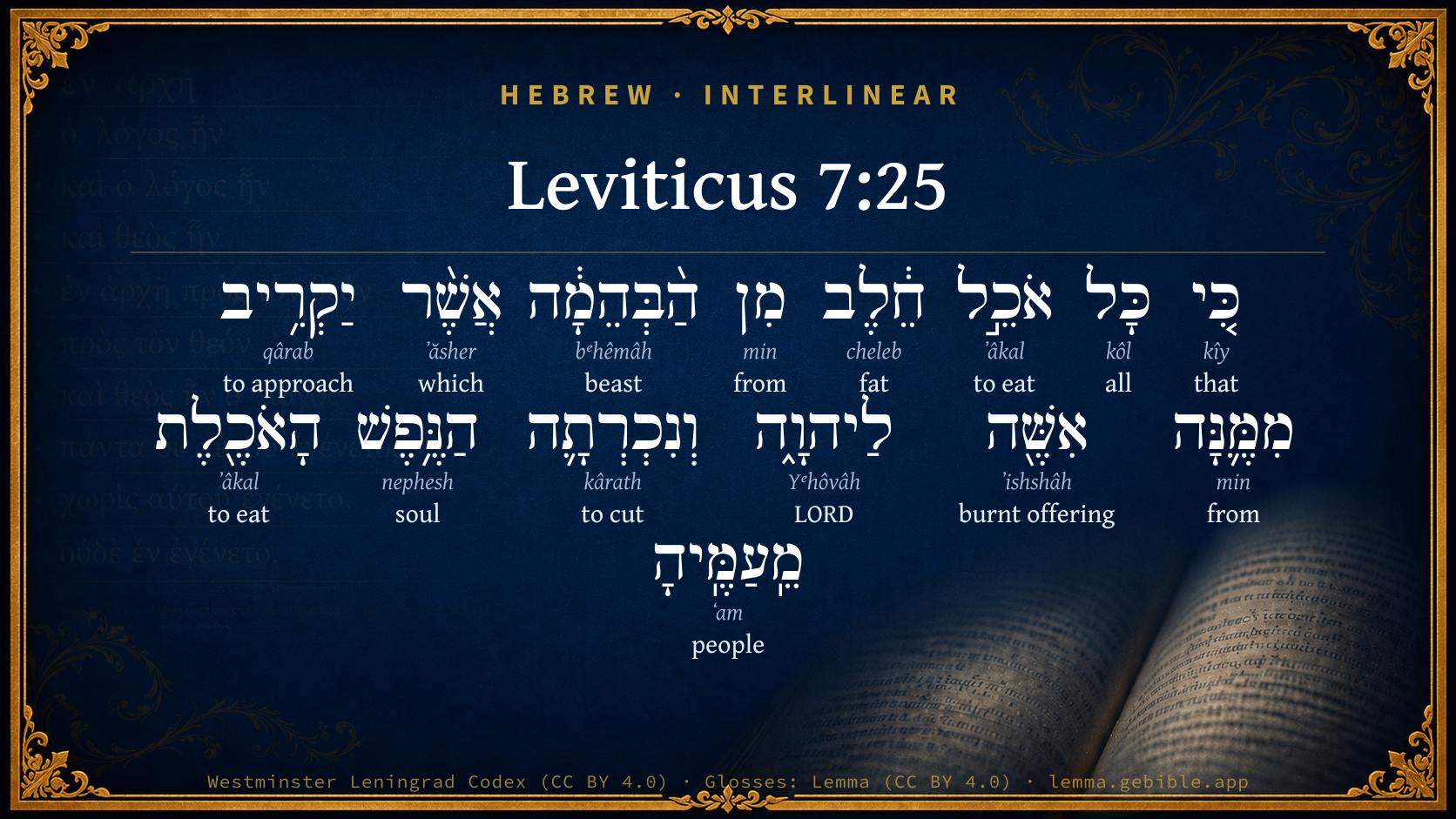
Hebrew (Westminster Leningrad Codex) Leviticus 7:25 appears in the Hebrew Old Testament. The text above is from the Westminster Leningrad Codex. Each word links to its Strong’s number, a concise gloss, and parsing drawn from the Open Scriptures Hebrew Bible morphology. Click any word for its full Brown-Driver-Briggs (BDB) entry.
Download image
Cite this verse

Leviticus 7:25 (World English Bible). Public Domain. Lemma interlinear Bible study tool, https://lemma.gebible.app/v/leviticus/7/25.

Show BibTeX & RIS
BibTeX
RIS
English Translation
For whoever eats the fat of the animal, of which men offer an offering made by fire to Yahweh, even the soul who eats it shall be cut off from his people.
World English Bible · Public Domain
Download a study sheet

One document with this verse’s original text, its word-by-word gloss line, the meaning frame, cross-references with their text, attributed commentary, and full source and license credits — printable, and it pastes into notes with its structure intact.

This verse Autodidact and up

Study sheet (.html) Plain text (.txt)

A passage Seminary Student

Up to 50 verses in one chapter. A passage sheet keeps up to 6 commentary sources and 12 cross-references per verse, in the order this page ranks them, and says so on the sheet whenever that leaves anything out. Ask for a single verse and you get the Autodidact verse sheet above.

Everything on this page stays free to read, with no account — the sheet is a download of what is already on screen, not access to it.

Want to remove ads? Support Godless Engineer
Compare translations 3

The same verse in 3 English versions, stacked beneath the original-language interlinear above. Click any original word for its lexicon entry.

Each is an independent rendering of the whole verse — the interlinear is not word-aligned to these translations.

Highlighted words mark where these versions differ — a whole-verse word diff, not a word-by-word alignment.

  • World English Bible Public Domain
    For whoever eats the fat of the animal, of which men offer an offering made by fire to Yahweh, even the soul who eats it shall be cut off from his people.
  • King James Version Public Domain
    For whosoever eateth the fat of the beast, of which men offer an offering made by fire unto the LORD, even the soul that eateth it shall be cut off from his people.
  • unfoldingWord Literal Text CC BY-SA 4.0
    When anyone is eating fat from the livestock that he presents from it a gift to Yahweh, then the person, the one eating it, shall be cut off from his people.

unfoldingWord Literal Text — © unfoldingWord, licensed CC BY-SA 4.0. Word-aligned USFM3 via Door43 (git.door43.org/unfoldingWord/en_ult).

Versions to compare (up to 4)

3 of 4 selected

Show all 18 translations

Every available English version of this verse, each an independent rendering of the whole verse.

  • World English Bible Public Domain
    For whoever eats the fat of the animal, of which men offer an offering made by fire to Yahweh, even the soul who eats it shall be cut off from his people.
  • Berean Standard Bible Public Domain
    If anyone eats the fat of an animal from which an offering made by fire may be presented to the LORD, the one who eats it must be cut off from his people.
  • Majority Standard Bible Public Domain
    If anyone eats the fat of an animal from which a food offering may be presented to the LORD, the one who eats it must be cut off from his people.
  • King James Version Public Domain
    For whosoever eateth the fat of the beast, of which men offer an offering made by fire unto the LORD, even the soul that eateth it shall be cut off from his people.
  • American Standard Version (1901) Public Domain
    For whosoever eateth the fat of the beast, of which men offer an offering made by fire unto Jehovah, even the soul that eateth it shall be cut off from his people.
  • Revised Version (1885) Public Domain
    For whosoever eateth the fat of the beast, of which men offer an offering made by fire unto the LORD, even the soul that eateth it shall be cut off from his people.
  • Geneva Bible (1599) Public Domain
    For whosoeuer eateth the fat of the beast, of the which he shall offer an offering made by fire to the Lord, euen the person that eateth, shalbe cut off from his people.
  • Douay-Rheims (1899) Public Domain
    If any man eat the fat that should be offered for the burnt sacrifice of the Lord, he shall perish out of his people.
  • Young's Literal Translation Public Domain
    for whoever eateth the fat of the beast, of which `one' bringeth near a fire-offering to Jehovah, even the person who eateth hath been cut off from his people.
  • Literal Standard Version CC BY-SA 4.0
    for whoever eats the fat of the beast, of which [one] brings near [as] a fire-offering to YHWH, indeed, the person who eats [it] has been cut off from his people.
  • Unlocked Literal Bible CC BY-SA 4.0
    Whoever eats the fat of an animal that men can offer as a sacrifice by fire to Yahweh, that person must be cut off from his people.
  • unfoldingWord Literal Text CC BY-SA 4.0
    When anyone is eating fat from the livestock that he presents from it a gift to Yahweh, then the person, the one eating it, shall be cut off from his people.
  • Darby Bible Public Domain
    For whoever eateth the fat of the beast of which men present an offering by fire to Jehovah, the soul that hath eaten shall be cut off from his peoples.
  • World Messianic Bible Public Domain
    For whoever eats the fat of the animal which men offer as an offering made by fire to the LORD, even the soul who eats it shall be cut off from his people.
  • Webster's Bible Public Domain
    For whoever eateth the fat of the beast, of which men offer an offering made by fire to the LORD, even the soul that eateth it shall be cut off from his people.
  • Free Bible Version CC BY-SA 4.0
    Anyone who eats the fat of an animal from a food offering presented to the Lord must be expelled from their people.
  • Bible in Basic English Public Domain
    For anyone who takes as food the fat of any beast of which men make an offering by fire to the Lord, will be cut off from his people.
  • JPS Tanakh (1917) Public Domain
    For whosoever eateth the fat of the beast, of which men present an offering made by fire unto the LORD, even the soul that eateth it shall be cut off from his people.

Literal Standard Version (2020), Covenant Press — licensed CC BY-SA 4.0. Text via the HelloAO Bible API (eBible.org). Unlocked Literal Bible (unfoldingWord) — licensed CC BY-SA 4.0. Text via the HelloAO Bible API (eBible.org). unfoldingWord Literal Text — © unfoldingWord, licensed CC BY-SA 4.0. Word-aligned USFM3 via Door43 (git.door43.org/unfoldingWord/en_ult). Free Bible Version, Dr. Jonathan Gallagher — licensed CC BY-SA 4.0. Text via the HelloAO Bible API (eBible.org).

Word by word

More ways to search: Search by grammar → Find every occurrence → Compare this word →

Practice this passage: Drill this verse → Learn its vocabulary →

אִשֶּׁ֖ה
ʼishshâh
H801
“burnt offering”
Noun, Common, Masculine, Singular, Absolute
Part of Speech
Noun
Type
Common
Gender
Masculine
Number
Singular
State
Absolute
Full BDB Definition

Origin: the same as H800 , but used in a liturgical sense

TWOT: 172a

burnt-offering, offering made by fire, fire offering
  1. כִּ֚י kîy H3588 “that” Conjunction
  2. כָּל kôl H3605 “all of” Noun, Common, Masculine, Singular, Construct
  3. אֹכֵ֣ל ʼâkal H398 “eating” Verb, Qal, Participle Active, Masculine, Singular, Absolute
  4. חֵ֔לֶב cheleb H2459 “fat” Noun, Common, Masculine, Singular, Absolute
  5. מִן min H4480 “from” Preposition
  6. הַ֨בְּהֵמָ֔ה bᵉhêmâh H929 “the · beast” Particle, Definite Article + Noun, Common, Feminine, Singular, Absolute
  7. אֲשֶׁ֨ר ʼăsher H834 “which” Particle, Relative
  8. יַקְרִ֥יב qârab H7126 “to approach” Verb, Hiphil, Imperfect, 3rd Person, Masculine, Singular
  9. מִמֶּ֛נָּה min H4480 “from · her” Preposition + Suffix, Personal, 3rd Person, Feminine, Singular
  10. לַיהוָ֑ה Yᵉhôvâh H3068 “to/for · LORD” Preposition + Noun, Proper
  11. וְנִכְרְתָ֛ה kârath H3772 “and · to cut” Conjunction + Verb, Niphal, Sequential Perfect, 3rd Person, Feminine, Singular
  12. הַנֶּ֥פֶשׁ nephesh H5315 “the · soul” Particle, Definite Article + Noun, Common, Both, Singular, Absolute
  13. הָאֹכֶ֖לֶת ʼâkal H398 “the · eating” Particle, Definite Article + Verb, Qal, Participle Active, Feminine, Singular, Absolute
  14. מֵֽעַמֶּֽיהָ ʻam H5971 “from · peoples · her” Preposition + Noun, Common, Masculine, Plural, Construct + Suffix, Personal, 3rd Person, Feminine, Singular

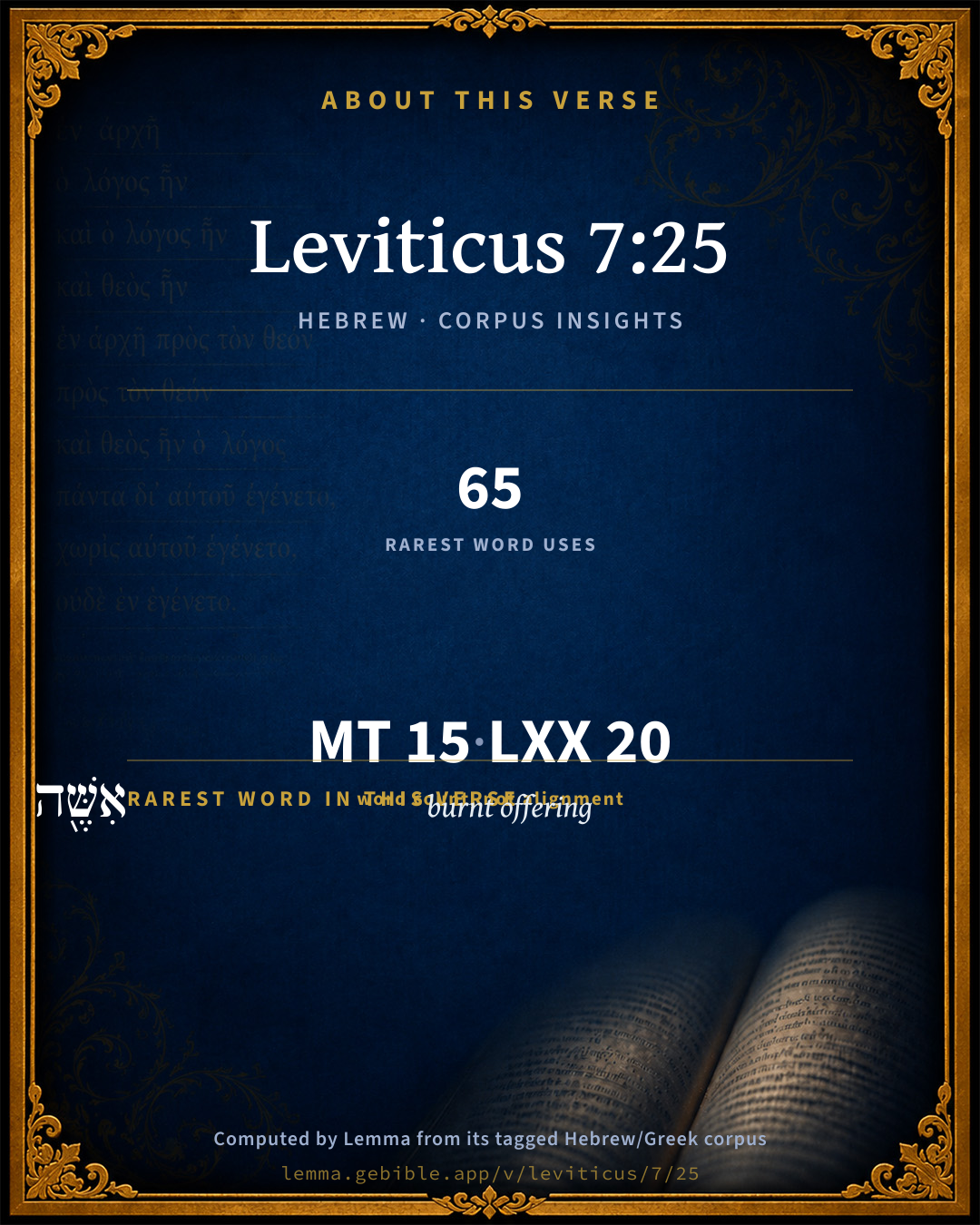
About this verse

These counts appear in no published source. They are computed here, from the morphology-tagged text and Lemma’s own curated glosses. What Lemma adds →

15
words
13
distinct lemmas
Pentateuch
section

Grammatical profile

  • 4 verbs
  • 7 nouns
  • 2 prepositions
  • 1 conjunction
  • 1 particle

Verb forms

  • אֹכֵ֣ל Qal · Participle Active
  • יַקְרִ֥יב Hiphil · Imperfect
  • וְנִכְרְתָ֛ה Niphal · Sequential Perfect
  • הָאֹכֶ֖לֶת Qal · Participle Active

Repetition

Words recur within this verse — often emphatic in Hebrew:

  • אֹכֵ֣ל to eat H398 ×2
  • מִן from H4480 ×2

Hebrew & Septuagint length

In English translation the verse runs 32 words from the Hebrew and 37 from the Septuagint (LXX English) — closely comparable.

A rough comparison of the two English renderings, which tokenize alike — not a word-level alignment.

Word counts can differ between the Hebrew and the Greek without any difference in meaning — e.g. the Hebrew direct-object marker אֵת has no separate Greek word, and Greek often adds the article ὁ.

In the original languages it is 15 Hebrew tokens and 20 Greek tokens — but the two are counted differently (Hebrew bundles its prefixes and suffixes into one token; the Greek is in lemma form), so that isn’t a like-for-like length.

Hebrew and Greek witnesses Masoretic Hebrew ↔ Greek Septuagint

The same verse in the two great witnesses to the Old Testament, shown verse-for-verse.

These are two independent witnesses, not word-aligned to each other, and the Septuagint is shown in lemma (dictionary) form.

Hebrew Leviticus 7:25 Masoretic · Westminster Leningrad Codex

כִּ֚י כָּל אֹכֵ֣ל חֵ֔לֶב מִן הַ֨בְּהֵמָ֔ה אֲשֶׁ֨ר יַקְרִ֥יב מִמֶּ֛נָּה אִשֶּׁ֖ה לַיהוָ֑ה וְנִכְרְתָ֛ה הַנֶּ֥פֶשׁ הָאֹכֶ֖לֶת מֵֽעַמֶּֽיהָ

For whoever eats the fat of the animal, of which men offer an offering made by fire to Yahweh, even the soul who eats it shall be cut off from his people.

World English Bible · Public Domain

Greek LXX Leviticus 7:25 Septuagint · lemma form

πᾶς ὁ ἐσθίω στέαρ ἀπό ὁ κτῆνος ὅς προςἄγω αὐτός κάρπωμα κύριος ἀποὀλλύω ὁ ψυχή ἐκεῖνος ἀπό ὁ λαός αὐτός

This is the anointing of Aaron, and the anointing of his sons, their portion of the burnt offerings of the Lord, in the day in which he brought them forward to minister as priests to the Lord;

LXX2012 (modern English Septuagint) · Public Domain

Hebrew: Westminster Leningrad Codex (CC BY 4.0). Greek: Septuagint (public domain); English from LXX2012 (modern English Septuagint) (Public Domain). How the Septuagint differs from the Hebrew →

Targum (Aramaic paraphrase)

2

The Targum is the ancient Jewish Aramaic paraphrase of the Hebrew Scriptures — an interpretive translation, not the Hebrew text itself. Onkelos (literal) and Pseudo-Jonathan (expansive) render the Torah, and Jonathan the Prophets. Coverage is partial: where no permissively-licensed English translation exists for a verse, only the Aramaic is shown. This is verse-level text, not a word-by-word alignment to the Hebrew.

  1. Targum Onkelos Torah (Genesis–Deuteronomy)
    אֲרֵי כָל דְיֵכוּל תַּרְבָּא מִן בְּעִירָא דִי יִקָרְבוּן מִנַהּ קוּרְבָּנָא קֳדָם יְיָ וְיִשְׁתֵּיצֵי אֱנָשָׁא דִי תֵיכוּל מֵעַמֵּיהּ

    (no public-domain English translation for this verse)

    Targum Onkelos — Aramaic: “Onkelos Genesis” (public domain); “Onkelos Exodus” (public domain); “Onkelos Leviticus” (public domain); “Onkelos Numbers” (public domain); “Onkelos Deuteronomy” (public domain). English: “Sefaria Community Translation” (CC0 1.0 (public-domain dedication)); “J.W. Etheridge. The Targums of Onkelos and Jonathan Ben Uzziel on the Pentateuch. London: Longmans, Green, 1862” (public domain). Text via Sefaria.

  2. Targum Pseudo-Jonathan Torah (Genesis–Deuteronomy)
    אֲרוּם כָּל דְיֵיכוֹל תְּרֵיב מִן בְּעִירָא דְמִתְכַּשְׁרָא לְמִיקְרַב מִנֵיהּ קָרְבָּנָא קֳדָם יְיָ וְיִשְׁתְּצֵי בַּר נְשָׁא הַהוּא דְיֵיכוֹל יַת תַּרְבָּא מֵעַמֵיהּ

    For he who eateth (the fat) of an animal that is fit to be offered as an oblation before the Lord, that man who eateth the fat shall be cut off from his people.

    Targum Pseudo-Jonathan — Aramaic: “Targum Jonathan on Genesis” (public domain); “Targum Jonathan on Exodus” (public domain); “Targum Jonathan on Leviticus” (public domain); “Targum Jonathan on Numbers” (public domain); “Targum Jonathan on Deuteronomy” (public domain). English: “The Targum of Jonathan ben Uzziel, trans. J. W. Etheridge, London, 1862” (public domain). Text via Sefaria.

Commentary

Notes on Leviticus 7:25 from classic Christian and Jewish commentators (each source and its license shown beneath its notes). The classic Christian expositions comment on the surrounding passage and are grouped to its opening verse, so a note may address several verses; the Jewish commentaries on the Tanakh (Rashi and others) are per-verse, so they appear only where the commentator wrote on this verse.

Lemma curates 59 commentaries, every one of them public domain or Creative Commons licensed, each selected and text-cleaned for this edition rather than reprinted as found. About our sources →

Trapp's Complete Commentary

John Trapp

Lev 7:25 For whosoever eateth the fat of the beast, of which men offer an offering made by fire unto the LORD, even the soul that eateth [it] shall be cut off from his people.

Ver. 25. Shall be cut off,] i.e., Shall be liable to God’s judgments.

John Trapp, A Commentary or Exposition upon All the Books of the Old and New Testament (1647–1656) — public domain. Text from a community e-Sword module.

Ellicott's Commentary for English Readers

(25) The fat of the beast of which men offer an offering.—That is, the fat of beeves, sheep, or goats. (See Lev_7:23.) If he did it presumptuously he incurred the penalty of excision, and if he did it inadvertently he was beaten with forty stripes save one, and had to bring the sin offering appointed.

A Bible Commentary for English Readers, edited by Charles John Ellicott (1878–1897) — public domain. Text from a community e-Sword module.

John Gill's Exposition

Moreover ye shall eat no manner of blood,.... Of any of the above creatures, or any other, even of any clean creature, and much less of an unclean one:

whether it be of fowl or of beast; of all sorts and kinds. Jarchi thinks, the words being thus expressed, the blood of fishes and locusts is excepted, and so lawful to eat:

in any of your dwellings; this shows that this law is not to be restrained to creatures slain in sacrifice in the tabernacle, and to the blood of them, but to be understood of all such as were slain in their own houses for food, and the blood of them.

John Gill's Exposition of the Whole Bible (1746–1763) — public domain (CC PDM 1.0). Text via the HelloAO Bible API.

Whedon's Commentary on the Bible

Daniel D. Whedon

25. Of the beast, of which men offer — This is evidently an interdict of the fat of the entire class of sacrificial animals, and not of the particular victims. Fat promotes cutaneous diseases. The prohibition of this article of diet also raised up a barrier between the Israelites and the idolatrous nations by restraining the former from partaking of the festive banquets of the latter. Michaelis suggests that the prohibition of fat was for the purpose of promoting the culture of the olive, and Knobel maintains that it was because the mouth of man is unclean. A better reason is, because it would be an infringement of Jehovah’s rights to eat as common food that which he had sanctified unto himself.

Daniel D. Whedon (gen. ed.), Commentary on the Old and New Testaments (1874–1909) — public domain. Text from a community e-Sword module.

The Pulpit Commentary

To eat of the fat of which men offer an offering made with fire unto the Lord, is to rob God of his chosen offering. The injunction condemns sacrilege in all its forms. Whoever takes to his own use things dedicated to God, "eats the fat;" and" the soul that eateth it shall be cut off from his people."

The Pulpit Commentary (1880–1919), ed. H.D.M. Spence-Jones & Joseph S. Exell — public domain. Text from a community e-Sword module.

unfoldingWord translationNotes

Door43 World Missions Community

sacrifice by fire

This can be stated in active form. AT: "burnt offering" (See: Active or Passive)

that person must be cut off from his people

A person being excluded from his community is spoken of as if he had been cut off from his people, as one would cut a piece of cloth or cut a branch from a tree. This can be translated in active form. See how you translated this in Leviticus 7:20. (See: Metaphor and Active or Passive)

You must eat no blood

"You must not consume blood"

in any of your houses

"in any of your homes" or "wherever you live"

translationWords

sacrifice

fire

Yahweh

cut off

blood

house

unfoldingWord translationNotes — © Distant Shores Media and the Door43 World Missions Community, licensed CC BY-SA 4.0. Source: git.door43.org/Door43/en_tn.

Ramban (Nachmanides)

Rabbi Moshe ben Nachman (Ramban / Nachmanides)

FOR WHOSOEVER EATETH THE FAT OF THE BEAST, OF WHICH MAN PRESENTS AN OFFERING … SHALL BE CUT OFF FROM HIS PEOPLE. It is impossible that the explanation of the phrase: of the beast [of which man presents an offering], is that this beast is itself an offering, so that an unconsecrated animal be excluded from this prohibition, since in the section of Vayikra, Scripture has already prohibited all fat in an unqualified manner, without any condition or exception. Here too it prohibited at first all fat of ox, or sheep, or goat, and it further decreed against eating the fat of that which dieth of itself, and the fat of that which is torn of beasts, and these cannot be brought as offerings to G-d. Besides, He said there [in the section of Vayikra], It shall be a perpetual statute throughout your generations in all your dwellings, and the expression in all your dwellings is never found in any matter connected with offerings. In speaking of the gifts of the priests He says many times, a statute forever, 6:11, etc. but does not mention “in all your dwellings,” because the offerings are not “a statute forever in all your dwellings,” as they only apply in the Tabernacle and in the place which the Eternal shall choose. Let not the eyes of him who is mistaken refers also to the offerings (see the verse mentioned in the text with reference to the new produce, and also the following note). be blinded by the verse, And ye shall eat neither bread, nor parched corn, nor fresh ears, until this selfsame day, until ye have brought the offering of your G-d; it is a statute forever throughout your generations in all your dwellings. applies also to the offerings, since the verse refers to the omer (a measure of new barley brought as a meal-offering on the second day of Passover). But Ramban answers that the phrase refers not to the omer, but to the new crop which, through the offering of the omer, was henceforth permitted to be eaten (see “The Commandments,” Vol. II, pp. 186-188). It is to this prohibition of eating of the new crop before the bringing of the omer [or before the end of the sixteenth day of Nisan], that the phrase in all your dwellings refers. Hence the phrase in all your dwellings which is stated in connection with the prohibitions against eating fat and blood (above, 3:17) must perforce mean that they are applicable everywhere, independent of the existence of the Sanctuary and its offerings. For it is eating of the new crop that is forbidden by law of the Torah in all places, and Scripture is saying that we are not to eat bread, nor parched corn, nor fresh ears forever in all our dwelling places, until that same day on which we bring the offering of the new barley in the Sanctuary. If the offering is not brought [as when the Sanctuary is destroyed], it does not become forbidden henceforth to eat of the new crop [i.e., after the end of the sixteenth day of Nisan], for He did not say, “ye shall not eat until ye have brought the offering of your G-d,” but instead the prohibition extends until this selfsame day only. Rather, the meaning of until this selfsame day is the one on which you bring the offering when you are in a position to do so, the reason being that the offering should be a new meal-offering [but when you are not able to bring the offering, as when the Sanctuary is destroyed, the prohibition is only until this selfsame day]. It is possible that the word hayom (the day) is connected also with [the latter part of the verse:] “until this selfsame day, until the day ye have brought the offering of your G-d,” [thus clearly indicating that the prohibition depends on the day the offering is brought, and not on the actual bringing thereof].The complete proof that the explanation of the phrase [in the verse before us] the beast of which man presents an offering, is “of the kind of beast from which man presents an offering,” [and not “of the beast which is itself an actual offering,” so that the unconsecrated beast would be excluded from the prohibition against eating of the fat thereof,] is that it says also in the section on valuations, And if it be a beast, whereof men bring an offering unto the Eternal, all that any man giveth of such unto the Eternal shall be holy, and it explains that this means the kind of beast whereof men bring an offering to G-d. And so also, And if it be any unclean beast, of which they may not bring an offering unto the Eternal, Verse 11. here clearly stating, “any unclean beast of the kind from which offerings are not brought.” There is no difference whatever between stating it in the plural — whereof men bring, of which they may not bring, Verse 11. — or saying it in the singular [as in the verse before us], of which man presents, for the meaning is “the kind of beast of which man presents an offering.” Similarly He said, And if any beast, of which ye may eat, die, which means the kind of beast of which ye may eat, but not that the particular beast may be eaten [since it is expressly prohibited as meat, as it died without being slaughtered properly].Now since He prohibited all fat of a beast whereof an offering is brought, but not of the kind of which offerings are not brought, it might enter one’s mind to say that a beast which died of itself or was torn [by other beasts] is regarded as a kind from which offerings may not be brought [and therefore their fats may be eaten]; therefore it was necessary to mention [in Verse 24] that [the fats of these animals] are forbidden, and it is this which He said, and ye shall in no wise eat of it, meaning that he who eats it is liable to excision as with all other fats, as He forbade the fat of the entire class of beasts from which offerings are brought, even of those animals which died of themselves or were torn by [wild] beasts. He states, they may be used for any other service, meaning to say that [the fat of a clean animal which died of itself or was torn by beasts] has no law of uncleanness of carrion [but is like ordinary food which has become unclean], 1:5. for since He said, and their carcasses ye shall not touch, He states concerning the fat thereof that one may touch it and use it for any other service. Now if the prohibition of eating fat would apply only to that of actual offerings, why was it necessary to say there in the section of Vayikra, Ye shall not eat any fat, when He had already commanded [in the preceding verse] that it be brought up on the altar as a sweet savor, and how could we eat of the fire-offering of G-d? Why did He not also prohibit the eating of the lobe above the liver and the two kidneys, which are removed from the offerings [and burnt on the altar — yet these may be eaten in the case of ordinary clean animals because they do not come under the term cheilev (fat)]. Moreover, why was it necessary to mention here, Ye shall eat no fat of ox, or sheep, or goat, when it is known that offerings can be brought only from them [it thus being obvious that the prohibition of cheilev applies to all clean animals — hallowed or unhallowed]! The reason why Scripture said concerning dedicated offerings that became invalidated [because of a blemish they received, in which case they are redeemed and may then be slaughtered and eaten as ordinary food], Only thou shalt not eat the blood thereof, and did not mention anything concerning the fat, I shall explain when G-d helps me to reach there.

Ramban (Nachmanides) on the Tanakh — English translation: “Commentary on the Torah by Ramban (Nachmanides). Translated and annotated by Charles B. Chavel. New York, Shilo Pub. House, 1971-1976” (CC BY 4.0). Text via Sefaria.

Lesson kit

Teaching starters — assembled from the data on this page, not authored interpretation. Every prompt links to the verse data it draws on. Edit before teaching.

Leviticus, in the Pentateuch, opens this verse with 15 words (13 distinct Hebrew lemmas). Its most distinctive word is ʼishshâh (“burnt offering”). A historical commentator’s framing appears above. Read the whole chapter for the surrounding context.

Discussion questions

  1. How does “burnt offering” (ʼishshâh) shape what this verse is saying?
  2. “to eat” occurs 2× in this one verse. What is the effect of the repetition?
  3. The translations on this page render this verse differently — a whole-verse word diff, not a word-by-word alignment. What might account for the different wordings?
  4. The verb «אֹכֵ֣ל» is Qal Participle Active. How does its form color the action?
  5. Reading how Trapp's Complete Commentary and Ellicott's Commentary for English Readers read this verse, where do the two commentators agree and where do they part?

Things to notice

Reading settings

Reading text

Shown beneath each verse's original-language words.

Old Testament
Old Testament edition

Read the OT as the Masoretic Hebrew (MT) or the Greek Septuagint (LXX).

English shown for the Greek Septuagint (in the Hebrew ↔ Greek comparison).

Comparing translations? Open the Compare panel on any verse page to stack up to four side by side.