
Isaiah 29:20

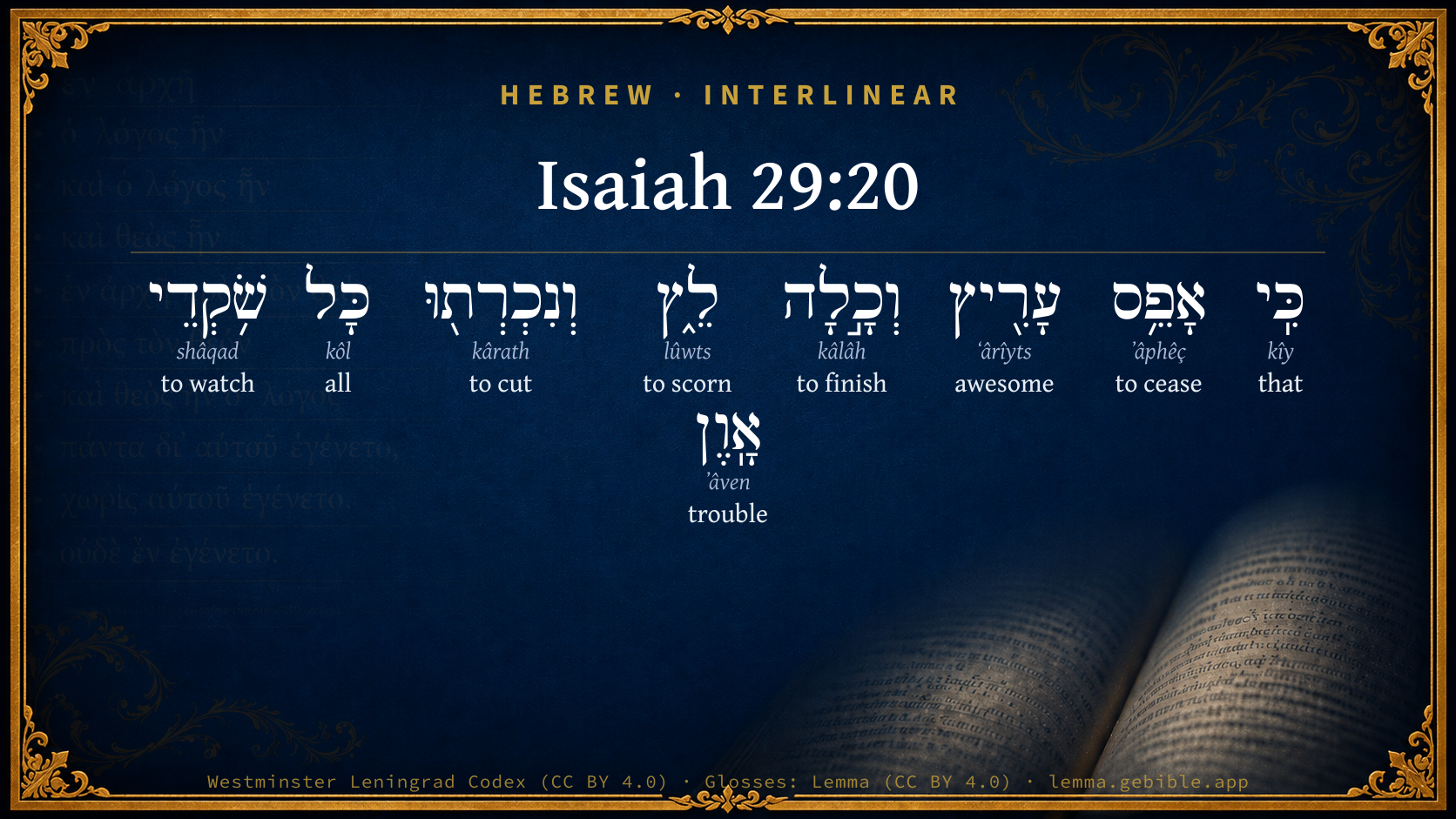
Hebrew (Westminster Leningrad Codex) Isaiah 29:20 appears in the Hebrew Old Testament. The text above is from the Westminster Leningrad Codex. Each word links to its Strong’s number, a concise gloss, and parsing drawn from the Open Scriptures Hebrew Bible morphology. Click any word for its full Brown-Driver-Briggs (BDB) entry.
Download image
Cite this verse

Isaiah 29:20 (World English Bible). Public Domain. Lemma interlinear Bible study tool, https://lemma.gebible.app/v/isaiah/29/20.

Show BibTeX & RIS
BibTeX
RIS
English Translation
For the terrible one is brought to nothing, and the scoffer ceases, and all those who watch for iniquity are cut off;
World English Bible · Public Domain
Download a study sheet

One document with this verse’s original text, its word-by-word gloss line, the meaning frame, cross-references with their text, attributed commentary, and full source and license credits — printable, and it pastes into notes with its structure intact.

This verse Autodidact and up

Study sheet (.html) Plain text (.txt)

A passage Seminary Student

Up to 50 verses in one chapter. A passage sheet keeps up to 6 commentary sources and 12 cross-references per verse, in the order this page ranks them, and says so on the sheet whenever that leaves anything out. Ask for a single verse and you get the Autodidact verse sheet above.

Everything on this page stays free to read, with no account — the sheet is a download of what is already on screen, not access to it.

Want to remove ads? Support Godless Engineer
Compare translations 3

The same verse in 3 English versions, stacked beneath the original-language interlinear above. Click any original word for its lexicon entry.

Each is an independent rendering of the whole verse — the interlinear is not word-aligned to these translations.

Highlighted words mark where these versions differ — a whole-verse word diff, not a word-by-word alignment.

  • World English Bible Public Domain
    For the terrible one is brought to nothing, and the scoffer ceases, and all those who watch for iniquity are cut off;
  • King James Version Public Domain
    For the terrible one is brought to nought, and the scorner is consumed, and all that watch for iniquity are cut off:
  • unfoldingWord Literal Text CC BY-SA 4.0
    For the terrible will cease, and the mocker will end, and all of the watchers of iniquity will be cut off,

unfoldingWord Literal Text — © unfoldingWord, licensed CC BY-SA 4.0. Word-aligned USFM3 via Door43 (git.door43.org/unfoldingWord/en_ult).

Versions to compare (up to 4)

3 of 4 selected

Show all 18 translations

Every available English version of this verse, each an independent rendering of the whole verse.

  • World English Bible Public Domain
    For the terrible one is brought to nothing, and the scoffer ceases, and all those who watch for iniquity are cut off;
  • Berean Standard Bible Public Domain
    For the ruthless will vanish, the mockers will disappear, and all who look for evil will be cut down—
  • Majority Standard Bible Public Domain
    For the ruthless will vanish, the mockers will disappear, and all who look for evil will be cut down—
  • King James Version Public Domain
    For the terrible one is brought to nought, and the scorner is consumed, and all that watch for iniquity are cut off:
  • American Standard Version (1901) Public Domain
    For the terrible one is brought to nought, and the scoffer ceaseth, and all they that watch for iniquity are cut off;
  • Revised Version (1885) Public Domain
    For the terrible one is brought to nought, and the scorner ceaseth, and all they that watch for iniquity are cut off:
  • Geneva Bible (1599) Public Domain
    For the cruel man shall cease, and the scornefull shalbe consumed: and all that hasted to iniquitie, shalbe cut off:
  • Douay-Rheims (1899) Public Domain
    For he that did prevail hath failed, the scorner is consumed, and they are all cut off that watched for iniquity:
  • Young's Literal Translation Public Domain
    For ceased hath the terrible one, And consumed hath been the scorner, And cut off have been all watching for iniquity,
  • Literal Standard Version CC BY-SA 4.0
    For the terrible one has ceased, || And the scorner has been consumed, || And all watching for iniquity have been cut off,
  • Unlocked Literal Bible CC BY-SA 4.0
    For the ruthless will cease, and the scoffer will vanish. All those who love to do evil will be eliminated,
  • unfoldingWord Literal Text CC BY-SA 4.0
    For the terrible will cease, and the mocker will end, and all of the watchers of iniquity will be cut off,
  • Darby Bible Public Domain
    For the terrible one shall come to nought, and the scorner shall be no more, and all that watch for iniquity shall be cut off,
  • World Messianic Bible Public Domain
    For the ruthless is brought to nothing, and the scoffer ceases, and all those who are alert to do evil are cut off—
  • Webster's Bible Public Domain
    For the terrible one is brought to naught, and the scoffer is consumed, and all that watch for iniquity are cut off:
  • Free Bible Version CC BY-SA 4.0
    Cruel people will no longer exist, the scornful will vanish, and those looking to do evil will be destroyed—
  • Bible in Basic English Public Domain
    For the cruel one has come to nothing; and those who make sport of the Lord are gone; and those who are watching to do evil are cut off:
  • JPS Tanakh (1917) Public Domain
    For the terrible one is brought to nought, and the scorner ceaseth, and all they that watch for iniquity are cut off;

Literal Standard Version (2020), Covenant Press — licensed CC BY-SA 4.0. Text via the HelloAO Bible API (eBible.org). Unlocked Literal Bible (unfoldingWord) — licensed CC BY-SA 4.0. Text via the HelloAO Bible API (eBible.org). unfoldingWord Literal Text — © unfoldingWord, licensed CC BY-SA 4.0. Word-aligned USFM3 via Door43 (git.door43.org/unfoldingWord/en_ult). Free Bible Version, Dr. Jonathan Gallagher — licensed CC BY-SA 4.0. Text via the HelloAO Bible API (eBible.org).

Word by word

More ways to search: Search by grammar → Find every occurrence → Compare this word →

Practice this passage: Drill this verse → Learn its vocabulary →

About this verse

These counts appear in no published source. They are computed here, from the morphology-tagged text and Lemma’s own curated glosses. What Lemma adds →

9
words
9
distinct lemmas
Prophets
section

Notable vocabulary

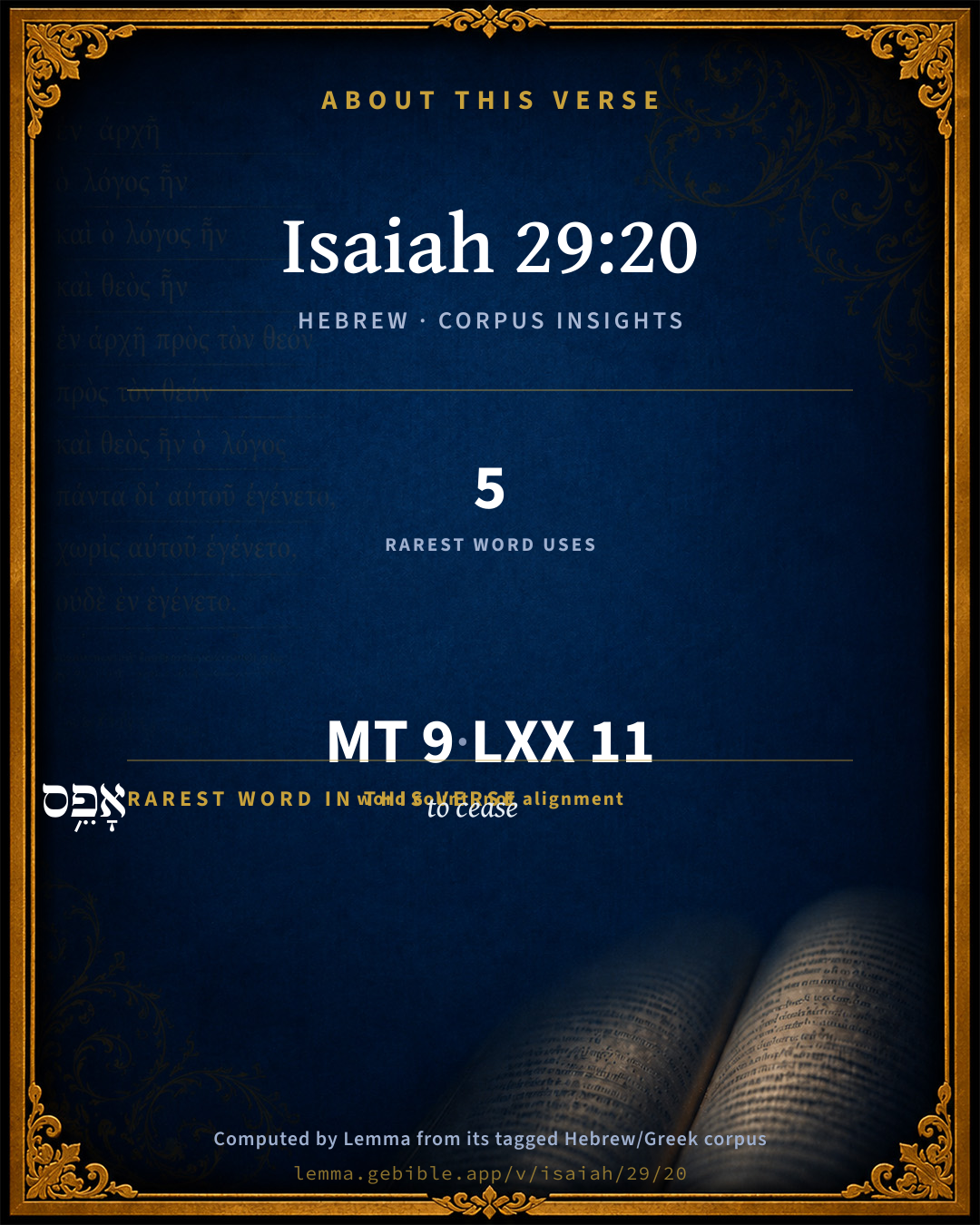
The rarest word here is אָפֵ֥ס to cease H656 — appearing just 5 times in the whole Hebrew Bible.

Shared distinctive vocabulary

אָפֵ֥ס to cease H656 occurs in 5 verses of the Hebrew Bible. Also found in:

Grammatical profile

  • 4 verbs
  • 2 nouns
  • 2 adjectives
  • 1 conjunction

Verb forms

  • אָפֵ֥ס Qal · Perfect
  • וְכָ֣לָה Qal · Sequential Perfect
  • וְנִכְרְת֖וּ Niphal · Sequential Perfect
  • שֹׁ֥קְדֵי Qal · Participle Active

Hebrew & Septuagint length

In English translation the verse runs 22 words from the Hebrew and 22 from the Septuagint (LXX English) — the same length.

A rough comparison of the two English renderings, which tokenize alike — not a word-level alignment.

Word counts can differ between the Hebrew and the Greek without any difference in meaning — e.g. the Hebrew direct-object marker אֵת has no separate Greek word, and Greek often adds the article ὁ.

In the original languages it is 9 Hebrew tokens and 11 Greek tokens — but the two are counted differently (Hebrew bundles its prefixes and suffixes into one token; the Greek is in lemma form), so that isn’t a like-for-like length.

Cross-references

20

Topical passages linked to Isaiah 29:20 in the Treasury of Scripture Knowledge — connected by theme and wording, ordered by reader-vote popularity; previews shown in the World English Bible.

  • Micah 2:1 Woe to those who devise iniquity And work evil on their beds! When the morning is light, they practice it, Because it is in the power of their hand.
  • Isaiah 28:14–22 Why hear the word of Yahweh, you scoffers, that rule this people that is in Jerusalem:
  • Isaiah 13:3 I have commanded my consecrated ones, yes, I have called my mighty men for my anger, even my proudly exulting ones.
  • Isaiah 29:5 But the multitude of your foes shall be like small dust, and the multitude of the awesome ones as chaff that passes away: yes, it shall be in an instant suddenly.
  • Isaiah 59:4 None sues in righteousness, and none pleads in truth: they trust in vanity, and speak lies; they conceive mischief, and bring forth iniquity.
  • Luke 16:14 The Pharisees, who were lovers of money, also heard all these things, and they scoffed at him.
  • Isaiah 25:4–5 For you have been a stronghold to the poor, a stronghold to the needy in his distress, a refuge from the storm, a shade from the heat, when the blast of the awesome ones is as a storm against the wall.
  • Isaiah 49:25 But thus says Yahweh, Even the captives of the mighty shall be taken away, and the prey of the terrible shall be delivered; for I will contend with him who contends with you, and I will save your children.
  • Isaiah 51:13 and have forgotten Yahweh your Maker, who stretched forth the heavens, and laid the foundations of the earth; and fear continually all the day because of the fury of the oppressor, when he makes ready to destroy? and where is the fury of the oppressor?
  • Daniel 7:7 After this I saw in the night-visions, and, behold, a fourth animal, awesome and powerful, and strong exceedingly; and it had great iron teeth; it devoured and broke in pieces, and stamped the residue with its feet: and it was diverse from all the animals that were before it; and it had ten horns.
  • Daniel 7:19–25 Then I desired to know the truth concerning the fourth animal, which was diverse from all of them, exceedingly terrible, whose teeth were of iron, and its nails of brass; which devoured, broke in pieces, and stamped the residue with its feet;
  • Habakkuk 1:6–7 For, behold, I raise up the Chaldeans, that bitter and hasty nation, that march through the breadth of the earth, to possess dwelling places that are not theirs.
  • Mark 2:6–7 But there were some of the scribes sitting there, and reasoning in their hearts,
  • Mark 3:2–6 They watched him, whether he would heal him on the Sabbath day, that they might accuse him.
  • Luke 6:7 The scribes and the Pharisees watched him, to see whether he would heal on the Sabbath, that they might find an accusation against him.
  • Luke 13:14–17 The ruler of the synagogue, being indignant because Jesus had healed on the Sabbath, said to the multitude, "There are six days in which men ought to work. Therefore come on those days and be healed, and not on the Sabbath day!"
  • Luke 20:20–23 They watched him, and sent out spies, who pretended to be righteous, that they might trap him in something he said, so as to deliver him up to the power and authority of the governor.
  • Luke 23:11 Herod with his soldiers humiliated him and mocked him. Dressing him in luxurious clothing, they sent him back to Pilate.
  • Luke 23:35 The people stood watching. The rulers with them also scoffed at him, saying, "He saved others. Let him save himself, if this is the Christ of God, his chosen one!"
  • Revelation 12:10 I heard a loud voice in heaven, saying, "Now is come the salvation, the power, and the Kingdom of our God, and the authority of his Christ; for the accuser of our brothers has been thrown down, who accuses them before our God day and night.

Cross-references courtesy of OpenBible.info (CC BY 4.0).

Hebrew and Greek witnesses Masoretic Hebrew ↔ Greek Septuagint

The same verse in the two great witnesses to the Old Testament, shown verse-for-verse.

These are two independent witnesses, not word-aligned to each other, and the Septuagint is shown in lemma (dictionary) form.

Hebrew Isaiah 29:20 Masoretic · Westminster Leningrad Codex

כִּֽי אָפֵ֥ס עָרִ֖יץ וְכָ֣לָה לֵ֑ץ וְנִכְרְת֖וּ כָּל שֹׁ֥קְדֵי אָֽוֶן

For the terrible one is brought to nothing, and the scoffer ceases, and all those who watch for iniquity are cut off;

World English Bible · Public Domain

Greek LXX Isaiah 29:20 Septuagint · lemma form

ἐκλείπω ἄνομος καί ἀποὀλλύω ὑπερήφανος καί ἐκὀλεθρεύω ὁ ἀναὄμνυμι ἐπί κακία

The lawless man has come to nothing, and the proud man has perished, and they that transgress mischievously have been utterly destroyed:

LXX2012 (modern English Septuagint) · Public Domain

On this verse, John Gill's Exposition discusses the Septuagint’s reading. Read the note in Commentary ↓

Hebrew: Westminster Leningrad Codex (CC BY 4.0). Greek: Septuagint (public domain); English from LXX2012 (modern English Septuagint) (Public Domain). How the Septuagint differs from the Hebrew →

Targum (Aramaic paraphrase)

1

The Targum is the ancient Jewish Aramaic paraphrase of the Hebrew Scriptures — an interpretive translation, not the Hebrew text itself. Onkelos (literal) and Pseudo-Jonathan (expansive) render the Torah, and Jonathan the Prophets. Coverage is partial: where no permissively-licensed English translation exists for a verse, only the Aramaic is shown. This is verse-level text, not a word-by-word alignment to the Hebrew.

  1. Targum Jonathan Prophets (Joshua–Malachi)
    אֲרֵי סָף מְעִיקָא וְאִשְׁתֵּיצֵי בָזְזָא וְסָפוּ כָּל דַהֲווֹ מְשַׁחֲרִין לְמֵינָס:

    For the oppressor is come to an end, and the plunderer is made to cease, and all that rose up early to act violently have come to an end;

    Targum Jonathan — Aramaic: “Mikraot Gedolot” (public domain). English: “Sefaria Community Translation” (CC0 1.0 (public-domain dedication)); “London "Chaldee Paraphrase," 1871” (public domain). Text via Sefaria.

Commentary

Notes on Isaiah 29:20 from classic Christian and Jewish commentators (each source and its license shown beneath its notes). The classic Christian expositions comment on the surrounding passage and are grouped to its opening verse, so a note may address several verses; the Jewish commentaries on the Tanakh (Rashi and others) are per-verse, so they appear only where the commentator wrote on this verse.

Lemma curates 59 commentaries, every one of them public domain or Creative Commons licensed, each selected and text-cleaned for this edition rather than reprinted as found. About our sources →

Trapp's Complete Commentary

John Trapp

Isa 29:20 For the terrible one is brought to nought, and the scorner is consumed, and all that watch for iniquity are cut off:

Ver. 20. For the terrible one is brought to nought.] This is part matter of the just man’s joy; where observe the contrary characters given to the godly and the wicked; those are said to be lowly, meek, poor in spirit; these to be tyrants, scorners, sedulous in sin, publicans, incorrigible, such as turn aside the just, &c. {Isa 29:20}

And all that watch for iniquity.] Surgunt de nocte latrones; they also break their sleep to devise mischief; {Psa 36:4 Mic 2:1} but they should watch for a better purpose, {Mar 13:37} as Seneca also could say, and Pliny, Qui vitam mortalium vigelium esse pronunciat; { a} who calleth man’s life a watch.

{a} Proaem. Nat. Hist.

John Trapp, A Commentary or Exposition upon All the Books of the Old and New Testament (1647–1656) — public domain. Text from a community e-Sword module.

The Biblical Illustrator

Joseph S. Exell

Isa_29:20-21

For the terrible one is brought to nought

Scorners and their punishment

Observe what had been the wickedness of these scorners, for which they should be cut off.

1. They ridiculed the prophets and the serious professors of religion. They despised them, and did their utmost to bring them into contempt; they were scorners, and sat in the seat of the scornful.

2. They lay at catch for an occasion against them. By their spies they watch for iniquity, to see if they can lay hold on anything that is said or done that may be called an iniquity. Or, they themselves watch for an opportunity to do mischief, as Judas did to betray our Lord Jesus.

3. They took advantage against them for the least slip of the tongue; and if anything were never so little said amiss, it served them to ground an indictment upon. They made a man, though he were never so wise and good a man, though he were a man of God, an offender for a word, a word mischosen or misplaced, when they could not but know that it was well meant. They cavilled at every word that the prophets spoke to them by way of administration, though never so innocently spoken, and without any design to affront them. They put the worst construction upon what was said, and made it criminal by strained innuendos.

4. They did all they could to bring those into trouble that dealt faithfully with them and told them of their faults. Those that reprove in the gates, namely, reprovers by office, that were bound by the duty of their place as prophets, as judges, and magistrates to show people their transgressions, they hated these, and laid snares for them. It is next to impossible for the most cautious to place their words so warily as to escape such snares.

5. They pervert judgment, and will never let an honest man carry an honest cause; they turn aside the just for a thing of nought, i.e., they condemn him, or give the cause against him upon no evidence, no colour or pretence whatsoever. They run a man down, and misrepresent him by all the little acts and tricks they can devise, as they did our Saviour. But wait a while, and God will not only bring forth their righteousness, but cut off and consume these scorners. (M. Henry.)

.

The Biblical Illustrator, edited by Joseph S. Exell (c. 1880s–1900s) — public domain. Text from a community e-Sword module.

Joseph Benson's Commentary

Isa 29:20-21. For, &c. — Here we have the second event connected with the calling of the Gentiles, the punishment of the enemies of God and his truth. For the terrible one is brought to naught — The proud and potent enemies of those meek and poor believers, mentioned in the last verse, such as the unbelieving Jews and their rulers, and the heathen potentates, were in the first age of Christianity. And the scorner is consumed — The scornful opposers of God’s word and servants. And all that watch for iniquity — That early and diligently apply themselves to the practice of wickedness. That make a man an offender for a word — That condemn a man, as if he were a great criminal, for a verbal reproof; and lay a snare for him that reproveth — For God’s faithful prophets and ministers, whose office it is to reprove ungodly men; in the gate — Where the people used to assemble, both upon civil and sacred accounts, and where prophets used to deliver their prophecies. And turn aside — From his right; the just — Hebrew, the just, or righteous one, meaning chiefly the prophets and ministers of God, and especially Christ, often called the Just One, both in the Old and New Testaments; for a thing of naught — Not for any great advantage, but for a trifle, which was a great aggravation of their injustice, or, with vanity, as כתהוsignifies, that is, with vain and frivolous pretences, or without any colour of reason or justice. Vitringa applies all this to those who opposed Christ and his apostles.

Joseph Benson's Commentary on the Old and New Testaments (1811–1818) — public domain. Text from a community e-Sword module.

Jamieson, Fausset & Brown

Robert Jamieson, A. R. Fausset & David Brown

terrible--namely, the persecutors among the Jewish nobles.

scorner-- (Isa 28:14, Isa 28:22).

watch for--not only commit iniquity, but watch for opportunities of committing it, and make it their whole study (see Mic 2:1; Mat 26:59; Mat 27:1).

Jamieson, Fausset & Brown — Commentary Critical and Explanatory on the Whole Bible (1871) — public domain (CC PDM 1.0). Text via the HelloAO Bible API.

Ellicott's Commentary for English Readers

(20) The terrible one.—The word stands, as in Isa_29:5, for the Assyrian invader; the “scorner,” for the prophet’s enemies who derided his message, and sought, “watching for iniquity,” to find an accusation against him.

A Bible Commentary for English Readers, edited by Charles John Ellicott (1878–1897) — public domain. Text from a community e-Sword module.

The Cambridge Bible for Schools and Colleges

gen. ed. J. J. S. Perowne

20. the terrible one] or “tyrant” probably denotes an external oppressor (the Assyrian); cf. Isa_25:3-4; the scorner is the despiser of religion (ch. Isa_28:14; Isa_28:22; Psa_1:1, &c.).

all that watch for iniquity] Perhaps “those who are wakefully intent upon plans of mischief” (Mic_2:1; Amo_8:5). Some think the phrase is ironical, implying that those spoken of were appointed to watch over right, but betrayed their trust in the manner described in Isa_29:21.

The Cambridge Bible for Schools and Colleges (gen. ed. J. J. S. Perowne; Cambridge University Press, 1878–1918) — public domain. Text from a community e-Sword module.

John Gill's Exposition

For the terrible one is brought to nought,.... Who before was so to the people of God; meaning not Sennacherib king of Assyria, but some formidable enemy or enemies under the Gospel dispensation; as the Scribes and Pharisees, and the Jewish sanhedrim; who were "violent" (c), as it may be rendered, violent persecutors of the followers of Christ, the meek and poor before described; who were brought to nought, and their power ceased at the destruction of Jerusalem; and the Roman emperor, with all subordinate rulers and governors in the empire, who harassed the Christians in a terrible manner, but were at last brought to nought by Constantine, and their persecution ceased; and the Romish antichrist, who has been so terrible, that none could or dared oppose him; he in a little time will be brought to nought, and cease to be. The Septuagint version renders it, "the wicked one faileth"; and uses the same word (d), by which antichrist is described, Th2 2:8 also Satan, that terrible enemy of the saints, shall be brought to nought; first bound for a thousand years; and afterwards, being loosed, shall be taken again, and cast into the lake of fire; all which will be matter of joy to the meek and lowly:

and the scorner is consumed; the same as before, only represented under a different character; the Jew, that mocked at Christ, because of his meanness, and that of his followers, that scoffed at his doctrines and miracles; and the Gentile, that derided his cross, and the preaching of it; and antichrist, whose mouth is full of blasphemies against God, and his tabernacle, and them that dwell in it:

and all that watch for iniquity are cut off; that cannot sleep unless they commit it, and seek for and take all opportunities of doing it; or watch for iniquity in others, in Christ, and the professors of his religion; or for anything they could call so, that they might have something to accuse them of, and charge them with, and a pretence to proceed against them in colour of law and justice: which has been the practice of Jews, Pagans, and Papists.

(c) "violentus", Junius & Tremellius, Piscator, Cocceius. (d)

John Gill's Exposition of the Whole Bible (1746–1763) — public domain (CC PDM 1.0). Text via the HelloAO Bible API.

Albert Barnes' Notes on the Bible

For the terrible one - The violent one (עריץ ‛ârı̂yts), the oppressor, who had exercised cruelty over them. This, I suppose, refers to the haughty among the Jews themselves; to those who held offices of power, and who abused them to oppress the poor and needy.

And the scorner - (see Isa 28:14, Isa 28:22).

Is consumed - Shall be entirely destroyed.

And all that watch for iniquity - That is, who anxiously seek for opportunities to commit iniquity.

Albert Barnes' Notes on the Bible (1834–1885) — public domain. Text from a community e-Sword/MySword module.

Haydock's Catholic Bible Commentary

Prevail. Wicked princes, scoffers, &c., (ver. 10., and chap. xxviii. 7.) shall be exterminated. Ezechias promoted piety with greater zeal after his deliverance.

George Leo Haydock (1774–1849), Haydock's Catholic Family Bible and Commentary, 1859 edition — public domain. Excludes Psalms (Douay-Rheims chapter numbering differs from Protestant) and Deuterocanonical books (Catholic canon only).

Matthew Poole's English Annotations

The terrible one; the proud and potent enemies of those meek and poor believers now mentioned, such as the unbelieving Jews and the heathen potentates were in the first age of Christianity.

The scorner; the scornful opposers of God’s word and people. That watch for iniquity; that early and diligently apply themselves to the practice of wickedness, or to do mischief to others.

Matthew Poole's English Annotations on the Holy Bible (1683–1685) — public domain. Text from a community e-Sword/MySword module.

Whedon's Commentary on the Bible

Daniel D. Whedon

20, 21. For the terrible one — The haughty and overbearing among the worldly Jewish leaders.

Watch for iniquity — For opportunities to commit it.

That make a man an offender for a word — Hold a man criminal, perhaps, for a reproving word; the prophet, for example, who was faithful to announce the truth front God, or any pious, uninfluential man, whose modest remonstrance they would not endure, and whom they would have condemned in a mock trial at the gate, the place for holding court.

Turn aside the just — The man who had a just cause, by a decision that was a mere mockery of justice.

Daniel D. Whedon (gen. ed.), Commentary on the Old and New Testaments (1874–1909) — public domain. Text from a community e-Sword module.

The Pulpit Commentary

The terrible one... the scorner. "The terrible one" may be the foreign enemy, as in ver. 5, or, possibly, the native oppressor (Isa_1:23, etc.) a still more tearful evil. "The scorner" is the godless man, who scoffs at religion. (Isa_28:14, Isa_28:22) Both classes would be "consumed" and "brought to naught" when the new state of things was established. All that watch for iniquity; i.e. "all those who, for the furtherance of their iniquitous schemes, rise up early and late take rest, and eat the bread of carefulness". (Psa_127:2)

Vers. 20, 21. The humiliation of the suspicious.

We should see in these verses a strictly personal reference. Some parties, especially among the leaders of the people, could see nothing good, nothing wise, in Isaiah"s teachings and warnings. They thought them babyish, untimely, leading to a false security. They valued statesmanship, political wisdom, and the subtlety of setting one great nation against another, so that their kingdom might be let alone. The kinds of scorning and sneering in which they indulged are described to us in Isa_28:9-13. Here Isaiah utters his complaint of their suspiciousness and unreasonableness. "They make a man an offender for a word, and lay a snare for him that reproveth in the gate." There are no members of society more disagreeable to society than the suspicious, who can so keenly discern evil when there is none to discern; and find evil motive in actions of transparent sincerity. If men praise, the suspicious-tempered call it flattery. If men reprove, the suspicious-tempered say they are jaundiced. Suspiciousness comes to be a disease, a mania. It is absolutely opposed to the spirit of considerate brotherliness and heavenly Divine charity, which "thinketh no evil, and is not easily provoked." Matthew Henry, describing the people referred to here, says, "They made a man, though he were ever so wise and good a man, though he were a man of God, an offender for a word, a word mischosen or misplaced, when they could not but know that it was well meant. They caviled at every word that the prophets spoke to them by way of admonition, though ever so innocently spoken, and without any design to affront them. They put the worst construction upon what was said, and made it criminal by strained innuendoes. Those who consider how apt we all are to speak unadvisedly, and to mistake what we hear, will think it very unjust and unfair to make a man an offender for a word." As the illustration and enforcement of this subject must greatly depend on the experiences and observations of each preacher, we only give suggestive divisions.

I THE SUSPICIOUS TEMPER MAY HAVE ITS ROOT IN NATURAL DISPOSITION.

II THE SUSPICIOUS TEMPER SWIFTLY GROWS WITH INDULGENCE.

III THE SUSPICIOUS TEMPER LEADS MEN TO MAKE MISTAKES.

IV THE SUSPICIOUS TEMPER LIMITS A MAN"S ENJOYMENTS.

V THE SUSPICIOUS TEMPER MAY MAKE IT NEARLY IMPOSSIBLE FOR A MAN" TO TRUST IN GOD. R.T.

The Pulpit Commentary (1880–1919), ed. H.D.M. Spence-Jones & Joseph S. Exell — public domain. Text from a community e-Sword module.

John Wesley's Explanatory Notes

That watch - That early and diligently apply themselves to the practice of wickedness.

John Wesley, Explanatory Notes Upon the Whole Bible (1754–1765) — public domain. Text via the GEBible commentary corpus.

J. A. Alexander on Isaiah

Joseph Addison Alexander

“For the violent is at an end, and the scoffer ceaseth, and all the watchers for injustice are cut off.” A main cause of the happiness foretold will be the weakening or destruction of all evil influences, here reduced to the three great classes of violent wrong-doing, impious contempt of truth and goodness, and malignant treachery or fraud, which watches for the opportunity of doing evil, with as constant vigilance as ought to be employed in watching for occasions of redressing wrong and doing justice. This is a change which, to some extent, has always attended the diffusion of the true religion.

Joseph Addison Alexander, The Prophecies of Isaiah (1846–1847; New York: Scribner, 1870–1878) — public domain. Text from a community e-Sword module.

unfoldingWord translationNotes

Door43 World Missions Community

For the ruthless will cease

The nominal adjective "the ruthless" can be stated as an adjective. AT: "For the ruthless people will cease" or "For there will no longer be cruel people" (See: Nominal Adjectives)

the scoffer will vanish

The nominal adjective "the scoffer" can be stated as a verb. AT: "those who scoff will vanish" or "the people who mock will disappear" (See: Nominal Adjectives)

All those who love to do evil will be eliminated

This can be stated in active form. AT: "Yahweh will eliminate all those who love to do evil" (See: Active or Passive)

who by a word make a man out to be an offender

This refers to giving testimony in court against someone. AT: "who testify against a man and make him out to be an offender" or "who say in court that an innocent man is guilty of doing something wrong" (See: Assumed Knowledge and Implicit Information)

They lay a snare for him who seeks justice at the gate and put the righteous down with empty lies

The evil people doing anything they can to stop a good person is spoken of as if the evil people set a trap like a hunter catching his prey. AT: "They lie and try to stop those who want to do what is fair and right" (See: Metaphor)

who seeks justice at the gate

The city gate was often the place where the city leaders made official decisions.

translationWords

evil

word

snare

just

gate

righteous

unfoldingWord translationNotes — © Distant Shores Media and the Door43 World Missions Community, licensed CC BY-SA 4.0. Source: git.door43.org/Door43/en_tn.

Rashi

Rabbi Shlomo Yitzchaki (Rashi)

those eager to commit violence Those who hurry and give thought how they will commit violence.

Rashi on the Tanakh — English translations: “The Judaica Press complete Tanach with Rashi, translated by A. J. Rosenberg” (CC BY 4.0); “Pentateuch with Rashi's commentary by M. Rosenbaum and A.M. Silbermann, 1929-1934” (public domain); “The Metsudah Tanach series, Lakewood, N.J” (CC BY 4.0); and “The Book of Joshua, Metsudah Publications, 1997” (CC BY 4.0). Text via Sefaria.

Ibn Ezra

Rabbi Abraham ibn Ezra

אפס Is brought to naught. Comp. Gen. 47:15.

שקדי That watch. Comp. לשקד to watch (Prov. 8:34)

Ibn Ezra on the Tanakh — English translations: “Sefaria Community Translation” (CC0 1.0 (public-domain dedication)); “Yalkut, Sifsei Chachomim Chumash, Metsudah Publications, 2009” (CC BY 4.0); and “Commentary of Ibn Ezra on Isaiah - trans. by M. Friedlander, 1873” (public domain). Text via Sefaria.

Lesson kit

Teaching starters — assembled from the data on this page, not authored interpretation. Every prompt links to the verse data it draws on. Edit before teaching.

Isaiah, in the Prophets, opens this verse with 9 words (9 distinct Hebrew lemmas). Its most distinctive word is ʼâphêç (“to cease”). A historical commentator’s framing appears above. Read the whole chapter for the surrounding context.

Discussion questions

  1. How does “to cease” (ʼâphêç) shape what this verse is saying?
  2. Genesis 47:15 shares the word «to cease» with this verse. How do the two illuminate each other?
  3. These translations render this verse differently. What is at stake in choosing one wording over another?
  4. The verb «אָפֵ֥ס» is Qal Perfect. How does its form color the action?
  5. Reading how Trapp's Complete Commentary and The Biblical Illustrator read this verse, where do the two commentators agree and where do they part?

Things to notice

Reading settings

Reading text

Shown beneath each verse's original-language words.

Old Testament
Old Testament edition

Read the OT as the Masoretic Hebrew (MT) or the Greek Septuagint (LXX).

English shown for the Greek Septuagint (in the Hebrew ↔ Greek comparison).

Comparing translations? Open the Compare panel on any verse page to stack up to four side by side.