
Isaiah 28:15

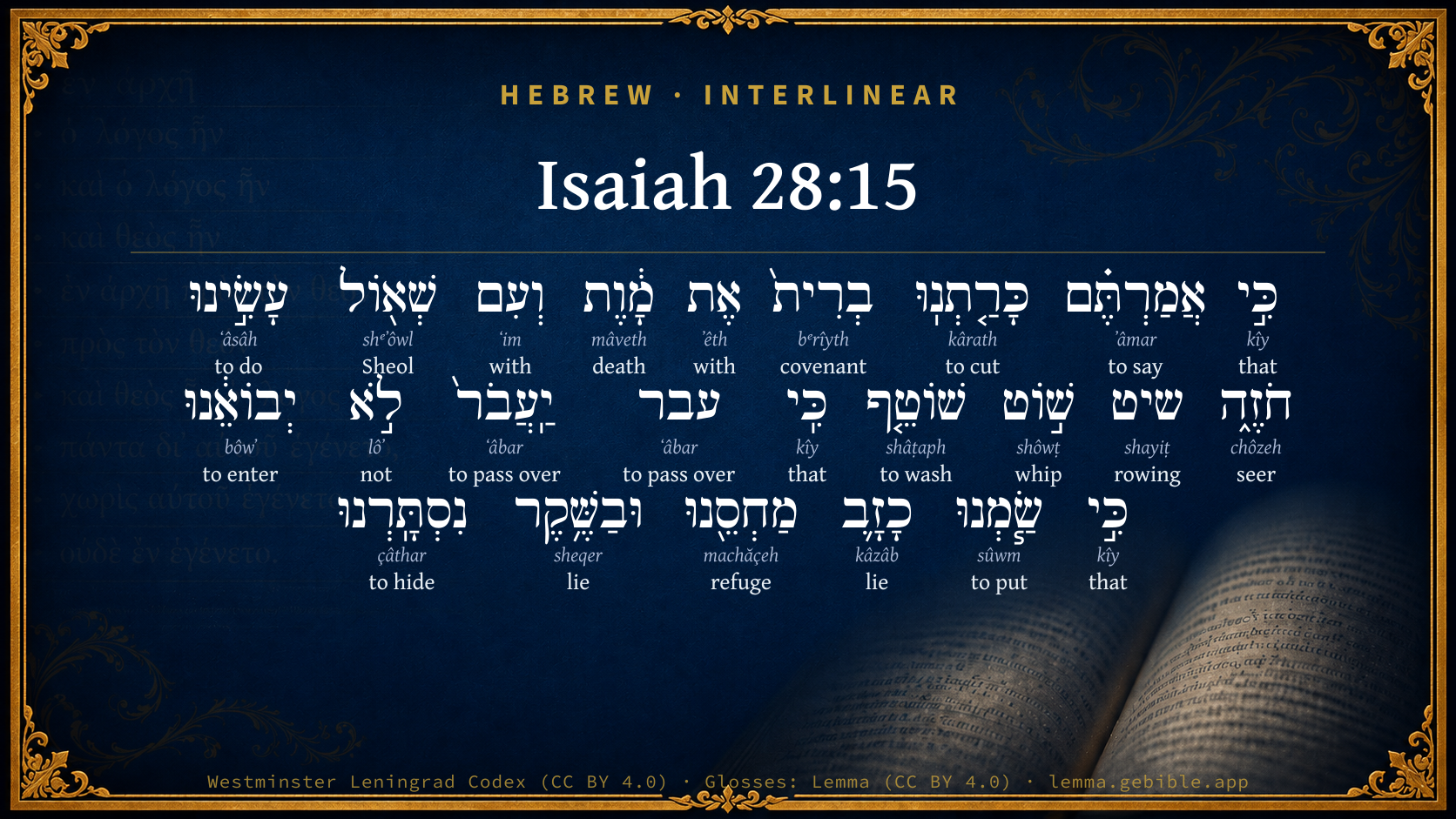
Hebrew (Westminster Leningrad Codex) Isaiah 28:15 appears in the Hebrew Old Testament. The text above is from the Westminster Leningrad Codex. Each word links to its Strong’s number, a concise gloss, and parsing drawn from the Open Scriptures Hebrew Bible morphology. Click any word for its full Brown-Driver-Briggs (BDB) entry.
Download image
Cite this verse

Isaiah 28:15 (World English Bible). Public Domain. Lemma interlinear Bible study tool, https://lemma.gebible.app/v/isaiah/28/15.

Show BibTeX & RIS
BibTeX
RIS
English Translation
Because you have said, We have made a covenant with death, and with Sheol are we at agreement; when the overflowing scourge shall pass through, it shall not come to us; for we have made lies our refuge, and under falsehood have we hid ourselves:
World English Bible · Public Domain
Highlights
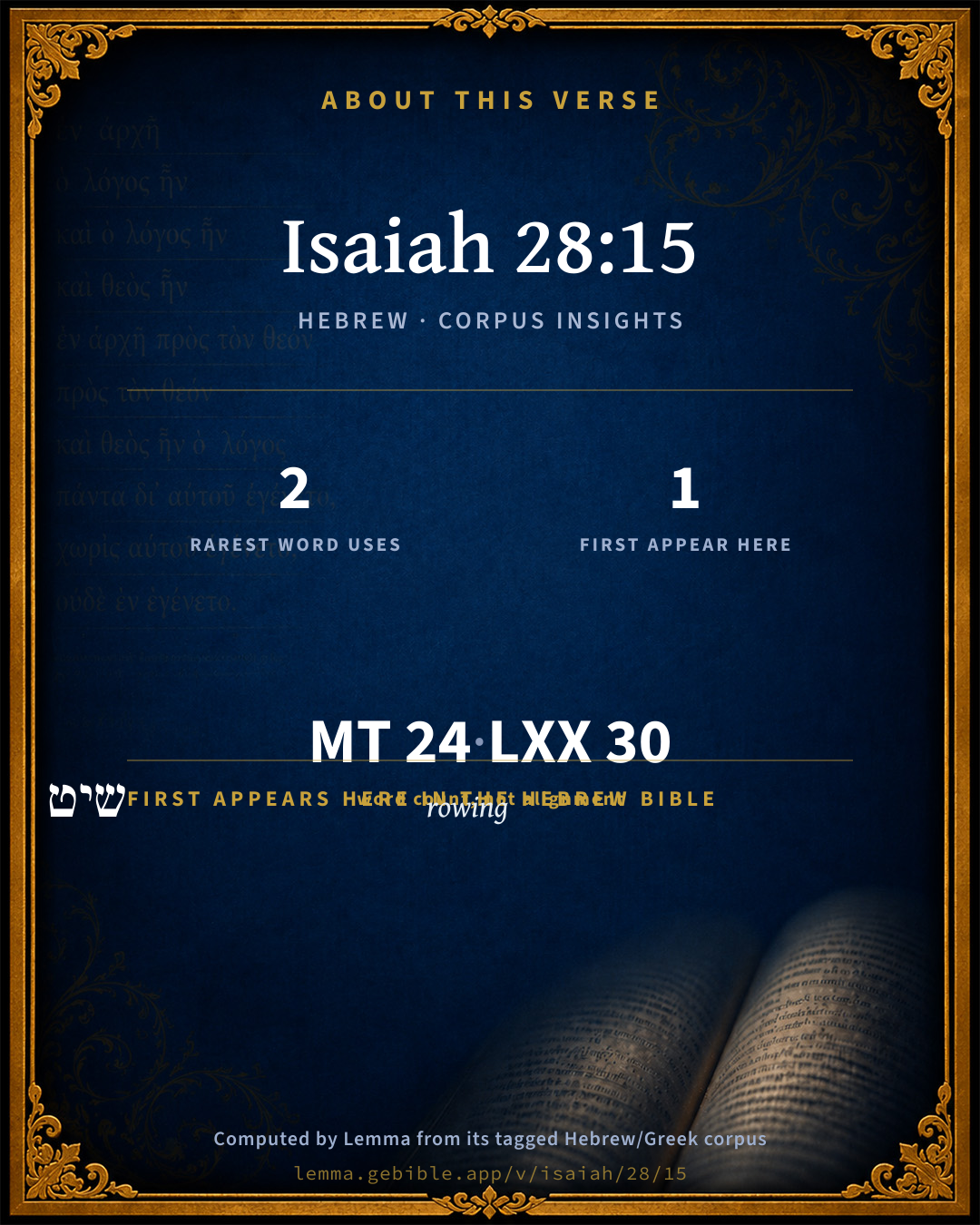
  • 1 first appearance in the Hebrew Bible
Full analysis ↓
Download a study sheet

One document with this verse’s original text, its word-by-word gloss line, the meaning frame, cross-references with their text, attributed commentary, and full source and license credits — printable, and it pastes into notes with its structure intact.

This verse Autodidact and up

Study sheet (.html) Plain text (.txt)

A passage Seminary Student

Up to 50 verses in one chapter. A passage sheet keeps up to 6 commentary sources and 12 cross-references per verse, in the order this page ranks them, and says so on the sheet whenever that leaves anything out. Ask for a single verse and you get the Autodidact verse sheet above.

Everything on this page stays free to read, with no account — the sheet is a download of what is already on screen, not access to it.

Want to remove ads? Support Godless Engineer
Compare translations 3

The same verse in 3 English versions, stacked beneath the original-language interlinear above. Click any original word for its lexicon entry.

Each is an independent rendering of the whole verse — the interlinear is not word-aligned to these translations.

Highlighted words mark where these versions differ — a whole-verse word diff, not a word-by-word alignment.

  • World English Bible Public Domain
    Because you have said, We have made a covenant with death, and with Sheol are we at agreement; when the overflowing scourge shall pass through, it shall not come to us; for we have made lies our refuge, and under falsehood have we hid ourselves:
  • King James Version Public Domain
    Because ye have said, We have made a covenant with death, and with hell are we at agreement; when the overflowing scourge shall pass through, it shall not come unto us: for we have made lies our refuge, and under falsehood have we hid ourselves:
  • unfoldingWord Literal Text CC BY-SA 4.0
    For you say, “We have cut a covenant with death, and we have made an agreement with Sheol. The overflowing scourge, when it passes through, it will not come to us. For we have made lying our refuge, and in falsehood we have hidden ourselves.”

unfoldingWord Literal Text — © unfoldingWord, licensed CC BY-SA 4.0. Word-aligned USFM3 via Door43 (git.door43.org/unfoldingWord/en_ult).

Versions to compare (up to 4)

3 of 4 selected

Show all 18 translations

Every available English version of this verse, each an independent rendering of the whole verse.

  • World English Bible Public Domain
    Because you have said, We have made a covenant with death, and with Sheol are we at agreement; when the overflowing scourge shall pass through, it shall not come to us; for we have made lies our refuge, and under falsehood have we hid ourselves:
  • Berean Standard Bible Public Domain
    For you said, “We have made a covenant with death; we have fashioned an agreement with Sheol. When the overwhelming scourge passes through it will not touch us, because we have made lies our refuge and falsehood our hiding place.”
  • Majority Standard Bible Public Domain
    For you said, “We have made a covenant with death; we have fashioned an agreement with Sheol. When the overwhelming scourge passes through it will not touch us, because we have made lies our refuge and falsehood our hiding place.”
  • King James Version Public Domain
    Because ye have said, We have made a covenant with death, and with hell are we at agreement; when the overflowing scourge shall pass through, it shall not come unto us: for we have made lies our refuge, and under falsehood have we hid ourselves:
  • American Standard Version (1901) Public Domain
    Because ye have said, We have made a covenant with death, and with Sheol are we at agreement; when the overflowing scourge shall pass through, it shall not come unto us; for we have made lies our refuge, and under falsehood have we hid ourselves:
  • Revised Version (1885) Public Domain
    Because ye have said, We have made a covenant with death, and with hell are we at agreement; when the overflowing scourge shall pass through, it shall not come unto us; for we have made lies our refuge, and under falsehood have we hid ourselves:
  • Geneva Bible (1599) Public Domain
    Because ye haue said, We haue made a couenant with death, and with hell are we at agreement: though a scourge runne ouer, and passe through, it shall not come at vs: for we haue made falshood our refuge, and vnder vanitie are we hid,
  • Douay-Rheims (1899) Public Domain
    For you have said: We have entered into a league with death, and we have made a covenant with hell. When the overflowing scourge shall pass through, it shall not come upon us: for we have placed our hope in lies, and by falsehood we are protected.
  • Young's Literal Translation Public Domain
    Because ye have said: `We have made a covenant with death, And with Sheol we have made a provision, An overflowing scourge, when it passeth over, Doth not meet us, Though we have made a lie our refuge, And in falsehood have been hidden.'
  • Literal Standard Version CC BY-SA 4.0
    Because you have said: “We have made a covenant with death, || And we have made a provision with Sheol, || An overflowing scourge, when it passes over, || Does not meet us, || Though we have made a lie our refuge, || And have been hidden in falsehood.”
  • Unlocked Literal Bible CC BY-SA 4.0
    This will happen because you said, “We have made a covenant with death, and with Sheol we have reached an agreement. So when the overwhelming whip passes through, it will not reach us. For we have made a lie our refuge, and taken shelter in falsehood.”
  • unfoldingWord Literal Text CC BY-SA 4.0
    For you say, “We have cut a covenant with death, and we have made an agreement with Sheol. The overflowing scourge, when it passes through, it will not come to us. For we have made lying our refuge, and in falsehood we have hidden ourselves.”
  • Darby Bible Public Domain
    For ye have said, We have made a covenant with death, and with Sheol have we made an agreement; when the overflowing scourge shall pass through, it shall not come unto us; for we have made lies our refuge, and under falsehood have we hid ourselves.
  • World Messianic Bible Public Domain
    “Because you have said, ‘We have made a covenant with death, and we are in agreement with Sheol. When the overflowing scourge passes through, it won’t come to us; for we have made lies our refuge, and we have hidden ourselves under falsehood.’”
  • Webster's Bible Public Domain
    Because ye have said, We have made a covenant with death, and with hell are we in agreement; when the overflowing scourge shall pass through, it shall not reach us: for we have made lies our refuge, and under falsehood have we hid ourselves:
  • Free Bible Version CC BY-SA 4.0
    You claim, “We've made an agreement with death; we've got a contract with the grave. When the terrible disaster rushes by, it won't affect us, because our lies protect us and we hide in our own deceptions.”
  • Bible in Basic English Public Domain
    Because you have said, We have made death our friend, and with the underworld we have made an agreement; when the overflowing waters come through they will not come near us; for we are looking to false words for help, taking cover in what is untrue:
  • JPS Tanakh (1917) Public Domain
    Because ye have said: 'We have made a covenant with death, and with the nether-world are we at agreement; when the scouring scourge shall pass through, it shall not come unto us; for we have made lies our refuge, and in falsehood have we hid ourselves';

Literal Standard Version (2020), Covenant Press — licensed CC BY-SA 4.0. Text via the HelloAO Bible API (eBible.org). Unlocked Literal Bible (unfoldingWord) — licensed CC BY-SA 4.0. Text via the HelloAO Bible API (eBible.org). unfoldingWord Literal Text — © unfoldingWord, licensed CC BY-SA 4.0. Word-aligned USFM3 via Door43 (git.door43.org/unfoldingWord/en_ult). Free Bible Version, Dr. Jonathan Gallagher — licensed CC BY-SA 4.0. Text via the HelloAO Bible API (eBible.org).

Word by word

More ways to search: Search by grammar → Find every occurrence → Compare this word →

Practice this passage: Drill this verse → Learn its vocabulary →

שיט
shayiṭ
H7885
“rowing”
Noun, Common, Masculine, Singular, Absolute
Part of Speech
Noun
Type
Common
Gender
Masculine
Number
Singular
State
Absolute
Full BDB Definition

Origin: from H7751

TWOT: 2344c

rowing - rowing - scourge (figuratively)
  1. כִּ֣י kîy H3588 “that” Conjunction
  2. אֲמַרְתֶּ֗ם ʼâmar H559 “to say” Verb, Qal, Perfect, 2nd Person, Masculine, Plural
  3. כָּרַ֤תְנֽוּ kârath H3772 “to cut” Verb, Qal, Perfect, 1st Person, Common, Plural
  4. בְרִית֙ bᵉrîyth H1285 “covenant” Noun, Common, Feminine, Singular, Absolute
  5. אֶת ʼêth H854 “with” Preposition
  6. מָ֔וֶת mâveth H4194 “death” Noun, Common, Masculine, Singular, Absolute
  7. וְעִם ʻim H5973 “and · with” Conjunction + Preposition
  8. שְׁא֖וֹל shᵉʼôwl H7585 “Sheol” Noun, Proper
  9. עָשִׂ֣ינוּ ʻâsâh H6213 “to do” Verb, Qal, Perfect, 1st Person, Common, Plural
  10. חֹזֶ֑ה chôzeh H2374 “seer” Noun, Common, Masculine, Singular, Absolute
  11. שׁ֣וֹט shôwṭ H7752 “whip” Noun, Common, Masculine, Singular, Absolute
  12. שׁוֹטֵ֤ף shâṭaph H7857 “washing” Verb, Qal, Participle Active, Masculine, Singular, Absolute
  13. כִּֽי kîy H3588 “that” Conjunction
  14. עבר ʻâbar H5674 “to pass over” Verb, Qal, Perfect, 3rd Person, Masculine, Singular
  15. יַֽעֲבֹר֙ ʻâbar H5674 “to pass over” Verb, Qal, Imperfect, 3rd Person, Masculine, Singular
  16. לֹ֣א lôʼ H3808 “not” Particle, Negative
  17. יְבוֹאֵ֔נוּ bôwʼ H935 “to enter · us” Verb, Qal, Imperfect, 3rd Person, Masculine, Singular + Suffix, Personal, 1st Person, Common, Plural
  18. כִּ֣י kîy H3588 “that” Conjunction
  19. שַׂ֧מְנוּ sûwm H7760 “to put” Verb, Qal, Perfect, 1st Person, Common, Plural
  20. כָזָ֛ב kâzâb H3577 “lie” Noun, Common, Masculine, Singular, Absolute
  21. מַחְסֵ֖נוּ machăçeh H4268 “refuge · our” Noun, Common, Masculine, Singular, Construct + Suffix, Personal, 1st Person, Common, Plural
  22. וּבַשֶּׁ֥קֶר sheqer H8267 “and · in/at the · lie” Conjunction + Preposition, Determined + Noun, Common, Masculine, Singular, Absolute
  23. נִסְתָּֽרְנוּ çâthar H5641 “to hide” Verb, Niphal, Perfect, 1st Person, Common, Plural

About this verse

These counts appear in no published source. They are computed here, from the morphology-tagged text and Lemma’s own curated glosses. What Lemma adds →

24
words
21
distinct lemmas
Prophets
section

Notable vocabulary

The rarest word here is שיט rowing H7885 — appearing just 2 times in the whole Hebrew Bible.

First appearance in Scripture

This word makes its first canonical appearance in the Hebrew Bible here:

Shared distinctive vocabulary

שיט rowing H7885 occurs in 2 verses of the Hebrew Bible. Also found in:

Grammatical profile

  • 9 verbs
  • 9 nouns
  • 2 prepositions
  • 3 conjunctions
  • 1 particle

Verb forms

  • אֲמַרְתֶּ֗ם Qal · Perfect
  • כָּרַ֤תְנֽוּ Qal · Perfect
  • עָשִׂ֣ינוּ Qal · Perfect
  • שׁוֹטֵ֤ף Qal · Participle Active
  • עבר Qal · Perfect
  • יַֽעֲבֹר֙ Qal · Imperfect
  • יְבוֹאֵ֔נוּ Qal · Imperfect
  • שַׂ֧מְנוּ Qal · Perfect
  • נִסְתָּֽרְנוּ Niphal · Perfect

Repetition

Words recur within this verse — often emphatic in Hebrew:

  • עבר to pass over H5674 ×2
  • כִּ֣י that H3588 ×3

Hebrew & Septuagint length

In English translation the verse runs 45 words from the Hebrew and 40 from the Septuagint (LXX English) — closely comparable.

A rough comparison of the two English renderings, which tokenize alike — not a word-level alignment.

Word counts can differ between the Hebrew and the Greek without any difference in meaning — e.g. the Hebrew direct-object marker אֵת has no separate Greek word, and Greek often adds the article ὁ.

In the original languages it is 24 Hebrew tokens and 30 Greek tokens — but the two are counted differently (Hebrew bundles its prefixes and suffixes into one token; the Greek is in lemma form), so that isn’t a like-for-like length.

Cross-references

25

Topical passages linked to Isaiah 28:15 in the Treasury of Scripture Knowledge — connected by theme and wording, ordered by reader-vote popularity; previews shown in the World English Bible.

  • Isaiah 8:7–8 now therefore, behold, the Lord brings up on them the waters of the River, strong and many, [even] the king of Assyria and all his glory: and it shall come up over all its channels, and go over all its banks;
  • Ecclesiastes 8:8 There is no man who has power over the spirit to contain the spirit; neither does he have power over the day of death. There is no discharge in war; neither shall wickedness deliver those who practice it.
  • Isaiah 28:18 Your covenant with death shall be annulled, and your agreement with Sheol shall not stand; when the overflowing scourge shall pass through, then you shall be trodden down by it.
  • Jeremiah 5:31 the prophets prophesy falsely, and the priests bear rule by their means; and my people love to have it so: and what will you do in the end of it?
  • Ezekiel 13:22 Because with lies you have grieved the heart of the righteous, whom I have not made sad; and strengthened the hands of the wicked, that he should not return from his wicked way, and be saved alive:
  • Daniel 11:22 The overwhelming forces shall be overwhelmed from before him, and shall be broken; yes, also the prince of the covenant.
  • Hosea 2:18 In that day I will make a covenant for them with the animals of the field, And with the birds of the sky, And with the creeping things of the ground. I will break the bow, the sword, and the battle out of the land, And will make them lie down safely.
  • Amos 2:4 Thus says Yahweh: "For three transgressions of Judah, yes, for four, I will not turn away its punishment; Because they have rejected Yahweh's law, And have not kept his statutes, And their lies have led them astray, After which their fathers walked;
  • Job 5:23 For you shall be in league with the stones of the field. The animals of the field shall be at peace with you.
  • Job 15:25–27 Because he has stretched out his hand against God, And behaves himself proudly against the Almighty;
  • Isaiah 5:18–19 Woe to those who draw iniquity with cords of falsehood, And wickedness as with cart rope;
  • Isaiah 9:15 The elder and the honorable man, he is the head; and the prophet who teaches lies, he is the tail.
  • Isaiah 28:2 Behold, the Lord has a mighty and strong one; as a tempest of hail, a destroying storm, as a tempest of mighty waters overflowing, will he cast down to the earth with the hand.
  • Isaiah 29:15 Woe to those who hide deep their counsel from Yahweh, and whose works are in the dark, and who say, Who sees us? and who knows us?
  • Isaiah 30:10 who tell the seers, "Don't see;" and to the prophets, "Don't prophesy to us right things, speak to us smooth things, prophesy deceits,
  • Isaiah 30:28 and his breath is as an overflowing stream, that reaches even to the neck, to sift the nations with the sieve of destruction: and a bridle that causes to err [shall be] in the jaws of the peoples.
  • Jeremiah 14:13 Then said I, Ah, Lord Yahweh! behold, the prophets tell them, You shall not see the sword, neither shall you have famine; but I will give you assured peace in this place.
  • Jeremiah 16:19 Yahweh, my strength, and my stronghold, and my refuge in the day of affliction, to you shall the nations come from the ends of the earth, and shall say, Our fathers have inherited nothing but lies, [even] vanity and things in which there is no profit.
  • Jeremiah 28:15–17 Then said the prophet Jeremiah to Hananiah the prophet, Hear now, Hananiah: Yahweh has not sent you; but you make this people to trust in a lie.
  • Jeremiah 44:17 But we will certainly perform every word that is gone forth out of our mouth, to burn incense to the queen of the sky, and to pour out drink-offerings to her, as we have done, we and our fathers, our kings and our princes, in the cities of Judah, and in the streets of Jerusalem; for then had we plenty of food, and were well, and saw no evil.
  • Ezekiel 8:12 Then said he to me, Son of man, have you seen what the elders of the house of Israel do in the dark, every man in his chambers of imagery? for they say, Yahweh doesn't see us; Yahweh has forsaken the land.
  • Ezekiel 13:16 [to wit], the prophets of Israel who prophesy concerning Jerusalem, and who see visions of peace for her, and there is no peace, says the Lord Yahweh.
  • Jonah 2:8 Those who regard lying vanities forsake their own mercy.
  • Zephaniah 1:12 It will happen at that time, that I will search Jerusalem with lamps, and I will punish the men who are settled on their dregs, who say in their heart, "Yahweh will not do good, neither will he do evil."
  • 2 Thessalonians 2:9–11 even he whose coming is according to the working of Satan with all power and signs and lying wonders,

Cross-references courtesy of OpenBible.info (CC BY 4.0).

Hebrew and Greek witnesses Masoretic Hebrew ↔ Greek Septuagint

The same verse in the two great witnesses to the Old Testament, shown verse-for-verse.

These are two independent witnesses, not word-aligned to each other, and the Septuagint is shown in lemma (dictionary) form.

Hebrew Isaiah 28:15 Masoretic · Westminster Leningrad Codex

כִּ֣י אֲמַרְתֶּ֗ם כָּרַ֤תְנֽוּ בְרִית֙ אֶת מָ֔וֶת וְעִם שְׁא֖וֹל עָשִׂ֣ינוּ חֹזֶ֑ה שיט שׁ֣וֹט שׁוֹטֵ֤ף כִּֽי עבר יַֽעֲבֹר֙ לֹ֣א יְבוֹאֵ֔נוּ כִּ֣י שַׂ֧מְנוּ כָזָ֛ב מַחְסֵ֖נוּ וּבַשֶּׁ֥קֶר נִסְתָּֽרְנוּ

Because you have said, We have made a covenant with death, and with Sheol are we at agreement; when the overflowing scourge shall pass through, it shall not come to us; for we have made lies our refuge, and under falsehood have we hid ourselves:

World English Bible · Public Domain

Greek LXX Isaiah 28:15 Septuagint · lemma form

ὅτι εἶπον ποιέω διαθήκη μετά ὁ ᾅδης καί μετά ὁ θάνατος συνθήκη καταιγίς φέρω ἐάν παραἔρχομαι οὐ μή ἔρχομαι ἐπί ἐγώ τίθημι ψεῦδος ὁ ἐλπίς ἐγώ καί ὁ ψεῦδος σκεπάζω

Because you⌃ have said, We have made a covenant with Hades, and agreements with death; if the rushing storm should pass, it shall not come upon us: we have made falsehood our hope, and by falsehood shall we be protected:

LXX2012 (modern English Septuagint) · Public Domain

On this verse, John Gill's Exposition discusses the Septuagint’s reading. Read the note in Commentary ↓

Hebrew: Westminster Leningrad Codex (CC BY 4.0). Greek: Septuagint (public domain); English from LXX2012 (modern English Septuagint) (Public Domain). How the Septuagint differs from the Hebrew →

Targum (Aramaic paraphrase)

1

The Targum is the ancient Jewish Aramaic paraphrase of the Hebrew Scriptures — an interpretive translation, not the Hebrew text itself. Onkelos (literal) and Pseudo-Jonathan (expansive) render the Torah, and Jonathan the Prophets. Coverage is partial: where no permissively-licensed English translation exists for a verse, only the Aramaic is shown. This is verse-level text, not a word-by-word alignment to the Hebrew.

  1. Targum Jonathan Prophets (Joshua–Malachi)
    אֲרֵי אֲמַרְתּוּן גְזַרְנָא קְיָם עִם קְטוֹלָא וְעִם מַחְבְּלָא עֲבַדְנָא שְׁלָמָא מְחַת סַנְאָה אֲרֵי תֵיתֵי עֲלֵיכוֹן כְּנַחַל מַגְבַּר דְאַתּוּן אָמְרִין לָא תֵיתֵי עֲלָנָא אֲרֵי שַׁוֵינָא בִּכְדִיב רָחֲצָנָנָא וּבְגִין שִׁקְרִין אִטַמַרְנָא:

    Because ye say, “We have made a covenant with death, and have made peace with the destroyer:” ye say, when the blow of the enemy shall come upon you like an overwhelming river, “It shall not come upon us, because we have placed our confidence in a lie, and have hidden ourselves under falsehood.”

    Targum Jonathan — Aramaic: “Mikraot Gedolot” (public domain). English: “Sefaria Community Translation” (CC0 1.0 (public-domain dedication)); “London "Chaldee Paraphrase," 1871” (public domain). Text via Sefaria.

Commentary

Notes on Isaiah 28:15 from classic Christian and Jewish commentators (each source and its license shown beneath its notes). The classic Christian expositions comment on the surrounding passage and are grouped to its opening verse, so a note may address several verses; the Jewish commentaries on the Tanakh (Rashi and others) are per-verse, so they appear only where the commentator wrote on this verse.

Lemma curates 59 commentaries, every one of them public domain or Creative Commons licensed, each selected and text-cleaned for this edition rather than reprinted as found. About our sources →

Trapp's Complete Commentary

John Trapp

Isa 28:15 Because ye have said, We have made a covenant with death, and with hell are we at agreement; when the overflowing scourge shall pass through, it shall not come unto us: for we have made lies our refuge, and under falsehood have we hid ourselves:

Ver. 15. Because ye have said,] i.e., Ye have thought and reckoned so, but without your host, as they say; {Jer 6:19} Hear, O earth; behold, I will bring evil upon this people, even the fruit of their thoughts.

We have made a covenant with death.] Nos ab omni male sumus secttrissimi: Thrasonicae hyperbolae - we are shot free, and shall escape scot free. Becket’s friends advised him, for his security, to have a mass in honour of St Stephen, to keep him from the hands of his enemies. He had so, but it saved him not, as not to have been dipped in Lethe Lake could save the son of Thetis from death, &c. {a}

And with hell are we at agreement.] Heb., We have made provision, or taken order, egimus cantum. The prophets tell us a tale of death and hell, but we shall yet dance upon their graves; and for hell, we fear it not. The lion is not so fierce as he is painted, nor the devil so black as he is represented. Diabolo optime convenit cum lurconibus. Good fellows shall have good quarter with the devil, say our modern atheists. But what a mad fellow was that advocate in the court of Rome, mentioned by Bellarmine, who, lying at his last gasp almost, and being called upon to repent and cry to God for mercy, prayed thus: O Lord, I have much desired to speak one word unto thee before I die, not for myself, but for my wife and children, ego enim propero ad inferos, neque est ut aliquid pro me agas, for I am hasting to hell; neither is there anything to be done by thee for me. And this he spoke, saith Bellarmine, {b} who was by and heard it, with as much confidence as if he were but travelling to the next town.

When the overflowing scourge shall pass through.] To sweep away such as are drowned in drunkenness, and dread no danger.

It shall not come to us.] Whatever the prophets prate; let them say as they please, we will believe as we list.

For we have made lies our refuge.] A poor refuge; for, tenue mendaciam pellucet, lies are so thin, they may be seen through; but it may be that they called their false refuges lies, not because they held them so, but because the prophets called them so, whereas to themselves they seemed prudent counsels.

{a} Spencer.

{b} De Arte Mor., lib. ii. cap. 10.

John Trapp, A Commentary or Exposition upon All the Books of the Old and New Testament (1647–1656) — public domain. Text from a community e-Sword module.

Tyndale Open Study Notes

Tyndale Open Resources

28:15 cheat death (literally have made a covenant with death) . . . dodge the grave: There are two interpretive possibilities: (1) The people had sold themselves to the Canaanite god of death, Mot, in return for his supposed protection. (2) The prophet was being sarcastic; the people thought their various political and economic moves guaranteed their personal security, but they had actually destroyed themselves. • lies and deception: The leaders did not think of themselves as deceptive, but they were.

Tyndale Open Study Notes — © Tyndale Open Resources, licensed CC BY-SA 4.0. Text via the HelloAO Bible API.

Geneva Bible (1599)

Geneva Bible translators

They thought they had shifts to avoid God’s judgments, and that they could escape though all others perished.

Though the prophets condemned their idols and vain trust of falsehood and vanity, yet the wicked thought in themselves that they would trust in these things.

Geneva Bible (1599) marginal notes — public domain. Text via Bolls.life.

Jamieson, Fausset & Brown

Robert Jamieson, A. R. Fausset & David Brown

said--virtually, in your conduct, if not in words.

covenant--There may be a tacit reference to their confidence in their "covenant" with the Assyrians in the early part of Hezekiah's prosperous reign, before he ceased to pay tribute to them, as if it ensured Judah from evil, whatever might befall the neighboring Ephraim (Isa 28:1). The full meaning is shown by the language ("covenant with death--hell," or sheol) to apply to all lulled in false security spiritually (Psa 12:4; Ecc 8:8; Jer 8:11); the godly alone are in covenant with death (Job 5:23; Hos 2:18; Co1 3:22).

overflowing scourge--two metaphors: the hostile Assyrian armies like an overwhelming flood.

pass through--namely, through Judea on their way to Egypt, to punish it as the protector of Samaria (Kg2 17:4).

lies--They did not use these words, but Isaiah designates their sentiments by their true name (Amo 2:4).

Jamieson, Fausset & Brown — Commentary Critical and Explanatory on the Whole Bible (1871) — public domain (CC PDM 1.0). Text via the HelloAO Bible API.

Adam Clarke's Commentary

Verse 15. A covenant with death] To be in covenant with, is a kind of proverbial expression to denote perfect security from evil and mischief of any sort: -

"For thou shalt be in league with the stones of the field;

And the beasts of the field shall be at peace with thee."

Job 5:23.

"And I will make a covenant for them with the beasts of

the field.

And with the fowls of heaven, and with the creeping things

of the ground."

Ho 2:18.

That is, none of these shall hurt them. But Lucan, speaking of the Psylli, whose peculiar property it was to be unhurt by the bite of serpents, with which their country abounded, comes still nearer to the expression of Isaiah in this place: -

Gens unica terras

Incolit a saevo serpentum innoxia morsu

Marmaridae Psylli.__

Pax illis cum morte data est.

Pharsal. ix. 891.

"Of all who scorching Afric's sun endure,

None like the swarthy Psyllians are secure:

With healing gifts and privileges graced,

Well in the land of serpents were they placed:

Truce with the dreadful tyrant death they have,

And border safely on his realm the grave."

ROWE.

We have made a covenant with death and with hell are we at agreement] עשינו חזה asinu chozeh, we have made a vision, we have had an interview, struck a bargain, and settled all preliminaries. So they had made a covenant with hell by diabolic sacrifice, כרתנו ברית carathnu berith. "We have cut the covenant sacrifice;" they divided it for the contracting parties to pass between the separated victim; for the victim was split exactly down the middle, so that even the spinal marrow was exactly divided through its whole length; and being set opposite to each other, the contracting parties entered, one at the head part, the other at the feet; and, meeting in the centre, took the covenant oath. Thus, it is intimated, these bad people made an agreement with שאול sheol, with demons, with whom they had an interview; i.e., meeting them in the covenant sacrifice! To such a pitch had the Israelitish idolatry reached at that time!

Adam Clarke's Commentary on the Bible (1810–1826) — public domain. Text from a community e-Sword/MySword module.

Ellicott's Commentary for English Readers

(15) We have made a covenant with death . . .—The phrase was a proverbial one. (Comp. Job_5:23; Hos_2:18.) Cheyne quotes Lucan, ix. 394, Pax illis cum morte data est (They have made peace with death”). “Hell” is the Hebrew Sheol (Hades), the region of the dead. The two are joined together, as in Hos_13:14; Rev_20:13-14.

When the overflowing scourge . . .—The words probably implied a sneer at the imagery which the prophet had used, painting the Assyrian invasion first as a flood (Isa_8:7-8), and then as a scourge (Isa_10:24). (Comp, Isa_28:2.) The scorners think that their “lies” will give them a refuge from the danger under either form.

A Bible Commentary for English Readers, edited by Charles John Ellicott (1878–1897) — public domain. Text from a community e-Sword module.

John Gill's Exposition

Therefore thus saith the Lord GOD,.... In order to show what is the true foundation of hope and trust for security from death and hell, and to convince men of their vain and false confidence, as well as to comfort the people of God, such as truly feared him in Jerusalem; who, bearing the judgment denounced, might conclude that they were going to be cut off from being a nation, and that the family and kingdom of David would be at an end, and then where was the promise of the Messiah? wherefore, to relieve the minds of such, a promise of him is delivered out in the midst of a denunciation of judgment upon the wicked:

Behold, (a note of attention and admiration, as well as asseveration,)

I lay in Zion for a foundation a stone; which the Targum interprets of a king; and Jarchi of the King Messiah, who undoubtedly is meant, as is clear from Rom 9:33 and not Hezekiah, as Kimchi, and others, who was now king, when this prophecy was made, and therefore cannot respect him; but Christ, who is frequently spoken of, under the simile of a stone, Gen 49:24 and may be compared to one for his usefulness in the spiritual building, being both foundation and cornerstone, and for his great strength and durableness; and this is a stone of the Lord's laying, which he had been laying in his eternal purposes and decrees, as the Mediator, Saviour, and Redeemer of his people; and whom he was about to lay, by sending him forth, in the fulness of time, to be incarnate, suffer, and die for them: and whom he lays as the foundation in the effectual calling of his people, to build their faith and hope upon; and this is done in Zion, in the church, which is built upon him, and where he is revealed and made known to be what he is, and as here described:

a tried stone; by the Old Testament saints, and by saints in all ages, who have ventured their souls on him, and laid the whole stress of their salvation upon him, and have been saved by him; and by Satan, and his principalities and powers, by his temptations of him in the wilderness, and by his attacks upon him in the garden, and on the cross, and found him to be an immovable stone, and were broken by him; and by his divine Father, who tried his faithfulness by trusting him with all his elect, and the salvation of them; and his great strength, by laying upon him all their sins, and the punishment due unto them. Some render it, "a stone of trial", or "a trying stone" (t); by which men are tried, and discovered to be what they are, whether believers or unbelievers, sincere Christians or hypocrites; which may be known by their conduct and behaviour to Christ; if they come to him as a living stone, and he is precious to them, they are true believers; but if he is to them a stone of stumbling, and a rock of offence, they are unbelievers, and reprobate persons, Pe1 2:4,

a precious corner stone; which, as it is both for the beauty and strength of the building, so it knits, cements, and keeps the parts together; and of this use is Christ in the spiritual building; angels and men are knit together in him, Jews and Gentiles, Old and New Testament saints, saints above and saints below, saints in all ages, times, and places: and a "precious" stone he is, a pearl of great price; precious to his Father, who loves him, and delights in him, and has chosen and laid him as the foundation of his church, and of every true believer; to whom also he is precious, his person, names, offices, and relations, his blood, righteousness, and sacrifice, his word, ordinances, and people, and everything belonging to him:

a sure foundation; a well founded one (u); which will never give way; a rock on which the church is built, and the gates of hell cannot prevail against it; a sure foundation of faith and hope, of peace, joy, and comfort, and of eternal happiness, to all that build upon it; a foundation firm and strong, immovable and everlasting; and so is every thing that is laid or depends upon it, the covenant of grace, and the promises of it, the persons of the Lord's people, and their salvation:

he that believeth; either those things, as the Targum adds, this promise and prophecy, and the things contained therein; or in Christ, the foundation laid, the tried and precious cornerstone, so it is explained in Pe1 2:6,

shall not make haste; or be impatient for the fulfilment of this prophecy, but patiently wait for it, knowing that it is for an appointed time, and will not tarry; and that God will hasten it in his own time; or will not make haste to lay any other foundation, being satisfied with this that is laid; nor make haste to a strange god, to another Saviour, knowing there is salvation in him, and in no other. The Targum is,

"shall not be moved when trouble comes;''

being founded upon this Rock of ages, which is proof against all storms and tempests; see Mat 7:24. The Apostles Paul and Peter, agreeably to the Septuagint version, render it, "shall not be ashamed", or "confounded"; See Gill on Rom 9:33, Pe1 2:6.

(t) "lapidem probationis", Junius & Tremellius, Calvin, Vitringa. (u) "fundamentum fundatum"; so some in Vatablus; "fundationem fundatissimam", Junius & Tremellius; "fundamentum solidum", Calvin; "solidissimum" Tigurine version; So Ben Melech interprets it a strong foundation.

John Gill's Exposition of the Whole Bible (1746–1763) — public domain (CC PDM 1.0). Text via the HelloAO Bible API.

Albert Barnes' Notes on the Bible

We have made a covenant with death - We are not to suppose that they had formally said this, but that their conduct was as if they had said it; they lived as securely as if they had entered into a compact with death not to destroy them, and with hell not to devour them. The figure is a very bold one, and is designed to express the extraordinary stupidity of the nation. It is most strikingly descriptive of the great mass of people. They are as little anxious about death and hell as if they had made a compact with the king of terrors and the prince of darkness not to destroy them. They are as little moved by the appeals of the gospel, by the alarms of God’s providence, by the preaching of his word, and by all the demonstrations that they are exposed to eternal death, as though they had proved that there was no hell, or had entered into a solemn covenant that they should be unmolested. A figure similar to this occurs in Job 5:23 :

For thou shalt be in league with the stones of the field;

And the beasts of the field shall be at peace with thee.

Compare Hos 2:18.

And with hell - Hebrew, ‘Sheol’ - the land of shades, or of departed spirits (see the note at Isa 5:14). It is nearly synonymous here with death.

When the overflowing scourge shall pass through - There is here, in our translation, a little confusion of metaphor, since we speak usually of an overflowing “stream,” and not of an overflowing “scourge.” The word ‘scourge’ (שׁיט shayiṭ) means usually “a whip, a scourge,” the same as שׁוט shôṭ, and then means any punishment or calamity (see the note at Isa 10:26; compare Job 9:23; Job 5:21. Here its means severe judgments or calamities, as overflowing like water, or inundating a people.

We have made lies ... - That is, they acted as if they had a safe refuge in falsehood. They sought security in false doctrines, and regarded themselves as safe from all that the prophets had denounced.

Albert Barnes' Notes on the Bible (1834–1885) — public domain. Text from a community e-Sword/MySword module.

Haydock's Catholic Bible Commentary

Protected. Their conduct spoke this language. They would not fail to make alliances with Egypt, and to trust in idols, whatever the prophets might say to dissuade them. (Calmet)

George Leo Haydock (1774–1849), Haydock's Catholic Family Bible and Commentary, 1859 edition — public domain. Excludes Psalms (Douay-Rheims chapter numbering differs from Protestant) and Deuterocanonical books (Catholic canon only).

Matthew Poole's English Annotations

Because ye have said in your hearts,

We have made a covenant with death, and with hell are we at agreement; we are as safe from death, and hell, or the grave, as if they had entered into covenant with us, that they would not invade us. The word rendered hell most commonly signifies the grave; which also seems most proper in this place, that so the same thing may be repeated in. other words, as is most usual in prophetical writings.

The overflowing scourge; the judgment of God, Which is called a scourge, for its sharpness and severity; and overflowing, for its universality; two differing metaphors being joined together; which is not unusual, both in Scripture and in other authors. Shall pass through, to wit, the land.

We have made lies our refuge, and under falsehood have we hid ourselves; we shall secure ourselves by lying and dissimulation, by compliance with our enemies, and with their religion too, if it be necessary, and many crafty devices. Or by lies and falsehood he means their riches and strength, to which they trusted, to which he giveth these titles, not that they called or thought them such, but that he might signify what they really were, and would appear to be: See Poole "Pro 1:11".

Matthew Poole's English Annotations on the Holy Bible (1683–1685) — public domain. Text from a community e-Sword/MySword module.

The Pulpit Commentary

We have made a covenant with death. (comp. Job_5:23 Hos_2:18) The words are a boast, expressed somewhat enigmatically, that they have secured their own safety by some secret agreement. The exact nature of the agreement they are disinclined to divulge. With hell are we at agreement. A synonymous parallelism," merely strengthening the previous assertion. When the overflowing scourge shall pass through. Assyrian invasion has been compared to a "flood", (Isa_8:7 Isa_28:2) and to a "rod" or "staff" in Isa_10:24. Here the two metaphors are joined together. It shall not come to us. Some means will be found what, they do not say, either for diverting the flood, or for stemming it. For we have made lies our refuge. Here the Divine reporter departs from the language of those whose words he is reporting, and substitutes his own estimate of the true nature and true value of that "refuge" on which they placed such entire reliance. It appears Isa_30:1-7 and Isa_36:6-9 that that refuge was Egypt. Now, Egypt was a "bruised reed," not to be depended on for keeping her engagements. To trust in her was to put confidence in "lies" and "falsehood."

The Pulpit Commentary (1880–1919), ed. H.D.M. Spence-Jones & Joseph S. Exell — public domain. Text from a community e-Sword module.

John Wesley's Explanatory Notes

Said - In your hearts. We - We are as safe from death, and hell, or the grave, as if they had entered into covenant with us. The scourge - The judgment of God. Through - The land. For - We shall secure ourselves by lying and dissimulation.

John Wesley, Explanatory Notes Upon the Whole Bible (1754–1765) — public domain. Text via the GEBible commentary corpus.

J. A. Alexander on Isaiah

Joseph Addison Alexander

“Because ye have said (in thought or deed if not in word), we have made a covenant with death, and with hell (the grave, or the unseen world) have formed a league; the overflowing scourge, when it passes through, shall not come upon us, for we have made falsehood our refuge, and in fraud we have hid ourselves.” The meaning evidently is, that if their actions were translated into words, this would be their import. The mixed metaphor of an overflowing scourge combines two natural and common figures for severe calamity. The falsehood mentioned in the last clause is unfaithfulness to God, (i.e., wickedness in general, perhaps with an allusion to the falsity or treacherous nature of the hopes built upon it). The translation under falsehood, which is given in the English Bible and in some other versions, is neither justified by usage nor required by the connection.

Joseph Addison Alexander, The Prophecies of Isaiah (1846–1847; New York: Scribner, 1870–1878) — public domain. Text from a community e-Sword module.

Scofield Reference Notes

C. I. Scofield

hell

Heb. "Sheol," (See Scofield "Hab 2:5")

The Scofield Reference Bible (1917 edition), notes by C. I. Scofield — public domain. Text from a community e-Sword module.

Rashi

Rabbi Shlomo Yitzchaki (Rashi)

We made a treaty with death that it come not upon us.

we have made a limit a boundary that it should not cross. Comp. (Ps. 117:30) “the boundary (מְחוֹז) of their desire,” similarly (I Kings 7:4), “An edge opposite an edge (מֶחֱזָה אֶל מֶחֱזָה). They are all an expression of a boundary and an extremity of a thing, asomajjl in O.F.

an overflowing scourge a scourge that travels throughout the land.

it shall not come upon us (יְבוֹאֵנוּ), the usual form for a transitive verb with a direct object. It shall not come upon us.

we have made lies We have made idolatry.

our shelter (מַחְסֵנוּ) our shelter.

and in falsehood have we hidden ourselves We have hoped in idols to conceal us.

Rashi on the Tanakh — English translations: “The Judaica Press complete Tanach with Rashi, translated by A. J. Rosenberg” (CC BY 4.0); “Pentateuch with Rashi's commentary by M. Rosenbaum and A.M. Silbermann, 1929-1934” (public domain); “The Metsudah Tanach series, Lakewood, N.J” (CC BY 4.0); and “The Book of Joshua, Metsudah Publications, 1997” (CC BY 4.0). Text via Sefaria.

Ibn Ezra

Rabbi Abraham ibn Ezra

We have made a covenant with death. We shall not die now.

חזה An agreement. R. Moses Hakkohen says that חזות (ver. 18) signifies a kind of prophecy; but how can he apply this explanation to the phrase?עשינו חזה I think that חזה means prophet, and explain עשינו חזה to be the same as עשינו ברית חזה We have made a prophet’s covenant, a covenant like that made by divine inspiration.

שוט שוטף An overflowing scourge, that is, famine; or better, the scourge of an overflowing stream; שוט נחל שוטף ═שוט שוטף.

כי Although. Comp. Ps. 41:5

Ibn Ezra on the Tanakh — English translations: “Sefaria Community Translation” (CC0 1.0 (public-domain dedication)); “Yalkut, Sifsei Chachomim Chumash, Metsudah Publications, 2009” (CC BY 4.0); and “Commentary of Ibn Ezra on Isaiah - trans. by M. Friedlander, 1873” (public domain). Text via Sefaria.

Lesson kit

Teaching starters — assembled from the data on this page, not authored interpretation. Every prompt links to the verse data it draws on. Edit before teaching.

Isaiah, in the Prophets, opens this verse with 24 words (21 distinct Hebrew lemmas). Its most distinctive word is shayiṭ (“rowing”). A historical commentator’s framing appears above. Read the whole chapter for the surrounding context.

Discussion questions

  1. What does “rowing” (shayiṭ) contribute to the verse as a whole?
  2. This is the first place “rowing” appears in Scripture (first appears here). What does its debut here establish?
  3. How does Isaiah 33:21, which shares the word «rowing», read alongside this verse?
  4. What does the repetition of “to pass over” (2× in this one verse) do in this verse?
  5. The translations on this page render this verse differently — a whole-verse word diff, not a word-by-word alignment. What might account for the different wordings?
  6. «אֲמַרְתֶּ֗ם» is a Qal Perfect verb. How does that grammatical form shape the action described?
  7. Compare how Trapp's Complete Commentary and Tyndale Open Study Notes read this verse. Where do they agree or differ?

Things to notice

Reading settings

Reading text

Shown beneath each verse's original-language words.

Old Testament
Old Testament edition

Read the OT as the Masoretic Hebrew (MT) or the Greek Septuagint (LXX).

English shown for the Greek Septuagint (in the Hebrew ↔ Greek comparison).

Comparing translations? Open the Compare panel on any verse page to stack up to four side by side.